

Crypto World
Anthropic Suspends Access to Fable 5 and Mythos 5 After US Government Export Directive



Anthropic disabled access to its Fable 5 and Mythos 5 models on June 12 after the US government issued an export control directive citing national security authorities to suspend availability for any foreign national.
The order forced Anthropic to comply immediately for all users, even though the company publicly disagrees with the underlying reasoning.
What the US Government Directive Actually Requires
An export control directive is a US government order that restricts the transfer of specific technologies to foreign nationals. In this case, the order targets Anthropic’s Fable 5 and Mythos 5 models, including access by foreign national Anthropic employees inside the country.
The company received the directive at 5:21 p.m. ET on June 12. Anthropic confirmed that to ensure full compliance, access had to be disabled for every customer, while reiterating that all other Anthropic models remain available without any disruption.
The letter did not specify the exact national security concern. However, Anthropic believes the government became aware of a method for bypassing, or “jailbreaking,” Fable 5. The company reviewed a demonstration of the technique and called it minor.
Anthropic also noted that the vulnerabilities identified appear simple. Furthermore, other publicly available models, including OpenAI’s GPT-5.5, are able to discover similar flaws without requiring any bypass at all.
Follow us on X to get the latest news as it happens
Why Anthropic Disagrees With the Federal Order
Anthropic emphasized that Fable 5 launched with stronger safeguards than any previously deployed model. Before the release, the company worked with the US government, UK AISI, and multiple third-party teams to red-team the safeguards for thousands of hours.
No tester has yet found a universal jailbreak capable of bypassing Fable 5’s protections across a wide range of cyber capabilities. As a result, Anthropic adopted a defense-in-depth approach combining narrow safeguards, monitoring, and 30-day data retention for Mythos-class models.
So far, the government has provided only verbal evidence of a narrow, non-universal jailbreak. The technique reportedly involves asking the model to read a codebase and fix software flaws, a use case widely available across the industry.
Subscribe to our YouTube channel to watch leaders and journalists provide expert insights
Anthropic argued that pulling a commercial model deployed to hundreds of millions of users over a narrow vulnerability sets a problematic precedent. If applied across the industry, this standard would essentially halt all frontier AI model deployments.
The company is fully complying with the directive but has called the action a likely misunderstanding. Anthropic plans to share more technical details over the next 24 hours and is working to restore Fable 5 and Mythos 5 access as soon as possible.
The post Anthropic Suspends Access to Fable 5 and Mythos 5 After US Government Export Directive appeared first on BeInCrypto.


The narrative of Crypto Winter seems to be changing course, as some key market parameters have signaled the onset of more positive trends within the industry. In the wake of Bitcoin falling toward $59,375, investors have been tracking various signs of possible market recovery, including institutional involvement, exchange activity, and interest from ETF investors.
Although there have been some fluctuations in the markets, long-term accumulation continues to be strong. Exchange outflows have continued unabated for both Bitcoin and Ethereum, and many experts view them as a sign of increasing investor optimism. Combined with stable ETF flows and bullish institutional projections, there is now increased speculation about an end to Crypto Winter.
Standard Chartered Sticks to Its Positive Outlook on Bitcoin and Ethereum
International banking firm Standard Chartered remains positive about the performance of cryptocurrencies in the coming months, despite recent declines. As noted by the Wu Blockchain report, the bank is still predicting Bitcoin will reach $100,000 and Ethereum will hit $4,000 by year-end.
As part of its outlook, the bank views the recent fall in prices as a temporary pullback rather than a long-term market trend. The decline in Bitcoin recorded on June 5 was considered to have been the lowest point of the current crypto bear cycle, suggesting investors may have experienced the toughest period of the current market decline.
According to the analysts, there are various reasons for the latest fall in the crypto market. For instance, spot redemptions of Bitcoin ETFs lowered institutional demand at particular times, while the upcoming SpaceX IPO brought additional market volatility.
Bitcoin Outflows From Exchanges Continue to Point to Accumulation
The Bitcoin exchange flow shows a market in which accumulation trends still play a dominant role. While price action may have been erratic, net outflows have continued to be the trend among exchanges for most of the year.
Significant outflows have been seen from August through November, with many days showing outflows in excess of $1 billion. This trend is usually a sign of traders shifting their holdings to a personal wallet or other long-term storage where coins are less readily accessible on exchanges for trading.
A smaller amount of exchange coins means that there is less supply on exchanges that are ready for trade. This can help improve future price action when demand starts to strengthen.
In an anomaly, exchange outflows changed course to inflows in February, with the figure at about $1 billion. This period was marked by higher levels of price volatility, which saw the Bitcoin price drop sharply.
Similar Accumulation Trends Can Be Observed in Ethereum
Similar trends can be observed in Ethereum exchange trading. Throughout the past few months, outflows have consistently been higher than inflows, suggesting traders kept withdrawing Ethereum from exchanges amid persistent market volatility.
A couple of days saw withdrawals of over $300 million, while some days saw outflows reaching up to $600 million to $700 million. This is likely to decrease the amount of ETH supply on exchanges, which many holders view as a positive sign.
Even though Ethereum’s price fell from above $4,500 to below $1,700 during the market correction, accumulation tendencies were still visible. The notable influx took place in early February, when over $600 million of ETH was moved onto exchanges due to market selling pressure.
ETF Demand Could Signal the End of Crypto Winter
Market players are currently looking at ETFs as a crucial metric of future performance. According to the Wu Blockchain report, Standard Chartered suggests that Ethereum may exceed Bitcoin’s performance in the short term thanks to ETF demand and increased institutional sentiment.
With ETF demand rising alongside robust exchange outflows, the two metrics could create positive supply and demand dynamics for both cryptocurrencies. In that case, it becomes even clearer that investors are buying, not selling.
Despite possible risks, stable ETF demand and high exchange outflows, coupled with optimistic sentiment from institutions, point to Crypto Winter coming to an end.
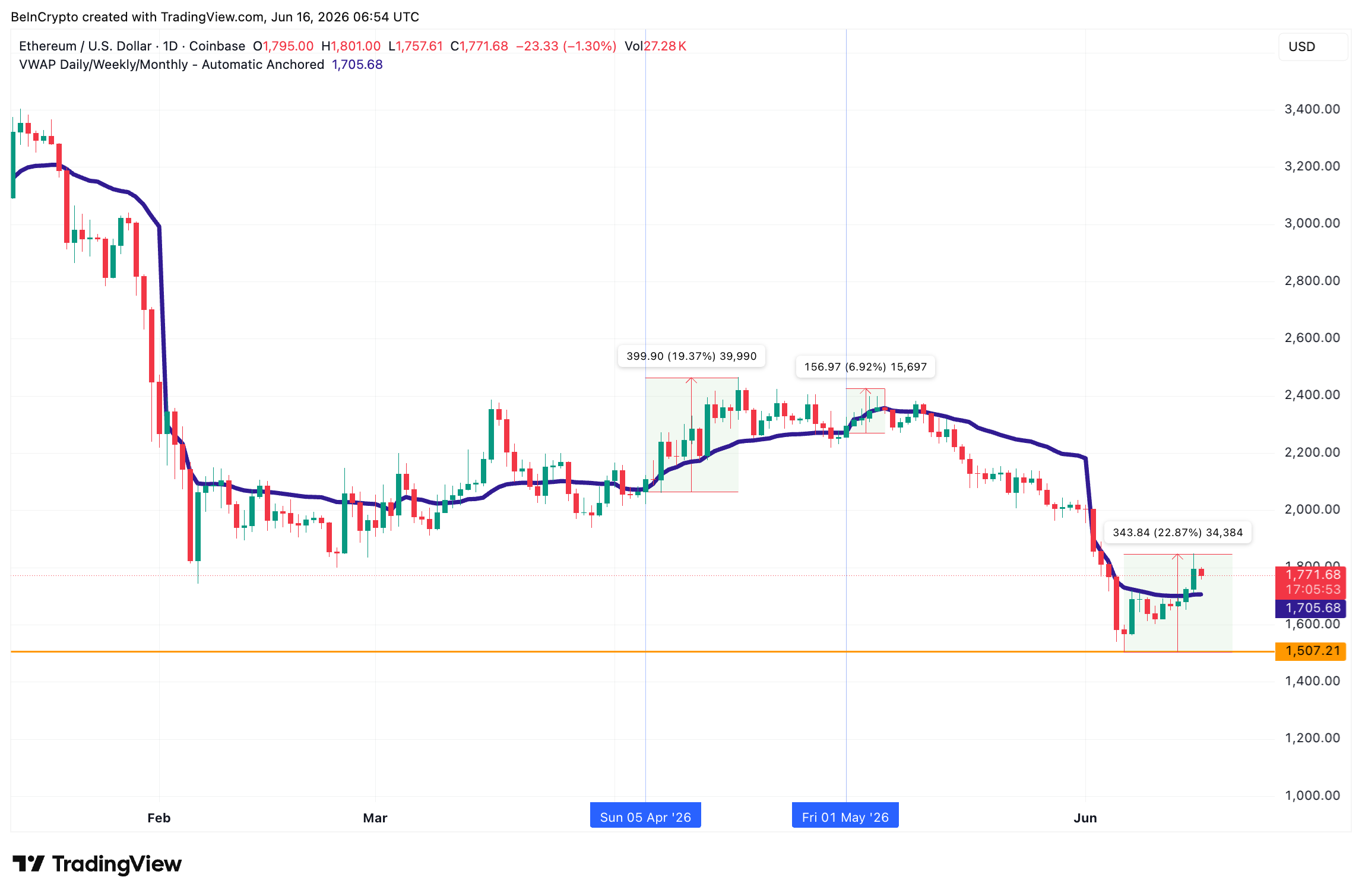
Ethereum (ETH) price has rebounded 22% its June low and reclaimed a closely watched institutional trend line. The move lands just as spot ETF money flips back into ETH after weeks of redemptions.
Whales kept adding through the slide, and on-chain accumulation is returning. Yet rising leverage leaves one question open, whether this is a real bottom or another bounce inside a downtrend.
Ethereum Price Reclaims the Monthly VWAP Line
On June 14, the Ethereum price closed back above its monthly VWAP, the volume-weighted average price that many desks treat as the line between accumulation and distribution.

The reclaim matters because of what followed past crosses. When ETH cleared the same line on April 6, it ran roughly 19% before stalling. A second reclaim around May 1 produced a smaller move near 7%.

Each of those reclaims shared one trait. Spot ETF flows flipped positive within days, as if the cross pulled institutional money back in.

Whether that link is causal or simply reflects returning optimism is hard to prove. Still, the pattern has repeated.
Want more token insights like this? Sign up for Editor Harsh Notariya’s Daily Crypto Newsletter here.
That makes the latest ETF print the first thing to check.
Spot ETF Flows Turn Green After a Brutal Streak
The flip arrived on cue. ETH spot ETF products took in $22.50 million on June 15, one day after the VWAP reclaim.
That green print breaks a long run of pain. From May 11 to June 12, the funds bled on all but two trading days, a near-continuous outflow streak. The contrast with spring is sharp. Early May saw heavy inflows, including $101 million on May 1 and $98 million on May 5, before the bleed set in.

Total net assets now sit near $10.04 billion. The return to inflows, however small, mirrors what happened after the April and May reclaims. The May’s extended VWAP reclaim saw multiple inflow days, something that can be expected now, if the bottom theory holds weight.
But ETF flows alone cannot confirm a bottom. For that, the on-chain holders matter more.
Whales Keep Adding as Capitulation Shows Signs of Exhaustion
The big holders believed in ETH before it crossed the VWAP line. Whale accumulation kept climbing through the decline. Addresses tracked by Santiment lifted their balance from about 124.85 million ETH on June 10 to roughly 125.4 million now. That’s roughly worth $950 million in under a week.

On-chain flows reinforce that buying. The heavy selling appears to have run dry around June 7, one day after the price formed a local bottom. That is when the exchange net position change, a metric that tracks coins moving on and off exchanges, flipped toward net outflows.
That flip suggests holders are pulling coins into storage rather than selling. It lines up with the whale buying above, as steady accumulation absorbed the last of the supply hitting exchanges.
The result reads like seller exhaustion, the exact condition a bottom call depends on.

The backdrop fits a possible bottom. Swissblock’s Altcoin Vector report describes ETH as stuck in a long capitulation phase, the stage of deep, sustained stress that often precedes a bottom.
The firm notes that capitulation only builds bottoms once selling pressure begins to exhaust. It asks whether that exhaustion is near now. And the exchange net position change metric shows that it just might.
One factor, however, complicates the bottom call, and it sits in the derivatives market.
Key Ethereum Price Levels Surface
Here is where the levels come in. The Ethereum price trades near $1,771, back above the monthly VWAP at $1,705 that it reclaimed on June 14. Price has climbed about 22% from the June low near $1,507. A confirmed bottom, though, needs more.
The line in the sand sits at $1,851. A daily close above it would validate the rebound and open room toward the prior range.
The catch is leverage. Open interest in ETH futures, the total value of contracts left open, has climbed sharply. It rose from about $8.86 billion in early June to roughly $9.96 billion, briefly touching $10.27 billion.

A durable capitulation bottom usually forms after leverage is flushed out and stays low. Here it is doing the opposite, as open interest rebuilds while price climbs.
That points to a leverage-led bounce, not pure spot demand. Those crowded longs are fragile. A sharp dip could liquidate them and force another wave of selling. So the capitulation may not be fully done.
On the downside, $1,624 is the first floor, followed by the $1,507 low. A daily close below $1,507 would open a new-bottom hypothesis.

A reclaim of $1,851 separates a confirmed bottom from another bounce that fades back below the VWAP.
The post Ethereum Whales Add $950 Million as Bottom Hopes Build, but the Story Has a Hole appeared first on BeInCrypto.

Bitcoin’s latest bounce is being framed as a macro-driven rebound rather than a fully confirmed technical reversal, with multiple analysts pointing to weak on-chain participation signals despite a move back toward $67,000.
According to LVRG Research director Nick Ruck, momentum remains muted and on-chain indicators have not yet caught up with the price recovery—leaving the rally vulnerable if geopolitical conditions deteriorate or liquidity thins.
Key takeaways
- Analysts say Bitcoin’s recovery lacks “conviction,” citing declining volume and stagnant on-chain metrics even after reclaiming $67,000.
- A possible US–Iran peace arrangement is positioned as a key macro catalyst; any breakdown could trigger renewed risk-off pressure.
- Swissblock reports Bitcoin remains in a “weak momentum and participation regime,” with on-balance volume (OBV) at bear-market lows.
- Swissblock notes historical bear-market behavior: momentum tends to weaken first, then OBV contracts—often before price breaks lower.
Recovery buoyed by geopolitics—signal still unproven
While Bitcoin has recently traded in closer alignment with broader market risk sentiment and institutional demand, Ruck argues that the internal data still points to hesitation. In comments to Cointelegraph, he said Bitcoin’s momentum is “weak,” pointing to declining volume alongside “stagnant on-chain metrics” that suggest the move upward may not have durable follow-through.
Ruck’s warning centers on what he sees as a concentration of influence from macro and geopolitical catalysts. He added that if a recently brokered US–Iran peace deal fails, the resulting instability—and potential knock-on effects for oil markets—could push Bitcoin into a more volatile trajectory.
“It may initially find bids as a hedge asset before broader risk-off flows push it toward key support zones, underscoring how macro and geopolitical catalysts continue to dominate crypto price action.”
What the US–Iran “peace deal” would change
Trump said on Sunday that the US had completed a peace deal with Iran meant to end months of conflict, with the agreement expected to be signed on Friday. The Associated Press reported on Monday that much of the agreement’s details remain unclear, but Trump’s statements indicated that the Strait of Hormuz would be opened and that the US would lift its blockade of the strait and Iran’s ports.
The report also notes that after the initial steps, the two countries would begin 60 days of negotiations relating to Iran’s nuclear program and potential sanctions relief.
For traders, the practical implication is that Bitcoin is reacting not just to crypto-specific narratives, but to expectations about shipping, energy pricing, and risk sentiment tied to the region.
Swissblock: weak momentum and OBV still point to bear-market conditions
On the market-structure side, Swissblock said on Monday that Bitcoin’s momentum—used as a gauge of the strength of price movements—remains in a “weak momentum and participation regime.” The firm also flagged on-balance volume (OBV), a metric intended to reflect buying and selling pressure through volume flows.
Swissblock characterized both measures as negative, arguing that the current state resembles bear-market behavior where participation fades. It highlighted that price momentum has been weak and that OBV sits at extremely low levels, reinforcing the view that the rebound is not yet backed by sustained demand.
In the same framework, Swissblock noted that once OBV and momentum both flip back into a positive regime, it typically provides a stronger recovery signal. Until that happens, the risk of another attempt at retesting recent lows remains material, the firm warned.
Quantitatively, the report cited that price momentum stood at -1 while OBV was at roughly -1.7 million, despite Bitcoin’s rebound back above $67,000 on Monday after it fell below $60,000 on June 6. It also observed that Bitcoin began to ease from Monday’s intraday high, slipping below $66,000 in early trading on Tuesday.
Why the difference between price and participation matters
A central theme across the commentary is the gap between a visible price recovery and the confirmation signals investors often look for—especially volume trends and on-chain participation indicators. Even when the market lifts, weak participation can mean that fewer buyers are stepping in strongly enough to absorb supply, leaving rallies susceptible to reversal on lighter liquidity or shifting macro expectations.
Ruck’s analysis points in the same direction: “stagnant on-chain metrics” and declining volume suggest that the recovery may not yet have the breadth needed to persist through changing conditions. Swissblock’s momentum/OBV framing provides a complementary lens, suggesting the underlying participation regime remains bearish.
For now, readers should watch whether Bitcoin can regain not only key price levels but also the participation signals that would indicate a regime shift—particularly as the US–Iran situation moves from announcements toward negotiated outcomes. If geopolitical headlines turn, the data-driven “weak conviction” view could quickly reassert itself; if negotiations proceed smoothly, the market may seek confirmation through stronger volume and improving on-chain flows.

Key Highlights
- SpaceX has decided to distribute quarterly and annual financial reports exclusively through its website and X, bypassing conventional wire services such as Business Wire and PR Newswire
- The aerospace company secured $75 billion through its initial public offering by selling 555.56 million shares priced at $135 apiece
- Following the greenshoe option activation by underwriters, the IPO’s total value reached $85.7 billion
- Trading saw SpaceX shares surge approximately 19% higher during Monday’s session, with an additional 2% gain in after-hours activity
- This strategy represents a significant shift from conventional investor communication practices employed by most publicly traded corporations
In an unprecedented move, SpaceX has announced it will abandon traditional wire distribution channels for releasing financial information. The company plans to share all quarterly and annual financial statements, alongside other significant corporate updates, solely through its corporate website and official X social media presence.
This declaration appeared in an official regulatory document filed Monday. According to SpaceX’s statement, the company “encourages members of the investment community, the media, and others to follow” both its dedicated investor relations webpage and its X social media handle.
Typically, publicly traded corporations rely on established platforms like Business Wire or PR Newswire for information dissemination. These intermediary services ensure simultaneous delivery of critical data to journalists, financial platforms, and shareholders. SpaceX’s decision represents a complete departure from this long-established practice.
The regulatory filing provided no detailed explanation for this strategic pivot. SpaceX characterized the decision as an initiative to communicate directly with stakeholders and the general public through proprietary digital platforms.
Historic IPO Generates $85.7 Billion in Total Proceeds
This announcement coincided with SpaceX revealing that its IPO underwriters had activated the greenshoe provision. This mechanism permits underwriters to offer additional shares when market demand exceeds initial expectations.
Activating this provision elevated the IPO’s total capital raised to $85.7 billion. Prior to this adjustment, SpaceX had already secured $75 billion from the initial share distribution of 555.56 million shares at the $135 price point.
This achievement established SpaceX’s market debut as the largest public offering ever recorded, even excluding the greenshoe component. The company, under Elon Musk’s leadership, operates diverse ventures spanning rocket technology, artificial intelligence development, and global satellite internet infrastructure.
Market participants reacted enthusiastically to both announcements. Monday’s trading concluded with shares climbing roughly 19%.
Space Exploration Technologies Corp., SPCX
Investor Response and Trading Activity
Extended trading hours showed continued momentum, with shares advancing approximately 2% beyond regular market close. The dual announcements regarding the greenshoe execution and unconventional disclosure approach appeared to maintain robust investor enthusiasm throughout the day.
The choice to designate X as a principal investor communication platform breaks from industry norms. X, the social media service also under Elon Musk‘s ownership, now holds equivalent status to SpaceX’s official investor relations portal for corporate announcements.
Regulatory reception of this approach remains uncertain. Securities regulations mandate that material corporate information must reach all investors simultaneously, and SpaceX’s filing indicates confidence that publishing through its website and X fulfills this regulatory obligation.
Stakeholders seeking timely SpaceX financial updates must now actively track these two specific platforms. The company has confirmed it will not employ alternative distribution mechanisms for financial reporting.
With its IPO recently concluded, SpaceX has emerged as among the most prominent and scrutinized newly public entities in today’s financial markets.


Cryptocurrencies have long promised faster and more efficient payments. The challenge for businesses, however, has always been volatility. A payment received today could be worth significantly less tomorrow, making it difficult to use cryptocurrencies for everyday transactions.
Stablecoins have helped solve that problem.
By maintaining a value tied to traditional currencies such as the US dollar, stablecoins allow businesses to benefit from blockchain technology without worrying about major price swings. As a result, they are becoming an increasingly popular payment option across a wide range of industries.
Faster Payments and Quicker Settlements
Traditional payment systems can be slow, especially when international transfers are involved. Businesses often wait several days for funds to clear, creating unnecessary delays.
Stablecoins operate on blockchain networks that run 24/7, allowing transactions to settle much faster. This can improve cash flow and give businesses quicker access to their funds, regardless of where customers are located.
Lower Transaction Costs
Payment processing fees remain a significant expense for many online businesses. Credit card providers, banks, and other intermediaries all take a share of each transaction.
Stablecoins can help reduce some of these costs by allowing funds to move directly between parties. For businesses processing large transaction volumes or serving international customers, the savings can add up over time.
Expanding Global Reach
One of the biggest advantages of stablecoins is accessibility.
Businesses can accept payments from customers around the world without relying entirely on traditional banking infrastructure. This makes it easier to serve international markets and reach customers who may have limited access to conventional payment methods.
As global commerce continues to grow, payment solutions that remove geographic barriers are becoming increasingly valuable.
Real-World Adoption Is Accelerating
Stablecoins are no longer used only by crypto traders.
E-commerce companies, freelancers, software providers, and digital service businesses are increasingly using stablecoins for everyday transactions. Adoption is also growing among crypto casino sites in Australia, where stablecoin payments can provide faster deposits and withdrawals compared to some traditional banking methods.
These use cases demonstrate how digital assets are moving beyond speculation and becoming practical tools for online commerce.
Greater Transparency
Blockchain transactions are recorded on public ledgers, providing a clear and verifiable record of payments.
For businesses, this can simplify transaction tracking and improve financial visibility. Rather than relying solely on third-party reports, companies can independently verify transactions whenever needed.
Regulatory Progress Is Driving Confidence
One of the biggest barriers to adoption has been regulatory uncertainty. That is beginning to change as governments and regulators establish clearer frameworks for digital assets and stablecoins.
At the same time, major financial institutions and payment companies are investing heavily in blockchain infrastructure. This growing institutional support is helping businesses view stablecoins as a legitimate payment solution rather than an experimental technology.
Final Thoughts
Stablecoins offer a combination of speed, stability, and accessibility that traditional payment systems often struggle to match. While businesses must still consider compliance, security, and operational requirements, the benefits are becoming increasingly difficult to ignore.
As digital commerce continues to evolve, stablecoins are well-positioned to play a larger role in how businesses send, receive, and manage payments worldwide.
Hyperliquid’s native cryptocurrency, HYPE, is one of today’s best performers, charting a double-digit move as trading activity accelerates across multiple verticals.
At the time of this writing, HYPE is trading at around $72, very close to its all-time high.
This marks an increase of around 10% in the past 24 hours, lining it up as one of the best performers during the period. The move is driven by accelerated ETF buying and fresh momentum around its ecosystem, fueled by the success of SpaceX perps trading.
ETF Demand Adds Fresh Optimism
ETF data from SoSoValue suggests that regulated products around HYPE are becoming a powerful part of the token’s market structure. The three products currently listed and operated by Bitwise, 21Shares, and Grayscale hold a combined total of $209M worth of HYPE, accounting for around 1.4% of its total market capitalization.
During this fresh rally, net inflows over the past 24 hours surpass $17 million, bringing the cumulative total to $171M, suggesting strong structural interest in Hyperliquid’s underlying cryptocurrency.

By contrast, BTC ETFs recorded outflows of around $64M, suggesting risk appetite is shifting towards altcoins, a trend further supported by positive flows into ETH, SOL, and XRP ETFs.
SpaceX Perps Strengthen the HIP-3 Narrative
The other key driver is Hyperliquid’s growing role in non-crypto markets through HIP-3.
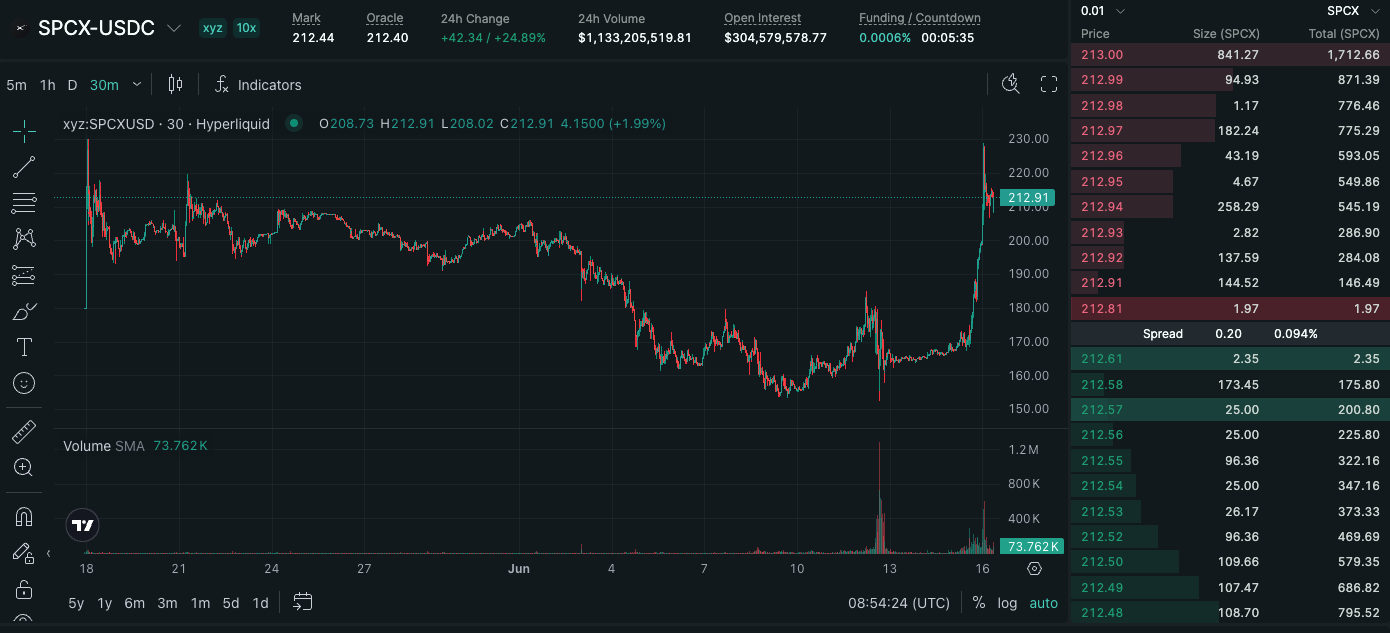
As seen in the chart below, SPCX-USDC is currently trading with a 24-hour trading volume of more than $1.12 billion. Open interest is approaching $300 million, while the contract trades near $212.
This follows broader market attention around SpaceX-linked perpetuals. In fact, during the initial burst after the listing, SPCX became the most-traded asset on the venue, with trading exceeding $1.3 billion.
This adds more weight to the idea that Hyperliquid can host liquid markets far beyond standard crypto pairs. Previous examples include gold and oil. After all, it has become one of the preferred exchanges to trade oil with crypto.
The post HYPE Price Explodes as ETF Inflows and SpaceX Perps Boost Hyperliquid appeared first on CryptoPotato.
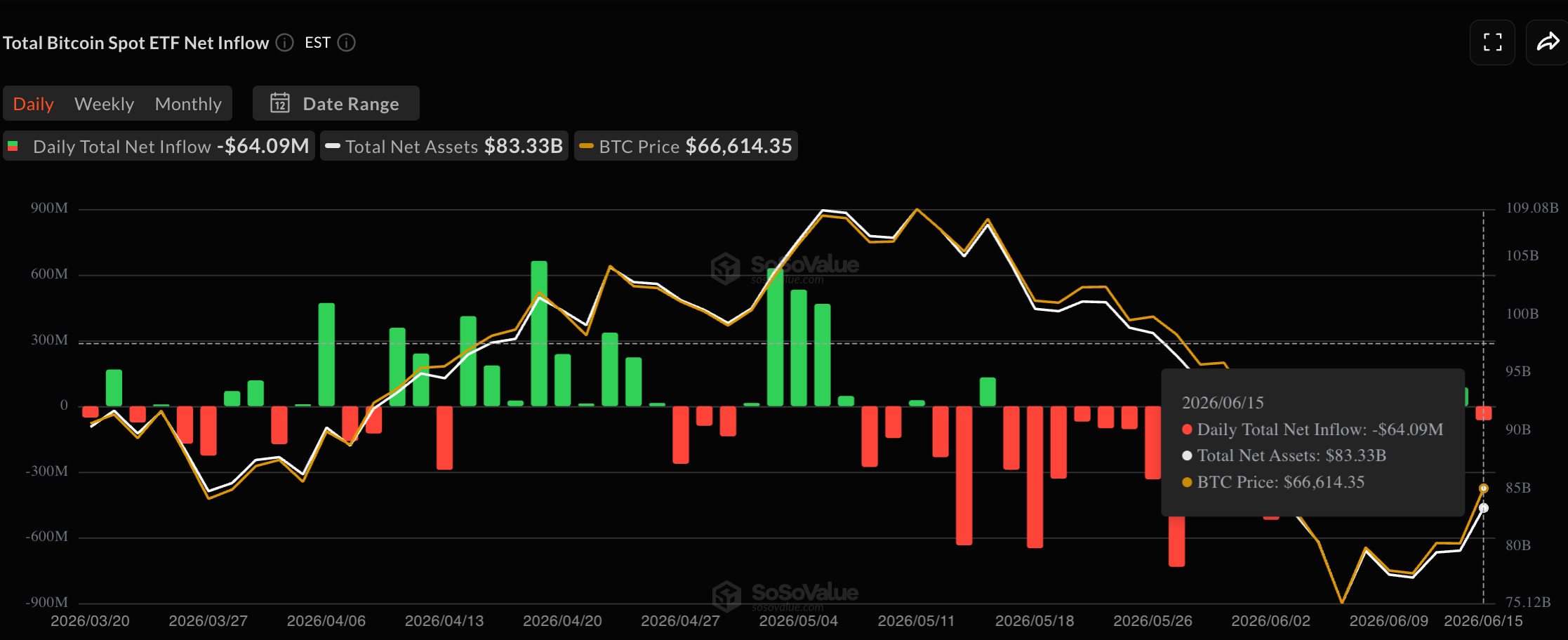
Crypto ETF flows are sending a clear message, and Bitcoin is not the one receiving it. On June 15, spot Bitcoin funds bled capital while Ether, XRP, Solana, and HYPE products pulled in fresh money.
The split follows the largest IPO in history. After weeks of investors possibly selling crypto and stocks to chase the SpaceX listing, money is flowing back, yet the early returns favor altcoins over Bitcoin.
Crypto ETF Flows Split as Bitcoin Funds Bleed
The earlydivergence was clean. Spot Bitcoin ETF products posted a net outflow of $64.09 million on June 15, meaning more money left the funds than entered.

Every other major product moved the other way. Ethereum (ETH) ETF inflows reached $22.50 million, while Hyperliquid (HYPE) funds added $17.19 million.

XRP and Solana (SOL) products took in $2.82 million and $2.81 million.


The cause traces back to the SpaceX listing. Geoff Kendrick, Global Head of Digital Assets at Standard Chartered, tied the recent Bitcoin selling to the IPO scramble.
“The SpaceX IPO may sound the end of ETF selling (anecdotally BTC ETF holders have been selling to free up cash to enter the IPO),” Kendrick said.
With the IPO now trading, that forced selling should fade. That didn’t happen on the first day of the week. The flows alone, however, do not show whether the wider market structure agrees.
Bitcoin Dominance Slips as Capital Broadens Into Altcoins
Market structure backs the flow story. Bitcoin dominance, the share of total crypto value held in Bitcoin, eased from 56.79% on June 10 to 56.06% by June 16.
The detail that matters sits underneath. Ether dominance fell from 9.11% to 8.82% over the same window, and stablecoin share dropped from 12.87% to 11.98%.

Only one group gained. The “Others” category, which tracks every coin outside Bitcoin, Ether, and stablecoins, rose from 21.23% to 23.14%.
That mix suggests a broadening, not a simple Bitcoin-to-Ether trade. Falling stablecoin dominance also suggests sidelined cash is being deployed rather than parked.

Institutional rotation of this kind, as shown via ETF flows, tends to appear in flows before price. If capital keeps favoring the long tail, the move points past a single asset. And this also revisits discussions regarding the altcoin season.
One token majorly sits at the center of both the fund flows and the platform demand driving this shift.
HYPE Shows the Rotation Is About Demand, Not Just Flows
Hyperliquid is the clearest example. Its HYPE ETF products took in $17.19 million on June 15, even as Bitcoin funds bled. The first month tells a bigger story. Spot HYPE ETFs have drawn about $153 million in net inflows and nearly $900 million in trading volume since launch.

Three products hold the token directly and pass on staking rewards. They are 21Shares’ THYP, Bitwise’s BHYP, and Grayscale’s HYPG. About 434 million HYPE, or roughly 45% of the stakeable supply, is staked.
The demand is not only financial. Hyperliquid runs perpetual futures, contracts that track an asset’s price without an expiry, on traditional assets most stock traders cannot easily reach.
Its permissionless HIP-3 framework lets builders list perps on oil, forex, equities, and even private companies before they go public. The SpaceX contract is the standout. Listed as SPCX in May, it became the main price-discovery venue before the June 12 debut, with aggregate open interest above $215 million.
According to a Grayscale research note, Hyperliquid’s HIP-3 markets hit roughly $3.2 billion in peak open interest in June, and the first S&P 500 perpetual launched on the platform in March. Grayscale compared the venue to cloud infrastructure rather than an exchange, with the HYPE token capturing fees from every trade.
That utility helps explain why HYPE drew capital while Bitcoin did not. Still, one strong session does not confirm a lasting shift.
What Confirms the Crypto ETF Rotation, and What Breaks It
The case is building. Fund flows, slipping Bitcoin dominance, and HYPE’s twin demand all point the same way. The macro backdrop helps. The reopening of the Strait of Hormuz has eased some pressure on risk assets, including Bitcoin.
Tim Sun, Senior Researcher at HashKey Group, sees relief but not a turn.
“The reopening of the Strait of Hormuz would positively boost risk assets, including Bitcoin, by temporarily easing market fears regarding a renewed spike in inflation and providing relief from macroeconomic pressures. However, this alone is likely insufficient to reverse the current downward trend,” Sun said.
He pointed to what a real reversal needs.
“For a true structural trend reversal, the market requires more than geopolitical easing; it specifically needs a resumption of consistent spot buying and the return of ETF capital inflows,” Sun added.
That sets the test. Kendrick expects the SpaceX selling to fade and Ether to outperform Bitcoin from here. Yet on June 15, Bitcoin funds still bled, so the confirmation is not in place.
Continued inflows into altcoin ETFs separate a genuine crypto ETF rotation from a one-day split that Bitcoin’s next wave of buying erases.
The post Crypto ETF Flows Reveal Where Institutional Money Is Going, and It’s Not Bitcoin appeared first on BeInCrypto.


The Enforcement Directorate has filed a prosecution complaint in a cryptocurrency fraud case involving more than $20 million in stolen digital assets and has attached assets worth about INR 64.55 crore (approx. $6.83 million) linked to the alleged proceeds of crime.
Summary
- Enforcement Directorate has filed a prosecution complaint against Chirag Tomar and others in a crypto fraud case involving more than $20 million in stolen digital assets.
- Investigators alleged the group used fake Coinbase websites to steal user credentials and transfer cryptocurrency from victim accounts into wallets under their control.
- Indian authorities have attached assets worth about INR 64.55 crore after tracing the alleged proceeds through multiple crypto wallets and peer-to-peer transactions into India.
According to the agency, the complaint names Chirag Tomar, Pankaj Tomar, Kushagra Shakya, Akash Vaish, Rahul Anand, Ketan Luthra, Tomar Group of Industries Private Limited, and Exahomes Realtors. The case stems from allegations that cryptocurrency investors were tricked through fake websites designed to resemble the U.S.-based crypto exchange Coinbase.
Investigators alleged that Chirag Tomar, who is currently in custody in the United States, played a central role in the scheme. The agency said evidence and case details were obtained from U.S. authorities through Mutual Legal Assistance Treaty channels as part of the investigation.
Authorities alleged that the group created fraudulent websites resembling Coinbase and used them to collect login credentials and authentication details from unsuspecting users. Once access was obtained, cryptocurrency holdings were allegedly transferred from victims’ accounts into wallets controlled by the accused.
U.S. conviction tied to Coinbase spoofing scheme
Court records in the United States show that Tomar was arrested by the Federal Bureau of Investigation at Atlanta airport in December 2023. He later pleaded guilty to wire fraud conspiracy and was sentenced to 60 months in prison, followed by two years of supervised release.
U.S. prosecutors had alleged that the operation ran from at least June 2021 and targeted victims in the United States and other countries through spoofed Coinbase websites. According to court filings, the fraudsters used domains designed to imitate Coinbase’s services, including a fake version of the exchange’s Coinbase Pro platform.
Prosecutors also alleged that members of the scheme impersonated Coinbase customer support representatives and, in some instances, used remote desktop software to gain access to victims’ accounts. One victim in North Carolina reportedly lost more than $240,000 in February 2022.
U.S. authorities said the scheme generated more than $20 million in stolen cryptocurrency from hundreds of victims. Court documents further alleged that some of the proceeds were spent on luxury vehicles and international travel, including trips to Dubai.
ED traces alleged crypto proceeds to assets in India
Indian investigators alleged that after the cryptocurrency was stolen, the assets were moved through multiple wallets and converted into other virtual digital assets to obscure the transaction trail.
The agency said the funds were eventually converted into Indian currency through peer-to-peer transactions and routed into bank accounts linked to Chirag Tomar and other accused individuals.
Those funds were then allegedly used to acquire properties and other assets in India, according to the investigation.
The prosecution complaint comes as Indian authorities continue to tighten oversight of the digital asset sector under the Prevention of Money Laundering Act.
Under rules enforced by the Financial Intelligence Unit, cryptocurrency exchanges and other virtual asset service providers are required to maintain customer records, carry out know-your-customer checks, and report suspicious transactions.
The Enforcement Directorate serves as one of the key agencies responsible for investigating alleged money laundering involving digital assets.
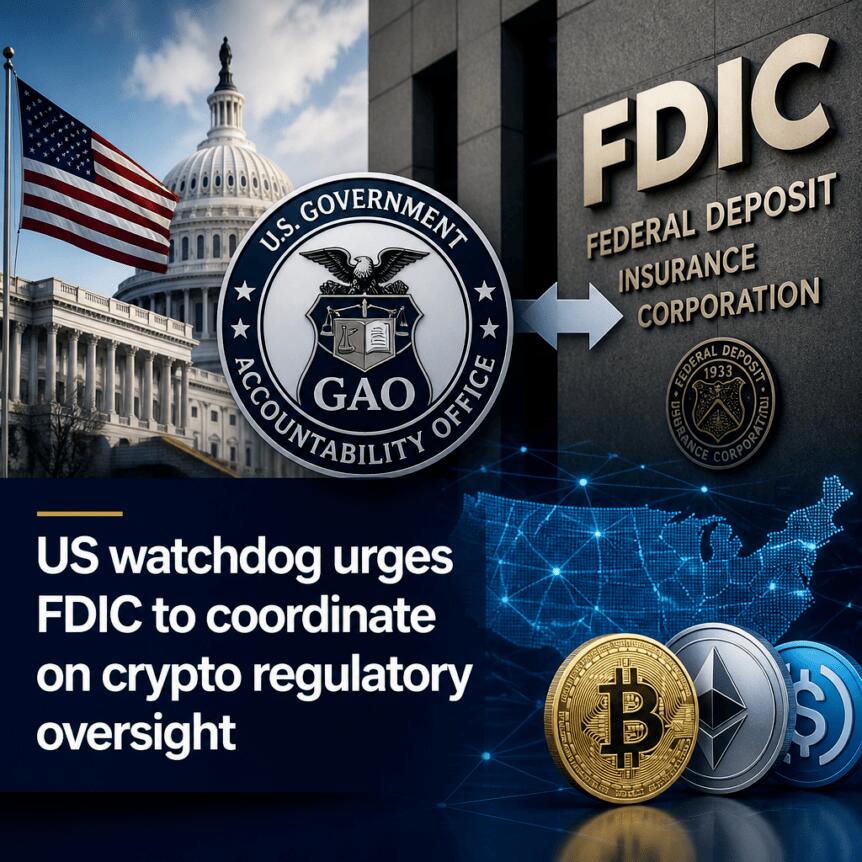
The U.S. Government Accountability Office (GAO) has urged the Federal Deposit Insurance Corporation (FDIC) to coordinate more closely with other federal regulators to address risks linked to blockchain technology—warning that oversight has struggled to keep pace with the rapid growth of blockchain-based financial products.
In a June 8 letter to FDIC Chairman Travis Hill, GAO said it raised “priority recommendations” with the regulator in May of the previous year, including efforts to manage blockchain-related risks through better inter-agency coordination.
Key takeaways
- GAO says regulators have lacked an ongoing coordination mechanism for blockchain risk management, even as blockchain-based financial services expanded.
- The FDIC oversees stablecoin issuers that are subsidiaries of banks it supervises under the GENIUS Act.
- GAO recommends the FDIC rotate case managers assigned to supervised banks to strengthen supervision and protect independence.
- GAO pointed to crypto-linked bank failures in 2023 as raising questions about whether supervisory concerns were addressed promptly.
GAO flags blockchain oversight gaps
GAO placed blockchain technology on its “High Risk List,” characterizing it as an area where regulators have had difficulty overseeing blockchain-based financial products and the potential impact those products can have on U.S. markets.
In the letter, GAO said that in 2023 it found financial regulators “lacked an ongoing coordination mechanism for addressing blockchain risks,” and that blockchain-related financial products and services have grown substantially in the intervening period. GAO argued that establishing such a coordination mechanism would allow the FDIC and other regulators to identify risks and implement responses more quickly.
The regulator’s concern is not limited to one institution or one product. Instead, GAO framed blockchain as a cross-cutting risk category—one that requires regulators to share information and coordinate oversight approaches rather than addressing it in isolation.
GENIUS Act and why FDIC oversight matters
GAO’s push arrives as federal oversight of crypto-linked banking continues to take shape. Under the GENIUS Act passed last year, the FDIC is the main regulator for stablecoin issuers that operate as subsidiaries of banks it supervises.
That structure gives the FDIC a direct supervisory role in a segment of the crypto market that connects traditional banking regulation to blockchain-based settlement and tokenization. The GAO letter underscores the practical reality for regulated banks: even when token-related activity sits inside or alongside banking entities, supervisory expectations still fall largely on the banking regulators.
Separately, Senate lawmakers are reportedly looking to pass a bill intended to clarify how federal agencies would regulate the broader crypto market, reflecting ongoing legislative efforts to reduce uncertainty across the sector. The GAO letter complements that policy backdrop by highlighting operational and coordination issues inside the existing regulatory framework.
Earlier coverage from Cointelegraph noted FDIC moves aimed at regulating stablecoin issuers under the GENIUS Act, illustrating how the agency’s mandate is already expanding in step with stablecoin activity tied to supervised banks (FDIC moves to regulate stablecoin issuers under the GENIUS Act).
Case manager rotation and supervisory independence
Beyond coordination, GAO raised a governance recommendation aimed at strengthening supervision. It urged the FDIC to rotate case managers assigned to banks.
GAO said that in 2024 it found the agency did not require supervisors to rotate across different banks. In GAO’s view, the absence of such rotation “could compromise their independence and interfere with supervision outcomes.” GAO added that a rotation requirement “could mitigate threats to independence.”
The underlying idea is straightforward: closer, long-running supervisory relationships can potentially blur boundaries, while a rotation approach can help maintain objectivity and keep supervisory attention fresh. GAO’s recommendation suggests that even if regulators have the right policies on paper, staffing and supervisory processes can still affect how effectively risks are identified and addressed.
2023 bank failures put pressure on supervision
GAO also tied its recommendations to supervisory outcomes during the crypto-linked banking stress seen in 2023. The GAO letter said the failure of multiple crypto and technology industry-linked banks in 2023 “raised questions” about whether bank watchdogs took sufficient action to ensure institutions “promptly addressed supervisory concerns.”
The GAO cited the collapse of Silicon Valley Bank, Silvergate Bank, and Signature Bank—each of which had significant exposure to the crypto industry. Those failures occurred within less than a week in March 2023, in the fallout of FTX’s bankruptcy, which triggered major disruptions across crypto markets.
GAO’s point, as presented in the letter, is not that any single supervisory mechanism failed in isolation. Rather, it implies that when the sector’s risk profile changed quickly—especially amid high-profile market events—regulators needed faster, more coordinated action, along with supervision structures that preserve independence and responsiveness.
The GAO’s emphasis on both coordination and case manager rotation indicates a dual focus: regulators must communicate and align on emerging blockchain risks, and they must also ensure internal supervisory practices do not slow down decision-making or reduce the rigor of oversight.
What to watch next
For banks and stablecoin-related businesses operating within FDIC-supervised structures, the immediate question is whether the FDIC will adopt GAO’s recommendations on inter-agency coordination and case manager rotation—and how that translates into supervisory expectations. More broadly, lawmakers’ efforts to set a clearer federal framework for crypto regulation will determine whether coordination concerns can be addressed through policy design as well as through agency process.
XRP recovered sharply after weeks of selling pressure, with traders returning to major altcoins as geopolitical fears eased.
Summary
- XRP rebounded as easing geopolitical fears helped traders rotate back into major altcoins this week.
- Wallets holding at least one million XRP now control 74.1% of its supply, Santiment says.
- ETF inflows, Binance withdrawals, and $1.30 resistance remain key factors for XRP traders this week.
Santiment said the token surged more than 13% in 24 hours and reclaimed $1.28 for the first time in two weeks before cooling from that level.
“XRP has staged an impressive comeback,” Santiment said.
The move followed a slide from above $2.30 in January to a June 11 low near $1.10. Updated market data showed XRP trading near $1.23 on June 16, up 4.17% in 24 hours, with volume above $3 billion. XRP ranked fifth by market value, with a market cap near $76.4 billion.
The rebound came as risk appetite improved across the crypto market. Traders reacted to reports that the U.S.-Iran conflict had reached a resolution, easing concern over energy prices, inflation pressure, and wider market stress.
Still, XRP remains below recent peaks. The token traded between $1.18 and $1.29 over the latest 24-hour period. It remains down about 13% over the past month and more than 43% over the past year. That leaves the recovery intact in the short term, but not enough to confirm a full trend change.
Whale wallets and exchange flows draw attention
Large XRP holders remain central to the current market setup. Santiment said wallets holding at least 1 million XRP now control 74.1% of supply and added 1.53 billion tokens over the past six months. That accumulation came while retail sentiment stayed weak.
This whale activity matters because it can reduce liquid supply when large holders keep coins away from short-term trading. It can also add confidence during rebounds, although it does not remove downside risk. If large wallets sell into strength, the rally may face pressure.
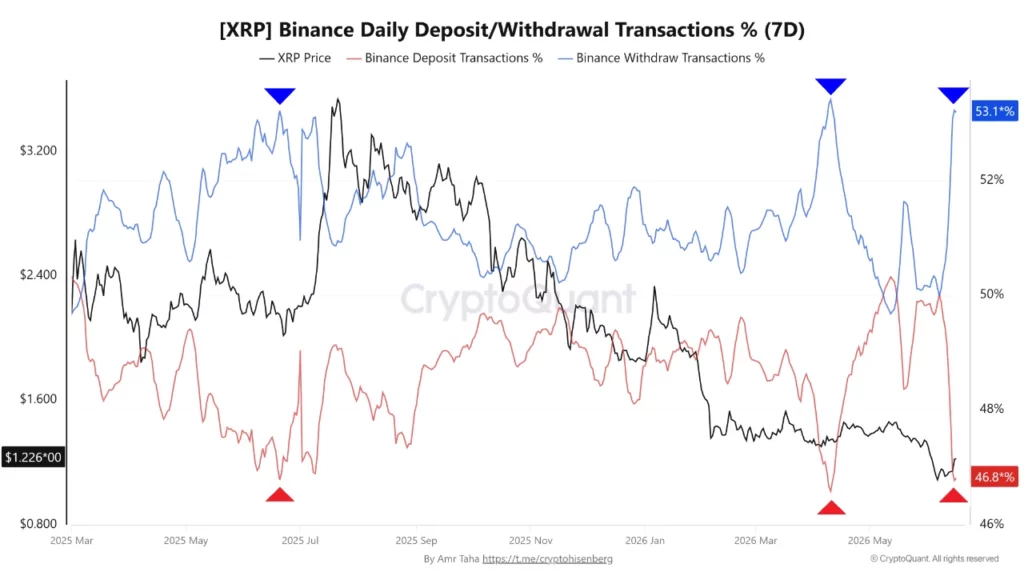
Exchange data also showed a shift in Binance activity. CryptoQuant analyst Amr Taha said XRP withdrawal transactions reached 53.2% on June 15 and stayed near 53.1% on June 16. Deposits fell near 46.7% and 46.8% over the same period.
The signal does not confirm immediate upside, but it shows transaction activity leaning toward withdrawals rather than deposits. In market terms, that may suggest fewer coins moving onto Binance for sale. However, traders still need price confirmation.
ETF demand and XRPL activity support the market story
Institutional demand remains another focus for XRP traders. As previously reported, XRP-linked products recorded positive inflows for a fifth straight week while Bitcoin and Ethereum products saw outflows. Recent fund-flow data showed XRP products added about $10.68 million in the week ended June 12, bringing cumulative inflows close to $1.44 billion. SoSoValue data also showed $2.82 million in Monday inflows on June 15.
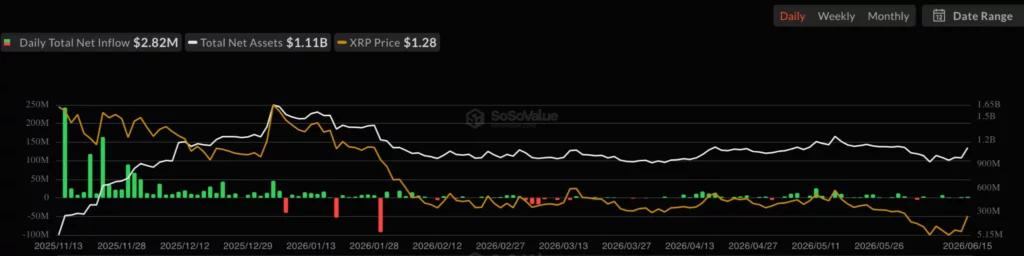
The ETF data has kept XRP in the institutional conversation despite its weak price trend this year. Analysts have noted that access alone has not been enough to lift XRP back toward January levels. Traders are still watching whether legal clarity, sustained inflows, and stronger spot demand can work together.
At the same time, traders are watching Ripple’s payment network and tokenization work on the XRP Ledger. Former Ripple developer Matt Hamilton recently pointed to XRPL’s long-running exchange design as new Solana DEX models drew attention. “This problem was solved 15 years ago on the XRP Ledger,” Hamilton wrote.
XRPL’s built-in DEX has operated since 2012, giving the network a long history in on-chain exchange design. Developers are also testing lending and AMM upgrades, which may keep XRP Ledger activity in focus. These network updates support the broader utility debate around XRP, but they do not guarantee token gains.
$1.30 remains the key short-term level
The next price test sits near $1.30. Crypto analyst CasiTrades said XRP is approaching major resistance in that zone after a stronger-than-expected bounce from the $1.09 macro support area. The analyst said the move may be early evidence of a new trend, but it still needs confirmation.
CasiTrades also said XRP has not removed downside risk unless it reclaims $1.65 and turns that level into support. If buyers fail at $1.30, traders may again watch the $0.90 support area. Another analyst, Batman, pointed to a bullish MACD crossover and rising futures activity, but open interest data still sits near its normal range.
The latest move has improved short-term momentum, but the market is still testing whether buyers can hold higher levels. A daily close above $1.30 would strengthen the recovery case. A rejection could leave XRP back inside its recent range, with traders watching Binance flows, ETF demand, and whale balances for the next signal.
Disclosure: This article does not represent investment advice. The content and materials featured on this page are for educational purposes only.

URGENT!!! I’M ALL IN ON XRP!!!!

Police remove ‘hate crime’ banner from Co Tyrone village for a second time

Iran Fight Back Twice to Earn 2-2 Draw Against New Zealand in Dramatic 2026 World Cup Opener


-

 Business2 days ago
No Jackpot Winner as $257 Million Prize Rolls Over to $269 Million Monday Draw
-

 Crypto World5 days ago
Oppenheimer backs SpaceX as $70 billion retail frenzy builds
-

 Fashion4 days ago
Weekend Open Thread: Tuckernuck – Corporette.com
-

 Crypto World5 days ago
Markets Rally as SpaceX IPO Looms Amid Iran Tensions and Inflation Surge
-
Crypto World1 day ago
Zimbabwe Requires Crypto Businesses to Register Annually Under New FIU Regulations
-

 Entertainment7 days ago
The Ryan Gosling True Crime Thriller On Netflix That Gets Even Stranger, Stream It Now
-

 Tech3 days ago
NanoClaw integrates JFrog registries to secure AI agent downloads
-
 Sports7 days ago
Bangladesh beat Australia after 20 years in ODIs, register only their second win over six-time world champions | Cricket News
-

 Crypto World3 days ago
Bitget enters Argentina’s regulated crypto market through PSAV registration
-

 Tech4 days ago
This Week In Security: Microsoft On Microsoft, Register Your Domains, Linux On ARM, And FreeBSD Joins The File Cache Club
-
 Tech5 days ago
Dutton Ranch star claims they ‘didn’t see any disruption’ on set following Chad Feehan’s exit from Yellowstone spinoff fueled by Taylor Sheridan clash rumors
-

 NewsBeat4 days ago
El Nino has formed in the Pacific and could set records, forecasters say
-

 Politics5 days ago
Politics Home | Healey Resignation Is “Colossal Failure Of Government”, Says Former Labour Defence Secretary
-

 Business6 days ago
Thailand Ranks Second Worldwide for AI Adoption Growth, Microsoft Reports
-

 Tech6 days ago
‘This is Seattle’s position on AI’: City Council votes unanimously to pause big new data centers
-
 Entertainment5 days ago
Donnie Wahlberg & More Heat Up Las Vegas at Circa’s Barry’s Downtown Prime
-
 Tech5 days ago
Opendoor Ends India Operations, Fueling a Bigger Conversation About AI and Outsourcing
-

 Sports5 days ago
First Time Since 1971: Australia Register Historic Low In ODI Cricket
-

 Politics5 days ago
Belfast burns, while Met chief points finger at Iran and Russia
-

 NewsBeat4 days ago
FBI searches office of Ohio voter registration group
You must be logged in to post a comment Login