
Crypto World
Tether USDT Briefly Overtakes Ethereum in Market Cap: A $187B Wake-Up Call

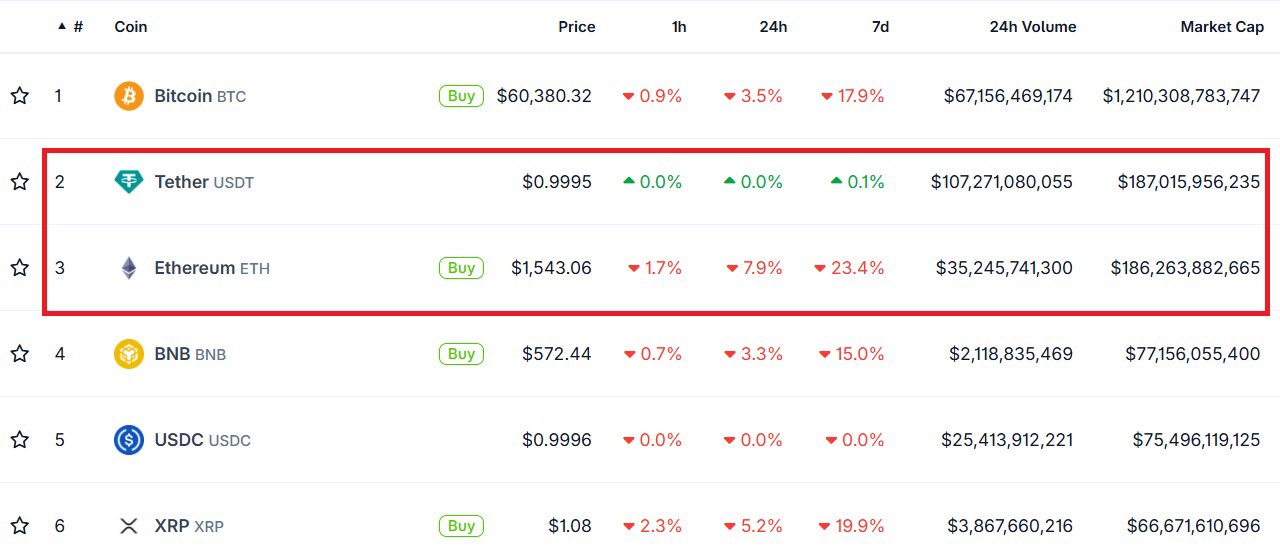
For a few hours, earlier this week, Tether USDT stablecoin held a higher market cap than Ethereum, the first time that has happened in eight years. Data across multiple trackers placed both assets in the $183–188B range during the crossover window, with one snapshot showing USDT at $187B against ETH at $186B, a spread of under $1B.
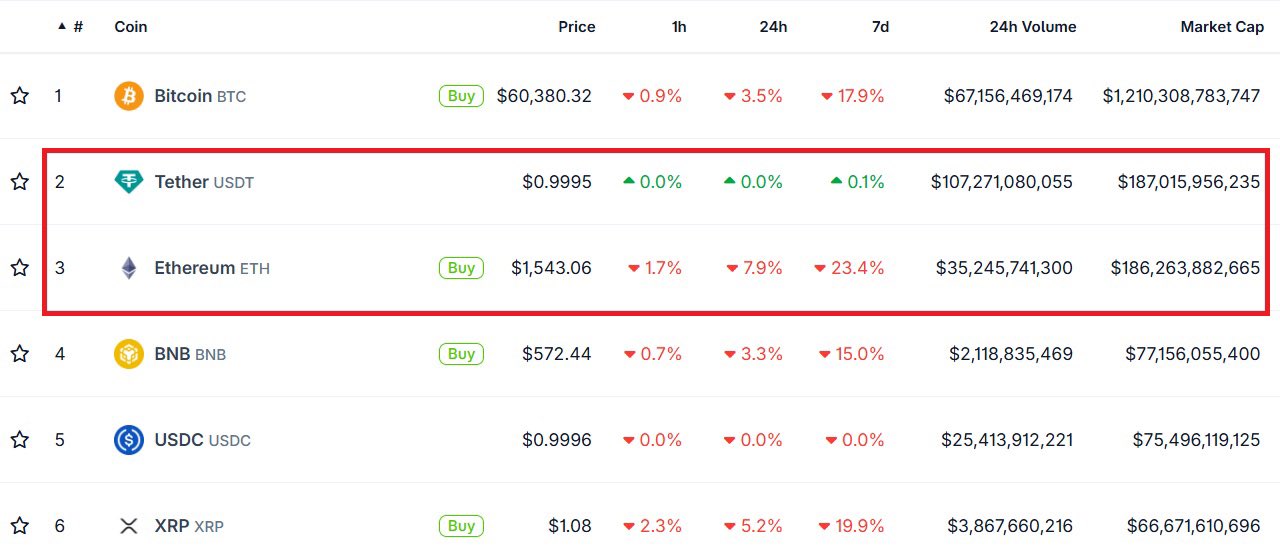
The flip lasted hours, and ETH reclaimed second place once the price stabilized. The mechanism that produced the crossover, steady USDT supply expansion meeting sustained ETH price weakness, did not disappear when the ranking reversed.
Discover: The Best Crypto to Diversify Your Portfolio
Crypto Market Structure: Tether USDT Flippening
This was not a supply shock on Ethereum’s side. What compressed ETH’s market cap was price, and what expanded USDT’s was issuance. Tether own Q4 2025 attestation showed USDT at a record $187.3B, having added $12.4B in a single quarter even as the crypto market was catching a falling knife.
By early 2026, USDT’s market cap had climbed from $144.2B to $184B in twelve months, 28% growth, while ETH’s dollar valuation moved in the opposite direction.
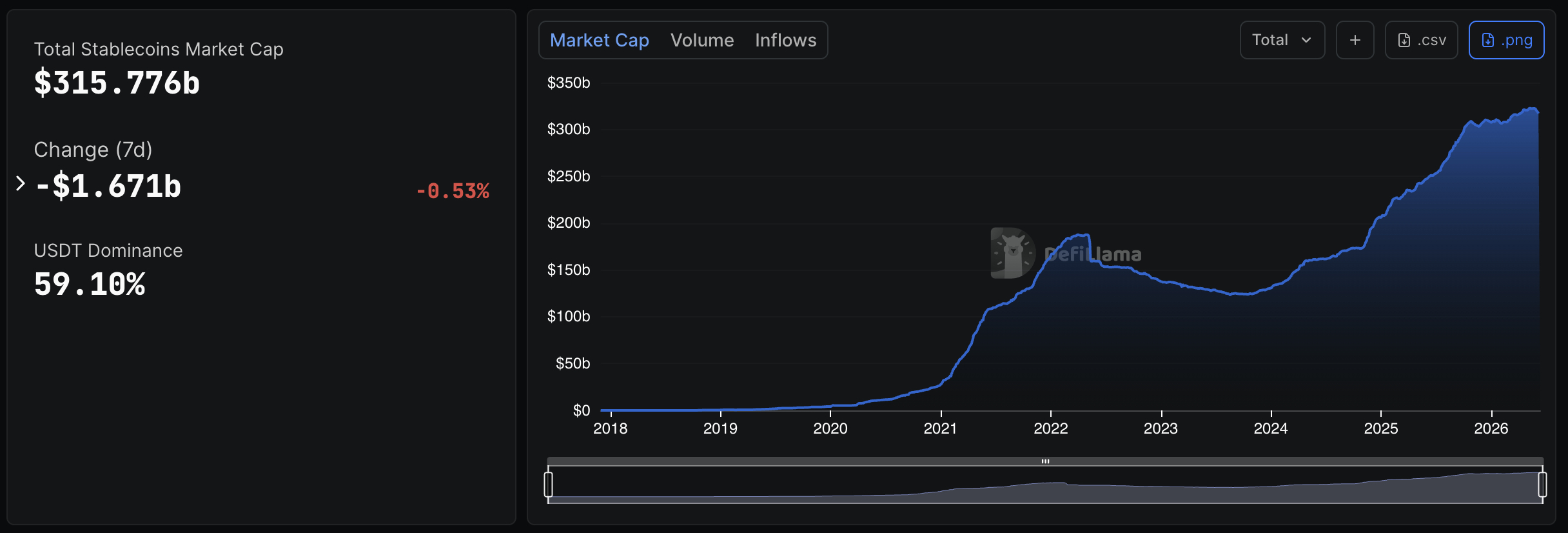
In the three weeks leading into the crossover, more than $7B exited the stablecoin sector while $400B was wiped from the total crypto market cap. Ethereum’s DeFi TVL slid to around $36B. Traders were not abandoning stablecoins; they were parking liquidity while shedding volatile assets.
USDT’s share of the total stablecoin sector sits at 59%, with USDT and USDC together accounting for 82%, which means Tether is not a peripheral player in this dynamic.
Discover: The Best Token Presales
Mike McGlone’s Warning: It Doesn’t Stop at Ethereum
Bloomberg Intelligence senior commodity strategist Mike McGlone has been tracking this trajectory longer than most. In October 2020, McGlone wrote that USDT, then at $16B against ETH’s $43B, was “on pace to match the market capitalization of Ethereum in a bit less than a year,” describing it as part of an “inexorable trend” toward stablecoins gaining mainstream footholds.
LATEST: — CoinMarketCap (@CoinMarketCap) February 13, 2026
 Bloomberg analyst Mike McGlone says Tether's USDT stablecoin is on track to eventually flippen both Ethereum and Bitcoin. pic.twitter.com/kiAbF30dbb
McGlone’s updated thesis goes further. He expects “the flippening to continue,” with Tether’s market cap topping Ethereum in 2026 and “eventually Bitcoin.” The extreme scenario he outlines: if Bitcoin falls toward $10,000, USDT, which would need to grow 7x from current levels, could eventually challenge BTC for the top spot.
We are not endorsing the $10,000 BTC scenario here. But dismissing it entirely because it sounds extreme is how people missed the USDT-flips-ETH call in the first place.
Discover: The Best Crypto to Diversify Your Portfolio
ETH and USDT Now: The Gap, the Recovery, and What Comes Next
As of today, Ethereum has reclaimed the second position in market cap rankings, but the margin is not comfortable. ETH would need to sustain meaningful price recovery, or Tether USDT issuance would need to plateau for the second place to feel secure again.
Neither is guaranteed. Structural improvements in Ethereum’s tech stack, including ZK-proof scaling developments, offer a longer-term bullish counterpoint, but those catalysts operate on a different timeframe than the near-term price weakness that enabled the June flip.

USDT’s supply trajectory shows no sign of reversal. Tether added $12.4B in a single quarter during a down market. In a neutral or risk-on environment, that pace could accelerate. At $1 peg, market cap and circulating supply are essentially the same number, so every new USDT minted is a direct market cap increment, without the price volatility that governs ETH’s ranking.
Discover: The Best Token Presales
The post Tether USDT Briefly Overtakes Ethereum in Market Cap: A $187B Wake-Up Call appeared first on Cryptonews.


Bitcoin whipsawed around the $64,000 level on Wednesday as multiple risk factors collided—weakness in Asian equities, fresh tensions around the US-Iran situation, and an approaching Federal Reserve decision that traders see as a near-term volatility trigger.
According to TradingView, BTC/USD struggled to extend a local rebound after the Wall Street open and was still wrestling with downside pressure following a move to 11-day lows near $62,700 the prior day. The broader selloff atmosphere was reinforced by additional stress in risk assets, including equity weakness tied to the semiconductor and AI complex.
Key takeaways
- BTC paused near $64,000 after dropping to roughly $62,700 on the prior session, suggesting demand has not fully returned.
- Equity weakness linked to Asian chip stocks appears to be spilling into US trading, pressuring crypto alongside traditional markets.
- Oil jumped after renewed US-Iran tensions, raising the risk that inflation expectations could move and complicate rate outlooks.
- Markets are split on the Fed’s next move: CME’s FedWatch Tool showed a majority probability for no change at current target levels.
- Bitcoin’s recent trading behavior looks range-bound between key moving averages, with potential liquidation clusters forming on both sides.
Risk assets stumble ahead of the Fed
Wednesday’s drawdown pressure extended beyond crypto. Trading activity reflected a broader risk-off posture that began with a selloff in Asian chip stocks, then carried into US markets. Cointelegraph previously reported that the cost to insure AI debt had reached new highs amid an Asian semiconductor pullback, framing the backdrop for heightened credit and equity sensitivity in the region.
Alongside the equity-driven drag, geopolitical nerves resurfaced. US President Donald Trump said the US would “be hitting them hard,” referring to tit-for-tat strikes linked to the US-Iran conflict, in an interview with Fox News. The immediate market implication was a rise in energy prices: WTI crude was up 7.6% and Brent crude was up 5.4%, according to the figures cited in the original reporting.
Oil price jumps can matter for crypto indirectly. They often feed into expectations for future inflation, and inflation expectations feed into interest-rate expectations. With the Federal Reserve preparing to deliver its next interest-rate decision, traders are likely to treat energy moves as one more input to a complex rate-volatility equation.
What the Fed decision could mean for BTC
Markets are waiting for the Federal Open Market Committee (FOMC) outcome, which will include a statement and a press conference by Fed Chair Kevin Warsh, according to the details described in the source. The reporting noted Warsh has provided less forward guidance than his predecessor, which increases the importance of any cues about the future path of policy.
According to CME Group’s FedWatch Tool data referenced in the original piece, there was a 66.3% probability that current target levels of 3.5%-3.75% would remain unchanged. A 0.25% hike was priced with 33.7% odds.
The Kobeissi Letter also highlighted that opinions were divided on what the Fed would do. In the same vein, the source described the pricing environment as unusually split, implying that BTC could see sharper-than-usual moves if the outcome or language deviates from what traders expect.
Bitcoin’s range trade: moving averages and liquidation zones
Before the next macro catalyst, BTC price action appeared technically constrained. As described in the original reporting, Bitcoin traded broadly within a range bounded by the 50-day simple moving average (SMA) and the 50-day exponential moving average (EMA). This kind of “between-the-guides” behavior often happens when market participants remain cautious—waiting for confirmation from macro data while liquidity thins.
The source added that the range structure began in mid-July, with breakouts failing as price encountered liquidity zones on both sides. That context helps explain why the market has not decisively moved away from the $63,500 to $64,900 corridor.
CoinGlass data cited in the original article pointed to potential liquidation buildup on both ends of the current range, with notable clusters around $63,500 and $64,900. In practice, these zones can act like magnets during volatile sessions: if price pushes into one side, leveraged positions are forced out, which can accelerate the move and widen the range temporarily.
Liquidity and positioning: why the move may start slowly
Even as liquidation risk builds, the source emphasized that trading activity remained subdued. Trading volumes were described as “conspicuously low,” with spot-market volume at its weakest level since July 2023.
K33 Research, in a bulletin referenced by the original report, attributed this to muted derivatives positioning and softer participation. The piece stated that CME open interest was near multi-year lows, perpetual futures open interest had stalled around 300,000 BTC, and average daily spot volume had fallen to about $2.2 billion for the month.
There’s also a behavioral angle to the current setup. The source noted that retail interest in both Bitcoin and the broader crypto market has been declining since the market’s October 2025 all-time highs, and that investors have increasingly directed attention toward AI stocks. When that rotational behavior persists, crypto can struggle to attract incremental spot demand—making BTC more sensitive to macro shocks and harder to sustain higher breakouts.
With the FOMC decision and press conference approaching, traders should watch whether the Fed’s communication shifts expectations for the rate path—especially given the inflation-sensitive impulse from oil—and whether BTC can hold its range boundaries or instead tests the liquidation clusters around $63,500 and $64,900. Until liquidity and participation improve, the next decisive move may arrive suddenly rather than gradually.
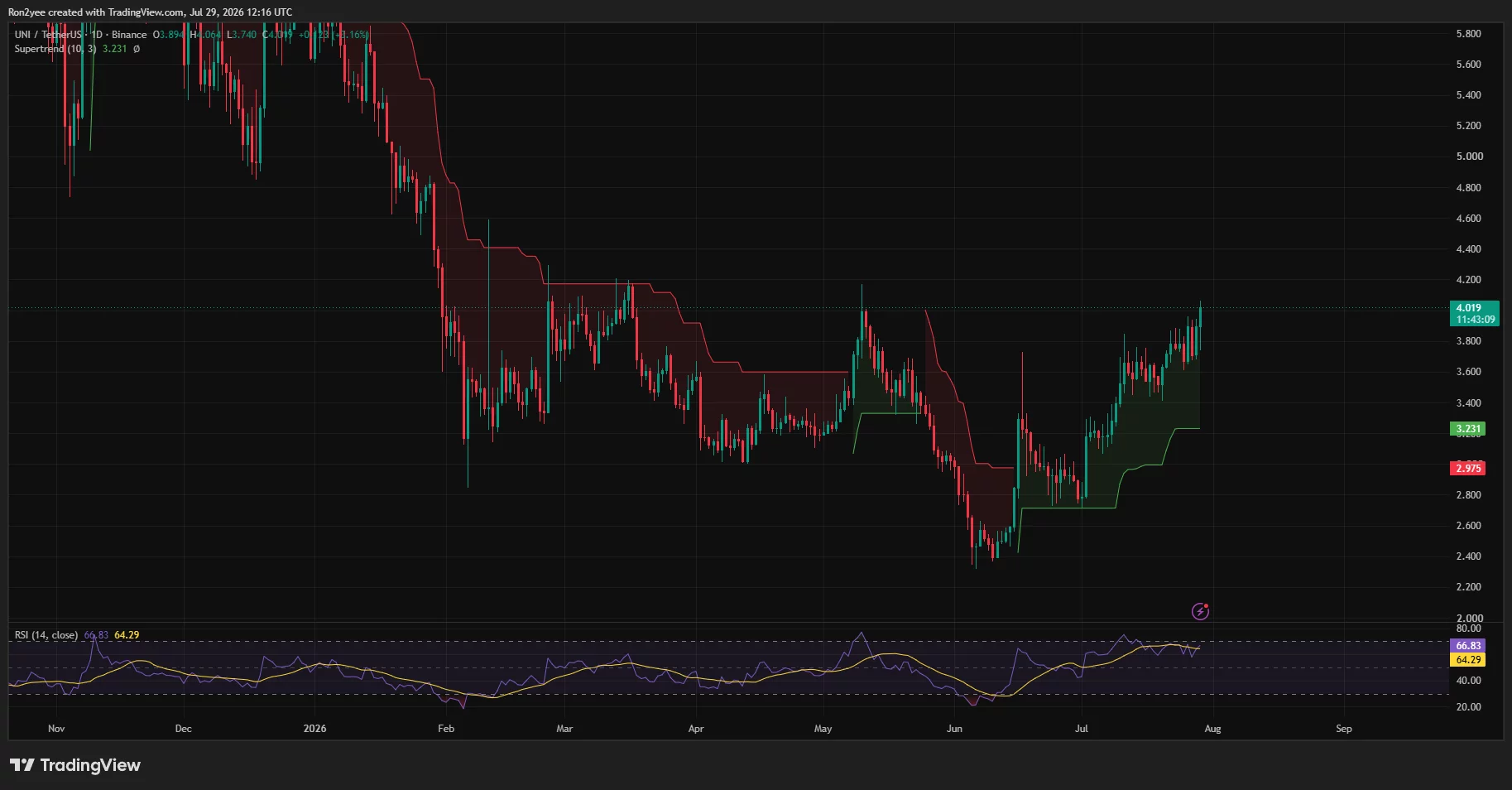
Uniswap price rebounded 8% from its July 29 intraday low as Hayden Adams addressed concerns over v4 protocol fees, helping UNI reclaim the $4 psychological level.
Summary
- UNI recovered from $3.74 to $4.06, producing an intraday rebound of more than 8%.
- Daily RSI reached 66.83, showing strong momentum without entering overbought territory.
- The 4-hour chart places immediate resistance between $4.10 and $4.30.
- A rising wedge and weak 19.77 ADX leave UNI exposed to a short-term pullback.
Uniswap price returns above $4
According to data from crypto.news, Uniswap (UNI) price traded at $4.02 at the time of writing after briefly reaching $4.06, according to the Binance daily chart. The intraday rebound from $3.74 amounted to about 8.5%, while the token was up roughly 3% from its daily opening price.
UNI has now recovered more than 70% from its June low near $2.35. The rally has formed a sequence of higher highs and higher lows, allowing the token to return to a price area last tested in May.
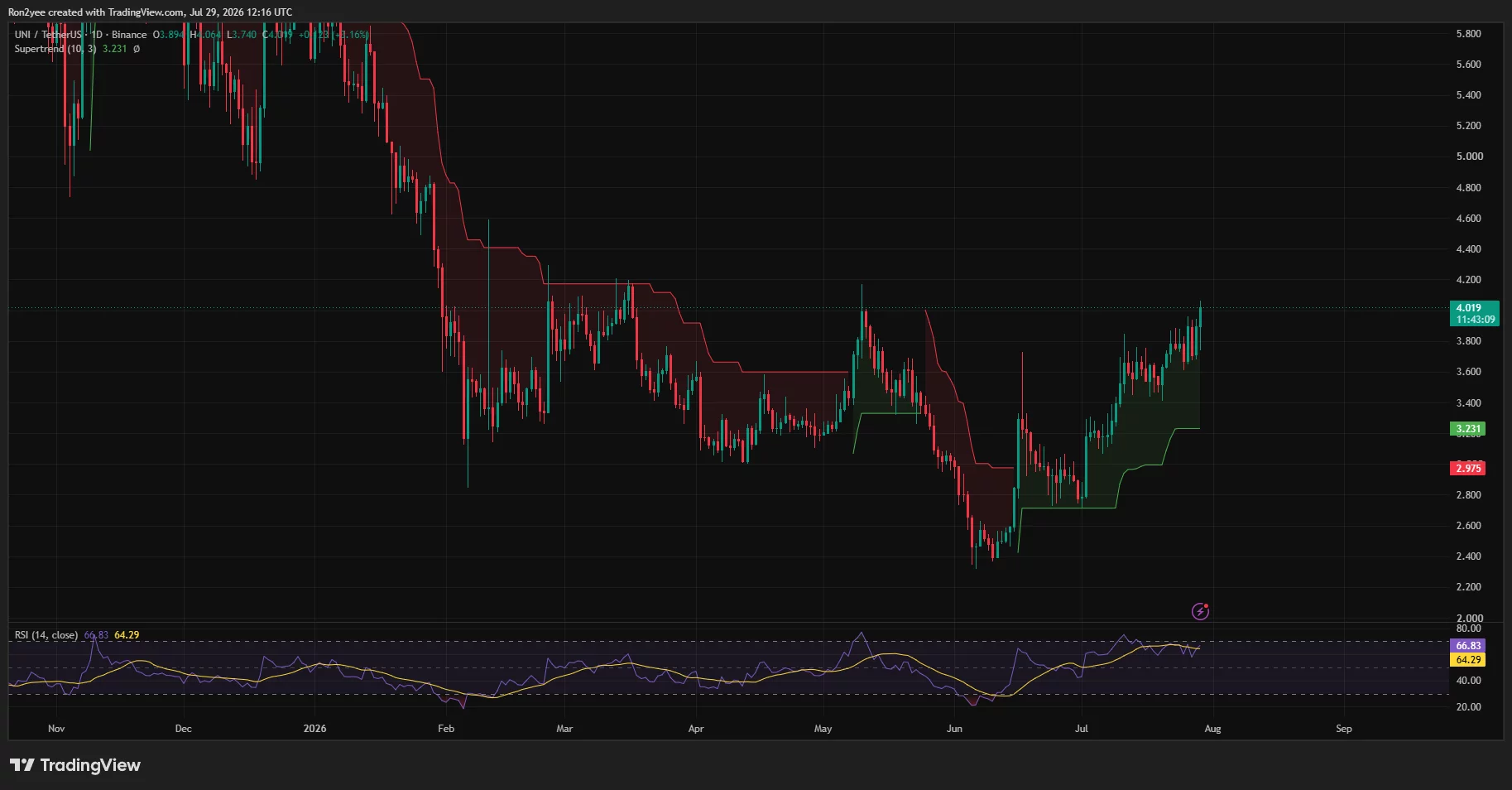
Momentum remains favorable on the daily timeframe. UNI is trading above its Supertrend support at $3.23, while the relative strength index has risen to 66.83. The RSI remains below the standard overbought threshold of 70, although the reading shows that buying conditions are becoming stretched.
The daily candle also approached the May swing high near $4.15. A close above that level would strengthen the case that UNI has moved beyond a temporary relief rally and entered a broader recovery phase.
Hayden Adams addresses Uniswap v4 fee concerns
The immediate move followed comments from Uniswap founder Hayden Adams about the protocol’s v4 fee structure.
Adams said the protocol fee would be added to the liquidity provider fee instead of being deducted from it. Under his example, traders using a pool with a 30-basis-point liquidity provider fee would pay 35 basis points in total. Liquidity providers would continue receiving 30 basis points, while five basis points would go to the protocol.
The clarification addressed concerns that activating protocol fees would lower returns for liquidity providers and potentially push capital toward competing decentralized exchanges.
Uniswap has also submitted governance proposals covering protocol fees from v4 pools and deployments on Robinhood Chain. The proposals would send new protocol revenue into the existing UNI burn mechanism, creating a clearer connection between exchange activity and the token’s circulating supply.
That connection has gained attention since Robinhood Chain launched on July 1. Uniswap generated about $5.16 million in fees during one 24-hour period earlier this month, according to DefiLlama data cited by crypto.news. Roughly $4.38 million came from Robinhood Chain.
Uniswap volume on the network crossed $1 billion within nine days of launch. However, future UNI burns will still depend on governance approval, fee collection and sustained trading activity.
UNI faces resistance between $4.10 and $4.30
The 4-hour chart shows that UNI has moved above the $4.00 top of its recent trading range. The next technical level sits at $4.10, identified by the Murrey Math indicator as a strong reversal pivot.
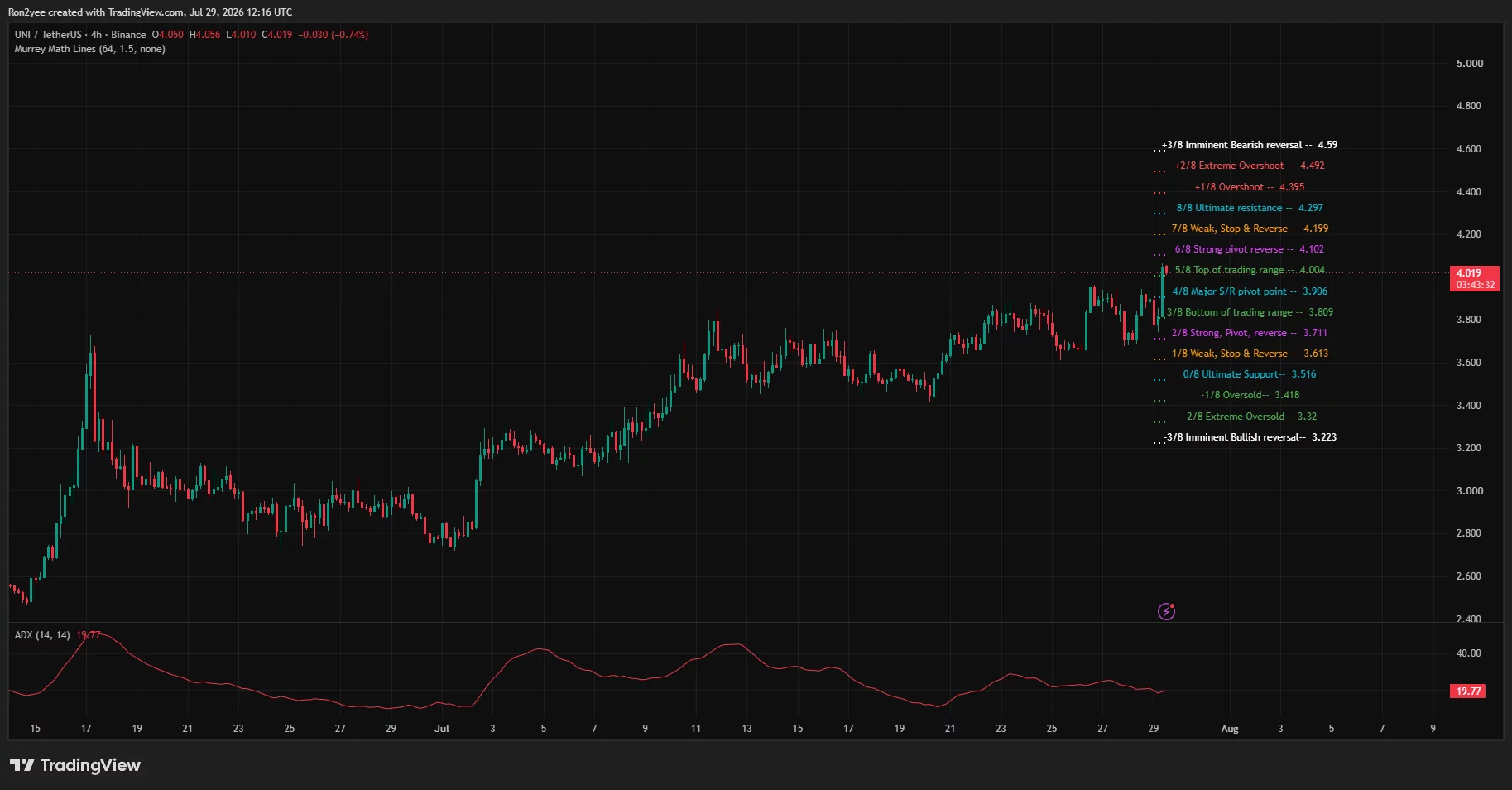
A sustained close above $4.10 could open the path toward $4.20 and $4.30. The latter represents the indicator’s ultimate resistance level. Beyond that, the chart places extended targets at $4.40, $4.49 and $4.59.
However, the average directional index stands at 19.77. An ADX reading below 20 suggests that the current trend has not yet developed strong directional conviction, despite the price breakout.
The one-week CoinGlass liquidation heatmap also shows a dense concentration of leveraged positions around $3.98 to $4.03. UNI’s move through this area likely forced some short sellers to close their positions, adding buy pressure to the rebound.
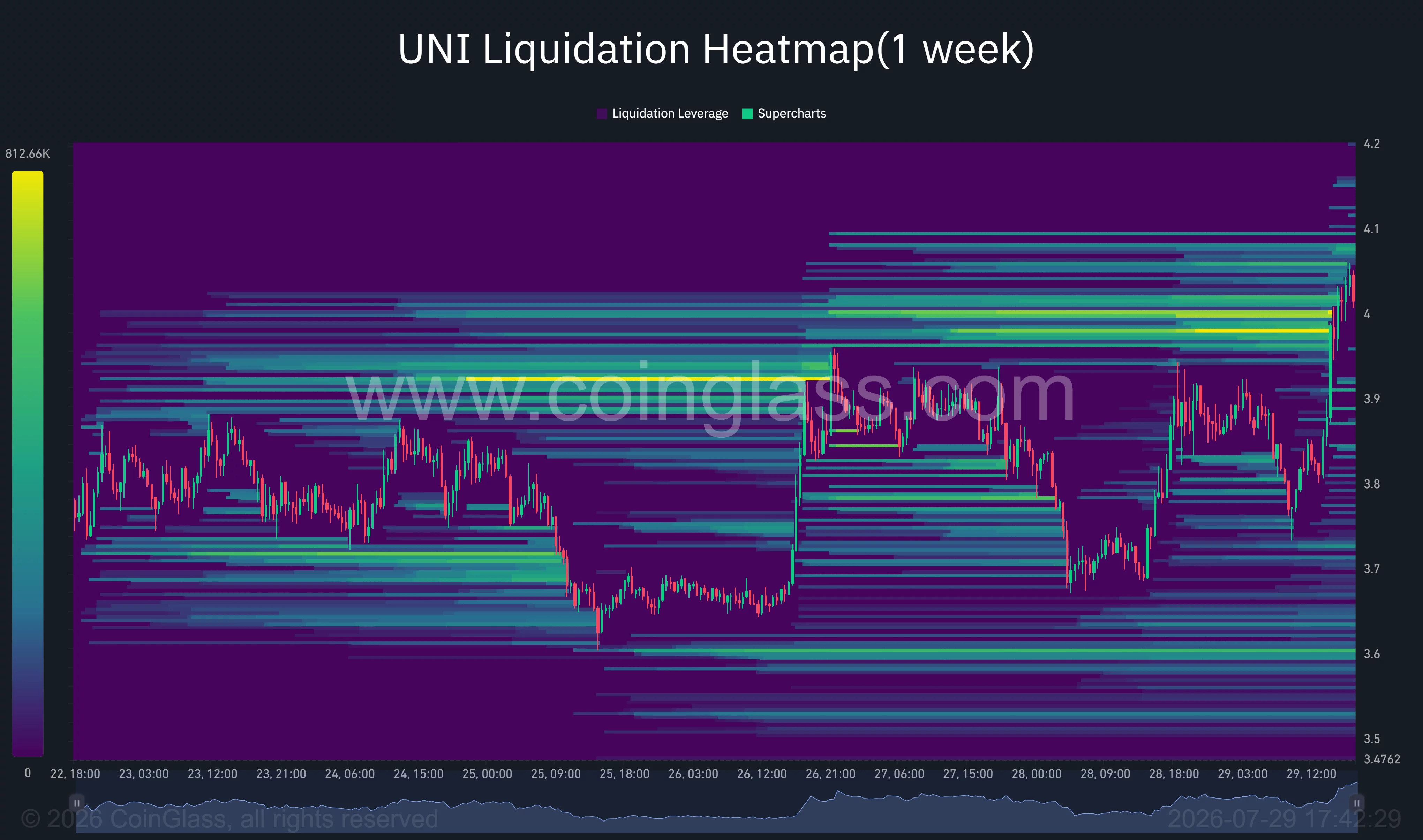
Additional liquidity is visible near $4.07 to $4.10, making that zone a possible short-term price target. On the downside, the main liquidity clusters sit near $3.90, $3.72 and $3.60.
If UNI loses $4.00, the 4-hour chart identifies $3.91 as the first support. Lower levels appear at $3.81 and $3.71. The bullish structure would weaken more clearly below the $3.52 support zone.
Analysts see breakout and pullback scenarios
Analyst Gopal identified a rising wedge on the UNI chart, noting that the token continues to form higher highs and higher lows inside a narrowing structure.
According to the analyst, repeated tests of wedge support suggest that bullish momentum may be losing strength. A confirmed break below the lower trendline could cause a deeper correction, while a breakout above the upper boundary would invalidate the bearish setup.
Nebraska Gooner also described UNI as being at resistance. The analyst said reclaiming the red resistance area on his chart could create a moving-average squeeze and lead to a stronger rally. His setup points toward the $5 region if UNI establishes support above the current barrier.
The two views make the $4.10–$4.30 range central to UNI’s next move. A confirmed breakout would reduce the risk posed by the rising wedge, while rejection could send the token back toward $3.80 or the ascending support line.
US macro conditions remain a risk for UNI
Uniswap’s growth on Robinhood Chain gives the rally a direct US market connection. The network has brought decentralized trading infrastructure closer to Robinhood’s user base, while Uniswap’s Permissioned Pools could support tokenized funds and equities subject to investor eligibility rules.
Uniswap Labs launched Permissioned Pools with Securitize, Superstate and Dowgo as early participants. The v4-based framework allows issuers to control which wallets can trade or provide liquidity, making it more suitable for regulated assets.
Still, UNI’s breakout comes ahead of a Federal Reserve rate decision that could drive volatility across US stocks and crypto. A hawkish policy signal could reduce demand for risk assets, and pressure leveraged UNI positions.
UNI must therefore hold above $4.00 and clear $4.10 to confirm the breakout. Failure to do so would leave the rising-wedge warning active, with $3.81 and $3.71 serving as the next levels to watch.
Disclosure: This article does not represent investment advice. The content and materials featured on this page are for educational purposes only.

The American Arbitration Association (AAA), one of the world’s best-known providers of private dispute resolution, has launched a dedicated panel aimed at blockchain and digital-asset disputes. The move is designed to connect companies with arbitrators who can handle both the legal and technical complexities that increasingly arise in crypto-related commercial relationships.
Announcing the initiative on Wednesday, the AAA said its new Web3 Panel brings together specialists with experience spanning law, technology, academia, litigation, and digital-asset businesses. The panel focuses on disagreements tied to decentralized and highly automated systems as they become more common in day-to-day commerce.
Key takeaways
- AAA’s Web3 Panel is intended to provide arbitrators with blockchain and digital-asset expertise for complex, technical disputes.
- The scope includes contract interpretation, governance questions, asset control, cybersecurity issues, and disputes over transaction records.
- The panel also targets emerging “agentic commerce” cases, where software or AI systems may execute agreements with limited human involvement.
- Arbitration still depends on both parties agreeing to submit a dispute to private arbitration—AAA does not regulate the crypto industry.
Why AAA is building a specialized Web3 arbitration panel
As blockchain networks move from experimental use to more structured commercial workflows, disputes are evolving alongside the technology. According to the AAA, its Web3 Panel is meant to address conflicts arising from “increasingly automated and decentralized commercial systems,” where business arrangements can be influenced by code, on-chain records, and distributed governance mechanisms.
That shift matters because many of the practical friction points in crypto are not purely legal. They can involve how smart contracts behave, what data is recorded on-chain, and how to interpret technical evidence in a dispute. The AAA’s framing suggests that mainstream dispute resolution institutions see demand for arbitrators who can communicate across legal reasoning and technical realities—without treating those domains as separate problems.
The AAA also highlighted the kinds of issues parties may bring to arbitration. The panel is designed to cover disagreements related to:
- Contract interpretation in technical environments, including how automated terms operate in practice.
- Governance questions in systems where decision-making may be decentralized or code-driven.
- Asset control disputes, where access permissions and operational control can be complex.
- Cybersecurity incidents and related responsibility questions.
- Transaction records and disputes over what those records show in evidentiary terms.
- Cross-border enforcement considerations tied to international counterparties.
Who is behind the panel
The AAA said the Web3 Panel assembles arbitrators with experience across multiple disciplines, reflecting the breadth of questions that can appear in crypto cases. It cited initial members including lawyers who specialize in digital-asset and technology disputes, along with University of Pennsylvania law professor David Hoffman and Rich Widmann, identified as Google Cloud’s global head of Web3 strategy.
Beyond specific names, the AAA’s description points to a deliberate blend of perspectives. The institution emphasized experience not only in legal practice and litigation, but also in the technology and academic environments that often influence how smart contracts and blockchain governance are understood.
Eric Dill, the AAA’s senior vice president and head of panel relations, said: “Web3 disputes involve familiar commercial questions in a highly technical environment.” The quote underscores what the AAA appears to be trying to solve: keeping familiar business law issues from getting derailed by gaps in technical comprehension, especially where automated systems produce records and outcomes that become central to the case.
Agentic commerce and disputes involving autonomous transactions
One of the panel’s notable elements is its coverage of disputes involving agentic commerce and autonomous transactions. The AAA describes this as scenarios where software—or artificial intelligence systems—may initiate or carry out agreements with limited human involvement.
This is a meaningful extension of traditional arbitration needs. In conventional contracting, human decision-making and signatures tend to play a direct role in how obligations are formed. In agentic systems, however, the “decision maker” may be code executing according to rules, and the party seeking enforcement may argue the system acted within its programmed authority. Disagreements can quickly become both legal and technical: what the system was designed to do, what it actually did, and who bears responsibility when outcomes are unexpected.
While the AAA did not lay out specific example scenarios, its inclusion of agentic commerce signals that dispute resolution frameworks may have to adapt not only to blockchain-based evidence, but also to the contractual questions raised by automation and AI-driven execution.
What the launch does—and doesn’t—change
The AAA’s Web3 Panel is structured as an arbitration resource, not a regulatory body. The institution said it does not give AAA regulatory authority over the crypto industry. Arbitration typically requires that the parties involved agree to submit their dispute to a private arbitrator, meaning companies must usually opt in through contract terms or other mutual arrangements.
For investors, operators, and companies building onchain or integrating digital assets into commercial workflows, the practical implication is that dispute resolution options are becoming more specialized. A dedicated panel may make it easier to find arbitrators who can evaluate technical claims—such as how a smart contract performed, how governance processes operated, or how transaction evidence should be interpreted—without forcing parties to educate arbitrators from scratch.
At the same time, the existence of a panel doesn’t automatically solve bigger questions about standards for responsibility, liability, and evidence in decentralized systems. Those issues still depend heavily on each case’s facts and the agreement between the parties, including whether arbitration is explicitly chosen.
Related coverage from Cointelegraph noted how AI is being layered into legal workflows as agentic commerce accelerates. The AAA’s panel launch appears aligned with that trend: as autonomous systems become more common, the legal ecosystem—including dispute resolution—may increasingly need subject-matter expertise that spans both code and contract law.
Next steps for companies considering arbitration clauses
Companies using blockchain-based contracting, governance, or automated transaction workflows should watch how arbitrators on the AAA’s Web3 Panel approach technical evidence and cross-border enforcement questions—especially as agentic commerce becomes more mainstream. The immediate uncertainty is less about whether such panels will exist, and more about how parties will incorporate arbitration provisions into agreements and how quickly specialized expertise translates into more predictable outcomes.

In July 2025, a judge sentenced criminology graduate student Bryan Kohberger to life in prison after he pleaded guilty to stabbing four college students to death on Nov. 13, 2022, at a house near the University of Idaho’s Moscow, Id., campus. The students were Ethan Chapin, 20, Kaylee Goncalves, 21, Xana Kernodle, 20, and Madison Mogen, 21.
A year later, Kohberger told the New York Times in a phone call from prison that he’s filed a petition challenging his conviction, arguing that he is innocent and did not mean to confess to the killings. “A lot went wrong in those plea discussions,” he told the Times from a maximum security prison south of Boise. “I really do want that to be heard.”

Filippi explains that the storms created by the pyrocumulonimbus, which loom over the fire, create gusts of wind, which in turn lead the water vapor further into the clouds.
“Then the fire is raging more and propagating at [a] higher speed with more energy, so it injects even more water vapor. The cloud is getting bigger, and then it is sucking air [in a stronger way]. Then you have this feedback loop, making an acceleration,” Filippi says.
Those conditions make fires more difficult to contain because the feedback loop continually strengthens both the fire and the cloud above it.
Additionally, studies have found wildfire smoke can make some clouds denser, making it harder for them to drop rain that could help dampen the fires.
Even when water droplets do fall, if the rain is falling into hot air, “it’s gonna evaporate before it reaches the ground,” Filippi says.
Instead, “you’re gonna have a big downdraft. You’re gonna have thunder. Then you can have some other effects, like lifting ashes up into the stratosphere,” he notes, adding that the ash could later fall onto neighboring areas, raising the need for precautionary evacuation measures.
Trade.xyz, an operator of onchain perpetual markets on Hyperliquid, said it will cover eligible liquidation losses after a price anomaly hit its contract tracking SK Hynix, a South Korean chipmaker and producer of high-bandwidth memory for artificial intelligence.
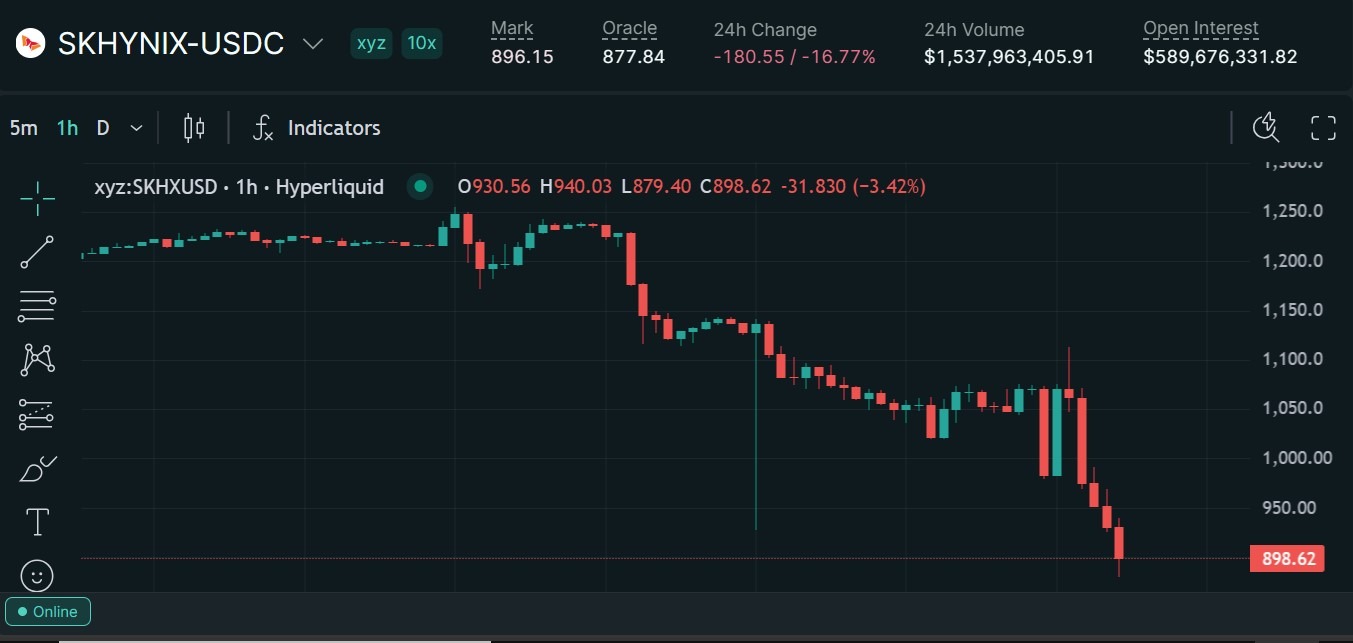
Trade.xyz said the SKHYNIX contract’s mark price fell to $917.25 from $1,127.90 at 23:01 UTC on Monday after an executed trade was relayed by multiple independent data providers. Eligibility requirements will be announced soon, with distributions expected in the coming days.
The SK Hynix contract ranks among Hyperliquid’s most active markets. On Wednesday, Hyperliquid data showed the contract had generated over $1.5 billion in 24-hour volume and held nearly $600 million in open interest at the time of writing.
Trade.xyz said its oracle was tracking the external venue used as the primary South Korean pre-market and had “worked as intended according to its specification.” It acknowledged traders’ frustration and described the reimbursement as a “one-time discretionary decision,” adding that it would review how prices are formed during extreme market events.
The platform did not disclose how many traders would qualify for reimbursement or the total amount it expects to distribute.
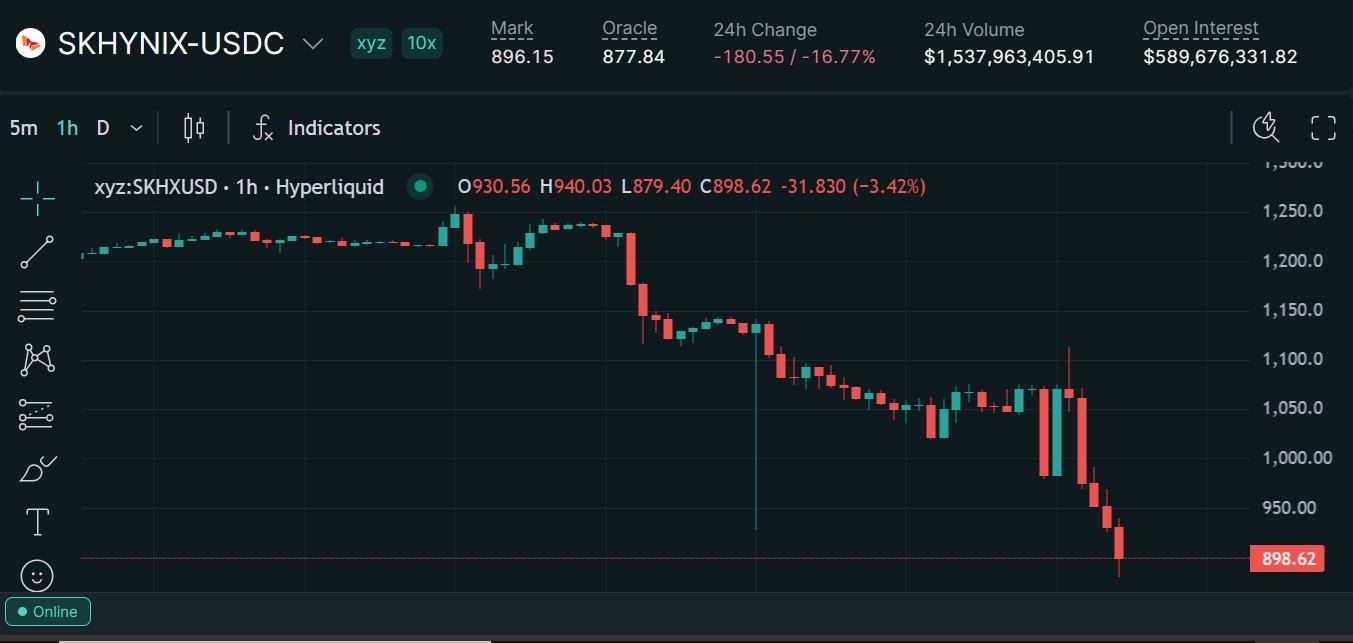
SK Hynix trading chart. Source: Hyperliquid
How the anomaly reached the perpetual market
Trade.xyz said the sharp move originated from an executed transaction on an external market rather than its own order book. Its SK Hynix oracle tracks the US dollar value of one SKHX common share by converting the underlying Korean won price using the prevailing exchange rate, according to its documentation.
The external print fed into the oracle and contributed to the contract’s mark-price move. Hyperliquid uses the mark price to value positions for margin purposes and determine when leveraged positions should be liquidated.
The platform said it is considering giving more weight to prices formed on its own order books, which it said now provide meaningful liquidity and market signals.
Related: Onchain commodity trading is here to stay, but liquidity remains an issue
Trade.xyz operates under Hyperliquid’s HIP-3 framework, which allows builders to launch perpetual contracts tied to assets with external price feeds.
The platform accounted for more than $22 billion of HIP-3’s first $25 billion in cumulative volume and later launched an officially licensed S&P 500 perpetual using S&P Dow Jones Indices data.
Magazine: How Hong Kong is turning tokenized bonds into real market infrastructure

Bitcoin dipped below $63,000 yesterday ahead of the FOMC meeting today but has recovered well over a grand since then.
Prominent analyst Joao Wedson identified on-chain data that suggests BTC is nearing a historically significant accumulation zone.
Long-Term Holders Take Control
In his latest tweet, Wedson explained that he divided the Long-Term Holder Realized Cap by the Short-Term Holder Realized Cap to track where the market’s realized capital is concentrated. According to the Alphractal founder, Bitcoin formed major price bottoms on two previous occasions when this ratio moved above 4. The metric currently stands at 3.9, which means the market is approaching that historically important threshold.
The reading indicates that a much larger share of realized capital is now held by Long-Term Holders than by Short-Term Holders, which demonstrates a shift toward investors with stronger conviction while short-term speculative participation remains relatively limited.
Wedson added that this type of market structure has previously emerged during “advanced” accumulation phases, when weaker hands exit, and ownership moves to long-term investors. Alphractal stated,
“It does not confirm that the exact bottom is already in. However, it shows that Bitcoin is approaching a zone that previously appeared during major cycle-bottom formations.”
A similar view was echoed by Santiment, which found that wallets holding between 10 and 10,000 BTC increased their stash by 19,696 during the eight-day period it tracked. Meanwhile, wallets with less than 0.01 BTC displayed weaker dip-buying activity. On the institutional front, Bitcoin ETFs recorded around $172 million in inflows in July. These factors, combined, make the overall setup “constructive” as supply continued shifting toward stronger hands, Santiment noted.
MVRV Differs From Past Cycles
All eyes are on Bitcoin’s current position in the market cycle. Trader Ardi said the asset’s MVRV ratio currently stands at 1.21, well above the levels seen at previous bear market lows of 0.69 in 2018 and 0.75 in 2022. The metric compares BTC’s market value with its realized value to show how far the price trades above or below the network’s aggregate cost basis.
Based on those historical levels, Ardi said that it has not reached the same degree of capitulation seen in the last two cycles. However, he added that volatility is compressing and cycle extremes are becoming less severe. Because of that, he believes MVRV could form a higher low during this cycle.
The post What Does Bitcoin’s 3.9 Holder Ratio Tell Us About the Market Right Now? appeared first on CryptoPotato.


Pascal Caversaccio joins the Ethereum Foundation’s four-member board as the organization elevates privacy and security in its protocol strategy.

Ten European financial institutions have formed a jointly owned blockchain cooperative called Regulated Layer One (RL1), aiming to provide shared infrastructure for tokenized assets and regulated market workflows. The initiative positions RL1 as a “permissioned” network built for institutional use rather than public, open participation.
RL1 announced that it has been established as a European Cooperative Society in Luxembourg and has started operations with founding members including ABN AMRO, Cecabank, Chartered Investment, Crédit Mutuel Alliance Fédérale, DekaBank, DZ BANK, LBBW, Natixis CIB, SC Ventures, and Seturion. The group says governance is structured so that each member holds equal decision-making rights over the network’s development and direction.
Key takeaways
- RL1 is launching as a European Cooperative Society in Luxembourg, bringing 10 founding financial institutions into a shared, permissioned blockchain network.
- The network is governed on an equal voting basis among members, with plans to expand participation to additional institutions.
- RL1 is built on infrastructure previously developed by German fintech Secure Worldwide Interbank Asset Transfer (SWIAT).
- SWIAT reported processing more than 50 transactions worth over €700 million during three years of production use.
- The cooperative targets regulated institutional use cases such as tokenized bonds, collateral, and settlement for digital money.
From SWIAT infrastructure to a member-owned cooperative
RL1’s launch centers on a shift in ownership from the previously developed SWIAT platform to the cooperative structure. According to RL1, SWIAT has transferred ownership of the network to the cooperative, effectively moving the project from a vendor-led or sponsor-led stage into a jointly controlled model.
That transition matters because institutional blockchain projects often struggle not only with technology, but also with long-term governance, shared standards, and accountability. By placing decision-making in a cooperative framework, RL1 is attempting to reduce the “single-rail” problem—where multiple institutions build or operate separate ledger systems that may not interoperate cleanly.
For its part, RL1 says the permissioned design is intended to fit regulated environments and institutional processes, rather than trying to replicate the accessibility and openness typical of public blockchain networks.
Reported production usage and the scope of institutional applications
RL1 says its underlying platform has already been used in production for three years. SWIAT reported that the system processed more than 50 transactions with a total value exceeding €700 million (about $808 million). While the report does not specify the exact nature of every transaction type, RL1 frames the technology around institutional patterns such as tokenized bonds, collateral, digital money, and blockchain-based settlement.
RL1 also argues that using a shared network could help address fragmentation across financial markets—especially where banks and other institutions deploy distinct distributed ledger systems. In practical terms, fewer separate ledgers can reduce duplicated development, simplify integration efforts, and potentially speed up cross-institution settlement experiments.
Still, investors and builders will likely want to watch whether RL1’s cooperative model translates into measurable interoperability advantages—such as smoother settlement across participating institutions—rather than remaining primarily a governance and pilot-coordination framework.
Governance, leadership, and expansion plans
Leadership for RL1 will be led by former SWIAT managing director Henning Vollbehr, with KfW and L-Bank continuing to provide support for the initiative. RL1 did not detail the precise structure of ongoing involvement from these backers, but their continued support signals that the project retains institutional and policy-level sponsorship beyond the initial founding members.
On expansion, RL1 said it is already in discussions with additional institutions, including NatWest, about joining the network. The cooperative’s equal decision-making rights among members may become a central factor in future growth: as more institutions join, governance will need to scale without diluting consensus or slowing development.
The network’s success will likely depend on attracting participants with complementary use cases—such as custody, issuance, market settlement, and collateral management—while ensuring that shared standards hold up as the number of stakeholders increases.
Why RL1’s cooperative model could matter for tokenized markets
Tokenization in traditional finance has progressed in bursts, often driven by pilots and consortia, but scaling remains difficult when participants operate on disconnected infrastructures. RL1’s emphasis on reducing fragmentation directly targets one of the sector’s recurring friction points.
At the same time, it’s important to recognize that RL1 is permissioned, meaning access and participation are restricted relative to public networks. That tradeoff can be beneficial for compliance and integration in regulated markets, but it also raises questions about interoperability with other ledgers and token ecosystems—particularly if tokenized assets are expected to move across platforms over time.
For market participants, the key watch item is whether RL1 evolves from “shared infrastructure” into a platform with demonstrable deployment outcomes—such as repeatable settlement flows, standardized token mechanics, and smoother inter-institution operations—rather than limited transaction counts typical of early-stage pilots.
As RL1 begins operations in Luxembourg, the next signals to monitor will be how quickly additional institutions join, what concrete tokenization and settlement workflows are prioritized, and whether the cooperative’s shared governance model leads to faster, more scalable execution compared with earlier, siloed distributed ledger efforts.

XRP price is trading around $1.09, up about 3% over the past 24 hours, as a regulatory catalyst from Hong Kong gives traders a fresh prediction that defends the dollar level. The bounce is real, although whether it continues depends on follow-through buying.
OSL HK, Hong Kong’s first licensed retail crypto exchange, confirmed through its official channels that retail users can now trade XRP against the U.S. dollar on its Flash Trade platform. OTC trading is also available through XRP/USD and XRP/HKD pairs. That puts XRP alongside BTC, ETH, and SOL among the few assets approved for retail trading on the licensed venue.
The wait is over! XRP is now LIVE for retail investors on OSL HK. Whether you're using Flash Trade or OTC, we’ve got you covered with secure, lightning-fast execution. — OSL (@osldotcom) July 29, 2026
Read the details below and start trading right now! https://t.co/iPTbsl6j2N
The approval carries more than symbolic value. Hong Kong’s regulatory framework supports compliant digital asset trading and could attract fresh institutional and retail participation. That gives XRP greater visibility in one of Asia’s leading financial centers and may strengthen demand over time.
Even so, traders are still waiting for stronger confirmation before pushing prices higher. XRP has held near $1.09 despite the positive catalyst, showing buyers are defending support while watching for the next catalyst. For now, the Hong Kong listing improves XRP’s regulatory standing, but sustained gains will still depend on continued buying pressure.
Discover: The Best Crypto to Diversify Your Portfolio
XRP Price Prediction: Reclaim $1.15 After the Hong Kong Catalyst?
XRP is trading around $1.09, with a 24-hour range of roughly $1.06 to $1.09. That fits the current technical picture. The lower boundary near $1.06 continues to attract buyers, while the $1.09 area remains the first resistance traders need to clear.
Three scenarios remain in play. In the bullish case, buying follows the Hong Kong retail listing, XRP closes above $1.09, and momentum extends toward $1.15 to $1.18. The base case sees XRP consolidating between $1.06 and $1.09 as traders digest the catalyst without a decisive breakout.

The bearish case appears if crypto markets lose momentum and XRP falls below $1.06. That would weaken the recent rebound and bring the $1.03 support area back into focus. Even so, buyers have defended the lower end of the range during recent pullbacks.
The OSL listing is a genuine demand-side catalyst. More trading access creates more opportunities for retail participation and potential buying activity. It does not guarantee a breakout, but it strengthens XRP’s long-term market structure. After several days of consolidation, a regulated retail listing in Hong Kong could provide the spark that traders have been waiting for. Watch the $1.09 level closely.
Trade XRP on Bybit and Get a Chance to Win Our $1,000 USDT Airdrop
Bitcoin Hyper Targets Early-Mover Upside as XRP Tests Key Levels
XRP at $1.09 is a recovery, not a revelation. Even a clean break to $1.18 represents just 8% upside from current levels. It’s respectable, but capped by the weight of a 62.47 billion token circulating supply and a market cap already deep in the tens of billions.
For traders eyeing asymmetric early-stage exposure while XRP sorts out its range, Bitcoin Hyper is attracting serious attention in the presale market. Hyper is positioning itself as the first Bitcoin Layer 2 with full Solana Virtual Machine (SVM) integration, sub-second smart contract execution on top of Bitcoin’s security model, without sacrificing BTC’s trust layer.
The presale has raised just a nod below $33 million at a current token price of $0.0136838, with high-APY staking available to early participants. The core thesis is straightforward: Bitcoin’s programmability ceiling is a known constraint, and any infrastructure that credibly removes it. It has fast execution, low fees, a decentralized canonical bridge for BTC transfers that captures value from both the BTC ecosystem and the broader DeFi migration.
Research Bitcoin Hyper’s full terms before committing capital.
Discover: The Best Token Presales
The post XRP Price Bounces as Hong Kong Pushes Ripple Retail Trading appeared first on Cryptonews.

Athletics’ 1B Nick Kurtz leaves early after being hit in wrist by pitch in game vs. Red Sox

Verizon scores $1 billion Google deal to connect its data centers to dark fiber – but is this only the beginning?

Bitcoin stalls as split FOMC meets amid Iran-war oil shock (+8%)


-

 Fashion5 days ago
Weekend Open Thread: Brooks Brothers
-
 Sports3 days ago
Commonwealth Games boxing: Jadumani Singh seals dominant 5-0 win over Pakistan’s Sumama Rehman to enter quarter-finals | Commonwealth Games News
-

 Tech3 days ago
Intel is reversing course and bringing hyper-threading back to its server chips
-

 Business6 hours ago
Why Trees Belong on the Risk Register
-

 Politics3 days ago
Luke Littler dismantles Gerwyn Price to retain title in Blackpool
-

 Crypto World4 days ago
Ripple bought a bank in pieces. The $4 billion audit
-
 Entertainment6 days ago
A New Post-Apocalyptic Gundam Anime Series Blasts Into SDCC
-

 News Videos3 days ago
BITCOIN JUST ENTERED THIS CRITICAL ZONE…
-

 Politics2 days ago
The Part of the Electric Transition Nobody Wants to Discuss
-

 Sports6 days ago
2026 3M Open leaderboard: Scottie Scheffler finds putter in Round 1, sits three back
-

 Fashion6 days ago
16 Dresses for the High Summer Event
-

 News Videos6 days ago
The Peugeot Family: How 200 Years of an “Old Money” Dynasty Died in A Boardroom
-

 Business21 hours ago
Major shareholder moves on Canyon
-

 Crypto World4 days ago
XRP Ledger adds $2.6B as RWA inflows rank second
-

 Politics4 days ago
Spain sweeps the board at 2026 World Cup with individual awards
-

 Crypto World7 days ago
Uniswap (UNI) pushes deeper into tokenized RWAs with permissioned trading pools
-
 Entertainment1 day ago
‘Stargate’ Creator’s New Sci-Fi Series Returns for Season 3 Tomorrow
-
Crypto World7 days ago
SEC Agrees to Overhaul Recordkeeping After Settling Coinbase Lawsuit Over Gensler’s Lost Texts
-

 Tech5 days ago
Anthropic launches Claude Opus 5, a cheaper AI model for coding, agents and enterprise workflows
-

 Entertainment4 days ago
Sara Gilson Killed By Husband After Viral “Pedophile” TikTok Video
You must be logged in to post a comment Login