

Crypto World
Strategy Inc. Hints at More Bitcoin Purchases as Saylor Posts Cryptic Market Tease


TLDR:
- Strategy Inc. holds 845,256 BTC worth $54.36B, averaging $75,682 per coin and sitting 15% underwater.
- Saylor’s “still adding dots” post signals another Bitcoin buy following the June 8 purchase of 1,550 BTC.
- CEO Phong Le confirmed the 32 BTC sale was a process test, not a move to fund dividends or cut exposure.
- Public companies now hold 5.5% of Bitcoin’s supply, with Strategy remaining the largest corporate holder.
Strategy Inc. is signaling another Bitcoin purchase as founder Michael Saylor posted a cryptic hint on social media.
The company, formerly known as MicroStrategy, currently holds 845,256 BTC valued at approximately $54.36 billion.
With an average acquisition price of $75,682 per coin, the position sits roughly 15% underwater at current market prices near $64,000. Saylor’s latest post has reignited debate around the company’s aggressive treasury strategy.
Saylor’s X Post Sparks Fresh Bitcoin Speculation
Michael Saylor took to X with a brief but loaded message directed at Bitcoin watchers. Referencing Strategy’s current holdings of 845,256 BTC at a $54.36 billion value, he closed the post with the phrase “still adding dots.” The crypto community widely interprets that phrase as a signal that another purchase is imminent.
The timing of the post comes just days after Strategy’s most recent acquisition. The company purchased 1,550 BTC on June 8, continuing a buying pattern that stretches back several years. Each purchase reinforces Saylor’s long-standing belief in Bitcoin as a superior treasury reserve asset.
Strategy’s year-to-date Bitcoin yield stands at 12.8%. That figure measures the growth in Bitcoin per share, a metric the company uses to track the effectiveness of its strategy. Despite the current unrealized loss, the yield number remains a key talking point for Strategy bulls.
Critics, however, continue to raise concerns about the company’s financial exposure. Strategy carries over $10 billion in debt and share obligations tied to its Bitcoin strategy. Any sustained drop in Bitcoin’s price could put pressure on the company’s ability to service that debt.
Strategy CEO Addresses Bitcoin Sale and Company Financing Plans
Strategy CEO Phong Le appeared on CNBC on June 11 to address questions about a recent, small Bitcoin sale. Le confirmed the company sold 32 BTC, explaining that the move was done mainly “to inoculate the market and test its internal selling process.” The transaction was also structured to generate tax losses that can offset related tax liabilities.
On the question of dividends, Le was direct. “The sale was not meant to pay dividends,” he said, noting that Strategy still has access to several other financing channels for that purpose.
The transaction represented a procedural test rather than any shift in the company’s Bitcoin-first treasury philosophy.
However, Le left the door open for future Bitcoin sales under the right conditions. He stated that “if selling Bitcoin is beneficial to common shareholders, the company may choose to do so.” That position marks a nuanced but notable clarification of Strategy’s publicly stated approach.
Meanwhile, public companies collectively hold about 5.5% of Bitcoin’s total supply. Strategy remains by far the largest corporate holder, and its continued accumulation keeps it at the center of institutional Bitcoin conversations.


TLDR:
- Zimbabwe’s Finance Minister has issued the country’s first dedicated regulations for virtual asset service providers.
- Crypto businesses must register annually with the FIU and pay a $500 fee or face criminal charges.
- Sub-Saharan Africa recorded over $205 billion in on-chain value between July 2024 and June 2025.
- Zimbabwe joins South Africa, Nigeria, Kenya, and Mauritius in formally regulating digital assets.
Zimbabwe’s government has introduced regulations requiring cryptocurrency businesses to register annually and pay fees, marking the country’s first formal legal framework for digital assets.
The Finance Minister issued the rules to bring an industry that has long operated underground under regulatory oversight.
Businesses involved in buying, selling, transferring, or safeguarding virtual assets must now register with the Financial Intelligence Unit (FIU), an anti-money laundering body within the central bank.
Zimbabwe’s Crypto Market Comes Out of the Shadows
The new rules set a $500 annual registration fee for all virtual asset service providers operating in the country. Operating without registration is now a criminal offence under the regulations. The FIU, which sits within the Reserve Bank of Zimbabwe, will oversee compliance across the sector.
Zimbabwe banned financial institutions from trading cryptocurrency in 2018, pushing activity onto peer-to-peer platforms and social media channels.
The market has since grown largely informally, with traders navigating legal grey areas for years. These new rules represent the government’s first direct attempt to bring that activity into a regulated space.
Traders on the ground have responded positively to the announcement. Jeffrey Mutambiranwa, a Harare-based crypto trader who has operated through informal channels, shared his reaction with Reuters. “This is a welcome development… It’s also good for traders that they don’t have to operate underground,” he said.
The regulations come as part of a broader global push to oversee digital asset markets following high-profile exchange collapses, fraud cases, and growing concerns over money laundering risks worldwide.
Historical Currency Crises Drove Zimbabweans to Crypto
Zimbabwe’s relationship with digital currencies is deeply tied to its economic history. Hyperinflation in the late 2000s wiped out savings and pension funds across the country.
Repeated currency changes further eroded public trust in the formal banking system, pushing many residents toward Bitcoin and other cryptocurrencies as alternative stores of value.
Remittances have also played a major role in driving crypto adoption. Banks remain the most expensive channel for sending money into the country, according to the World Bank’s Remittance Prices Worldwide report. Crypto offered a cheaper, faster alternative for Zimbabweans receiving funds from abroad.
Sub-Saharan Africa recorded more than $205 billion in on-chain transaction value between July 2024 and June 2025, a 52% year-on-year increase, according to the Chainalysis 2025 Global Crypto Adoption Index. That growth reflects how deeply digital assets have embedded themselves into regional financial activity.
Zimbabwe joins South Africa, Nigeria, Kenya, and Mauritius among African nations that have moved to regulate digital assets.
As crypto use rises across the continent, more governments are choosing formal oversight over outright bans. Zimbabwe’s new framework signals a shift in that same direction.
Crypto World
Ethereum Users Can Now Add Quantum-Resistant Account Protection for Just $0.07, Researchers Say
TLDR:
- Researchers say Ethereum users can secure accounts against quantum attacks today for as little as $0.07.
- SPHINCS- verifies post-quantum signatures on-chain at ~150,000 gas using Ethereum’s native KECCAK256 opcode.
- C11 and C12 variants support hardware wallet signing, tested at 390s and 47.5s on a Ledger secure element.
- Future leanSPHINCS variant targets STARK aggregation, cutting per-transaction verification to 3,000 gas.
Researchers say Ethereum users could add quantum-resistant account protection for as little as $0.07, without a hard fork.
A developer known as nicocsgy published SPHINCS-, a family of EVM-optimized post-quantum signature schemes derived from SPHINCS+.
The system verifies post-quantum signatures on-chain at around 150,000 gas using only existing Ethereum infrastructure. Formal proofs via Lean 4 with Verity are included, and additional audits are in progress.
Quantum Threat to Ethereum Accounts Is Closer Than Expected
Quantum computers capable of breaking ECDSA, the signature scheme securing Ethereum and Bitcoin, are no longer a distant concern. Recent resource estimates by Babbush et al. have brought attack timelines closer than previously projected.
This makes post-quantum alternatives at the execution layer increasingly urgent for wallet holders and institutions alike. SPHINCS- addresses that gap by enabling quantum-resistant verification on Ethereum today.
The researcher shared on X: “Ethereum can already start preparing accounts for a post-quantum world, without waiting for a hard fork. Today, it would be just $0.07.”
The core technical insight came from a conversation with Vitalik Buterin. Since SPHINCS+ is built entirely from hash functions, replacing the standard SHAKE256 with Ethereum’s native KECCAK256 opcode makes on-chain verification possible.
This substitution removes any dependency on new precompiles or protocol changes. Users and organizations can therefore deploy quantum-resistant account protection right now.
Parameter tuning drove the bulk of the gas optimization work. Extensive modeling under EIP-7623 and EIP-7976 floor pricing revealed that the Winternitz parameter w=8 produces the lowest real verification cost.
Short hash chains with more iterations proved cheaper than fewer but longer chains. That finding overturned assumptions from earlier calldata-only models.
Four Variants Cover Hardware Wallets to FIPS-Compliant Deployments
Researchers produced four main variants, each targeting a different signer profile and security requirement. The C13 variant uses WOTS+C and FORS+C compression, verifying at 127,000 gas with a 3,704-byte signature.
It suits laptop-class signers and requires around 4.3 million hash calls per signature. Organizations pursuing FIPS compliance can instead use SLH-DSA-SHA2-128-24, a standardized-style alternative.
C11 and C12 were tested on a Ledger Nano S+ ST33K1M5 secure element to assess hardware wallet viability. Signing times came in at 390 seconds and 47.5 seconds respectively, making hardware deployment realistic.
Both variants carry a reduced per-key signature budget compared to the NIST standard’s 2^64 limit. However, on-chain data shows the average active Ethereum address sends roughly 431 transactions per year, making smaller budgets sufficient.
The SLH-DSA Keccak twin cuts on-chain verification costs by around 34% against its FIPS-aligned counterpart. It trades bit-exact NIST compliance for meaningfully cheaper gas, which suits blockchain-native deployments.
Verifier contracts for all variants are publicly available on GitHub for audit and deployment. NIST is also developing smaller SLH-DSA parameter sets with a 2^24 signature budget, narrowing the gap further.
Future research targets ZK-friendly hash functions under the working name “leanSPHINCS.” That variant would support STARK-based aggregation, dropping verification to around 3,000 gas per transaction at the protocol level.
A companion post on JARDIN, expected soon, aims to cut hardware wallet signing time to three seconds. Together, these efforts position hash-based post-quantum signatures as a practical near-term path for Ethereum account security.
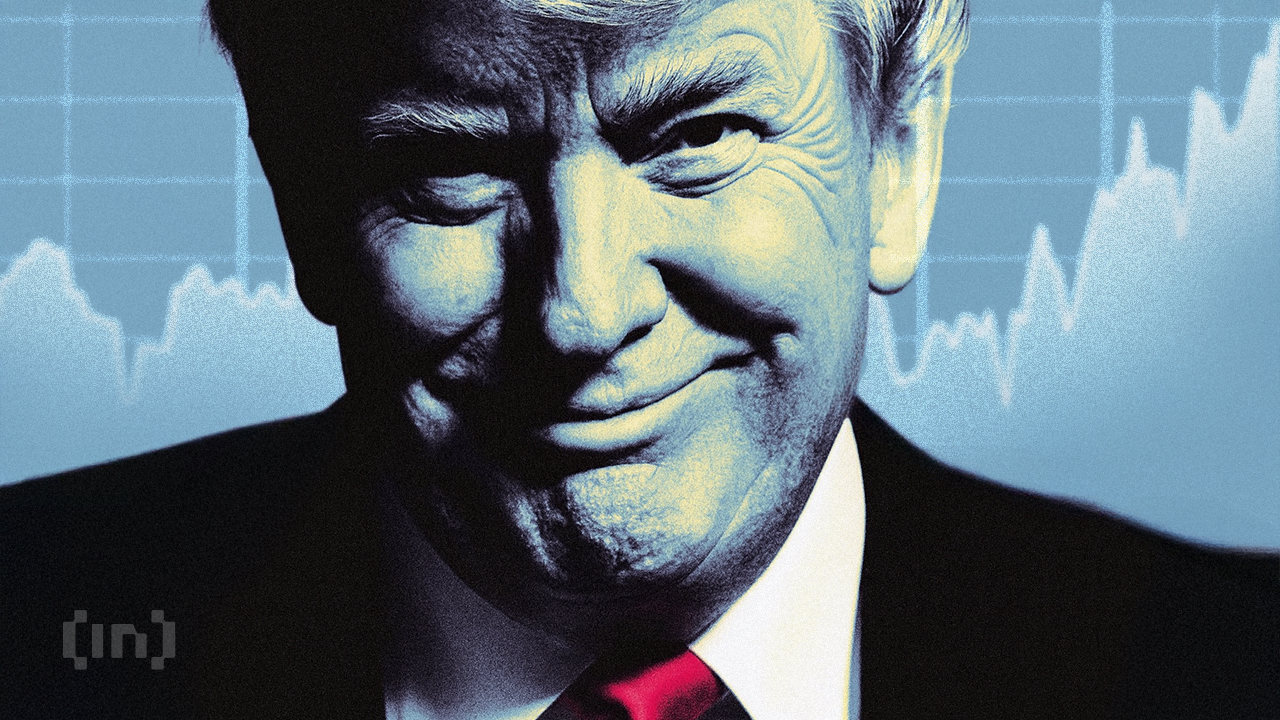

Donald Trump says the United States and Iran have finalized a peace deal, with a signing ceremony set for June 19 in Switzerland. The framework reopens the Strait of Hormuz while pushing the hardest nuclear questions into later talks.
The agreement works as a 60-day memorandum of understanding rather than a final treaty. It freezes the fighting, eases oil flows, and trades sanctions relief for Iranian compliance. Major disputes over enrichment and weapons stay open.
What the Trump Iran Deal Actually Contains
The memorandum runs for 60 days and can extend by mutual consent, according to a U.S. official cited by Axios. The structure favors quick de-escalation over a binding settlement.
It reopens the Strait of Hormuz with no tolls. Iran agrees to clear the naval mines it laid. The United States then lifts its blockade on Iranian ports in phases.
Temporary waivers let Iran sell oil again during the window. Frozen funds stay locked until a final, verified deal. Trump calls the principle “relief for performance.”
Tehran has pushed back on the schedule, fueling a disputed signing timeline that traders continue to watch closely.
Why the Nuclear Questions Stay Unresolved
The draft includes an Iranian pledge to never pursue nuclear weapons. It defers enrichment limits and stockpile removal to the 60-day negotiations.
That gap echoes the 2015 nuclear accord, the JCPOA, which Trump exited in 2018. This time, relief is meant to follow compliance rather than upfront commitments.
The two sides still disagree openly. Trump insists the deal allows no uranium enrichment. Iranian Foreign Minister Abbas Araghchi says otherwise.
“Enrichment in Iran, however, will continue with or without a deal.”
Ballistic missiles and proxy networks receive little immediate attention in the text.
What the Deal Defers and How Markets Reacted
Critics argue the framework buys roughly 60 days of calm, not a lasting settlement. Permanent enrichment caps, missiles, and regional proxies wait for a second round of talks.
Practical hurdles also remain. The Pentagon has warned that fully clearing Hormuz mines could take up to six months, slowing any return to prewar shipping.
Markets still moved on the announcement. A calmer geopolitical backdrop could keep supporting Bitcoin’s recovery if equities hold firm into the signing.
The June 19 ceremony will test whether the truce holds. The harder measure comes later, when negotiators decide if compliance can replace the upfront bargains that earlier deals relied on.
The post Trump Iran Deal: A Ceasefire That Solves Everything Except the Hard Parts appeared first on BeInCrypto.
TLDR:
- Binance recorded a 7-day average of $83M daily USDT inflows on Ethereum over the past two weeks
- USDT outflows on Tron averaged $101M daily, while Binance total stablecoin reserves fell just 1.3%
- The deposit-via-ETH, withdraw-via-TRX pattern points to whale and institutional cross-chain activity
- Capital exiting via Tron rails is likely heading to OTC desks or cold storage, not crypto purchases
Stablecoin bridge activity on Binance has drawn attention over the past two weeks. Large-scale opposing flows between Ethereum and Tron networks are being recorded.
USDT inflows on Ethereum are running at a 7-day average of $83 million daily. Meanwhile, USDT outflows on Tron are averaging $101 million per day. Despite these movements, Binance’s total stablecoin reserves have declined by only 1.3%.
Binance Becomes a Cross-Chain Liquidity Corridor
Market observers are watching a clear pattern take shape on Binance. Capital is entering the exchange via Ethereum-based USDT and exiting through Tron-based rails. This opposing flow dynamic effectively turns Binance into a cross-chain bridge for large players.
The scale of these movements points to whale and institutional involvement. Retail traders rarely move capital in volumes that register at $83 million in daily averages. The consistency of the flows over two weeks further rules out isolated or accidental transactions.
On-chain analytics platform CryptoOnchain flagged the trend earlier this week. The platform noted that Binance’s reserves remaining flat despite opposing flows of this magnitude is itself a telling data point. It confirms that inflows and outflows are nearly perfectly offsetting each other.
Historically, heavy ERC-20 stablecoin deposits into centralized exchanges have marked moments when large players step back from DeFi. These actors tend to seek centralized order books either to reallocate holdings or prepare for exits.
Tron’s Low-Fee Rails Attract Outbound Institutional Capital
The withdrawal side of this equation tells its own story. Capital leaving Binance via TRC-20 USDT is not staying on the exchange to purchase crypto assets. Instead, it appears to be heading toward OTC desks, cold storage, or alternative settlement venues.
Tron has long been the preferred network for high-volume, low-cost stablecoin transfers. Its fee structure makes it practical for moving large sums without incurring the gas costs associated with Ethereum. Institutions and OTC operations favor this rail for exactly that reason.
This “deposit via ETH, withdraw via TRX” pattern has appeared before periods of reduced activity in Ethereum-based DeFi markets.
When purchasing power migrates away from Ethereum’s native layer, organic spot accumulation on that network tends to slow.
Total market liquidity, however, remains intact for now. The stablecoin supply itself has not shrunk — it has simply shifted settlement rails.
Markets will need to see these opposing flows neutralize before a clear resumption of Ethereum-based accumulation can be confirmed.
TLDR:
- SpaceX priced its IPO at $135 per share, raising a record $75 billion on its first day of trading.
- SPCX closed nearly 19% higher at $161, pushing the company’s market valuation above $2 trillion
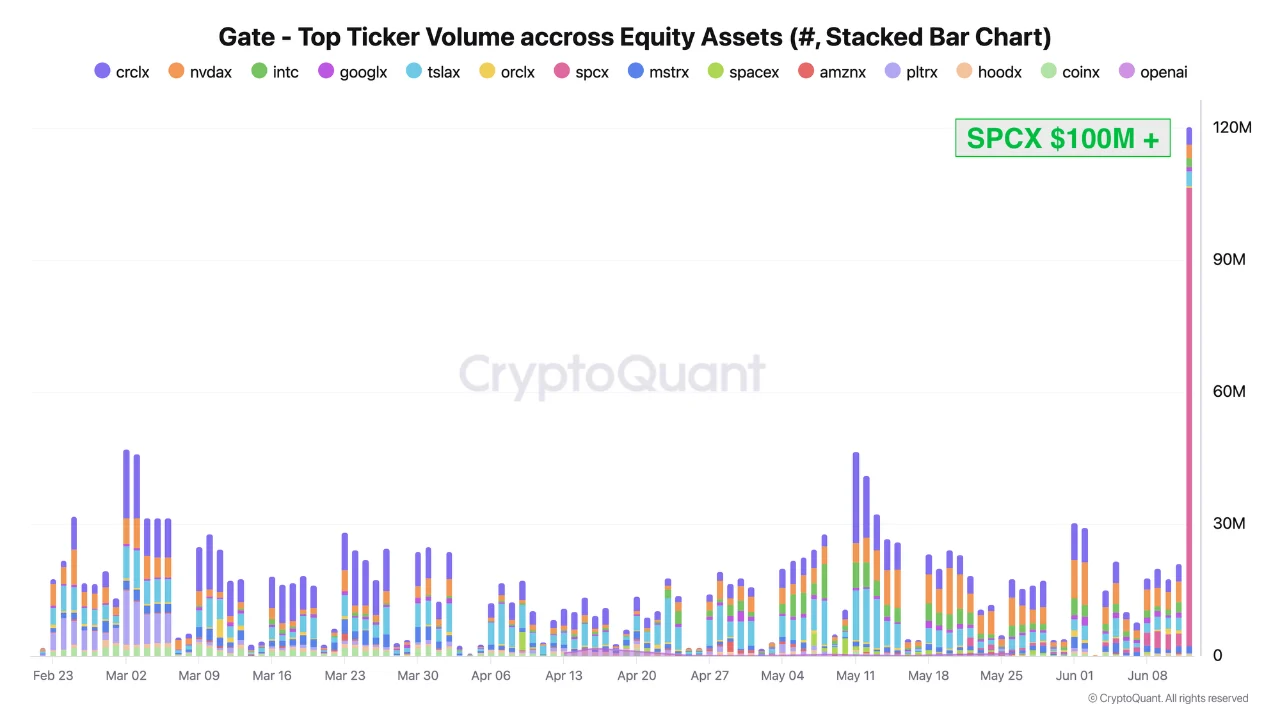
- Gate.io recorded over $100 million in SPCX trading volume on day one, far ahead of other tickers.
- Vanda Research noted SPCX retail purchases surpassed Nvidia by more than 3.5 times on debut day.
SpaceX made its long-awaited Nasdaq debut on June 12, 2026, under the ticker SPCX. The company priced its IPO at $135 per share, raising a record $75 billion. Shares opened at $150 and closed nearly 19% higher at around $161.
The listing pushed SpaceX’s market valuation above $2 trillion on day one. Crypto markets responded just as strongly, with tokenized equity platforms recording notable trading volumes tied to the new stock.
Record Retail Demand Greets SPCX on Wall Street
SpaceX’s public debut drew immediate and widespread interest from retail investors. According to Vanda Research, SPCX became the most purchased stock among retail investors on its first trading day. Net retail purchases surpassed those of Nvidia by more than 3.5 times, a remarkable gap for any new listing.
More than 490 million shares changed hands during the session alone. That level of activity placed SPCX among the most actively traded stocks in recent memory.
The strong opening reflected years of pent-up demand from investors who had tracked SpaceX as a private company.
The stock rose as high as $176.52 during intraday trading before paring some gains into the close. Even after the pullback, shares settled around $161, holding well above the IPO price. Post-market activity added further momentum, with shares rising another 3.5% after the closing bell.
SpaceX COO Gwynne Shotwell rang the opening bell alongside company leadership at the Nasdaq MarketSite in Times Square.
The ceremony also took place simultaneously at SpaceX’s Starbase facility in Texas. The dual celebration reflected the scale of the occasion for the 24-year-old aerospace company.
Crypto Platforms Bridge the Gap Between Equities and Digital Assets
Crypto investors did not wait for traditional brokerage accounts to gain exposure to SPCX. Platforms offering tokenized equity products saw strong demand from the moment the stock went live. On Gate.io, SPCX trading volume crossed $100 million on its first day of listing.
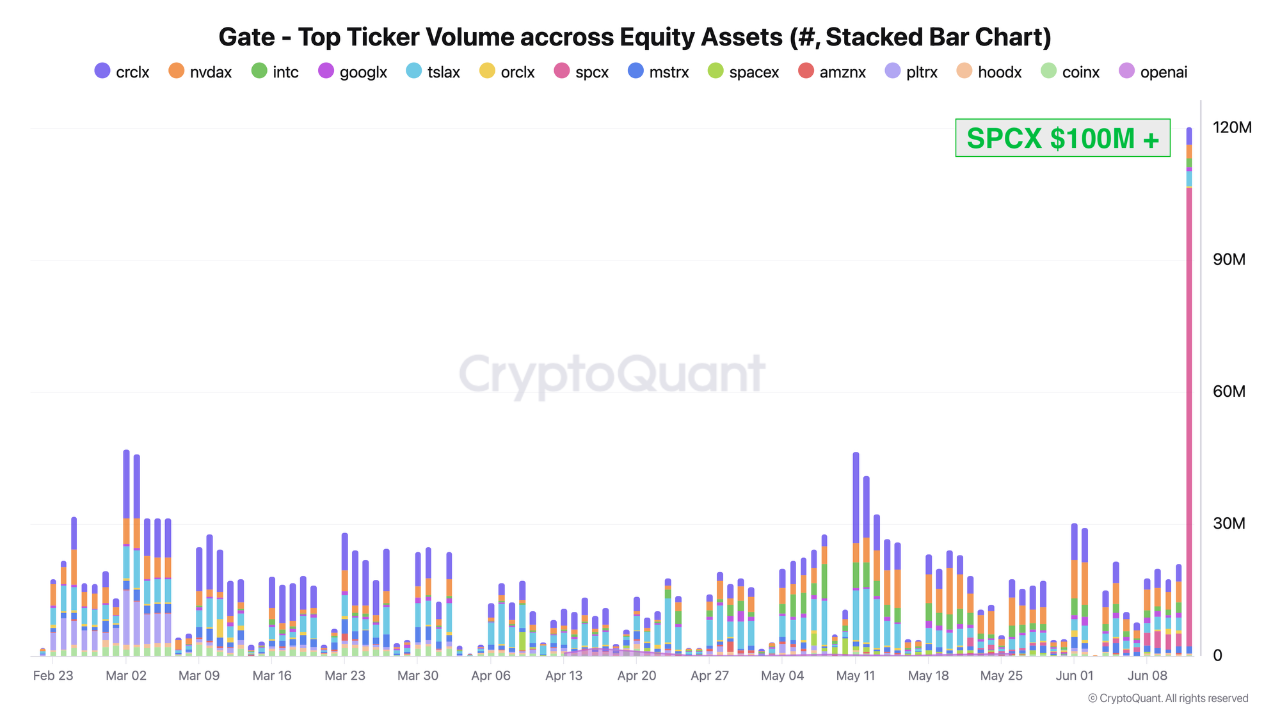
That figure stood out sharply against other equity tickers on the same platform. Circle and Tesla recorded trading volumes of $4 million and $3.5 million respectively on the same day. The gap between SPCX and those assets reflects the level of retail enthusiasm surrounding the SpaceX listing.
Broader equity-related trading on Gate.io typically generates between $10 million and $25 million in daily volume across listed assets.
SPCX surpassed that range by a wide margin within hours of becoming available. That pace pointed to genuine demand from crypto-native investors seeking equity exposure.
Perpetual futures contracts tied to SPCX on Hyperliquid also recorded strong activity ahead of and during the IPO. The SPCX-USDC perpetual contract traded around $176, roughly 30% above the IPO price.
Over $233 million in volume changed hands in those contracts within 24 hours, with open interest climbing above $263 million.
Crypto World
VersaBank Names Ethereum, Algorand, and Stellar for Tokenized Bank Deposits in SEC Filing
TLDR:
- VersaBank’s SEC filing names Ethereum, Algorand, and Stellar for its tokenized deposit initiative
- RBTDs represent actual CAD$1 or US$1 demand deposit liabilities, not stablecoin-backed instruments.
- Proposed use cases for RBTDs cover payments, settlement, digital asset custody, and mainstream finance
- VersaBank’s multi-network approach signals banks are actively choosing public blockchain infrastructure.
VersaBank has named Ethereum, Algorand, and Stellar in a recent SEC filing related to its Digital Meteor initiative. The filing covers Real Bank Tokenized Deposits, or RBTDs, formerly called Digital Deposit Receipts.
These instruments represent actual demand deposit liabilities of the bank. This development marks a notable step in regulated banking’s engagement with public blockchain infrastructure.
VersaBank Tokenized Deposits Differ From Stablecoins
VersaBank tokenized deposits are not stablecoins. Each RBTD represents either a CAD$1 or US$1 demand deposit liability of the bank.
The deposits remain direct liabilities of VersaBank or VersaBank USA throughout their lifecycle. That structural difference sets them apart from privately issued stablecoin products.
Stablecoins are typically backed by reserve assets held by private companies. Tokenized deposits, by contrast, originate directly from a regulated banking institution.
in the industry view this distinction as important for compliance and financial stability. It positions RBTDs closer to traditional banking products than crypto-native instruments.
Analyst Marco Salzmann noted the filing on X, describing it as potentially one of the most important blockchain adoption stories of the decade.
He credited researcher algerstmehn for the original discovery of the SEC document. The filing was dated June 3, 2026. It marked a formal update to regulators on the bank’s Digital Meteor initiative.
The proposed use cases for RBTDs span payments, settlement, digital asset custody, and mainstream financial applications.
These are practical, infrastructure-level functions rather than speculative or investment-oriented ones. The bank appears to be targeting real operational workflows rather than retail crypto markets.
Three Blockchain Networks Enter the Conversation
The choice of Ethereum, Algorand, and Stellar in the same filing increased observation of how banks are evaluating public networks. Ethereum remains the largest smart contract ecosystem by adoption and developer activity.
Algorand has built a track record in institutional tokenization projects. Stellar has established itself in cross-border payments and tokenized asset transfers.
Referencing all three in a single regulatory filing suggests VersaBank is not locked into one network. The bank appears to be assessing which infrastructure best fits different product requirements.
This multi-network approach reflects broader trends among financial institutions exploring blockchain deployment. It avoids over-reliance on any single ecosystem.
The shift toward tokenizing deposits themselves marks a different phase compared to tokenizing bonds or real estate funds.
Those earlier use cases involved external assets. Tokenized deposits represent the bank’s own liabilities moving on-chain. That is a structurally deeper form of blockchain integration for traditional finance.
Whether VersaBank brings RBTDs to commercial scale remains an open question. However, the SEC filing confirms that regulated institutions are moving from observation to active evaluation. Public blockchain networks are now part of formal banking conversations at the regulatory level.

Historically, the crypto market has been fueled by hype, retail fear of missing out (FOMO),
leveraged trading and bull runs. The introduction of US spot Bitcoin ETFs has changed that.
Institutional investors now drive the market. Registered investment advisors, hedge funds,
asset managers, pension funds and sovereign wealth entities are the big players in spot crypto
today. Through the ETF structure, they gain Bitcoin exposure without dealing with the
counterparty and technical risks that come with holding the asset directly. That is a major
reason why net inflows have remained strong even during periods when retail interest has
This institutional presence is also reshaping how retail traders participate. Instead of relying
on fragmented crypto-only exchanges, many everyday investors are moving toward regulated
like OANDA, for example, sits within a wider trading ecosystem that combines crypto with
traditional markets, built-in analysis tools and smoother execution. The result is that retail
and institutional capital are increasingly flowing through the same regulated channels, which
is adding stability to a market that was once driven almost entirely by speculation.
In early May, the spot Bitcoin ETFs had nearly $1 billion in weekly inflows, according to data
from SoSoValue. The total net assets across spot Bitcoin ETFs crossed $101 billion, while daily
trading volume neared $4.8 billion. This broad market uptick indicates an acceleration of
capital that is not accidental but rather the result of institutional-grade catalysts aligning at
The Securities and Exchange Commission paved the way for spot ETFs in 2024. Since then, the
SEC’s regulations have evolved, providing federal oversight frameworks for consumers. For
years, the largest roadblock for institutional capital was a lack of clear guidelines. In 2026,
institutional players now have the official stamp of validation with established compliance


Elon Musk says SpaceX revenue could reach roughly $1 trillion a year by 2030, and likely more in 2031. That projection sits far above the forecasts of the bankers who just took his company public.
Musk made the claim on X (Twitter) over the weekend, days after SpaceX completed the largest stock market debut in history. His own underwriters model only a fraction of that number.
SpaceX Revenue Math Faces a Steep Climb
SpaceX reported $18.7 billion in revenue for 2025, according to its IPO filing. Revenue climbed from $14 billion in 2024, growth of about 33%.
Revenue stood near $10 billion in 2023, so the trajectory is steep but not vertical.
Even so, hitting $1 trillion by 2030 would demand a 53-fold jump in five years. No company near this size has ever grown that fast.
Musk framed the goal directly on the platform he owns.
I think SpaceX might be able to reach approximately $1T revenue in 2030,” he said in a post.
Follow us on X to get the latest news as it happens
He added that he would be surprised if revenue fell below $1 trillion in 2031.
Wall Street Forecasts Sit Far Below
Morgan Stanley, a lead underwriter, estimates SpaceX revenue near $330 billion in 2030. The bank models $160 billion as early as 2028.
Goldman Sachs leans harder on artificial intelligence yet still lands well short of Musk. Both banks assume years of flawless execution.
The optimism arrived alongside the company’s historic IPO debut, which pushed its valuation past $2 trillion. That session produced a string of surprising IPO facts, including Musk keeping 82.4% of voting power.
The AI Bet Carries the Forecast
Both forecasts rest on AI infrastructure rather than rockets. Morgan Stanley sees AI delivering roughly $190 billion of its 2030 total.
However, that unit earned just $3.2 billion in 2025 while losing $6.4 billion. It would need to outgrow the world’s leading AI labs to deliver.
For now, the Starlink satellite network carries the business, generating $11.4 billion last year. Subscribers reached 10.3 million by March 2026, up from 8.9 million a year earlier.
Meanwhile, SpaceX still posted a steep quarterly loss in early 2026.
Musk has repeatedly missed his own timelines while eventually delivering results.
Investors weighing the space stocks in play must now decide which pattern holds.
The post Elon Musk Projects $1 Trillion SpaceX Revenue by 2030: Practical or a Long Shot? appeared first on BeInCrypto.
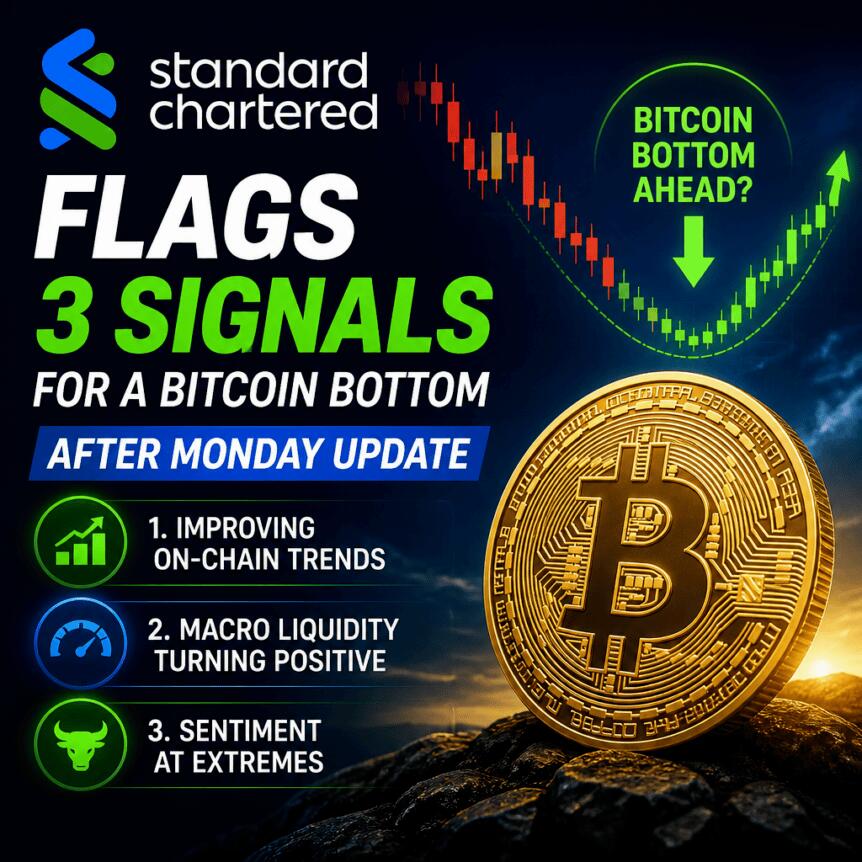
Standard Chartered’s Geoff Kendrick said he believes crypto prices have already traced the low for the current cycle, and he outlined three signals he wants to see to confirm that view. In a note to clients on Friday, Kendrick pointed to Strategy’s latest Bitcoin buying, renewed demand for US-listed Bitcoin exchange-traded funds (ETFs), and continued weakness in oil prices.
Kendrick anchored his assessment around Bitcoin’s drawdown from its prior peak, stating that the cycle low would correspond to roughly $59,000 for BTC, about 53% below a $126,000 high. CoinMarketCap data cited in the note showed Bitcoin trading around $63,704 at its last update on Sunday.
Key takeaways
- Geoff Kendrick (Standard Chartered) says crypto has likely already bottomed, tying the call to market and macro confirmation.
- Strategy’s reported Bitcoin purchases are presented as one of the three indicators that would support a bottom.
- SoSoValue data shows Friday’s Bitcoin ETF activity with $85.84 million in one-day net inflows.
- Crude oil weakness is included as a macro backdrop indicator, with futures falling for a second straight day on Friday.
- Kendrick’s “winter is over” framing depends on whether the ETF flows and macro trend persist.
Why Standard Chartered thinks the cycle low may be in
In his Friday client note, Kendrick argued that the market has already reached the low and that the next step is confirmation across multiple dimensions—positioning within crypto, how traditional investors are expressing demand, and whether broader risk appetite is supported by easing energy prices.
To him, the setup is reinforced by three developments happening around the same time. First, Strategy reportedly added to its Bitcoin holdings “last week,” a move that would signal continued institutional-like accumulation even after a sharp decline. Second, Kendrick highlighted Friday’s net inflows into Bitcoin ETFs, using data tracked by SoSoValue.com. Third, he linked the crypto outlook to crude oil futures, which were falling for a second straight day, citing Yahoo Finance data.
That combination matters because a “bottom” call in crypto tends to be fragile without evidence that demand is returning and that broader macro conditions aren’t worsening. Kendrick’s framework is essentially a checklist aimed at reducing the chances that the market’s lowest point is merely a pause before another leg down.
Bitcoin ETFs turn positive on Friday inflows
One of Kendrick’s most concrete inputs is the flow data from US Bitcoin ETFs. According to SoSoValue.com, Bitcoin ETFs recorded $85.84 million in one-day net inflows on Friday. Kendrick’s note further specified that investors directed capital into five funds, while eight of the ETFs saw no net change on the day.
While ETF inflows alone cannot prove a market bottom, they can serve as a useful proxy for whether mainstream allocation is restarting after a period of hesitation. For traders, ETF flow patterns are often watched for signs that dips are being actively bought rather than simply endured. For longer-term investors, sustained inflows tend to be read as a shift in willingness to hold Bitcoin exposure through regulated wrappers.
Still, the signal is time-sensitive: Kendrick’s thesis explicitly leans on confirmation. If subsequent days show continued inflow strength, it would fit his “cycle low” narrative; if inflows fade quickly, it may suggest Friday was more an interruption than a turning point.
Strategy keeps adding—despite its “sell” reality
Kendrick’s first indicator is also tied to Strategy, the corporate Bitcoin buyer most closely associated with CEO Michael Saylor’s public messaging. The note referenced Strategy’s reported additional Bitcoin purchase and framed it as part of the confirmation process for a bottom.
The background to this matters because Strategy’s Bitcoin strategy has been the subject of debate since it disclosed a first reported Bitcoin sale since 2022. In a June 1 filing with the US Securities and Exchange Commission, the company disclosed that it offloaded 32 BTC, a move that ran counter to the firm’s long-running “never sell your Bitcoin” messaging associated with Saylor.
Coverage from Cointelegraph described how Saylor defended the sale as necessary for Strategy’s “digital credit” model. At the BTC Prague conference, he argued that limiting the company to a “won’t sell the Bitcoin” policy could undermine the value of credit instruments issued against that treasury.
The core point attributed to Saylor was that Bitcoin treasury companies must retain the ability to sell holdings when necessary to support dividend-paying securities and other BTC-backed credit products. That explanation helps reconcile the apparent tension between rhetorical commitment to holding and the practical flexibility required to operate a credit business.
For investors tracking Kendrick’s view, Strategy’s behavior is a key variable: continued buying supports the notion that conviction remains even if prices have fallen. But readers should also recognize that the firm’s structure and financing strategy can still include transactions that are not perfectly aligned with an “only accumulate” storyline.
Macro check: oil weakness as a risk backdrop
Kendrick also tied his outlook to macro conditions, specifically the direction of oil prices. In his note, he cited that crude oil futures fell on Friday for the second straight day, based on Yahoo Finance data.
That choice reflects a broader pattern in market analysis: when energy prices cool, it can ease cost pressures and potentially improve risk sentiment, especially for assets that have historically behaved like higher-volatility bets. If crude continues to trend downward while crypto demand indicators—such as ETF inflows—remain supportive, Kendrick’s “confirmation” logic becomes more convincing.
Conversely, if oil rebounds sharply or if macro stress reappears, the bottom thesis would face a stronger challenge, regardless of one-off improvements in crypto-specific demand.
Investors watching this next should focus on whether ETF inflows persist beyond Friday and whether Strategy’s purchasing trend continues, while also tracking whether oil’s decline holds up. Kendrick’s “winter is over” framing is ultimately a conditional call—confirmation will come from consistency across both crypto and macro signals.


Stanford graduates walked out of Stanford Stadium on June 14 as Sundar Pichai opened the university’s 2026 commencement address, protesting Google’s contract with the Israeli government.
The Alphabet and Google chief executive then sidestepped artificial intelligence entirely. That was a pointed choice when other tech leaders have drawn boos this year for leaning into the topic.
A Walkout Aimed at Google, Not AI
Organizers from Stanford Students for Justice in Palestine had pledged the walkout weeks earlier. They directed it at Pichai’s company rather than at fears about automation and jobs.
Their target was Project Nimbus. The roughly $1.2 billion deal gives Israeli government agencies cloud and AI services from Google and Amazon.
Follow us on X to get the latest news as it happens
Israel’s Finance Ministry announced the agreement in April 2021. It runs for an initial seven years and covers government, defense, and security users.
Protesters argue the contract supports surveillance and military operations in Gaza. The dispute keeps Google’s broader AI ambitions race tied to a single geopolitical flashpoint.
The Speech That Skipped the Obvious Topic
Pichai, who earned a Stanford master’s degree, acknowledged the pressure to address AI. He joked that the subject sat in the last two letters of his last name.
Actually, it’s been the same advice, and it’s about what not to say. People thought it would be really difficult for me; it is the last two letters of my last name, after all,” read an excerpt in his speech.
Instead he offered three filters. He told graduates to choose optimism, work on hard things, and do what excites them.
The Google executive drew on his arrival from Chennai and his early work building Chrome.
The restraint breaks from his usual focus. Pichai has spent the past year promoting his personalized AI agents vision and Google’s Gemini-powered Mariner agent.
A Year of Backlash Against Tech on Campus
His caution reflects a tense season for technology speakers at graduations. Several drew boos this spring over remarks about AI and the jobs it may replace.
Google also knows the Nimbus fight from inside. In 2024 it fired more than two dozen workers who protested the contract, fueling the No Tech for Apartheid campaign.
The scrutiny now reaches Google’s wider government AI contracts and the heavy AI spending push straining Alphabet’s stock.
For the Class of 2026, an AI-free speech still could not separate Pichai from the deal that drew protesters to their feet.
The coming days may show whether Google answers the renewed pressure or waits it out.
The post Stanford Graduates Walk Out on Google CEO as Commencement Speech Sidesteps AI appeared first on BeInCrypto.

Pomegranate Persian Tea Room in Great Ayton called ‘hidden gem’

Oil prices slide after Pakistan announces deal between US and Iran
Zimbabwe Requires Crypto Businesses to Register Annually Under New FIU Regulations

BloFin War of Whales 2026 Grand Prix opens registration for $5M trading championship

Blockchain.com files with SEC for U.S. IPO

Israel says it has killed new Hamas military leader in Gaza City airstrikes

Jimmy tried to teach Jesse how to turn the stolen money into “legitimate working capital.”#series

1983 Mein 24,000 Crore, Aaj Kitna? GD Birla Story!#financial#finance#wariko#financial development

VAC FINANCIAL LITERACY | UNIT 1 – 4 | COMPLETE ONE SHOT | DU/SOL/REGULAR/NCWEB | DETAILED EXPLAINATI
-

 NewsBeat7 days ago
Alexander Zverev wins the French Open to finally earn a 1st Grand Slam title
-

 Crypto World7 days ago
Anatomy of the June crypto crash: Fed, Iran, Saylor
-

 Crypto World3 days ago
Oppenheimer backs SpaceX as $70 billion retail frenzy builds
-

 Crypto World3 days ago
Markets Rally as SpaceX IPO Looms Amid Iran Tensions and Inflation Surge
-

 Business8 hours ago
No Jackpot Winner as $257 Million Prize Rolls Over to $269 Million Monday Draw
-

 Sports6 days ago
FIFA WC 2026 Group C: Morocco, Scotland challenge Brazil’s hunt for glory | FIFA World Cup 2022
-

 Business7 days ago
High Stakes for Wembanyama as New York Pushes for 3-0 Lead
-

 Tech7 days ago
Notion restores access to Anthropic after service disruption
-
 Crypto World6 days ago
Eli Lilly (LLY) Stock Surges 4% Following Breakthrough Sleep Apnea Trial Results
-

 Fashion2 days ago
Weekend Open Thread: Tuckernuck – Corporette.com
-
 Sports5 days ago
Bangladesh beat Australia after 20 years in ODIs, register only their second win over six-time world champions | Cricket News
-

 Tech2 days ago
NanoClaw integrates JFrog registries to secure AI agent downloads
-

 Crypto World2 days ago
Bitget enters Argentina’s regulated crypto market through PSAV registration
-

 Tech2 days ago
This Week In Security: Microsoft On Microsoft, Register Your Domains, Linux On ARM, And FreeBSD Joins The File Cache Club
-

 Politics3 days ago
Politics Home | Healey Resignation Is “Colossal Failure Of Government”, Says Former Labour Defence Secretary
-

 Sports3 days ago
First Time Since 1971: Australia Register Historic Low In ODI Cricket
-
 Entertainment3 days ago
Donnie Wahlberg & More Heat Up Las Vegas at Circa’s Barry’s Downtown Prime
-

 Entertainment6 days ago
The Ryan Gosling True Crime Thriller On Netflix That Gets Even Stranger, Stream It Now
-
 Tech3 days ago
Opendoor Ends India Operations, Fueling a Bigger Conversation About AI and Outsourcing
-

 Sports7 days ago
Ginebra moves within two more wins of first PBA title in three years
You must be logged in to post a comment Login