Connect with us
DAPA Banner
DAPA Coin
DAPA
COIN PAYMENT ASSET
PRIVACY · BLOCKDAG · HOMOMORPHIC ENCRYPTION · RUST
ElGamal Encrypted MINE DAPA
🚫 GENESIS SOLD OUT
DAPAPAY COMING

Business

YES Bank share price rises 3% on partnership with Northern Arc to extend lending offerings

Published

on

YES Bank share price rises 3% on partnership with Northern Arc to extend lending offerings
Shares of YES Bank rose over 3% to their day’s high of Rs 24.38 on the BSE on Tuesday after the private lender announced a strategic partnership with Northern Arc Capital aimed at expanding access to credit, scaling digital lending, and offering debt investment opportunities to customers.

The collaboration brings together YES Bank’s balance-sheet strength, digital infrastructure, and distribution network with Northern Arc Capital’s origination, underwriting and technology capabilities.

The partnership is also a result of YES Bank’s collaboration with Sumitomo Mitsui Banking Corporation (SMBC), which is the largest strategic shareholder in YES Bank and a key shareholder in Northern Arc Capital.

According to the companies, SMBC played a role in bringing together the two platforms, with the partnership expected to leverage synergies across origination, distribution, technology and balance-sheet capacity. The companies described the agreement as the first in a series of potential collaborations between YES Bank and Northern Arc Capital.

Advertisement

As part of the arrangement, Northern Arc Capital will use its network of 368 originator partners, comprising financial institutions, to facilitate credit deployment for YES Bank through its placements business. The partnership will provide the lender access to a diversified pipeline of credit opportunities sourced through Northern Arc’s ecosystem of lending partners.


The companies said the alliance will also focus on expanding retail lending through Northern Arc’s nPOS co-lending platform. The initiative will be supported by data-led underwriting, risk-sharing structures and portfolio monitoring frameworks, while leveraging Northern Arc’s origination network across underserved markets.
In addition to lending, the partnership will extend to wealth and investment products. Northern Arc Investment Managers (NAIM), a wholly owned subsidiary of Northern Arc Capital, will offer Alternative Investment Funds (AIFs) and Portfolio Management Services (PMS) to YES Bank’s retail, affluent and institutional clients.Further, Altifi, Northern Arc Capital’s online bonds platform, will be integrated with YES Bank’s wealth management ecosystem, enabling customers to access fixed-income investment products through a technology-enabled interface.

A key aspect of the collaboration is the integration of technology platforms across both organisations. Northern Arc’s proprietary platforms, including nPOS, NIMBUS and NuScore, will be integrated with YES Bank’s digital lending architecture to support loan onboarding and credit delivery at scale.

Commenting on the development, Ashish Mehrotra, Managing Director and Chief Executive Officer of Northern Arc Capital, said the partnership combines technology, distribution and risk management capabilities to improve access to financial services and strengthen credit market linkages.

Rajan Pental, Executive Director at YES Bank, said the partnership aligns with the bank’s strategy of building technology-enabled credit infrastructure and will help expand formal credit access while also opening up private credit and alternative investment opportunities for a wider customer base.

Advertisement

(Disclaimer: Recommendations, suggestions, views and opinions given by the experts are their own. These do not represent the views of The Economic Times)

Continue Reading
Click to comment

You must be logged in to post a comment Login

Leave a Reply

Business

SpaceX, Western Digital among market cap stock movers on Tuesday

Published

on


SpaceX, Western Digital among market cap stock movers on Tuesday

Continue Reading

Business

Major Highlights in Politics, Economy, Tourism, and Society

Published

on

Major Highlights in Politics, Economy, Tourism, and Society

Royal Family and National Mourning

Thailand is observing a 15-day mourning period following the death of Princess Bajrakitiyabha (Princess Bha) at the age of 47. Mourners lined Bangkok streets to pay their respects, and the princess, seen by some as a potential heir to the Thai throne, is being remembered for her people-centred legacy of service. Businesses, tourists, and organizations have been advised to observe the mourning period respectfully. Taiwan and other nations have formally expressed their condolences.


WWII Death Railway Resurfaces

A sunken train station from the infamous World War II “Death Railway” has re-emerged from a Thai reservoir after approximately 40 years underwater, attracting significant international media attention. Multiple outlets including AP News have published photographs documenting the resurfaced remains, offering a rare glimpse into one of history’s most harrowing wartime construction projects, which claimed tens of thousands of lives. The re-emergence has reignited interest in preserving this significant historical site.


Political Developments

Thaksin Shinawatra and Domestic Politics

Former Prime Minister Thaksin Shinawatra has been freed from parole following a royal pardon, though questions remain about whether he can genuinely “leave politics behind.” A progressive political leader was separately acquitted by a Thai court on charges of royal defamation, signaling ongoing tensions around political freedoms. Independent candidates are tipped to lead the upcoming Bangkok council race, suggesting a shift in voter sentiment away from established party structures.

Foreign Policy and Regional Disputes

Thailand has appointed South African and German experts to represent the country in a UN arbitration process and UNCLOS conciliation panel concerning its maritime dispute with Cambodia. Cambodia continues to urge Thailand to resume border demarcation work, citing delays in the joint mechanism, while over 28,000 Cambodians remain displaced despite a ceasefire agreement. Thailand has welcomed the US-Iran ceasefire and the reopening of the Strait of Hormuz, reflecting its broader diplomatic engagement.

Advertisement

Tourism: Challenges and Opportunities

Visa Changes and Safety Concerns

Thailand has slashed visa-free durations for 93 countries, including the United States, following controversy over tourist behaviour. The move has triggered a rush among travellers seeking last-opportunity visits before the new rules take effect. Separately, the Tourism Ministry reaffirmed that Thailand remains safe for Russian tourists, following a widely circulated travel warning. A U.S. Embassy health alert issued in early June flagged enhanced Ebola screening measures at Thai entry points.

Competition and Strategy

Vietnam is emerging as Southeast Asia’s hottest tourist destination, with analysts noting Thailand must work to avoid repeating past missteps around over-tourism and infrastructure strain. Thailand’s Tourism Authority (TAT) is leveraging AI tools and visual content strategies — including an AI influencer named Nong Mali — targeting a 6.7 million Chinese visitor goal. China has already overtaken Malaysia, Russia, and South Korea to lead inbound tourism with nearly 2.4 million visitors, cementing first place in regional arrival rankings.


Economy and Business

Trade, Tax, and Investment

Thailand is advancing a 15% global minimum tax on multinational corporations, aligning with international frameworks. The country is also joining an international tax information sharing system and implementing electricity tariff reforms, with higher rates proposed for data centres to help reduce household power costs. Three major property groups have requested urgent government measures to revive the struggling real estate sector.

Industry and Infrastructure

Bangchak Group has unveiled Thailand’s first commercial Sustainable Aviation Fuel (SAF) production facility, a landmark step in the country’s green energy transition. Microsoft has committed over US$1 billion in investment in Thailand, covering technology, trust, and talent development. However, a KBank economist has warned that Thailand risks becoming the world’s “landlord” rather than a genuine technology player if structural reforms are not prioritised.

Advertisement

Agricultural and Trade Tensions

Thailand’s shrimp industry is facing significant uncertainty following a ban imposed by Malaysia, with ministers preparing for bilateral talks. The Thailand-Malaysia standoff has been described by analysts as a “textbook case of modern food nationalism.” Thailand also risks losing 8 billion baht as visa changes threaten lucrative Indian wedding tourism, a growing and high-spending market segment.


Environment and Climate

Thailand faces a prolonged El Niño risk, with meteorological authorities warning of heavy rainfall, flooding, and broader climate disruption across multiple regions. The government’s Department of Climate Change and Environment (DCCE) is stepping up response measures, and Thailand is actively building a climate risk database to inform long-term planning. A toxic “time bomb” has been identified threatening the Mekong River basin, with arsenic levels hitting nine times the danger threshold — disproportionately affecting the region’s poorest communities.


Legal, Social, and Cultural Highlights

  • Thailand’s Draft Clean Air Act has returned to Parliament, with significant implications for environmental regulation and corporate compliance.
  • The government is cracking down on foreign companies using local ownership as a front for illegal operations.
  • Thailand and the Philippines led Asia at the Gerety Awards 2026 shortlist stage, highlighting the region’s growing creative industry presence.
  • Netflix’s Thai legal drama “Courtroom Devil” conquered the platform overnight, underscoring Thailand’s rising influence in global entertainment content.

Sources include The Guardian, AP News, Bangkok Post, Nation Thailand, The New York Times, and additional regional and international outlets.

Source : Google News – Search

Advertisement
Continue Reading

Business

Business activity falls in Yorkshire and Humber, survey suggests

Published

on

Business Live

The NatWest Regional Growth Tracker pointed to a range of pressures facing businesses in the area

Scarborough, North Yorkshire, United Kingdom - 10 September 2022: sign and logo on the front of a high street branch of a natwest bank in Scarborough

A NatWest branch(Image: Philip Openshaw via Getty Images)

Business activity in the Yorkshire and Humber area saw a reduction in May, according to an influential business survey.

The NatWest Regional Growth Tracker, which measures change in the output of the region’s manufacturing and service sectors – dropped to 46.5 in May from 51.4 in April. The latest reading pointed to a second reduction in output in the past three months, with scores below 50 suggesting a contraction in the economy.

Advertisement

The pace of decline was the sharpest since last September and greater than the national average. Companies taking part in the survey indicated lower new orders amid weaker customer demand, as well as highlighting uncertainty among clients, which prompted hesitation in committing to new projects.

Efforts by Yorkshire & Humber companies to limit costs resulted in employment reductions in May, both through direct job cuts and the non-replacement of leavers. As a result, workforce numbers decreased sharply, marking the largest contraction since July last year.

Companies also had to contend with growing inflationary pressures, the survey found, but firms in Yorkshire and Humber remained above the national average for confidence in the year ahead.

Malcolm Buchanan, Chair of the NatWest North Regional Board

Malcolm Buchanan, Chair of the NatWest North Regional Board(Image: Nicola Gotts Photography)

Malcolm Buchanan, chair of the NatWest North Regional Board, said: “After showing signs of positivity in April, the Yorkshire & Humber region suffered a setback in May as market uncertainty and steep price rises suppressed demand and led to a renewed fall in business activity. In particular, cost pressures intensified again and were substantial, with firms locally suffering one of the sharpest increases in input costs across the UK.

Advertisement

“Price pressures stemmed from a range of sources, including energy, transportation, raw materials and staff, providing little respite for companies. In turn, cost cutting efforts meant that staffing levels decreased sharply.

“There were some positive signs in terms of the year-ahead outlook, however, with a number of companies planning business investment in an effort to boost activity over the coming 12 months.”

The survey has been released ahead of the release of key economic data this week on regional and national unemployment levels, and on the latest inflation figures.

Advertisement
Continue Reading

Business

'We'll raise rates again if we need to': Bullock

Published

on

'We'll raise rates again if we need to': Bullock

RBA governor Michele Bullock says the central bank’s board will not hesitate to raise the cash rate again if needed, after resolving to hold the rate at 4.35 per cent following three consecutive rate rises.

Continue Reading

Business

Getting the right finance to support rural Wales

Published

on

Business Live

Chief executive of the Development of Wales Giles Thorley says th rural economy is not a niche part of Wales, but is fundamental and foundational

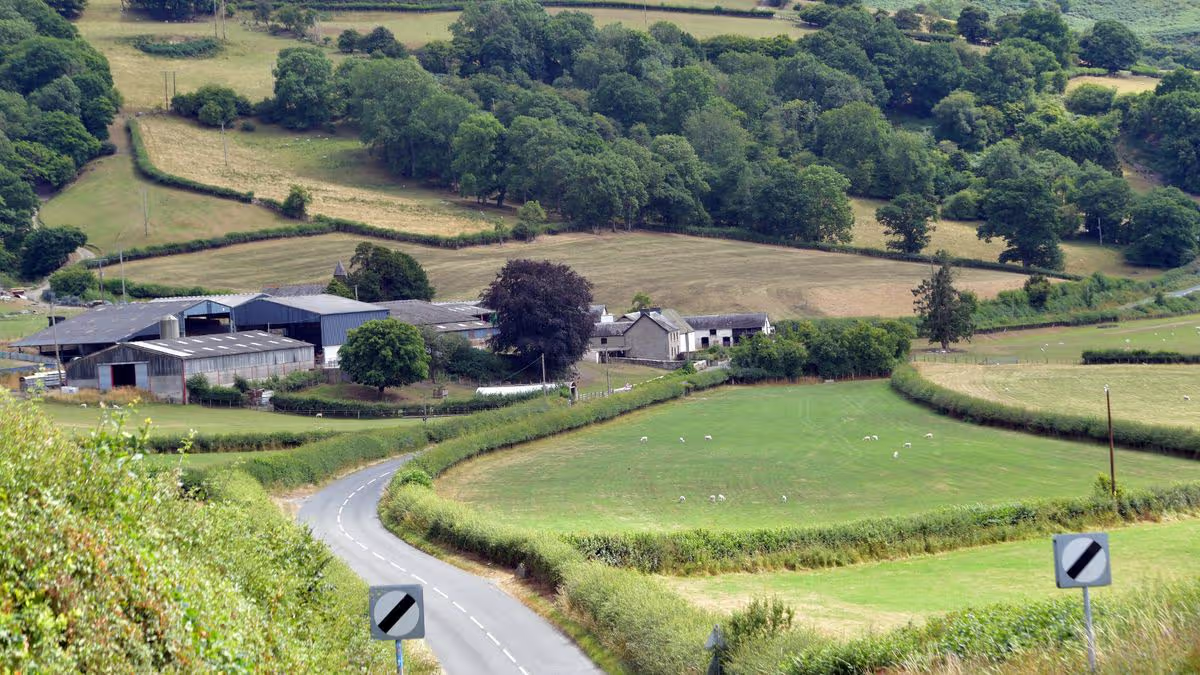
A farm in Powys.(Image: WalesOnline/Rob Browne)

Rural Wales is often discussed in the context of its challenges: a changing population, pressure on incomes, access to services, and connectivity. Those pressures are real and should not be understated.

But I also know that rural communities are home to some of the most resilient, innovative and entrepreneurial businesses anywhere in Wales.

Advertisement

Across the country, rural businesses are already innovating, adapting and investing for the future. What they often lack is access to the right finance that reflects the realities of how they operate.

I spend a great deal of time around farming and rural businesses. My wife runs a smallholding so you could call me the farmer’s husband, so I think about farming a great deal.

I understand what a fantastic asset this part of the economy is, and just how many amazing people work in it. But I believe there is a disconnect around the way farming and the rural economy is perceived. That perception – or gap in perception – is important because it shapes how we think about investment.

The rural economy is not a niche part of Wales. It is fundamental and foundational to the country’s economic future. It supports jobs, local culture, communities, food security, environmental stewardship and, increasingly, our transition to a lower-carbon economy.

Advertisement

Innovation in rural Wales, however, does not always look the same as it does in urban centres. It is often more gradual, more grounded and more closely tied to place. It can be a family farm diversifying into tourism, a food producer expanding into new markets, or a business investing in renewable energy or more sustainable production methods. These are not always labelled as innovation, but they are exactly that.

Across Wales, I have seen many examples of such transition. In Ceredigion, YnNi Teg is a community-owned renewable energy business helping local communities generate more green energy. In Mid Wales, we’ve backed many small rural businesses and entrepreneurs creating jobs in sectors from horticulture to hospitality.

Businesses like Bargoed Farm in Aberaeron are showing how farming and tourism can complement each other, while companies such as Cerrig Granite and Slate demonstrate how traditional industries can invest to reduce carbon emissions and modernise.

All of these businesses showcase the very best of rural Wales and they are not isolated examples. They are innovating, adapting and investing, showing us what a prosperous future looks like.

Advertisement

But what many of them also need is access to long-term capital that reflects the realities of doing business in the rural economy.

Such firms often operate on different timescales to urban businesses. Returns can be seasonal. Investment cycles are longer. Margins can be tighter and access to traditional finance more constrained, particularly for smaller businesses or farms which means that the right product fit is every bit as important as the right supply.

That is why I strongly welcome the forthcoming launch of the Sustainable Agriculture Loan Scheme (SALS). Developed with the Welsh Government and delivered through the Development Bank of Wales, the scheme is designed to support small and medium-sized farms not able to get funding from the private sector to invest in energy efficiency, waste management and productivity improvements.

The structure of the scheme has been developed with the practical realities of the rural economy in mind. Farmers will be able to borrow between £25,000 and £1m; repayment periods will be up to 15 years.

Advertisement

A repayment holiday at the outset can allow businesses time to realise the benefits of investment before repayments begin. Seasonal repayment structures reflect the realities of agricultural cashflow.

Importantly, SALS also represents a wider point about the role public finance can play in rural Wales.

Alongside traditional grant support, repayable finance can become a practical tool for enabling long-term investment while recycling capital for future generations of businesses.

It is about creating lasting impact, not simply offering one-off interventions.

Advertisement

That approach aligns with wider aspirations for Wales. There is growing recognition that economic development must be rooted in communities: supporting Welsh ownership, strengthening local supply chains, retaining wealth here. Rural Wales has a central role to play in that.

There is also a growing recognition that farming itself sits at the centre of several national priorities: food production, biodiversity, energy transition, land management and rural employment.

Supporting sustainable farming practices is not about supporting one sector, it is about supporting communities and landscapes that underpin much of Welsh life.

In doing so, it also aligns closely with the Well-being of Future Generations (Wales) Act, contributing to a more resilient, sustainable and prosperous Wales for the long term.

Advertisement

Of course, finance alone does not solve every issue facing rural Wales. Infrastructure, housing, skills and connectivity all matter. But access to the right kind of finance, money that can be patient, flexible and grounded in local understanding, can act as a catalyst for innovation and investment.

One of the things I admire most about rural businesses is their ability to adapt. Whether in farming, tourism, food production or energy, many of the most forward-thinking businesses I encounter are based in rural communities. They balance tradition with innovation and long-term stewardship with commercial reality.

Rural Wales is not standing still economically; in many areas, it is quietly reinventing itself.

Advertisement
Continue Reading

Business

Yum Brands sells Pizza Hut to LongRange Capital and Yum China

Published

on

Yum Brands sells Pizza Hut to LongRange Capital and Yum China

A sign hangs above the front of a Pizza Hut restaurant on Feb. 9, 2026 in Chicago, Illinois.

Scott Olson | Getty Images

Yum Brands on Tuesday announced it is selling Pizza Hut to private equity firm LongRange Capital for roughly $1.5 billion.

Advertisement

The deal excludes the pizza chain’s locations in mainland China; Yum China will acquire those in a separate transaction for about $1.2 billion.

The deals cap off years of struggles for Pizza Hut, which has weighed on Yum’s overall financial performance. In the U.S., the pizza chain has transitioned from the sit-down format and salad bars of yore to focus on delivery and carryout — far behind the curve. Rival Domino’s Pizza has gobbled up market share from Pizza Hut for years; third-party delivery apps like DoorDash have further stolen sales from the chain.

Shares of Yum were up nearly 2% in morning trading Tuesday.

In November, Yum said it was exploring strategic options for Pizza Hut. On Tuesday, the company said its leadership team and board determined that selling Pizza Hut would provide “the strongest path” to maximize shareholder value and give the pizza chain an ownership structure “tailored to its distinct markets, competitive strengths and long-term priorities.”

Advertisement

Across both deals, Yum expects to receive about $2.3 billion in net proceeds after taxes, closing adjustments and fees, excluding a possible earnout of $75 million by 2030 from LongRange. Yum also anticipates one-time expenses of about $85 million during the rest of 2026 tied to the transactions.

The company’s management will provide more details about the financial impact of the transactions during Yum’s second-quarter conference call on July 30. Yum expects the sales to close in the third quarter, subject to regulatory approval.

Brothers Dan and Frank Carney founded Pizza Hut in 1958 in Wichita, Kansas. A year later, they were franchising the concept.

In 1969, Pizza Hut went public. Just two years later, it was the biggest pizza chain in the world, although it lost that title in 2017 to Domino’s.

Advertisement

The deal severs Pizza Hut’s decades-long ties to Taco Bell and KFC, its sister brands in Yum’s portfolio.

PepsiCo bought Pizza Hut in 1977, marking the beverage giant’s entry into the restaurant business. By 1986, it also owned Taco Bell and KFC. When Pepsi spun off its restaurant unit in 1997, the holding company was dubbed Tricon Global Restaurants — later renamed to Yum.

At the end of 2025, Pizza Hut had nearly 20,000 locations across 108 countries and territories and reported $12.8 billion in annual system sales, according to regulatory filings from Yum. The U.S. is its biggest market, representing about 40% of its system sales, followed by China with roughly 20% of its system sales.

Correction: The headline was updated to reflect that the $2.7 billion sale value includes deals with both LongRange Capital and Yum China.

Advertisement
Choose CNBC as your preferred source on Google and never miss a moment from the most trusted name in business news.
Continue Reading

Business

Nestle USA completes removal of artificial colors from portfolio

Published

on

Nestle USA completes removal of artificial colors from portfolio

The company started its reformulation initiative a year ago. 

Continue Reading

Business

Yum Brands to sell Pizza Hut for $2.7B as company sharpens focus on Taco Bell, KFC growth

Published

on

Yum Brands in exclusive talks to sell Pizza Hut to LongRange Capital

Yum Brands announced on Tuesday that it is selling Pizza Hut to private equity firm LongRange Capital for $2.7 billion.

The transaction would mark a significant shift for one of America’s most recognizable pizza chains and underscores growing consolidation across the restaurant industry as operators navigate slowing consumer demand and higher costs.

Advertisement
pizza hut location in nyc

A Pizza Hut restaurant in New York. (Michael Nagle/Bloomberg via Getty Images)

Yum said last year it was evaluating strategic alternatives for Pizza Hut, including a potential sale, as the chain worked to reverse a prolonged sales slump.

This is a breaking news story. Please check back for updates.

Advertisement
Continue Reading

Business

Goldman Sachs BDC: Why The Worst May Not Be Over For Income Investors (NYSE:GSBD)

Published

on

Goldman Sachs BDC: Why The Worst May Not Be Over For Income Investors (NYSE:GSBD)

This article was written by

Roberts Berzins has over a decade of experience in the financial management helping top-tier corporates shape their financial strategies and execute large-scale financings. He has also made significant efforts to institutionalize REIT framework in Latvia to boost the liquidity of pan-Baltic capital markets. Other policy-level work includes the development of national SOE financing guidelines and framework for channeling private capital into affordable housing stock. Roberts is a CFA Charterholder, ESG investing certificate holder, has had an internship in Chicago board of trade (albeit, being resident and living in Latvia), and is actively involved in “thought-leadership” activities to support the development of pan-Baltic capital markets.

Analyst’s Disclosure: I/we have no stock, option or similar derivative position in any of the companies mentioned, and no plans to initiate any such positions within the next 72 hours. I wrote this article myself, and it expresses my own opinions. I am not receiving compensation for it (other than from Seeking Alpha). I have no business relationship with any company whose stock is mentioned in this article.

Seeking Alpha’s Disclosure: Past performance is no guarantee of future results. No recommendation or advice is being given as to whether any investment is suitable for a particular investor. Any views or opinions expressed above may not reflect those of Seeking Alpha as a whole. Seeking Alpha is not a licensed securities dealer, broker or US investment adviser or investment bank. Our analysts are third party authors that include both professional investors and individual investors who may not be licensed or certified by any institute or regulatory body.

Advertisement
Continue Reading

Business

Victor Goh-linked company to divest long-vacant North Freo site

Published

on

Victor Goh-linked company to divest long-vacant North Freo site

A North Fremantle site with views of Leighton Beach and links to elusive Malaysian developer Victor Goh is set to sell, after it sat vacant for more than a decade.

Continue Reading

Trending

Copyright © 2025