
Related: Why Andrea Denver Kept Engagement News a Secret From ‘Summer House’ Cast
Advertisement




By Robert Scucci
| Published

Whenever I plan a romantic getaway with the Missus, I have a very short list of win conditions. If the bar has an arcade, I’m playing Time Crisis II for an hour. If the hotel doesn’t have a continental breakfast schedule that allows me to sleep in, I’m eating the free soap. And if we’re going to renew our vows or do anything super cute like that, we can’t do it in the remote wilderness where feral teenagers with the home-field advantage think killing is a game. I’ve watched too many movies like Willow Creek (2013), Significant Other (2022), and 2008’s Eden Lake. At least in Backcountry (2014), all they had to run from was a bear, because in Eden Lake, the kids are far more terrifying.
A bear will eat your face because it thinks you’re invading its territory, calm down, and move on with its life. To the best of its knowledge, the bear was just defending itself and had no other choice. The teenagers in Eden Lake will set you on fire after they’ve already killed you so they can film it and show everybody what they’ve done for bragging rights.

Both are horrible outcomes, but at least with the bear you die with dignity.

As much as I want to yell at Jenny Greengrass (Kelly Reilly) and Steve Taylor (Michael Fassbender) for taking the stupidest vacation they could possibly take, I have to remind myself that they’re characters living in this movie, which hopefully means they aren’t aware that their situation is a big old trope. I’m willing to forgive them and say they don’t deserve anything that happens to them in Eden Lake, and I’m willing to suspend disbelief because it’s a tried-and-true setup. We have to get them into the woods, or there’s no movie.
So they go to the woods, even though they both seem like inexperienced campers who probably should have rented an RV and parked it at a national park, and do the usual stuff: swimming, smoochies, fumbling with the tent when the sun’s already setting. The usual stuff happens here, and I’m still not really impressed because we’ve seen it all before.

Then we’re introduced to Brett (Jack O’Connell) and the gang of teenagers who are about to make the couple’s life a living hell. These kids are so awful that they make the events of Lord of the Flies look like Gilligan’s Island by comparison. It starts with loud music and a rowdy dog, but before you know it, Jenny and Steve’s car is stolen, their food is trashed, and their camp is destroyed. Not wanting to take matters into their own hands beyond retrieving their belongings and getting the hell out of dodge, they try to leave, but Brett and his goons continue terrorizing them while Paige (Finn Atkins), the only female in the group, films whatever happens on her cell phone.

My kids aren’t quite teenagers yet, and hopefully I’m raising them well, because the teenagers in Eden Lake are the stuff of nightmares. Brett is clearly the alpha of the pack, and his menace is strong enough to make everybody bend to his will. It doesn’t matter if he wants them to vandalize property or slit somebody’s throat, they’ll do it if he pushes hard enough. Even more terrifying, anybody who disobeys him faces fatal consequences. When the group is at its most united, Jenny and Steve are no match for them because their only moral code is simple: there will be no consequences for their actions.
Rational adults, even the ones who want to camp in the remote wilderness despite their inexperience, are simply no match for unchecked teenagers who clearly don’t have any meaningful authority figures in their lives. They’re fully formed little humans, but they’ve grown up in conditions that nurtured their more animalistic impulses far more than their human ones. There’s no reasoning with that kind of terror, and Eden Lake leans into this social hierarchy without shame as Jenny and Steve fight for their lives, Steve wondering when he’s supposed to get down on one knee and pull out the engagement ring he’s been hiding.


Eden Lake is far from an easy watch, but it’s a shockingly effective thriller once things start heating up. It’s worth its weight in unease alone thanks to Jenny Greengrass handling herself like a boss and Jack O’Connell channeling some truly psychopathic energy to bring his character to life. If you think you can handle the suspense, which culminates in one of the most upsetting endings this kind of movie could have, Eden Lake is currently streaming free on Tubi.
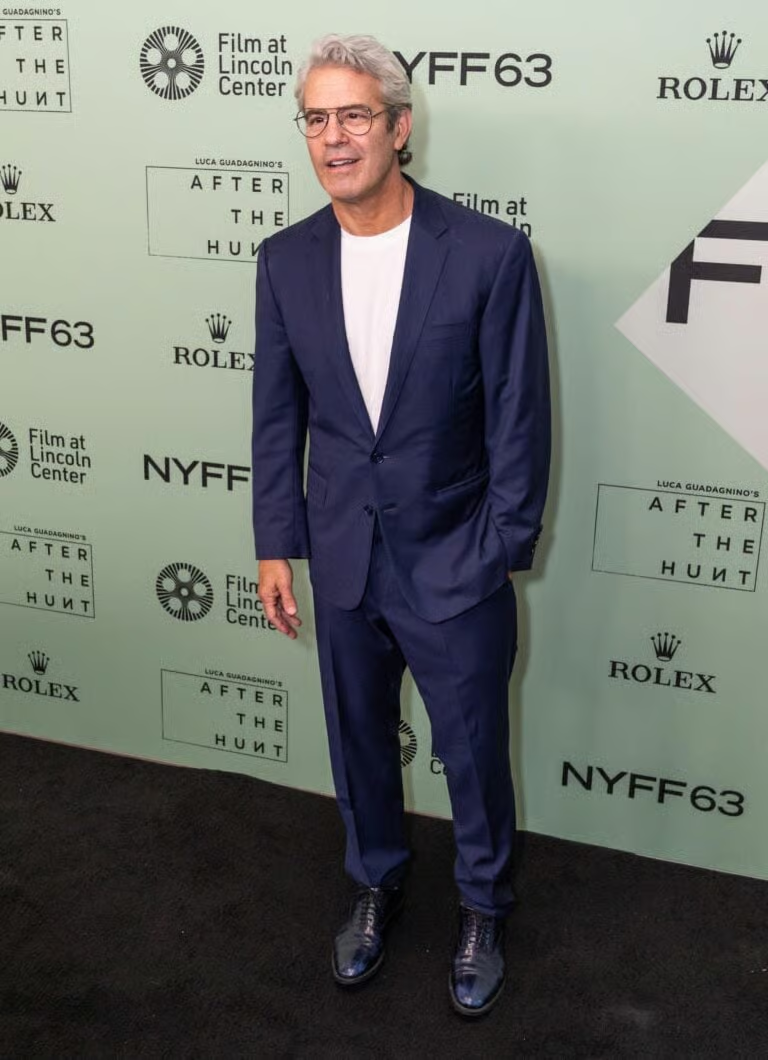
Andy Cohen is excited about the return of Bravo’s “The Real Housewives of New Jersey.” The series has been off the air since 2024, and when the Garden State ladies return (likely in 2027), it’ll be must-see television. In a new interview, the Bravo figurehead and father of two opened up about why now was the right time to return the series from hiatus, saying it all had to do with Teresa Giudice and Melissa Gorga‘s recent reconciliation.

Speaking with Variety, Cohen, who serves as an executive producer of the series, said that “The Real Housewives of New Jersey’s” return has everything to do with Gorga and Giudice finally making up.
“They actually have [reconciled], and I do believe it,” Cohen said. “You know, this happened months ago, and we decided not to film anything because, frankly, we’ve seen Melissa — and we’ve seen Joe and Teresa — make up before. We were like, ‘Great, if you’re going to do this, go do it!’ And they lived in it for many months.”
Gorga and Giudice have fought incessantly on the show for over a decade. Their most recent fallout sent the show into a hiatus. However, they shocked the Bravoverse at BravoCon 2025 when they appeared side by side, telling the fandom they were moving forward as a family.
“I remember talking to Gia at BravoCon [2025], and she looked in my eye, and she was telling me things that they had been doing as a family, and she was emotional about having her uncle back and her cousins back. And I was like, ‘OK, good. This is real,’” Cohen added.

At BravoCon, Gorga touched on her newfound relationship with her sister-in-law, admitting that the pair were in a much “different place” than they were in 2024.
“Let’s just say that… everybody’s working on it. We’re working on it. We’re trying to move forward and we’ve, you know, hashed a lot of things out privately without all of this. And I think that’s a good thing,” she said.
Gorga went on to say that she’s always wanted her family to be united while filming the series, and their time away from the show helped them both realize what was most important. “Whatever it takes to wake someone up is, you know, that’s how life goes, right? And you never want it to be a funeral or a wedding or someone in the hospital. Like, that’s not what we want. So, this was a more of a natural reason,” she said.
In addition to Giudice and Gorga making their long-awaited comeback, Bravo mainstay Dolores Catania will also be back in the mix.
While the rest of the cast members have yet to be announced, Cohen teased the next season, saying that the network put together a fantastic group of women.
“We have a great group, and this has been a journey,” he said on “Radio Andy.” “This has been a journey. We have gone through… this has been a long and winding road to get to this place, and I’m very excited. What we owe you is a good show, so that’s what we want to deliver.”
Gorga echoed the exec’s statements during a chat with Us Weekly’s official Instagram account. “I mean, I’m excited,” she shared earlier this year, adding that the cast shakeup was a welcome change. “I love a little freshening up,” she said.
“We’ve done this before. We’ve been on this show for 15 years, so we’ve been through a lot of different people, and I’m excited about this crew,” she added.

According to a previous report from The Blast, cast members Jackie Goldschneider, Jennifer Fessler, Rachel Fuda, and Danielle Cabral received their pink slips from the network and won’t be featured in the upcoming season.
Margaret Josephs was also booted from the show after seven seasons, and in her departure video, she told her followers that she was moving in a different direction.
“I think the timing is right. A lot of things have changed in my life. I’ve been blessed to work on a different project. I’m on the set right now,” she said. “I realized I have to spend more time with my family, work on my designing, and just take a break and move on.”

Booted “Love Island” star Sean Reifel has responded to Bethlehem, Pennsylvania, mayor William J. Reynolds after the politician blasted the 29-year-old for leaving his job as a cop to film the Peacock reality show. During an episode of “Love Island: Aftersun,” cameras captured Reifel’s reactions to Reynolds’ claims. While discussing the moment with producers, Reifel admitted he was surprised by Reynolds’ words, as he had allegedly had a candid conversation with his employer about his plans.

In the first episode of “Aftersun,” the talk-show component of Peacock’s “Love Island USA,” Reifel broke his silence on Reynolds’ scathing statement about his decision to leave his job as a cop to film the series.
“I guess he’s upset. That’s interesting,” Reifel said.
Later, Reifel expressed his confusion over the mayor’s statements, claiming that he had an open and honest conversation about where he was going.
“I definitely had a sit down with my job and told them exactly where I was going and what was happening, and they asked me to put in for unpaid leave,” Reifel shared.

Elsewhere in the episode, Reifel said he was irked by the mayor’s public comments about him, given that he was reportedly praised by the department for his commitment and dedication to the city just before he left.
“It does bother me because they – just before I left – gave me awards for like, with my partners, taking a lady out of a building on fire and talking someone off a roof that was mentally ill. So, to give me those, and then do something like this? I just don’t understand,” said Reifel.
While it appeared Reifel had more to say about the situation, he chose to keep his words to a minimum.
“I don’t want to say anything bad about them. I know things can be taken out of context. Everyone in the department knew where I was going,” he said.

For those who may be unfamiliar with the mayor’s comments, he alleged that Reifel left the city of Bethlehem, Pennsylvania, high and dry when he walked away from his job as a police officer to find love on TV.
“Our police department spent a lot of time training and we paid thousands of taxpayer dollars to send him to the police academy. We are disappointed he left as we now have another vacancy in our department that is impossible to fill until next year,” Williams said. “I never thought I’d see the day in America where reality show participation wins out over being a police officer.”
The mayor wasn’t the only public official with something negative to say. Bethlehem police Chief Michelle Kott shared a similar statement, saying that while she’s a fan of Reifel’s, she was “disappointed” in him.
“Just because we work so incredibly hard to try to recruit the best people we can to be part of the Bethlehem Police Department,” she said, according to The Morning Call.
Speaking of “Love Island,” several outlets, including NBC News, confirmed yesterday, June 15, that one of the show’s executive producers, James Barker, died “after suffering an unexpected medical emergency” while filming in Fiji.
While information about his sudden and unfortunate passing has been kept to a minimum, the streaming giant will dedicate part of tonight’s episode (June 16) to honoring him.
Peacock also released a statement about Barker following his death, calling the 40-year-old “a beloved and greatly valued member” of the production team. “We extend our heartfelt condolences to James’ family, friends, and colleagues,” the statement continued.

Barker’s death has negatively impacted several people, including his partner, Adam Roth. While speaking with NBC News, Roth called Barker “the absolute light and love of my life.”
“He brought joy and brilliance to everything he touched. James was such a champion of the community of young music artists he was able to introduce to audiences on ‘Love Island,’” Roth continued.
Continuing, Roth said he was proud of Barker’s work on the series before adding that he was “thankful for the time we had and the memories we made together.”

In the City’s Andrea Denver and wife Lexi Sundin are expecting their first baby.
“Last fall, we decided it was time to start trying for a family, something we had always hoped for,” Sundin, 26, said in an interview with People on Tuesday, June 16. “Over Christmas, while we were spending time with family, I realized my period was a few days late and had a feeling I might be pregnant.”
Sundin explained she took a test and once she received the positive result she told Denver, 35, the good news.
“It was one of those moments you wish you could bottle up forever,” she continued. “We were completely stunned in the best way and filled with gratitude.”
The couple revealed to the outlet that they are expecting a baby girl and are excited to meet their little one.
“It’s exciting because every week makes it a little more real, and we’re both counting down the days until we finally get to meet our little one,” they gushed.
Denver and Sundin shared that they told their family and friends about the pregnancy before officially announcing their news to the world. The pair bonded with their In the City costars Yvonne Najor and Danielle Olivera too, as the women are also expecting with their respective partners. (Najor is pregnant with her and husband Nick Barber’s first baby while Olivera is expecting her first baby with boyfriend Eoin Heavey.)
“Telling our friends was just as special. It’s honestly crazy that two of our closest friends and cast mates from In the City, Yvonne and Danielle, are also pregnant, and we’re all due around the same time,” Denver and Sundin reflected. “There’s something really special about experiencing this season of life together. We get to share milestones, swap stories and navigate all the excitement of becoming parents side-by-side, which has made the journey even more meaningful.”


Summer House star Andrea Denver pulled off the perfect proposal for his now-fiancée, Lexi Sundin. “It was really romantic. It was by the sea in Italy. It was during sunset,” Andrea, 32, exclusively told Us Weekly at BravoCon on Saturday, November 4. “She didn’t expect [anything]. It was in a really romantic spot and we […]
Denver and Sundin also shared that they cannot contain their excitement as they embark on this next chapter of their lives.
“More than anything, we’re excited for all the little moments that come with becoming parents and building our own family. It’s also incredibly special knowing we’re about to make our parents grandparents,” they said. “We feel incredibly grateful and can’t wait to meet our daughter and begin this next adventure together.”
The pair first met in 2021 and their love story was featured on Summer House when Denver was in the cast from 2022 to 2024. Denver and Sundin tied the knot in June 2024 in Denver’s hometown of Verona, Italy. Since then, the couple have joined the Summer House spinoff, In the City.
By Chris Sawin
| Published

The Furious doesn’t quite live up to expectations, and that’s probably weird to hear from someone who was highly anticipating the film and enjoys martial arts films in general. Looking at the likes of who made the film, The Furious is directed by Kenji Tanigaka, the action choreographer of Twilight of the Warriors: Walled In, and the stunt coordinator or action director on at least a dozen of Donnie Yen’s films from Blade II to Sakra. The fight choreography in The Furious is credited to Kensuke Sonomura, director of Ghost Killer and action director of all of the Baby Assassins films.

The Furious capitalizes on the action and martial-arts elements of a film of this nature, but everything else is lacking. The story is that some bad guys are human trafficking children, and that’s about as deep as it goes. A journalist disappears while investigating a story, but her husband, Navin (Joe Taslim), continues the investigation, going undercover to locate her.
Meanwhile, a young girl named Rainy (Yang Enyou) is abducted as part of the human trafficking ring. Her father, a mute handyman named Wang Wei (Xie Miao), attempts to track her down and save her himself when the police turn him away for lack of evidence.

Outside of Navin searching for his wife and Wang Wei looking for his daughter, there’s no character development in The Furious. The human trafficking syndicate is run by Paklung (Joey Iwanaga), who is marrying into a gangster family and whose wife is pregnant. His motivation seems to be that because he’s expecting a child and because he needs to maintain his life of luxury, he needs to turn to doing despicable things to other children to accomplish those goals.
The villains in the film have such strange motivations. What makes the story frustrating at times is that the police chief is corrupt for its own sake. The cops are difficult to work with because he’s in charge. The human trafficking syndicate sells children because they can make money. It’s true that you don’t go into a movie like this for memorable acting or a well-written story, but it should also be considered a hindrance when lackluster film elements are this noteworthy.

The film does pack a lot of surprises into its action, though. The Furious seems not to be a huge fan of children, as they’re killed and terrorized throughout the film. It’s borderline ridiculous at times, too, as people never seem to die from lethal injuries. Wang Wei gets hit by a car while running and gets back up like it’s nothing. There’s a climactic bicycle duel in the rain, people bite off fingers unexpectedly, and somebody does a handstand, holds a knife with their feet, and then stabs somebody else with it.
With foreign films like this, it’s baffling why the filmmakers choose to make the films (mostly) in English. When everyone involved is from Hong Kong or Indonesia and English is clearly their second language, it’s evident in their performances, regardless of how much effort they put into it.

Dialogue takes the biggest hit in The Furious because it is slow and broken up in a way that sounds like it’s being performed phonetically. It’s like it’s done in an effort to appeal to a wider audience, since reading subtitles isn’t for everyone, but the majority of the fanbase of foreign and martial arts films are used to it by now. Unless an actor is fully fluent in the other languages they speak, their performance will be affected. The easiest fix is to allow them to speak in their native language so they can feel more confident, natural, and sound more genuine.
Despite the film featuring wushu, judo, and taekwondo as fighting styles, the action in The Furious is reminiscent of Muay Thai mixed with a lot of grappling; think Ong Bak: The Thai Warrior meets Donnie Yen’s Flash Point. And, for the most part, it’s awesome. But personally speaking, it grew a bit redundant. You can only slide on the ground, hit someone with your back, elbow, or knee, suplex, or use a hammer as a weapon so many times before it feels stagnant.

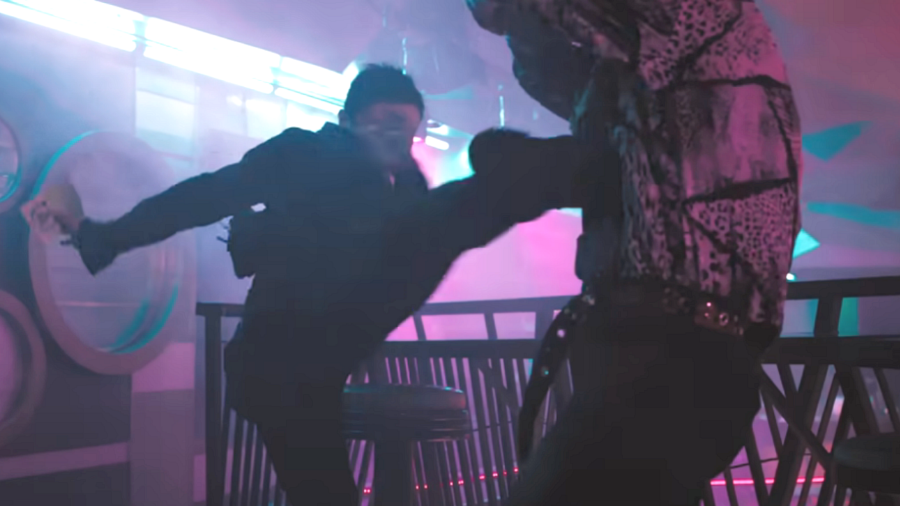
To be fair, there are some incredible sequences in The Furious, as well. Wang Wei’s first real use of the hammer is so awesome. He’s trapped in an MMA cage, so he uses a hammer to smack and pull people down to build this unconscious mountain of bodies to jump out of the cage. Xie Miao is a beast throughout the film. He spends the first third of the film either in flip-flops or barefoot running in the streets as he chases the men who take his daughter. The bloody feet T-1000 runs combined with the constant pitter-pattering of his feet smacking against the ground will be playing on repeat in your head for a long, long time.
Before the mountain of dudes sequence in the cage, the club sequence is really awesome as Wang Wei shows up wearing steel-toe boots with a picture of his daughter in his mouth and just annihilates anyone that stands in his way. There’s also a sequence where Wang Wei is riding a motorcycle through a tight hallway as Rainy rides behind him and pummels passersby with a pipe. There’s no doubt that adrenaline-fueled innovation pulses through every frame of The Furious, but it loses its steam the longer the fights last.

Tak (Yayan Ruhian) is Paklung’s right-hand man and is a weapons expert. He uses a bow and arrow for the majority of the film and is just as fast and as wicked as you’d expect him to be. The finale is also ridiculously amazing as it involves five different people using five different fighting styles, and it eats up the last 15-20 minutes of the film so effortlessly.
The Furious is one of the best action films of the year, but not the best of all time. It’s crazy innovative, but its unique nature fades as the film progresses. Its ingenuity is swapped for a fast pace that doesn’t let up, so the action is quick but repetitive. It’s a film that deserves its praise with a slight caveat.
The Furious is pummeling its way through theaters now.

By Robert Scucci
| Published

Seeking out a solid psychological thriller is always a mixed bag experience because it’s a genre that paints in very broad strokes. Once you start watching enough of them, you begin to notice patterns in the form of recurring motifs and storylines, which can help or hurt a particular film depending on a number of variables. If the plot is generic or contrived, for instance, you might not feel any suspense because you can typically predict the beats and reveals long before any “big reveal” arrives. Sometimes it kills the movie, but for films like 1992’s Single White Female, latching onto genre conventions is exactly the move to make.
The whole thing follows your typical “person living with me isn’t who she says she is” kind of story, which is exacerbated when our antagonist slowly infiltrates and steals the identity of our protagonist, resulting in an evil twin scenario you’d expect to see in your average soap opera.

I went into Single White Female with guarded enthusiasm because I was expecting some sort of committee-written thriller designed for mass appeal, which, in most cases, ends up being garbage. While I still stand by my assessment that Single White Female plays out like your typical psychological game of cat and mouse, it’s elevated to stratospheric heights thanks to Bridget Fonda and Jennifer Jason Leigh sharing top billing and absolutely going for it here.
In any other context, with any other talent, Single White Female would fall apart before you even finish the first act. As a cynical fan who’s seen too many thrillers, I recognize a good one when I see it, whether it’s doing something entirely original or not. My verdict: the film is far from original, but I’m sticking around for the characters, so I don’t care.

At the outset, Single White Female gives us a number of convenient setups that quickly fill in the exposition and allow us to watch the characters interact under extenuating circumstances. When software developer Allison Jones (Bridget Fonda) breaks up with her unfaithful fiancé Sam (Steven Weber), she suddenly needs a new roommate. She puts out a classified ad for a single white female and settles on Hedy Carlson (Jennifer Jason Leigh), who seems like a perfect fit.
Hedy is awkward but well-meaning, or at least she seems that way at first. It quickly becomes apparent that she forms a co-dependent relationship with Allison that’s very much one-sided. Allison is simply looking for a roommate to help with rent. Hedy is looking for a ride-or-die bestie. It’s charming at first, like when Hedy tells off Mitchell Myerson (Stephen Tobolowsky), one of Allison’s potential clients who gets a little too handsy with her. Matters escalate when Allison reconciles with Sam and expresses her desire to find her own place with her lover.

On one hand, I get it. In any other context, Hedy has every right to be upset, especially after moving in and getting situated in her new home. In this context, though, Hedy goes completely off the rails, and her desire to stay close to Allison manifests in disturbing ways, like dressing exactly like her, getting an identical haircut, making appearances at sex clubs while posing as her unsuspecting roommate, and trying to seduce Sam.
Having just watched Macaulay Culkin’s The Good Son (1993) this past week, I’m wondering what was in the water because Hedy also kills a dog and pretends it’s an accident. It’s an off-screen death, but we knew its name was Buddy, so that took the wind out of my sails for a minute, if I’m being entirely honest. Just like head-smashing in modern elevated horror movies, harming animals was a very effective way to get a reaction from moviegoers. This is just another example of how the film leans into its tropes, but its leads use them well.

If Single White Female didn’t allow itself a few convenient setups, things wouldn’t be able to escalate nearly as quickly. Allison working as a freelance software developer allows her to be home more frequently so we can focus on the relationship dynamic between Allison, Hedy, and Sam. Thanks to how available both Allison and Hedy are, they’re able to establish a bond rather quickly and become besties before Hedy completely loses her mind and becomes the worst roommate ever. This works especially well for Hedy’s personality type because her clinginess and subsequent feelings of rejection don’t feel sudden or like they’re coming from nowhere.
While Bridget Fonda is a powerhouse lead in Single White Female, it’s Jennifer Jason Leigh’s willingness to go all in on Hedy’s neuroses that makes the film work as well as it does. When she fully transitions into looking like her roommate, Hedy is terrifying because she’s doing it without a hint of irony. Seriously, for a second, imagine your roommate coming home dressed exactly like you, down to the smallest detail. Now imagine they start talking like you and perfectly mimicking your body language while their motives remain unclear. You’d be ripping up your lease in no time if this was something you had to deal with.

SINGLE WHITE FEMALE SCORE
The on-screen dynamic between Bridget Fonda and Jennifer Jason Leigh cannot be overstated in Single White Female. I’ll be the first to admit that the narrative structure it latches onto leaves a lot to be desired when it comes to originality, but the film takes a relatively generic setup and turns it into something next-level thanks to the acting talent involved. If you’re looking for a reliable thriller that thrives within its supposed limitations, you can stream Single White Female on Netflix as of this writing.
By Robert Scucci
| Published

The most dangerous thing in the world is a desperate man who feels like he has nothing left to lose. It makes for inherently compelling cinema, especially when the desperation is played with nuance, like in 2025’s Dead Man’s Wire. Based on the real-life 1977 Tony Kiritsis hostage standoff, Dead Man’s Wire is a fictional retelling of the events depicted in the 2018 documentary Dead Man’s Line, written and directed by Alan Berry and Mark Enochs, who consulted screenwriter Austin Kolodney and director Gus Van Sant on the historical context of the nationally broadcast incident.
While I’m not here to nitpick historical inaccuracies, nor do I want to because I’m talking about the film adaptation as a piece of cinematic art, I can confidently say that Dead Man’s Wire is a shockingly immersive period piece. I didn’t stop to verify every car make and model or anything like that, but the movie takes place in 1977, and it convincingly looks like something that came out of that era. While mostly shot through conventional means, we’re also given on-the-street footage that looks like it was pulled directly from police cameras, and there’s even some real archival footage peppered throughout the film in a similar fashion to how Weezer pulled off looking like they were performing in an episode of Happy Days.

And I haven’t even gotten to the best part about Dead Man’s Wire: Bill Skarsgård as the desperate man operating in this lane, and he’s mad as hell!
There’s a kind of wish-fulfillment arc that plays out in Dead Man’s Wire that makes it all feel so universal. Tony Kiritsis has a bone to pick with one specific person, M.L. Hall (Al Pacino), who, in a botched real-estate deal, undermined the profitability of Tony’s most recent and valuable investment. Knowing he’s ruined financially if he doesn’t straighten things out, he heads over to Meridian Mortgage Company, where M.L. Hall said he’d be to exchange words, only to find out that he ducked out for vacation early and delegated the meetup to his son, Richard (Dacre Montgomery).

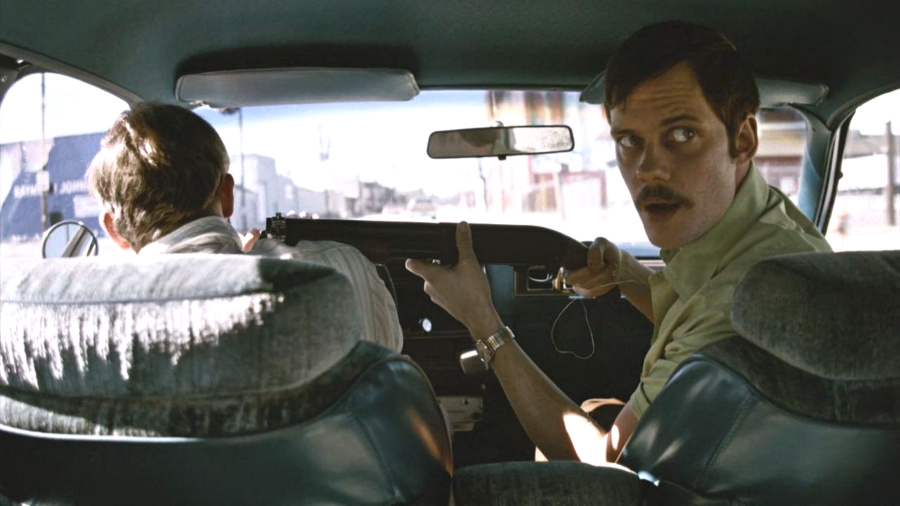
Furious and unable to contain himself, Tony assaults Richard and straps a loaded shotgun to his neck with a wire rig connected to a dead man’s switch. Here’s how it works: if you move enough to trigger the switch, your head will get blown clean off. With Richard and the device in tow, Tony holes up in his apartment and begins making his demands to the authorities. He also places crazed calls to his favorite radio DJ, Fred Temple (Colman Domingo), hoping his story will be broadcast so the public will side with him.
As Dead Man’s Wire slow-burns through its second and third acts, we get a clear glimpse into Tony’s psychology, which, to Bill Skarsgård’s credit, is portrayed with care, nuance, and just the right amount of unpredictable explosiveness lingering beneath the surface. He knows that he’s dead to rights. Everybody saw what he did. But he refuses to buckle under pressure until he’s made whole financially and receives a sincere apology from M.L. Hall, who doesn’t want to kowtow to terrorists and is more than willing to treat his son as collateral if it means he doesn’t have to show any signs of weakness.

While it’s obvious that Dead Man’s Wire is an indictment of capitalism, it’s carefully constructed in a way that allows you to appreciate all of the gray areas. M.L. Hall is your perfect corrupt capitalist, to the point where he’s willing to gamble with his son’s life during a hostage negotiation while sipping mai tais on the beach. But it’s also reasonable to assume that he’s a smart guy who knows he’s crossed every t and dotted every i, legally speaking, and believes people like Tony are all bark and no bite.
Tony, on the other hand, is a loner facing financial ruin who initially only wanted an apology. His whole stunt was orchestrated with the intent of exposing the kind of financial impropriety that happens behind closed doors at Meridian Mortgage. Even if Hall was well within his legal rights to screw Tony over, Tony recognizes that the house always wins and questions the ethics of what happened to him. In his mind, he’s the little guy taking one for the team by hurting the company’s bottom line with bad publicity.

Everybody in Dead Man’s Wire is in the wrong, but it shows just how far a man is willing to go when he’s convinced, without a sliver of doubt, that he was swindled out of his nest egg and the institutions that are supposed to protect him have failed him. It doesn’t condone or condemn the violence, but rather examines the untethered rage that’s unfortunately, and all too frequently, the byproduct of living in a capitalist society where the working man is forever getting screwed by the institutions that run his life.
What’s most telling about this fictional retelling of Tony Kiritsis’ most unhinged moments is how the entire ordeal ultimately resolves. Mental health is brought into question, but it’s a hotly debated topic when discussing the real-life incident. It does make me wonder how unhinged Tony Kiritsis truly was before he decided to take this route. If Bill Skarsgård’s performance is any indication, it certainly feels like an otherwise reasonable man pushed to the brink by a series of personal and financial crises. It’s written all over his face when he has to mean-mug for the camera, but his true personality occasionally slips through the facade when he’s trying to lighten the mood or add some levity to an impossibly high-strung situation.

Dead Man’s Wire offers no easy answers to its unfolding story, but I don’t think it’s supposed to. Its delivery is very much, “this is what happened, as authentically as we could replicate,” forcing the viewer to arrive at their own conclusions after watching the whole thing play out. Like most Gus Van Sant films, this one lingers because it’s supposed to make you uncomfortable, as if you’ve got a dead man’s switch tied to your neck and any sudden movement could end it all.
As of this writing, Dead Man’s Wire is streaming on Netflix.
:max_bytes(150000):strip_icc():format(jpeg)/RFK-Jr-Kerry-Kennedy-061626-812b77835a124181a5abd87624136533.jpg)
The Secretary of Health and Human Services has had a lifelong fascination for animals ranging from exotic creatures to roadkill.
Editor’s note: The below contains spoilers for the Pluribus Season 1 finale.As an alum of The X-Files, Vince Gilligan understands the eternal power of the unknown. By leaving viewers in the dark, you’ll keep them wanting more. The creator of Breaking Bad and theacclaimed Apple TV series Pluribus, Gilligan forces his audience to sit through episodes of methodical plot-building and character development, but he rewards their patience with some of the most intense, probing, and dynamic episodes of television in history. When recommending Breaking Bad to friends, everyone was obligated to preface it by saying, “It starts out slow.” With its spin-off series, Better Call Saul, Gilligan and co-creator Peter Gould upped the ante by crafting multiple deliberately paced seasons without an explosive resolution.
Pluribus, which reunites Gilligan with Better Call Saul breakout star Rhea Seehorn, is the showrunner’s apex as a patient storyteller, so much so that many audiences have turned against it after its first season due to its pacing. However, to suggest that the show is boring, repetitive, or anticlimactic is a grave misreading of Gilligan’s artistic touch that has defined his legendary career in television.
The first episode of Pluribus introduces viewers to Carol Sturka (Seehorn), a cynical author residing in Gilligan’s favorite city, Albuquerque, who finds herself in the middle of a traumatic global takeover by an unknown entity. Like Carol, who witnesses the death of her wife, Helen (Miriam Shor), amid the chaos of the world, viewers are perplexed, if not horrified, at what is occurring. Why are all these people dying? How do all the survivors know Carol’s name, including a White House staff member? Most importantly, why is everyone so peculiarly nice? It’s a dazzling episode that drops viewers into this ostentatious scenario and trusts them to make their own judgments.
As the nine-episode season progresses, the audience is given little crumbs that explain the origin and existence of this hivemind, known as “The Others,” who dutifully serve Carol with the intent of making her happy, something she’s certainly not interested in. She first tries to commission assistance from the remaining people in the world unaffected by the virus. Then she turns to performing her own sleuthing and undermining the hive, which embodies what Artificial Intelligence would look like as a cult. After tiresome resistance, Carol begins exhibiting signs of Stockholm syndrome, learning to accept the comfortable but inhuman lifestyle propagated by the Others.
After its enticing setup, Pluribus does not indulge the audience with a thrilling second act and conclusion. In Gilligan’s previous shows, Walter White (Bryan Cranston) shaves his head and transforms into the first phase of Heisenberg in Breaking Bad, and in Better Call Saul, Jimmy McGill (Bob Odenkirk) can’t help but lay the groundwork for his titular alter ego by performing numerous cons. Pluribus, which ends with Carol and fellow immune Manousos Oviedo (Carlos-Manuel Vesga) receiving a package containing an atom bomb (an item that Carol previously asked if she could request from the Others), indicates that the story is only starting. The show more or less remains in the same place from the end of Episode 1 through its finale, drawing the ire of some viewers who felt cheated out of dramatic stakes.
Despite Gilligan’s fascination with change and character evolution, Pluribus deals with a protagonist stubborn to change her pessimistic ways in the face of her perpetually happy neighbors. As a reluctant hero, a woman already stuck in a malaise as a frustrated novelist writing low-brow fantasy books, it would be disingenuous to Carol’s characterization if she solved the world’s problems within a season. While it slows the development of the story, her exasperation at the Others’ robotic friendliness is an essential component to the show’s dark humor and grounded quality. The series may be science fiction, but living with advanced technology with the potential to take over humanity is eerily reflective of our present day.

Having attained the highest levels of critical adoration during the peak of the prestige television boom, Gilligan has nothing to prove, and Pluribus represents an artist in complete control of his uncompromising vision. Even when Breaking Bad was at its most heart-pounding, Gilligan and his creative team always returned to slow-burn filmmaking, visualized by unbroken wide shots of a sweeping vista. Characters who concoct elaborate schemes, investigate documents, and build machinery complement his love for process and procedure, leaving no stone unturned in the world and story-building department. Preternatural private eye/hitman Mike Ehrmantraut (Jonathan Banks) in the Heisenberg-verse is perhaps the North Star of Gilligan’s style, as both shows depict him laboriously dismantling devices and tailing his enemies.
Gilligan’s love for process comes alive in Pluribus, resulting in low-energy scenes without a direct resolution. However, the series is more suited to slow-burning sequences than Breaking Bad or Saul, as the plot machinations are limited to merely watching Carol try to make sense of her surroundings. The series wisely keeps its scope measured — forcing us to focus on one tiny aspect of this global takeover rather than diving into the life-or-death consequences in its first season.
Although time has passed since the nadir of 2020, the listless nature of Carol’s life recalls how we all hunkered down and dealt with grave uncertainty during the pandemic, and this feeling should resonate with all audiences. Interstitials track the progression of time since the Others’ takeover, yet nothing has changed. Slow-burn pacing is not just an artistic flex on the showrunner or director’s part, but also an actor’s showcase. Off the momentum as Kim Wexler in Better Call Saul, Seehorn uses the narrative flexibility of Pluribus to express a wide range of emotions, starting with disdain towards Carol’s audience to a strange affection for her chaperone, Zosia (Karolina Wydra).
Pluribus is never boring, but it refuses to hold the audience’s hand — a challenge for those engaging in passive or second-screen viewing. The series taps into your feelings of being stuck in a dead end. First, you try to fight against it, then you begrudgingly accept these circumstances after futile efforts, and then you find yourself longing to stay in a place of eternal comfort. Rather than conveying these ideas out loud, Gilligan uses methodical pacing to track Carol’s psychological status, which has devolved from a noble rebel to being romantically involved with her captor. For some, Pluribus perhaps just hits too close to home as a reflection of recent history and our attachment to technological assistance that enables loneliness.
A celebration following the New York Knicks’ championship victory ended in tragedy when a family’s beloved dog, Jameson, was fatally shot by a Los Angeles Police Department officer.
Topanga Patrol Division police officers responded to reports of a “screaming woman” at an apartment unit in Canoga Park, California, on Saturday, June 13, at 8:55 p.m., according to a Los Angeles Police Department press release.
Upon their arrival, officers found New York native Marie Marseille watching the Knicks win the championship with Jameson. The pet was wearing the basketball team’s jersey, according to FOX 11.
Police said that while they spoke to Marseille, a “large dog was by her side” and was “barking at the officers.”

The family of late Dallas Cowboys defensive end Marshawn Kneeland has cast suspicion upon law enforcement over the death of the NFL star. “I truly think they killed him, I truly do,” Marshawn’s cousin Jasmine Kneeland, 33, told the Daily Mail in a story published on Saturday, November 8. Marshawn died on Thursday, November 6, […]
“The officers asked her to secure the dog, and the resident closed the door momentarily. She re-opened the door, and the dog exited the apartment,” the release stated. “Once outside of the apartment, the dog charged at one of the officers, resulting in an Officer-Involved Shooting (OIS).”
Jameson, a 2-year-old golden retriever, Saint Bernard and poodle mix, died in the shooting. The LAPD said in the release that the Los Angeles Department of Animal Services then took custody of his body.
Following the shooting, Marseille told FOX 11 that she didn’t “understand what happened.”
“I don’t understand why he had to get shot, I don’t get it, he didn’t do anything,” she said. “He’s my baby, he’s my baby. It doesn’t make any sense to me, I can’t make sense of anything.”
Marseille also told the outlet that Jameson wasn’t baring his teeth, barking, growling or being aggressive when the officers were at her home. “He was just moving towards the officer,” she said.
Force Investigation Division investigators responded to the scene after the shooting and are now looking into the incident, according to the LAPD.
The LAPD also said that the dog owner was there at the time of the incident and cooperated with the investigation. No community members or officers were injured in the shooting.

Police in California are investigating the death of a young Arizona mother after she was tragically killed in a dog attack while protecting her 5-year-old son, Us Weekly has learned. Emily Panuco sustained several severe injuries in the February 27 attack that unfolded inside her mother’s home in Big River, California. She was just 26. […]
Following the dog’s death, a GoFundMe page was set up with the goal to “get justice for Jameson” and to raise money for his cremation fees.
“On June 13th, 2026, 10 minutes after celebrating the Knicks championship win, our dog was fatally shot right outside our home. Jameson was 2 years old, and he was taken from us too soon,” fundraiser organizer Jeremiah Garcia wrote. “Anyone who’s met Jameson would tell you he is the sweetest boy in the world. Please help us raise money to get Justice for Jameson and any cremation fees.”
The LAPD did not immediately respond to Us Weekly’s request for comment when asked about an update in the case.

Marvel Studios isn’t playing it safe with the long-awaited X-Men reboot.
Recent comments from writer Lee Sung Jin suggest that Marvel is aiming for a fresh start, one that won’t be tied down by the previous X-Men films and will instead embrace bold ideas and a new creative direction.
While discussing the project, Lee revealed that Marvel Studios President Kevin Feige is encouraging the team to think bigger than what has come before.
“Truthfully, it’s same parameters on this project, which is so exciting. I’d say there were actually more parameters on Thunderbolts because it was plugging into an existing arc and existing characters, whereas with X-Men, Kevin [Feige]just wants to take a big swing and start anew, not be beholden to any of the movies that have come before.”
That approach appears to fit perfectly with director Jake Schreier’s vision for the film. According to Lee, Schreier wants to focus on what made the classic X-Men comics resonate with fans in the first place.
“And Jake Schreier has such a clear vision in terms of wanting to get back to character first, and to what is exciting about those early Chris Claremont-run comics, which was all about team dynamics. There were a lot of soapy elements to those comics.”
The upcoming reboot is expected to serve as a true fresh start for Marvel’s mutants. Rather than recreating the Fox era, the studio appears focused on introducing a new generation of heroes while placing a stronger emphasis on character relationships and team chemistry.

Lee also spoke about how exciting it has been to help shape this new version of the franchise.
“I’m such a big fan of that IP of the comics. My dad and I, every Saturday morning, used to watch the show on television, so to be able to look around this Marvel conference room and have every X-Men character on the board and be able to spitball and freestyle on, ‘What about this person?’ it’s so emboldening, because you’re like, ‘Oh, wow, this isn’t going to be a safe movie. This is actually going to be a really exciting new take.’”
Before the reboot arrives, fans are expected to see familiar mutant faces return in Avengers: Doomsday, helping bridge Marvel’s past with its future. But when the MCU’s X-Men finally assemble, it sounds like audiences should expect something completely different.
If Lee Sung Jin’s comments are any indication, Marvel isn’t interested in playing it safe. The studio is taking a major creative swing, and that could make the MCU’s X-Men one of the franchise’s most exciting new chapters yet.




No Jackpot Winner as $257 Million Prize Rolls Over to $269 Million Monday Draw


Oppenheimer backs SpaceX as $70 billion retail frenzy builds


Weekend Open Thread: Tuckernuck – Corporette.com


Markets Rally as SpaceX IPO Looms Amid Iran Tensions and Inflation Surge

Zimbabwe Requires Crypto Businesses to Register Annually Under New FIU Regulations


NanoClaw integrates JFrog registries to secure AI agent downloads


Thailand Ranks Second Worldwide for AI Adoption Growth, Microsoft Reports


This Week In Security: Microsoft On Microsoft, Register Your Domains, Linux On ARM, And FreeBSD Joins The File Cache Club


Bitget enters Argentina’s regulated crypto market through PSAV registration

Dutton Ranch star claims they ‘didn’t see any disruption’ on set following Chad Feehan’s exit from Yellowstone spinoff fueled by Taylor Sheridan clash rumors


El Nino has formed in the Pacific and could set records, forecasters say


Politics Home | Healey Resignation Is “Colossal Failure Of Government”, Says Former Labour Defence Secretary


‘This is Seattle’s position on AI’: City Council votes unanimously to pause big new data centers

Donnie Wahlberg & More Heat Up Las Vegas at Circa’s Barry’s Downtown Prime

Opendoor Ends India Operations, Fueling a Bigger Conversation About AI and Outsourcing


First Time Since 1971: Australia Register Historic Low In ODI Cricket


Belfast burns, while Met chief points finger at Iran and Russia


FBI searches office of Ohio voter registration group


AT&T: Verizon's 27% Outperformance Sets Up A Solid Entry Point


Modi thanks Trump for wishes as US attacks Indian seafarers


You must be logged in to post a comment Login