Connect with us
DAPA Banner
DAPA Coin
DAPA
COIN PAYMENT ASSET
PRIVACY · BLOCKDAG · HOMOMORPHIC ENCRYPTION · RUST
ElGamal Encrypted MINE DAPA
🚫 GENESIS SOLD OUT
DAPAPAY COMING

Tech

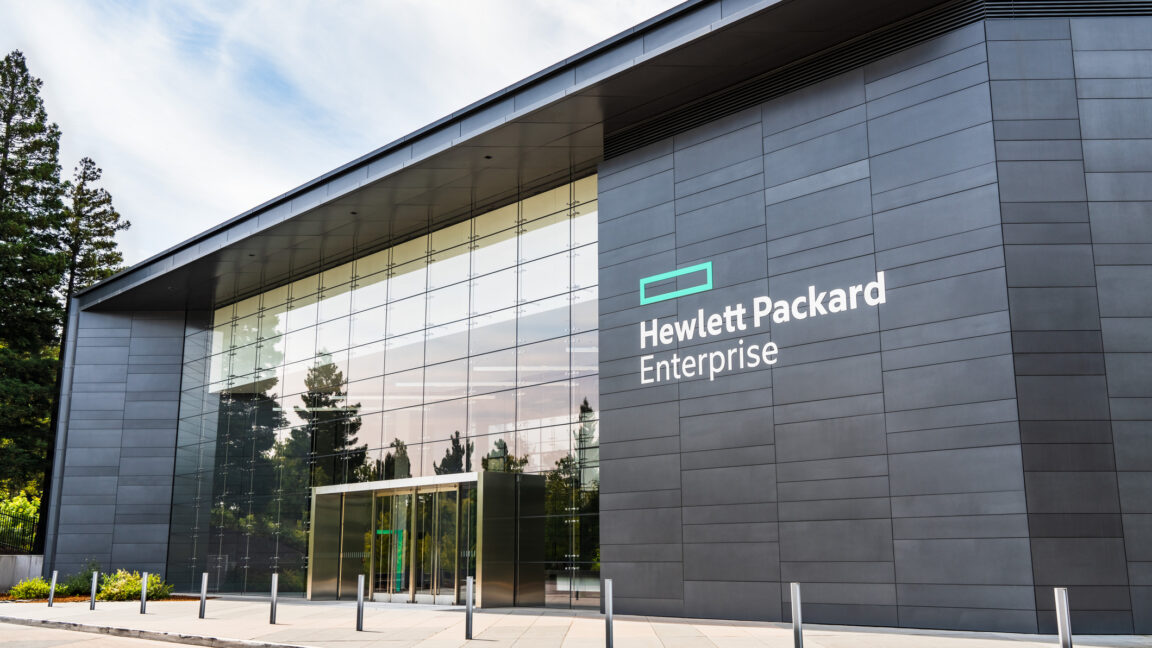
Year of free HPE software a “step in the correct direction” in VMware rivalry

Published

on

HPE’s new promotion aims to entice customers to more deeply consider migrating off VMware. While numerous third-party surveys have pointed to a significant amount of VMware customers looking to reduce or eliminate their VMware use over the next few years, concerns around time and cost are also expected to slow or deter migration plans, especially given that migration can require paying for two virtualization products simultaneously.

“One of the big things we see is that as customers are going through this journey on transforming their operating model, you end up with double expenses,” HPE’s EVP and CTO Fidelma Russo said, according to The Register.

Dean Colpitts, CTO of Canadian managed services provider (MSP) Members IT Group (MITG), which VMware cut from its reseller program after 19 years of partnership a year ago, doesn’t expect the promotion to drive sales much.

“All our clients work on three, four, or five-year life cycles and generally roll that purchase into their initial buy,” he told Ars. “The biggest issue I’m seeing right now that is affecting VM Essentials sales and adoption is [that] the high prices and constraints of DRAM [are] affecting customers’ ability to obtain new hardware to migrate onto.”

Advertisement

Colpitts pointed to a lack of available hardware for permanent migrations and “to temporarily facilitate a brownfield reimage of the customer’s existing equipment from VMware to” VM Essentials.

On the other hand, one of HPE’s biggest channel partners, San Diego-based Nth Generation, is expecting its “VM Essentials sales pipeline to as much as quadruple and sales to grow at about that rate” because of HPE’s promotion, CRN reported.

“These additional free licensing and migration capabilities are going to drastically lower the risk of moving to VM Essentials,” Nth Generation co-president and CTO Dan Molina told the publication.

Partner promotion

HPE also announced that it would give 600 reseller partners who earn the HPE partner program’s Private Cloud with Virtualization competency by the end of the year free VM Essentials software licenses for three years. Partners still have to pay support costs, though.

Advertisement

Colpitts said that the benefit is “a step in the correct direction” but that limiting the promotion to 600 partners is “very shortsighted.” He believes that HPE should give all of its partners VM Essentials “to facilitate getting [VM Essentials] into customer sites and displacing the competitors.”

“They need to fling [VM Essentials] as far and as fast as they possibly [can] to immediately gain traction and draw ISVs to them, which will increase adoption even more,” he said.

Source link

Advertisement
Continue Reading
Click to comment

You must be logged in to post a comment Login

Leave a Reply

Tech

What the New Screen-Time Debate Means for Edu

Published

on

The screen-time debate is no longer confined to parenting advice. As states introduce legislation limiting devices in schools, and pediatric researchers rethink how digital environments affect development, educators are confronting a difficult question: when does technology support learning, and when does it undermine it?

In the first part of this series, I examined the American Academy of Pediatrics’ updated guidance on children’s digital ecosystems and how screens can shape early development at home. The same principles now apply in another place where children spend much of their day: school.

Screens are already a routine part of early childhood classrooms. In a 2025 RAND survey of pre-K teachers, roughly two-thirds reported using games on electronic devices in their classrooms. At the same time, a growing body of research is raising new questions about how different types of digital media affect children’s developing brains.

One frequently cited Canadian longitudinal study followed nearly 2,500 children between 24 and 36 months old and found that higher levels of screen time were associated with missed developmental milestones on screening tests at ages 36 to 60 months. That means that we’re seeing the developmental effects of increased toddler screen time as early as one year later.

Advertisement

Other studies suggest that certain types of media may be particularly overstimulating for young children. Fast-paced content designed to capture attention usually features rapid scene changes, constant motion, bright colors and loud sound effects. I love shows like Netflix’s “Word Party” for the language acquisition skills it teaches, but its features can overwhelm developing brains and temporarily disrupt executive functions such as attention, emotional regulation and self-control (ask me how I know).

These design features are meant to hold viewers’ attention, but the result can sometimes be what many parents recognize instantly: the moment when their sweet child suddenly turns into what I jokingly call a “screen monster.” I have three of them. I can’t imagine a classroom full of screen monsters.

As new technology becomes even more embedded in our lives, screens have become more pervasive in both homes and classrooms. And because technology changes so frequently, it’s helpful for educators to understand how instructional technology choices can either support or disrupt healthy digital environments for students.

I know this tension well, both as a parent and as a behavioral science and public health researcher. In the first part of this column series, I wrote about how screens have both helped and challenged my own family as we navigated parenting during the pandemic. Like most parents and teachers, we are still figuring it out. I’ve written previously about how short-form video addiction has made its way to Gen Z and Gen Alpha. And I recently reported the results of a research project we did at EdSurge that showed that prohibiting devices doesn’t really meet its intended goal.

Advertisement

Devices, screens, algorithms and technology in general have mutated from a household question to an education policy issue.

NEWSLETTERS

STAY AHEAD IN EDUCATION.

Sign up for EdSurge newsletters for timely news, insights and analysis.

The Emerging Landscape of Technology Regulation

From a public health perspective, digital media is becoming part of the broader developmental environment shaping childhood development.

Advertisement

In education, conversations about technology traditionally have focused on the digital divide and ensuring equitable access to devices and internet connectivity. That conversation is shifting.

Researchers are now examining how digital environments affect sleep, attention, emotion regulation and social development. Population-level research suggests that heavy or poorly designed media exposure can contribute to sleep disruption, emotional dysregulation and difficulty disengaging from devices. Remember, screen monsters are lurking with their snotty noses and sippy cups.

Now, these concerns are beginning to influence policy.

Across several states, lawmakers are proposing restrictions on student device usage during the school day, including bans on smartphones and new scrutiny of edtech that uses personalized algorithms to maximize engagement. Since many edtech companies have enhanced or marketed their AI-powered features, the competition to capture and hold students’ attention has likely stiffened.

Advertisement

This is a significant shift. Historically, digital technology, social media and the Internet has been one of the least regulated environments with, arguably, among the greatest effects on both children’s and adults’ lives. Technological change often moves faster than public policy and data, leaving lawmakers and educators to respond after new tools become widespread.

Now the regulatory landscape appears to be catching up and entering the environments children already inhabit.

So What Should Educators Do?

What started as a deeply personal parenting dilemma has become a much larger question for schools. As pediatric researchers update guidance on children’s digital environments, and states debate limits on student screen exposure, educators are being asked to reconsider how technology shapes the cognitive environments where children learn.

The debate often falls into extremes. Some people argue that screens are ruining learning. Others claim that technology is the future of education.

Advertisement

The research suggests that the truth lies somewhere in the middle.

This is one of those test questions where “all of the above” fits best. How screens affect children depends heavily on context, content and duration of use. A passive, fast-paced digital experience is very different from an interactive lesson where students discuss ideas, solve problems or collaborate with peers.

It can be tempting to respond to uncertainty by rejecting technology altogether. And I don’t fault that perspective, because I believe that response comes from a desire to protect kids from unpredictable harm. But the reality is that there is no one-size-fits-all approach for every child, classroom, school or community.

Public health offers a useful framework for thinking about this challenge: harm reduction.

Advertisement

When an exposure is widespread and difficult to eliminate, reducing risk is often more effective than banning it outright. Seatbelts and car seats made riding in cars and buses safer, instead of banning vehicles to reduce vehicular accidents. That’s a classic harm-reduction strategy.

Similarly, screens are unlikely to disappear from classrooms. The more productive question is how educators can create guardrails that reduce potential harms while preserving the benefits of digital tools. I think students would keep using devices, anyway. What’s school without TikTok dances nowadays?

That means choosing technology that supports interaction rather than passive consumption, and balancing digital activities with discussion and hands-on learning. The personalized algorithms in edtech are becoming more common, but the science suggests that it’s best to avoid tools designed primarily to maximize screen engagement.

As states debate new regulations on student screen exposure, educators and school leaders will increasingly be asked to make decisions about how technology shapes the environments where children learn.

Advertisement

The research offers a useful starting point: children’s brains learn best through interaction, conversation, manageable stimulation, productive struggle, and moments of curiosity that make ideas stick.

Technology can support those experiences. But it cannot and will not replace the relationships between students and the adults who teach and care for them.

The real question for schools is not whether screens belong in classrooms, but whether they help students think, or simply keep them clicking and scrolling.

Source link

Advertisement
Continue Reading

Tech

HPE Tempts VMware Users, Partners With Year of Free Virtualization Software

Published

on

An anonymous reader quotes a report from Ars Technica: Hewlett Packard Enterprise’s (HPE) new virtualization software promotion will likely pique the interest of end users and resellers who are unhappy with Broadcom’s pricing of VMware. During its HPE Discover event in Las Vegas this week, HPE announced that customers could use its “HPE Morpheus Software — VM Essentials” offering for free for “up to one year,” per a press release. HPE’s website describes its virtualization platform as a “VMware alternative.” It includes a hardware virtual machine (HVM) hypervisor and unified management and lets users “manage VMware ESXi and HVM clusters from one console and migrate when you’re ready,” HPE’s website says. “New VM Essentials customers can receive up to one free year of licenses for VM Essentials, a year of HPE Zerto for $1 to support non-disruptive migration to HPE virtual machines, and 0 percent interest on software through HPE Financial Services,” HPE’s announcement reads, referring to HPE’s group for helping IT teams manage funding.

Free for a year is cheaper than what Broadcom has charged for VMware vSphere since taking over. VMware prices have skyrocketed due to VMware’s parent company eliminating perpetual licenses and bundling products into expensive packages. Notably, per its website, HPE recommends charging $600 per CPU socket per year for VM Essentials; Broadcom has controversially shifted vSphere licensing pricing to a per-core basis. “Customers are feeling quite a bit of pain in the change that some of the virtualization companies have put there, specifically Broadcom,” Jeremiah Jenson, VP of HPE’s North American channel and partner ecosystem, told CRN. The executive claimed that VM Essentials could bring up to 90 percent cost savings compared to VMware while also helping to “eliminate vendor lock-in and simplify hybrid IT.”

From March 1 to June 30, HPE has also been offering a free year of VM Essentials via rebate to customers who buy an AMD server and a one-year VM Essentials license. VM Essentials is only available through channel partners, a stark contrast from Broadcom’s VMware approach, where the chip giant has drastically reduced the number of resellers that can sell VMware products. HPE’s new promotion aims to entice customers to more deeply consider migrating off VMware. […] HPE also announced that it would give 600 reseller partners who earn the HPE partner program’s Private Cloud with Virtualization competency by the end of the year free VM Essentials software licenses for three years. Partners still have to pay support costs, though. The benefit is “a step in the correct direction,” said Dean Colpitts, CTO of Canadian managed services provider (MSP) Members IT Group (MITG), which VMware cut from its reseller program after 19 years of partnership a year ago. However, limiting the promotion to 600 partners is “very shortsighted.” He believes that HPE should give all of its partners VM Essentials “to facilitate getting [VM Essentials] into customer sites and displacing the competitors.”

“They need to fling [VM Essentials] as far and as fast as they possibly [can] to immediately gain traction and draw ISVs to them, which will increase adoption even more,” he said.

Advertisement

Source link

Continue Reading

Tech

Cyberattack sees crops kept in the ground

Published

on

CYBER-CRIME

Sugar cane in the field

A cyberattack on Australia’s second-largest sugar producer has forced farmers to keep crops in the ground, and looks like denting their incomes.

Advertisement

Mackay Sugar, based in the Australian state of Queensland, processes sugar cane farmed in nearby districts. The company disclosed a cyberattack on June 10 and limited operations while it dealt with the fallout. 

Some operations remain restricted, but the company said on Monday that it managed to perform some manual crushing at its Farleigh Mill site, working with sugar cane that was harvested before the attack.

“Significant progress has been made over the weekend in restoring the systems that support cane supply, harvesting, and mill operations,” Mackay Sugar said in a statement.

“Steam trials are now underway, and subject to final validation activities, some harvesting is expected to recommence this week in preparation for the staged restart of crushing operations later this week.”

Advertisement

While the company is optimistic it can resume crushing, it’s advised growers not to harvest their crops for the time being.

That edict works for Mackay Sugar because sugar producers need to process crops within 48 hours of harvest. Doing so preserves high sugar content and overall yield. Delaying the processing for any longer after harvesting could result in sucrose converting to simple sugars, unwanted fermentation, and lower yields. 

But late harvesting can reduce the quality of cane, reducing the price they earn for their crops. Interrupted harvesting also impacts the railways used to move cane from farms to mills.

Mackay Sugar acknowledged the impact its downtime could have on growers and other partners, and committed to restoring systems safely.

Advertisement

“We are communicating directly and regularly with our employees, growers, and key partners,” it said. “We recognise the impact this incident is having on our growers, and we are doing everything we can to support them and to safely resume full operations as soon as possible.

“We take our responsibility to protect our systems, operations, and information very seriously. We apologise for any disruption this incident has caused and will continue to provide updates as we continue our investigation.”

The company operates three mills across Queensland, two of which were operating at a limited capacity due to the attack.

Its Racecourse Mill, described as the heart of the business and home to its corporate offices, was among those affected. Racecourse Mill typically generates 213,000 tons of raw sugar and 58,000 tons of molasses a year, and the site’s cogeneration plant generates 156,000 MWhs of renewable electricity a year, around 71 percent of which is sent back into the national electricity grid.

Advertisement

Mackay’s mill in Farleigh, the company’s oldest, was also affected. It typically produces around 196,000 tons of raw sugar and 49,000 tons of molasses per year.

The company’s largest and most productive factory, Marian Mill, was unscathed.

Ungentlemanly conduct

Cybercrime group The Gentlemen claimed responsibility for the attack on Mackay Sugar, posting the company to its data leak site without offering any details about the attack or whether it stole data to use as leverage for extortion demands.

Cyber threat intelligence professionals have known of the group for almost a year, after spotting it in July 2025 and classifying it as a ransomware-as-a-service provider. 

Advertisement

However, there is no evidence that ransomware was used in the attack on Makay Sugar. The company has never mentioned ransomware in its statements, referring to the attack only as a “cyber security incident.”

However, The Gentlemen is known for using file-encrypting malware in its double extortion attacks.

The group caught the attention of Microsoft’s researchers, who last month published a deep dive into how it carries out attacks.

Microsoft’s report noted that not only do The Gentlemen affiliates have access to a powerful file encryptor, but also one that self-propagates, which “increases the likelihood of widespread impact once initial access is achieved.”

Advertisement

It has also recently established a partnership with BreachForums, which allows the group to recruit prospective new affiliates with different skillsets, such as penetration testers and initial access brokers. ®

Source link

Continue Reading

Tech

Avatar, Interstellar, The Rolling Stones and Breakfast at Tiffany’s: I took a look at the Blu-ray reference library used by the world’s biggest AVR maker to develop its home theater gear

Published

on

I recently visited the Japanese factory where Denon and Marantz make the hi-fi and home theater gear, and the best part of the seeing the facility was getting a demo of the reference home theater listening there, with its 9.4.6 channels of Dolby Atmos sound delivered via $250k of Bowers & Wilkins speaker.

While snooping around the room, the shelving in the corner that houses their disc library naturally caught my eye. Marantz’s engineers had already told me that they consider Gravity to be one of the ultimate stress tests for AVRs (you can read why in the piece I linked above), but what else do they keep on hand for testing AV receivers and other gear?

Source link

Continue Reading

Tech

Why Weibo’s tiny VibeThinker-3B has the AI world arguing over benchmarks again

Published

on

On Sunday, a team of nine researchers at Sina Weibo — the Chinese social media giant better known for its microblogging platform than for cutting-edge artificial intelligence — quietly posted a 14-page technical report to arXiv that sent shockwaves through the AI research community. Their claim: a language model with just 3 billion parameters can match or exceed the reasoning performance of flagship systems from Google DeepMind, OpenAI, Anthropic, and DeepSeek that are hundreds of times larger.

The model, called VibeThinker-3B, scored 94.3 on AIME 2026 — the American Invitational Mathematics Examination, one of the most demanding standardized math competitions in the world. That figure places it alongside DeepSeek V3.2, a model with 671 billion parameters, and ahead of Gemini 3 Pro, Google’s high-performance flagship reasoning system, which scored 91.7. With a test-time scaling technique the team calls Claim-Level Reliability Assessment, the score climbs to 97.1, edging past virtually every system in the public record.

Within hours of publication, the paper had drawn 62 upvotes on Hugging Face’s daily papers feed, the model repository had accumulated 130 likes, and the GitHub repository had reached 685 stars. But the reaction on social media was not uniformly celebratory. It was, in many cases, deeply skeptical.

“WHAT THE HELL is happening in AI?” wrote the user @orcus108 on X, in a post that accumulated over 161,000 views. “A 3B parameter model just put up coding benchmark scores in the same league as Claude Opus 4.5… I genuinely don’t know if this is a breakthrough or if the benchmarks are broken.”

Advertisement

That tension — between genuine scientific advancement and the growing suspicion that AI benchmarks have become gameable to the point of meaninglessness — sits at the heart of the VibeThinker-3B story. And the answer matters enormously, not just for academic bragging rights, but for the multibillion-dollar question of whether the AI industry’s relentless push toward ever-larger models is the only path to intelligence.

Benchmark scores that defy the scaling laws of modern AI

The results reported in the technical report are, by any conventional standard, extraordinary.

On the mathematics side, VibeThinker-3B achieved 91.4 on AIME 2025, 94.3 on AIME 2026, 89.3 on HMMT 2025 (the Harvard-MIT Mathematics Tournament), 93.8 on BruMO 2025 (the Brown University Math Olympiad), and 76.4 on IMO-AnswerBench, a benchmark comprising 400 problems at the level of the International Mathematical Olympiad. In coding, it posted an 80.2 Pass@1 on LiveCodeBench v6, a benchmark designed to test executable code generation, and achieved a 96.1 percent acceptance rate on unseen LeetCode weekly and biweekly contests from late April through late May 2026. On instruction following, it scored 93.4 on IFEval.

To put the parameter disparity in perspective: DeepSeek V3.2 has 671 billion parameters — roughly 224 times the size of VibeThinker-3B. GLM-5, from Zhipu AI, has 744 billion parameters. Kimi K2.5, from Moonshot AI, exceeds 1 trillion. VibeThinker-3B’s 3 billion parameters could run on a consumer laptop.

Advertisement

The researchers frame this result not as an anomaly but as evidence for a broader theoretical claim. They introduce what they call the “Parametric Compression-Coverage Hypothesis,” which argues that different types of AI capability have fundamentally different relationships to model size. Verifiable reasoning — the kind tested by math competitions and coding challenges, where answers can be definitively checked — is what the paper calls a “parameter-dense” capability: one that can be compressed into a compact core. Open-domain knowledge, by contrast, is “parameter-expansive,” requiring broad coverage across facts, concepts, and edge cases that inherently demands more parameters.

The paper acknowledges this distinction directly. On GPQA-Diamond, a graduate-level science knowledge benchmark, VibeThinker-3B scored just 70.2 — well behind the 91.9 achieved by Gemini 3 Pro and the 87.0 scored by Claude Opus 4.5. The authors write that this gap “is consistent with our claim rather than a contradiction to it: the main finding is not that a 3B model has fully replaced leading general-purpose models, but that a small model can reach first-tier performance on many verifiable reasoning tasks.”

Inside the four-stage training pipeline that powers a tiny reasoning engine

VibeThinker-3B is not built from scratch. It is post-trained on top of Qwen2.5-Coder-3B, a compact foundation model from Alibaba’s Qwen team, through what the Weibo AI researchers call the “Spectrum-to-Signal Principle” — a multi-stage pipeline first introduced in the team’s earlier VibeThinker-1.5B work in November 2025.

The training unfolds in four major phases. The first is a two-stage supervised fine-tuning process that uses curriculum learning: the model first trains on a broad mixture of math, code, STEM reasoning, general dialogue, and instruction-following data, then shifts to a curated subset of harder, longer-horizon reasoning problems. In the second stage, samples with reasoning traces shorter than 5,000 tokens are discarded, and problems that VibeThinker-1.5B can solve more than 75 percent of the time are filtered out, forcing the model to focus on genuinely difficult challenges.

Advertisement

The second phase applies reinforcement learning across multiple domains — mathematics, code, and STEM — using the team’s MaxEnt-Guided Policy Optimization algorithm, or MGPO, which prioritizes training on problems at the model’s current capability boundary rather than problems it already solves easily or finds impossible. Notably, the team found that a strategy that worked well at the 1.5B scale — progressively expanding the context window during RL training — actually hurt performance at 3B. They hypothesize that the stronger starting checkpoint meant that truncating reasoning traces during warm-up was no longer removing noise but disrupting valid reasoning patterns. The solution was to train with a single 64,000-token context window throughout.

Within the math RL phase, the team also introduces what it calls “Long2Short Math RL,” a secondary optimization stage that redistributes rewards to favor shorter correct solutions over longer ones, reducing verbosity without sacrificing accuracy. The technique uses a zero-sum reward redistribution that avoids biasing the overall reward signal while nudging the model toward more efficient reasoning.

The third phase extracts high-quality reasoning trajectories from the RL-trained checkpoints and distills them back into a unified model through supervised fine-tuning. The team uses a “learning-potential score” — essentially the student model’s perplexity on each teacher trajectory — to prioritize traces that are correct but that the student has not yet internalized. The final phase, called Instruct RL, applies reinforcement learning on instruction-following tasks using a combination of rule-based validators for format constraints and rubric-based reward models for open-ended quality assessment.

Francesco Bertolotti, an AI researcher who flagged the paper early on X, described the approach succinctly: “These results were achieved primarily through post-training refinements on Qwen2.5-Coder. The paper doesn’t provide many details, but it appears they distill from RL ckpts and then do a final RL-based instruct RL.” His post drew over 161,000 views.

Advertisement

Real-world testing reveals the gap between benchmark scores and practical AI performance

For every enthusiastic reaction, the paper drew an equally forceful objection. The AI research community in mid-2026 has grown deeply wary of benchmark-driven claims, and VibeThinker-3B arrived in an environment primed for suspicion.

“The benchmarks are literal pattern matching single file coding,” wrote @BigMoonKR on X. “It has no relation to actual coding work. I don’t know how people still don’t get this.”

“Benchmaxxing,” declared @oflu_bedirhan, using a term that has become shorthand in the AI community for models that appear optimized specifically for benchmark performance at the expense of real-world utility.

The most pointed criticism came from users who actually downloaded and tested the model. “Just tried the full precision,” wrote @politilols. “It doesn’t even know what a uv script (so the most popular Python dev tool) is. Haven’t seen that in a single LLM in at least a year now. Benchmaxxed.” When Bertolotti responded that the model seemed more focused on mathematical reasoning than practical coding, the user countered: “They include a livecodebench score. Zero chance that is reflective of the model.”

Advertisement

@Itsdotdev raised a structural criticism: “Look into the benchmarks themselves and it probably won’t be so shocking. Why no DeepSWE? Why none of the standard benchmarks SOTA providers use?” The user @AvenirReym posed a more diagnostic question: “If it holds on a benchmark made after the model’s training cutoff, it’s real. If it only wins on AIME-style sets that have been circulating for years, it’s leakage.”

The paper’s authors appear to have anticipated these objections. The technical report states that training sets “have undergone strict benchmark decontamination,” including n-gram-based filtering to remove “n-gram overlaps with evaluation sets.”

The LeetCode contest evaluation — which covers contests from April 25 to May 31, 2026, dates that postdate any plausible training data cutoff — represents the most robust guard against data contamination concerns. On those contests, VibeThinker-3B passed 123 out of 128 first-attempt submissions, a 96.1 percent rate that exceeded GPT-5.2, Doubao Seed 2.0 Pro, Kimi K2.5, and Claude Opus 4.6 under identical evaluation conditions.

Still, real-world user reports suggest a significant gap between benchmark performance and practical utility — a phenomenon that has become familiar across the industry. “In LM Studio it only responds well to first question, next questions reply to the first question,” reported @luismolinaab.

Advertisement

Why a social media company may have found a crack in the scaling hypothesis

Even the sharpest critics acknowledged that achieving these benchmark numbers at 3 billion parameters — regardless of how transferable they are to production use cases — is a meaningful engineering achievement. “Even if it’s benchmaxxing doing so with 3B parameters is fascinating, goes to show how fast this field is progressing,” wrote @rohityin.

The observation cuts to a question that has consumed the AI industry since the advent of the scaling hypothesis: Is bigger always better? The conventional wisdom, articulated most famously in the Chinchilla scaling laws and reinforced by the commercial dominance of ever-larger foundation models, holds that more parameters and more training data reliably yield better performance. The economic corollary is stark: training and deploying frontier models costs tens or hundreds of millions of dollars, creating enormous barriers to entry.

VibeThinker-3B challenges that consensus — but only partially. The paper is careful to draw a boundary around its claims, distinguishing between tasks with “clear verification signals” and those that require broad factual knowledge. The Parametric Compression-Coverage Hypothesis explicitly argues that small models cannot replace large ones across the board.

“The true significance of VibeThinker-3B does not lie in proving that a 3B model can replace large-scale generalists,” the paper states, “but rather in providing a concrete empirical signal: the development of compact models is no longer merely a passive compromise for deployment efficiency or cost control; it emerges as a promising research trajectory that is fundamentally complementary to the traditional parameter scaling paradigm.”

Advertisement

Perhaps the most surprising element of the work is its provenance. Sina Weibo — publicly traded on Nasdaq and Hong Kong, with a market capitalization that fluctuates in the single-digit billions — is not a company typically associated with frontier AI research. Yet the VibeThinker series is Weibo’s second major open-source AI contribution in seven months. 

VibeThinker-1.5B, released in November 2025, demonstrated that a model with just 1.5 billion parameters could outperform the original DeepSeek R1 on several math benchmarks — a result the team achieved for what it claimed was a post-training cost of just $7,800, compared to the $294,000 estimated for DeepSeek R1.

The research team is compact — nine authors, all listed as Sina Weibo Inc. employees. The model is released under the MIT License, one of the most permissive open-source licenses available, and the weights are freely downloadable from both Hugging Face and ModelScope. Within the first day of release, community members had already created GGUF quantizations and derivative models.

Small models, big implications, and the question the AI industry can no longer avoid

The most honest assessment of VibeThinker-3B may be that it is simultaneously less and more than what the benchmarks suggest. Less, because a model that struggles with basic knowledge of popular developer tools is unlikely to replace any production-grade coding assistant anytime soon. More, because the underlying insight — that reasoning ability and factual knowledge are partially decoupled, and that the former can be compressed far more aggressively than previously assumed — has profound implications for how the industry thinks about model design, deployment economics, and the accessibility of advanced AI capabilities.

Advertisement

If the Parametric Compression-Coverage Hypothesis holds, it suggests a future in which small, specialized reasoning engines operate alongside large knowledge-rich models in hybrid architectures — a vision where a 3-billion-parameter model handles the logical heavy lifting while a larger system supplies the factual grounding. Such an architecture could dramatically reduce the cost of deploying AI reasoning capabilities, potentially bringing competition-level mathematical and coding performance to devices with modest hardware.

“The interesting part is that we’re starting to separate knowledge from reasoning,” wrote @RealLambdaFlux on X. “A small model with strong post-training can punch way above its size on tasks with clear feedback.”

@cmitsakis suggested the practical endgame: “I think small models are the future for agents because they can use tools to get the knowledge and they can run fast and cheap.”

Whether that future arrives through VibeThinker-3B specifically, or through the dozens of teams now racing to reproduce and extend these results, the paper has already accomplished something that no benchmark score can fully capture.

Advertisement

It has forced the AI community to confront an uncomfortable possibility: that for years, the industry may have been spending billions of dollars scaling up parameters to improve a kind of intelligence that could have fit, all along, on a laptop. The weights are public. The code is open. And the most important test isn’t on any leaderboard — it’s whether anyone can make a model this small actually useful in the real world.

Source link

Continue Reading

Tech

AMD Zen 6 desktop CPUs may ditch integrated graphics for a built-in NPU

Published

on

Weird if True: Integrated graphics have been a fixture on AMD’s desktop Ryzen lineup since the Ryzen 7000 series launched in 2022, less useful for gaming and more as a fallback when a discrete GPU fails or during hardware troubleshooting. But according to a new rumor, that may be coming to an end with Zen 6, because AI is apparently claiming whatever silicon it can find.

AMD is expected to launch its Zen 6 “Morpheus” processors later this year or in early 2027 at the latest. The new CPU line is shaping up to bring meaningful changes on both the architectural and platform fronts. Now, a fresh leak suggests the Ryzen 10000 desktop series will also abandon the integrated GPU entirely – replacing it with a dedicated NPU aimed at local AI workloads.

The claim comes from notorious leaker Gotou_kai3, who states that the Zen 6-based “Olympic Ridge” desktop platform will gain an integrated NPU and CUDIMM support, while dropping integrated graphics. The same source adds that Olympic Ridge will still lack native USB4 controller support, meaning motherboard makers will continue relying on external chips for USB4 connectivity, as they do today on AM5 boards.

Advertisement

AMD has included integrated graphics in its mainstream desktop CPUs since the Zen 4-based Ryzen 7000 series, continuing through the Zen 5-based Ryzen 9000 family. With Olympic Ridge, the company appears to be reallocating that silicon for different purposes as the role of integrated graphics in enthusiast desktop builds continues to diminish.

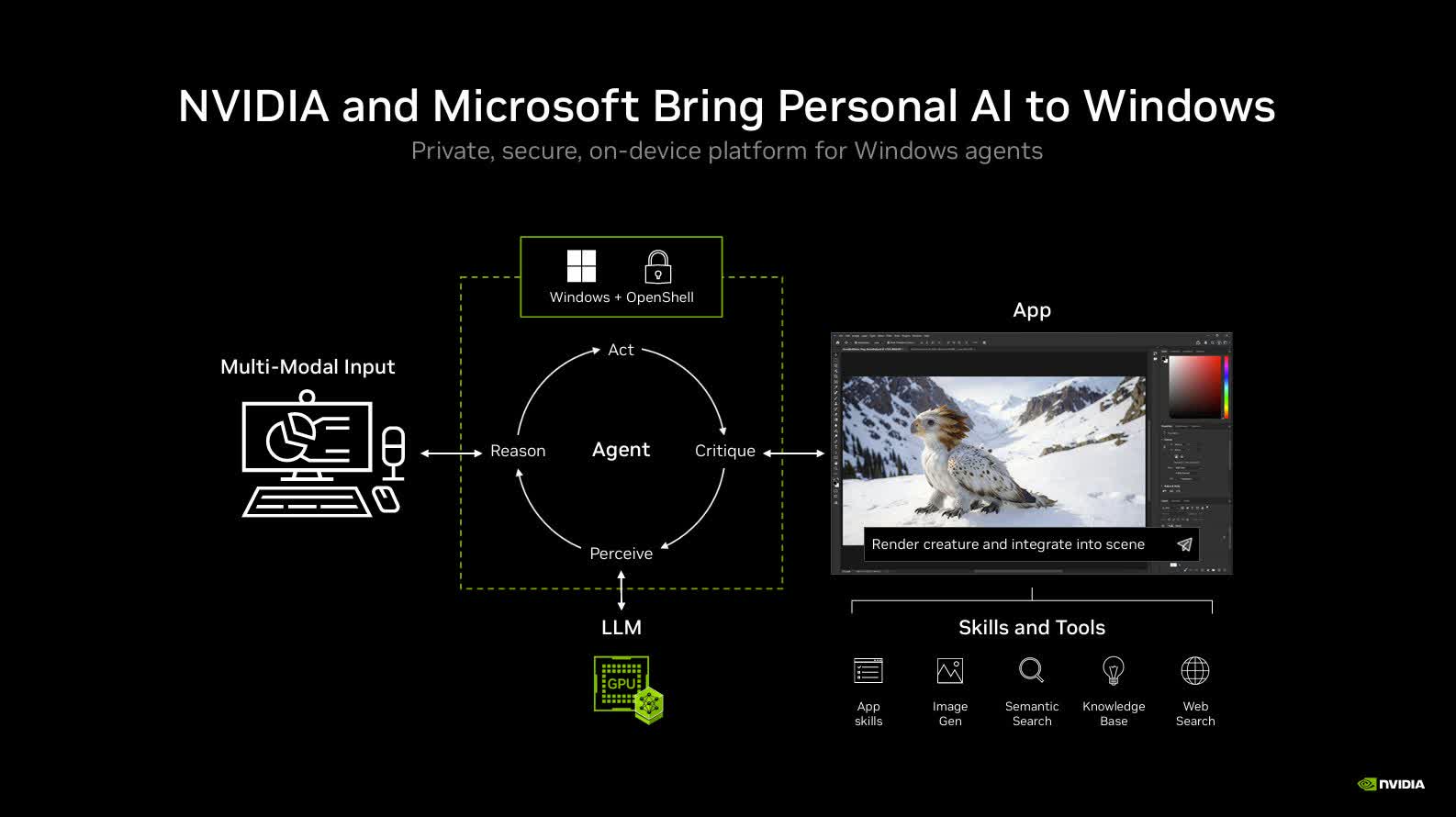
NPUs, short for Neural Processing Units, have become a baseline requirement for Microsoft’s Copilot+ PC certification, where they handle AI inference tasks – from background model processing to LLM interactions – more efficiently than a general-purpose CPU or GPU.

That rationale makes sense for laptops and all-in-ones, where power budgets are constrained and efficiency matters. On the desktop, it’s a harder sell. Microsoft has since extended Windows AI model support to discrete Nvidia GPUs, which further undercuts the case for a dedicated desktop NPU.

Integrated GPUs have their uses on budget PCs and in other specific scenarios. Onboard graphics allow a system to POST and display output even when a discrete GPU is malfunctioning – a scenario that matters to builders, repair technicians, and anyone who has swapped a graphics card mid-troubleshooting.

Advertisement

Removing that safety net from a platform aimed squarely at power users and gamers is a questionable tradeoff, particularly when the NPU replacing it serves a narrower use case. Then again, Nvidia’s RTX Spark CPUs are expected to hit shelves later this year, and there is mounting expectation around local AI workloads becoming a standard part of the Windows OS experience. AMD’s move may well be a preemptive response to that emerging competitive pressure.

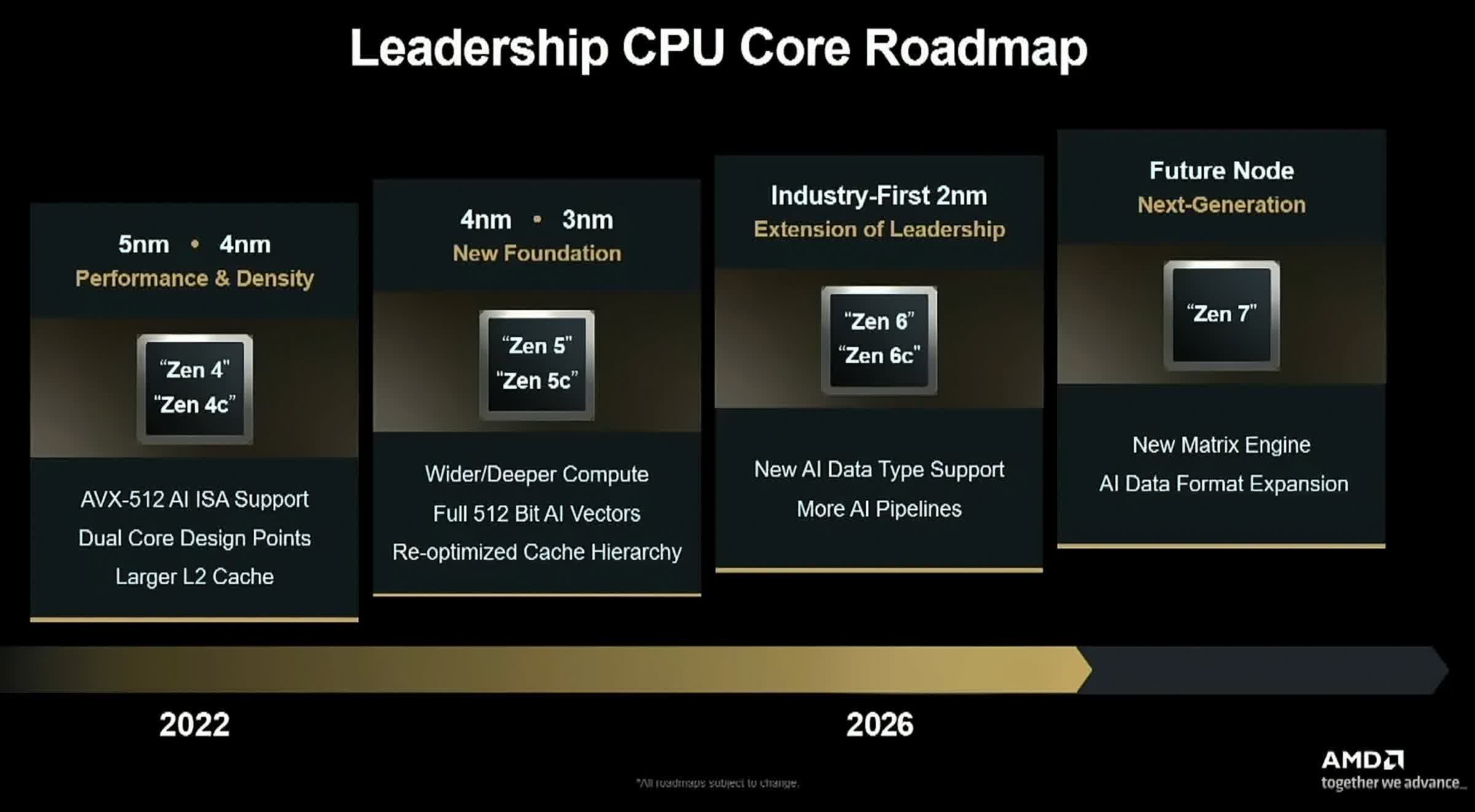
Beyond the iGPU controversy, Zen 6 “Morpheus” is targeting clock speeds of up to 7GHz on TSMC’s 2nm process, and each new CCD is expected to pack up to 12 cores and 48MB of L3 cache, with desktop configurations scaling from 6 cores up to 24 with SMT support.

That would mark a new core-count ceiling for mainstream AMD desktop CPUs. Whether pairing those specs with an NPU and no iGPU reflects a coherent product vision – or a forced hand from the AI PC trend – will likely depend on how useful desktop NPUs actually become by the time Ryzen 10000 ships.

Advertisement

Source link

Continue Reading

Tech

Egypt and Belgium tied, but drones grab a World Cup win over Seattle with lighted scoreboard

Published

on

The flags of Belgium, left, and Egypt are represented in the night sky near the Space Needle in Seattle after the teams tied 1-1 in a FIFA World Cup match on Monday. (Roman Yuferev Photo)

Egypt and Belgium played to a 1-1 draw in a FIFA World Cup matchup in Seattle on Monday. Fans who looked to the sky near Seattle Center later that night got a visual win.

Visit Seattle calls the lighted display the first-ever drone scoreboard, and the destination marketing organization plans to repeat the feat for five more matches hosted in Seattle.

The Egypt vs. Belgium match at Seattle Stadium (Lumen Field) attracted more than 66,000 fans for a noon start time. Thanks to the Pacific Northwest’s late sunsets this time of year, the 400 drones didn’t take flight near the Space Needle until 10:05 p.m. The scoreboard was up for 2 minutes, 45 seconds.

Certainly there are quicker ways to determine a match outcome, but Visit Seattle views the effort as a way to celebrate the city’s first World Cup and embody “Seattle’s history of innovation, strong sports fandom, and iconic skyline.”

Drones fly in formation to create Visit Seattle’s “Let’s Play SEA 26” slogan near the Space Needle. (Roman Yuferev Photo)

The drones are flown by Sky Elements, the Fort Worth, Texas-based company that has put on shows at T-Mobile Park for a Mariners game, Lumen Field for the Seahawks, and at the Needle for New Year’s Eve

The next scoreboard will be live on Friday for USA vs. Australia. The showing is free and open to the public, with schedules here.

Advertisement

Here is the schedule for remaining FIFA World Cup matches in Seattle:

  • June 19 (noon): United States vs. Australia (Group D)
  • June 24 (noon): Qatar vs. TBD (Winner of Playoff A: Italy/NI/Wales/BIH) (Group B)
  • June 26 (8 p.m.): Egypt vs. Iran (Group G) 
  • July 1 (1 p.m): Round of 32 Match 82
  • July 6 (5 p.m.): Round of 16 Match 94

Source link

Continue Reading

Tech

Qualcomm launches Snapdragon Reality Elite and a white-label toolkit for AI glasses, betting the next platform is not a phone

Published

on

TL;DR

Qualcomm unveiled Snapdragon Reality Elite for MR headsets and START, a turnkey smart glasses toolkit. CEO says 40+ AI wearable designs are underway.

Qualcomm announced two products on Tuesday aimed at positioning the company as the silicon supplier for whatever computing device eventually displaces the smartphone. The first is Snapdragon Reality Elite, a mixed reality chip platform with substantially improved AI processing for headsets and tethered glasses. The second is START, a white-label toolkit that gives eyewear manufacturers a near-complete smart glasses design they can brand, customise, and ship without building the technology stack themselves.

The announcements came alongside comments from CEO Cristiano Amon, who told CNBC that Qualcomm is working on more than 40 different AI wearable devices spanning jewelry, camera-equipped earbuds, pins, and watches. “I think there’s going to be a lot of experimentation with different form factors,” Amon said. He described the unifying principle as “something that you wear, something that is with you all the time, something that can see the world around you.

Snapdragon Reality Elite delivers up to 60% higher GPU performance, 30% higher CPU performance, and 160% higher NPU performance compared to the previous XR2+ Gen 2 platform. The chip’s neural processing unit is rated at 48 TOPS, enough to run a 3-billion-parameter language model at 45 tokens per second on-device, according to Qualcomm. The platform also runs up to 20% longer on battery and up to 12 degrees Celsius cooler under the same workloads.

Advertisement

The 💜 of EU tech

The latest rumblings from the EU tech scene, a story from our wise ol’ founder Boris, and some questionable AI art. It’s free, every week, in your inbox. Sign up now!

The display capability supports 4.4K per-eye resolution at 90 frames per second, a modest increase from the XR2+ Gen 2’s 4.3K per-eye figure. Qualcomm says the chip enables improved head and hand tracking alongside better see-through performance. Those improvements matter for reducing the motion sickness and eye strain that have historically limited how long users can wear mixed reality headsets.

Reality Elite is designed to power two categories of device. The first is standalone video-see-through headsets that overlay digital content on a camera feed of the real world, the approach used by devices like the Meta Quest. The second is lightweight, tethered optical-see-through glasses that blend digital imagery directly into the wearer’s field of view.

Advertisement

Among the first products using the platform are XREAL’s Project Aura, the Android XR glasses shown at Google I/O with a 70-degree field of view and binocular displays, and an upcoming device from Play for Dream. Qualcomm has not disclosed pricing for the platform or a timeline for when consumer devices will reach retail.

START, which stands for Scalable Turnkey AI-Ready Toolkit, takes a different approach to market entry. It bundles a hardware module built on Qualcomm’s AR1+ chip with a software platform, companion iOS and Android apps, an AI cloud solution, and three white-label reference designs. The designs cover an audio-and-camera configuration similar to Meta’s Ray-Ban smart glasses, a monocular display variant, and a binocular display variant.

The programme’s first partners are eyewear manufacturer Inspecs and O’Neill, the latter owned by TitanFlex. Qualcomm has also made a $10 million strategic equity investment in Inspecs, subscribing for 7.5 million new shares at £1 each. The investment signals that Qualcomm is not merely licensing silicon but taking a financial stake in the supply chain that will manufacture and distribute the devices.

The strategic logic is that traditional eyewear companies have the design expertise, retail distribution, and consumer trust to sell smart glasses as fashion accessories, but lack the chip architecture, AI software, and sensor integration to build the technology themselves. START is Qualcomm’s attempt to bridge that gap, mirroring the reference design programme it used in the early 2010s to help manufacturers build smartphones on its Snapdragon platform. Qualcomm says START will expand beyond smart glasses to other form factors in the future, though it has not specified which.

Advertisement

The competitive landscape is crowded and moving fast. Meta has sold more than seven million pairs of Ray-Ban smart glasses and commands roughly 82% of the market, with annual production capacity being expanded to 10 million units by the end of 2026. Snap launched its $2,195 Specs AR glasses this week.

Apple is reportedly testing multiple frame designs for a possible 2027 launch. Google is shipping Android XR audio glasses this autumn with Samsung, Warby Parker, and Gentle Monster. Qualcomm silicon already powers many of these devices, but the company is now building the full stack rather than waiting for partners to assemble it themselves.

What Qualcomm is betting on is that none of those companies will dominate the category alone. If the smart glasses market fragments the way the smartphone market did, with dozens of manufacturers building on a shared platform, the company supplying the foundational silicon layer captures value regardless of which brand wins. That is the same bet Qualcomm made with mobile phones, and Amon’s 40-device pipeline suggests the company sees the transition accelerating faster than the public market does.

The claims remain largely forward-looking, however. The 48 TOPS figure and performance percentages are Qualcomm’s own, measured against its own previous generation, and no independent benchmarks have been published. The 40 AI wearable designs Amon referenced are in various stages of development, not shipping products.

Advertisement

Whether the smart glasses category actually becomes large enough to justify Qualcomm’s investment depends on consumer adoption that has so far been limited to Meta’s ecosystem and a handful of developer-focused devices. The company is placing a structural bet that the transition away from smartphones is inevitable, but the timeline remains anyone’s guess.

Source link

Advertisement
Continue Reading

Tech

The Webb Telescope Has Captured Its First ‘Bulge Fossil Fragment’

Published

on

The funny-sounding name offers new insights into galaxy formation.

Many of the developments shared by astronomers using the James Webb Space Telescope and similar instruments center on trying to understand the history of the galaxy. The latest update from the Webb telescope researchers confirms the existence of a phenomenon known as “bulge fossil fragments” that can offer new insights on the Milky Way’s formation.

The subject of this latest investigation is known as Terzan 5, a region in the center of the galaxy often dubbed “the bulge” that has been challenging for astronomers to study due to the density of stars and presence of dust. Between their observations with the Webb telescope and archival observations taken from the Hubble Space Telescope, the team was able to confirm that Terzan 5 is not a globular star cluster, as it was previously classified. Globular star clusters usually only have one ancient star population. Instead, Terzan 5 has experienced at least four distinct phases of star formation. According to the researchers’ survey, it has two older star populations that were formed 12.5 billion and 4.7 billion years ago. The astronomers also found two more contemporary populations that formed 3.8 billion years ago and 2.5 billion years ago.

Advertisement

“For some reason, this peculiar clump of stars formed separately from the bulge and was not destroyed as the bulge itself formed,” said University of Bologna professor Francesco R. Ferraro, principal investigator of the Webb observations. “Terzan 5 is what we now call a bulge fossil fragment because it resembles the primordial clumps that contributed to the formation of the bulge.”

“Based on observations and in-depth simulations, we think that galaxies in the early Universe had huge discs of gas that fragmented into clumps and formed stars. These clumps migrated to the center of the galaxies, and many merged to form their bulges,” co-author and University of Bologna associate professor Barbara Lanzoni said.

The findings were published in the journal Astronomy & Astrophysics.

Advertisement

Source link

Continue Reading

Tech

How to watch Austria vs Jordan: World Cup 2026 Free Streams & TV Channels

Published

on

In a World Cup 2026 group that also contains Argentina and Algeria, Austria vs Jordan will be a must-win game for both teams if they are to make a deep run in the tournament. While this is Jordan’s maiden World Cup appearance, the Burschen are returning to football’s biggest stage for the first time since 1998.

Ralf Rangnick’s men are coming on the back of an excellent qualifying campaign, winning six, drawing one, and losing just one of their eight matches. They also won all three of their warm-up matches against Ghana, South Korea and Tunisia, and are currently on a five-match unbeaten run.

Source link

Advertisement
Continue Reading

Trending

Copyright © 2025