

Crypto World
Dollar Holds Near Key Levels Ahead of the Fed Verdict

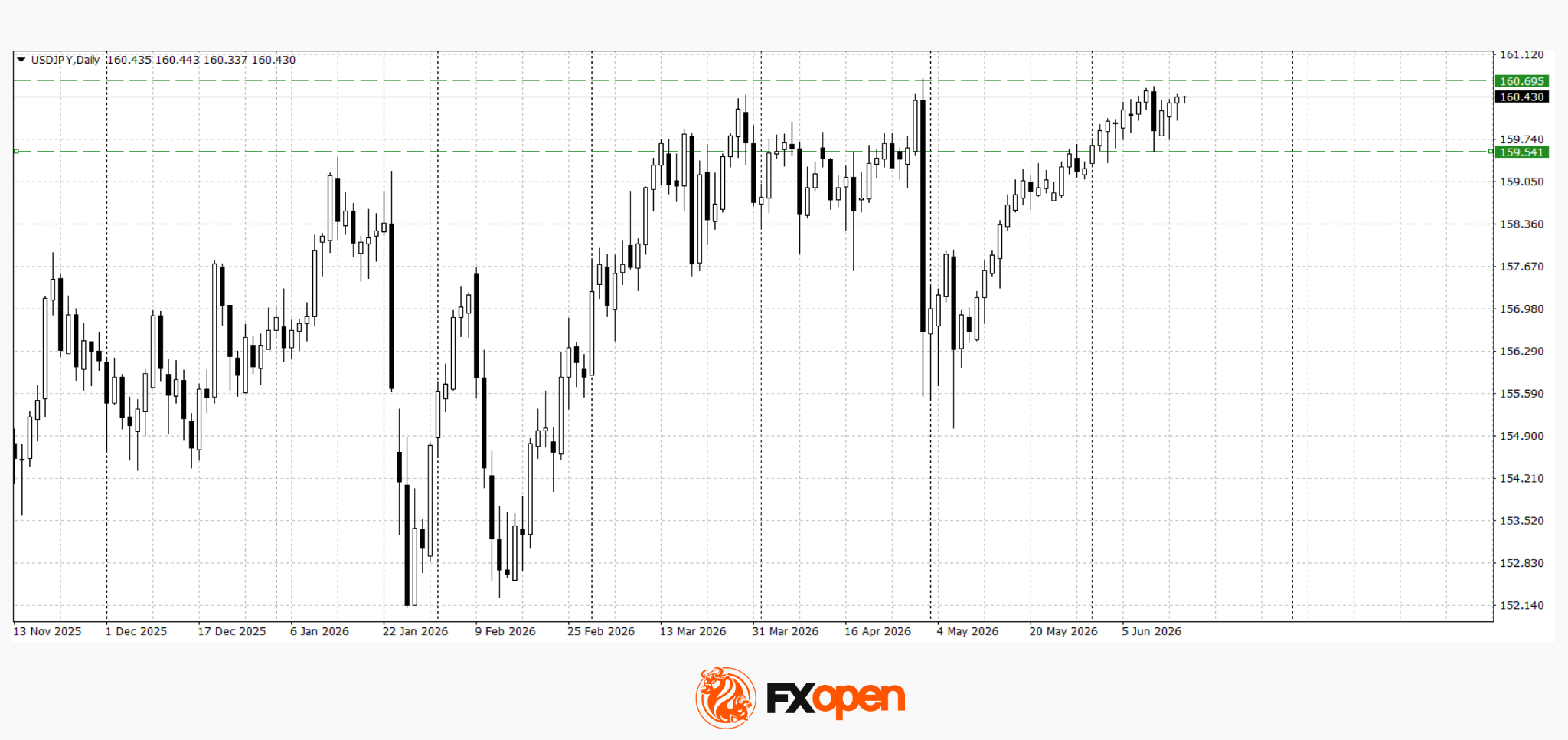
The US dollar remains well supported against most major currencies, although the next phase of its movement will largely depend on the outcome of the Federal Reserve meeting. Investors are adopting a cautious stance ahead of the interest rate decision, the release of updated FOMC economic projections, and Jerome Powell’s press conference. Particular attention will be paid to policymakers’ forecasts, as these could reshape expectations regarding the number of potential rate cuts before the end of the year.
Market participants will also focus on a fresh batch of US economic data. Today’s retail sales figures are expected to provide further insight into the strength of consumer demand in the United States. Investors will also monitor Canada’s New Housing Price Index ahead of the Fed decision. While the Fed is widely expected to leave rates unchanged, the key driver for markets will be any signals regarding the future path of monetary policy and the timing of possible rate cuts.
USD/JPY
Sellers in USD/JPY managed to trigger a correction towards 159.50 last week. However, they failed to develop a sustained downward move, and the pair is once again trading above 160.00. Technical analysis of USD/JPY points to range-bound trading within the 159.50–160.70 corridor. It appears that investors require clearer guidance from the Fed regarding the future direction of monetary policy.
Key events for USD/JPY:
- Today at 15:30 (GMT+3): US Core Retail Sales;
- Today at 16:30 (GMT+3): speech by US President Donald Trump;
- Today at 21:00 (GMT+3): Federal Reserve interest rate decision.
USD/CAD
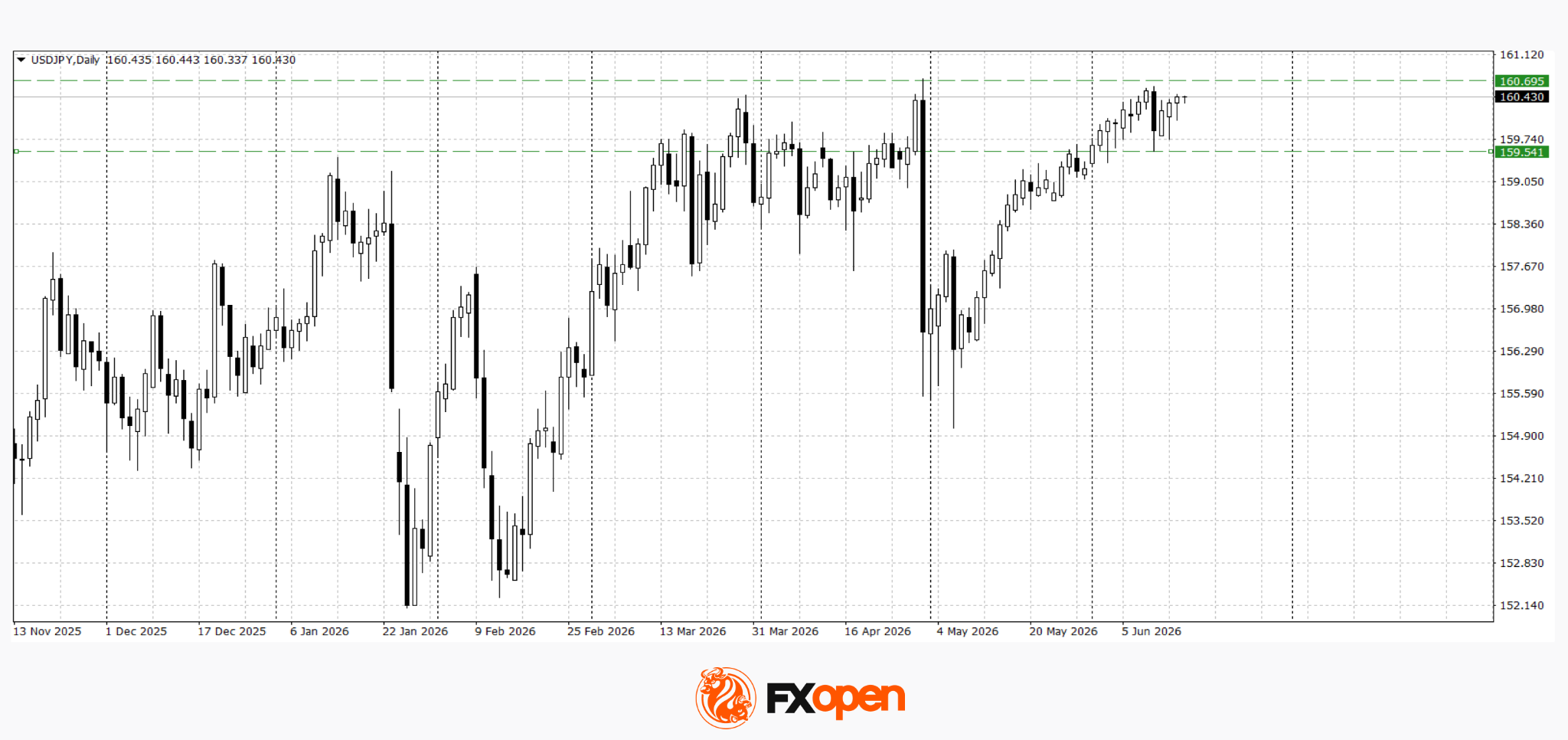
USD/CAD reached fresh yearly highs last week and tested the psychological resistance level at 1.4000. Following the breakout above the year’s previous peak, the pair has entered a consolidation phase within the 1.3950–1.4020 range. A sustained move below 1.3950 could trigger a corrective decline towards the 1.3850–1.3900 area. Conversely, a decisive break and close above 1.4000 could pave the way for further gains towards the next significant resistance zone near 1.4130.
Key events for USD/CAD:
- Today at 15:30 (GMT+3): Canada New Housing Price Index;
- Today at 17:30 (GMT+3): US Crude Oil Inventories;
- Tomorrow at 15:30 (GMT+3): Canada Raw Materials Price Index (RMPI).
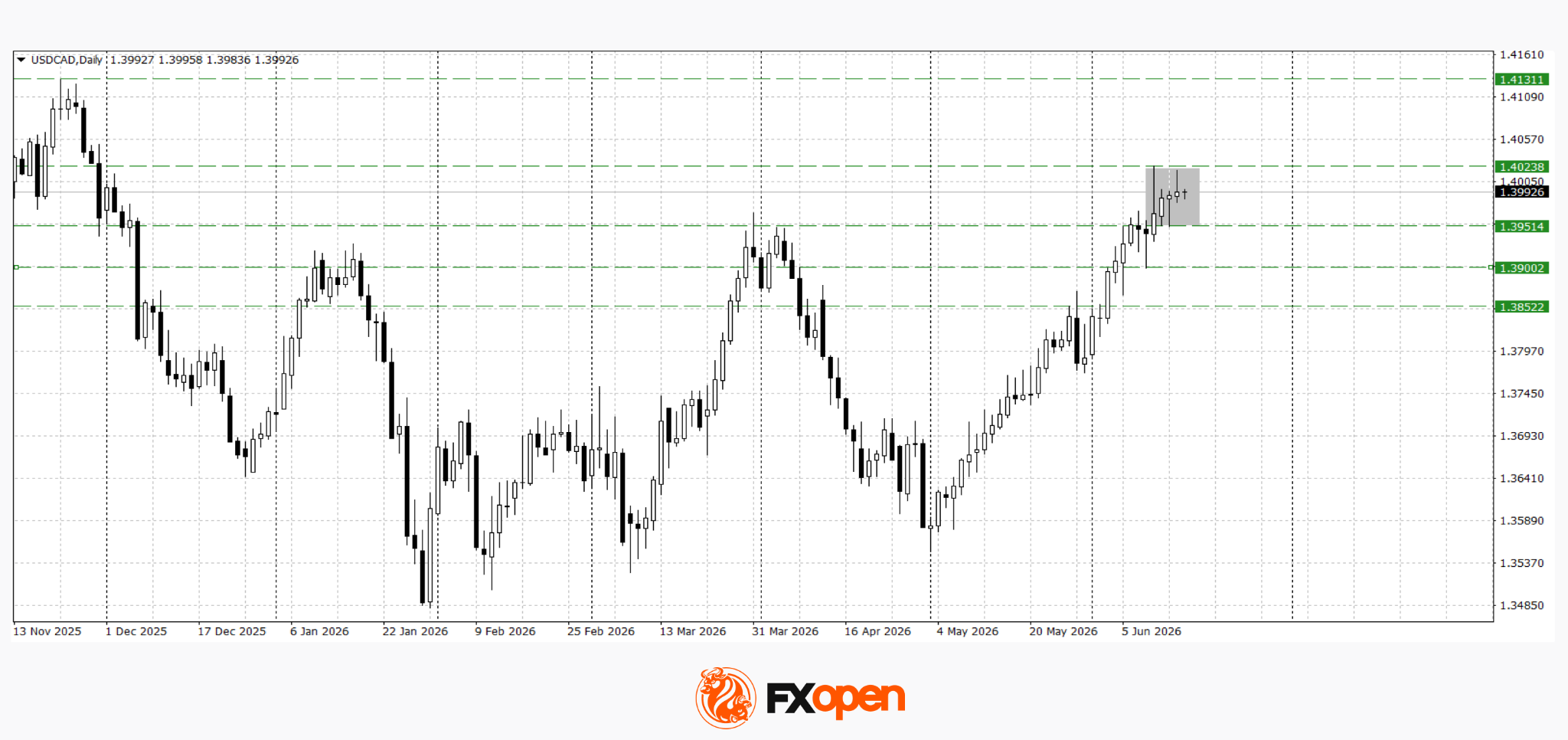
The dollar remains close to important technical levels against both the Japanese yen and the Canadian dollar, but the next directional move is likely to be determined by the outcome of the Federal Reserve meeting. Should the Fed maintain a hawkish tone and reaffirm its cautious approach to rate cuts, USD/JPY and USD/CAD may extend their gains and attempt to break through current resistance levels. A more dovish message from Powell, however, could encourage profit-taking in the dollar and lead to a corrective pullback following the strong rally seen in recent weeks.
Trade over 50 forex markets 24 hours a day with FXOpen. Take advantage of low commissions, deep liquidity, and spreads from 0.0 pips (additional fees may apply). Open your FXOpen account now or learn more about trading forex with FXOpen.
This article represents the opinion of the Companies operating under the FXOpen brand only. It is not to be construed as an offer, solicitation, or recommendation with respect to products and services provided by the Companies operating under the FXOpen brand, nor is it to be considered financial advice.

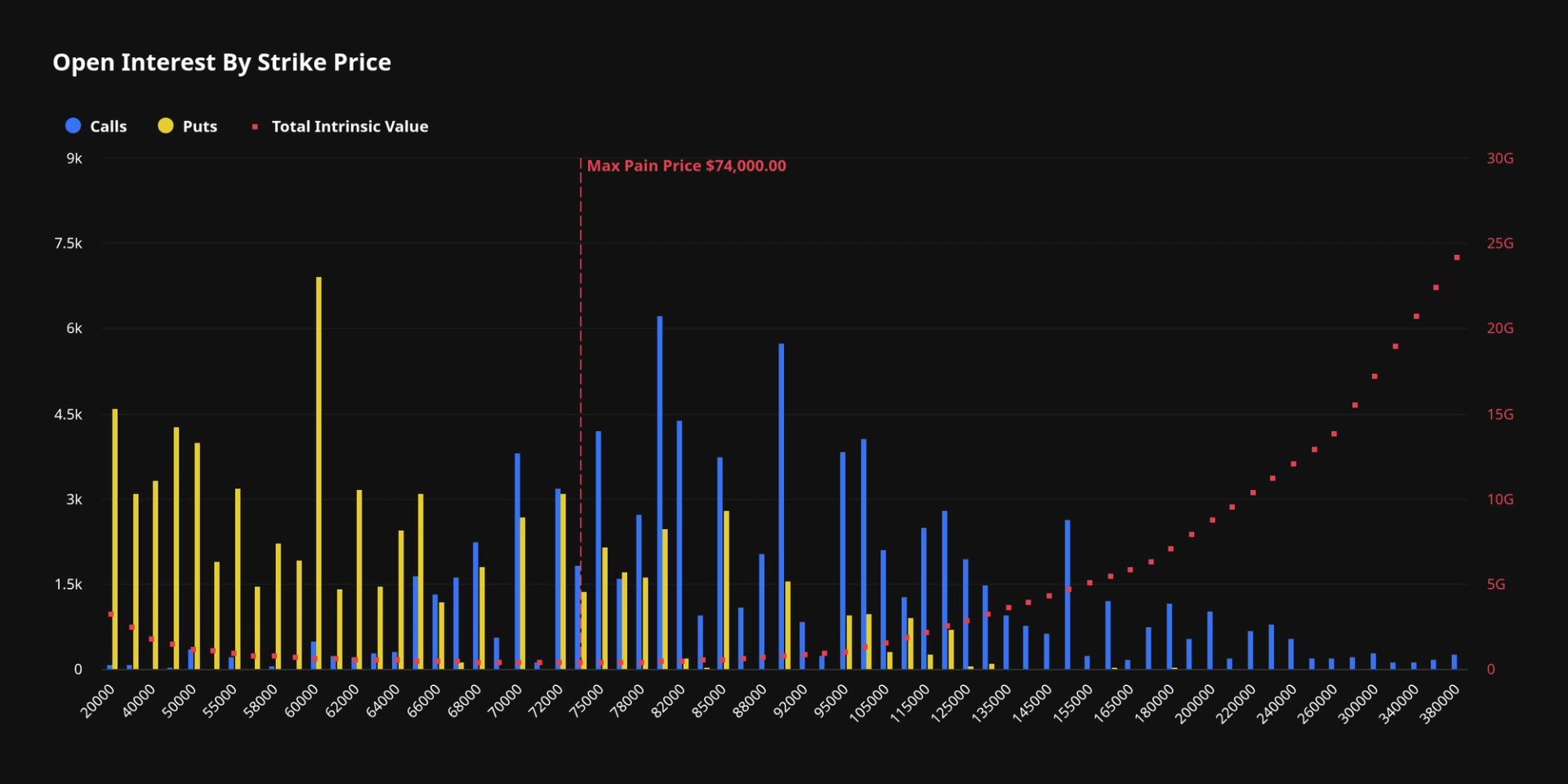
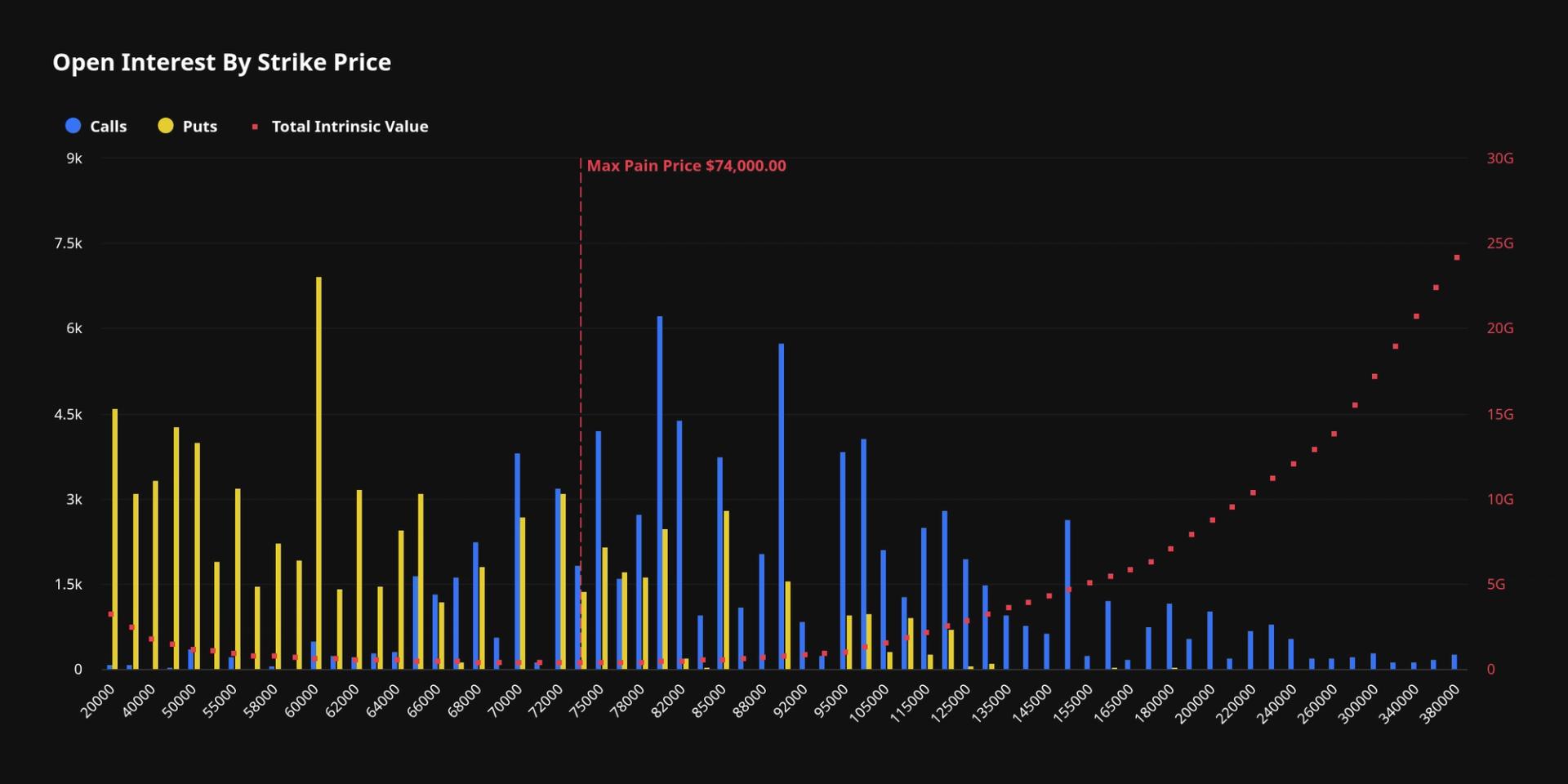
With only about 20% of the $10.6 billion in open interest sitting in-the-money (ITM) and the remaining 80% out-of-the-money (OTM), the market has a strong imbalance that could fuel sharp price swings as participants scramble to adjust their positions.
The story doesn’t end there.
Max pain and put-call ratio
Another factor pointing to potential volatility is the max pain price for the June 26 expiry, which currently sits at $74,000, about 14% above bitcoin’s current spot price near $65,000.
Max pain is the price level at which the largest number of options contracts would expire completely worthless. The theory suggests that as expiry approaches, the underlying asset (in this case bitcoin) tends to gravitate toward that max pain level, as market makers and traders adjust their positions.
While this “max pain” effect is widely watched in traditional markets, its reliability in crypto is often debated. Still, if the theory holds, bitcoin could see a strong bounce toward $74,000 in the coming days.
Meanwhile, the put-to-call ratio stands at 0.87, reflecting 87,156 call contracts versus 76,241 put contracts across more than $10.6 billion in notional open interest. Although call options still slightly outnumber puts, the relatively balanced positioning highlights growing uncertainty among traders.
Open interest is heavily concentrated around two key strikes. The $60,000 put holds roughly $450 million in exposure, making it an important support level, which bitcoin tested at the start of June. Meanwhile, the $80,000 call, with about $406 million in open interest, remains a significant upside hurdle.
Crypto World
Bitcoin Price Prediction: Andrew Tate Liquidated for 108 Times, Now He Doubles Down With 40x BTC Long
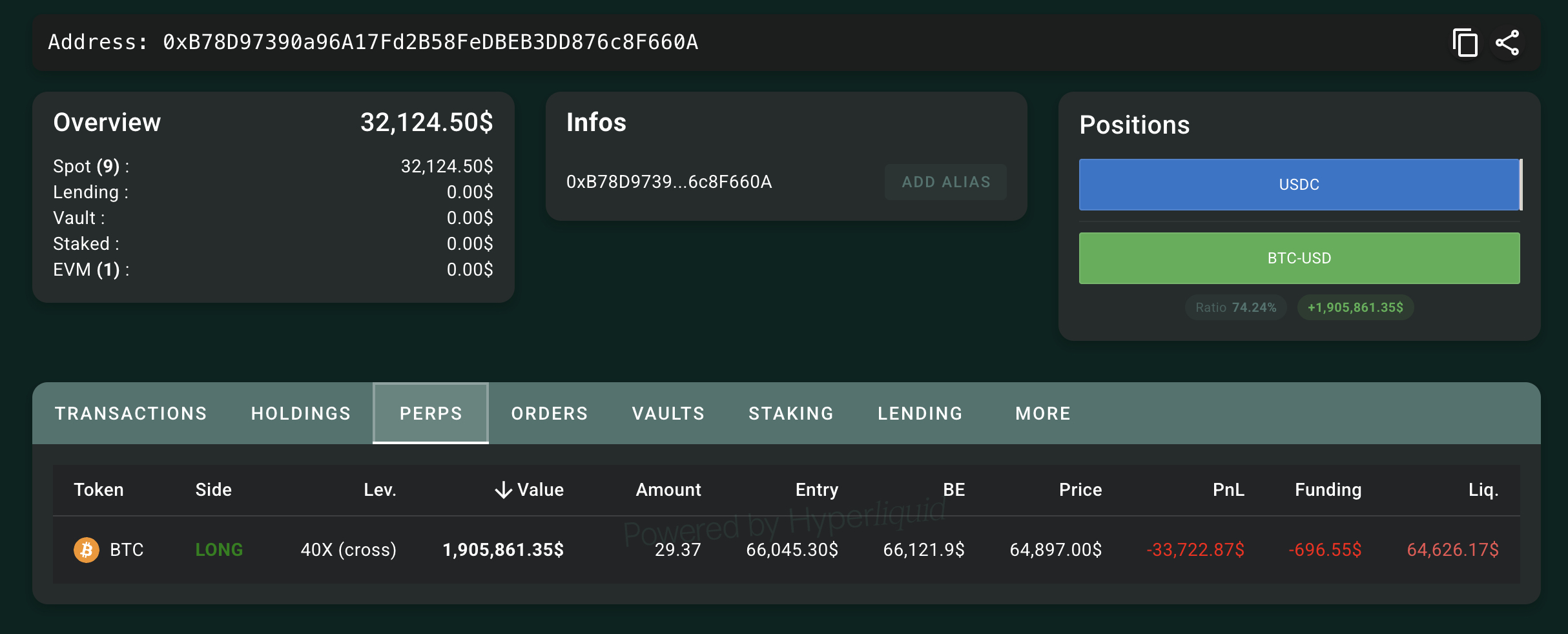
Bitcoin is holding a precarious perch at $65K, price prediction is turning slightly bearish, and the margin for error right now is razor-thin. Into that environment, Andrew Tate has opened a 40x leveraged long on BTC, his 108th attempt at a trade that has ended in liquidation every previous time.
Onchain analytics firm Lookonchain flagged the position: Tate is long 57.36 BTC ($3.76 million), with a liquidation price sitting at $65,216. Spot BTC was trading around $65,500 at the time of the report, a gap of roughly $300 between live price and the wipe-out level.
At 40x leverage, even a brief wick through that level ends the trade. The position is either a bold macro bet or a very public margin call waiting to happen.
Wait, actually, he has been liquidated while this is being written, and he has now reopened another long(changed the headline). Smaller amount now, still at 40X leverage. Anyway, data shows he has been liquidated 108 times now, with 90% being Bitcoin long positions.
Bitcoin has been struggling to push cleanly through the $67k–$69k band, and this stall is the context framing Tate’s outsized risk here.
Discover: The Best Token Presales
Bitcoin Price Prediction: Reclaim $69k Before Bears Take Control? Or Tate Cooked?
Bitcoin’s technical picture is consolidating. The nearest support sits at approximately $65,000 has been breached. Now, deeper demand zones are clustered between $63,000 and $62,500. On the resistance side, $67,000–$69,000 is the ceiling, followed by a heavier band from $71,500 to $73,000.
The 4-hour chart shows BTC still respecting an ascending trendline, with intraday momentum described as effectively neutral over the past eight hours. Although the price has been slightly sliding, we see small oscillations with no directional commitment.
Since the $65K suuport broke, BTC needs to hold $63,000 and reclaim $65,000, and eventually closes above $71,500, at which point a structural uptrend becomes defensible and short-term targets extend toward $73k.

The most likely scenario would see price continue chopping between $63,500 and $67,000, grinding out consolidation while macro catalysts like Fed data and regulatory headlines remain absent or ambiguous.
Or Tate would be really cooked if the daily close is below $63,000 as it opens a move toward the $62,00 zone. Bearish analysts are already flagging downside Fibonacci targets as low as $52k–$45k if the structure breaks, a scenario that would, incidentally, liquidate Tate before the market even gets interesting on the downside.
Institutional forecasters remain split, with some bullish targets contingent entirely on that $71.5k–$73k zone giving way. Until it does, high-leverage directional bets are trading against the range.
Discover: The Best Crypto to Diversify Your Portfolio
Bitcoin Hyper Targets Early Mover Upside as Bitcoin Tests Key Levels
Here’s the uncomfortable truth for spot BTC holders at current levels: even a clean breakout to $73k represents roughly 11% upside from here. That is not a bad trade, but it is not a life-changing one at this market cap.
The asymmetry that made Bitcoin at $3k or $10k so compelling simply does not exist at $65k. Which is exactly where early-stage Bitcoin infrastructure plays enter the picture.
Bitcoin Hyper ($HYPER) is positioning as the first Bitcoin Layer 2 with SVM (Solana Virtual Machine) integration, bringing Solana-speed smart contract execution directly into the Bitcoin ecosystem without sacrificing BTC’s security layer.
The architecture addresses Bitcoin’s three core limitations in one stack: slow throughput, high fees, and the absence of native programmability. The presale has pulled in $32 million at a current token price of $0.01368, with staking live for early participants. That is real capital allocation, not speculative noise.
For those watching BTC grind in a $4k range while Tate bets $3.76 million at 40x leverage, the calculus on where asymmetric upside actually lives right now is worth running.
Research Bitcoin Hyper here before the current presale stage closes.
The post Bitcoin Price Prediction: Andrew Tate Liquidated for 108 Times, Now He Doubles Down With 40x BTC Long appeared first on Cryptonews.

Citing people familiar with the matter, Reuters reported that the world’s largest cryptocurrency exchange could be forced to stop service to European Union customers as early as next month after its application for a key regulatory license is set to be rejected.
The threat comes from the EU’s Markets in Crypto-Assets (MiCA) framework, which requires digital asset firms operating within its borders to obtain authorization from a national regulator.
Binance to Drop Out of EU?
The report claimed that the exchange’s application through Greece’s Hellenic Capital Market Commission (HCMC) is expected to be denied, which would leave it without the authorization needed to continue serving clients from the bloc after the June 30 deadline.
If the situation escalates, this potential setback could become Binance’s largest regulatory hurdle in Europe since the implementation of MiCA a few years ago. The framework is designed to bring crypto firms under a unified regulatory regime, and even Hungary has turned the tide after the change in administration earlier this year.
As with essentially all reports from legacy media that might be harmful to Binance in any way, the company has taken a strong stance against those claims. A spokesperson pushed back against the coverage from Reuters, indicating that the exchange has worked with regulators for approximately 18 months and understands that the Green watchdog completed its review, with the application considered compliant.
Binance further said it has not received any formal indication from the HCMC that its application might be rejected.
“Binance remains fully committed to securing our MiCA license and operating under a unified European framework.
With 1,500+ compliance professionals globally, we continue to work closely with regulators while keeping users at the center of every decision,” reads a company statement on X.
Teng Concurs
Binance CEO Richard Teng also weighed in on the matter, saying the company is “dedicated to Europe.” He added that Binance and the team are “dedicated to securing our MiCA license and remain ready to operate under a fair, predictable, and genuinely harmonized European framework.”
In a follow-up post, he reassured the company’s user base of millions that their assets “remain secure.”
Please rest assured that your assets remain secure, are and will remain accessible at all times. Our intention is to support an orderly process and minimise disruption to our users. We will provide a further update prior to June 30 2026.
— Richard Teng (@_RichardTeng) June 16, 2026
The post Pushing Back at Reuters: Inside Binance’s Fight for Its European Future appeared first on CryptoPotato.


The day’s main event is Fed Chair Kevin Warsh’s first interest-rate decision. No change in rates is expected, which means markets will be scanning the policy statement, economic projections and the post-meeting press conference for cues.
Here is what could elicit a risk-on, positive reaction from bitcoin
The dot plot: This is a graphical representation of where individual Fed members see interest rates heading. Fed funds futures currently price in an 80% chance of a 25 basis-point increase by December. That’s the reference point for reading the plot: If it shows fewer than 80% of members projecting a hike by December, the BTC price could react positively.
Warsh’s take on rates and inflation: Will the Trump nominee break from market expectations and strike a dovish tone, citing recent oil prices and AI-driven disinflation to lay the groundwork for the rate cuts the administration wants? Or will he fall in line with current market pricing? In the former case, BTC could once again react positively.

Key Takeaways
-
Australia’s High Court delivers unanimous verdict requiring licence for Block Earner’s product
-
ASIC secures significant victory in cryptocurrency product regulation battle
-
Full Federal Court to reconsider penalty determinations following High Court ruling
-
Judges confirm crypto yield offering satisfied financial product criteria
-
Company pivots business model to Bitcoin-collateralized mortgage products
In a landmark decision, Australia’s highest judicial authority has sided with the financial regulator in a critical cryptocurrency licensing battle against Block Earner. The court determined that the company’s discontinued fixed-yield digital currency product required proper financial services authorization. The matter of penalties will now be reconsidered by the Full Federal Court.
Supreme judicial body reverses lower court decision
The seven justices delivered a unanimous verdict that overturned a previous Full Federal Court judgment favorable to Block Earner. The company, managed by Web3 Ventures Pty Ltd, previously provided the Earner yield service. ASIC maintained that the offering was subject to established financial product regulations.
The highest court determined that Earner functioned as an investment facility under Australian law. Additionally, judges concluded the product qualified as a derivative instrument. The judgment noted that yields fluctuated based on digital currency valuations and foreign exchange variations.
This determination bolstered ASIC’s argument that Block Earner required proper Australian financial services authorization. The watchdog emphasized that operating without appropriate licensing deprived customers of essential safeguards under financial services legislation. The penalty phase now proceeds to the Full Federal Court for fresh consideration.
Legal proceedings clarify Australian cryptocurrency framework
ASIC initiated civil penalty action against Block Earner during November 2022. The enforcement targeted the Earner service due to the company marketing it without necessary authorization. Block Earner discontinued the offering that same month.
The Federal Court determined in February 2024 that Block Earner operated an unlicensed managed investment structure. Nevertheless, the court subsequently granted the firm relief from monetary sanctions in June 2024. ASIC contested that relief decision, while Block Earner submitted its counter-appeal during July 2024.
The Full Federal Court granted Block Earner’s counter-appeal in April 2025. It simultaneously rejected ASIC’s penalty appeal at that juncture. The High Court has now overturned those findings and reinstated the regulator’s pursuit of penalties.
Company transitions to cryptocurrency-collateralized financing
Block Earner has subsequently pivoted away from fixed-return cryptocurrency offerings. The firm obtained an Australian Credit Licence during May 2026. It subsequently unveiled intentions to launch cryptocurrency-backed mortgage solutions.
The planned service would enable borrowers to pledge Bitcoin as security for residential financing. This structure would permit customers to obtain credit while maintaining their Bitcoin positions. The licensing approval represented a significant milestone for digital asset lending services in Australia.
Nevertheless, the High Court verdict strengthens ASIC’s regulatory authority over cryptocurrency products. The ruling establishes that existing legislation applies to digital asset offerings when they satisfy financial product criteria. Consequently, cryptocurrency businesses confront increased licensing obligations under Australia’s current regulatory structure.


BitGo is expanding its custody and compliance infrastructure into Europe with a new “crypto-as-a-service” offering designed to align with the European Union’s Markets in Crypto-Assets Regulation (MiCA). The move arrives as exchanges and other regulated crypto firms prepare for a key transition point: the EU-wide requirement for authorization to continue serving customers across member states.
BitGo Europe launched the platform with the explicit aim of supporting MiCA readiness for partners that need to meet regulatory obligations for custody, trading connectivity, onboarding and wallet-related functions. According to Cointelegraph, the company is positioning its regulated setup as a way for service providers to reduce the time required to operationalize compliance measures during the licensing transition.
Key takeaways
- BitGo Europe has launched a MiCA-oriented crypto-as-a-service platform aimed at exchanges and fintech firms.
- The platform is designed to connect partners to regulated custody, trading, onboarding and wallet systems via APIs, while keeping customer-facing control with the partner.
- Compliance tooling referenced by BitGo includes programmatic KYC checks, transaction controls and settlement of supported digital assets.
- BitGo’s expansion builds on prior regulatory authorization: BaFin granted BitGo a MiCA-related license in May 2025.
- Regulatory uncertainty remains across the EU as firms seek MiCA authorizations ahead of the July 1 deadline.
BitGo Europe launches MiCA-focused crypto-as-a-service
BitGo Europe’s new platform is intended to help other crypto businesses meet MiCA requirements through a modular integration model. In its announcement shared with Cointelegraph, the company said partners can use BitGo’s infrastructure for core regulated functions instead of building all compliance and custody capabilities internally.
From an operational standpoint, the approach matters because MiCA compliance is not limited to one-off licensing paperwork. It requires firms to have ongoing systems in place that can support customer onboarding, risk controls, and transaction processing consistent with the regulation’s standards. BitGo’s service model—using application programming interfaces (APIs) to connect services—targets the practical challenge of standing up compliant workflows quickly across multiple EU jurisdictions.
BitGo stated that the service is especially relevant for companies seeking to maintain service continuity while regulatory decisions and authorization timelines evolve. In comments shared publicly by CEO Mike Belshe, he argued that regulated infrastructure can help firms keep operations moving safely and compliantly during licensing delays.
What the platform covers: custody, onboarding, controls and SEPA payments
BitGo’s MiCA-focused offering is built around connectivity to regulated custody and related functions. The company said exchanges and fintech platforms can integrate with BitGo systems for custody, trading integration, onboarding processes and wallet operations.
The service includes features intended to support compliance and operational risk management, such as programmatic KYC checks, transaction controls and settlement of supported digital assets. These capabilities are central to meeting MiCA’s expectations for regulated crypto-asset activity, where firms must demonstrate they can manage customer onboarding and transaction handling in a controlled and auditable manner.
BitGo also referenced support for euro payments through SEPA rails in eligible regions. For institutions and payment operators, the inclusion of fiat connectivity can be a significant part of operational compliance: regulated on- and off-ramp design typically intersects with AML/KYC procedures, transaction monitoring and other controls expected by regulators.
Regulatory pressure ahead of the July 1 MiCA deadline
The launch comes as EU crypto regulation transitions from fragmented national approaches toward a unified framework under MiCA. Under MiCA’s timetable, July 1 is a critical date for authorization requirements governing entities that continue offering crypto-asset services in the EU.
Recent reporting highlighted the possibility that some major exchanges may face difficulties securing authorizations in time. While BitGo did not provide details on whether its infrastructure would allow specific platforms to continue serving EU users if an authorization application is rejected, the broader compliance timing risk is evident: market participants need clarity on regulatory status, and delays can create operational and legal exposure.
Cointelegraph reported that Greek regulators may reject Binance’s MiCA license application, underscoring uncertainty surrounding the licensing pipeline for large venues. For institutions monitoring market structure, these outcomes are material not just from a business perspective, but because they affect where and how regulated service providers can legally operate across borders.
Beyond authorization decisions, MiCA-related implementation also interacts with national transition rules. BitGo pointed to markets where legacy registration regimes are being phased out as the EU-wide framework takes effect. In Lithuania, the transition period for legacy virtual asset service providers ended on Dec. 31, 2025. In Poland, implementation remains unsettled, leaving some companies navigating unclear timelines for how national approvals will map into the new EU system.
Institutional and compliance implications for crypto firms
BitGo’s move reflects a broader trend in European crypto markets: regulated infrastructure providers are increasingly central to how exchanges and fintechs build compliance capabilities. For compliance teams, outsourcing or integrating certain regulated functions can affect the internal control framework, including who is responsible for customer due diligence workflows, how transaction monitoring is performed, what audit trails exist, and how regulatory obligations are allocated across the service chain.
MiCA also creates supervisory expectations around governance, operational resilience and risk controls. While BitGo’s model is designed to enable partners to meet the MiCA standard, regulated counterparties will still need to perform their own due diligence on vendor controls and ensure that contractual and operational arrangements support ongoing compliance. This includes verifying how KYC checks are executed, how transaction controls are enforced, and how fiat-related processes interface with AML/KYC requirements.
From a historical and regulatory context, BitGo’s European expansion is not starting from zero. The company previously obtained authorization under the MiCA framework, with BaFin issuing a license in May 2025. That detail is important for institutional readers because it indicates the company is operating under an EU supervisory authorization rather than operating purely as an offshore service. In turn, this can reduce—but not eliminate—regulatory uncertainty for partners seeking integrations that align with EU oversight.
However, unresolved questions remain across the sector. Licensing decisions for major firms can change quickly, and the legal landscape will continue to evolve through regulator guidance, enforcement actions and court-related developments where applicable. Partners evaluating integrations will need to track not only the vendor’s authorization status but also the regulatory expectations for their own licensed activities.
What to watch next
BitGo Europe’s launch will likely be tested by how exchanges and fintech providers operationalize MiCA compliance under real-world timelines and regulatory outcomes across member states. Market participants and compliance teams should monitor MiCA authorization decisions, evolving national implementation details, and how regulators interpret responsibility for customer onboarding and transaction controls within multi-party infrastructure models.

BitGo says it has launched “crypto-as-a-service” in Europe, positioning the firm’s regulated custody and compliance infrastructure as a practical bridge for exchanges and fintech companies rushing to meet the EU’s Markets in Crypto-Assets Regulation (MiCA). The move comes as the July 1 MiCA authorization deadline approaches and uncertainty grows around how certain large platforms will handle licensing in individual member states.
According to a statement shared with Cointelegraph, BitGo Europe’s platform is designed to help service providers connect core functions—custody, trading support, onboarding and wallet capabilities—through APIs, rather than building an entire compliance stack from scratch. The company framed the launch as a way to keep businesses operating “safely and compliantly” during regulatory transitions, with BitGo CEO Mike Belshe arguing that regulated infrastructure can reduce downtime when licenses are delayed.
Key takeaways
- BitGo Europe launched a MiCA-oriented crypto-as-a-service platform aimed at exchanges and fintech firms that need regulated infrastructure.
- The service is presented as an API-based way to integrate regulated custody, programmatic KYC checks, transaction controls, and settlement.
- BitGo’s EU approach is tied to MiCA readiness ahead of the EU-wide July 1 authorization deadline.
- The firm says the need is acute in markets such as Poland and Lithuania, where legacy registration pathways are being phased out.
- BitGo did not clarify whether its infrastructure would allow specific exchanges to continue operating in the EU if a license application is rejected.
MiCA deadline pressure reshapes the EU custody race
MiCA sets a common authorization standard across the European Union for crypto-asset firms that wish to continue serving customers. The July 1 deadline is particularly significant for platforms that have not yet secured the required authorization to operate under the new regime.
Recent reporting highlighted the potential for uneven outcomes as regulators decide on major firms’ applications. Earlier coverage from Cointelegraph noted that Greek regulators may reject Binance’s MiCA license application, raising questions about how the largest exchange by trading volume might adjust its EU footprint if authorization does not go through.
In that environment, BitGo’s pitch is aimed at reducing friction for businesses that must comply with MiCA while continuing to offer products during the transition. While BitGo did not explicitly state how its platform would work in the event of a rejected license for a specific exchange, the emphasis on “keeping you moving” suggests an intent to support continuity where regulatory readiness is still in progress.
What BitGo Europe’s “crypto-as-a-service” includes
BitGo Europe said the product is built for integration-heavy use cases. Rather than asking partners to replace their customer-facing systems, the platform is designed to let exchanges and fintech companies plug into BitGo’s services via APIs.
BitGo’s Europe push reportedly builds on earlier groundwork: the firm obtained authorization under the relevant framework more than a year ago, and Germany’s Federal Financial Supervisory Authority (BaFin) issued the license in May 2025. With that license as a foundation, BitGo is now marketing an operational suite intended to reduce the time and cost involved in reaching MiCA-aligned operations.
Among the components BitGo describes are:
- Programmatic KYC checks that can be executed through the platform.
- Transaction controls intended to enforce rules around activity.
- Settlement support for supported digital assets.
- Euro payments via SEPA rails in eligible regions, aimed at connecting fiat on- and off-ramps to a regulated operating setup.
For exchanges and intermediaries, the practical value of this approach is that regulatory capabilities—particularly custody and compliance workflow—can be sourced from a licensed infrastructure provider. The model also potentially shifts the compliance burden away from each partner building bespoke controls, while still allowing the partner to keep direct ownership of its customer-facing products.
Regional transition gaps in Poland and Lithuania
BitGo’s statement also emphasized that MiCA transition pressures vary by country. The firm highlighted markets including Poland and Lithuania, where older national registration regimes are being phased out as the EU-wide system takes effect.
In Lithuania, BitGo points to the end of a transition period for legacy virtual asset service providers on Dec. 31, 2025. In Poland, it says implementation remains unresolved, leaving some firms in a state of uncertainty regarding which approvals they can rely on as the MiCA framework rolls forward.
This matters for operators because the compliance timeline is not uniform across jurisdictions. Even when MiCA is the overarching EU structure, companies often face a multi-layer regulatory reality—national requirements, transition rules, and regulator-by-regulator outcomes—that can affect product availability, onboarding, and the ability to process fiat rails.
BitGo CEO Mike Belshe argued that Europe is moving toward a more unified and durable regulatory framework for digital assets. In his view, MiCA readiness is not only about obtaining authorization but also about having systems that can continue functioning during licensing delays. He said the company was built for such moments and positioned BitGo Europe as a route for businesses to meet the MiCA standard while continuing to serve the market.
Open questions: continuity, licensing outcomes, and partner readiness
While BitGo’s launch is clearly aimed at helping partners operationalize MiCA compliance, important uncertainties remain. The company did not confirm whether its infrastructure would specifically allow an exchange to continue operating if a MiCA license application is ultimately rejected. Cointelegraph attempted to request clarification but did not receive a response by publication time.
For the market, the bigger takeaway is that regulated custody and compliance tooling are becoming a competitive differentiator as the EU transition tightens. Investors and industry participants will likely watch how quickly exchanges and fintech providers are able to integrate licensed infrastructure, and whether regulator decisions—such as those affecting major firms’ applications—drive further consolidation in compliance services.
With MiCA authorization decisions approaching, the next phase will hinge on how effectively exchanges and service providers can translate “license readiness” into real operational continuity—especially in countries where legacy pathways have already ended or remain unresolved.


Pre-IPO perpetual futures volume on crypto exchanges reached roughly $12 billion in June, a 6,000-fold jump from March.
The notable growth came as traders chased exposure to technology giants.
Pre-IPO Perpetuals Now Drive 55% of Crypto Equity Trades
Pre-IPO perpetual futures let traders speculate on private companies before their shares reach public markets. The contracts track expected valuations without the ownership of shares.
Volume in these products climbed from $2 million in March to $715 million in May, according to CryptoQuant data. June then pushed the figure to about $12 billion.
Pre-IPO products form part of a wider push to trade traditional assets on crypto rails. Exchanges have added oil, metals, and equity perpetuals.
Consequently, pre-IPO contracts accounted for 55% of all perpetual equity trading on crypto exchanges in June. That share stood at just 5% in May.
“This growth coincides with increased market interest in Pre-IPO perpetuals including SpaceX, OpenAI and Quantinuum, as well as the launch of additional equities offerings on crypto platforms,” the report read.
Follow us on X to get the latest news as it happens
Binance Captures 83% of Pre-IPO Perpetuals Market in June Boom
Meanwhile, CryptoQuant data shows Binance leading the segment by a wide margin. The exchange recorded $10.3 billion in pre-IPO perpetual volume in June. That figure marks a 20-fold increase over its May total.
Binance now holds an 83% share of all pre-IPO perpetual trading. Bitget trails in second place with $1.3 billion in June volume.
Notably, several private companies have gone public in June. Quantinuum listed on Nasdaq under the ticker QNT on June 4. SpaceX followed on June 12, trading under the ticker SPCX. OpenAI has not set an IPO date. However, the company filed a confidential S-1 with the SEC.
Subscribe to our YouTube channel to watch leaders and journalists provide expert insights
The post Pre-IPO Perpetual Trading Grows 6,000x Since March on Tech Bets appeared first on BeInCrypto.
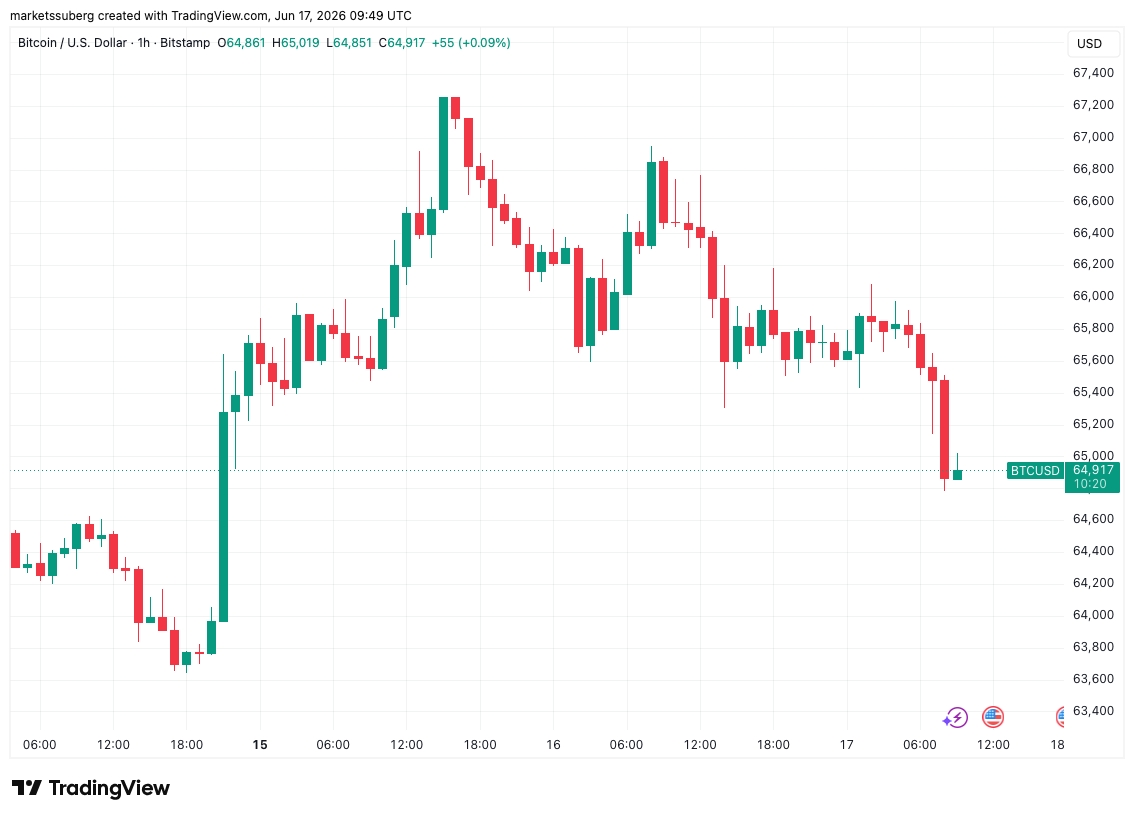
Bitcoin (BTC) fell below $65,000 on Wednesday as traders predicted the impact of a key macro event.
Key points:
- Bitcoin approaches the next Fed interest-rate decision near important support.
- BTC price analysis warns that “bearish” moves typically accompany FOMC days.
- $55,000 remains on the table as a target next.
BTC price analysis: FOMC could “set the tone” for June
Data from TradingView showed intraday lows of $64,782 on Bitstamp.
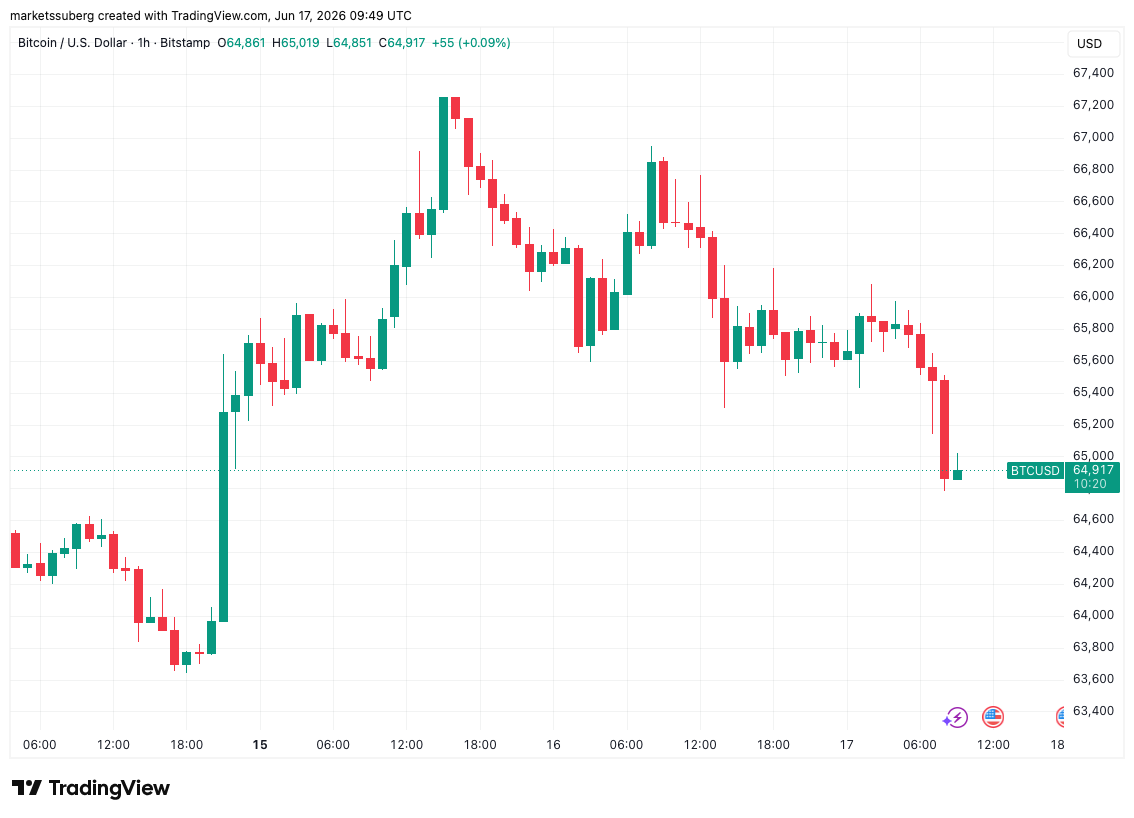
BTC/USD one-hour chart. Source: Cointelegraph/TradingView
The US Federal Reserve was due to decide on changes to interest rates at 2pm Eastern time — a move that formed the week’s main volatility catalyst.
The meeting of the Federal Open Market Committee (FOMC) would be the first under new Fed chair, Kevin Warsh, making his remarks at the subsequent press conference just as important as the overall outcome.
As Cointelegraph reported, Warsh had been under pressure to cut rates despite the inflationary impact of the US-Iran war.
“FOMC could set the tone for the rest of the month,” trader Killa wrote in an X post on the topic.
Killa noted that BTC price action tended to weaken around Fed decisions.
“Right now, BTC is forming a bullish narrative into the event, but as I always say, the outcome is usually priced in before the news is released,” they continued.
“If recent history is any indication, we have generated far more bearish reactions than bullish ones.”
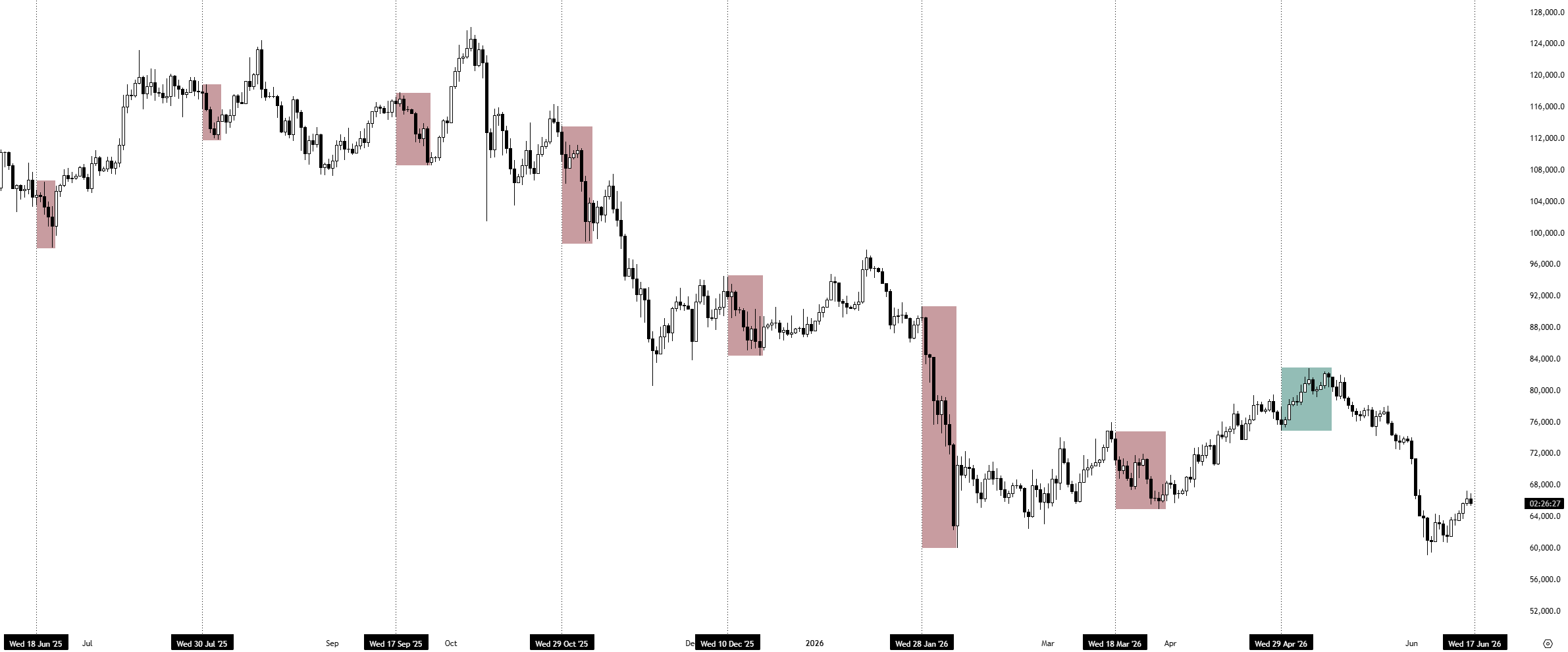
BTC/USD chart with FOMC meetings marked. Source: Killa/X
On Tuesday, Bitcoin already experienced a loss of momentum, even as stocks headed higher on Iran relief. Analysis had already warned that price would likely stall above $67,000 as demand remained subdued.
“We need to maintain bullish market structure from here… (64K). If not, there’s a strong chance we revisit the $60K lows after this pivot,” Killa warned.
Bitcoin trader preserves $55,000 target
Other perspectives included a “short-term bounce” for Bitcoin before the resumption of the bear market.
Related: Bitcoin miner ‘capitulation’ comes as trader sees later 2026 bear-market bottom
“FOMC meeting is happening today, exactly when the US-Iran peace deal is very close,” Niels, cofounder of marketing agency STABL, told X followers.
“IMO, Bitcoin could show some strength but eventually it’s going to $55,000.”
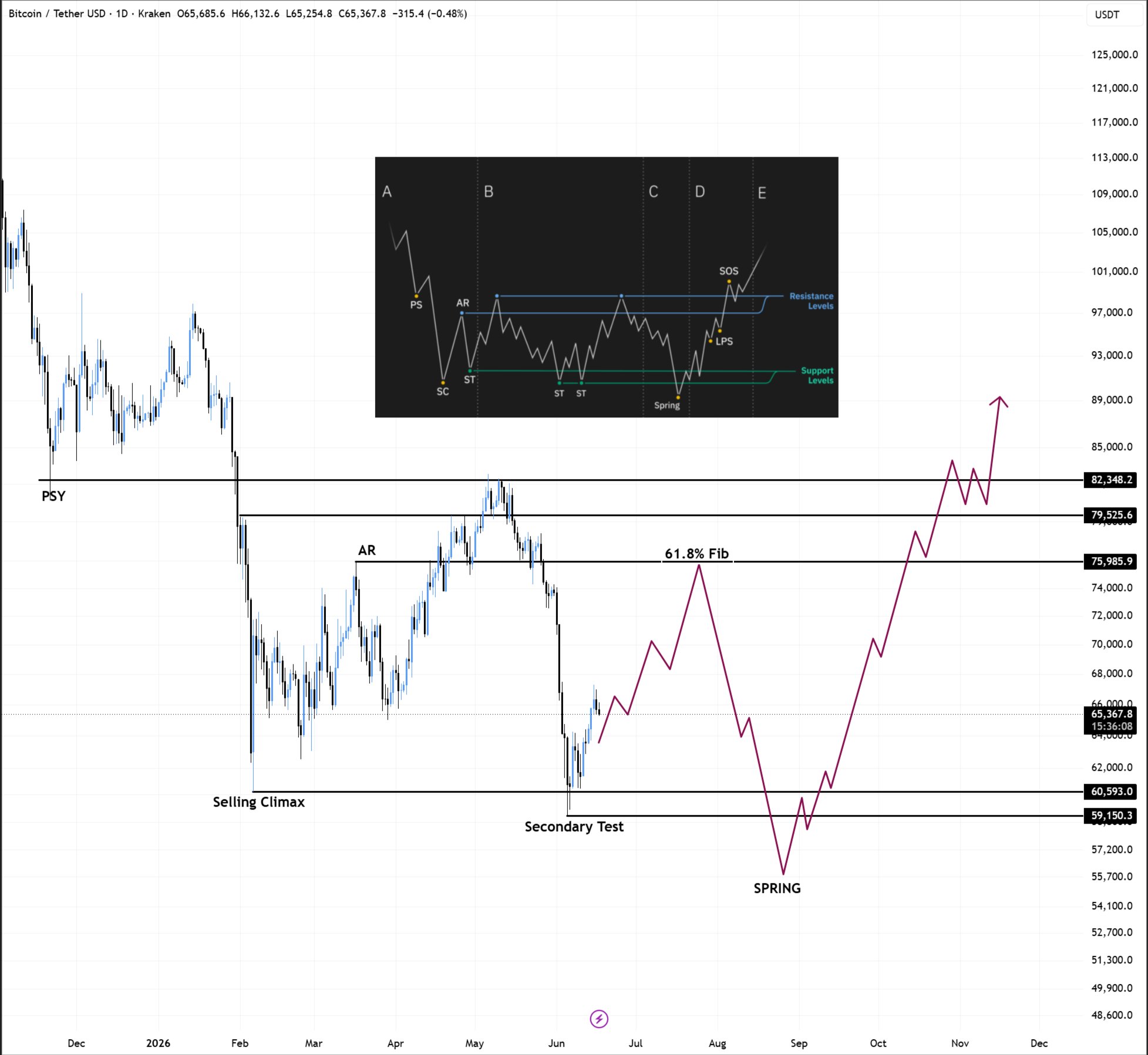
BTC/USDT one-day chart. Source: Niels/X
A more optimistic take came from analytics account Cryptic Trades, which saw the rebound continuing after the FOMC.
BTC/USD, it said, had rejected at two key moving averages that together form Bitcoin’s daily bull market support band.
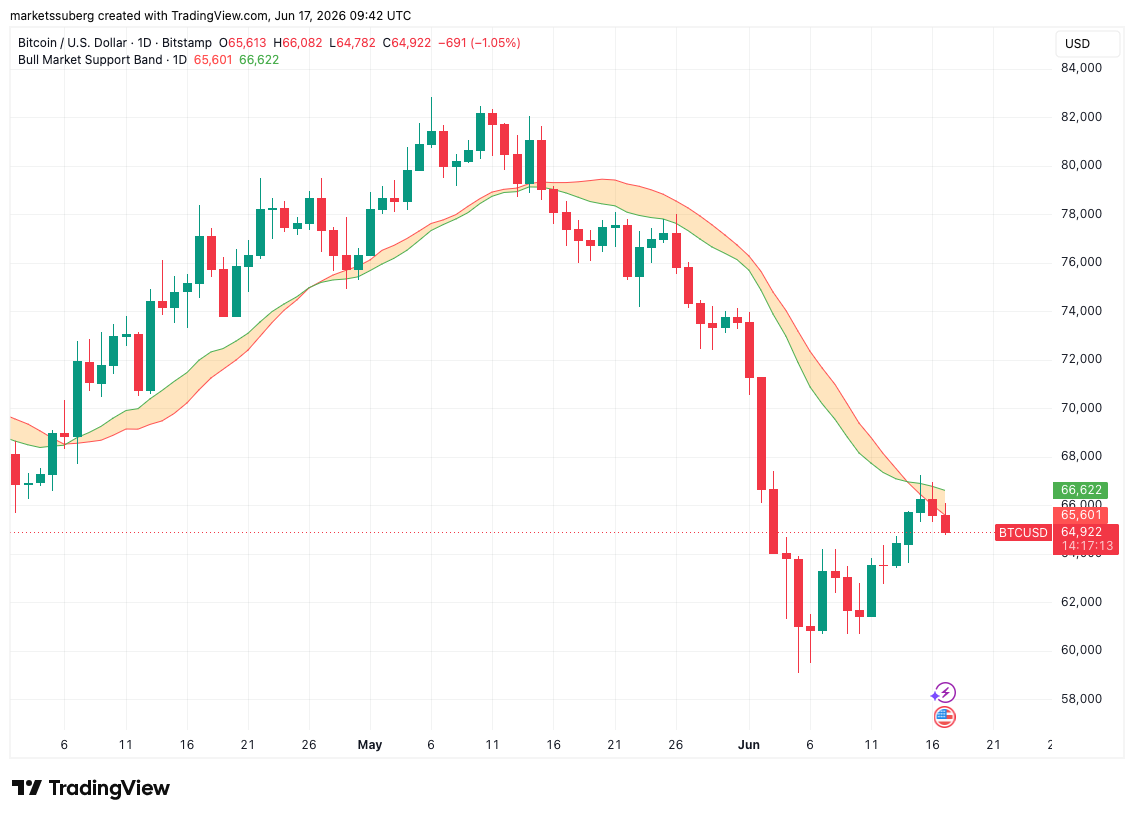
BTC/USD one-day chart with bull market support band. Source: Cointelegraph/TradingView
“However, after this pullback, the next big leg up is coming,” Cryptic Trades predicted.
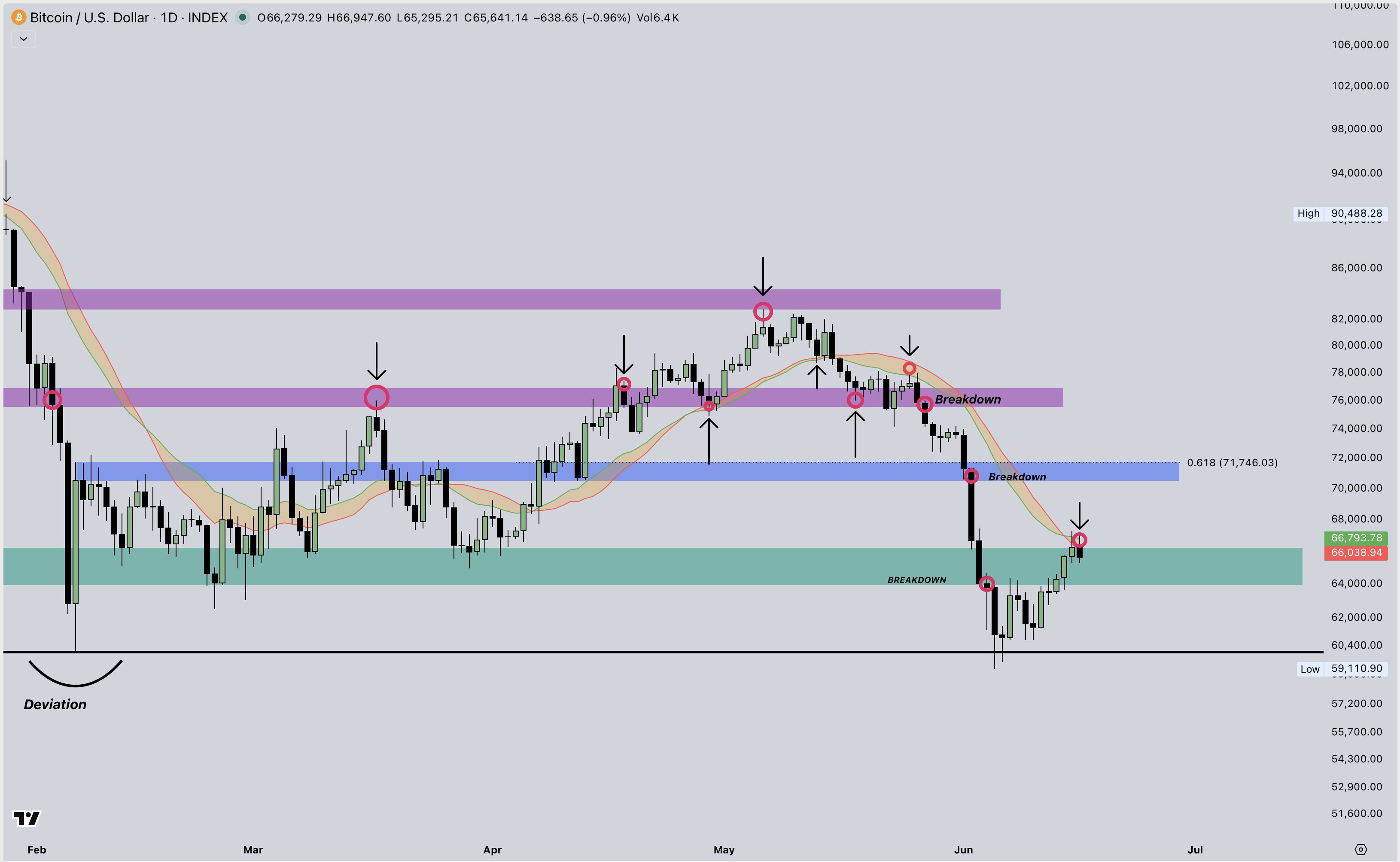
BTC/USD one-day chart. Source: Cryptic Trades/X


Cathie Wood bought $529.7 million of SpaceX stock on its first day of trading and sold Tesla shares at the same time. Both companies belong to Elon Musk, but Wood’s conviction has clearly shifted.
The trades came on June 12, SpaceX’s IPO day, when shares surged 19% and Musk’s net worth crossed $1 trillion for the first time. ARK bought 3.29 million SpaceX shares at the IPO price of $135, a position worth $529.7 million at closing. ARK then trimmed Tesla alongside Advanced Micro Devices, Rocket Lab, Roku, and Baidu on the same day.
Why Wood Is Moving On From Tesla
Tesla has been one of ARK’s core holdings for years, and Wood has publicly defended it through multiple down cycles. But the EV maker faces a different landscape today: Chinese rivals have narrowed the gap, margins are under pressure, and Musk’s political visibility has become a liability for some buyers.
SpaceX is a different proposition. Its Starlink satellite internet division is the company’s only profitable business, and it is growing fast. Wood first bought SpaceX in late 2023, and the stake became the largest holding in ARK’s roughly $1 billion internal venture fund. The IPO gave ARK the chance to scale that conviction in public markets.
The SpaceX Trade and Its Risks
The $529.7 million buy is a large commitment, even by ARK’s standards. SpaceX priced its IPO at $135 and closed 19% higher on day one.
SpaceX carries an accumulated deficit of $41.3 billion as of March 31. And the IPO’s retail allocation sits at 30% of the offering, three to six times the typical level.
ARK’s Performance Context
The ARK Innovation ETF is up 1.61% year to date, while the S&P 500 has gained around 9%. Over the past 12 months, the fund recorded roughly $294 million in net outflows. A Morningstar analysis found the fund wiped out $7 billion in investor wealth from 2014 to 2024.
Wood’s IPO bets follow a pattern. ARK bought Coinbase after its 2021 listing and CoreWeave more recently, each time seeking early exposure to high-conviction names. SpaceX is the biggest version of that bet yet.
Whether SpaceX turns that deficit into durable profit, or this becomes ARK’s next painful lesson, is a question the market will spend years answering.
The post Cathie Wood Swaps Tesla for SpaceX in $529M Elon Musk Pivot appeared first on BeInCrypto.

Inquest opened into death of Little Lever man killed in Montenegro

CNBC to simulcast 11 WNBA games this season

Bitcoin options traders brace for pivotal $10.6 billion June expiry


-

 Business3 days ago
No Jackpot Winner as $257 Million Prize Rolls Over to $269 Million Monday Draw
-

 Crypto World6 days ago
Oppenheimer backs SpaceX as $70 billion retail frenzy builds
-

 Fashion5 days ago
Weekend Open Thread: Tuckernuck – Corporette.com
-

 Crypto World6 days ago
Markets Rally as SpaceX IPO Looms Amid Iran Tensions and Inflation Surge
-
Crypto World3 days ago
Zimbabwe Requires Crypto Businesses to Register Annually Under New FIU Regulations
-

 Tech4 days ago
NanoClaw integrates JFrog registries to secure AI agent downloads
-

 Tech5 days ago
This Week In Security: Microsoft On Microsoft, Register Your Domains, Linux On ARM, And FreeBSD Joins The File Cache Club
-

 Crypto World4 days ago
Bitget enters Argentina’s regulated crypto market through PSAV registration
-
 Tech6 days ago
Dutton Ranch star claims they ‘didn’t see any disruption’ on set following Chad Feehan’s exit from Yellowstone spinoff fueled by Taylor Sheridan clash rumors
-

 NewsBeat6 days ago
El Nino has formed in the Pacific and could set records, forecasters say
-

 Politics6 days ago
Politics Home | Healey Resignation Is “Colossal Failure Of Government”, Says Former Labour Defence Secretary
-
 Entertainment6 days ago
Donnie Wahlberg & More Heat Up Las Vegas at Circa’s Barry’s Downtown Prime
-
 Tech6 days ago
Opendoor Ends India Operations, Fueling a Bigger Conversation About AI and Outsourcing
-

 Sports6 days ago
First Time Since 1971: Australia Register Historic Low In ODI Cricket
-

 Politics6 days ago
Belfast burns, while Met chief points finger at Iran and Russia
-

 Business6 days ago
AT&T: Verizon's 27% Outperformance Sets Up A Solid Entry Point
-

 NewsBeat5 days ago
FBI searches office of Ohio voter registration group
-
 Tech5 days ago
Anthropic is spending $150M to embed 1,000 AI fellows inside nonprofits. No degree required.
-

 Politics6 days ago
Modi thanks Trump for wishes as US attacks Indian seafarers
-
 Entertainment5 days ago
‘The Pitt’s Fan-Favorite Doctor Confirms Noah Wyle Gave His Blessing to Return [Exclusive]
You must be logged in to post a comment Login