
TL;DR
A Pew survey of 5,119 US adults finds 49% use AI chatbots but 40% say AI will hurt society, 67% distrust government regulation, and 59% distrust companies.




Up until a few weeks ago, I had never heard of the Tartan Army (despite being one-quarter Scottish and having an actual family tartan of my own!). But now that the World Cup has begun and the Scotland fans known as the Tartan Army have descended on my home state of Massachusetts, they’re inescapable. And that’s not a bad thing.
Full disclosure: I live in a suburb outside Boston, so I haven’t had any firsthand experiences with any of these kilted soldiers, but I have been following their exploits in the news and on social media, and I’m so glad they’re here. (If I were in a neighboring house to visiting tourists who were playing bagpipes throughout the day, it’s possible I’d feel differently.)
The Tartan Army has been going viral over the past week or so, partly due to their sheer numbers — it’s estimated up to 40,000 Scottish fans have traveled to Massachusetts for the group stage of the tournament — and partly because of the festive atmosphere they’ve brought to places like Fenway Park. Upwards of 10,000 fans attended a Red Sox game last weekend, and on the streets, they’ve marched while wearing their signature kilts and playing the bagpipes. And they’ve done their research as tourists, too.
They know that the real tourist attractions in Boston are Dunkin’ and the Cop Slide, a slide at the playground on Boston’s City Hall Plaza known for causing injuries because some people accelerate so fast. The slide went viral when a police officer attempted to use the slide and… it didn’t go well. (We can laugh now because he’s OK.) But this is why we now have a video of a man playing the bagpipes while descending the Cop Slide.
I don’t know if anyone thought that would be one of the byproducts of hosting the World Cup, but this World Cup has provided us with so many unexpected and delightful moments. The Cape Verdean goalkeeper, Vozinha, who went from virtual unknown to worldwide legend during his team’s 90-minute match against Spain, is another story that’s sparking joy, along with yet another viral police officer video, this time of Boston cops joyfully dancing with fans after the Cape Verde-Spain match. All these little dopamine hits really add up.
Bostonians and most New Englanders have a reputation for not being warm. It’s a remnant of the Puritanical and stoic values imported by our earliest settlers and that have lingered for centuries — this can make us seem standoffish and aloof at times, when really it’s more an innate reservedness that some of us can’t shake, no matter how hard we try. But the Scots are cracking our tough outer shell, at least temporarily.
A scroll through TikTok will turn up dozens of videos of gratitude, both from the Scots, thanking Boston for the warmth they’ve been shown, and from locals who have been charmed by the exuberant and joyful visitors. Fans and pundits alike keep talking about how the World Cup really has become the great unifier we need right now, and the influx of Scottish tourists in our state feels like it has lifted the local mood.
But alas, we won’t get to call the Tartan Army ours for long. The team and their fans will stick around for one more match on June 19 against Morocco before traveling down to Miami for their final group-stage match against Brazil on June 24. Sure, Miami has beautiful beaches, and we’ll probably get a viral video of a bagpiper on a jet ski out of this, but we’ll miss the Tartan Army when they’re gone. At least we’ll always have Cop Slide.


A Pew survey of 5,119 US adults finds 49% use AI chatbots but 40% say AI will hurt society, 67% distrust government regulation, and 59% distrust companies.
Half of American adults now use AI chatbots, but a plurality believe the technology will ultimately damage society, and overwhelming majorities have lost confidence that either the government or the companies building it will manage it responsibly. A new Pew Research Center report released Wednesday, based on a survey of 5,119 US adults conducted in February, found that 49% of respondents use AI chatbots, up from roughly a third in 2024. At the same time, 40% said AI will be worse for society, roughly two-thirds said it is advancing too quickly, and 71% agreed the technology will make their personal data less secure.
ChatGPT remains the dominant chatbot among US adults, with 44% of respondents reporting they have used the OpenAI application. Google’s Gemini ranked second at 24%, followed by Microsoft Copilot at 17%, MetaAI at 14%, Grok at 8%, Claude at 6%, and Character.ai at 3%. The most common use case was information searching, cited by 42% of chatbot users, followed by entertainment at 25%, creating or editing images and videos at 24%, and medical advice at 20%.
The trust deficit is the report’s most striking finding. Two-thirds of Americans, 67%, said they have little or no confidence that the US government could effectively regulate AI. A separate 59% said they have little or no confidence that US companies could develop the technology responsibly.
The federal government’s failure to produce a coherent AI regulatory framework, despite months of internal deliberation and a scrapped executive order, appears to have registered with the public. The partisan divide on regulation is notable, with a separate Pew survey from March 2025 finding that 54% of Republicans had at least some trust in the US to regulate AI, compared with only 36% of Democrats.
“AI is no longer the future; for many, it’s here and now,” Pew Research Center associate director of research Jeffrey Gottfried said in a statement accompanying the report. “Americans are increasingly using chatbots and bringing AI into their homes, but they have a complex relationship with AI. They may use it, but they’re still highly skeptical of it and how it will impact our society.”
The skepticism extends across demographics. In an earlier Pew survey from 2024, only 17% of the general public said AI would have a positive impact on the United States over the next 20 years, compared with 56% of AI experts who thought the same. Americans were more optimistic about AI in medical care, where 44% expected positive effects, but far less so about education, where only 24% were positive, and jobs, where the figure dropped to 23%.
The jobs concern is not abstract. Meta and Microsoft eliminated a combined 23,000 positions in a single day in April, with both companies explicitly citing AI investment as the reason. The tech sector has recorded more than 96,000 job cuts in 2026 so far, and companies making the cuts are among the most profitable on earth.
Pew found that 21% of US workers now use AI in their jobs, up from 16% in 2024, but far more workers report being worried than hopeful about where the trend leads. Only 23% of the general public said AI would have a positive impact on how people do their jobs over the next 20 years, compared with 73% of AI experts.
The report also captured the scale of non-adoption. Of the 51% of US adults who do not use AI chatbots, 60% attributed it to disinterest rather than lack of access or technical ability. Many respondents also acknowledged using products with AI features without identifying them as AI tools, including smartwatches at 37% and smart speakers such as Amazon Echo or Apple HomePod at 35%.
Fewer Americans use chatbots for the kinds of high-stakes applications that have attracted the most regulatory scrutiny. Only 13% reported using chatbots for news, 10% for emotional support, and 4% for companionship. The data privacy concern was more pervasive, with 71% of respondents agreeing that AI will make personal data less secure.
The new Pew data draws from multiple surveys conducted at different points between 2024 and February 2026. The chatbot usage figures reflect the February 2026 survey, while some attitudinal measures draw from earlier polling periods. The methodology uses Pew’s American Trends Panel, a nationally representative sample recruited through random sampling of residential addresses, with interviews conducted online or by phone.
What the data describes is a country that is adopting AI tools faster than it is developing confidence in the institutions meant to govern them. The gap between usage and trust is widening, not closing, and neither regulators nor the industry has offered a credible plan to address it.

At IO-AI Tech, a startup about 45 minutes north of downtown Shenzhen, China, I glimpsed a wacky new frontier of blue-collar work. Workers wearing the company’s VR headsets, handheld controllers, and motion-tracking gear remotely control humanoid robots for workplaces like factory floors and convenience stores. The company wants the robots to do useful work, like stocking shelves and picking items out of bins, but it also wants to gather training data that could one day let the bots operate autonomously.
To show off the tech, the company invited me to its offices, where I was allowed to control 10 humanoid robotic hands, each from a different company, using a custom motion-tracking glove. The device instantly transferred my finger movements to all 50 robotic digits.
I’m a little embarrassed to say that the first thing I tried with this futuristic gear was getting all 10 hands to flip the bird. After getting this out of my system, I was impressed by how quickly my movements transferred to the robot hands, and how easily the tech went both ways—I was able to feel a ball placed in one of the electronic hands.
Courtesy of Will Knight
The company also let me try a system that’s being tested by a Chinese convenience store chain. Using a VR headset and a pair of grippers, I tried picking up boxes of medication from a shelf. It was disorienting at first: I had to adjust to a slight difference between my movements and those of the robot I could see through the headset. After a little practice, however, I was stacking shelves like a robot-boss.
Elsewhere, I watched people wearing virtual reality headsets and body-tracking sensors reminiscent of Ready Player One. In one large room, I saw workers using a range of different systems to control diminutive Unitree humanoids. One person marched around with a Unitree robot next to them, and the machine mirrored their movements within a mocked-up apartment. The human operator, wearing a headset and viewing the scene through the robot’s eye-level cameras, went through the motions needed to remove a shirt from a hanger and fold it.
IO-AI develops technology that transfers a person’s movements to different robot forms—a useful offering because there are dozens of different humanoids and robot hands on the market in China today. The startup’s algorithms also need to combine human control with some level of autonomy because a person and a robot aren’t always going to be the same shape, size, and weight. Without some ability to move independently, the robot may lose its balance.

This week Jonathan chats with Florian Gilcher about Rust and Ferrous Systems! How have we gotten here, what’s coming next, and what’s new in the Rust world? Watch to find out!
Did you know you can watch the live recording of the show right on our YouTube Channel? Have someone you’d like us to interview? Let us know, or have the guest contact us! Take a look at the schedule here.
Direct Download in DRM-free MP3.
If you’d rather read along, here’s the transcript for this week’s episode.
Theme music: “Newer Wave” Kevin MacLeod (incompetech.com)
Licensed under Creative Commons: By Attribution 4.0 License

The Trump administration’s disagreement with Anthropic over its most advanced AI models appears to be fast coming to a head.
Trump officials tell Inner Loop that if Anthropic wants to rerelease Claude Fable 5, the AI model that they took offline with export controls last week over concerns about jailbreaking—a method of using prompts to get around a model’s safeguards—the company will need to take steps to actually address what the government alleges are vulnerabilities.
Anthropic has said for days that the administration’s concerns are overblown and that the effects of the jailbreaks are minimal. It reiterated this position to the Commerce Department and the Office of the National Cyber Director, Sean Cairncross, in a technical meeting on Monday.
But officials say they are past arguing whether the jailbreaks are significant, since the National Security Agency concluded that there are ways to disable guardrails on Fable 5, which are put in place to prevent users from accessing capabilities of the Mythos model related to cybersecurity, chemistry, and biology
At this stage, the administration essentially views the situation as Anthropic’s problem to fix, according to three people familiar with discussions.
Neither the Commerce Department’s Center for AI Standards and Innovation nor the National Security Agency has the staff or the bandwidth to be drawn into chasing down every conceivable jailbreak on every model that reaches the market, the people said.
As a result, the administration believes that Anthropic should be more proactive about continually testing not just Fable 5 but all of its frontier AI models to find potential jailbreaks and flag them to the government themselves.
But on a more fundamental level, it remains unclear how Anthropic is supposed to prevent jailbreaking.
Independent cybersecurity experts have increasingly taken the view that guardrails on AI models are only a stopgap solution, since skilled users and future AI models will find ways to bypass constraints—meaning that what the White House appears to want cannot be done.
A White House spokesperson declined to comment.
At the start of the week, Trump’s pick to serve as Acting Director of National Intelligence, Bill Pulte, was on track to never even start the job. Now, Trump has thrown him a lifeline—and it’s the permanent DNI nominee, Jay Clayton, who now faces the prospect of never serving in the role.
To recap: Trump initially named Pulte, his housing finance chief, to replace outgoing DNI Tulsi Gabbard.
Faced with bipartisan pushback because Pulte doesn’t have the national security experience required by law for the role and because he flagged allegedly questionable mortgage fraud accusations against Trump’s political enemies, Trump announced Clayton, the US attorney for the Southern District of New York, as his nominee for a permanent DNI.
Gabbard was scheduled to depart June 18, with Pulte’s first day set for June 19. But Senate Republicans wondered, if Clayton could have his hearing fast-tracked to June 17 and start by June 22, would Pulte even get into the building?
On Wednesday, Trump blew up the plan. As part of a wider feud with Senate Republican leadership over the filibuster, Trump announced Clayton’s hearing would be delayed indefinitely, in an apparent effort to prevent Pulte from getting jumped. Senate Republicans then announced that the hearing would proceed, unless Clayton didn’t appear or his nomination was withdrawn.
The situation may be a body blow for the Office of the Director of National Intelligence, which Trump has directed Pulte to vastly downsize, and staffers have been unimpressed by what they see as Pulte’s minimal effort to get to know the agency and lack of regular briefings, people familiar with the matter said.

If you need to store some data on a resource-constrained embedded platform, the prospect of dragging in a dependency for something like FAT filesystem access to flash or other storage medium can seem rather daunting. Not only is your binary size now significantly larger, the overhead of these filesystems is also not insignificant as they were not really designed for this type of environment. Here [Drew Gaylo]’s UTFS format is an interesting alternative to just writing raw binary data to said storage medium.
As explained in the accompanying introduction article, the basic idea is similar in scope but very much slimmed down compared to the venerable Tape ARchive (TAR) format, hence the Micro (µ) Tar File System name. The provided UTFS implementation is quite small, spanning two source files in C99 with zero heap usage. Targeting a custom store medium requires implementing one read and one write function to match the underlying platform.
A couple of examples are also provided, covering using the built-in Flash of a SAMD20 MCU and the EEPROM of an ATmega328. Compared to raw binary data that’d have to be fully rewritten, UTFS allows for sections of the storage to be accessed as files and thus updated in-place.

Schools are racing to write AI policies, but what if the policy is not the first step? This week, we hear from Aleta Margolis, founder and president of the Center for Inspired Teaching, who argues that real progress starts with a conversation, not a rule. Then EdSurge editor-in-chief Sarah McKibben brings it home with what AI actually looks like at her kitchen table, with two middle schoolers navigating it in real time.
What You’ll Learn:
A new RAND American Youth Panel survey found that only about one in three students say their school has a school-wide AI policy, and Aleta Margolis of the Center for Inspired Teaching explains why co-creating guidelines with students leads to better outcomes than top-down rule-making.
A recent NPR and Ipsos poll found that 54 percent of teachers say AI is making it harder for students to learn critical thinking skills, and nearly three in four believe its impact on education will exceed that of the internet or computers.
Sarah McKibben describes the mix of productive and concerning AI use she sees with her own children, including a student using an AI humanizer app to avoid plagiarism detection when submitting AI-written essays.
Both guests converge on the idea of productive struggle: the concern is not AI itself but whether students are learning to think with it rather than bypassing the thinking entirely.
Listen here:
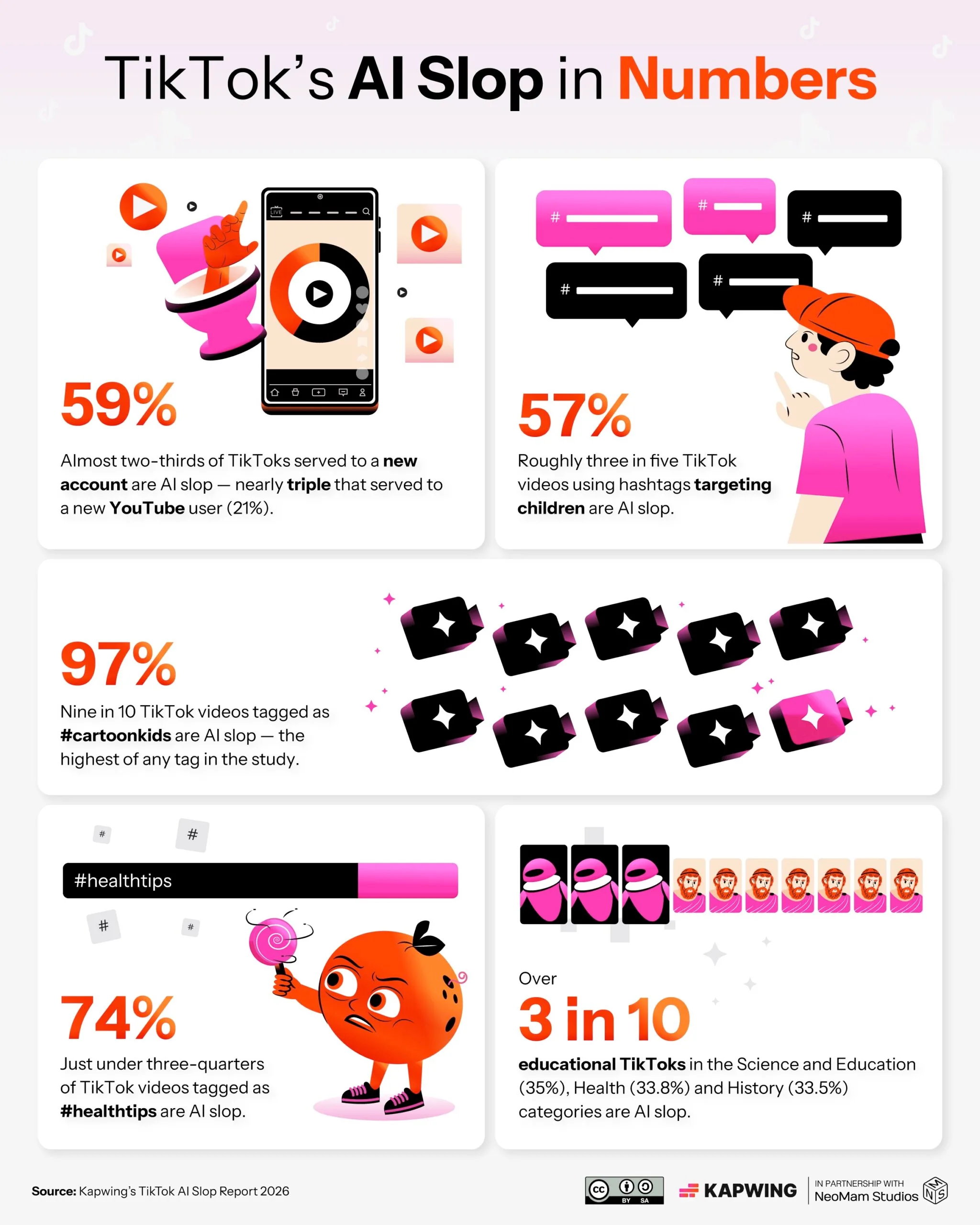
If you have ever felt like your TikTok feed is mostly fake content, you are not imagining it. A new report from Kapwing found that 59% of videos served to a brand-new TikTok account are AI slop. That is roughly three times the rate Kapwing found when it ran the same test on YouTube.
Kapwing built a fresh account on both platforms and manually checked the first 500 videos served to each one. On TikTok, 294 of those videos were AI-generated. On YouTube, only 104 of the first 500 Shorts qualified as slop, putting that platform’s rate at 21%.

The scale of the problem is staggering when you consider that TikTok had already labeled 1.3 billion videos as AI-generated by November. Kapwing also manually reviewed over 10,000 TikTok videos across 20 different content categories to get a fuller picture of where slop tends to cluster.
Kids’ content topped every category, with 57% of the 2,000 videos turning out to be AI-generated. The worst single tag was #cartoonkids, where 97 out of 100 featured videos were artificial.

Science and Education, Health, and History followed close behind, each landing between 33% and 35% AI slop. These are categories where animation and voiceover narration tend to replace real demonstration.
On the other end, Fashion, Music, and Fitness were nearly untouched, each sitting below 2%, likely because those formats rely heavily on real, on-camera presence.
Even though TikTok has rolled out tools for users to dial back AI content in their feeds, this study suggests that what shows up by default still leans heavily towards AI. For now, the burden of filtering slop from substance largely falls on the viewer.

The problem with letting an AI agent loose inside a company is not that it might forget who it is. It is that it has no reason to hold back.
A human employee is restrained by the fear of being fired. An agent, as one investor in Arcade.dev put it, “will exhaustively exploit every permission it inherits” to reach its goal. Arcade has raised $60mn to make sure that, by design, it cannot.
The Series A was led by SYN Ventures, with strategic cheques from Morgan Stanley and Wipro. Added to a $12mn seed last year, it brings the San Francisco startup to $72mn in total funding.
Most companies can already verify that an agent is what it claims to be. What they cannot do, according to Arcade chief executive Alex Salazar, is prove that a given agent, acting for a given user, is allowed to perform a given action on a given system.

The 💜 of EU tech
The latest rumblings from the EU tech scene, a story from our wise ol’ founder Boris, and some questionable AI art. It’s free, every week, in your inbox. Sign up now!
“Agents don’t fail in production because the model is wrong,” Salazar said. “They fail because nobody can prove” who is authorised to do what. That gap, he argues, is why so many corporate agents never leave the pilot stage.
Salazar, a former Okta product leader who once sold a startup to the identity firm, built Arcade with chief technology officer Sam Partee, formerly of Redis.
Arcade did not set out to build this. Its first product was an agent that diagnosed misbehaving servers and databases, which required sweeping super-user access. “No one in their right mind was going to actually let us do that in the real world,” Salazar said.
So the team split the model’s reasoning from the layer that actually touches tools, and built the part that decides which tools the agent may use. Nobody was excited about the diagnostic agent. Everybody who understood AI was excited about the authorisation layer. Arcade dropped the agent and kept the plumbing.
That plumbing now hangs off Anthropic’s Model Context Protocol, the emerging standard for connecting models to tools like email and internal APIs, to which Arcade says it has contributed. Its runtime checks each request against an organisation’s real permissions, can run inside a customer’s own environment, and logs every action so a company can tell an agent’s move apart from a human’s.
Salazar’s argument for why a control layer has to sit outside the agent is the oldest one in enterprise risk: the thing taking an action never gets to authorise itself. Traders don’t approve their own trades. A smarter model, he says, doesn’t change that, and because most companies run several models at once, the control layer has to be neutral to all of them rather than owned by any one vendor.
It lands amid a rush of startups selling ways to put AI agents to work and, increasingly, to fence them in. Arcade frames the incumbents as solving the wrong problem, with API gateways routing traffic and identity tools proving who you are, when the question is what an agent may do, on which system, right now. Its bet is that the boring layer underneath is where the durable business sits.
For now this is a roughly 40-person company that still has to scale and defend its turf in a field filling up fast. Several of its headline proof points, production use at the world’s largest banks, a 25-fold jump in usage, thousands of prebuilt tools, are Arcade’s own figures rather than independently verified.
The underlying argument, though, is hard to dismiss. As agents start acting on systems no single person fully understands, the question of what they are permitted to touch stops being a policy document and becomes infrastructure. Arcade is betting it owns that infrastructure.


systems
AI drug discovery is so last year, even though it hasn’t accomplished much yet
In order to move more semiconductor manufacturing onshore, the US needs to depend less on foreign-sourced materials. Now, the government is giving an Alphabet spinoff $500 million in CHIPS Act funds to find domestic minerals, molecules, and chemicals needed for this process.
SandboxAQ (that’s AI and Quantum, for those wondering), which spun off from Alphabet in 2022 under the chairmanship of former Google CEO Eric Schmidt, announced the award Wednesday. The company won’t be doing any manufacturing – this is just an R&D grant to turn the startup’s AI simulation software toward discoveries necessary to build a domestic chip industry.
According to SandboxAQ, the $500 million awarded to it by the Department of Commerce will go toward developing “novel molecules and formulations for semiconductor manufacturing,” including chip production materials that are free of PFAS (“forever chemicals”), new semiconductor fabrication catalysts, magnets that don’t rely on foreign-sourced neodymium and other rare earths, and fab-powering batteries that don’t rely on majority foreign-sourced materials like lithium.
The CHIPS and Science Act, signed into law by President Biden in 2022, was designed in part to dole out $52 billion to US firms to reignite domestic semiconductor manufacturing, which has mostly fled the country for more favorable production environments overseas. Four years on, the government’s many investments have seen some payoff, like the acquisition of a 10 percent stake in Intel to help keep the company afloat, but there’s still a lot of work to be done to reduce dependence on foreign supply chains and manufacturers.
SandboxAQ relies its own large quantitative models (LQMs), which it describes as “AI systems trained on the laws of physics, chemistry, and biology, not human language.” That, the company asserts, means they’re well-suited to discover new materials needed to eliminate harmful PFAS and foreign-sourced materials from the semiconductor supply chain.
The hope is that the LQMs will be able to generate their own material predictions that researchers then test in the lab – essentially the same process that’s undergirded the years-long effort to use AI to help synthesize new drugs.
Despite AI industry leaders prognosticating we’d be popping AI-designed drugs in 2025, AI has yet to design a functional medicine, according to the US National Institutes of Health. Why, then, should we presume an AI will succeed at replacing critical battery and chip manufacturing components where drug research has failed?
In fact, according to SandboxAQ’s announcement, its LQMs aren’t even necessarily grounded in real-world data. They rely in part on synthetic data, which is then fed into the company’s LQMs and used to train their design-make-test workflows.
A company spokesperson told The Register in an email that it still uses real-world data where possible.
“Where experimental data exists, we incorporate it,” SandboxAQ told us. “Where it doesn’t, we can still move forward and solve the problem.”
When asked whether an error in the reasoning process could compound, leading to considerable lost time for researchers and a lack of results, the company admitted that such a potential is exactly what “any rigorous AI-driven materials program has to answer.”
“Our models are trained on the laws of physics and chemistry, so they are anchored to physical reality, rather than free to drift,” the spokesperson told us, adding that lab testing is the final check on AI accuracy. “A material either performs in the lab, or it doesn’t, and that validation gate is precisely what prevents a chain of reasoning from running away with itself.”
SandboxAQ added that it is not starting from zero in any of the four target areas, having done previous work on catalysts, battery materials, alloy discovery, and PFAS breakdown that will be incorporated into its CHIPS Act-funded work.
“In commercial deployment, we’ve already cut development timelines from months to weeks” at the candidate screening stage, the SandboxAQ spokesperson explained. SandboxAQ said that some of the work it’s doing, like PFAS mitigation, could be rolled out to existing fabs, as could new batteries and the like, but it admitted that the various verticals will operate on different timelines.
“Qualification in the semiconductor industry is genuinely rigorous and does take time – we wouldn’t minimize that – but the path runs through validation and industrial qualification with existing manufacturers, not through standing up new fabrication capacity from scratch,” SandboxAQ told us. ®


Karthik Bangalore Rajendra Prasad. Image: Karb AI
The company was recognised for its work in e-commerce advertising for Meta and Google promotions.
Belfast-based technology company Karb AI has come away from the 2026 UK StartUp Awards with the Digital Startup of the Year title for Northern Ireland (NI). The ad optimisation tool for e-commerce brands and agencies was recognised for an ‘AI layer’ that impacts how e-commerce advertises for Meta and Google promotions.
Established in 2025 by Karthik Bangalore Rajendra Prasad, Karb AI enables e-commerce platforms to audit, optimise and scale digital advertising. Its flagship product is an AI decision layer for e-commerce Meta ads.
The UK StartUp Awards, which were founded by Prof Dylan Jones Evans aim to celebrate the ambition and resilience of the entrepreneurs driving the economy. As the NI winner, Karb AI will progress to the UK StartUp Awards national final to be held on 9 September at Ideas Fest in Champneys Tring in Hertfordshire, an event projected to attract 6,000 founders, investors and leaders.
Commenting on the win, Prasad said: “Winning the Digital Startup of the Year for Northern Ireland is a significant milestone for us as we approach our first anniversary. Our mission is to empower e-commerce brands with AI-driven insights that simplify complex advertising decisions and this recognition from the UK StartUp Awards validates the many benefits we’re already delivering for digital marketers and e-commerce companies.”
In other start-up news, earlier this week University College Dublin’s Nax Bioscience and Trinity College Dublin’s Imragen were awarded the top spot at the inaugural Irish Genomics Business Plan Competition, an initiative established to identify and support high-potential genomics-focused start-ups and research ventures in Ireland’s life sciences ecosystem.
Both Nax Bioscience and Imragen were selected as the winners in recognition of their innovative genomics-driven technologies and strong commercial potential.
Don’t miss out on the knowledge you need to succeed. Sign up for the Daily Brief, Silicon Republic’s digest of need-to-know sci-tech news.




No Jackpot Winner as $257 Million Prize Rolls Over to $269 Million Monday Draw


Oppenheimer backs SpaceX as $70 billion retail frenzy builds


Weekend Open Thread: Tuckernuck – Corporette.com


Markets Rally as SpaceX IPO Looms Amid Iran Tensions and Inflation Surge

Zimbabwe Requires Crypto Businesses to Register Annually Under New FIU Regulations


NanoClaw integrates JFrog registries to secure AI agent downloads


Bitget enters Argentina’s regulated crypto market through PSAV registration


This Week In Security: Microsoft On Microsoft, Register Your Domains, Linux On ARM, And FreeBSD Joins The File Cache Club

Dutton Ranch star claims they ‘didn’t see any disruption’ on set following Chad Feehan’s exit from Yellowstone spinoff fueled by Taylor Sheridan clash rumors


El Nino has formed in the Pacific and could set records, forecasters say


Politics Home | Healey Resignation Is “Colossal Failure Of Government”, Says Former Labour Defence Secretary

Donnie Wahlberg & More Heat Up Las Vegas at Circa’s Barry’s Downtown Prime

Opendoor Ends India Operations, Fueling a Bigger Conversation About AI and Outsourcing


Belfast burns, while Met chief points finger at Iran and Russia


First Time Since 1971: Australia Register Historic Low In ODI Cricket


FBI searches office of Ohio voter registration group


AT&T: Verizon's 27% Outperformance Sets Up A Solid Entry Point
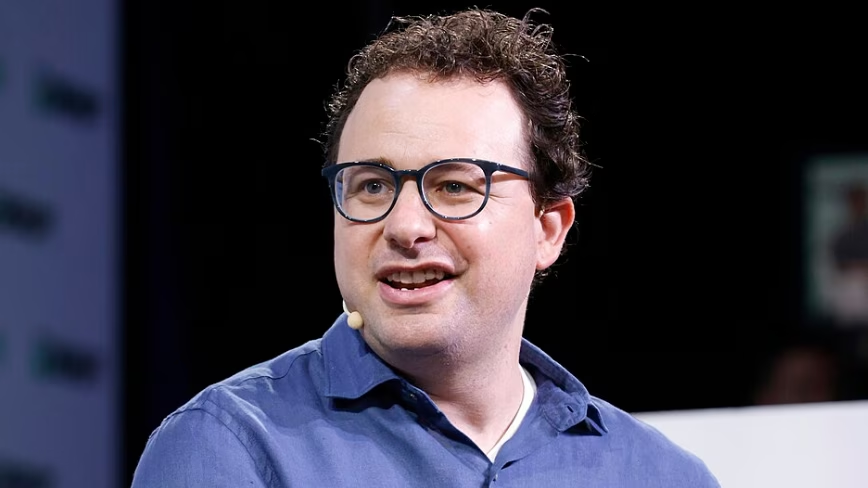
Anthropic is spending $150M to embed 1,000 AI fellows inside nonprofits. No degree required.


Modi thanks Trump for wishes as US attacks Indian seafarers
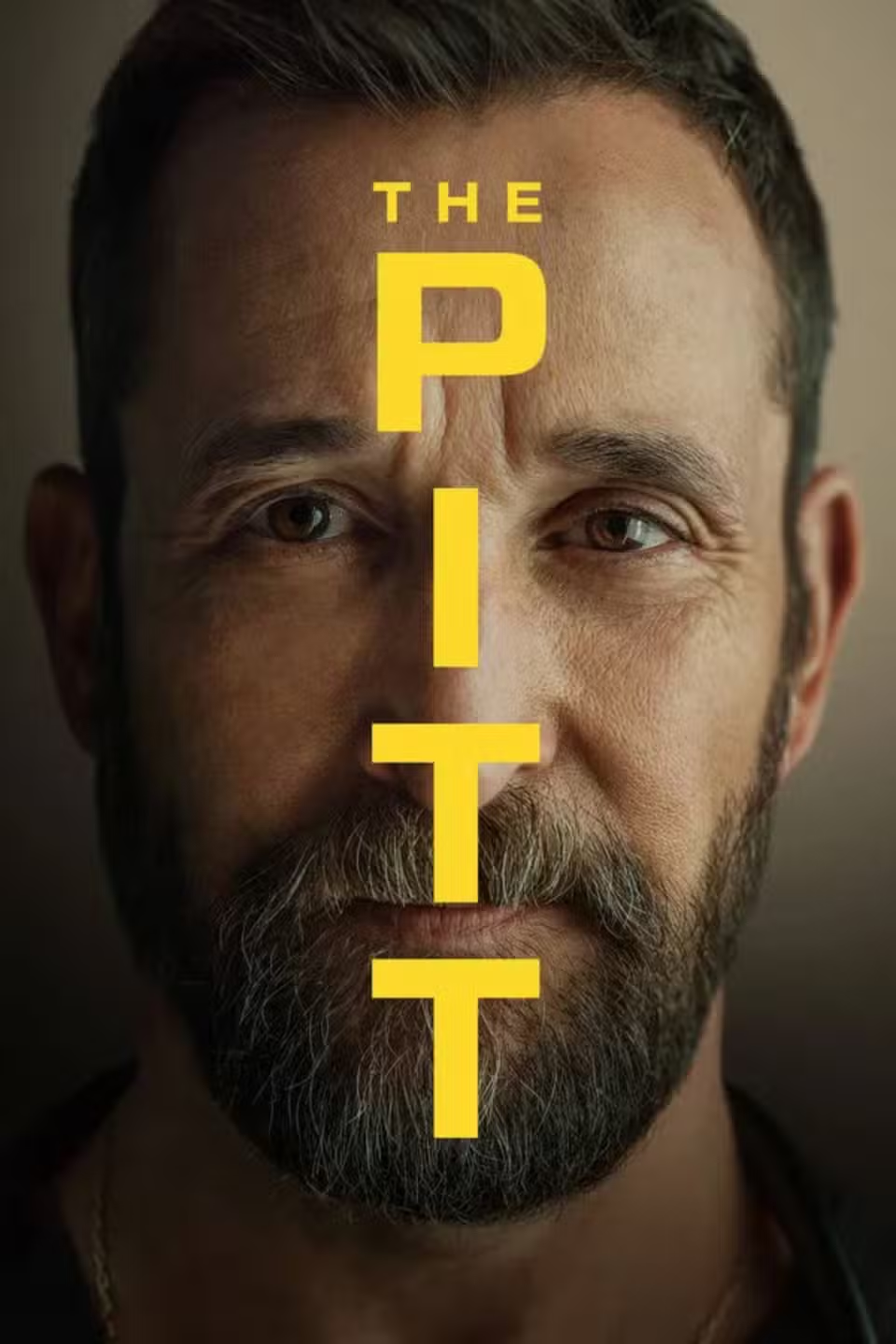
‘The Pitt’s Fan-Favorite Doctor Confirms Noah Wyle Gave His Blessing to Return [Exclusive]


You must be logged in to post a comment Login