The UK has recently announced that, from Spring 2027, all those under 16 years old will be banned from accessing certain social media platforms.
This, pretty unsurprisingly, has been met with mixed reactions as many parents, guardians, teachers and even under-16s have praised the ban. On the other hand, some have criticised the ban as, to them, it simply makes “no sense”.
Whatever your stance on the social media ban is, we’ve rounded up everything you need to know, from what platforms will be included and how the ban will be enforced. We should disclaim that the ban isn’t expected until next year, so there’s still a lot of unanswered questions.
The UK government is planning to ban social media for those aged under 16. This means that although under-16s will still have general access to the internet, and can read the news, research topics and play games, they won’t be able to use platforms like Instagram, YouTube, TikTok, Snapchat, Facebook and X. At the time of writing, we don’t know whether that list is exhaustive, or if the government will eventually include more platforms to the ban list.
Advertisement
You’d be right in thinking this sounds familiar, as the government has stated that it’s using the “same model” as Australia’s social media ban which was implemented back in December 2025.
The purpose of the social media ban is partly in response to a national consultation which showed an “overwhelming public demand for action”. According to the consultation, the vast majority of parents and under-16s alike agreed that social media platforms shouldn’t be used by young people.
Advertisement
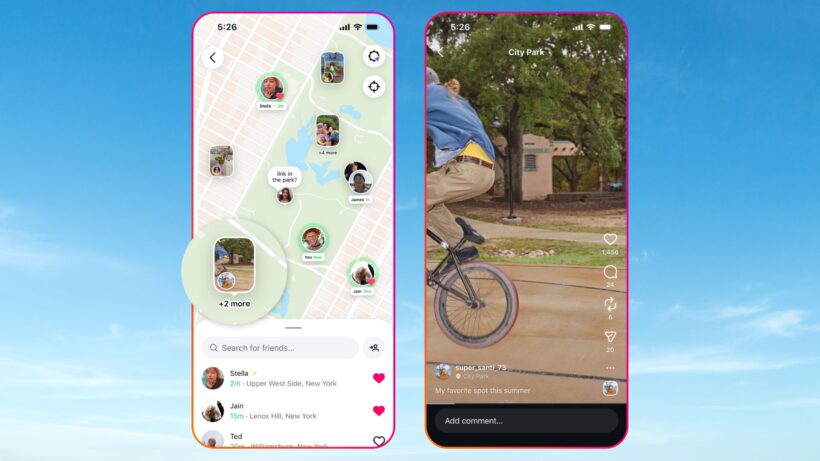
Instagram
According to the government, the social media ban will be implemented in Spring 2027 after the first set of regulations are laid out by the end of the year. At the time of writing, there haven’t been any specific dates provided.
Judging from the fact sheet on gov.uk, it would be fair to say that the details haven’t been formalised yet. Instead, the government states that it plans on following Australia’s ban, whose model included “platforms like Instagram, YouTube, TikTok, Snapchat, Facebook and X”. We’d assume that YouTube Kids will still be available for under 16s, but the government hasn’t confirmed this just yet.
YouTube on iPad Air M3. Image Credit (Trusted Reviews)
Advertisement
What about WhatsApp and other messaging apps?
The government has stated that it does not “intend” for messaging services to be included in the social media ban, which is likely to be a relief for parents who are concerned about keeping in touch with kids while they’re out and about. However, it has currently only mentioned Whatsapp and Signal, and fails to explain whether the likes of Telegram will be banned.
We also wonder whether Messenger will be banned too. Yes, you need a Facebook account to initially set-up the tool, but you can technically still use it even if you deactivate your account.
It seems that the main method of enforcing the social media ban will be via age verification, with stronger requirements needed for age checks on platforms. Ofcom is said to be setting out different options for effective forms of age verification that are “accurate, robust, reliable and fair”. However, the government hasn’t provided any further details on what those verifications will look like.
Advertisement
Adults won’t need to do checks, as many already have a social media account that’s been open for more than 16 years (what a way to make us feel old), has a credit card connected or is linked to an email address that’s already passed age verification in other ways. If those steps fail to prove an age, then apparently a simply face scan should verify a person’s age.
What does the ban mean for parents and children?
For children, the ban has been hailed by the government as “kickstarting a cultural shift”, and is promised to give kids their childhoods “back” as there will be less time for scrolling and “more time for play”.
However, those slightly older children who have grown up with social media platforms and will soon lose access may struggle to get used to the so-called “new normal”. There’s even, at the time of writing, a petition calling for the social media ban to be stopped which has over 208,000 signatures.
Advertisement
Advertisement
Essentially, people are clearly divided by the ban as although the harms of social media are widely acknowledged, many hail it a useful tool to stay in contact with friends and family.
Otherwise, the government has assured parents that, as of right now, they don’t have to do anything and they will be provided with further detail ahead of the changes in 2027. For now, it’s advisable that parents start taking steps with their children to discuss the upcoming ban and explain why the government is implementing it.
What about 16 and 17-year olds?
Being 16 or 17 years old has always been a difficult age to navigate, and it seems the social media ban will feel similar. While 16 and 17 year olds will be able to access social media, the government plans to ban live streaming and stranger communication for those ages.
According to the organisation, the money raised will be put towards supporting further product development and scaling.
Hexis, a personalised nutrition app, has raised $2.1M in a seed funding round led by Apex Capital. The round also received support from Enterprise Ireland, ScaleX Investments and Sheffield United’s leading goal scorer, Patrick Bamford.
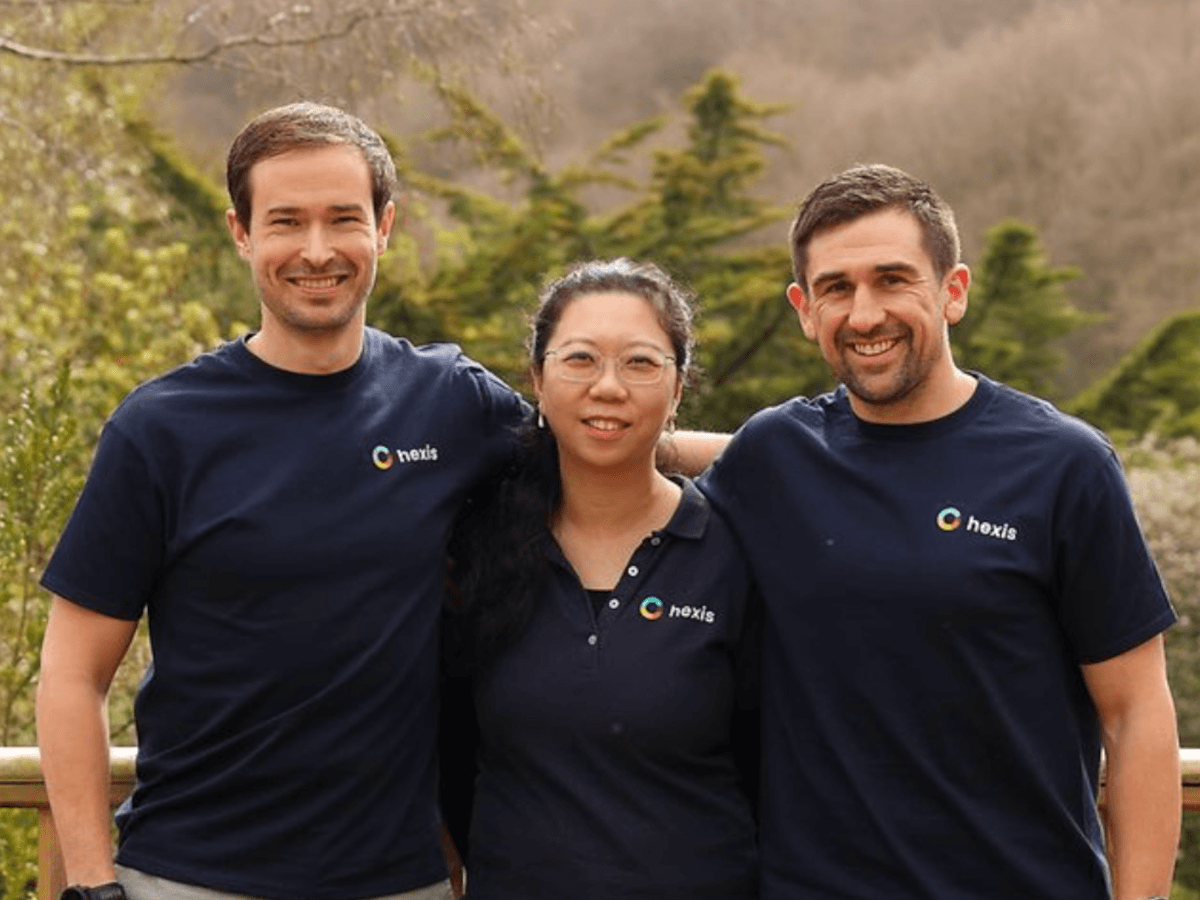
Established in Dublin and founded by David Dunne, Xiaoxi Yan and Sam Impey, Hexis provides a nutrition operating system for athletes. The company integrates software, wearable tech and fitness tracking platforms to turn personalised workout data into a tailored fitness strategy, depending on the users goals, lifestyle and training methods.
Reportedly, Hexis works with nearly 40pc of Tour de France riders and 50pc of Premier League clubs and has ambitions to broaden its geographic reach by focusing on the US market. Hexis intends to use the funds raised to better support product development and scaling.
Advertisement
Commenting on the announcement, David Dunne, who is also the company’s CEO, said, “Our vision at Hexis is to be the global nutrition operating system for human performance. Wearables and training platforms have transformed how athletes understand their training and recovery, but nutrition, the fuel behind both, has lagged behind and remained the missing layer.
“Hexis is ready to complete the picture and make nutrition your smartest training tool. This round allows us to go further, deepening our impact across professional sport while laying the foundations to bring truly personalised, periodised nutrition to every athlete, at every level. That has always been the ambition. We are now in a position to deliver it.”
Keith Brock, the head of Enterprise Ireland’s sports technology portfolio said, “Enterprise Ireland is proud to back Hexis as it scales its performance nutrition platform from elite sport into the wider consumer market. Our investment reflects real confidence in the science, the founding team and the global ambition behind the business, which already supports professional teams across four continents.
‘Supporting companies like Hexis sits at the heart of our strategy of helping ambitious Irish firms scale and compete internationally, and it underlines the growing strength of Ireland’s sports tech sector.”
Advertisement
In late 2025, Hexis took home the Grand Prix award at the 2025 National Startup Awards. As well as being named the overall winner, Hexis also won the top prize in the tech start-up category, performing well alongside other companies, such as Haon Life Sciences, Silicate Carbon and Glitch.
Don’t miss out on the knowledge you need to succeed. Sign up for the Daily Brief, Silicon Republic’s digest of need-to-know sci-tech news.
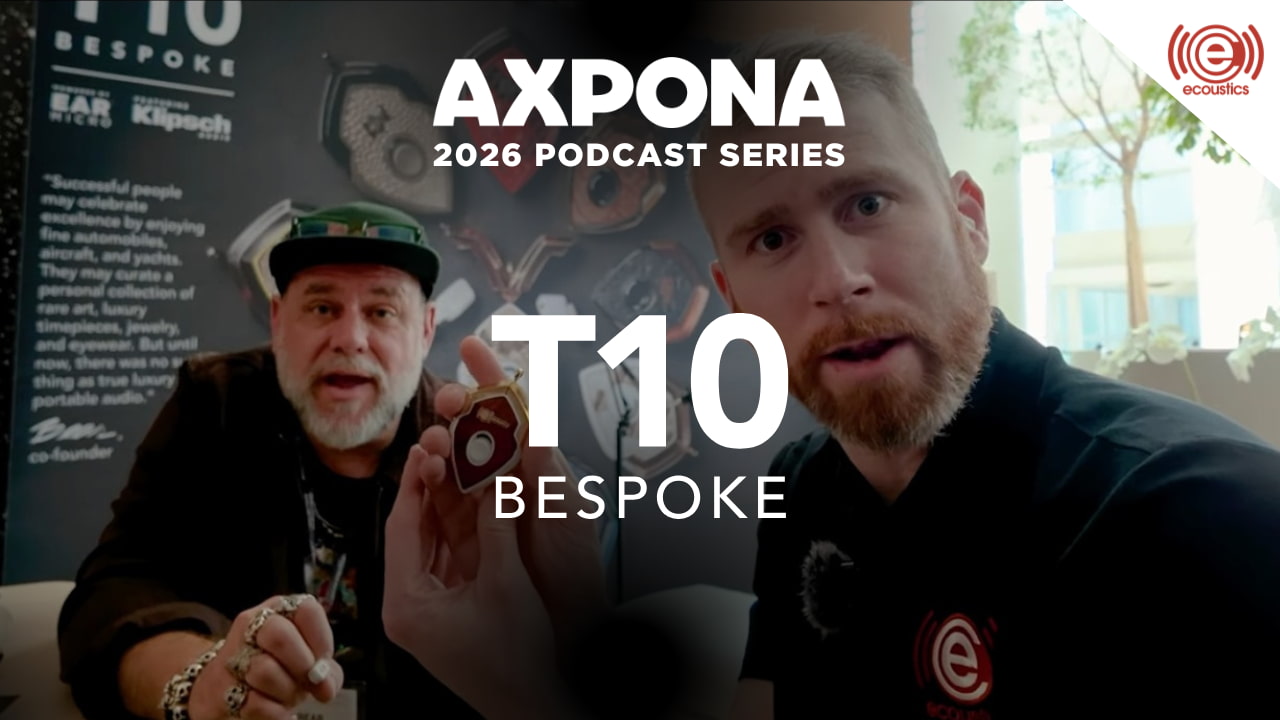
Recorded from the show floor at AXPONA 2026, our Podcast Producer, Mitch Anderson sits down with Bear Clark (aka Hi-Fi Bear) to try out T10 Bespoke In-Ear Computers for the first time. Find out all about “the world’s smallest, smartest, and lightest HiFi listening instrument” and why it’s unlike any wireless earbud on the market. Not only is each set hand-crafted by Hi-Fi Bear himself, but they can be custom made just for you!
Plus there’s still a limited number of raffle tickets available for a chance to win the eCoustics Special Edition T10 Bespoke In-ear Computers featured in this episode. Learn more about our raffle here.
Sponsors: Thank you SVS for sponsoring this episode, along with Audeze for supplying all guests LCD-S20 Headphones, and Loewe and T10 Bespoke for sharing lounge space at AXPONA 2026.
This episode was recorded on April 12, 2026 (the third day of AXPONA 2026).
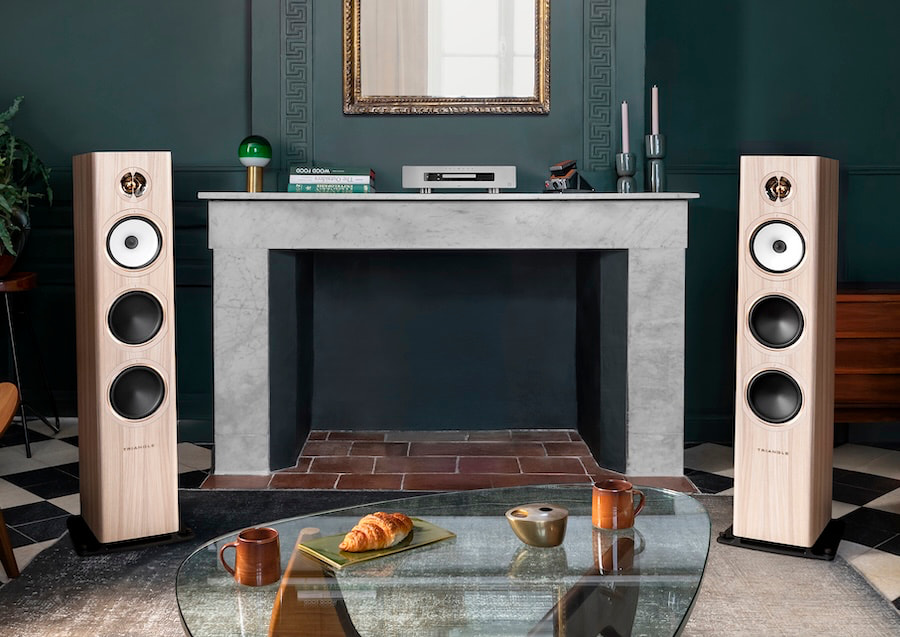
Triangle has replaced its long running Esprit range with Solstice, a new loudspeaker lineup developed and manufactured in Soissons, France. More than a cosmetic refresh, the Triangle Solstice series arrives with a redesigned horn tweeter, new driver architecture, revised cabinet construction, and an integrated base intended to give the French specialist a more cohesive platform for its next generation of stereo speakers.
For more than three decades, Triangle’s Esprit range built a reputation for high sensitivity, natural tonal balance, and strong value. Solstice represents the next chapter, introducing new technologies throughout the lineup while aiming to preserve the musical character associated with Triangle loudspeakers.
Rather than another evolutionary Esprit update, Solstice has been developed from the ground up. Triangle says every major component has been re-engineered, with particular attention paid to frequency coherence, cabinet rigidity, and the reduction of unwanted coloration.
All New Loudspeaker Series
The Solstice line comprises three models: the Solstice 8 floorstander, Solstice 3 bookshelf speaker, and Solstice C3 center channel. Designed as a coherent platform for stereo and home cinema systems, the range shares Triangle’s new driver technologies, crossover approach, and cabinet architecture. Finishes include white, black, teak, and birch, while matching stands are available for the Solstice 3.
Advertisement
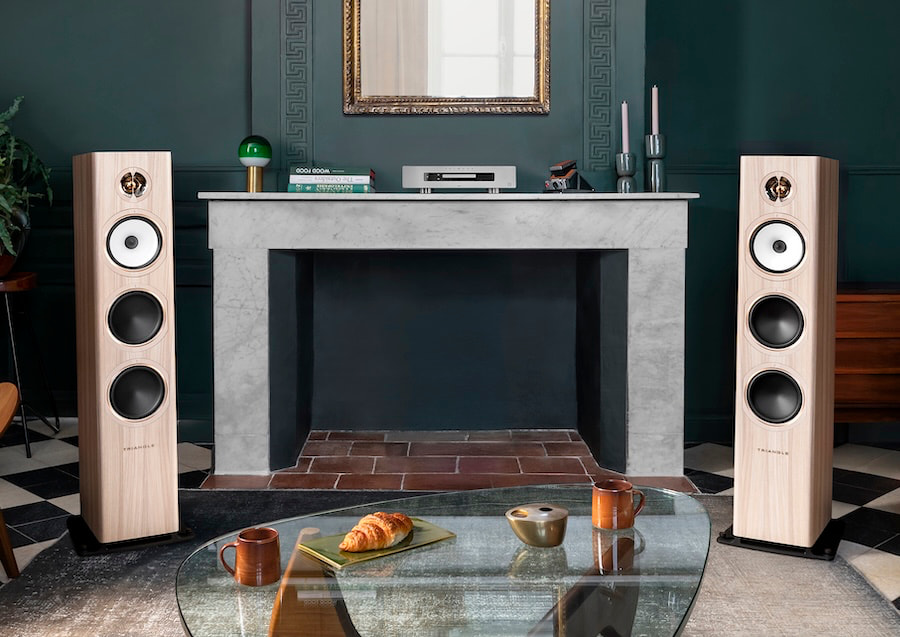
Triangle Solstice 8 (birch)
Solstice 8: The flagship floorstander uses a three-way bass-reflex design with a 25 mm horn-loaded tweeter, a 16 cm cellulose-pulp midrange driver, and a pair of 16 cm woofers with concave cones. Triangle specifies a frequency response of 38 Hz to 22 kHz and RMS power handling of 130 watts. Its dual terminal arrangement supports conventional single-wire connection, bi-wiring, or bi-amping. The Solstice 8 is intended for rooms measuring roughly 15 to 50 m², or about 160 to 540 square feet.
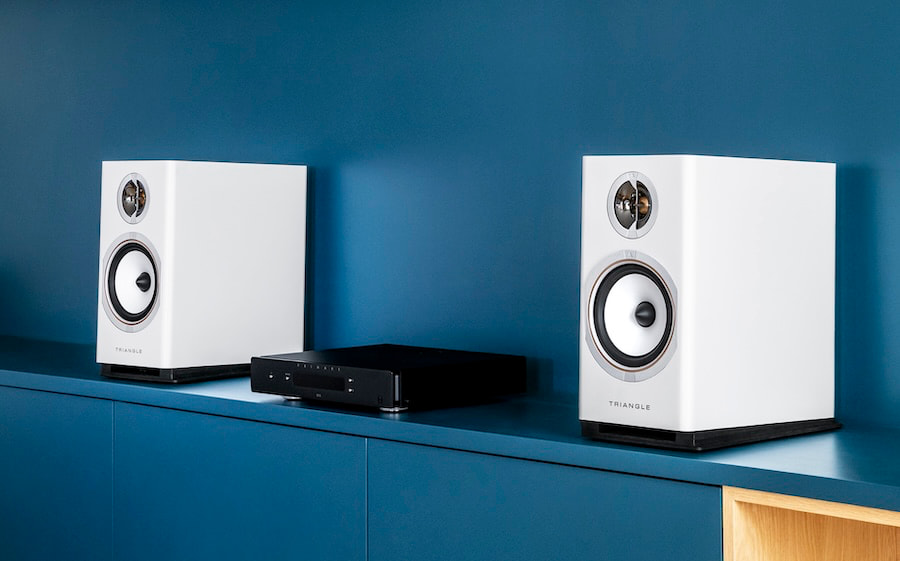
Triangle Solstice 3 (white)
Solstice 3: The compact standmount uses a two-way bass-reflex design with a 25 mm horn-loaded tweeter and a 16 cm cellulose-pulp midrange/bass driver. Triangle specifies a frequency response of 48 Hz to 22 kHz and RMS power handling of 90 watts. Its cabinet base is designed to integrate directly with Triangle’s matching S05 stand. The Solstice 3 is recommended for rooms measuring roughly 10 to 35 m², or about 108 to 377 square feet.
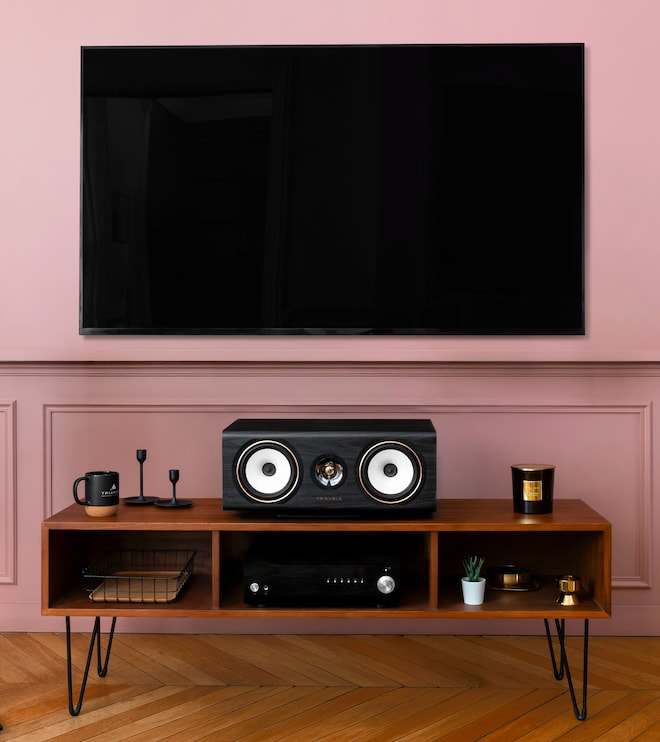
Triangle Solstice C3 (black)
Solstice C3: The center channel employs a two-way sealed design with a 25 mm horn-loaded tweeter and twin 16 cm cellulose-pulp midrange/bass drivers. It can be positioned horizontally beneath a display or used vertically as a left or right channel. Triangle specifies a frequency response of 50 Hz to 22 kHz, RMS power handling of 120 watts, and 92 dB sensitivity. That sensitivity is closely matched to the Solstice 8 and Solstice 3, helping maintain consistent tonal balance across the front soundstage in a matched home cinema system.
Speaker Drivers
Triangle developed every Solstice driver specifically for the new lineup, rather than adapting existing units from the Esprit range. The goal is greater consistency between models, with shared driver technology and voicing across stereo and home cinema configurations.
Tweeter Innovation
All three Solstice models use Triangle’s new TZ2540MG horn tweeter. According to Triangle, the design combines two acoustic concepts not previously used together in one of the company’s tweeters.
Advertisement
Triangle Solstice 3 (teak)
The horn profile follows the OS-SEW (Oblate Spheroid Super Elliptical Waveguide) principle, which Triangle says is intended to promote more even high-frequency dispersion. The claimed benefits include a wider listening area, a more stable soundstage, and more consistent tonal balance beyond the central listening position.
A barrel-shaped cutout at the base of the horn is designed to create volumetric compression near the suspension point. According to Triangle, this improves behavior around the crossover region and supports smoother integration between the tweeter and midrange driver.
Advertisement. Scroll to continue reading.
The TZ2540MG uses a 25 mm aluminum/magnesium alloy dome that Triangle says builds on materials employed in its Esprit 40th and Magellan 40th ranges. The company says the alloy increases diaphragm stiffness while helping to reduce the metallic coloration sometimes associated with pure aluminum domes.
The tweeter also incorporates a neodymium ring motor with an open center and rear absorption chamber. Triangle says this configuration is intended to limit internal reflections and reduce distortion.
Advertisement
At the horn’s output, Triangle employs a newly designed, one-piece phase plug. Injection-molded as a single component, its geometry draws on the barrel-shaped structure of the horn. The design is intended to promote more even high-frequency dispersion and more consistent off-axis performance.
Triangle Solstice 8 (teak)
Midrange and Bass Drivers
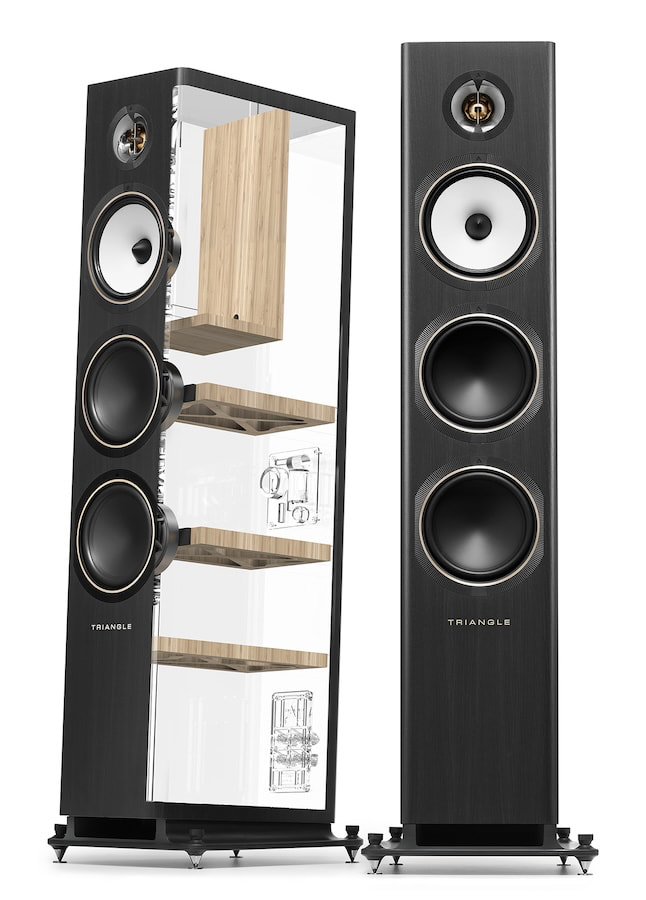
The 16 cm drivers use a new arch-shaped, die-cast aluminum basket designed to increase structural rigidity while improving airflow around the rear of the cone. Triangle says the revised structure also helps limit basket resonance that could affect midrange clarity, particularly at higher listening levels.
Triangle continues to use natural cellulose pulp for its midrange cones, a material the company associates with neutral tonal balance and natural reproduction of voices and instruments. A new rear-gluing assembly process is designed to increase the effective radiating surface area and improve linearity across the driver’s operating range.
The Solstice 8 uses twin bass drivers with concave cones and no conventional dust caps. Triangle says the concave profile creates a stiffer radiating surface, helping to reduce distortion at higher excursions while maintaining clean, controlled low-frequency output. It also gives the driver a cleaner, more distinctive appearance.
Cabinet Construction
Triangle says the Solstice enclosure was engineered for acoustic neutrality, with the goal of minimizing the cabinet’s contribution to the reproduced sound.
Advertisement
The company’s DVAS (Driver Vibration Absorption System) integrates the drivers into the speaker structure to help reduce vibration. Triangle says the approach increases cabinet rigidity and attenuates vibrations generated by the midrange driver, with the intended benefits of greater clarity, detail, and dynamic expression.
Solstice cabinets are constructed from high-density MDF. The Solstice 3 weighs 12.9 kg (28.4 lb), the Solstice C3 weighs 11.75 kg (25.9 lb), and each Solstice 8 weighs more than 30 kg (66 lb). All external cabinet edges are rounded to help reduce diffraction and support more even sound dispersion, which Triangle says contributes to more precise stereo imaging.
Crossover and Connectivity
The crossover network uses air-core inductors, MKT capacitors, and cement-coated resistors, with OFC (oxygen-free copper) internal wiring throughout.
The Solstice 8 features dual binding posts for bi-wiring or bi-amping, while the Solstice 3 and Solstice C3 use single terminal blocks. All models accept standard speaker cable terminations, including banana plugs and spade connectors.
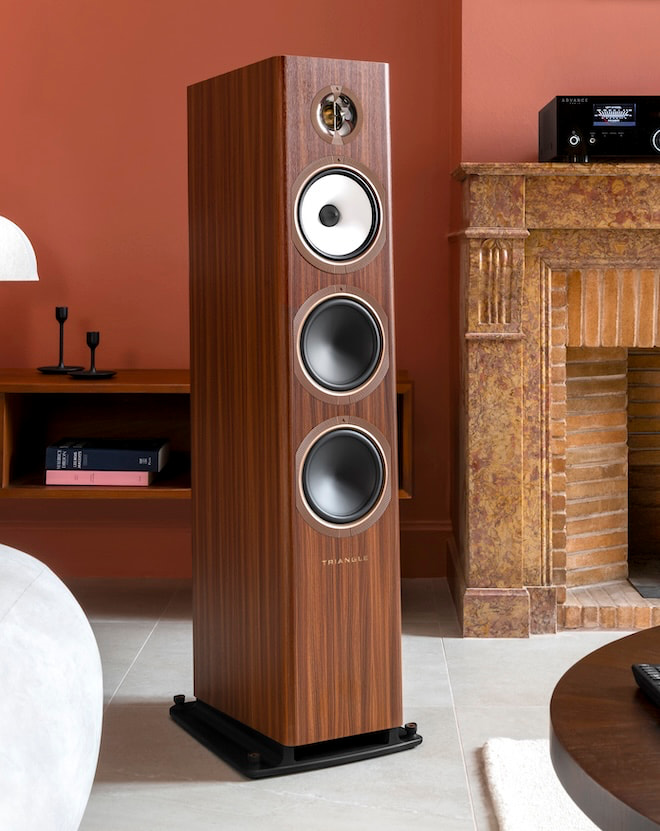
Triangle Solstice 8 (black ash)
Integrated Base
The Solstice 8 introduces Triangle’s new integrated base, which combines mechanical isolation, vibration control, and bass-reflex loading in a single structure.
Advertisement
Advertisement. Scroll to continue reading.
Its Hidden Laminar Bass-Reflex Port is routed through the base rather than the cabinet itself. Triangle says the laminar-flow design is intended to reduce turbulence and port noise while eliminating visible port openings from the enclosure.
The base uses a dual-material construction that combines a cast-iron honeycomb structure with a thick silicone outer layer. The cast iron adds mass and rigidity, while the silicone layer is intended to absorb vibration and help mechanically decouple the loudspeaker from the floor.
Triangle has also built a 2-degree rearward tilt into the base to better align the tweeter’s output with a seated listening position and widen the usable listening area.
Advertisement
The Solstice 8 includes adjustable spikes and counter-spikes for hard floors or carpeted rooms. Triangle-logo caps conceal the hardware once installed.
Exterior Finishes
Solstice speakers are available in four finishes: Teak, Birch, White, and Black Ash. The wood-effect options use a vertical grain orientation, and each model includes color-matched magnetic grilles.
Sculpted silicone surrounds frame each driver and are matched to the cabinet finish, while champagne-finish aluminum trim rings add a more polished visual detail around the drivers.
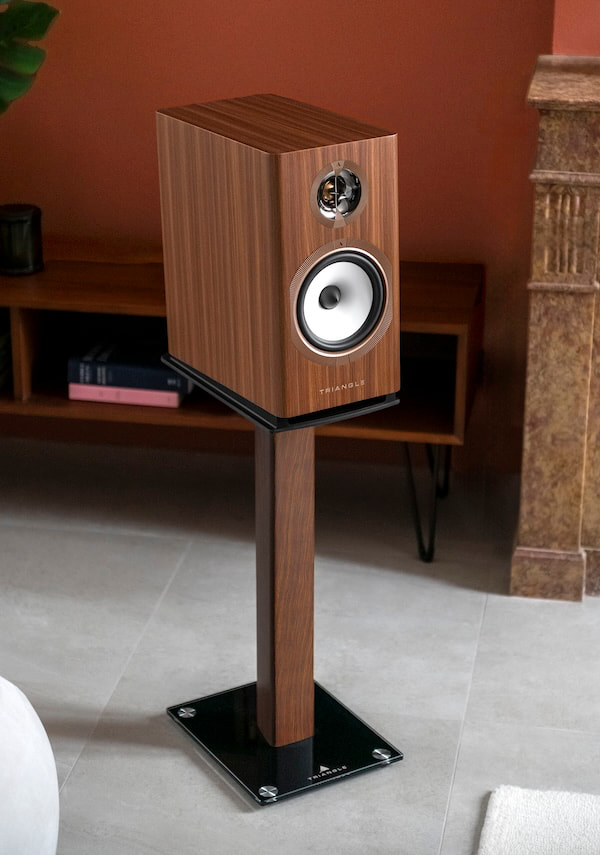
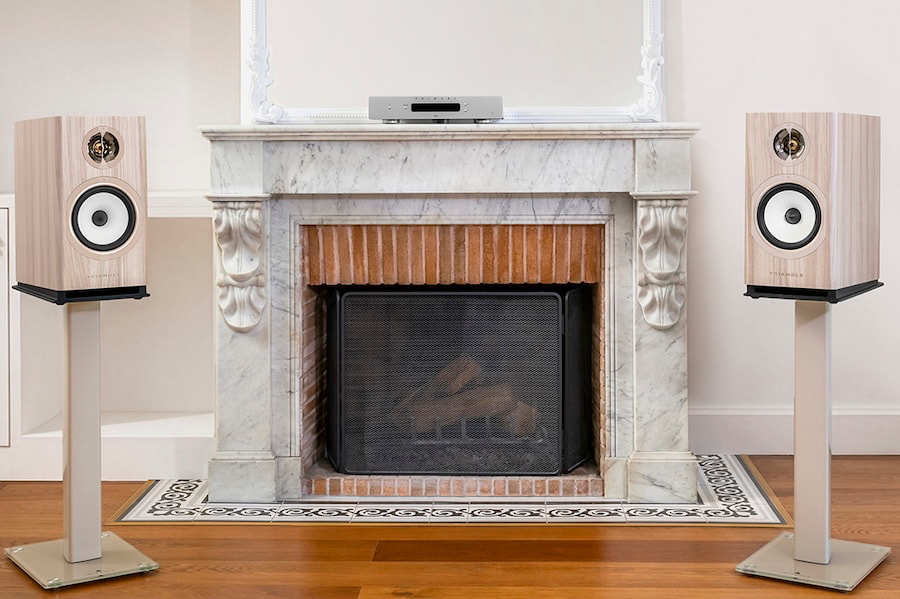
Triangle Solstice 3 on S05 stands (birch)
The optional S05 stands are designed specifically for the Solstice 3 and are available in Black, White, Teak, and Greige, the latter intended to complement the Birch finish. The speaker’s base locks directly into the stand’s top plate for a more secure and visually integrated installation.
Advertisement
Triangle Solstice Series Specifications
Triangle Model
Solstice 8
Solstice 3
Solstice C3
Product Type
Floorstanding Speaker
Bookshelf/Stand-mount Speaker
Center Channel Speaker
Price
$2,799/pair
$1,349/pair
$750 each
Speaker Type
3-way bass-reflex
2-way bass-reflex
2-way sealed
Speaker Drivers
1 x TZ2540MG tweeter 1 x 16cm midrange 2 x 16cm woofer
1 x TZ2540MG tweeter 1 x 16cm mid-woofer
1 x TZ2540MG tweeter 2 x 16cm mid-woofer
Sensitivity (dB/W/m)
91 dB
90 dB
92 dB
Bandwidth (+/-3dB)
38Hz–22kHz
48Hz–22kHz
50Hz–22kHz
Power Handling (Watts RMS)
130W
90W
120W
Impedance (min/nominal)
3.6 / 8 Ohm
5.3 / 8 Ohm
4.5 / 8 Ohm
Crossover Frequencies
250Hz / 3.7kHz
2.8kHz
2.85kHz
Dimensions (WxHxD)
308 x 1075 x 394mm
12.12 x 42.32 x 15.51″
221 x 418 x 370mm
8.7 x 16.45 x 14.56″
Advertisement
540 x 235 x 310mm
21.25 x 9.25 x 12.2″
Net Weight
30.4kg / 67lbs (each)
12.9kg / 28.4lbs
11.75kg / 25.9lbs
Finishes
Teak, Birch, White, Black Ash
Teak, Birch, White, Black Ash
Teak, Birch, White, Black Ash
The Bottom Line
Triangle is not treating Solstice as a routine Esprit refresh with a new veneer and some upgraded crossover parts. The new line is built around a redesigned acoustic platform that includes the TZ2540MG horn tweeter, new 16 cm cellulose-pulp drivers, DVAS cabinet construction, revised crossovers, and, in the Solstice 8, an unusually ambitious integrated base that combines mechanical isolation, a hidden laminar bass-reflex port, and a 2-degree listening-axis tilt.
That makes Solstice most compelling for music listeners who want a properly engineered, visually distinctive French loudspeaker system rather than another generic rectangular box with a familiar driver complement. The Solstice 8 should appeal to buyers building a serious two-channel system in a medium to larger room, while the Solstice 3 and C3 offer a logical route into a matched stereo or three-channel front soundstage.
Advertisement
The limitation, at least for now, is system breadth. Triangle has launched Solstice with a floorstander, standmount, and center channel, but no dedicated surround, on-wall, height speaker, or matching subwoofer. That makes it a strong fit for stereo and front-stage home cinema systems, but less complete for buyers planning a fully matched Dolby Atmos installation.
Competition will come from Focal’s Theva series, DALI’s SONIK range, Perlisten’s A-Series, and Elipson’s Prestige Facet II lineup. Focal offers French design and Slatefiber driver technology; DALI SONIK provides a broader home cinema ecosystem; Perlisten brings more overtly performance-driven engineering and dedicated on-wall surround options; and Elipson offers the widest model selection, including surround, Atmos, LCR, center, bookshelf, and floorstanding options.
Triangle’s advantage is that Solstice feels like a more comprehensive acoustic redesign than a simple replacement range, with the horn tweeter, cabinet engineering, and Solstice 8 base doing most of the heavy lifting.
What just happened? The challenge for autonomous vehicles has never been ordinary driving – it’s the edge cases. Temporary roadwork, shifting lane lines and irregular signage can still confuse even sophisticated systems. A recent recall by Waymo shows how those gaps can surface in real-world deployments.
Waymo is recalling nearly 3,900 robotaxis following incidents in freeway construction areas. According to a safety recall report filed with the National Highway Traffic Safety Administration, the company’s fifth-generation automated driving system may enter and drive at speed in freeway construction zones under certain circumstances, either because it fails to recognize the construction zone or prioritizes other freeway hazards.
The filing identifies 3,871 vehicles as potentially affected. It states that under certain circumstances, the system “may enter and drive at speed in freeway construction zones due to inappropriately prioritizing the avoidance of other freeway hazards and/or failing to recognize the construction zone.”
The problem was not confined to a single event. On April 11, a Waymo vehicle was involved in an incident on a freeway, prompting the company to review how the system handled closures. Five similar events followed on April 19 in Phoenix. On May 18, seven vehicles in the San Francisco Bay Area drove between cones and into freeway lanes where construction was underway, a pattern that suggests difficulty reading temporary lane layouts.
Advertisement
Together, the incidents suggest a broader issue with how the system processes dynamic environments rather than a one-off failure. Construction zones are inherently inconsistent. Signage can vary, cones can shift, and lane configurations often change. For human drivers, those conditions demand judgment calls. Automated systems require accurate detection paired with real-time decision-making that can adapt.
Waymo responded by restricting freeway driving in affected scenarios while it worked on a fix. The company’s field safety committee put those limits in place shortly after the April incidents, and its safety board formally approved the recall on June 8 after reviewing additional data.
The remedy will focus on software updates. According to the report, Waymo plans to improve how its vehicles detect construction zones and determine when they are already inside one. The update is also expected to improve how the system behaves once a construction zone is detected and to add additional operational protocols.
The issue underscores a persistent technical challenge in autonomous driving: prioritization. These systems constantly evaluate multiple potential hazards – other vehicles, road debris, lane markings – and must decide which to respond to first. In the cases outlined by regulators, the system appears to have given higher priority to certain roadway risks while failing to fully account for construction-related restrictions such as closed ramps.
Advertisement
Competition in the robotaxi sector continues to intensify. Uber Technologies, Lucid Group and Nuro recently announced plans to launch a robotaxi service in Houston next year, while Mobileye has said it is targeting a 2027 rollout. As companies move toward broader deployment, the ability to handle unpredictable, temporary road conditions is becoming a critical benchmark.
Amazon is offering the Apple Watch Ultra 3 at a record-low $649 as part of an early Prime Day push.
Amazon’s $649 early Prime Day price is available on the Apple Watch Ultra 3 with an Ocean Band. The 49mm GPS + Cellular model with your choice of a Black Titanium Case or Natural Titanium Case comes in one size, so you don’t have to worry about finding the right size band if the watch will be a gift.
Along with the $150 discount on the Apple Watch Ultra 3, Amazon has launched numerous early Prime Day deals across Apple’s product lineup. From the Apple Watch Series 11 for $279 to AirPods Max 2 plunging to a record-low $399, the sales are heating up.
Advertisement
Here are a few highlights, with dozens more at your fingertips in our Apple Price Guides.
Get caught up on the latest technology and startup news from the past week. Here are the most popular stories on GeekWire for the week of June 14, 2026.
A new Downtown Seattle Association report says the city’s JumpStart payroll tax has helped drive jobs and office value out of downtown over its first five years, pointing to booming Bellevue as the contrast. … Read More
Luke Larson is buzzing about matcha and his plans to build Vale into a Seattle-born beverage empire — think Starbucks, but make it matcha — scaling from a handful of local cafes and mobile bars to a nationwide network of thousands of automated machines. … Read More
Seattle’s Yoodli used a cardboard sign to get its name and web address on Fox Sports’ live broadcast of FIFA World Cup festivities from Pier 62 on the waterfront. … Read More
Andy Jassy was reportedly among the tech leaders who flagged security risks in Anthropic’s newest AI models to senior Trump administration officials — an awkward turn for Amazon, which has invested billions in the AI lab. … Read More
After leadership roles at Microsoft, Amazon and Google, Brian Hall joins Mistral; Amazon’s VP of Alexa Domains retires; Dropzone AI names a head of product. … Read More
Dan Lewis, who led the Seattle freight marketplace Convoy before it shut down in 2023, has left Microsoft to start a stealth company focused on running AI models more efficiently, extending a career spent at the intersection of AI and logistics. … Read More
AWS used its New York Summit to roll out AI agents that act on their own — from fixing security vulnerabilities to triaging email — while trying to keep humans in control of how far they go. … Read More
Chromebooks aren’t exactly the most exciting laptops on the market, but they continue to be a popular option for students and anyone who primarily works in the cloud. Looking to capitalize on that demand, ASUS has launched three new Chromebooks in India, including a detachable 2-in-1 model that doubles as a tablet.
The new lineup consists of the ASUS Chromebook CM32 Detachable, Chromebook CM14, and Chromebook CM15. All three devices run ChromeOS and come with Google’s latest AI-powered features, along with cloud-first productivity tools aimed at students, educators, and young professionals. ASUS is also bundling three months of Google AI Pro with the devices, giving buyers access to Google’s AI tools and 5TB of cloud storage.
ASUS Chromebook CM32 Detachable Leads the Lineup
Leading the lineup is the ASUS Chromebook CM32, a 2-in-1 device designed for users who want the flexibility of both a tablet and a laptop. The device features a 2.5K touchscreen display, a detachable keyboard, a magnetic kickstand, and support for the ASUS Pen. This makes it suitable for everything from note-taking and studying to media consumption and light gaming.
ASUS has also focused on portability and durability. Despite its lightweight design, the Chromebook comes with military-grade durability certifications and Corning Gorilla Glass protection, making it better equipped to handle everyday wear and tear.
Chromebook CM14 and CM15 Focus on Battery Life
If you prefer a traditional laptop design, ASUS is also offering the Chromebook CM14 and Chromebook CM15. The two laptops feature 14-inch and 15-inch displays, respectively, and are powered by the MediaTek Kompanio 540 processor. While these aren’t performance-focused machines, they should be more than capable of handling web browsing, document editing, online classes, and other everyday workloads.
One of the standout features is battery life. ASUS claims both laptops can deliver up to 20 hours of usage on a single charge, which should easily get most users through a full day of work or study. The laptops also include a 180-degree hinge, allowing users to lay the display flat for easier collaboration during meetings, presentations, or classroom sessions.
Advertisement
Price and Availability
The new ASUS Chromebook lineup is now available through Amazon and the ASUS eShop. Pricing starts at ₹26,990 for the Chromebook CM14, while the larger Chromebook CM15 starts at ₹28,990. The more premium Chromebook CM32 Detachable is priced at ₹37,990. ASUS is also offering No Cost EMI and ASUS Easy Pay financing options. Monthly installments start at ₹5,165 for the CM14, ₹5,665 for the CM15, and ₹6,332 for the CM32 Detachable.
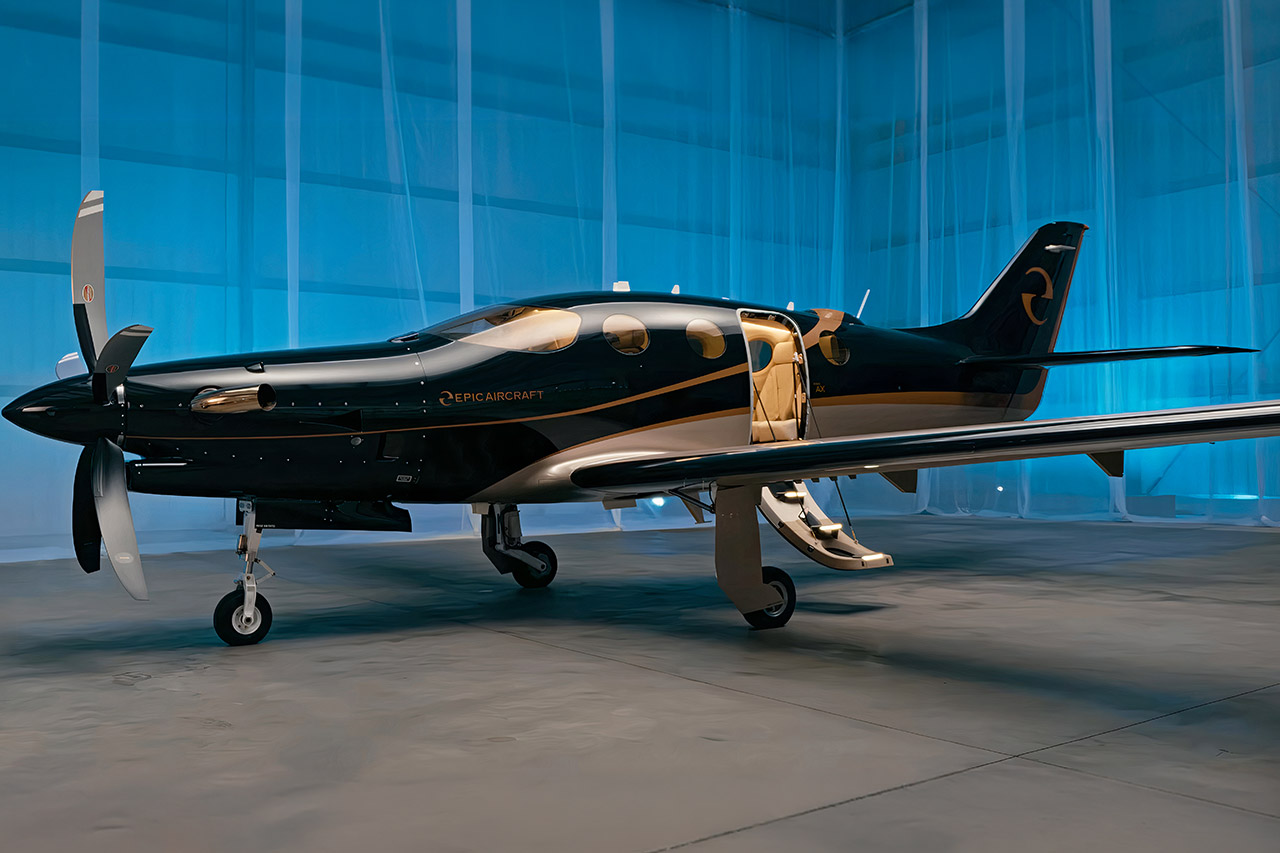
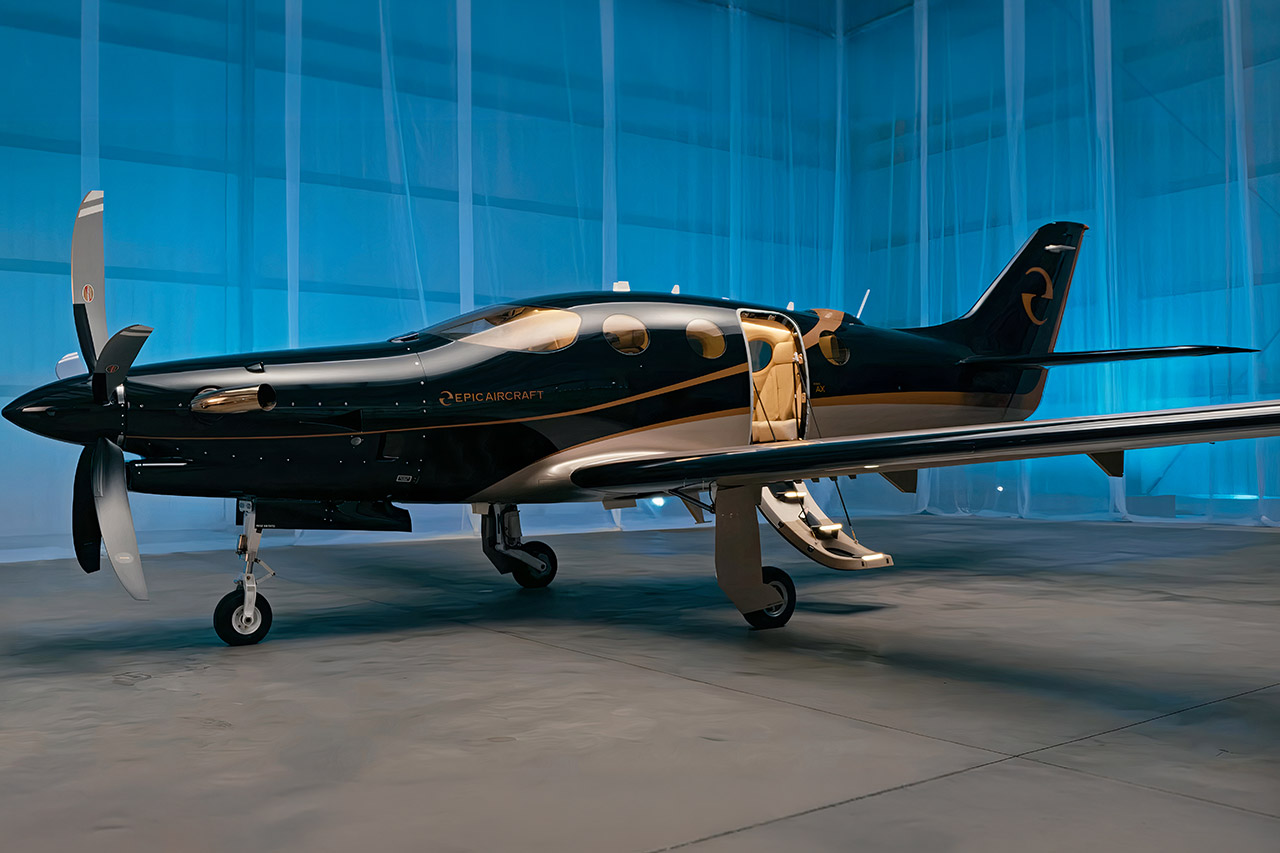
Epic Aircraft builds single-engine turboprops that move fast and carry serious loads for their size. The newest version, the E1000 AX, keeps every bit of that performance edge while folding in deeper Garmin automation than the company has used before.
The Pratt & Whitney PT6A-67A engine still produces 1,200 shaft horsepower. That’s plenty of power to match the all-carbon-fiber airframe, which has a maximum cruise speed of 333 real airspeed knots. It can climb at a whopping 4,000 feet per minute and still reach 34,000 feet. With full tanks, it can travel 1,560 nautical miles and still carry 1,150 to 1,177 pounds of payload, depending on how you rig it up.
Ultracompact, key-sized dash camera goes virtually unnoticed on your windshield; automatically records and saves video of incidents with date and time…
Easy-to-use dash camera records crisp 1080p HD video, and a wide 140-degree field of view captures details in bright and low light; automatically…
Built-in Garmin Clarity polarizer lens reduces windshield glare to clearly show important video details
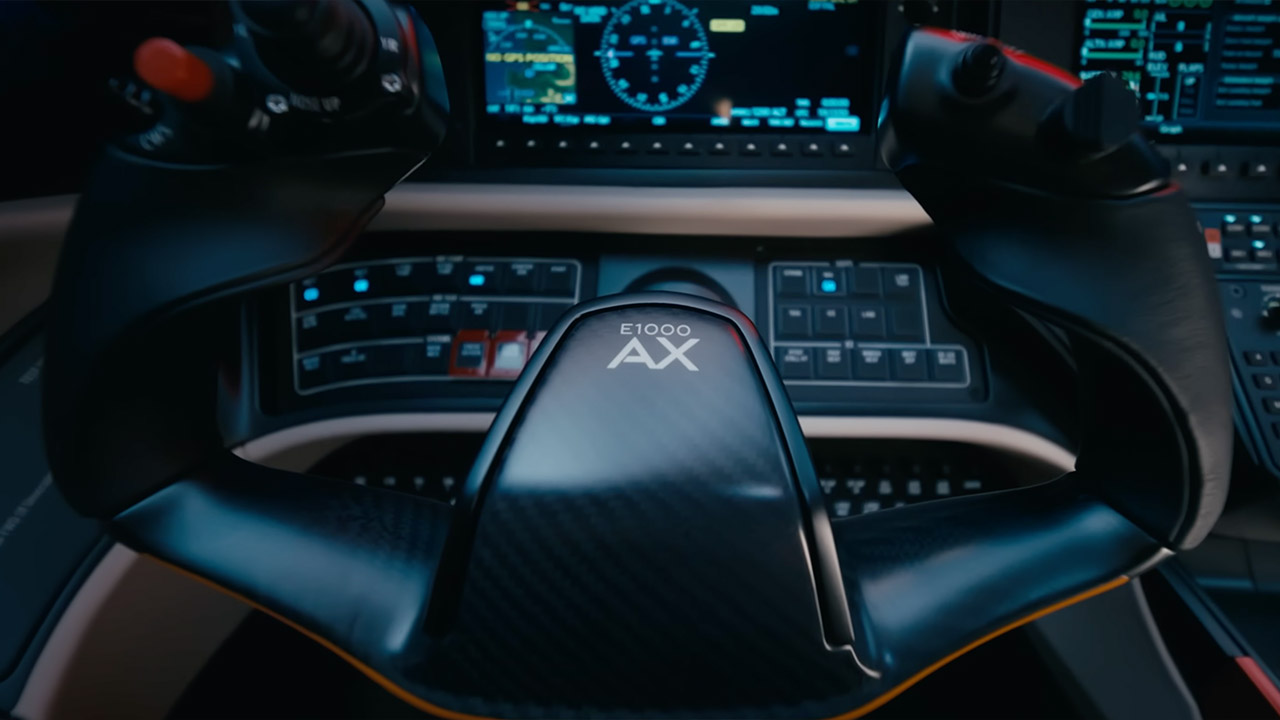
These numbers placed the E1000 GX at the top of the single-engine turboprop class in terms of speed and usable load. The AX retains the same reliable engine, prop, and basic aerodynamics. What has changed significantly is the cockpit, as well as all of the new safety features. Garmin’s G1000 NXi flight deck is now the focal point of the entire system. The GFC 700 autopilot features envelope protection, a one-button level mode, and tighter connectivity throughout the panel. Then there’s Autothrottle, which is a significant addition to the AX’s capabilities because it manages power from takeoff to landing, maintains commanded speeds, and monitors engine limits so pilots don’t have to keep a close eye on torque, temperature, or overspeed conditions because they’re all handled behind the scenes, and it considers flap and gear position when adjusting thrust, so you don’t have to worry about those details either.
Advertisement
The real show stopper, however, is Garmin’s Autoland technology. If you activate it, either by pressing the ceiling button or because the system detects the pilot is in trouble, the aircraft will level the wings, select the best airport based on distance, runway length, fuel, and weather conditions, fly the approach, configure the plane, land, stop on the runway, and turn off the engine. It also follows proper air traffic control procedures and keeps passengers informed. The certified aircraft now has all of the necessary hardware and integration in place, but full operational activation is still pending regulatory certification, which is expected in the near future.
Even beyond that, several other modifications cut pilot workload even further. To keep the plane coordinated, an auto yaw damper is activated after takeoff and deactivated before landing. When you need to take a break, electronic brake hold prevents the aircraft from drifting about on the ground, and a radar altimeter allows you to see where you are in relation to the surface. If you want to go the extra mile, there is optional StormOptix weather radar and 3D SafeTaxi routing, which provide you with even more situational awareness on the ground and in the air. PlaneSync handles database updates automatically and allows you to monitor your aircraft remotely with no effort.
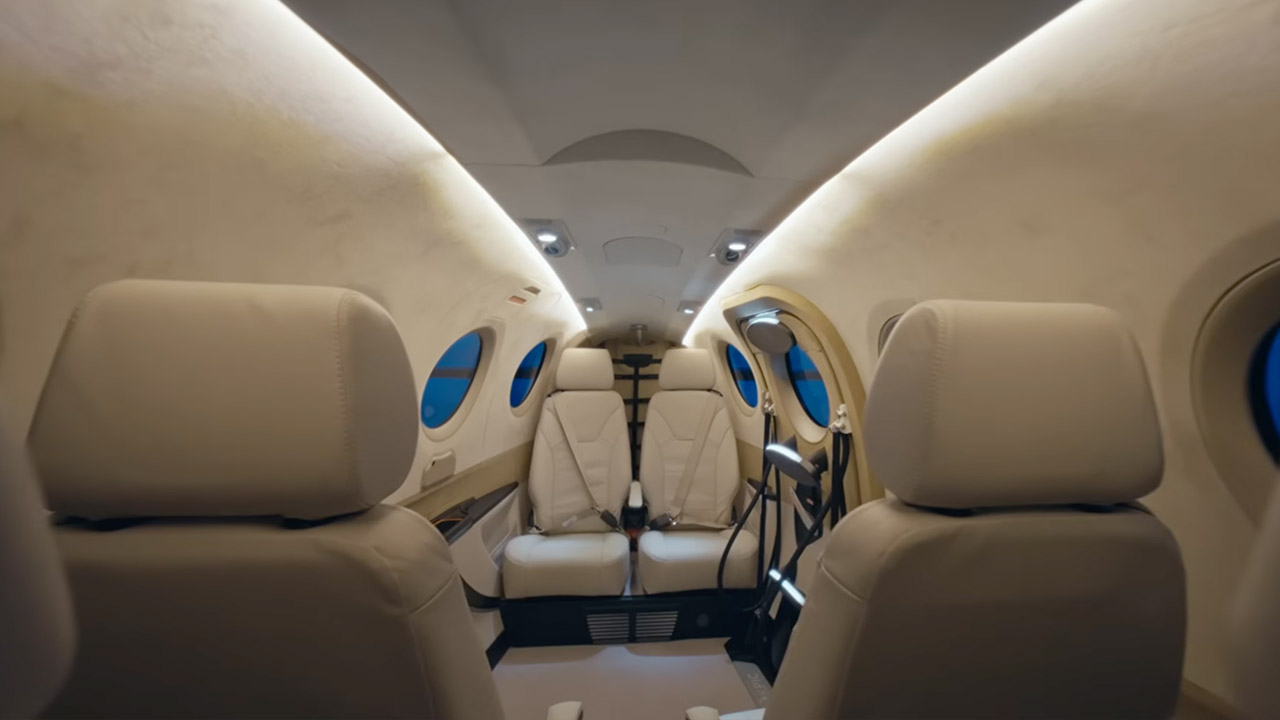
Inside the cabin, the aircraft has a lot of space for its class, especially when compared to its competitors in the six-seat single turboprop sector, which can sometimes seem tight. People who are 6’8″ or taller can fit rather comfortably up front. The CoolView windows across the cockpit and cabin have a specific gold coating that effectively blocks 73% of infrared heat. This also effectively reduces glare and UV exposure. It also includes high-speed internet via Starlink, making it an excellent choice for anyone looking to stay connected while in the air. Furthermore, True Blue Power lithium-ion batteries are an excellent improvement over outdated battery systems, providing improved performance, a longer lifespan, and less maintenance for the owner.
A well-specced E1000 AX will cost between 4.7 and 4.85 million dollars, depending on the options you choose. That puts it on par with other high-end single turboprops and some smaller light jets, but it does have some advantages. For one thing, it is much less expensive to operate than some of its competitors, and the fact that it just has one engine makes it much easier to manage for owner-pilots or pilots in small corporate flight departments.
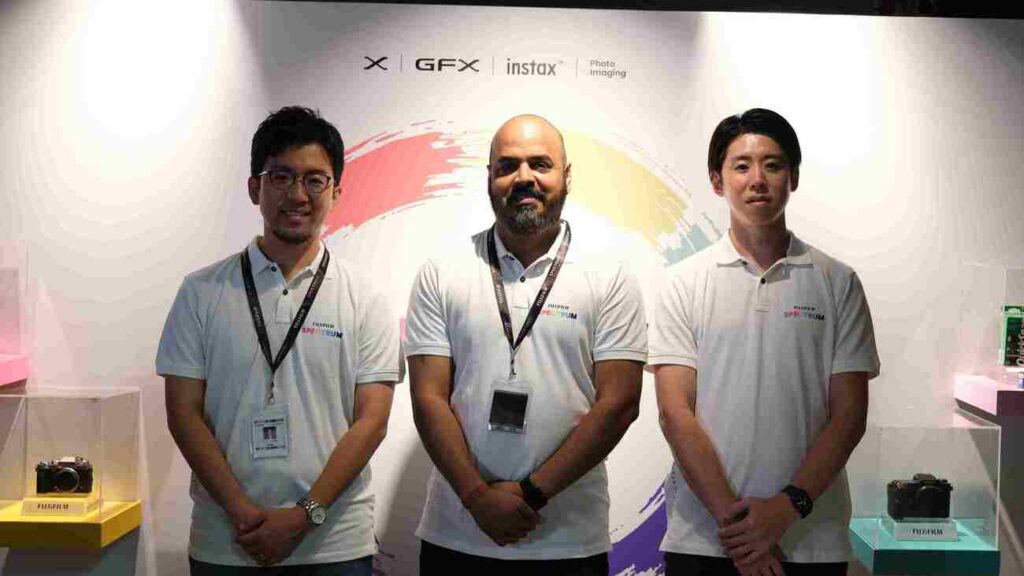
FUJIFILM India recently concluded its Spectrum India Tour 2026, a nationwide initiative designed to bring photographers, content creators, and visual storytellers closer to the company’s latest imaging technologies. Built around Fujifilm’s “Click to Print” philosophy, the event showcased the brand’s imaging ecosystem through hands-on experiences, product demonstrations, workshops, and interactive sessions.
The tour kicked off in Delhi-NCR at Museo Camera between June 18 and June 20, where attendees had the opportunity to explore Fujifilm’s latest cameras, lenses, and imaging solutions. The event featured interactive Touch & Try zones, live product demonstrations, and exhibitions highlighting Fujifilm’s portfolio across photography, videography, and printing.
Hands-On Experience Across Fujifilm’s Imaging Ecosystem
One of the major highlights of the Spectrum India Tour was the opportunity for visitors to experience Fujifilm’s products firsthand. Dedicated Touch & Try zones allowed attendees to test cameras and lenses across a variety of creative scenarios, including vlogging, cinematography, portrait photography, travel photography, and street photography.
Visitors also explored Fujifilm’s premium GFX medium-format ecosystem alongside products from the broader Fujifilm lineup. The exhibition further showcased binoculars and other imaging products from Fujifilm’s partner brands, giving attendees a comprehensive look at the company’s imaging technologies.
Industry Expert Insights & Interactive Activities
Beyond product showcases, the Spectrum India Tour focused heavily on learning and skill development. The event hosted multiple masterclasses and visual storytelling sessions led by renowned Fujifilm X-Mentors, including Ashish Chawla, Abhimanyu Pandey, Dinesh Khanna, and Tarun Khiwal. These sessions covered both technical and creative aspects of photography, providing participants with practical insights into lighting, composition, portraiture, storytelling, and professional workflows.
Advertisement
FUJIFILM also introduced the Experience Passport Challenge during the event. Attendees could collect stamps by participating in various activities and exploring different experience zones throughout the venue. Those who completed the challenge became eligible for giveaways and other rewards. The initiative helped create a more engaging environment while encouraging visitors to explore every aspect of the exhibition.
Amazon has issued a steeper price drop on AirPods Max 2 leading up to Prime Day, with the over-ear headphones plunging to a record-low price of $399.
You can pick up AirPods Max 2 at a $150 discount at Amazon when you opt for the Starlight finish, which is the lowest price on record for the 2026 release. If you prefer another color option, Walmart is matching the $399 price across the line.





























































You must be logged in to post a comment Login