

Crypto World
MoneyGram takes validator role on Solana, joins institutional developer platform



MoneyGram has joined the Solana ecosystem as a network validator and participant in the Solana Developer Platform, expanding the payments company’s blockchain infrastructure strategy beyond stablecoins and payment services.
Summary
- MoneyGram has become a validator on the Solana blockchain and joined the Solana Developer Platform as it expands its blockchain payments strategy.
- The company now operates official validator nodes on Solana, Tempo and Midnight while continuing to build stablecoin based payment services.
- The move follows MoneyGram’s recent launch of its MGUSD stablecoin and broader efforts to integrate blockchain infrastructure into global money transfers.
According to a June 22 announcement from MoneyGram, it now operates an active validator on the Solana blockchain, where it stakes SOL, processes transaction blocks, and contributes to network security and performance. The company also joined the Solana Developer Platform, a development environment designed for institutions building financial products on Solana.
The company described the move as the next stage of a blockchain strategy that has become part of its treasury, product development and payments operations over the past five years.
MoneyGram expands blockchain infrastructure role
Luke Tuttle, Chief Product and Technology Officer at MoneyGram, said operating a validator places the company directly within Solana’s consensus process and allows it to help secure the network at the protocol level.
“We help run the rails we move money on,” Tuttle said, adding that MoneyGram is also developing products intended to support money movement across different forms of value.
Sheraz Shere, General Manager of Payments and Commerce at the Solana Foundation, said MoneyGram’s participation demonstrates how organizations involved in global payments are becoming active members of blockchain networks as more payment activity moves onchain.
MoneyGram said it joined the Solana Developer Platform alongside institutions that include Mastercard. The company said the platform provides tools to build and scale compliant financial products on Solana.
Anthony Soohoo, Chairman and CEO of MoneyGram, said blockchain infrastructure has become a core component of the company’s payment systems and that future development efforts will build on that foundation.
“We believe the future of global money movement will be built on open, interoperable stablecoin rails that anyone, anywhere can access,” Soohoo said.
The company did not announce any new payment products tied to Solana but said its participation in the network forms part of a long-term effort to support open blockchain infrastructure for global money transfers.
Follows stablecoin and validator expansion
The Solana announcement comes weeks after MoneyGram launched MGUSD, its own U.S. dollar stablecoin, on the Stellar blockchain.
MoneyGram introduced the stablecoin on June 2 through a partnership with Bridge, a Stripe-owned company that serves as the issuer. M0 provides the infrastructure used to mint and burn the token, while Fireblocks supplies custody services.
MGUSD became the latest addition to a blockchain payments strategy that has expanded through partnerships with Stellar, Crossmint, Fireblocks and Kraken. MoneyGram has also introduced stablecoin-based remittance services, crypto-to-cash withdrawals and digital dollar products across multiple markets.
The company previously became an anchor remittance validator on the Tempo blockchain and was named a validator for Midnight, Cardano’s privacy-focused sidechain. Solana now becomes the third blockchain network where MoneyGram operates an official validator.
MoneyGram also worked with Ripple between 2019 and 2021, using RippleNet and XRP-based On-Demand Liquidity products before the partnership ended following the U.S. Securities and Exchange Commission’s lawsuit against Ripple.



The departures also come as the foundation has unveiled a new strategic framework known as “CROPS,” an acronym standing for cypherpunk values, resilience, open-source development, permissionlessness and security. Foundation leaders presented the framework as a way to clarify the EF’s mission and reinforce Ethereum’s core values as the ecosystem becomes increasingly decentralized. Supporters viewed it as a reaffirmation of Ethereum’s founding principles, while critics argued it did little to address concerns about execution, organizational effectiveness and the network’s competitive position.
Among the most vocal critics was former Ethereum researcher Dankrad Feist, who suggested the recent spate of executive departures reflected deeper management issues rather than disagreements over strategy.
“The people who are leaving the Ethereum Foundation are CROPS believers,” Feist wrote on X. “The problem isn’t with the strategy, it’s with management.”
Feist’s comments were notable because they challenged the prevailing idea that recent departures stemmed from dissatisfaction with the foundation’s new direction. Instead, he argued that many of those leaving supported the CROPS vision itself, making the loss of talent a reflection of leadership shortcomings rather than ideological disagreements. “The exodus of talent is truly bearish for Ethereum, sadly,” he added.
Other community members echoed concerns about the Foundation’s internal dynamics. “It makes me sad to see the dysfunction at the Ethereum Foundation,” head of engineering at Coinbase Yuga Cohler wrote on X.
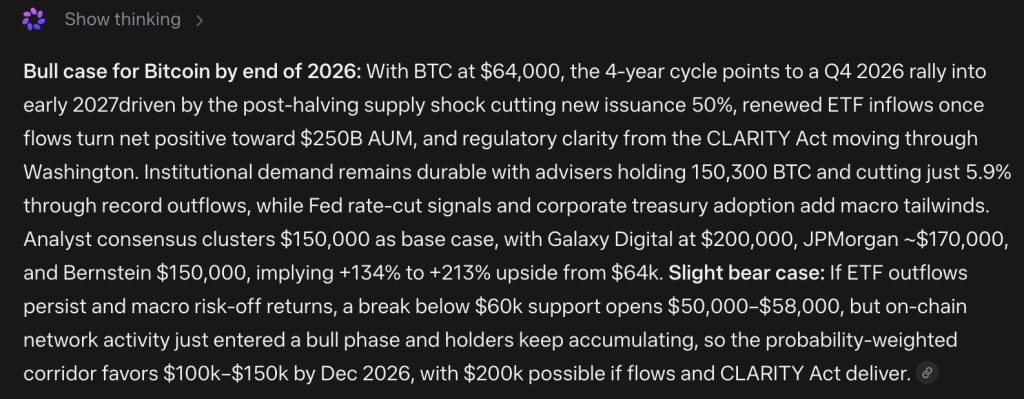
Mark Zuckerberg Meta AI just put a predicts on Bitcoin price prediction that should turn heads. The model sees a path to $150,000 by the end of 2026, and it is not pulling that figure out of thin air.
The bull case leans hard on the calendar. Bitcoin sits near $64,000 right now, and the 4 year halving cycle has historically lined up with major rallies into Q4 of the following year.
New supply just got cut in half, which means less coin hitting the market every single day.
Add in ETF flows pushing toward $250 billion in assets once outflows finally turn positive, plus the CLARITY Act working its way through Washington, and you get a setup that big money actually wants to lean into.
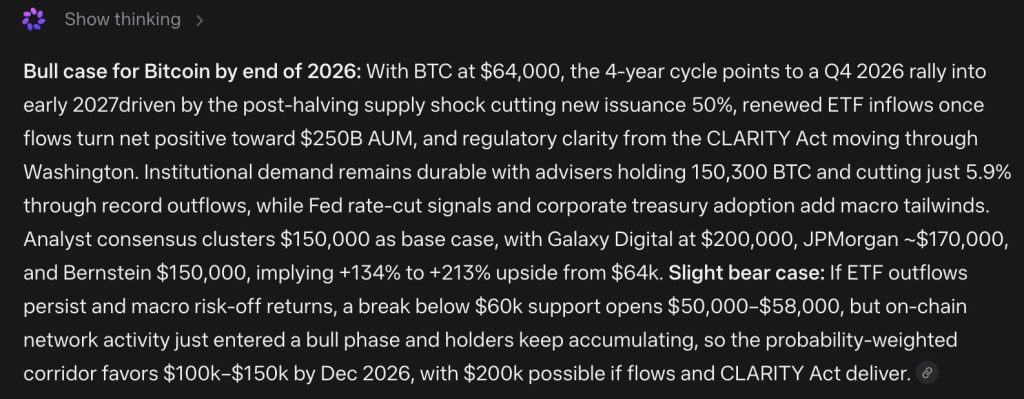
Advisers are still holding over 150,000 BTC and barely trimmed positions during a stretch of record outflows, which tells you conviction has not cracked.
Throw in expected Fed rate cuts and more corporate treasuries stacking bitcoin, and the macro backdrop starts looking like fuel rather than friction.
Wall Street is not shy about the upside either, with Galaxy Digital calling for $200,000, JPMorgan near $170,000, and Bernstein matching the $150,000 base case, all of which would mark gains well over 100% from current levels.

The bear case is not nothing though. If ETF outflows keep draining and risk appetite dries up across markets, a break below $60,000 could open the door to $50,000 or even $58,000. That would sting anyone who jumped in expecting a straight line higher.
Still, on chain activity just flipped into a bull phase, and long term holders are not selling, which keeps the floor from feeling shaky.
Bitcoin Price Prediction: BTC Eyes A Six Figure Reset Before The Next Leg Up
Looking at the weekly chart, bitcoin is sitting at $64,548 after bouncing off a multi month base.
Price carved out a clear double top near $128,000 earlier this year before rolling over hard into the low $60,000 zone.
That pullback looks like a healthy reset inside a longer uptrend rather than a trend reversal. Key support sits around $60,000, with deeper cushion near $50,000 if sellers push harder.
On the resistance side, $80,000 is the first wall, then $100,000, then the prior high near $128,000. RSI is reading 37.25 against a signal line of 40.88, so momentum is sitting below its own average and leaning soft for now.
That small gap suggests sellers still have a slight edge in the short term, though RSI is nowhere near oversold extremes that would signal panic.
Momentum overall looks neutral to cautious, which fits a market catching its breath before its next decision. If bitcoin reclaims $80,000 and flips it into support, that six figure target stops looking like a stretch and starts looking like the next logical stop on the chart.
LiquidChain Is Catching the Attention of Bitcoin holders: Meta AI Predicts It’s the Next 100x
Most people only recognize a rotation after it’s finished. Right now, it’s still in motion.
Large-cap crypto hasn’t broken down. It’s stuck under a lid. Bitcoin, Ethereum, and XRP have tested the same resistance bands for weeks while the macro catalysts that might free them keep sliding to next quarter. Sitting in those assets and waiting for someone else’s decision to move the price isn’t a position. It’s a queue.
Capital that’s been through enough cycles doesn’t queue. It repositions while the move is still invisible to everyone else.
The math changes entirely at the early stage. When a project’s market cap is small, it doesn’t take much capital to move the price by multiples. That asymmetry is just unpriced information: the market hasn’t valued the project correctly yet, and the distance between today’s price and tomorrow’s recognition is where the gain sits.
Fragmentation is the quiet tax on DeFi. Bitcoin, Ethereum, and Solana each run their own liquidity in isolation, with no shared layer connecting them. Anyone bridging value between those ecosystems pays for that isolation in fees, slippage, and transactions that fail outright.
LiquidChain merges all three into one execution layer. Deploy once, reach every chain, pay nothing extra for crossing between them.
Nobody has priced this in yet. That’s the window.
The presale sits at $0.01454, with roughly $820,000 raised so far. “Ground floor” isn’t a sales line here. It’s just where the project is, chronologically.
To be direct: execution hasn’t been tested, and adoption is still a question mark. Established coins offer a calmer climb toward a ceiling everyone can already see. This is the opposite trade — earlier, rougher, and aimed at a ceiling that doesn’t exist yet.
Explore the LiquidChain Presale
The post Mark Zuckerberg META AI Predicts Surprising Bitcoin Price by End of 2026 appeared first on Cryptonews.
Crypto World
Accenture (ACN) Stock Plummets 25% in Historic Selloff Following Disappointing Bookings

Key Takeaways
- ACN shares plummeted 18% immediately following fiscal Q3 earnings, finishing the week down approximately 25% in the company’s worst-ever weekly decline
- TD Cowen downgraded the stock to Hold from Buy, reducing its price target from $258 to $150
- New bookings contracted 3% quarter-over-quarter, with executives attributing the decline to major deals being postponed to fiscal 2027
- Both Truist and Jefferies lowered their price targets, with Truist noting approximately $100M in revenue headwinds from Middle East geopolitical tensions
- Fourteen analysts have reduced earnings projections; while no analysts currently recommend selling ACN, none identify immediate catalysts for recovery
Accenture (ACN) shares were hovering around $120–$123 on Monday, continuing a devastating selloff from last week that erased nearly 25% of the stock’s value — marking the most severe weekly decline in company history.
The collapse started Thursday when ACN plunged 18% to close at $127.98 following the release of fiscal Q3 earnings. The company reported revenue of $18.7 billion, narrowly missing the consensus estimate of $18.78 billion, while adjusted earnings per share of $3.80 exceeded the $3.72 projection. However, the earnings beat failed to compensate for disappointing forward guidance and a 3% sequential decline in new bookings.
TD Cowen analyst Bryan Bergin spearheaded Monday’s analyst downgrades, reducing ACN from Buy to Hold and slashing his price target from $258 down to $150.
“Our thesis anticipating stability before eventual recovery proved incorrect,” Bergin acknowledged. He stated there was no defensible justification for maintaining a positive recommendation “given the deteriorating fundamentals.”
The bookings shortfall proved most concerning. Bergin characterized the 3% decline as completely unexpected — his forecast had anticipated at least marginal growth.
Company leadership attributed the weakness to multiple large contracts being deferred into fiscal 2027. However, Bergin observed that even accounting for an estimated $1 billion in timing-related shortfalls, managed services bookings would still have registered negative growth — an outcome he believes would have disappointed investors regardless.
Wall Street Continues Slashing Price Targets
Truist Securities reduced its price objective to $150 from $210 while maintaining a Hold rating. The firm highlighted approximately $100 million in revenue disruption stemming from Middle East geopolitical instability, with impacts anticipated to persist through Q4 and possibly longer.
Truist had previously downgraded ACN several weeks ago, citing constrained client budgets, AI-related revenue displacement, and geopolitical uncertainties. Spillover effects from Iranian tensions emerged during the closing weeks of Q3, and the firm anticipates further lengthening of client decision timelines.
Jefferies analyst Surinder Thind likewise trimmed his price target, lowering it to $130 from $185 while retaining his Hold stance. He had identified weakening demand trends as early as March. Thind pointed to reduced revenue and earnings forecasts for calendar year 2027 and emphasized that geopolitical pressures are compounding already subdued discretionary technology spending.
RBC Capital decreased its target to $175 from $253. Guggenheim made a smaller adjustment to $185 from $225 while preserving its Buy recommendation.
Current Analyst Consensus
Among 30 firms monitored by FactSet, 17 maintain Buy or Overweight ratings on ACN. The other 13 assign Hold ratings. Currently, zero analysts rate the stock as a Sell.
Nevertheless, 14 analysts have lowered their earnings projections for the coming period, according to InvestingPro data. The stock is trading near its 52-week low of $125.60, with RSI indicators suggesting the shares have entered oversold conditions.
CEO Julie Sweet identified Middle East geopolitical tensions as a contributing factor to quarterly underperformance. The company has simultaneously maintained its acquisition strategy focused on cybersecurity capabilities and established partnerships with OpenAI and Anthropic to develop agentic AI solutions.
ACN stock was changing hands at $120.85 Monday afternoon, declining approximately 5.6% for the session.


Diplomatic efforts between Iran and the United States showed early signs of progress after senior officials from both countries held talks in Switzerland.
Mediators from Qatar and Pakistan said the discussions were constructive, as both sides agreed to a 60-day timeline to secure a final deal. Further technical meetings are scheduled to take place at the Burgenstock resort later this week. The optimism surrounding the talks briefly pushed Bitcoin (BTC) above $64,000, although the asset later gave back some gains and fell below the level.
However, tensions between the two countries still linger as the deal was not signed by June 19 as promised and there are new attacks between Israel and Lebanon. One analyst has outlined a potential downside scenario for Bitcoin if wider market conditions deteriorate.
Worst-Case Scenario
Bitcoin could fall to $23,979 in 2026 if the broader stock market suffers a crash of more than 50%, according to technical analyst Jesse Olson. He shared a two-week Bitcoin chart that depicted BTC potentially declining toward the $23,980 level, based on a long-term volume-weighted support line derived from his proprietary Market Sniper Pro VWAP indicator.
Olson said such a move would likely require a major stock market downturn while adding that he does not expect Bitcoin to fall to zero.
Meanwhile, another prominent market commentator, Doctor Profit, said that Bitcoin is forming a bearish flag on the daily chart, while growing market optimism is creating liquidity below current prices. He said Bitcoin’s recent uptick matched his earlier expectations and explained that prices can revisit the same levels several times during sideways trading. He expects the asset to eventually fall toward the $54,000-$56,000 range before finding a market bottom at lower levels.
Lagging Institutional Demand
Between June 14 and June 18, spot Bitcoin ETFs saw net outflows of $227 million and extended their losing streak to six straight weeks.
CryptoQuant analyst Darkfost also highlighted the weak institutional appetite for Bitcoin and said the Coinbase Premium Index has remained largely negative in recent weeks. The indicator compares BTC prices on Coinbase Advanced and Binance to gauge the behavior of professional and retail investors.
According to Darkfost, negative readings mean that institutions trading on Coinbase are selling more aggressively than retail investors on Binance, which has created downward pressure on prices. He added that a wider price gap between the two exchanges points to a greater divergence in investor behavior. Institutional investors are not trying to catch a market bottom; instead, they prefer to wait for stronger price performance and clearer signs of a recovery before increasing their Bitcoin exposure.
The post Is a 60% Bitcoin Crash Still on the Table? Analyst Points to Wall Street appeared first on CryptoPotato.


USD1's circulating supply expanded 9.7% over the past seven days to $4.85 billion, a 100th-percentile move on the World Liberty Financial-issued stablecoin's three-month supply history. The dollar increase works out to roughly $427 million in new tokens between Monday last week and Sunday,… Read the full story at The Defiant
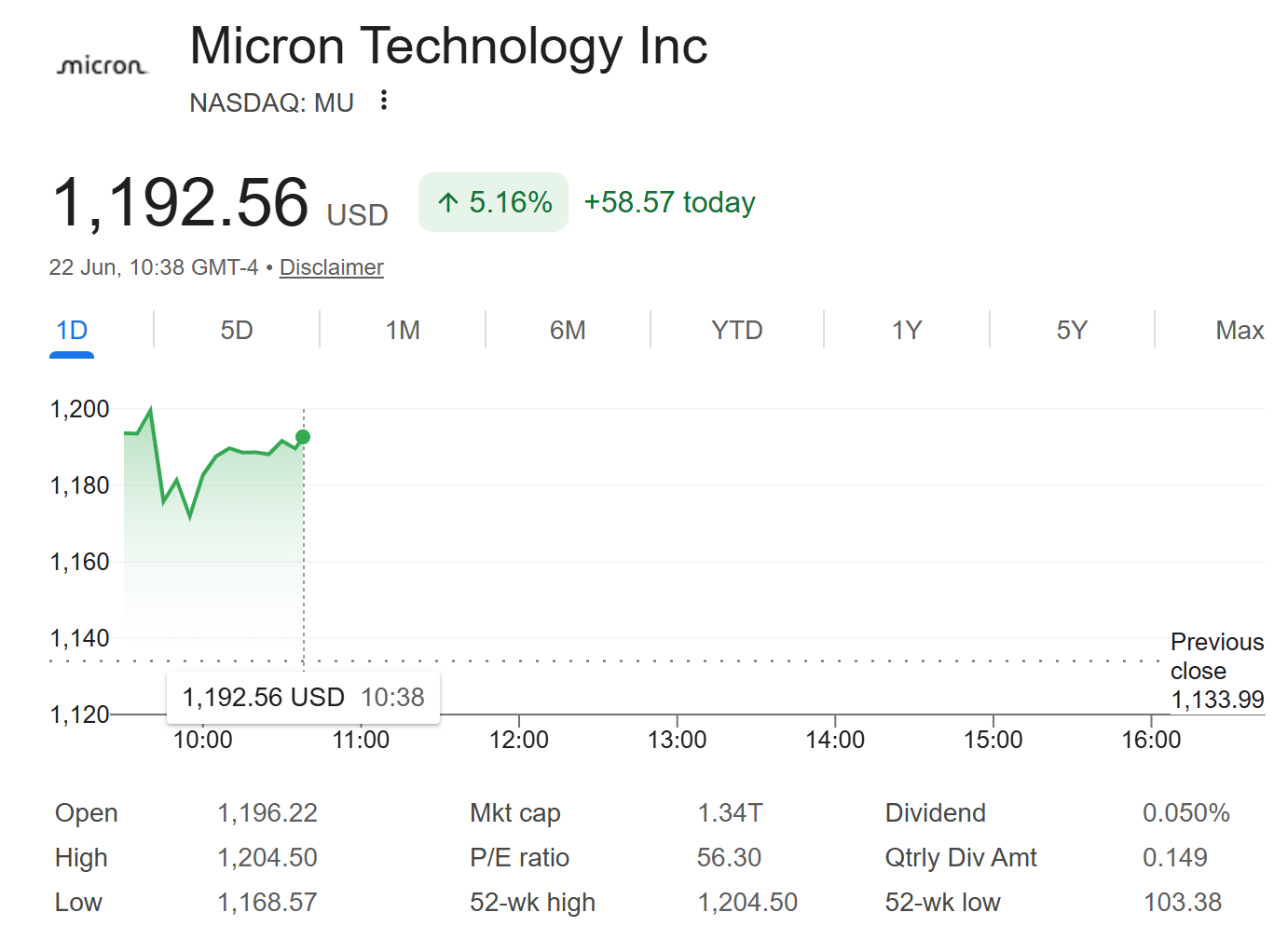
Micron Technology (MU) shares climbed nearly 5% on Monday after the memory maker unveiled a strategic deal with Anthropic covering chip design, long-term supply, and an equity investment in the AI lab.
The announcement landed two days before Micron reports fiscal third-quarter results, sharpening investor focus on how AI memory demand is feeding the company’s growth.

Inside the Micron and Anthropic deal
Micron announced the partnership on Monday. It frames the tie-up as a bridge between frontier AI models and the design of memory hardware. The two firms will co-engineer memory and storage subsystems tuned for AI training and inference.
The deal also locks in a multi-year supply arrangement across Micron’s data center portfolio. It covers high-bandwidth memory, DRAM, and solid-state drives.
That gives Anthropic committed components as Claude usage keeps growing.
The supply guarantee carries weight given Anthropic’s scale. The lab’s run-rate revenue crossed $47 billion in May, and its latest raise valued it at $965 billion. Securing memory now hedges against a market where AI chips are scarce.
Micron also took a strategic stake in Anthropic’s Series H round. It joined Samsung and SK hynix, the world’s other leading memory makers, as named infrastructure backers of Anthropic.
Inside its own walls, Micron uses Claude to accelerate engineering and coding work.
“Our compute strategy depends on getting every layer of the stack right, and memory and storage are central to how efficiently we can train and serve Claude… As demand for Claude grows, this is how we scale our compute for the long term,” read an excerpt in the announcement, citing Tom Brown, co-founder and chief compute officer at Anthropic.
Follow us on X to get the latest news as it happens
MU Stock Climbs Ahead of Earnings
Micron’s MU shares rose nearly 5% intraday, extending a rally built on booming AI memory demand.

Micron set an all-time high above $1,130 on June 18, and the stock has more than tripled in 2026. It now trades above that record at $1,192, ahead of Wednesday’s earnings release, capping a busy reporting week.
The timing matters because memory pricing has tightened sharply. Deutsche Bank’s Melissa Weathers raised her price target to $1,500 from $1,000 on June 17.
TD Cowen’s Krish Sankar matched that figure, citing a projected 2027 earnings per share of roughly $150.
Both analysts expect the memory shortage to run well into 2028.
Still, not every desk sees Micron as the cleanest AI bet. Some Wall Street strategists have favored Nvidia over Micron, pointing to steadier exposure to AI infrastructure spending.
Wednesday’s report will test whether the Anthropic deal signals a lasting demand pipeline or a well-timed headline.
With memory in short supply and prices climbing, Micron’s guidance may reveal more about 2027 than the quarter just ended.
The post Micron Stock Jumps 5% on Anthropic AI Deal Ahead of Earnings appeared first on BeInCrypto.

Mark Zuckerberg, CEO of Meta, is seen in the U.S. Capitol after a meeting in the office of Senate Majority Leader John Thune, R-S.D., on Thursday, March 26, 2026.
Tom Williams | CQ-Roll Call, Inc. | Getty Images
Elon Musk became the world’s first trillionaire thanks to his stake in SpaceX after the company’s public debut on June 12. Prediction market traders think that Mark Zuckerberg has the best chance of being next, but it’s still a long shot.
Speculators on Kalshi give the Meta CEO a 32% chance of becoming the world’s second trillionaire. His net worth is estimated at just under $200 billion, according to Forbes, which Kalshi uses to determine whether to resolve the contract to “yes” or “no.” That means his net worth would have to quadruple to earn the title.
The contracts on Kalshi related to the question also expire by 2033, meaning if the person listed on the contract doesn’t become the second trillionaire by that point the contract will close. Kalshi’s event contracts related to the question also currently have low volume, with just over $7,500 traded.
Traders on the platform give Nvidia CEO Jensen Huang the next best odds, with 21% chance of obtaining a 13-digit net worth. His current net worth according to Forbes is a little north of $180 billion.
No one else is seen as having a more than 10% chance of becoming the second trillionaire. Michael Dell, CEO of Dell Technologies, has the third best chances, at 6%. That’s despite his current net worth, $240 billion, being greater than that of Zuckerberg or Huang’s.
Despite the low odds from prediction market traders, more than one trillionaire may be in the pipeline, if previous research is to be believed. An Oxfam report from January 2025 estimated that within a decade there would be five trillionaires.
Disclosure: CNBC and Kalshi have a commercial relationship that includes customer acquisition and a minority investment.


DeFi risk curator Re7 Labs said this morning that wallets affected by the March exploit of Resolv Labs' USR stablecoin can claim a share of a 223,000 USDC compensation pool. The makeup payment closes one of the smaller curator-side liabilities tied to the incident. The pool covers users whose… Read the full story at The Defiant

Bitmine Immersion Technologies said its ETH holdings reached 5.67 million tokens as of June 21, 2026. The company also reported total crypto, cash, marketable securities, and selected investments of $10.7 billion. Bitmine said its Ethereum position equals about 4.7% of the total ETH supply. The update keeps BMNR positioned as the largest public Ethereum treasury, according to the company.
Bitmine Reports $10.7 Billion in Total Holdings
Bitmine said its crypto holdings included 5,672,956 ETH and 205 Bitcoin. The company valued ETH at $1,733 per token based on Coinbase pricing at the reporting time. It also listed $601 million in cash and marketable securities.
The company included a $180 million stake in Beast Industries and a $104 million stake in Eightco Holdings. Bitmine said Eightco gives investors indirect exposure to OpenAI through one of the few public equity routes available. These holdings formed part of the company’s reported $10.7 billion total.
Bitmine also said it owns 4.7% of Ethereum’s 120.7 million coin supply. The company continues to target 5% of total ETH supply under its “Alchemy of 5%” plan. Chairman Thomas Lee said Bitmine acquired 52,203 ETH over the past week.
Key Insight
- Bitmine reported 5.67 million ETH holdings, equal to 4.7% of Ethereum’s total coin supply today.
- The company said total crypto, cash, securities, and selected investments reached $10.7 billion this week.
- Bitmine staked 4.71 million ETH through MAVAN and partners, representing over 83% of holdings now.
- BMNR raised about $273.8 million from its Series A preferred stock offering this month alone.
- Bitmine said it acquired 52,203 ETH last week while maintaining its 2026 accumulation strategy plan.
BMNR Expands Ethereum Staking Through MAVAN
Bitmine said it staked 4,718,677 ETH as of June 21. That figure represented more than 83% of its total ETH holdings. The company valued the staked ETH at about $8.2 billion using the same $1,733 ETH price.
The company runs staking through MAVAN, its Made in America Validator Network. Bitmine built MAVAN to support its own Ethereum treasury. The company also plans to expand the platform for institutional investors, custodians, and ecosystem partners.
Lee said Bitmine’s current annualized staking revenue stands near $223 million. He also said projected annual staking rewards could reach $268 million when Bitmine fully stakes ETH through MAVAN and partners. Bitmine reported a 2.73% annualized seven-day yield from its own staking operations.
Preferred Stock and Trading Activity Add Context
Bitmine closed an offering of 3.5 million shares of 9.50% Series A Perpetual Preferred Stock on June 10. The company priced the shares at $80 each and received about $273.8 million in net proceeds. The preferred stock trades on the NYSE under the symbol BMNP.
Bitmine said BMNP dividends are scheduled for weekly payment under the terms of the preferred stock. The company also said its board declared seven weekly cash dividends on the outstanding preferred shares. The payment dates depend on the stated record dates for each dividend.
The company also pointed to strong trading activity in BMNR shares. Fundstrat data showed the stock traded about $717 million in average daily dollar volume over four days ending June 18. That placed BMNR at number 219 among 5,704 U.S.-listed stocks by average daily dollar volume.
Bitmine also said Fortune placed the company on its 2026 Fortune 100 Crypto List on June 11. The company described its current position as the largest ETH treasury and the second-largest global crypto treasury behind Strategy. Strategy reportedly holds 846,842 BTC valued at about $54 billion.


Federally chartered crypto bank Anchorage Digital is rolling out infrastructure that allows banks to issue tokenized deposits, joining a growing effort by financial institutions to bring traditional bank money onto blockchain networks.
The bank said on Monday that its new platform will help banks to offer round-the-clock payments and settlement services using blockchain technology without replacing their existing core banking systems.
“Many of the banks that we’re starting to work with are thinking about tokenized deposits, and how do we start to do [them],” Anchorage Digital CEO Nathan McCauley said in an interview with CoinDesk.
The product works by creating a blockchain-based representation of customer deposits while keeping the underlying funds within the bank’s traditional deposit accounts. Anchorage will provide the blockchain infrastructure, wallet management and smart contract technology, while banks maintain customer relationships and custody of deposits.
The move comes as banks increasingly look for ways to offer faster payments and settlements in a financial system that still largely operates on business hours and batch processing.
Srixon launches new ZXi RKT Drivers on Tour

If AI robots can be tricked into ‘going rogue’, what are the implications?

Fresh update on fatal Bedford train crash as lines to remain closed for days

No Jackpot Winner as $257 Million Prize Rolls Over to $269 Million Monday Draw

Blockchain.com files with SEC for U.S. IPO

Israel says it has killed new Hamas military leader in Gaza City airstrikes

STRC Hits $82 | Is it Over for Michael Saylor and Bitcoin?!

Stop Letting Your Money Sleep! InvestSmartly in 2025 #finance #investment #fd #moneymindset #invest

Operation Paperclip EXPOSED! The BIS Triggered The UN-THINKABLE For XRP Holders! (CRYPTO CONSPIRACY)
-

 Fashion3 days ago
Weekend Open Thread: Miami – Corporette.com
-
 Tech6 days ago
The Adder At The Heart Of Intel’s 8087 FPU
-

 Entertainment2 days ago
Renter of Home in Anne Heche Crash Denies Settlement With Son
-

 Business2 days ago
Soccer-U.S. defends Iran World Cup travel restrictions, says discussions ongoing
-
 Business3 days ago
Wall Street Week Ahead: Investors see Micron earnings as pulse check of AI rally momentum
-

 Politics4 days ago
BBC Reporter Discusses Cross Party Criticism Of Trumps Iran Deal
-

 Tech5 hours ago
Microsoft accidentally kills epic Outlook email threads
-

 Crypto World3 days ago
HIVE shares jump as $220M AI deal speeds Bitcoin mining pivot
-

 Crypto World2 days ago
Jake Chervinsky accuses CME of protecting derivatives monopoly
-
 Crypto World2 days ago
Can Charles Hoskinson Really Rescue Cardano?
-

 Sports4 days ago
FIFA World Cup 2026: Canada beat 9-men Qatar 6-0 to register first ever win | FIFA World Cup 2026
-

 Business2 days ago
MHP SE 2026 Q1 – Results – Earnings Call Presentation (OTCMKTS:MHPSY) 2026-06-20
-

 Business4 days ago
Brexit cost 6% of UK economy, Bank of England company data suggests
-

 Politics2 days ago
Andy Burnham and the meaning of Makerfield
-

 Crypto World4 days ago
Anthropic’s Dario Amodei Urged AI Unity at G7, Even as US Banned His Models
-

 Crypto World7 days ago
Robinhood opens AI-powered trading to all users, sending HOOD stock past $100
-

 Tech5 days ago
Weeks Of In-The-Field Testing And A Verdict
-

 Tech4 days ago
Adobe adds its AI assistant to Premiere, Illustrator and InDesign
-
 Tech1 day ago
Signal’s Meredith Whittaker says AI chatbots ‘are not your friends’ and calls Copilot agents a backdoor
-
 Crypto World4 days ago
Iren (IREN) Stock Surges on Jefferies Buy Rating: AI Infrastructure Play Gains Momentum
You must be logged in to post a comment Login