

Crypto World
Bitcoin slides to $62,300 as tech stock rout drags crypto lower

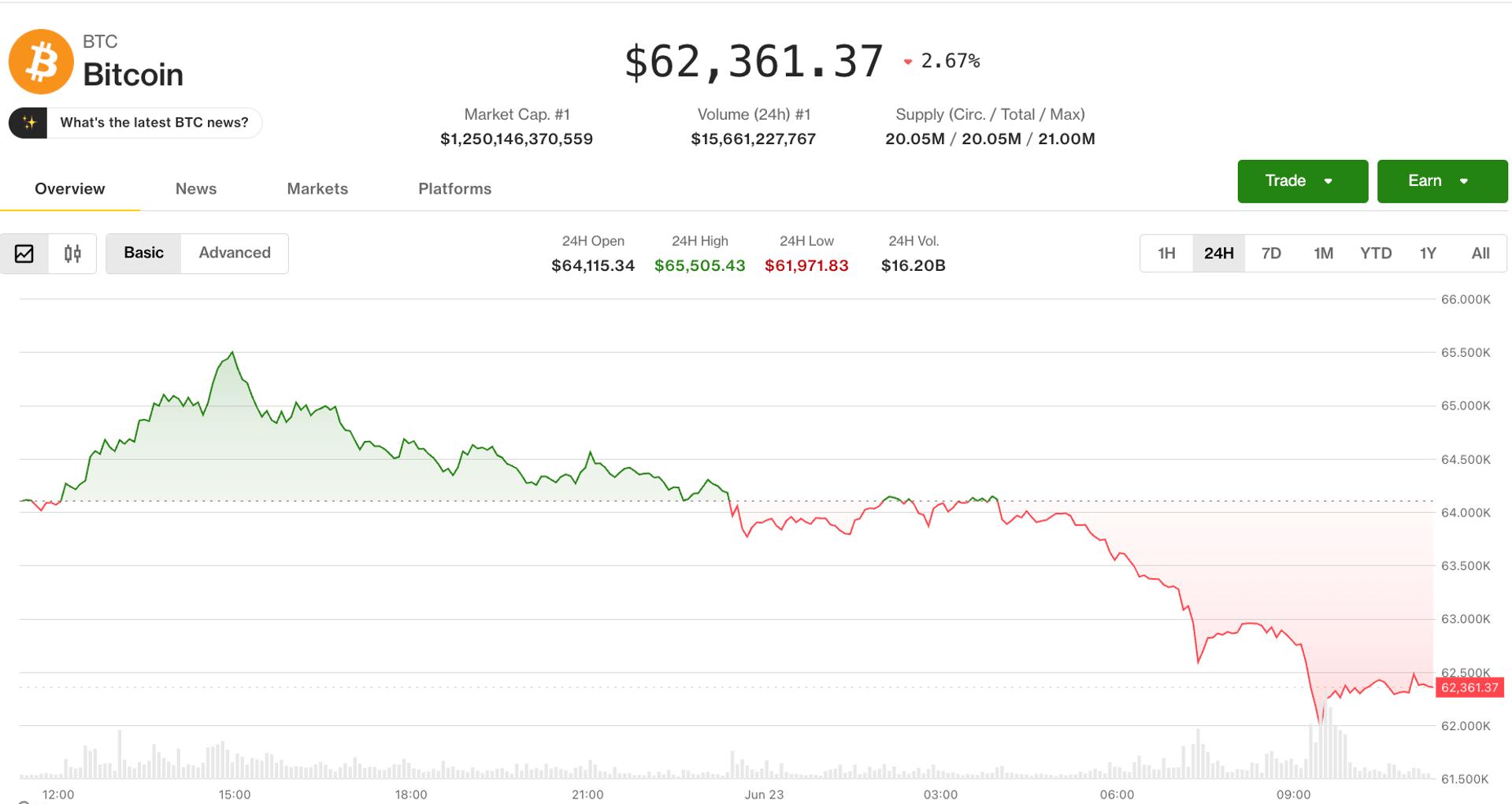
The crypto market fell on Tuesday, with bitcoin trading at $62,300, having lost 2.5% since midnight UTC, while ether (ETH) tumbled by more than 4% to $1,650.
The selloff follows Monday’s downturn in technology stocks, with another day in the red foreshadowed by Nasdaq 100 futures, which have cratered by 2.5% since midnight.
Tech stocks are struggling due to profit-taking and the risk of higher bond yields, according to Patrick Munnelly, market strategy partner at TickMill.
Altcoins performed worse than bitcoin and ether, with tokens such as ethena (ENA) and hype (HYPE) losing 5%-6% and $717 million in liquidations across the market spurring exaggerated downswings.
The Dollar Index (DXY) rose to its highest level in more than a year, hitting 101.15, the most since May 2025.
Derivatives positioning
- The most notable data point in derivatives is the 10% surge in open interest (OI) in SpaceX perpetuals listed on Hyperliquid, Binance and other exchanges while the price has dropped by 15%.
- This combination validates the downtrend and suggests the deployment of leverage on the short side. The OI increase is the highest among major tokens, a clear sign of a raised preference for trading traditional assets over blockchain rails.
- SpaceX futures are also now the sixth-largest in the world, ahead of several prominent coins such as ZEC, but still behind BTC, ETH, XRP, and others.
- XRP futures open interest increased to 2.38 billion tokens, revisiting eight-month highs. These continued capital flows come alongside a near 2% drop in the token for the week, and follow last week’s 5% slide.
- As with SpaceX, this combination validates the downtrend. Even more so, in fact, because the OI-adjusted 24-hour cumulative volume delta (CVD) is negative for the second straight day, a sign of price action being led by traders shorting at market prices rather than passive limit orders.
- Traders continue to scale back exposure to BTC futures. Open interest has slipped to 720K BTC from 742K BTC last week. It hit a peak of 800K BTC early this month.
- In ether, futures OI has bounced up from five-week lows to 14.13 million ETH, but overall positioning remains light compared with the peak of 15.98 million ETH on May 28.
- Broadly speaking, sellers seem to be dominant across most of the top 25 coins. Most of these coins have negative OI-adjusted 24-hour CVD.
- Traders are also likely to keep an eye on bitcoin’s 30-day implied volatility index, BVIV, which has turned higher from 40%. The increase suggests higher demand for options. Ether’s volatility index, EVIV, is displaying a similar pattern. Upswings in volatility indexes are typically a feature of bearish price trends.
- In the options market, the structure is long calls (or bullish bets) heading into the quarterly expiry on Friday. However, these long positions are sitting on losses, given the collapse in spot prices throughout the quarter. In the meantime, put options, or downside bets, are sitting in the money or in profit.
- Put-call skews show the market continues to pay for downside protection, a sign of persistent, cautious sentiment.
Token talk
- Privacy coins dash (DASH) and monero (XMR) showed strength despite Tuesday’s crypto selloff, with DASH losing just 0.2% since midnight and XMR about 0.7%
- The same cannot be said zcash (ZEC), a rival privacy coin that was hit by an AI-inspired exploit earlier this month. ZEC lost 4.2% over the same period, falling in line with the broader altcoin market.
- AI tokens FET, RENDER and TAO also struggled, dropping 3%-5% as negative sentiment from tech stocks spilled over into crypto.
- One positive for investors is that the average crypto relative strength index (RSI) is currently at 39.05, suggesting “oversold” conditions that could pave the way for a bounce or a relief rally over the course of the day.


The U.S. Commodity Futures Trading Commission (CFTC) has filed a federal lawsuit against the state of Kentucky, seeking to halt Kentucky’s efforts to block several prediction market platforms. The action comes after Kentucky sued major players in the prediction market space last week, arguing they operate without the required state gaming approvals.
According to the CFTC, the event contracts offered by platforms including Polymarket and Kalshi fall under the agency’s jurisdiction as federally regulated prediction markets. The regulator’s complaint also challenges a Kentucky law that imposes an excise tax on prediction market transaction fees, arguing the measure is effectively designed to make such platforms unable to operate in the state.
Key takeaways
- The CFTC filed suit in federal court to block Kentucky’s legal action against five prediction market-related defendants.
- Kentucky’s complaint targets Polymarket and Kalshi, as well as partners including Coinbase, Robinhood, and Webull, alleging “sports wagering” without proper licensure.
- The CFTC argues its authority is exclusive because the platforms’ event contracts are regulated as swaps and are linked to CFTC-designated contract markets.
- Kentucky’s 14.25% excise tax on prediction market transaction fees is part of the dispute, with the CFTC claiming it would make operation economically unviable.
- This is the ninth state case the CFTC has pursued since it began escalating enforcement around prediction market jurisdiction.
CFTC moves to preserve federal control over prediction markets
In its filing, the CFTC asked the court for declaratory and injunctive relief aimed at stopping Kentucky’s state-level case. The lawsuit identifies Kentucky Governor Andrew Beshear, Attorney General Russell Coleman, and the Kentucky Horse Racing and Gaming Corporation, among others.
CFTC Chair Mike Selig said the agency is “firmly committed to maintaining its exclusive jurisdiction over prediction markets,” calling Kentucky “the latest state attempting to shut down federally-regulated event contracts.” In the same statement, Selig framed the lawsuit as part of the CFTC’s broader effort to protect its federal authority over how these markets are regulated.
The CFTC said its enforcement push has intensified since Selig became chair in December. Kentucky’s case marks the ninth state action the CFTC has initiated over state measures targeting prediction markets.
Kentucky’s theory: event contracts are “sports wagering” under state law
Kentucky’s earlier lawsuit, filed last week, named Polymarket and Kalshi, along with Kalshi partners Coinbase, Robinhood, and Webull. Kentucky argued these entities are “doing business without a Kentucky gaming license or following state regulations,” and that their sports event contracts “fall squarely within the definition of ‘sports wagering’ under Kentucky law.”
The state also pointed to consumer-protection requirements. Kentucky alleged the platforms provide users “few or no resources” to identify or seek help for a gambling problem, as required under Kentucky law.
Sports betting falls under the jurisdiction of the Kentucky Horse Racing and Gaming Corporation, which has overseen the sector since 2023. Kentucky’s complaint effectively treats prediction markets offering sports-linked event contracts as a category of gambling that must comply with Kentucky’s licensing and regulatory framework.
How the CFTC reframes the same contracts as swaps and regulated derivatives
The CFTC’s lawsuit takes a different starting point: it argues that Polymarket and Kalshi operate within the CFTC’s regulatory universe. Specifically, the agency contends that the platforms are designated contract markets under its authority and that their event contracts are “swaps” under federal commodities law.
On the involvement of Coinbase, Robinhood, and Webull, the CFTC argues these firms are CFTC-registered futures commission merchants capable of offering event contracts in partnership with a designated contract market. This approach ties the platforms’ products to federal derivatives-style oversight rather than state gambling licensing requirements.
At the center of the broader legal clash is jurisdiction—whether states can enforce their gaming rules on prediction markets that, according to the CFTC, are already regulated at the federal level.
Excise tax dispute raises stakes for state enforcement
Kentucky’s efforts aren’t limited to licensure. The CFTC also challenged Kentucky’s recent law imposing a 14.25% excise tax on prediction market transaction fees. The regulator argued the tax is an attempt to make prediction markets economically unviable in Kentucky.
In the CFTC’s view, the tax structure functions as a practical barrier rather than a neutral fiscal policy—an argument that could become important if the court evaluates whether the state measure effectively undermines federally regulated market activity.
Just weeks earlier, the CFTC similarly sued New Mexico to block state actions aimed at applying state gaming laws to Kalshi, underscoring that the dispute is not confined to one state. The pattern suggests the agency intends to test—through litigation—whether state gaming enforcement can proceed when the CFTC believes federal commodities regulation already governs the same products.
Political backdrop and what to watch next
The Kentucky case lands amid a wider political conversation about prediction market jurisdiction. Earlier reporting in the same coverage noted that President Donald Trump gave the CFTC “moral support,” saying it was “critically important” that the regulator be the authority on prediction markets. The filing also references related public political ties, including that Trump Jr. has invested in and advises groups connected to Polymarket and Kalshi.
For market participants and users, the practical question now is procedural as well as substantive: whether federal court intervention will pause or narrow Kentucky’s enforcement timeline, and how the court evaluates the CFTC’s claim of exclusive federal jurisdiction. Readers should watch for developments on the scope of the injunction the CFTC is seeking, and for whether additional states facing similar disputes will move to accelerate or pause their own prediction market enforcement actions.
Bitcoin’s price was rejected at almost $66,000 yesterday, and the crash has worsened over the past few hours, with the asset dumping below $63,000.
Most altcoins have followed suit, including many of the larger-cap ones, which has increased the total value of liquidations from over-leveraged positions.
Why Is Crypto Down Today?
After a calm weekend in which its price stood at around $64,000, bitcoin experienced minor positive volatility on Monday, jumping past $65,000 and tapping a multi-day peak at over $65,500. Its rather gradual ascent was stopped immediately, though, and the bears resumed control.
There are many possible reasons behind bitcoin’s drop. The ETF outflows continue, with another $68 million withdrawn from the funds on Monday. Many analysts claimed that the strengthening dollar is bad news for BTC, and the past few days have proven that. Additionally, online FUD has risen following reports that many OG investors have begun disposing of their bitcoin holdings.
US President Donald Trump signed an executive order advancing research and development of quantum computing, which is seen as a major threat to bitcoin and crypto.
Separately, the FUD around Strategy and its STRC shares continues, as many analysts have argued that the company might need to start selling BTC soon to cover dividends. Additionally, the firm’s BTC purchases have been smaller lately, while it has focused on rebuilding its USD reserve.
And, as it typically happens, bitcoin’s correction has extended to many altcoins. ETH has lost the $1,700 support after a 2.5% daily decline, XRP is testing the $1.10 level again after a rejection at $1.15, while SOL has plummeted by nearly 5% and is down to $70.
Liquidations Rise
Intense volatility in the cryptocurrency markets generally leads to high levels of liquidations, and the past few (and 24) hours are no exception. The total value of wrecked positions in the last hour alone is over $170 million, while the daily chart shows roughly $530 million. Expectedly, longs dominate as BTC and ETH lead with $170 million and $96.5 million, respectively.
Almost 120,000 traders have been wiped out in the past day. The single-largest liquidation took place on Aster and was worth over $7 million, according to data from CoinGlass.

The post 5 Reasons Why Bitcoin Just Crashed Below $63K as Liquidations Top $500M appeared first on CryptoPotato.
The cryptocurrency market took another blow over the past 24 hours, with BTC once again entering red territory.
ETH and many leading altcoins have followed suit, posting even larger losses, while DEXE, HASH, and RAIN are among the few gainers today (June 23).
Renewed BTC Correction
The primary cryptocurrency attempted a decisive recovery yesterday (June 22), briefly crossing $65,000. However, that resurgence was short-lived, and the bears regained control, suppressing the valuation to the current $62,000 (per TradingView’s data).

The reasons behind the new pullback are various and include constant outflows from spot BTC ETFs, FUD following reports that some OG investors have begun dumping their holdings, the strengthening dollar, and the recent executive order signed by Donald Trump. The directive aims to advance research and development of quantum computing, which is seen as a major threat to bitcoin and crypto.

Alts Are Also Bleeding
Most of the well-known altcoins have fared even worse than the market leader. ETH is down 6% for the day, trading around $1,650, while Ethena (ENA), Worldcoin (WLD), and Stellar (XLM) have slipped by 9-10%.
Solana (SOL) and Hyperliquid (HYPE), which recently staged an evident rebound, also headed south, whereas DeXe (DEXE) and Provenance Blockchain (HASH) are among the few rays of hope. The former soared by 47% over the last 24 hours, and the latter pumped by 26%. Rain (RAIN) is also in green territory, albeit registering a more modest increase.
The total crypto market cap has erased around $120 billion in a single day and is now below $2.23 trillion as of press time.

The post Bitcoin (BTC) Dips Below $62K, Ethereum (ETH) Plunges 6% Daily: Market Watch appeared first on CryptoPotato.


SOIL has positioned itself to become the first application to use XRP Ledger’s proposed native lending infrastructure as the network considers activating the XLS-65 and XLS-66 amendments.
Summary
- SOIL is preparing to become the first application to use XRP Ledger’s proposed native lending infrastructure.
- The XLS-65 and XLS-66 amendments would introduce on-chain lending, liquidity pools, and yield products to XRPL.
- XRP Ledger recently launched version 3.2.0, while XRP price remains near a projected $1 support retest.
According to a recent update shared by SOIL on X, the regulated yield protocol is preparing to operate on the XRP Ledger Lending Protocol and Single Asset Vault framework once the proposed amendments receive approval.
The project stated that XLS-65 and XLS-66 would enable a new class of lending and yield products directly on XRPL and voiced support for activating the changes as soon as possible.
The development comes as XRP Ledger participants review two proposals designed to introduce lending functions at the protocol level. While XLS-66 outlines a structure for fixed-term, uncollateralized loans backed by pooled liquidity, XLS-65 introduces the SingleAssetVault model, which allows multiple users to contribute assets to a shared vault that can supply liquidity to lending markets.
Recent work on the network has also focused on infrastructure improvements. As reported by crypto.news, XRP Ledger released version 3.2.0 on June 22, deploying fixes for several software issues after a security review by blockchain security firm Common Prefix identified numerical and behavioral edge cases in the network’s core implementation. According to the XRP Ledger Foundation, those fixes were included in the latest mainnet upgrade.
Proposed amendments create the foundation for lending markets
A demonstration published by SOIL provided an early look at how the system could function once the amendments move into production. The presentation showed several Single Asset Vaults operating on XRPL’s Lending DevNet environment.
In the demonstration, users deposited funds into separate vaults and received MBT tokens representing their positions. According to the presenter, each vault issues its own MBT token, allowing depositors to maintain an on-chain representation of their ownership share.
Additional deposits into multiple vaults showed how ownership records expand as liquidity increases. Transaction values and sequence data were displayed through an explorer interface, giving participants visibility into fund movements and vault activity.
According to SOIL, one of the intended use cases involves depositing assets into pooled vaults that can support lending activity while preserving transparent records of participation on-chain. Under the proposed framework, liquidity providers would be able to track their positions through the issued vault tokens.
Development remains in testing ahead of approval
Current testing remains limited to development environments. During the demonstration, the presenter stated that no wallet currently supports the Lending DevNet, requiring developers to rely on internal testing tools. The presenter explained that wallet seeds have been hardcoded and transactions are being assigned behind the scenes during testing.
If approved, XLS-65 and XLS-66 would introduce native lending capabilities directly into the XRP Ledger protocol. According to the proposal descriptions, the changes would support lending markets, liquidity pools, yield-generating products, and on-chain credit systems without relying on external infrastructure.
Meanwhile, activity across the XRP ecosystem continues to attract attention from both developers and traders. As reported earlier by crypto.news, XRP recently formed a bearish MACD crossover on the four-hour chart, a signal that pointed to weakening momentum and a potential retest of the $1 support zone.
At press time, XRP (XRP) was down about 2% over the past 24 hours and trading roughly 5% above the bearish target, leaving the token close to the projected support level.

Few names in online betting carry the weight of Bet365 and 888casino. They sit on top of regulated markets across Europe and parts of North America, with millions of players returning to them year after year. But the industry has new entrants worth paying attention to, and a fresh group of crypto-first casinos is starting to grow into real competition for the legacy operators. ZunaBet, which went live in 2026, is one of the platforms making that climb.
This piece looks at how Bet365 and 888casino stand today, and where ZunaBet is positioning itself as something new in the same space.
Decades of Industry Presence
Bet365 traces its roots back to 2000. From a UK base, it grew into a global operation covering sports betting, casino, poker, and bingo from one account. The brand handles deposits through familiar channels — cards, bank transfers, and e-wallets — and holds licenses in nearly every region it serves.
888casino predates Bet365 by three years, going back to 1997. As part of the 888 Holdings group, it stands as one of the original online casino brands. Its catalogue covers slots, table games, and live dealer rooms, and its strongest footprint sits in regulated parts of Europe and North America. Like Bet365, it runs purely on fiat and follows the licensing requirements of each market it enters.
Reliability is the calling card for both. But the trade-off is also obvious. Their payment options are bound to traditional banking, withdrawals can take days depending on the method, and their game catalogues sit well below what crypto-first casinos pull together. Loyalty rewards run on the same point-and-tier model the industry has used since the early 2000s.
ZunaBet Joins the Climb
ZunaBet went live in 2026 and has been gaining ground since. Strathvale Group Ltd owns the brand, which holds an Anjouan gaming license. What sets it apart from older operators starts at the architecture. ZunaBet was designed for crypto from the beginning — no retrofits, no add-ons.

Its game catalogue tops 11,000 titles from more than 60 studios. The list of providers reads like an industry who’s-who: Pragmatic Play, Hacksaw Gaming, Yggdrasil, BGaming, and Evolution all feature. That depth ranks among the largest crypto-focused collections out there and clears what Bet365 and 888casino can field in their licensed regions. Slots, table games, and live dealer streams all run from a single account.
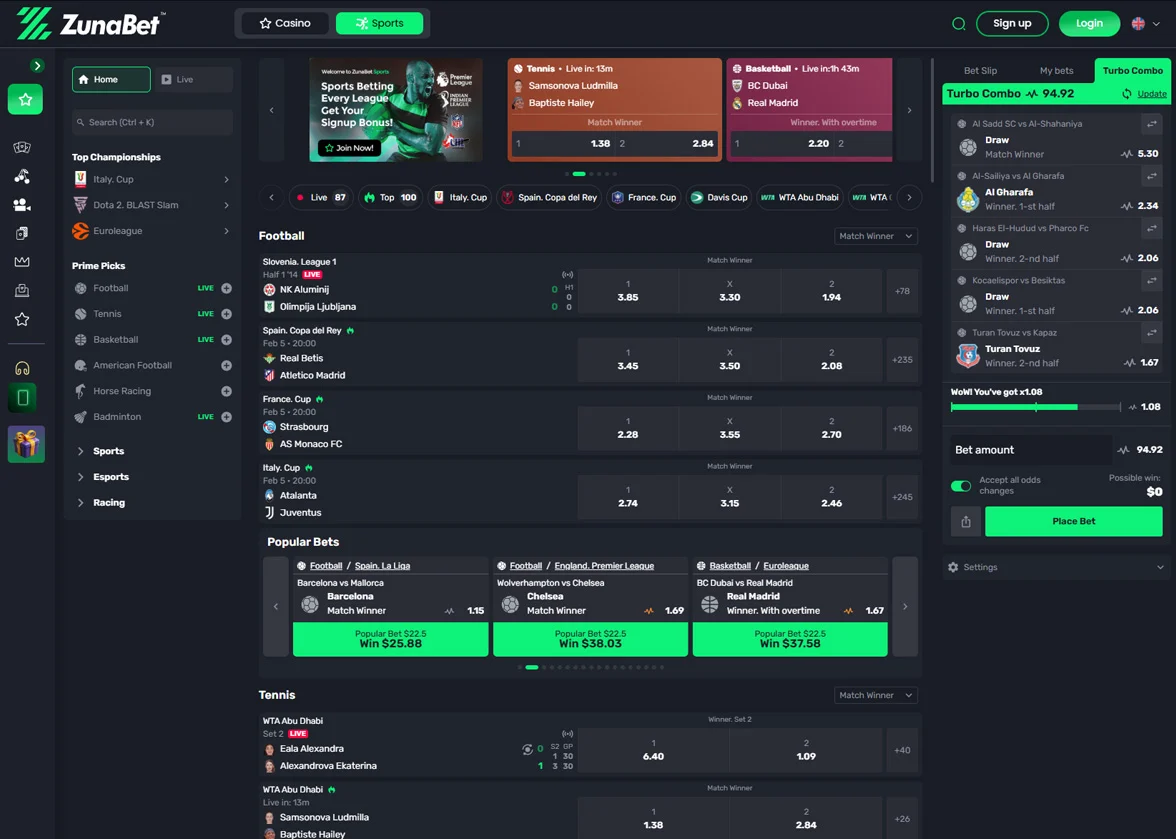
The sportsbook side rounds things out. Football, basketball, tennis, NHL, and the other usual sports sit alongside CS2, Dota 2, League of Legends, and Valorant. Virtual sports and combat sports complete the menu. This brings ZunaBet into the same hybrid territory as Bet365 with a broader spread of markets.
How the Payment Models Differ
The split here is sharp. Bet365 and 888casino are fiat operations. Bank rails come with their own pace: processing windows, possible holds, and slower withdrawals depending on what the player chose at deposit.
ZunaBet’s payment stack is entirely crypto. Over 20 currencies are supported, covering Bitcoin, Ethereum, USDT across several chains, Solana, Dogecoin, Cardano, and XRP. Transactions carry no platform fees, and withdrawals process quickly. For anyone holding crypto or simply tired of waiting on bank transfers, the difference shows up immediately.
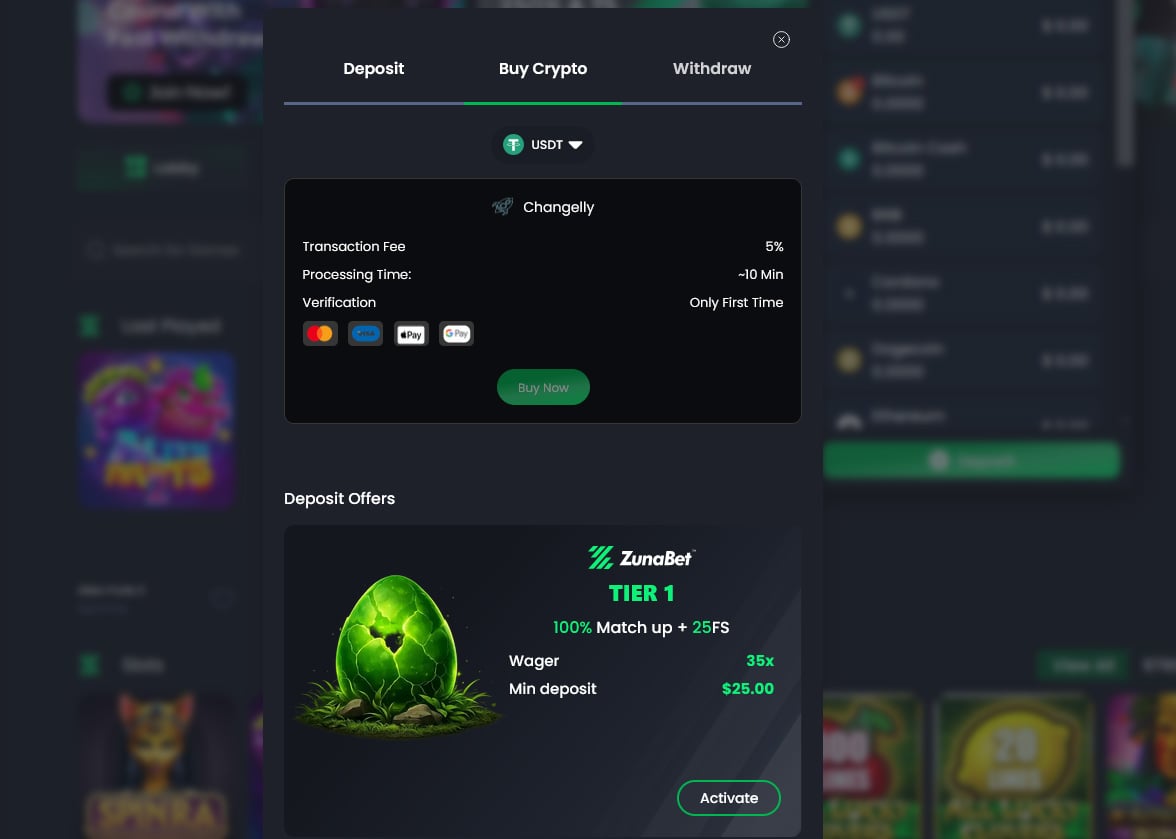
There’s also the question of reach. Crypto platforms aren’t pinned to specific licensed jurisdictions in the same way. Players in many regions can use ZunaBet’s full lineup without bumping into the patchwork rules legacy operators contend with. That kind of access matches how a younger demographic already operates online.
Sign-Up Promotions
Bet365 and 888casino offer welcome packages that vary heavily by region. Deposit matches or smaller new-player bonuses are typical, often paired with wagering rules that take some reading to navigate.
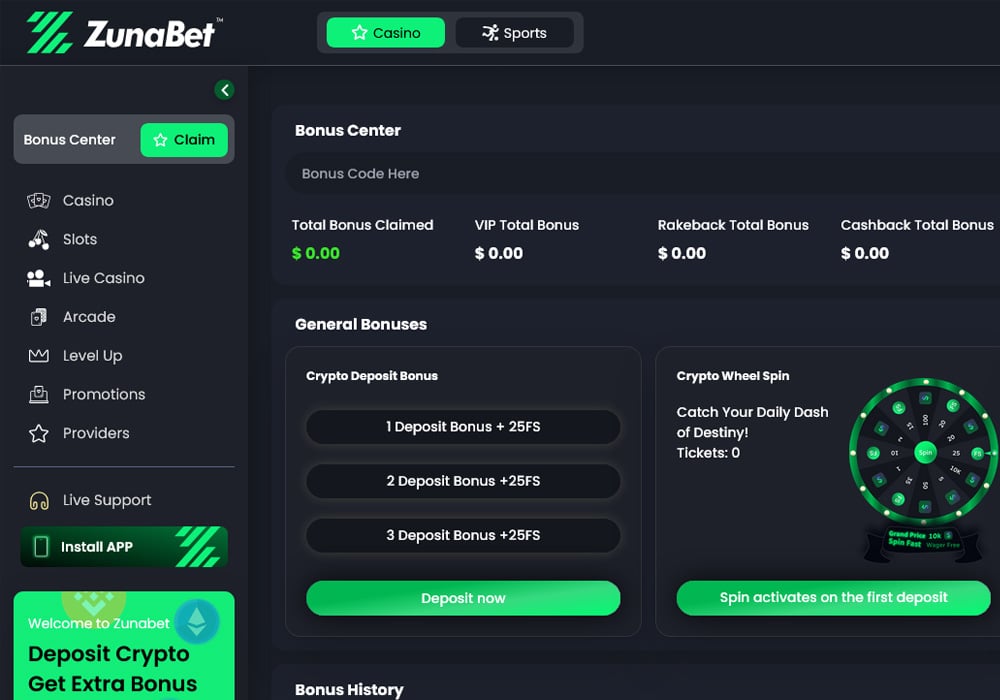
ZunaBet’s welcome offer stretches up to $5,000 plus 75 free spins, broken across three deposits. The first deposit pays 100% up to $2,000 plus 25 spins. The second adds 50% up to $1,500 plus 25 spins. The third returns to 100% up to $1,500 plus another 25 spins. Marketed as a 250% three-deposit package, it leaves more room for new players to find their footing than a single-deposit bonus would.
Loyalty Setup Differences
Bet365 keeps its loyalty side low-key, with offers landing in player accounts based on activity. 888casino takes the classic VIP route — point accumulation, free spins, and elevated promos for upper tiers. Both work, but both feel like extensions of a model the industry has been running on for ages.
ZunaBet flips the structure. Its loyalty program runs as a dragon evolution theme, with the mascot Zuno guiding players through six tiers. Squire starts the climb at 1% rakeback, then Warden at 2%, Champion at 4%, Divine at 5%, Knight at 10%, and Ultimate sitting at the top with 20% rakeback.
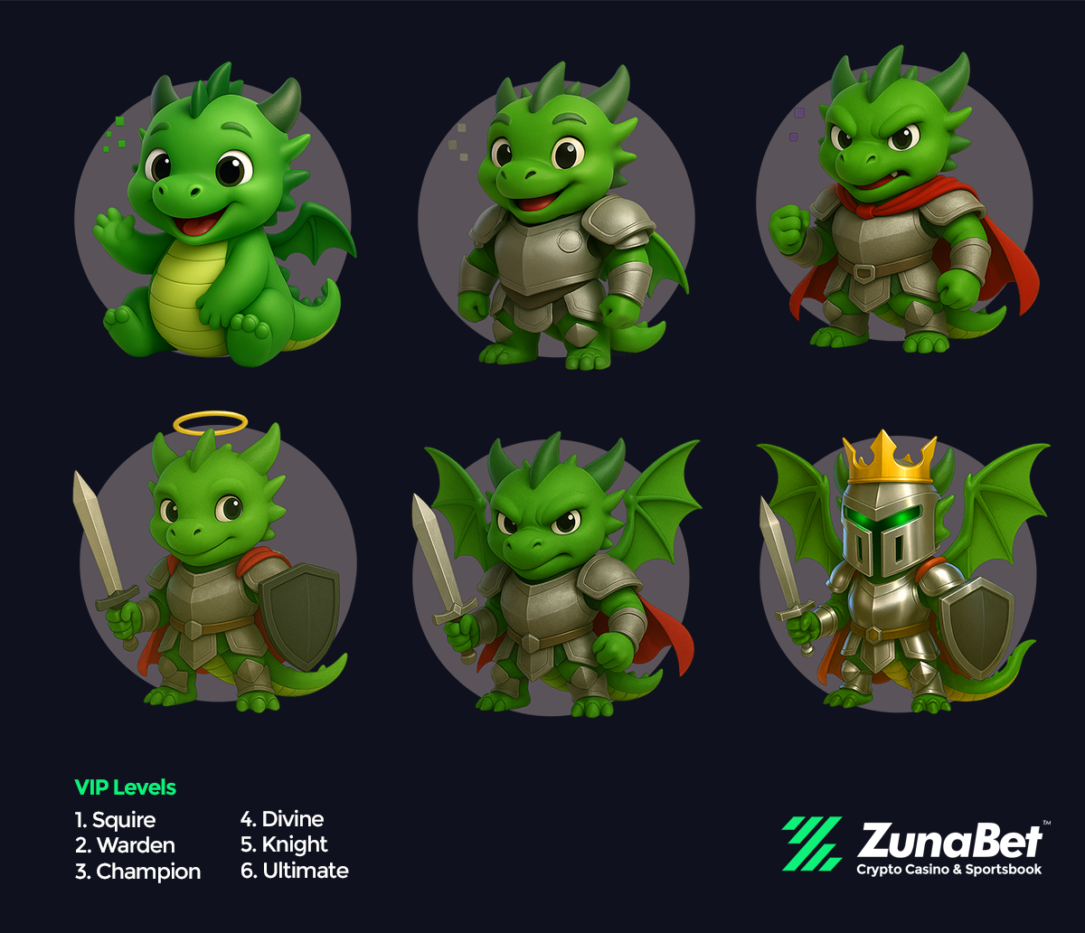
Climbing the tiers unlocks more than rakeback. Tier-based free spins go up to 1,000 spins, plus VIP club entry and double wheel spins along the way. The progression feels closer to advancing through a game than punching a loyalty card — a structure that connects with players who grew up on that mechanic.
Why ZunaBet Stands Out
Bet365 and 888casino remain solid options for anyone who values longevity and regulation. Neither brand is at risk of losing its position. But the bar for what online betting platforms should deliver keeps moving. Quick withdrawals, vast game libraries, and engaging reward systems are turning into baseline features rather than upgrades.
ZunaBet was built around that new baseline. Crypto-first means fast settlement and minimal fees. The library outsizes most established brands. The sportsbook covers traditional sports and esports without needing a second account. The dragon loyalty program turns regular play into something with shape and direction.
For players chasing speed, variety, and a more current feel, ZunaBet sits among the more interesting options available right now. It’s still building its name, but the trajectory points clearly forward. A new generation of players treats crypto, gamified rewards, and global access as defaults, not perks bolted onto the side.
Bet365 and 888casino built the online betting world that exists today. ZunaBet is one of the platforms working on what comes after it.
Disclaimer: This is a Press Release provided by a third party who is responsible for the content. Please conduct your own research before taking any action based on the content.


[PRESS RELEASE – Zug, Switzerland, June 23rd, 2026]
The Liechtenstein Financial Market Authority has granted Bitcoin Suisse (Europe) AG a license as a Crypto Asset Service Provider (CASP) under MiCAR. The European entity of Bitcoin Suisse can now serve clients across selected EEA markets, with Roman Przibylla appointed CEO to lead the expansion.
After more than a decade as Switzerland’s crypto pioneer, the Bitcoin Suisse Group (“Bitcoin Suisse”) is expanding across Europe. Its European entity, Bitcoin Suisse (Europe) AG, founded in 2018, has been granted a license as a Crypto Asset Service Provider (CASP) under MiCAR by the Liechtenstein Financial Market Authority (FMA), building on its long-standing registration under the Token and TT Service Provider Act (TVTG).
Across Europe, Bitcoin Suisse operates with a clear ambition: to be the first choice for high-net-worth individuals, corporates and institutional investors. This ambition is built on more than a decade of operational experience, proven across multiple market cycles in which the company’s business model has consistently demonstrated its resilience.
Its core services of trading, custody and staking rest on two pillars that clearly differentiate Bitcoin Suisse in the market: a robust, proprietary infrastructure and a unique service philosophy that provides every client with a dedicated relationship manager.
As a result, clients benefit not only from institutional-grade technology and regulatory clarity, but also from personal attention, deep expertise and continuity in the relationship. In a market that is often complex, fast-moving and fragmented, Bitcoin Suisse offers clients a trusted partner that combines technical strength with human accessibility.
“We are very proud of this milestone. The MiCAR authorization marks a decisive step on our journey towards a global brand and eventually becoming a global wealth management platform. Together with our presence in Switzerland and Bermuda, we now have the regulatory foundation to serve clients across some of the world’s most important financial centers,” says Andrej Majcen, Co-Founder and Group CEO, Bitcoin Suisse.
Roman Przibylla Appointed to Lead European Business
Roman Przibylla leads the European expansion as CEO of Bitcoin Suisse (Europe) AG. He brings more than 15 years of distribution experience from senior roles at Deutsche Bank, Commerzbank, HSBC, Vontobel and Maverix Securities.
“The MiCAR license gives Bitcoin Suisse access to one of the largest and most sophisticated investor markets in the world. We can now bring high-net-worth and institutional clients in Europe what they truly need: infrastructure at the highest level and, at the same time, direct, personal points of contact with genuine crypto expertise. That combination is not a given in this market,” says Roman Przibylla, CEO Bitcoin Suisse (Europe) AG.
About the Bitcoin Suisse Group
Bitcoin Suisse is a leading premium provider of crypto financial services for institutional clients, crypto foundations, family offices, asset managers and high-net-worth individuals. Headquartered in Zug and founded in 2013 by crypto natives, Bitcoin Suisse employs over 200 people across Switzerland, Liechtenstein, the United Arab Emirates and Bermuda.
The post Bitcoin Suisse Receives MiCAR License and Launches European Expansion appeared first on CryptoPotato.


A Trump White House official is now directly negotiating an ethics compromise on the CLARITY Act with Senate Democrats, the last major sticking point standing between the crypto market structure bill and a Senate floor vote. The development was reported by journalist Pete Rizzo on Tuesday, citing… Read the full story at The Defiant


In the same state, Fairshake backed incumbent Representative April McClain Delaney for $516,000, while also contributing ad spending in other states’ Tuesday primaries to Republican incumbent Representative Blake Moore in Utah and $1.3 million for one of the industry’s most reliable allies in the House, Representative Ritchie Torres, a New York Democrat. All of them also won their races or were winning, with McClain Delaney in an early lead with votes still being counted.
The most recent Federal Election Commission filings showed Fairshake with about $126 million still on-hand at the end of last month. But it’s spending heavily on the way to the November general elections in which the two-year destiny of the U.S. Congress will be decided.
If Boafo contributes to the rise of a new Democratic majority in the House, the crypto industry will have a campaign-finance bond with him and other Democrats the PAC has supported. A Democratic majority is set at 79% odds in betting on prediction market platform Kalshi, and if the party earns that status, it’ll have chairmanships of all the committees, complete with control of the chamber’s agenda and subpoena power.
Fairshake’s approach is to flood pro-crypto candidates from both parties with large-scale independent advertising that can’t legally be coordinated with the campaigns. The ads don’t typically mention crypto as a political issues but are instead just calculated to use whatever political message would be most helpful for the candidates.
The US Commodity Futures Trading Commission filed a lawsuit against Kentucky on Tuesday after the state sued prediction market operators last week, accusing them of operating unlicensed and illegal gambling platforms.
The lawsuit, filed in federal court, seeks to block Kentucky’s legal action against five prediction markets filed on Wednesday last week, calling for declaratory and injunctive relief. It names Kentucky Governor Andrew Beshear, Attorney General Russell Coleman and the Kentucky Horse Racing and Gaming Corporation, among others.
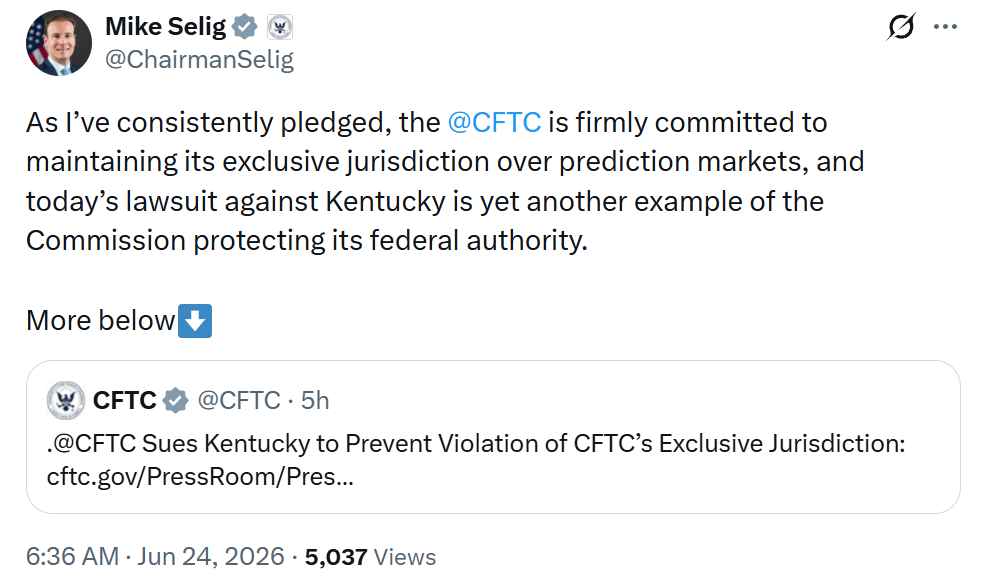
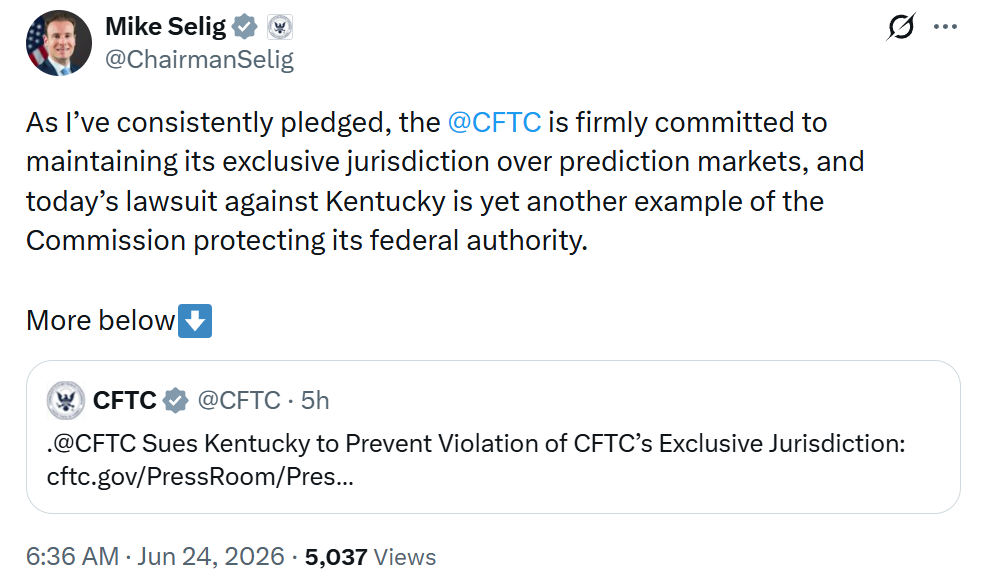
“Kentucky is the latest state attempting to shut down federally-regulated event contracts,” CFTC Chair Mike Selig said in a statement. “As I’ve consistently pledged, the CFTC is firmly committed to maintaining its exclusive jurisdiction over prediction markets, and today’s lawsuit against Kentucky is yet another example of the Commission protecting its federal interests.”
The CFTC has been ramping up its effort to maintain authority over prediction markets since Selig was appointed as chair in December. Kentucky is now the ninth state that the CFTC has sued over state authorities taking action against prediction markets.
Source: Mike Selig
Kentucky sued Polymarket and Kalshi, along with Kalshi partners Coinbase, Robinhood and Webull, claiming they are “doing business without a Kentucky gaming license or following state regulations” and that their sports event contracts “fall squarely within the definition of ‘sports wagering’ under Kentucky law.”
Sports betting has been under the jurisdiction of the Kentucky Horse Racing and Gaming Corporation since 2023.
Related: Mark Zuckerberg ordered Meta staff to develop moneyless prediction market: NYT
The state also alleged the platforms offer users “few or no resources” to identify or seek help for a gambling problem as required by state law.
In its lawsuit, the CFTC argued that Kalshi and Polymarket are designated contract markets under its authority, and their event contracts are “swaps” under federal commodities law.
It argued that Coinbase, Robinhood and Webull are CFTC-registered futures commission merchants that can offer event contracts in partnership with a designated contract market.
The regulator also took aim at Kentucky’s recent law that imposed a 14.25% excise tax on prediction market transaction fees, arguing it was an attempt to make prediction markets economically unviable in the state.
“This tax essentially makes it impossible for prediction markets to operate in Kentucky,” the CFTC argued.
The lawsuit comes just weeks after CFTC similarly sued New Mexico to block the state’s efforts to apply state gaming laws to Kalshi.
In May, US President Donald Trump gave the CFTC moral support, saying it was “critically important” that the regulator was the authority on prediction markets.
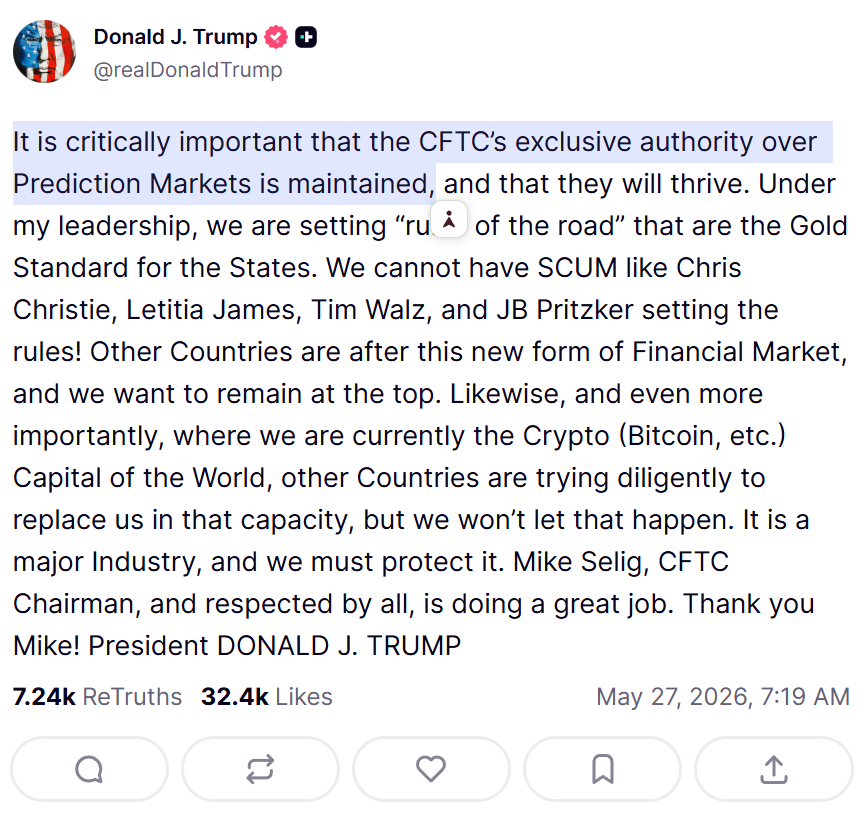
Source: Donald Trump
Trump’s son, Donald Trump Jr., has invested in and is on the advisory board for Polymarket and is an adviser to Kalshi.
Magazine: Bitcoin decouples from tech stocks, Ether eyes ‘selling wave’: Market Moves


Both chambers of Congress have passed legislation barring the Federal Reserve from issuing a central bank digital currency through 2030, with the bill heading to President Trump for signature after the House cleared it Tuesday. The House passed the 21st Century ROAD to Housing Act with a large… Read the full story at The Defiant

MorningStar Farms issues warning over select nuggets, patties: FDA

CFTC Sues Kentucky Over State Prediction Market Lawsuits

HBO’s Forgotten 5-Part Mystery Series Is a Grim, Gripping Watch for Crime Drama Fans


-

 Fashion4 days ago
Weekend Open Thread: Miami – Corporette.com
-

 Entertainment3 days ago
Renter of Home in Anne Heche Crash Denies Settlement With Son
-

 Tech2 days ago
Microsoft accidentally kills epic Outlook email threads
-

 Business3 days ago
Soccer-U.S. defends Iran World Cup travel restrictions, says discussions ongoing
-

 Politics5 days ago
BBC Reporter Discusses Cross Party Criticism Of Trumps Iran Deal
-
 Sports9 hours ago
Two goals and an assist by sheer aura: Cristiano Ronaldo just entered the World Cup chat
-
 Business4 days ago
Wall Street Week Ahead: Investors see Micron earnings as pulse check of AI rally momentum
-
Business3 hours ago
Entergy settles forward sale agreements, raises $672 million in cash proceeds
-

 Tech6 days ago
AWS enters the context layer race with a graph that learns from agents, not manual curation
-

 Politics4 days ago
Andy Burnham and the meaning of Makerfield
-
 Crypto World4 days ago
Can Charles Hoskinson Really Rescue Cardano?
-

 Crypto World4 days ago
HIVE shares jump as $220M AI deal speeds Bitcoin mining pivot
-

 Crypto World4 days ago
Jake Chervinsky accuses CME of protecting derivatives monopoly
-

 NewsBeat4 days ago
Keir Starmer Allies Question His Chances For No 10
-

 Tech1 day ago
Nearly 7,000 fake Amazon domains registered ahead of Prime Day 2026, researchers warn
-

 Business5 days ago
Brexit cost 6% of UK economy, Bank of England company data suggests
-

 Sports5 days ago
FIFA World Cup 2026: Canada beat 9-men Qatar 6-0 to register first ever win | FIFA World Cup 2026
-
 Tech3 days ago
Signal’s Meredith Whittaker says AI chatbots ‘are not your friends’ and calls Copilot agents a backdoor
-

 Entertainment4 days ago
Jose Alvarado Wants Taylor Swift at More Knicks Games
-

 Business3 days ago
MHP SE 2026 Q1 – Results – Earnings Call Presentation (OTCMKTS:MHPSY) 2026-06-20
You must be logged in to post a comment Login