
Security teams log 54% of successful attacks and alert on just 14%. The rest move through your environment unseen.
The Picus whitepaper shows how breach and attack simulation tests your SIEM and EDR rules so threats stop slipping by detection.





Drug discovery is notoriously inefficient. Pharmaceutical projects span years, moving from one specialized human team to the next through disconnected workflows that result in knowledge loss during each handoff.
A shocking 90% to 95% of drug discovery projects reportedly fail — one of the highest failure rates of any industry. A single successful drug can take over a dozen years and up to $1 billion from initial discovery to patient distribution, according to published reports.
Generative AI is being used to solve some of the challenges, but Stanford researchers have moved the ball forward with agentic AI.
A team led by James Zou, associate professor of Biomedical Data Science at Stanford University, has deployed thousands autonomous AI “scientist” agents in a virtual biotech that simulates the full lifecycle of drug development. The agents handle everything from initial discovery through safety testing and clinical trial design, while maintaining the continuity that’s lacking in today’s drug discovery processes, according to Zou.
The project uses a hierarchical orchestration framework. At the top sits a chief scientist officer agent that acts as a planner, delegating tasks to teams of specialized agents, Zou told VentureBeat during a call ahead of his upcoming session at VB Transform 2026.
While one team of agents focuses on discovery, another manages safety, and others handle specialized analytical tasks. Because these agents operate within a unified, hierarchical ecosystem, they retain the full context of a project, maintaining continuity from the first molecule identified to the final clinical outcome.
The “brain” of the system relies on a vast amount of primary data. The agents are granted access to data sources ranging from genomics and FDA chemistry data to clinical trial databases using a model context protocol.
The team has invested heavily in agent-native and agent-friendly data, allowing the AI to synthesize complex information more effectively. The system relies on a combination of models, with Zou noting that while Claude often serves as the backbone for coding and data analysis, the architecture employs a mixture of models, including those fine-tuned specialized use cases.
Zou is raising money at a roughly $1 billion valuation for his startup, Human Intelligence, based on the research.
During Zou’s session at VB Transform on July 15, titled How 10,000 agentic scientists in Stanford’s lab are set to revolutionize medical research and discovery, he will share valuable insights including strategies for managing context and long-running, multi-step workflows in a multi-agent system, the process of transforming and indexing raw enterprise data to make it agent native, and how to use human auditing and experimental reward signals to verify agent actions.
Another session at VB Transform focused on the value of agentic context includes Building a trustworthy agentic AI foundation: How Zillow accelerated engineering by 40%, with Zillow’s SVP of engineering and technology, Toby Roberts and Glean’s CEO Arvind Jain.
Interested in attending VB Transform 2026? Register here. A select number of complimentary passes are also available to senior technology leaders. Contact us to get yours.


Google is rolling out new privacy controls for Search services and Google Play, giving you more control over saved history and personalized recommendations.
In an email titled “New privacy settings for Search services,” sent to users and seen by Bleeping Computer, Google said it is “updating our settings to give you even more control over saved history and personalized recommendations across Google Search services and Google Play.”
Google noted that Search services include “Search, Maps, Shopping, Hotels, Flights, Translate, and News,” and users will see the change in their Google Account in the next few days.

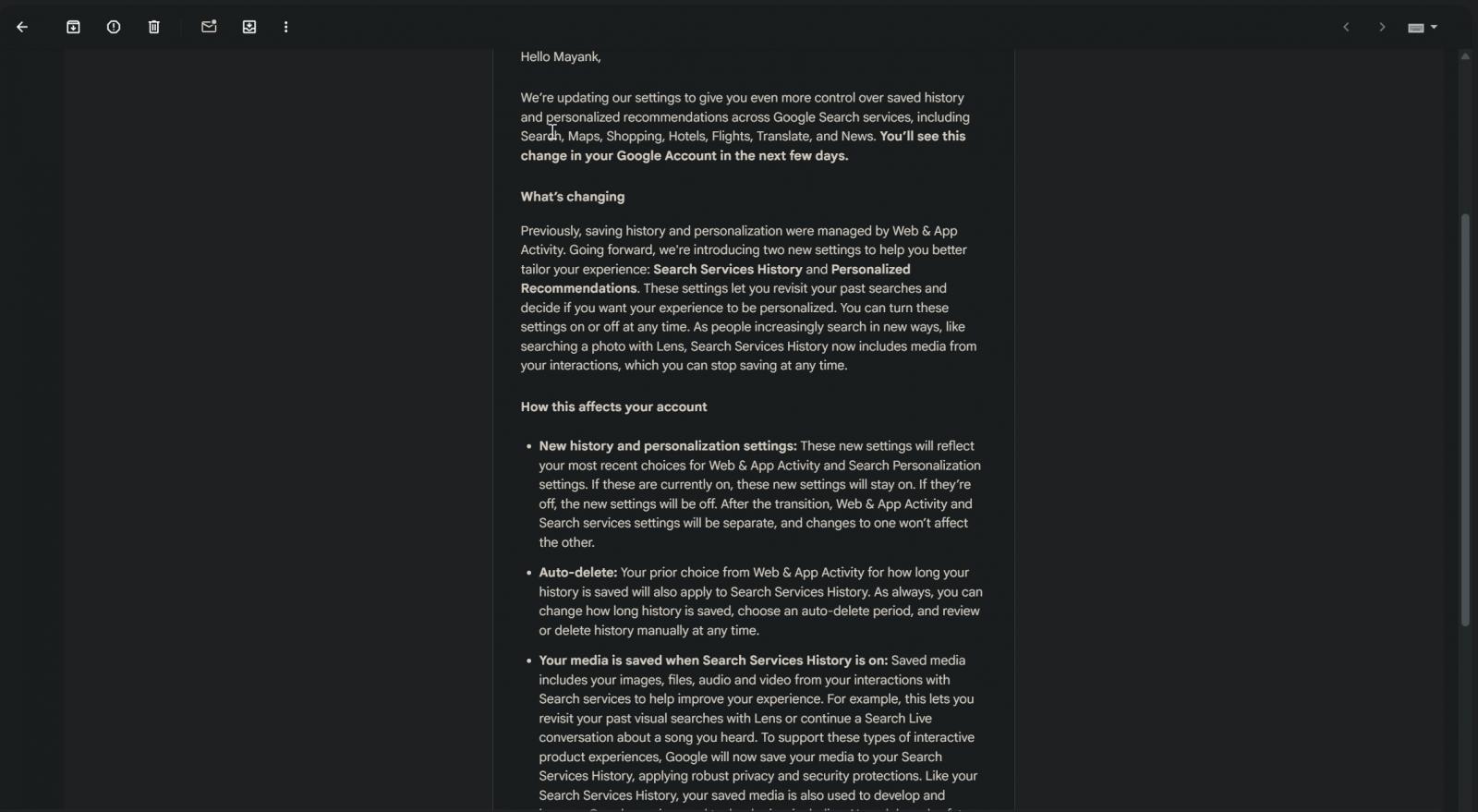
The company said it will offer separate settings for saved history and personalized recommendations. However, if you have turned on the “Web & App Activity” feature, Google’s new media-saving option for Search services will also be turned on after the transition.
Until now, Google has allowed you to manage history and personalization for Google services through Web & App Activity.
For example, the Web & App Activity page allowed you to keep track of your web visits and the apps you use on your phone.
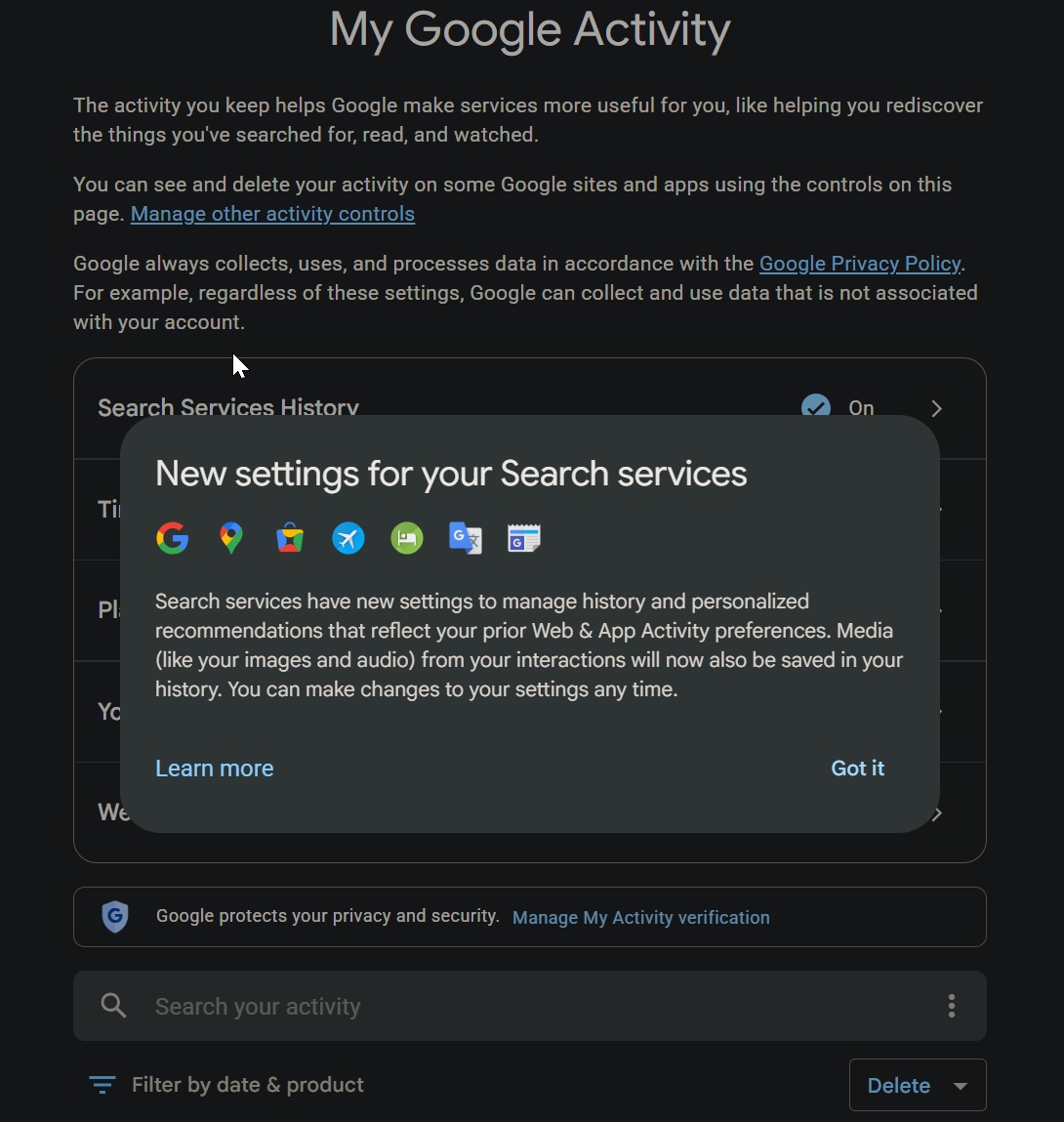
Google is now separating some of that into new controls called Search Services History and Personalized Recommendations.
“Previously, saving history and personalization were managed by Web & App Activity,” Google said in the email. “Going forward, you can better tailor your Search services experience using your new Search Services History and Personalized Recommendations settings.”
“These settings let you revisit your past searches and decide if you want your experience to be personalized,” Google added.
Going forward, Search Services History will control whether Google saves your activity from Search services to your Google Account. This can include your searches, Maps activity, Shopping searches, Flights and Hotels activity, Translate usage, News activity, and more.
Google says this will make it easier for you to revisit previous searches and continue using newer interactive Search experiences.
“As people increasingly search in new ways, like searching a photo with Lens, Search Services History now includes media from your interactions, which you can stop saving at any time,” Google noted in the email.
While Google’s announcement gives you more direct controls, there is an important detail worth checking.
In the email, Google says saved media can include images, files, audio, and video from your interactions with Search services.
“Saved media includes your images, files, audio and video from your interactions with Search services to help improve your experience,” Google said.
This can include visual searches with Google Lens or audio from voice-based interactions. According to Google, this helps support interactive product experiences.
“For example, this lets you revisit your past visual searches with Lens or continue a Search Live conversation about a song you heard,” Google noted in the email. “To support these types of interactive product experiences, Google will now save your media to your Search Services History, applying robust privacy and security protections.”
However, saved media, like Search Services History, can be used to develop and improve Google services and technologies, including AI models and safety systems.
“Like your Search Services History, your saved media is also used to develop and improve Google services and technologies, including AI models and safety measures,” Google said.
Google says it applies privacy and security protections, and the company says you can turn off the Save Media subsetting at any time. You can also delete individual pieces of media from your history.
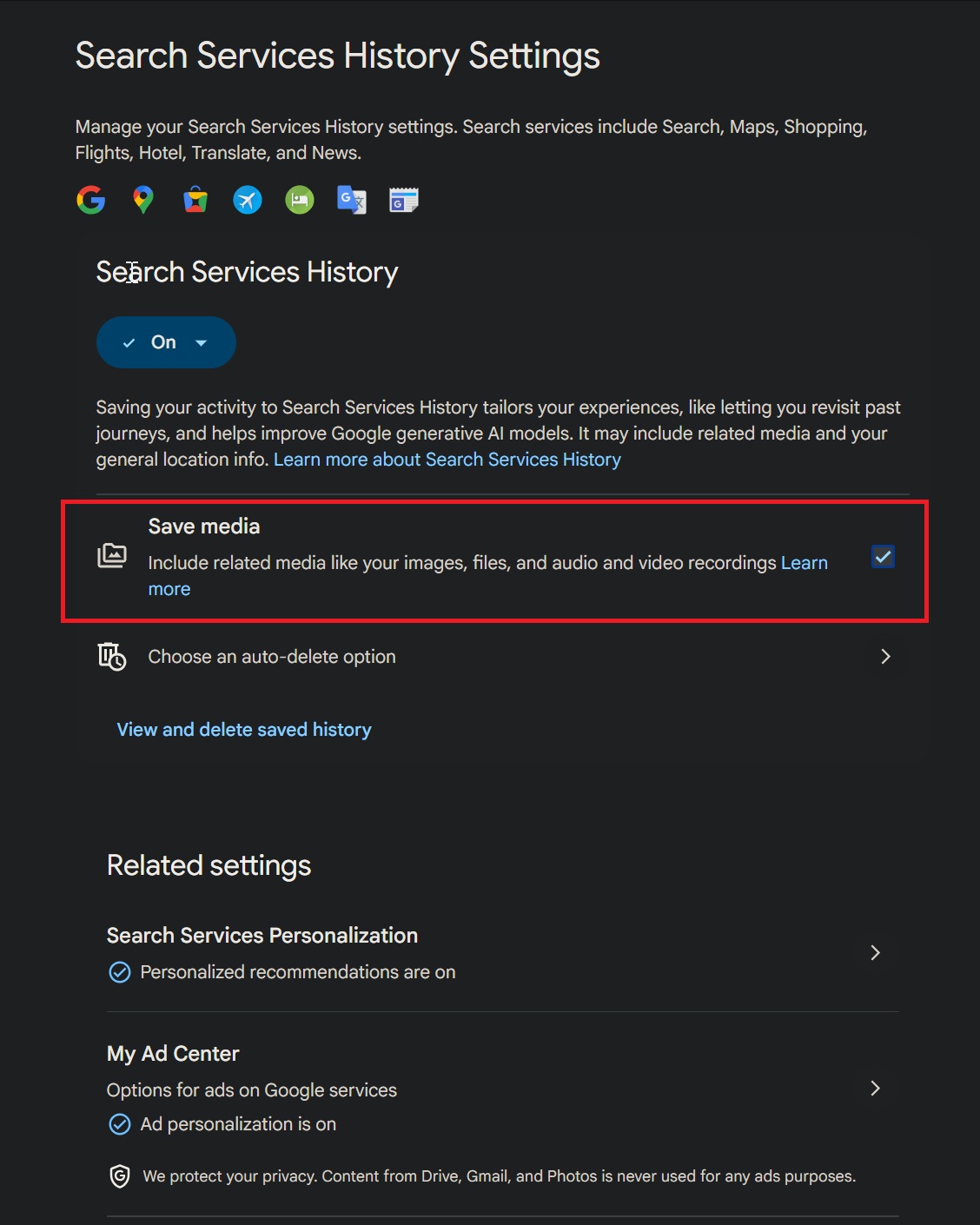
If Web & App Activity is currently turned on for your account, Google says Search Services History will be turned on after the transition, and the Save Media subsetting will also be turned on.
Google also confirmed that you can turn off the media-saving option later and “delete individual pieces of media from your history.”
Google is also introducing a separate Personalized Recommendations setting for Search services.
This will allow you to control whether Google personalizes your Search services experience.
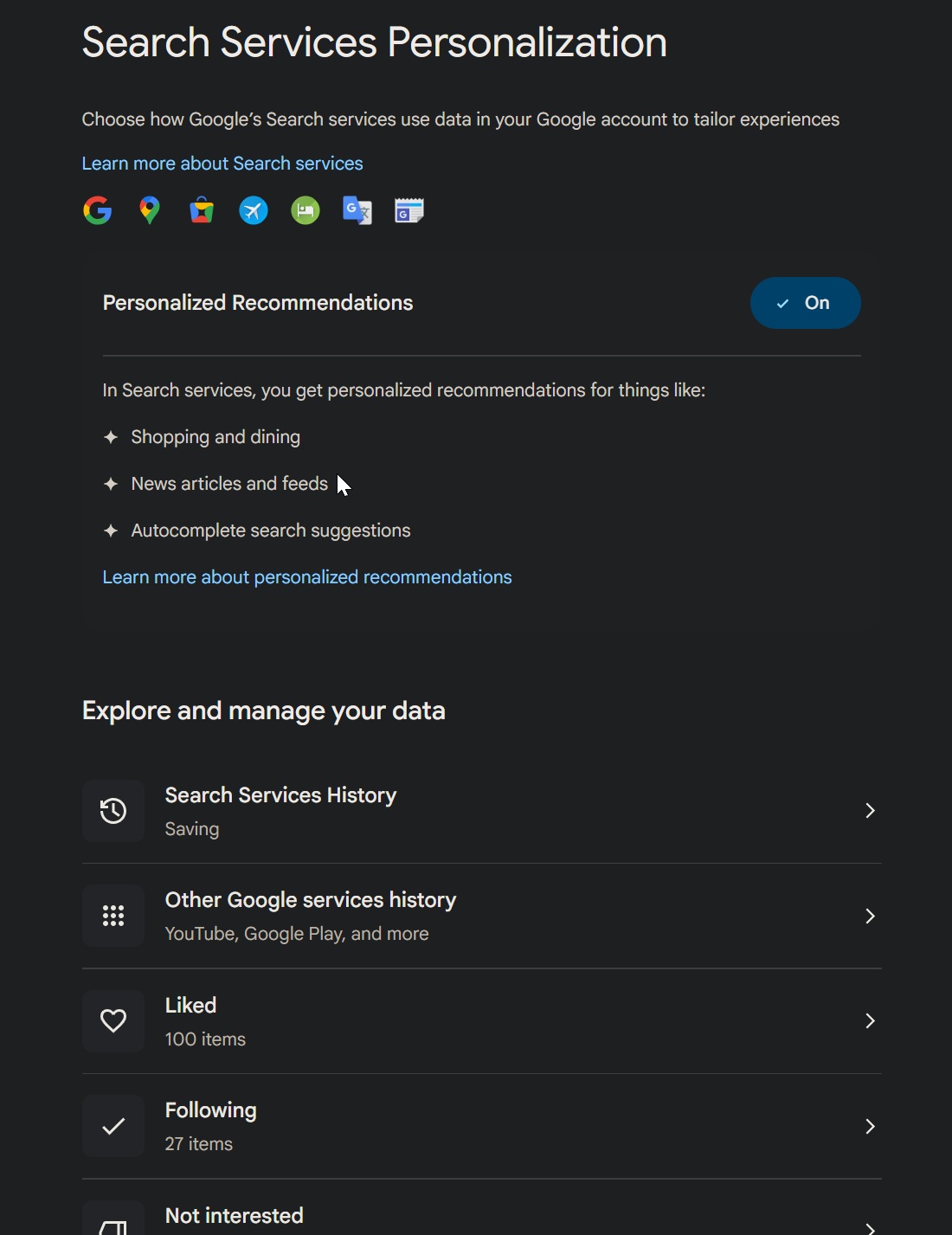
In other words, Search Services History controls whether the activity is saved, while Personalized Recommendations controls whether Google uses that saved data to tailor what you see.
That separation is helpful because some people may want their history saved for convenience, but may not want Google to personalize recommendations based on it.
After the transition, Web & App Activity will be separate from Search services’ history and personalization settings. Google says changes to one setting will not affect the others.
In the same email, Google says these settings will appear even if you have never used Google Play. Like the Search settings, they can be turned on or off at any time.
“For Google Play, you’ll have new Play History and Personalization in Play settings, even if you’ve never used this service,” Google said.
Google says the new Search services and Google Play settings will reflect your most recent choices for Web & App Activity and Search Personalization settings.
“Your prior choice from Web & App Activity for how long your history is saved will also apply to Search Services History and Play History,” Google said.
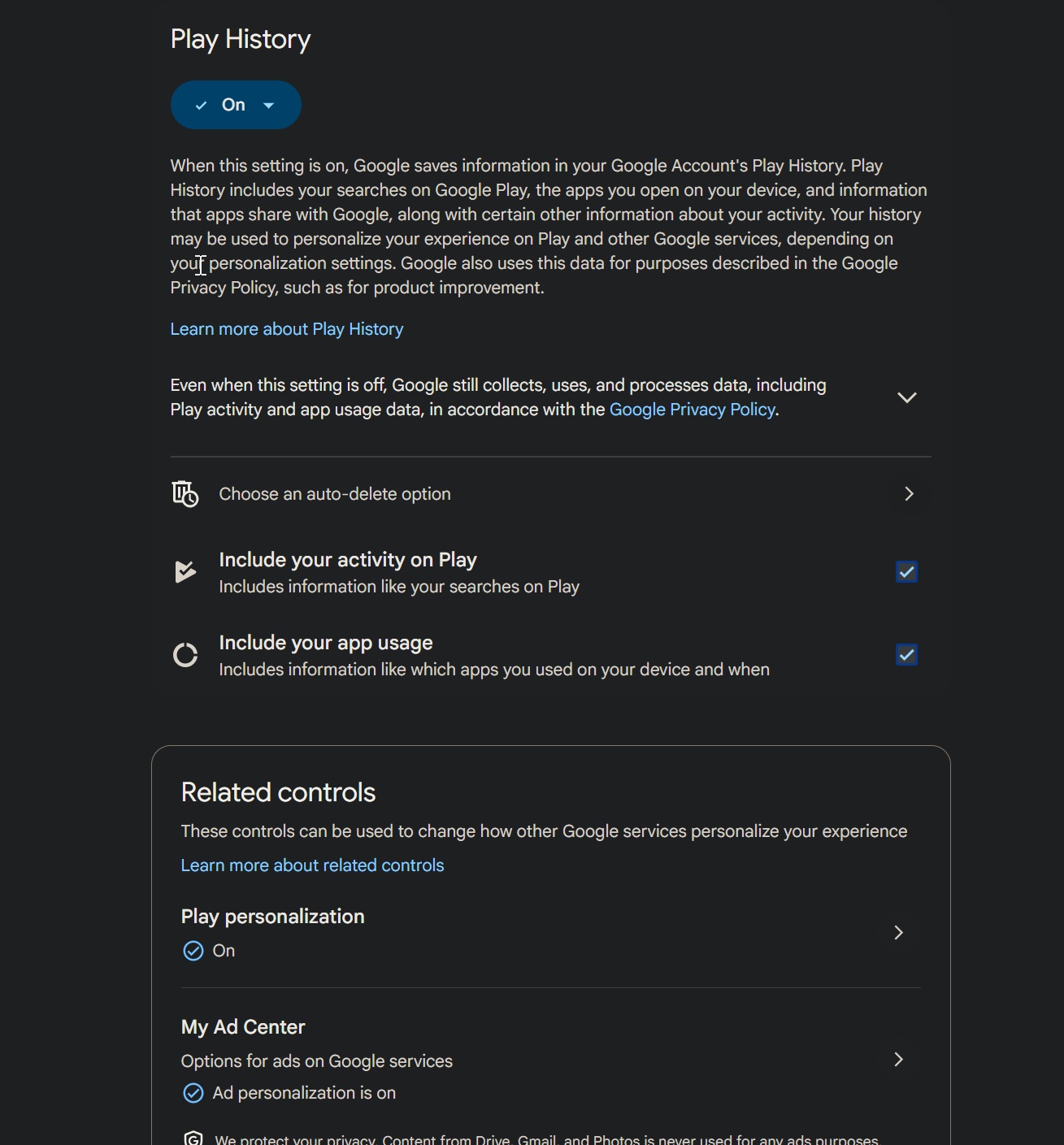
So if you previously told Google to delete activity after a certain period, that choice should carry over to the new settings. You can still change the auto-delete period, manually review your history, or delete activity at any time.
This change is not necessarily bad. In fact, separating Search history, Search personalization, Google Play history, and Google Play personalization gives you more direct control than one broad Web & App Activity switch.
However, you should still check the settings once they appear in your Google Account, especially if Web & App Activity is currently turned on.
Google says users will see the change in their Google Account over the next few days.

Security teams log 54% of successful attacks and alert on just 14%. The rest move through your environment unseen.
The Picus whitepaper shows how breach and attack simulation tests your SIEM and EDR rules so threats stop slipping by detection.
Meta’s controversial surveillance tool, which tracked staff’s keystrokes, mouse clicks and content to train the company’s AI models, didn’t quite work out as planned. The Model Capability Initiative, which was implemented in April and strongly opposed by staff, has been paused following an incident in which employee data became accessible to the entire company.
Over the last several weeks, more than 1,600 Meta employees, including software engineers, research scientists and designers, signed a petition calling on the company to stop collecting and repurposing employee computer data.
“We collectively believe that empowering individuals and communities through building responsible AI includes respecting their boundaries and privacy,” the petition states. “Any approach to AI that relies on intrusive, coercive, non-consensual data collection contradicts that principle.”
Business Insider reported that the software tracked apps and programs such as Gmail, GChat and Metamate, an employee AI assistant, as part of its data collection. The data-tracking software also captured screenshots. It’s unclear if it will be reinstated.
Citing an internal security notice and information from three Meta employees, Wired reported that private conversations, prompts, transcriptions, and performance reviews were exposed to “anyone inside the company.”
In a statement obtained by Wired, a Meta spokesperson said the company was investigating the incident and would stop data tracking indefinitely.
“We have carefully designed this program with privacy safeguards, and while we have no indication at this time that any data was improperly accessed by Meta employees, we’re pausing it while we investigate,” the spokesperson said.
A representative for Meta did not respond to CNET’s request for comment.
Meta, which is spending at least $135 billion on AI infrastructure this year, is among several major tech companies ramping up AI investment, including Amazon ($200 billion), Microsoft ($190 billion), and Alphabet ($185 billion).
Meta AI, the company’s main chatbot, is integrated into its main social media platforms such as WhatsApp, Instagram and Facebook.
According to leaked audio from an in-house company meeting on April 30, Meta CEO Mark Zuckerberg said it made sense to use his own employees to train the AI.
“The AI models learn from watching really smart people do things… The average intelligence of the people who are at this company is significantly higher than the average set of people that you can get to do tasks,” Zuckerberg said.
Rory Mir, director of open access and tech community engagement at the digital rights group Electronic Frontier Foundation, said Meta employees were right to oppose an invasive practice that raises privacy, consent, and trust concerns.
“Seeking new data for AI training is no excuse,” Mir told CNET. “Such disproportionate monitoring of workers is an abuse of power and highlights the necessity of legislation to protect worker privacy by requiring consent and due process.”
Companies are monitoring how much their employees use company AI tools in their daily work. CNBC reported in May that “almost every Fortune 500 is tracking overall AI usage” to determine whether workers are using it effectively and maximizing its potential.

It’s official: the 2026 TV Shootout is happening next month and it will include six of the top performing TVs of 2026. As usual, the Shootout event will be hosted by the good folks at Value Electronics at their headquarters on 35 Popham Road in Scarsdale, NY, starting at 9:30 AM and running as long as it takes until a new KING OF TV is crowned.

With Panasonic effectively dropping back out of the high end TV market in the United States, just three manufacturers will be represented this year: LG, Samsung and Sony. Each manufacturer will have one OLED TV and one RGB-lit LCD TV, for a total of six models.
As in previous competitions, all TVs will be evaluated by professional judges from within the A/V community, including tech journalists (including yours truly), trained calibrators and creative video content professionals. The evaluation will feature video clips and stills chosen to highlight specific areas of video performance including contrast, brightness, color volume, color accuracy, motion reproduction, HDR tone mapping and image uniformity. After the tests, the judges’ scorecards will be tabulated an a new “King of TV” crowned for 2026.

Consumers can use the results of the TV Shootout to select the best TV for their own liking and specific use-case. Performance in both bright and light-controlled rooms will be considered.
Event creator, Robert Zohn, says: “The arrival of Micro RGB TVs marks one of the most intriguing developments in display technology in recent years. We are eager to see how the 2026 TV lineup performs in our side-by-side comparison with all the excellent contenders this year. This is a must-see event for all who are interested in the best video displays.”
As in previous years, it “takes a village” to put the event together. It also takes a fair amount of gear. AVPro Global is supplying the latest state-of-the-art switching, distribution, and test equipment for the event. Magnetar’s UDP-900MKII flagship 4K universal disc player and Kaleidescape’s Strato K 8K-capable Media Player will be the reference sources for content. The Strato K is the company’s first player to support 4:4:4 color encoding and video bandwidth that exceeds that of UHD Blu-ray Disc.
As in previous year’s Sony Professional’s BVM-HX3110 mastering monitors will be used as the reference, against which all displays will be compared.
Portions of the event will be webcast live to reach the largest audience of A/V enthusiasts and media. After the TV Shootout is completed several of the top YouTube TV specialty channels (including our friends Stop the FOMO and Brian’s Tech Therapy) will have edited content of the TV Shootout for everyone worldwide to see the key components of the event.
While previous TV Shootouts have not been without controversy, as some TVs have not always performed as well as expected, the TV Shootout remains one of the premier TV comparison events as it pits the top performing TVs against each other and hits them with a wide range of content to reveal each of their strengths and weaknesses. The event’s results will help inform TV buyers’ choices through the remainder of the 2026 and beyond.
TV Shootout 2025 Results Revealed: Meet the King of TV for 2025
TV Shootout 2025 Results Discussed with Special Guest, B The Installer (YouTube)
We may receive a commission on purchases made from links.
With the rise of AI and the demand for chips skyrocketing in the last year or so, many consumer electronics have become much more expensive. Laptops fall into this category, but fortunately, there are still some on the market that aren’t too hard on the wallet. Whether you are a student, gamer, freelancer, or just a casual user, there is enough competition between manufacturers that you can find a solid laptop without burning a hole in your pocket.
While there are many factors to look at when buying a laptop, that non-burning pocket thing will be the main focus here. Yes, the laptops mentioned in this article won’t have top-notch hardware or certain features that elevate them to be the best of the best, but hey, you get what you pay for. It also doesn’t mean they are bad by any means, as some of them can give you the most bang for your buck. With that in mind, here are the 4 most affordable laptops you can buy in 2026.
One of the most popular budget options for Windows is the Acer Aspire Go 15. While Acer has a few budget-friendly laptops, it’s hard to find a more affordable one than this. The Aspire Go 15 goes (pun intended) for less than $500, and even around $300 for the entry-level model with 128GB storage and 8GB RAM. The budget option typically comes equipped with Intel Core i3 and N-series, like Intel Core i3-N355 CPU, but can be found with AMD Ryzen 3 7320U as well.
Storage and RAM vary, going from 128GB SSD and 8GB RAM to 1TB SSD and 16GB RAM. Obviously, the price rises with more storage and RAM, but you can still find a model with 512GB SSD and 16GB RAM below $500, which is pretty neat. The device has a good selection of ports, which is unusual for a budget laptop, including HDMI, a 3.5mm combo audio jack, USB-A, and USB-C. It has no Ethernet port, though, meaning Wi-Fi is the only choice available. All in all, with its price range, Acer Aspire Go 15 is a good fit for students, some lighter work, and casual users.
What Acer Aspire Go 15 is for Windows users, MacBook Neo is for Apple users. Starting at $599, the cheapest MacBook Apple has ever sold is powered by the Apple A18 Pro chip, sporting a 6‑core CPU with 2 performance cores and 4 efficiency cores. It comes with a 5-core GPU, 8GB RAM, and 256GB SSD. Apple reports a battery life of up to 16 hours in some cases, while users report an average of 13 hours of battery life for standard use.
The laptop doesn’t have that many ports compared to the Aspire Go 15, featuring two USB-C ports, one of them being USB 2. However, critics point out the great-looking display and a premium build with an all-metal chassis. That makes MacBook Neo an affordable laptop to keep an eye out for, especially if you’re an Apple connoisseur. While not without its disadvantages, you’ll be hard-pressed to find an Apple-quality product at this price range.
For those who prefer Chromebooks or simply want to try one out, the Asus Chromebook Plus CX34 is an excellent starting point that isn’t too costly. This 14-inch laptop goes under $500, sometimes even $400, depending on the retailer and model. It offers reliable performance and a good battery life that can last anywhere between 7 and 11 hours on average.
Asus Chromebook Plus CX34 has the Intel i3-1215U CPU, but you can find models with other CPUs, such as the Intel i3-1315U. The storage and memory go up to 512GB and 16GB, respectively. Notably, the Chromebook has two USB-C and two USB-A ports, with one 3.5mm combo audio jack and one HDMI. Users and critics alike report a good and comfortable keyboard with large keys. Also, being a Chromebook, you won’t get the usual Windows bloatware, which can be annoying to some (guilty as charged). If you mostly use a laptop for browsing, watching movies, working with documents, and general use, the Asus Chromebook Plus CX34 scratches that itch without thinning your wallet too much.
Lenovo often has good and affordable laptops, and the Lenovo Chromebook Duet 11 (Gen 9) keeps the tradition going. It’s a versatile 2-in-1 detachable primarily made for younger users and educational use, as well as for those who need quick access to important applications. As the name suggests, the Chromebook has an 11-inch display and comes equipped with a MediaTek Kompanio 838 processor. You can either have 4GB or 8GB of memory, and similarly for storage, it’s a choice between 64GB or 128GB eMMC.
Most importantly, it’s priced below $400, and depending on the retailer and sales, you can occasionally find it under $300. Don’t expect some top-tier performance or battery life, but that is to be expected considering the price tag. Still, it has a good touch screen, and the Chromebook as a whole is built rather well, especially the tablet part. Just bear in mind that the keyboard is a bit flimsy, with smaller keys and a tight layout, so that could be an issue if you have larger fingers and hands.
To make this short list, we looked into various laptops that fit the bill of the most affordable laptops in 2026. Unlike some of our other reviews, in this one, we primarily focused on affordability. Naturally, we still looked at performance and hardware to pick the better ones, since you can easily find dozens of laptops under $500. Apart from our own experience, to help us in that search, we went through several reviews from reputable sources such as PCMag, Tom’s Hardware, TechRadar, and the like.


Darkness swallows the apartment building as the Category 5 hurricane slams the coast in Netflix’s Unhinged. The electricity goes out, the stairwell locks, and Ava soon realizes she’s sharing the space with something far more dangerous than wind and rain. Her only way to contact anyone who can help her is through the device that most people carry with them wherever they go.
A quick scan of the QR code on the TV screen connects your phone directly to the game. From that point on, your phone no longer behaves like a normal phone, but rather changes into Ava’s lifeline while navigating the game simultaneously. Just move the phone around in the air, and Ava’s in-game hands will lock on with precision. It’s just as simple to sweep the virtual flashlight beam across a dark room or whatever just tilting the phone in your palm. You can even reach into a drawer or pick up something that has fallen over by making the same gesture you would in real life. The way the game tracks even the simplest motions just makes them part of the survival attempt.


Ava’s story centered around one particularly traumatic night spent locked inside a building. As the game’s principal character, Zoë Kravitz’s voice conveys Ava’s fragility and determination as she navigates storm devastation and an unknown menace. Sadie Sink plays Claire, a friend who can see into Ava’s apartment from her own window and offers advice via phone calls and messages. Troy Baker plays Ben, the building superintendent, who adds to the danger by being present but is unclear about his motivations.

The game was developed by Night School Studio, the same team that created the Oxenfree series. They specialize in tight, character-based horror that moves at a speed that seems like an intense discussion or a story that is so captivating that you can’t help but want to keep listening. They took that approach with Unhinged, which keeps the overall experience limited while still allowing for exploration of new paths on subsequent visits.

Two game modes are available to control the tension in the game. Story Mode allows you to relax without any strain. There is no timer, and Ava cannot die because the performances, ambiance, and twists make what is effectively a blackout feel much more intense. Standard Mode raises the stakes, with a diminishing timer bar in critical moments. You must find and interact with the correct object before time runs out, or the scenario will reset to where you last left off. Both modes are approximately thirty to forty minutes long, similar to a single episode of a television show.

Netflix created Unhinged for those who already have the app installed on their phones and televisions. There is no need for any additional hardware, such as a controller, or a lengthy setup process to get started. The design introduces this sort of horror to those who enjoy the genre on television but rarely devote the time to play a regular game. It also provides a quick fix for genre aficionados who want to squeeze in a short, intensive session between other commitments – all without breaking a sweat. The game will become available to all Netflix subscribers on June 30.
[Source]


Security
CVE-2026-20230 under exploitation, while an earlier SD-WAN 0-day looks even worse than we thought
It’s looking like another tough week (month? year?) for Switchzilla amid reports of new serious vulnerabilities under attack.
First up is a server-side request forgery bug in its Unified Communications Manager tracked as CVE-2026-20230.
Cisco disclosed and patched this flaw in early June. The comms control platform doesn’t properly validate some HTTP requests, and an attacker could exploit this bug to gain root privileges on a compromised device.
At the time, Cisco said that a proof-of-concept exploit was available – and now it seems unknown miscreants are putting that exploit code to use, with threat intel company Defused warning that it observed miscreants exploiting CVE-2026-20230 over the weekend.
“The observed chain abuses the WebDialer SSRF to deploy a rogue Apache Axis service, uses that service to write a first-stage JSP file-writer, then drops a second-stage command-execution shell under /platform-services/axis2-web/,” the firm noted on LinkedIn.
Then, a Mandiant advisory on Wednesday warned that a Cisco SD-WAN zero-day tracked as CVE-2026-20245 was exploited much earlier than initially disclosed, including at a communications service provider where the attacker elevated a compromised admin account to full root-level access.
While the Google-owned threat hunting biz said it can’t assess the full scope of the intruders’ post-compromise activity, this SD-WAN device compromise could have been dire, potentially giving the attacker total visibility across an entire corporation’s internet traffic. This is what makes SD-WAN zero-days such a hot target for government-sponsored spies looking to set up shop for long-term snooping activities.
It also explains the rash of attackers battering Cisco SD-WAN devices since the start of the year.
Cisco had issued an advisory for CVE-2026-20245 in early June, admitting that attackers had a head start on abusing this security hole. “In June 2026, the Cisco PSIRT became aware of exploitation of this vulnerability,” the vendor said at the time.
In a Wednesday report, however, Google’s Mandiant incident response and consulting biz reported that exploitation of this bug – Cisco’s sixth SD-WAN vulnerability listed as under attack since the start of the year, and the second zero-day in two months – began much earlier.
“In early 2026, Mandiant identified a threat actor targeting SD-WAN infrastructure at a service provider,” Mandiant threat hunters Chester Sng, Pete Boonyakarn, and Logeswaran Nadarajan wrote. “After gaining initial access, the threat actor exploited a zero-day vulnerability (CVE-2026-20245) in Cisco Catalyst SD-WAN to escalate privileges from a compromised administrative account to root-level access.”
The attacker gained initial access via an unauthorized peering connection, abusing the SD-WAN fabric to authenticate between network components and facilitate Secure Shell (SSH) access. In this case, they authenticated to the SD-WAN manager device via SSH using the vmanage-admin account on the same victim devices.
Then, they changed the default password on the admin account, authenticated directly to the SD-WAN Manager web application interface using the admin account, and exfiltrated SD-WAN fabric configurations.
Likely in an effort to cover their tracks and not get caught, the attacker changed the password of the admin account back to its original one before terminating their active session.
Neither the vmanage-admin nor the admin accounts on Cisco Catalyst SD-WAN controllers possess root shell access, however. To gain root access, the attacker exploited CVE-2026-20245, which allows an authenticated, local attacker to execute arbitrary commands as root by supplying a crafted file to the vulnerable system.
The attacker uploaded a file named evil_tenant.csv that contained the exploit payload. Upon execution, the digital intruder created a user account named troot with full root privileges. Mandiant says it later observed the miscreant accessing this new troot account from the admin account using the substitute user command.
The Register reached out to Cisco about the reported exploitation of CVE-2026-20230, and Mandiant’s investigation into CVE-2026-20245. The company pointed us to its June advisory on the latter matter, and is working on response to our first question. ®

Dutch Trade Minister Sjoerd Sjoerdsma visited Washington this week to meet with Commerce Secretary Howard Lutnick and members of Congress to oppose the MATCH Act, a bill that would bar Chinese chipmakers from accessing Western semiconductor equipment, and one that would hit ASML especially hard.
ASML, based in the Netherlands, is Europe’s most valuable company and the only maker in the world of the sophisticated lithography machines that are used to make cutting-edge AI chips.
“It’s exceptional that I’m coming here to broadly outline our concerns to Congress,” Sjoerdsma told Bloomberg after the meetings. “The stakes for the Netherlands may be very high.”
China accounts for 19% of ASML’s net system sales. The MATCH Act would go further than existing controls, extending curbs to ASML’s deep ultraviolet immersion machines on top of the long-standing ban on its most advanced extreme ultraviolet, or EUV, tools reaching China.
As ASML CEO Christophe Fouquet told TechCrunch in May, what China can currently buy are older-generation deep ultraviolet tools — gear first shipped about a decade ago — the same machines the MATCH Act would now relegate off limits.
The bill, introduced in April, hasn’t yet faced a full House or Senate vote; Bloomberg notes it would likely need to be folded into a larger package to pass.

I have had big ideas before. Ideas that felt urgent and important at 11 p.m. and somehow evaporated by morning. So, when the idea for creating an AI-powered reading recommendation system to generate student excitement about our school’s library catalog came to me, I asked my partner what she thought about me giving up evenings and weekends for a year or two. “Just go for it,” she said.
That conversation was in May 2025. By November, my vibe-coded app was live in my classroom.
Why I Started Vibe Coding
I’m a U.K.-trained primary school teacher with 11 years of experience in international schools across the Middle East and Southeast Asia. Over the years, I have seen librarians carefully curate books only to have them sit untouched on library shelves. This is because there was no systematic way to connect each child to the book most likely to excite them.
Existing solutions were expensive, rigid, and built around proprietary book lists that didn’t match our collection. The more I looked at what was available, the more I realized the problem wasn’t that the technology didn’t exist — it was that nobody had built it for teachers like me, working in schools like mine.
So, I decided to build one myself, using an AI technique that I had read about with increasing interest: vibe coding.
Learning to Build an App
Vibe coding is a practice where people use AI tools to generate software code by describing what they want in plain language to the tool, with little to no traditional programming knowledge required. So, I started vibe coding and telling a large language model what I was trying to build.
Progress was painfully slow — a day forward, three days back. Over the summer months I nearly quit several times. The early architecture decisions haunted me: I was working on a 12-year-old Mac I hadn’t upgraded, and just getting the right development environment installed felt like a full-time job. The worst moment came when several files of code were deleted with no backup. Hours of work, gone. I sat staring at the screen for a long time.
One of the most painstaking phases involved book cover images — I wanted to display covers for our library’s 10,000 books using freely available API calls, without scraping the information, to stay on the right side of copyright laws. Writing the code for this was exhausting. When it finally worked imperfectly, I built a separate page to manually evaluate every cover — AI searching for the ones that hadn’t loaded correctly. That process took weeks. Then the page itself failed completely, and I had to start from scratch.
Switching from Copilot to Claude made a significant difference. It was still prone to errors and loops that would, as I put it to colleagues, drive me absolutely crazy. But it was more reliable than what I’d had before.
What strikes me now is how much has changed — what took me days and weeks in late 2025, I can now accomplish in hours. The rate of improvement in LLMs is frankly frightening.
How It Works
If you’re interested in building a similar tool, the steps are simple: A teacher uploads their school’s library catalog as a CSV file — no re-cataloging required. The teacher then creates student profiles and runs a short reading assessment to gauge their reading level and interests. The AI analyzes the catalog against each student’s reading level, interests, favorite authors and curriculum topics, and generates a personalized reading list from the books already on the shelves.
Student profiles include name, reading age, reading interests, favorite authors, preferred genres, and current class topic. These profiles power the AI recommendations. Progress data includes books read, reviews written, points earned, and comprehension quiz scores. Student profiles and progress data are only visible to their class teacher and school librarian — not to other students.
When students log in, they see their recommendations — typically 50 books ranked by how well the books match their profile. Students can mark books as “reading,” “finished,” or “want to read.” When they finish a book, they write a teacher-verified review and answer AI-generated reading comprehension questions. Correct answers earn genre-specific points which unlock accessories for their animated worm companion — one accessory category per genre across 21 genres, so reading widely is rewarded, not just reading a lot. Student reviews are fed back into the recommendation engine — so a hidden gem that one child discovers becomes visible to the whole school community over time.

A LibraryAid Recommendation Worm
Credit: David Webb
The recommendation engine in the app draws on a “master books” list I built from more than 1,000 award-winning and highly rated children’s titles across various categories. It’s not just matching reading levels — it’s actively surfacing books that most children would never stumble upon independently.
Student Book Recommendations
Credit: David Webb
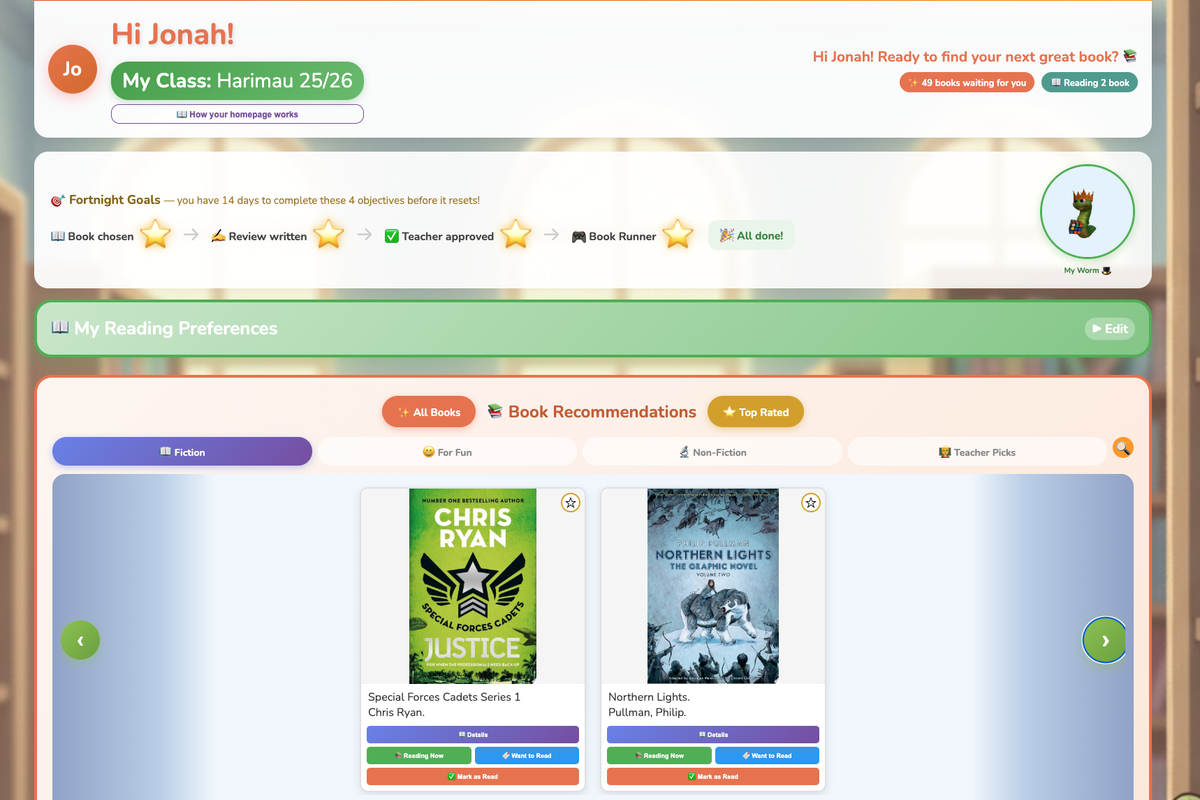
Sometimes a recommendation worked because it was an award-winning book the child had never heard of. Sometimes it was simply a genre they hadn’t tried before but which sat under a topic they’d listed as an interest — opening their eyes to a new corner of the library. Other times it was a natural next step: a similar author, a continuation of a series, a book that built on something they’d already loved and rated.
For data protection, LibraryAid is COPPA and GDPR compliant. Student data is stored securely in Google Firebase. No student email addresses are collected — students log in via a school-issued code and PIN, with no personal email required. Data is never sold or shared with third parties.
Positive Feedback From Colleagues and Family
Early on I told a colleague what I was trying to do. What she said, and the sincerity with which she said it, gave me more confidence than any tutorial or documentation. She said she genuinely believed I could make it work, and that I should not give up. Feedback from other teachers proved equally invaluable. It was frank and occasionally humbling. So far, one colleague has integrated the app into her class and found it very useful.
My 12-year-old son, however, became perhaps my most enthusiastic supporter. He spent considerable time testing the system, told his own school about it and, in what felt like a distinctly contemporary parenting moment, told me he’d asked an LLM whether LibraryAid had a high chance of being successful and it responded with an enthusiastic “yes.”
What My Students Thought
When my tool went live with my students, something shifted in them. Children who had been unenthused about the library before suddenly became excited to explore it. Finding their recommended book became a treasure hunt. Students began venturing into new series and authors they would never have chosen independently.
One student, an English learner reading approximately two grade levels below his current placement, made 3x the average reading progress of his classmates once he was matched to books that genuinely interested him at the right level. The technology didn’t fix his reading struggles, but it connected him to books worth the effort of reading.
I also read aloud to my class, ending the school year with “Swimming Against the Storm” by Jess Butterworth, which has a strong environmental theme. The impact of reading that book last year was striking: suddenly the majority of the class was searching the app for adventure stories with a similar feel. That moment reinforced something I believe deeply about the app — it works best alongside human influence, not instead of it. The app surfaces the right books for students, but the teacher or librarian sparks the interest.
What Vibe Coding Taught Me
Debugging code and diagnosing why a student isn’t understanding a concept require surprisingly similar thinking. For both, you need to be systematic, patient, and hypothesis-driven. Writing algorithms that adapt to different reading patterns made me think more clearly about differentiation. And spending months building something that real children would use every day gave me clarity into why so much edtech misses the mark. At least in my own experience, most education technology is built for administrators, not teachers. It optimizes for reporting and data dashboards rather than the daily reality of 30 children with 30 different relationships with reading. The products that work are the ones built by people who have stood in a classroom and felt the gap between what exists and what’s needed.
Although my tool surfaces an array of enticing books for children, there is no guarantee the recommendations will inspire them to take action. I remember a moment I had with one child this term, who showed me her curated list with a lost expression and eyes that were pleading for guidance. Her list had hidden gems and well-known classics, all with appealing covers — some in her comfort zone and some designed to stretch her thinking. However, the only one that interested her was a familiar series she already knew. The algorithm had done its job. What she needed next was a conversation with a trusted adult.
There isn’t a recommendation engine in the world that can replace the moment a child says, “I’m not sure about any of these,” and looks to their teacher or librarian for a nudge. The trust a child has for the person standing in front of them can’t be coded.
My advice to any educator considering building their own edtech tool: build something that extends what teachers do rather than replaces what they do. The technology should handle the matching but let the children’s learning guides handle the moment.
LibraryAid has turned out to be the most useful thing I have ever built, perhaps even eclipsing some of my lessons.


The Apple Watch Series 11 [GPS 42mm], priced at $279 for Prime Day (was $399), retains the same slim profile, while the always-on screen is clear even in direct sunlight. The battery now lasts nearly two full days on a single charge, allowing for less time plugged in and more time on the wrist, where it should be. Health tracking runs silently in the background and sends useful signals such as irregular beats or blood pressure changes without requiring any additional steps or complicated configuration. When paired with an iPhone, the watch handles calls, messages, and apps with ease, and the 5G option keeps everything responsive even when the phone is in a bag or another room.
Meta’s Quest 3S slips on easily and transports you immediately into virtual worlds without the use of wires or additional gear. The integrated Gorilla Tag experience transforms you into a nimble gorilla swinging from tree to tree and tagging teammates in fast-paced multiplayer battles that get your full body moving in a way that feels more like play than exercise. The full-color passthrough keeps the real room visible, allowing you to keep track of furniture and space while the virtual activity takes place around it. A three-month trial of other games, as well as exclusive in-game items and currency for Gorilla Tag, ensures that there is enough to discover straight away. Product page.
Ninja’s CREAMi 7-in-1 converts a simple overnight freeze into fresh homemade ice cream or sorbet in just a few minutes of processing after the base has set. You combine whatever ingredients seem appealing, such as milk and sugar for classic flavors, protein powder for a lighter treat, or fruit for a dairy-free option, pour them into the pint, freeze, and then insert the container into the machine and pick the desired setting. The powerful blades cut through the frozen block, changing it into a smooth, scoopable texture. A separate mix-in cycle allows you to fold in cookies, candy, or nuts at the end, retaining their delightful texture rather than blending into the foundation. Product page.
Elgato’s Stream Deck+ stands on your desk like a little command center, with eight LED buttons that identify their function and four smooth-turning knobs that allow precise control over whatever you assign them. A single button press can change camera angles during a stream, start or stop a recording, mute the microphone, or launch any software without the need to explore menus or recall complex key combinations. The dials allow you to easily increase or decrease volume, explore a video timeline, and change settings in small increments, while the touch strip above them allows you to swipe through additional menu pages when you need more options. Everything is linked using simple software that allows you to drag and drop operations onto the buttons and knobs, ensuring that the entire layout matches your personal workflow. Product page.
Roborock’s Q10 S5+ moves across floors according to its own schedule and returns to its port to empty its own dustbin, letting you to go weeks without touching the machine. The powerful suction takes pet hair and ground-in filth from carpets, while the vibrating mop removes ordinary spills and footprints from hard floors, automatically lifting itself when it detects carpet to ensure nothing gets wet where it shouldn’t. Smart mapping allows it to remember your home’s layout after the first run and thereafter clean only the rooms you designate or skip portions you indicate in the app. Dual tangle-resistant brushes keep things moving smoothly even in homes with long hair or shedding dogs, and the entire operation is quiet enough to be used while you are at home. formerly everything is set up the first time, the robot will simply keep the floors clean day after day with very little effort from you, transforming what was formerly a weekly duty into something that happens automatically. Product page.
The Anker SOLIX S2000 rests in a corner or closet and offers consistent power to a fridge, lights, or small appliances when the lights go out, allowing everything to run smoothly for hours or perhaps a complete day, depending on what you plug in. The efficient design consumes relatively little power on its own, so stored energy lasts longer than you may expect, and the long-life LFP battery cells allow for thousands of charges over many years without losing capacity. Five common wall plugs make it simple to connect daily gadgets without the need for adapters, and a quick recharge from a wall socket restores it to full power in less than two hours when needed again. App monitoring allows you to check the remaining runtime from your phone, while the complete unit remains small and portable enough to be transferred as needed. Product page.


AI agent orchestration platforms are popping up like weeds these days, but London-based AI transformation startup Mindstone’s Rebel might be among the most promising I’ve come across.
That’s because the system, which officially launched this week, is a local-first, agentic AI operating system distributed under a “Fair Source” license, allowing teams of under 100 users to freely adopt and customize it to suit their needs, while those organizations with more users will require paying for an enterprise license.
The marquee features are its simplicity and extensive customizability to fit any given team, no matter how unique or specific the workflows, all based around the common, open source standard file format markdown, and, as a result, an organizational memory layer that ensures agents reliably use the enterprise’s preferred AI models for each given task or even subtasks — dynamically switching between local and cloud ones in a predictable, visible way to save costs and maintain data privacy and security as needed.
“Shared memory is the most empowering thing you could possibly do with a knowledge-worker AI,” said Greg Detre, chief technology officer (CTO) of Mindstone, in a recent video call interview with VentureBeat. “You get this feeling of being a super-organism as a company that just gets smarter and smarter.”
Rebel is available now for macOS on Intel and Apple Silicon machines, as well as Windows, with Linux support in development.
Mindstone has raised $5 million from private investors including Pearson Ventures, Moonfire Ventures and Zanichelli Venture.
What makes Rebel distinctive is its local-first architecture.
Instead of the approach found in developer-heavy agent frameworks such as as LangGraph, CrewAI and AutoGPT, which require teams to wire together databases, cloud infrastructure and state-management logic, Rebel’s core agent memory and instructions live across local markdown (.md) text files — arguably the simplest, easiest, and most popular way to steer AI agents, one that has been widely adopted by AI developers and power users around the globe.
Mindstone says Rebel stores its state, prompts, task instructions and memory hierarchy in these files, allowing users and companies to easily inspect, move or modify them as needed. A primary configuration file, agents.md, acts as the agent’s core instruction layer and runtime boundary.
That architectural choice is partly about cost. Mindstone argues that common office formats such as Word documents and PDFs often carry formatting and metadata overhead that consumes model token context and raises API costs. Markdown keeps the information closer to raw text, allowing more of the model’s context window to be spent on the actual task rather than document structure.
The company also positions the approach as a hedge against vendor lock-in. If a company’s agent instructions, automations and memory are stored locally as text files, they are not trapped inside one SaaS provider’s interface or database. That matters more as enterprises begin giving AI systems broader access to email, calendars, documents and internal workflows.
Rebel also lets users create repeatable AI workflows. “Skills” are saved multi-step procedures an agent can reuse. “Operators” adjust how the agent behaves for a given task, such as reviewing a pitch deck from an investor’s perspective or evaluating work through a security lens. “Automations” can run scheduled background tasks, such as scanning messages or files, finding relevant updates, drafting responses, or preparing work before an employee opens the app.
Another important feature is multi-model orchestration. Rebel can break a task into parts and route different steps to different models, including splitting between local and cloud-based ones depending on the sensitivity of the information or as guided by enterprise policies.
A more powerful model can handle planning or complex reasoning; a cheaper model can handle routine work; a local model can handle sensitive steps or approval checks. This matters for enterprises that want flexibility or are seeking cost controls: not every task need be sent to the same expensive cloud model, and some enterprise workflows prohibit sensitive corporate data leaving local infrastructure.
“I want to be able to say, ‘Help me with this,’ and it knows what’s personal, what’s sensitive, and what can be shared with the whole company,” Detre explained.
That model-agnostic setup gives companies more control over cost and security. Data-heavy work can run on lower-cost models such as Llama or DeepSeek. Higher-level reasoning can be reserved for more expensive models. Sensitive work can be routed through a local model running on the user’s machine, keeping that information from leaving the device.
This approach also gives enterprise teams a way to mix cloud and local inference without treating the choice as all-or-nothing.
By shifting away from centralized, monolithic cloud interfaces toward a local file-driven architecture, Mindstone is introducing a model for how enterprise technical decision-makers orchestrate autonomous workflows without forfeiting data sovereignty or predictability
Mindstone CTO Greg Detre designed Rebel’s memory system to avoid a common problem in enterprise AI: dumping large amounts of company information into a database and hoping search will retrieve the right context later.
Instead, Rebel uses a tiered memory structure. When an interaction happens, the system estimates how likely that information is to be useful again.
Information with a high expected value is written into a local readme.md file tied to a specific project space. Information with a moderate expected value becomes a reference link back to deeper historical records.
Lower-priority material is stored in an indexed memory directory, where it remains available but dormant until a relevant task calls it back.
For larger organizations, Mindstone Pro adds an Impact Dashboard designed to show where Rebel is saving time and money across business units.
Mindstone says the dashboard uses a separate, closed LLM to evaluate telemetry and calculate business impact. The company says the system is calibrated conservatively, using the lower end of estimated performance gains to avoid inflated productivity claims.
That feature speaks to a practical problem for enterprise AI buyers: proving value without over-surveilling employees. Mindstone says the dashboard is isolated from individual workspaces, allowing IT and business leaders to evaluate adoption and return on investment without reading employees’ private agent activity.
Mindstone is releasing Rebel under a Fair Source license, a model meant to sit between fully closed SaaS and permissive open source.
Under the license, Rebel’s code is viewable, auditable, modifiable and deployable. Individuals and organizations with up to 100 concurrent users can run it for free. Once an organization exceeds that threshold, it needs a commercial Mindstone Pro license.
The license also includes a two-year sunset clause. Twenty-four months after a given version is released, that version automatically converts to the MIT open-source license.
For enterprise buyers, the practical pitch is that Rebel reduces the risk of being trapped. If every automation, memory file and agent instruction is stored locally in markdown, a company can move its data and workflows elsewhere if needed. The product may be commercial, but the underlying work is designed to remain inspectable and portable.
Rebel’s debut on the open access tech product sharing platform Product Hunt this week prompted technical questions about how a local-first agent should handle permissions, safety checks and shared memory.
One developer, Nikita Pokryschko, asked whether approval checks for sensitive actions could run entirely on a local model, or whether the gating logic still required a cloud call.
Detre responded by explaining Rebel’s separation between planning, execution and background safety logic. Wöhle added that companies can configure Rebel to rely entirely on a local model for gating decisions.
That distinction matters for corporate security teams. Autonomous agents often need broad permissions to read files, draft emails or interact with internal systems. If the final approval layer depends on an external cloud model, some companies may see that as a compliance risk. Mindstone is arguing that Rebel can keep those approval boundaries local.
A second discussion focused on how Rebel decides what memory can be shared. Product developer Clement Morel asked whether shareability is determined by content, user settings or learned behavior, and what happens if the system gets it wrong.
Detre said Rebel uses the user’s local “Chief-of-staff README” and defined spaces to separate private, team and company-wide information. When the agent encounters ambiguous context, the system pauses and asks the user for approval before proceeding.
That emphasis on visibility is part of Mindstone’s broader argument against opaque agent systems. As CEO Joshua Wöhle put it in a post on his LinkedIn account: “If an agent is going to sit inside your workspace, remember your context, and ask permission before changing the world, you should be able to see how it works. Not because everyone will read the code, but because someone can.”
Mindstone says Rebel has already been deployed across the 250-person workforce of customer Epignosis, covering sales, engineering, product, finance and customer success teams.
“The entire organization is operating on Rebel today,” Wöhle told VentureBeat.
Over a 12-week deployment, Mindstone says Epignosis recaptured the equivalent capacity of eight full-time roles. The company says adoption spread organically after employees saw colleagues automate time-consuming work, a pattern employees reportedly called the “potatoes effect.”
The Epignosis case is central to Mindstone’s argument that enterprise AI should not be treated as a set of isolated personal tools. Rebel’s shared-memory design is meant to let workflows move across teams and improve as more employees use them.
“The border between learning and doing is fading out – and that changes everything about how you scale,” Epignosis CEO Dimitris Tsingos said in a statement provided to VentureBeat by Mindstone.
Mindstone Learning Limited, headquartered in London, launched in 2020 under the direction of CEO Joshua Wöhle, previously a co-founder of the digital child safety firm SuperAwesome. Originally positioned in the consumer education technology market, the company built a digital curation tool likened to a “Spotify for learning” that utilized compound learning methodologies.
However, following the widespread commercialization of generative artificial intelligence platforms between 2022 and 2024, Mindstone moved into business-to-business enterprise enablement. Leadership identified a critical “last-mile” barrier: while AI tools promised substantial productivity gains, traditional corporate training failed to equip the workforce to practically integrate them into daily operations.
Today, Mindstone functions as a comprehensive enterprise software and training ecosystem designed to maximize corporate return on investment for existing AI licenses. The product architecture systematically addresses different organizational tiers through highly contextualized, “live-fire” software applications rather than abstract slide presentations.
Financially, Mindstone utilizes a hybrid capitalization strategy that interweaves institutional venture capital from entities like Moonfire Ventures and Pearson Ventures with community-based equity crowdfunding on platforms such as Seedrs and Crowdcube.
Mindstone has successfully penetrated the enterprise market, securing commercial contracts with blue-chip corporations including The Home Depot, Hyatt Hotels Corporation, Pearson, and Ernst & Young.
Ultimately, Mindstone positions itself as the crucial antidote to corporate inertia, ensuring organizations establish the internal competency required to execute successful AI transformations.
Rebel arrives as companies are trying to move from AI experimentation to AI operations. The first wave of enterprise adoption centered on access: giving employees chatbots, copilots and model subscriptions. Mindstone is betting the next wave will center on coordination.
That means shared memory, reusable workflows, local control, flexible model routing and measurable business impact. It also means giving enterprises a way to inspect the systems they are being asked to trust.
The company’s challenge now is execution. Local-first software can be harder to manage than cloud SaaS. Shared memory raises governance questions. Multi-model routing adds complexity. And enterprises will still need proof that agentic workflows can deliver reliable productivity gains without creating security or compliance headaches.
But Mindstone is making a clear argument: buying AI seats is not the same as building AI infrastructure. Rebel is its attempt to turn scattered employee experiments into an operating layer for work.




Weekend Open Thread: Miami – Corporette.com


Renter of Home in Anne Heche Crash Denies Settlement With Son

Two goals and an assist by sheer aura: Cristiano Ronaldo just entered the World Cup chat


Microsoft accidentally kills epic Outlook email threads


Soccer-U.S. defends Iran World Cup travel restrictions, says discussions ongoing
Bitcoin (BTC) Dips Below $62K, Ethereum (ETH) Plunges 6% Daily: Market Watch


Andy Burnham and the meaning of Makerfield


BBC Reporter Discusses Cross Party Criticism Of Trumps Iran Deal


Securitize Wraps Roubini's SEC-Registered ETF as Dubai VARA Digital Security
Entergy settles forward sale agreements, raises $672 million in cash proceeds

Wall Street Week Ahead: Investors see Micron earnings as pulse check of AI rally momentum


Keir Starmer Allies Question His Chances For No 10


AWS enters the context layer race with a graph that learns from agents, not manual curation

Can Charles Hoskinson Really Rescue Cardano?


HIVE shares jump as $220M AI deal speeds Bitcoin mining pivot


Jake Chervinsky accuses CME of protecting derivatives monopoly

Signal’s Meredith Whittaker says AI chatbots ‘are not your friends’ and calls Copilot agents a backdoor


Jose Alvarado Wants Taylor Swift at More Knicks Games


Nearly 7,000 fake Amazon domains registered ahead of Prime Day 2026, researchers warn


Brexit cost 6% of UK economy, Bank of England company data suggests


You must be logged in to post a comment Login