Earlier this week we noted how ABC has been asking its audience to give the Trump FCC an earful about its clumsy efforts to censor journalists, comedians, and daytime talk show hosts:
The ad only hints at the fact that FCC boss Brendan Carr has launched a fake “investigation” of ABC because The View hosted Texas Senate hopeful James Talarico last February. As we’ve explored repeatedly, Carr is pretending that this appearance violates a dated and irrelevant FCC “equal time rule,” despite the fact the show has had a formal exemption since 2002.
It’s all weird, performative bullshit designed to chill speech and punish ABC because President Trump is a thin-skinned autocrat. It’s also intended to send a message to all major media outlets that if they platform people openly critical of our dim kakistocracy, they’ll be inundated with endless costly legal headaches and bad “press” (read: lots of hostility aimed at them by right wing propaganda outlets).
Advertisement
Despite the ABC ad being relatively timid, it clearly upset the similarly-thin-skinned Carr, who took to Elon Musk’s right wing propaganda website to whine about it:
Again, The View was already exempt from this rule, for more than two decades. Even if it wasn’t, the rule hasn’t been enforced in 26 years because it’s a relic that doesn’t matter. It was crafted for an era where a TV appearance could make or break a political candidacy, requiring that a politician of the opposite party ideology get “equal time” on broadcast airwaves.
But broadcast is increasingly irrelevant, as is the rule, which you’ll notice Carr doesn’t enforce for right wing radio (because this is an ideological crusade by a weak zealot). This is also a giant loser of a case on First Amendment grounds. But it could be a particularly problematic case for Carr during discovery, given the indications that Carr covertly worked with right wing broadcasters to falsely make it look like ABC’s affiliate actively broke the law by not filling out some paperwork.
Carr knows all of this but his audience of bots and MAGA zealots over at ex-Twitter obviously don’t. They will simply see women daytime TV hosts and “news” in the same line of sight and immediately suffer embolisms of hate.
“Some may dislike certain — or even most — of the viewpoints expressed on ‘The View’ or similar shows,” ABC said in one recent filing. “Such dislike, however, cannot justify using regulatory processes to restrict those views.”
Advertisement
Carr doesn’t want this to ever see an actual courtroom. He just wants to intimidate corporate media giants, censor valid speech, and then bask in the adoration of the misinformed and deluded.
But it’s genuinely bad news for Carr and Trump that Disney Corporation is fighting back. If they can openly and legally demonstrate that Carr is a toothless extremist hack, other corporations are likely to be encouraged. And as Trump’s health and political power starts to buckle and fail, that sort of uncharacteristic corporate media courage could prove contagious.
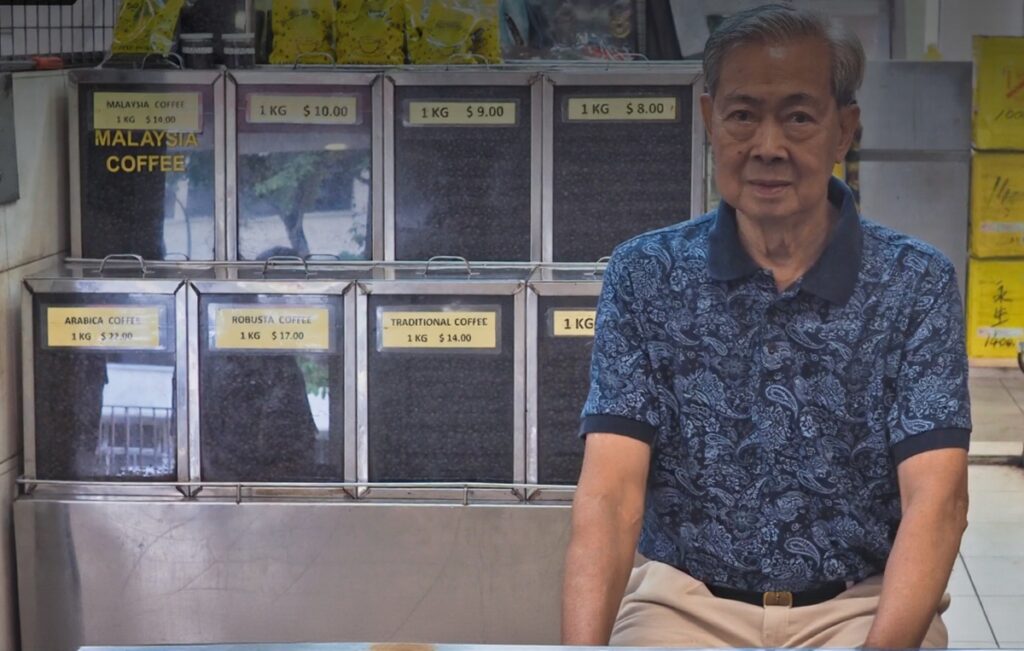
Most family bizs don’t last this long, but Yong Seng Coffee is still roasting after 5 decades
For more than five decades, Yong Seng Coffee has been a fixture at Tiong Bahru Market.
It has weathered the rise of instant coffee, the café boom that’s transformed the neighbourhood in the 2010s, and, more recently, the emergence of a specialty coffee scene that has made Singaporeans increasingly discerning about what goes into their cup.
Through it all, the Tay family has continued roasting the same honest Nanyang-style kopi that they first sold door-to-door in the 1960s.
Vulcan Post spoke with Marcus Tay, 34, the third-generation owner of Yong Seng Coffee, about how a family business built on trust and tradition has remained relevant across generations—and how he is carefully introducing the brand to a new generation of coffee drinkers without losing the values that have sustained it for decades.
Advertisement
Going from door-to-door to sell coffee
Founder of Yong Seng Coffee, Tay Yiong Theng./ Image Credit: Yong Seng Coffee
The story begins with Marcus’s grandfather, Tay Yiong Theng, who started his career in the coffee industry at just 13 years old, taking orders and delivering drinks at a coffee stall. The stall owner noticed his interest and eventually taught him the art of Nanyang coffee roasting.
Armed with that knowledge, Tay struck out on his own in 1960, roasting coffee in the mornings and selling it in the evenings. Back then, roasting was done in a wok over wood fire, requiring constant attention and careful control of the heat.
To get customers, he did what any resourceful hawker of that era did. He knocked on doors in the neighbourhoods around Tiong Bahru and Jalan Kukoh, moving through the streets on foot with his hawker cart while he roasted coffee beans on the go.
Eventually, the hustle paid off. Tay earned enough to formally incorporate Yong Seng Coffee in 1974, opening a stall at Tiong Bahru Market and pooling resources with partners to operate a shared roastery—giving him the capacity to supply not just walk-in customers but also businesses at coffee shops, school canteens, and other businesses, too.
Marcus’s father joined the fold in the late 1970s and early 1980s, helping with deliveries and working the factory floor. By the time Marcus was old enough for primary school, he was already spending his school holidays following his grandfather around on his coffee deliveries.
Advertisement
A business built on trust
Marcus, the third-generation owner, mainly runs the stall at Tiong Bahru Market./ Image Credit: Yong Seng Coffee
What has kept Yong Seng Coffee going across three generations? Marcus’s answer centred on ethics.
“My grandfather had a very strong principle of being honest and transparent with his customers,” he said. “Because of that, he built a lot of trust, and a lot of our long-term customers have been with us since they were kids.”
Over the years, the trust between customers and Yong Seng Coffee has been tested by rising costs.
According to Marcus, coffee bean prices have climbed two to three times since before COVID-19, driven by adverse weather conditions in the Indonesian archipelago—where most of their beans are sourced—reduced supply, and surging global demand, including from large international coffee chains buying up Indonesian beans in bulk.
Rising energy costs have also followed, making each roasting batch more expensive as gas prices rise.
Advertisement
Faced with that pressure, the family made a difficult choice. Rather than quietly reduce the quality of their coffee while holding prices steady, they raised prices and told their customers why.
“Surprisingly, they understood,” Marcus said. “A lot of them gave feedback that they would rather pay a bit more and have the same quality, than maintain the same price and experience a drop in quality.”
That personal relationship with customers, especially with regulars, has become a defining feature of how Yong Seng Coffee operates.
Keeping the roasting process traditional
Yong Seng Coffee’s former roastery, which the business operated out of until 2021 before shifting production to a facility run by its long-time roasting partners. / Image Credit: Yong Seng Coffee
Yong Seng’s roastery operation runs through a partner facility today, but the Tay family controls every step of the process and craft detail. The original shared roastery wound down around 2021 when the older partners retired.
The setup involves a 60kg roaster for the core kopi blends and a 15kg roaster for specialty coffees. Each month, the team processes just over 1,000kg of beans, roasted in weekly batches and stored in an 800 sqft processing facility where blending and online orders are also handled.
Advertisement
For traditional kopi specifically, the roasting process runs in two stages: first roasting the beans, then coating them with sugar and margarine, before cooking them, taking roughly 40 minutes per batch.
On the other hand, the specialty coffees undergo a cleaner, shorter process at around 20 minutes.
For every new coffee bean that comes in, Marcus first runs a small-batch test roast on a 1kg machine to develop its ideal roast profile before scaling it up on the main roaster.
The challenge, he said, is that consistency still relies heavily on human skill and intuition. Roasters need to read the beans, account for changes in humidity, and spot subtle differences before the machines can.
Advertisement
Yong Seng’s coffees start at S$7.60 per 300g.
Making the online shift
Yong Seng Coffee’s coffee is offered in drip bags, apart from being freshly ground on the spot./ Image Credit: Yong Seng Coffee
When Marcus joined the family business in 2019, Yong Seng was entirely a physical operation. He was in his late 20s, coming from a career in internal audit, and the gap between how the business operated and how his generation shopped was immediately obvious.
As such, Marcus went on to modernise Yong Seng Coffee’s packaging and launched a website to open the store to online orders.
The timing turned out to be fortuitous. Not long after, COVID-19 hit, and the wet market was no longer easily accessible. Customers who couldn’t get to Tiong Bahru Market found them online instead, and that period helped establish a digital customer base that has stayed.
Going online also opened the door to expanding the product range in ways that the physical stall—with its early morning hours and limited space—couldn’t accommodate. Yong Seng now offers multiple grind sizes (fine, medium, and coarse), a range of online-exclusive formats including single-serve sachets, batch brew sachets, and drip bags, bringing in new customer profiles by providing convenience.
Advertisement
Expanding Yong Seng’s range of grind sizes was a meaningful shift, particularly for customers buying its specialty coffee beans. For years, offering only a medium grind kept operations simple and order fulfilment efficient.
Introducing more grind options meant processing orders individually rather than in batches, inevitably slowing things down. But for home brewers using equipment such as moka pots, pour-overs, or French presses, the right grind size can make a significant difference to the final cup.
It’s a trade-off Marcus is happy to make—one that reflects the care and craftsmanship he believes good coffee deserves.
We figured we should do it. It allows the coffee to be better presented to the customer, and they’re able to brew it better.
Bridging Asian kopi and specialty coffee
Yong Seng Coffee offers both kopi (Nanyang coffee) and specialty coffee./ Image Credit: Yong Seng Coffee
Perhaps the most personal addition Marcus has made to the business is the #dYScover collection—a rotating lineup of single-origin specialty coffees that changes every two months, chosen by Marcus himself, from beans sourced through a trusted trader.
The idea came from his own relationship with coffee. He used to prefer specialty coffee over kopi, and when he first joined the business, he half-wondered whether the future was in moving entirely toward specialty. Moreover, with many café concepts popping up in Singapore over the years, Marcus realised the demand for specialty coffee was becoming on par with local kopi.
Advertisement
What the #dYScover range does is give customers a reason to come back regularly and explore beans from all over the world, from South America to the Caribbean.
Marcus selects each offering with an eye toward variety, avoiding repeated origins and flavour profiles where possible. The current offering for Jun and Jul includes beans from Guatemala, alongside the core collection blends that have been there since the beginning.
The collection has also helped shift some customers’ perceptions of kopi itself. Many older customers, accustomed to the earthier, more bitter profile of traditional Nanyang coffee, initially resist anything that tastes acidic, a quality that’s natural in Arabica beans and which Marcus finds adds sweetness and complexity to a cup.
However, with the #dYScover collection, getting customers to try something new besides kopi, and to understand why it tastes the way it does, has become a norm for Yong Seng Coffee.
Advertisement
“I get to educate my customers, and they get to enjoy good coffee,” he said. “I think that’s a win-win.”
Staying deliberately small
Yong Seng Coffee typically roasts about 1,000kg of coffee a month./ Image Credit: Yong Seng Coffee
One thing Yong Seng has not done is expand aggressively.
There are no plans for multiple outlets, no wholesale push into supermarkets, and no ambition to see their beans sitting on shelves in chain stores—not because the opportunity hasn’t arisen, but because Marcus is wary of what that would mean for quality.
“We can’t control how quickly it moves,” he said of wholesale retail. “It could sit on the shelf for two or three weeks, and by the time the customer gets it, it’s not the experience we want them to have.”
The business, as Marcus’s grandfather always ran it, has avoided taking on significant debt and prioritised keeping cash flow healthy. Growth has come slowly and deliberately.
Advertisement
The online store expanded its reach without requiring new physical space. “We evolve very slowly, but consistently,” Marcus said.
For now, Marcus is focused on deepening what Yong Seng already does well—roasting honest kopi, introducing customers to good coffee from around the world, and being transparent with the people who keep coming back.
His advice to anyone looking to enter the coffee business in Singapore distils the same philosophy his grandfather started with: offer something consistent, improve openly, and don’t rely on marketing spend to do the work that product quality should.
“Consumers in Singapore are smart enough to see that,” he said. “If you’re consistently improving and transparent about it, I think the local consumers appreciate that and will support the business.”
The robots glide across the floor, sometimes pausing to spin a quarter turn or two before resuming their route. They come close to one another but never collide. It’s not choreographed – they’re adapting on the fly – but the movement does have the feel of a ballet.
If ballet dancers were mechanized platforms on wheels, that is. Flat-topped and low to the ground, like oversized bathroom scales granted the gift of movement and the ability to navigate on their own.
These are Amazon’s Proteus robots in action.
Advertisement
In a spacious Amazon warehouse in London, as in its counterparts around the world, Proteus, Titan and fellow robots are perpetually tasked with fetch quests – finding and retrieving shelving units that contain items that all of us order day in and day out and bringing them to stations where those items are picked, packed and sent on their way.
Some of those days are busier than others – Prime Day sales, for example, when Amazon orders surge. During these periods, fulfillment centers bring on thousands more workers and the robots keep pace.
We visited two Amazon locations – the LCY3 London fulfillment center and the BOS27 robot development facility in Westborough, Massachusetts – to better understand the role robots play in ensuring our packages reach us at speed, both now and in the future.
After decades of humanity’s sci-fi-inspired preoccupation with robots, advances in AI (including large language models and vision language models) over the past five years are increasingly allowing robots to interact with people in more natural ways. For the most part, these real-world robots bear little resemblance to the pop culture depictions, particularly of the humanoid variety. Humanoids are starting to spring up, but most robots around us today are much closer to the type Amazon and other companies are using in industrial settings.
Advertisement
Proteus version two — coming soon to a fulfillment center near you.
Katie Collins/CNET
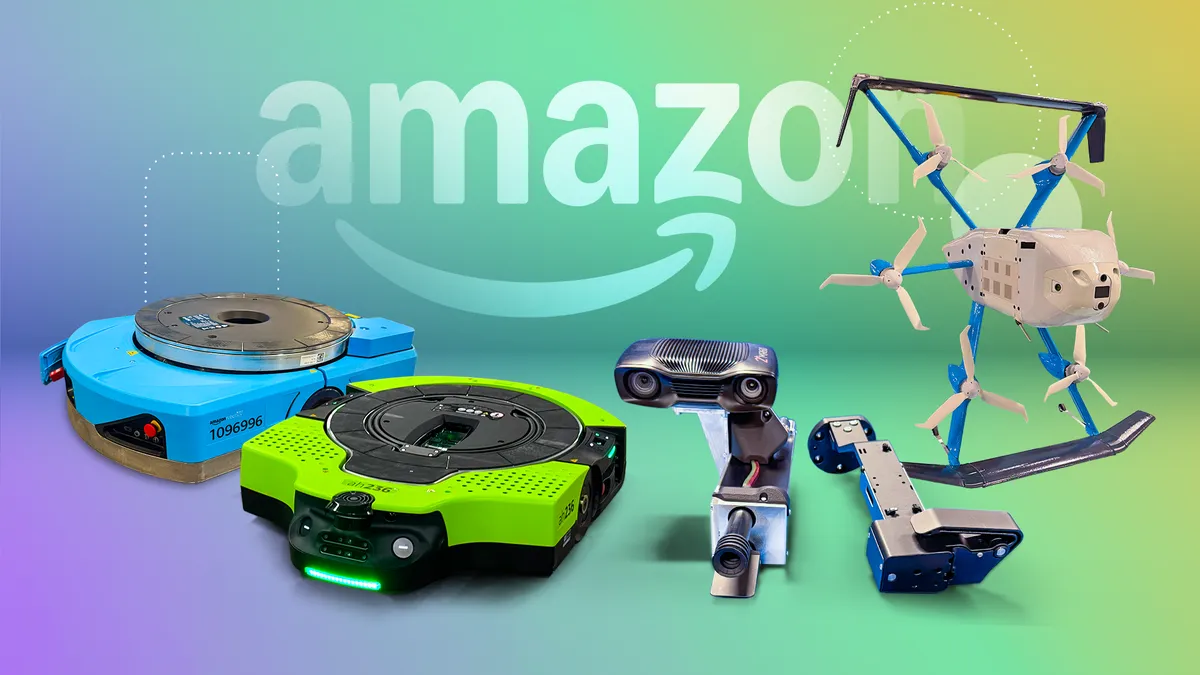
In Amazon facilities, the robots range from Proteus, which could be a Roomba’s more strapping younger sibling, to Vulcan, a robotic arm with a sense of touch that can pick up objects and understand what it’s handling. Altogether, Amazon has over 1 million robots operating in fulfillment centers, handling tasks such as stowing, picking, sorting and transporting.
Even though Amazon has been developing robots for years, it’s still only in the early stages of growing its robotics portfolio, said Tye Brady, Amazon’s chief technologist, speaking in London in early June.
Advertisement
What it’s learned so far is that robots make the environment safer, and therefore more efficient. In centers where robots have been deployed, Amazon has seen a 41% reduction in the number of accidents and a 40% increase in the amount of goods delivered.
“The efficiencies allow us to pass on a low cost to our customers,” said Brady. “The robotic systems allow us to store more goods physically closer to our customers as well.”
Over time, Brady added, the gradual introduction of robots is creating a powerful cycle within Amazon. “We deploy systems, we learn from them, we improve them and then we expand on what they can do for people,” he said.
That’s exactly what it’s done with Proteus, with a new version ready and raring to replace the existing model in fulfillment centers across the globe in the next few years.
Advertisement
Freewheeling Proteus robot gets language skills
Proteus is Amazon’s first fully autonomous robot – a “collaborative robot” designed to work and move around in the same spaces as humans going about their normal activities, not cordoned off behind fences with tightly restricted access for employees. It’s loaded with sensing and navigation capabilities.
“You just put them where the people are, or put the people where they are, and they’ll get right around you,” said Travis Hearn, a QA engineer at Amazon’s BOS27 facility, located 30 miles west of Boston along a once rural road now lined with low-rise industrial and commercial buildings. Cyclone fencing divvies up sectors of a cavernous space, where a diverse array of mobility and manipulation robots go through their paces.
The more diminutive demo area for Proteus, by contrast, is wide open, simulating the fulfillment center terrain it’s built to traverse, potentially several hundred meters from where chutes drop customer packages to where those packages get placed into delivery vehicles.
Advertisement
In a London fulfillment center, an Amazon mobility robot has slid under a rack that it’ll lift and tote across the floor.
Katie Collins/CNET
A Proteus robot – 7.8 inches tall, 31.5 inches long and 29.9 inches wide – can carry up to almost 900 pounds. That’s modest compared to what the larger, lookalike Hercules and Titan mobile robots can carry (1,250 and 2,500 pounds, respectively). Racks holding the goods for delivery get stacked on top, creating tall rectangles that scoot from one station to another.
But Proteus can be much more freewheeling than its fellow bots. It doesn’t need markers on the floor to know where it is or what route to follow. It learns its environment over time. It also recognizes when something – or someone – unexpected is in the way.
“You could think of it like an invisible force field, a bubble around the vehicle. So if somebody stepped in the way of the vehicle, then it would come to a safe stop or slow down,” Scott Dresser, Amazon’s vice president of robotics, said in an interview this week at BOS27. “The intelligence is to find and detect people and safely avoid them.”
Advertisement
The first-generation Proteus has been around for several years, and Amazon has a little over 4,000 of them at 25 sites. Earlier this month, the company introduced the Proteus 2, which gains natural language processing so that people will be able to direct it with voice prompts.
“What makes this possible is a new AI architecture that allows employees to interact with Proteus through natural language using advancements in our generative and agentic AI systems,” said Brady.
Amazon employees will be able to talk to the robot the same way they do their colleagues, including gesturing – with a casual, “Hey Proteus, could you take this to the corner of the building?” It will be able to figure out route planning and timing and then execute the task on its own.
The second-generation Proteus will be rolled out to Amazon facilities in the coming months.
Advertisement
Robots doing fulfillment work for Amazon orders
The new Proteus will be deployed at LCY3 in the first half of 2027. Meanwhile, Amazon robots are already an essential part of the furniture.
Situated in Dartford, right at London’s eastern-most point, LCY3 is a strategically located fulfillment center on the banks of the River Thames, serving the British capital and beyond. Here, Prime Day orders are picked, packed and shipped across the UK and Europe.
Last year Amazon invested $60 billion across Europe to grow its operations on the continent, and it has ambitious goals for improving delivery times. It’s growing Amazon Now ultra-fast delivery to 20-plus sites in the UK, and it’s accelerating same-day delivery by adding more than 25 sites across Europe this year.
“When we make delivery faster, we are not just moving boxes quicker,” said Mariangela Marseglia, vice president of Amazon European Stores, speaking at the London event. “We are giving people minutes, hours back.”
Advertisement
Faster delivery, she added, comes from working safer and smarter. This is where the robots come in.
Amazon is experimenting with different robotic systems for different tasks.
Katie Collins/CNET
To hit its delivery goals in Europe, Amazon is investing more than $10 billion to expand and modernize its fulfillment network with robotics across the continent over the next few years. Some of the robotics systems it’s putting in place have been built on suggestions made by Amazon employees, said Armin Cossman, the company’s vice president of operations for Europe.
Advertisement
A new system called Stark, for example, was the idea of an Amazon operations employees in Spain. It picks up huge crates from conveyer belts and places them onto trolleys – repetitive work that puts an enormous amount of strain on the human body. Stark is being piloted in Barcelona, but Amazon plans to bring it to at least 15 more sites across Europe by the end of 2027.
It’s the first successful deployment of collaborative robots in Amazon’s fulfilment network, said Cossman. “Employees work side by side with collaborative technology – the same space working together on the same process.”
On both of our visits to its sites, Amazon was careful to impress upon us that this human-robot collaboration is a key part of its robotics strategy. The company, which has been repeatedly accused of unsafeworkconditions in its warehouses and of looking to replace workers with machines, wanted us to know, and you to know, that its robots aren’t here to take its workers’ jobs – just to make them better.
Advertisement
Amazon’s Proteus robots can navigate safely around other robots and humans.
Katie Collins/CNET
“When people have a people versus machines mentality, I find that wrong,” said Brady. “I believe that people, when they have technologies as a tool set, that there’s nothing in this world that they can achieve.”
Amazon has upskilled 700,000 workers, he added, with many more to come. He also anticipates the creation of new jobs linked to robotics as Amazon’s portfolio evolves.
“Robots create jobs. Full stop. It’s a fact,” said Paul Miller, vice president and principal analyst at market researcher Forrester. “New jobs are created to maintain the robots, to manage the robots and to do the new work that’s made possible because automation has lowered the cost, improved the consistency or accelerated the delivery of the tasks people once performed.”
Advertisement
Still, some individuals will be adversely affected by the disruption, Miller added. Those people will need to be supported as they change careers to ensure they’re better off.
At LCY3, there were many workers stationed across the 2 million square feet of operating space, spread out across airy halls with natural light flooding in from the Thames-view windows. Many were packing deliveries or unpacking returns, and some were working with and on the robots.
One key role is that of amnesty responder, whose responsibility it is to rescue items that have fallen from the pods the Proteus robots whisk around. Fallen items are the main point of failure in the Proteus system. When something tumbles out of one of the shelving units, the amnesty responder hits a button and the entire ballet pauses to allow the human in the loop to retrieve the offending object. Only once they’ve exited the arena does the dance continue.
On rare occasions, Amazon acknowledged, a collision occurs. Usually this will result in the Proteus needing a new camera lens, courtesy of the mechanic that’s always on hand. Then it’s back to work.
Advertisement
What next for Amazon robotics
Amazon’s robotics capabilities are evolving fast.
Beyond the walls of its fulfillment centers are delivery robots, such as the Amazon Scout and Amazon Prime Air drone. The latter is already live at eight sites across the US. Meanwhile, the company is testing the service in Darlington in the UK.
The MK30 drone can deliver shoebox-sized packages, allowing Amazon to deliver from a range of 60,000 items within a two-hour window. With its six propellors, a redundancy that allows the drone to continue on even if one fails, it will hover above the ground and drop packages without damaging them (it can detect obstacles on the ground).
Advertisement
Amazon Prime Air is another of the company’s robotics projects.
Katie Collins/CNET
Meanwhile, today’s robots are the preliminaries for what comes next. No, not humanoids, like in Elon Musk’s fever dreams of swarms of Optimus robots doing factory jobs.
Amazon has more modest expectations, targeting somewhere between what it’s doing with robots today and what humanoids may eventually deliver. That could include merging the capabilities of its mobility (e.g. Proteus) and manipulation (e.g. Sparrow) robots. Dresser said Amazon sees paths to using some combination of those technologies.
“How can we move and manipulate in the same robot, and what does that look like? Because we think that that is where our operations are heading,” Dresser said. “I think we’re going to see some new, interesting form factors in the coming months that are going to be in our warehouses very quickly.”
Advertisement
It’s clearly a company learning in real time – designing robots to meet its specific needs, and then refining them based on how they perform when thrust into real-world situations. “The systems we’re building today,” said Brady, “are laying the foundation for what comes next.”
Theory Professional arrived at InfoComm 2026 with two new loudspeaker products, but the SR-221.3 was the one that made it difficult to ignore the company’s booth. The extreme output, full range sound reinforcement loudspeaker is the latest addition to Theory Professional’s SR Series, designed for installations and portable applications that require serious scale, wide coverage, and the kind of dynamic headroom that makes most conventional commercial speakers sound rather polite.
Do not confuse Theory Professional with Theory Audio Design. The two brands share the same corporate umbrella and the engineering vision of founder Paul Hales, but they serve different masters. Theory Audio Design is focused on premium residential and custom installation systems, while Theory Professional takes that same emphasis on compact form factors, high output, advanced drivers, and refined voicing into commercial venues, hospitality spaces, houses of worship, entertainment installations, and live sound reinforcement.
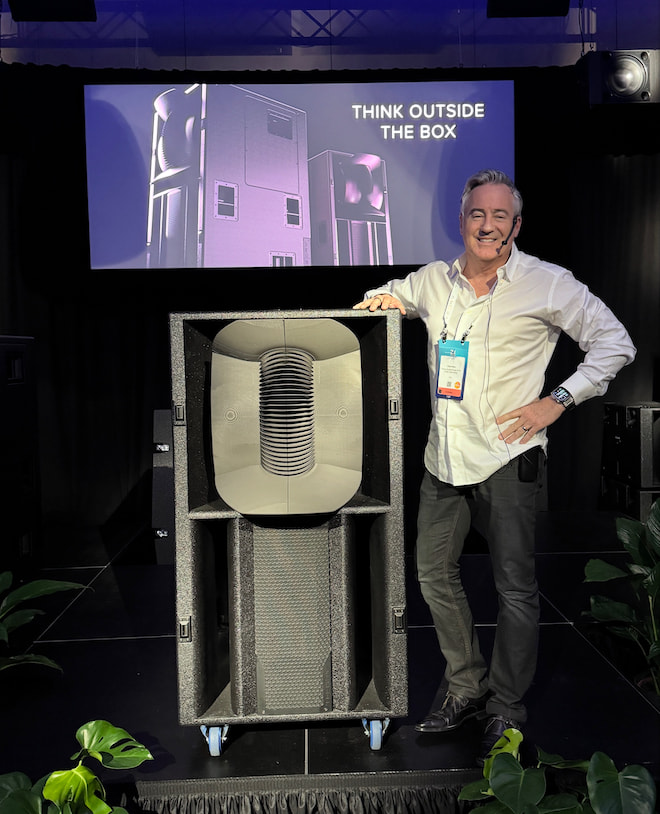
Paul Hales with Theory Professional SR-221.3 Loudspeaker at ISE 2026
First previewed at ISE 2026 in Barcelona, the SR-221.3 made its InfoComm debut as the flagship statement piece in that strategy. With dual 21 inch low frequency drivers, four 10 inch carbon fiber midrange drivers, and a 5 inch ring radiator compression driver, it is essentially Theory Professional’s argument that a single enclosure can deliver rock concert scale without requiring a small army of boxes and a spreadsheet to deploy them. For a deeper look at the SR-221.3 and the wider SR Series, refer to our report from ISE 2026.
At InfoComm 2026, Theory Professional also debuted the p9 Pendant Loudspeaker, a second new product shown alongside the SR-221.3.
Theory Professional p9 Pendant Loudspeaker: What We Know So Far
The p9 expands Theory Professional’s pendant loudspeaker lineup, building on the existing ic6 PENDANT. With this new model, Theory is targeting premium commercial spaces that require more output, wider bandwidth, and greater placement flexibility than a conventional compact pendant speaker can typically provide.
Advertisement
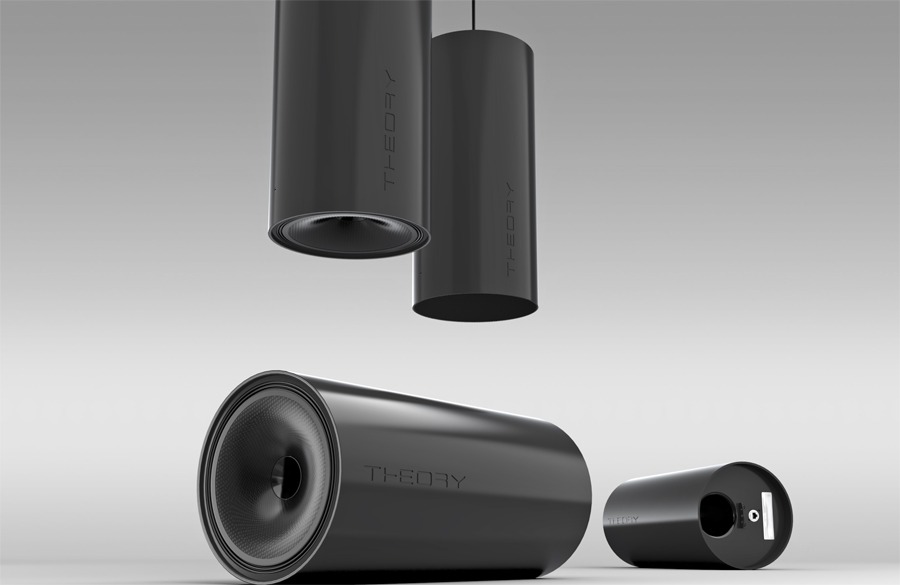
Theory Professional p9 Pendant Speakers
The p9 combines high output capability and dynamic range with a slender, design-conscious form factor. Inside its black anodized aluminum enclosure is a 9-inch driver system featuring Theory’s Theorem axi-symmetric waveguide and a carbon fiber sandwich low-frequency diaphragm. Theory specifies a frequency range of 45Hz to 20kHz, which means that many foreground music installations may not require a separate subwoofer.
The p9 is also designed to maintain 120-degree dispersion through the upper frequencies, creating broad and consistent coverage in spaces where listeners may be spread across a wide area. That could prove particularly useful in restaurants, hotels, retail environments, and other installations with lower ceilings, where fewer loudspeakers and broader coverage can simplify system design.
Its driver provides the radiating surface area of a 9-inch unit while fitting within an 8-inch chassis, helping Theory keep the overall enclosure compact. The bezel-free industrial design further minimizes its visual footprint, allowing the p9 to blend more naturally into hospitality, wellness, retail, and other architecturally sensitive environments.
Theory Professional positions the p9 as an answer to a growing mismatch in commercial AV: increasingly refined spaces are still too often fitted with loudspeakers that prioritize utility over both sound quality and appearance. The p9 is intended to give dealers, integrators, architects, and designers a more upscale pendant option without sacrificing output or coverage. It is expected to ship in Q4 2026 in passive 16-ohm/70V and PoE versions.
Advertisement
The Bottom Line
Under Paul Hales, Theory Professional continues to pursue a very specific corner of the market: compact loudspeakers that do not surrender dynamics, bandwidth, or intelligibility simply because the installation needs to look civilized.
The p9 is not aimed at projects that require the cheapest possible 70V pendant speaker. Its appeal is the attempt to combine wide 120-degree coverage, useful low-frequency extension, high output capability, and a compact, architecturally friendly enclosure in one product. For restaurants, hotels, retail spaces, spas, clubs, and premium residential or light-commercial projects with exposed ceilings, that could mean fewer speakers, less visual clutter, and potentially no subwoofer for foreground music systems.
Advertisement. Scroll to continue reading.
Theory has confirmed that the p9 and SR-221.3 will be shown and demonstrated at CEDIA Expo 2026 in Denver, giving the eCoustics team a chance to hear both products in person. That matters, because the specification sheet is promising, but the real question is whether the p9 can deliver the scale, tonal refinement, and broad coverage Theory is claiming without becoming another expensive pendant speaker that looks better than it sounds. We also expect CEDIA to bring clearer details regarding final specifications, availability, and pricing.
Advertisement
Price & Availability
The p9 will be available in Q4 2026 in both passive (16-ohms/70V) and PoE versions through Theory Professional commercial and residential partners.
Apple’s Certified Refurbished store has been a sanctuary for people who balk at the prices of new Apple products, but it provided little shelter from today’s increases across many of its lines. Reconditioned items are also more expensive.
Outgoing Apple CEO Tim Cook warned last week that price increases were coming due to the scarcity of memory components that are being reserved for building out AI infrastructure.
The stock of Apple’s refurbished store fluctuates wildly, but comparing a few current items as of June 25 with listings found at the Internet Archive’s Wayback Machine reveals price bumps of around 6% to 15%.
For example, a refurbished 15-inch MacBook Air M4 with 16GB of memory and 256GB of storage cost $929 on June 14, and now lists for $1,019, an increase of $90. It originally sold for $1,199.
A 14-inch MacBook Pro M5 with 16GB of memory and 512GB of storage was $1,359 on June 14, and now lists for $1,439, an $80 jump. Its original price was $1,599.
Kicking these prices up by less than $100 doesn’t seem like a big difference, except that these are machines with existing memory and processors — Apple likely isn’t sourcing new components. That said, there’s no visibility into what goes into each reconditioned product, so it’s possible these items did get new logic boards. But they could also have needed new screens or replacement cases.
Advertisement
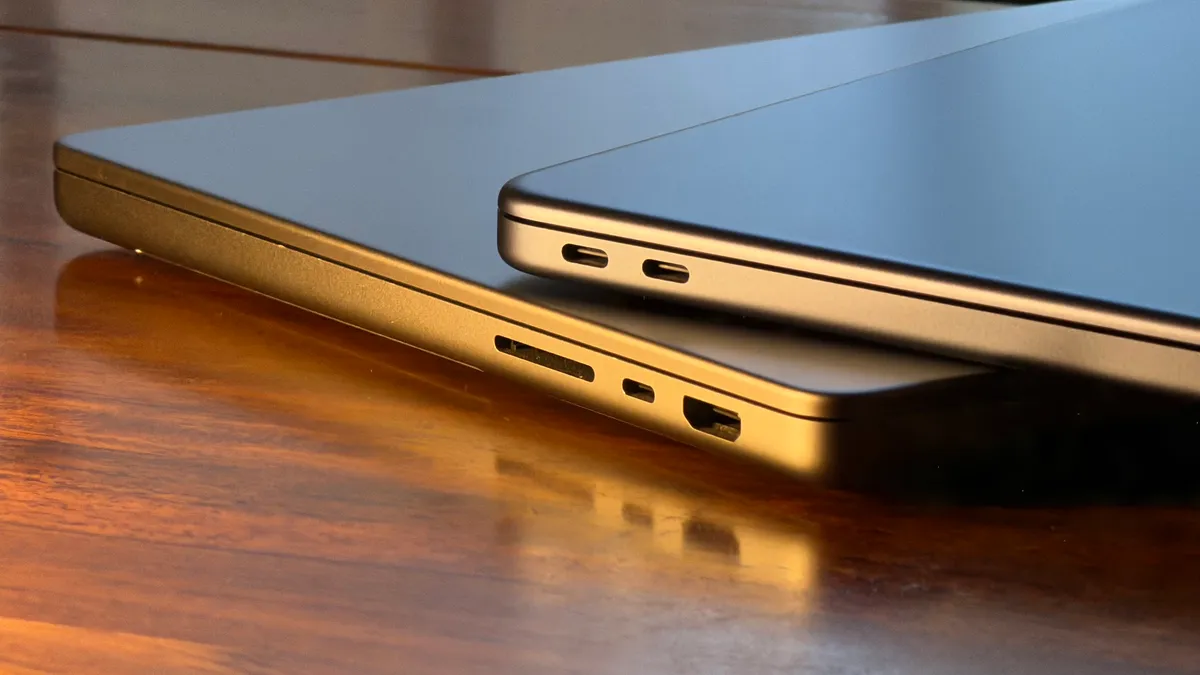
Apple’s Certified Refurbished store can garner great deals on reconditioned equipment, but it, too, is seeing price increases.
Apple/Screenshot by Jeff Carlson/CNET
Refurbished iMac models see a more substantial increase. A refurbished 24-inch iMac M4 with 16GB of memory and 256GB of storage was $1,099 on June 14 and now costs $1,269, a $170 difference.
Macs aren’t the only refurb products seeing higher costs. A 13-inch iPad Pro M4 (Wi-Fi model) with 256GB of storage sold for $1,019 on June 14 and is now $150 more expensive at $1,169.
Advertisement
The prices for new Apple TV and HomePod configurations also saw increases, but as of June 25, Apple did not list any refurbished inventory.
These are the costs for Apple’s own Certified Refurbished store. From a cursory look, it appears the price jumps haven’t migrated to other stores that sell refurbished Apple products, such as Best Buy. Those also include older models that can be great deals if you don’t need this year’s or even last year’s machine.
If you’re looking to buy one of the affected Apple products, Amazon’s Prime Day prices have not incorporated any of Apple’s new pricing so far.
An Apple representative didn’t immediately respond to a request for comment.
A long time before Beowulf clusters wired up with commodity Ethernet hardware became a hobbyist thing and a running joke, the transputer took a swing at a very similar architecture. This used stand-alone computers that were networked together with other transputer systems, to achieve task-level parallelism. For some people like [Lance Harvie] this is the kind of hardware that he used during his university years for a project, with him not only still having that hardware, but also recently adding to this collection with a recent eBay purchase.
The transputer story is a fascinating one, forming a major part of the UK’s semiconductor industry during the 1980s, creating a strong legacy as the computer industry awkwardly tried to figure out what types of parallelism to target. Whereas the industry largely moved to instruction-level (superscalar) parallelism alongside tightly coupled task-level parallelism along with multiple CPU cores on a single die, one could consider today’s supercomputer clusters to be one example of the transputer legacy.
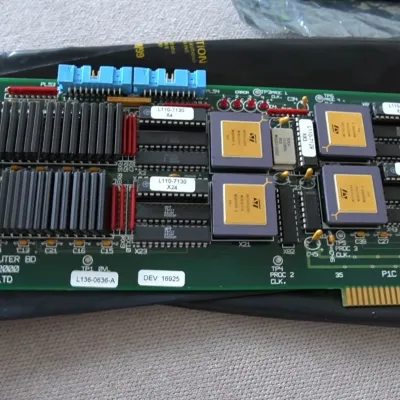
[Lance]’s university-era board features the T400, which he shows off while recalling programming it in the Occam language. He’s currently looking for an ISA-to-USB adapter to be able to use it again with a modern PC. While searching around, he came across an EBay listing for a four-processor board, containing four T425s. These are significantly more powerful and also can use external memory, unlike the T400.
This four-CPU board omits the external serial links, as it’s meant to be used in e.g. a scientific instrument as a stand-alone 4-unit transputer system, with all of the available four serial links per processor connected on the PCB. Even more interesting is that the processors on this board were manufactured in 1999 by ST, which was many years after transputers stopped being developed.
Advertisement
As [Lance] explains, this was due to the UK government pulling the plug on the transputer project, with the IP subsequently ending up at ST who kept producing the chips until 1999 at its Philippines plant.
In time, [Lance] hopes to power up all these boards and use them again in combination with a modern-day Linux-based computer. We’re definitely looking forward to seeing that happen.
Although you can definitely use any random MCU these days as your very own transputer module or link chip, with e.g. SPI making for an attractive alternative for the high-speed serial links, there’s always something to be said for using real, original hardware.
Screenshots from PaperTok-generated videos. (PaperTok.com Images)
Researchers have a new weapon against the scientifically inaccurate AI slop muddying public understanding of complex topics. A University of Washington team is helping scientists tell their own stories with a free tool that converts dense, jargon-heavy publications into short, accessible videos.
“There’s a lot of science communication happening in short form — primarily on TikTok, but also we’re seeing YouTube Shorts and Instagram Reels — these tidbits of science findings,” said Meziah Ruby Cristobal, a UW doctoral student in human centered design and engineering.
Cristobal and her colleagues built PaperTok hoping to use AI for good — to fight the technology’s irresponsible use elsewhere by non-scientists who misrepresent research.
The tool is simple. A researcher uploads a paper into PaperTok, which analyzes it to find attention-grabbing hooks and the most relevant takeaways for a general audience. The tool generates a script with an opening scene and narrative arc, producing a 45-second AI-narrated video. It closes with a reference to the paper, including the researchers’ names and the journal, to establish credibility.
Other tools can turn PDFs into videos, but Cristobal said PaperTok was intentionally designed to keep humans in the loop. It uses a multi-step process that requires approval at each phase, giving users the ability to edit the output down to individual words.
Advertisement
Cristobal presented research on PaperTok this spring in Barcelona at the Association for Computing Machinery’s Conference on Human Factors in Computing Systems. She co-led the study with fellow doctoral student Donghoon Shin; the senior author is UW professor Gary Hsieh.
Lead contributors on the University of Washington’s PaperTok study, from left: Gary Hsieh, UW professor in human centered design and engineering; and UW doctoral students Meziah Ruby Cristobal and Donghoon Shin. Cristobal presented the findings at the Association for Computing Machinery’s Conference on Human Factors in Computing Systems in Barcelona. (Photo courtesy of Cristobal)
A team of eight built PaperTok last summer, starting with interviews with science communicators and researchers before developing the tool and gathering user feedback.
“A lot of the researchers actually found huge value in seeing how the AI tries to visualize what they believe to be very abstract concepts,” Cristobal said. For many, it served as a brainstorming tool that highlighted new ways to communicate their findings.
There was critical feedback as well. Some users said the videos felt “too AI-ish,” pointing to issues like nonsense text. The UW team is continuing to refine PaperTok, including plans to let researchers incorporate charts and graphics from their papers into the videos.
PaperTok was built to translate research papers on human-computer interaction but has been tested on topics including physics, and it held up well. The team wants to expand its reach across research disciplines to create videos for social sciences and hard sciences alike.
Advertisement
The tool is free to use, but because video generation is computationally expensive, the company asks researchers to use a Gemini key so the cost is charged to their Google account.
Samsung just unveiled its newest budget phone, Galaxy A27 5G, starting at $349, which is $50 pricier than last year’s Galaxy A26, yet it actually takes a step back in a few areas that matter for everyday use.
What you actually get for the higher price
Samsung swapped the A26’s Exynos chip for a Snapdragon 6 Gen 3, which delivers a 10 to 20% speed boost, plus a GPU upgrade for smoother gaming and graphics work. The display still rocks a 6.7-inch Super AMOLED panel with a 120Hz refresh rate. It now has a punch hole camera cutout instead of last year’s teardrop notch, with slimmer bezels around the screen.
You get three memory configurations to choose from too, 6GB plus 128GB, 8GB plus 128GB, and 8GB plus 256GB. AI features get a small boost too, including multi-object recognition in Circle to Search, sharper Object Eraser results, and real-time translation in the Voice Recorder app across 22 languages. Samsung is sticking with six years of OS upgrades and security updates, just like before. However, most of this feels like a minor refresh rather than a real leap forward.
Galaxy A27 5G vs A26: what’s downgraded?
Samsung
The biggest letdown is IP ratings. Samsung Galaxy A26 was the first in its tier to score an IP67 rating, meaning it could survive a brief dunk, and Samsung loved bragging about that flagship-grade feature trickling down to a budget phone. Sadly, the A27 drops to IP64, which only shrugs off splashes and dust, not a dip in water.
Meanwhile, the cameras took a hit too. The ultrawide lens falls from 8MP to 5MP, and the selfie camera drops from 13MP to 12MP, though the 50MP main camera with OIS stays the same. Additionally, the phone is even slightly thicker now, going from 7.7mm to 7.8mm, which is a negligible difference, but a regression nonetheless.
Advertisement
If you are still looking forward to picking one up, the Galaxy A27 5G lands July 3 internationally and July 14 in the US. And if the price hike has you eyeing other options, here are four terrific Galaxy A37 alternatives worth checking out too.
Productivity company Notion is shutting down its email product, Notion Mail, on September 22. The company said it is discontinuing its email inbox in favor of its AI agent offering. It noted that users were increasingly handing over reins of their email to the agents, and not opening their inbox at all.
“As Notion agents have gotten more capable, we’ve seen more users hand off email workflows to them. Today, more than half of Notion Mail users manage emails without ever opening their inbox. So, we’re going all in on using agents to run your inbox,” the company said in a post on X.
Notion Mail is connected with Gmail, meaning all emails in the inbox will stay intact. However, users will need to export drafts and scheduled emails if they want to keep them. The company said that users can export snippets and auto-label instructions and use them elsewhere and emphasized that Notion’s email-based agents will keep working post-Notion Mail shutdown.
Notion announced its email product in preview mode in 2024 after it acquired security-centric productivity startup Skiff. The company aimed to integrate email with Notion AI with features like auto-labeling, filtering, and handling scheduling for users. The company made the product available to users in April 2025 to better compete with the likes of Superhuman and Fyxer. Newer startups like AgentMail are in step with Notion’s thesis and are trying to build an email service specifically for agents.
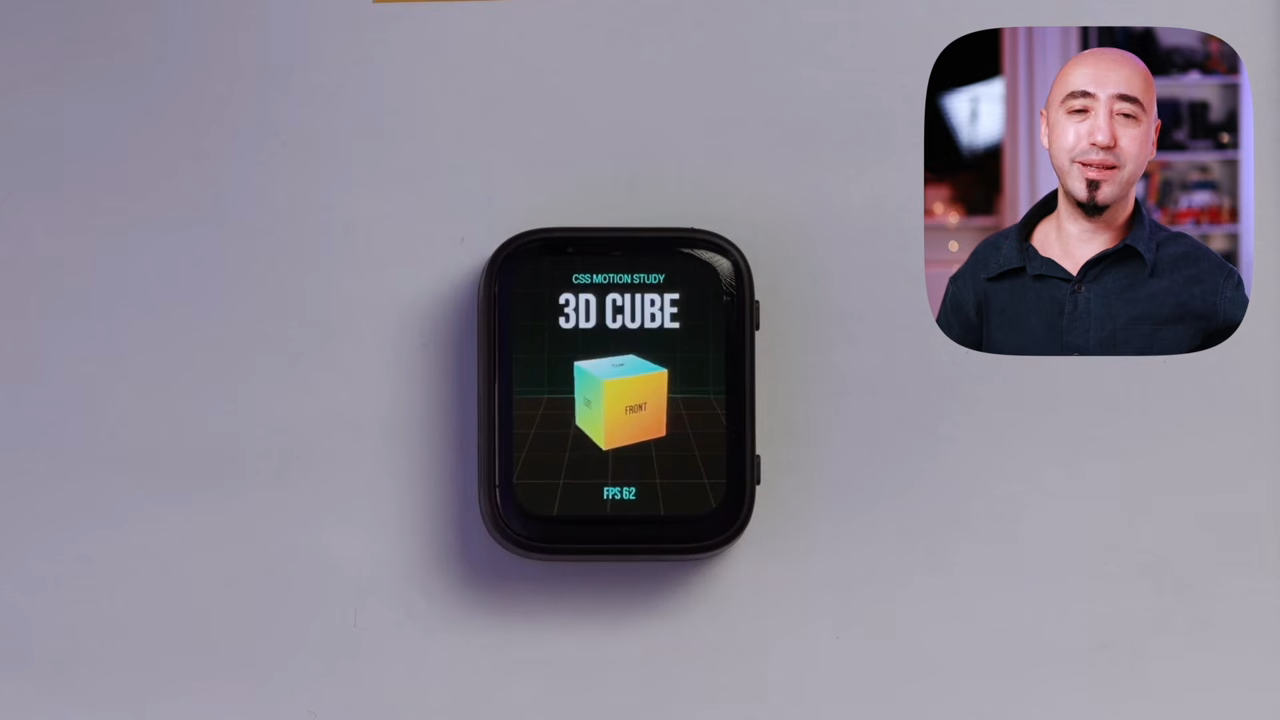
There are lots of graphics libraries available for the ESP32, and lots of ways to program one to boot. Even still, most of us wouldn’t immediately think to CSS when it comes to embedded products — yet that’s now a thing on the Espressif platform, apparently.
The Gea stack allows one to compose CSS and TypeScript code that is then turned into generated C++ code that compiles to native firmware. The team behind Gea have demoed this ability by running a 3D cube animation on an ESP32 at up to 60 FPS. This isn’t some ugly, low-res wireframe demo, either. It’s a full-color animation running on a 410×502 AMOLED screen. It’s very fluid, and can even handle transparency on the cube faces (albeit with a performance penalty).
It’s worth noting that this isn’t a full browser engine. As you might expect, some concessions had to be made to get it running on the ESP32. Namely, it doesn’t handle “:hover” states because it’s designed for touchscreen use, fonts are rasterized, and the UI tree is limited to just 512 nodes. Regardless, it shows that using CSS and TypeScript to develop for the ESP32 is entirely possible without some crazy loss of performance. If you want to build easy interfaces on an ESP32 while leaning on web dev experience, this could be very useful indeed.
Earlier today, Microsoft raised the price of its Xbox consoles by up to $150 in the US. Following the price hike, the asking price for the Xbox Series X 2TB edition has climbed all the way up to $800. The 1TB model now costs $650, while the Xbox Series S with 512 GB storage will now cost $400 in the US market.
What’s the game plan?
To retain gaming enthusiasts, Microsoft has introduced a new installment-based payment scheme for its consoles that is now live through its official storefronts. The Buy Now Pay Later system is currently available for the Xbox Series S and the Xbox Series X consoles — for both new and refurbished units.
Now that the price of Xbox has gone up by up to $150, Microsoft is introducing Buy Now, Pay Later option. “We’ve made it easier for players to use Buy Now, Pay Later options on eligible XBOX hardware purchases through Microsoft Stores, making it possible to break up your payment… pic.twitter.com/6PgLHsEumw
According to Microsoft’s website, the Buy Now, Pay Later system works in collaboration with PayPal and allows you to pay the full cost of a device in four installments (paid bi-weekly) with zero interest, or you can opt for monthly installments and pay them across installments.
Advertisement
If you opt to pay monthly for an Xbox console, you can break the installments across 24 months. There are no late fees or sign-up charges involved. “Flexible payment options help you pay how you want, at Microsoft Store,” says the company on its online storefront.
The caveat, and alternative
But in order to avail the buy now, pay later benefit on Microsoft Store, which is essentially an extension of the PayPal Pay Later system, your purchase must first be approved before you can decide the duration over which you want to pay the full cost of the Xbox console.
The situation with memory pricing is pretty grim. Earlier today, Apple raised Mac and iPad prices, after claiming the situation is unsustainable now. #Xbox is running into a similar wall. This is what the company has to say: “Unfortunately, console storage and memory prices… https://t.co/NERFunpNlv
In case your purchase is not approved by PayPal or you don’t have a PayPal account, you can head over to Amazon and purchase an eligible Xbox console via a financing scheme with zero interest, spread across 12 months.

















































You must be logged in to post a comment Login