

Crypto World
France Plans Stronger Security Response After 77 Crypto Wrench Attacks


French Interior Minister Laurent Nuñez says authorities have recorded 77 incidents involving kidnapping, extortion, or attempted extortion linked to crypto in the first half of 2026—an increase from 45 cases recorded across all of 2025. Speaking to the Association for the Development of Digital Assets (ADAN), Nuñez pledged a “more ambitious” government response to tackle the so-called “crypto wrench” attacks, where criminals use physical violence to force victims into handing over cryptocurrencies.
France is among the countries most frequently targeted for these attacks, in part due to the scale of retail adoption. ADAN estimates that about 11% of the French population owns cryptocurrencies—roughly 7.3 million people—making the country a major pool for criminals seeking both visibility and leverage.
Key takeaways
- France recorded 77 crypto-linked kidnapping/extortion incidents in the first half of 2026, up from 45 across all of 2025, according to figures cited by BFM Business.
- Nuñez says France’s dedicated prevention platform and rapid-alert/protection system has attracted 724 sign-ups so far.
- Emergency measures have reportedly led to 200 arrests, including an attacker detained within eight hours after a victim used an emergency identification hotline.
- Nuñez outlined a three-part plan focused on better intelligence-sharing, deeper coordination with ADAN, and improved operational alignment between security services.
- CertiK reports wrench attacks rose 41% globally in the first four months of 2026 versus the same period in 2025, with Europe accounting for most activity.
A sharp rise in crypto-linked extortion and kidnapping
Nuñez’s remarks underscore how quickly crypto crime involving physical coercion appears to be scaling in France. The 77 incidents reported so far this year, as cited by BFM Business, represent a steep year-over-year acceleration: 45 incidents were logged over the entire previous calendar year of 2025.
Nuñez told ADAN that authorities regard these cases as serious and that public concern is justified. That framing matters for both policy and investor sentiment, because it signals that the state is moving beyond general warnings and into more structured prevention and enforcement.
France expands prevention and emergency response
Earlier in 2026, French authorities reportedly launched a prevention platform alongside a rapid-alert and protection system for crypto holders and professionals. Nuñez said the initiative has already reached 724 sign-ups, suggesting that at least some in the sector are willing to use formal reporting channels and risk-reduction tooling.
According to Nuñez, the emergency approach has also translated into enforcement outcomes. He said it has resulted in 200 arrests, and highlighted a recent case where an attacker was arrested within eight hours on Friday—helped, he said, by a victim using an emergency identification hotline.
For victims and service providers, the practical value of such a hotline is that time-to-response can determine whether coercion ends with a transfer or with the attack interrupted. For the industry, higher sign-up rates may also improve the quality of reporting data, helping law enforcement target networks rather than individual incidents.
Three-part plan: intelligence, coordination, and operations
Nuñez promised a “more ambitious” three-part plan designed to strengthen security across the crypto sector. The plan includes:
- Stronger intelligence-sharing, reflecting Nuñez’s view that criminal networks often operate from abroad.
- Deepened partnership with ADAN, aiming to align the government’s approach with the sector’s infrastructure and reporting mechanisms.
- Better operational coordination between security services, intended to streamline how cases are investigated and responded to.
While the government’s prevention measures are already in place, the emphasis on intelligence-sharing and cross-agency coordination indicates officials see wrench attacks as a transnational criminal problem—not simply isolated cases. That framing can influence how exchanges, custody providers, and other compliant market participants think about operational readiness and incident reporting.
Why France is a focal point for wrench attacks
Broader reporting from blockchain security firm CertiK adds context to Nuñez’s announcement. In a report released in May, CertiK said wrench attacks globally increased 41% in the first four months of 2026 compared with the same period in 2025, with most attacks occurring in Europe.
CertiK also described France as the “epicenter” of these attacks. In its assessment, factors include the presence of prominent industry companies and their executives, what it characterizes as a culture of public “flexing” and voluntary doxxing within parts of the crypto community, and “proven exposure” from multiple sensitive data leaks.
The human and industry consequences are not theoretical. French hardware wallet maker Ledger co-founder David Balland was kidnapped and held for ransom in January 2025, alongside his partner, before police rescued them. The incident followed a damaging earlier event: CertiK-linked coverage points to Ledger’s 2020 data breach, in which its customer database was hacked and more than 270,000 personal records were leaked—an episode that the firm says contributed to subsequent phishing and wrench attacks that continue to this day.
“France ranks among the most targeted countries in the world for this type of breach,” CertiK said, connecting the country’s risk to both criminal targeting and the downstream effects of data exposure.
What to watch next for holders and the sector
Nuñez’s plan suggests France intends to scale enforcement and prevention further, but readers should watch whether sign-ups to the rapid-alert system continue to grow and whether intelligence-sharing and operational coordination lead to sustained disruption of the networks behind these attacks. With CertiK’s data indicating Europe is driving much of the year’s rise, the next measure of success will likely be fewer incidents alongside faster intervention when threats emerge.

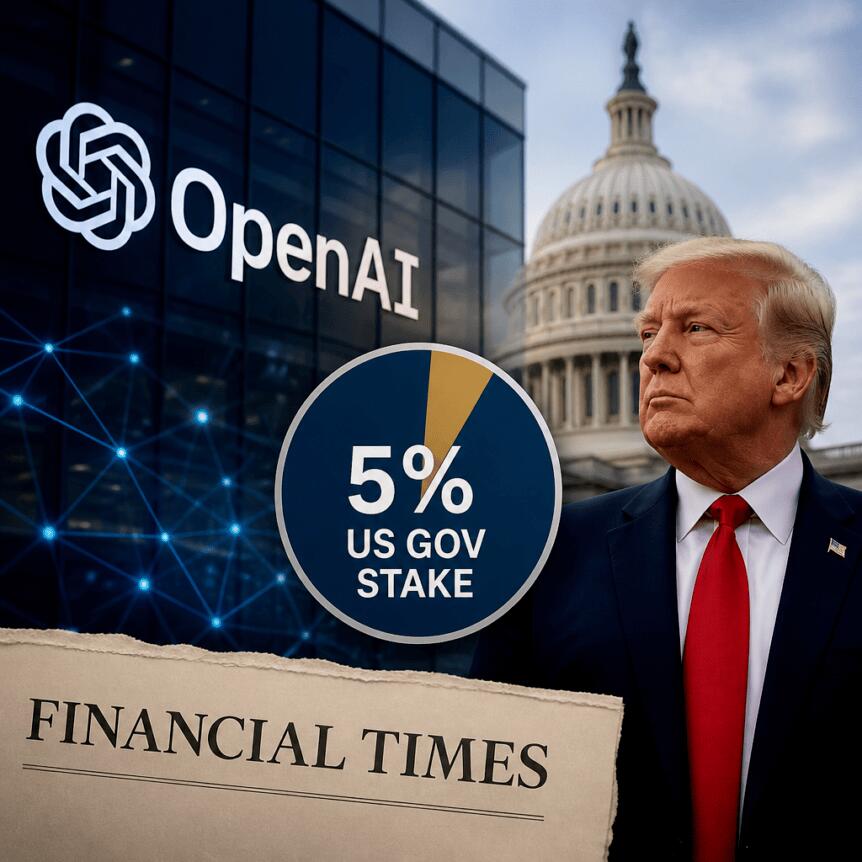
OpenAI has reportedly floated a plan to give the US government a 5% equity stake as Washington moves toward tighter oversight of frontier AI models. The proposal, discussed in early talks with the Trump administration, is tied to how the company and other major AI players might share in the economic upside of rapidly expanding AI capabilities, according to the Financial Times, citing people familiar with the matter.
The idea comes as OpenAI prepares for a potential US public listing, having confidentially submitted an S-1 for an initial public offering in the United States. Earlier coverage from Cointelegraph noted that OpenAI is joining Anthropic in preparing for a Wall Street debut this year, while the US government takes a more active role in how advanced models are built, released, and governed.
Key takeaways
- OpenAI reportedly discussed offering the US government a 5% equity stake as AI oversight intensifies in Washington.
- The proposal is framed as a way to share the economic benefits of AI, modeled by OpenAI CEO Sam Altman on Alaska’s Permanent Fund structure.
- It remains unclear whether major US AI firms beyond OpenAI would support contributing equity to a public investment vehicle.
- The discussions arrive alongside reported steps toward voluntary security and access standards for frontier AI models from the White House.
A shareholder-like approach to AI economics
The reported 5% stake would not be a one-off grant or regulatory fee, but an equity position—suggesting a longer-term relationship between AI developers and the public sector. According to the Financial Times, OpenAI raised the concept in early discussions with the Trump administration as the company weighs how it navigates a more demanding political environment ahead of a potential public listing.
OpenAI CEO Sam Altman argued that letting the public hold a financial stake could be the “best” mechanism to ensure Americans share in the economic benefits generated by the AI boom. The report says Altman modeled the proposal on Alaska’s Permanent Fund, which invests oil revenue into stocks and pays dividends to residents—an example often used to illustrate how natural resource earnings can be converted into ongoing public wealth.
How the plan could work—and what’s uncertain
Under the reported framework, several leading US AI companies would contribute a 5% equity stake to a public investment vehicle. While the direction is clear, the details are not: the Financial Times reports it remains unclear whether firms such as Anthropic, Google, or Meta would back the idea.
This uncertainty matters because any equity-based structure depends on broad coordination among market participants—particularly if the goal is to create a stable “public” ownership pool rather than a patchwork of separate deals. If major developers do not participate, the plan could fail to achieve the universal “sharing” effect Altman is aiming for, or it could lead to a narrower arrangement centered on specific companies.
The report also describes Altman as actively engaging in the political conversation beyond standard corporate lobbying. It says he has discussed the idea with President Donald Trump and senior officials including Commerce Secretary Howard Lutnick and Treasury Secretary Scott Bessent, and that he also spoke with Sen. Bernie Sanders, who earlier this year proposed a one-time 50% tax on the stock of the largest AI companies to help fund a nearly $7 trillion sovereign wealth fund for Americans.
For investors and builders watching AI policy, this angle is important: it suggests AI governance may increasingly blend market participation with public ownership models. Even if the exact equity structure changes, the underlying direction—linking national oversight with financial alignment—could shape how companies approach compliance, product timelines, and long-term strategy.
Washington’s shift from regulation to standards
The equity-stake discussion is occurring as the White House moves toward a more operational oversight posture for frontier AI systems. The Financial Times reports that the White House is preparing voluntary standards for frontier models following interventions involving recent systems from OpenAI and Anthropic.
Those standards are expected to be announced as early as next week and would cover security benchmarks, define review timelines, and clarify access rules for the most advanced models—both within the United States and abroad. In practice, that implies the US is seeking to formalize “how” advanced models are handled, not just “whether” they meet broad requirements.
Separately, reporting indicates that the Trump administration requested a staggered rollout of OpenAI’s GPT-5.6 and temporarily imposed export controls on Anthropic’s latest models due to cybersecurity concerns before later lifting the restrictions. Coverage from The Guardian describes these steps as part of a broader pattern of active involvement in model deployment and distribution.
Earlier reporting also highlighted how quickly the policy environment can change for model release and export. Cointelegraph, for example, noted that Anthropic planned to bring back its newest models after the US lifted export controls. That coverage underscores how regulatory or security decisions can directly affect availability.
Potential implications for IPO timing and governance
Because equity proposals intersect with capital markets, the timing of OpenAI’s public listing plans is hard to ignore. A potential IPO changes the internal calculus for any government-related ownership or governance mechanism: it can alter how negotiations are framed, how disclosures are handled, and how investors assess regulatory risk.
The reported talks also highlight a broader tension facing the largest AI firms. On one hand, they are moving toward greater transparency and public-market visibility. On the other, they are operating under a government that appears increasingly willing to intervene directly—whether through standards, access rules, rollout expectations, or export controls.
Cointelegraph reports it reached out to OpenAI for comment on the discussions but had not received a response at the time of publication. Until OpenAI or the administration provides further clarification, the equity-stake concept should be treated as a reported proposal rather than an announced policy.
Still, for market participants, the direction of travel is clear: AI oversight is evolving into something more detailed and more closely tied to how advanced models move through the economy and across borders. If voluntary standards harden into practical gatekeeping—or if equity-based public participation gains traction—AI companies may face a governance reality where policy alignment becomes part of competitive strategy rather than a post-launch compliance step.
Readers should watch next whether the White House’s upcoming voluntary standards are sufficiently specific to guide developers’ release and security processes, and whether any government-aligned ownership concept gains support from other major AI firms beyond OpenAI. Those two threads—standards and financial participation—could determine how quickly policy risk becomes predictable for the sector.

Key Highlights
- PLTR shares jumped 8.8% on Wednesday, reaching $127.22 in its strongest four-day performance since early 2025
- A strategic collaboration with Nvidia to develop tailored AI solutions for government agencies drove the recovery
- The stock had plummeted 39% year-to-date and shed 25% in June following a seven-session decline
- Wolfe Research assigned a “Peer Perform” rating, acknowledging superior enterprise AI capabilities despite elevated valuation
- Projections indicate 39% revenue compound annual growth rate through 2029, with optimistic scenarios reaching 55%
Palantir Technologies (PLTR) shares surged 8.8% during Wednesday’s trading session, closing at $127.22 and completing a four-day advance of approximately 19% since June 25. This marked a dramatic reversal for shares that had experienced sustained downward pressure.
Palantir Technologies Inc., PLTR
The turnaround stems from a strategic collaboration with Nvidia unveiled Monday. The alliance focuses on developing customized AI solutions specifically for U.S. government organizations, merging Nvidia’s artificial intelligence infrastructure with Palantir’s operational platforms.
The initiative aims to provide federal agencies with protected systems for developing and implementing AI models. Palantir describes the offering as an “intelligent engine.”
CEO Alex Karp outlined the strategy during a Wednesday appearance on CNBC’s Squawk Box. He emphasized that the collaboration centers on providing clients with “control over their compute, their models, their data stack and their alpha.”
Karp further noted that Palantir maintains “critical infrastructure” throughout the United States, Ukraine, and Israel. He highlighted that AI large language models deployed “on the battlefield” operate through Palantir’s Ontology framework.
The Ontology infrastructure enhances AI model security and accuracy—representing a fundamental element of Palantir’s value proposition to government customers.
While this isn’t Palantir’s initial partnership with Nvidia, the announcement’s timing proved significant. It arrived precisely when PLTR had reached multi-month lows.
Understanding the Recent Downturn
Prior to this week’s recovery, Palantir had experienced significant headwinds. Shares had declined 39% during 2026 and tumbled 25% throughout June.
A consecutive seven-session losing streak from June 16 through June 25 drove the stock through several critical technical thresholds. The decline bottomed at $107.27 on June 25.
The underlying concern fueling the selloff: potential for AI technology to supplant the software platforms supporting it. Guggenheim challenged this perspective Wednesday, elevating ServiceNow and Salesforce to Buy ratings while characterizing the “AI eliminates software” theory as a “hallucination.”
Palantir received additional support from financial disclosures revealing President Trump’s investment positions in various companies, including Palantir.
Analyst Perspectives
Wolfe Research initiated coverage of PLTR on June 16 with a Peer Perform designation. Analyst Alex Zukin characterized Palantir’s enterprise AI offerings as having “the best product market fit of any enterprise software company in the market today.”
Despite this favorable product assessment, the premium valuation prevented a Buy recommendation.
Wolfe’s metrics deserve attention: 150% net revenue retention, 85% year-over-year revenue expansion, and a 97% annual increase in residual deal value backlog—all supported by roughly 1,000 clients and 4,000 personnel.
Wolfe’s baseline forecast projects 39% revenue compound annual growth from 2026 through 2029. An optimistic scenario elevates this figure to 55%, within a total addressable market exceeding $385 billion.
PLTR also announced an expanded commercial agreement with Surf Air Mobility this week, contributing additional positive momentum.
Following Wednesday’s close, Palantir’s market capitalization stood at approximately $279.7 billion. Typical daily trading volume averages around 45 million shares.

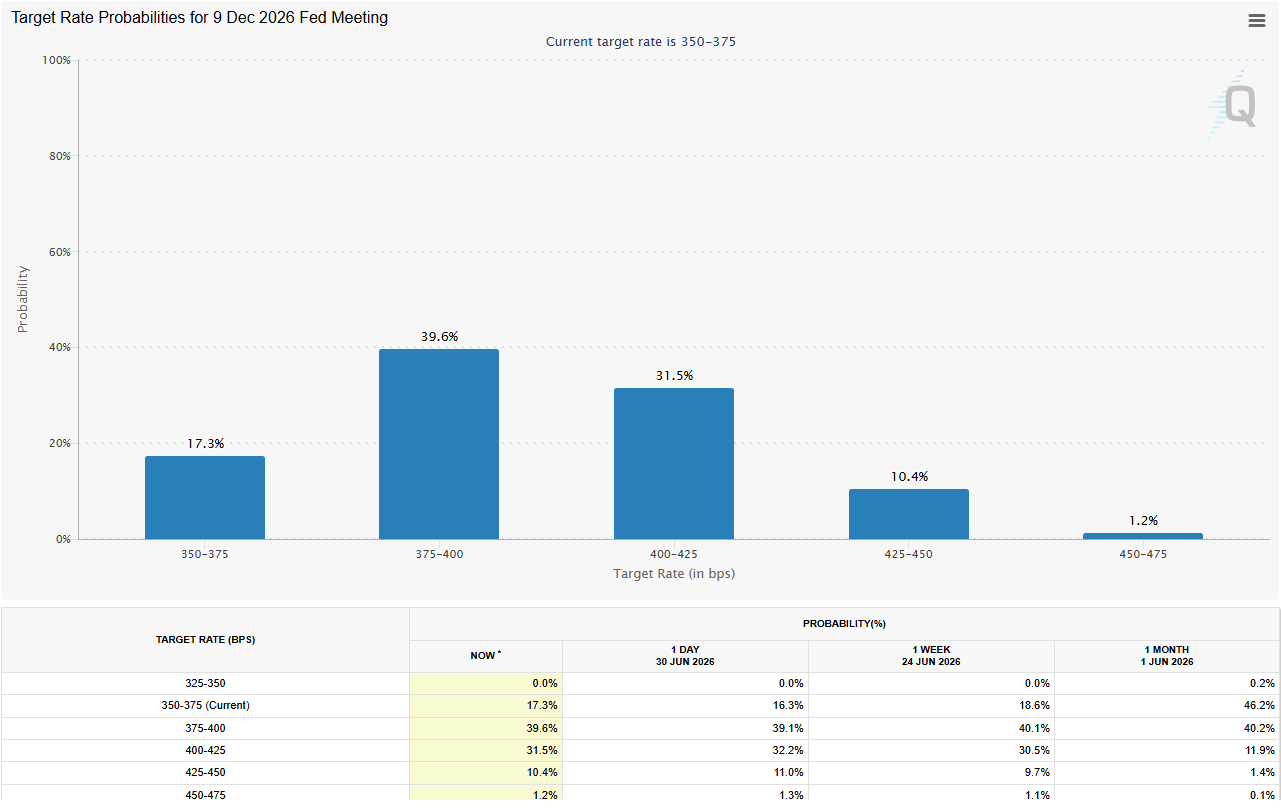
The United States (US) Bureau of Labor Statistics (BLS) will release the Nonfarm Payrolls (NFP) data for June on Thursday at 12:30 GMT.
With investors pricing in a hawkish Federal Reserve (Fed) policy outlook with the new Chairman Kevin Warsh at the helm, the underlying details of the employment report could influence the timing of a possible interest rate increase.
Payroll data is among the indicators that generally trigger a significant market reaction. Still, this time, with all eyes on the inflation front, only a dismal print could hurt the US Dollar in a meaningful way.
What to Expect From the Nonfarm Payrolls Report?
Investors expect NFP to rise by 110K following three consecutive months of surprisingly strong increases. The Unemployment Rate is seen holding steady at 4.3%, while the annual wage inflation, as measured by the change in the Average Hourly Earnings (AHE), is projected to edge higher to 3.5% from 3.4% in May.
TD Securities analysts note that they expect NFP to rise at a softer pace than what markets expect.
“We expect June payrolls to moderate to 80k (55k private, 25k government) after strong early‑2026 gains. Job growth broadened beyond healthcare, led by trade/transport and leisure, but should cool this month. Local governments may stay firm on World Cup effects. We see the Unemployment Rate edging down to 4.2% as participation dips. AHE likely moderated to 0.2% m/m (3.5% y/y),” they add.
The Automatic Data Processing (ADP) reported on Wednesday that private sector employment in the US grew by 98K in June. This print followed the 122K increase recorded in May and came in below the market expectation of 113K.
Similarly, National Bank of Canada Senior Economist Jocelyn Paquet forecasts a 90K increase in NFP and explains:
“Based on the weekly data released by ADP and previously published ‘soft’ employment indicators, such as S&P Global’s flash composite PMI, job creation likely remained fairly robust during the month, although not as robust as what we had been accustomed to between February and May. Layoffs, for their part, may have increased slightly, judging by the rise in initial jobless claims recorded between the May and June survey periods. These two factors combined should, in our view, result in an increase of 90K in nonfarm payrolls.”
How Will the US May Nonfarm Payrolls Affect EUR/USD?
Although crude Oil prices came down to levels seen since pre-US-Iran conflict, investors remain concerned over global inflation remaining sticky, mainly due to heightened costs of consumer electronics via AI-driven hardware demand.
As a result, the US Dollar (USD) has been outperforming its major rivals, supported by growing expectations for a tighter Fed policy.
Hammack Flags Broad Inflation, Keeps Rate Hike Option Alive
In an interview with CNBC on Tuesday, Cleveland Fed President Beth Hammack delivered a moderately hawkish message with the FXS Speechtracker score at 6.4/10.
This is slightly softer relative to the historical average of 7/10 but still signals a tightening bias. By stressing that the job market is “right around full employment” and that growth “looks good,” while warning that “inflation is still too high” and that rate hikes may need to be considered, the speech underscores a willingness to tighten policy despite concerns about the broader economy.
According to the CME FedWatch Tool, markets are currently pricing in about a 34% probability of the Fed raising the interest rate by 25 basis points (bps) as early as July, compared to a 6% chance seen in early June. Moreover, the probability of at least two rate increases by the end of 2026 now sits slightly above 40%.

Another positive surprise of 130K or higher in the headline NFP could feed into July rate hike projections and fuel another leg higher in the USD. In this scenario, EUR/USD could remain under bearish pressure and extend its downtrend in the near term.
On the other hand, a significantly disappointing print below 70K could trigger an upward correction in the pair. However, a steady bullish reversal is unlikely to materialize unless Fed policymakers shift their tone and put more emphasis on labor market conditions rather than the inflation outlook.
Given three consecutive months of very strong prints, however, a single NFP miss is likely to be overlooked, keeping any potential rebound in EUR/USD short-lived.
Eren Sengezer, European Session Lead Analyst at FXStreet, offers a brief technical outlook for EUR/USD:
“EUR/USD’s near-term technical outlook doesn’t point to oversold conditions and suggests that the bearish bias stays intact. The Relative Strength Index (RSI) indicator on the daily chart remains below 40 after recovering from oversold territory and the pair trades slightly above the lower arm of the Bollinger Band.”
“On the downside, 1.1320-1.1280 (lower arm of the Bollinger Band, static level) forms the first support ahead of 1.1160 (static level) and 1.1000 (psychological level, static level).”
“Looking north, a strong resistance area could be spotted at the 1.1485-1.1500 region (20-day Simple Moving Average (SMA), round level) before 1.1600 (round level, 50-day SMA) and 1.1650-1.1660 (200-day SMA, descending trend line, 100-day SMA).”

The post June Payrolls Forecast at 110K With Wage Growth Seen Ticking Higher appeared first on BeInCrypto.


Crypto companies are entering public markets at a time when investors are asking harder questions about how these businesses actually make money.
A listed crypto company cannot rely only on adoption, user growth, or a strong brand. Public equity investors want to see revenue quality, margins, reserves, governance, client asset protection, and performance across weaker market cycles.
That shift is changing how the industry is judged. Exchanges, stablecoin issuers, miners, custody firms, data companies, and Bitcoin treasury businesses are all being measured against public-market expectations.
BeInCrypto spoke with Anton Efimenko, Co-Founder and Lead Expert at 8Blocks; Fernando Lillo Aranda, CMO at Zoomex; and Federico Variola, CEO of Phemex, about how IPOs and listings reshape expectations for crypto businesses.
A Listed Company Does Not Automatically Lift Its Token
Going public can give a crypto company more visibility. It can also make the business easier for traditional investors to track. But shareholders and token holders are often exposed to different economics.
Anton Efimenko, Co-Founder and Lead Expert at 8Blocks, said token holders should not assume an IPO will directly support token prices.
“Unfortunately, an IPO itself doesn’t really give anything to the crypto community. Many tokens are not tied to the issuer’s business. So even if the company goes public and reports strong annual profit, its token doesn’t have to increase in value. The token price won’t necessarily follow the stock price,” Efimenko said.
He added: “An IPO can bring visibility to the issuer, but it doesn’t guarantee profit for token holders.”
A listed share represents ownership in the company. A token may reflect access, governance, network activity, or market sentiment. Those links are often indirect.
This distinction is becoming more important as more crypto firms move toward public markets. Investors need to understand whether they are buying a company’s earnings power, a token’s utility, or broader exposure to crypto sentiment.
Institutional Access Still Depends on Risk Rules
Public listings can make crypto exposure easier for pension funds, banks, and asset managers. Some institutions cannot hold tokens directly, but they may be able to buy shares in a listed exchange, miner, stablecoin issuer, or custody company.
Efimenko said institutional access still depends on ratings and internal policy.
“Pension funds will be able to buy shares of crypto companies, but only if the rating of those shares matches the fund’s investment policy. For such large financial institutions, the asset’s rating matters a lot because they can’t afford to lose their depositors’ money,” he said.
Many institutions may still choose lower-yielding traditional assets over crypto-native returns if the risk profile is clearer.
“That’s why it’s easier for them to invest in US Treasuries at 3% annually than to stake USDT at 5.5%,” Efimenko said.
Tokenized Treasuries could create a middle ground. They may allow institutions to use digital asset systems while relying on the rating of the underlying government debt.
“But once Treasuries become tokenized assets, pension funds may be able to hold them on their balance sheets based on the rating of the underlying asset,” he said.
Exchanges and Stablecoin Issuers Have the Clearest Case
The experts were most confident about exchanges and stablecoin issuers as public-market businesses.
Fernando Lillo Aranda, CMO at Zoomex, said stablecoin companies have the strongest structural position because their revenue can become more recurring and less dependent on trading volumes.
“Stablecoin infrastructure is the strongest structural position. This model benefits from network effects, float economics, payments expansion, and increasingly becoming financial rails rather than pure crypto businesses. Revenue can become more recurring and less dependent on trading cycles,” Aranda said.
Stablecoin issuers can benefit from reserve income, payments growth, and wider institutional use. Their challenge is scrutiny around reserves, regulation, and concentration risk.
Exchanges also remain among the strongest crypto businesses when they execute well. They sit close to users, liquidity, and transaction activity.
“Exchanges offer the strongest cash generation (when executed well). Exchanges still monetize attention and liquidity better than most crypto businesses. The best ones evolve beyond trading into custody, cards, lending, staking, payments, launchpads, and brokerage layers. The challenge is cyclicality and fee compression,” Aranda said.
Federico Variola, CEO of Phemex, also placed exchanges and stablecoin issuers at the top of the public-market list.
“The strongest business models in public markets are, for sure, exchanges and possibly stablecoin issuers. Others will face certain constraints, whether because of their business model or because there is some seasonality in their revenue,” Variola said.
He added: “Exchanges and stablecoin companies tend to have a more stable baseline in terms of revenue and room for growth, especially exchanges.”
Exchanges still face pressure from market cycles, falling fees, regulation, and user trust. But compared with many crypto business models, their revenue engines are easier for public investors to understand.
The Less Visible Infrastructure Businesses May Age Better
Some of the strongest public-market crypto businesses may be less visible to retail investors.
Aranda pointed to custody, market services, analytics, data, and compliance providers as important long-term categories. These companies provide the operational layer institutions need before they allocate more capital to digital assets.
“Custody and market infrastructure offers a quiet but powerful category. Institutions entering digital assets need custody, reporting, settlement, compliance, and execution layers. This often behaves more like financial infrastructure than speculative crypto exposure,” Aranda said.
These firms may benefit from digital asset adoption without relying fully on token prices. Their revenue can come from enterprise contracts, reporting tools, surveillance systems, and compliance services.
Miners and Bitcoin Treasury Firms Face a Harsher Cycle Test
Miners and Bitcoin treasury companies can attract attention because they offer public-market exposure to Bitcoin. That can be useful for equity investors who want Bitcoin-linked upside without buying the asset directly.
The weakness is their exposure to market cycles.
Aranda said miners remain vulnerable to energy prices, hardware costs, and commodity-like economics.
“Miners. Public markets like the Bitcoin beta, but mining remains exposed to energy costs, hardware cycles, and commodity-like economics unless vertically integrated,” he said.
Bitcoin treasury companies face a different problem. They can raise capital around Bitcoin exposure, especially in bullish markets, but their operating value can become harder to defend over time.
“Bitcoin treasury companies. Very powerful for capital formation and attracting BTC exposure through equities, but harder to defend operationally. Over time they risk becoming viewed more as leveraged holding vehicles than operating businesses,” Aranda said.
Variola said treasury firms, miners, and other market-sensitive businesses are likely to face more pressure when crypto prices fall.
“I think treasury companies in particular are bound to suffer significant stress when the market turns bearish. The same can be said for miners and other firms that are more exposed to market volatility,” he said.
These companies may remain popular during strong Bitcoin cycles. Public investors, however, will keep asking whether they can create value beyond holding or producing Bitcoin.
Overall, the gist is that crypto’s public-market era will reward companies that can explain their business in financial terms. The firms that rely only on market excitement will face a harder audience.
The post How Public Listings Change Crypto Companies appeared first on BeInCrypto.

OpenAI, the company behind ChatGPT, has reportedly discussed giving the US government a 5% equity stake as artificial intelligence oversight in Washington intensifies.
The company raised the idea in early discussions with the Trump administration as it seeks to navigate a tougher political environment ahead of a potential public listing, the Financial Times reported on Thursday, citing people familiar with the matter.
OpenAI CEO Sam Altman argued that giving the public a financial stake in the company would be the best way to share the economic benefits of the booming AI industry.
The report comes weeks after OpenAI announced it had confidentially submitted an S-1 for a US initial public offering, joining Anthropic in preparing for a Wall Street debut this year. It also comes as the US government takes a more active role in overseeing advanced AI models.
Proposal extends to other AI companies
The proposal would see several leading US AI companies contribute a 5% equity stake to a public investment vehicle. However, it remains unclear whether companies such as Anthropic, Google and Meta would support the idea.
The Financial Times reported that Altman modeled the proposal on Alaska’s Permanent Fund, which invests the state’s oil revenue into stocks and pays dividends to residents. Under a similar approach, Americans could share in the economic gains generated by AI.
According to the report, Altman has been in talks with President Donald Trump, Commerce Secretary Howard Lutnick and Treasury Secretary Scott Bessent. He also reportedly spoke with Senator Bernie Sanders, who in June proposed a one-time 50% tax on the stock of the largest AI companies to create a nearly $7 trillion sovereign wealth fund for Americans.

Source: Vivek Sen
Washington steps up AI oversight
The White House is preparing voluntary standards for frontier AI models following its intervention in the rollout of recent systems from OpenAI and Anthropic.
The guidance is expected to be announced as early as next week and would set security benchmarks, establish review timelines and clarify who can access the most advanced AI models in the US and abroad.
The Trump administration reportedly requested a staggered rollout of OpenAI’s GPT-5.6 and temporarily imposed export controls on Anthropic’s latest models over cybersecurity concerns before lifting the restrictions.
Related: Anthropic to bring back Fable 5 as US lifts export controls
Cointelegraph reached out to OpenAI for comment on the reported discussions but had not received a response by the time of publication.
Magazine: The end of anonymity? AI could unmask crypto’s hidden identities


FBI Director Kash Patel disclosed a purchase of between $100,001 and $250,000 in MicroStrategy stock roughly six months after the trade, breaching the STOCK Act reporting window.
According to NOTUS, Patel bought the shares on November 21, 2025, but only reported the transaction to federal regulators on May 26, 2026, stating he had “inadvertently omitted” it from an earlier filing.
Why Kash Patel’s MicroStrategy Trade Draws Scrutiny
The delayed filing has raised questions because it falls outside the STOCK Act’s reporting window. The STOCK Act, the Stop Trading on Congressional Knowledge Act, is a US federal law signed by former President Obama in April 2012.
The law requires covered federal officials to disclose securities trades worth at least $1,000 within 45 days. First-time violators face a $200 fine, which the Justice Department has not imposed on Patel so far, according to NOTUS.
MicroStrategy, rebranded as Strategy, ranks as the largest corporate holder of Bitcoin (BTC). The firm also works as a contractor for the federal government and has done millions of dollars’ worth of business with the Justice Department, which oversees the FBI.
Meanwhile, the bureau itself investigates cryptocurrency fraud, and Patel has publicly promoted its enforcement record, including a $15 billion Bitcoin seizure announced in October 2025.
The overlap raises questions about federal officials trading shares of companies tied to their agencies. However, late STOCK Act filings are not uncommon. According to NOTUS, more than 30 members of Congress submitted overdue disclosures over the past year.
Follow us on X to get the latest news as it happens
Ethics Officials and Watchdogs Split on the Violation
Deputy Assistant Attorney General William Taylor reviewed the amended filing, which attributed the delay to a “miscommunication.” In a May 28 letter, he said,
“I continue to believe that Director Patel is in compliance with applicable laws and regulations governing conflicts of interest.”
However, Dylan Hedtler-Gaudette of the Project on Government Oversight said the disclosure was “absolutely” late under the statute.
“That’s violating the law — no other way to put it,” he stated.
The trade has also proven costly. MicroStrategy stock has lost nearly 48% since Patel’s purchase date. In late June, BeInCrypto reported that MSTR dropped below $100 for the first time since March 2024, before the company announced a financial overhaul plan.
Subscribe to our YouTube channel to watch leaders and journalists provide expert insights
The post FBI Director Kash Patel Amends Disclosure to Add MicroStrategy Stock Purchase appeared first on BeInCrypto.
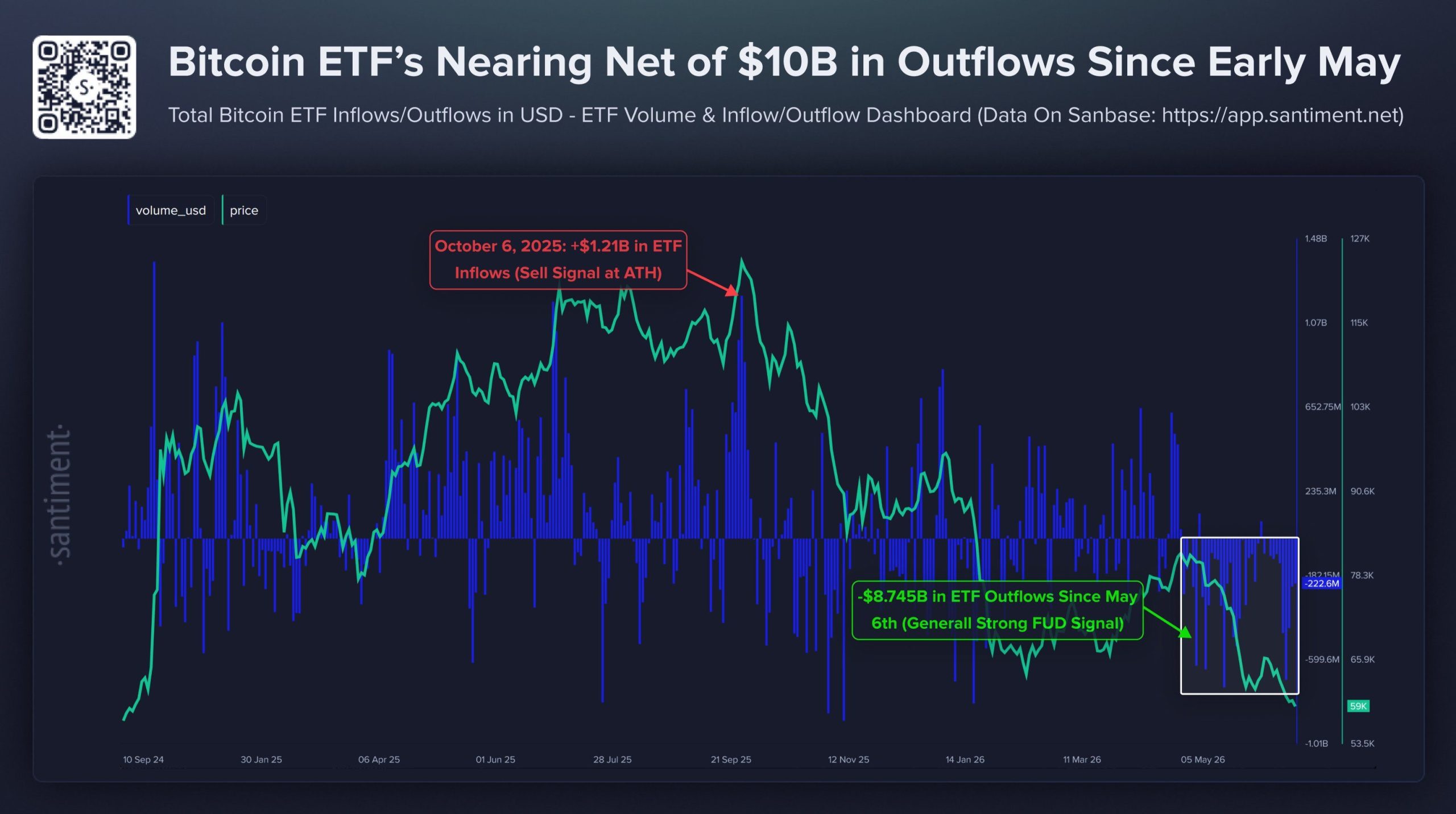
Bitcoin (BTC) just recorded its worst month since June 2022, falling 20.48% amid contracting demand and a risk-off market environment.
Yet three on-chain indicators point to deepening Bitcoin capitulation and early signs of seller exhaustion.
Santiment Says ETF Outflows Near Capitulation Levels
On-chain analytics firm Santiment reported that Bitcoin ETFs have logged $8.475 billion in total net outflows since May 6.
Follow us on X to get the latest news as it happens

However, the firm argued that fund flows work better as a sentiment gauge than a crash warning. Prices often move in the opposite direction of crowd expectations over time, the firm said.
“The bigger this streak of BTC outflows gets, the more we can reliably identify this stretch as frustration, fear, and retail capitulation rather than a fresh reason to panic,” the post read.
Santiment added that heavy redemptions suggest many weak hands have already left. Extended outflows would therefore strengthen the case that Bitcoin is approaching a “prime bottom zone.”
Underwater Supply Points to Investor Stress
Glassnode data points in the same direction. The firm said roughly 10.83 million BTC now sit at a loss, against 9.22 million in profit. This marks one of the sharpest declines in profitability during the current cycle.

Historically, Glassnode noted, loss-making supply overtaking profitable supply has coincided with financial stress and widespread capitulation among newer participants. Meanwhile, long-term holders have returned to accumulation.
Still, the firm cautioned that a final volatility spike driven by capitulation cannot be ruled out.
“The data suggests Bitcoin is transitioning from a distribution phase toward one of accumulation, but confirmation is still needed. While the foundations for a longer-term recovery are gradually taking shape, the market may first need to endure one final test of conviction before a sustainable uptrend can emerge,” Glassnode said.
Bitcoin Net Supply Ratio Hits a 2022 Bear Market Low
Analyst Darkfost highlighted a third signal from Bitcoin’s Net UTXO Supply Ratio.
“This ratio has now been negative for a week and just reached -0.075, corresponding to a buy signal. The last time this happened was at the end of 2022, right at the end of the bear market,” he wrote.
He clarified that the signal does not detect a bottom. Still, the analyst noted that a growing number of indicators have hit extreme levels. In his view, this points to Bitcoin “entering a genuine devaluation phase.”
“We now have several signals pointing to seller exhaustion. The next step is a renewal of demand, and that could take some time,” Darkfost added.
Nonetheless, caution remains warranted. BeInCrypto highlighted that Bitcoin’s Coinbase Premium turned negative in mid-January near $95,583.
By February 24, BTC had crashed 33% to about $64,100. The current negative streak is longer. If the premium stays negative, the January precedent suggests downside risk persists.
Subscribe to our YouTube channel to watch leaders and journalists provide expert insights
The post 3 On-Chain Signals Point to Deepening Bitcoin Capitulation appeared first on BeInCrypto.

Metaplanet announced it had acquired 2,823 BTC after a three-month pause, completing its second-quarter accumulation under its ongoing Bitcoin Treasury Operations.
The company spent a total of 35.89 billion yen, or around $222 million, on the purchases after paying an average of over 12.7 million yen per coin. As a result, its total holdings increased from 40,177 BTC at the end of March to 43,000 BTC as of June 30.
Metaplanet’s Fresh Buy
According to the official announcement, the lower average purchase price for the quarter also reduced Metaplanet’s overall average acquisition cost from 15.51 million yen per unit to 15.3 million yen. Across its entire treasury, the company revealed investing 659 billion yen to acquire 43,000 BTC. The company also reported generating $10.95 million, or about 1.747 billion yen, in revenue from its Bitcoin Income Generation activities during the quarter.
After offsetting that revenue against its purchases, the effective acquisition cost fell to 34.14 billion yen, or about 12.093 million yen per unit.
The latest purchase moves the Tokyo-listed firm closer to its long-term Bitcoin goals, though it still has a significant distance to cover. The company has set a target of 100,000 BTC by the end of 2026, which requires it to add 57,000 more BTC in the remaining months of the year.
Stock Slumps, Expansion Continues
Despite expanding its treasury to 43,000 BTC, Metaplanet’s stock has remained under heavy pressure this year. The shares are down nearly 49% year-to-date.
Alongside its Bitcoin accumulation efforts, the company announced plans to acquire Japanese securities firm Siiibo Securities in a deal worth around $13 million. The move, which is expected to close in July, will result in the firm being rebranded as Metaplanet Securities.
CEO Simon Gerovich described the transaction as their first major acquisition and the first concrete step under Project Nova, its long-term initiative to build a Bitcoin-focused financial ecosystem in Japan.
The post Metaplanet Adds 2,823 Bitcoin, But Still Needs 57,000 BTC to Hit 2026 Target appeared first on CryptoPotato.
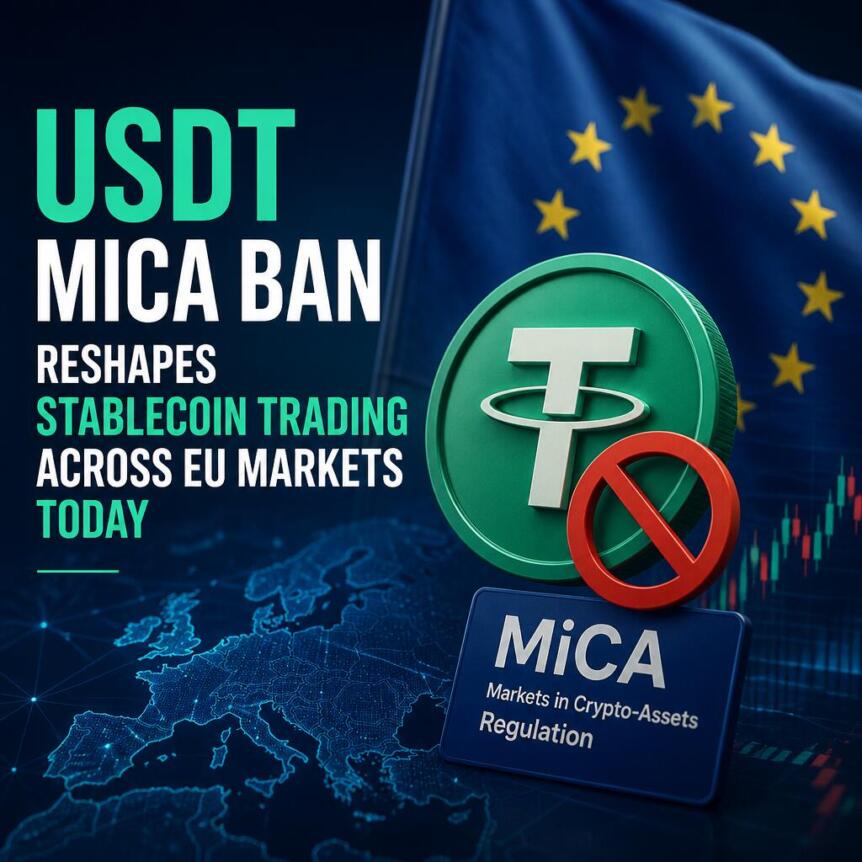
Europe’s stablecoin market entered a stricter phase as MiCA reached its full enforcement deadline across member states and licensed platforms. The July 1, 2026, cutoff removed USDT from regulated exchange access across the bloc’s licensed venues. The shift redirects licensed liquidity toward USDC, EURC, and new euro-backed tokens under tighter EU supervision and clearer reserve controls.
USDT Loses Its Regulated EU Route
Europe has removed USDT from regulated crypto trading as MiCA now reaches full force across licensed markets and service providers. The deadline blocks non-compliant stablecoins from licensed EU exchanges, brokers, and trading venues under the new regime for stablecoin issuers. That decision ends Tether’s direct regulated access to the bloc’s main crypto platforms and order books.
The change followed months of phased exchange action rather than one sudden cutoff. Coinbase Europe removed USDT in December 2024, and Crypto.com followed in January 2025 under the same compliance pressure. Binance later restricted EU USDT pairs, while Kraken moved from sell-only trading to paused support for regional clients.
Tether did not seek approval as a MiCA e-money token before the final deadline, despite the market size. The company opposed the reserve rule requiring large deposits inside European banking institutions and supervised accounts under EU oversight. Therefore, USDT lost its regulated pathway despite its leading role in global stablecoin trading liquidity and offshore demand.
USDC Takes The Main Dollar Route
Circle used the same rulebook to strengthen its position inside the European crypto market under MiCA and local oversight. The company secured a French Electronic Money Institution license before the hard deadline took effect across the bloc. As a result, USDC can operate across all 27 EU member states through passporting rights and local supervision.
USDC now stands as the leading compliant dollar stablecoin on licensed European exchanges and broker platforms. Platforms can list it without the legal pressure now attached to USDT in Europe after the cutoff. Consequently, trading desks and market makers must rebuild liquidity around new compliant pairs and settlement routes for clients.
The transition may tighten short-term liquidity because USDT still drives large global volumes. Yet regulated EU exchanges now need tokens that fit MiCA’s stablecoin rules and reserve standards for issuers. That requirement gives USDC a stronger role in euro-area crypto trading and settlement flows.
EURC And Euro Tokens Push Local Control
Circle’s EURC also gains from the same regulatory approval and passporting rights across Europe. The euro-pegged token gives exchanges a compliant local currency stablecoin option under MiCA and local oversight. In turn, platforms can reduce reliance on dollar pairs for selected regional trading activity inside Europe.
Tether still has indirect exposure to Europe through other regulated token projects and partners. StablR and Oobit launched MiCA-compliant tokens using Tether’s Hadron tokenization platform for compliant issuance. Their EURR and USDR products show how Tether can support compliant issuers without listing USDT on regulated venues.
Banks are also preparing a larger euro stablecoin push under the new framework. A group of 37 European banks, including BNP Paribas and ING, is developing Qivalis. MiCA now sets the rulebook, and July 1 resets regulated European stablecoin trading.

Ethereum’s push to win broader institutional involvement just gained a new coordinating body. On Wednesday, a new independent nonprofit called Ethereum Institutional was launched with backing from Ether treasury companies BitMine Immersion Technologies and SharpLink, along with Joe Lubin and other contributors, aiming to build a more formal “front door” between Ethereum and mainstream financial firms.
The timing reflects a familiar tension in the market: Ethereum remains the leading platform for institutional-facing crypto use cases like stablecoins and tokenized real-world assets (RWAs), yet the ecosystem is also facing intensifying competition from other blockchains that are actively courting banks and asset managers.
Key takeaways
- Ethereum Institutional is designed to coordinate outreach to financial institutions with education, standards development, research, and industry events.
- The nonprofit plans to expand beyond early hubs including New York, London, Hong Kong, and Singapore to additional financial centers.
- Ethereum’s institutional narrative is supported by market concentration in stablecoins and tokenized RWAs, according to DeFiLlama and Token Terminal.
- Launches arrive while parts of Ethereum’s treasury-heavy constituency face ETH price pressure, underscoring how institutional strategy and token volatility remain intertwined.
- Industry observers link the new organizations to renewed efforts around Ethereum’s long-term ecosystem development alongside layer 1, layer 2, and DeFi.
A new “front door” for TradFi engagement
According to a Wednesday announcement from Ethereum Institutional on X (available at https://x.com/ethereuminsti/status/2072304960142729373?s=20), the group was created because the Ethereum ecosystem lacked what it described as a “credible, independent front door” for engaging financial institutions.
Ethereum Institutional says it intends to support institutional adoption by offering multiple layers of engagement: education for traditional finance participants, standards development work, industry research, and institutional events. The organization also signals an outward geographic push, with plans to go beyond its initial focus on New York, London, Hong Kong, and Singapore.
For investors and market participants, the practical value is less about a single announcement and more about what institutional firms typically need before they allocate resources: clear points of contact, consistent educational material, and credible pathways for discussing standards and risk. An independent nonprofit structure may also help reduce perceived conflicts of interest that can arise when outreach is perceived as coming directly from token-driven incentives.
Ethereum’s institutional use cases remain hard to ignore
While other networks have been increasingly vocal about winning institutional attention, the underlying activity on Ethereum continues to anchor the institutional narrative. The article’s data points emphasize that Ethereum retains strong market share in tokenized finance.
According to Token Terminal, Ethereum hosts nearly 58% of the tokenized RWA market. In parallel, DeFiLlama data cited in the report indicates Ethereum accounts for roughly half of the $311 billion stablecoin market—a scale that matters because stablecoins remain one of the most direct onchain interfaces for many financial institutions.
That dominance can influence how institutional outreach groups prioritize where to engage. Even if traders respond quickly to price moves, institutions often plan more slowly, following the liquidity and settlement rails that already exist. Ethereum’s concentration in these categories—stablecoins and tokenized RWAs—helps explain why an institutional coordination effort targeting mainstream finance is arriving now, rather than after a competitor has already established similar entry points.
ETH volatility adds urgency to the strategy
Institutional expansion is happening alongside continued uncertainty around ETH itself. The same report notes that Ether prices have been under pressure, weighing on the balance sheets of companies that hold large ETH treasuries.
It states that BitMine and SharpLink are both facing “sizable unrealized losses,” and references ETH trading around $1,620 at last check on Wednesday, with market cap data of $195.4 billion from CoinGecko (https://www.coingecko.com/en/coins/ethereum). It also points out that ETH had been above $4,000 as recently as Oct. 27.
For readers, this matters because institutional outreach and token performance are not independent variables. When large holders see drawdowns, it can shift internal priorities toward risk management, governance questions, and long-horizon development—yet it can also strengthen the case for structured engagement with traditional finance, where firms often expect clearer frameworks around custody, compliance, and operational reliability.
The report also cites 21shares, arguing that current asset prices have not fully reflected growing demand from portfolio managers, asset managers, and financial institutions.
Governance shake-ups and new ecosystem organizations
Ethereum Institutional’s launch comes while the Ethereum Foundation is undergoing internal changes. The report describes a broad organizational overhaul, including leadership turnover, internal debates over governance and development priorities, increased competition from other blockchains, and criticism tied to ETH market performance.
Earlier coverage referenced in the report notes that Hsiao-Wei Wang, co-executive director of the Ethereum Foundation, stepped down last month. It also highlights reported departures from the foundation this year and a restructuring that included laying off 20% of staff, as covered previously by Cointelegraph.
At the same time, the report frames the emergence of additional independent efforts as part of a broader shift: rather than consolidating all ecosystem-facing work under one umbrella, multiple specialized nonprofits are taking on distinct roles. It points to Ethlabs, launched in June by backers associated with Ethereum Institutional—also supported by BitMine, SharpLink, and Joe Lubin—described as a nonprofit research organization focused on advancing Ethereum’s scalability.
In other words, Ethereum Institutional appears to focus on institutional readiness and engagement, while Ethlabs targets technical R&D. The combination suggests a coordinated attempt to separate “market-facing trust building” from “protocol and performance development,” even as governance and staffing transitions continue within the Foundation itself.
Banking eyes: “commercialisation” as TradFi scales in
Standard Chartered’s Geoff Kendrick highlighted the potential overlap between these nonprofit efforts and Ethereum’s broader ecosystem roadmap. In a Wednesday note to clients cited in the report, Kendrick said the announcement—paired with the earlier launch of Ethlabs—has “direct positive implications for both Ethereum layer 1, layer 2s and the Ethereum originated DeFi protocols.”
Kendrick also pointed to the composition of the anchor funders, calling them “the three commercial giants in the Ethereum ecosystem,” and argued their expertise should help drive commercialization of Ethereum as “TradFi is entering at scale.”
Separately, the report notes Kendrick reaffirmed ETH price forecasts of $4,000 at the end of 2026 and $40,000 at the end of 2030—figures that remain predictions rather than commitments, but they reinforce the bank’s bullish framing around Ethereum’s institutional trajectory.
What to watch next is how Ethereum Institutional operationalizes its stated mission: which standards it prioritizes, what education or research outputs it produces, and how quickly it can translate outreach into measurable commitments from banks and asset managers. Equally important will be whether governance turbulence inside core institutions (like the Ethereum Foundation) stabilizes enough to ensure these new nonprofit tracks complement rather than compete with each other.
Why is Messi not getting the red card

Heat Domes Are Dangerous. July Fourth Activities Will Make Things Worse

Bitcoin Bubble Has BURST! Peter Schiff vs. Anthony Pompliano

No Jackpot Winner as $257 Million Prize Rolls Over to $269 Million Monday Draw

Renter of Home in Anne Heche Crash Denies Settlement With Son

Weekend Open Thread: Staud – Corporette.com
Bitcoin Bubble Has BURST! Peter Schiff vs. Anthony Pompliano

Assets Put Money In Your Pocket | Robert Kiyosaki Tamil Motivation | Financial Freedom | #Shorts

GOLD LIVE TRADING by FOREX MONEY Session# 522 | AHMAD by FOREX MONEY #gold #xauusd #rsi
-
 Fashion6 days ago
Weekend Open Thread: Staud – Corporette.com
-

 Politics6 days ago
The House | Manchesterism won’t survive the painful trade-offs unless it gets citizens on board
-

 Crypto World2 days ago
Strategy authorizes up to $1.25B in Bitcoin sales under new capital plan
-

 Politics6 days ago
Potential 2028er World Cup attendee leaderboard
-

 Business6 days ago
Asia stock markets slide as tech shares slump
-

 News Videos4 days ago
MAJOR BITCOIN & MARKET UPDATE!!!! (MUST WATCH ASAP!!!)
-

 Tech7 days ago
A Look At A Gaggle Of Transputer Boards
-
 Crypto World7 days ago
Dell (DELL) Shares Tumble Over 5% Following Analyst Downgrade to Hold
-

 Crypto World5 days ago
Coinbase, Circle Deepen Crypto Stock Losses Despite Resilient S&P 500
-

 Business2 days ago
Australia treasurer says alleged access of prime minister’s bank data ’incredibly concerning’
-

 Crypto World5 days ago
Kraken's xStocks Opens Bending Spoons IPO Registration to EEA Retail
-

 Sports6 days ago
FIH Pro League: India defeat Pakistan 7-1, register biggest win of campaign | Other Sports News
-

 Crypto World6 days ago
Bitcoin Sparks $600M Hourly Liquidations With $65,000 Set To Become Resistance
-

 Tech2 days ago
Anonymous researcher drops 0-day ‘exploitarium’ repo
-

 Tech4 days ago
Bluekit phishing kit adopts browser-in-the-middle for login theft
-

 Tech5 days ago
Russian hackers now target Signal backup recovery keys
-
 Crypto World6 days ago
Hyperliquid Named on Singapore MAS Investor Alert Register
-

 Crypto World6 days ago
RTX holders must register wallets before token distribution begins
-

 Sports20 hours ago
Broncos roster: OL Ben Powers (No. 74) entering final year of contract
-
 Business3 days ago
The AI boom won’t burst all at once. It will pop in ‘rolling bubbles’: Macquarie
You must be logged in to post a comment Login