This is one of those projects that was both inspired and made possible by the absolute embarrassment of dev boards available to the modern hacker. In this case, the dev board was the M5Stack PaperS3, which as the name implies combines an ESP32-S3 with an e-ink panel. [Wenting Zhang] picked one up and was immediately inspired to try and make an e-ink Game Boy.
The M5Stack PaperS3 made this project possible by exposing the display with row/column control — parallel, some would call it, as opposed to the usual serial interface of SPI. That allowed [Wenting] to work some of the same e-ink magic he perfected on his Modos monitors to allow partial refresh at up to 60 Hz. That the ESP32-S3 is capable of emulating a Game Boy while driving the screen should surprise no one, since it can emulate an MSX while outputting VGA or even Windows 95 on a 386. In this case, he’s basing the actual Game Boy emulation on Crank Boy.
Of course the e-ink screen on the M5Stack is far larger and has a much higher resolution than what the Game Boy shipped with, which lets him implement touch controls and scale the image up 3X so he can fake a couple of shades of grayscale while actually outputting black and white. Even better, if he was actually playing this thing on the regular, once the high-refresh portion of the screen starts to wear out, he can flip the orientation and keep gaming on the virtually-unrefreshed control portion of the screen — doubling the lifetime of the system, something many of you raised as a concern when we last looked at a his e-ink monitor project.
Advertisement
The only real shortcoming of this hack is the sound. With one-bit beeps coming out of the M5Stack buzzer, it’s got nothing on Nintendo’s hardware. Of course, that’s partially down to using the hardware as-is. With the addition of an I2S sound chip like the one used in the MOD player project we featured recently, you’d just need to squeeze out enough processor cycles to make this sound as good as it looks.
Anthropic is discussing a custom AI chip with Samsung, though the project is early-stage and no design has been finalized.
Anthropic is in talks with Samsung Electronics to explore manufacturing a custom AI chip, The Information reported on Thursday. The project remains at an early stage, and Anthropic has not yet decided what the chip would be used for, how powerful it would be, or how it would fit into a server, according to the report. The company could still abandon the effort entirely.
When asked for comment, Anthropic told TechCrunch that a diversified hardware stack including chips from Google, Amazon, and Nvidia will continue to be central to its compute strategy, and said it had nothing further to add on the Samsung discussions. Samsung already plays a significant role in the AI chip supply chain as a major manufacturing partner for Nvidia, producing chips that power AI training and inference workloads. The two companies are also building an AI chip factory together in South Korea.
The talks follow a Reuters report in April that Anthropic was exploring the idea of building its own chips as Claude’s compute demands outpaced available supply. At the time, the effort was described as preliminary, with no dedicated team assembled and no commitment to a specific design. What has changed since April is that Anthropic has hired Clive Chan, who previously helped build OpenAI’s custom chip programme, a signal that the company is moving from exploration to active development.
Advertisement
The timing also coincides with a move by Anthropic’s main competitor. Last week, OpenAI unveiled its first custom chip, a Broadcom-built inference processor it calls the “Intelligence Processor,” designed to reduce the company’s dependence on Nvidia hardware. Amazon and Google both already offer their own custom silicon through their cloud platforms, and Anthropic currently runs Claude across all three chip families.
Anthropic’s annualized revenue run rate surpassed 30 billion dollars earlier this year, more than tripling from roughly nine billion dollars at the end of 2025, a growth rate that makes the economics of custom silicon increasingly attractive. The company signed a long-term deal with Google and Broadcom in April for roughly three and a half gigawatts of TPU compute starting in 2027, but designing its own chips would give it an additional layer of control over the hardware that runs its models. Whether Samsung or another manufacturer ultimately builds a chip for Anthropic remains an open question, but the direction of travel across the industry, away from total reliance on Nvidia, is now unmistakable.
Microsoft executive Nick Parker at a conference in 2018. (Microsoft Photo)
Nick Parker, a 26-year Microsoft veteran who led the company’s worldwide commercial sales business, is leaving to become Nvidia’s new sales chief — a high-profile talent shift between two of the biggest players in the AI boom.
Parker will join Nvidia as executive vice president of worldwide field operations, effective Aug. 24, according to a regulatory filing. He succeeds Jay Puri, who is retiring after 21 years running Nvidia’s global sales operation and will stay on as a senior adviser.
“Microsoft and NVIDIA are great partners and I look forward to continuing to nurture that fantastic relationship,” Parker wrote in a LinkedIn post announcing the move.
The regulatory filing by Nvidia sets Parker’s base salary in the new role at $1 million, with a $5 million signing bonus and equity grants targeted at $40 million. The bulk of that, $35 million in restricted stock units, vests over roughly four years, while the additional $5 million in shares is tied to Nvidia outperforming the S&P 500 over three years.
The new role puts him in charge of global sales and customer relationships at the center of the AI boom, reporting directly to Nvidia CEO Jensen Huang — one of the most consequential commercial roles in the industry, overseeing the operation that sells Nvidia’s chips to the world’s largest companies.
Advertisement
Parker, 55, rose through OEM, device and partner sales roles at Microsoft before being named president of industry and partner sales in 2022. After a promotion this year, he served most recently as executive vice president and chief business officer of Microsoft Worldwide Sales & Solutions, reporting to Judson Althoff, CEO of Microsoft’s commercial business.
Puri, 71, is credited with helping transform Nvidia from a consumer gaming brand into an AI infrastructure giant, building the enterprise sales operation Parker will now inherit.
On Thursday, Microsoft unveiled a $2.5 billion initiative called the Microsoft Frontier Company, which will embed AI engineers inside customers. It will be led by Rodrigo Kede Lima, a longtime Microsoft sales and enterprise leader, most recently president of Microsoft Asia.
Samsung is plotting to replace your M.2 SSD with a storage chip smaller than a fingernail to improve battery life and supercharge ondevice AI inference
Samsung reveals industry first UFS 5.0 storage: A single fingernail-sized chip that can read at up to 10.8GB/s
With capacities of up to 1TB on offer, it makes a solid case for displacing existing M.2 drives in laptops, handhelds and game consoles amongst other hardware
The chip is also relevant for AI, offering a significant increase in read speeds for on-device AI solutions as a 40% decrease in power consumption versus UFS 4.1
Samsung has unveiled what it says is the industry’s first look at UFS 5.0, a new storage standard for its customers.
The memory and storage giant unveiled its new storage chip on the 23rd of June while positioning its embedded storage standard as an important breakthrough for localized, or on-device, AI solutions.
Samsung claims its chips are based on the standard feature a sequential read speed of up to 10.8 GB/s and a sequential write speed of up to 9.5 GB/s, making them more than twice as fast as the previously mainstream UFS standard, which clocks in at 4.2 GB/s and 2.8GB/s respectively.
Latest Videos From
Faster, less power hungry flash in a more compact package
Samsung’s latest offering isn’t just an iterative upgrade in raw speeds compared to past generations; it sets the stage for devices that have yet to come as the world grapples with the need for on-device AI solutions, even as demand for more localized solutions dwarfs expectations among many manufacturers.
Advertisement
With generative AI often leveraging fast NAND flash as a substitute for relatively more expensive DRAM even as smartphones and computers are increasingly hit by rising prices for both components, Samsung’s UFS 5.0-based offering fills an important gap for many of its OEM customers as well as its own smart devices lineup.
“In the era of on-device AI, storage devices are evolving into a key driver defining AI experiences,” noted Jangseok Choi, head of Memory Product Planning at Samsung Electronics.
“As we successfully move beyond the development stage of the industry’s first UFS 5.0 solution, Samsung is setting a new standard for storage on the go and will continue to drive innovation for the next-generation mobile platform market.”
Advertisement
Sign up to the TechRadar Pro newsletter to get all the top news, opinion, features and guidance your business needs to succeed!
As AI solutions range from hyperscalers to things smaller than smartwatches, Samsung’s offering becomes even more important. The package for its solution is 16.7% smaller than its previous-generation offering, measuring just 7.5mm x 13mm x 0.9mm, or smaller than most people’s fingernails.
Samsung’s most important achievement, however, might be the 40% power efficiency it claims to offer compared to its new chip’s predecessor, while delivering speeds that effectively make its solution viable for most local models to run on.
With Samsung touting 5x faster random read speeds, it is clear that it is aiming to position its upcoming UFS module as a de facto solution for downstream AI inference, and it could pose a very real threat to some of the most powerful NVMe SSD drives out there.
Right before crowds across the country prepare to mark the Fourth of July with displays of light and sound, NASA’s James Webb Space Telescope offered a view from far beyond Earth that carries a similar sense of energy and new activity. Two protostars in the FS Tau system sit near the center of the frame. Both remain young enough that they still draw in gas and dust while pushing excess material outward through strong flows.
One of the two shoots off large orange streams that fan out and become entangled in the surrounding cloud. These streams compress the gas and dust, resulting in ridges visible in lighter blue where the material has been pushed together like a big cosmic bulldozer. Looking at the stars in near infrared light (thanks to Webb) provides insight into what is truly going on. The activity was invisible in visible light because of the dust, but infrared allows us to discern the form of the flows and textures in the cloud surrounding the primary stars in much greater detail.
NASA rocket model kit – Launch into a creative project with the LEGO Icons NASA Artemis Space Launch System model building project for adult space…
What’s in the box? – This creative building set includes everything you need to craft a multistage rocket with 2 solid-fuel boosters, an Orion…
Features and Functions – This NASA-themed rocket model features retractable launch tower umbilicals, rocket support and crew bridge, detachable…
In the background, you can see faraway galaxies of various colors. Some are jumbled and appear redder because there is a lot of dust in their path. Others have a clear path to the camera and sparkle in yellow or white tones. They appear to be dispersed around the area, with brilliant spots sporadically appearing.
The decision to release the image on July 2 was wise, as it coincides with a holiday in a year when the country is commemorating a significant milestone of its founding. Many people will be staring up at the sky soon, watching all of the amazing fireworks and bursts, as it is a perfect moment to reflect on the history of the area. Systems like this one are extremely beneficial for researchers because they allow them to observe how lower mass stars originate in a non-overwhelming manner. Everything stays clean and clear, allowing you to observe what’s going on and track changes over time.
The obvious gaps in the orange streams are quite telling, as it appears that the material is dragged in and then blown out in stages rather than all at once. Webb continues to return to places like FS Tau because each encounter adds another brick to the understanding wall that transforms simple clouds into stars and planets.
For most Singaporeans, Raffles Medical is a familiar name. The healthcare group has built a reputation as one of Singapore’s most established private medical providers.
But behind the scenes, the company has spent the last decade chasing a much bigger ambition.
Rather than remaining a Singapore-focused healthcare operator, Raffles Medical wanted to become a regional healthcare brand—one with hospitals and clinics stretching across Asia.
Today, however, that investment still hasn’t translated into equally impressive financial returns. While its Singapore operations are well-established and consistently profitable, its sizeable investment in China continues to lag behind.
Why China looked like an obvious market
Image Credit: Raffles Medical Group
Back in the mid-2010s, expanding into China seemed like the logical move.
The country’s population was ageing, disposable incomes were rising, and healthcare reforms were gradually opening the door to private healthcare providers.
Rather than stopping at outpatient clinics, Raffles Medical doubled down on its China ambitions by investing in full-service hospitals.
The Raffles Hospital in Beijing./ Image Credit: Raffles Medical Group
Together, the projects required years of planning, construction, regulatory approvals, specialist recruitment and investment in medical equipment before they could even begin seeing patients.
Advertisement
Unlike retail stores or restaurants, hospitals can’t simply open their doors and expect customers to flood in.
Patients need to trust the brand. Doctors need to establish referral networks. Insurance partnerships have to be secured. Operating theatres, diagnostic equipment and inpatient wards all have to be utilised before a hospital starts generating meaningful profits.
In other words, healthcare is a long game.
The investment is huge, but so is the gap
The Raffles Hospital in Chongqing./ Image Credit: Raffles Medical Group
That long game is becoming increasingly visible in Raffles Medical’s financials.
Ahead of its 2026 AGM, shareholders questioned why China’s business had grown so slowly despite years of investment. Between FY2018 and FY2025, revenue from China increased by only S$25.4 million, reaching S$65.4 million.
Advertisement
The disparity becomes even more striking when compared with the group’s asset base. China accounts for around 30% of Raffles Medical’s total assets, yet contributes only 10% of group revenue.
By comparison, Singapore’s asset base is only about 2.2 times larger than China’s, but generates more than 10 times the revenue.
The figures suggest that while Raffles Medical has built a sizeable presence in China, its overseas assets have yet to achieve the same level of utilisation and productivity as its mature Singapore operations.
The company says patience is part of the plan
Raffles Medical doesn’t dispute that its overseas operations are taking time. Instead, management argues that’s simply how hospital investments work.
Advertisement
Building a hospital isn’t the hardest part—building patient volumes is.
Image Credit: Getty Images
The group says overseas operations typically require years to develop clinical capabilities, improve utilisation and reach sufficient scale before becoming meaningfully profitable.
China has also become a tougher operating environment than many expected. The company cited geopolitical tensions, technological restrictions and broader economic challenges as factors weighing on its performance.
Even so, management continues to view China as a strategic market, pointing out that around 30% of the country’s population can already afford higher-quality healthcare, giving it a sizeable addressable market.
More importantly, Raffles Medical has gradually secured access to China’s public insurance system, allowing it to treat more local patients instead of relying primarily on expatriates—a key milestone that could improve patient volumes over time.
Advertisement
China was the exception, not the rule
Image Credit: Raffles Medical Group
Despite more than a decade of overseas expansion, Singapore still remains Raffles Medical’s financial backbone. In FY2025, the group’s local operations generated nearly 90% of its revenue, effectively funding its regional ambitions while newer markets continue to mature.
Not all of its overseas markets, however, have followed the same playbook.
While China saw Raffles Medical invest heavily in building full-fledged tertiary hospitals, its expansion elsewhere has been far more measured.
In markets such as Vietnam, Cambodia and Japan, the group has focused on outpatient clinics, specialist centres and partnerships with local healthcare providers instead of embarking on similarly capital-intensive hospital projects.
That more cautious approach is reflected in its balance sheet. As at FY2025, Raffles Medical’s non-current assets in Greater China stood at about S$304 million, compared with just S$13.4 million across the rest of Asia.
Advertisement
This makes China the group’s biggest regional bet and the market that will likely determine whether its international expansion ultimately pays off.
So, was the gamble worth it?
The Raffles Hospital in Shanghai./ Image Credit: Raffles Medical Group
Hospital investments are unlike most businesses. They take years to generate sustainable returns, but there are signs that Raffles Medical’s China operations are beginning to gain traction.
In FY2025, both its Shanghai and Chongqing hospitals reported higher patient volumes, while Shanghai also recorded revenue and profit growth. The group has also expanded partnerships with leading public hospitals and secured access to China’s National Health Insurance Programme for its Shanghai hospital, moves aimed at broadening its local patient base.
Still, there’s no denying that its financials are still catching up.
If Raffles Medical succeeds in improving utilisation and profitability, years of investment could prove worthwhile. If not, its China expansion could become a costly reminder that succeeding overseas is much harder than replicating a proven business model.
Advertisement
For now, Raffles Medical appears committed to seeing the strategy through.
After spending a decade—and hundreds of millions of dollars—building its regional footprint, turning back is no longer really an option.
Read other articles we’ve written on Singaporean businesses here.
Micron and Anthropic announce four-part strategic agreement
Micron will adopt Claude models as both a daily driver and an assistant to oversee parts of its infrastructure stack
Despite billing itself as a full-stack collaboration, the agreement is silent on computational storage and processing-in-memory
Anthropic and Micron Technology have announced a new strategic agreement which will see the latter use Claude AI models to better oversee parts of its infrastructure stack.
However the move does have a curious aspect to it versus most other deals: generally, buyers tend to invest in their suppliers to support them financially while also benefiting in turn from the business they bring in.
We often see capital flowing the other way here, with Micron essentially investing in one of its largest customers for the foreseeable future.
Latest Videos From
AI to optimize memory and storage for AI consumption needs?
Anthropic runs some of the largest and most memory-hungry inference fleets in existence, and its telemetry on how HBM bandwidth, DRAM capacity, and SSD latency actually bottleneck real frontier-model serving is data Micron cannot generate internally, but it could learn how to work around these limitations while leveraging Claude to process said data to generate actionable optimizations across its organization.
Advertisement
Anthropic painted this as a solution to its scaling needs, noting that the agreement allowed it to work closer with Micron across two major segments: memory and storage.
“Our compute strategy depends on getting every layer of the stack right, and memory and storage are central to how efficiently we can train and serve Claude. Partnering with Micron means we collaborate closely on optimizing these systems for our workloads and secure the supply we need. As demand for Claude grows, this is how we scale our compute for the long term,” noted Tom Brown, co-founder and chief compute officer at Anthropic.
(Image credit: Micron)
The arguably more interesting part of this agreement is not what Micron already mentions, but what it chooses to gloss over. Not only do both companies fail to elaborate on the financial terms of their multifaceted agreement, but they also choose to skip mentioning what is increasingly becoming a core theme in AI inference workloads: Computational storage.
Advertisement
Sign up to the TechRadar Pro newsletter to get all the top news, opinion, features and guidance your business needs to succeed!
A growing share of Anthropic’s needs is inference-based, and that share is increasingly bound by memory bandwidth rather than computing power. Nvidia is already a few steps ahead in this department: at CES 2026, it announced the Inference Context Memory Storage Platform, which uses BlueField-4 DPUs to extend GPU KV cache into NVMe SSDs, a solution it calls CMX.
Micron’s (and by proxy, Anthropic’s) silence on the matter feels deliberate: the former benefits considerably from selling HBM to the highest bidder, and such solutions directly undercut or invite unfavorable comparisons to its most lucrative product lineup.
Advertisement
The latter simply has far too many options to tie itself to one particular supplier for all its inference needs; Anthropic currently has deals with AWS, Google, SpaceX, Broadcom, Microsoft, and CoreWeave to guarantee it compute, and by proxy, memory and storage needs, even as it has made strategic commitments with Nvidia to ensure it has access to its solutions.
With Anthropic’s most ambitious consumer-grade AI model, Fable 5, now back on the table, its route seems to be clear-cut: securing as much of Micron’s memory and storage supply as is possible while also making it a stakeholder in its success.
This is even as it turns to a mix of data center companies to address its short-term compute needs for a growing, and increasingly capable suite of AI models it offers to a diverse set of consumers, including governments. Its agreement with Micron is simply one of the strategic stepping stones the AI juggernaut had to take, even as it could look sideways for its computational storage needs.
Advertisement
The agreement, which has multiple facets, has been received well by investors, propped up the stock post-announcement by about 6%, with many factoring in Micron’s stake in one of the world’s most prolific AI companies positively.
Neither of the two companies mentioned the financial nitty-gritty of Micron’s investment or the supply agreement between the two even as they outlined how the planned to co-operate in the future.
This kind of deal, however, is not unique in the AI space, with Microsoft, which provided compute and cash to OpenAI in exchange for a stake in the company, and Nvidia making similar commitments with Anthropic’s rival in addition to a mix of data center and infrastructure companies, many of which are also direct customers of the world’s biggest AI hardware company.
Back in June, the UK government announced that it would ban those under 16 years old from accessing social media platforms.
While details are yet to be officially confirmed, the government has stated that under-16s won’t be able to use Instagram, YouTube, TikTok, Snapchat, Facebook and X. If you’re surprised to see YouTube included there, then visit our guide which explains all you need to know about the video-sharing platform’s social media ban.
However, one platform that’s missing from the government’s initial round-up is Discord. At the time of writing, we don’t know whether the government will eventually add Discord to the ban list or not.
In the meantime, we explain everything you need to know about Discord including whether it is classed as a social media, what safety measures it takes for younger users and more.
We’ll start with a refresher on what Discord actually is. Discord is designed for gamers and allows its users to communicate with others online, using either video or voice calls and instant messaging.
At the heart of Discord are “servers” which are a collection of chat rooms and voice channels that can be accessed either through private invite links or simply by searching. Each server can hold up to a massive 25 million users at once, though you can also create smaller and private servers for chatting with friends.
Advertisement
For more information, our dedicated what is Discord explainer goes into more detail on the platform.
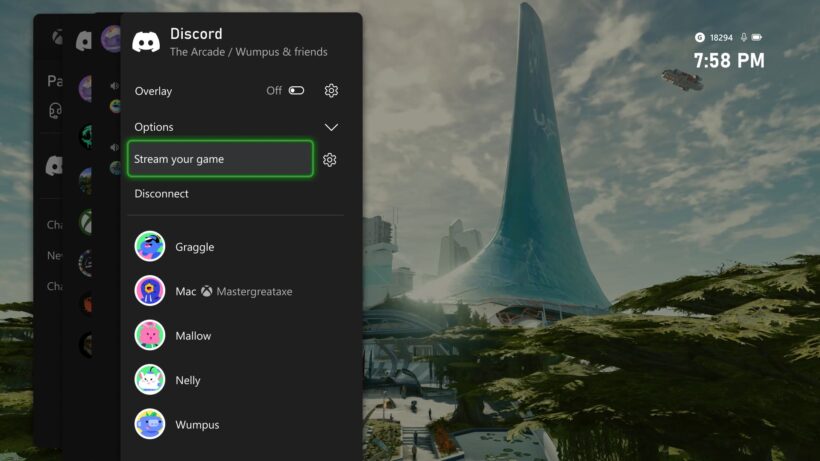
Streaming on Discord via Xbox
Discord is described as being a “communications platform” that enables users to build connections around the “joy of playing games through voice, video and text features”.
So, although it does enable communication and sharing with friends, it isn’t technically classified as social media.
Advertisement
At the time of writing, Discord is not included in the list of platforms that will be banned by the UK governments for under-16s. However, the government hasn’t confirmed whether this list is exhaustive or not, so there’s potential for more platforms to be added.
Advertisement
The government has also disclaimed that it doesn’t intend for “messaging services like Whatsapp and Signal” to be included in the ban. Considering Discord is classed as a communications platform, this could suggest that the government may not see it as a social media platform.
Plus, the UK government has said that it plans to use the “same model for a social media ban as Australia”, who doesn’t include Discord in its own ban. However, many critics have since called for Australia to include Discord in its ban, as the platform allows for video chatting and live streaming.
What is Discord’s minimum age, and does it change under the ban?
The minimum age you need to be to join Discord is 13 years old, however this varies depending on where you are in the world. For example, while UK residents can join when they’re 13, some European countries like Spain and Italy require users to be 14 years old. In fact, countries including Ireland, Germany and Poland have a minimum age requirement of 16 years old.
Discord hasn’t disclosed whether it plans to change the UK’s minimum age in-line with the upcoming social media ban. That means for now, we can assume its minimum age will remain at 13 years old.
Advertisement
What other apps are and aren’t included in the ban?
So far, the apps included in the ban are: X, Snapchat, Facebook, Instagram, YouTube and TikTok. Messaging apps are “not intended” to be included in the ban, with the government explicitly referencing Whatsapp and Signal. At the time of writing, those are all the apps that we know about.
Advertisement
When does the ban come into effect?
The UK’s social media ban for under-16s should be implemented in Spring 2027, after the first set of regulations are laid out by the end of 2026.
Take advantage of holiday savings in the U.S. on AirTags, MacBooks, iPads, and more. Many of these 4th of July deals could sell out after Apple’s recent price hikes.
Holiday deals are in effect in the U.S. and Apple products are now up to $650 off. Highlights can be found below, with even more discounts in our Apple Price Guides.
Apple’s newest AirTags are still at the lowest price seen since release when you opt for the 4-pack that’s on sale for $89.
AirPods from $99
AirPods 4 prices are as low as $99 heading into the weekend.
AirPods 4 without ANC are still available for $99 at Amazon, matching Prime Day pricing.
iPads up to $400 off
iPad Pro and iPad Air models are heavily discounted at Amazon.
Advertisement
Amazon’s iPad discounts of up to $400 off are worth checking out, as Apple’s recent price hikes may result in these deals expiring or selling out soon.
That perfect black foundation is driven by the alpha 9 AI Processor Gen8, which analyses and upscales every frame in real time to sharpen detail without making anything look artificially smoothed over or overworked.
Advertisement
Brightness Booster works alongside that same processor to lift highlights and punch through glare, so the picture holds its impact whether the room is pitch dark or lit by an unforgiving afternoon sun.
That kind of responsiveness carries straight into motion handling, where the 120Hz refresh rate keeps fast-paced sport and gaming sequences fluid rather than letting quick pans smear into a distracting blur.
That same fine texture in skin, foliage and fabric gets matched by sound, with Dolby Atmos and AI Sound Pro spreading dialogue and effects convincingly around the room via a virtual 11.1.2 up-mix.
Advertisement
None of that immersive setup requires extra hardware either, since the AI Magic Remote’s dedicated AI button lets you search, adjust settings or ask questions using nothing more than your own voice.
Connectivity has been built with the same forward thinking, offering four HDMI ports, three USB ports and both Bluetooth and Wi-Fi so every console, soundbar and streaming stick stays connected without a fuss.
The webOS platform ties the whole experience together, pulling in Netflix, Prime Video, Disney Plus and Apple TV without ever needing a separate streaming box cluttering up the cabinet underneath.
If you want to see how this LG model stacks up against rivals from Samsung, Sony and Panasonic, our Best OLED TV 2026 roundup breaks down the strongest option from every major brand.
Of the many impressive aircraft developed for the United States military, Lockheed’s SR-71 Blackbird is probably the most well-known. The high-altitude reconnaissance jet has set numerous world records for speed, and many of the SR-71’s records have yet to be broken. The SR-71 is unlike pretty much every aircraft ever operated by the U.S. Air Force, and it had strict build requirements that enabled its altitude and speed achievements.
Among its many unique requirements, the SR-71 cannot use standard jet fuel, and it was built out of highly expensive titanium, much of which was procured from the Soviet Union by the CIA. Working with titanium was challenging, leading to another interesting quirk of the aircraft’s design: many of the SR-71’s parts were prone to fail, but only when they were manufactured during the summer. At the time of its initial construction, the use of titanium was relatively new, so finding out what caused the problem took some time to figure out.
Advertisement
Winter-built parts functioned seemingly indefinitely, and the unusual reason for this early issue in the SR-71’s development was something few could have imagined: water. It turns out that water mucked up the wing panels that were welded during the summer, and it had everything to do with the chlorine content of the water used during manufacturing. Lockheed solved the problem after spending some time trying to determine its cause, and it’s something Lockheed’s engineers couldn’t have imagined being a problem in the construction of one of the most secretive and advanced aircraft ever built.
Advertisement
The problem chlorinated water posed to the SR-71
Titanium isn’t an easy metal to work with, and it is highly sensitive to contaminants capable of corroding it. Wing panels needed to be welded into place, but the water used to wash the panels after an acid treatment caused the summer problem because of chlorine. The SR-71 was assembled by Skunk Works out of the Burbank Airport in California. The Burbank Water treatment plant added chlorine to the water during the summer to prevent algae blooms. Because algae prospers in warm environments, chlorine wasn’t required during the winter.
As a result, the parts welded during the summer degraded within six to seven weeks. Conversely, the parts that were worked on during the winter didn’t have this problem. The fix was relatively easy, requiring the workers to switch to using distilled water devoid of chlorine or other contaminants for the post-acid treatment. Another contaminant caused similar issues, but it wasn’t found on the parts — it had to do with the tools.
Skunk Works’ personnel working on the problem found that cadmium-plated wrenches left enough residue that weakened the bolts, causing them to fail. Cadmium, like chlorine, degrades titanium, so they replaced the tools. All of these issues resulted in a great deal of titanium and expensive tools tossed in the trash, elevating costs and delaying the production of the SR-71 Blackbird. Ultimately, it all worked out; the aircraft took to the skies, where it was most often used to spy on the very nation that unknowingly supplied much of the metal that went into its construction.








































































You must be logged in to post a comment Login