

Crypto World
Bitcoin miners are selling: is capitulation here?



Public miners have dumped Bitcoin at a record pace, hashprice has collapsed to post-halving lows, and older machines are switching off. That is the textbook definition of capitulation. The harder question is whether it marks a bottom or the start of a deeper shakeout.
Summary
- Publicly traded Bitcoin miners sold more than 32,000 BTC in the first quarter of 2026, a single-quarter record that exceeded their combined sales for all of 2025 and topped the roughly 20,000 BTC sold during the Terra-Luna collapse in 2022.
- The pressure is economic: hashprice, the revenue a miner earns per unit of computing power, fell to post-halving lows in the high-$20s per petahash per day by mid-2026, well below the roughly $35 breakeven for older machines, putting a large share of the industry underwater.
- Network hashrate has started to fall as older hardware powers down, the classic signature of a miner capitulation, in which the least efficient operators stop mining at a loss.
- The bull reading is that capitulation has historically marked bottoms, because it clears weak capacity, lowers difficulty, and rewards the survivors. The bear reading is that this squeeze is structural, with heavy debt, record ETF outflows, and even Strategy turning seller removing the usual counterweight.
- Whether this is a bottom or a way station depends on whether Bitcoin can reclaim miner production cost, estimated by some near $80,000, against a price sitting closer to $58,000.
Bitcoin miners are supposed to be the market’s most committed holders, the operators who spend real money to produce coins and who have every incentive to keep them. So when miners start dumping Bitcoin at a record pace and switching off machines, the market pays attention, because it usually means something has broken in the economics of production. That is exactly what has happened through the first half of 2026. Public miners have sold more Bitcoin than in any prior quarter on record, hashprice has fallen to lows not seen since the last halving, and network hashrate has begun to slip as older rigs go dark.
This piece works through what is driving the selling, what capitulation actually means, and the real disagreement underneath it: whether a miner capitulation at these levels marks the bottom, as it often has, or whether this cycle is different. The signal matters because miners sit at the production edge of Bitcoin, where price, power costs, difficulty, debt, and treasury strategy meet. It also lands at a moment when Bitcoin sentiment is already washed out, making every capitulation signal easier to overread.
The record selling
The headline number is stark. Publicly traded mining companies, including MARA, CleanSpark, Riot Platforms, Cango, Core Scientific, and Bitdeer, collectively sold more than 32,000 Bitcoin in the first quarter of 2026, according to industry trackers. That figure set a single-quarter record. It exceeded what those same companies sold across all four quarters of 2025 combined, and it surpassed the roughly 20,000 Bitcoin they offloaded during the second quarter of 2022, the depths of the bear market that followed the Terra-Luna collapse.
When miners sell more in three months than they did in a full prior year, and more than during one of the worst crises in crypto history, the signal is hard to ignore. The individual disclosures fill in the picture. Riot Platforms sold 3,778 Bitcoin in the first quarter at an average price near $76,626, generating about $289.5 million, while producing only 1,473 coins in the same period, meaning it sold far more than it mined. Core Scientific liquidated roughly 1,900 Bitcoin worth about $175 million in January alone. Cango sold 2,000 Bitcoin in March for approximately $143 million, using the proceeds to retire Bitcoin-backed loans.
In a single week, MARA, Genius Group, and Nakamoto Holdings revealed combined sales of more than 15,000 coins, with the largest share from MARA. These were not routine sales of freshly mined coins to cover the power bill; they were drawdowns of treasury reserves the companies had previously chosen to hold. The trend shows up in the aggregate data too. The total Bitcoin held by miners, a metric some analysts call the miner reserve, has been declining since 2023, falling from more than 1.86 million coins at the end of that year toward roughly 1.8 million by mid-2026.
Selling that once looked like occasional balance-sheet management has become a sustained drawdown, and the pace accelerated as prices fell. The question is what forced it. The answer begins with mining economics, but it does not end there.
Why miners are selling
The answer is a profit squeeze that has been building since the last halving. The central metric is hashprice, which measures the daily revenue a miner earns per unit of computing power. Hashprice has been sliding since mid-2025, and by the first half of 2026 it had fallen to record post-halving lows, dropping into the high-$20s per petahash per day on some trackers, down roughly two-thirds from the October 2025 peak. The breakeven level for many miners running older equipment sits near $35 per petahash per day.
With hashprice well below that line, a large share of the industry, estimated at around a fifth at points earlier in the year, has been operating at a loss. Several forces compounded to produce that squeeze. The April 2024 halving cut the block reward in half, instantly halving the Bitcoin miners earn for the same work. Network difficulty has climbed relentlessly since, sitting roughly 10 times higher than in 2021, which means far more computing power now competes for that smaller reward.
Energy costs rose as Middle East conflict pushed oil higher and pressured power prices. Bitcoin itself fell, dropping toward a 21-month low near $58,000, so the coins miners produce are worth less at the moment they most need the cash. Taken together, mining profitability has compressed by close to an order of magnitude from its peak. Debt turned the squeeze into forced selling.
Aggregate miner debt surged over the past year, rising from around $2.1 billion to roughly $12.7 billion as companies borrowed to fund expansion, buy more efficient rigs, and diversify. Debt has to be serviced regardless of price, so when revenue collapses, miners with loan obligations have little choice but to sell coins or, in some cases, sell coins specifically to repay Bitcoin-backed loans. Some estimates put the all-in cost to produce a single Bitcoin near $80,000, well above the current price, which means the least efficient operators are now mining at a loss on every coin. That is the condition that forces capitulation.
What capitulation actually means
Capitulation is a loaded word, so it helps to define it precisely. In mining, capitulation is the point in a cycle where revenue falls below what a meaningful share of the network costs to run, and those operators power down their machines rather than keep mining at a loss. It is not a crash or a malfunction. It is the market clearing, the mechanism by which the least efficient capacity leaves the network when it can no longer pay for itself.
The signature of capitulation is a falling hashrate, and that is now visible. As unprofitable machines switch off, the total computing power securing the network declines. By mid-2026, a meaningful slice of older hardware had gone offline, and the 30-day average network hashrate had fallen by several % from its highs, after earlier swings in which difficulty dropped sharply and then rebounded as miners reconnected. When hashrate falls and stays down, Bitcoin’s built-in difficulty adjustment eventually lowers the bar, making it cheaper and more profitable to mine for the operators who remain.
That self-correcting loop is what distinguishes a mining capitulation from a permanent decline. Analysts track this through indicators built on hashrate momentum, which flag when short-term hashrate falls below its longer-term trend, historically a marker of miner stress and, often, of a market bottom forming. The pattern moves through recognizable stages: revenue falls below cost, weak operators power down, hashrate and difficulty drop, and the survivors, who sit on cheaper power and more efficient machines, absorb the share the leavers gave up and become more profitable. The shakeout is loud and it photographs like a collapse, but the underlying mechanism is orderly.
Whether that orderly clearing is bullish or bearish for the Bitcoin price is where the disagreement begins. For miners, capitulation is an industry sorting event. For traders, it is a possible bottom signal. Those are related, but not identical.
The bull case: capitulation marks bottoms
The optimistic reading rests on history. Miner capitulations have consistently preceded recoveries rather than endings. The logic is mechanical, not hopeful. When high-cost operators power down, network difficulty falls, which lowers the cost to mine for everyone still online.
The efficient survivors, running new machines on cheap power, then capture a larger share of a reward that has become cheaper to earn, so their margins expand even if the price does not move. The capitulation sorts the industry on a single variable, cost per hash, and consolidates it around its lowest-cost producers. For the price, the argument is that miner capitulation tends to coincide with peak seller exhaustion. Miners are a persistent source of supply, selling coins into the market to fund operations.
When the highest-cost miners give up and switch off, that stream of forced selling thins out, removing pressure that had been weighing on the price. Historically, the crossover in hashrate momentum indicators that signals capitulation has aligned with attractive long-term entry points, because it marks the moment the weakest hands, on the production side, have been washed out. The recovery mechanism has proven fast in the modern, industrialized mining sector. Earlier in 2026, a difficulty drop of around 11% was followed within two weeks by a record upward adjustment near 15% as miners reconnected the moment conditions eased.
That speed is the point: surviving operators are committed and well-capitalized enough to scale back up quickly when hashprice recovers. In this reading, the record selling and the falling hashrate are not a warning but a washout, the part of the cycle where the field clears before the next leg up. The bull case does not deny the pain. It argues that the pain is how the reset finishes.
The bear case: this squeeze may be structural
The skeptical reading argues that the usual capitulation-marks-a-bottom pattern assumes a market backdrop that no longer holds. The first difference is debt. The mining sector carries far more leverage than in past cycles, with aggregate debt having climbed toward $12.7 billion, which means capitulation now involves not just idle machines but the risk of defaults, forced liquidations, and distressed asset sales that can overhang the market longer than a simple hashrate reset would. The second and larger difference is who is buying.
In past capitulations, miner selling was absorbed by a mix of retail and, more recently, institutional demand. In 2026, the marginal buyer has turned into a seller. U.S. spot Bitcoin ETFs recorded their worst month on record in June, with roughly $4.5 billion in net outflows, removing the very demand channel that had absorbed supply on the way up. Even Bitcoin treasury companies, long the reliable counterweight to miner selling, have wobbled: the largest corporate holder made its first Bitcoin sale in years to fund a dividend and has come under pressure over its financing structure.
When miners sell into a market where ETFs are bleeding and the corporate bid is faltering, the supply has fewer places to go, and the price can keep falling even as capitulation runs its course. The third concern is duration. Capitulation clears quickly only if price recovers to pull survivors back and thin the selling. If Bitcoin remains stuck well below the estimated production cost for an extended period, held down by a hawkish Fed and tight liquidity, the squeeze can grind on, pushing even mid-cost operators toward the exit and turning a healthy shakeout into a prolonged contraction.
In this view, the capitulation signal is real, but the conditions that historically turned it into a bottom, rebounding demand and easing macro, are absent, so the pattern may not repeat on its usual schedule. This is also where Strategy’s balance sheet matters, because the market’s biggest corporate Bitcoin buyer is no longer treated as an unconditional bid. The bear case is not that miner capitulation does not exist. It is that capitulation may not be enough when the buyers are missing.
The AI pivot: capitulation or reinvention
There is a third storyline that complicates the simple capitulation frame, and it is specific to this cycle. Many miners are not simply powering down; they are repurposing. The same data centers, power contracts, and cooling infrastructure that mine Bitcoin can, with investment, host the computing demand of artificial intelligence and high-performance workloads, which command far higher and more stable revenue than mining at current hashprice. Several operators have pivoted hard in that direction, converting capacity or striking deals to serve AI customers instead of mining coins.
That pivot muddies the read on hashrate and selling. Some of the machines going dark are not distressed operators giving up but companies reallocating capacity to a more profitable use, and some of the Bitcoin being sold is funding that transition instead of covering losses. For those firms, selling coins and reducing mining is a strategic reallocation, not a capitulation in the traditional sense. It is a rational response to a world where a unit of power and compute is worth more pointed at AI than at a halved block reward.
The implication cuts both ways for Bitcoin. On one hand, the AI pivot means some hashrate decline reflects opportunity rather than distress, which is less bearish for the price and could permanently shrink the pool of forced sellers. On the other hand, it means the mining industry’s most valuable operators may increasingly treat Bitcoin as a secondary business, weakening the reflexive commitment that made miners such steadfast long-term holders. A sector that once mined and held because it believed in the asset is becoming a sector that mines, or computes, wherever the margin is best.
That shift also connects miners to the broader class of Bitcoin treasury companies, where balance-sheet Bitcoin is no longer always sacred. Coins can be collateral, reserves, working capital, or transition funding. In a tight market, that difference matters. It means miner selling is not always panic, but it is still supply.
The divergence that matters
Underneath all of it sits one divergence worth watching more than any single figure. On the supply side, miners are selling into weakness while their reserves shrink and their hashrate falls. On the demand side, the buyers who absorbed that supply on the way up have stepped back, with ETFs posting record outflows and the flagship corporate holder turning seller. In prior cycles, miner capitulation coincided with new demand stepping in at low prices, which is what turned the washout into a floor.
This time, the demand side is thinner precisely when the supply side is capitulating. That is why the capitulation signal, on its own, is not enough to call a bottom in 2026. The historical pattern is real, and the mechanics that clear weak capacity and reward survivors still function. But the pattern completed into a recovery in past cycles because demand returned to meet the reduced supply.
The open question now is whether a new source of demand, renewed ETF inflows, a macro shift toward easier policy, or a return of the corporate bid, arrives to meet the capitulating miners. Until it does, the cleaner read is that miners are doing exactly what they do at cycle lows, while the buyers who usually meet them there have not yet shown up. That makes this capitulation signal important, but incomplete. It is a setup, not a confirmation.
The same distinction applies to corporate Bitcoin holders. A company can hold Bitcoin and still create supply pressure if it sells, or demand if it accumulates. The market does not care which category a holder belongs to; it cares whether they are adding or removing coins from available supply. Right now, the supply-side pressure is visible, and the demand-side recovery has not yet proven itself.
What to watch
For anyone trying to judge whether this capitulation marks a turn, a handful of signals matter more than the daily price. The first is hashprice: a sustained recovery back above the roughly $35 per petahash breakeven would ease the forced selling at its source, while a further slide would deepen it. The second is hashrate and difficulty: a stabilization in network hashrate, followed by a downward difficulty adjustment, would confirm the clearing is working and would improve economics for the survivors. Momentum indicators built on hashrate crossing back above their longer-term trend have historically flagged the completion of a capitulation.
The third is the demand side, which this cycle makes decisive. A return of net inflows to spot Bitcoin ETFs would signal that the marginal buyer is back, and a resumption of corporate treasury accumulation would restore the counterweight to miner selling. The fourth is the price relative to production cost: Bitcoin reclaiming and holding above the estimated all-in cost to mine a coin would pull the economics back into profitability and remove the pressure driving the sales. Until those turn, the record miner selling and the falling hashrate tell a consistent story of an industry clearing its weakest capacity, with the crucial question, whether fresh demand arrives to complete the pattern, still unanswered.
That is the disciplined read. Miner capitulation can mark a bottom, but it does not create one by itself. It needs confirmation from price, hashprice, ETF flows, and corporate demand. Without that, capitulation remains evidence of stress, not proof of recovery.
Frequently asked questions
Why are Bitcoin miners selling so much Bitcoin?
Miners are selling because their economics have collapsed. Hashprice, the revenue earned per unit of computing power, fell to post-halving lows in the high-$20s per petahash per day by mid-2026, below the roughly $35 breakeven for older machines. The 2024 halving cut rewards, difficulty rose about 10 times from 2021, energy costs climbed, and Bitcoin fell toward a 21-month low, forcing miners with heavy debt to sell coins to cover costs.
How much Bitcoin did miners sell in 2026?
Publicly traded miners including MARA, CleanSpark, Riot, Cango, Core Scientific, and Bitdeer collectively sold more than 32,000 Bitcoin in the first quarter of 2026. That set a single-quarter record, exceeding their combined sales for all of 2025 and topping the roughly 20,000 Bitcoin sold during the 2022 Terra-Luna bear market. The total Bitcoin held by miners has fallen from about 1.86 million at the end of 2023 toward 1.8 million. The pace of selling shows miners treating reserves as working capital in a stressed market.
What is miner capitulation?
Miner capitulation is the point in a cycle where mining revenue falls below what a meaningful share of the network costs to run, so those operators power down instead of mining at a loss. Its signature is a falling network hashrate as unprofitable machines switch off. It is a market-clearing mechanism: weak capacity leaves, Bitcoin’s difficulty adjustment lowers the bar, and the efficient survivors become more profitable. It is painful for the sector but can improve economics for the miners that remain.
Does miner capitulation mean the price has bottomed?
Historically, miner capitulation has often preceded recoveries, because it clears weak capacity, lowers difficulty, and thins the forced selling that weighs on price. But that pattern completed into a bottom in past cycles because new demand stepped in at low prices. In 2026, ETFs have posted record outflows and even the largest corporate holder turned seller, so the usual demand counterweight is thinner, making the signal less reliable on its own. Capitulation is a bottoming condition, not a guaranteed bottom.
What is hashprice and why does it matter?
Hashprice is the daily revenue a miner earns per unit of computing power, typically quoted per petahash per second per day. It combines the Bitcoin price, network difficulty, and transaction fees into a single profitability measure. When hashprice falls below a miner’s cost to operate, roughly $35 per petahash for older machines, that operator loses money on every coin, which is what drives capitulation and forced selling. A recovery in hashprice would be one of the clearest signs the pressure is easing.
Are miners capitulating or pivoting to AI?
Both are happening, which complicates the read. Some miners are genuinely distressed and powering down, while others are repurposing their data centers, power contracts, and cooling infrastructure to serve artificial intelligence and high-performance computing, which pays more than mining at current hashprice. That means some hashrate decline reflects strategic reallocation instead of distress, and some coin sales fund the transition instead of covering losses. The result is a sector that is both stressed and reinventing itself.
How does this capitulation compare to past cycles?
The mechanics are familiar, but the backdrop differs in two ways. Miner debt is far higher, having climbed toward $12.7 billion, so capitulation now carries default and forced-liquidation risk. The demand side is weaker too, with spot ETFs recording their worst month on record in June and the flagship corporate buyer turning seller. Past capitulations resolved into bottoms partly because fresh demand met the reduced supply, which is less certain now.
What signals would show the capitulation is ending?
Watch four things: hashprice recovering back above the roughly $35 breakeven, network hashrate stabilizing followed by a downward difficulty adjustment, a return of net inflows to spot Bitcoin ETFs and corporate treasury buying, and Bitcoin reclaiming the estimated production cost near $80,000. Hashrate momentum indicators crossing back above their longer-term trend have historically marked the completion of a miner capitulation. In this cycle, ETF inflows may be the most important confirmation because they show the marginal buyer has returned.
Disclaimer: This article is for information and educational purposes only and does not constitute financial, investment, or trading advice. Cryptocurrency prices and mining economics are highly volatile, and historical patterns do not guarantee future outcomes. Nothing here is a recommendation to buy or sell any asset. Always do your own research and consider consulting a licensed professional before making financial decisions. Figures are accurate as of July 2, 2026, and will change.



Riot Platforms transferred another 500 BTC to NYDIG Custody, according to Arkham data cited by onchain trackers.
Summary
- Riot Platforms moved another 500 BTC to NYDIG Custody, raising fresh sale speculation among traders.
- The miner already sold 3,778 BTC in Q1 while producing only 1,473 BTC total.
- Public Bitcoin miners continue selling reserves as mining costs rise and margins remain under pressure.
The transfer was worth about $30.72 million at the time of the report and was shared through an Onchain Lens post.
The move may signal that Riot is preparing to sell part of its Bitcoin holdings. Transfers to custody or execution partners do not always confirm a sale, but similar Riot transfers this year have often come before reported selling activity.
Another move in a longer sale pattern
The latest transfer follows earlier Riot activity involving NYDIG. As crypto.news reported in April, Riot sent 500 BTC to an NYDIG deposit address in a move worth about $39 million at the time. That report said the transfer added to a series of Bitcoin moves from Riot over the same period.
Riot had also disclosed large Bitcoin sales in its first-quarter 2026 operations update. The company sold 3,778 BTC in Q1 for about $289.5 million. It sold those coins at an average net price of $76,626 per BTC.
Riot produced 1,473 BTC in the first quarter, down 4% from 1,530 BTC in the same period a year earlier. Its BTC holdings fell to 15,680 at quarter-end, down 18% from 19,223 in Q1 2025. The company said 5,802 BTC were restricted at the end of the quarter.
Riot’s Q1 results also showed pressure in its mining business. Bitcoin mining revenue fell to $111.9 million from $142.9 million a year earlier. Riot linked the decline to lower average Bitcoin prices and higher network hash rate.
Miner selling pressure continues
Riot’s latest BTC movement comes as public miners face tighter economics after the Bitcoin halving. Higher mining difficulty, lower hashprice, energy costs, and capital needs have pushed several listed miners to sell reserves.
As crypto.news reported, publicly traded Bitcoin miners sold more than 32,000 BTC in the first quarter of 2026. That was a record quarterly figure and topped the amount sold by the same firms across all of 2025. Riot, MARA, CleanSpark, Cango, Core Scientific, and Bitdeer were among the miners named in that wider trend.
Riot also continues to expand beyond Bitcoin mining. The company has been building a data center business while using its power assets and infrastructure to serve high-performance computing customers. That shift gives the miner another capital need at a time when mining margins remain tight.
The 500 BTC transfer does not confirm an immediate sale on its own. Still, the timing adds to the market’s focus on Riot’s treasury strategy.


Ether and solana led crypto higher on Friday as a squeeze on bearish traders pushed bitcoin toward $62,000, capping the market’s first genuinely strong week since mid June.
Bitcoin traded around $61,360, up 2.5% over seven days, per CoinDesk data. Ether rose 4.2% in 24 hours to about $1,702 and is up 9.7% on the week, while solana held near $80 with a weekly gain of 18.6%, the strongest among the majors. XRP added 5.7% over the week to $1.09 and Hyperliquid’s HYPE rose 5.1% on the day.
Traders betting against crypto lost $281 million to liquidations over the past 24 hours, against $159 million in longs, out of $440 million in total forced closures across 95,690 traders, according to Coinglass data.
When shorts are forced to close, they buy back the asset, and that buying pushes prices into the next tranche of shorts, the loop that turns a modest bounce into a squeeze.
The largest single liquidation was an $18.2 million ether position on Hyperliquid, fitting a day when ether led the damage to bears at $157 million in wiped positions against bitcoin’s $103 million in an unusual flip.


The U.S.-listed bitcoin ETFs pulled in $221.7 million on Thursday, their largest inflow in two months, according to SoSoValue.
Fidelity’s FBTC led the charge with a hefty $165.96 million inflow, followed by ARKB at $91.84 million and HODL at $4.35 million. BlackRock’s IBIT, the world’s largest Bitcoin ETF, was the outlier with a $40.43 million outflow.
The cumulative inflow ends a painful 10-day outflow streak that saw investors pull $2.73 billion from the funds. Even so, the year-to-date picture remains ugly, with net outflows still sitting at a hefty $5.4 billion.
Thursday’s bounce is therefore a drop in the ocean compared to the selling we’ve seen this year. Still, it’s a welcome sigh of relief for the bulls. At the very least, it helps validate bitcoin’s rebound to around $61,700 after hitting 21-month lows under $58,000 earlier this week.
For a real recovery, though, these inflows need to turn into a consistent trend. Historically, steady money flowing into Bitcoin ETFs has been a hallmark of bull runs.


Binance is reportedly set to lead a new funding round for Mesh, a crypto payments and settlement company, at a valuation of up to $2 billion.
Summary
- Binance’s planned lead role could double Mesh’s valuation from $1B to as much as $2B.
- Mesh’s payments network targets digital asset transfers across wallets, exchanges, stablecoins, and fiat rails globally.
- Growing stablecoin rules and tokenization demand are pushing investors toward crypto settlement infrastructure providers.
The deal was reported by Axios, citing people familiar with the matter. The report said demand for digital asset-to-fiat transfer tools, payment systems, and settlement infrastructure is rising.
Meanwhile, that demand comes as stablecoin rules become clearer and tokenization moves deeper into financial markets. The round has not been formally announced by Binance or Mesh.
Mesh valuation could double
The reported round would mark a sharp rise in Mesh’s valuation. As crypto.news reported, Mesh raised a $75 million Series C in January at a $1 billion valuation. That round was led by Dragonfly Capital, with backing from Paradigm, Moderne Ventures, Coinbase Ventures, SBI Investment, and Liberty City Ventures.
Mesh was formerly known as Front Finance. The company builds payment infrastructure that connects wallets, exchanges, digital assets, and fiat rails. It aims to make crypto payments easier for users while letting merchants receive stablecoins or fiat without handling complex blockchain steps.
Stablecoin rules lift demand
Stablecoins have become a major focus for payment companies, exchanges, and banks. Banking Circle launched regulated stablecoin settlement services after receiving approval in Luxembourg. The bank now supports USDC, USDG, and its own EURI for institutional fiat and crypto conversion.
The market is also moving toward tokenized bank deposits. As crypto.news reported, major U.S. banks are backing a tokenized deposit network through the Clearing House, with a launch targeted for early 2027. That system would let banks settle tokenized deposits around the clock while keeping customer deposits inside regulated banking channels.
Funding race turns to settlement
Mesh sits in the middle of this shift because it focuses on the movement of value between assets, wallets, and payment systems. Its model addresses a common issue in crypto payments: users may hold one asset, while merchants or platforms may want settlement in another asset or in fiat currency.
The company has also worked to expand access through partnerships. Moreover, Mesh partnered with Italy’s crypto wallet Conio in 2024, giving Conio users access to several crypto exchanges and withdrawal options through Mesh’s connection layer.
A Binance-led round would show that large exchanges still see payment and settlement infrastructure as a core growth area. It would also place Mesh closer to the center of the stablecoin and tokenization race, where firms are trying to connect crypto rails with everyday payments, institutional transfers, and fiat settlement.
The reported valuation also reflects a wider shift in crypto funding. Investors have moved beyond trading apps and tokens toward systems that can support regulated payments, cross-border transfers, and asset settlement.
If the round closes near the reported level, Mesh would have doubled its valuation in about six months, showing continued demand for infrastructure that links digital assets with traditional money.

TLDR:
- Ironwood testnet activates with two independent consensus implementations built by separate teams.
- Zcash reduced ten-note wallet migration times from around 15 minutes to about 2.5 minutes.
- Multi-transaction signing now supports more than 11 transactions through a single QR code.
- Mainnet activation could occur around July 21 as audits and ZIP specifications near completion.
Zcash is moving forward with its Ironwood network upgrade after confirming a scheduled testnet activation. The update introduces new consensus changes and major wallet performance improvements ahead of a planned mainnet deployment.
Development teams have also completed two independent consensus implementations for the upgrade. The work marks one of the most advanced testnet preparations recorded for a Zcash network upgrade.
Zcash Ironwood Testnet Upgrade Brings Dual Consensus Implementations
Zcash developer Dev announced that the Ironwood testnet upgrade would activate on July 4. The release includes two independently developed consensus implementations.
One implementation came from Valar Group, while the other was built by the Zcash Foundation. According to Dev, the Valar Group version has already entered the audit process.
The teams also released a desktop wallet fork that supports migration testing on the testnet. Users with Keystone development devices can update firmware and test migration functions before the mainnet launch.
The upgrade introduces multi-transaction signing through a single QR code. Dev said the feature required extensive work behind the scenes and represented a major technical milestone for the testnet.
Contributors from zodl also participated in the process. The group worked on technical specifications, wallet libraries, circuit updates, and application programming interfaces supporting Ironwood.
Zcash Wallet Performance Improves Ahead of Mainnet Activation
Development updates shared by Dev showed major gains in wallet migration performance. The time needed to complete a ten-note migration fell from around 15 minutes to approximately two and a half minutes.
Inbound QR scanning dropped from three minutes to one minute. Loading and transaction review declined from two minutes to 45 seconds.
The signing process posted the largest improvement. Signing time fell from roughly nine minutes to about 37 seconds.
Outbound QR scanning also became faster. The process now takes about 10 seconds compared with roughly one minute previously.
In a separate update, Zcash developer Sean Bowe said all Ironwood consensus rule changes had been implemented and were undergoing audits.
He added that the specifications and Zcash Improvement Proposals, known as ZIPs, were approaching their final state.
Bowe also said developers expected readiness for a mainnet activation around July 21. He confirmed that the official testnet activation was scheduled for the following day and noted that the Zebra release supporting Ironwood should become available around the same time.
According to Bowe, sufficient mining hash rate already signals technical readiness for the mainnet upgrade. He noted that some wallets may not support Ironwood immediately, although alternative options and testnet preparation time remain available before activation.

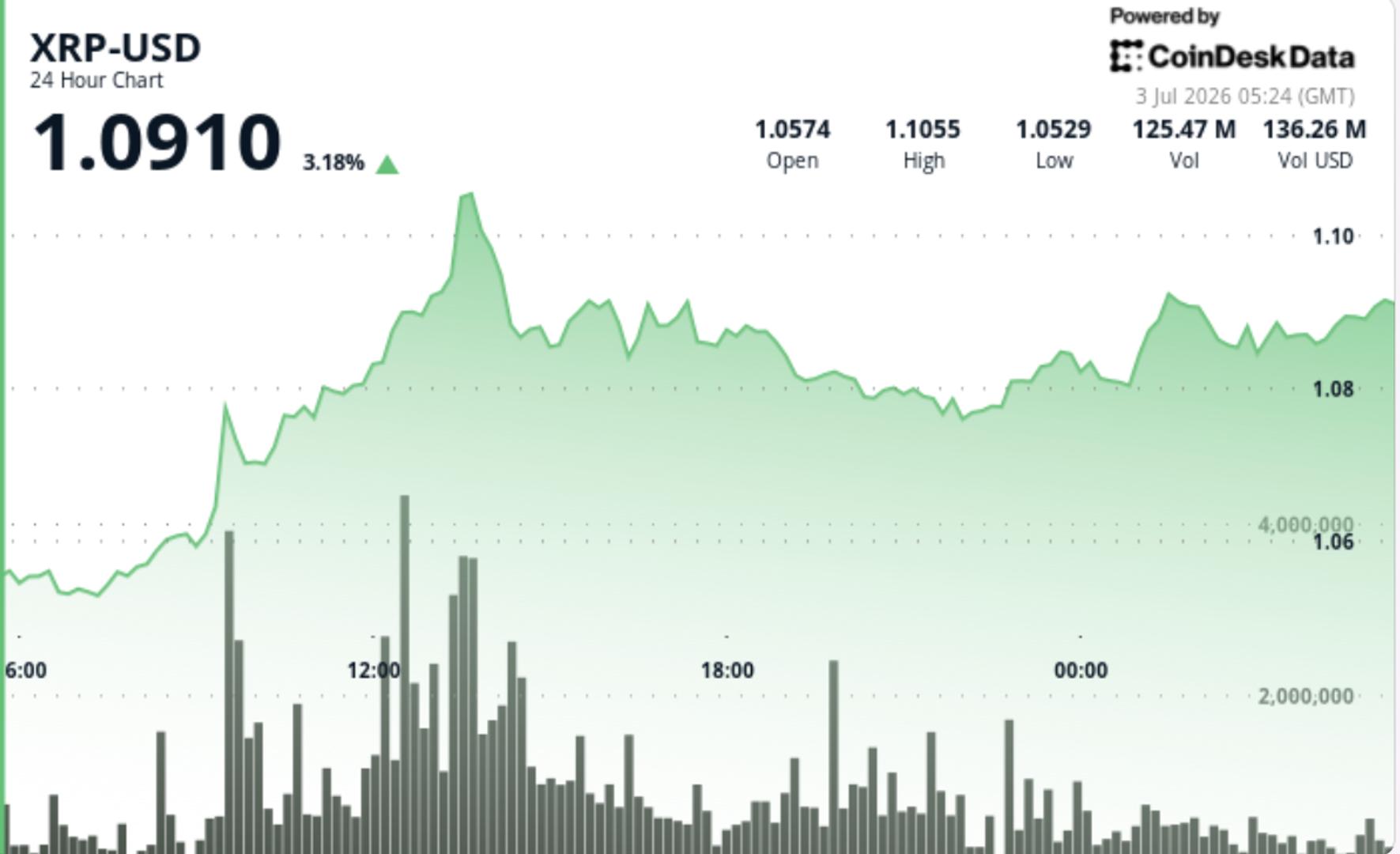
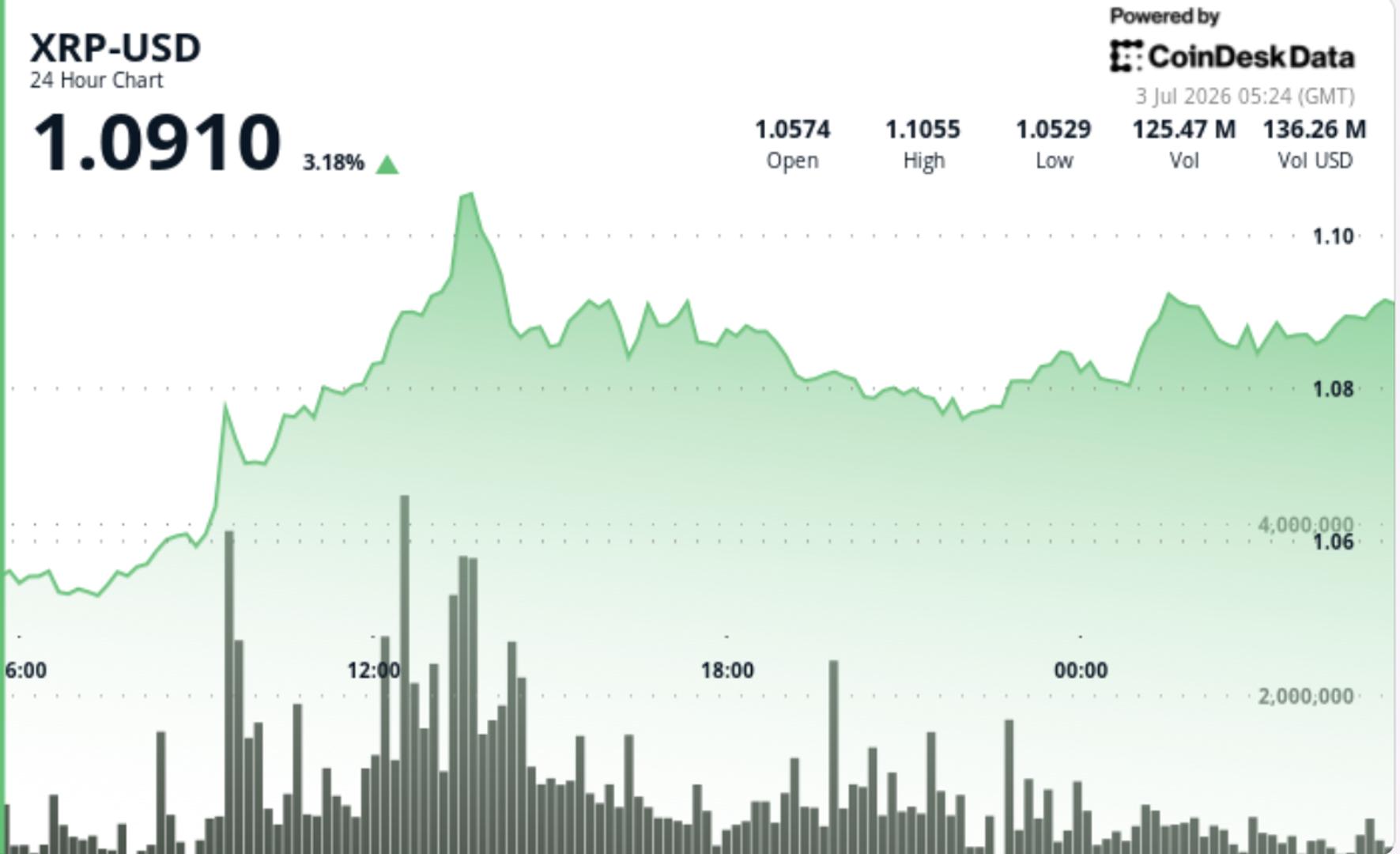
XRP is starting to build a higher base above $1 following last week’s sell-off. The token edged higher through the U.S. session, held $1.08 on repeated tests and pushed toward $1.10 before sellers slowed the move. That keeps the setup constructive, but still unfinished, with traders watching whether the latest accumulation turns into a clean breakout.
News Background
• XRP wallet creation rose to 4,941 daily addresses, the strongest single-day growth in 14 weeks.
• Bullish social sentiment reached a three-month high, with positive comments outnumbering bearish ones by 3.7 to 1.
• Ripple completed its scheduled 1 billion XRP escrow unlock without a meaningful price shock.
• XRP’s move tracked the broader crypto market closely, with idiosyncratic variance against CD5 staying well below the level that would suggest a major asset-specific catalyst.
Price Action Summary
• XRP rose from $1.0611 to $1.0894 during the 24-hour session, gaining 0.62%.
• The token established higher lows at $1.0552, $1.0589 and $1.0799, showing buyers stepped in at progressively higher levels.
• Volume rose 26.92% above the seven-day average, pointing to steady participation around the move.
• The strongest push came at 13:00 UTC, when volume reached 117.5 million XRP, about 142% above the 24-hour average.
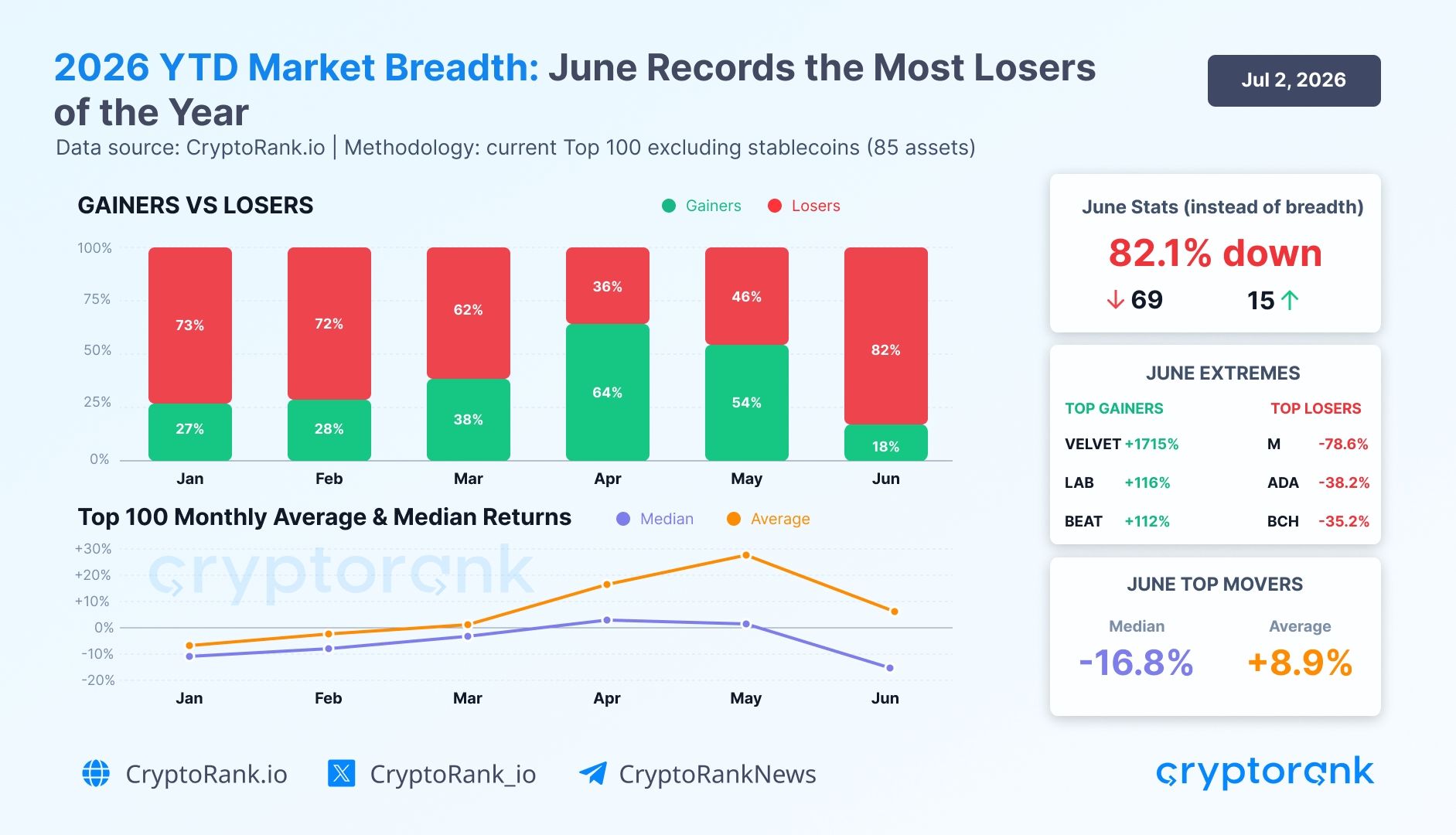
Roughly 82.1% of the top-100 crypto assets declined in June, the worst market breadth of 2026, even as the group’s average return stayed positive.
That split defined the month. A single outlier lifted the average into positive territory while the median return dropped 16.8%, according to a second-quarter recap from CryptoRank.
A Headline Average That Hid the Damage
Across the current top-100 assets excluding stablecoins, CryptoRank recorded a positive average return of 8.9% for June. That figure reflected a single outlier rather than the broader market.
“The market breadth data shows a clear deterioration in participation across the current non-stablecoin Top 100 assets. In June, breadth weakened to its worst level of 2026 so far,” the report read.
Follow us on X to get the latest news as it happens

The report noted that the average was affected by Velvet (VELVET), which surged 1,715% during the month, lifting the aggregate. The 25-point gap between the positive average and the negative 16.8% median showed how few tokens carried the upside.
Besides VELVET, other top gainers included LAB (LAB) at 116% and Audiera (BEAT) at 112%. June also reversed a stronger start to the quarter.
April saw 64% of top-100 assets gain, the best month of 2026. Meanwhile, May showed a more fragile structure, and the June breakdown confirmed the reversal.
Weakness Reached Major Crypto Narratives in June
The decline was not limited to the largest assets. Across all traded tokens with 24-hour volume of more than $1 million, every one of the eight tracked narratives posted a negative median return.
Layer 2 chains led the losses at -24.9%, followed by Decentralized Physical Infrastructure Networks (DePIN) at -24.8% and Layer 1 chains at -22.8%.
“All 8 tracked narratives posted negative median returns, with losers outnumbered gainers in nearly every category, confirming that the market remained defensive and narrow through Q2 without a broad recovery in breadth,” CryptoRank said.

The gainers-versus-losers split showed how narrow the market became. Decentralized Finance (DeFi) recorded 42 gainers against 117 losers, while Artificial Intelligence (AI) posted 21 gainers against 35 losers.
The pattern pointed to a defensive market. Bitcoin (BTC) dominance held near 56% at quarter-end as capital rotated away from weaker altcoins.
Whether June marks a base or another leg lower depends on breadth recovering in the second half.
Subscribe to our YouTube channel to watch leaders and journalists provide expert insights
The post Crypto’s Positive June Average Masked an 82% Decline Across Top Assets appeared first on BeInCrypto.


Russia’s central bank says the digital ruble is ready for a Sept. 1 rollout, keeping the country’s central bank digital currency plan on schedule.
Summary
- Russia’s Sept. 1 digital ruble rollout moves ahead despite EU sanctions targeting related financial infrastructure.
- Bank rules require major lenders and large retailers to support digital ruble payments in stages.
- U.S. lawmakers are moving toward a temporary CBDC ban while Russia expands state digital money.
Governor Elvira Nabiullina said “everyone is ready” for the launch, according to a July 2 report by RIA Novosti.
The digital ruble will circulate alongside cash and non-cash rubles, not replace them. The Bank of Russia has said people will be able to open digital wallets through banking apps connected to its platform. It has also said individuals will not pay fees on digital ruble transactions.
The rollout begins with banks and large merchants
The Bank of Russia’s timeline requires major banks to offer digital ruble services from Sept. 1, 2026. Large retailers with annual revenue above 120 million rubles must also accept digital ruble payments from that date.
The rules will expand in stages. Banks with universal licenses and retailers with annual revenue above 30 million rubles must join from Sept. 1, 2027. Other banks and smaller retailers will follow from Sept. 1, 2028, while very small merchants will remain exempt.
Sanctions pressure frames the rollout
The launch comes as the European Union has already moved against Russia-linked digital finance. In its 20th sanctions package, the EU Council banned transactions involving RUBx and all EU support for the development of the digital ruble. It linked the measures to Russia’s war against Ukraine and wider concerns over sanctions evasion.
In addition, the EU also proposed broader restrictions on foreign crypto services tied to Russian sanctions evasion. That plan followed growing scrutiny of ruble-linked crypto rails, including platforms and tokens that authorities say may support cross-border payments outside Western controls.
Russia has tested digital ruble use cases for more than a year. As previously reported, the Central Bank of Russia piloted digital ruble smart contracts in Tatarstan, including tests on conditional spending for public funds. The latest timeline shows that Moscow now wants to move the project from testing into broader payment use.
U.S. policy moves in the opposite direction
Russia’s CBDC push contrasts with U.S. policy, where lawmakers have moved toward a temporary ban on a Federal Reserve digital dollar. As crypto.news reported, the 21st Century ROAD to Housing Act would block the Fed from creating a CBDC or similar asset through 2030 if it becomes law.
The U.S. debate reflects concerns over privacy, state control, and the role of private stablecoins. The Russian approach is different. Moscow is building a state-run digital currency while also testing other digital asset rules for trade and financial access under sanctions.
A February report by Jack Jarmon for the Australian Institute of International Affairs said Russia could face limits if it relies on Bitcoin or other proof-of-work assets to bypass sanctions. The report pointed to old power infrastructure and limited access to foreign technology. Those limits may explain why the digital ruble remains central to Moscow’s state-led payment strategy.
The Sept. 1 launch will test whether Russia can drive adoption among banks, merchants, and users. Nabiullina said the central bank wants the digital ruble to be “in demand by people and businesses” and “convenient.”
For now, the rollout places Russia among the countries pushing CBDCs forward while sanctions and U.S. policy debates keep digital state money under close review.
eToro has led a $12.5 million strategic funding round in Extended, an onchain exchange for perpetual futures.
Summary
- eToro’s Extended investment links Zengo self-custody tools with onchain perpetual futures trading access for users.
- Jump Crypto joined the round as brokerages move deeper into decentralized derivatives and market infrastructure.
- Perp DEX growth is pulling trading platforms toward self-custody, tokenized assets, and onchain execution.
Extended announced the round in a July 2 post on X, saying eToro led the investment and Jump Crypto also joined the deal.
Meanwhile, the funding is tied to a partnership between Extended and Zengo, the self-custody wallet eToro acquired earlier this year. The companies plan to work on access to global financial markets through onchain infrastructure. eToro said the partnership will explore ways to connect traditional financial assets with decentralized trading venues.
Self-custody becomes part of the plan
Zengo gives eToro a direct route into self-custody products. The wallet uses multi-party computation technology, which removes the need for seed phrases while still giving users control over assets. It also supports swaps, staking, and access to decentralized applications.
eToro completed its Zengo acquisition on April 30 while reporting a sharp drop in crypto trading profit. The company said at the time that Zengo would support its plan to connect traditional financial products with onchain systems. The Extended deal now gives that plan a derivatives-focused path.
Extended builds onchain perps market
Extended was founded by former Revolut employees and opened trading to all users in late 2024. In its public launch announcement, the company said it planned to add unified margin with technical support from StarkWare.
The exchange is built on StarkWare’s StarkEx scaling engine. It focuses on perpetual futures, a type of derivative contract that has no expiry date. Extended says its model supports self-custody trading while aiming to keep execution fast enough for active traders. That structure places it between centralized crypto futures venues and fully decentralized trading platforms.
Perps growth draws larger firms
Perpetual futures remain one of the largest crypto trading markets. As crypto.news reported, CoinGecko’s 2026 Crypto Perpetuals Report found that perp DEX open interest share rose from 3.6% in early 2025 to 13.5% in 2026. The same report showed Binance and OKX still leading centralized perps trading, even as decentralized venues gained share.
That growth has drawn more attention from brokers and trading apps. Previously, crypto.news reported that Robinhood launchedperpetual futures tied to commodities, ETFs, and currencies for eligible European users. The rollout showed how crypto-style trading tools are moving into traditional markets.
Deal follows weaker crypto trading income
The investment comes after eToro reported lower crypto-related trading profit in the first quarter of 2026. As reported by crypto.news, crypto generated $13 million in profit during the quarter, or about 5% of eToro’s total net trading profit of $258 million. That was down from $46 million in the same period in 2025.
The Extended round shows that eToro is still building around digital assets despite weaker short-term crypto revenue. The company is using Zengo to strengthen its self-custody stack and Extended to enter onchain derivatives more directly.
Moreover, the move also places eToro closer to a market where trading apps, crypto exchanges, and decentralized platforms are competing for users who want faster access, direct asset control, and broader exposure to global markets.

Blockchain technology has evolved rapidly over the past decade, giving rise to hundreds of networks optimized for different use cases. Some prioritize speed, others focus on security, privacy, scalability, or specialized applications like gaming and decentralized finance (DeFi). While this diversity has fueled innovation, it has also created one of Web3’s biggest challenges: blockchain silos.
Today, the industry is moving toward a future where blockchains no longer operate as isolated ecosystems. Instead, they’re becoming interconnected networks that can communicate, exchange assets, and share data seamlessly. This shift could redefine how decentralized applications (dApps), users, and institutions interact with blockchain technology.
What Are Blockchain Silos?
A blockchain silo exists when a network operates independently without native communication with other blockchains. Assets, data, and smart contracts remain confined to their respective ecosystems.
For example:
- Bitcoin primarily serves as a secure store of value.
- Ethereum powers a vast ecosystem of smart contracts.
- Solana focuses on high-speed transactions.
- BNB Chain emphasizes affordable and scalable DeFi.
- Avalanche offers customizable blockchain infrastructure.
Each blockchain has unique strengths, but moving assets or information between them has traditionally required third-party bridges or centralized exchanges.
This fragmentation often creates unnecessary complexity for users and developers alike.
The Problems Caused by Blockchain Silos
1. Fragmented Liquidity
Liquidity scattered across multiple blockchains reduces capital efficiency. Instead of one unified financial ecosystem, liquidity is divided among separate networks, making markets less efficient.
2. Poor User Experience
Managing several wallets, switching networks, paying different gas fees, and learning multiple interfaces discourages mainstream adoption.
3. Limited Application Potential
Developers often build applications for a single blockchain, restricting access to users and liquidity from other ecosystems.
4. Security Risks
Traditional cross-chain bridges have become attractive targets for hackers. Billions of dollars have been lost through bridge exploits over the past several years, highlighting the need for more secure interoperability solutions.
The Rise of Blockchain Interoperability
Instead of competing in isolation, blockchain ecosystems are increasingly embracing interoperability—the ability for different blockchains to communicate securely.
Modern interoperability solutions aim to allow:
- Cross-chain asset transfers
- Cross-chain messaging
- Shared liquidity
- Multi-chain smart contract execution
- Unified user experiences
Rather than forcing users to choose one blockchain, interoperability allows them to benefit from many simultaneously.
Technologies Driving the End of Silos
Cross-Chain Messaging
Instead of merely transferring tokens, cross-chain messaging enables smart contracts on one blockchain to trigger actions on another.
This opens the door to far more sophisticated decentralized applications.
Interoperability Protocols
Dedicated interoperability layers provide standardized communication between independent blockchains.
These protocols reduce fragmentation while allowing each network to maintain its own security and governance.
Chain Abstraction
One of the biggest emerging trends is chain abstraction.
Instead of asking users to manually manage networks, wallets, bridges, and gas tokens, applications handle the complexity behind the scenes.
Users simply interact with the application while the infrastructure determines the optimal blockchain for each transaction.
Intent-Based Architecture
Intent-based systems allow users to specify their desired outcome rather than manually executing every blockchain interaction.
For example:
Instead of bridging tokens, swapping assets, and staking manually, a user simply requests:
“Stake my stablecoins in the highest-yield lending protocol.”
The protocol automatically completes every required cross-chain action.
Benefits of an Interoperable Future
Better Capital Efficiency
Assets can move freely across ecosystems, creating deeper liquidity and more efficient markets.
Improved User Experience
Users no longer need to understand every blockchain’s technical details. Applications become as simple as traditional fintech apps.
More Powerful Applications
Developers gain access to users, assets, and services across multiple chains, enabling richer decentralized applications.
Greater Ecosystem Collaboration
Instead of competing for users, blockchain networks can specialize while remaining connected through shared infrastructure.
Challenges That Still Need Solving
Although interoperability has advanced significantly, several challenges remain.
Security
Cross-chain infrastructure must maintain strong security guarantees without introducing centralized trust assumptions.
Standardization
The industry still lacks universal standards for messaging, identity, and asset transfers across every blockchain.
Scalability
As interoperability grows, systems must efficiently process increasing volumes of cross-chain communication.
Governance
Coordinating upgrades across multiple decentralized ecosystems remains a complex challenge.
What This Means for DeFi
The end of blockchain silos could dramatically reshape decentralized finance.
Future DeFi platforms may automatically source liquidity from multiple chains, optimize yields across ecosystems, and execute transactions wherever conditions are most favorable—all without requiring users to manually bridge assets or switch networks.
This could make decentralized finance significantly more accessible to everyday users while improving efficiency for institutional participants.
Beyond DeFi: A Unified Web3
Interoperability extends far beyond finance.
Potential applications include:
- Cross-chain gaming assets
- Portable digital identities
- Interoperable NFTs
- Multi-chain DAOs
- Unified social networks
- Enterprise blockchain integration
- AI agents coordinating across decentralized ecosystems
Rather than existing as separate blockchain islands, these services could operate within one connected Web3 ecosystem.
Conclusion
The next phase of blockchain evolution isn’t about finding a single “winning” blockchain—it’s about enabling all blockchains to work together.
As interoperability protocols, chain abstraction, and intent-based systems mature, users may no longer need to think about which blockchain they’re using. Just as internet users rarely consider which servers deliver a website, future Web3 users may simply interact with applications while the underlying infrastructure seamlessly coordinates across multiple networks.
The end of blockchain silos represents more than a technical milestone. It marks the transition from isolated blockchain ecosystems to a truly interconnected decentralized internet—one where assets, applications, and information flow freely across networks, unlocking the full potential of Web3.
REQUEST AN ARTICLE

Bayelsa State Government Appoints Committee to Manage Bayelsa United

Inside Taylor Swift and Travis Kelce’s ultimate love story as wedding preparations ramp up

Instagram running ads promoting child sexual abuse material in India, BBC finds

No Jackpot Winner as $257 Million Prize Rolls Over to $269 Million Monday Draw

Renter of Home in Anne Heche Crash Denies Settlement With Son

Weekend Open Thread: Staud – Corporette.com

The lots made strong money at the farm sale today….what did Michael buy?

99.99% Pure Gold Bitcoin Mass Production Process #allprocessofworld

PayItMonthly Celebrates Financial Times Top 1000 Fastest Growing Companies in Europe ranking!
-
 Fashion7 days ago
Weekend Open Thread: Staud – Corporette.com
-

 Crypto World3 days ago
Strategy authorizes up to $1.25B in Bitcoin sales under new capital plan
-

 Business7 days ago
Asia stock markets slide as tech shares slump
-

 News Videos4 days ago
MAJOR BITCOIN & MARKET UPDATE!!!! (MUST WATCH ASAP!!!)
-

 Tech3 days ago
Anonymous researcher drops 0-day ‘exploitarium’ repo
-

 Crypto World6 days ago
Coinbase, Circle Deepen Crypto Stock Losses Despite Resilient S&P 500
-

 Business3 days ago
Australia treasurer says alleged access of prime minister’s bank data ’incredibly concerning’
-

 Crypto World6 days ago
Kraken's xStocks Opens Bending Spoons IPO Registration to EEA Retail
-

 Sports6 days ago
FIH Pro League: India defeat Pakistan 7-1, register biggest win of campaign | Other Sports News
-

 Tech5 days ago
Bluekit phishing kit adopts browser-in-the-middle for login theft
-

 Tech6 days ago
Russian hackers now target Signal backup recovery keys
-

 Crypto World7 days ago
Tether (USDT) Passes Ether in Market Cap as ETH Drops Toward $1.5K
-
Crypto World7 days ago
Hyperliquid Named on Singapore MAS Investor Alert Register
-

 Crypto World7 days ago
RTX holders must register wallets before token distribution begins
-

 Sports2 days ago
Broncos roster: OL Ben Powers (No. 74) entering final year of contract
-
 Business4 days ago
The AI boom won’t burst all at once. It will pop in ‘rolling bubbles’: Macquarie
-

 Tech5 days ago
Claude Code turned every engineer into three. Now companies need more product thinkers
-
 Crypto World7 days ago
SpaceX Called a Market Top Signal Just 2 Weeks After Its $86 Billion IPO
-

 Tech6 days ago
Silicon Valley paid to kill AI regulation, now it wants the rules back
-

 NewsBeat2 days ago
Presenter Caroline Flack’s brother Paul Flack dies aged 55
You must be logged in to post a comment Login