


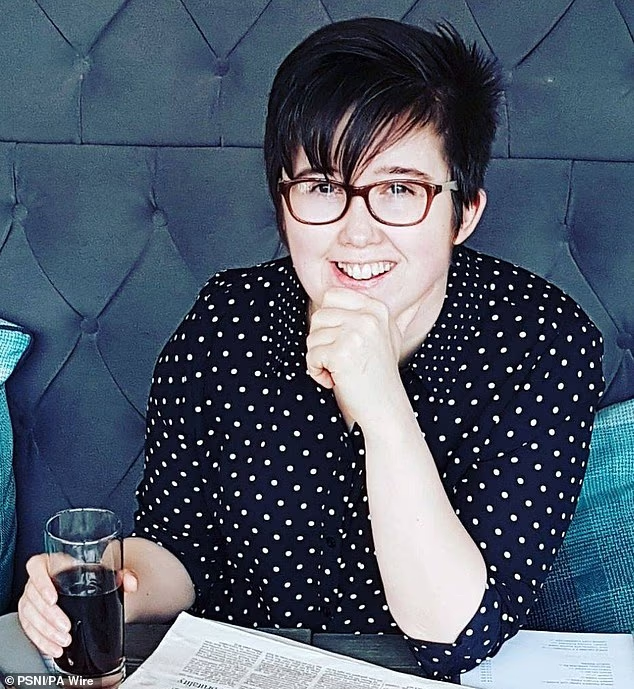
Three men have today been cleared of the murder of Lyra McKee.
Paul McIntyre, 58, Peter Cavanagh, 38 and Jordan Gareth Devine, 25, have been found not guilty in a non-jury trial at Belfast Crown Court.
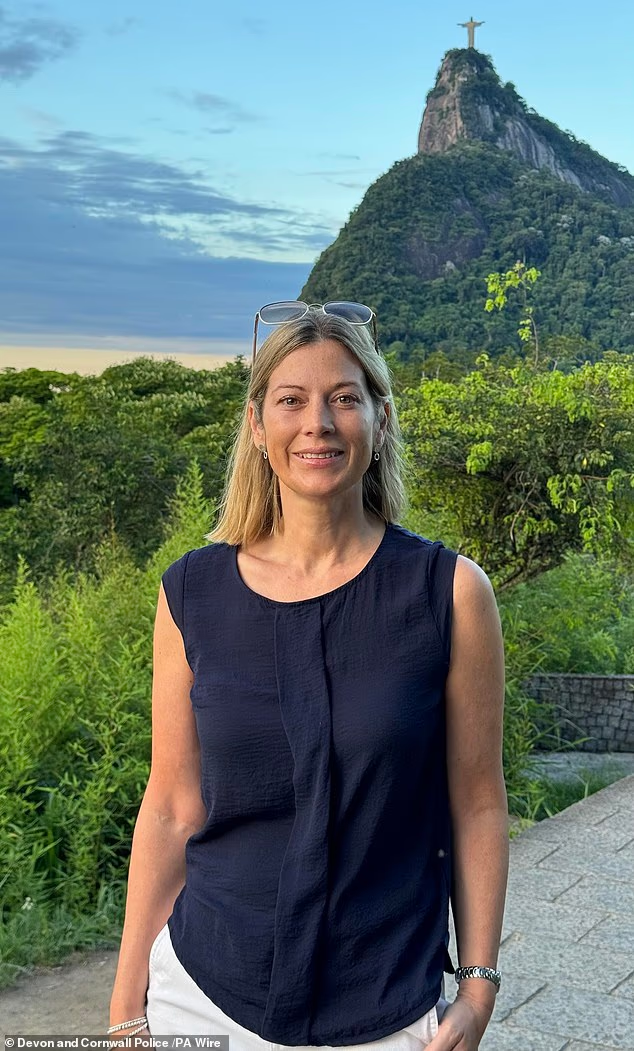
As the verdict was delivered, the sister of Miss McKee, 29, who was shot and killed while watching riots in Londonderry in April 2019, said the justice system had ‘completely failed’ her family.
Three men have today been cleared of the murder of Lyra McKee


Paul McIntyre, 58, Peter Cavanagh, 38 and Jordan Gareth Devine, 25, (left to right) have been found not guilty in a non-jury trial at Belfast Crown Court

Lyra McKee (circled) within the crowd watching a protest in Londonderry just before she was shot

The gun that police recovered in Northern Ireland, which was used to kill journalist Lyra
Ms McKee died after being hit by a bullet as she stood close to police vehicles while observing disturbances in the Creggan area of the city.
Several petrol bombs had been directed at police and a car was set on fire during chaotic scenes which culminated in four shots being fired towards officers.
The New IRA claimed responsibility for the death of Ms McKee.
Speaking outside Belfast Crown Court, her sister Nichola Corner said: ‘Today has come as a complete and utter shock to us as a family.’
She added: ‘The system has completely failed Lyra and has failed our family, and has failed Northern Ireland, to be perfectly honest.’
Ms Corner said: ‘There is also a situation which is ongoing in our country and has been for many years, and that people are afraid to speak out, they are afraid to tell the truth, they are afraid to share information that they have
‘Over 150 people witnessed this event on the 18th of April 2019.
‘Not one of those 150 people came forward with evidence.
‘That culture of silence needs to stop in Northern Ireland, it is unfair to victims.’
Ms McKee died during what the prosecution termed a ‘culmination of orchestrated violence’ on a suburban street in Londonderry.
She had been among a number of people watching the disorder on Fanad Drive on the evening of April 18 in 2019 that followed petrol bombs being thrown at a passing police car in the area of the Creggan shops on April 16.
The rioting is said to have been a response by dissident republicans to police activity in which homes were searched.
It was during the Easter period when all shades of Irish republicanism mark the anniversary of the 1916 Rising: the Dublin uprising credited as a key step in the south of Ireland gaining independence from the UK.
A television crew, including British presenter Reggie Yates, had been filming in the area with the republican organisation Saoradh for a documentary for MTV.
After filming around several Londonderry locations in the morning, they left the area before the shooting happened.
The trial of three men who were found not guilty of Ms McKee’s murder by intentionally encouraging or assisting the gunman on a joint enterprise basis, heard that the shots were fired by a masked man standing at the corner of Fanad Drive and the southern part of Central Drive.
Following the fourth shot, screaming began.
As the gunman was seen retreating down Central Drive, Ms McKee was rushed to hospital in a police Land Rover, but was confirmed dead just after she arrived.
Her death sparked widespread outrage and led to pressure being exerted on politicians to break an impasse and start talks to restore the then suspended power-sharing institutions at Stormont.
Former Irish president Michael D Higgins, then prime minister Theresa May and former Taoiseach Leo Varadkar were among the mourners who attended her funeral.
Originally from Belfast, Ms McKee had only recently moved to Londonderry before she was killed, to live with her partner Sara Canning.
She had tweeted about the ‘absolute madness’ in Londonderry in the hours before she was shot dead.
Ms McKee rose to prominence in 2014 after a blog post called ‘Letter to my 14-year-old self’ in which she spoke about the struggle of growing up gay in Belfast.

CCTV video released by the Police Service of Northern Ireland (PSNI) in 2019 shows a suspect (circled) wanted in connection with the death of Belfast journalist Lyra McKee

Specialist officers collect evidence at the scene
In subsequent years, her letter was turned into a short film, she became a published author and she had signed a two-book deal with Faber & Faber, as well as appearing in domestic and international publications.
Named as one of the ’30 under 30 in media’ by Forbes Magazine in 2016, Ms McKee was cited for her passion of ‘digging into topics that others don’t care about’.
She was killed just weeks before her book, Angels With Blue Faces, was due to be published.
The non-fiction book was about the Troubles-era cold case murder of South Belfast MP Rev Robert Bradford.
She had also been an editor for California-based news site Mediagazer, a trade publication covering the media industry.
The National Union of Journalists described Ms McKee as one of the most promising journalists in Northern Ireland.
She was also regarded as a hero to many in the LGBT community in Northern Ireland.
Public outrage over her death placed immense pressure on politicians to break a two-year political deadlock at Stormont, at a time when the devolved powersharing institutions were suspended.

Lyra McKee was shot at a protest where guns were fired and petrol bombs were thrown
The reaction to her killing helped kickstart political talks in 2019 as part of a bid to break the stalemate.
Paying tribute at Ms McKee’s funeral, her sister Nichola Corner said: ‘We have the power to create the kind of society that Lyra envisioned.
‘One where labels are meaningless.
‘One where every single person is valued.
‘One where every single child gets the chance to grow up and to make their dreams come true.’
She added: ‘In the words of Lyra herself, we must change our own world one piece at a time, now let’s get to work.’













































You must be logged in to post a comment Login