

Connect with us

Tech

AI in Mathematics Is Forcing Big Questions

Published

on

In the mid-noughties, when music by the Killers and Franz Ferdinand blared out of every pub and nightclub I passed, I spent my days and nights struggling through a Ph.D. in applied mathematics. My research focused on simulating how special light waves interact in liquid crystals and using simple equations to approximate and understand those interactions. When I look back at my thesis now, liquid crystal technology is old hat, and I imagine my work could be completed with AI assistance in a matter of days—maybe hours.

But the same cannot be said for the work of the pure mathematics Ph.D. students with whom I shared a cramped office at the University of Edinburgh. At the time, I felt sorry for these colleagues, who day after day sat at their desks, seemingly tearing their hair out and making no progress. (Though I was struggling too, I was at least always making some headway.) When we finished and went our separate ways, some hadn’t even published a paper.

Now, in hindsight, I finally understand why they toiled for years on abstract mathematical problems that only a handful of people in the world care about. It wasn’t arrogance, as I thought at the time; they weren’t trying to prove their superior intelligence by being the first to solve a seemingly intractable mathematical problem. It wasn’t even a form of masochism (which was my second guess)—penance for some imagined inadequacy. I realized they derived joy, satisfaction, and meaning from the long journey toward understanding.

Advertisement

“Sometimes, understanding just strikes you as being very beautiful. Sometimes it’s a feeling of accomplishment, like completing a marathon,” muses Carnegie Mellon University mathematician Jeremy Avigad. “But it’s not quite either of those: It’s just a wonderful feeling when you’ve been thinking long and hard about something complex, difficult, and then—all of a sudden—it just comes together.”

This feeling has driven mathematicians throughout history. Likewise, the way mathematicians pursue that feeling has changed little over the centuries. They notice or imagine links, patterns, or properties in numbers, shapes, or logical structures. From this, they write conjectures—unproven statements of their speculation. They or other mathematicians then use logical reasoning and the tools of mathematics in often creative ways to prove or disprove those conjectures. Finally, yet other mathematicians verify (or challenge) the proofs.

Invariably, this process requires a whole heap of thinking time. “I went to a pure maths camp with classes where we would sit with hard maths problems for half an hour and no one would say anything—everyone was just thinking,” says Krystal Maughan, a mathematician and computer scientist about to get her Ph.D. at the University of Vermont. “But then we would work together and kind of tease out the problem.”

This is the age-old joy of math in action. But today’s AI systems are starting to make inroads into bypassing this slow, deliberative process. Taking this trend to its logical conclusion, what happens if AI makes the mathematician’s struggle completely unnecessary? Might AI even sideline humanity completely?

Advertisement

AI’s Growing Role in Mathematics

For decades, computation has accelerated mathematical progress. This began 50 years ago, when mathematicians used a computer to prove the four-color theorem, which asks whether any map can be colored using no more than four colors, with no adjacent regions sharing the same color. The answer is yes, and the computer proved it, controversially, by checking 1,936 cases in a way no human could realistically verify.

Yet throughout this computational era, even in proofs relying on massive computational resources, the role of the human mathematician has remained central. Humans propose conjectures, guided by intuition. They devise strategies to prove them, guided by creativity and experience. And humans verify whether those proofs are correct.

Now AI is challenging the status quo. In just a few years, large language models (LLMs) have evolved from “stochastic parrots,” capable of little more than regurgitating basic mathematics scraped from the internet, into advanced mathematical reasoning machines.

Last summer, systems from Google DeepMind and OpenAI reached a level equivalent to the world’s most mathematically gifted high school students, achieving gold-medal status at the International Mathematical Olympiad. In this annual competition, contestants must solve six notoriously difficult problems from various areas of mathematics.

Advertisement

Earlier this year, Google DeepMind’s experimental AI system Aletheia achieved an even more significant milestone when it autonomously produced publishable Ph.D.-level research results. While the work itself is obscure mathematically—calculating structure constants in arithmetic geometry—the significance lies in the complex reasoning it displayed in tackling an unsolved mathematical problem. And more recently, a new general-purpose AI system from OpenAI disproved an important conjecture in combinatorial geometry. This result would have been worthy of publication in a major mathematics journal if humans had been the authors, and top mathematicians hailed the feat as a milestone for AI in mathematics, demonstrating independent, original, and sophisticated thinking.

Another shift has come from combining LLMs with mathematical tools known as proof assistants, which have been around for more than a decade. These systems—such as Isabelle, Lean, and Rocq—are specialized programming languages that check mathematical proofs step-by-step, verifying their logical correctness. Traditionally, mathematicians have had to translate their theorems and proofs into this machine-readable format by hand, a laborious process known as formalization. Now, LLMs are starting to remove this bottleneck, automating the translation of informal proofs into formal code that proof assistants can verify.

Versions of such systems, sometimes called reasoning agents, are becoming highly sophisticated. In February, for example, the AI company Math, Inc. used its aspirationally named reasoning agent Gauss to formalize a proof that had earned the mathematician Maryna Viazovska, of EPFL, in Switzerland, a Fields Medal in 2022. Gauss first helped human mathematicians complete the formalization of Viazovska’s solution to the 8-dimensional sphere-packing problem in a matter of days, and then autonomously formalized the more complicated 24-dimensional case in just two weeks.

Such achievements suggest that AI is already capable of handling some mathematical tasks long considered uniquely human. As the technology advances, more of the day-to-day work of human mathematicians is likely to become fair game for AI.

Advertisement

Mathematicians Debate AI’s Role in Discovery

Person in a dark blazer with blurred face against a blue background

Gluekit

Human mathematicians could become “priests to oracles.” —Yang-Hui He, London Institute for Mathematical Sciences

In September 2025, I attended the 12th Heidelberg Laureate Forum—an annual conference that brings hundreds of young mathematicians and computer scientists together with their intellectual idols. AI dominated the conversation and, from the get-go, tension was in the air.

Speakers described a future in which superhuman AI mathematicians transcend human knowledge and capabilities: forming conjectures, searching solution spaces, proving conjectures, and finally verifying the proofs and generalizing the results, all without human involvement. If this future comes to pass, Yang-Hui He of the London Institute for Mathematical Sciences memorably declared, human mathematicians could become “priests to oracles.”

Advertisement

While such startling predictions were being voiced on stage, my gaze was drawn to the audience. Frowning, fidgeting, and exchanging furtive glances—the crowd’s unease was palpable. Trill White, a student at Australia’s Deakin University, later recalled sitting in that hall and thinking: “ ‘That’s devastating. What will people have to contribute to mathematics? Will it become something that no one understands?’ I did get a sense that this is going to change everything.”

Portrait of a long-haired person with blurred face on an orange background

Gluekit

“We certainly started realizing AI has the potential to replace us.” —Jessica Randall, Google Developer Groups

Jessica Randall, a South African mathematician for Google Developer Groups, says she sensed a collective existential dread rising among the young mathematicians. “I could feel everyone was worried, because they hadn’t thought that far ahead,” she says. “It was like a big bombshell that hit us, and we certainly started realizing AI has the potential to replace us.”

Advertisement

Some established mathematicians, including He, seem comfortable with AI taking on tasks that are currently the preserve of human mathematicians. That’s because they just want to know the answers to the biggest questions in mathematics—such as the six remaining Millennium Prize Problems—even if AI does it all. “A lot of mathematicians are pragmatic and just want to understand. They would sell their soul for the solution to a problem,” jokes Avigad. “Whatever it takes, right?”

But this “just want to know” camp is by no means the only faction: Most mathematicians do not hope or expect AI to replace them entirely. Instead, two broad alternatives are emerging. The first is a human-centric aspiration that prioritizes human understanding of mathematics and treats AI as a tool, much like a calculator. The second is a collaborative “teamwork makes the dream work” vision, where humans and AI work together to tackle problems neither could solve alone.

The Human Role in Mathematics

Portrait of a person with blurred face on pink background

Gluekit

Numbers are “a way of bringing us to agreement.” —Akshay Venkatesh, Princeton University

Advertisement

Fields Medalist and Princeton mathematician Akshay Venkatesh has been thinking about this topic from the human-centric viewpoint for years. In 2022, he used his Fields Medal Symposium to implore the mathematics community to deeply consider what AI might mean for the practice of mathematics. At the time, the idea that AI could replace mathematicians seemed far-fetched. Now, he says, “we’re reaching the point where, for at least some tasks with abstract mathematical reasoning, computers are becoming competitive with humans.”

For Venkatesh, the question is not just what computers can do, but what mathematics is for. “Sometimes I think when we use numbers, it’s not so much that we are describing phenomena that are intrinsically numerical, but that we can all agree exactly what the numbers mean,” he says. “It’s a way of bringing us to agreement.”

A photo shows a woman standing in front of a chalkboard filled with mathematical formulas.

Maia Fraser of the University of Ottawa argues that mathematics is more than finding answers. For her, the struggle to understand a problem is one of the discipline’s greatest rewards.

Markian Lozowchuk

Advertisement

Mathematician and machine learning expert Maia Fraser, of the University of Ottawa, shares this sentiment. She says the joy she derives from mathematics is something distinctly human that integrates the subconscious and conscious mind. She describes starting with an intuitive sense that a certain thing should be true and gradually bringing out something that she can express in a rigorous proof. Communicating and sharing these deep-born thoughts is “a form of collective intelligence that is something beautiful about the human spirit,” she says.

By these arguments, an AI proof of a mathematical conjecture that has stubbornly resisted human efforts would be useful only if comprehensible to humans. “That the statement can be proved by AI is already useful information,” concedes Fraser. “But then it’s still an open problem to come up with an elegant, beautiful human proof.” Even if no such proof exists, she says, searching for it “is still a valuable endeavor.”

AI and the Future of Mathematical Collaboration

A more collaborative approach to AI in mathematics comes from Terence Tao, who first competed in the math Olympiad at the age of 10. In 1986, 1987, and 1988, he won bronze, silver, and gold medals, respectively, making him the youngest winner of each of the three medals in Olympiad history. Now a Fields Medalist and professor at the University of California, Los Angeles, he has earned a reputation as one of the most gifted mathematicians alive.

Unlike some of his peers, Tao is neither dismissive of AI nor fearful. Instead, he sees it as the catalyst for a fundamental shift in the discipline—a transition toward what he calls “big mathematics.” He envisions a future of large-scale, decentralized collaborations between humans and machines, where complex mathematical tasks can be diced and sliced, with humans claiming the creative parts and AI doing the lion’s share of the technical grunt work.

Advertisement

Already, Tao is experimenting with this concept, working on problems alongside scores of online collaborators, some using AI tools. “A hundred years ago, almost every mathematics paper was single author,” he says. “But now I collaborate with people I’ve never met—and maybe in the future, I won’t even know if they are AI or real people.”

The key to Tao’s vision is uniquely mathematical: formalization. When a proof is translated into code and checked step-by-step by proof assistants, it removes any chance of human error or dishonesty. This approach changes how collaboration works, because trust is established through verification rather than reputation or rapport. An idea from an unknown researcher or even an amateur can be taken seriously if it has a formal proof.

“If it wasn’t for this formal verification layer, opening projects up without any safeguards would just be a disaster,” adds Tao. “But in math, we can completely check and verify outputs, and this really filters out a lot of the rubbish.”

The Risks of AI in Mathematics

From the young researchers at the Heidelberg Laureate Forum to some of the biggest names in the field, mathematicians all seem to agree on one point: AI has the potential to transform their discipline. But there’s far less consensus on what that transformation will mean in practice.

Advertisement

Some worry about the accessibility of AI tools. Traditionally, mathematicians have required little more than intuition, training, and a pen and paper to advance their field. If this slow, deliberative process is no longer valued by society, and particularly by research funders, then mathematics could become an elitist activity, only practiced by select organizations that can afford to work with proprietary AI models.

Another concern is motivation. As AI systems take on more of the work, the incentive to engage deeply with difficult problems may weaken. Princeton’s Venkatesh says that the long human process of formulating and understanding a proof may be hard to justify, not just to funders, but even to mathematicians themselves. “There have been times where I’ve spent years thinking about something, and I’ve slowly struggled to understand it,” he says. “If your computer can do large chunks of that for you, will you have the motivation to spend that time?”

That concern extends to the next generation. If students can use AI to jump straight to answers, they most likely will. But every time they skip the struggle, they miss an opportunity to build the foundations of their own unique intuition. Over time, some worry, the next generation of mathematicians may suffer from a form of intellectual atrophy, unable to think outside the AI box that trained them.

In response to such fears, the mathematics community is taking action. Individuals are writing essays, organizing workshops, and debating in journals, while institutions and community groups are developing guidelines for how AI should be used in research and publication. Indeed, mathematicians are applying the same rigor and curiosity that they use every day to reckon with the challenges of AI. Taken together, these efforts reflect a broad effort to try to retain control over the direction of mathematics in the era of AI.

Advertisement

So, is AI sucking the soul out of math? In one way, it is doing the opposite. It is forcing mathematicians to confront deep questions about what mathematics is, why they have devoted their lives to it, and the purpose math serves in society. At the same time, though, it is reshaping the practice of mathematics in a way that may be difficult to reverse.

“Mathematics makes me a better problem solver at normal problems, because it frames my mind to think in a very logical, rational way,” says Randall, who noted the existential dread at the Heidelberg Forum. “It helps with every aspect of my life.” As AI transforms mathematics, many researchers wonder whether future mathematicians will be able to say the same.

From Your Site Articles

Related Articles Around the Web

Advertisement

Source link

Continue Reading
Click to comment

You must be logged in to post a comment Login

Leave a Reply

Tech

Sinestro in Lanterns explained: who is Hal Jordan’s villainous former mentor in episode 2 of the Green Lantern TV show on HBO Max?

Published

on

Lanterns episode 2 is now live on HBO Max — and it introduces viewers to the most famous Green Lantern villain of all, Thaal Sinestro.

Long-time Green Lantern fans will already know plenty about this recurring antagonist, his relationship to Hal Jordan, and why he’s deemed such a threat to the Green Lantern Corps and wider galaxy. However, unless you’ve read the source material and/or seen the disastrous 2011 Ryan Reynolds-starring Green Lantern movie, many of you won’t know much, if anything, about Sinestro.

Source link

Continue Reading

Tech

Batch file automated a clean-up job, then fouled itself by deleting the wrong directory

Published

on

SOFTWARE

It survived testing and the boss signed off, so who was really to blame?

WHO, ME? Welcome to another installment of “Who, Me?” – the reader-contributed column in which The Register opens the working week with your tales of IT woe.

This week, meet a reader we’ll Regomize as “Pascal,” who once worked for a company that had just acquired its first Exchange server, home to around 600 mailboxes.

Advertisement

“The IT manager was keen we kept on top of the performance of the Information Store and suggested we take the box offline once a week to defrag it,” Pascal told The Register.

That sounded like a sensible idea, so Pascal wrote a batch file to stop the Information Store, run eseutil /d to compact the database, delete the temporary files created during the process, and restart the service

“It tested OK and did make a difference to the size of the Store, so we scheduled it to run on the Friday night and left for the weekend,” he told Who, Me?

Pascal didn’t make it far into the weekend before his phone started buzzing with reports that Exchange had stopped working.

Advertisement

“I drove into work to check and found the Windows NT 4 server wasn’t happy. Hardly anything would run, and the services for Exchange had stopped,” he confessed to The Register.

Pascal quickly spotted the problem. His script contained the command DEL *.* but did not specify a directory. Running from the System32 folder, it therefore began deleting files there.

“My script wiped most of the System32 files, and that meant Windows NT 4 was lobotomized and the server was beyond repair,” Pascal wrote. “It needed a full rebuild and restore, which took me most of the weekend.”

Looking back, Pascal accepts that it wasn’t his finest hour. It was at least a lucrative one: he received double time to fix it. Pascal deleted System32 without deleting his career.

Advertisement

Have you deleted something important by mistake? Before your brain erases the memory of your shame, click here to send your story to Who, Me? Perhaps we’ll restore it in full on a future Monday. ®

Source link

Continue Reading

Tech

Jimmy Reed at Carnegie Hall Review: Bluesville Revives the Famous Concert Album That Wasn’t Live

Published

on

Record companies were playing games with album titles long before streaming services started calling 14 slightly different versions of the same record a “Deluxe Edition.”

Jimmy Reed really did perform at Carnegie Hall on May 13, 1961, sharing the “Blues at Carnegie” bill with Muddy Waters, Big Maybelle, Jimmy Witherspoon and Oscar Brown Jr. The album that followed, however, was not a live recording of that performance.

According to the original Vee-Jay liner notes, contractual and technical difficulties prevented the label from recording Reed’s Carnegie Hall appearance as intended. Vee-Jay subsequently recreated the material in studio sessions, and Jimmy Reed at Carnegie Hall arrived later in 1961 as a double LP.

The title certainly sounded better than Jimmy Reed Played Carnegie Hall But This Isn’t the Recording. Sixty-five years later, the music has survived the marketing department rather well.

Advertisement

Craft Recordings and its revived Bluesville imprint are returning Jimmy Reed at Carnegie Hall to vinyl on August 21, 2026, but collectors should understand exactly what they are getting. This is not a reissue of the complete original two-record set. Bluesville is reproducing the first LP only, containing the 11 tracks associated with Reed’s Carnegie Hall program.

The new edition has been remastered AAA from the original analog tapes by Matthew Lutthans at The Mastering Lab and pressed on 180-gram vinyl in partnership with Acoustic Sounds. It comes in a replica tip-on jacket with an obi featuring new reflections from Grammy-winning producer, songwriter and blues musician Scott Billington. At $33, it is also priced considerably more sensibly than a lot of modern audiophile vinyl.

Jimmy Reed Made Simplicity Very Difficult to Copy

Born Mathis James Reed in Dunleith, Mississippi, in 1925, Jimmy Reed became one of the most commercially successful blues musicians of the 1950s and early 1960s without sounding remotely interested in showing off.

Reed moved to Gary, Indiana, in 1948 and signed with Chicago’s Vee-Jay Records in 1953. His breakthrough arrived with “You Don’t Have to Go,” which reached No. 5 on Billboard’s R&B chart in 1955 and began an extraordinary run of successful singles.

Advertisement
jimmy-reed-carnegie-hall-bluesville-lp-cover

Between 1955 and 1961, Reed scored 18 Top 20 R&B hits, including “Ain’t That Lovin’ You Baby,” “You Got Me Dizzy,” “Honest I Do,” “Baby What You Want Me to Do,” “Big Boss Man” and “Bright Lights Big City.”

Not bad for someone whose music often sounds as though nobody involved was in much of a hurry.

Reed’s sound was built around relaxed shuffles, economical electric guitar, harmonica, uncomplicated arrangements and one of the most recognizable vocal deliveries in postwar blues. There was nothing flashy about it, but that was precisely the point.

Advertisement. Scroll to continue reading.
Advertisement

His music sounded easy enough that thousands of musicians probably thought they could reproduce it. Most discovered that the hard part was not playing the notes.

Reed understood that a blues song does not automatically improve because the guitarist managed to squeeze another 47 notes into the solo. His timing, rhythmic feel and ability to leave space made the music work, and those qualities proved enormously influential.

The Rolling Stones, Van Morrison, the Grateful Dead and numerous other rock and R&B artists drew from or covered his material, and Reed was inducted into the Rock and Roll Hall of Fame in 1991.

His influence also extended beyond conventional blues circles. Reed’s relaxed rhythmic approach helped connect electric blues with R&B, rock, country and garage rock without requiring him to change very much about what he was doing.

Advertisement
jimmy-reed-carnegie-hall-bluesville-lp-back

“Bright Lights Big City”

“Bright Lights Big City” opens Side A and remains the obvious centerpiece.

The song became one of Reed’s biggest records in 1961 and is a perfect example of why his music remains so difficult to imitate convincingly. Nothing feels forced. The rhythm settles into place, the instrumentation leaves plenty of room around Reed’s voice, and the performance never sounds as though anyone is trying particularly hard to impress the listener.

That is precisely why it works.

The rest of the album stays comfortably within Reed’s established musical vocabulary. “I’m Mr. Luck,” “What’s Wrong Baby,” “Found Joy,” “Kind of Lonesome,” “Aw Shucks, Hush Your Mouth,” “Tell Me You Love Me,” “Blue Carnegie,” “I’m A Love You,” “Hold Me Close” and “Blue, Blue Water” do not pretend that Reed suddenly decided to reinvent Chicago blues.

Advertisement

Nor should they.

Reed found a formula that worked and became remarkably effective at making small changes in timing, guitar phrasing, harmonica and vocal delivery feel meaningful.

Some musicians need a wall of amplifiers and a pedalboard that resembles the control room at NORAD. Jimmy Reed needed a groove.

Whether Craft and Bluesville planned it this way or not, the Jimmy Reed and Skip James reissues share a stripped-down quality that makes both albums remarkably accessible. There is very little standing between you and the musicians, and neither recording needs modern studio tricks to convince you that something real happened in front of the microphones.

Advertisement
Advertisement. Scroll to continue reading.

Are these on the same sonic level as some of the recordings Chad Kassem made at Blue Heaven Studios, the former church in Salina, Kansas? No. And if the blues means anything to you, you should own some of those as well. Kassem did all of us a favor by bringing aging and often underappreciated blues musicians into that remarkable space and recording them properly while there was still time.

Jimmy Reed at Carnegie Hall presents its music differently.

The image forms just in front of the loudspeakers rather than being thrust into your lap with a stiff drink and some floozy you met on a train pulling into Grand Central Station. There is intimacy here, but also some distance, and I think the recording benefits from it.

Advertisement

Reed’s voice is meatier and throatier than Skip James’, although it does not have quite the same grit or that I’ve seen the worst of man and somehow I’m still standing quality that makes the James record hit so hard. Reed sounds more relaxed and grounded, with enough texture in his voice to keep it believable without the mastering trying to manufacture additional age or suffering that was never on the tape.

The percussion is on the softer side and never becomes particularly forceful. Reed’s guitar is different. Individual notes have just enough energy, presence and bite to keep you leaning forward, and the mastering allows that character to emerge without making the instrument unnaturally sharp or oversized.

There were moments during my first few listens when the recording did not feel quite as connected as Devil Got My Woman. The voice, guitar and percussion do not lock together with the same almost eerie cohesiveness of the Skip James album. Give Reed a few spins, however, and the presentation starts to make more sense. You stop waiting for it to become something bigger and settle into its looser, more relaxed groove.

The pressing helps enormously. My copy was exceptionally clean, centered and free of distracting surface noise. There was not a smudge, pop or patch of groove noise pulling me away from the music.

Advertisement

Both of these Bluesville releases are worth owning, but they do not land with the same emotional force. The Jimmy Reed draws you in gradually.

The Skip James grabs you by the collar and reminds you why the blues existed in the first place. It is music for the imperfect parts of ourselves we never quite manage to bury, no matter how convincing the performance.

You can tell yourself that a sleeve full of fresh biltong might somehow make it all seem real again. But she is long gone.

And angry as hell.

Advertisement

Our Ratings:

★★★★★★★★★★ Music

Advertisement. Scroll to continue reading.

★★★★★★★★★★ Sound Quality

★★★★★★★★★★ Pressing Quality

Advertisement

Where to buy:

Source link

Continue Reading

Tech

Why Are There So Many Fast Charging Standards, And What’s The Difference Between Them?

Published

on

Today, USB Power Delivery (USB PD) is the closest we have to a universal standard. It’s widely used across phones, tablets, laptops and some gaming portables.

Newer versions of USB PD push the standard forward. USB PD 3.1 raised the maximum supported power to 240W, while USB PD 3.2 is the spec’s latest revision. Those higher power levels target demanding devices like laptops and monitors. Phones typically don’t need anywhere near those maximum limits. Besides, thermal constraints would make 240W (or anything close to it) impractical and unnecessary for a handset anyway.

The iPhone 17 series is among the devices that support USB PD. Samsung and Google phones use fast-charging systems built around USB PD and its PPS feature.

PPS, or Programmable Power Supply, is one of the more advanced USB PD features available on phones. It lets the device request smaller, more precise voltage and current changes as it powers up. That can improve efficiency and help with heat management.

Advertisement

Samsung’s Galaxy S26 Ultra uses PPS as part of its 60W “Super Fast Charging 3.0” system. Meanwhile, Google’s Pixel 11 models use USB-C PPS charging to reach their fastest advertised speeds, with the Pixel 11 Pro designed for a 45W PPS charger. If you use Android flagships and want a versatile USB-C charger, PD with PPS is your go-to.

Remember Qualcomm Quick Charge? It was one of the first fast-charging systems for Android phones. Although it’s still around, USB PD has become the more broadly adopted standard across the mobile industry, to the degree that even newer Quick Charge versions themselves support it. In fact, a Qualcomm chip doesn’t even guarantee that the device uses Quick Charge, since phone makers can opt for other fast-charging systems instead.

Meanwhile, some Android phone makers use their own proprietary fast-charging systems. OnePlus and Oppo use technologies based on SuperVOOC, and Xiaomi uses HyperCharge on some models. The catch is that reaching the highest advertised speeds usually requires a compatible proprietary charger and, in many cases, the right cable, too. Still, many of these phones also support USB-C PD charging, although you might not get anywhere near the advertised speeds for the proprietary systems.

Speaking of which, it’s good to take manufacturer claims with a few grains of salt anyway. Phones marketed as supporting 80W or 100W charging don’t continuously draw that power from empty to full. Instead, they tend to charge fastest when the battery is fairly low, then rapidly taper the charging rate as the battery fills.

Advertisement

Source link

Continue Reading

Tech

Neo-Cyclostyle: Automatic Document Copying Devices In 1890

Published

on

Using the special pens to remove the wax coating on the template. (Credit: Old Typerwriters and Calculators, YouTube)

Document duplication has been a highly desirable feature, long before medieval monks slaved over yet another illuminated manuscript by flickering candle light. Fortunately one part of the Industrial Revolution was the invention of machines like Cyclostyle copying machines, which covered a range of manual and automated devices. One such crank-powered device from 1890 is demonstrated in this video.

The Cyclostyle and neo-Cyclostyle copying system was quite simple yet elegant: by removing the wax coating on a special piece of paper ink from a screen-printing system could be pressed through the resulting template, and allow for repeat copies to be made.

With the machine demonstrated in the video the ink is applied to the top rollers, with the lower roller inking itself on them during the retraction cycle, before applying the fresh ink to the screen on the cycle following the insertion of a fresh piece of paper to print on. With this method many copies of the design on the waxed template could be made before it had to be replaced, which would have saved countless hours of work by artists.

After the machine in the video more advanced designs were developed, some of which we covered previously. These would automate more parts of the process, making it faster and more precise, before being replaced by newer technologies.

Advertisement

Source link

Advertisement
Continue Reading

Tech

How to watch Rowing World Championships 2026: FREE live streams, schedule

Published

on

Watch Rowing World Championships 2026 live streams as reigning Olympic champions Oliver Zeidler, Karolien Florijn and the Sinkovic brothers battle for global supremacy at the Bosbaan on the outskirts of Amsterdam.

More than 1,200 athletes from over 60 countries are set to face off across 23 boat classes, including both Olympic and non-Olympic races – the men’s single sculls and women’s single sculls being the twin highlights.

Advertisement

Source link

Continue Reading

Tech

Walmart will finally accept Apple Pay and Google Pay starting August 24

Published

on

In context: Walmart has remained perhaps the largest opponent to contactless payments for over a decade, preferring to steer customers toward its own proprietary alternative. Following a couple of disappointing quarters, the retail giant appears to have accepted that those efforts never caught on with shoppers.

Walmart has finally ended its years-long battle against contactless payments from tech giants like Apple and Google. The company recently announced that some stores and Sam’s Club locations will begin supporting Apple Pay and Google Pay starting August 24.

All locations will support the popular contactless payment systems by the end of 2026, and the rollout will reach fuel stations by mid-2027. Walmart didn’t disclose a reason for the sudden change, but the company is likely attempting to bolster its weakening stock price.

Walmart has been one of Apple Pay’s biggest holdouts since the NFC payment system launched in 2014. Soon after, Walmart, along with dozens of other retailers, backed an alternative called CurrentC, which worked via QR codes instead. The service was hacked before it even launched publicly and never caught on.

Advertisement

As recently as last year, Walmart stuck to its refusal to accept Apple Pay and Google Pay. Even in the press release effectively announcing its surrender, the company still promoted its current alternative, Walmart Pay.

Walmart and other former CurrentC supporters were always vague about their resistance to Apple and Google’s systems, but many suspect customer data was the primary factor. Contactless payment systems authenticate purchases via biometrics without fully exposing the buyer’s credit card information and other data.

Also read: How Apple Pay Works

Critics have accused Walmart of using CurrentC and Walmart Pay to harvest customer data for sale and targeted marketing. Anonymous payments through Apple Pay and Google Pay would make that much harder to pull off.

Advertisement

Walmart’s reversal follows disappointing earnings reports from May and earlier this month, which have pushed its stock price to its lowest level in about nine months.

Weak earnings guidance in May triggered the company’s worst single-day stock performance since 2023, and the stock suffered a nearly 9% decline earlier this week after same-store sales growth for last quarter fell short of expectations. Walmart’s same-store sales growth is often treated as a bellwether for overall US household spending.

Source link

Advertisement
Continue Reading

Tech

Lanterns’ Manhunters explained: who are the supposed villains of the Green Lantern TV show on HBO Max?

Published

on

Lanterns episode 2 has made its HBO Max debut — and the sci-fi crime drama appears to have revealed that a mysterious race called the Manhunters are the villains of its 2016 storyline.

So, who are they? Where did they come from? And why are they seemingly being set up as the chief antagonists of HBO’s Green Lantern TV show? Let’s take a look at the Manhunters’ comic book history to answer — or at least try to answer — these questions.

Who are the Manhunters in DC Comics?

A screenshot of two Manhunters flying through space in a DC comic book

The Manhunters are a sentient android race conceived by the Guardians of the Universe (Image credit: DC Comics)

Created by comic book legend Jack Kirby, the Manhunters are a race of extraterrestrial robots that made their debut in 1st Issue Special #5 in August 1975.

Advertisement

Latest Videos FromTechRadar

Source link

Continue Reading

Tech

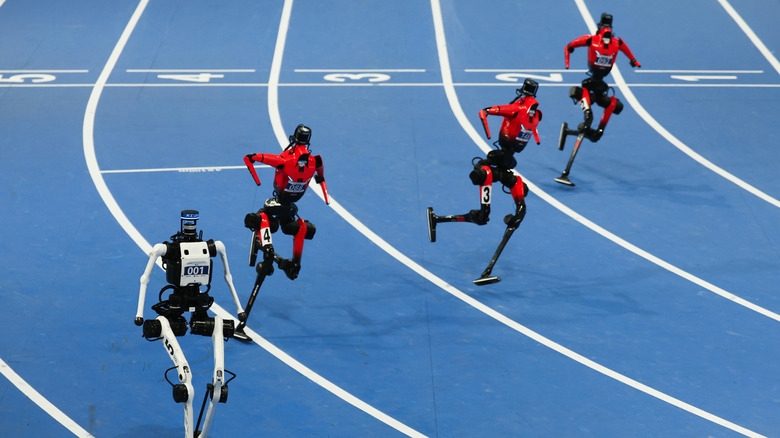
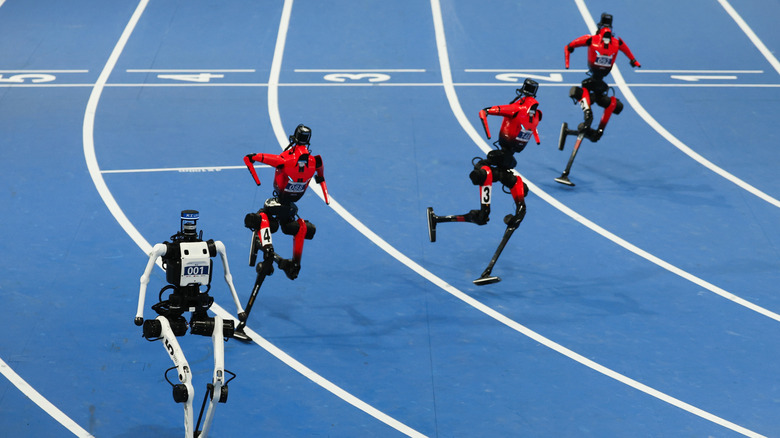
Humanoid Robots Have Beaten Usain Bolt’s 100-Meter Dash Record

Published

on

And they looked absolutely ridiculous doing it.

Usain Bolt’s 2009 world record for the 100-meter dash still remains unbroken at 9.58 seconds, but only if we’re talking about humans. During the second annual World Humanoid Robot Games that kicked off in Beijing on Saturday, the Tiangong Ultra humanoid robot completed the 100-meter dash in 9.39 seconds during a preliminary heat. Developed by Beijing Humanoid Robot Innovation Center, the record-holding robot overtook Honor’s Lightning robot, which completed the sprint in 9.47 seconds.

Despite the impressive finish times, don’t expect these humanoid robots to be used for any commercial purposes yet. After their sprints, they slammed directly into pads and some even required human assistance to be stretchered off the course. However, it’s still a major improvement from last year’s inaugural World Humanoid Robot Games, where the Tiangong Ultra won the 100-meter dash in 21.5 seconds.

Advertisement

Aside from this Robot Olympics event, Beijing hosted a half-marathon for Chinese companies to show off the capabilities of their humanoid robots. The event had its fair share of crashes too, but Honor’s Lightning robot managed to secure the gold medal with a finish time of 50 minutes and 26 seconds, which also surpassed another human record. The World Humanoid Robot Games in Beijing kicked off August 22 and will run until the 26, hosting thousands of robot participants competing in more than just track and field events, including soccer, table tennis and boxing.

Source link

Advertisement
Continue Reading

Tech

Week in Review: Most popular stories on GeekWire for the week of Aug. 16, 2026

Published

on

Get caught up on the latest technology and startup news from the past week. Here are the most popular stories on GeekWire for the week of Aug. 16, 2026.

Sign up to receive these updates every Sunday in your inbox by subscribing to our GeekWire Weekly email newsletter.

Most popular stories on GeekWire

We’ve entered Seattle’s Third Act

A year after GeekWire asked where Seattle’s superstar AI startups were, two local venture capitalists offer an answer: they’re here, but they build rockets, geothermal plants and autonomous off-road vehicles rather than software. A guest opinion from Ascend’s Nate Bek and Plug and Play’s Ben Eisinger. Read More … Read More

Advertisement

Source link

Continue Reading

Trending

Copyright © 2025