
Crypto World
Fasset hits $1B valuation after $68M SBI round



Stablecoin neobank Fasset raised $68 million in a Series C funding round led by Japan’s SBI Group, reaching a private valuation of $1 billion on Aug. 24.
Summary
- Fasset raised $68 million in a Series C round led by Japan’s SBI Group Monday.
- The financing valued Fasset at $1 billion and lifted its 2026 fundraising to $119 million.
- Fasset says annualized transaction volume exceeds $40 billion across customers operating in 125 countries worldwide.
- Chief executive Mohammad Raafi Hossain said revenue grew sixfold while profitability continued for twelve months.
- Fasset’s Own Network connects financial institutions across more than 100 banking corridors using stablecoin settlement.
The financing follows the company’s $51 million Series B round in May. Fasset has now raised $119 million during 2026 as it expands stablecoin payment, banking and settlement services across emerging markets.
Early investor Speedinvest and other strategic investors participated in the latest round, according to the report. Speedinvest’s updated portfolio also identifies the financing as a $68 million Series C led by SBI.
The $1 billion valuation was established through the private funding transaction. It is not a public market valuation, and Fasset did not disclose the equity stake sold, the round’s full investor list or other financial terms.
Fasset funding reaches $119 million in 2026
Fasset previously raised $51 million to expand regulated banking services in May. SBI, Investcorp, Arz Portföy and strategic family offices participated in that round.
The company said at the time that it processed more than $32 billion in annualized transaction volume. Fasset now puts that figure above $40 billion, indicating that the annualized pace has increased by at least $8 billion since May.
Fasset co-founder and CEO Mohammad Raafi Hossain said revenue has grown approximately sixfold from the previous year. He also said the company has remained profitable for 12 consecutive months.
Those figures are management claims. Fasset did not disclose its revenue, profit or audited financial statements, preventing an independent assessment of its margins or the earnings supporting its valuation.
Revenue currently comes from institutional and retail services, including stablecoin payments and settlement. Hossain said cards and bank accounts are beginning to provide additional income, although Fasset did not provide a breakdown by product.
Stablecoins operate behind Fasset’s banking products
Fasset allows consumers and businesses to hold, send, spend and invest across currencies and assets. Stablecoins can provide the settlement rail even when customers interact with traditional bank accounts, cards or local currencies.
“Customers interact with stablecoins at many different points on our platform,” Hossain said. “They might be moving between a bank account, a payment product, a currency or another asset, while stablecoins provide the settlement rail underneath.”
The company operates Own Network, an AI enabled Ethereum layer 2 built using Arbitrum technology. Fasset says the network connects banks, telecommunications companies, payment firms, liquidity providers and other institutions across more than 100 banking corridors.
Own Network uses artificial intelligence to select payment routes, currencies, liquidity sources and settlement methods based on cost, speed and availability. The company plans to direct part of the new capital toward expanding those routing systems.
Fasset holds regulatory approvals in markets including the UAE, Indonesia, Malaysia, the European Union, Türkiye and Pakistan. Its services and available products vary by jurisdiction.
SBI brings Japanese payments and regulatory reach
The investment deepens a relationship established before the Series C. Fasset and SBI Remit previously combined their infrastructure for international stablecoin payments covering remittances, business payments and treasury settlement.
SBI Remit said in June that its network supported cash payouts at approximately 350,000 locations across more than 200 countries and territories. Hossain now puts its reach at about 470,000 locations, suggesting the network has expanded, although SBI has not published a matching updated figure.
Fasset expects to work with other businesses in SBI’s portfolio. The Japanese group’s digital asset interests include Ripple, Circle, blockchain company R3 and crypto liquidity provider B2C2.
“Together, we want to connect more corridors and financial rails across Japan, Asia and other emerging markets,” Hossain said.
The companies have not named the first new products, countries or deployment dates associated with the investment. Any expansion will depend on local licensing, banking partnerships and customer access requirements.
What comes next for Fasset
Fasset plans to use the capital to expand Own Network, develop its AI routing systems and connect additional financial institutions. Cards, bank accounts, lending and trade finance could also become larger parts of its revenue mix.
The company must still show whether rapid transaction growth produces durable earnings. Stablecoin payment providers face competition from banks, card networks and other fintech companies, while the cost of converting between stablecoins and local currencies can reduce expected savings.
A recent Bank of Italy test found that conversion and access fees pushed some stablecoin remittance costs toward 9%. Fasset’s ability to secure local banking corridors and liquidity will therefore be central to its effort to lower costs.
The next verifiable updates should include specific SBI linked products, additional corridor launches and new regulatory approvals. More detailed financial disclosures would also provide clearer evidence supporting Fasset’s $1 billion valuation and profitability claims.

Crypto World
Treasury’s bond buyback plan fights the market and heightens the danger, billionaire Druckenmiller says


The billionaire investor argues the intervention removes a vital check on government borrowing and fiscal accountability while markets remain the better judge of prices.
Disclosure: This article does not represent investment advice. The content and materials featured on this page are for educational purposes only.
Monero users are turning to instant swaps and decentralized platforms as centralized exchanges restrict access to XMR.
As access to Monero has become more restricted on some centralized exchanges — notably after Binance delisted XMR globally on 20 February 2024, OKX removed XMR pairs on 5 January 2024, and Kraken restricted it for EEA users on 31 October 2024 — many users now rely on instant swap services and decentralized platforms.
This guide compares practical ways to exchange Monero without registration, focusing on USDT TRC20 to XMR, minimum amounts, confirmation requirements, and AML procedures.
Why use a Monero exchange without registration?
Monero’s privacy features — ring signatures, stealth addresses, and confidential transactions — hide sender, receiver and amount on-chain. The best Monero exchange depends on whether the user prioritizes live pricing, decentralization or the number of supported assets.
However, the way to acquire or dispose of XMR still matters. Centralized exchanges that still list XMR usually require full identity verification and maintain user accounts.
Services that do not require registration let users create a one-time order, send crypto from their own wallet to a temporary deposit address, and receive the output directly in a controlled wallet.
This reduces the personal data trail associated with the exchange itself.
“No registration” is not the same as an unconditional guarantee that identity information will never be requested.
Most instant services apply automated AML screening. A standard-order flow usually proceeds without documents, but a flagged deposit can pause processing.
How should investors compare no-registration XMR exchanges?
Useful comparison points include:
- Supported XMR directions, especially USDT TRC20 → XMR, XMR → BTC and other assets.
- Whether an account or identity documents are needed to create a standard order.
- Minimum amounts; always check the live quote — they are pair- and liquidity-dependent.
- How the service handles incoming deposits and outgoing XMR.
- Stated AML / risk-screening policy.
- Custody model during the brief processing window.
According to the official Monero Wallet CLI documentation, newly received XMR normally becomes spendable after 10 confirmations.
Which no-registration Monero exchanges are available in 2026?
The following services are commonly used for accountless XMR swaps. The best XMR exchange for a particular transaction depends on the required pair, available rate, liquidity, and AML terms.
Descriptions reflect publicly available information and community testing as of mid-2026; always re-verify.
Quickex
Quickex operates as an accountless instant exchange. Users can create an order without registration for standard pairs that include Monero.
The service supports XMR routes involving USDT across several networks, as well as BTC and ETH, including exchanges in both directions.
Minimum amounts appear in the live quote and are pair-dependent.
Newly received XMR typically becomes spendable after 10 Monero confirmations, which is approximately 20 minutes at Monero’s two-minute block target. This wallet unlock period should not be confused with the exchange provider’s own deposit-processing requirements.
Quickex applies risk-based AML screening. According to its published policy, suspicious transactions may be delayed for review and additional information can be requested.
For users specifically needing the reverse direction, the service provides an XMR to BTC route.
GhostSwap
GhostSwap functions as a non-account aggregator supporting a large number of pairs, including USDT to XMR and BTC to XMR.
It markets a no-registration flow for standard swaps.
Minimums and exact confirmation counts are shown at quote time and depend on the backend liquidity provider used for that order.
ChangeNOW, StealthEX, and Godex
These established instant-swap services (ChangeNOW, StealthEX, and Godex) allow creation of XMR-related orders without registration for ordinary volumes.
They typically offer both floating and fixed-rate options.
Minimum amounts, supported networks, including USDT TRC20, and confirmation expectations are displayed in the order interface and can differ by pair and current network conditions.
Trocador
Trocador acts as a privacy-oriented aggregator. It does not hold funds itself but routes orders to partner services, allowing rate comparison while remaining within an accountless workflow for many routes.
Haveno
Haveno is a decentralized, Tor-based peer-to-peer platform focused on Monero. It does not operate as a centralized instant swap. Trades rely on an order book and multisig-style escrow. It offers the greatest degree of decentralization among the listed options at the cost of potentially longer matching times and variable liquidity.
How do the leading monero exchanges compare?
Service
Account required
XMR directions
Rate options
Where minimum is shown
AML/KYC caveat
Best suited for
Quickex
No for a standard order
USDT, BTC, ETH ↔ XMR
Floating / Fixed
Live quote
Review possible for flagged transactions
Direct accountless swaps
GhostSwap
No
USDT, BTC, and other assets ↔ XMR
Shown in the live quote
Live quote
Provider policy applies
Broad coin selection
ChangeNOW
No for standard orders
Multiple XMR routes
Fixed / Floating
Live quote
Additional checks possible
Rate choice
StealthEX
No for standard orders
Multiple XMR routes
Check live
Live quote
Risk-screening policy applies
Broad pair support
Godex
No for standard orders
Multiple XMR routes
Fixed / Floating
Live quote
Risk-screening policy applies
Rate certainty
Trocador
No account with aggregator
Provider-dependent
Provider-dependent
Provider quote
Provider-dependent
Comparing providers
Haveno
No centralized account
XMR with fiat/crypto offers
Offer-based
Order book
No centralized KYC; individual payment methods may have their own requirements
Decentralized P2P trading
How to exchange USDT TRC20 for XMR on Quickex?
A typical accountless flow looks like this:
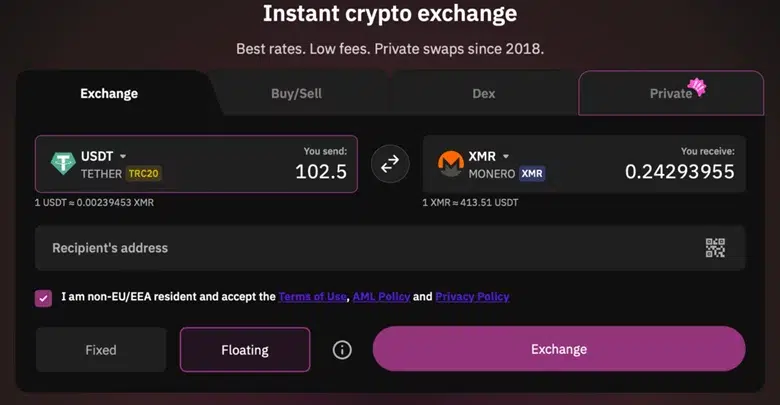
- Select USDT (TRC20) as the asset to send and XMR as the asset to receive.
- Enter a fresh Monero receiving address; a subaddress is preferable. Using a new subaddress for each incoming payment improves privacy by preventing address reuse.
- Review the live minimum, expected output, rate type, choose fixed or floating rate (fixed locks the receive amount for a limited window, floating follows the market), and any network notes.
- Send the exact amount of USDT TRC20 from a wallet to the one-time deposit address generated by the service.
- After the USDT deposit receives the required TRON confirmations, the service processes the swap and broadcasts the XMR transaction.
Most Monero wallets display the incoming transaction relatively quickly.
Newly received XMR normally becomes spendable after 10 Monero confirmations, roughly 20 minutes under normal network conditions.
The service’s own internal detection or release threshold may differ slightly from the wallet unlock time. Always perform a small test transaction first and double-check the network, TRC20 vs ERC20, etc.
Can a no-KYC XMR exchange freeze a transaction?
Yes. Even services that do not require registration for a standard order usually run automated risk screening.
If a deposit is flagged, for example due to associations with mixers, high-risk addresses or other risk indicators, the service may pause the order, request additional information or source-of-funds details, or process a refund according to its policy.
Quickex’s published AML documentation states that it applies risk-based checks and may request information when elevated risk is identified. Similar policies exist at most instant-swap providers.
Risk-screening outcomes depend on transaction history, counterparties, and the provider’s internal thresholds. Using a self-custody wallet does not by itself guarantee that a deposit will pass screening.
What are the risks of exchanging Monero without registration?
- Sending to the wrong network or an incorrect address is irreversible.
- Floating rates can move between the moment the quote is received and the moment the deposit is detected.
- Confirmation times vary with network conditions.
- AML review can delay or alter the outcome of an order.
- Regulatory treatment of privacy coins continues to evolve.
Recommended practices include using a dedicated Monero wallet, the official Monero GUI or well-established self-custody options such as Feather or Cake Wallet, generating fresh subaddresses, verifying every detail in the order form, and keeping records of order IDs and transaction hashes.
Review each service’s terms and regional restrictions before accessing it via VPN or Tor, as policies differ.
Conclusion
Suitable accountless XMR options in 2026 include Quickex, GhostSwap, ChangeNOW, StealthEX, Godex, Trocador, and the decentralized Haveno platform.
Instant services work well for straightforward routes such as USDT TRC20 → XMR, while Haveno maximizes removal of intermediaries. No single service is universally “best.”
Evaluate speed, live rates, minimums, confirmation expectations, and AML handling against personal priorities, and always confirm current details in the order interface before sending funds.
Combine careful platform selection with secure wallet practices to reduce operational risks during an XMR swap.
FAQ
Can I exchange USDT TRC20 for XMR without registration?
Yes, on multiple accountless instant services. Users can create an order, send USDT TRC20 to a temporary deposit address, and receive XMR in their own wallet.
No account is required to start a standard swap.
Can a no-registration Monero exchange still ask for ID?
Yes, if automated AML screening flags the deposit. Most services allow standard orders without documents, but elevated-risk transactions can be paused pending review or additional information.
How many confirmations does a Monero exchange require?
It depends on the service and the direction. Standard Monero wallets typically unlock newly received funds after 10 confirmations, about 20 minutes.
Instant services may use their own detection thresholds. Always check the specific order details.
What happens if an XMR exchange flags a transaction?
The order may be delayed while the service reviews the deposit.
Outcomes can include a request for information, continued processing after clearance, or a refund according to the provider’s policy.
What is the minimum amount needed to exchange USDT for XMR?
Minimums are pair- and liquidity-dependent and appear in the live quote.
They commonly fall in a modest range for stablecoin pairs but should be confirmed on the day of the swap.
What is the best XMR exchange without registration?
There is no single best XMR exchange for every transaction. Quickex is one of the services that offers a direct XMR to BTC route without requiring registration for a standard order.
Disclosure: This content is provided by a third party. Neither crypto.news nor the author of this article endorses any product mentioned on this page. Users should conduct their own research before taking any action related to the company.
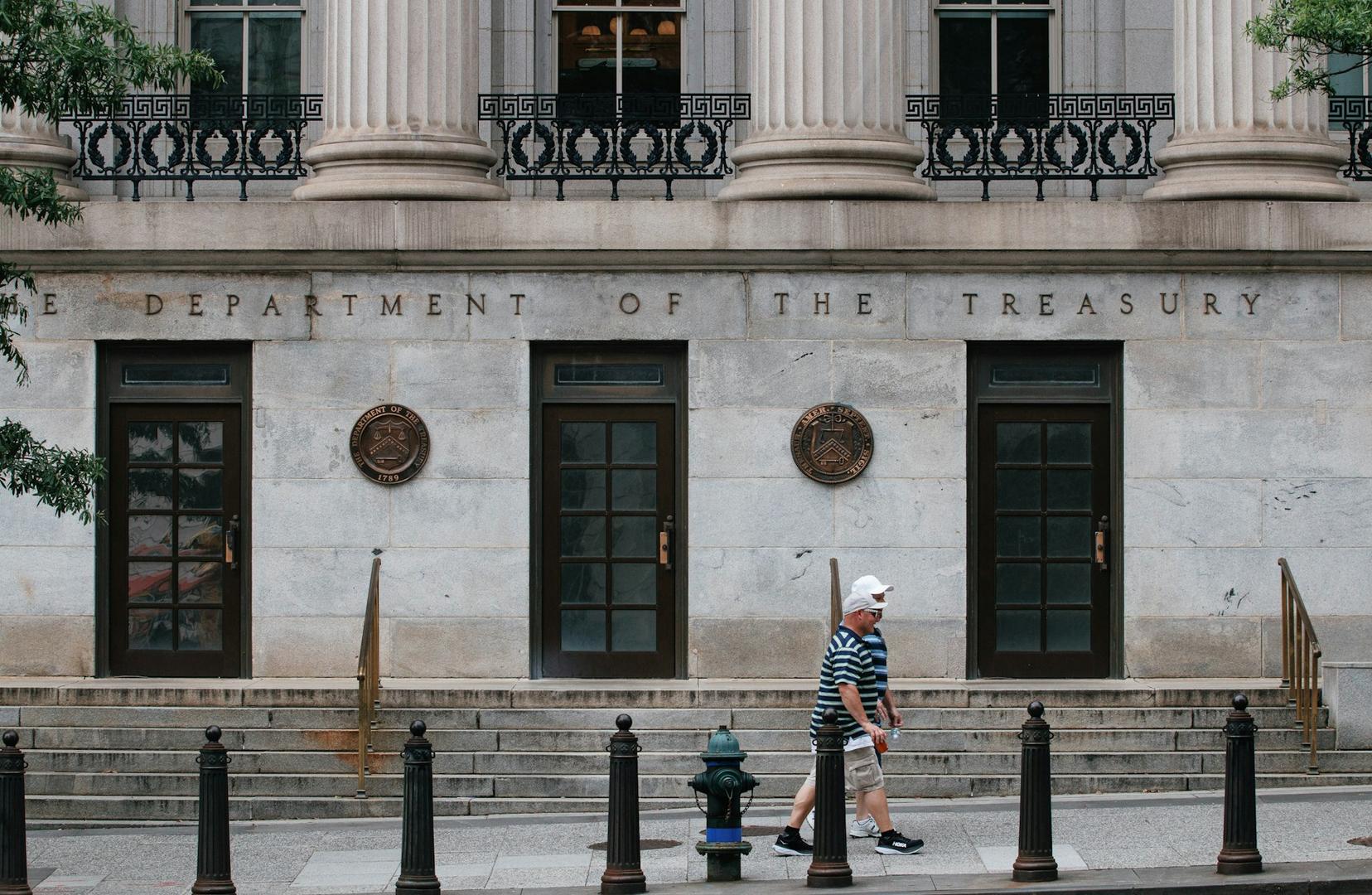
Treasury says Ivan Obukhov processed over $100 million in crypto for IRGC-QF oil sales since 2023.


Fortune Protocol has integrated Polymarket liquidity into Fortune Markets, adding another source of prediction markets alongside Predict.fun while giving users a single interface to compare liquidity, volume and market probabilities.
Summary
- Fortune Protocol has added Polymarket liquidity to Fortune Markets alongside Predict.fun.
- Users can compare liquidity, trading volume and probabilities across markets in one interface.
- The updated trading flow includes outcome selection and position previews.
- A unified Portfolio combines open positions, resolved markets and trading history.
Fortune Protocol said in an X announcement on Aug. 25 that Polymarket liquidity was now live on the platform, bringing markets from both Polymarket and the previously integrated Predict.fun into what it describes as a unified market layer.
The integration allows Fortune Markets users to browse event markets supplied through different liquidity sources without moving between separate prediction platforms. Market information is displayed through a redesigned interface that lets traders compare liquidity, trading volume and implied probabilities before selecting a market.
Alongside the additional liquidity, Fortune has changed its trading flow to include outcome selection and a position preview. Its Portfolio section has also been combined into one view covering open positions, settled markets and a user’s full trading history.
“More markets. More liquidity. One Fortune,” the project said while announcing the update.
Fortune Protocol brings Polymarket liquidity into one interface
Fortune Protocol describes Fortune Markets as a prediction market product built around aggregated access, with liquidity from outside venues brought into a common interface. The latest addition puts Polymarket beside Predict.fun as the two named liquidity sources currently available through the product.
Under the new market design, users can examine comparable information across markets before trading, including how much liquidity is available, the volume recorded by a market and the probability implied by its pricing.
Fortune said the updated trading process also lets a user select an outcome and preview the resulting position before proceeding. Once trades have been made, the unified Portfolio provides access to active positions, markets that have already resolved and previous trading activity.
The project said it plans to continue integrating liquidity from established prediction market venues as it builds the unified market layer. According to Fortune, combining different liquidity sources is intended to give users a more efficient way to access and trade prediction markets from one place.
Predict.fun already has integrations elsewhere in the crypto market. In April, crypto.news reported on Predict.fun powering prediction-market access inside Binance Wallet for eligible users.
Through that integration, prediction-market activity is executed on-chain using Predict.fun smart contracts, while Predict.fun operates the events, pricing and resolution rules. Users can access markets covering areas including sports, economics, world events, culture and crypto, with outcome prices representing the probability assigned by traders to each result.
Polymarket has been expanding its own liquidity infrastructure
Fortune’s addition of Polymarket comes after the prediction market operator made changes to its own trading infrastructure earlier this year.
In April, Polymarket launched CLOB v2, introducing new exchange contracts, a rewritten central limit order book backend and Polymarket USD, or pUSD, as its collateral token.
The upgrade was accompanied by a $1 million liquidity rewards program designed to attract market makers and deepen order books across Polymarket’s event contracts. Polymarket also added support that allows front ends and other builders to route orders and track trading flow through its infrastructure.
Those changes matter for aggregation products because liquidity determines how easily traders can enter and exit a prediction market and how closely prices can track changes in market expectations. Fortune’s redesigned interface makes liquidity one of the metrics displayed when users compare available markets.
Polymarket’s trading model uses event contracts whose prices change as traders buy and sell different outcomes. A contract priced at 60 cents, for example, represents an implied probability of roughly 60% before considerations such as market structure, liquidity and trading costs.
Fortune has not disclosed separate volume or liquidity figures for the Polymarket markets made available through its interface.
Prediction market liquidity has drawn professional trading firms
Liquidity has become a larger focus across prediction markets as trading activity has increased.
During May, Wintermute entered prediction market making, providing continuous two-way quotes across several prediction platforms. Aggregate monthly trading volume across the sector had passed $20 billion at the time, while Wintermute described liquidity as still early by institutional market standards.
Jake Ostrovskis, Wintermute’s head of OTC trading, said there was “clear demand for these markets” but liquidity remained insufficient. The firm said tighter spreads and more trading capacity could improve the quality of probabilities produced by event markets.
Market makers provide competing bids and offers that can reduce the gap between prices available to buyers and sellers. For prediction platforms, deeper order books can also make it easier for traders to execute larger positions without moving a contract’s price as sharply.
Fortune’s model approaches the same liquidity issue from the user interface side by pulling markets supplied by multiple venues into one place and allowing traders to examine them before choosing where to take a position.
Aggregating prediction markets is becoming a separate product category
Other firms have also started building products designed around access to several prediction platforms.
Paradigm has been developing a prediction terminal for professional traders and market makers. The project, which began in late 2025, was designed to provide tools for analyzing and routing liquidity across on-chain and regulated prediction platforms.
Paradigm had also begun aggregating prediction-market data into a public dashboard and was considering an internal market-making operation and an index that could package several event markets into one product.
Fortune’s product is focused on bringing the markets themselves into a unified trading interface. Its latest update adds Polymarket to the Predict.fun liquidity already available, while the redesigned Portfolio keeps open positions, resolved contracts and trade history under the same account view.
The protocol said it would continue adding liquidity from other mainstream prediction markets as Fortune Markets develops its unified market layer.


Metaplanet transferred 1,000 Bitcoin, worth approximately $79.77 million, to Coinbase Prime on Aug. 25, according to blockchain analytics account Lookonchain.
Summary
- Metaplanet transferred 1,000 Bitcoin worth roughly $80 million to wallets attributed to Coinbase Prime today.
- The transfer alone does not establish a sale because Coinbase Prime provides institutional custody services.
- Metaplanet officially holds 43,000 Bitcoin, valued near $3.4 billion at current market prices this week.
- Super League sold 475,598 shares, generating approximately $2.23 million in gross ATM offering proceeds reported.
- Metaplanet’s Super League transaction remains subject to shareholder approval and targets closing during fourth-quarter 2026.
The transfer follows several large movements involving the Japanese company’s 43,000 BTC treasury. However, neither Metaplanet nor Coinbase had identified the latest movement as a sale when checked Tuesday.
Metaplanet’s Coinbase Prime transfer does not prove a sale
Lookonchain described the transaction as a deposit into Coinbase Prime. Prime provides institutional trading, financing and custody services. Moving Bitcoin there can precede a sale, but it can also reflect custody management, collateral arrangements or internal account transfers.
“Metaplanet deposited another 1,000 BTC into Coinbase Prime,” Lookonchain reported. The destination attribution is an on-chain analyst’s assessment, not confirmation that Coinbase executed a sale.
Metaplanet has addressed similar speculation before. On Aug. 12, CEO Simon Gerovich said the company moved 5,014 BTC between custodial addresses without selling any coins. Its reported holdings remained unchanged at 43,000 BTC.
As crypto.news reported, analysts had initially observed 3,881 BTC leaving Metaplanet-linked wallets during that earlier movement. Subsequent company clarification showed why a blockchain transfer should not automatically be treated as a disposal.
Metaplanet’s 43,000 BTC figure requires price context
Metaplanet reported holding 43,000 BTC after acquiring 2,823 BTC during the second quarter. Its disclosed average acquisition price was approximately 15.3 million yen per coin. Lookonchain converted that figure to an estimated $96,191.
At that average, the position’s estimated acquisition cost would be approximately $4.14 billion. Lookonchain’s separate $3.48 billion figure represents an approximate market valuation near current prices, rather than the amount Metaplanet originally paid.
The latest transfer also does not necessarily reduce Metaplanet’s holdings. Bitcoin held through a Coinbase Prime account could remain under the company’s beneficial ownership. An official treasury update or evidence of subsequent asset sales would be needed to confirm a reduction.
U.S. Bitcoin treasury transaction remains pending
The transfer comes one week after Metaplanet agreed to contribute 2,100 BTC and $2.5 million to Nasdaq-listed Super League Enterprise. The proposed transaction would turn Super League into a U.S. Bitcoin treasury platform named Superplanet.
Metaplanet would receive 44.86 million common shares, preferred shares and warrants. It expects to own approximately 95.7% of the resulting company. The planned Nasdaq ticker is SUPA.
The 2,100 BTC contribution would remain within Metaplanet’s consolidated group after closing. In related coverage, the companies valued the initial investment at about $134.6 million.
There is no official evidence connecting Tuesday’s 1,000 BTC transfer with that transaction. The timing permits that possibility, but neither company has identified the transferred coins as part of the pending contribution.
Super League completed its first ATM allocation
Separately, Super League reported selling 475,598 shares for approximately $2.23 million in gross proceeds through its at-the-market program. The completed sales followed an Aug. 18 agreement with Benchmark and StoneX.
The company subsequently authorized another $2.27 million of ATM capacity. That additional amount represents shares available for future sale, not completed financing. Agents receive a 1% commission on gross proceeds from each sale.
The larger Superplanet transaction still requires Super League shareholder approval, Nasdaq requirements and applicable procedures in the U.S. and Japan. The companies are targeting a fourth-quarter 2026 closing.
Until Metaplanet issues another treasury disclosure, the verified development is a 1,000 BTC movement to wallets attributed to Coinbase Prime. Describing it as a confirmed sale would go beyond the available evidence.


Chinese state-affiliated hackers now run twice as many attacks as they did before handing mundane work to DeepSeek and open-source artificial intelligence (AI) systems, according to Taiwanese threat intelligence firm TeamT5.
Attribution remains imprecise. The firm cannot tie every intrusion to a specific system, though it said that DeepSeek remains a popular choice among hackers.
Why Cheap AI Beats Frontier Models for Attackers
The finding inverts a common assumption that the risk of offensive AI lies mainly with the most advanced systems. Instead, operators are now scaling output using relatively weaker tools.
Cost and permissiveness drive that choice. Moonshot’s Kimi K3 is more powerful. Yet, TeamT5 has logged no incidents involving it and considers its running costs prohibitive for hackers.
Charles Li, chief analyst at TeamT5, framed the trade-off directly.
“DeepSeek is the AI of choice for Chinese hackers because it’s relatively powerful with very low cyber guardrails. Western models are highly sought-after but their guardrails are much more strict and require a lot more effort to bypass,” Li said.
Follow us on X to get the latest news as it happens
How Hackers Use AI
TeamT5 obtained scripts and logs, placing DeepSeek across multiple attack stages. A group called Grimfengxi used it to generate exploit code. Teleboyi used it to gather 1,000 IP addresses and map a target’s domains.
Huapi hit a Taiwanese company’s email system with a Chinese model that researchers believe was DeepSeek. Western tools appear too.
TeamT5 said a group tracked as Slime22 breached a Taiwanese technology firm’s systems, installed Kali, and directed Claude Code to run lateral movement. Operators bypassed safeguards by claiming to be engineers conducting authorized tests.
Meanwhile, CyCraft traced a 10-person Chinese startup selling intrusion software for 300,000 to 500,000 yuan, or roughly $44,500 to $74,000. At least four hacking groups bought it. The company also used ChatGPT during an attack.
A spokesperson for OpenAI said the firm is committed to identifying, preventing, and disrupting attempts to abuse its models.
Meanwhile, Chinese groups are not alone in this shift. North Korea’s Kimsuky is also testing local models.
Anthropic reached a broader conclusion in June, finding that AI now handles advanced attack work for hackers who lack the skill to do it themselves.
Subscribe to our YouTube channel to watch leaders and journalists provide expert insights
The post Chinese State Hackers Double Attack Volume After Adopting AI, Report Shows appeared first on BeInCrypto.
Meta Platforms is reportedly planning to launch a consumer AI agent, known internally as Hatch, within the coming weeks. Documents reviewed by The Information also show an October target for a new model, Watermelon.
The release anchors Chief Executive Mark Zuckerberg’s ambition to monetize Meta’s AI investments and diversify revenue. The AI spending has weighed substantially on the company’s cash flow.
Meta Plans Subscription AI Agent Hatch as It Seeks To Diversify Revenue
Meta has weighed a tiered subscription for Hatch, according to the documents. Premium access could cost up to $199.99 per month and include higher usage limits. The documents put the release in late August or early September.
The stakes show up in Meta’s own numbers. The firm reported $60.8 billion in second-quarter revenue. Advertising delivered $59.4 billion of that, more than 97% of the total.
Everything else is quite small. Reality Labs brought in $431 million, while other revenue reached $1.01 billion.
Meanwhile, the AI buildout continues to grow. Meta raised the floor of its 2026 capital expenditure range to $130 billion from $125 billion. The ceiling stayed at $145 billion.
Capital expenditures reached $31.08 billion in the quarter. Operating cash flow of $31.86 billion left just $784 million in free cash flow. The figure was $8.55 billion a year earlier.
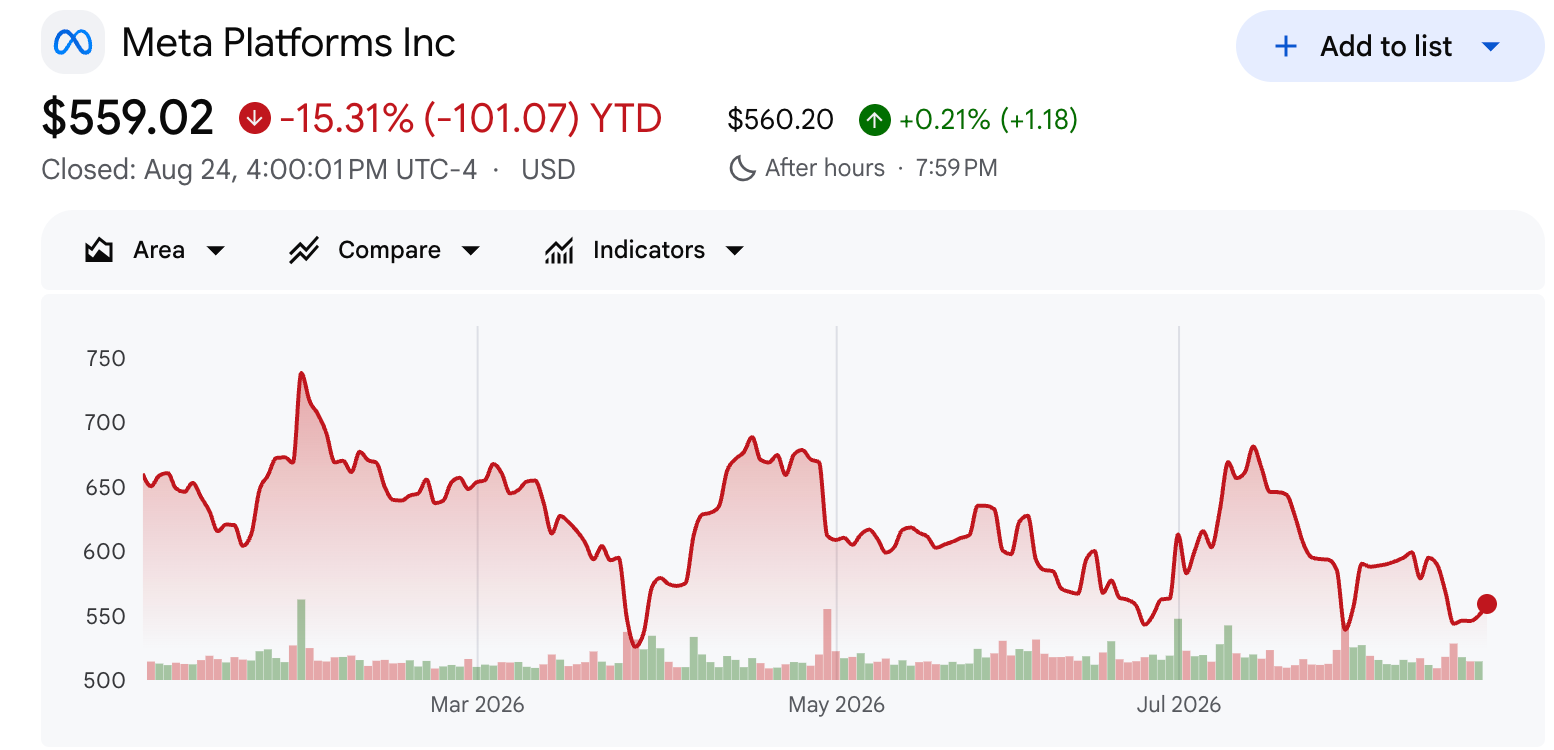
Investors have not rewarded the buildout so far. META closed Monday at $559.02, valuing the company at nearly $1.42 trillion, and the shares have fallen by over 15% this year.

A youth-safety trial in Oakland has also added pressure. Bank of America keeps a Buy rating and an $810 target. Mizuho is wary, comparing the case to the tobacco litigation of the 1990s.
Hatch would give Meta a consumer revenue line that does not depend on advertisers. Whether subscribers pay enough to matter against a $145 billion spending year is the open question.
Follow us on X to get the latest news as it happens
What Meta’s AI Agent Will Do
Hatch has been trained to work across DoorDash, Etsy, Reddit, Yelp, and Outlook. Early prototypes show a customizable dashboard featuring tools and skills created by AI agents.
Meta is also preparing a WhatsApp platform that lets users integrate and interact with third-party AI agents. The company could begin testing the platform with a limited group of users as soon as this week.
The company has shipped several models this year. Muse Spark arrived in April, version 1.1 in July, and version 1.2 alongside the Muse Code agent in August.
Whether Watermelon will join the Muse family remains unclear. Meta is estimated to report its third-quarter earnings on October 28, the same month Watermelon is due. Neither product will have had long to prove its economics by then.
Subscribe to our YouTube channel to watch leaders and journalists provide expert insights
The post Meta Targets Early September for Hatch, Its Consumer AI Agent appeared first on BeInCrypto.


Stablecoin card spending has crossed $10.9 billion in cumulative volume as RedotPay projected that annual spending through the products could quadruple to $50 billion by 2028.
Summary
- Stablecoin cards have processed more than $10.9 billion in cumulative spending.
- July card spending topped $1 billion for the first time, according to Paymentscan.
- RedotPay expects annual stablecoin card spending to reach $50 billion by 2028.
- The company cited adoption, clearer regulation and cross border payment use as growth drivers.
RedotPay said in an Aug. 25 blog post that the industry recorded more than $1 billion in card spending during July for the first time, citing independent payments data provider Paymentscan, as usage continued to rise across markets in Latin America, Africa and Asia-Pacific.
The stablecoin payments company expects the industry to process its next $10 billion in eight months after taking roughly three years to reach the first $10 billion. By 2028, RedotPay expects stablecoin-powered cards to be handling $50 billion in annualized spending.
“When you consider that over $20 trillion will be spent this year on traditional cards, $50 billion per year no longer seems unattainable,” the company said.
Paymentscan data showed July 2026 as the largest month recorded for the sector. Its headline dataset put stablecoin card spending at about $1.04 billion during the month, compared with roughly $339 million in July 2025.
RedotPay attributed its forecast to its own operating data, adoption patterns in several developing markets, clearer rules for stablecoin businesses and increasing use of digital dollars for payments, remittances and foreign exchange services.
Stablecoin card spending has accelerated in 2026
Stablecoin cards connect cryptocurrency balances to existing card networks, allowing users to pay merchants while stablecoins or other digital assets are converted or settled through the infrastructure behind the transaction.
RedotPay said the products have moved from an experimental payment method toward regular consumer use. When the company launched its first card about three years ago, it estimated that the entire industry was processing around $60,000 each month. Current volumes can reach the same amount in roughly four minutes, according to its blog.
Jonathan Chan, RedotPay’s head of partnerships and co-founder, said the company was seeing demand from customers who use stablecoins to handle ordinary financial needs instead of cryptocurrency trading.
“Stablecoin-powered cards have reached their mainstream moment, hitting all-time highs in spending volume on the strength of their utility in daily life,” Chan said.
“Our users are not necessarily crypto traders. They are people who found a better way to manage their finances because the previous options they had weren’t good enough. This is where the growth will come from.”
The company pointed to customers using the cards for expenses such as groceries, subscriptions, travel and rent across more than 100 countries. RedotPay also cited examples of users who need access to international digital services, mobile wallets or dollar-denominated balances where local banking products do not provide the same options.
Consumer card products have also become a larger part of RedotPay’s own business. In July, crypto.news previously reported that the company had launched an XRP Ledger-powered product allowing customers to pledge XRP as collateral and access a credit line settled in Ripple USD.
The product uses a 50% loan-to-value ratio and allows the borrowed value to be spent through Visa merchants while customers retain exposure to their pledged XRP. At the time, RedotPay reported more than 8 million users in over 100 countries and roughly $12 billion in annualized payment volume.
RedotPay now puts its annualized payment volume at approximately $14 billion and annualized revenue at more than $180 million. The company said it has built a profitable business while expanding its stablecoin payment services.
Clearer rules and better products are supporting card use
Explaining the increase in card activity, RedotPay identified regulatory developments as one of the factors that have made consumers and payment companies more willing to use stablecoin-based services.
The company said clearer requirements in important markets have given established operators a more defined framework for licensing and compliance while giving potential customers more confidence in stablecoin products.
Product improvements have played a role as well, according to RedotPay. Interfaces have become easier to use, fiat-to-crypto and crypto-to-fiat services have expanded their coverage, conversion pricing has improved and customer support has become more developed.
RedotPay expects fast-growing payment companies to spend more on licenses and compliance as transaction volumes rise. It also expects traditional financial companies to make more use of stablecoin settlement infrastructure, while additional providers connect blockchain networks with existing banking rails.
The company has begun building its own U.S. regulatory footprint. RedotPay said it recently obtained its first U.S. money transmitter license and has applications pending in more than 20 additional states.
Card networks have been adding stablecoin settlement services at the same time. In June, Mastercard added support for settlement using six regulated dollar-backed stablecoins, including USDC, PayPal USD, Ripple USD, Global Dollar, Pax Dollar and SoFiUSD.
Mastercard said the system can settle transactions outside normal banking hours, including weekends and holidays, while retaining existing card payment processes. Supported blockchain networks included Ethereum, Solana and the XRP Ledger.
Stripe has also been building stablecoin card infrastructure through Bridge. A July report detailed how the program expanded into more than 100 markets after Stripe acquired the stablecoin infrastructure company.
Former Stripe stablecoin partnerships head Connor Fitzgerald said the team established sponsor bank and card network relationships, built stablecoin settlement infrastructure in the United States and took annualized payment volume from zero into the tens of millions of dollars.
Stablecoin payments extend beyond consumer checkout
Card spending represents one part of the stablecoin payments market, with cross-border settlement, remittances and business payments accounting for other use cases that RedotPay expects to support future adoption.
In May, BridgerPay co-founder and CEO Ran Cohen said stablecoin payment demand remained concentrated in cross-border settlement, business-to-business payouts and treasury operations. Cohen expected stablecoins to expand through business payment flows without displacing conventional cards at merchant checkouts.
RedotPay’s model connects the two systems by allowing users to fund spending from digital assets while relying on existing card networks for merchant acceptance.
The company identified Latin America, Africa and Asia-Pacific as important markets in its forecast. RedotPay said customers in such regions can use stablecoins for dollar savings, international purchases, travel spending and access to payment products that may not be available through their local banks.
Cross-border use also gives stablecoin cards a role in remittances and foreign exchange, according to the company, particularly where customers already hold digital dollars and need to convert or spend them without moving funds through several financial services.
RedotPay said competition among companies connecting traditional banking systems with stablecoins could reduce costs as more providers enter the sector. The company expects established financial institutions to increase their use of stablecoin rails as payment infrastructure develops.
Its 2028 projection would put annual stablecoin card spending at $50 billion, roughly four times the current annualized level cited by the company, while remaining a small fraction of the more than $20 trillion RedotPay expects consumers to spend using traditional cards this year.
The company currently serves more than 8 million users globally, with pending money transmitter license applications in more than 20 U.S. states alongside the first state license it has already received.
Crypto World
Live updates: Bitcoin ETFs draw a sixth straight day of inflows as the rally holds above $80,000
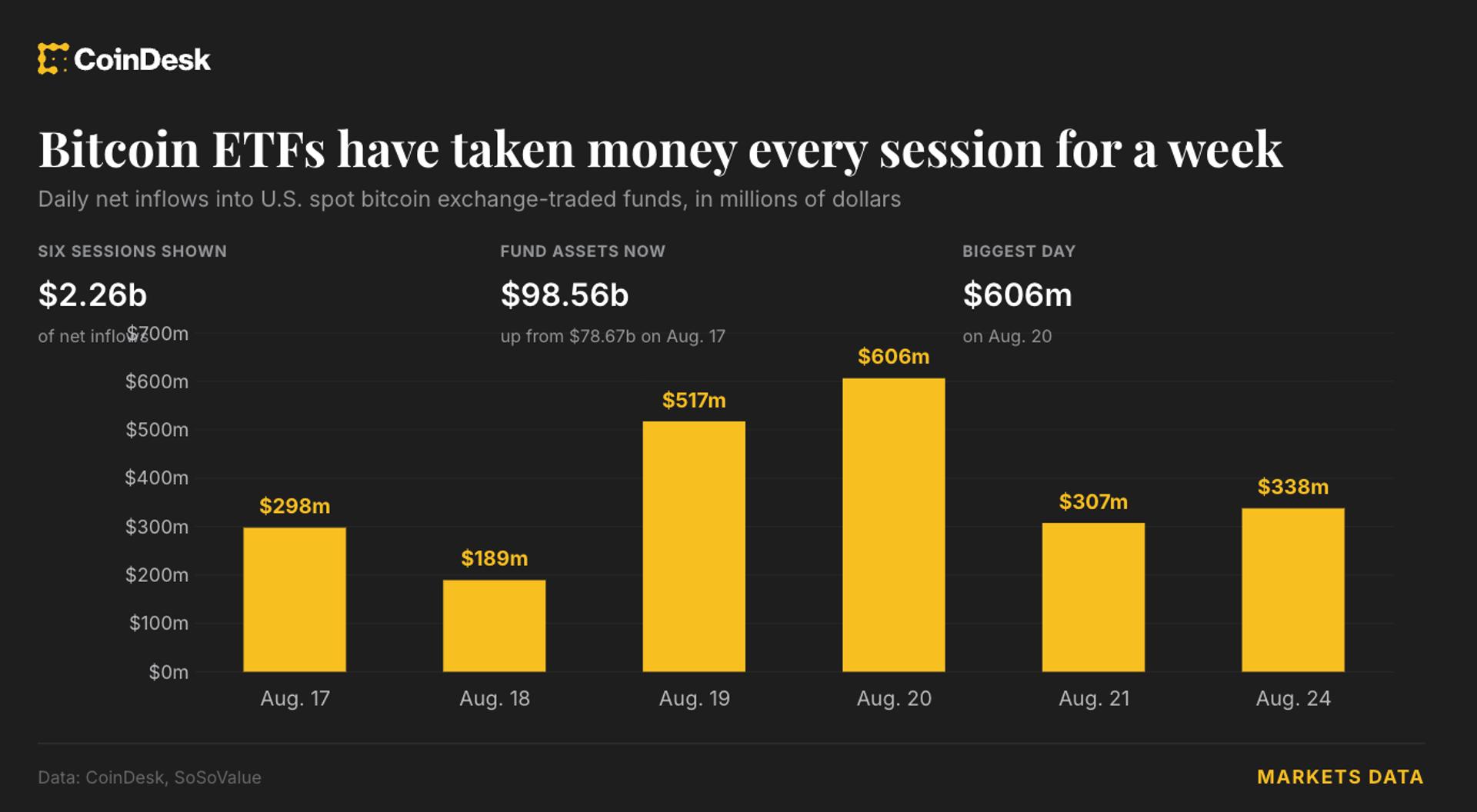
Spot bitcoin funds took in $337.56 million on Aug. 24, extending an unbroken run of inflows that has now put real money behind a rally that started with a short squeeze.


Cointelegraph is committed to providing independent, high-quality journalism across the crypto, blockchain, AI, and fintech industries.
All news, reviews, and analyses are produced with full journalistic independence and integrity. For more details on our standards and processes, please read our Editorial Policy.
Why is Fluence Energy stock surging today?

Treasury’s bond buyback plan fights the market and heightens the danger, billionaire Druckenmiller says

Taylor Swift Reveals How She Copes With Her Global Fame





-

 Fashion4 days ago
Weekend Open Thread: Madewell – Corporette.com
-

 Business3 days ago
Musk’s Tesla, SpaceX Confirm $16.8 Billion ‘Terafab’ Chip Plant as World’s Largest Building in Texas
-

 Crypto World3 days ago
anatomy of crypto’s biggest liquidation event since 2021
-

 Business7 days ago
SMA Solar Technology AG (SMTGY) Q2 2026 Earnings Call Transcript
-

 Politics3 days ago
6 months on, Irish renters crushed by effects of government housing bill
-
 NewsBeat3 days ago
The ‘Lucky Dip Gang’ causing carnage for clicks: After five thugs were killed speeding in the wrong direction on a motorway, GUY ADAMS investigates a sick new trend… and why police aren’t even allowed to pursue them
-

 Tech6 days ago
GLM-5.3 hits the API at $1.4/$4.4 per million tokens
-

 News Videos5 days ago
Don’t Leave Your Financial Future To Chance | August 19, 2026
-

 Business2 days ago
Mystery AI Model ‘Ox Alpha’ Draws Developers With Free Access as Chinese Lab Origins Remain Debated
-

 Business5 days ago
Five Below: Kids Discount Retailer Reaps Rich Rewards
-

 Business7 days ago
Stock Market Today: Tech Futures Slide As Treasury Yields Jump; Nvidia, Micron, Sandisk Sell Off
-

 Business6 days ago
Marvell Shares Jump 7% as Google Chip Deal Confirms Custom AI Silicon Partnership, Analysts
-

 Tech7 days ago
Ken Okuyama’s Kode89 Supercar Features Three Pedals and a Choice of V12s
-

 Politics7 days ago
The House Opinion Article | Security means more than military spending
-

 Sports2 days ago
Deshaun Watson fires back at Browns fans after being booed: ‘It’s a disrespectful thing’
-

 Fashion7 days ago
The Best Wide Leg Pants to Wear to Work
-

 Crypto World7 days ago
Sherlock Takes Audit Engine Public After Months of Quiet Testing
-

 Fashion7 days ago
Flat sandals on sale at Esska
-

 Tech5 days ago
OpenAI confirms ChatGPT is down as logins and signups fail
-

 Business4 days ago
UK firms in critical financial distress rise 9% to 53,756
You must be logged in to post a comment Login