

Crypto World
Digital Chamber Backs Dismissal of NY Lawsuit on 39,069 Dormant Bitcoin Wallets

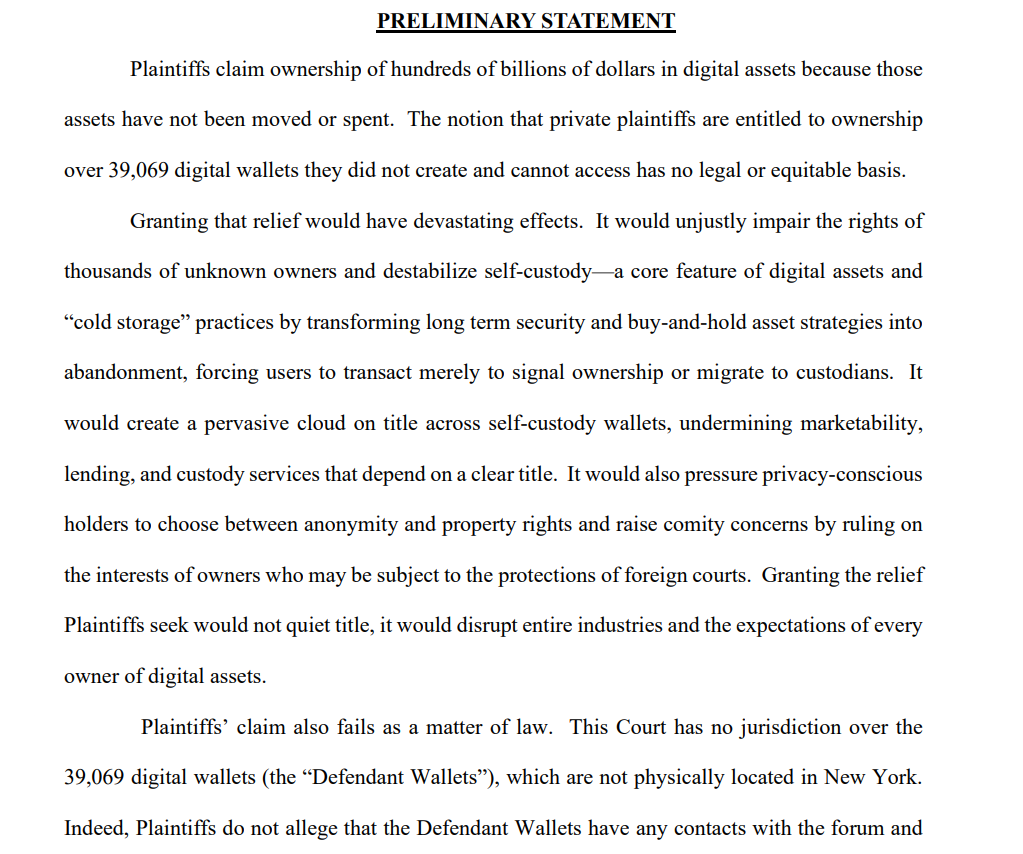
Blockchain trade association the Digital Chamber filed an amicus brief in the New York lost property case seeking ownership of thousands of dormant Bitcoin addresses.
The Monday filing is the second amicus brief in the case. It opposes the claims of ownership, arguing that treating dormant wallets as abandoned property would create a “pervasive cloud on title across self-custody wallets.”
Digital Chamber argues that a ruling based on the plaintiffs’ theory would undermine the “foundational principles of digital property ownership, with negative ripple effects reaching the traditional finance industry.”
The amicus brief was filed in a lawsuit brought by “Noah Doe” and two Wyoming-based companies in late May, seeking ownership of 39,069 dormant Bitcoin addresses, in what could become a test of how inactive crypto may be treated under the state’s lost-property law.
The listed addresses hold an estimated 3.7 million Bitcoin (BTC) worth about $234 billion and include some of the wallet addresses associated with Bitcoin creator Satoshi Nakamoto, according to Sani, founder of analytics platform Timechain Index.
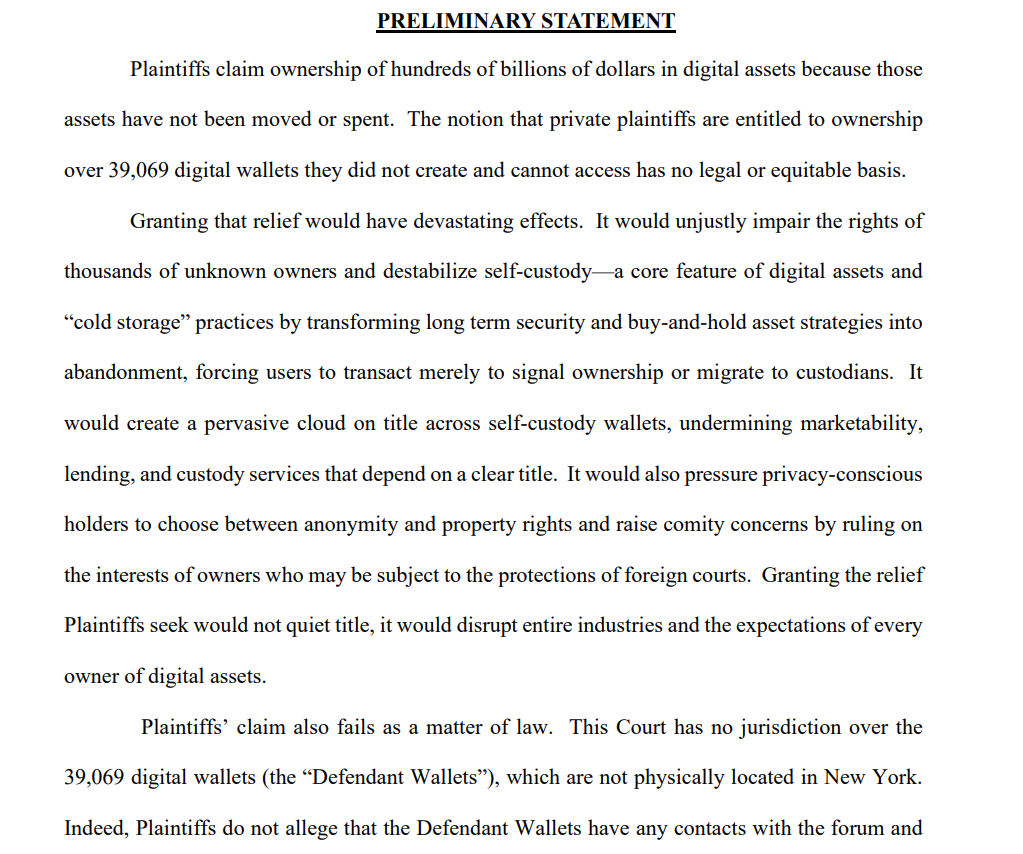
The Digital Chamber files an amicus brief to dismiss the case seeking ownership of 39,069 Bitcoin wallets. Source: iapps.court.state.ny.us
The Digital Chamber describes itself as the oldest and largest digital asset trade association representing over 250 members, including crypto exchanges, banks, investment firms and other industry participants.
Related: Strategy sells 3,588 Bitcoin for $216M to fund dividends, keeps $2.55B reserve intact
Dormant Bitcoin wallets awaken after lawsuit
Some of the long-dormant Bitcoin wallets named in the lawsuit have been waking up.
At least 31 of the listed addresses moved 17,527 Bitcoin in June, up from five addresses that transferred 4,834 BTC in February, according to Galaxy Digital head of research Alex Thorn.
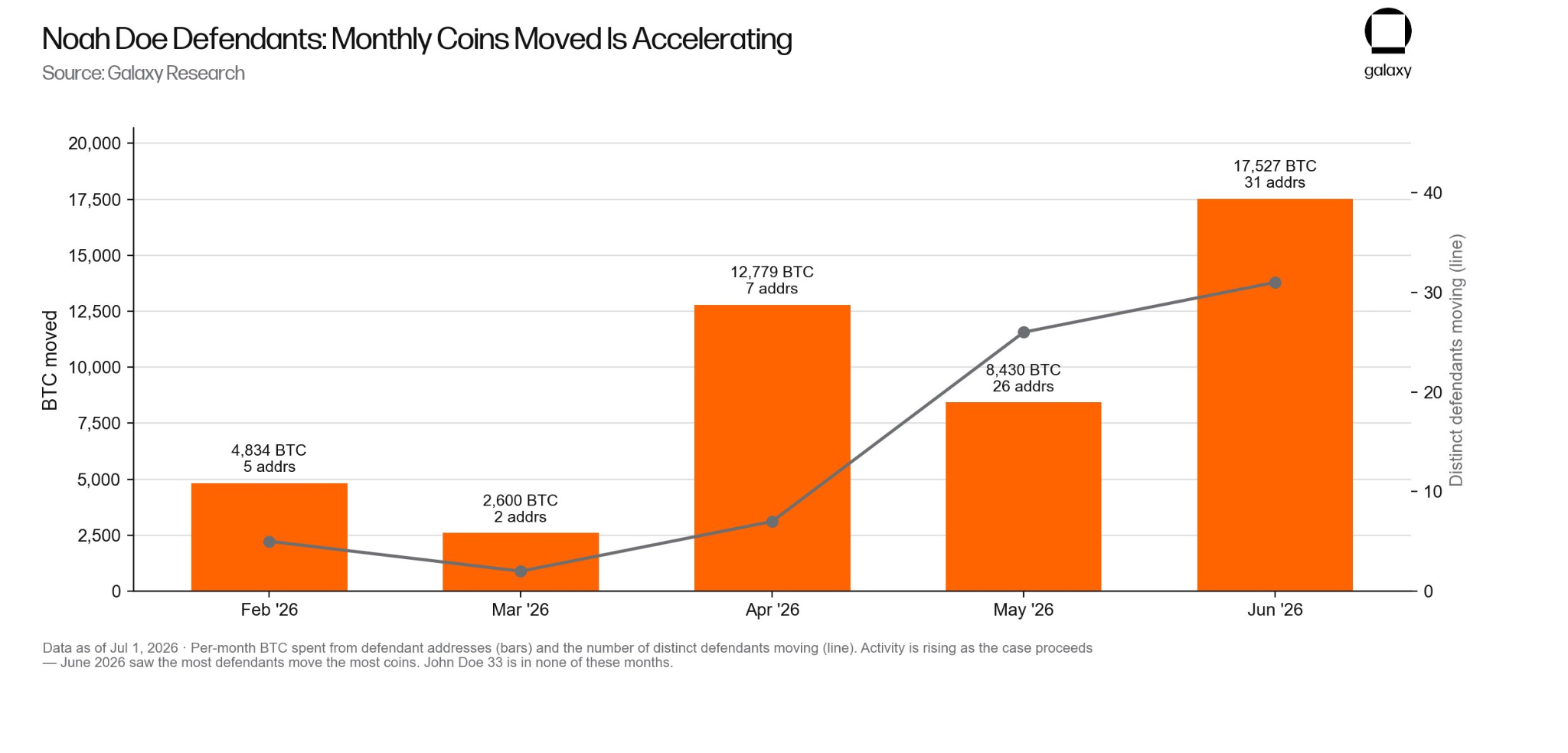
Source: Alex Thorn
Bitcoin address “1KV47” transferred 30 BTC, worth about $1.88 million, on Saturday, marking the wallet’s first movement in almost 15 years, since August 2011.
Regardless of the lawsuit’s outcome, it is unclear how the plaintiffs could gain control of the assets without holding the private keys to the wallets.
On Thursday, a pseudonymous defendant filed a notice of appearance and motion to dismiss, claiming they control one of the dormant wallets named in the lawsuit.
Magazine: Bitcoin decouples from tech stocks, Ether eyes ‘selling wave’: Market Moves

Tether has taken a $20 million stake in Brazil’s Mercado Bitcoin as it pushes further into tokenized financial products and stablecoin-powered payments across Latin America. The investment is intended to back the company’s expansion into tokenized assets, lending and other blockchain-based services throughout the region.
Mercado Bitcoin, originally launched in 2013 as a crypto trading venue, has since broadened into regulated financial offerings. The platform says it now serves more than 4.5 million users and has issued over 2 billion Brazilian reais (about $370 million) in tokenized assets, while operating under nearly a dozen licenses in Brazil and Europe, including a payment institution authorization from Brazil’s central bank.
Key takeaways
- Tether’s $20 million investment targets Mercado Bitcoin’s expansion into tokenized assets, lending and stablecoin payments in Latin America.
- Mercado Bitcoin positions its business model as “onchain” financial infrastructure supported by multiple licenses, including Brazil’s payment institution framework.
- Tether says it is using profits from its stablecoin business (including USDT) to fund strategic investments in blockchain financial services.
- The deal builds on Mercado Bitcoin’s earlier tokenization deployments, including a $20 million private credit rollout on Bitcoin’s Rootstock sidechain.
Tether backs Mercado Bitcoin’s regulated onchain push
The partnership highlights how stablecoin issuers are increasingly funding regulated platforms rather than focusing solely on token supply. Tether Investments’ stated approach is to support companies building blockchain-based financial infrastructure, and Mercado Bitcoin is positioned as one of Latin America’s most developed “regulated onchain” ecosystems—according to Tether CEO Paolo Ardoino.
Ardoino said Mercado Bitcoin has established a comprehensive platform by combining licensing, tokenization capabilities, and integrated financial services. For investors and users, the practical takeaway is that the project is aiming to connect tokenization and payments to mainstream financial rails under oversight, rather than treating blockchain services as purely standalone experiments.
While the statement emphasizes regulatory breadth, the investment also implicitly addresses a core challenge facing tokenized finance: making tokenized products easier to deploy within existing legal and payment frameworks. Mercado Bitcoin’s cited license footprint—spanning Brazil and Europe, and including a Brazilian central bank payment institution license—suggests the company intends to keep expanding within compliance constraints as it adds more stablecoin and tokenized offerings.
Tokenization momentum: from private credit to wider asset services
Mercado Bitcoin’s broader tokenization strategy appears to be accelerating. In February, the platform announced it had deployed more than $20 million in tokenized private credit, describing this as part of its expanding real-world asset (RWA) activity. That deployment was carried out on Bitcoin’s sidechain Rootstock, according to earlier reporting from Cointelegraph: Mercado Bitcoin expands LatAm RWA push.
Against that backdrop, Tether’s new investment can be read as reinforcement of a direction already underway: scaling tokenization use cases beyond early pilots. The company’s most recent plan explicitly includes stablecoin payments and lending—two segments that typically require not only token issuance and custody capabilities, but also reliable payment processing and settlement infrastructure.
Still, the specific operational details of how the $20 million will be allocated within Mercado Bitcoin’s product stack weren’t provided in the information available here. Readers should watch for updates on whether the funding is earmarked for token issuance infrastructure, credit origination/servicing, or specific stablecoin settlement integrations.
Where Tether’s money is coming from
For Tether, the Mercado Bitcoin investment fits a broader pattern of deploying capital through its investment arm. The company issues USDT, which it describes as the largest stablecoin by circulation, with about $184 billion in circulation cited in the underlying material.
In its Q1 2026 results, Tether reported approximately $1.04 billion in net profit and said it is using those earnings for strategic investments. The underlying report also notes ongoing emphasis on reserves; the investment announcement ties directly to this broader capital deployment thesis via Tether’s finance strategy.
Beyond Mercado Bitcoin, Tether’s participation in other initiatives—such as a $134 million funding round for the Stablecoin Development Corporation—has also been framed as part of expanding the “stablecoin economy” and the infrastructure around it. In April, Tether backed that financing round, and later invested in remittance platform LemFi with the aim of supporting USDT settlement for cross-border payments across Africa and Asia.
Tether also outlined plans to work with the Government of Georgia to launch a stablecoin pegged to the Georgian lari under the country’s digital asset framework. Separately, Tether has said it invests in sectors including artificial intelligence, energy, biotechnology and digital media through its investment arm.
Signals for stablecoin adoption and regulated finance in LatAm
The Mercado Bitcoin deal matters because it sits at the intersection of three trends: tokenization of real-world assets, stablecoin payments, and regulatory-driven rollout. Stablecoins can reduce settlement friction, while tokenized credit and other RWAs aim to bring traditional financial products onto blockchain rails. Mercado Bitcoin’s licensing and reported track record are positioned as the bridge between those worlds.
For users in Brazil and across Latin America, the most meaningful question is whether stablecoin payments and lending will become integrated into Mercado Bitcoin’s regulated financial stack in a way that supports scale—especially for remittances, merchant payments, and other high-frequency use cases. For builders and institutional participants, the investment suggests continued demand for compliant infrastructure that can connect tokenized assets to payment systems.
There’s also an important context point: Tether leadership has previously addressed speculation about going public. Paolo Ardoino said the company has no plans to go public, according to a social post linked in the underlying material.
That clarification doesn’t change the Mercado Bitcoin story directly, but it underscores that the investment strategy is being presented as an ongoing part of Tether’s operating approach rather than a short-term funding maneuver tied to corporate restructuring.
Next, the market will likely look for concrete milestones from Mercado Bitcoin: how quickly stablecoin payments and lending roll out under its licensing framework, and whether additional tokenized credit or other RWAs expand beyond the earlier Rootstock-based deployment. The $20 million investment is a clear signal of intent, but execution details will determine how much of Latin America’s tokenized-finance promise turns into sustained, usable products.
Binance added 10 more bStocks tokenized securities as margin collateral, the second expansion in four days. The list includes Alphabet (GOOGLB), Coinbase (COINB), and the triple-leveraged semiconductor token SOXLB.
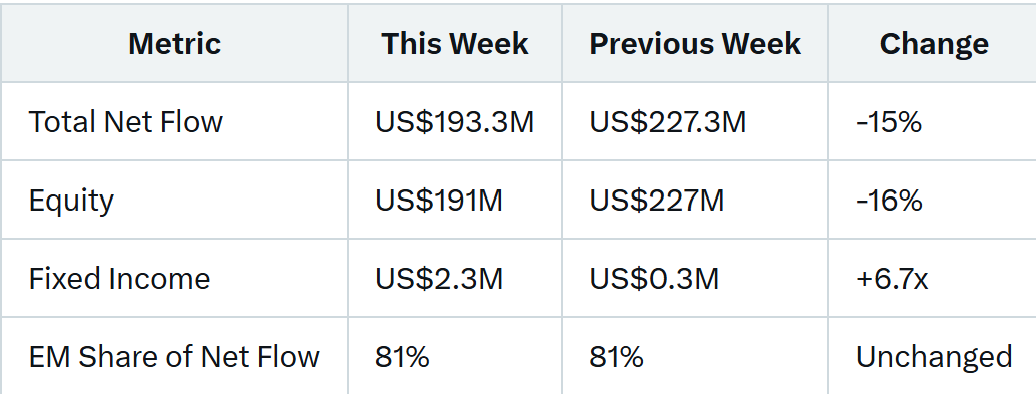
The push deepens leverage utility for a product whose first month produced $193.3 million in weekly net inflows but also revealed narrow, tech-heavy demand.
Binance bStocks Collateral Push Builds on $193 Million Week
According to the exchange’s announcement, eligible users can post the tokens as collateral under cross margin and unified account modes. Borrowing is not supported, and access is limited to VIP 3 and above users in approved jurisdictions.
The batch also covers DRAMB, a memory-sector ETF token, and arrives four days after 15 additions disclosed on Square. Those included NVIDIA (NVDAB), Tesla (TSLAB), and SpaceX (SPCXB), bringing eligible bStocks collateral to 25 tokens.
The expansion caps a strong opening month. Binance Research reported a $193.3 million net rise in user stock exposure for the week to July 1. However, that figure fell 15% from $227.3 million the week before.

Binance says users acquired more than $1 billion in US equities after it opened US stock trading on June 1, with roughly 73% of stockholders based in emerging markets.
“Binance launched direct stocks on June 1, giving users access to over 7,000 U.S. stocks and ETFs, right alongside their crypto. In just 30 days after the launch, users have acquired more than $1 billion of U.S. equities on Binance, while generating close to $3 billion in trading volume. Around 73% of people using Binance’s direct stocks come from emerging markets, the places traditional brokerages have underserved for decades.”
Follow us on X to get the latest news as it happens
Warning Signs Behind the Headline Numbers
Binance’s own data reveals heavy concentration. Technology absorbed $159 million, or 83% of net inflows, in the latest weekly report. Binance Research titled that report “From Missiles to Memory” after inflows rotated from defense stocks into memory and chip names.

The pattern runs deeper than one week. Tech accounts for 71% of all stock holdings, with semiconductors alone drawing 48% of allocations. Meanwhile, just over 700 of more than 7,000 available assets have traded, roughly 10% of the catalog.

Against that backdrop, accepting SOXLB (triple-leveraged semiconductor token) as collateral looks bold. The token tracks a 3x leveraged semiconductor ETF, so a chip downturn could hit both positions and their collateral.
In addition, bStocks already back loans through a tokenized stocks collateral market on BNB Chain.
Competition raises further questions. Ondo controls about $870 million of the nearly $1.08 billion tokenized stock market, dwarfing bStocks’ visible share.
Regulatory friction adds pressure too. Binance logged record weekly crypto outflows of $1.23 billion as the EU’s Markets in Crypto-Assets (MiCA) rules took hold.
Collateral expansion may deepen bStocks liquidity, but it could equally concentrate leverage in the same few volatile trades. With weekly inflows already cooling, the next fund flow reports should reveal which effect dominates.
The post Binance Expands bStocks After $193 Million Debut, but Warning Signs Emerge appeared first on BeInCrypto.
The world’s biggest stablecoins are increasingly becoming chain-specific financial products, with Tether’s USDt (USDT) and Circle’s USDC (USDC) serving distinct roles across the crypto ecosystem rather than competing head-on.
Dune’s Digital Asset Brief found that USDT overwhelmingly dominates onchain payments. During the first half of 2026, the biggest stablecoin settled about $95 billion in identified commerce payments, compared with $14 billion for second-biggest USDC. It also accounted for roughly 92% of the $48 billion in business-to-business payment volume. On Tron, USDT’s largest network, around 93% of the token’s supply is held in ordinary wallets rather than on exchanges, underscoring its role as a payment and remittance asset.
USDC, meanwhile, has established itself as the dominant stablecoin in decentralized finance. USDC on Base processed roughly $2.6 trillion in transfer volume in June, the highest of any token-chain pair, while on Ethereum, that stablecoin handled another $1.6 trillion.
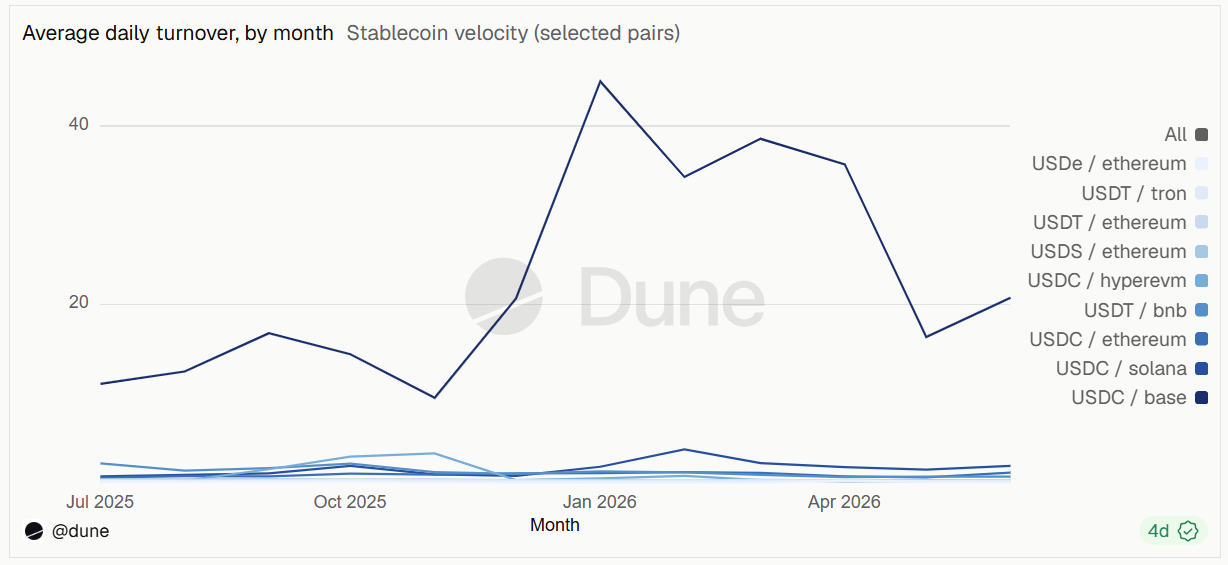
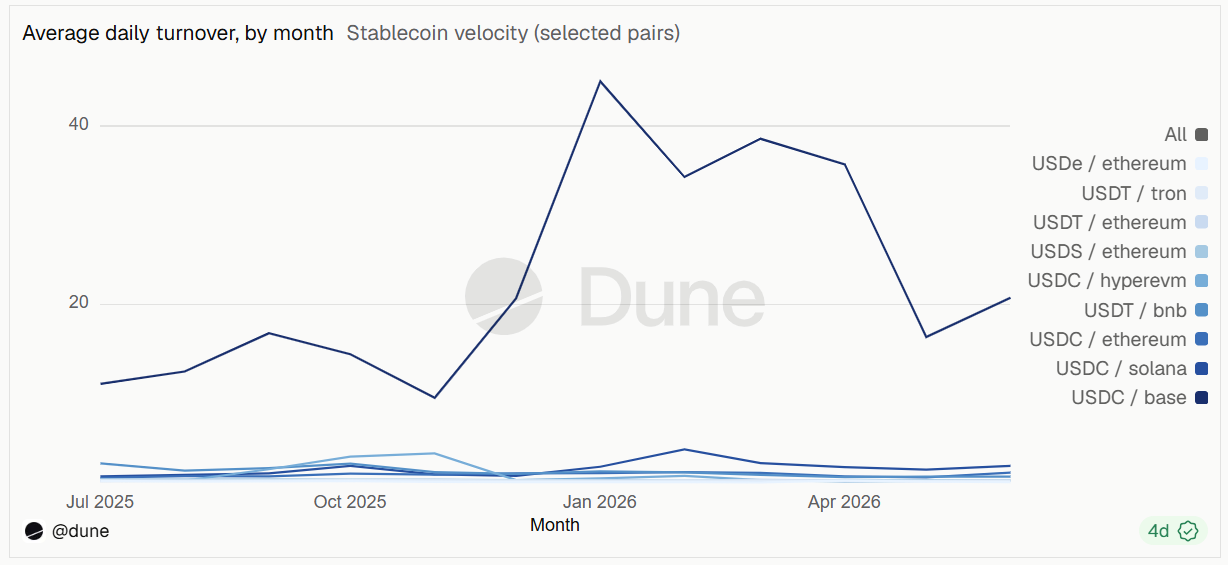
USDC on Base recorded daily velocity of about 20 times its circulating supply in June, reflecting its extensive use in trading and DeFi. Source: Dune
The findings suggest the traditional USDT-versus-USDC narrative is becoming less useful. Instead, each stablecoin is carving out its own niche, with USDT dominating payments and USDC underpinning much of crypto’s trading and DeFi activity.
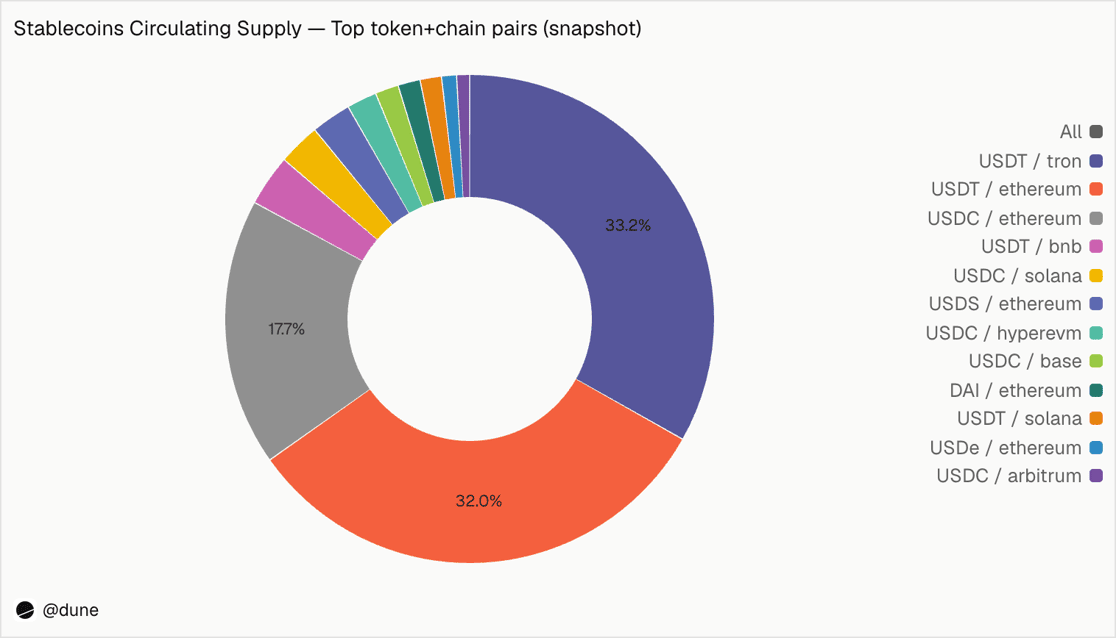
USDT’s supply is split almost evenly between Tron and Ethereum, while USDC remains heavily concentrated on Ethereum despite expanding to newer blockchains. Source: Dune
The findings come as the two digital assets continue to dominate the stablecoin market. Together, they account for roughly 83% of the sector’s approximately $315 billion market capitalization, according to Dune, which tracked more than 200 stablecoin tokens across multiple blockchains.
Related: UN agency moves Stellar blockchain payment initiative beyond pilot stage
US lawmakers reshape stablecoin rules
The stablecoin sector has gained momentum in the United States following the passage of the GENIUS Act. Signed into law in 2025, GENIUS established the first federal regulatory framework for payment stablecoins, paving the way for banks and other companies to issue US dollar-pegged digital assets.
Lawmakers are now debating the CLARITY Act, which would establish a broader market structure for digital assets by defining when crypto assets fall under the jurisdiction of the US Securities and Exchange Commission or the US Commodity Futures Trading Commission. While the bill does not regulate stablecoins directly, it would shape the broader regulatory environment in which stablecoin issuers, exchanges and DeFi platforms operate.
CLARITY cleared the Senate Banking Committee in May and could receive a full Senate vote before the August recess, although Galaxy recently trimmed its odds of passage before the break to 50% as lawmakers run short on time.
Magazine: Kraken’s $600M stablecoin firm, Huione scandal deepens: Asia Express
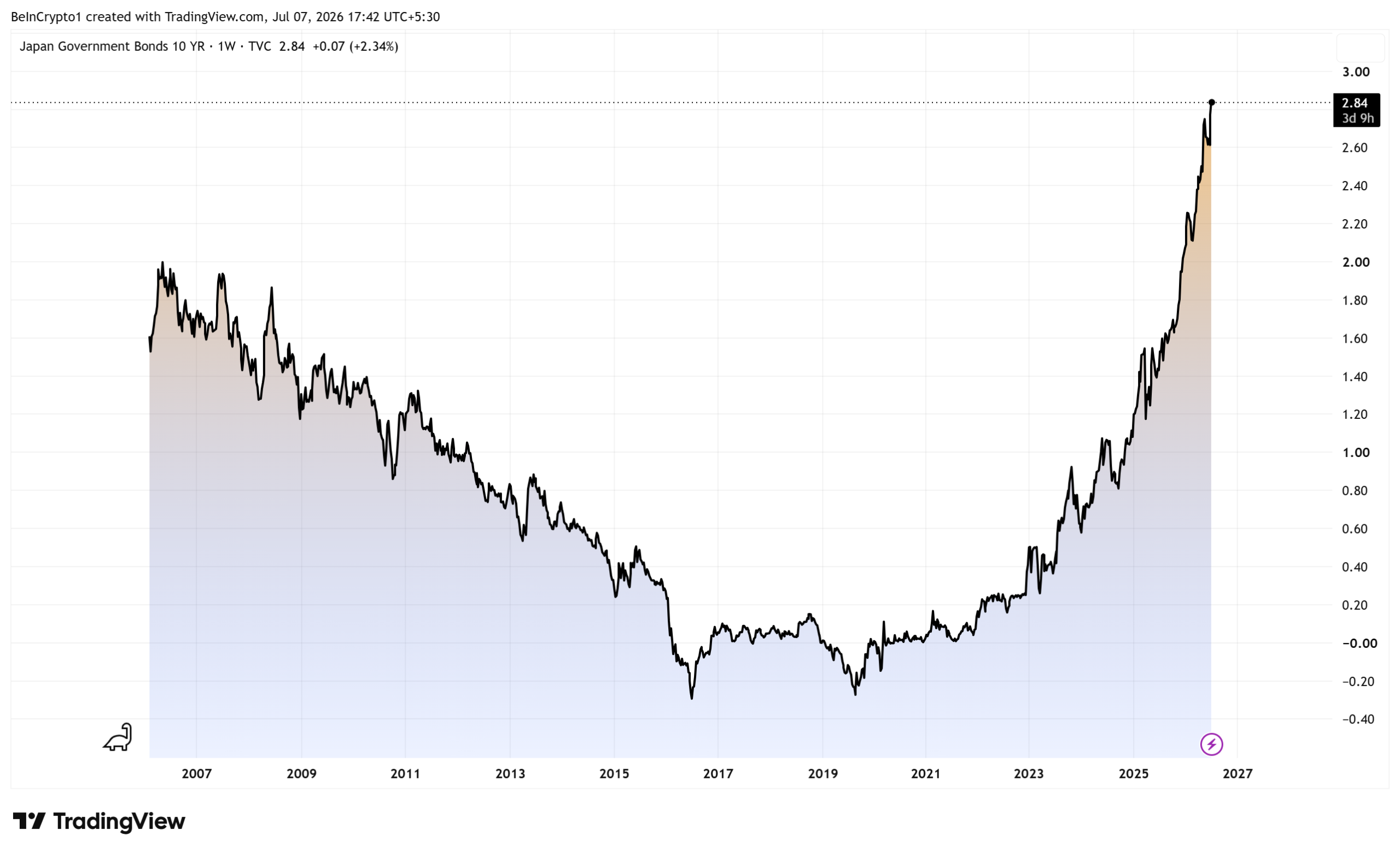
Japan’s bond market stress deepened Monday as the 10-year yield touched 2.825%, its highest level since October 1996. The surge threatens the easy money that funded multi-year rallies in stocks and Bitcoin (BTC).
The yen trades near 162 per dollar, its weakest since 1986, even after Tokyo spent a record sum defending it this spring.

Japan Bond Market Faces More Supply and a Shrinking Buyer
Prime Minister Sanae Takaichi’s government plans to mobilize over ¥370 trillion ($2.28 billion) in public and private investment across 17 strategic sectors through fiscal 2040. The roughly $2.3 trillion program implies heavier bond issuance ahead.
Meanwhile, the Bank of Japan keeps trimming its bond purchases. Reuters reported that policymakers may pause the taper only from fiscal 2027. Until then, the market’s largest buyer keeps stepping back.
Demand elsewhere looks fragile. A weak 10-year auction preceded Monday’s yield spike, and 20-year and 40-year sales follow later this month. Japan’s debt above 200% of GDP leaves little room to absorb higher borrowing costs.
“Less demand at auction plus more supply plus a smaller BOJ bid means yields get pushed higher mechanically, not just sentimentally,” noted macro analyst Bull Theory.
Carry Trade Unwind Risk Hangs Over Bitcoin and Stocks
Investors have borrowed cheap yen for years to fund positions in US equities, Treasuries, and crypto. Higher Japanese yields raise that funding cost and give capital a reason to come home. Repaying those loans means selling the very assets the borrowed money bought.
The precedent is fresh. A surprise BOJ hike in July 2024 triggered a carry trade unwind, which the Bank for International Settlements later detailed in a bulletin.
The Nikkei fell 12.4% on August 5, 2024, its worst day since 1987. Bitcoin briefly slid below $50,000 in the same rout.

Positioning now looks stretched again. Data compiled by LSEG shows yen short bets near $11.3 billion, the largest since July 2024.
Policy tools are losing traction. The Ministry of Finance disclosed a record ¥11.73 trillion ($73.6 billion) in yen-buying intervention between April 28 and May 27. The currency has since surrendered all of those gains and returned to four-decade lows.

The BOJ’s June 16 hike to 1%, its highest rate in 31 years, changed little. Goldman Sachs responded with a more bearish forecast, seeing the yen at 165 per dollar within a year. Analysts already frame further BOJ hikes as a direct risk for Bitcoin.
Bitcoin traded near $63,676 at press time, up 3% over the past 24 hours. Equities carry similar exposure after the Nikkei’s record run in June.
This week’s 30-year auction and the BOJ’s next signals now become key tests. A gradual adjustment would let markets adapt, while a disorderly unwind could spread volatility across stocks and crypto within days.
The post Why Japan’s Bond Market Could Kill the Easy-Money Rally in Stocks and Bitcoin appeared first on BeInCrypto.
Oil prices climbed on Tuesday after Iran reportedly fired at least two missiles at commercial ships crossing the Strait of Hormuz, reviving fears over the world’s key oil chokepoint and the fragile truce between Washington and Tehran.
The rebound landed just days after crude erased its entire war premium and sank closer to pre-war levels.
Oil Rebounds Following Sharp Slide Toward Pre-War Levels
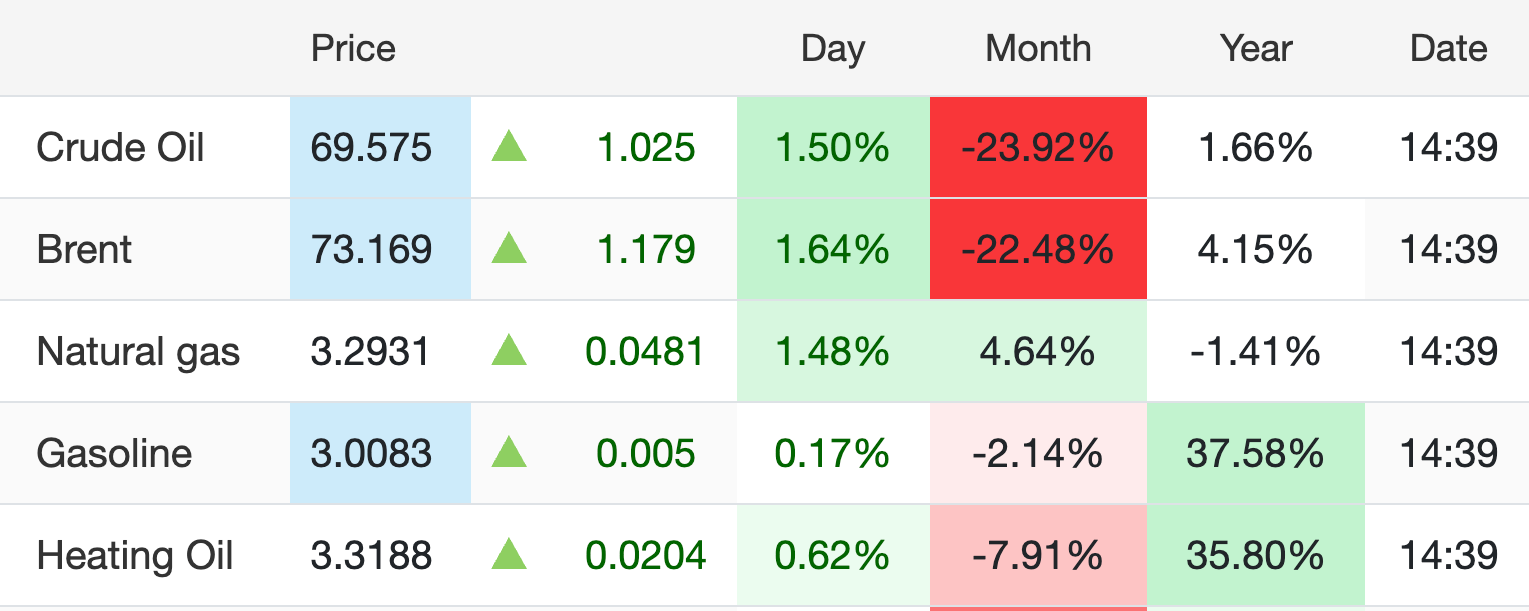
West Texas Intermediate (WTI) crude rose 1.50% to $69.575 on Tuesday. Brent crude gained 1.64% to $73.169.
The wider energy sector also gained. Gasoline rose 0.17%, and heating oil added 0.62%, while natural gas climbed 1.48%.
Follow us on X to get the latest news as it happens

Both oil benchmarks sit far below their wartime highs. Brent has dropped more than 22% over the past month, and WTI has fallen nearly 24% in the same span.
Missile Strikes Test a Fragile US-Iran Truce
The Strait handles roughly 20% of the world’s oil traffic, which magnifies the market reaction to any disruption there. Axios, citing two US officials, reported that Iran fired at least two missiles. The reported strikes came after a one-week agreement between the two sides to halt attacks in the waterway expired.
The United Kingdom Maritime Trade Operations centre reported an incident 8 nautical miles east of Limah, Oman. A southbound tanker was struck by an unknown projectile, causing a fire, according to UKMTO.
A US official said a second commercial vessel was hit by an Iranian missile. Both ships suffered significant damage, though no casualties.
The reported fire threatens a memorandum of understanding barely three weeks after both governments signed it. That deal, reached last month, aimed to end their nearly four-month war. A round of indirect talks in Doha last week closed without meaningful progress.
Meanwhile, the conflict has weighed on President Donald Trump politically. A recent poll found 58% of voters judged the war not worth the cost, while his approval rating held at 36%.
Whether oil extends its bounce or slips back toward pre-war support depends on how Washington responds.
Subscribe to our YouTube channel to watch leaders and journalists provide expert insights
The post Iran Reportedly Hits Ships in Strait of Hormuz: Oil Price Jumps Again appeared first on BeInCrypto.

Key Highlights
- STLA experiences decline as FIAT announces Topolino pre-orders launching July 2026.
- Compact Topolino model targets city-based transportation and brief neighborhood commutes.
- Stellantis broadens portfolio beyond conventional automobiles into micromobility sector.
- Urban convenience drives FIAT’s strategy with small-format vehicle design.
- Topolino represents fresh U.S. micromobility alternative in Stellantis brand family.
Shares of Stellantis declined 1.29% to $5.73 as FIAT announced its plan to begin accepting U.S. pre-orders for the Topolino starting July 2026. This move represents the automaker’s strategic shift toward micromobility solutions. The initiative positions FIAT within the emerging compact neighborhood transportation market.
FIAT Launches Topolino for American Consumers
The Italian brand plans to offer the Topolino as a micro-vehicle solution tailored for American buyers. This model emphasizes brief journeys, crowded urban environments, and customers prioritizing straightforward transportation. It incorporates FIAT’s signature Italian styling within a miniature vehicle format.
While the Topolino projects a whimsical aesthetic, FIAT markets it as functional urban infrastructure. Its compact dimensions facilitate simplified parking and reduced operational complexity. Consequently, the vehicle addresses increasing consumer interest in localized mobility solutions.
According to company announcements, U.S. customers can begin placing orders in July 2026. FIAT enters a market segment defined by accessibility and metropolitan functionality. This introduction provides Stellantis with an additional pathway into the compact transportation arena.
Stellantis Broadens Mobility Portfolio
Stellantis leverages the Topolino introduction to diversify beyond conventional passenger automobiles. The conglomerate currently oversees numerous brands spanning diverse international territories. Accordingly, the Topolino addresses a niche for abbreviated daily transportation requirements.
Micromobility solutions have attracted significant interest as metropolitan areas reconsider congestion, affordability, and accessibility. Compact vehicles serve localized travel without substituting full-sized automobiles. FIAT’s market entry acknowledges this transformation and enhances overall product adaptability.
The Topolino reinforces FIAT’s distinctive character within the Stellantis brand ecosystem. Its aesthetic honors the marque’s historical legacy while fulfilling contemporary mobility demands. Nevertheless, consumer acceptance hinges on affordability, availability, and regulatory frameworks.
FIAT Introduces Specialized Metropolitan Solution
STLA experienced weakness during morning sessions before recovering modestly at midday. This movement coincided with Stellantis announcing its fresh U.S. product initiative. Individual product debuts seldom influence immediate market perception significantly.
The Topolino establishes FIAT within the specialized compact urban transportation category. It facilitates daily mobility across residential areas, educational facilities, and brief metropolitan routes. Thus, the vehicle may attract consumers beyond conventional automotive segments.
Stellantis now incorporates the Topolino into its American mobility strategy. The model provides FIAT with a unique position within an expanding transportation sector. Meanwhile, the corporation’s overall success depends on comprehensive portfolio execution.


TeraWulf has signed a 20-year lease with Anthropic for a 401 MW AI data center campus at its Justified Data site in Hawesville, Kentucky, locking in approximately $19 billion in contracted revenue, a figure that exceeds the bitcoin miner’s entire current market cap of roughly $12 billion.
The deal forces a straightforward question onto the table: at what point does WULF stop trading as a BTC proxy and start pricing as an infrastructure REIT?
Shares jumped as much as 19% intraday on July 6 before settling to around a 4% gain at the close. That compression from intraday high to close is worth noting, it suggests the market is discounting execution risk even as it prices in the headline value, which is the correct reflex given the multi-year buildout ahead.
Today, TeraWulf announced two strategic transactions that significantly advance our AI infrastructure strategy: — TeraWulf (@TeraWulfInc) July 6, 2026
 A 20-year lease with @AnthropicAI at our Justified Data Campus The sale of our 50.1% ownership interest in the Abernathy Joint Venture to an investor group led…
TeraWulf CEO Paul Prager told CNBC: “The Anthropic lease validates our strategy and establishes a long-duration revenue stream with one of the world’s leading AI companies.” The Wall Street Journal reported the agreement is underpinned by Anthropic’s strong investment-grade credit rating, which matters structurally, long-duration revenue anchored to investment-grade paper is a fundamentally different asset than hashrate-dependent block rewards.
What the Kentucky Deal With Anthropic Actually Commits TeraWulf To
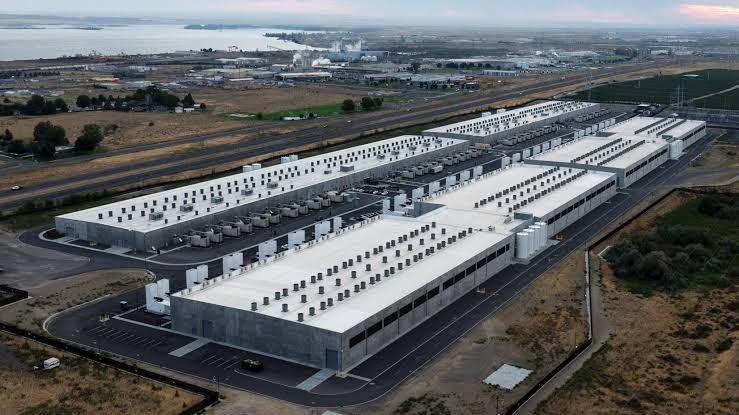
The Kentucky data center campus will deliver approximately 401 MW of critical IT load for Anthropic’s Claude AI infrastructure in phases, with initial capacity expected online in H2 2027 and full build-out targeted by early 2028.
The Justified Data site sits on a former Century Aluminum facility, giving TeraWulf an existing large-power footprint with roughly 480 MW of available capacity and room to expand. That kind of shovel-ready power access is precisely what AI labs cannot easily replicate on their own timeline.
At an industry-standard capex figure of approximately $8–$10 million per MW for HPC-grade infrastructure, the 401 MW buildout implies a capital requirement in the range of $3.2 billion to $4 billion.
That number is not in the headline, the $19 billion contracted revenue figure is, but it is the variable that will determine whether this deal creates or destroys equity value over the next 24 months. TeraWulf has not yet specified its full financing structure for the Kentucky campus.
Anthropic is not the only AI lab moving this aggressively on power. Reports says the company has locked up approximately 3.5 GW of AI compute capacity across multiple deals, and Benzinga notes that IREN has also signed with Anthropic, framing TeraWulf as part of a growing cohort of former Bitcoin miner operators now serving as dedicated AI infrastructure landlords.
The AI infrastructure buildout cycle driving these commitments shows no sign of decelerating.
Capital Recycling and the Abernathy Exit
Running parallel to the Anthropic announcement, TeraWulf confirmed it will sell its 50.1% ownership interest in the Abernathy Joint Venture, a 168 MW AI data center project in Texas formed in 2025, to an investor group led by Fluidstack.
The company said the transaction monetizes its approximately $450 million investment at a premium to invested capital, according to Reuters. That is not a trivial data point: it means TeraWulf is already realizing gains on its crypto mining pivot before a single rack goes live in Kentucky.
The logic of the Abernathy exit is clean. Rather than hold a minority stake in a joint venture it does not control, TeraWulf is recycling capital into wholly owned infrastructure where it captures the full margin profile.
CoinShares has estimated that up to 70% of listed miners’ revenue could eventually come from AI hosting for those that secure long-term agreements, a shift that changes the entire valuation framework for companies like TeraWulf.
The 20-year lease structure itself is the most significant element beyond the dollar figure. For investors previously using WULF as a leveraged bet on bitcoin price cycles, that tenure represents a genuine change in the underlying business.
Long-duration, fixed-revenue infrastructure produces a very different earnings profile than mining, more predictable, less volatile, and increasingly comparable to a data center operator rather than a commodity producer. That is the risk miners like TeraWulf are explicitly choosing to trade away from: direct exposure to BTC price swings and hashprice compression following the halving.
The post TeraWulf’s $19B Anthropic Lease Turns Bitcoin Miner Into AI Landlord appeared first on Cryptonews.


As of 8:19am today in New York, every retail investor who had ever bought shares of Enlivex on the Nasdaq, an arthritis biotech-turned-digital asset treasury (DAT), had lost money.
The company bet its balance sheet on the RAIN crypto token that ZachXBT eventually tied to Moshe Hogeg, an Israeli entrepreneur facing a $290 million law enforcement investigation.
Shares of Enlivex, which have been trading publicly for 12 years, traded to their all-time low of $0.42 this morning. Investors are slowly losing it all.
Hogeg has denied fraud allegations via a spokesperson.
The biotech company spent years developing clinical therapeutics. Bizarrely, it then reinvented itself in November 2025 to what it called the “world’s first prediction markets digital asset treasury strategy.”
That was a world first — and probably last.
The company raised over $200 million through a private placement at $1 per share, funded in dollars and USDT.
It also apppointed a former prime minister of Italy to its board, and spent money accumulating RAIN, a so-called governance token of an Arbitrum-based protocol, calling it “the Uniswap of prediction markets.”
Still today, Enlivex holds about 78.8 billion RAIN worth $1.2 billion, equal to 12% of the token’s circulating supply.
Sadly, even though the token has independently rallied substantially since last year, shares of its largest publicly traded holding company keep falling.
Something is wrong at that company.
Read more: Police want party animal and alleged crypto scammer Moshe Hogeg charged with fraud
ZachXBT flags RAIN, Enlivex, and Moshe Hogeg
On-chain investigator ZachXBT flagged the RAIN token in May of this year. He warned, “You only provide exit liquidity for insiders,” and concluded, “team is tied to a sketchy DAT Enlivex & launchpad Gems[.]vip.”
In a follow-up, he reiterated warnings about RAIN and Enlivex.
Days later, ZachXBT reiterated his RAIN warnings and further traced RAIN’s funding to a blockchain addresses that once moved money for two failed projects, TOMI and Data Ownership Protocol.
TOMI was co-founded by Hogeg, who was behind a string of crypto ventures that lost investors’ money.
ZachXBT alleges on-chain activities link RAIN to Hogeg-connected blockchain addresses.
Despite the mark-to-market value of Enlivex’s RAIN holdings at $1.2 billion, the token is thinly traded and would likely fetch less during a sudden, large sale.
Moreover, its holdings dwarf the company’s actual market capitalization of a mere $118 million which indicates encumbrances over those assets or other serious problems.
Some of its RAIN is pledged as collateral, for example.
The stock has fallen 94% over the past five years, including a 30% year-to-date decline. Even privileged investors who bought within its November placement at $1 have watched their investments halve in value.
In short, Enlivex’s treasury pivot is just another installment in a long series of retail money routed toward Hogeg-linked crypto tokens.
Got a tip? Send us an email securely via Protos Leaks. For more informed news and investigations, follow us on X, Bluesky, and Google News, or subscribe to our YouTube channel.

UK Reform Party leader Nigel Farage has announced he will resign as the Member of Parliament for Clacton and stand in the by-election that could determine whether he remains in the job. Farage said his decision follows what he described as “foul means” used by established politicians, after reports that he received gifts and donations linked to crypto figures and a convicted fraudster.
His move comes amid parliamentary standards scrutiny of the circumstances around those reported transfers. Farage has repeatedly insisted he has done nothing wrong and says the upcoming contest should give voters a direct say on his actions.
Key takeaways
- Farage confirmed he will resign as MP for Clacton and run in the resulting by-election, framing it as a decision for voters rather than a legal verdict.
- Reports cited by UK coverage link alleged gifts to crypto billionaire Christopher Harborne and George Cottrell, a convicted fraudster associated with a crypto casino.
- Farage said he is the subject of two probes by the UK parliamentary standards commissioner.
- Farage has long had ties to the crypto industry, including speaking at Bitcoin 2025 in Las Vegas and being an investor in a London-listed “Bitcoin treasury” company, Stack.
- The UK case lands as US elections approach, with watchdog reporting continued spending by crypto industry groups to influence candidate outcomes.
Farage steps aside from Clacton seat amid standards probe
Farage made the announcement in a Tuesday statement on X. He said he would resign as MP representing Clacton, followed by the formal by-election process. In his message, Farage argued that he has not broken any law or misused public funds, while also pointing to what he described as unfair tactics by political opponents.
According to reporting referenced by Cointelegraph, the renewed attention began after allegations that Farage received millions of dollars’ worth of donations and gifts connected to Christopher Harborne and George Cottrell. The original claims have been discussed alongside an investigation into UK parliamentary standards, with scrutiny focused on whether the nature and receipt of those benefits complied with rules governing MPs.
“Let me be absolutely clear: I have done nothing wrong,” Farage said in an X livestream. “I have not broken the law in any way at all. I have not misused public money.”
What Farage says about the gifts—and why the by-election matters
Farage confirmed he is facing two probes by the UK parliamentary standards commissioner. In comments relayed through the same coverage, he described the reported gifts as being provided “on an unconditional basis.”
He also said he planned to use Harborne’s gift specifically for funding related to his security, citing ongoing threats and attacks. In a separate passage explaining his decision, Farage suggested the by-election would allow constituents to judge whether he should continue representing them.
“I’ve decided that the people of Clacton should be the judges of my actions […] I will be putting my name forward to stand in this by-election.”
Coverage from the London Standard indicated that the by-election outcome could take weeks or months to resolve, largely due to the logistics of stepping down and calling the vote. Farage previously won the Clacton seat with 46.2% of the vote in July 2024, according to the same reporting, edging out Conservative and Labour candidates.
Crypto links predate the current controversy
Cointelegraph reported that Farage had connections to the crypto sector well before the latest set of allegations. That includes his appearance at Bitcoin 2025 in Las Vegas and his role as an investor in Stack, described in earlier coverage as a London-listed Bitcoin treasury company.
In May, when reports first circulated about a claimed $6.7 million “gift” from Christopher Harborne, Farage described it as a “reward” for campaigning for Brexit—the 2016 referendum that led to the UK’s exit from the European Union. Those earlier remarks help explain why the current dispute is not only about alleged donations, but also about how Farage has sought to characterize his relationships with crypto-linked donors.
The latest developments also broaden the conversation beyond crypto money alone. The reported involvement of George Cottrell—described in the cited coverage as a convicted fraudster linked to a crypto casino—adds an additional compliance and reputational dimension that could intensify the scrutiny of how political figures accept benefits and whether disclosure obligations were met.
Pressure on crypto-linked politics extends to the US
While Farage faces UK scrutiny, the question of whether crypto-linked funding can shape elections is not confined to the UK. As November approaches for the US midterms, consumer advocacy group Public Citizen reported in June that the crypto industry spent about $189 million to support candidates viewed as favorable to digital asset policies as part of the 2026 election cycle.
That same broader political backdrop includes criticism directed at US President Donald Trump over his 2025 financial disclosures. Cointelegraph noted that Trump’s filings included reporting $1.4 billion in earnings related to crypto, which has drawn complaints from many lawmakers about possible conflicts and the transparency of his financial ties.
Taken together, the UK by-election dispute and the US election-cycle spending claims reflect a recurring political issue: how regulators, voters, and lawmakers assess the influence of digital asset wealth—especially when potential donors and campaign backers are tied to the industry itself.
What to watch next in Clacton
For voters in Clacton, the immediate variable is straightforward: whether Farage can retain support in the by-election even as parliamentary probes continue. For observers of crypto and politics, the key open question is how the standards commissioner’s findings—once available—will address the substance of Farage’s claims about the gifts, their “unconditional” nature, and what the process will ultimately mean for political fundraising scrutiny.
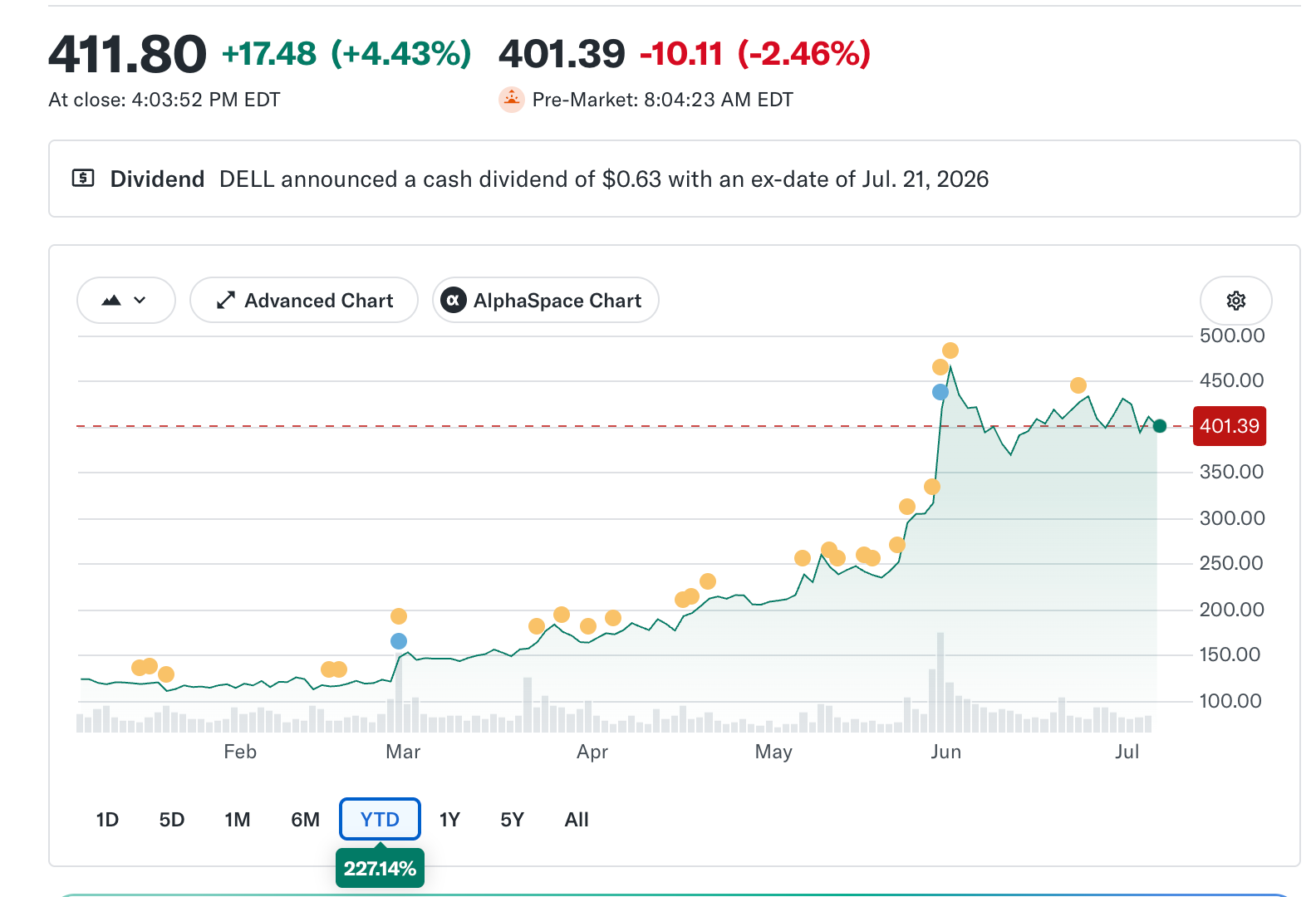
President Donald Trump has urged Americans to buy Dell three times in five months, helping lift Dell (DELL) stock by more than 220% this year.
His latest plug came on Monday. Yet even with the president cheering it on, traders are quietly betting the stock will fall, and a closer look shows why.

Trump’s Third “Buy a Dell” Call in Five Months
Trump made his latest call at a White House ceremony on July 6, and the stock briefly jumped as much as 10%. He had already told people to buy Dell in February and May.
The timing looks awkward. According to government ethics filings, Trump owns between $1 million and $5.1 million in Dell shares, bought about nine days before his first endorsement in February.
Want more insights like this? Sign up for Editor Harsh Notariya’s Daily Newsletter here.
There is a real business behind the hype. Dell now sells huge numbers of AI servers, the powerful computers that run artificial intelligence. That business grew 757% over the past year, and the stock soared 32% on its last earnings report.
Traders are Not Buying the Hype
Here is the part the headlines skip. In the options market, where investors place side bets on where a stock will go, the balance still leans bearish. A put-call ratio above 1 means more money is riding on a fall than a rise.
For Dell, that ratio stayed above 1 through the price surge. The open-interest reading, which counts all standing bets, was 1.11 on July 2 and 1.12 on July 6, even after Trump’s Monday boost.
The daily volume side did slip to 0.40, a sign some traders bought calls to chase the move, but the bigger pool of open bets stayed negative.

The flow of cash is mixed, too. A money-flow gauge called Chaikin Money Flow (CMF), a proxy for institutional flows, reads slightly positive for Dell, near +0.05 over 20 days, so a little money is still coming in.
The same gauge is negative for rivals such as Supermicro, Broadcom, and HP, indicating money leaving them.

So why the doubt when sales are booming? The answer sits inside the machines Dell sells.
Dell Builds the Box, but Nvidia Owns the Value
Dell builds the AI server, but not its most valuable part. Nvidia (NVDA) does. Dell buys Nvidia’s chips and sells the finished computer. This passes most of the chip’s cost to the buyer. So in its latest quarter, a roughly $16 billion AI-server haul was largely Nvidia’s revenue crossing Dell’s books, leaving Dell only a thin slice.
That thin slice shows in the profit. In Dell’s infrastructure arm (ISG), which houses its AI servers, operating margin fell to 8.8% during the ramp of Nvidia’s costly Blackwell chips.
Higher-margin storage sales lifted it back to 14.8%, but as AI-server sales jumped 757% and retook the mix, margin slipped to 10.5%. The faster Dell sells Nvidia-powered servers, the thinner its profit gets. That is the uncomfortable truth.

The pressure is growing. Over the past 20 days, Dell’s stock rose about 4%. Yet, the cost of the memory and storage parts it buys rose about 10%. When costs climb faster than the stock, the profit math gets harder.

There is one more tell. Dell has outrun Nvidia this year, up about 132% over three months, while Nvidia is up about 10%. Yet Dell usually moves the day after Nvidia, not before, so it is riding Nvidia’s demand, not creating its own.
That makes Nvidia the early warning. If Nvidia’s AI demand cracks, Dell tends to feel it the next day and cannot get ahead of trouble at its supplier.

So Trump can move Dell stock for a day. The harder question is what happens after the noise fades. With traders betting against it, thin profits, and a business built on someone else’s chips, the 220% rally may need real earning power to catch up.
The post Trump is Endorsing Dell Stock, But There Is an Uncomfortable Truth You Must Know appeared first on BeInCrypto.

Tether Backs Mercado Bitcoin as Latin America Blockchain Finance Grows

The Joker’s Fate After ‘The Dark Knight’ Was Never Told on Screen, but This Shadowy Novel Hints at the Truth

How To Make Money Magic Trick – Best Money Magic Trick using Extreme Burn Magic Trick.

No Jackpot Winner as $257 Million Prize Rolls Over to $269 Million Monday Draw

Renter of Home in Anne Heche Crash Denies Settlement With Son

Weekend Open Thread: Staud – Corporette.com
How To Make Money Magic Trick – Best Money Magic Trick using Extreme Burn Magic Trick.

TRUMP ABOUT TO FORCE MILLIONS OF PEOPLE TO BUY BITCOIN WHETHER THEY LIKE IT OR NOT

Financial Planner Ini Berikan Jalan Keluar Agar Income Lo Bisa Sampai Triple Digit! | Folknomics #84
-

 Fashion4 days ago
Weekend Open Thread: High Hopes
-

 Fashion1 day ago
Open Thread: What Great Books Have You Read Recently?
-
 NewsBeat3 days ago
Taylor Swift and Travis Kelce wedding staffer hilariously struggles to keep her cool while checking in megastars
-

 Politics4 days ago
The House | “Reframing the debate from a binary discussion of winners and losers”: Yuan Yang reviews ‘We Are Not Machines’
-
 Crypto World6 days ago
Airdrop Registration Becomes Key Focus For Remittix As RTX Launch Updates Approach
-

 Crypto World4 days ago
Standard Chartered Secures MiCA License as ESMA Adds 37 New Crypto Firms
-

 Business1 day ago
AXT Shares Jump Nearly 14% as Semiconductor Materials Maker Rebounds on AI-Linked Indium Phosphide Demand
-

 Sports6 days ago
Broncos roster: OL Ben Powers (No. 74) entering final year of contract
-

 Crypto World6 days ago
Binance stock trading tops $1B in first month after launch
-

 NewsBeat7 days ago
Presenter Caroline Flack’s brother Paul Flack dies aged 55
-
Crypto World24 hours ago
SK hynix (000660.KS) Stock Dips as $28B Nasdaq ADR Offering Drives AI Memory Expansion
-

 Crypto World6 days ago
Alibaba-affiliate Ant Group enters the humanoid robot market with 12 deals
-

 Crypto World2 days ago
South Africa proposes crypto tax guidance under existing rules
-

 News Videos1 day ago
Best Time to Enter Small Caps Right Now? Another Bull Run? | Financially Free
-

 Tech2 days ago
Lenovo laptops are now shipping with YMTC SSDs, a sign of Chinese NAND entering the mainstream
-

 Business6 days ago
Meta Platforms Stock Jumps 7% Today as Bloomberg Reports Company Plans to Enter the Cloud Business
-

 News Videos15 hours ago
Whats Hidden Inside This Cash Register? #treasure #reselling #money
-
 NewsBeat5 days ago
New exhibition reflects five decades of movement between island of Ireland and GB
-

 Business5 days ago
What a 10 Percent Drop Means for Buyers, Sellers and Renters
-

 Crypto World5 days ago
Binance Re-Enters Philippines As EU MiCA Rules Restrict Access
You must be logged in to post a comment Login