
Crypto World
The altcoin depression: Ex-BTC/ETH market down 23%



Strip Bitcoin and Ethereum out of the crypto market and what remains has shed almost a quarter of its value in the first half of 2026, falling to $666 billion while liquidity retreats into a handful of survivors. This is not a crash; crashes end. It is something slower and stranger: a depression in the long tail of crypto, with its own causes, its own refugees, and its own short list of assets that refuse to participate.
Summary
- The ex-Bitcoin and ex-Ethereum crypto market lost nearly 23% in the first half of 2026.
- Liquidity is retreating from the long tail into Bitcoin, stablecoins, and a few assets with stronger revenue mechanisms.
- The current altcoin downturn looks more like a slow structural depression than a fast liquidation crash.
- Token supply glut, ETF-driven institutional access, and the rise of perpetual trading have weakened broad altcoin demand.
- The main survivors are tokens with real fee flows, buybacks, or utility that does not depend purely on retail speculation.
The number that best describes crypto in mid-2026 is not Bitcoin’s price. It is this one: the total market capitalization of every cryptocurrency except Bitcoin and Ethereum fell 22.84% in the first half of the year, down to $666.58 billion as of July 2. Bitcoin, for all its drama, a 21-month low of $58,188 in late June, a bounce back above $62,000, trades within a wide band it has occupied before. The long tail is somewhere it has not been in years: bleeding steadily, month after month, with no single catastrophic day to blame and no capitulation candle to mark a bottom.
The individual charts are grim in a way indexes flatten. Ethereum, the second pillar, just closed three consecutive red quarters for the first time in its history, down 28% in the second quarter alone to trade near $1,740, roughly 65% below its August 2025 peak. Solana sits in the high $70s to low $80s. Worldcoin fell 80% over seven months; Pi Network printed all-time lows 96% below its peak; MicroStrategy’s stock, the market’s favorite leveraged proxy, was the worst performer in the entire Nasdaq-100 last year and trades 85% below its 2024 high. The Fear and Greed Index touched 12 this month, readings last seen at the bottom of the previous cycle, and sentiment surveys read like obituaries.
And yet, scattered across the wreckage, a short list of assets is behaving as if none of this is happening: a perp exchange token near all-time highs, a lending token up 40% in a month on a buyback, a supposedly dead layer-1 up 31% in a week. The pattern of who is exempt is as informative as the destruction itself. This piece maps the altcoin depression properly: how the damage is distributed, the three structural forces that caused it and distinguish it from an ordinary bear market, the anatomy of the exceptions, the honest bull and bear cases for what comes next, and the historical precedents that both camps are quoting at each other.
The shape of the damage
Start with what the aggregate number hides. A 23% half-year decline in the ex-BTC-ETH market sounds survivable until it is decomposed, because the aggregate is propped up by its largest and most defensible members, stablecoins, exchange tokens, the top handful of layer-1s, which means the decline in the actual long tail is far deeper. Move down the capitalization table and the drawdowns compound: mid-caps routinely 60-80% below their 2025 highs, the memecoin complex down by more, and the sub-$100 million tier functionally illiquid, with tokens drifting on a few thousand dollars of daily volume. The market has not fallen uniformly; it has hollowed out from the bottom.
The flows data explains the mechanism. Capital is not so much leaving crypto as retreating inward along the risk curve: into Bitcoin, into stablecoins, whose aggregate supply has kept growing through the drawdown, and into a few narrative fortresses. Bitcoin dominance has ground higher all year, the ETF complex institutionalized a version of crypto exposure that simply does not include the long tail, and the marginal retail buyer, the historical engine of altcoin seasons, is conspicuously absent, with new-wallet and app-download metrics at multi-year lows. When markets are healthy, liquidity spreads outward toward risk; when they are frightened, it retreats toward quality and exits through the same narrow doors it entered. The first half of 2026 has been eighteen consecutive weeks of the second pattern.
Two aggravating events bracketed the half. The macro turn, a hot inflation print, Bank of America forecasting three rate hikes into 2026’s back half, and gold and AI equities absorbing the speculative appetite crypto once monopolized, reset the discount rate on every long-duration asset, and nothing has longer duration than a token whose cash flows are hypothetical. And the ETF reversal removed the market’s newest demand engine precisely when it was needed: after absorbing supply for eighteen months, spot Bitcoin funds bled $4.51 billion in June alone, their worst month on record, roughly $7 billion across May and June, converting the structure that had validated the asset class into a source of daily sell pressure and headline gloom that the long tail, which never even had ETFs, absorbed by proxy.
A tour of the casualty list
Abstractions need faces, and the depression’s casualty list is best understood as concentric rings around the majors.
The first ring is the large-caps that were supposed to be safe. Ethereum’s three consecutive red quarters, the first such streak in its existence, ending with a 28% second-quarter loss, did more damage to the market’s psyche than any memecoin implosion, because ETH was the institutional asset, the one with ETFs, staking yield, and a corporate buyer base, and it fell 65% from its peak anyway. Solana, the cycle’s performance champion, trades in the high $70s, its ecosystem activity, notably resilient, decoupled from its token price in exactly the way bulls once promised could not happen. XRP holds near $1.10 with the most institutionally credentialed story in the sector and a chart that ignores it.
The second ring is the narrative tokens, and here the numbers turn brutal: Worldcoin down 80% across seven months, Pi Network at all-time lows 96% below peak, the two of them jointly holding the most commercially promising identity thesis in crypto and jointly demonstrating that theses without token mechanisms no longer receive the benefit of the doubt. The AI-agent complex, the restaking complex, the modular complex, each of 2024-25’s manufactured metas has round-tripped, their tokens down 70-90% while, in several cases, their underlying usage grew, the market’s new discipline applied without sentiment.
The third ring is the equity shadow market, where the depression is arguably deepest: MicroStrategy 85% off its high and the treasury-company complex trading at or below the value of its own coins, the crypto IPO class down 42-89% with its pipeline frozen, and the mining sector repricing around AI-datacenter pivots because coin economics alone no longer support the multiples. When the leveraged wrappers, corporate, listed, and structured, all compress toward or below net asset value simultaneously, the market is making a single statement across every instrument: it will pay for crypto’s contents, and it will no longer pay a premium for containers.
And beneath all three rings lies the true dead zone, the thousands of sub-$100 million tokens where the depression is not a price level but a liquidity condition: order books measured in thousands of dollars, market-making contracts lapsing, volumes that round to zero. No index captures this stratum because indexes weight by capitalization, but it is where most tokens actually live, and its condition is the honest answer to what the altcoin market is in mid-2026: not cheap, not expensive, but in the majority of cases simply unpriced, waiting for either a buyer or a delisting.
Why this is a depression and not a crash
Crypto has crashed many times, and this is not what those looked like. Crashes are violent, leveraged, and fast: a cascade, a weekend of liquidations, a V-shaped aftermath. The 2026 altcoin market is experiencing something with different physics, a slow structural repricing driven by three forces that do not resolve with a bounce.
The first is terminal supply glut. The token-creation machinery built in 2024-25, led by Pump.fun’s million-plus launches but including every launchpad, points program, and airdrop meta, produced assets far faster than the market produced holders, and the professionalized unlock calendar keeps delivering supply into weakness: more than $776 million of scheduled unlocks this week alone, with the sector’s largest single cliff landing Saturday. Every project financed in the 2021 and 2024 vintages is now vesting into a market with no marginal buyer, which functions as a standing tax on the entire asset class. Previous altcoin winters ended when new demand met fixed supply; this one must end against supply that grows on a schedule.
The second is the rerouting of institutional access. The ETF era was supposed to legitimize crypto broadly; what it actually did was create a compliance-approved lane for exactly two assets, soon a handful more, and drain the legitimacy premium from everything outside the lane. An allocator who wants crypto exposure in 2026 buys the funds; the reflexive spillover into altcoins that characterized retail-driven cycles has no institutional equivalent, because no pension committee rotates winnings into mid-cap layer-1s. The long tail has been structurally decoupled from the asset class’s own adoption story, and the decoupling is visible in every chart pair: Bitcoin flat on the year at this writing, the ex-majors index down by a quarter.
The third is the migration of the speculative economy itself. The activity that once expressed itself as altcoin buying now expresses itself as perpetual-futures trading, where the same directional appetite generates volume and fees without anyone holding a token overnight, the instrument having become the market’s true center of gravity. Decentralized perp venues’ share of open interest has nearly quadrupled year over year to 13.5%, volumes concentrate in venues rather than assets, and the professionalization is self-reinforcing: why own a token’s drawdown risk when its volatility can be rented by the hour? The long tail’s former buyers did not leave the casino; they moved from owning the chips to trading the table.
The stablecoin paradox and the macro vise
Two forces frame the depression from outside, and both are widely misread.The first is the stablecoin paradox: through six months of risk-asset destruction, aggregate stablecoin supply grew, and it now stands as one of the largest pools of capital inside the crypto perimeter. Bulls read this as dry powder, an army of dollars parked on-chain awaiting redeployment, and the reading has a real mechanism behind it, since capital that intended to exit crypto entirely would have redeemed to banks instead of rotating to Tether and Circle. Bears read the same data as infrastructure, not intent: stablecoins grew because they became payment rails, collateral, and settlement instruments for uses that have nothing to do with buying altcoins, the yield-bearing plumbing of a parallel dollar system, and mistaking plumbing for a bid is how every failed bottom call of the past year was constructed. Both readings are partially right, which is the paradox: the money is there, and nothing about its presence obligates it to arrive.
The second frame is the macro vise, and it deserves respect as a cause rather than an excuse. The asset class that grew up entirely inside a low-rate world is now pricing Bank of America’s projection of three hikes into late 2026, December hike odds above a third on CME’s tracker, and a Federal Reserve meeting on July 29 that markets treat as a live risk event. Long-duration speculative assets reprice first and hardest under tightening, and the long tail of crypto is the longest-duration asset class ever invented. Layer onto that the attention competition, AI equities absorbing the thematic capital and the narrative oxygen that altcoins monopolized in prior cycles, and gold absorbing the debasement trade, and the depression acquires its external half: even a structurally healthy altcoin market would be fighting the tape, and this one is not structurally healthy. The Fear and Greed Index at 12 measures the collision of the internal and external stories, and its historical record, extreme readings preceding reversals, is the single most cited statistic in every bull’s arsenal, cited, as bears note, at 20 as well, and at 15, all the way down.
The depression also has a geography worth noting: it is unevenly distributed across chains as well as capitalizations. Solana’s application economy has held activity remarkably well even as SOL fell, Ethereum’s layer-2 complex has kept throughput growing while its tokens bled, and several ecosystems have effectively bifurcated into functioning networks with failing tokens, the clearest evidence yet that usage and token value have decoupled at the base layer too. The decoupling reads bearish today and cuts ambiguous tomorrow: networks that stay busy through a depression retain the raw material, users, developers, fee flows, from which mechanisms can later be built, while quiet chains with quiet tokens have neither.
The exceptions, and what they share
Against that backdrop, the survivors form a pattern too consistent to be luck, and the pattern is cash flow with a mechanism attaching it to the token.
Hyperliquid is the archetype: a perp exchange near all-time highs in a bleeding market, because 97% of its enormous fee revenue mechanically buys its token every block, a structural bid this publication dissected in May. Aave rallied roughly 40% in a month after switching on fee-funded buybacks. The pattern extends to venues, launchpads, and protocols whose revenue is real and whose tokenomics route it to holders, and it conspicuously excludes projects with identical revenue and no routing: the market has stopped paying for adoption stories and started paying, narrowly and skeptically, for distributions. Call it crypto’s dividend repricing; in a depression, only the assets that pay you to hold them get held.
The second class of exceptions is idiosyncratic reversal from the dead zone, Cardano’s 31% weekly bounce from multi-year lows being the current specimen, and these are better read as the volatility of abandonment than as recoveries: when a major asset’s holder base has been reduced to conviction and neglect, small demand produces large moves in both directions. The third class is the RWA-and-infrastructure complex, tokenized Treasuries growing straight through the drawdown and the perp venues annexing equities and commodities, which is not altcoin strength at all but the market routing around altcoins entirely, building things institutions want on rails the long tail happens to share, proof-of-human networks being the cautionary counter-example of vast userbases that never found the mechanism.
The exceptions also share a negative property worth stating: none of them is a bet on the altcoin market recovering. Hyperliquid’s buyback runs on trading volume that exists in every market weather; Aave’s fee stream runs on lending demand that persists through drawdowns; the RWA complex runs on institutional needs that have nothing to do with retail speculation. The survivors are, almost by definition, the assets that found a customer other than the crypto cycle itself, which inverts the sector’s old logic completely. In previous cycles, the long tail was leveraged exposure to crypto’s growth, the beta on the beta; in this one, the only long-tail assets working are the ones that de-correlated from that growth entirely. The depression, seen through the survivors, is not punishing altcoins for being risky. It is punishing them for being redundant, for offering exposure to an asset class that Bitcoin, Ethereum, and the ETFs now deliver with less risk, and rewarding, narrowly, whatever offers something else. That is a harsher filter than any bear market, because bear markets end, and redundancy does not.
The bear case, the bull case, and the precedents
The bear case says this is not a cycle but a verdict. The long tail was an artifact of zero rates, retail mania, and the absence of regulated alternatives; all three conditions are gone, the supply overhang is permanent, and the correct comparison is not crypto 2018 but small-cap altcoins after 2018, thousands of which never recovered because nothing required them to. On this reading, the 23% half is not a drawdown to be recovered but a repricing toward a world where perhaps a few dozen tokens have durable claims on value and the rest converge, slowly, on their terminal worth. The absence of capitulation is itself the tell: markets that cannot crash cannot bottom.
The bull case answers with the same history read differently. Every previous altcoin winter, 2015, 2018-19, 2022, featured identical obituaries, identical dominance grind, identical proclamations that this time the long tail was structurally dead, and each resolved when a demand catalyst met a market positioned exactly like this one: Fear and Greed at cycle-bottom readings, funding negative, sentiment surveys unanimous, and the sellable supply, per the flows data, increasingly transferred from weak hands to strong. The catalysts are even legible in advance: the CLARITY Act’s resolution would extend regulated access beyond the ETF duopoly, three specific fights currently deciding it; a Fed pivot would reprice duration assets in unison; and the halving-cycle clock that bulls treat as scripture points to exactly this phase, maximum despair, preceding rotation. The 23% number, on this reading, is what the bottom of an accumulation phase looks like from inside it.
The honest synthesis is narrower than either slogan. Both camps are describing real mechanisms; the question is which applies to which stratum. The structural forces, supply glut, institutional rerouting, speculation’s migration to perps, are genuine and will not reverse with sentiment, which argues the bear case is right about the median token. The positioning extremes, the survivor pattern, and the catalyst calendar are equally genuine, which argues the bull case is right about the market’s investable core. A depression, unlike a crash, does not end for everyone at once: it ends first for the assets with cash flow and mechanisms, later for the assets with users and stories, and never for the rest. The 23% figure will eventually be revised by a recovery; how much of the long tail participates in that revision is the actual bet, and the first half of 2026 has been the market showing, asset by asset, exactly how it intends to grade it.
A word, finally, on how to actually navigate a depression, because the historical playbook differs from the crash playbook most participants trained on. Crashes reward buying panic and selling relief; depressions reward selection and patience, and punish both panic-buying and generalized bottom-fishing, since the defining feature of the regime is that most of what looks cheap is cheap for a reason and will get cheaper or simply stay dead. The discipline the survivors’ pattern suggests is uncomfortable but legible: hold the market’s investable core to whatever extent one holds the asset class at all; demand a mechanism, revenue routed to holders, structural buybacks, genuine fee claims, before treating any long-tail position as investment rather than trade; treat narrative without mechanism as rental property, entered and exited with the attention cycle; and respect the unlock calendar as a standing map of scheduled supply, because in a market without a marginal buyer, the vesting schedule is the price forecast. None of this is exciting, which is rather the point: depressions transfer wealth from participants who need excitement to participants who can do without it.
The last observation belongs to the long view. Crypto has now run this experiment enough times for the shape to be familiar: a technology wave mints an asset class, the asset class overproduces claims on the future, the claims deflate for years while the technology quietly compounds, and the next wave is built by whoever kept working through the deflation. The 2026 altcoin depression is that middle phase executing on schedule, and its most reliable historical property is also its least appreciated: the assets that lead the next cycle are rarely the ones that led the last, and are frequently being built, unlisted and unpriced, during exactly this kind of silence. The $666 billion question is not when the long tail recovers; it is which fraction of the current long tail has anything to do with what recovers, and the honest answer, on every precedent available, is: less than its holders hope, and more than its obituaries allow.
For the record, the numbers to watch from here are few and public: the ex-majors market capitalization itself, whose trend break above the H1 downchannel would be the first structural all-clear; Bitcoin dominance, whose rollover has preceded every genuine altcoin rotation on record; the weekly unlock calendar against long-tail volumes, the supply-demand scissors in one glance; and the count of tokens with live buyback or fee-distribution mechanisms, the survivor class’s census, which grows every month and quietly defines what the next cycle’s investable universe will look like. Depressions end without announcements. They end in data series, and these four will carry the announcement when it comes.
However it resolves, the first half of 2026 has already earned its place in the asset class’s institutional memory, the six months in which the market stopped grading crypto on its future and started grading it, token by token, on its books.
Disclaimer: This article is for informational purposes only and does not constitute investment advice. Digital asset markets are volatile and you can lose your entire investment. Figures are current as of July 9, 2026, and may change. Always do your own research.



South Africa has proposed new rules requiring cross-border crypto transfers to pass through authorized providers and be reported to the central bank, expanding the country’s effort to bring digital assets under its financial control framework.
Summary
- South Africa has proposed rules requiring cross border crypto transfers to go through authorized service providers and be reported to the central bank.
- The draft says only transfers to offshore providers or private wallets would qualify as regulated cross border crypto transactions.
- Individuals would be allowed to move crypto offshore only within South Africa’s existing foreign currency allowances.
- The proposal builds on earlier plans to bring crypto under the country’s foreign exchange control framework.
- Public comments on the draft Crypto Asset Manual will remain open until Sept. 30.
According to local media, South Africa’s National Treasury and the South African Reserve Bank (SARB) on Monday released a draft Crypto Asset Manual setting out when crypto transactions become regulated cross-border events and how they must be handled. The proposal forms part of the country’s ongoing overhaul of its capital flow rules first introduced in April.
South Africa has defined when crypto transfers become reportable
Under the draft, moving crypto offshore will only qualify as a cross-border transaction in specific situations. A report to the SARB’s Financial Surveillance Department (FinSurv) would be required when crypto assets move from a locally authorized Crypto Asset Service Provider (CASP) to an offshore CASP or into a privately controlled non-custodial wallet.
The proposal says people who wish to transfer crypto abroad would have to use an authorized provider instead of sending assets directly through unregulated channels. FinSurv would receive reports of those transactions as part of the country’s foreign exchange monitoring process.
Domestic crypto activity would remain outside those reporting requirements. Buying or selling crypto in South African rand through a local authorized provider would not be treated as a cross-border event under the proposed framework.
For now, the draft allows only individuals to move crypto assets offshore, and only within South Africa’s existing foreign currency allowances. The SARB also said the framework does not recognize crypto assets as legal tender and currently does not distinguish between different categories of digital assets because additional research is still underway.
Interested parties can submit comments on the draft until Sept. 30.
Crypto rules build on South Africa’s earlier capital flow proposal
The new manual follows South Africa’s Draft Capital Flow Management Regulations released in April, which proposed bringing crypto assets into the country’s foreign exchange control system for the first time.
The National Treasury and SARB said in April that crypto assets would be treated as a form of capital moving across borders, placing them alongside other regulated assets under the country’s capital flow regime. The proposal was also designed to replace South Africa’s Exchange Control Regulations dating back to 1961 while aligning the country’s framework with recommendations from the Financial Action Task Force and the Organisation for Economic Co-operation and Development.
The April proposal introduced the concept of authorized crypto service providers, transaction reporting, declaration requirements and administrative penalties for non-compliance. Treasury officials said at the time the policy would focus on reporting, traceability and risk-based oversight instead of relying only on transaction-by-transaction approvals.
The draft Crypto Asset Manual now explains how those principles would work in practice by defining the point at which crypto movements become cross-border transactions that fall under financial surveillance rules.
Authorities have linked the framework to financial crime controls
According to Reuters, the reporting framework is intended to stop crypto assets from being used to bypass South Africa’s existing financial controls while helping authorities identify illicit financial flows.
By limiting offshore transfers to authorized service providers, regulators would receive transaction data through FinSurv instead of relying on transfers conducted outside the regulated financial system.
The proposal arrives as crypto adoption continues to grow in South Africa. Reuters, citing blockchain analytics firm Chainalysis, said the country already has hundreds of licensed virtual asset service providers, while several major banks are developing crypto products for institutional clients.
South Africa has become one of Africa’s largest digital asset markets in recent years. Earlier industry estimates placed annual crypto transaction value in the country among the highest on the continent, while blockchain investment has continued to attract institutional interest.
Crypto oversight has expanded beyond capital controls
The latest consultation follows another crypto policy proposal published in July by the South African Revenue Service (SARS), which released draft guidance explaining how existing tax laws apply to digital assets.
Unlike the latest capital flow proposal, the SARS draft focused on taxation rather than foreign exchange regulation. It confirmed that crypto assets are treated as intangible assets instead of legal tender or foreign currency under existing tax law and explained how income tax and capital gains tax could apply depending on each taxpayer’s circumstances.
The tax authority also outlined how activities including crypto trading, token swaps, staking, mining, decentralized finance participation and crypto payments may trigger taxable events under current legislation.
At the same time, South Africa has begun implementing the Crypto-Asset Reporting Framework (CARF), under which crypto service providers will collect and report selected customer and transaction information to SARS. The first reporting period runs from March 1, 2026, through Feb. 28, 2027.
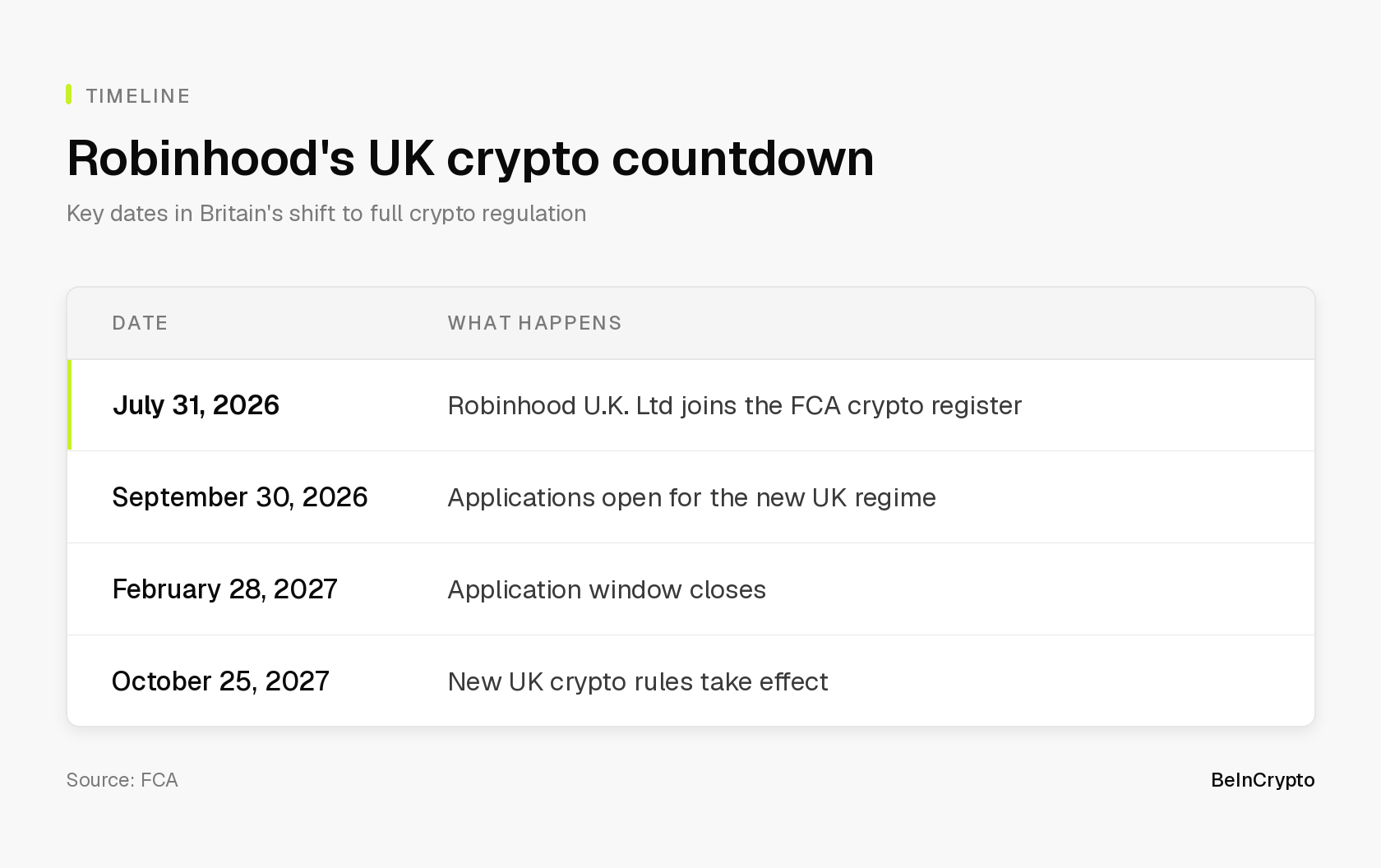
Robinhood Markets won UK crypto approval on July 31. The surprise is everything the approval does not allow.
The Financial Conduct Authority (FCA) added Robinhood U.K. Ltd to its crypto register. The company may pass customer orders to other firms. It cannot hold anyone’s coins.
What the FCA actually approved
Robinhood has been an FCA-approved stockbroker in Britain since August 2019. Crypto is new ground. The regulator added it to the crypto register on July 31, 2026.
Two limits took effect the same day, with the first one mattering most:
- Robinhood UK may only arrange crypto trades.
In plain terms, it takes your order and hands it to someone else to finish.
UK crypto rules cover two other jobs. One is running an exchange. The other is holding coins for customers. Robinhood got neither.
- The second limit bans crypto cash machines unless the FCA agrees in writing.
The register also says the firm cannot hold client money. Even this much is hard to win. FCA figures show 291 firms applied between January 2020 and October 2022. Only 38 made the register. Another 155 gave up before a decision.
One point matters for customers. Being on the register is not a safety net. The FCA warns that crypto services are unlikely to be protected if something goes wrong.
Britain’s compensation scheme rarely covers crypto losses. The financial ombudsman usually cannot help either.
Rivals Got There First, With More Freedom
Robinhood is late. The register opened in 2020.
Kraken’s UK arm, Coinbase, and Revolut are all on it. Several also hold e-money licences, which let them handle customer cash. Robinhood UK does not.
It already owns one company on the list. Bitstamp UK Ltd joined years earlier, and Robinhood bought its parent for $224 million in June 2025.
That makes Bitstamp the obvious place for UK orders to land.
Robinhood has also tried and failed here before. It agreed to buy British crypto app Ziglu in April 2022. Ten months later it walked away. The $12 million it had already sent Ziglu was written off.
So the new approval looks like housekeeping rather than a launch. Robinhood told investors in July it plans to start UK crypto soon.
Its own small print still says UK customers get no crypto trading or custody. Elsewhere the company keeps building, including its Robinhood Chain public testnet.
Why October 2027 Decides What Survives
This approval is temporary. Tougher UK crypto rules start on October 25, 2027.
Every firm on today’s register must apply again. Nothing carries over.

The window is five months long. Firms that miss it must stop most crypto work. The FCA has warned that today’s registration counts for nothing at that stage.
That deadline has driven Britain’s crypto policy debate all year, alongside UK stablecoin payment plans.
For investors, any reward is years away. Crypto revenue fell 38% to $100 million in Robinhood’s second quarter. Total revenue still hit a record $1.31 billion.
The market shrugged on Monday. HOOD closed Friday at $86.56, then traded at $87.22 before the bell, up 0.76%. Its 52-week high is $153.86.

The real test comes with that 2027 application. Robinhood sells trading, custody, and staking across Europe. An arranging license supports none of it.
What the company asks for will show how serious it is about Britain.
The post Robinhood Cleared for UK Crypto, But There Are Major Limits appeared first on BeInCrypto.
Crypto World
Solo Bitcoin (BTC) miner nets $200,000 as Coldcard wallet hack rocks sentiment: Crypto Daily


A solo miner scored a major win even as the broader market frets over a multimillion-dollar Coldcard hardware wallet exploit.
According to mempool data, an independent miner successfully packaged block 960,804 early Monday. The block reward of 3.157 BTC is valued at approximately $199,300. Details on the specific hardware used remain unknown.
The success came just three weeks after another solo miner, running a single hobbyist-grade Bitaxe device, struck block 957,382, pocketing 3.1382 BTC, worth roughly $200,000 at the time.
These back-to-back wins highlight a broader trend. Solo miners have already claimed 13 blocks this year. While individual operators continue to defy the odds with relatively modest setups, the wider Bitcoin mining sector has come under stress due to tight margins. That has prompted several large mining companies to pivot toward artificial intelligence data centers and related infrastructure in search of sustainability.
Meanwhile, small BTC holders continue to express frustration over the Coldcard incident, which has led to the loss of long-held Bitcoin savings. Over the weekend, onchain data showed signs of some BTC holders moving millions of dollars worth of coins to exchanges.
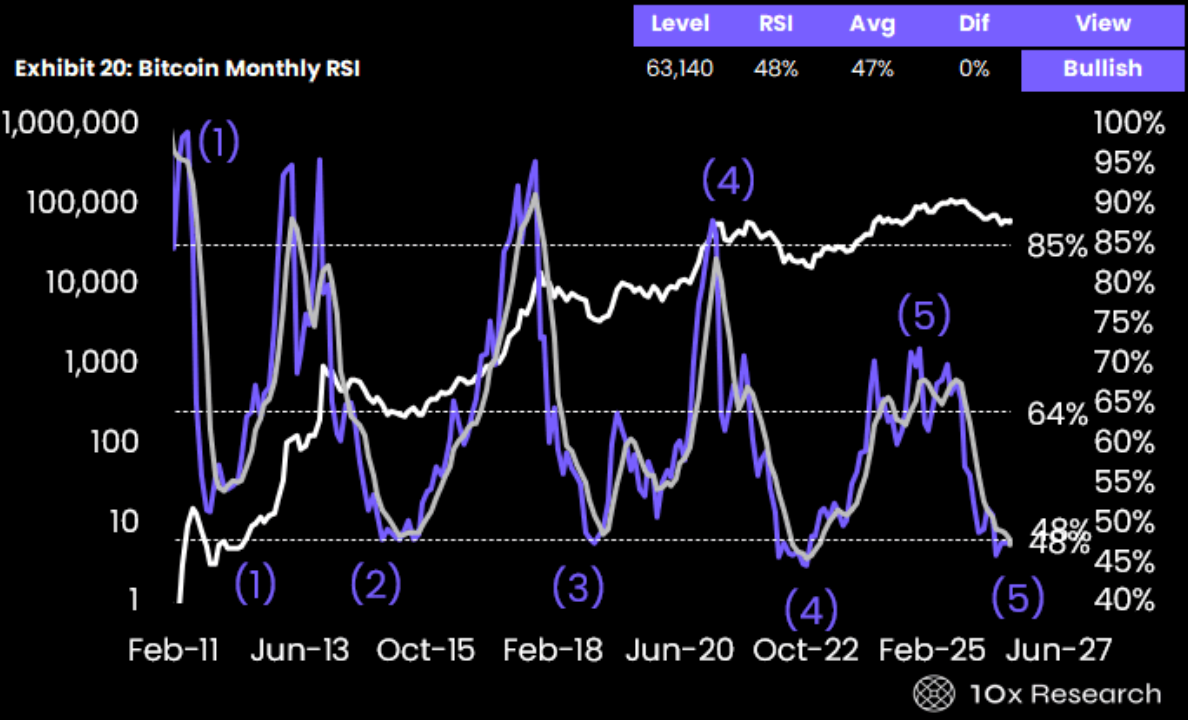
Bitcoin could confirm a bear-market bottom in August with a monthly close above $63,000, according to 10x Research.
Markus Thielen, founder of 10x Research, said in a Monday report shared with Cointelegraph that Bitcoin closed July below the threshold needed to confirm a technical bottom.
A monthly close near $63,000 would turn several of 10x Research’s cycle indicators bullish. Bitcoin was trading at $63,140 when the analysis was prepared, meaning a relatively small gain from July’s closing level could trigger the reversal signal. The company said it continued to favor long positions but would shift to a neutral stance if Bitcoin broke key support levels and moving averages.
The base case is that the Federal Reserve holds interest rates steady. However, further increases in the 10-year Treasury yield could force a September rate hike, while the Iran conflict remained an unpredictable risk.
The report said miners could generate roughly 100,000 BTC of selling pressure as some miners shift their businesses toward artificial intelligence. The company said it expected additional supply from Bitcoin treasury companies unwinding positions, though it described macroeconomic conditions as the larger risk to the market.
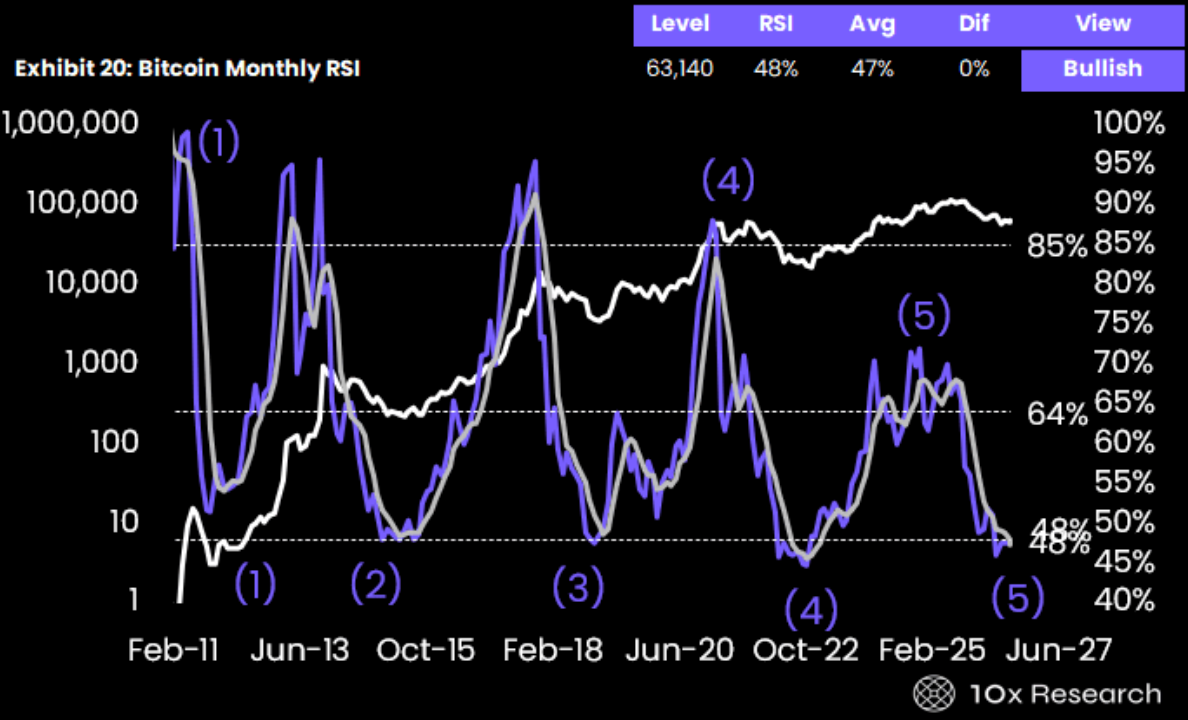
Bitcoin monthly relative strength index (RSI) chart. Source: 10x Research
Separately, Grayscale head of research Zach Pandl said in a July 22 report that Bitcoin may have bottomed earlier than the traditional four-year cycle would suggest. That pattern would place the cycle low in September or October.
Pandl said macroeconomic conditions, including Fed policy, would remain the primary drivers of Bitcoin’s price and could determine when it bottoms.
Related: Strategy-led group pledges $15M to quantum-proof Bitcoin network
More indicators point to an approaching Bitcoin bottom
Earlier in July, crypto brokerage K33 said more than half of Bitcoin’s supply was held at a loss, which it described as another indication that a market bottom was approaching.
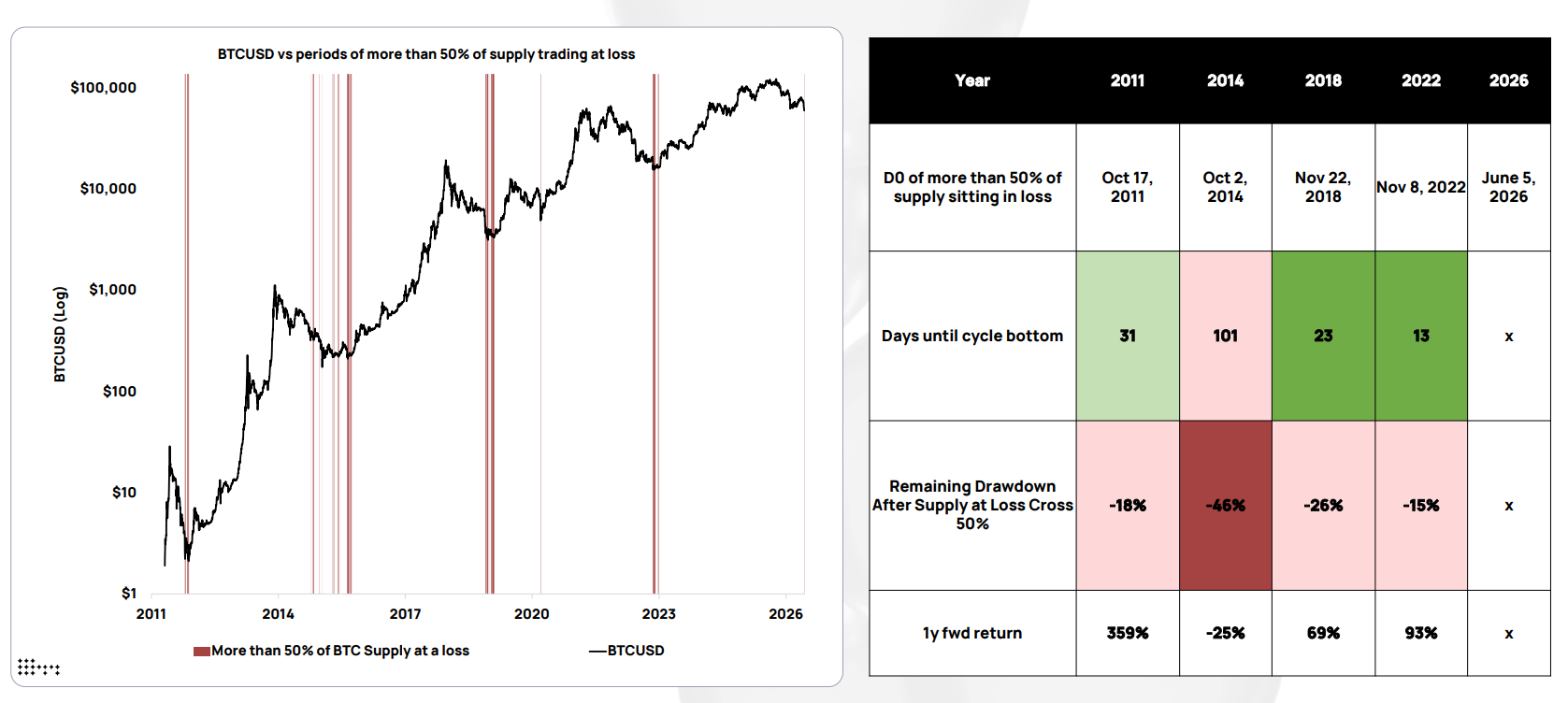
Bitcoin during periods when 50% of supply was held at a loss, with subsequent annual returns. Source: K33
Bitcoin bottomed within 13 to 31 days of the same threshold being reached in 2017, 2018 and 2022, according to K33.
In a June interview, Swan Bitcoin CEO Cory Klippsten told Cointelegraph that long-term holders’ record balance of 14.7 million BTC was another indication that Bitcoin was nearing a bottom.
Magazine: ‘Bitcoin Standard’ author explores reality where decentralized gold stopped WWI
Crypto World
Brent Analysis: Oil Retreats from $100 as Saudi Arabia Proposes Maritime Coalition Initiative
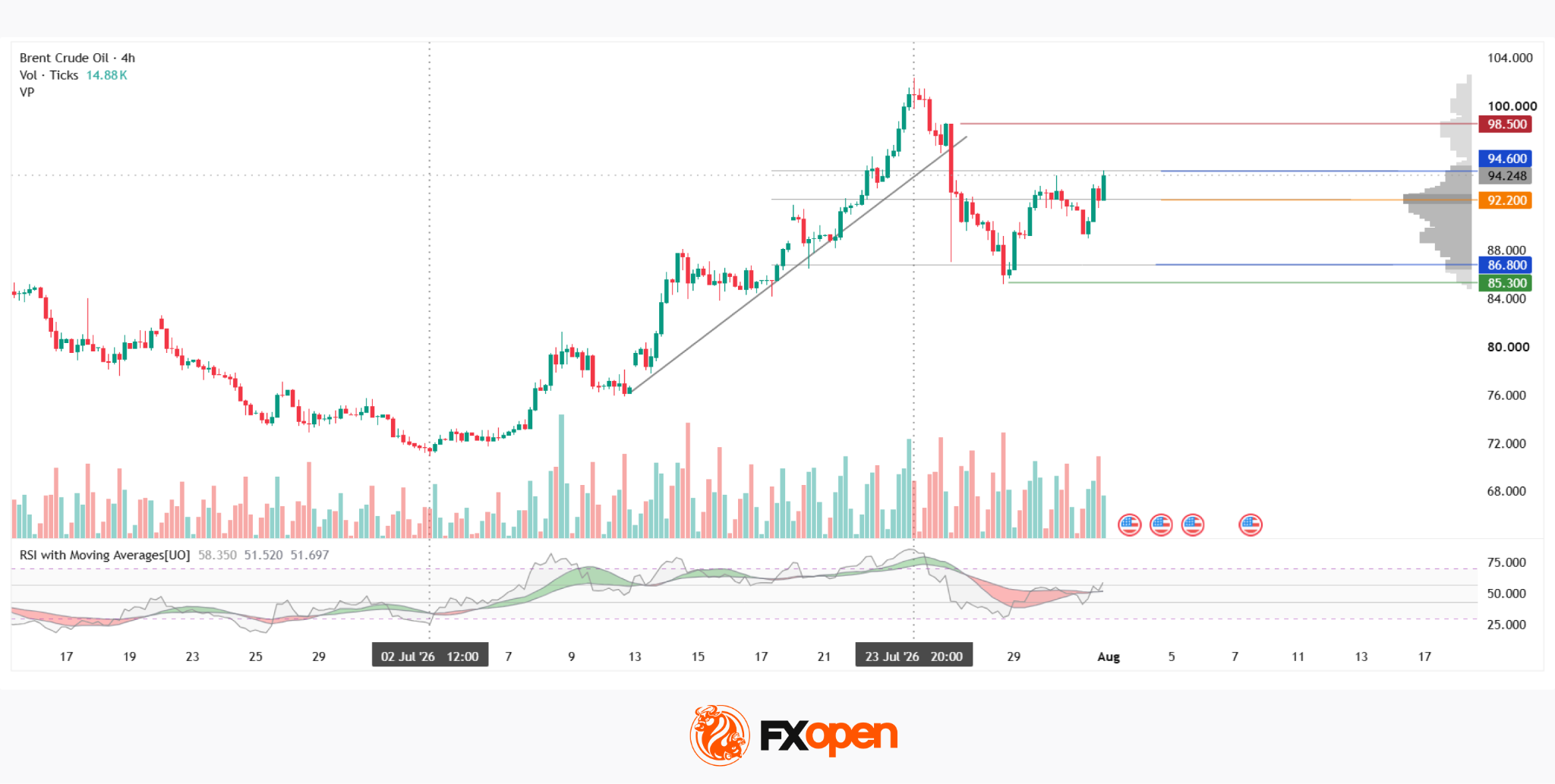
On 23 July 2026, Brent crude rose above $100 amid reports of attacks on tankers and infrastructure in the Red Sea area, as well as strong statements from Donald Trump towards Iran over threats to shipping security through the Strait of Hormuz. The move proved short-lived: on 30 July, Saudi Arabia proposed creating a maritime coalition to protect key shipping routes amid the ongoing confrontation between the US and Iran. According to CNBC data from 31 July, tanker traffic through the Strait of Hormuz partially resumed, although the Islamic Revolutionary Guard Corps claimed attacks on vessels under US escort — claims that have not been confirmed by Western maritime authorities.
Technical Analysis of Brent Crude Oil
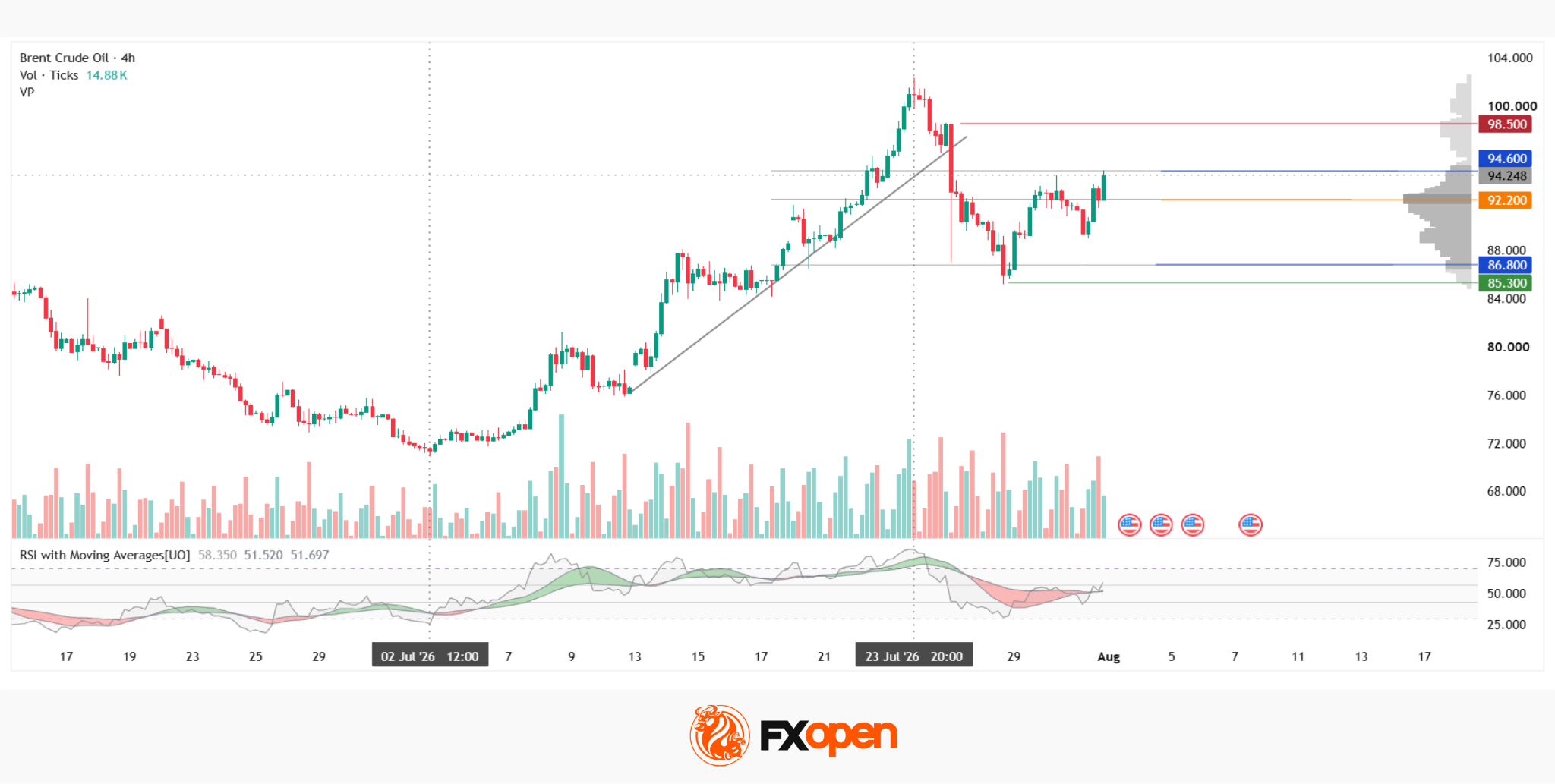
On the four-hour XBRUSD chart, the asset formed a short-term trend from the beginning of July, moving from around $71 towards the $102 area. The trendline was then broken, after which the current market profile was formed, within which the price is currently trading. The asset is now positioned between the POC (Point of Control) zone at $92.20 and the upper boundary of the profile at $94.60. A breakout above this boundary could open the way towards the red resistance level at $98.50.
If the price moves below the POC zone, the next area of interest would be the cluster of two important levels: the lower profile boundary at $86.80 and the green support level at $85.30. The RSI + MAs indicator shows readings of 58, 51 and 51, with all oscillator values returning to the neutral zone after a period of elevated volatility. Trading volume remains relatively high, confirming continued market interest from participants.
Summary
Saudi Arabia’s initiative to create a maritime coalition could gradually reduce the geopolitical risk premium priced into oil if diplomatic efforts continue to make progress. However, unconfirmed reports of incidents in the Strait of Hormuz continue to leave room for increased volatility. The neutral positioning of the RSI + MAs indicators currently suggests that there is no clear directional momentum.
Start trading commodity CFDs with tight spreads (additional fees may apply). Open your trading account now or learn more about trading commodity CFDs with FXOpen.
This article represents the opinion of the Companies operating under the FXOpen brand only. It is not to be construed as an offer, solicitation, or recommendation with respect to products and services provided by the Companies operating under the FXOpen brand, nor is it to be considered financial advice.


Bitget has begun withdrawing services for residents of Japan, stopping new account registrations immediately and setting a timeline that will lead to mandatory account restrictions later this year.
Summary
- Bitget has stopped new registrations from Japan and will begin restricting resident accounts from Nov. 1.
- Users who believe they were wrongly classified as Japan residents must complete address verification before the deadline.
- Japan’s regulators had repeatedly warned Bitget over providing services without local registration before the exchange announced its exit.
- The move follows Bitget’s recent practice of limiting access in markets where it does not hold the required local authorization.
Bitget announced on Monday that it has stopped accepting new registrations from residents of Japan and will begin applying account restrictions from Nov. 1 as it exits the market. The exchange also said any positions that remain open on Dec. 31 will be closed automatically as part of the withdrawal process.
Under the plan, users who believe they have been mistakenly identified as residents of Japan must complete Level 2 identity verification, including address verification, before Nov. 1. Bitget said accounts that fail to complete the process by the deadline will continue to be classified as belonging to residents of Japan and will become subject to the restrictions.
Users affected by the changes will receive further instructions by email explaining the required procedures and available options for managing or withdrawing their assets, according to the announcement.
Japan action follows repeated regulatory warnings
The latest decision comes after several warnings issued by Japanese regulators over the past few years.
Japan’s Financial Services Agency first warned Bitget in March 2023 for allegedly offering cryptocurrency services to Japanese residents without registration. The regulator repeated that warning in November 2024, again stating that the exchange had continued operating without obtaining the required authorization.
Regulatory scrutiny continued in June 2025 when the Kanto Local Finance Bureau, a regional bureau of Japan’s Ministry of Finance, issued a separate warning to BTG Technology Holdings Limited. The bureau said the company, which it identified as operating under the Bitget name, had solicited online over-the-counter derivatives transactions without registration.
Rather than announcing plans to seek local authorization in Japan, Bitget has now outlined a timetable for ending services to residents, with new registrations already closed and existing accounts moving toward phased restrictions.
Bitget continues separating markets under local rules
The Japan withdrawal follows a pattern that Bitget has adopted across several jurisdictions, where product availability depends on local regulatory status instead of a single global operating model.
In July, the exchange formally stated that it is not licensed, approved, registered or supervised by the Monetary Authority of Singapore. Bitget also confirmed Singapore remains a prohibited jurisdiction under its terms of use, saying it neither offers nor targets its services to residents there while restricting platform access from the country.
At the same time, Bitget has continued seeking registrations and approvals in markets where it intends to operate. Last month, the company completed registration on New Zealand’s Financial Service Providers Register across several financial service categories and joined the country’s Insurance and Financial Services Ombudsman dispute resolution scheme.
However, New Zealand’s Companies Office states that registration on the FSPR does not by itself represent government approval or active regulatory supervision. Certain financial activities may still require separate authorization from the Financial Markets Authority or the Reserve Bank of New Zealand.
Commenting on the company’s regulatory strategy in previous statements, Bitget CEO Gracy Chen said the exchange would continue pursuing local regulatory requirements as it expands internationally.
Expansion plans continue outside restricted jurisdictions
While reducing access in markets where it lacks local authorization, Bitget has continued preparing for expansion elsewhere.
As previously reported by crypto.news, the company plans to establish a separate U.S. entity before launching services in the country. According to her comments, Bitget intends to secure money-transmitter, broker-dealer and derivatives approvals before entering the U.S. market, regardless of whether Congress ultimately passes the CLARITY Act.
The exchange has also been expanding its tokenized investment products. Chen previously said tokenized traditional assets accounted for between 20% and 30% of Bitget’s spot trading volume during the previous quarter, while more than half of its users held both cryptocurrencies and stocks.
Ripple announced two new strategic investments as the blockchain-focused fintech seeks to expand access to tokenized financial assets on its blockchain ledger.
The company said it made strategic investments in Zilo, which provides global transfer agency asset solutions for wealth managers, and in Licuido, a tokenization solutions provider regulated by the UK Financial Conduct Authority, according to a Monday announcement.
Financial details for the investments were not provided. UK-based Zilo has raised $58.7 million in total equity funding, according to data compiled by Traxcn. Licuido is also based in the UK.
Ripple expects these deals to bring regulated transfer agency, issuance, and collateral mobility to its XRP Ledger (XRPL) infrastructure.
Combining the investments aim to help Ripple address the issues tied to idle collateral by enabling tokenized funds to be used as collateral from the point of issuance. The announcement came a week after London-based asset manager Aviva Investors launched a tokenized share class of its US Dollar Liquidity Fund on XRPL, after receiving approval from the Central Bank of Ireland.
Last month, Ripple launched Ripple Mint, a platform that gives institutions new ways to access, mint, redeem and manage its US dollar-pegged stablecoin, Ripple USD (RLUSD).
XRPL is the 11th-largest blockchain network with $368 million in tokenized real-world assets (RWAs). Ethereum ranked first with $17.1 billion in tokenized RWAs, according to data provider RWA.xyz.
Total RWA holders increased by 50% to 1.57 million during the past 30 days, while the total value of tokenized assets rose by 1.5% to $37.3 billion.
Magazine: What NYSE’s exploration of onchain systems means for financial markets

SHANGHAI, CHINA – JUNE 29, 2026 – Chinese and foreign tourists visit historical buildings at night near the Bund in Shanghai, China on June 29, 2026. (Photo credit should read CFOTO/Future Publishing via Getty Images)
Cfoto | Future Publishing | Getty Images
China’s domestic tourism market is weakening faster than expected, clouding one of the few bright spots in the country’s sluggish consumer economy.
Hilton China said last week it now expects revenue per available room (RevPAR) to fall by low single digits this year, worse than expectations earlier this year for a flat performance. The hotel group’s RevPAR swung from 1.3% growth in the first quarter, to a 2.2% fall in the second quarter.
“The China economy is sputtering, and I mean it’s growing, but not consistent with what prior growth rates have been,” Christopher Nassetta, President and CEO of Hilton, said in the group’s earnings call on Tuesday, according to a FactSet transcript.
A weekend night in August at a Hilton resort in Dali, Yunnan province, popular with domestic Chinese tourists, runs at $173. But other options recommended on travel booking site Trip.com are less than half the price, with one around $50.
Across China, hotel RevPAR has tumbled 6% year-on-year through late July, following a 1% drop in June, according to Smith Travel Research data cited by Goldman Sachs on Tuesday. That’s after RevPAR rose mildly this spring, the data showed.
A three percentage point drop in occupancy along with a 1% decline in average daily rates versus a year ago dragged down revenue, the Goldman report indicated.
The downturn reflects how China’s post-Covid tourism boom is fading after three years, amid a broader slowdown in the economy and retail sales.
Gary Ng, senior economist at Natixis, noted that there has been a “sharp decline of per-capita spending” on tourism since the third quarter of 2025.
“While tourism is still a bright spot, [it] cannot escape this broad macro trend,” he said, adding that consumers in China increasingly seek more unique or premium experiences, amid slower wage growth.
BAOSHAN, CHINA – JUNE 04: Tourists take photos at a viewing platform overlooking coffee plantations on June 4, 2026 in Baoshan, Yunnan Province of China. Xinzhai Village in Baoshan, known as “China’s First Coffee Village,” has over 70 years of coffee planting history and offers visitors experiences including picking, processing, roasting and brewing. (Photo by Li Jiaxian/China News Service/VCG via Getty Images)
China News Service | China News Service | Getty Images
Trip.com data showed price competition was clear in the three most-popular Chinese regions for travel this summer — Shanghai, Xinjiang and Yunnan.
An August weekend stay in China can cost anywhere from 40 yuan (US$6) to 18,000 yuan (US$2,633) per night, according to a CNBC analysis of Trip.com listings.
One-night stays saw a median price of just 192 yuan (US$28) in Kashgar, Xijiang, 373 yuan (US$55) in Dali, Yunnan, and 595 yuan (US$88) in Shanghai. Although premium rooms costing thousands of yuan lifted the averages, typical prices were far lower, with inexpensive options widely available in all three destinations.
KASHGAR, CHINA – OCTOBER 10: Tourists enjoy the picturesque scenery of the Bandir Blue Lake on October 10, 2025 in Kashgar Prefecture, Xinjiang Uygur Autonomous Region of China. (Photo by Bao Gansheng/VCG via Getty Images)
Vcg | Visual China Group | Getty Images
China’s retail sales have remained sluggish since the pandemic, with spending dipping in May from a year ago. Consumer prices have likewise been subdued, with a slower-than-expected 1% rise in June from a year ago.
Reflecting a sequential decline, the travel sub-index – part of the broader consumer price index – dropped by 0.6% in June from the prior month, according to China’s National Bureau of Statistics. In accompanying commentary, chief statistician Dong Liquan also pointed to sharp price drops in hotel rates and airfares.
The foreign luxury boost
While sentiment towards the domestic tourism market remains dim, inbound travel is emerging as a source of hope for the industry.
Thanks to China’s policy of allowing in travelers visa free from a growing number of countries, including in Europe, visitors from economies with far higher per capita income than China‘s are coming.
Upscale U.S. hotel operator Hyatt on Thursday reported an 18% increase in U.S. visitors into China, and 24% from Europe in the past quarter.
This premium end of the market offers a far brighter picture than the rest of the industry.
“China luxury properties were up 11% this past quarter in China. Lot of it’s leisure. So China is on fire,” Mark Hoplamazian, Hyatt president and CEO, said on the earnings call, according to a FactSet transcript.
Hyatt’s Greater China RevPAR rose 7.2% year-on-year in the second quarter, as Hoplamazian cited “leisure luxury” as a key driver.
Inbound travelers offer modest support for China’s tourism market. Overseas visitors account for 12% to 13% of total tourism spending, according to Natixis estimates.


Two French crypto investors have been held captive in London for more than 52 hours in a kidnapping and extortion case that ended with five men convicted after the victims were forced to transfer $30,000 in cryptocurrency.
Summary
- Five men were convicted after two French crypto investors were held captive in London for more than 52 hours and forced to transfer $30,000 in cryptocurrency.
- Prosecutors said the victims were tortured and threatened during the ordeal, while the alleged mastermind remains at large.
- Police rescued the victims after tracing a forgotten mobile phone and arrested several suspects following a high speed chase.
The Daily Mail, citing proceedings at Inner London Crown Court, reported that the two French cryptocurrency investors, both in their 20s, were abducted while visiting London and subjected to more than two days of confinement, violence and threats before officers from the Metropolitan Police’s Flying Squad rescued them.
Prosecutors told the court the victims’ lavish lifestyle, much of it documented on social media, may have drawn the attention of the group behind the attack. The prosecution argued that their public online presence made them attractive targets for criminals looking to extort digital assets.
Convictions follow London crypto kidnapping
A jury found Gerson Borges and Mohamed Osman guilty of conspiracy to blackmail and false imprisonment, while Julius George, Isaac Bakoya and William Adebisi were convicted of false imprisonment. The defendants were cleared of kidnapping, possessing an imitation firearm and sexual assault charges.
Court proceedings also identified Ibrahim Mohamed, known as “Nino,” as the alleged organizer of the operation. Prosecutors said he directed members of the group from overseas through WhatsApp and Snapchat and remains at large.
One of the victims alleged that he had been sexually assaulted during the ordeal. The jury acquitted the defendants on those allegations, but UK reporting restrictions prevent identification of two defendants because of laws protecting alleged victims in sexual offence cases.
Victims said torture was used to force crypto transfers
According to evidence presented in court, the victims traveled from France to London and were staying in Kensington before arranging to buy cannabis in east London.
After leaving their rented Mercedes in Shadwell, prosecutors said they were confronted by three masked men carrying a gun and a knife before being forced back into the vehicle and driven to an apartment in Canning Town.
The victims told investigators they were held inside the flat for about 52 hours. During that time, they said they were stripped naked, bound with tape and cable ties, beaten, burned with cigarettes and scalded with boiling water, including on their genitals.
Prosecutors said the gang also threatened to mutilate them, force them into sexual acts and attack one victim’s girlfriend unless they handed over cryptocurrency.
The court heard the group initially demanded $150,000 in crypto. The victims ultimately transferred about $30,000 before the attackers concluded no more funds were immediately available.
Evidence presented during the trial stated that one victim was released, while the second remained captive. In a recorded police interview played to jurors, the remaining victim said he believed he had been “sold” to another criminal group that intended to continue the extortion.
The victims also described harsh treatment during their confinement. Court testimony stated they received only one spicy chicken wing from a KFC meal while members of the gang ate the remaining food. One victim also alleged he was forced to drink toilet water.
Police tracked the gang through a forgotten phone
The prosecution said the investigation turned after a friend who had traveled with the victims escaped during the ambush.
Although he was pulled from the Mercedes by the attackers, his mobile phone remained inside the vehicle without the gang noticing. After reaching a McDonald’s in Earl’s Court, he persuaded a security guard to call emergency services.
Using the phone’s location together with CCTV footage, officers from the Metropolitan Police’s Flying Squad identified the location where the victims were being held.
Police intercepted the suspects after a vehicle pursuit through residential London streets that reportedly reached speeds of about 70 mph.
When officers rescued one of the victims from the suspects’ car, prosecutors said his hands were still tied and visible cigarette burns covered parts of his face, including his forehead and cheek.
The victims later declined to testify in person during the trial, telling the court they remained afraid of the group after the attack.
Crypto kidnapping cases continue to draw attention
The London convictions add to a series of violent crimes targeting cryptocurrency holders, with criminals increasingly relying on physical coercion rather than online attacks to steal digital assets.
Earlier this year, two Texas brothers pleaded guilty in a U.S. federal case after admitting to holding a Minnesota family at gunpoint for more than eight hours and forcing the transfer of more than $8 million in cryptocurrency. Investigators later traced the suspects using physical evidence, rental records and surveillance footage.
Security researchers commonly describe such incidents as “wrench attacks,” where victims are threatened or assaulted to surrender access to digital assets instead of having their wallets hacked remotely.
France has also experienced a rise in crypto-linked violent crime. Interior Minister Laurent Nuñez said on June 30 that authorities had recorded 77 cases involving kidnapping, unlawful detention, extortion or attempted offences connected to the crypto sector in 2026, compared with 45 cases during 2025.
Nuñez said around 200 people had been arrested following attacks or preventive operations, while the government has expanded cooperation between law enforcement agencies and the country’s digital asset industry. French officials have also warned that organized criminal groups increasingly target individuals whose crypto wealth is visible through social media or public activity.
The circumstances described by prosecutors in the London case closely match that pattern, with the court hearing that the victims’ online display of wealth may have contributed to them being selected by the gang.
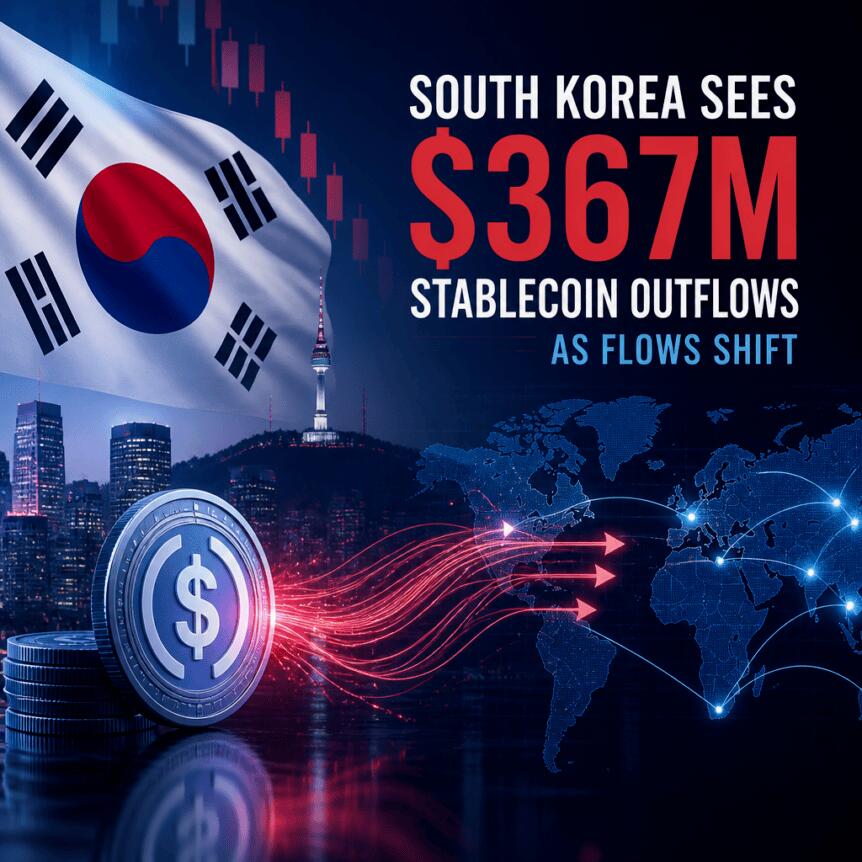
Stablecoin transfers from South Korea to overseas crypto platforms surged again in June, underscoring how much demand from local users continues to flow outside domestic rails. According to Financial Supervisory Service (FSS) data cited by Yonhap News Agency, South Korea recorded stablecoin outflows of 560.3 billion won (about $367 million) to foreign exchanges—marking an 18-month streak of net outflows.
The same FSS data, obtained by People Power Party lawmaker Lee Jong-wook, points to a large volume of cross-border movement through the country’s five major exchanges: Upbit, Bithumb, Coinone, Korbit and Gopax. In June, these platforms transferred 2.7 trillion won (about $1.81 billion) in stablecoins offshore while receiving 2.2 trillion won (about $1.44 billion) from foreign platforms.
Key takeaways
- South Korea’s stablecoin outflows hit 560.3 billion won in June, extending a net outflow streak to 18 straight months.
- The FSS figures cited by Yonhap show South Korean exchanges both exported and imported large stablecoin volumes in June, with exports exceeding imports.
- Yonhap market participants linked the outflows to overseas products that may be restricted or unavailable domestically, including derivatives and certain DeFi and staking offerings.
- Lawmakers and regulators are reviewing investor protection and cross-border supervision as authorities seek to finalize a broader digital-asset framework.
- Regulatory discussions also include expanding crypto transfer reporting and tightening scrutiny of unregistered overseas exchanges.
Why stablecoins are leaving: availability and product access
In commentary collected by Yonhap, market participants attributed the cross-border stablecoin transfers to practical access differences between local and offshore venues. They pointed to demand for products that are either restricted or unavailable on South Korean exchanges, such as overseas derivatives, tokenized real-world assets (RWAs), and various decentralized finance (DeFi) and staking products.
That framing matters because it suggests the outflows aren’t simply about holding stablecoins abroad—they’re tied to the ability to deploy them in specific strategies. If domestic platforms cannot offer comparable products under current rules, users may prefer the regulatory and product availability advantages of offshore exchanges.
Investor protection concerns rise as outflows persist
Lawmaker Lee Jong-wook used the June figures to argue that South Korea needs to re-examine how it safeguards investors across borders. As reported by The Korea Times, Lee called on the government to “comprehensively examine its investor protection and supervisory frameworks again and move swiftly to improve regulations.”
The core concern is that stablecoin users may be exposed to risks that aren’t fully addressed by domestic oversight once funds move to jurisdictions with different licensing and supervision standards. The persistent nature of the outflows—net outflows for 18 months—also increases pressure on policymakers to ensure the new regulatory framework can address the real-world behavior of market participants, not just domestic activity.
Policy work continues: phased stablecoin rules and a new digital-asset framework
The latest outflow data arrives as South Korea continues building a broader legal structure for digital assets. A policy report released this week recommended that authorities introduce interim licensing guidance and phase in stablecoin regulation before the Digital Asset Basic Act is finalized, according to earlier coverage on Cointelegraph.
If enacted, the proposed act would be South Korea’s first comprehensive digital asset framework, covering areas such as stablecoin issuance, required disclosures, and rules governing market activities. However, the reporting also highlighted that lawmakers are still negotiating how the framework should work in practice—particularly which institutions should be permitted to issue won-pegged stablecoins. Disagreements on that point have contributed to delays, leaving a window where the regulatory environment may still be incomplete for some market participants.
For users and investors, the uncertainty has direct implications: when licensing, issuance rules, and market-activity requirements are not fully aligned, offshore venues can remain more attractive—especially if they already support the products users want.
Reporting expansion and tighter scrutiny of offshore venues
Beyond stablecoin-specific rules, South Korea’s regulators are also targeting cross-border compliance. Cointelegraph previously reported that the Financial Intelligence Unit (FIU) sought to broaden reporting requirements for crypto transfers. On June 22, the FIU proposed extending Travel Rule reporting requirements to transactions below 1 million won (roughly $650).
The FIU also urged stronger enforcement against unregistered overseas exchanges serving South Koreans. The agency argued that uneven licensing and supervision across jurisdictions can create opportunities for regulatory arbitrage—effectively allowing users to route activity to less constrained environments.
That enforcement argument dovetails with the persistent outflow trend. If domestic supervision tightens while offshore compliance remains uneven, policymakers may expect some shift back toward regulated channels. But the data cited by Yonhap suggests the decision to move stablecoins offshore is also driven by product access; enforcement alone may not be enough if users still perceive offshore platforms as offering functionalities they cannot obtain at home.
As South Korea moves toward interim licensing and broader stablecoin regulation ahead of the Digital Asset Basic Act, investors and market participants should watch for two things: whether the promised phased approach closes gaps that currently push activity offshore, and whether expanded Travel Rule reporting and offshore enforcement meaningfully reduce regulatory arbitrage without constraining legitimate domestic market development.

Yahya Abdul-Mateen Reacts As Marvel Pulls Plug On ‘Wonder Man’

What happens to pupils’ Welsh after they leave school?

Morningstar: Undervalued With A Differentiated Business Model (NASDAQ:MORN)


-

 Business5 days ago
Why Trees Belong on the Risk Register
-

 Fashion3 days ago
Weekend Open Thread: Wit & Wisdom
-

 Politics3 days ago
Meta enters AI-training agreement with far-right ‘propaganda rag’ Newsmax
-
 Entertainment6 days ago
‘Stargate’ Creator’s New Sci-Fi Series Returns for Season 3 Tomorrow
-

 Crypto World2 days ago
MicroStrategy Post-Earnings CLARITY Act Push Could Add New Catalyst for Its Stock
-

 Politics6 days ago
The Part of the Electric Transition Nobody Wants to Discuss
-

 Business5 days ago
Major shareholder moves on Canyon
-

 Crypto World2 days ago
XRP Ledger v3.3.0 brings five institutional features
-

 News Videos4 days ago
Bitcoin Enters the 3rd Stage of the Bear Market
-

 Crypto World6 days ago
Kraken Enables Retail Access to Jersey Mike’s IPO via Tokenized Shares
-

 Tech6 days ago
New macOS Sequoia & Sonoma security updates for older Macs
-

 Politics4 days ago
Luke Littler’s dominance sparks GOAT debate
-

 News Videos6 days ago
Claude: Build Financial Dashboards in Minutes (2026)
-

 Business6 days ago
Johnson & Johnson agrees to $5.5B settlement over talc cancer claims
-

 Sports3 days ago
Seema Kaliramna Wins Discus Throw Bronze, Takes India’s CWG Medals Tally To 17
-

 Crypto World1 day ago
Crypto PAC spending tops $2M in Michigan House race
-

 Business3 days ago
Trump Announces Hamas Disarmament Agreement as Iran Strikes Kuwait Air Base and US Attacks Pause Overnight
-

 Tech5 days ago
Gemini can now summarize the messiest comment threads in Google Docs
-

 Tech1 day ago
ESET tracks rise in malicious AI skills and adaptable malware
-

 News Videos5 days ago
LIVE: XRP BULL RUN CONFIRMED! Donald Trump & Brad Garlinghouse Discuss Ripple
You must be logged in to post a comment Login