
Crypto World
Top Democrats Slam Trump Over Crypto Engagement


Bitcoin price remains constructive as it trades around $62,000 to $63,000, while Trump and crypto legislation continue to shape market expectations. Daily price action has been relatively calm, but developments in Washington could influence sentiment over the coming sessions. While volatility has eased, traders are watching whether policy headlines begin to outweigh macro drivers.
Five senior Senate Democrats publicly criticized President Donald Trump growing ties to the crypto industry. Elizabeth Warren, Richard Blumenthal, Gary Peters, Dick Durbin, and Ron Wyden argued that Trump’s reported crypto-related financial interests raise fresh conflict of interest concerns. They said those disclosures deserve closer scrutiny as Congress advances digital asset legislation.
Meanwhile, lawmakers are still negotiating key pieces of crypto legislation. Senate leaders have yet to release the final text of a broader market structure bill, while several policy issues remain unresolved. In the House, disagreements over unrelated measures have also slowed momentum, making the legislative timetable less certain.
Even so, markets have largely priced in expectations for regulatory progress. Investors continue watching for stablecoin legislation and a clearer market structure framework, both viewed as long-term positives for the industry. However, any meaningful delay could remove one of Bitcoin’s strongest near-term catalysts and leave prices more dependent on macroeconomic and liquidity trends.
Don’t Miss Out on Our $1,000 USDT Airdrop on ByBit
Can Bitcoin Reclaim $73,000 With Trump Crypto Headwinds Building?
Bitcoin climbed more than 6% this week, briefly trading around the $63,000 to $64,000 range before easing slightly. That leaves the recent breakout zone under the spotlight rather than in the rearview mirror. As long as buyers defend roughly $61,000 to $62,000, the trend stays constructive. Lose that area, and the market could suddenly remember where the exit is.
Market activity remains healthy, with daily crypto trading volume hovering around $80 billion. Bitcoin dominance is holding above 58%, showing that larger investors still prefer the market’s heavyweight instead of chasing every shiny new token. Meanwhile, Ethereum has outperformed on the week, while Solana continues to trade sideways, waiting for a reason to wake up.

The bullish case is straightforward. If lawmakers make tangible progress on digital asset legislation, Bitcoin could challenge the $65,000 region and test higher resistance. The market has a habit of reacting first and asking questions later when regulation turns friendlier.
The base case is less dramatic. Political wrangling could drag on without derailing the legislation, leaving Bitcoin stuck between roughly $61,000 and $65,000 for the next few weeks. It may not be exciting, but markets often spend more time catching their breath than sprinting.
The bearish scenario hinges on politics rather than charts. If bipartisan support fades and the legislation becomes another partisan battleground, sentiment could cool quickly. In that case, Bitcoin may revisit the upper $50,000s, where buyers would likely get another chance to prove they still mean business.
Discover: The Best Crypto to Diversify Your Portfolio
Maxi Doge Targets Early-Mover Upside as Bitcoin Tests Key Levels
Traders positioned in large-caps at current levels are essentially buying a policy lottery ticket, meaningful upside if the bill clears, limited near-term edge if it stalls. For traders who’ve already rotated profits from the BTC spike and are hunting asymmetric setups, the early-stage presale market is where that calculus shifts.
Maxi Doge ($MAXI) is a meme token built on Ethereum around a 240-lb canine mascot and a blunt trading philosophy, 1000x leverage mentality, gym-bro culture, and holder-only trading competitions with leaderboard rewards. It’s not trying to be infrastructure.
The presale is currently priced at $0.0002828, with $4.8 million raised to date. The project runs a dynamic APY staking mechanism, a Maxi Fund treasury for liquidity and partnerships, and a meme-first marketing engine designed to move fast in bull-market conditions.
The tagline is blunt: Never skip leg-day, never skip a pump. Research Maxi Doge here.
Discover: The Best Token Presales
The post Top Democrats Slam Trump Over Crypto Engagement appeared first on Cryptonews.

Cardano’s native token is among the best-performing cryptocurrencies (from the top 10 club) over the past week.
Its renewed momentum has naturally drawn more attention, with some market observers now projecting further gains.
The Rally Goes on?
ADA experienced a sudden and rather unexpected revival this weekend, rising to a monthly peak of around $0.19. As of this writing, it trades just south of that mark, representing a 13% increase on a seven-day scale.
The most probable catalyst for the upswing seems to be the accumulation from whales, with Ali Martinez revealing that these big investors have purchased more than 240 million tokens in just five days.
Meanwhile, X user JAVON MARKS believes that ADA’s recent performance resembles that of 2020-2021, which was followed by a massive bull run towards an ATH. That said, the analyst set a target of $2.90, which is currently 1,300% away.
Leon Voss Official also chipped in, claiming that ADA has broken above a long-term descending trendline that had acted as persistent resistance.
“Daily candle comes on stronger side and now obvious touch the support for further confirmation to hold above $0.17. That’s connected to Cardano TVL surge by some +9% over the past week, reclaiming a level of nearly $68 million,” the X user added.
For their part, Crypto Tony said they will look for a short position upon a potential rejection of the recent rally or go long if the price flips the $0.22 zone.
Entering a Dangerous Territory
ADA’s pump is more than evident, yet one should keep in mind the unfavorable condition of the broader crypto market, meaning the bears can regain control at any time and quickly erase the gains.
The Relative Strength Index (RSI) should serve as another warning. Its ratio briefly spiked above 80, easing back to 65, which still keeps it hovering near overbought territory and signals a potential short-term correction.

The post Cardano (ADA) Could Explode to Almost $3 if History Repeats: Analyst appeared first on CryptoPotato.

A Contemporary Services Corporation (CSC) now hiring flyer is displayed for job opportunities as an event security guard at an Inspire Together job and resource fair in Los Angeles, California on July 29, 2026.
Patrick T. Fallon | Afp | Getty Images
The Bureau of Labor Statistics is set to release the employment picture for July on Friday, and economists are expecting a gain of 85,000 jobs in the month, according to Dow Jones consensus estimates.
However, traders on prediction market platform Kalshi think those figures may come in lower.
Speculators place just a 47% chance that employers added more than 80,000 jobs in July, but they also give a 60% chance that they added more than 70,000 jobs in the month.
The contracts on the platform ask traders what the jobs number will be for July, asking if the official figure will be above a series of numbers. Contracts are resolved using the official data from the Bureau of Labor Statistics.
A beat compared with consensus estimates isn’t out of the question, even if not likely: traders place a 41% chance employers added 90,000 jobs in July, and just over a one-in-three chance that the number will come in at six figures.
However, traders also think there’s a one-in-three chance the number will come in below 60,000.
Last month, Kalshi traders placed a 63% chance that employers added more than 125,000 jobs in June, above consensus estimates for 115,000. However, the official figure came in much lower, at just 57,000 jobs added.
Disclosure: CNBC and Kalshi have a commercial relationship that includes customer acquisition and a minority investment.

Fake World Assets (FWAs) have reignited attention on Ethereum’s onchain “gacha” niche—an NFT-based system where users pay to spin for randomly selected collectibles. In just days after launch, the protocol reportedly became a top Ethereum gas consumer by fees, underscoring how quickly gamified mechanics can draw speculative participation.
According to DeFiLlama, FWAs briefly ranked as Ethereum’s largest gas consumer over a 24-hour window in late July, with peak daily fees of about $1.53 million on July 25. The project’s token incentive program and the broader appeal of lottery-like gameplay helped drive rapid traction, though skepticism from some market participants suggests much of the current demand may be incentive-driven.
Key takeaways
- Ethereum activity spiked fast: DeFiLlama data shows FWAs briefly became one of Ethereum’s biggest fee consumers by blockspace usage within days of launch.
- Strong early liquidity metrics: Total value locked (TVL) reportedly climbed above $6.15 million by July 31, indicating more than a purely ephemeral burst of interest.
- Fees have normalized after the initial frenzy: Fee revenue eased to roughly $350,000 per day by the latest figures cited in the reporting.
- Demand may be tied to incentives: Investor Simon Dedic argues current participation could be largely fueled by token rewards rather than sustained end-user desire.
- The core bet is on retention: The “real test” for onchain gacha, as framed by critics, will come once incentives fade and novelty wears off.
FWAs surge: from launch to Ethereum gas leader
FWAs are built around an onchain lottery mechanic that trades random NFT outcomes for player participation. Within four days of launch, the protocol reportedly consumed enough Ethereum gas to briefly top the chain’s gas usage rankings by fees over a 24-hour period, according to DeFiLlama.
At the height of the early activity—July 25—FWAs generated about $1.53 million in daily fees, briefly overtaking major stablecoin issuers’ associated onchain activity in the same fee-consumption comparisons. The project’s creators, TokenWorks, publicly celebrated the protocol’s rapid arrival, posting that it had reached a major milestone just days after launch.
While growth appears to have slowed from the peak, the scale remains notable. TVL reportedly rose to more than $6.15 million by July 31. Fee revenue was cited as easing to around $350,000 per day, which implies an annualized run rate of roughly $268 million based on the figures referenced.
How the onchain gacha works
At its core, Fake World Assets uses NFTs as the prize pool. Users pay to interact with an onchain “gacha” machine that selects a randomly chosen NFT backed by Ether. Instead of purchasing a specific NFT directly, participants buy the right to spin and potentially receive one of many collectibles.
TokenWorks has positioned FWAs as part of the broader onchain gacha evolution. The system is described as “latest” within Ethereum-based protocol experiments that apply randomness and game-like purchasing behavior to tokenized collectibles. The prize catalog, as reported, draws from multiple recognizable collections, including CryptoPunks, Azuki, Lil Pudgys, and Art Blocks.
Those who hold NFTs can also participate in the protocol differently: NFT holders are described as liquidity providers who deposit collectibles alongside ETH and receive a share of protocol fees while their NFT remains in the pool. Players, meanwhile, purchase spins for the chance to receive a random NFT and then decide whether to keep the prize or redeem most of its attached ETH value.
Blockworks Research is referenced in the source reporting for an additional detail: around 70% of purchasers allegedly choose to convert their winnings to FWA rather than keeping the received asset, suggesting the system is currently functioning as much like an ETH-linked bet as it is a pure collectible acquisition.
Supporters see gamified commerce; critics worry about incentives
Not everyone is convinced that FWAs represent durable demand. Simon Dedic, founder of Moonrock Capital and an early backer of onchain collectible platforms, expressed enthusiasm for gamified commerce while singling out specific concerns about FWA’s current appeal.
Dedic’s skepticism centers on whether participation reflects genuine consumer interest or is mainly driven by token incentives. In the remarks cited, he characterized the activity as targeted at “crypto degens” seeking to gamble and speculate—an important distinction because incentive-led engagement can diminish quickly once rewards decline.
Other participants and commentators in the reporting highlight the novelty of the combined roles inside the mechanism. The protocol blends player behavior (seeking a favorable random outcome) with “house” behavior (earning fees as an NFT liquidity provider), which some see as a more engaging primitive than simple onchain lotteries or typical NFT marketplaces.
Still, the source framing makes clear that the sustainability question is unresolved. Dedic argues that the industry may be moving toward more gamified shopping behavior as Gen Z’s purchasing power grows, but he also notes a preference for selling assets people actually want—such as widely demanded collectibles—rather than forcing interest through rewards for assets that have little independent pull.
The retention test: novelty vs. real utility
Even if FWAs can keep drawing transaction volume, the long-term question is whether the protocol can continue without strong incentive support. The early numbers—high peak fees, rising TVL, and significant early volume and purchase counts mentioned in the source—suggest there is real attention and a willingness to pay for the mechanic.
However, “hype” can be measured in weeks, not months. If users continue spinning even after incentives taper off, that would indicate the system has found something closer to a retail use case. If activity drops sharply once token rewards lessen, FWAs may follow the pattern of other short-lived crypto experiments that attract bursts of attention but fail to convert them into durable user demand.
What makes the outcome particularly relevant for the broader market is that onchain gacha is part of a wider trend: tokenized versions of familiar collectibles and randomized purchase mechanics. If FWAs demonstrate sustained retention, they could strengthen the case that gamified retail primitives can coexist with token liquidity models. If they fail, it may reinforce the view that the current wave is mostly speculation riding on incentives.
For now, readers should watch how fee generation and participation evolve as token incentives change, and whether a majority of users keep engaging for the collectible mechanic itself rather than primarily for conversion to incentive-linked rewards.


Circle has acquired nearly 1,000 blockchain patents from IBM, giving the USDC issuer what it describes as the largest blockchain patent portfolio in the United States.
Summary
- Circle acquired nearly 1,000 issued patents spanning more than 680 patent families.
- The portfolio covers blockchain, banking, insurance, cloud security, and enterprise infrastructure.
- Circle has not disclosed the purchase price or explained whether it could enforce the patents against competitors.
- CRCL initially gained about 2%, but later fell after Morgan Stanley cut its target to $38.
Circle takes control of IBM’s blockchain portfolio
Circle announced the acquisition on July 27, saying it had purchased core assets from IBM’s blockchain patent portfolio. The transaction covers more than 680 patent families and nearly 1,000 issued patents worldwide.
The intellectual property spans blockchain systems, financial services, banking, insurance, supply-chain verification, enterprise infrastructure, and secure cloud operations. Circle did not disclose the financial terms.
Circle said the portfolio would support USDC, the Circle Payments Network, its Arc blockchain, and tools designed for artificial intelligence agents. The two companies also plan to consider further commercial agreements.
“Intellectual property is critical to advancing our mission and expanding adoption of onchain infrastructure,” Circle General Counsel Sarah Wilson said.
Wilson added that the acquisition would expand Circle’s ability to develop infrastructure for internet-based finance.
Patent deal raises concerns over possible enforcement
Circle’s announcement did not state whether the company intends to license the patents, use them defensively, or enforce them against other blockchain businesses.
That lack of detail has prompted questions about how Circle could use its newly acquired intellectual property. In an Aug. 3 commentary, Fortune’s Jeff John Roberts warned that the patents could become legal leverage against competitors or startups.
Roberts argued that Circle could theoretically seek licensing payments, bring infringement cases, or transfer patents to separate entities that pursue enforcement. However, Circle has not announced plans to take any of those actions.
The concerns also stem from IBM’s mixed record in commercial blockchain development. IBM previously backed several enterprise blockchain projects, including supply-chain and trade-finance platforms, but many failed to achieve broad adoption.
A large patent portfolio does not necessarily indicate that the underlying products reached commercial success. Still, issued US patents can give their owner the right to restrict others from using covered inventions, subject to their validity and scope.
Circle has also not announced a public defensive patent pledge comparable to commitments used by some other digital-asset companies. Such pledges generally promise that patents will not be used offensively against developers acting in good faith.
US blockchain firms face new intellectual property risk
Circle’s position as the largest US holder of blockchain-related patents could affect companies building stablecoin, payments, interoperability, and enterprise ledger products.
The practical impact will depend on the language of individual patent claims and whether Circle chooses to enforce them. Any infringement dispute would also face review in US courts, where defendants can challenge whether a patent is valid or applies to their technology.
For Circle, the acquisition may provide protection as it expands beyond reserve income from USDC. Arc, Circle Payments Network, cross-chain services, and agent-based payment tools could expose the company to a broader set of technology competitors.
It may also strengthen Circle’s bargaining position in licensing or partnership negotiations. Still, without an enforcement policy, developers and competitors have limited visibility into whether the portfolio will function mainly as a defensive shield or a commercial asset.
CRCL falls despite initial reaction to IBM deal
Fortune reported that Circle shares rose about 2% following news of the acquisition. That gain did not hold as separate concerns about the company’s USDC business weighed on CRCL on Aug. 3.
Circle shares fell nearly 5% to around $59 after Morgan Stanley downgraded the stock to underweight and cut its price target from $106 to $38. The bank cited weaker USDC supply forecasts, pressure on reserve income, and a potential shift toward lower-margin transaction revenue.
Morgan Stanley reduced its USDC supply estimates by 33% for 2027 and 44% for 2028. The downgrade was separate from the IBM patent acquisition, although both developments reflect Circle’s attempt to establish revenue sources beyond interest earned on USDC reserves.
Investors will now watch for details on how Circle intends to integrate, license, or enforce the patents. Until the company provides those details, claims that it will use the portfolio against competitors remain speculative.

Blanche also clarified that the written order did not imply that the fund had ever been operational.
“No Members were appointed; no funds were transferred; no process for receiving claims was established; no claims were paid,” the retraction order said. “This Order establishes, beyond any doubt, that there is no Fund.”
In a joint statement Monday, Cornyn and Tillis said they were “pleased” by Blanche’s decision and “look forward to voting to advance his nomination out of the Senate Judiciary Committee soon.”
The Judiciary Committee is scheduled to vote on whether Blanche should replace Pam Bondi as Attorney General on Tuesday. With Tillis and Cornyn back in his corner, Blanche is expected to move forward without further Republican opposition.
Could Trump revive the fund?
The “anti-weaponization fund” stemmed from the Justice Department’s settlement of Trump’s lawsuit against the IRS over the leak of his tax returns. It was formally established May 18.


U.S. Treasury Secretary Scott Bessent confirmed Sunday that the U.S. joined Japan in coordinated foreign exchange intervention last Friday, calling it a move to counter “disorderly yen movements.” The USD/JPY pair almost hit 164 its weakest level since 1986 before snapping back to 156.5 on Monday.
“We will not hesitate to participate in further joint intervention,” Bessent wrote on X, adding that the U.S. “strongly supports Japan’s decisive market and monetary steps to correct the substantial undervaluation of the yen.”
For the crypto market, August 2024 marked a bloodbath caused by the unwind of the yen carry trade. When the Bank of Japan (BOJ) hiked interest rates to 0.25% unexpectedly that month, the yen strengthened, and BTC collapsed from roughly $62,000 to $49,000 in a week, roughly a 20% drawdown, as leveraged carry investors sold risk assets to cover yen-denominated losses.
The BOJ held rates at 1% last week, while Governor Kazuo Ueda’s flagged AI demand and yen weakness as the two factors pushing inflation above 2%.
Different this time?
However, with everyone expecting bitcoin to fall alongside a strong yen, CoinDesk analysis shows the opposite. Bitcoin’s 52-week rolling correlation with USD/JPY had hit -0.90, suggesting BTC was actually falling alongside a weakening yen, which is the opposite of carry-trade logic. Analysis shows it was more likely broad U.S. dollar strength, not the yen.
Japanese bond yields are still surging regardless of the announcement, with the 30-year yield approaching 4%, while bitcoin has remained relatively flat above $63,000.


Iran is expanding the theater of war with an eye on the Strait of Hormuz. Last week, according to U.S. Central Command, more than 30 Iranian-directed drones attacked American forces and Saudi energy installations near Riyadh and the Eastern Province. On July 28, the Islamic Revolutionary Guard Corps (IRGC) spread the battle to Jordan, firing a fresh volley of ballistic missiles at U.S. forces in the country.
American and Saudi aircraft answered in Iraq, striking targets across seven provinces, where the Popular Mobilization Forces—militias funded by, and loyal to Tehran—counted 20 dead. There were strikes on targets in Iran, too, and threats of more to come. President Donald Trump, who only four days earlier had called off a 13-day bombing campaign, promised that the Islamic Republic was “going to get a beating.”
Oman’s most recent attempt to find an off-ramp that would satisfy all the belligerents collapsed. Muscat had reportedly handed Tehran a Gulf-backed plan for joint management of the Strait of Hormuz, under which Iran would not exercise sole control and any fees would be voluntary. Iran’s deputy foreign minister, Kazem Gharibabadi, rejected it. The Islamic Republic, he countered, should run one full lane through its own waters and part of the other—and Tehran would consider “any action” to keep control of the strait, including resuming the war.
And so, here we are: Iran has restarted its on-again, off-again war with the U.S. over the administrative terms of a shipping lane. The American-Saudi response, punitive in its immediate purpose, must also be understood as an effort to break Iran’s grip on the strait. This is not where we began. When the U.S. and Israel struck Iran on Feb. 28, they had a list: regime change, elimination of the nuclear program, destruction of missile capabilities, dismantling of proxy militias.
Tehran initially turned Hormuz into an instrument of defense, closing the strait to make the conflict unaffordable for everyone else. The U.S. answered with a naval blockade to make it unaffordable for Iran. Each was using the waterway to force the other to stop. Somewhere in the past five months, the instrument became the objective. In March, I argued in these pages that the strait was Iran’s real nuclear option—a weapon cheaper than a nuclear bomb and immune to American or Israeli bunker-busting munitions. That was right as far as it went. But I misjudged the ambition.
Tehran has spent the summer turning a blockade into a business. And now it is going on the offensive to protect it. Consider what a ship’s master must now do to enter the Persian Gulf. According to Windward, a According to Windward, a maritime intelligence firm, he must first communicate with the Persian Gulf Strait Authority, a regulatory body that Iran established in May. Then he must file a Vessel Information Declaration: ownership, insurers, crew manifest, cargo and intended routing. A permit follows once the paperwork is accepted and a fee is paid.
No official tariff has been published, but Lloyd’s List has reported vessels paying as much as $2 million per transit, and since mid-March, every recorded passage using the corridor controlled by the IRGC rather than the normal route. J.P. Morgan estimates that a fully operational regime could earn Tehran $70 billion to $90 billion a year.
Minefields are lifted when wars end; customs houses are not.
The Malacca model with a twist
The Omani plan deserves more credit than it has received. Contributions of the kind collected in the Strait of Malacca—where Indonesia, Malaysia, and Singapore charge ships fees for navigation assistance, environmental protection, and search-and-rescue services are entirely lawful. Article 43 of the Law of the Sea Convention encourages strait states and user states to cooperate. One Western diplomat likened the scheme to a voluntary carbon offset for airline passengers: check the box if you like.
But the Malacca fund works because Indonesia, Malaysia, and Singapore have never claimed the right to stop a ship. Nobody pays them for permission, because permission was never theirs to sell. Iran has stopped the ships, and says it will stop them again.
India, Pakistan, Thailand, and the Philippines have all since made their own arrangements with Tehran. But one of very states whose model Oman hopes to replicate has refused to do so. Asked in Parliament whether his country would negotiate passage or pay Iran a toll, Singapore’s foreign minister Vivian Balakrishnan minced no words: “It is not a license to be supplicated for. It is not a toll to be paid.”
Once a state establishes the right to charge, buying it back gets expensive. A little history lesson: Denmark charged tolls on ships entering the Baltic for more than four centuries, and it took a treaty, in 1857, and a large cash payment to stop the practice. Designed to prevent a repeat of that episode, Articles 26, 38 and 44 of the Law of the Sea Convention forbid any coastal state from charging ships merely for passing through an international strait.
Another instrument, the Montreux Convention, allows Turkey to recover costs, but not to impose a transit fee for passage through the Bosphorus, the Sea of Marmara, and the Dardanelles. The rules for canals, like the Suez canal and the Panama canal, are different because they are not natural bodies of water: somebody had to dig them.
Iran signed the Law of the Sea Convention in 1982 but never ratified it, objecting from the start to the transit-passage rule it is now defying. A state that objects consistently from the beginning is not bound by an emerging custom. Iran has been that objector for four decades, and now it proposes to collect.
On Mar. 30, Iran’s parliament passed a law to formally impose transit fees on commercial vessels passing through the Strait of Hormuz, codifying Iranian sovereignty over the strait “while also creating a source of revenue,” as Mohammadreza Rezaei Kouchi, an Iranian lawmaker, told Iranian state media. “We provide its security, and it is natural that ships and oil tankers should pay such fees.”
Except that some ships don’t pay. Malaysia’s transport minister announced in March that Iran’s ambassador had exempted Malaysian vessels “because we are a friendly party.” A charge that can be waived for friends is not a fee so much as a tribute.
What Washington signed
The International Maritime Organization saw the danger in April. A spokesperson for the UN shipping agency explained that no international agreement permits tolls for transit through straits, and a toll of ships sailing through Hormuz would set a “dangerous precedent.” Only days earlier, Trump had mused to ABC News about a joint U.S.-Iranian toll system. A charge on Hormuz, he said, would be a “beautiful thing.”
Two months later, Trump signed an initial agreement that seemed to formalize the arrangement. Paragraph 5 of the Islamabad Memorandum of Understanding, which Trump signed at Versailles on June 17 during a dinner with President Emmanuel Macron of France, has Iran undertaking to arrange safe passage for commercial vessels “with no charge, for 60 days only.” Sixty days sounds suspiciously like a trial subscription. The agreement also committed Iran to talks with Oman “to define the future administration and maritime services” in the Strait of Hormuz, in line with “the sovereign rights of coastal states” of the strait.
The agreement conceded that the strait has an administration, and that it is a matter for the coastal states. It conceded that free passage now has an expiration date. That expiration falls around Aug. 16. General License X, a waiver issued by Department of Treasury’s Office of Foreign Assets Control, that made the reopening commercially possible, lapses five days later. Nobody has agreed on what comes next.
But Iran’s latest missile and drone attacks must be read as a statement of intent: Tehran is ringing the bell, and the tolls are coming for us all.

Flare has announced that its FXRP token can now be used as collateral in Sentora’s RLUSD vault on Morpho, marking a new step for XRP in decentralized finance. The update allows XRP holders to access lending markets on Ethereum without selling their underlying holdings.
The integration follows Sentora’s approval of FXRP for use in its institutionally managed RLUSD vault, announced on August 3, 2026. The vault holds about $280 million in RLUSD and now includes a dedicated FXRP/RLUSD market on Morpho Blue.
FXRP Approved as Ethereum Lending Collateral
According to a press release sent to CryptoPotato, this is the first time a version of XRP has been accepted as collateral in an institutional lending vault on Ethereum mainnet. Users can mint FXRP through Flare’s FAssets system, transfer it to Ethereum through Stargate, and borrow RLUSD while keeping exposure to XRP.
The lending market is open to all users and does not require a whitelist before participation. A supply cap has been introduced at launch, with the limit expected to change as liquidity grows.
Commenting on the milestone, Flare Co-founder and CEO Hugo Philion said limited infrastructure had restricted XRP’s use in decentralized finance for years. He added that the approval shows institutional risk managers now recognize FXRP as collateral on Ethereum rather than simply another bridged asset.
Echoing that view, Sentora Co-founder and Chief Technology and Product Officer Jesus Rodriguez said the integration brings XRP into on-chain credit markets. He noted that the development expands the practical use of XRP across decentralized lending.
Risk Controls and Future Development
Before approving the asset, Sentora completed a review covering market behavior, price oracles, liquidity, and liquidation mechanisms. The company said FXRP will continue to undergo the same monitoring process applied to other approved collateral assets.
Morpho Blue isolates each lending market, limiting potential risks to the specific FXRP/RLUSD pool. The structure also gives the market its own oracle system and liquidation parameters.
Under this setup, borrowers will pay interest based on market utilization and must maintain enough collateral to avoid liquidation. Flare is developing Smart Accounts that will allow users to complete the process directly from XRP Ledger wallets. The company is also working on direct FXRP transfers from the XRP Ledger to Ethereum.
The post XRP Gains Access to Institutional DeFi Lending Through FXRP on Ethereum appeared first on CryptoPotato.


Introduction
Ethereum’s shift to proof of stake in September 2022 created a pool of economic security: over 30 million ETH staked by validators who risk losing their deposit (slashing) if they behave maliciously. This security pool protects Ethereum, but it sits idle with respect to every other protocol.
New protocols that need decentralized validation face a bootstrapping problem. An oracle network, a data availability layer, or a cross-chain bridge needs validators, and those validators need economic stakes large enough to make attacks unprofitable. Building this security from scratch is expensive. Each new protocol must attract its own set of stakers, issue its own token for staking rewards, and hope that enough capital commits to make the system secure.
Restaking proposes a different model. Instead of building independent security, new protocols borrow it from Ethereum. Stakers who already have ETH committed to Ethereum’s consensus opt in to additionally securing other services. The same capital backs multiple protocols simultaneously.
EigenLayer formalized this concept and built the infrastructure for it. This guide explains how restaking works, what EigenLayer introduced, and where the risks compound.
How Ethereum staking works before restaking
To understand restaking, start with what it extends.
Ethereum validators deposit 32 ETH into a staking contract. In return, they earn rewards for proposing and attesting to blocks (currently around 3% to 4% annualized). If a validator acts maliciously (double-signing, proposing conflicting blocks) or goes offline for extended periods, a portion of their 32 ETH is slashed.
This creates an economic security guarantee. Attacking Ethereum’s consensus requires controlling enough staked ETH that the cost of being slashed exceeds the profit from the attack. With over 30 million ETH staked (roughly $100 billion at mid-2026 prices), that threshold is prohibitively high.
Liquid staking protocols like Lido (stETH) and Rocket Pool (rETH) added a layer on top. Users deposit ETH, receive a liquid token representing their stake, and can use that token in DeFi while still earning staking rewards. The underlying ETH remains staked with validators. For a detailed breakdown of how liquid staking tokens work and the depeg risks they carry, the mechanics are important context for understanding the additional risk layer that restaking introduces.
Restaking adds a second layer on top of staking (or liquid staking). The same ETH that secures Ethereum also secures additional protocols.
EigenLayer’s architecture
EigenLayer is a set of smart contracts on Ethereum that coordinate restaking. The system has three roles:
Restakers. Users who commit their staked ETH (or liquid staking tokens like stETH) to EigenLayer. Restakers deposit into EigenLayer’s contracts and delegate their stake to an operator.
Operators. Entities that run validation software for actively validated services. An operator registers with EigenLayer, receives delegated stake from restakers, and opts into one or more AVSs. Operators are responsible for meeting each AVS’s validation requirements and face slashing if they fail.
Actively validated services (AVSs). Protocols that use EigenLayer’s restaked security. An AVS defines its own validation logic, reward structure, and slashing conditions. When an operator opts into an AVS, the restaked ETH backing that operator becomes subject to the AVS’s slashing rules.
The flow:
- A restaker deposits stETH (or native ETH) into EigenLayer.
- The restaker delegates to an operator.
- The operator opts into AVSs (for example, EigenDA, a data availability service).
- The operator runs the AVS’s validation software.
- The restaker earns additional rewards from the AVS, on top of their base Ethereum staking yield.
- If the operator violates an AVS’s rules, the delegated stake can be slashed.
EigenLayer’s contracts enforce the delegation and slashing logic, but they do not define what constitutes a slashable offense. Each AVS writes its own slashing contract, which EigenLayer’s DelegationManager calls when a slashing event is proven. This modularity is what allows any type of protocol to become an AVS, but it also means the security of each AVS’s slashing logic varies independently.
What actively validated services look like
AVSs are the demand side of the restaking marketplace. They are protocols that need decentralized validation but do not want to build their own validator set and token economy from scratch.
The first and largest AVS is EigenDA, a data availability layer built by EigenLayer’s team. Rollups can post their transaction data to EigenDA instead of Ethereum’s calldata or blobs, reducing costs while inheriting security from restaked ETH. By mid-2026, EigenDA was processing data for multiple L2 rollups, providing an alternative to Celestia and Ethereum’s native blob space.
Other AVS categories include:
Oracle networks. A decentralized oracle can use restaked ETH as its security bond instead of requiring oracles to stake a separate token. If an oracle submits a false price, the restaked ETH backing it gets slashed. This provides stronger economic guarantees than a standalone oracle token with a small market capitalization.
Cross-chain bridges. Bridge validators can be backed by restaked ETH, creating an economic deterrent against fraudulent attestations far larger than what a standalone bridge token could provide. Given that bridge exploits have caused over $4 billion in losses, the appeal of Ethereum-grade security for bridge validation is significant.
Keeper networks. Protocols that require off-chain computation or automation (liquidation keepers, MEV relayers) can use restaked security to guarantee performance. An AVS slashing contract can penalize operators who fail to execute required actions within a time window.
Coprocessors. Off-chain computation services that produce verifiable results, such as ZK proof generation or AI inference verification, can use AVS slashing to enforce correct output. This category is expanding as more protocols look to verify off-chain computation without running it on-chain.
By mid-2026, over 20 AVSs had launched on EigenLayer, with EigenDA processing the highest volume. EigenLayer’s expansion to accept any ERC-20 token as a restakable asset broadened the potential collateral base beyond ETH and its liquid staking derivatives.
Liquid restaking tokens: the third layer
Just as liquid staking created tradable representations of staked ETH (stETH, rETH), liquid restaking protocols create tradable tokens representing restaked positions.
The major liquid restaking protocols:
Ether.fi (eETH). The largest liquid restaking protocol by TVL. Users deposit ETH, Ether.fi stakes it and restakes it through EigenLayer, and users receive eETH that they can use across DeFi. Ether.fi outpaced competitors in the liquid staking sector by offering a streamlined one-step deposit flow and integrating with major DeFi protocols for composability.
Renzo (ezETH). Abstracts the EigenLayer delegation process. Users deposit ETH or stETH, Renzo handles operator selection and AVS opt-in, and users receive ezETH. Renzo differentiates by offering diversified AVS exposure: the protocol spreads delegated stake across multiple operators and AVSs to reduce concentration risk.
Puffer (pufETH). Focuses on solo validator participation and anti-slashing technology alongside liquid restaking. Puffer’s approach includes secure-signer technology that aims to prevent validators from producing slashable messages, even if their keys are compromised.
Kelp (rsETH). Aggregates restaked positions across operators and AVSs into a single liquid token. Kelp aims to provide diversified restaking exposure similar to an index fund approach.
LRTs add convenience but also add another layer of smart contract risk. The stack becomes: ETH -> staked ETH -> liquid staking token -> restaked on EigenLayer -> liquid restaking token. Each layer introduces its own contract, its own governance, and its own potential failure mode. A bug or exploit at any layer can cascade downward.
The arithmetic of shared security
Restaking’s value proposition depends on simple economics.
Suppose a new oracle network needs $100 million in economic security to make attacks unprofitable. Without restaking, it must convince stakers to buy and lock $100 million worth of its native token. The token needs price stability, liquidity, and market confidence, none of which a new project has on day one.
With restaking, the oracle network becomes an AVS on EigenLayer. It borrows security from ETH already staked, a liquid asset with deep markets and established value. The oracle does not issue a staking token. It pays ETH-denominated rewards to operators, and the $100 million in restaked ETH backing those operators provides the security.
The cost to the AVS is the reward it must pay operators (and by extension restakers) to opt in. This is typically denominated in the AVS’s own token or in ETH. The cost is lower than bootstrapping a standalone staking economy because restakers already earn base staking yield. The AVS only needs to offer enough marginal reward to justify the additional slashing risk.
For restakers, the appeal is yield stacking. A position might earn:
- 3.5% from Ethereum consensus staking
- 0.5% from liquid staking protocol fees
- 1% to 3% from AVS rewards via restaking
Aggregate yields of 5% to 7% on ETH drew significant capital into restaking during 2024 and 2025. At its peak, EigenLayer held over $15 billion in restaked assets, making it one of the largest DeFi protocols by TVL.
However, yield stacking is not free money. Each additional percentage point of yield comes with a corresponding increase in risk exposure. The higher the aggregate yield, the more slashing vectors the position is exposed to.
Slashing risk: where restaking gets dangerous
The compounding of yield comes with compounding of risk. Restaked ETH is subject to slashing from multiple sources simultaneously.
Ethereum consensus slashing. If the underlying validator double-signs or commits an attributable fault, the base stake is slashed under Ethereum’s rules. This risk exists with or without restaking.
AVS slashing. Each AVS the operator opts into introduces its own slashing conditions. An operator running three AVSs faces three independent sets of slashing rules. A bug in any single AVS’s slashing contract could trigger an incorrect slash.
Correlated slashing. If an operator runs multiple AVSs and a single infrastructure failure (a data center outage, a key compromise) causes violations across all of them, the same stake can be slashed multiple times. EigenLayer’s contracts permit proportional slashing, meaning the total slash can exceed what would occur from any single AVS.
Smart contract risk in slashing contracts. AVS slashing logic is defined in smart contracts written by the AVS team. A bug in the slashing contract could slash honest operators. Unlike Ethereum’s consensus slashing, which has been battle-tested since 2020, AVS slashing contracts are new and less audited.
LRT compounding risk. Users holding liquid restaking tokens face all the above risks plus the smart contract risk of the LRT protocol itself, and the risk that the LRT depegs from its underlying value during a slashing event or a liquidity crisis.
Systemic risk. If a large-scale slashing event hits a major operator, the resulting sell pressure on LRTs could trigger cascading liquidations in DeFi protocols that accept LRTs as collateral. A restaking-linked liquidation cascade has not occurred yet, but the structural possibility exists as more DeFi protocols integrate LRTs as collateral types.
The competitive landscape beyond EigenLayer
Restaking is no longer an EigenLayer monopoly.
Symbiotic launched in 2024 as a permissionless restaking protocol. Unlike EigenLayer, which initially only accepted ETH and liquid staking tokens, Symbiotic accepts any ERC-20 token as collateral. This allows protocols to restake their own governance tokens or stablecoins. Symbiotic’s architecture is also more modular: slashing conditions, reward distribution, and operator management are separated into distinct contracts that each AVS can customize independently.
Karak introduced the concept of restaking across multiple chains, with support for restaking on Arbitrum, Mantle, and other L2s in addition to Ethereum mainnet. Karak’s multi-chain approach appeals to AVSs that want security from assets on chains other than Ethereum, and to restakers who want to avoid bridging to Ethereum mainnet.
Babylon applies the restaking concept to Bitcoin. BTC holders lock their Bitcoin in a time-locked script and use it to secure proof-of-stake chains. The Bitcoin never leaves the Bitcoin blockchain (no wrapping, no bridging), but it is subject to slashing via a cryptographic penalty mechanism called extractable one-time signatures. If a staker signs conflicting messages, the EOTS scheme reveals their private key, allowing anyone to claim the locked Bitcoin as a penalty.
The emergence of competitors suggests that restaking is becoming a category, not a single product. The long-term question is whether security fragmentation across competing restaking layers weakens the shared security model that makes restaking valuable in the first place. If the same capital is split across EigenLayer, Symbiotic, and Karak, the security each provides is proportionally reduced.
How operator selection shapes risk
Not all EigenLayer operators carry the same risk profile. The choice of operator determines which AVSs your stake is exposed to, the quality of the infrastructure running those AVSs, and the operational maturity of the team managing the node.
Professional operators (Figment, P2P, Kiln, and similar institutional staking providers) typically run redundant infrastructure across multiple data centers, maintain dedicated security teams, and limit the number of AVSs they opt into. Solo operators or smaller teams may offer higher yields by opting into more AVSs, but they also concentrate risk in fewer hands and less resilient infrastructure.
The operator’s track record is the most reliable signal. EigenLayer’s delegation dashboard shows historical uptime, slashing events (if any), and the list of active AVS commitments. An operator with 99.9% uptime across 12 months of operation and a conservative AVS selection provides a meaningfully different risk profile than a new operator running aggressive multi-AVS strategies.
Delegation is not permanent. Restakers can re-delegate to a different operator, though the process involves a withdrawal delay. If an operator begins opting into AVSs with unclear slashing conditions or questionable audit histories, re-delegation is the primary risk management tool available to restakers.
What this does not cover
This guide explains restaking mechanics and risks. It does not cover:
- Detailed comparison of individual AVSs and their reward structures
- The tokenomics of the EIGEN token and its governance functions
- Step-by-step instructions for restaking through specific protocols
- The regulatory classification of restaking yields
Practical checks before restaking
Understand operator risk. When you delegate to an operator, you inherit their slashing exposure. Review which AVSs the operator has opted into, their uptime history, and their infrastructure setup. An operator running 15 AVSs on a single server in a single data center is a concentrated risk.
Review AVS slashing conditions. Before your operator opts into a new AVS, understand what triggers a slash. Some AVS slashing conditions are straightforward (fail to submit data within a window). Others are complex or depend on dispute resolution mechanisms that have not been tested under stress.
Assess LRT risks separately. If you hold a liquid restaking token, you carry the restaking risk plus the LRT protocol’s smart contract risk. Check audit reports for both the LRT protocol and the underlying restaking contracts. Consider the LRT’s redemption mechanism: some LRTs allow instant redemption, while others queue withdrawals.
Monitor your position. Restaking is not a deposit-and-forget strategy. New AVSs, operator changes, and slashing events can alter your risk profile. Protocols like EigenLayer provide dashboards showing operator performance and AVS status. Set up notifications for operator changes if the protocol supports them.
Consider the withdrawal queue. Restaked positions may have longer withdrawal periods than simple staking. EigenLayer enforces a withdrawal delay (currently 7 days), and during high-demand periods the queue can extend. Do not restake funds you may need to access quickly. Factor withdrawal timing into your liquidity planning.
What is restaking in simple terms?
Restaking means using ETH that is already staked on Ethereum to simultaneously secure other protocols. The same deposit earns staking rewards from Ethereum and additional rewards from the other protocols it helps secure, in exchange for accepting additional slashing risk.
What is an actively validated service?
An actively validated service (AVS) is a protocol that uses restaked ETH from EigenLayer for its security. Examples include data availability layers, oracle networks, bridges, and keeper networks. Each AVS defines its own validation requirements and slashing conditions.
How is restaking different from liquid staking?
Liquid staking (Lido, Rocket Pool) creates a tradable token representing staked ETH. The ETH secures only Ethereum’s consensus. Restaking takes that staked ETH and commits it to securing additional protocols beyond Ethereum. Liquid restaking combines both: it creates a tradable token representing a restaked position.
Can I lose my ETH through restaking?
Yes. Restaked ETH is subject to slashing from Ethereum’s consensus rules and from every AVS the operator has opted into. If the operator behaves maliciously or suffers a fault that triggers AVS slashing conditions, a portion of the restaked ETH can be permanently destroyed.
What returns does restaking offer?
Returns vary by operator and AVS. Base Ethereum staking yields approximately 3% to 4%. AVS rewards can add 1% to 3% or more, depending on the service. Total yields of 5% to 7% were common during 2024 and 2025, though these fluctuate with market conditions and AVS demand.
Is restaking safe?
Restaking introduces additional risk layers beyond standard staking. Each AVS adds a new slashing vector, and the slashing contracts are newer and less battle-tested than Ethereum’s consensus penalties. Operator selection, AVS due diligence, and smart contract audit quality all affect the safety of a restaking position.
What is a liquid restaking token?
A liquid restaking token (LRT) is a tradable token representing a restaked position. Protocols like Ether.fi (eETH), Renzo (ezETH), and Puffer (pufETH) issue LRTs that let users maintain DeFi composability while their ETH is restaked. LRTs carry the underlying restaking risk plus the LRT protocol’s own smart contract risk.
Can I restake Bitcoin?
Yes, through Babylon Protocol. BTC holders lock Bitcoin in a time-locked script on the Bitcoin blockchain (no wrapping or bridging required) and use it to secure proof-of-stake chains. Slashing is enforced through a cryptographic mechanism that extracts the staker’s private key if they sign conflicting messages.
*Disclaimer: This article is for informational purposes only and does not constitute financial, investment, or legal advice. Cryptocurrency involves significant risk, and you should conduct your own research before making any decisions. Information is accurate as of August 2026.*
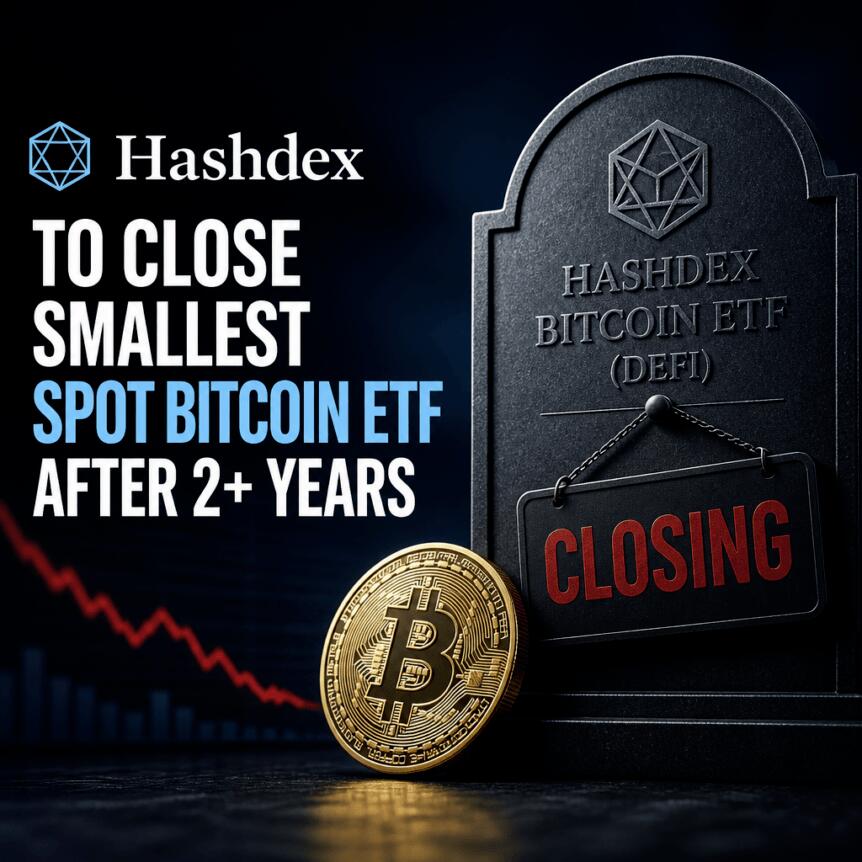
Hashdex has announced that it plans to liquidate its Bitcoin spot exchange-traded fund (ETF) later this month, moving to sell the fund’s remaining Bitcoin holdings and distribute the resulting cash to remaining shareholders. In an SEC filing made public on Monday, the issuer said the wind-down follows a review of factors such as trading liquidity, ongoing operating costs, and investor demand.
The fund—listed on NYSE Arca under the DEFI ticker—holds roughly 225 BTC, according to the fund’s own disclosures. The filing also states that the fund’s 200,000 shares have traded on NYSE Arca since March 2024, and that net assets amount to $14.25 million, based on figures published on the fund’s website.
Key takeaways
- Hashdex says it will liquidate its DEFI Bitcoin spot ETF and sell its remaining Bitcoin holdings.
- The decision follows an SEC filing citing trading liquidity, operating expenses, and investor interest.
- The DEFI fund has net assets of about $14.25 million, with roughly 225 BTC reported in the fund’s holdings.
- DEFI has been trading on NYSE Arca since March 2024, after debuting later than many peers in the spot-BTC ETF launch wave.
SEC filing details the liquidation plan
In the Monday filing, Hashdex described its plan to liquidate the Bitcoin spot ETF and distribute cash proceeds to all remaining shareholders. The filing links the move to an internal assessment of market conditions and fund economics, specifically naming trading liquidity, operating costs, and investor interest as key considerations.
The fund issuer noted that the ETF’s shares—200,000 in total—have been available to investors on NYSE Arca under the DEFI ticker since March 2024. The filing also aligns with the fund’s public materials: its website lists net assets of $14.25 million.
For investors, a liquidation notice like this typically shifts the question from performance to logistics—how proceeds will be calculated, how quickly holdings are sold, and how distributions to shareholders are handled during the wind-down period. Readers who hold shares may want to monitor announcements closely for details around timing and the mechanics of the cash distribution.
Why DEFI’s wind-down matters in the spot-BTC ETF era
The liquidation arrives in a market where the spot Bitcoin ETF lineup quickly expanded after the first wave of approvals. Earlier coverage around the launch period emphasized the competitive landscape, and DEFI’s own history reflects that timing. Analysts have previously pointed to how early mover advantage and scale have played a major role for many of the products that followed.
The fund initially launched in 2022 as a Bitcoin futures ETF (Hashdex Bitcoin Futures ETF). Over time, DEFI entered the spot-BTC ETF category and began trading on NYSE Arca in March 2024—months after the first of 10 competing US-traded Bitcoin ETFs debuted.
In hindsight, that later start appears to have mattered. SoSoValue data shows DEFI’s highest asset level was $17.54 million, reached on May 9, 2025, using SoSoValue’s tracking of the ETF. While that peak suggests the product once gained traction, it also underscores how quickly investor preferences and capital flows can concentrate among larger, more established options in the crowded spot-BTC ETF market.
Investor demand vs. fund economics
Hashdex’s stated rationale—trading liquidity, operating costs, and investor interest—gets to the core of why some ETFs struggle even when the underlying asset is widely followed. In ETF structures, costs and trading efficiency can become more difficult to justify as assets shrink, particularly if bid-ask spreads or market activity don’t remain strong enough to support the product’s economics.
The fund’s size offers a straightforward datapoint. With net assets reported at $14.25 million and holdings around 225 BTC, DEFI is far smaller than the largest US-listed Bitcoin ETFs. According to figures cited via SoSoValue, WisdomTree Bitcoin Trust (BTCW) had $140.37 million in net assets as of Friday’s market close—an order of magnitude larger than DEFI.
That size gap can influence investor behavior in practical ways: larger funds typically attract more attention, may offer tighter trading conditions due to deeper liquidity, and can have an easier time sustaining ongoing operations. Hashdex’s liquidation choice suggests that, after reviewing those dynamics, the firm concluded continuing the product was no longer economically viable.
Separately, Bloomberg ETF analyst Eric Balchunas previously highlighted DEFI’s “late” arrival in the spot-BTC ETF race. In a March 27, 2024 post on X, he wrote: “The getting is so good right now I could see this one getting some bites (if the fee is competitive) despite being so late.” The current liquidation indicates that, regardless of the initial optimism around fees and demand, the fund ultimately failed to maintain sufficient scale to continue.
What happens next for shareholders
For holders, the main near-term change is the shift from holding an ETF that tracks Bitcoin spot exposure to receiving a cash distribution following liquidation. The SEC filing makes clear that Hashdex intends to sell the fund’s roughly 225 BTC holdings and distribute the cash to remaining shareholders.
Because the wind-down is tied to evaluation factors such as liquidity and investor interest, the most important thing to watch next is the timeline and execution details: how quickly the Bitcoin is sold, whether there are any market-impact considerations during liquidation, and when investors can expect distributions.
While the underlying Bitcoin market remains the same, ETF-specific outcomes—share trading, liquidity conditions, and fund operating structure—can change quickly. The DEFI liquidation is a reminder that in the current spot-BTC ETF landscape, product survival depends not just on exposure to Bitcoin, but also on maintaining enough investor demand and fund scale to make operations sustainable.
Going forward, market participants will likely watch which remaining smaller Bitcoin ETFs either consolidate, adjust their strategies, or continue to seek liquidity and investor flow—especially as investors weigh the trade-off between fee levels, fund size, and day-to-day trading conditions.
Where is “The Princess Diaries” cast now? See the stars 25 years later

IRAN & USA War to END SOON ! | Zee | Urban Company | Muthoot Finance | ITC | JP POWER | Vodafone …

Oil prices fall sharply as Trump signals Iran deal on Hormuz Strait


-

 Business5 days ago
Why Trees Belong on the Risk Register
-

 Fashion3 days ago
Weekend Open Thread: Wit & Wisdom
-

 Politics3 days ago
Meta enters AI-training agreement with far-right ‘propaganda rag’ Newsmax
-
 Entertainment6 days ago
‘Stargate’ Creator’s New Sci-Fi Series Returns for Season 3 Tomorrow
-

 Crypto World2 days ago
MicroStrategy Post-Earnings CLARITY Act Push Could Add New Catalyst for Its Stock
-

 Politics6 days ago
The Part of the Electric Transition Nobody Wants to Discuss
-

 Business5 days ago
Major shareholder moves on Canyon
-

 Crypto World2 days ago
XRP Ledger v3.3.0 brings five institutional features
-

 News Videos4 days ago
Bitcoin Enters the 3rd Stage of the Bear Market
-

 Crypto World6 days ago
Kraken Enables Retail Access to Jersey Mike’s IPO via Tokenized Shares
-

 Tech7 days ago
New macOS Sequoia & Sonoma security updates for older Macs
-

 Politics4 days ago
Luke Littler’s dominance sparks GOAT debate
-

 News Videos6 days ago
Claude: Build Financial Dashboards in Minutes (2026)
-

 Business6 days ago
Johnson & Johnson agrees to $5.5B settlement over talc cancer claims
-

 Sports4 days ago
Seema Kaliramna Wins Discus Throw Bronze, Takes India’s CWG Medals Tally To 17
-

 Crypto World1 day ago
Crypto PAC spending tops $2M in Michigan House race
-

 Business3 days ago
Trump Announces Hamas Disarmament Agreement as Iran Strikes Kuwait Air Base and US Attacks Pause Overnight
-

 Crypto World3 days ago
New York sues Kalshi over prediction market gambling
-

 Tech5 days ago
Gemini can now summarize the messiest comment threads in Google Docs
-

 Tech1 day ago
ESET tracks rise in malicious AI skills and adaptable malware
You must be logged in to post a comment Login