

Crypto World
Altcoin Season Index Signals Growing Momentum Beyond Bitcoin

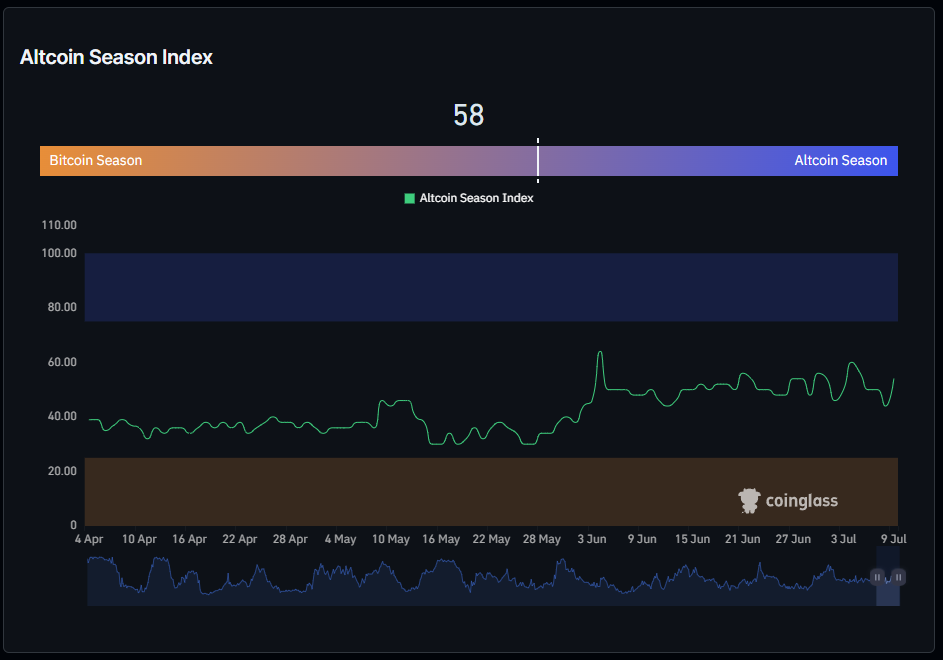
Coin Glass’s Altcoin Season Index has climbed to 58, building on a June 4 spike that hit 64, a signal that capital may be starting to rotate out of Bitcoin and into the broader altcoin market.
The Altcoin Season Index tracks how many top cryptocurrencies by market capitalization have outperformed Bitcoin over a trailing 90-day window. It scores the market from 0 to 100. A reading above 75 marks a confirmed altcoin season
A Gauge That’s Been Trending Higher
Coin Glass’s current reading of 58 on the altcoin index sits well above the neutral midpoint, but not strongly enough to erode Bitcoin’s dominance in the market which is at 57%, according to CoinGecko.

Determining an altcoin season is not an exact science as CoinMarketCap’s version of the index tells a similar but more cautious story. It measures a similar basket of coins and currently holds at a more neutral 53.
The gap between the two trackers isn’t unusual, since each provider weighs its coin universe and lookback window slightly differently.
Bitcoin’s own price action adds weight to the rotation case. BTC dominance has spent recent weeks testing key support levels. Some traders see a breakdown there as the trigger altcoin season needs.
Bitcoin Dominance Cracks as Capital Moves
The index’s climb lines up with a broader shift in market structure. Bitcoin’s dominance fell from 58.12% to roughly 54% in early July, according to CryptoRank data. The same source has BTC dominance currently at 56.3%. Over the same stretch, the combined market share of altcoins outside Bitcoin, Ethereum, and stablecoins expanded from 19.39% to 24.68%.

That said, not every recent signal points to organic altcoin strength. In late June, Glassnode flagged its own altcoin season signal returning to altcoin-season territory. The firm cautioned, though, that Bitcoin’s own sharp decline was driving most of that move, not genuine altcoin outperformance.
The rotation so far also looks selective rather than broad-based. Capital has concentrated in yield-bearing tokens and the Solana ecosystem, even as altcoin spot selling deepens across large parts of the smaller-cap market.
Institutional flows tell a more constructive story. In mid-June, ETF flows rotated toward altcoins, with fresh money moving into Ether, Solana, and XRP products even as Bitcoin funds saw outflows. That pattern typically precedes wider altcoin strength rather than confirming it outright.
That split between a rising index and weakening speculative appetite matters. It’s why most analysts describe the current move as a rotation building strength, not a confirmed altcoin season.
For now, the case rests on direction rather than confirmation. CoinGlass’s climb toward 58, paired with Bitcoin’s price action losing some grip on total market share, gives the rotation thesis real data behind it.
Whether it continues toward the 75 threshold will likely hinge on whether Bitcoin dominance keeps sliding through the rest of July.
The post Altcoin Season Index Signals Growing Momentum Beyond Bitcoin appeared first on BeInCrypto.



Digital assets posted a third consecutive quarter of losses in Q2 2026, the longest losing streak since the 2022 bear market, as institutional capital rotated into AI equities and Bitcoin ETFs recorded their largest quarterly outflow since launch. Our report examines what drove the divergence, where structural adoption continued regardless, and what Q3 signals to watch.
Digital assets posted a third consecutive quarter of losses in Q2 2026, the longest losing streak since the 2022 bear market, as institutional capital rotated into AI equities and Bitcoin ETFs recorded their largest quarterly outflow since launch. Our report examines what drove the divergence, where structural adoption continued regardless, and what Q3 signals to watch.
Bitcoin price traded near $62,800 on Monday after slipping about 1.5% over 24 hours, according to crypto.news market data.
Summary
- Bitcoin stayed above key support while war fears drove sharp losses across major traditional markets.
- Spot Bitcoin ETFs attracted $197 million, ending eight straight weeks of net investor withdrawals overall.
- Analysts see $65,000 as resistance, while weaker exchange flows may limit near-term breakout attempts again.
The move kept the largest crypto above the $60,000 support area, even as the latest U.S.-Iran strikes triggered sharper moves across oil, stocks, bonds and gold. Ether traded near $1,779, XRP stood around $1.08 and Solana changed hands near $76.40.
Crypto prices weakened, but they avoided the steep losses seen in several Asian equity markets. Bitcoin’s limited reaction contrasted with its sharp selloffs during earlier rounds of conflict this year.
Brent crude climbed more than 4% to about $79.31 a barrel as traders assessed threats to shipping through the Strait of Hormuz. Gold fell about 1.5% toward $4,060 as higher Treasury yields reduced demand for assets that pay no interest.
Japan’s Nikkei dropped 2.2%, while South Korea’s KOSPI lost 7.6%. The two-year U.S. Treasury yield reached its highest level since early 2025 as markets raised expectations for tighter Federal Reserve policy.
U.S.-Iran attacks revive oil and inflation concerns
The latest market moves followed another exchange of attacks between the United States and Iran. U.S. Central Command said its forces struck dozens of Iranian military sites after Iran attacked a container ship near the Strait of Hormuz.
Iran again claimed control over the waterway, while U.S. officials said the route remained open. Those statements remain disputed, and shipping data showed traffic through the strait stayed limited.
The route carried about one-fifth of global oil and liquefied natural gas flows before the war, making any disruption important for energy prices. Higher oil can raise transport and production costs, which may keep inflation elevated.
Minutes from the Federal Reserve’s June meeting showed that a few officials saw a case for raising rates, although they supported holding the target range at 3.5% to 3.75%. Officials also listed Middle East conflict and energy prices among the risks that could keep inflation high.
Bitcoin ETF inflows provide support after eight weak weeks
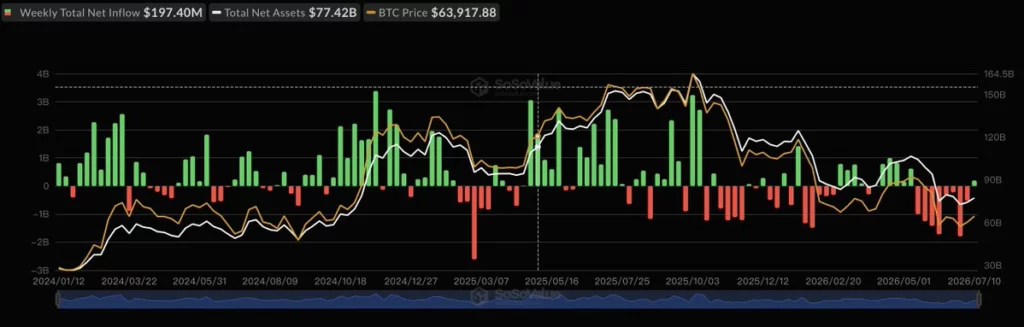
U.S. spot Bitcoin ETFs recorded $197 million in net inflows from July 6 through July 10, ending eight straight weeks of withdrawals, according to SoSoValue data. The reversal followed $527 million in outflows during the shortened week ending July 2.
Source: SoSoValue
BlackRock’s IBIT led the latest weekly inflows with about $292 million, while Grayscale’s smaller Bitcoin trust added roughly $95 million. GBTC recorded about $108 million in withdrawals, leaving demand uneven across individual funds.
As crypto.news previously reported, Bitcoin ETF selling had removed a key source of demand during the June decline. The return to weekly inflows supports the recovery from the $58,000 to $60,000 area, but the total remains modest compared with the money withdrawn during the previous eight weeks.
Bitcoin also failed to hold above $65,000 after several tests, showing that fund inflows have not yet produced a clear breakout.
Bitcoin indicators improve but $65,000 remains key
Bitcoin’s recent structure remains sideways to slightly positive after the late-June bottom. The price has stayed above the main support zone near $60,000, while sellers continue to defend the area around $65,000.
The relative strength index stands near 47, close to its moving average and below the neutral 50 level. That reading shows that buying pressure has improved from oversold conditions but has not taken control of the market.
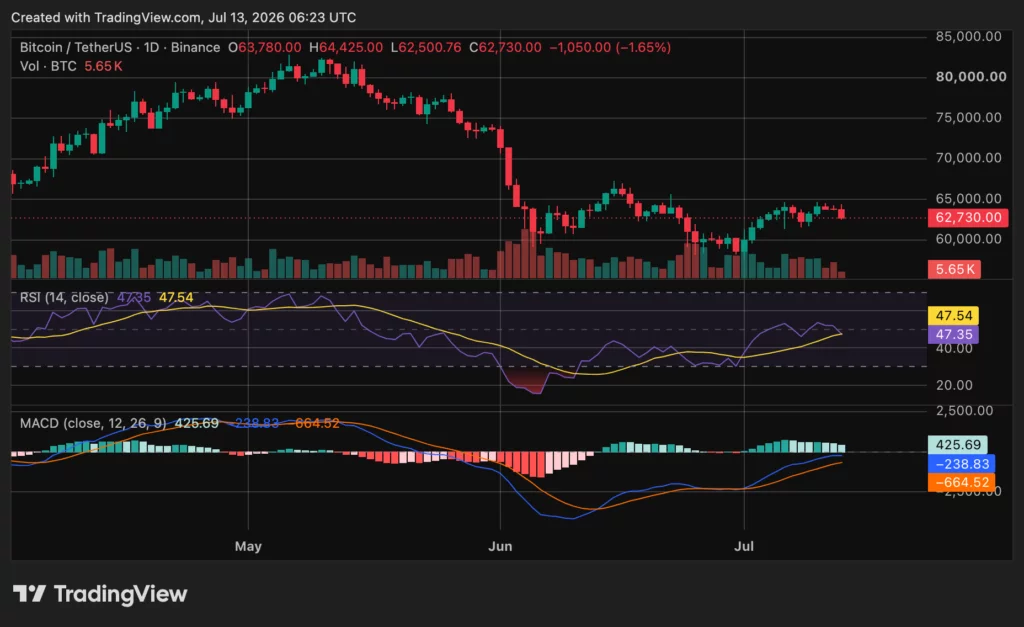
The moving average convergence divergence indicator also shows an early recovery. Its histogram remains positive, and the MACD line sits above the signal line. Both lines remain below zero, which means the wider trend has not turned firmly positive.
A daily close above $65,000 would improve the technical setup and open the way toward higher resistance. A fall below $60,000 would weaken the recovery and return attention to the June lows.
In addition, Crypto analyst Crypto Patel said exchange-to-exchange Bitcoin flows fell 91% in 30 days, from 1,800 BTC on June 14 to 166 BTC on July 12. He linked the decline to European users moving away from Binance after the exchange lost access to regulated services in the European Union under MiCA.
He called the move “the Bitcoin signal almost everyone missed,” but the flow figures and the claimed direct link have not received independent confirmation.
Binance suspended several services for European Union users on July 1 after failing to secure a MiCA license before the deadline. The exchange kept withdrawals available and said it planned to seek authorization in another member state.
Patel said flows above 800 to 1,000 BTC could show that European liquidity had settled on new venues. For now, Bitcoin remains inside its recent range while traders watch ETF demand, exchange liquidity, oil prices and the next Federal Reserve decision.
Disclosure: This article does not represent investment advice. The content and materials featured on this page are for educational purposes only.


Democratic senators have renewed calls for Senate hearings into President Donald Trump’s cryptocurrency business interests after his latest financial disclosure reported about $1.4 billion in crypto-related income as lawmakers prepare to vote on the CLARITY Act.
Summary
- Democratic senators have renewed calls for hearings into President Trump’s crypto holdings ahead of the Senate vote on the CLARITY Act.
- Lawmakers said Trump’s latest financial disclosure has raised fresh concerns over potential conflicts of interest in crypto legislation.
- A separate bill banning a U.S. central bank digital currency until the end of 2030 is set to become law without Trump’s signature.
A notice released on July 10 by the Democratic ranking members of five U.S. Senate committees and subcommittees called for congressional hearings to examine what they described as the national security implications of Trump’s cryptocurrency holdings.
The lawmakers said the president’s 2025 financial disclosure, which reported roughly $1.4 billion in earnings linked to ventures including his memecoin and the Trump family-backed World Liberty Financial platform, has intensified concerns over Congress advancing digital asset legislation while Trump maintains significant financial interests in the sector.
“We call on our respective Committees to hold hearings to investigate the national security implications of President Trump’s cryptocurrency holdings, including the influence of the UAE or unknown third parties on President Trump’s actions,” the senators wrote in the notice.
The statement comes as the Senate prepares to consider the Digital Asset Market Clarity (CLARITY) Act later this month. The legislation is expected to establish a regulatory framework for the U.S. crypto market, though negotiations over its final language are still underway.
Ethics concerns continue to shape CLARITY debate
Among the signatories were Senators Elizabeth Warren, Richard Blumenthal, Gary Peters, Dick Durbin, and Ron Wyden, who have previously argued that Trump’s crypto businesses create potential conflicts as Congress debates legislation affecting the industry.
Earlier this month, the same group pointed to Trump’s financial disclosure and said unidentified third parties continued to hold interests in the Trump family’s World Liberty Financial project. They argued those business ties should receive additional scrutiny before lawmakers approve the CLARITY Act.
Separately, Warren has urged Senate negotiators to add ethics provisions that would bar the president, vice president, members of Congress, senior administration officials and their immediate families from profiting from cryptocurrency ventures while in office. She has previously described Trump’s crypto businesses as a conflict of interest that Congress should address through the legislation.
Republicans hold the Senate majority, leaving Democrats unable to convene hearings without Republican support. Still, Senate rules require 60 votes to overcome a filibuster, giving Democratic lawmakers leverage as Republicans seek enough bipartisan backing to advance the CLARITY Act.
Some Republicans continue to press ahead despite the criticism. Senator Cynthia Lummis has maintained support for moving the legislation forward, while Representative French Hill, who chairs the House Financial Services Committee and helped advance the bill through the House in 2025, has acknowledged that Trump’s crypto ties have made the legislative process more difficult.
The Senate is expected to take up a consolidated version of the bill that combines proposals from the Banking and Agriculture committees. Previous reporting has indicated the updated draft includes stronger consumer protection measures, while disputes over ethics rules, decentralized finance provisions and protections for non-custodial blockchain developers remain unresolved.
CBDC ban set to take effect without Trump’s signature
Hours after the Democratic notice was released, a separate crypto-related measure was expected to become law without presidential approval.
The 21st Century ROAD to Housing Act, which contains a provision prohibiting the Federal Reserve from issuing or creating a U.S. central bank digital currency until Dec. 31, 2030, is set to take effect automatically after Trump declined to sign the legislation and did not issue a veto.
Trump previously said on Truth Social that he was withholding his signature because the Senate had not yet passed the Save America Act, an election bill he has repeatedly urged lawmakers to approve. A White House official had also confirmed earlier that the president did not intend to veto the housing legislation, allowing it to become law once the constitutional review period expired.
The CBDC restriction builds on Trump’s earlier executive order directing federal agencies not to pursue the creation of a U.S. central bank digital currency, adding another crypto policy measure as Congress continues debating the CLARITY Act and ethics concerns surrounding the president’s digital asset holdings.
John Deaton has credited 75,000 XRP holders with helping Ripple executives resist pressure during the company’s legal fight with the U.S. Securities and Exchange Commission.
Summary
- Deaton says 75,000 XRP holders helped Ripple’s leaders resist SEC pressure during the prolonged litigation.
- Ripple considered closing before executives chose a costly legal defense that preserved hundreds of jobs.
- The case ended with a mixed ruling, $125 million penalty, injunction, and dismissed appeals final.
In a July 12 post, the crypto lawyer praised chief executive Brad Garlinghouse and executive chairman Chris Larsen for refusing to settle early. He also accused SEC lawyers of using tactics to force a deal. His comments followed Garlinghouse’s account that Ripple considered closing after the agency filed its complaint in December 2020.
Deaton responded to comments from Ripple co-founder David Schwartz, who said outside lawyers once viewed the company as “unsavable.” Schwartz suggested that naming Garlinghouse and Larsen personally may have encouraged them to protect themselves through separate settlements.
That account describes internal advice and personal views. It does not establish the SEC’s motive for bringing claims against both executives. Garlinghouse has said Ripple instead spent about $150 million defending the business and protecting hundreds of jobs.
XRP holders entered the case as amici
Deaton entered the case after organizing XRP holders who opposed the SEC’s broad treatment of the token. A federal judge granted him permission to participate as an amicus, allowing him to present arguments from holders who bought or used XRP in different ways.
His group argued that secondary-market transactions should not automatically receive the same legal treatment as Ripple’s institutional sales. The group also submitted declarations about purchase reasons and uses unrelated to investment.
As crypto.news previously reported, Ripple deputy general counsel Deborah McCrimmon later said community members supplied research and records that saved the company millions of dollars in legal costs.
Deaton has also said holder declarations helped show that many buyers did not rely on Ripple’s promises. The court did not rule that the 75,000 holders alone decided the case. Their role formed one part of a larger record involving sales contracts, marketing and buyer expectations.
Court blocked the SEC’s broad records request
Deaton also returned to the SEC’s attempt to obtain years of personal financial records from Garlinghouse and Larsen. In 2021, a magistrate judge blocked subpoenas seeking broad banking information after finding that the regulator had not shown the records were relevant. The executives had already agreed to provide records tied to their XRP transactions, according to reports from the case.
His post called the requests an “intimidation tactic” and described some SEC lawyers as “ethically challenged.” Those phrases reflect Deaton’s allegations, not court findings in the Ripple action.
He also referred to sanctions against the SEC in the separate Debt Box case. A Utah judge found that agency lawyers made misleading statements there, but that ruling did not decide misconduct claims in Ripple’s case.
Final judgment remains in force
The Ripple lawsuit produced a divided result. Judge Analisa Torres ruled in 2023 that Ripple’s programmatic XRP sales on public exchanges did not qualify as securities transactions under the facts presented.
She ruled that institutional sales violated federal securities law. The SEC later dismissed its remaining claims against Garlinghouse and Larsen before trial, ending their personal exposure in that action.
The court imposed a $125 million civil penalty and an injunction against Ripple in 2024. Ripple and the SEC later sought a lower penalty and removal of the injunction, but Torres rejected that request.
Both sides dismissed their appeals in August 2025, leaving the final judgment intact. Deaton’s description of an overall “win” therefore reflects a favorable reading of a mixed legal outcome.
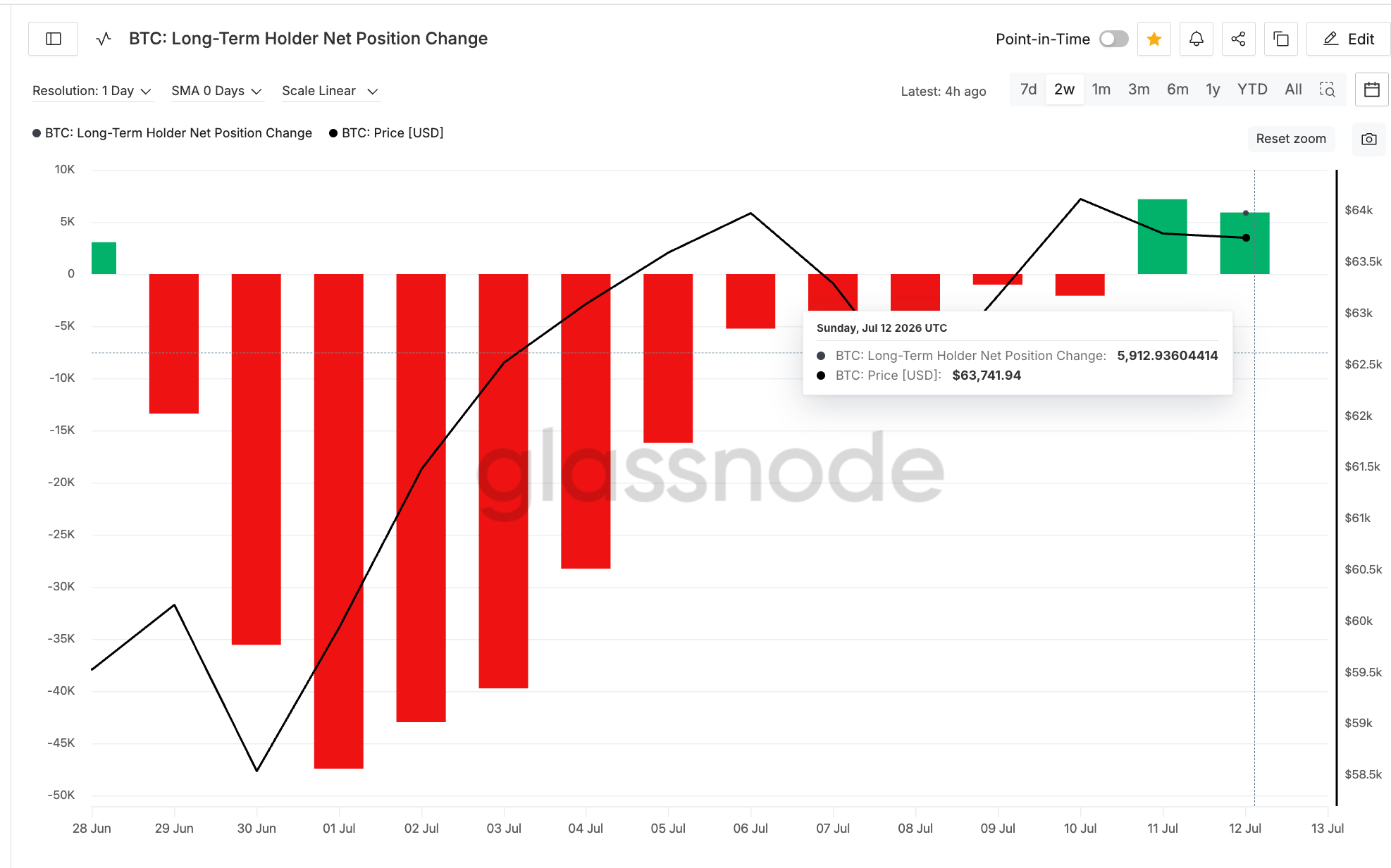
Bitcoin price is sliding, but its most patient owners are doing the opposite of panicking. After 12 days of selling, long-term holders of Bitcoin (BTC) flipped back to buying on July 11 and 12, adding a net 5,912 BTC.
The move is small and only two days old. Moreover, BTC is still down 2% over the past 24 hours. Still, it is the first shift from selling to buying since late February, a turn that came just before a 25% rally.
Why Long-Term Holders Move Bitcoin Price
Glassnode tracks these owners with its long-term holder net position change. The metric counts coins held for roughly 155 days or more, so a positive reading means the group is buying faster than it sells.
Want more token insights like this? Sign up for Editor Harsh Notariya’s Daily Crypto Newsletter here.
That matters because these wallets rarely react to noise. Their return to accumulation pulls supply off the market, which tightens conditions and gives Bitcoin price room to climb.
For the past 12 days that reading sat negative, meaning these owners were spending coins into a falling market. The flip to positive stops that bleed, at least for now.

Right now they are adding while price falls. Bitcoin trades near $62,717, down about 2% on the day, so this is buying into weakness rather than chasing strength.
The Signal That Called February’s Bottom
The last time selling flipped to buying was late February, when Bitcoin traded near $65,896. From there, long-term holder accumulation built steadily and BTC peaked around $82,186 on May 10, a gain of about 25%.

Then the pattern slowed and eventually reversed. These holders slowed buying from late May and turned to selling by late-June. Meanwhile, the Bitcoin price bled back toward $60,000 by late June. In each case the holder turn led the price, not the reverse.
That is the sequence this flip is testing again. The buying has to come first, then price tends to follow.

The fresh flip echoes that February low, which is why traders watching on-chain bottom signals are paying attention to two quiet green days.
A Green ETF Week Backs the Turn
A second signal points the same way. In the week to July 10, US spot Bitcoin ETFs pulled in about $197 million, their first green week after eight straight weeks of outflows. Because ETF buying moves real spot Bitcoin, two separate groups are now adding at the same time.

That overlap is why the long-term holder flip carries more weight than its size suggests. The patient wallets may even be reading the ETF turn as a signal of their own.
What Has to Hold for Bitcoin Price
The caution is simple. A two-day streak is thin, and it needs to survive. If the buying fades, the signal fails and the sell-off resumes.
For now the oldest hands are leaning against the drop, near a current Bitcoin price of above $62,700. The February turn that this one echoes ran for weeks before price responded.

Whether it becomes another climb depends on whether the streak lasts through the coming week.
The post The Signal Before Bitcoin’s 25% Rally Just Flashed: Can It Hold? appeared first on BeInCrypto.


Ross Gerber has renewed his criticism of Strategy founder Michael Saylor, saying the company’s financing model is hurting Bitcoin.
Summary
- Gerber says Strategy’s leveraged Bitcoin model creates selling pressure instead of lasting value for investors.
- Strategy sold Bitcoin to fund dividends, weakening Saylor’s long-standing image as a permanent corporate holder.
- Supporters argue limited sales show balance-sheet flexibility while Strategy remains Bitcoin’s largest public corporate holder.
The chief executive of Gerber Kawasaki made the claim after Saylor posted an AI-generated video titled “The Right to Bear Arms.” Gerber replied that Saylor was “destroying Bitcoin,” but he did not provide data showing that Strategy alone caused the market’s recent losses.
The latest remark follows Gerber’s earlier attacks on Strategy’s treasury plan. In June, he accused Saylor of creating a “negative cycle” by selling Bitcoin after promoting a long-term holding message. He also used the term “rug pull” for the company’s actions. Those comments represent Gerber’s view. Public filings do not describe Strategy’s sales as fraud or market manipulation.
Criticism centers on leverage and value creation
Gerber’s main complaint concerns the use of financial markets to increase Bitcoin exposure. Strategy has issued common shares, preferred stock and convertible notes to raise funds. It has used much of that capital to buy Bitcoin. Gerber argues that this process adds obligations without creating an operating asset that produces cash.
He also says investors can gain Bitcoin exposure through regulated exchange-traded funds instead of buying Strategy shares. Gerber has promoted active ETFs as a way to manage capital gains.
Tax outcomes vary by fund structure and investor circumstances, so his statement does not apply equally to every holder. Strategy says its model combines Bitcoin reserves with equity and credit products rather than copying a spot ETF.
Strategy’s Bitcoin sales fuel the dispute
As crypto.news reported, Strategy sold 3,588 BTC for about $216 million between June 29 and July 5. The company used the proceeds to fund dividends on several preferred stock products. After the sale, Strategy held 843,775 BTC and $2.55 billion in dollar reserves.
The transaction followed a wider plan that allows up to $1.25 billion in Bitcoin sales for liquidity needs. The company sold the coins below its average acquisition cost, according to disclosed figures, adding to debate over whether recurring payments could force more sales during weak markets.
The sale gave Gerber fresh material for his criticism because Saylor had spent years promoting a buy-and-hold approach. However, Strategy had already changed its public position. In May, Saylor said a Bitcoin sale before year-end was “not unlikely.” As previously reported, the company sold 32 BTC in late May, then bought 1,550 BTC and later added another 1,587 BTC.
Strategy supporters reject Gerber’s claims
Supporters reject Gerber’s description of the model. Blockstream chief executive Adam Back said limited Bitcoin sales showed treasury flexibility rather than weak conviction. He argued that Strategy could use part of its reserve to meet investor payments while keeping Bitcoin at the center of its balance sheet. The company remains the largest public corporate holder of Bitcoin despite its recent sales.
Questions remain over how Strategy’s capital structure performs during a prolonged market decline. The company’s enterprise value had fallen below the value of its Bitcoin holdings for the first time. Its preferred products also create recurring dividend needs.
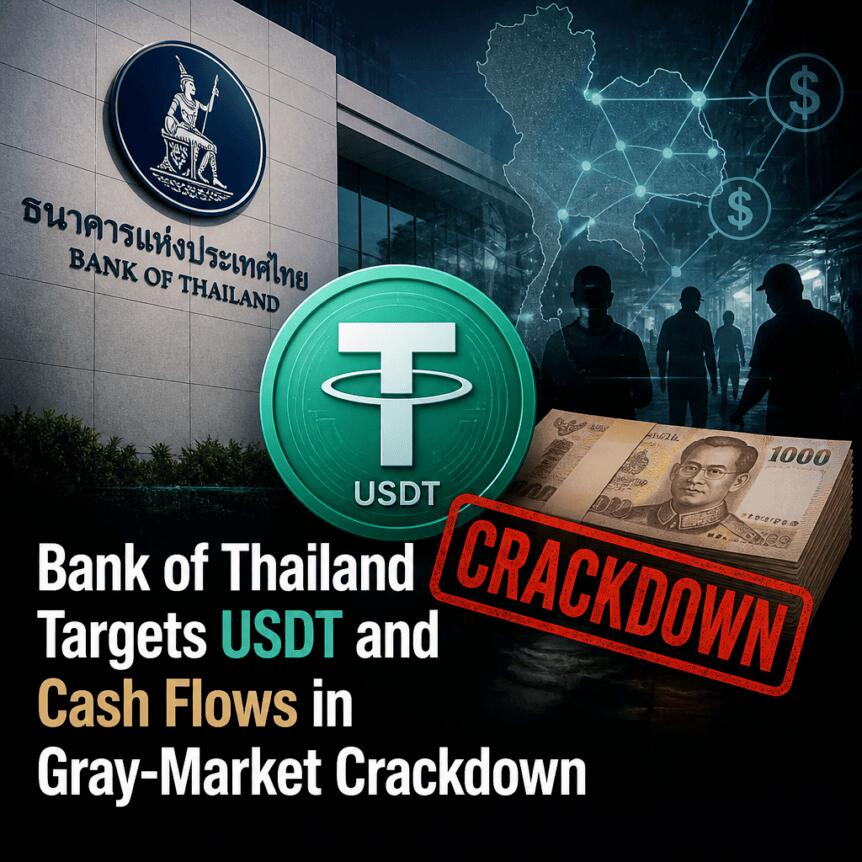
Thailand’s central bank is tightening its scrutiny of stablecoin activity as part of a broader campaign against money laundering, illicit finance and what officials describe as “gray money” flowing through cash-heavy channels. The Bank of Thailand says it is working alongside the Securities and Exchange Commission to audit high-volume stablecoin transfers—particularly those involving USDT—to uncover suspicious patterns and disrupt illicit funds.
According to local media outlet The Nation, Bank of Thailand Governor Vitai Ratanakorn said the response is designed to be ongoing rather than a one-time intervention. The push comes as stablecoins remain attractive for large cross-border movements due to fast settlement times.
Key takeaways
- Thailand’s Bank of Thailand and the Securities and Exchange Commission plan to audit high-volume stablecoin transactions, with a specific focus on USDT (USDT).
- The surveillance effort targets multiple channels, including cash transactions, currency exchanges and “suspicious stablecoin transactions,” to prevent regulated entities from being used for illicit flows.
- New rules expand compliance obligations for banks across cash networks and currency exchange activity, including source-of-funds declarations for certain high-value cash deals.
- Cash deposit thresholds are also being tightened: deposits above 5 million baht (about $150,000) require full disclosure, and large exchanges of big notes for smaller denominations may be monitored if they lack a clear business rationale.
- The crackdown is set against a backdrop of prior anti-scam measures that resulted in widespread account restrictions in 2025, according to earlier reporting.
Why Thailand is turning attention to stablecoin flows
The Bank of Thailand’s initiative is aimed at identifying illicit financial activity that can be hidden within high-volume transfers. The focus on stablecoins—especially USDt (USDT)—reflects their growing role as a transfer mechanism across borders, where near-instant settlement can make transactions harder to slow down or interrupt through traditional payment monitoring.
Thailand’s authorities are also targeting what they call the “gray economy,” a category that the article describes largely as cash that may have originated from suspicious activities, including scam call centers that have spread across the region. While the piece notes there are no reliable overall figures for the gray economy, it cites reported scam losses of 115 billion THB (about $3.4 billion) in 2025, alongside roughly 173 million scam calls and texts recorded.
For market participants, the implication is clear: even where crypto trading is regulated or legal, stablecoin transfer activity may face increased compliance scrutiny—particularly when transaction behavior resembles laundering patterns or attempted integration of illicit funds into legitimate financial systems.
What Thailand’s surveillance and compliance expansion includes
Beyond stablecoins, the planned measures would extend existing compliance expectations across several financial touchpoints. The reporting says the initiative will expand how commercial banks handle monitoring duties for cash networks, currency exchanges, gold bullion trading and suspicious stablecoin activity.
Among the specific steps highlighted in the article:
- High-value cash transactions would require a source-of-funds declaration.
- Banks and related institutions would monitor large exchanges of major banknotes for smaller denominations when there is no clear business justification.
- Cash deposits exceeding 5 million baht (about $150,000) would require full disclosure.
These provisions matter because they shift compliance from a reactive model—where suspicious activity is addressed only after the fact—to a more structured approach focused on documentation and transaction context. In practice, businesses and individuals moving cash at scale may face added paperwork burdens, while intermediaries may need tighter internal controls to flag unusual flows earlier.
The measures also reinforce a message Thailand has been sending for some time: stablecoin use and broader digital-asset payments do not fall into a completely hands-off category. Even with a thriving domestic market for crypto trading, policy authorities continue to tighten oversight around how digital assets interact with the traditional financial system.
Thailand’s crypto environment: legal trading, tighter rules for payments
The article reiterates that Thailand’s central bank has previously outlawed stablecoin and digital asset payments, even while crypto trading itself remains legal. It also points to ongoing regulatory tightening affecting crypto businesses.
Still, activity is visible. The piece cites CoinGecko data indicating Thailand’s largest exchange, Bitkub, is seeing about $26 million in daily volume. However, it also notes that close to 40% of that volume is attributed to forex, with the USDT/THB trading pair described as the most popular.
This split between legal trading and restricted payments is important for traders and compliance teams. Increased stablecoin monitoring could affect liquidity patterns, exchange volumes, and how firms approach onboarding, transaction monitoring, and internal risk assessments—especially if authorities emphasize stablecoin transfers even when trading itself is permitted.
From anti-scam account freezes to stablecoin audits
Thailand’s stablecoin surveillance drive is landing after a major episode of enforcement actions targeting scams and “mule” accounts. The article references an earlier crackdown in 2025 in which banks reportedly imposed sweeping account restrictions and froze three million bank accounts.
But it also highlights that the operation reportedly ensnared thousands of individuals and legitimate businesses. Media coverage referenced in the article characterized the situation as a “scammer crackdown gone wrong,” emphasizing the risk of overreach when targeting illicit activity.
That background shapes how market participants may interpret the new stablecoin focus. It suggests regulators are trying to improve how they detect harmful activity—potentially by extending scrutiny to structured transfer mechanisms such as stablecoins—while still confronting the real-world challenge of avoiding collateral damage to legitimate users.
At the same time, the article signals that authorities plan to deploy “multiple parallel strategies,” rather than relying on one narrow fix. If implemented carefully, that approach could refine targeting over time; if not, it may again raise friction for compliant users who don’t fit laundering profiles.
For investors, exchanges, and compliance teams, the next question is how Thailand will operationalize this stablecoin auditing—particularly what qualifies as “high-volume” and what transaction behaviors trigger deeper review. Monitoring whether enforcement focuses narrowly on suspected illicit patterns or broadens to capture ordinary stablecoin usage will likely determine how disruptive the policy becomes for legitimate market activity.
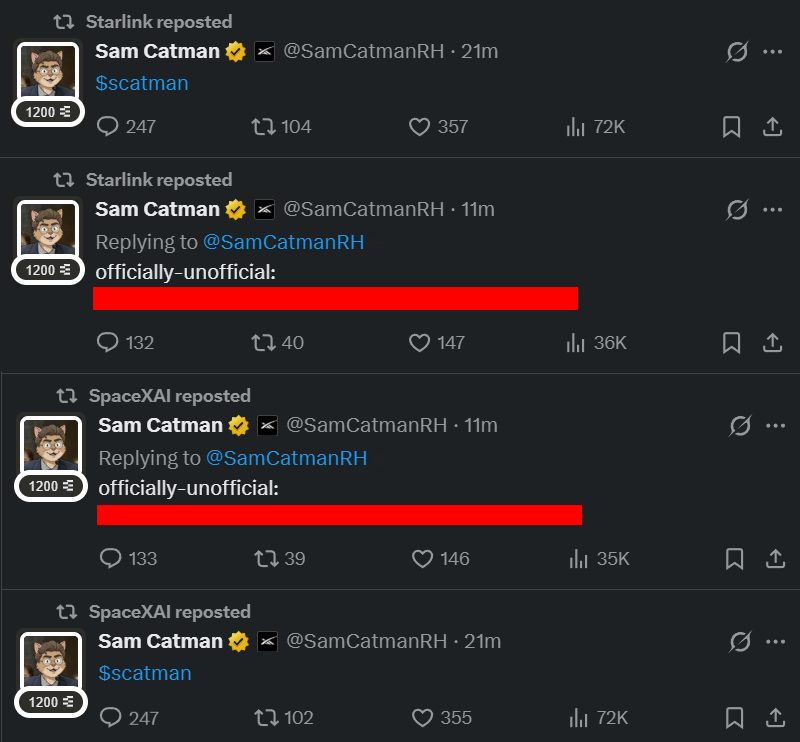
A hacker rug pulled a token called SCATMAN after reportedly seizing control of the SpaceXAI and Starlink accounts on X, walking away with roughly $125,000 in Ethereum (ETH).
On-chain tracker Lookonchain traced the stolen funds across two wallets. The scheme mirrors a run of high-profile account takeovers aimed at promoting fraudulent tokens.
Inside the SCATMAN Rug Pull
According to Lookonchain, the attacker promoted the SCATMAN meme coin after allegedly compromising the SpaceXAI and Starlink X accounts. Screenshots widely shared on social media appeared to show both accounts reposting content from the SCATMAN account.
Follow us on X to get the latest news as it happens

Lookonchain said the attacker minted 10 trillion SCATMAN. They then sold the entire supply for 59 ETH, worth about $108,000.
The analytics platform also identified a second wallet linked to the same attacker that sold an additional 59.28 million SCATMAN tokens for 14.7 ETH, worth approximately $27,000.
In total, the two wallets generated nearly $125,000 in ETH. Lookonchain identified the following addresses as belonging to the attacker:
- 0xfee50d4ce48f2d05f520ce04c875647e4870a8ba
- 0xdd9f6d3e16ebda7f35cb694ceadb50af3eebba89
As of press time, the reposts were no longer visible on the SpaceXAI and Starlink accounts, and BeInCrypto could not independently verify the claims. BeInCrypto has reached out to SpaceX for comment and will update this story if it receives a response.
Account Hacks Fuel a String of Rug Pulls
Hijacked social media accounts have become a common vehicle for rug pulls. Scammers borrow the credibility of trusted brands to lure buyers.
In February 2025, hackers seized Pump.fun’s X account to push a fake PUMP token. One wallet earned over $135,000 within a minute.
Political figures have faced the same tactic. Attackers hijacked former Malaysian Prime Minister Mahathir Mohamad’s account to promote a token, stealing $1.7 million.
Myanmar’s junta leader and World Liberty Financial co-founder Zach Witkoff faced similar breaches earlier that year.
Victims range from crypto platforms to heads of state. The common thread is a trusted account weaponized for a single, fast payout.
Each case follows the same pattern. A breach, a fast token launch, and a quick sell-off before the platform regains control.
Subscribe to our YouTube channel to watch leaders and journalists provide expert insights
The post SpaceX, Starlink X Accounts Hacked to Push SCATMAN Rug Pull appeared first on BeInCrypto.

Somewhat expected following the new wave of attacks in the Middle East, the cryptocurrency market has headed south again, and Ripple’s cross-border token is no exception.
While the short-term picture remains bleak, according to on-chain data, there are some charts providing more hope on the macro scale.
XRP Slips Again
The price of the cross-border token plummeted at the start of the month to $1.01 for the first time in nearly two years amid the market-wide crash. It rebounded swiftly in the following days and even challenged the $1.20 resistance, where it was rejected and pushed south to under $1.10 within days.
The past week or so has been a lot less eventful, as the asset spent it trading sideways between $1.09 and $1.12. The support level gave in on Monday morning, though, as the market priced in the new attacks between the US and Iran. Ripple’s coin slipped to just under $1.07 for the first time since the aforementioned low earlier this month.
Aside from market weakness, another possible reason for the asset’s retreat is ETF activity. After nine consecutive weeks of net inflows, that streak was finally broken last week, with over $7 million leaving the funds.
There’s more, though: on-chain data from Santiment and Ali Martinez suggests that whale activity on the XRP Ledger has “cooled significantly.” The number of large transactions worth over $1 million is down from 70 to just 2 in about a week.
Previously, Santiment also noted the XRP Ledger activity had “gone unusually quiet,” with newly created wallets dumping to their lowest levels in almost two years.
Still Major Price Targets
CRYPTOWZRD commented on XRP’s latest price moves, indicating that it had closed “indecisively.” The analyst expects to see “further upside” if Ripple’s token gains some traction against BTC, which hasn’t been the case for a long time.
Meanwhile, EGRAG CRYPTO remains highly bullish on the token’s long-term perspective. In a recent post on X, he noted that history might be rhyming for XRP, as there are several signs suggesting that the macro bottom is in.
“The macro bottom may already be behind us. Now we need a bounce toward the 50-MA (about $1.60), a healthy rejection, a retest of the 618 (0.5 Fibonacci zone), and that retest will become the make-or-break accumulation zone before the next impulsive move higher. In my view, this would complete a double-bottom lower low and set the foundation for the next macro rally for XRP.”
EGRAG outlined some major targets for that long-term rally, including up to $31 in some extreme cases. Other, more modest numbers include $15, $9, and $5-$6.50.
The post XRP Price Drops to 10-Day Low as Whale Demand and ETF Flows Fade appeared first on CryptoPotato.


The moves priced a single fear, that a wider war keeps oil elevated and forces the Federal Reserve to hold rates higher for longer. Minutes of the Fed’s June meeting show a few policymakers saw a case for raising rates before backing a hold. Gold fell because a higher-for-longer path lifts real yields and dulls the appeal of metal that pays nothing, and bonds fell for the same reason.
But bitcoin sat all of it out. Ether was little changed at about $1,800, up 2% on the week, and the rest of the majors barely moved on the day, with Solana the weakest at $76, down 5% over seven days. XRP held $1.09 and dogecoin sat near $0.07.
The one crypto-relevant thread runs through Korean stocks. SK Hynix shares plunged 12% in Seoul after the chipmaker’s U.S.-listed shares surged 13% on their Friday debut, a reversal that helped drag the Kospi down 7%. That chip trade drove the rally that lifted bitcoin on Friday, and its sharp reversal on Monday still left crypto flat, in either direction.
Bitcoin has now held a tight range through a weekend of strikes, a Monday selloff in every asset that usually reacts to war, and a hawkish repricing of the Fed. That is a marked change for a market that once sold off fast on a single Hormuz headline. It is no longer trading the war at all, taking its direction from dollar liquidity and the chip cycle while oil, gold and rates do the reacting.

Ann Widdecombe ‘murder’ suspect caught on CCTV ‘before driving nearly 300 miles to ex MP’s home with foot-long pole’

FTSE 100 Closes Higher at 10,497.29 as London’s Vodafone Surges, EasyJet Takeover Bid Lifts Sentiment

Bitcoin slips below $63,000 in an Asian-session leverage flush


-

 Fashion7 days ago
Open Thread: What Great Books Have You Read Recently?
-

 News Videos6 days ago
Whats Hidden Inside This Cash Register? #treasure #reselling #money
-

 Fashion4 days ago
Loro Piana Fall 2026 Enters Houston’s Art Scene
-

 Fashion2 days ago
Weekend Open Thread: Nutriplenish Leave-In Conditioner
-

 Crypto World6 days ago
$1,000 Credit Alert! BlockDAG X Exchange Pre-Registration Now Officially Open, Polkadot Dips & Zcash Rebounds
-
 Tech6 days ago
Anthropic’s new “J-lens” reveals a silent workspace inside Claude that mirrors a leading theory of consciousness
-

 Business7 days ago
AXT Shares Jump Nearly 14% as Semiconductor Materials Maker Rebounds on AI-Linked Indium Phosphide Demand
-

 News Videos7 days ago
Best Time to Enter Small Caps Right Now? Another Bull Run? | Financially Free
-

 Sports6 days ago
Joshua Pacio ‘more complete’ ahead of ONE rematch vs Malachiev
-
 Sports4 days ago
2026 Genesis Scottish Open Thursday TV coverage: Round 1
-

 Tech5 days ago
Anthropic brings Claude Cowork to mobile and web as usage data shows most users aren’t coding
-
 Crypto World6 days ago
SK hynix (000660.KS) Stock Dips as $28B Nasdaq ADR Offering Drives AI Memory Expansion
-

 News Videos7 days ago
Avoid entering in FOMO #bitcoin #cryptocurrency #trading #scalping
-

 Sports3 days ago
Super Eagles star Moses Simon opens up on Liverpool transfer regret
-
Sports6 days ago
We have punished the disrespect
-

 Crypto World6 days ago
Binance lists Strategy’s STRC stock as company expands Bitcoin funding
-

 Tech4 days ago
Character.AI enters the microdrama arena with its own productions, but there’s a twist
-

 Tech6 days ago
9 Best Keyboards (2025), Tested and Reviewed
-

 Business6 days ago
Enbridge: AI Tailwind Priced In (Rating Downgrade)
-

 News Videos6 days ago
“What’s going on?!” Carl Froch discusses Floyd Mayweather Jr financial issues
You must be logged in to post a comment Login