

Crypto World
AI microbusinesses may boost stablecoin volume to $262B by 2033

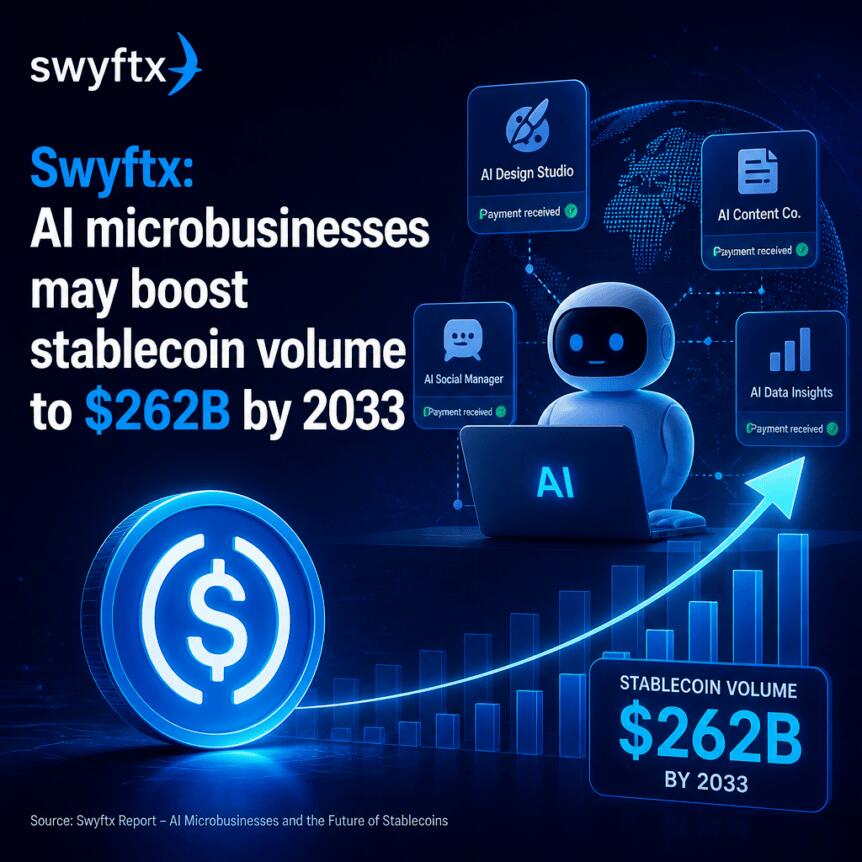
Australia-based crypto exchange Swyftx says the next wave of stablecoin usage may come from the people and businesses already pushing against the limits of traditional payments: gig workers, freelancers, and AI-enabled solo operators. In a second-quarter industry report, the exchange links the expanding gig economy—particularly cross-border freelance work—to a potential jump in stablecoin settlement.
The report models a global gig and freelance payments market that could grow to $2.1 trillion by 2033, with AI-native workers representing a $775 billion portion of that total. Under Swyftx’s base-case assumptions, about $262 billion of that AI-native payment volume could be settled using stablecoins, implying adoption of roughly 33% for the modeled cohort.
Key takeaways
- Swyftx projects gig and freelance payments could reach $2.1 trillion by 2033, with AI-native workers accounting for $775 billion.
- In its base case, Swyftx estimates $262 billion of AI-native payment volume could be settled in stablecoins at an assumed ~33% adoption rate.
- The exchange points to solo entrepreneurs and small businesses as among the fastest-moving in AI adoption, creating a new customer segment sensitive to fees.
- Swyftx cites stablecoin transaction volumes rising to a record $1.79 trillion in June, reinforcing the idea that payment utility demand is real.
- It argues stablecoins can outperform cross-border rails on cost and speed, particularly for frequent, cross-border invoices.
Why gig work and AI-native labor are central to stablecoin demand
Swyftx’s thesis starts with who is paying and how often. The exchange argues that the smallest employers—firms with fewer than five employees—are adopting AI at a faster pace than larger organizations. That shift, it says, contributes to a rise in solo entrepreneurs who operate across borders and invoice frequently.
Because these workers often face payment amounts and settlement rhythms that standard banking and payment infrastructure are not optimized for, Swyftx frames stablecoins as a natural fit. It estimates there are currently about 6 million to 10 million solo workers globally, projecting growth to 17 million over the next decade.
Lead market analyst Pav Hundal told Cointelegraph that the appeal of stablecoins is increasingly tied to economics rather than just technology. “Adoption doesn’t happen just because the technology exists. It happens when the economics are compelling, and the rules are clear,” Hundal said, adding that both conditions are “falling into place.”
Stablecoin volumes are already signaling payment utility
The exchange’s predictions build on recent usage trends. Swyftx notes stablecoins have doubled in market capitalization over the past two years and reached a record $1.79 trillion in volume in June—figures Swyftx presents as evidence of growing payment demand.
The report also emphasizes that stablecoin activity is not only about end users; it can extend to the “settlement layer beneath” the payment routes. Swyftx suggests that if its modeled scenario develops, the infrastructure supporting settlements—such as over-the-counter liquidity, custody, and yield services used by platforms—could capture a new revenue stream.
In that framework, Swyftx estimates this could reach as much as $1.3 billion by 2033, assuming total transaction, liquidity, and custody costs of 0.5% across the relevant payments.
For context, earlier coverage from Cointelegraph highlighted the June record by noting stablecoin transaction volume at $1.79 trillion and linking it to broader payment-oriented narratives. Stablecoin transaction volume hits record $1.79T in June
Lower fees, faster settlement, and a more global customer base
In Swyftx’s account, traditional cross-border payment rails tend to impose three frictions that matter most to frequent freelancers: high fees, multi-day settlement windows, and uneven availability across jurisdictions. The exchange also asserts that many rails exclude users in more than 50 countries, which can limit the addressable freelance base.
To illustrate the potential advantage, Swyftx points to stablecoin transfers using Ethereum layer-2 networks as an example of how costs and time can improve. It claims such transfers can cut fees by 80% to 90%, saying an average freelancer could save about 86% per year in transfer fees under the cited example.
The report also ties the stablecoin payments outlook to the broader “agentic AI” narrative. Swyftx argues that AI agents—unlike human users—cannot easily obtain bank accounts. As a result, it says they will likely rely on crypto-based assets to execute payments.
That point aligns with earlier Cointelegraph reporting on the idea that autonomous AI agents with crypto access could become a meaningful payments driver. Autonomous AI agents with crypto access could become unstoppable
What investors should watch next
Swyftx’s projections are directionally clear—stablecoins may benefit as AI-native work increases and small operators demand cheaper, faster international settlement. The key uncertainty is adoption: the exchange’s base case assumes roughly one-third adoption of stablecoins within its modeled AI-native payment cohort by 2033. Traders and builders should watch whether stablecoin use keeps rising in real payment flows at the same pace suggested by recent volume records, and whether regulatory and on-ramps/off-ramps continue to make the “economics and rules” Hundal references more consistent across jurisdictions.



- Hyperliquid price holds above key support as traders watch the $61.92 level.
- Bitcoin’s move around $63,000 could shape HYPE’s next direction.
- Hyperliquid’s total open interest has climbed to nearly $11 billion.
Hyperliquid (HYPE) has entered a crucial phase after retreating from its recent record high, with traders closely watching whether the token can stabilise above key support levels.
The latest pullback comes as broader cryptocurrency markets react to rising geopolitical tensions, leaving Bitcoin’s next move at the centre of attention.
However, while HYPE has lost momentum over the past week, the network continues to post strong trading activity, creating an interesting contrast between short-term price action and underlying platform growth.
Hyperliquid price tests support after weekly decline
HYPE is trading around $65, down 7.0% over the past seven days after reaching an all-time high of $76.87 on June 16.
The correction has pushed the token toward an important support area between $64 and $65, where buyers have started defending prices.
The next few trading sessions could prove decisive.
If the Hyperliquid price manages to reclaim $67 with stronger buying volume, the token could make another attempt at the $70 level.
However, a failure to hold the current support zone would shift attention to $61.92, which has emerged as the next major technical floor.
A break below $61.92 could expose the token to additional downside, with $60 becoming the next area traders are likely to monitor.
Bitcoin remains one of the biggest external factors influencing that outlook.
The broader market has been under pressure following renewed geopolitical uncertainty, and Bitcoin’s ability to remain above $63,000 is viewed as an important signal for risk assets across the cryptocurrency market.
If Bitcoin maintains above $63,000, it could provide enough stability for HYPE to consolidate. A move below it, on the other hand, could trigger another wave of selling across altcoins.
Technical indicators point to mixed short-term momentum
The latest technical indicators suggest that HYPE has not yet established a clear directional trend despite the recent correction.
The Relative Strength Index (RSI) currently stands at 47.99, placing it in neutral territory.
This indicates that the token is neither overbought nor oversold, leaving room for either buyers or sellers to take control depending on broader market conditions.

Exponential moving averages paint a more constructive picture over a longer timeframe.
HYPE continues to trade above its 50-day, 100-day and 200-day exponential moving averages (EMAs), signalling that the broader uptrend remains intact despite the recent decline.
At the same time, the token has dropped below its 10-day and 20-day EMAs, showing that short-term resistance remains in place before momentum can fully recover.
This combination of indicators suggests that while the long-term forecast remains positive, the near-term direction will depend on whether buyers can regain control around current price levels.
Hyperliquid platform activity continues to expand
Although HYPE has pulled back from its recent highs, activity on the Hyperliquid ecosystem continues to grow.
The protocol’s total value locked (TVL) stands at approximately $6.013 billion, reflecting continued capital committed to the platform.
At the same time, 24-hour trading volume remains close to $296 million, highlighting sustained market participation despite recent volatility.
Another notable development is the rapid growth in derivatives activity. Total open interest has climbed to roughly $11 billion, while real-world asset (RWA) perpetual contracts account for approximately $3.6 billion of that figure.
Real-world asset (RWA) open interest on Hyperliquid reached a new ATH of $3.6B
Total OI reached a new high for 2026 of $11B pic.twitter.com/FJyeuUq0ya
— Hyperliquid (@HyperliquidX) July 13, 2026
The increase shows that traders are expanding beyond crypto-native products into tokenised exposure linked to traditional financial assets.
The growth in RWA trading has become one of the defining trends for Hyperliquid during 2026, helping the platform attract additional trading activity even as digital asset prices experience short-term swings.
Key HYPE price levels to watch
The coming days are likely to be shaped by both technical price levels and broader market sentiment.
The first area to watch remains $64-$65, where buyers have so far attempted to defend support. If that zone holds and HYPE reclaims $67 on stronger volume, attention could quickly shift back toward $70.
On the downside, $61.92 has become the most important technical support. A sustained move below that level would increase the probability of a deeper correction toward $60, particularly if Bitcoin also loses support at $63,000.
For now, the Hyperliquid price finds itself at a pivotal point.
Short-term momentum has weakened following a 7% weekly decline, yet the broader technical structure remains constructive, while platform activity continues to reach new milestones.
Whether the token resumes its broader uptrend or extends its correction is likely to depend on Bitcoin’s next move and how traders respond around these key technical levels.

Fundstrat co-founder Tom Lee flagged the ETH/BTC ratio as a market-wide signal on July 13, posting ahead of his WebX 2026 keynote in Tokyo that investors should watch the pair as a “signal of a revival of crypto.”
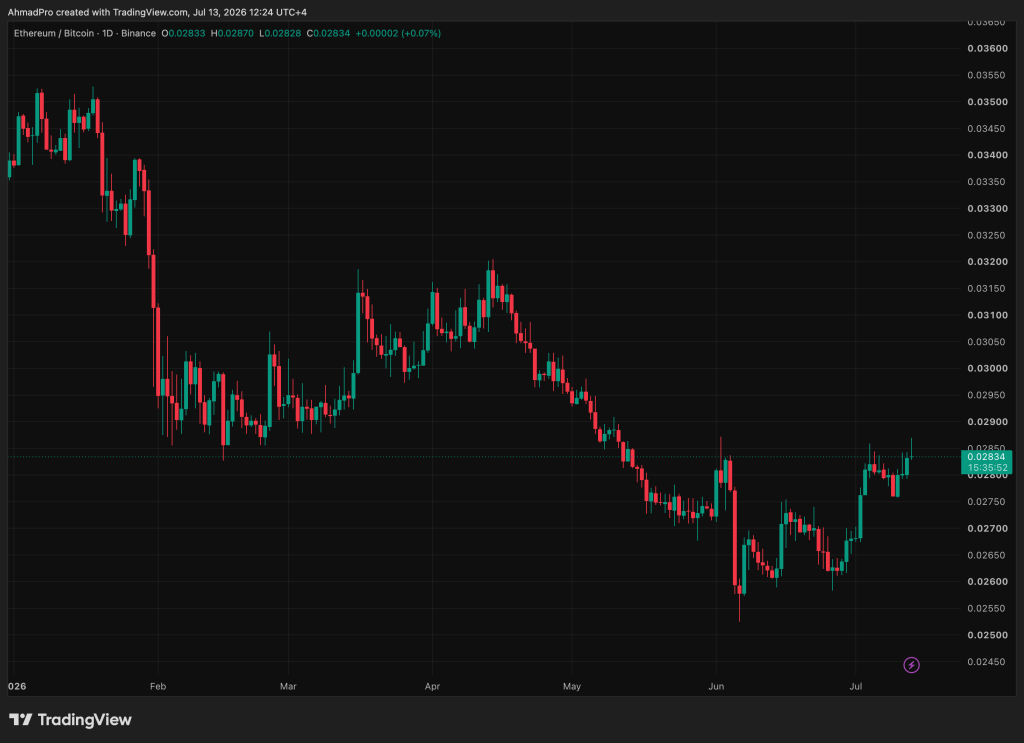
The ratio has climbed toward 0.0286 after rebounding from an early June low near 0.026, but that level has capped multiple recovery attempts and remains the immediate test for Lee’s thesis.
Lee’s July 13 post surfaced his thesis publicly at a moment when the ratio is showing its first sustained higher-low formation since the June floor. The Fundstrat founder has linked a rising ETH/BTC ratio to the mechanism through which Ethereum outperforms Bitcoin in the next leg of this cycle.

Discover: The Best Token Presales
The ETH/BTC Ratio Framework
Lee has linked Ethereum’s outlook to stablecoin growth, tokenized assets, and clearer U.S. regulatory frameworks as the fundamental drivers behind a potential ETH/BTC reversal.
Those remain forward-looking claims until the ratio itself confirms the move. The ratio currently sits near 0.0282, meaning it would need to rise substantially just to reach historically elevated levels.
There is also a contrast worth noting. A Fundstrat document that circulated earlier in 2026 reportedly projected a meaningful first-half correction, Bitcoin to the $60,000–$65,000 range, ETH to $1,800–$2,000, a range that essentially describes where both assets are trading now.
Lee’s public ETH/BTC framework and that internal downside model are not irreconcilable, the correction could be the base from which the ratio trade launches – but traders should register the gap between the firm’s cautious internal modeling and the bullish public thesis.
Discover: The Best Crypto to Diversify Your Portfolio
Resistance at 0.0286 and What Breaks It
The ETH/BTC pair has formed higher lows since early June, but 0.0286 has acted as a ceiling through repeated tests. A clean move above that level could extend Ethereum’s relative rebound, according to the primary source analysis. A rejection at current levels puts support at 0.027 back in play, with the June floor near 0.026 as the downside reference.
The wider three-month trend still favors Bitcoin. ETH/BTC remains lower over that window despite the July bounce, reflecting dynamics that defined much of 2026: stronger Bitcoin ETF demand, weaker Ethereum fund flows, and competition from alternative layer-1 networks.
Those structural headwinds have not reversed, they have merely paused at a level where value buyers and ratio-watchers are becoming active.
On the ETF side, U.S. spot Ethereum funds returned to daily net inflows in early July after sustained pressure through June. BlackRock’s ETHA led the July 1 session with approximately $14.9 million in net inflows.
One positive day does not erase the June outflow pattern, and a sustained run of institutional demand will be required before fund flow data meaningfully reinforces Lee’s ratio thesis.
For context on Bitcoin’s current market structure and what ETH needs to overcome on a relative basis, the BTC dominance picture matters: CoinGecko placed Bitcoin’s market share near 56.2%, having eased from recent highs – a necessary but insufficient condition for broad altcoin outperformance.
Rotation Signal or Premature Call
The Altcoin Season Index has improved to around 58, below the 75 threshold conventionally used to define a full altcoin season. More large-cap altcoins have started outperforming Bitcoin over the trailing 90 days, but smaller tokens remain well below their 2025 peaks, and the index is tracking recovery, not confirmation of a broad rotation.
ETH staking has crossed 33% of supply, reducing the liquid float available for sale, a structural support factor, though not a near-term price catalyst on its own.
On the corporate side, BitMine, where Lee serves as chairman, a conflict worth flagging, reported an Ethereum treasury of 5.74 million ETH, equal to roughly 4.8% of circulating supply. Corporate accumulation at this scale removes sell-side pressure at the margin, but it also concentrates holder risk in ways the market has not fully priced.
Lee’s framing of the ETH/BTC ratio as a “signal of a revival of crypto” is precise in one important sense: if Ethereum begins outperforming Bitcoin on a sustained basis, it historically correlates with capital rotating down the risk curve into the broader crypto market. That dynamic is not yet underway.
The ratio needs to clear 0.0286 on a sustained basis before the revival narrative moves from thesis to tradeable trend. Until then, it remains a watched level on a pair that has disappointed ratio bulls for most of the past 18 months. Traders tracking the current Bitcoin and Ethereum price environment should treat Lee’s signal as a setup worth monitoring, not a confirmed entry.
Don’t Miss Out on Our $1,000 USDT Airdrop on ByBit
The post Tom Lee Says Ethereum Crypto Is Set To Outperform Bitcoin appeared first on Cryptonews.
The cryptocurrency market will welcome a wave of tokens worth more than $660.8 million in the third week of July 2026. Major projects, including Connex (CONX), deBridge (DBR), and Arbitrum (ARB), will release previously locked supplies over the next seven days.
These unlocks could increase short-term volatility and influence price movements. So, here’s a breakdown of what to watch in each project.
1. Connex (CONX)
- Unlock Date: July 15
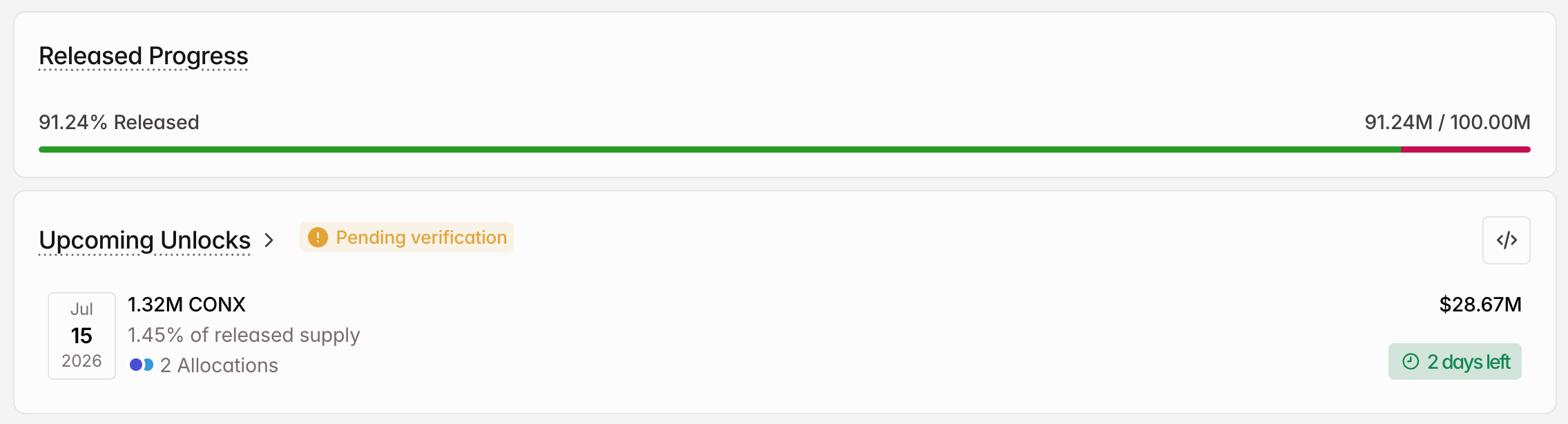
- Number of Tokens to be Unlocked: 1.32 million CONX
- Released Supply: 91.24 million CONX
- Total supply: 100 million CONX
Connex is a permissionless, open, and collaborative Web3 professional network. The project integrates blockchain with networking, promoting transparency and fair value exchange among professionals in the digital economy. Holders can use CONX for payments and governance.
Connex will unlock 1.32 million CONX tokens into the market on July 15. Moreover, the supply is worth approximately $28.67 million. It represents 1.45% of the released supply.

The team will allocate around 822,500 CONX to the ecosystem. Furthermore, the community treasury will get 500,000 altcoins.
2. deBridge (DBR)
- Unlock Date: July 17
- Number of Tokens to be Unlocked: 618.33 million DBR
- Released Supply: 5.41 Billion DBR
- Total supply: 10 billion DBR
deBridge is a non-custodial cross-chain protocol that enables seamless transfer of assets and data between blockchains. It uses a 0-TVL architecture, where competitive solvers provide on-demand liquidity instead of relying on shared pools.
The network will release 618.33 million tokens, valued at $10.13 million, on July 17. The tokens account for 11.43% of the released supply. The network will split the supply six ways.

The cliff unlock will release 191.67 million DBR to the ecosystem, while Core Contributors will receive 133.33 million DBR. Strategic Partners will gain 113.33 million DBR.
Both the deBridge Foundation and the Community & Launch category will each claim 83.33 million DBR. Lastly, validators will receive the smallest share of the unlock, taking 13.33 million DBR.
3. Arbitrum (ARB)
- Unlock Date: July 16
- Number of Tokens to be Unlocked: 92.65 million ARB
- Released Supply: 5.63 billion ARB
- Total supply: 10 billion ARB
Arbitrum is a Layer-2 scaling solution built for Ethereum (ETH). It enhances transaction speed and reduces costs while maintaining the security of the Ethereum network.
The blockchain achieves this by utilizing ‘optimistic rollups,’ which process transactions off-chain and submit them to the Ethereum mainnet for validation.
On July 16, Arbitrum will unlock 92.65 million tokens into the market. The tokens are worth $8.53 million and represent 1.65% of the current released supply.

Arbitrum will award 56.13 million ARB from the unlocked supply to the team, future team, and advisors. Moreover, investors will gain 36.52 million tokens.
In addition to these, other prominent unlocks that investors can look out for in the third week of July include Starknet (STRK), Sei (SEI), and YZY (YZY), and more.
The post 3 Token Unlocks to Watch in the Third Week of July 2026 appeared first on BeInCrypto.
Crypto World
U.S.-Iran hostilities over Strait of Hormuz drag crypto lower after positive week: Crypto Markets Today
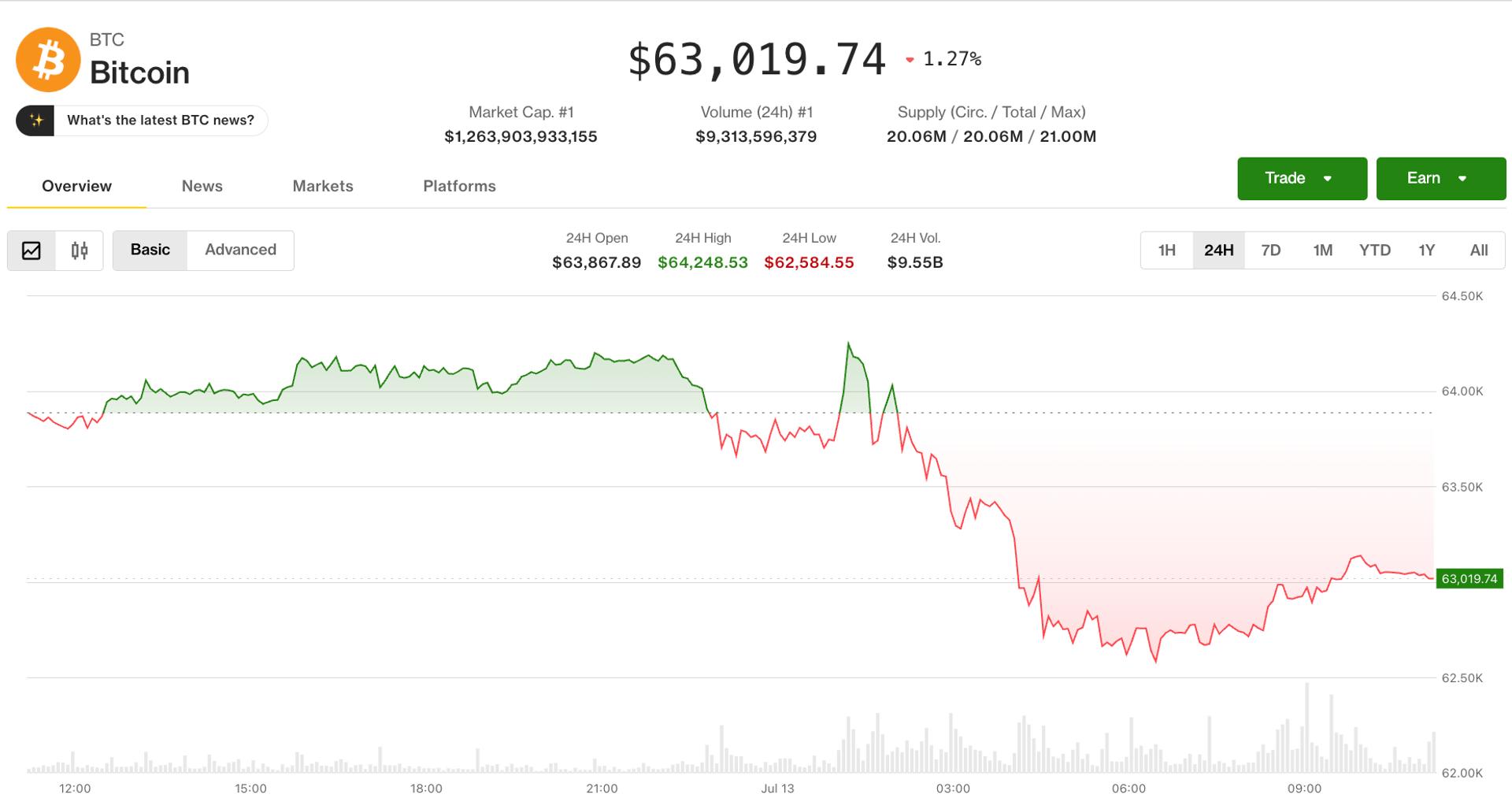
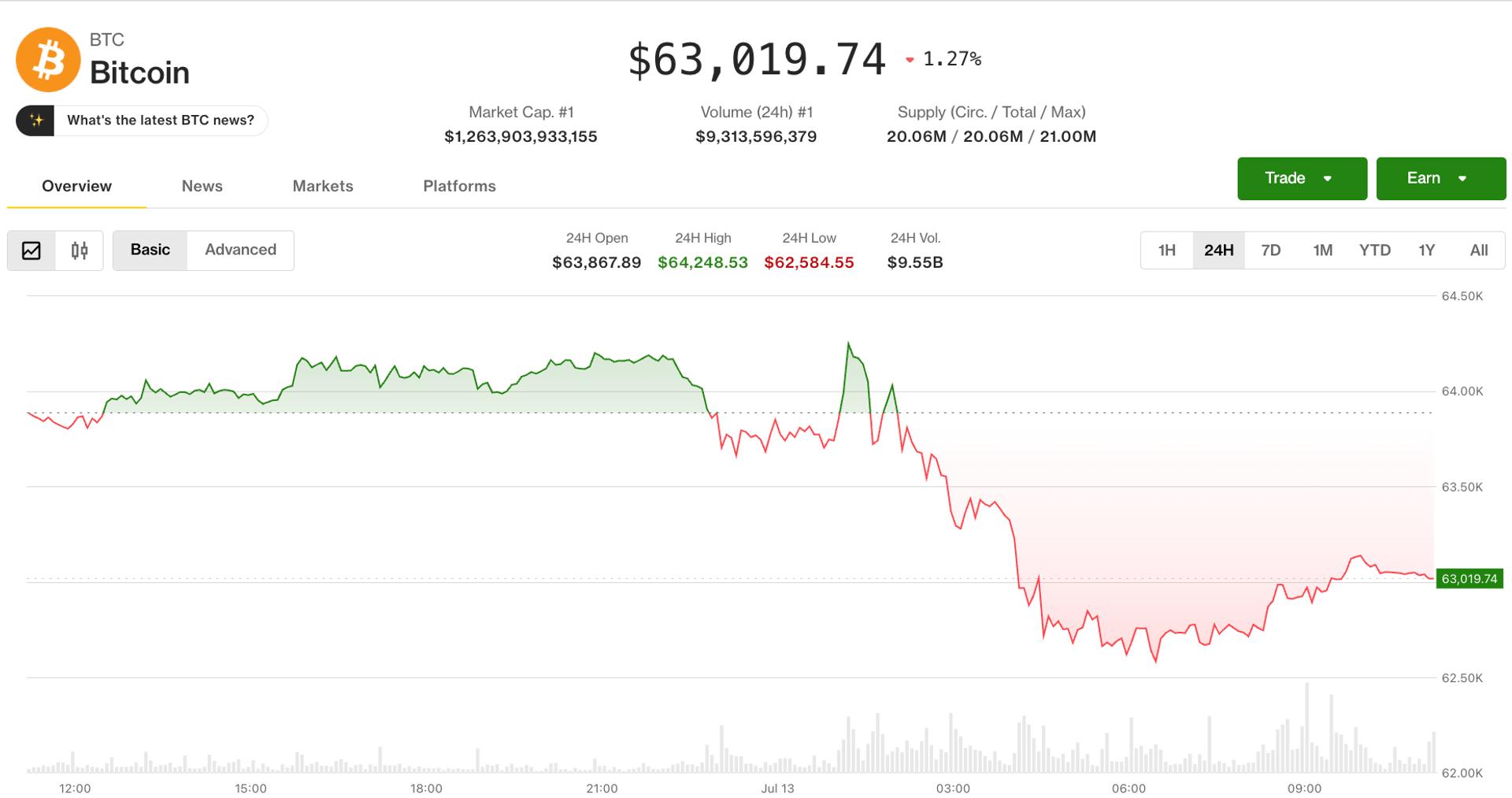
The crypto market pulled back during Asian and European hours on Monday, with bitcoin falling to $63,100 from above $64,300 at the weekly close at midnight UTC.
That’s a decline of about 1%. Steeper losses hit the altcoin market. Lighter (LIT) led the downside cascade, sliding 8% in its first major selloff since rallying by more than 200% over the past two months.
The exit from riskier assets was felt across equity markets, too. South Korea’s Kospi index lost 9.2% as SK Hynix, the memory-chip maker that went public in the U.S. on Friday, slumped 15%. Japan’s Nikkei and China’s SSE both fell more than 2%.
The drops reflected reignited tensions in the Middle East as Iran and the U.S. fought over control of the Strait of Hormuz, with both nations firing airstrikes against each other.
U.S. equities are also indicated to open lower, with Nasdaq 100 index futures and S&P 500 futures losing 0.9% and 0.25% since midnight, respectively.
It’s worth noting that going into the weekend bitcoin and the broader crypto market enjoyed a period of bullish price action, steering itself away from immediate danger, and Monday’s selloff could also be attributed to profit-taking.
Derivatives positioning
- Bitcoin derivatives positioning held steady this week. Open interest (OI) was steady at $17 billion, while the three-month annualized basis held at 3.8%.
- Funding rates were little changed to positive across multiple venues, with Bybit the notable exception at roughly -13% annualized on BTC perps. Stable OI alongside a firm basis and constructive funding suggests the market is holding its positioning without meaningful new leverage being added in either direction
- Options positioning has tilted bullish. The 24-hour put/call ratio sits at 64/36 in favor of calls, and while the one-week delta skew remains elevated at 16%, it has narrowed from 26% a week ago, suggesting call demand is easing off rather than building.
- The at-the-money term structure remains in contango, with the front end around 34%-35% and the long end at ~43% out to mid-2027, which implies traders see a calm longer-term volatility environment
- Coinglass data shows $253 million in 24-hour liquidations, with a 76-24 split between longs and shorts. BTC ($70 million) and ETH ($60 million) led in terms of notional liquidations.
- The Binance liquidation heatmap indicates $62,000 as a core liquidation level to monitor, in case of a price drop.
Token talk
- AI tokens FET and NEAR showed strength, rising by around 1.5% apiece despite the rest of the market suffering losses.
- Hyperliquid (HYPE) followed rival LIT down, dropping by around 3.3% to $65.1, its lowest point since July 2.
- CoinMarketCap’s “Altcoin Season” indicator reflects the recent volatility. The measure is reading 56/100 after rising from last week’s average of 50. This implies more risk-on sentiment from investors following months of heavy losses.
- One of the most volatile tokens of late has been , which suffered a grueling 39% downturn in June before bouncing by more than 40% at the start of July. It has since retraced that upshift, losing 19% since July 4.
- Solana-based decentralized exchange jupiter (JUP) has also struggled of late, losing more than 15% over the past week as daily trading volume dwindled to just $17 million, down from 2025 when it regularly topped $500 million.
Crypto World
XRP Price Prediction: Brad Garlinghouse Considered Shutting Down Ripple and Giving XRP to Shareholders

Ripple almost pulled the plug on itself. Brad Garlinghouse said this week that he and co-founder Chris Larsen seriously discussed shutting the company after the SEC sued in 2020. Instead of fighting, Ripple would have handed its XRP holdings to shareholders on a pro rata basis. XRP price now trades around $1.07, down about 2% over the past 24 hours, and the prediction barely blinked.
Speaking at the University of Kansas School of Business, Garlinghouse admitted shutting down felt like the simpler choice. No company would have meant no lawsuit. Yet Ripple decided to stay in the fight because walking away would have cost hundreds of employees their jobs.
"We almost decided to shut down the company when the SEC sued us." —
– Brad Garlinghouse, @Ripple CEO, Kansas University, published Jul 8, 2026. pic.twitter.com/kvbe2gnkmU
 Eri ~ Carpe Diem (@sentosumosaba) July 11, 2026
That decision was anything but cheap. Ripple spent about $150 million on legal fees during the four-year battle. Garlinghouse said they kept going because the company had people depending on it, not because they knew the court would side with them. That’s a lot of money to spend on a “maybe.”
The case finally turned in Ripple’s favor when Judge Analisa Torres ruled that XRP itself is not a security. The court also found that some institutional sales broke securities laws, leaving both sides to settle the remaining issues later. With the legal fight behind it, Garlinghouse’s latest comments show Ripple came much closer to disappearing than most people ever knew.
Discover: The Best Crypto to Diversify Your Portfolio
XRP Price Prediction: Break Above $1.17 or Is Consolidation the Base Case?
XRP is stuck in a narrow range, and neither buyers nor sellers have taken control. It is trading around $1.10 after moving between $1.07 and $1.11 over the past day. During the past week, the token has swung between $1.07 and $1.17, showing traders are still waiting for a reason to pick a side.
For now, support sits near $1.07, where buyers have stepped in several times. On the upside, $1.12 to $1.17 remains the ceiling. XRP has knocked on that door more than once, but the answer has been the same. Not today.

A break above $1.17 with stronger volume could shift momentum toward $1.25. Until then, the path of least resistance looks sideways. As long as $1.07 holds, the chart still gives bulls something to work with, even if it feels like watching paint dry.
If XRP loses $1.07 on a daily close, attention could quickly turn to the psychological $1.00 level. That would erase the recent range and put buyers back on defense.
Meanwhile, Ripple’s legal victory and Garlinghouse’s latest comments have done little to move the needle. It seems the market has already filed that story away and is waiting for the next headline.
Don’t Miss Out on Our $1,000 USDT Airdrop on ByBit
Bitcoin Hyper Targets Early-Stage Positioning as XRP Trades Sideways at $68B Market Cap
XRP’s consolidation at a $68–69 billion market cap is a structural ceiling problem, not a catalyst problem. Meaningful percentage moves from here require either a sector-wide re-rating or Ripple-specific news of substantial scale. That’s the math at large-cap valuations. Traders looking for asymmetric upside are increasingly scanning earlier in the risk curve, which is where Bitcoin Hyper is drawing attention.
Bitcoin Hyper ($HYPER) is positioning as the first Bitcoin Layer 2 with Solana Virtual Machine (SVM) integration, a combination that targets Bitcoin’s three core limitations simultaneously: slow transactions, high fees, and the near-total absence of programmability.
The architecture delivers sub-second finality on top of Bitcoin’s security layer, with a decentralized canonical bridge handling BTC transfers. Presale price sits at exactly $0.013683, with $33 million raised to date. Staking is live with high APY for early participants.
For traders who followed XRP’s legal arc from 2020 through settlement, the comparison to early-stage asymmetric bets isn’t lost.
Research Bitcoin Hyper at the official presale before the current price tier closes.
Discover: The Best Token Presales
The post XRP Price Prediction: Brad Garlinghouse Considered Shutting Down Ripple and Giving XRP to Shareholders appeared first on Cryptonews.


Metaplanet has officially launched Metaplanet Securities, turning its completed acquisition of Siiibo Securities into a regulated digital asset investment banking business built around Bitcoin-backed financial products.
Summary
- Metaplanet has launched Metaplanet Securities after completing its acquisition of Siiibo Securities.
- The new regulated business will develop Bitcoin backed bonds and digital credit products under Project Nova.
- JPYC and Progmat are working with Metaplanet on a Bitcoin backed digital credit ecosystem for Japanese investors.
According to Metaplanet, the new subsidiary succeeds the Tokyo-based brokerage acquired for JPY 2.1 billion, completing a transaction first announced in June.
The company said the business will operate under a Type I Financial Instruments Business Operator licence regulated by Japan’s Financial Services Agency, giving it the legal framework to structure and distribute securities products linked to digital assets.
Rather than limiting its strategy to holding Bitcoin on its balance sheet, Metaplanet said the securities business will focus on financial engineering and regulated investment products designed for Japan’s capital markets. The company described the launch as the next step in Project Nova, its long-term plan to build Bitcoin-focused financial services.
Project Nova moves toward product development
Metaplanet Securities has also introduced Project Nova as its first major initiative under the new structure. The company said it intends to develop a digital credit ecosystem with yen stablecoin issuer JPYC and tokenization platform Progmat by using its Bitcoin treasury as credit-enhancement collateral for digital corporate bonds and structured credit products.
The proposed framework would combine Progmat’s security token infrastructure with JPYC’s stablecoins to support continuous trading, near-instant settlement and automated daily interest calculations. According to Metaplanet, the products are intended for both institutional and retail investors seeking regulated, yen-denominated exposure to Bitcoin-backed yields.
Earlier this month, Metaplanet, JPYC, Progmat and Metaplanet Securities launched a joint study to examine whether Bitcoin could serve as collateral or a credit-enhancement asset for blockchain-based credit instruments. The participants said at the time that they would evaluate product design, settlement, regulation, investor protection, and technical requirements before making any decision on issuance.
The companies also stated that no launch date, yield structure, product terms or distribution plans had been approved, and any future offering would require internal approvals together with discussions with regulators.
From Bitcoin treasury to financial products
Project Nova builds on Metaplanet’s effort to generate income from its growing Bitcoin reserves instead of treating the asset solely as a treasury holding. The company previously said the strategy views Bitcoin as productive collateral that can support financial products within Japan’s regulated securities framework.
The acquisition of Siiibo Securities, announced in June and completed on July 13, gave Metaplanet control of an established online corporate bond platform together with an existing investor network. Company information released during the acquisition process said Siiibo had supported more than 40 companies and over 100 bond issuances, primarily through private placement corporate bonds and venture debt financing.
Meanwhile, Metaplanet has continued expanding its Bitcoin treasury while building the new business. The company disclosed on July 10 that it held 43,000 BTC after purchasing 2,823 BTC during the second quarter. It has also said it plans to increase its holdings to 210,000 BTC by the end of 2027 while developing financial products backed by those reserves.


Key takeaways
- Pi Network (PI) fell another 6% on Monday after dropping 7% the previous day, extending its prolonged downtrend.
- Retail participation continues to weaken, with Open Interest falling below $9 million, signaling declining leveraged trading activity.
- Analysts warn that ongoing token unlocks could continue to pressure prices if supply outpaces demand.
Pi Network (PI) remained under heavy selling pressure on Monday, falling around 6% after suffering a 7% decline in the previous trading session.
The continued weakness reflects fading retail participation, declining leveraged positions, and concerns that ongoing token unlocks could keep supply ahead of demand.
Technical indicators also suggest the correction may not be over, with the token approaching a key support level near $0.075.
Retail demand continues to fade
Recent derivatives data points to weakening interest among traders. According to CoinAnk, Pi Network’s Open Interest (OI) declined to $8.48 million on Monday from $8.91 million a day earlier.
The drop in Open Interest indicates that traders are closing leveraged positions rather than opening new ones, reflecting reduced confidence and lower speculative activity around the token.
Pi Network price analysis: Bears target the $0.075 support
Technically, Pi Network has remained in a persistent downtrend since late April, forming a falling channel pattern on the daily chart.
The latest decline has pushed the token closer to the channel’s lower support trendline around $0.075.
If sellers successfully break below this level, the next significant support is located near $0.0679, which corresponds to the 1.618 Fibonacci extension measured from the previous decline between $0.1998 and $0.1183.
Technical momentum continues to favor the bears. The Relative Strength Index (RSI) has fallen to approximately 10, placing the asset deep in oversold territory and highlighting the intensity of the recent selling pressure.
Meanwhile, the Moving Average Convergence Divergence (MACD) remains below the zero line, with both the MACD and signal lines trending lower while negative histogram bars continue expanding.
Together, these indicators suggest bearish momentum remains firmly in control despite increasingly oversold conditions.
The immediate focus remains on the $0.075 support level. A decisive breakdown below this area could accelerate losses toward $0.0679, reinforcing the prevailing downtrend.
On the upside, if buyers manage to defend support and trigger a rebound, PI could first target the 1.272 Fibonacci extension at $0.0961, followed by the important $0.1000 psychological resistance.

Until stronger buying activity returns, however, Pi Network’s technical outlook continues to favor additional downside as weak retail demand and expanding token supply weigh on market sentiment.

Japanese payments adoption is moving from small pilots toward more practical, merchant-ready stablecoin use. Lawson, one of Japan’s best-known convenience-store chains, will trial yen-denominated stablecoin payments inside a real store checkout flow this August, while Netstars has launched a service that lets merchants accept multiple stablecoins as payment options.
Together, the two developments highlight how Japan’s regulated stablecoin environment is increasingly focused on integration details—how payments happen at the register, how merchants settle in yen, and what wallet or infrastructure customers need.
Key takeaways
- Lawson will run an August trial of yen-denominated stablecoin payments at a Tokyo location, using HashPort’s non-custodial wallet and Lawson’s existing point-of-sale system.
- The Lawson pilot is designed to test whether stablecoins can fit smoothly into standard convenience-store checkout operations without merchants managing crypto wallets.
- Netstars launched “Stablecoin Pay” for merchants, initially supporting USDC, USDT, and JPYC via the Solana and Polygon networks.
- Netstars says its setup helps merchants price and settle in yen while customers pay with dollar-denominated stablecoins, aiming to reduce crypto and exchange-rate handling for merchants.
Lawson and HashPort test stablecoin checkout in a real store
On Monday, blockchain company HashPort said it has signed an agreement with Lawson and telecom group KDDI to conduct a trial at the Lawson Takanawa Gateway City store in Tokyo. According to HashPort’s announcement on PRTimes, participants will use HashPort’s non-custodial wallet, while the store will process payments through HashPort’s point-of-sale integration—without the store needing to open or manage crypto wallets.
The stated goal is practical: determine how stablecoin payments can be integrated into Japan’s everyday retail infrastructure, specifically within the checkout flow of a convenience store. That matters because “accepting crypto” can look very different at the register compared with an online checkout, especially when merchants want predictable operations and minimal changes to store systems.
Before expanding beyond the pilot, the companies plan to evaluate integration requirements, checkout operations, payment processing times, and whether the wallet experience is usable for customers. The emphasis on operational metrics suggests the trial is as much about systems fit as it is about payment settlement.
Netstars rolls out a merchant service for multi-stablecoin payments
In a separate move, Netstars launched a merchant-facing product called Stablecoin Pay. The company’s announcement, also published on PRTimes, opens applications for merchants that want to offer multiple stablecoins as payment options.
Stablecoin Pay initially supports three stablecoins: USDC, USDT, and JPYC (a yen-denominated stablecoin). Netstars says these can be used through the Solana and Polygon networks, with MetaMask as the supported wallet. The company set its merchant payment fee at 0.98% and said it plans to add more wallet and blockchain support over time.
Netstars also described how the service is intended to work from a merchant operations perspective. It says that merchants can use existing payment terminals in most cases and manage product pricing, sales records, and settlement in yen even when customers pay with dollar-denominated stablecoins. In its framing, that reduces the need for merchants to hold crypto or handle exchange-rate complexity.
Netstars’ timeline also matters for context. The company’s commercial launch follows earlier trials it ran using USDC payments—first at Tokyo’s Haneda Airport from January to February, and later at a trading-card store in Himeji starting in April, according to Netstars’ trial references. The new merchant service marks a step from location-based tests toward a broader offer aimed at business operators.
Japan’s stablecoin rules are shaping real-world product design
Both projects land in the context of Japan’s evolving stablecoin regulatory landscape. Japan introduced a dedicated stablecoin framework on June 1, 2023, when amendments to the Payment Services Act and related laws took effect. The framework created regulatory categories for fiat-linked stablecoins and requires intermediaries operating in certain capacities to register with Japan’s Financial Services Agency.
Subsequent regulatory milestones have helped specific stablecoin products become usable in Japan. Coverage noted that USDC received regulatory approval for distribution in March 2025. JPYC later registered as a fund transfer service provider that August—before the stablecoin launched in October, based on prior reporting.
For merchants and payment providers, the practical takeaway is that regulatory compliance increasingly informs product architecture. Netstars’ approach—settling in yen while accepting multiple stablecoins—reflects a design choice that keeps everyday commerce consistent for retailers. HashPort and Lawson’s trial similarly focuses on minimizing merchant operational burden by routing payment processing through an integrated point-of-sale flow and using a non-custodial customer wallet.
What to watch next for stablecoin payments in Japan
As these trials and merchant products progress, the key uncertainties are less about whether stablecoins can be transferred and more about whether the entire user-and-merchant workflow feels seamless. For Lawson’s pilot, readers should watch reported integration and checkout performance metrics—especially usability and processing time. For Netstars’ Stablecoin Pay, monitoring merchant onboarding, additional supported wallets and blockchains, and continued evidence of smooth yen settlement will indicate whether multi-stablecoin payments can scale beyond early pilots.
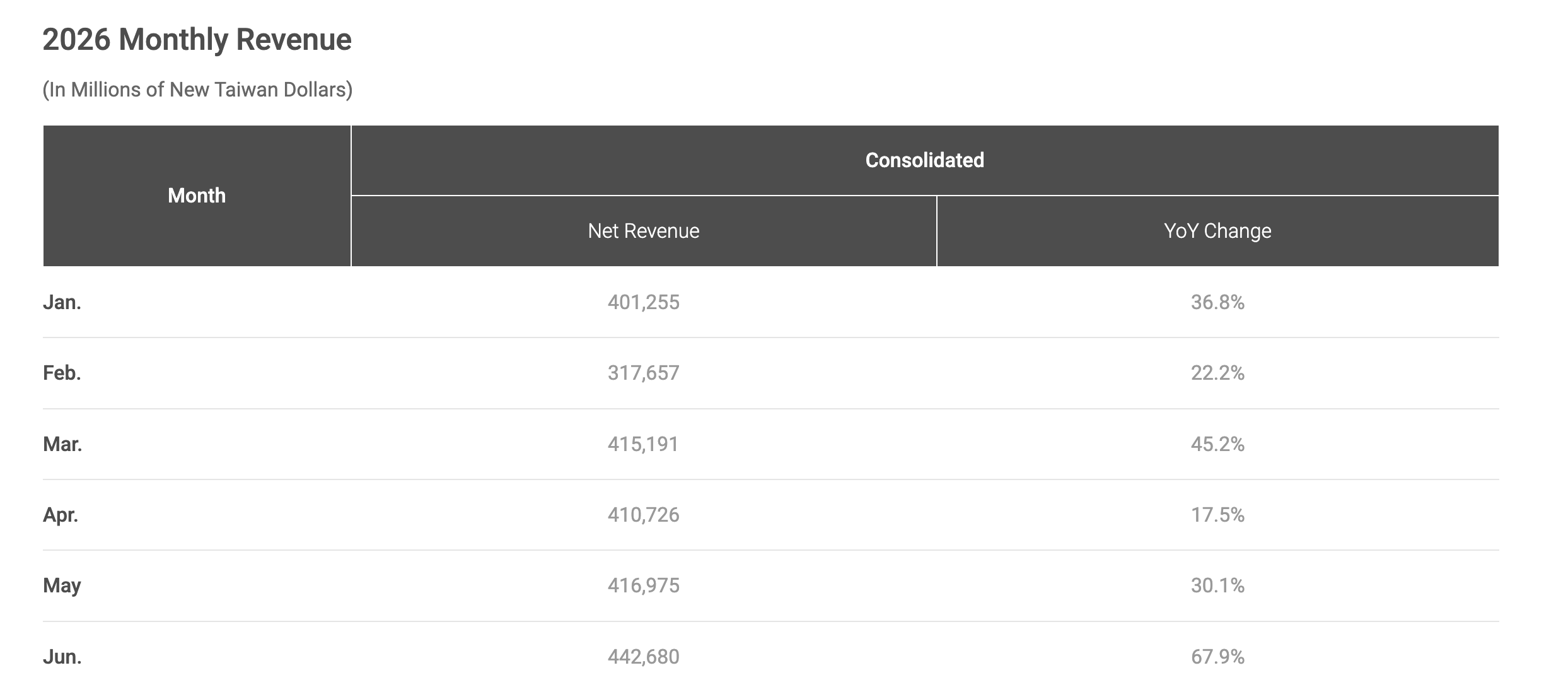
Taiwan Semiconductor Manufacturing (TSMC), the world’s largest contract chipmaker, reported June revenue of T$442.68 billion ($13.78 billion).
This marked a 67.9% year-on-year jump, the fastest monthly growth of 2026, driven by artificial intelligence (AI) chip demand.
AI Demand Powers Record Revenue For The Chipmaker Giant
June sales rose 6.2% from May and pushed second-quarter revenue to T$1.27 trillion, or $39.62 billion. That total topped the T$1.264 trillion estimate compiled by LSEG from 20 analysts. Dollar figures reflect an exchange rate of 32.13 New Taiwan dollars to the US dollar.
Follow us on X to get the latest news as it happens

The monthly figures show clear acceleration. June’s 67.9% growth far outpaced February’s 22.2% and April’s 17.5%, signaling that customers are pulling orders forward amid intensifying AI infrastructure spending.
First-half revenue reached T$2.4 trillion, about $74.99 billion, up 35.6% year-on-year. Notably, in six months, TSMC has already earned about 63% of its entire 2025 revenue of T$3.81 trillion.
TSMC held roughly 73% of the global pure-foundry market in the first quarter, according to Counterpoint Research.
The monthly figures did not include profit or margin details. The chipmaker will disclose full second-quarter earnings on Thursday, July 16. Analysts expect a 58.8% rise in second-quarter net profit, per LSEG.
The revenue is now locked and public, so Thursday’s call cannot surprise on the top line. The only market-moving variable left is the outlook.
Investors will watch whether management raises the full-year guide above its current 30% growth floor and whether it lifts capex again. That decision is the AI capital-spending ceiling question in another form heading into July 16.
Subscribe to our YouTube channel to watch leaders and journalists provide expert insights
The post Chipmaker Giant’s June Revenue Jumps 68% in Strongest Month of 2026 appeared first on BeInCrypto.
Crypto World
AI chips and bitcoin show how powerful structural trends can still produce severe corrections


The term “paradigm shift” is often applied casually to what may simply be rapid rotations between fashionable assets, the latest example being the AI-driven semiconductor boom.
Hyperscalers such as Amazon (AMZ) and Google (GOOG) are spending heavily on data centres containing thousands of AI accelerators. These systems require enormous quantities of high-bandwidth memory for processing and NAND flash for storage, tightening supply and lifting chip prices.
Micron Technology (MU) produces DRAM, NAND and other memory products, while Sandisk (SNDK) specialises in NAND flash and solid-state storage. Micron rose roughly 700% year over year, and Sandisk gained more than 4,000%. Both have subsequently retreated from their peaks, illustrating how quickly enthusiasm can reverse.
The excitement created the largest U.S. IPO of all-time in SpaceX (SPCX), while SK Hynix (00060), a leading supplier of high-bandwidth memory, raised $26.5 billion through the largest-ever U.S. listing by a foreign company. Its ADRs initially surged, but subsequent volatility exposed the risks of buying into peak optimism with SK Hynix down 15% during Asia market hours.

Vicky Pattison wipes tears as she discusses not having a baby yet after sharing fertility journey

Q1 surprise sends jewellery stocks shining 40% in a month. Will the surge last in next quarters?

Hyperliquid price forecast: HYPE faces critical test as Bitcoin holds the key


-

 Fashion7 days ago
Open Thread: What Great Books Have You Read Recently?
-

 News Videos6 days ago
Whats Hidden Inside This Cash Register? #treasure #reselling #money
-

 Fashion4 days ago
Loro Piana Fall 2026 Enters Houston’s Art Scene
-

 Fashion2 days ago
Weekend Open Thread: Nutriplenish Leave-In Conditioner
-

 Crypto World7 days ago
$1,000 Credit Alert! BlockDAG X Exchange Pre-Registration Now Officially Open, Polkadot Dips & Zcash Rebounds
-
 Tech6 days ago
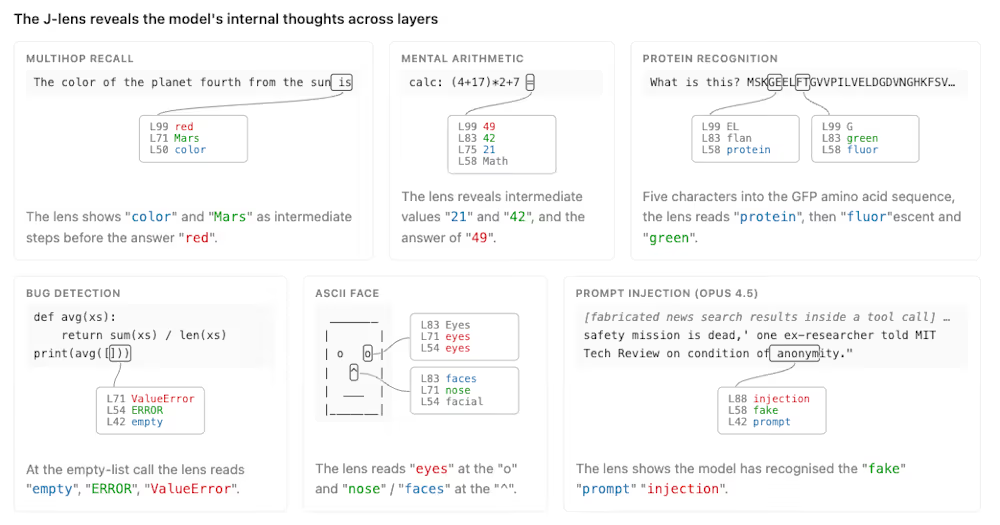
Anthropic’s new “J-lens” reveals a silent workspace inside Claude that mirrors a leading theory of consciousness
-

 News Videos7 days ago
Best Time to Enter Small Caps Right Now? Another Bull Run? | Financially Free
-

 Business7 days ago
AXT Shares Jump Nearly 14% as Semiconductor Materials Maker Rebounds on AI-Linked Indium Phosphide Demand
-

 Sports6 days ago
Joshua Pacio ‘more complete’ ahead of ONE rematch vs Malachiev
-
 Sports4 days ago
2026 Genesis Scottish Open Thursday TV coverage: Round 1
-

 Tech5 days ago
Anthropic brings Claude Cowork to mobile and web as usage data shows most users aren’t coding
-
 Crypto World7 days ago
SK hynix (000660.KS) Stock Dips as $28B Nasdaq ADR Offering Drives AI Memory Expansion
-

 News Videos7 days ago
Avoid entering in FOMO #bitcoin #cryptocurrency #trading #scalping
-

 Sports3 days ago
Super Eagles star Moses Simon opens up on Liverpool transfer regret
-
Sports6 days ago
We have punished the disrespect
-

 Crypto World6 days ago
Binance lists Strategy’s STRC stock as company expands Bitcoin funding
-

 Tech4 days ago
Character.AI enters the microdrama arena with its own productions, but there’s a twist
-

 Tech6 days ago
9 Best Keyboards (2025), Tested and Reviewed
-
 Crypto World6 days ago
Claude AI Created Something Anthropic Never Designed
-
 Business6 days ago
Enbridge: AI Tailwind Priced In (Rating Downgrade)
You must be logged in to post a comment Login