Connect with us
DAPA Banner
DAPA Coin
DAPA
COIN PAYMENT ASSET
PRIVACY · BLOCKDAG · HOMOMORPHIC ENCRYPTION · RUST
ElGamal Encrypted MINE DAPA
🚫 GENESIS SOLD OUT
DAPAPAY COMING

Politics

Why Are People Calling Women ‘Birds’ Online?

Published

on

Why Are People Calling Women 'Birds' Online?

Content note: this article contains discussion of domestic abuse.

If you grew up in the UK, you might have heard women referred to as “birds” once in a while (stats suggest many of us would like to ditch the term, however).

That usage refers to women in general, or a female partner, but on social media, calling a woman a “bird” has come to mean something entirely different.

What does calling a woman a “bird” mean on social media?

Advertisement

People on apps like TikTok have taken to referring to women as “birds” for enduring bad treatment from the men they’re romantically involved with, or for being overly male-centred (prioritising male perspectives and approval).

“A bird is essentially a woman who will give up her self-dignity for the purpose of supporting a man or being with a man,” one TikTok creator said, though the poster stressed that didn’t extend to physical abuse.

An example may be “if he cheats on you 35 times and you get with him a 36th time”, they added, and “you are willing to lie for a man … [and] are willing to put a woman down for a man”.

Per Urban Dictionary, it can also mean someone, especially a girl or young woman, who’s naive, easily fooled, and/or lacking in common sense.

Advertisement

It may also refer to internalised misogyny – so-called “bird brain behaviour” can involve laughing at a man’s joke deriding another woman’s looks, for instance.

Some have called the new use of the phrase “misogynistic”.

“Anyone notice how calling a woman a bird has quickly shifted from holding women accountable for enabling men, to blaming women for being mistreated by men?” asked one TikTok creator.

“Calling women birds for something a man did is rooted in misogyny,” another claimed.

Advertisement

Is it victim-blaming?

Not every use of the term “bird” has to do with men (one creator suggested hanging out and trusting a girl “who talks negative about everyone in their life” is “bird brain behaviour”), and some male-related videos about “birds” say the term shouldn’t extend to abuse and only applies to general bad dating behaviour.

But other posts on social media suggest the demarcation isn’t always clear.

“A piece of shit man can also be an abuser… just because it’s not straight-up domestic abuse… there’s different ways to be abused,” one TikToker said.

Advertisement

They added that factors like financial inequality, a patriarchal society, and negative childhood experiences can make staying through poor treatment and abuse more likely, which the charity Women’s Aid and research papers agree with.

“I’ve been thinking that calling women ‘birds’ is… basically telling her to shut up and that whatever situation she’s in is her fault,” a commenter assented, while another wrote: “I totally agree as a [sexual assault] survivor”.

A spokesperson for the European Institute for Gender Equality (EIGE) told HuffPost UK that if the term is used to describe abuse, it’s important to remember that “violence against women is fundamentally both a cause and a consequence of gender inequality”.

“It is rooted in unequal power dynamics and is often used to maintain power and control over women, whether in intimate relationships, workplaces, online spaces or public life,” they said.

Advertisement

“In this context, we also need to look at the responsibility online platforms have in moderating conversations about violence against women – especially when the language and tone risk reinforcing victim-blaming attitudes.”

But they added that safeguards should be instituted from the top down on social media, rather than focusing on a specific trend or post.

The EIGE’s recent report on combatting cyber violence against girls suggested platforms can help prevent the normalisation of abuse and foster safer digital environments by “embedding effective safeguards and challenging harmful gender stereotypes”.

If you, or someone you know, is in immediate danger, call 999 and ask for the police. If you are not in immediate danger, you can contact:

  • The Freephone 24 hour National Domestic Abuse Helpline, run by Refuge: 0808 2000 247
  • In Scotland, contact Scotland’s 24 hour Domestic Abuse and Forced Marriage Helpline: 0800 027 1234
  • In Northern Ireland, contact the 24 hour Domestic & Sexual Violence Helpline: 0808 802 1414
  • In Wales, contact the 24 hour Life Fear Free Helpline on 0808 80 10 800.
  • National LGBT+ Domestic Abuse Helpline: 0800 999 5428
  • Men’s Advice Line: 0808 801 0327
  • Respect helpline (for anyone worried about their own behaviour): 0808 802 4040

Source link

Advertisement
Continue Reading
Click to comment

You must be logged in to post a comment Login

Leave a Reply

Politics

David Beckham Responds To Victoria’s Viral World Cup Reactions

Published

on

Victoria wasn't quite as jubilant as the rest of her family on Saturday night

Sir David Beckham has responded to one comedian’s send-up of his wife Victoria’s less-than-animated reactions to watching the England football team playing over the weekend.

On Saturday night, Sir David and Victoria were joined by their youngest three children, Romeo, Cruz and Harper Beckham to see England’s latest World Cup game, where the squad triumphed over Norway.

While the rest of the Beckhams couldn’t hide their joy at England’s success, it’s fair to say that, true to form, the former Spice Girls star’s reactions were a touch more muted.

“I wanted to take a moment to single out England’s number one fan Victoria, Lady Beckham!!!!” the comedian Jenny Johnson wrote on Instagram the following day.

Advertisement

“There’s nothing like cheering your heart out for England from home, then they cut to Victoria and we see that classic Posh Spice smile! It’s so infectious!”

Jenny quipped: “I used to think I got animated while watching sports, but Victoria blows my enthusiasm out of the water! Each time I see her I shout, ‘SPICE UP YOUR LIFE!!!!’ because her energy is electric!!!”

“See for yourself!” she added, alongside a series of stoic-looking pictures of Victoria.

Within just a couple of hours, Sir David had popped up in the comments, joking: “She was celebrating inside I promise. Her reactions were slightly slower than mine.”

Advertisement
Victoria wasn't quite as jubilant as the rest of her family on Saturday night
Victoria wasn’t quite as jubilant as the rest of her family on Saturday night

Mark Large/ANL/Shutterstock

Back in 2019, Victoria claimed that “not smiling publicly” was a type of “armour” that she hid behind, an idea she elaborated on in her self-titled Netflix documentary last year.

“I’ve looked miserable for all these years because when we stand on the red carpet, this guy has always gone on the left,” she told viewers, referring to her famous husband.

“Now I didn’t realise that when I smile – which I do! – I smile from the left, because if I smile from the right, I look unwell. So, consequently I’m smiling on the inside – but no one ever sees it. So, that’s why I look so moody.”

Advertisement

Source link

Continue Reading

Politics

Counter-Terrorism Police Now Leading Investigation Into Ann Widdecombe’s Death

Published

on

Counter-Terrorism Police Now Leading Investigation Into Ann Widdecombe's Death

Counter-terrorism police are now leading on the investigation into Ann Widdecombe’s suspected murder.

It comes after a 28-year-old white British male was arrested in Rotherham, South Yorkshire, on Saturday in connection with her death.

Police previously said there was “nothing to suggest” Widdecombe’s death was politically-motivated.

The former Tory minister and later Reform UK spokesperson was found dead at her home in Hayton on Dartmoor on Thursday following sustaining serious injuries.

Advertisement

In a statement on X, home secretary Shabana Mahmood said: “Following new information and evidence, they are now leading on the investigation into the horrific murder of Ann Widdecombe.

“The police are pursuing multiple lines of enquiry to establish the motivation for this attack.

“I will be updating the House further this afternoon. My thoughts today remain with Ann’s family and friends, and all those who loved her.”

Counter Terrorism Policing South East also confirmed in a statement: “The man in custody has since been re-arrested on suspicion of commission, preparation or instigation of acts of terrorism.”

Advertisement

Listen to Commons People, the podcast that makes politics easy. Every week, Kevin Schofield and Kate Nicholson unpack the week’s biggest stories to keep you informed. Join us for straightforward analysis of what’s going on at Westminster.

Source link

Advertisement
Continue Reading

Politics

The IOF’s rampage in Lebanon’s rural south

Published

on

The IOF’s rampage in Lebanon’s rural south

Much of the economy south of Lebanon’s Litani river is generated by some of the most fertile and productive land in the region. It is famous for olives, avocados, bananas and citrus fruits. It is also the area most torn apart by fighting with the Israelis since 1982.

The district of Sour is particularly rich in agricultural resources. It was here that we met with Mohammed el-Hussaini, a spokesman of the Syndicate of South Lebanese Farmers.

He explained how the latest war, which started in October 2023, derailed the end of the olive harvest and made preparations for the following year impossible. He also described how the IOF are embarking on an orgy of thieving, vandalism and intimidation, causing deliberate, vindictive and long-lasting damage to the rural economy.

Chemical warfare

One such tactic, which is illegal under international law, is the use of white phosphorous. It is a chemical compound used by the Israelis to burn crops, dwellings and wooded areas within the zones where they operate. It also has a lasting environmental impact on the land where it is deployed.

Advertisement

In a more sinister development, it was recently used as a chemical weapon against agricultural labourers. A video of the workers fleeing the trademark white clouds that this compound produces has gone viral across the region.

Mohammad said:

Those farmers were hit by white phosphorus during the harvesting of watermelons. They were a few hundred metres from an Israeli checkpoint, and they were outside their line of control. The IDF saw them collecting the watermelons and they attacked them.

The Israelis are well known for deploying this illegal weapon across areas where they are being held back by local fighters. But using it against labourers, harvesting their produce during a ceasefire, represents a new low.

Another tactic of the occupiers is the deployment of herbicides to clear the vegetation in their so-called buffer zone. Mohammad continued:

Advertisement

They have used glyphosate – the herbicide that kills weeds by stopping the photosynthesis. The density that they used was 30 times more than is allowed, to ensure that they killed everything that is green – the plantations and the forests, including the areas where wild animals live. We have videos showing how they used planes to spray this herbicide.

The use of glyphosate in such a concentrated way amounts to ecological terrorism. It is a chemical agent that is already controversial when deployed within its recommended guidelines, and its use is heavily restricted in some countries and banned outright in others.

Studies suggest that it causes cancer, and contaminates the environment. Its use, in illegal doses, is a tactic that has long been witnessed in the border areas of Gaza where the IOF claim to be terraforming the land for security reasons. But in reality, they are trashing the food security of the Palestinians. A genocidal tactic that is now being imported to south Lebanon.

Aside from the chemicals, more familiar means have been used to destroy Lebanese land and inhibit the return of its people. The infamous D9 Bulldozers have been deployed into IOF controlled zones to destroy homes and plantations. There is also a growing body of evidence to suggest that non-military contractors from Israel are being commissioned for this and other tasks.

Wholesale demolitions

It is already confirmed that Israeli civilian companies are involved in the demolition of border villages. There is also verified evidence of systematic looting from residential south Lebanese properties by IOF soldiers.

Advertisement

Mohammed says there are now multiple testimonies saying that other outside contractors are being used to steal the resources of occupied rural areas:

We have olive trees that are hundreds of years of old, which they remove using excavators, and are then taking into Israel. They are worth thousands of dollars each. Typically, they end up in the gardens of newly built settler homes. They are also transporting livestock and other valuables from the areas they control behind their yellow line.

When the war restarted in March 2026, the Israeli line of control extended yet further into the south. At present, well over 600 square miles of south Lebanese territory is effectively off limits to the local farmers.

Aside from the burning, poisoning and bulldozing, the pausing of irrigation will kill the trees. This will render plantations fruitless for long into the future. Replanted citrus and olive trees need seven years of uninterrupted growth before they can start yielding. Avocados require five and bananas at least two.

Economy in ruins

Recently published figures by the World Bank estimate the cost of lost revenue up until 2025 at $1.2 billion. But this could just represent a fraction of the damage to livelihoods for years to come.

Advertisement

Satellite imagery seen by the farmers union confirms that over 7,000 hectares of farm land have been actively destroyed, with other occupied areas withering from neglect.

Along with the crops, the Israelis are also destroying the farmhouses and other infrastructure. Mohammad continued:

Around the border they are demolishing entire villages. Places like Bint Jbeil, Aitaroun and Aita Shaab are flattened. But they are forgetting the history of this area. Since 1982, the farmers have refused to leave this land. They have even stayed in tents, so that they can replant when they have had no homes. The people will return like they did in 2000 and 2006. They have beaten these occupations before.

All the time we are getting reports of farmers being shot at by the IDF when they approach their land. Yesterday, they dropped sound bombs on farmers in Nabatieh. Using their AI and facial recognition, the IDF can easily distinguish between civilians and fighters. Their cameras can recognise faces and connect to open sources like social media. They know that these people are non-combatants, but they attack them anyway. They just want to eliminate everyone. To make this an empty zone.

Threats and intimidation

Mohammad shared a recent experience of his own with me:

Advertisement

Before the ceasefire, I was 20 kilometres away from the yellow line harvesting bananas. They called me, ordering me to leave. They use some kind of machine that calls our mobiles with a recorded message, spreading the threat that we should move away from the area. The calls come from European and international phone numbers. My call came from Serbia.

The following day, we were heading south through miles of fields and plantations. Some of the bridges we crossed were temporary structures, placed by the army above the ruins of the original ones. Most farmhouses along our route were reduced to rubble.

When we reached our destination, Fadel Soufan, a member of the citrus growers association, took us on a tour of one of the local orchards to inspect the damage. A drone hummed overhead.

The area was vast with groves stretching for miles in every direction. Oranges and lemons worth millions of dollars lay rotting under the trees. Many of the trees were clearly dying. He explained that everyone had fled the area after six workers were killed in a drone strike:

It was night and they were getting ready to sleep in their tent when the drone came for them. None survived. They were from Syria and Palestine. They were innocent and had nothing to do with this war.

Much of Lebanon’s rural economy depends on migrant labour from poorer communities in neighbouring countries, or from refugee camps within its borders. The heat-sensitive cameras of the drone that murdered those people did not differentiate between people holding scythes or those who carry guns.

Advertisement

Artillery strikes on agricultural infrastructure

Fadel took me away from the track to show me an area targeted by the IOF:

This is where they shelled the plantation with their artillery.

A series of craters marked the places where the shells had landed among the trees, which were scorched and lacerated by shrapnel. Some of them were snapped in two nearest to where the explosions had detonated. The area was clearly of no military significance, but the object of the assault lay destroyed in the centre of the targeted area.

A twisted heap of metal and thick rubber pipes lay in a clearing. It had been the pumping facility that connected the nearest well to miles of smaller pipes that irrigated the orchards. The generator, which powered it and similar appliances, had also been destroyed by shelling a hundred yards away.

The bombing was a deliberate and calculated act of vandalism that would condemn the plantation to die in the unforgiving sun, unless it was repaired in the very near future.

Advertisement

For as long as the Israelis remain, the farmland of south Lebanon and its associated infrastructure will continue to degrade.

The present dynamic is different to previous occupations as no locals remain behind the so-called yellow line of control. For the local fighters intent on removing the IOF, this is both a blessing and a curse. They can engage their enemy without putting civilian lives at risk, but moving around this area undetected by modern military technology is now a lot harder.

All images and videos courtesy of the author

By Guy Smallman

Advertisement

Source link

Continue Reading

Politics

Politics Home | Counter Terrorism Now Leading On Investigation Into Ann Widdecombe Murder

Published

on

Counter Terrorism Now Leading On Investigation Into Ann Widdecombe Murder

Ann Widdecombe was found dead in her home in Devon last week (Alamy)


2 min read

Counter terrorism police are now leading on the investigation into the murder of Ann Widdecombe “following new information and evidence”, the Home Secretary has said.

Advertisement

Widdecombe, a former Conservative MP and minister who later joined Reform UK, was found dead in her home last week.

On Saturday evening, a 28-year-old man was arrested in South Yorkshire on suspicion of murder after Widdecombe’s death.

The suspect is believed to have driven almost 300 miles to Widdecombe’s home in Dartmoor, Devon, on the day she was killed. 

Advertisement

On Monday morning, Home Secretary Shabana Mahmood posted on X that she had spoken to the head of counter terrorism police and “following new information and evidence, they are now leading on the investigation into the horrific murder of Ann Widdecombe”.

“The police are pursuing multiple lines of enquiry to establish the motivation for this attack. I will be updating the House further this afternoon.”

The head of national counter-terrorism policing, Laurence Taylor, said: “Building on the progress made by our colleagues in Devon and Cornwall police, we now have new information and evidence that means counter-terrorism policing is now leading the investigation.

Advertisement

“We are pursuing multiple lines of enquiry to establish the motivation for this attack.

“Our priority is progressing this investigation quickly, with all the capabilities we have available to us. If anyone has any information, please share it with the police.”

A 26-year-old man was previously arrested on Friday but was released on Saturday and has now been ruled out of all police inquiries. 

Mahmood is set to update MPs on the case on Monday afternoon.

Advertisement


Advertisement

Source link

Continue Reading

Politics

Majority of voters think Farage was wrong over undeclared gifts

Published

on

Nigel Farage of Reform UK

Nigel Farage of Reform UK

As we’ve extensively reported, Nigel Farage is facing criticism over the various gifts and donations he’s failed to declare. He’s also facing multiple investigations into the same cases.

Unsuprisingly, the public is largely unimpressed with this state of affairs.

Nigel Farage vs the public

Farage has multiple ongoing scandals right now, including:

Now, the Times has commissioned YouGov to poll the public on what they think about the matter. They asked 2,000 people, which is about twice as many as you need for a poll to be considered credible.

The key takeaway is this:

Advertisement

Six in 10 voters believe Nigel Farage has behaved incorrectly over undeclared gifts from wealthy benefactors and only half of Reform UK voters back him

The issue isn’t that voters are simply uniformed because:

Some 22 per cent said they had seen “a lot” about accusations that he did not correctly register donations and another 45 per cent said they had seen “a fair amount”. Only 9 per cent said they had seen “nothing at all”.

Other findings include:

  • 40% of voters “disapprove of Farage’s decision to call a by-election” (22% approve)
  • 35% “think Farage is treated in the same way as politicians from other parties” (24% think the press is more hostile towards him)
  • 26% actually think the press is “unduly lenient” towards Farage

Farage ‘very sleazy’

The above isn’t the only polling YouGov has done on Farage recently. Data released on 10 July found:

Most Britons say Nigel Farage is ‘very sleazy’

Results included:

  • 73% of Britons describe Nigel Farage as sleazy, including 56% thinking he is *very* sleazy
  • This includes 40% of Reform UK voters seeing Farage as sleazy
  • Belief Reform UK as a party is sleazy has increased by 18 points over the last two years, with the public now more likely to consider them to be dodgy than Labour
  • 77% of the public feel British governments are generally sleazy
  • Keir Starmer is seen as sleazy by 51% of Britons, with 42% saying the same of Zack Polanski and 34-36% of Kemi Badenoch or Andy Burnham

That 77% figure is key to understanding why people will support Farage regardless. Once you think all politicians are corrupt, your options are:

  • Don’t vote
  • Ignore corruption as a factor

Still, Reform and Farage do top the charts when it comes to the perception of sleaziness.

Fading fortunes

It seems that the more the public sees of Farage, the more they dislike him. However, this doesn’t necessarily mean Reform couldn’t win in a general election. What we’ve seen in recent years is that politicians don’t need to enjoy broad support from the public; they just need to be less hated than the alternative.

Advertisement

Still, Farage’s various financial scandals could sink his career regardless of what’s happening with his popularity. We’re sure that Farage won’t be happy about that. We’re equally sure the public will broadly think he had it coming.

Featured image via the Canary

By Willem Moore

Advertisement

Source link

Continue Reading

Politics

What will Andy Burnham mean for EU relations?

Published

on

What will Andy Burnham mean for EU relations?

Based on what we know so far, Joël Reland considers how an incoming Andy Burnham government might approach its relationship to the European Union.

For all the ink which has been spilled previewing Andy Burnham’s government, precious little has discussed his approach to EU relations. This is largely because his narrative has been relentlessly domestic, but his op-ed in the Times last week provided some hints as to what his foreign policy might look like.

With the heavy caveat that Burnham has not yet taken power – or announced who his Foreign Secretary or EU Minister will be – it was possible to detect some important shifts in approach. The paradox is that Burnham sounds less pro-European than Starmer, but is formulating an economic and security agenda which could in fact bring London into closer line with Brussels.

Clearly, EU relations are less central to Burnham’s growth agenda than to Starmer’s. Both Starmer and Rachel Reeves have been stressing with increasing urgency the economic damage caused by Brexit and the need to get closer to the EU single market, calling it the “biggest prize” on offer to the UK economy. Burnham, on the other hand, has centred his growth agenda on devolution within the UK – not building ties beyond it – meaning EU relations are likely to drop down the list of priorities.

Advertisement

It is telling that, in his Times piece, Burnham says he wants to ‘consolidate the progress made on the existing UK-EU negotiations’ – an ambiguous construction which does not commit to finalising agreements by a specific date. In contrast, Starmer’s administration clearly wanted a package of agreements sorted by this summer’s UK-EU summit (which has been postponed since Starmer’s resignation).

Negotiations which are already stuttering could stall altogether if Burnham deems that a youth mobility scheme, where EU students pay UK tuition fee rates and add to net migration figures, does not pass his ‘Makerfield test’.  And even if agreements are finalised, the implementation of the necessary ‘dynamic alignment’, which is a significant bureaucratic task, may be slow given how much of Whitehall’s capacity will presumably be focused on delivering a radical devolution agenda.

Yet a Burnham administration could still bring fresh impetus to discussions on the future relationship. After all, Burnham says he wants to ‘make further progress quickly’, with his areas of focus being ‘strengthening our co-operation on illegal migration, economic security and the broader resilience of our societies to external threats’. Notably lacking is any talk of further economic agreements.

This may go down well in Brussels. The EU has more interest in the UK as a security partner than as an economic one. And, as is now well established, the Labour government is boxed in by its ‘red lines’ (no customs union, single market or free movement), which mean the Commission is unwilling to countenance deeper economic integration in many, if any, more areas.

Advertisement

The UK’s springtime proposal to join the EU single market for goods was rapidly dismissed – and it was not clear what else the Starmer administration could hope to achieve on the trade front. A UK which stops trying to ‘cherry pick’ its access to the single market would come as a welcome relief to the EU.

Moreover, there is plenty of unfinished business when it comes to closer security cooperation. A non-binding Security and Defence Partnership was signed before last year’s UK-EU summit but is yet to yield much fruit. Talks could be reanimated on UK participation in SAFE (an EU instrument for common defence borrowing) as well as other EU-led missions and projects, while Stamer is set this week to formalise UK participation in the Ukraine loan scheme.

There is also one important way in which Burnham does appear more European than Starmer. His ambition for greater ‘sovereign capabilities in areas… from shipbuilding and energetics to AI and quantum’ is strikingly similar to EU plans for greater ‘strategic autonomy’, i.e. reducing reliance on foreign suppliers in critical sectors.

A recent story about the Burnham team’s plan to make UK AI policy less ‘US-centric’ and ensure that “100 per cent of data centres aren’t owned by foreign companies” sounds like it could have been briefed by an Elysée official.

Advertisement

Yet 100% national ownership of critical tech infrastructure is an evidently unrealistic objective – meaning a less US-centric agenda will rely on greater ‘friendshoring’ of supply chains. This might quickly lead the Burnham government to look to the EU as a partner in, for instance, procuring critical minerals or developing pan-European sovereign capabilities in areas like cloud storage and payment systems – or to see what it can learn from the EU’s experience with its new Tech Sovereignty package.

This is the kind of economic and regulatory cooperation which is not necessarily precluded by Labour’s red lines. UK participation in a ‘Made in Europe’ scheme (subsidising European production of electric vehicles) and ‘Scaleup Europe’ fund for breakthrough technologies are both plausible; as are strategic dialogues on economic security and digital infrastructure.

Moreover, the Starmer administration’s overt attempts to court US tech and AI investment through lighter-touch regulation has been noticed in EU capitals, creating doubts about inviting the UK into new projects like ‘Made in Europe’ – out of fear it might operate as a US trojan horse. Burnham’s more Gaullist agenda may calm some of those nerves.

For all EU relations have improved under Starmer, certain Atlanticist instincts and a lack of realism about his red lines remained two marks against him. If Burnham can address those issues, he could prove a popular man in Brussels.

Advertisement

By Joël Reland, Senior Researcher, UK in a Changing Europe.

Source link

Advertisement
Continue Reading

Politics

Michael Jackson Biopic Makes $1 Billion Despite Controversy

Published

on

Michael Jackson Biopic Makes $1 Billion Despite Controversy

All of the controversy surrounding Antoine Fuqua’s Michael Jackson biopic has clearly not stood in the way of the film succeeding at the box office.

Earlier this year, Michael hit cinemas, leaving critics divided, not least because of the fact the film ends in 1988, meaning the allegations of child sexual abuse levelled against the Billie Jean singer in his lifetime were not included in the film.

Since its release in April, Michael has proved to be a smash at the global box office, eventually overtaking Oppenheimer to become the highest-grossing biopic of all time.

Over the weekend, it was revealed officially that the movie had made $1 billion (around £746 million), becoming the first biopic in history to do so.

Advertisement

“Reaching this extraordinary $1 billion milestone with Michael is a deeply humbling moment that celebrates the tireless dedication of our incredible producers, cast, crew and partners,” the film’s director said in a statement.

“This achievement belongs to everyone who came together with a shared vision to honour one of the greatest artists the world has ever known.”

Antoine continued: “I am profoundly grateful to the audiences around the globe who embraced this film, showed up in theatres, and connected with this story across generations and cultures.

Advertisement

“This historic milestone is a testament to the enduring power of cinema to bring us together, and it is a chapter in movie history I will never forget.”

Jafaar Jackson, the late performer’s nephew, takes the lead as Michael Jackson in the film, which also features performances from Nia Long, Miles Teller and Oscar nominee Colman Domingo.

It’s no secret that Michael was originally supposed to include details of the allegations made against the Grammy winner, with some scenes even being filmed.

However, these were scrapped when production learned of a clause in the settlement between Jackson and one of his accusers which meant that his likeness and name could not ever be used in a film.

Advertisement

As a result, costly reshoots took place, with the decision being made to re-shift the film’s plot to be more about Jackson’s relationship with his father, ending the story in the late 80s.

It had previously been suggested that a sequel to Michael could focus on the chart-topping performer’s later years, and the controversies he faced around that time, which looks increasingly likely given part one’s box office success.

Source link

Advertisement
Continue Reading

Politics

Matt Damon Reflects On ‘Getting Jacked’ In His 50s For The Odyssey

Published

on

Matt Damon Reflects On 'Getting Jacked' In His 50s For The Odyssey

Matt Damon has admitted that the more physical aspects of his role in the new Christopher Nolan epic The Odyssey were no small feat.

Over the years, the Oscar winner has appeared in a number of physically-demanding projects, including the action-packed Bourne films and the war epic Saving Private Ryan.

However, during a recent interview with Amy Poehler on her podcast Good Hang, Matt spoke candidly about how “getting jacked in your 50s” for The Odyssey was “way different” to what had been required of him earlier on in his career.

“It’s really hard,” he revealed. “It’s just a complete, complete lifestyle change.”

Advertisement

His approach, he went on to share, was to “put your feet on the gas and that’s it”, overhauling his diet, including giving up gluten, something he’s stuck to since filming ended.

“I didn’t realise the level to which [gluten] was affecting me and affecting my life,” he shared. “It’s completely changed my life these last couple of years of not eating it.”

Matt then conceded: “It’s a bummer. I’m a big fan of bread and beer and… you know… pasta and pizza, and all that stuff. But how I feel is just so much better.”

Advertisement

The Oscar winner plays Odysseus in Nolan’s new take on the Ancient Greek tome, leading a star-studded cast that includes everyone from Anne Hathaway, Charlize Theron and Lupita Nyong’o to Zendaya, Robert Pattinson and Tom Holland, who portrays Matt’s on-screen son.

Last month, Matt claimed the film is the “biggest movie I’ve ever done in my career, in terms of its scale” and “ambition”.

He’s also shared just how gruelling the on-location shooting could be, telling GQ: “The joke on the crew was we didn’t have a single easy location. Every time we’d go somewhere, we’d be like, ‘Well, Iceland will be easier’. And then it’s raining sideways and it’s fucking freezing. Iceland was like, ‘Yeah, easy? Hey, hold my beer.’”

The shoot ended up wrapping on a lot in Los Angeles, with Matt recalling that even this came with its problems.

Advertisement

“Sure enough, we showed up [to the set in LA] and Chris has two jet engines blowing so much water at us,” he said. “So it was kind of a fitting end. Even the controlled environment was cold, wet, and a little bit miserable.”

Co-star Robert Pattinson agreed that he’s “never seen people look so exhausted” as he did on the set of The Odyssey.

The Odyssey hits cinemas on Friday 17 July.

Advertisement

Source link

Continue Reading

Politics

Green Party leader and members nominated for Political Purpose Awards

Published

on

Zack Polanski of the Green Party sat on a bench outside in a relaxed manner posing for camera

Zack Polanski of the Green Party sat on a bench outside in a relaxed manner posing for camera

Zack Polanski and Green Party members are among the nominees for Nature 2030’s Political Purpose Awards 2026.

The awards celebrate individuals who use “their platform to put nature, wildlife and the environment at the heart of public life”.

Advertisement

Who in the Green Party is up for an award?

Polanski is nominated for the Animal Welfare Award, receiving the following write up:

Since becoming Leader of the Green Party, Zack Polanski has put animal welfare at the centre of the party’s political programme, helping to drive a near-fourfold increase in membership from 60,000 to 225,000.

He has campaigned for plant-based meals by default in schools and hospitals, pressed Mayor Sadiq Khan to remove GLA funding from London Fashion Week events using exotic skins and feathers, and used his London Assembly platform to challenge ministers on wild animal exploitation in fashion supply chains.

Other Green Party members being nominated include Adrian Ramsay, also for animal welfare.

Adrian Ramsay has consistently spoken out in support of animal welfare, particularly on factory farming.

He organised the cross-party MPs ‘ letter on cages and farrowing crates that fed directly into the December 2025 Animal Welfare Strategy’s commitments to consult on phasing out colony cages and farrowing crates by 2030.

Advertisement

He has pressed the government on greyhound racing, fur, trophy-hunting imports, electric shock collars and farm animal cages, and was the most prominent parliamentary voice arguing that the Strategy must ‘have real teeth’.

Siân Berry, for a Pollution, Waste & Air Award.

Siân Berry reintroduced the Clean Air (Human Rights) Bill (Ella’s Law) to the Commons on 1 July 2025 with cross-party backing.

The Bill would enshrine the right to breathe clean air, require WHO-aligned air quality standards by 2030, and create a Citizens ‘ Commission for Clean Air. It received its second reading in November 2025 and was back in the Commons on 27 March 2026 — a sustained legislative push on the UK’ s biggest environmental health crisis.

Hannah Spencer for a Companion Animal Care Award.

Advertisement

Elected at the February 2026 Gorton and Denton by- election, Hannah Spencer is the only sitting MP to own four rescue ex-racing greyhounds and got into politics through her campaign to close the Belle Vue track in Manchester.

In March 2026 she publicly backed Mark Ruskell MSP’s Greyhound Racing (Offences) (Scotland) Bill ahead of its successful Holyrood vote, and in April 2026 challenged Culture Secretary Lisa Nandy over Labour ‘ s refusal to consider an England-wide ban on greyhound racing.

Featured image via the Canary

By Willem Moore

Advertisement

Source link

Continue Reading

Politics

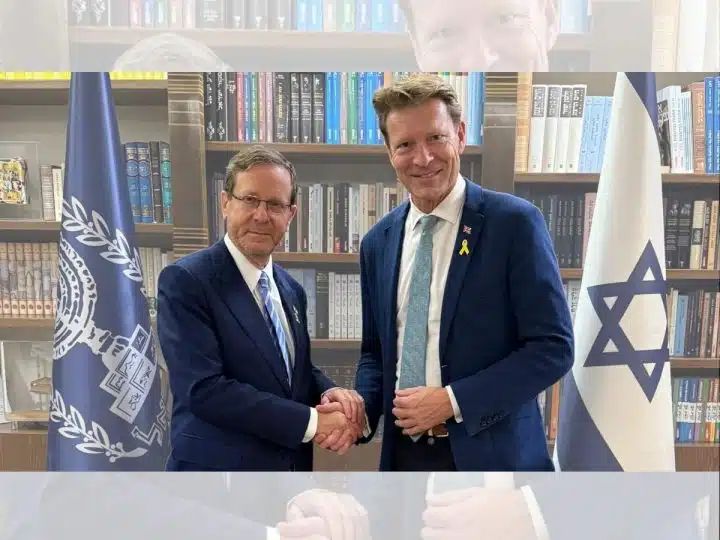
Richard Tice Claims Journalists Threaten Politicians Lives

Published

on

Richard Tice Claims Journalists Threaten Politicians Lives

Richard Tice has accused journalists on The Times newspaper of wanting another Reform UK politician “dead”.

The party’s deputy leader made his extraordinary comments as police continue their murder investigation following the death of Ann Widdecombe.

The former Tory minister, who was a Reform spokeswoman, was found dead at her home in Devon on Thursday. A 28-year-old man has been arrested on suspicion of murder.

Police have urged the public not to speculate about the possible motive for her killing.

Advertisement

That came after Reform leader Nigel Farage said on Saturday that he believed “this was premeditated murder”.

Speaking after he laid a wreath near Widdecombe’s home, he said: “Whether it was politically-motivated, whether it was someone with a grudge, I don’t think it pays at this time to speculate.”

Detectives have insisted that there is no evidence at the moment to suggest it was politically-motivated.

Former Tory MP Harvey Proctor told The Times: “Ann Widdecombe was far too dear to her family, friends and former colleagues for her murder to be exploited as political propaganda.

Advertisement

“The police have expressly asked the public not to speculate about the motive. It is therefore deeply disappointing that Nigel Farage has chosen to do precisely that.”

Reacting to the Times story on X, Tice said: “The Times Group: You are sick. Your contempt bordering on hatred of Nigel, myself & Reform means you stoop to any low to smear & discredit us.

“You lie, libel and make things up. How many more Reform politicians do you want dead? Shame on you.”

Meanwhile, Commons officials have hit back after Reform home affairs spokesman Zia Yusuf accused the government, the police and parliament of not caring about the safety of the party’s MPs.

Reform is now paying for round-the-clock security for its senior politicians.

But a House of Commons spokesperson hit back at Yusuf by insisting “all MPs are offered appropriate security measures”.

He said: “The ability of members and their staff to perform their parliamentary duties safely, both on and off the estate, is fundamental to our democracy.

Advertisement

“Any assessment of an individual MPs’ security arrangements or advice is subject to a rigorous risk-based assessment, conducted by security professionals and with input from the police and a range of professional authorities. These are naturally kept under continuous review.

“All MPs are offered appropriate security measures but we do not comment on specific cases or details of those measures so as not to compromise the safety of MPs, parliamentary staff or members of the public.”

Listen to Commons People, the podcast that makes politics easy. Every week, Kevin Schofield and Kate Nicholson unpack the week’s biggest stories to keep you informed. Join us for straightforward analysis of what’s going on at Westminster.

Advertisement

Source link

Continue Reading

Trending

Copyright © 2025