
Connect with us

Sports

Heroics of Messi, Mbappe and Haaland overshadowed by one surprising character

Published

on

Many of world football’s brightest names took the field over the weekend, as the quarter finals of the FIFA men’s World Cup played out. But for many fans, the heroics of the likes of Lionel Messi, Kylian Mbappe and Erling Haaland were overshadowed by the actions of a surprising character: the referee.

Two contentious decisions marred England’s 2–1 win over Norway: one that disallowed a Norwegian goal due to an earlier foul, and another that allowed an English goal despite an apparent earlier collision between the ball and an overhead cable. Similarly, Argentina’s victory over Switzerland never looked in doubt once the ref issued a game-ending second yellow card to Swiss forward Breel Embolo.

At the heart of all three controversial calls were technologies designed to do away with controversial calls. FIFA pointed to the contact-detecting “snicko” device attached to the ball in allowing England’s goal, and the other two decisions hinged on the little-loved Video Assistant Referee or VAR, an off-field panel of officials able to watch replays and advise the on-field referee.

These were just the latest in a string of contentious VAR calls at this World Cup. So why has a high-tech system designed to reduce unfairness and error in refereeing ended up sparking more of the very controversies it was supposed to put to bed?

Facts are important – but so is judgement

Advertisement

Football is a fast-paced and complex sport, its rules developed over more than 160 years.

Technology can help referees resolve some factual questions, such as whether the ball has crossed the goal line, or which player touched the ball last before it went out of play.

However, many decisions involving fouls, penalty kicks and handballs come down to questions of judgement and how to apply the rules. Often even the best-informed experts will disagree about the right decision.

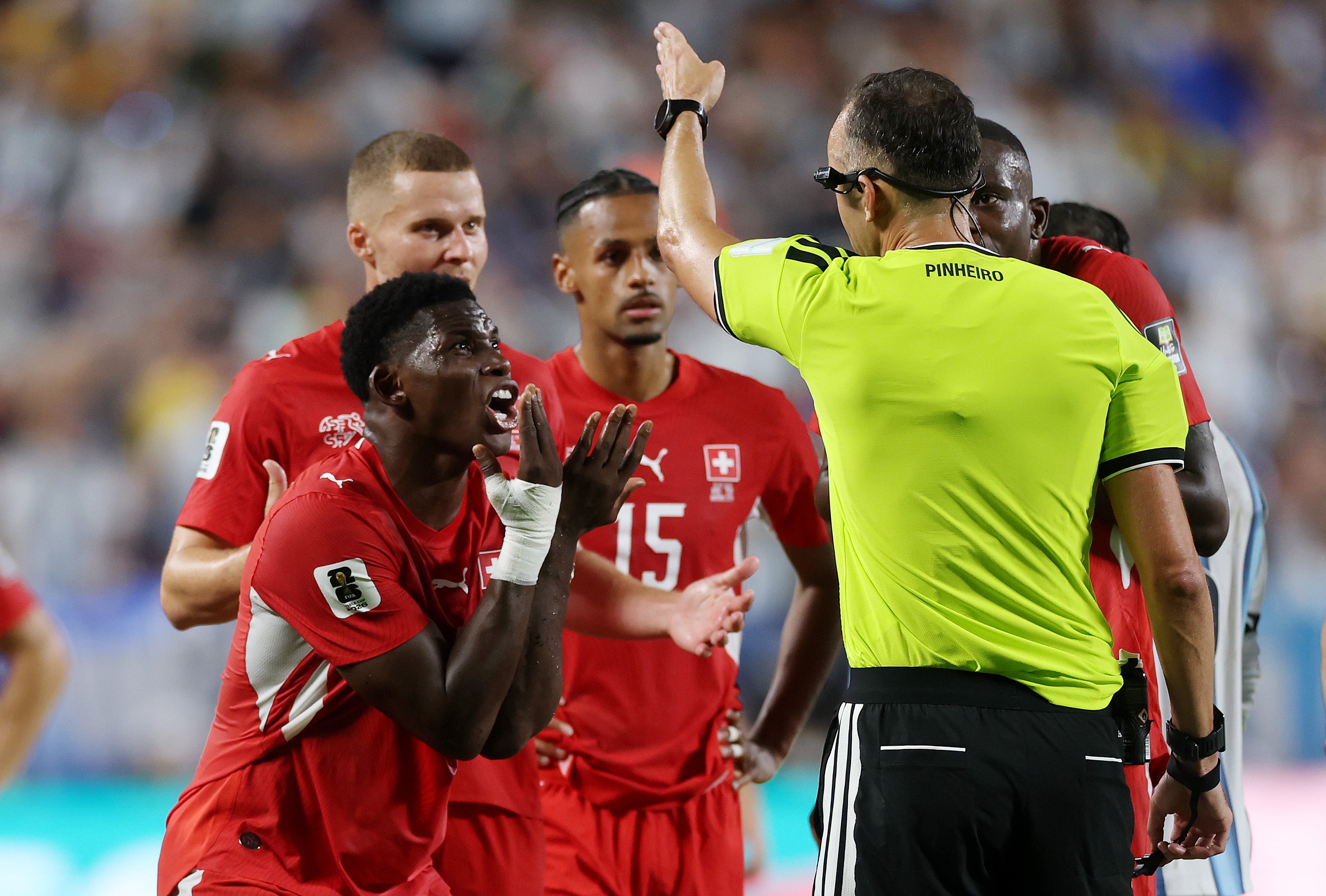
Breel Embolo argues with referee Joao Pinheiro after being shown a red card
Breel Embolo argues with referee Joao Pinheiro after being shown a red card (Getty)

Some disputes relate to margins of millimetres revealed by replays; others where even VAR has appeared to miss a clear foul; and others where a technically correct decision nevertheless feels unjust.

VAR can reproduce evidence to revisit decisions and review them. On paper, this should help alleviate the errors.

Advertisement

However, despite reviews now having more evidence to work with, the actual decision-making involved is regarded by many as highly inconsistent.

In part this is because the on-field referee has discretion over how strictly to enforce certain rules, such as how much contact between players may count as a foul. According to Pierluigi Collina, FIFA’s head of referees, VAR has to adjust to the way the match is officiated. If the referee allows strong contact in the field, VAR should adjust accordingly, and finding a sweet spot for consistency is challenging.

The core issues remain

More technology and more intervention are not likely to resolve some of the core issues.

Advertisement

A February match between Juventus and Inter Milan in Italy’s Serie A illustrates the problem. A Juventus player made minimal contact with an Inter player, who exaggerated the contact and fell over.

The referee issued a yellow card – given for a significant foul – to the Juventus player. It was the player’s second yellow card, which meant he was sent off the field for the rest of the match.

A perfect chance for a VAR review to set the record straight, you might think. However, VAR’s rules prevented it being used to intervene in second-yellow-card situations.

When the rule was subsequently changed, not everyone was happy – including the Italian league’s head of referees Gianluca Rocchi, who warned against the “greater use of technology”. At the same time, he said, such incidents didn’t occur when “the players focused on playing football and therefore made life easier for the referee”.

Advertisement

More technology, more demands

Even when the system does work, it may not increase fans’ trust in the system.

In a World Cup match in June between Qatar and Switzerland, a crucial penalty kick decision appeared to hinge on an offside call, which is precisely the kind of thing VAR is meant for. Typically, after a VAR review, an infographic detailing the result is shown – but in this case nothing was shown and the penalty kick proceeded.

Fans and commentators were unhappy with the lack of information, saying it led to distrust in the technology. FIFA later stated the VAR review was carried out successfully, but a technical issue had prevented the infographic being shown.

Advertisement

Bikesh Raj Upreti is a Lecturer in Business Information Systems at The University of Queensland. Federico Iannacci is a Senior Lecturer in Management at the University of Sussex Business School. Stan Karanasios is a Professor in Information Systems at The University of Queensland.

This article is republished from The Conversation under a Creative Commons licence. Read the original article.

So even when justice is done, it must also be seen to be done. The more advanced the technology becomes, the more the margin for error will shrink and the more audiences will demand transparency – and at the same time, the opportunities for failure will only increase.

Even when the technology works, it can turn football into a game of millimetres in cases where the position of a player’s toes may determine a game-changing offside call.

Advertisement

This method may seem factual and objective, but it risks taking out the very emotion that draws fans to the game. What’s more, it presupposes the measurements are perfectly precise and accurate, with no errors.

Problems far beyond the pitch

The VAR system has also seen trouble off the field. One VAR referee was caught watching betting sites on the job during a game. Another was suspended for match-fixing. A refereeing administrator has been investigated for unduly influencing VAR reviews.

And at an altitude way above the field, FIFA itself has been criticised for suspending a ban against a US player without a clear explanation, and after an intervention from US President Donald Trump. This may have opened the door to broader political interference, and we have already seen other countries ask for similar treatment.

Advertisement

Perhaps it was futile to hope a technical system could end fundamentally human disputes over a sport that has always been more art than science.

Meanwhile, millions of dollars have been invested in the technology and operations of VAR. Now it means errors come with a huge bill attached, which makes them less acceptable. And that same investment means VAR is very likely here to stay – whether we like it or not.

Source link

Advertisement
Continue Reading
Click to comment

You must be logged in to post a comment Login

Leave a Reply

Sports

Pochettino agrees new USA deal until 2030

Published

on

Mauricio Pochettino has agreed a new deal to remain as manager of the United States men’s national team until 2030.

The former Tottenham Hotspur and Chelsea boss has been in charge since September 2024 and led the USA to the last 16 of the 2026 World Cup on home soil.

The co-hosts topped their group after wins over Paraguay and Australia before beating Bosnia-Herzegovina 2-0 in the last 32.

Advertisement

Their World Cup run ended with a heavy 4-1 defeat by Belgium.

Under the new agreement, Pochettino and his coaching staff will have a bigger role within US Soccer. They will also advise and support the organisation on areas including youth development, coaching education, professional league partnerships and the wider national team pathway.

“Working together with US Soccer over the past two years, it has become clear to us that there is tremendous potential to make the men’s national team programme even stronger,” Pochettino said.

Advertisement

“We are excited by the opportunity to bring all our experience and knowledge to even more areas of US Soccer while helping strengthen the pathways for players, coaches and teams across the federation.

“We want to try to have a lasting impact on the sport in the country that has welcomed us so warmly and for that impact to extend beyond results on the field.”

US Soccer president Cindy Parlow Cone praised the work done by Pochettino and his staff.

“Mauricio has built a culture where players trust the group, trust the process and trust each other,” she said.

Advertisement

“We saw the impact of that belief in the way the team grew, competed and performed on the world’s biggest stage.

“That culture, and the staff who helped build it, are exactly what we want to continue investing in for the men’s national team now and for the future.”

Source link

Advertisement
Continue Reading

Sports

5 players who are switching states ahead of India’s 2026-27 domestic season ft. Shashank Singh

Published

on

The annual pre-season transfer window in Indian domestic cricket allows players to switch state associations as outstation or guest recruits under the Board of Control for Cricket in India (BCCI) regulations.

State teams are permitted up to three guest players to strengthen their squads ahead of the Ranji Trophy, Vijay Hazare Trophy, and Syed Mushtaq Ali Trophy campaigns. These transfers are driven by players seeking more game time, specialized roles, or leadership opportunities, while developing state teams aim to recruit veteran talents to bolster their squad depth.

The upcoming 2026-27 season features several notable moves, with prominent domestic regulars and IPL players shifting allegiances. Let’s take a look at five such moves.

#1 Shashank Singh

The Punjab Kings (PBKS) all-rounder Shashank Singh will turn up for Puducherry in the 2026-27 season after shifting base from Chhattisgarh. The Chhattisgarh State Cricket Sangh (CSCS) has already issued an NOC to the player.

Singh alleged that the state association didn’t support him while he was recovering from an injury that he suffered last season. He further claimed that the association questioned his commitment, saying that the batter only wanted to play in the Indian Premier League (IPL).

The 27-year-old added that CSCS officials didn’t give him any clarity over why he was left out of the Chhattisgarh Premier League and the team’s pre-season camp.

Advertisement

Singh has played 21 first-class games for Chhattisgarh over the last seven years. He has also represented the state in 31 List A and 42 T20s.


#2 Yash Dayal

Royal Challengers Bengaluru fast bowler Yash Dayal will represent Chhattisgarh in the upcoming domestic season. He has already joined the team’s pre-season camp in Alur.

Dayal has not played any competitive cricket since the IPL 2025 final, after which he faced charges relating to sexual assault. The left-arm pacer was retained by Gorakhpur Lions for the upcoming UP T20 League. However, he didn’t feature in the 18-member squad the franchise announced following the auction.

The 28-year-old has represented Uttar Pradesh in 27 first-class, 23 List A, and 71 T20s, picking up 186 wickets across formats, including two five-wicket hauls.

Advertisement

Dayal will look to start fresh for Chhattisgarh in the upcoming season and make his way back to the scheme of things.


#3 Dharmendrasinh Jadeja

Chhattisgarh is looking to build a strong squad for the upcoming domestic season. As a result, they have roped in Saurashtra‘s veteran left-arm spinner Dharmendrasinh Jadeja.

The 35-year-old spinner has been a stalwart in the domestic circuit, picking up 423 wickets in 100 first-class matches, including seven 10-wicket hauls and 26 five-fors. Jadeja also has 121 List A and 65 T20 wickets under his belt.

Jadeja is also a very handy batter in the lower order, accumulating almost 2900 runs across formats. He also has 10 fifties under his belt.

Advertisement

Jadeja’s addition will certainly boost Chhattisgarh’s squad depth as they look to put in a spirited performance next season.


#4 Prasad Pawar

Mumbai wicketkeeper-batter Prasad Pawar has signed with Puducherry to play alongside Shashank Singh as a guest player in the upcoming domestic season.

Prasad has struggled for game time in the Mumbai squad, with Hardik Tamore playing as the first-choice wicketkeeper-batter. As a result, Prasad has decided to shift base to Puducherry in search of more playing time.

Prasad made his List A debut in 2021, while his first-class and T20 debuts came in 2023. Overall, he has represented Mumbai in 27 matches, scoring 591 runs, including one hundred and fifty each.

Advertisement

#5 Jayant Yadav

An offspinner from Haryana, Jayant Yadav, has decided to join Chhattisgarh for the 2026-27 domestic season. He brings truckloads of experience along with him, having represented India in six Tests and two ODIs while picking up 17 wickets in total.

Yadav has 96 first-class, 74 List A, and 95 T20s under his belt, picking up 272, 68, and 61 wickets, respectively, including two 10-wicket hauls and 15 five-fors. He is also very handy with the bat in the lower order, scoring 4781 runs, including three hundreds and 22 fifties. The 36-year-old cricketer also has one Test hundred and fifty each to his name.

Chhattisgarh will rely heavily on the spin duo of Yadav and Jadeja to bring laurels for the team in the upcoming season.