

Crypto World
Is (Ripple) XRP Finally Ready to Break Out? Here Are 3 Reasons Why


Despite rebounding from a local bottom near $1, Ripple’s cross-border token remains heavily suppressed in the current bear market and hasn’t been able to stage a decisive comeback.
Even so, several key signs suggest the bulls might be getting ready to step in and take control soon.
Green Days on the Way?
Currently, XRP trades at around $1.11, representing a mere 1% increase on a weekly scale but a substantial 62% collapse over the past year. The recent whale behavior, though, may tilt the scales toward a more tangible rebound in the near future.
The renowned analyst Ali Martinez revealed that large investors have purchased roughly 70 million tokens over the last week, thus boosting their total holdings to approximately 3.8 billion units (around 6% of the asset’s circulating supply). Whale accumulation signals growing confidence among major holders, which can help stabilize price action and attract retail investors into the ecosystem.
The second bullish factor was presented again by Martinez, who noted that XRP’s TD Sequential indicator has flashed a buy signal. It is important to note that this metric hasn’t been fully reliable over the last several months. In December, it flashed a buy signal, which was followed by a strong price increase, but in January 2026, it preceded a major correction instead.
Last but not least, we will touch upon the shrinking amount of XRP stored on Binance. As CryptoPotato reported, the figure dropped to around 2.61 billion tokens, the lowest since February. The development indicates that a growing number of investors have moved their holdings to self-custody wallets, thereby reducing immediate selling pressure.
The Latest Predictions
Analysts on X have been quite vocal on XRP recently, with most outlining bullish forecasts. The market observer who uses the moniker Gerla claimed that if buyers defend the important $1.10 level, the price could rise to $1.24 next.
Crypto Patel and Celal Kucuker have been even more optimistic, envisioning an explosion to $9 and $7, respectively. JAVON MARKS joined the club of ultra bulls, arguing that $15+ is “a measured level that can be reached in the next wave.”
Of course, some remain cautious and believe the cycle’s bottom has yet to be formed. X user Diana, for instance, warned that the price could plummet to $0.87 before a new bull run begins.
The post Is (Ripple) XRP Finally Ready to Break Out? Here Are 3 Reasons Why appeared first on CryptoPotato.

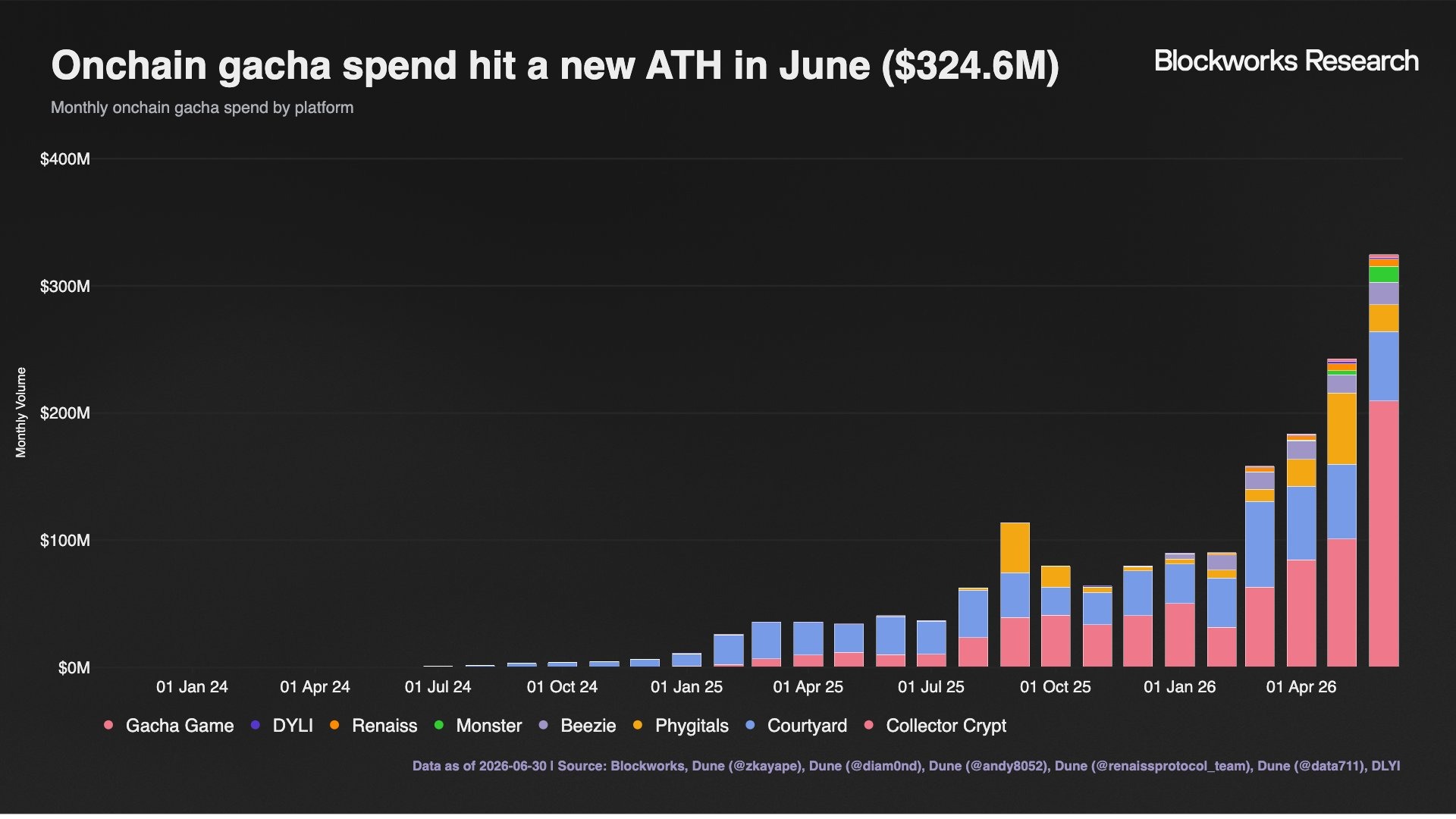
June 2026 was brutal for the crypto market. Bitcoin (BTC) fell more than 20%, hitting a 21-month low, while spot Bitcoin ETFs saw a record $4.5 billion in outflows.
That did not stop users from spending a record $324 million on onchain gacha during the month, according to Blockworks Research. A year earlier, the monthly figure was closer to $50 million.
Spending hit a new all time high in the depths of a bear market. While crypto prices were tanking, people were opening more and more packs of tokenized Pokémon cards — driven by the thrill, the hope of a profit or the urge to expand a collection.
It’s an entire randomized Real World Asset (RWA) sector that’s flown under the radar… until now.
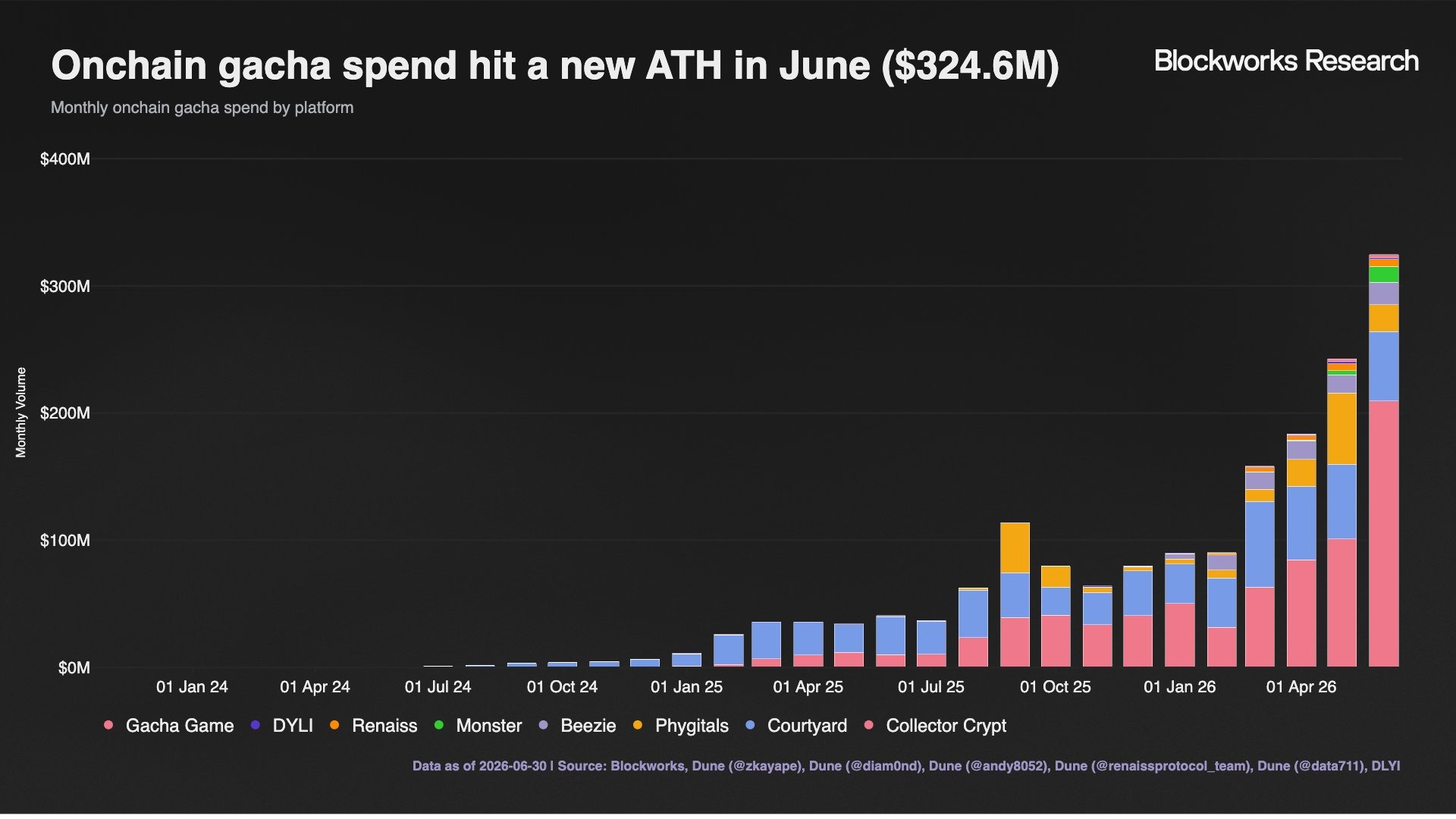
Onchain gacha spending hit an all-time high in June 2026. Source: Blockworks.
Booster packs, grades and slabs
Gacha is a mechanism borrowed from Japanese vending machines, where a fixed payment yields a random item. In the trading card game (TCG) market, it usually works through booster packs: sealed packs holding a random assortment of cards. The buyer does not know in advance what they will get.
The cards inside a booster are not created equal. Print run, rarity, condition and year of release drive prices orders of magnitude apart: from cents for an ordinary card, to hundreds of thousands of dollars for a rare copy in pristine condition. A market has grown up around those collectibles, which Global Market Insights values at $9.2 billion and Mordor Intelligence at $15.11 billion.
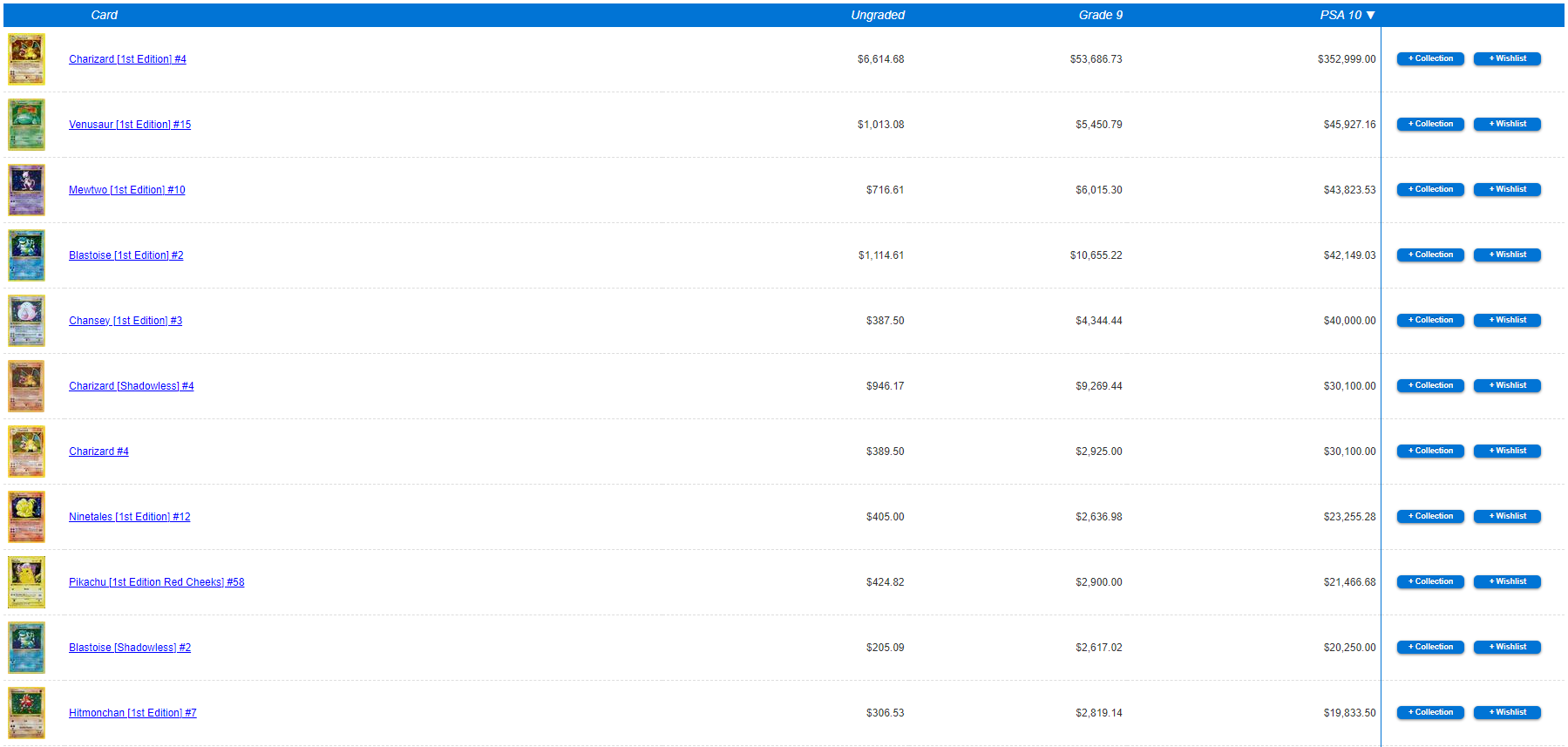
Some cards can fetch several hundred thousand dollars. Source: PriceCharting.
When a card can cost as much as a car, its authenticity and condition have to be assessed.
Related: Logan Paul sells Pokémon card for $16.5M, years after fractional NFT row
That is what grading is for — a process in which an independent company such as PSA, Beckett or CGC checks a card against several criteria. The card is inspected for image centering, the condition of its corners, edges and surface, and for scratches and stains, after which it is assigned a grade and sealed in a plastic case known as a slab.
The grade directly affects the price: two identical cards can be worth completely different amounts, while a raw, ungraded card sells as a riskier asset.
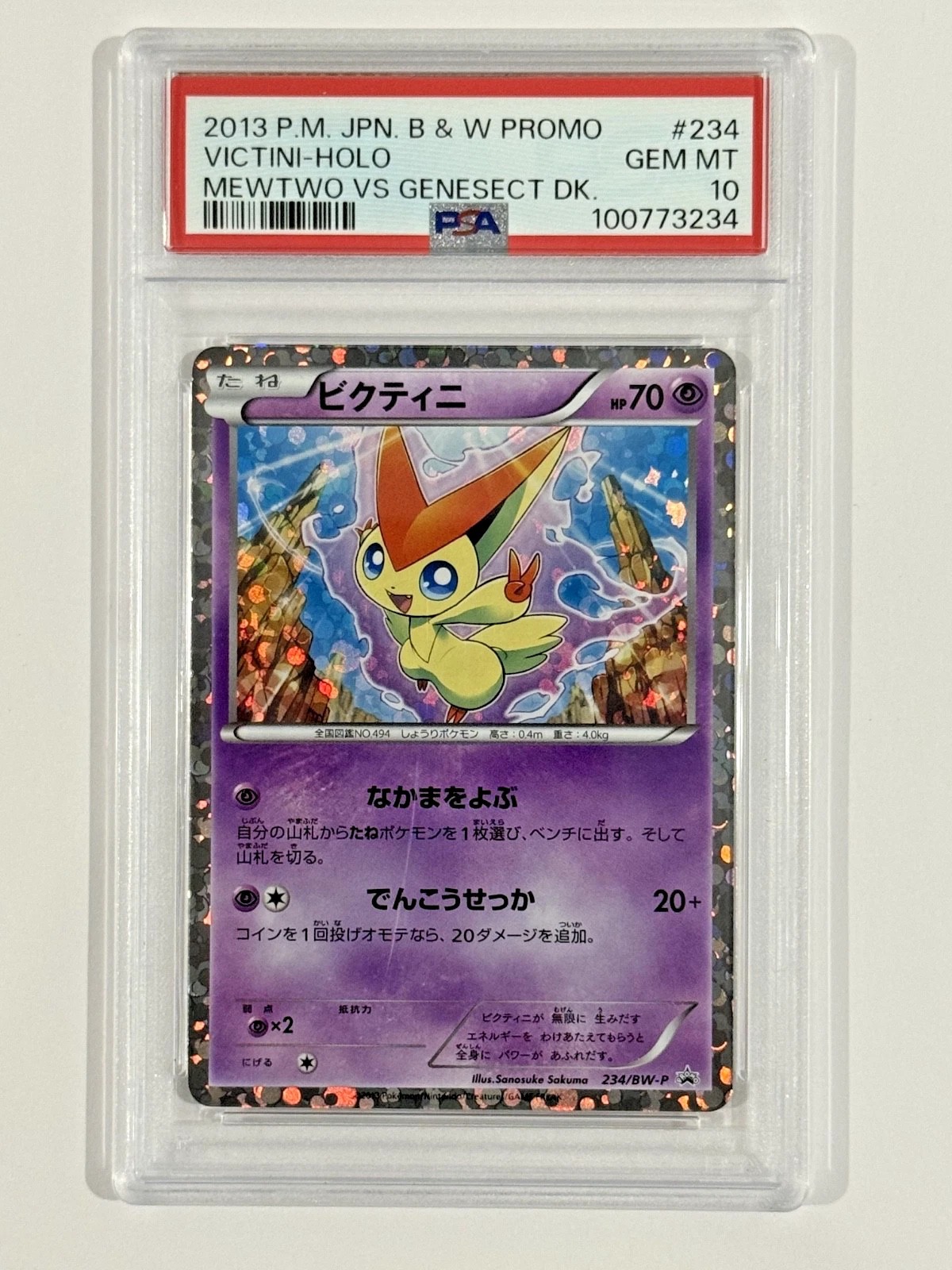
A Pokémon card sealed in a PSA slab. Source: eBay.
Projects such as Collector Crypt and Courtyard are moving these real world assets onto the blockchain. They accept physical cards — usually ones that have already been graded — hold them in vaults and issue NFTs tied to a specific copy.
When a user buys and opens a pack, they receive a token backed by a real card in a real vault. The token can be kept, listed on a marketplace, sold back to the platform or redeemed for the physical card.
Crucially, the value of these NFTs rests on the assumption that the partner vault really does hold that exact card in the stated grade. The user takes on custodial risk — the safety of the asset, the integrity of the authentication and the durability of the platform itself — and with grading companies themselves reporting a rise in counterfeits, that assumption is far from trivial.
Why now?
The growing popularity of onchain gacha, and of TCG-focused blockchain platforms more broadly, is probably down to several factors.
Pokémon cards are the core product for many of these projects, and the franchise is on a roll right now.
According to research firm Circana, Pokémon became the most popular toy brand in the US in 2025, with $2.5 billion in sales, up 87% from a year earlier.
The interest is not coming from children alone. Wealthier members of Generations Y and Z sometimes prefer cards to expensive paintings. Demand for grading is so high that in June, PSA temporarily suspended card submissions across four basic service levels as it tried to work through a backlog of almost 10 million cards.
Tokenization simply plugged into this frenzy by providing a useful service and removing friction.

High-profile buyers like Logan Paul have helped push Pokémon cards into the spotlight. Source: Logan Paul.
The real world trading card market suffers from a problem common to all collectibles markets: the absence of instant liquidity. To sell a card offchain, the owner has to find a counterparty, verify its authenticity and grade, and ship the item.
Related: The 5 types of real world assets being tokenized fastest onchain
“Traditional marketplaces are slow and expensive,” Dakota Campbell, head of marketing at Collector Crypt, told Cointelegraph. “With tokenized trading cards, collectors can buy, sell, trade, and verify ownership instantly while the physical asset remains securely vaulted until they want it shipped.”
Collector Crypt has tokenized roughly $40 million worth of cards and comic books, according to Campbell. About $23 million of that inventory belongs to the platform itself, while the rest sits in user wallets or has already been redeemed. To keep up with demand, the company buys around $2 million worth of cards every week.
Gambling on collectibles
As with the NFT boom, it’s hard to deny that price speculation and gambling-style dopamine hits from the random prizes are part of the appeal.
The instant buyback mechanism, available on most platforms, creates an almost perfect “gacha loop”: Buy a pack, and if the card is unappealing or not worth much, sell it back for, say, 85% of its value and go open the next one. Pull something rare, and either list it on a marketplace or keep it. Unlike with physical cards, there’s no searching for a buyer, no shipping, no waiting.
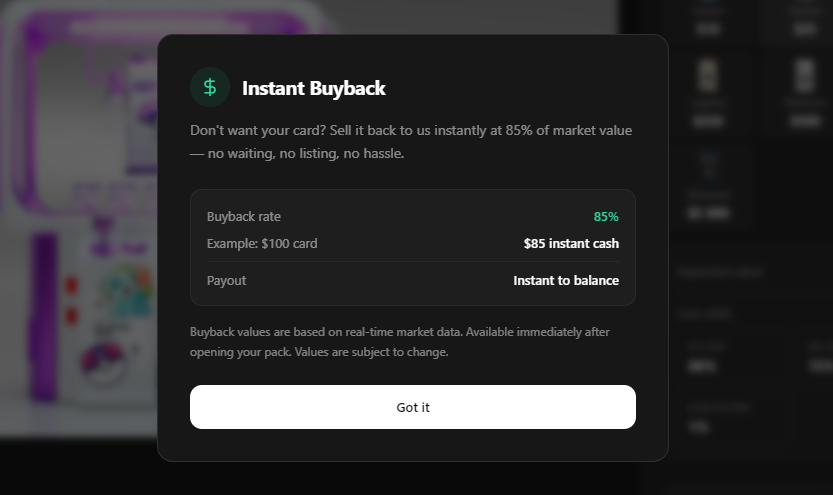
The “instant buyback” option is available on nearly all TCG platforms. Source: Phygitals.
The gagcha mechanism is similar to loot boxes within video games: The user pays for a random outcome, knowing only the odds. Some jurisdictions have already tried to bring loot boxes under gambling regulations. Whether that logic will reach tokenized TCGs probably depends on how big the sector grows.
Either way, this is exactly how the traditional TCG market works. The only difference is speed: Offchain, closing the gacha loop takes weeks. Onchain, it takes a few seconds.
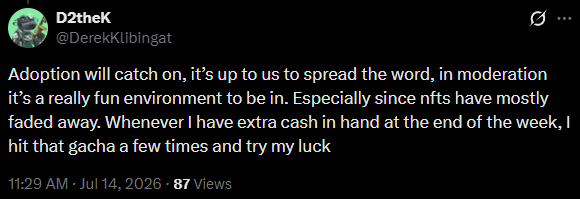
Sometimes users are driven by nothing more than the desire to “try their luck.” Source: X.
“There is always speculation in an emerging market, especially in the crypto sector,” Campbell said, while arguing that the platform benefits most from committed collectors hunting for their next “grail.”
No country for collectors?
Genuine collectors of physical cards still make up a proportion of the market. According to Dune, users burn 5% to 8% of the NFTs issued on Courtyard each week, with each burn representing a real physical claim.
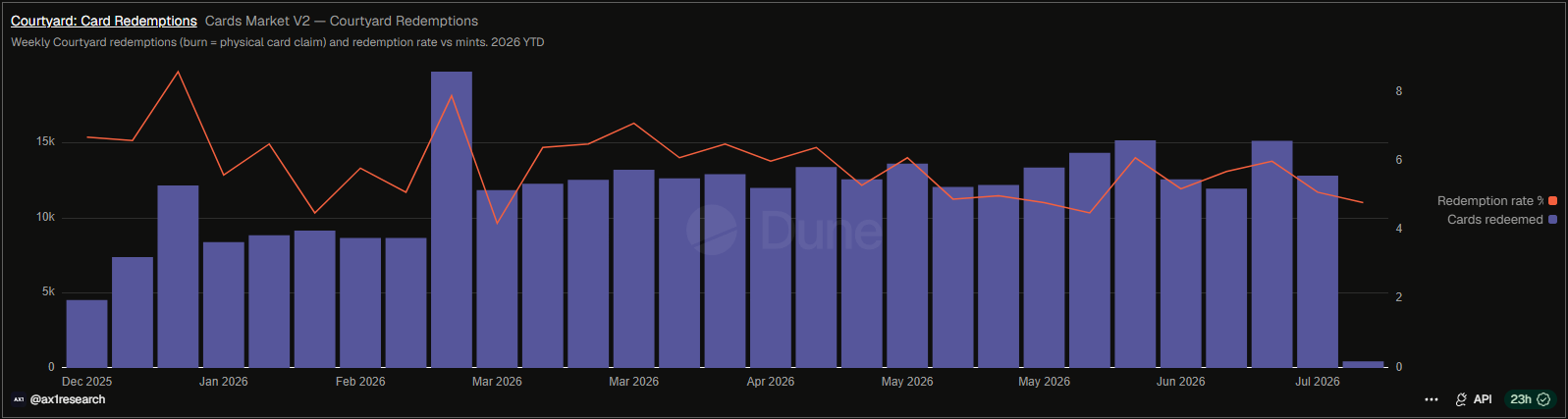
Users burn 5% to 8% of Courtyard’s issued NFTs each week for physical cards. Source: Dune.
Collector Crypt reports that around 30% of its users eventually redeem a card, according to Campbell, and many more hold their cards in their onchain inventory past the 72-hour buyback window rather than flipping them.
“In just the last 30 days, 5,400 assets shipped to 634 unique users at $3.29 million insured value,” he said.
New tracks for an old train
Essentially, blockchain startups are running the classic tokenization play: moving a proven business model onto more efficient rails and removing some of the friction.
Concerns about the speculative nature of this market, or the role of gambling in it, are warranted to the extent that platforms build their marketing around this aspect.
Beyond that, this is simply how gacha works. People sift through the “junk” in pursuit of a rare card. And if there are complaints to be made, they should be addressed to the entire TCG industry, not just its onchain segment.
As for June’s records, they are the result of several factors converging. The traditional card market is booming, tokenization has proved mature enough to plug into it, and the gacha mechanic sits neatly on blockchain rails.
How sustainable that is remains an open question. The gacha loop runs fast in both directions, and record inflows can reverse just as fast.
Features: Will the crypto lobby’s $189M campaign get CLARITY over the line?


Crypto spent fifteen years arguing the ledger is the truth. Tokenized securities quietly reversed it. The token in your wallet is a receipt, and a company you have never heard of keeps the record that actually decides who owns what.
Summary
- A transfer agent maintains the official register of who owns a security, processes subscriptions and redemptions, issues and cancels shares, and pays out distributions. In the United States they must register with the SEC.
- In tokenized securities, the transfer agent’s off-chain register remains the authoritative legal record of ownership. The token is a digital representation that enables on-chain mobility, not the source of truth.
- If the blockchain and the register disagree, the register wins. Administrators including JPMorgan retain authority to correct the on-chain ledger against the legal record.
- Transfer agents run the allow-list. They screen identity, add approved wallets to an on-chain list, and the token contract blocks transfers to any address that is not on it.
- This inverts crypto’s founding assumption. Whether that is a betrayal or the precise reason institutions will tokenize anything at all is the argument worth having.
Every crypto explainer starts from the same premise: the blockchain is the record, possession of the key is ownership, and no intermediary can reverse it. That premise is true for Bitcoin. It is false for essentially every tokenized security in existence, including the ones BlackRock and JPMorgan are issuing right now. In those products, the authoritative record of who owns what is a database maintained by a company called a transfer agent, and the token in your wallet is a mirror of that database. If the two diverge, the database is right, and the chain gets corrected. Understanding this is not a technicality. It is the difference between understanding what tokenized securities are and repeating a marketing claim about them.
What a transfer agent does
The transfer agent is one of the least glamorous and most load-bearing roles in traditional finance. It exists because a company issuing shares needs someone to answer a deceptively hard question: who owns them right now?
The core functions are these. The transfer agent maintains the register of security holders, the official list of names and balances. It processes transfers when securities change hands, updating that register. It issues new shares when investors subscribe and cancels them when investors redeem. It distributes dividends, interest, and other payments to the holders on the register. And it handles corporate actions, communications, and the reconciliation that keeps everything consistent.
In the United States, transfer agents must register with the SEC under the Exchange Act and operate under its rules. This is not an informal bookkeeping role. It is a regulated function with legal consequences, because the register the agent maintains is what a court would consult to determine ownership.
Traditionally, shares in most listed securities are recorded through a central securities depository, with the Depository Trust and Clearing Corporation performing that function in the US. Each institution keeps its own books, and post-trade steps such as confirmation, clearing, and settlement require multiple intermediaries and repeated reconciliation between those books. The transfer agent sits inside that architecture as the issuer’s official record-keeper.
What changes when a security gets tokenized
The pitch for tokenization is that a shared, consensus-validated ledger replaces fragmented books and eliminates the reconciliation. Instead of every institution maintaining a separate record that must be checked against every other record, all participants read one ledger.
In practice, tokenized securities did not do that. They did something more modest and more interesting.
Tokenized funds use distributed ledger technology to issue and maintain their shares instead of recording them solely through a central depository. That is a real change: settlement collapses from a T+1 or T+2 cycle to minutes, and the share becomes programmable. But the transfer agent did not disappear. It moved.
The structure now looks like this. The transfer agent still maintains the official ownership record. A tokenization platform, most prominently Securitize and also Tokeny, runs the smart contracts that mint tokens on subscription and burn them on redemption. An oracle, typically Chainlink, publishes the fund’s net asset value on-chain. And the token contract enforces the transfer restrictions that the transfer agent’s compliance rules require.
Securitize Transfer Agent LLC is the reference example. It is an SEC-registered transfer agent and broker-dealer, and it maintains the official record for BlackRock’s BUIDL fund. BlackRock’s filing for its OnChain Shares describes Securitize Transfer Agent as maintaining the official record through a permissioned system connected to multiple public, permissionless blockchains, with wallets linked to off-chain identity records.
Franklin Templeton’s structure works the same way: one FOBXX share links to one BENJI token, while the transfer agent maintains the official ownership record through the Benji platform.
Read those descriptions carefully and the architecture becomes clear. A permissioned system, connected to public blockchains, with wallets linked to off-chain identity. The chain is a distribution and mobility layer bolted onto a conventional register. It is not the register.
The token is not the record
This is the single most important idea here, and it is stated backwards in most coverage.
The beneficial ownership of tokenized fund shares remains recorded in the transfer agent’s official register. The token acts as a digital receipt that enables on-chain movement. When a token transfers between two authorized wallets, the system updates the off-chain ownership record to reflect the change. The chain does not replace the register; it triggers an update to it.
And when they disagree? The register wins. JPMorgan, among others, retains the authority to correct discrepancies between the on-chain ledger and the legal record, so that the technological holding never diverges from the legal reality. There is a company with a button that can change what your wallet says, because your wallet was never the authority.
Holding the token does not, by itself, prove ownership. The exact rights depend on the fund’s legal documents, the official ownership record maintained by the transfer agent, and the product’s wallet and transfer rules. The official record is generally the authoritative source.
Consider what that means for a scenario crypto users take for granted. You send tokens to a friend’s wallet. In Bitcoin, that is final and your friend owns them. In a tokenized security, either the transfer fails because the wallet is not allow-listed, or it succeeds and the transfer agent updates the register to reflect the new holder, which happens only because the wallet was pre-approved and identity-linked. There is no version of that transaction where a stranger acquires the security by receiving the token.
Who controls the allow-list
The transfer agent’s most consequential power in tokenized securities is not record-keeping. It is the gate.
Before any subscription, the transfer agent runs know-your-customer and sanctions screening on the wallet owner. The wallet address is then added to an on-chain allow list maintained by the token contract. Smart contracts enforce restrictions from that list: any transfer to an address that is not allow-listed reverts. The BIS has noted that these products rely on the allow-listing of blockchain wallets to constrain peer-to-peer trading and meet regulatory compliance requirements.
The enforcement lives in the token standards. Where stablecoins typically use plain fungible standards such as ERC-20 with unrestricted transfers, tokenized securities often employ security token standards such as ERC-1400 or ERC-3643. Under ERC-3643, a function called isVerified confirms that a recipient appears in the register of allow-listed investors, and canTransfer enforces any additional conditions required before a transfer proceeds. As compliance needs evolve, programmable checks let more complex rules be applied in code.
That is the whole architecture in one sentence: compliance rules, written by a regulated intermediary, enforced automatically by a smart contract, on a public blockchain that anyone can read and almost nobody can transact on.
The practical consequences are worth spelling out. Moving a token to a wallet not on the allow list may be blocked at the protocol or transfer agent level, which is why verifying transfer eligibility before attempting to move a position is not optional. Access through secondary markets or unapproved wallets may not carry the same rights as subscribing directly through the fund or its authorized platform. And restrictions vary sharply by product: some funds are limited to qualified purchasers, some exclude US persons entirely, some impose institutional minimums.
Why this exists
It would be easy to read all of this as institutions gutting the point of a blockchain. The steelman is stronger than that, and it deserves stating properly.
Securities law does not care what technology you use. If an instrument is a security, then rules about who may hold it, how ownership is evidenced, what disclosures are owed, and how sanctions screening works all apply regardless of whether the record sits in Oracle or Ethereum. A tokenized fund that let anonymous wallets hold shares would not be an innovation. It would be an unregistered securities offering with an anti-money-laundering failure attached.
The allow-list model is what makes tokenized funds work inside existing securities and AML frameworks. Without it, none of these products would exist, because no regulated manager would issue them and no regulator would permit it. The choice was never between a permissioned tokenized fund and a permissionless one. It was between a permissioned tokenized fund and no tokenized fund.
And the benefits are real even with the gate in place. Settlement in minutes instead of days. Around-the-clock operation. Shares usable as collateral without leaving the fund, which is why crypto prime brokers accept BUIDL as margin. Real-time auditable records for regulators. Programmability that lets a share do things a book entry cannot. None of that requires the ledger to be the final authority. It only requires the ledger to be fast, shared, and honest about what it is.
The counterargument is equally real. If an intermediary maintains the authoritative record, screens participants, and can reverse the chain, then the blockchain is performing the role of a message bus, and a permissioned database could deliver most of the benefits with less complexity. The transparency argument weakens too, since the interesting record is off-chain. What you are left with is faster settlement and composability with other on-chain assets, which is genuinely valuable but a long way from disintermediation.
Where the two worlds are colliding
The most interesting developments sit exactly at this seam.
The DTCC, the central node in US securities infrastructure, ran its Smart NAV pilot with Chainlink, showing how mutual fund net asset value data can be published on-chain using cross-chain interoperability infrastructure, with multiple global asset managers participating. It has also unveiled a platform for real-time tokenized collateral management. The depository is not being disintermediated. It is tokenizing.
Meanwhile some tokenized funds are pushing the other way. Products including Superstate’s short-duration government securities fund and Franklin’s OnChain US Government Money Fund enable peer-to-peer transactions among approved holders, and BUIDL has been listed on Uniswap’s decentralized exchange for eligible traders. Each step widens the set of things an allow-listed holder can do without going through the issuer, which is a slow migration of function toward the chain without ever surrendering the register.
The tension shows up plainly in retail products. Robinhood’s Stock Tokens are structured as tokenized debt securities that track a stock’s economic performance but confer no voting rights, no shareholder rights, and no direct legal ownership claim on the shares, and they are unavailable to US persons. That is a different structure from a tokenized fund share, and it exists because building a token that conveys actual equity ownership across borders runs straight into the transfer agent and registrar architecture that governs real shares. It is easier to issue a derivative of a stock than to tokenize the stock.
What a failure would look like
A useful way to test whether you understand an architecture is to ask how it breaks, and the transfer agent model has failure modes that differ sharply from the ones crypto users are trained to watch for.
The register and the chain diverge. This is the mundane one and it will happen. A subscription is recorded off-chain but the mint fails. A transfer succeeds on-chain but the register update does not process. For a period, the two records disagree about who owns what. In a permissionless system this would be a crisis with no resolution path. Here it is a reconciliation task, because the hierarchy is defined in advance: the register is authoritative, the chain gets corrected, and administrators such as JPMorgan hold explicit authority to do exactly that. The failure is contained precisely because the system is not decentralized. That is the trade in one sentence.
The transfer agent itself fails. This is the interesting one, and it has no on-chain answer.
If the entity maintaining the register suffers an outage, an insolvency, or a compromise, the authoritative record of ownership is impaired. The tokens still sit in wallets, still display balances, still move between allow-listed addresses. And none of that settles what anyone owns, because the record that decides ownership is the impaired register. Traditional finance has procedures for transfer agent succession, because this risk predates blockchains by a century. But the crypto instinct, which is to point at the chain and say the record is right there, is precisely wrong here. The chain is a mirror. A mirror does not help when the original is gone.
The allow-list becomes the attack surface. Whoever controls which addresses may hold the token controls the asset in a way no key holder does. A compromised allow-list could add unauthorized addresses or, more disruptively, remove legitimate ones, freezing holders out of transfers they are entitled to make. The smart contract will faithfully enforce whatever the list says, because faithful enforcement is its only job. Decentralization does not protect you here; it is what is being enforced against.
Composability breaks at the edge. Tokenized fund shares are increasingly used as collateral across DeFi. But a permissioned token cannot be liquidated to an arbitrary buyer, because arbitrary buyers are not allow-listed. A lending protocol that accepts BUIDL as collateral must have a liquidation path that terminates in an approved wallet, which means its liquidation mechanism depends on a whitelist maintained by a company that has no obligation to that protocol. The composability that makes these tokens attractive is conditional on a permission layer sitting outside the protocol using them, and that dependency has not been tested during a genuine stress event.
None of these are arguments against the model. They are the actual risk register, and it is a different register from the one crypto is used to reading. Nobody is going to lose a tokenized fund position because they mismanaged a seed phrase. They would lose it because an intermediary’s database, an approval list, or a reconciliation process failed, which are exactly the risks tokenization was supposed to have removed and instead relocated.
The question underneath
Strip away the mechanics and one question remains, and it is the one that decides whether tokenization matters.
If the transfer agent’s register is the truth, and the token is a receipt, what exactly has been tokenized? The optimistic answer: the settlement layer, and that alone is worth billions in operational savings and unlocks collateral mobility that did not previously exist. The skeptical answer: nothing important, because the trust assumptions are identical to the ones we had, and we added a blockchain to a system that already worked.
The honest answer is probably that this is a transitional architecture. Right now the register is authoritative and the chain is a mirror, because the law requires a registered intermediary to keep the record and the law has not changed. If it ever does, if a properly regulated on-chain register were permitted to be the record itself, the transfer agent function would not vanish. It would become code plus a compliance oracle, and something would be genuinely different.
Until then, the useful discipline for anyone touching tokenized securities is to hold the correct mental model. The wallet shows you a balance. The register decides whether that balance is yours. Those are two different claims, and only one of them is enforceable in a courtroom.
Disclaimer: This article is for information and educational purposes only and does not constitute financial, investment, or legal advice. Tokenized securities are subject to access restrictions and securities regulation, and eligibility, rights, and terms vary by product and jurisdiction. Nothing here is a recommendation to buy any product. Always do your own.
Frequently Asked Questions
What is a transfer agent?
A transfer agent maintains the official register of who owns a security, processes transfers between holders, issues shares on subscription and cancels them on redemption, distributes dividends and interest to registered holders, and handles corporate actions and reconciliation. In the United States, transfer agents must register with the SEC and operate under its rules, making it a regulated function rather than informal bookkeeping.
What does a transfer agent do in tokenized securities?
The same things, plus two more. It maintains the authoritative off-chain ownership register that the tokens mirror, and it controls the allow-list: screening investor identity, adding approved wallets to an on-chain list, and thereby determining which addresses can legally hold the token. The smart contract enforces those decisions automatically, blocking transfers to addresses that have not been approved.
If I hold the token, do I own the security?
Not by itself. The authoritative record is the register maintained by the transfer agent. The token functions as a digital receipt enabling on-chain mobility, and when it moves between approved wallets the off-chain record updates to match. Your actual rights flow from the fund’s legal documents, the register, and the product’s transfer and redemption rules.
What happens if the blockchain and the official record disagree?
The official record wins. Administrators including JPMorgan retain authority to correct discrepancies between the on-chain ledger and the legal record, so the technological holding never diverges from the legal reality. This inverts the usual crypto assumption that the ledger is the final source of truth, and it is the defining characteristic of tokenized securities as currently structured.
Why can I not send tokenized fund shares to any wallet?
Because the token contract enforces an allow-list maintained by the transfer agent. Security token standards such as ERC-1400 and ERC-3643 build the restrictions into the token itself. Under ERC-3643, isVerified checks whether a recipient appears in the register of allow-listed investors and canTransfer enforces additional conditions. A transfer to an unapproved address reverts at the contract level.
Who are the major transfer agents in tokenization?
Securitize is the most prominent. Securitize Transfer Agent LLC is an SEC-registered transfer agent and broker-dealer and maintains the official record for BlackRock’s BUIDL and its OnChain Shares filing. Tokeny is another tokenization platform operating in this space. Franklin Templeton maintains the official record for BENJI through its own Benji platform.
Does this defeat the purpose of using a blockchain?
That is the genuine argument. Critics note that if an intermediary keeps the authoritative record, screens participants, and can reverse the chain, a permissioned database could deliver similar benefits more simply. Supporters note that securities law requires a registered record-keeper regardless of technology, that the allow-list is what makes these products legal at all, and that faster settlement, continuous operation, and collateral mobility are real gains that do not require the ledger to be authoritative.
How does this differ from Robinhood’s Stock Tokens?
Considerably. Robinhood’s Stock Tokens are structured as tokenized debt securities that track a stock’s economic performance but confer no voting rights, no shareholder rights, and no direct ownership claim on the underlying shares, and they are unavailable to US persons. A tokenized fund share represents an actual registered fund position recorded by a transfer agent. It is easier to issue a derivative referencing a stock than to tokenize the stock itself, precisely because of registrar architecture.


The BNP-backed brokerage infrastructure provider is expanding into tokenized markets and AI-native financial services as both DeFi and TradFi companies pursue onchain business.
ARK Invest has challenged a16z crypto’s view that traditional financial institutions will mainly adopt controlled blockchain systems rather than decentralized finance.
Summary
- ARK argues public blockchains will win institutional adoption as tokenized assets increasingly connect with DeFi.
- A16z expects banks to adopt blockchain primitives while keeping compliance, governance and operational control centralized.
- Standard Chartered forecasts mature DeFi protocols could capture much of the future tokenized asset activity.
ARK director of research Lorenzo Valente called the argument “overly bearish and simplistic” in a response on X. He argued that public blockchains have already gained more traction than earlier private blockchain projects and that institutional finance will increasingly depend on infrastructure created by crypto-native companies.
A16z sees institutions choosing control over open access
The debate began after a16z crypto published an essay titled “TradFi doesn’t want DeFi. It wants blockchains.” The firm argued that banks and asset managers will adopt blockchain features when they reduce costs, improve settlement or expand distribution without giving up control.
Under that model, institutions may use tokenization, programmable money and atomic settlement while limiting open access and pseudonymous participation. A16z described the emerging system as “programmable financial infrastructure” built around regulatory, risk and governance requirements rather than today’s fully permissionless DeFi model.
The firm did not argue that open networks will disappear. Its thesis says institutional blockchain systems and crypto-native DeFi can develop in parallel, with open networks continuing to create technology that regulated firms later adopt.
ARK argues public networks have already proved their value
Valente’s counterargument centers on adoption already taking place on public blockchains. Tokenized funds, stablecoins and other financial assets increasingly operate on networks such as Ethereum rather than isolated private systems.
As previously reported, tokenized real-world assets had crossed $29 billion by April 2026. Tokenized US Treasury products alone reached about $13.4 billion, while more than 40 major financial institutions had launched or developed products using public blockchain infrastructure.
That growth supports part of ARK’s case, although institutional projects are not purely permissionless. Products can use public networks while placing restrictions on investors, wallets, custody and transfers. This allows firms to use shared blockchain infrastructure without adopting every feature associated with open DeFi.
DeFi protocols are gaining institutional connections
Recent institutional activity also shows that the dividing line between DeFi and traditional finance is becoming less clear. Standard Chartered has forecast that $4 trillion in stablecoins and tokenized assets could move onchain by the end of 2028, with established DeFi protocols handling much of that activity.
As reported by crypto.news, the bank identified Aave, Compound and Morpho as potential beneficiaries as institutions move more assets onto blockchain networks. BlackRock’s BUIDL fund has also gained DeFi utility by serving as collateral and connecting with onchain markets.
Other blockchain ecosystems are adding controls directly to decentralized infrastructure.However, XRP Ledger developers have been working on permissioned trading and lending features designed for regulated institutions while maintaining onchain settlement.
Permissioned networks remain a competing model
Traditional finance is also putting capital into systems designed specifically around institutional privacy and control. Canton Network has attracted banks and market infrastructure companies by offering permissioned access and privacy-focused settlement tools.
A crypto.news analysis previously examined the growing competition between Canton’s institution-focused model and Ethereum’s open infrastructure. The two approaches show that financial firms are testing both controlled systems and public blockchain rails rather than following one clear model.
The dispute between ARK and a16z therefore centers less on whether traditional finance will use blockchain and more on which infrastructure will carry the activity. A16z expects institutions to reshape blockchain technology around existing controls. ARK argues that public networks and DeFi protocols have already built liquidity and infrastructure that financial firms will find increasingly difficult to avoid.
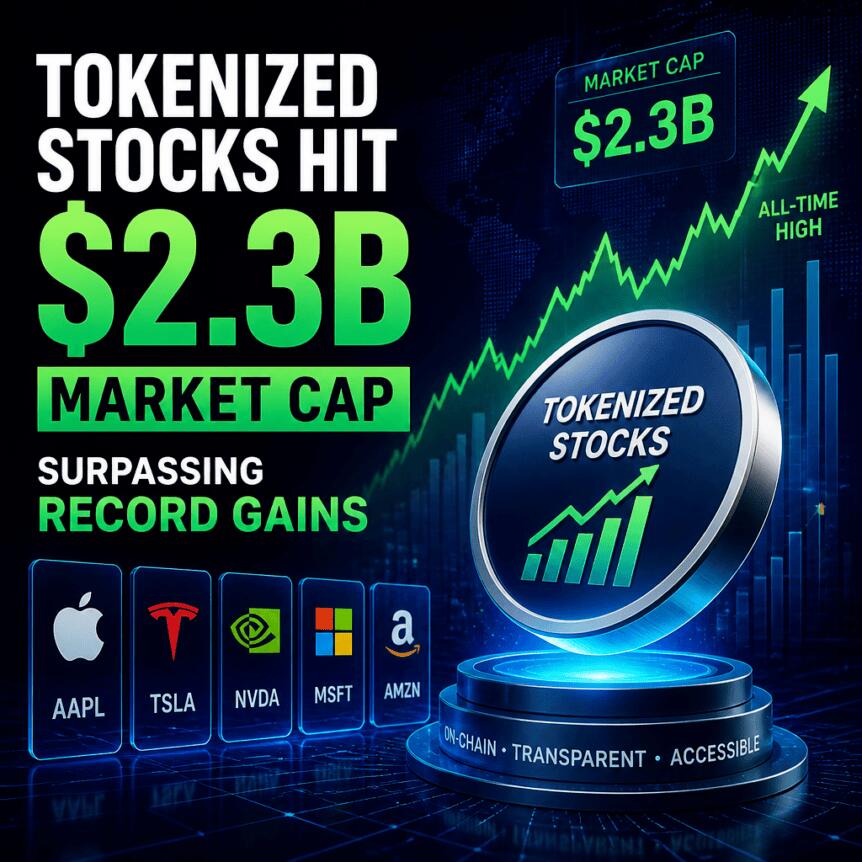
Tokenized stock products are continuing to gain traction even as wider crypto markets fluctuate. According to data aggregator Token Terminal, the total market capitalization of tokenized stocks climbed to a record $2.3 billion on Wednesday, reflecting renewed demand for blockchain-based access to equities.
The Ethereum ecosystem led the distribution of tokenized-stock market value with a 34% share, followed by BNB Chain at 30% and Solana at 23%, Token Terminal said in an X post. As more platforms expand “multi-asset” offerings, the shift highlights how tokenized equities are increasingly being treated as a mainstream bridge between traditional finance and onchain infrastructure.
Key takeaways
- Tokenized stocks reached a record $2.3 billion market capitalization, signaling stronger institutional-style exposure to equities onchain.
- Ethereum remains the largest venue for tokenized stocks by share (34%), with BNB Chain (30%) and Solana (23%) close behind.
- Kraken’s xStocks and Binance’s bStocks are among the biggest contributors to tokenized-stock market value, while Ondo Finance remains the top issuer.
- Despite rapid growth in tokenized real-world assets (RWAs), stocks still represent only about 5.5% of the overall tokenized RWA market.
Tokenized stocks hit a new high as access expands
The record figure—$2.3 billion—adds to a broader pattern of capital moving into tokenized versions of traditional financial instruments. Token Terminal’s breakdown points to a multi-chain race for distribution, with Ethereum still setting the pace for market share.
The issuer landscape also shows where liquidity is concentrating. Token Terminal data indicates Ondo Finance is the largest tokenized stock issuer, with $955 million in onchain equities. Two other large products—Kraken exchange’s xStocks and Binance’s bStocks—account for substantial portions of tokenized-stock market value, at $507 million and $334 million respectively, according to Token Terminal’s figures.
For investors, the practical appeal of tokenized stocks is often tied to two features: fractional ownership and the potential for faster, more continuous trading compared with traditional market schedules. For platforms and developers, these same characteristics support a broader product strategy—bringing familiar asset classes onto blockchain networks without requiring users to interact directly with settlement layers.
Which chains and products are driving tokenized-equity adoption
Token Terminal’s chain-level shares show a distribution that is increasingly difficult to ignore. Ethereum’s 34% share underscores that tokenized equities still find deep liquidity on the network with the longest track record for onchain asset issuance and trading. However, BNB Chain’s 30% share indicates that large centralized exchange ecosystems are successfully positioning themselves as distribution channels for tokenized financial products.
Solana’s 23% share suggests that speed and low fees—often associated with the network’s design—remain a meaningful part of the user experience for tokenized assets. Together, the three networks account for 87% of tokenized stock market share in Token Terminal’s dataset, implying that competition for tokenized-equity flows is currently concentrated rather than fragmented across dozens of chains.
On the product side, Kraken and Binance stand out for the scale of their tokenized equity offerings. Token Terminal’s numbers place Kraken’s xStocks as the largest single category contribution ($507 million), ahead of Binance’s bStocks ($334 million). These figures reinforce how exchange-led distribution can materially accelerate adoption by lowering friction for retail and active traders.
Push toward traditional assets keeps widening the onchain map
The tokenized-stock surge sits inside a larger expansion of crypto platforms adding regulated-style investment products to blockchain rails. Binance, for example, has been moving toward a multi-asset platform model. Earlier coverage noted that Binance opened zero-commission trading for eligible users in tokenized stocks—covering more than 7,000 US tokenized stocks—beginning June 1, as part of that strategy.
Coinbase has also signaled its intent to compete in traditional asset access. The exchange rolled out commission-free US stock and ETF trading with 24/5 availability in December 2025, according to its own update on its system changes. While these developments differ in implementation details from tokenized onchain equity products, they contribute to the same competitive direction: mainstream crypto platforms seeking to offer familiar “traditional” instruments in an exchange-like experience.
Kraken’s progress has likewise been rapid. Earlier reporting described Kraken launching access to 11,000 US-listed stocks and ETFs through xStocks in April 2025, positioning it as one of the first major crypto-native platforms to do so. That reporting also stated that cumulative xStocks trading volume exceeded $25 billion within about eight months of launch—an indicator of how quickly demand can build when liquidity and product choice meet user access.
Beyond stocks, tokenization efforts are showing up in other asset classes tied to traditional finance. For instance, in April, Bitget launched a proxy offering related to the pre-initial public offering phase of Elon Musk’s SpaceX. In January, Bitpanda outlined plans to expand its offering to include roughly 10,000 stocks and exchange-traded funds (ETFs). Earlier coverage from Cointelegraph also documented these moves as part of the broader push to bring traditional exposure onto blockchain-connected platforms.
Tokenized RWAs keep growing, but stocks are still a minority
Even with tokenized stocks hitting new highs, broader tokenized real-world assets (RWAs) remain dominated by fixed-income and cash-like instruments. Binance Research, in a June report, found that the tokenized RWA market surged 589% from early 2025 to June 2026. The growth was led by government bonds and money market funds.
In the same period, tokenized precious metals reportedly attracted about $1.5 billion in value, rising 39% during the timeframe. Those figures point to an increasingly diversified tokenized-assets landscape rather than a market focused exclusively on equities.
Still, stocks are a small piece of the total pie. The source data indicates that stocks account for roughly 5.5% of the $34 billion tokenized RWA market capitalization. In other words, tokenized stocks may be expanding quickly, but most tokenized RWA capital continues to flow into categories such as US Treasury debt.
According to RWA.xyz data cited in the report, about $15 billion in tokenized US Treasury debt is the largest segment—44% of the RWA market. Tokenized commodities represent a smaller share at $4.5 billion (13%). For readers, this matters because it helps explain why tokenized-stock headlines—while important—should be interpreted within a market where fixed income and cash-management-style products are currently the primary growth engines.
Going forward, investors should watch whether tokenized stocks can convert broader RWA growth into more sustained equity share, and whether chain distribution changes as exchanges scale their product offerings. The key unknown is how quickly tokenized equities can expand from a niche slice of RWAs into a larger allocation category without running into liquidity fragmentation or regulatory friction across jurisdictions.
Cryptocurrency markets struggled broadly in the second quarter of 2026, with declines across stablecoins, spot trading and derivatives, but prediction markets reached record highs.
Spot trading volume across the top 10 centralized exchanges (CEXs) fell to $1.95 trillion in the second quarter of 2026, a 27.9% drop from $2.7 trillion in Q1, according to CoinGecko’s latest Crypto Industry Report published Thursday.
CEX perpetual futures volume also declined 10% to $12.7 trillion, while the stablecoin market slipped 1.6% to $305.1 billion. In contrast, prediction markets recorded their strongest quarter on record with $113.8 billion in notional volume.
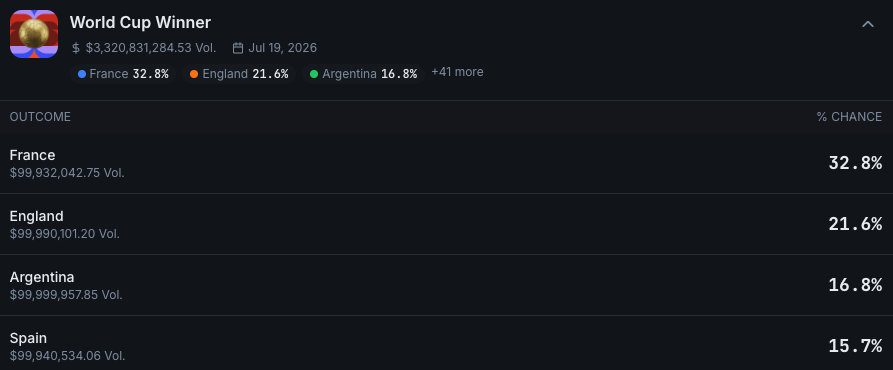
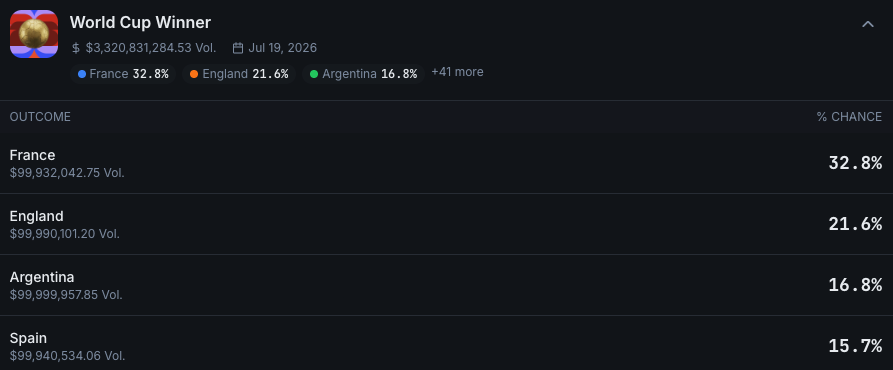
The divergence highlights the growing role of prediction markets, with sports and politics emerging as the sector’s biggest drivers. Polymarket’s World Cup winner market alone has attracted more than $3.3 billion in trading volume, while contracts tied to the 2028 US presidential election rank among the platform’s largest markets, according to Polymarketscan data.
Source: Polymarketscan
Binance extends dominance despite bear market as DEX activity falls
Despite the bear market, Binance extended its dominance, with a 38.7% market share in Q2. In contrast, MEXC saw the biggest slump among spot CEXs, with trading volume more than halving from $275.2 billion in Q1 to $121.2 billion in Q2.
DEX activity also weakened during the quarter, with the top 10 spot DEXs processing $408.9 billion in volume, down from $556.4 billion in Q1. Uniswap strengthened its position as the leading DEX, holding a 41.2% market share despite a 21.4% drop in volume to $168.5 billion.
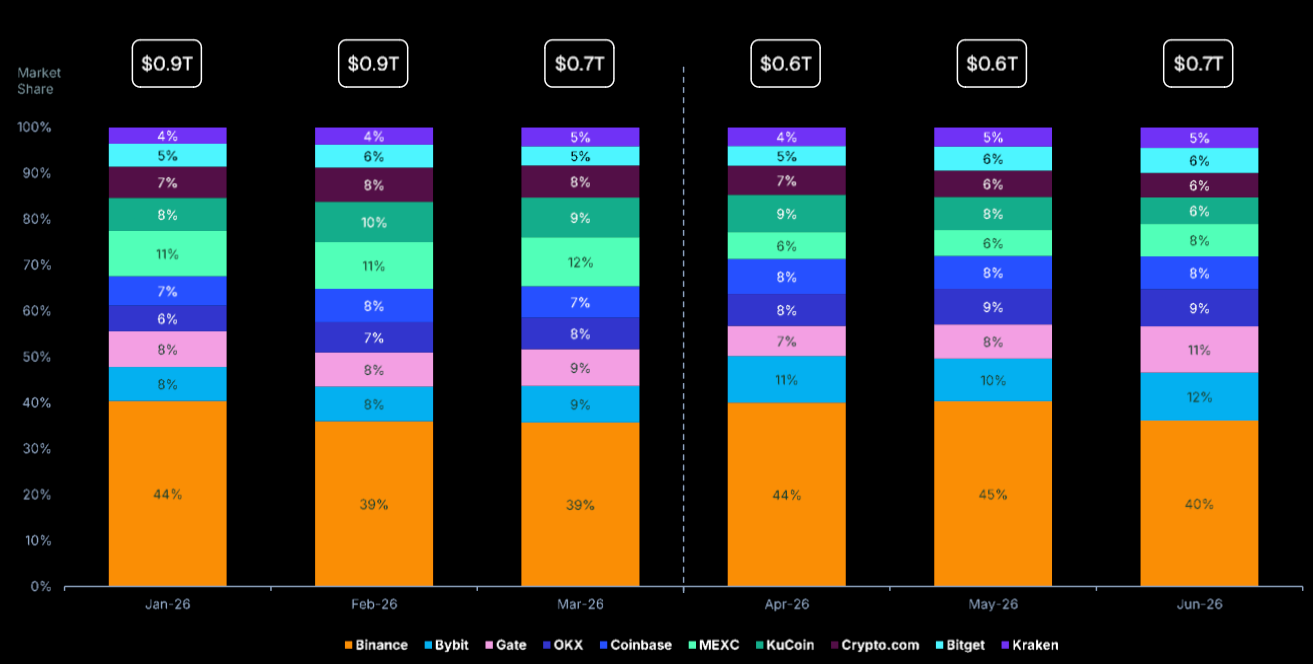
Source: CoinGecko
The declines came as the broader crypto market weakened, with total market capitalization falling 12.6% to $2.1 trillion during the quarter. April also marked a record month for hacks in decentralized finance (DeFi), highlighting ongoing security concerns across decentralized platforms.
Kalshi holds lead as prediction markets expand
Prediction market activity peaked in June, coinciding with the start of the FIFA World Cup, as monthly notional volume — the total value of all contracts traded — reached an all-time high of $50.7 billion, up 91.9% from the average of the previous five months.
Kalshi, the largest prediction market platform, maintained its lead over the quarter with a 58.9% market share, while Polymarket lost share from 35.8% to 30.2%. Robinhood-backed Rothera Markets climbed to fourth place.
Related: Czech Republic tells ISPs to block Polymarket after gambling blacklisting
The growth has drawn regulatory attention. In the US, regulators and states have clashed over whether prediction markets should be treated as financial markets or gambling platforms, with lawsuits involving platforms such as Kalshi escalating in 2026.
Authorities in other jurisdictions have also moved to restrict prediction markets, citing concerns including gambling rules, market integrity and potential insider trading risks.
Magazine: Has Bitcoin bottomed for this cycle? Analysts say ‘not yet’

Introduction
Credit is one of the most important pillars of the global economy. It enables individuals to buy homes, businesses to expand operations, and entrepreneurs to turn ideas into reality. Yet traditional credit markets remain slow, expensive, and often inaccessible to billions of people worldwide due to geographical limitations, rigid banking requirements, and outdated infrastructure.
Blockchain technology is transforming this landscape by introducing decentralized, transparent, and programmable credit markets. Instead of relying solely on banks and centralized financial institutions, blockchain enables borrowers and lenders to connect directly through smart contracts, creating a more efficient and inclusive financial ecosystem.
As decentralized finance (DeFi) continues to mature, blockchain-based credit markets are emerging as one of the most promising innovations capable of reshaping how capital flows across the globe.
What Are Blockchain-Based Credit Markets?
Blockchain-based credit markets are decentralized platforms where users can lend, borrow, or access credit using blockchain technology instead of traditional banking systems.
These platforms automate lending agreements through smart contracts, removing many intermediaries that typically increase costs and processing times.
Borrowers can access liquidity by providing collateral or, increasingly, through reputation-based lending models. Lenders earn yield by supplying digital assets into lending pools, where capital is allocated automatically based on transparent rules.
Everything—from interest calculations to loan repayments—is recorded on-chain, providing unprecedented transparency.
How They Work
A typical blockchain credit market follows a simple process:
1. Capital Providers Supply Liquidity
Investors deposit cryptocurrencies or stablecoins into lending pools.
2. Borrowers Request Loans
Users borrow assets by locking collateral or meeting protocol-specific credit requirements.
3. Smart Contracts Execute Loans
Instead of paperwork or manual approval, smart contracts automatically manage:
- Loan issuance
- Interest calculations
- Repayment schedules
- Liquidation rules
- Risk management
4. Lenders Earn Yield
Interest payments are distributed automatically to liquidity providers based on their contributions.
Why Blockchain Credit Markets Matter
1. Global Financial Inclusion
Traditional banks reject millions of borrowers due to geography, lack of documentation, or limited credit history.
Blockchain allows anyone with an internet connection and a crypto wallet to participate in global lending markets.
This opens financial opportunities for underserved populations worldwide.
2. Faster Loan Processing
Traditional loans can take days or even weeks.
Blockchain loans can be issued within minutes because smart contracts automate approvals and settlements.
3. Lower Costs
Removing intermediaries significantly reduces:
- Administrative fees
- Processing costs
- Cross-border transfer expenses
- Settlement delays
This benefits both borrowers and lenders.
4. Transparent Risk Management
Every transaction is recorded on-chain.
Investors can verify:
- Outstanding loans
- Pool liquidity
- Collateral levels
- Historical repayments
Transparency reduces information asymmetry that often exists in traditional finance.
5. Programmable Finance
Loans can include automated conditions such as:
- Dynamic interest rates
- Auto-repayment mechanisms
- Revenue-sharing agreements
- Milestone-based funding
- Tokenized collateral
This flexibility enables entirely new financial products.
The Rise of On-Chain Credit Scoring
One of the biggest challenges for decentralized lending has been undercollateralization.
Most DeFi loans today require borrowers to deposit more collateral than they borrow.
However, blockchain-native credit scoring is beginning to change this.
Protocols are developing reputation systems based on:
- Wallet history
- Repayment behavior
- On-chain transaction activity
- Governance participation
- Identity attestations
- Verifiable credentials
Instead of relying solely on traditional credit bureaus, future lending decisions may increasingly be based on verifiable blockchain activity.
Institutional Adoption Is Growing
Major financial institutions are beginning to recognize blockchain credit infrastructure.
Tokenized treasury products, real-world assets (RWAs), and on-chain lending protocols are creating bridges between traditional finance and decentralized finance.
Institutional lenders can now deploy capital more efficiently while benefiting from transparent risk monitoring and automated settlement.
As regulatory frameworks mature, institutional participation is expected to accelerate.
Challenges Still Ahead
Despite rapid innovation, blockchain credit markets face several obstacles:
Regulatory Uncertainty
Many jurisdictions are still developing rules for decentralized lending and digital assets.
Smart Contract Risks
Software vulnerabilities can expose lending protocols to exploits if not properly audited.
Identity and Reputation
Building secure, privacy-preserving decentralized identity systems remains an ongoing challenge.
Market Volatility
Crypto collateral can experience significant price fluctuations, increasing liquidation risk.
User Experience
Simplifying wallets, onboarding, and risk management remains essential for mainstream adoption.
The Future of Blockchain Credit
Several trends are likely to define the next generation of blockchain lending:
- AI-assisted credit risk assessment
- Zero-knowledge identity verification
- Cross-chain lending markets
- Tokenized real-world collateral
- Reputation-based unsecured lending
- Decentralized business financing
- On-chain corporate credit markets
- Embedded DeFi lending inside fintech applications
Over time, blockchain credit markets may evolve beyond crypto-native users and become foundational infrastructure for global digital finance.
Conclusion
Blockchain-based credit markets are redefining how capital is created, distributed, and managed. By replacing manual processes with transparent smart contracts, they make lending faster, more efficient, and more accessible to people around the world.
While challenges such as regulation, security, and identity remain, innovation is advancing quickly. As decentralized identity, tokenized real-world assets, and AI-powered risk assessment continue to mature, blockchain credit markets are poised to become a key component of the future financial system.
The evolution of credit is no longer limited to traditional banks. It is moving on-chain—where transparency, programmability, and global accessibility are creating a more open and inclusive financial ecosystem.
REQUEST AN ARTICLE


Ledger said is bringing its hardware security model to the fast-growing world of AI agents with the launch of Ledger Agent Stack, an open-source toolkit that allows autonomous software to interact with crypto wallets without ever controlling private keys.
The toolkit lets AI agents read wallet balances, analyze portfolios, prepare transactions and propose payments, but requires every sensitive action to be explicitly approved on a Ledger hardware device before it can be executed.
This is the first product release under Ledger’s 2026 AI roadmap, as the hardware wallet maker bets that human oversight will become a critical security layer as AI agents take on increasingly complex financial tasks.
“Agents propose. Humans approve,” the team wrote in their press release shared with CoinDesk. “Crypto wallets have protected billions on this standard for years,” said Ian Rogers, Ledger’s chief human agency officer, in the press release. “Ledger Agent Stack allows your agent to use these wallets just as easily as humans.”
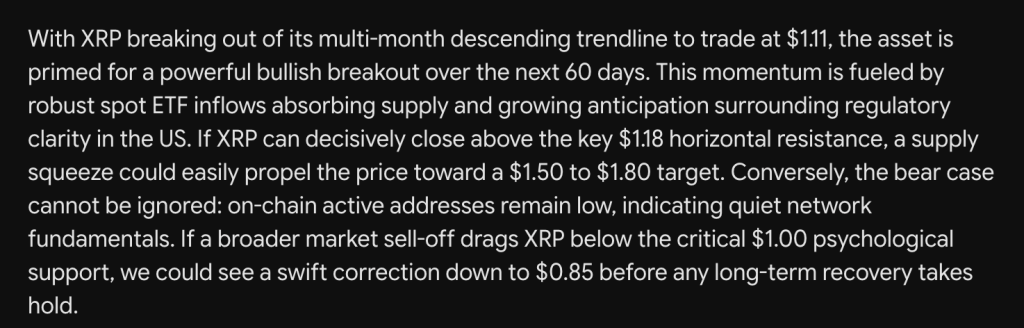
Google Gemini AI predicts and sees the XRP trendline break at $1.11; the model also predicts a $1.50 to $1.80 move sitting 60 days out.
The trigger is specific rather than vague. Gemini wants a decisive close above $1.18.
Clear that level, and the thesis is a supply squeeze, not a slow grind. Spot ETF inflows are already absorbing float. Regulatory clarity in the US keeps building as a background tailwind.
Put those together, and a close above $1.18 stops being a technical footnote. It becomes the spark for the whole move.

Gemini does not skip the weak spot in its own thesis either. On-chain active addresses remain low, which is the model’s own words for a network that is quiet under the hood.
Price can break a trendline and still lack real usage behind it. That gap between chart action and network activity is exactly what the bear case leans on.
If a broader market selloff drags XRP under the $1.00 psychological floor, Gemini sees a fast correction to $0.85 before any real recovery resumes. That is not a mild pullback scenario; it is a specific air pocket with a specific number attached.

Trade XRP and Don’t Miss Out on Our $1,000 USDT Airdrop on ByBit
The $1.18 Ceiling XRP Has Not Touched Since May
The chart backs up why $1.18 is the number everyone keeps circling. XRP closed at $1.11517, up 0.38%, with the session ranging between $1.09823 and $1.12895.
Zoom out, and this coin has been sliding since a September 2025 top near $3.20. February brought the real damage, a gap down through $1.60 that reset the entire structure.
Since February, the price has lived in a tightening range between roughly $1.30 and $1.60, then slipped under $1.20 in June. That June breakdown is the low Gemini that quietly betting has already printed.
Support sits at $1.05, then the psychological $1.00 line Gemini flagged directly. Resistance stacks at $1.18 first, then $1.30, then the May shelf near $1.60.
RSI reads close to 44 with the signal line just under it, near 42. That gap just turned mildly positive, meaning short-term momentum is finally leaning up instead of down for the first time in weeks.
It is an early signal, not a confirmed reversal. Gemini’s entire bull case rides on that flicker of momentum surviving contact with $1.18.
Clear it decisively, and the squeeze thesis gets real. Fail there again, and XRP goes right back to living below $1.
Don’t Miss Out on Our $1,000 USDT Airdrop on ByBit
Discover: The best crypto to diversify your portfolio with
Here is what Gemini AI Predicts For LiquidChain’s near future
Every cycle has a moment where waiting becomes the most expensive decision you can make. That moment is now.
Bitcoin, Ethereum, and XRP are all pinned under the same resistance they have been testing for weeks. The macro unlock is perpetually one data point away. The institutional money keeps arriving next quarter. Large-cap traders waiting for a breakout are queuing for a decision that belongs to someone else entirely.
Gemini AI has identified what experienced cycle traders already act on. Capital that registers as statistical background noise at Bitcoin’s market cap can completely reprice a small, undiscovered project. The asymmetry is not complicated. It lives in the distance between what something is genuinely worth and what the market has currently assigned it. The moment that distance gets noticed, it collapses. Before that moment, it is fully open.
Cross-chain fragmentation has been quietly taxing every DeFi participant since the first bridge went live. Bitcoin, Ethereum, and Solana were engineered independently with zero shared infrastructure and no design intent to communicate. Every transaction crossing those ecosystem boundaries absorbs the cost of that decision in fees, failed execution, and slippage that hits before settlement even begins. The bridge industry did not fix this problem. It built a business model on top of it.
LiquidChain removes the business model entirely. Three networks unified inside a single execution layer. One deployment reaches all of them simultaneously. No cross-chain tax is extracted from any interaction anywhere.
Gemini AI predicts it as a worth watching coin. The presale sits at $0.01454 with just over $860,000 raised.
Execution is unproven. Adoption is an open question. Established assets offer a smoother path toward a ceiling that the entire market can already see. LiquidChain is the entry point that stops existing once the market finds it.
The post Google Gemini AI Predicts XRP Price Will Surprise Everyone in the Next 60 Days appeared first on Cryptonews.


President Donald Trump said in January he had no plans to pardon Bankman-Fried. He has cleared Binance founder Changpeng Zhao and Silk Road creator Ross Ulbricht, along with other white-collar offenders.
Bankman-Fried ran two companies at once. FTX was a crypto exchange, which holds customer money the way a broker does and is not supposed to touch it. Alameda Research was a trading firm he also owned. He moved billions of dollars in FTX customer deposits to Alameda, which spent the money on trades, venture investments, political donations, and Bahamian real estate, while FTX’s software exempted Alameda from the rules that would have forced it to cover its losses like any other trader.
The facade was blown open after CoinDesk obtained Alameda’s balance sheet in November 2022 and found that most of what the firm counted as assets was FTT – a token FTX had created itself and could issue at will.
The collateral propping up Alameda was, in effect, something its sister company had invented. Further cracks emerged after the prominent exchange Binance said, days later, it would sell its FTT holdings, leading to a rapid collapse in FTT prices.
Customers rushed to pull their deposits, and FTX could not return the money because it was no longer there. The exchange filed for bankruptcy on Nov. 11, 2022, just over a week after the story ran.

This is Financial Advice

Mother of Jools Sweeney hopes new inquest into son’s death is a ‘turning point’

US suitor raises offer for pawnbroker Ramsdens following shareholder talks


-

 Fashion6 days ago
Weekend Open Thread: Nutriplenish Leave-In Conditioner
-

 Tech7 days ago
Character.AI enters the microdrama arena with its own productions, but there’s a twist
-
 Sports7 days ago
2026 Genesis Scottish Open Thursday TV coverage: Round 1
-

 Sports6 days ago
Super Eagles star Moses Simon opens up on Liverpool transfer regret
-

 Politics1 day ago
Young campaigners urge incoming PM to act on outdoor junk food ads
-

 News Videos2 days ago
XRP BOMBSHELL… XRP OMBOARDED FOR TRANSACTIONS!!!
-

 Tech2 days ago
Get Your ESP32 Sunny Side Up With This Solar Dev Board
-

 Tech2 days ago
Dark Secrets Emerge When Jailbreaking LLMs
-
 Entertainment21 hours ago
Disney’s Most Ambitious Failed Star Wars Attraction Is Coming to SDCC
-
 Sports17 hours ago
New Cornerback Enters Vikings Trade Rumor Mill
-

 Crypto World13 hours ago
CFTC blocks Kalshi from unwinding Michigan trades after court order
-

 News Videos3 days ago
how to make coin bank box with cardboard #scienceproject #money #diy #shorts
-
 Tech3 days ago
Cloudflare Precursor Watches Your Mouse and Keyboard To Decide If You Are Human
-
 Entertainment19 hours ago
Vicki Gunvalson Defends Discussing Heather Dubrow’s Money
-
Crypto World2 days ago
Ripple, Coinbase, Circle Join Linux x402 Foundation to Help Shape AI Payments
-

 NewsBeat16 hours ago
Watch: Is Donald Trump facing a popular backlash on immigration?
-

 Sports14 hours ago
Michigan officials not expected to discuss AD Warde Manuel at Thursday meeting
-
 NewsBeat16 hours ago
Firefighters issue update on Dovestone moorland blaze as fire enters fourth day
-

 Business2 days ago
ACCC warns AI could lift insurance costs in risk-prone areas
-

 Entertainment3 days ago
Hollywood’s Biggest Director Just Called Out AI, And It’s Glorious
You must be logged in to post a comment Login