

Crypto World
Is (Ripple) XRP Finally Ready to Break Out? Here Are 3 Reasons Why


Despite rebounding from a local bottom near $1, Ripple’s cross-border token remains heavily suppressed in the current bear market and hasn’t been able to stage a decisive comeback.
Even so, several key signs suggest the bulls might be getting ready to step in and take control soon.
Green Days on the Way?
Currently, XRP trades at around $1.11, representing a mere 1% increase on a weekly scale but a substantial 62% collapse over the past year. The recent whale behavior, though, may tilt the scales toward a more tangible rebound in the near future.
The renowned analyst Ali Martinez revealed that large investors have purchased roughly 70 million tokens over the last week, thus boosting their total holdings to approximately 3.8 billion units (around 6% of the asset’s circulating supply). Whale accumulation signals growing confidence among major holders, which can help stabilize price action and attract retail investors into the ecosystem.
The second bullish factor was presented again by Martinez, who noted that XRP’s TD Sequential indicator has flashed a buy signal. It is important to note that this metric hasn’t been fully reliable over the last several months. In December, it flashed a buy signal, which was followed by a strong price increase, but in January 2026, it preceded a major correction instead.
Last but not least, we will touch upon the shrinking amount of XRP stored on Binance. As CryptoPotato reported, the figure dropped to around 2.61 billion tokens, the lowest since February. The development indicates that a growing number of investors have moved their holdings to self-custody wallets, thereby reducing immediate selling pressure.
The Latest Predictions
Analysts on X have been quite vocal on XRP recently, with most outlining bullish forecasts. The market observer who uses the moniker Gerla claimed that if buyers defend the important $1.10 level, the price could rise to $1.24 next.
Crypto Patel and Celal Kucuker have been even more optimistic, envisioning an explosion to $9 and $7, respectively. JAVON MARKS joined the club of ultra bulls, arguing that $15+ is “a measured level that can be reached in the next wave.”
Of course, some remain cautious and believe the cycle’s bottom has yet to be formed. X user Diana, for instance, warned that the price could plummet to $0.87 before a new bull run begins.
The post Is (Ripple) XRP Finally Ready to Break Out? Here Are 3 Reasons Why appeared first on CryptoPotato.



Ledger said is bringing its hardware security model to the fast-growing world of AI agents with the launch of Ledger Agent Stack, an open-source toolkit that allows autonomous software to interact with crypto wallets without ever controlling private keys.
The toolkit lets AI agents read wallet balances, analyze portfolios, prepare transactions and propose payments, but requires every sensitive action to be explicitly approved on a Ledger hardware device before it can be executed.
This is the first product release under Ledger’s 2026 AI roadmap, as the hardware wallet maker bets that human oversight will become a critical security layer as AI agents take on increasingly complex financial tasks.
“Agents propose. Humans approve,” the team wrote in their press release shared with CoinDesk. “Crypto wallets have protected billions on this standard for years,” said Ian Rogers, Ledger’s chief human agency officer, in the press release. “Ledger Agent Stack allows your agent to use these wallets just as easily as humans.”
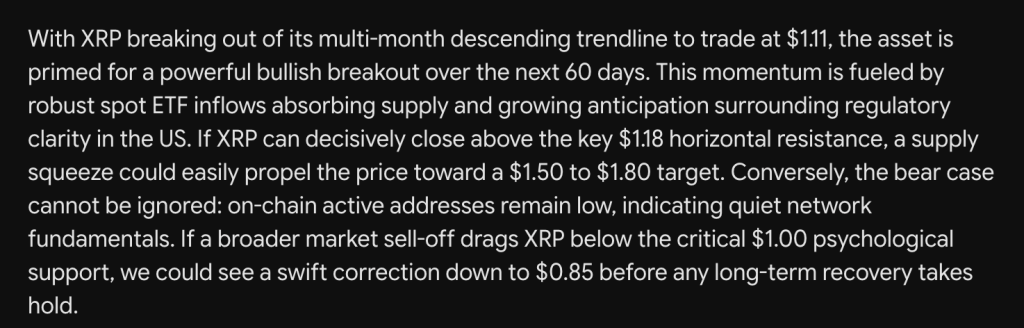
Google Gemini AI predicts and sees the XRP trendline break at $1.11; the model also predicts a $1.50 to $1.80 move sitting 60 days out.
The trigger is specific rather than vague. Gemini wants a decisive close above $1.18.
Clear that level, and the thesis is a supply squeeze, not a slow grind. Spot ETF inflows are already absorbing float. Regulatory clarity in the US keeps building as a background tailwind.
Put those together, and a close above $1.18 stops being a technical footnote. It becomes the spark for the whole move.

Gemini does not skip the weak spot in its own thesis either. On-chain active addresses remain low, which is the model’s own words for a network that is quiet under the hood.
Price can break a trendline and still lack real usage behind it. That gap between chart action and network activity is exactly what the bear case leans on.
If a broader market selloff drags XRP under the $1.00 psychological floor, Gemini sees a fast correction to $0.85 before any real recovery resumes. That is not a mild pullback scenario; it is a specific air pocket with a specific number attached.

Trade XRP and Don’t Miss Out on Our $1,000 USDT Airdrop on ByBit
The $1.18 Ceiling XRP Has Not Touched Since May
The chart backs up why $1.18 is the number everyone keeps circling. XRP closed at $1.11517, up 0.38%, with the session ranging between $1.09823 and $1.12895.
Zoom out, and this coin has been sliding since a September 2025 top near $3.20. February brought the real damage, a gap down through $1.60 that reset the entire structure.
Since February, the price has lived in a tightening range between roughly $1.30 and $1.60, then slipped under $1.20 in June. That June breakdown is the low Gemini that quietly betting has already printed.
Support sits at $1.05, then the psychological $1.00 line Gemini flagged directly. Resistance stacks at $1.18 first, then $1.30, then the May shelf near $1.60.
RSI reads close to 44 with the signal line just under it, near 42. That gap just turned mildly positive, meaning short-term momentum is finally leaning up instead of down for the first time in weeks.
It is an early signal, not a confirmed reversal. Gemini’s entire bull case rides on that flicker of momentum surviving contact with $1.18.
Clear it decisively, and the squeeze thesis gets real. Fail there again, and XRP goes right back to living below $1.
Don’t Miss Out on Our $1,000 USDT Airdrop on ByBit
Discover: The best crypto to diversify your portfolio with
Here is what Gemini AI Predicts For LiquidChain’s near future
Every cycle has a moment where waiting becomes the most expensive decision you can make. That moment is now.
Bitcoin, Ethereum, and XRP are all pinned under the same resistance they have been testing for weeks. The macro unlock is perpetually one data point away. The institutional money keeps arriving next quarter. Large-cap traders waiting for a breakout are queuing for a decision that belongs to someone else entirely.
Gemini AI has identified what experienced cycle traders already act on. Capital that registers as statistical background noise at Bitcoin’s market cap can completely reprice a small, undiscovered project. The asymmetry is not complicated. It lives in the distance between what something is genuinely worth and what the market has currently assigned it. The moment that distance gets noticed, it collapses. Before that moment, it is fully open.
Cross-chain fragmentation has been quietly taxing every DeFi participant since the first bridge went live. Bitcoin, Ethereum, and Solana were engineered independently with zero shared infrastructure and no design intent to communicate. Every transaction crossing those ecosystem boundaries absorbs the cost of that decision in fees, failed execution, and slippage that hits before settlement even begins. The bridge industry did not fix this problem. It built a business model on top of it.
LiquidChain removes the business model entirely. Three networks unified inside a single execution layer. One deployment reaches all of them simultaneously. No cross-chain tax is extracted from any interaction anywhere.
Gemini AI predicts it as a worth watching coin. The presale sits at $0.01454 with just over $860,000 raised.
Execution is unproven. Adoption is an open question. Established assets offer a smoother path toward a ceiling that the entire market can already see. LiquidChain is the entry point that stops existing once the market finds it.
The post Google Gemini AI Predicts XRP Price Will Surprise Everyone in the Next 60 Days appeared first on Cryptonews.


President Donald Trump said in January he had no plans to pardon Bankman-Fried. He has cleared Binance founder Changpeng Zhao and Silk Road creator Ross Ulbricht, along with other white-collar offenders.
Bankman-Fried ran two companies at once. FTX was a crypto exchange, which holds customer money the way a broker does and is not supposed to touch it. Alameda Research was a trading firm he also owned. He moved billions of dollars in FTX customer deposits to Alameda, which spent the money on trades, venture investments, political donations, and Bahamian real estate, while FTX’s software exempted Alameda from the rules that would have forced it to cover its losses like any other trader.
The facade was blown open after CoinDesk obtained Alameda’s balance sheet in November 2022 and found that most of what the firm counted as assets was FTT – a token FTX had created itself and could issue at will.
The collateral propping up Alameda was, in effect, something its sister company had invented. Further cracks emerged after the prominent exchange Binance said, days later, it would sell its FTT holdings, leading to a rapid collapse in FTT prices.
Customers rushed to pull their deposits, and FTX could not return the money because it was no longer there. The exchange filed for bankruptcy on Nov. 11, 2022, just over a week after the story ran.
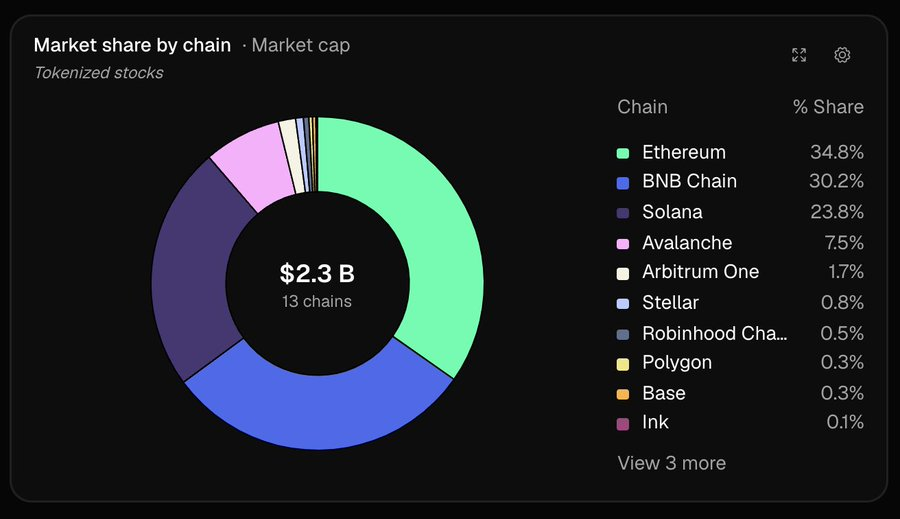
The global market capitalization of tokenized stocks rose to a record $2.3 billion on Wednesday, as more investors sought exposure to blockchain-based equity products.
The Ethereum network boasted the largest market share, at 34%, followed by BNB Chain with 30% and the Solana network with 23%, data aggregator Token Terminal shared in a Wednesday X post.
The largest increase came from Kraken exchange’s xStocks, which accounted for $507 million worth of tokenized stocks and Binance’s bStocks, with $334 million. Ondo Finance remained the largest tokenized stock issuer with $955 million in onchain equities, according to Token Terminal data.
More crypto platforms are bringing traditional investment products onto blockchain rails, in many cases opening up assets to investors outside of the United States. Tokenized stocks can also provide investors with fractional ownership and around-the-clock trading.
The world’s largest crypto exchange, Binance, opened zero-commission trading to over 7,000 US tokenized stocks for eligible users on June 1, as part of its strategy to become a multi-asset platform. Coinbase rolled out commission-free US stock and ETF trading with 24/5 availability in December 2025.
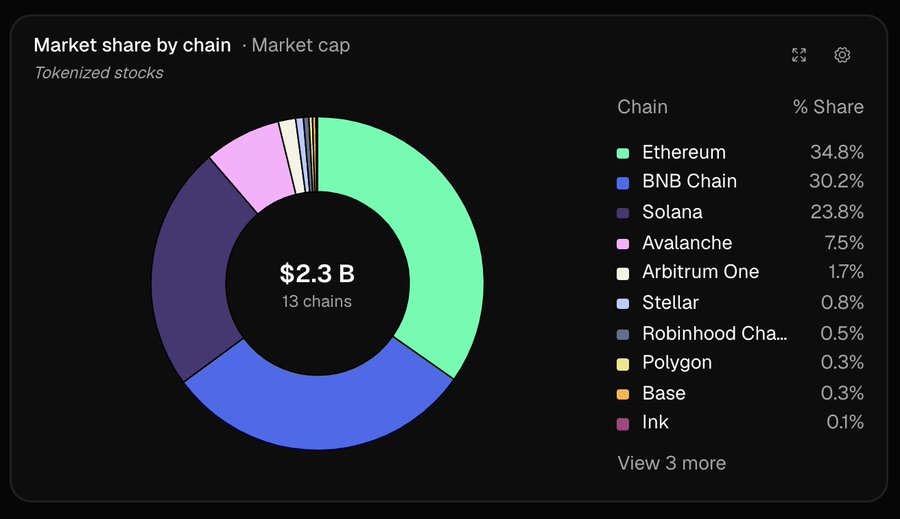
Source: Token Terminal
In April, crypto exchange Bitget launched a proxy offering tied to the pre-initial public offering (IPO) phase of Elon Musk’s aerospace manufacturing and space transportation company, SpaceX.
In January, Vienna-based crypto exchange Bitpanda shared plans to expand its offering to include about 10,000 stocks and exchange-traded funds (ETFs).
Kraken launched access to 11,000 US-listed stocks and ETFs through xStocks in April 2025 as one of the first major crypto-native platforms. The cumulative trading volume of xStocks exceeded $25 billion within about eight months of launch.
Related: NYSE parent ICE pushes ‘level playing field’ for 24/7 onchain perps
Tokenized RWAs surge despite crypto market pullback
The market for tokenized real-world assets (RWAs) surged 589% from early 2025 to June 2026, led by government bonds and money market funds, according to a June report from Binance Research.
Tokenized precious metals also attracted about $1.5 billion in value, rising 39% during the period.
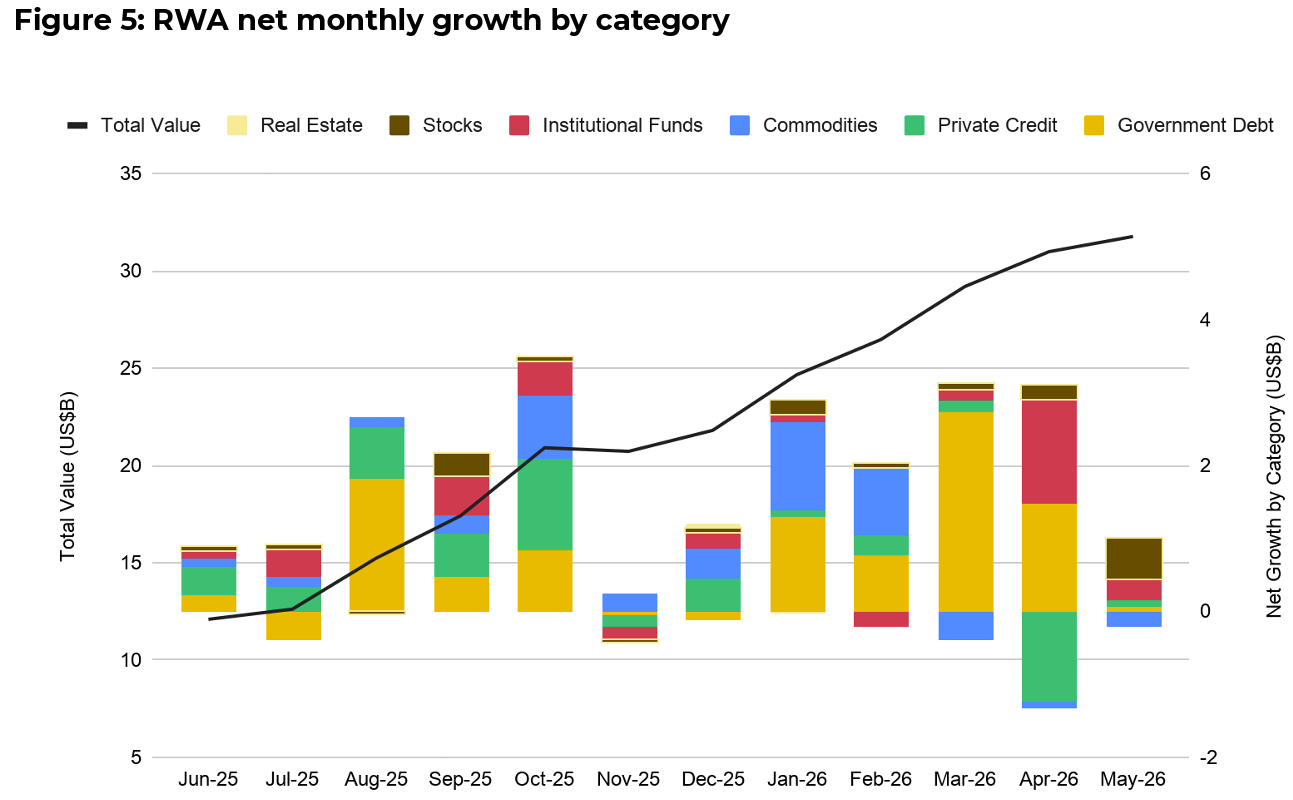
The market for tokenized RWAs is becoming more diversified.
Source: Binance Research
However, stocks remain a small fraction of the broader tokenized RWA market, accounting for only about 5.5% of the $34 billion RWA market capitalization.
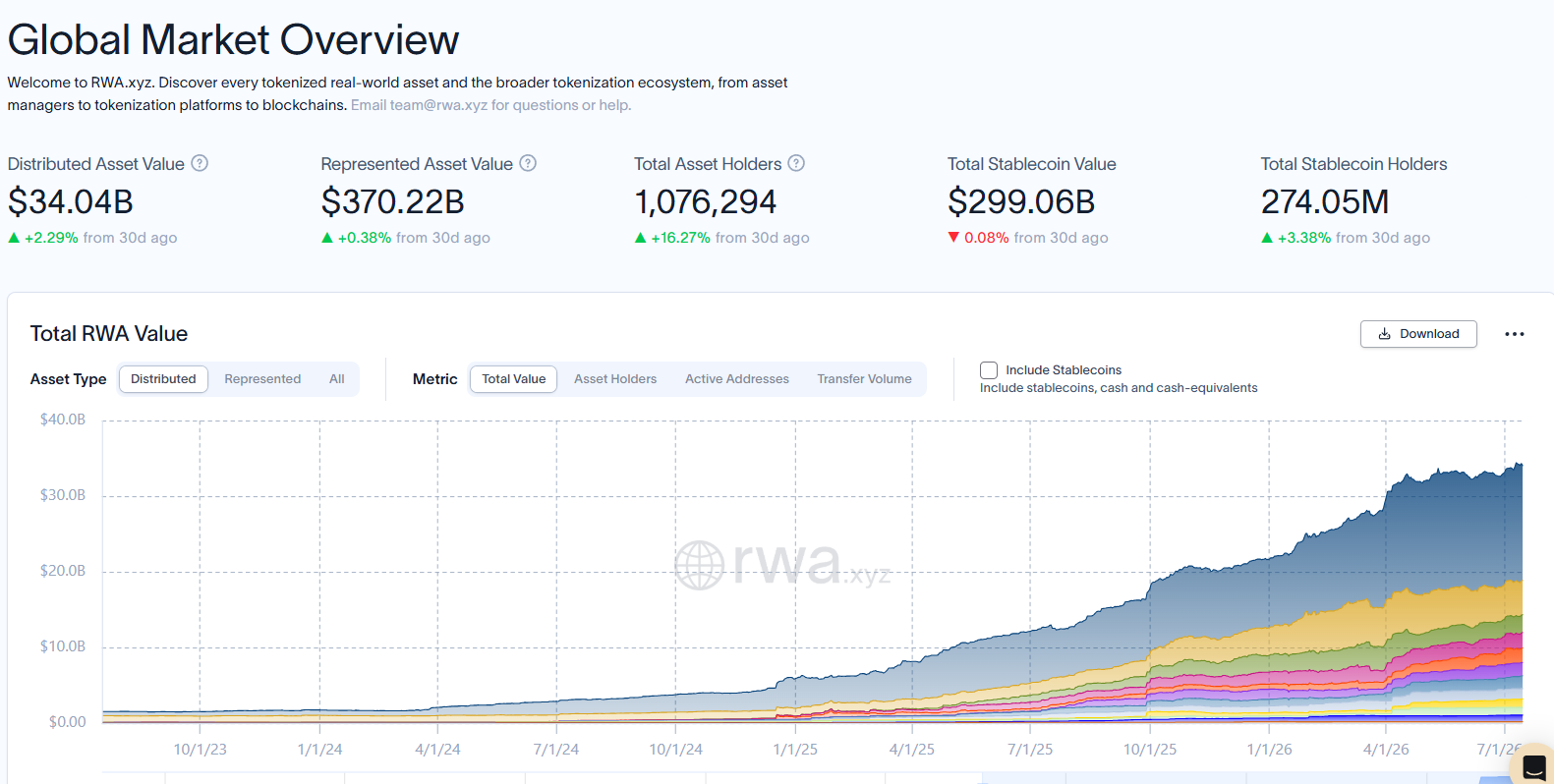
Tokenized RWA market overview, all-time chart. Source: RWA.xyz
About $15 billion in tokenized US Treasury debt represents the largest segment, or 44%, of the RWA market, followed by $4.5 billion in tokenized commodities, accounting for 13%, according to data provider RWA.xyz.
Magazine: The 5 types of real world assets being tokenized fastest onchain

AI agents are starting to change how payments need to work, and Visa is warning that the world’s card rails were never built for the transaction volume, speed, and cost sensitivity required by machine-to-machine commerce. In a joint report released this week with investment thesis platform Artemis, Visa argues that AI-driven micropayments demand near-zero fees and faster settlement to become commercially viable.
The report links the timing to a capability shift: it says AI agents crossed a key threshold in mid-2025, enabling them to discover unfamiliar APIs, assess pricing, and make autonomous payment decisions. That capability, Visa and Artemis say, is pushing commerce toward an agentic model—while existing infrastructure gaps continue to limit mainstream adoption.
Key takeaways
- Visa and Artemis say traditional cards are optimized for low-frequency, human-paced payments, making them poorly matched to high-frequency AI micropayments.
- The report frames 2025 as a turning point for “agentic” payment automation, driven by AI agents’ ability to autonomously evaluate and execute transactions.
- Visa and Artemis propose convergence: cards remain useful for proxy purchases inside merchant networks, while stablecoins fit machine-native micropayments.
- Some machine-payment standards are already gaining momentum, including Coinbase’s x402 protocol, which the report cites as reaching sharply higher monthly transaction counts in late 2025.
Why AI agents stress existing payment rails
Visa and Artemis describe the underlying mismatch as structural. Cards were designed for human commerce—where transactions tend to be less frequent and costs can be amortized across larger purchase sizes. AI agents, by contrast, are expected to generate many more micro-transactions, often on short time horizons and with different cost constraints.
For agentic micropayments to scale, the infrastructure must support payments with extremely low per-transaction overhead and settlement that enables rapid decision-making loops. The report suggests that without these properties, the economics of autonomous “machine-to-machine” payments remain unfavorable—even if the AI itself can now carry out the payment decision.
The report also warns that infrastructure gaps aren’t just theoretical. It frames current limitations as a direct brake on adoption, arguing that the shift from experimenting with agent capabilities to using them in everyday transactions depends on payment networks that can keep up.
x402 shows demand for machine-native transaction patterns
While Visa and Artemis emphasize the broader need for new infrastructure, they also point to early signs that some agentic payment designs are gaining usage. The report cites the x402 payment protocol developed by Coinbase as an example of standards beginning to attract real transactional volume.
According to the report, x402 processed $15 million in adjusted volume across more than 109 million adjusted transactions since its May 2025 launch. It also highlights a significant acceleration in October 2025: the monthly transaction count reportedly increased from 40,000 to 3.8 million, resulting in 38 million transactions processed in October alone. The report attributes this momentum to the growing practicality of the protocol for machine-style payments.
Stablecoins as an on-ramp to agentic micropayments
A central claim in the Visa-Artemis report is that stablecoins could play a key role in enabling machine-native micropayments without forcing all commerce to migrate away from cards. Rather than positioning stablecoins and card networks as direct competitors, the report argues for a convergence model.
“The trajectory points toward convergence rather than competition: cards for proxy purchases inside existing merchant networks, stablecoins for machine-native micropayments, and hybrid flows where both are used within the same workflow.”
This framing matters for investors and builders because it implies that payment interoperability—not replacement—will likely define near-term strategy. In practice, an AI agent workflow may still need cards for certain merchant-bound transactions, but stablecoins (or other crypto rails) could be better suited for the agent’s “background” actions that require very low fees and fast settlement.
The report adds that a single machine-payments framework could support both stablecoin-based flows and traditional card transactions. Visa says this creates a path for card networks to plug into agentic payments over time, rather than treating agent commerce as a separate universe.
Protocols and tooling: connecting onchain and fiat through tokens
Visa and Artemis point to a broader effort to unify payment approaches using shared payment tokens and machine-payment protocols. The report says Tempo’s Machine Payment Protocol (MPP) now spans both onchain crypto payments and fiat payments through shared payment tokens.
Visa also states that its Card Specification SDK was built to extend the protocol into card-based agent commerce. It further notes that Tempo and Visa’s crypto division launched AI-related tools in March, with different focal points: Visa’s tooling is described as enabling same-day payments for AI agents, while Tempo’s Machine Payments Protocol is designed to make it easier for AI actors to send and receive money.
While the report doesn’t spell out new performance benchmarks for every component, it does make one clear point: adoption depends on interoperability across rails and token frameworks. If AI agents can consistently route payments through a machine-friendly layer, then the difference between stablecoin settlement and card settlement becomes a routing and workflow decision—not a structural barrier.
For readers watching the space, this suggests a practical trend: payment infrastructure will likely evolve through standards, SDKs, and shared protocol logic that allow agentic workflows to move between fiat and crypto settlement depending on cost, speed, and merchant coverage.
Going forward, the key question is whether agentic micropayment demand keeps accelerating fast enough to force mainstream payment networks to meet machine-level cost and settlement requirements. Buyers of payments infrastructure, developers integrating agent payments, and traders tracking adjacent stablecoin usage should watch how quickly token-based frameworks and machine payment standards—like x402 and MPP—translate early transaction growth into consistent, scaled deployments.
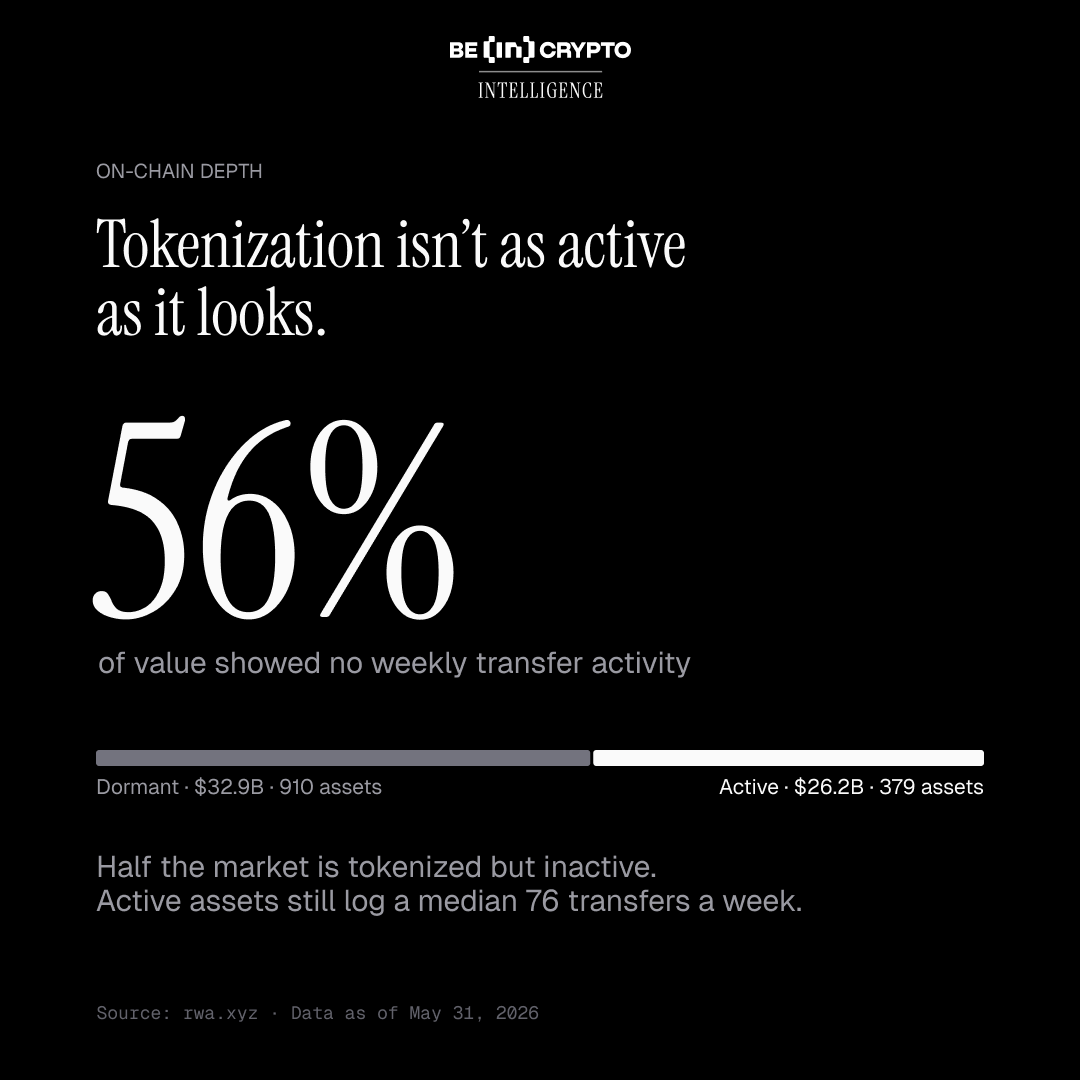
The tokenized real-world asset market has reached more than $60 billion, but most of that value remains concentrated, restricted, or inactive on-chain.
BeInCrypto Intelligence’s Real State of Tokenization in 2026 report, built with market data from RWA.xyz, tracked more than 7,000 products across 12 asset classes. It found that just 62 assets hold 88% of the market value, while five products account for roughly half.
The activity gap is even sharper. Of 1,289 tokenized assets worth more than $100,000, only 910 assets representing $32.9 billion recorded zero weekly transfers.
Meanwhile, 97% of the market remains outside US retail access. BeInCrypto asked members of its Expert Council what these findings reveal about the state of tokenization.

Archax: Institutions Should Not Have to Choose a Chain
Graham Rodford, CEO and Co-Founder of Archax, said blockchain fragmentation is making institutional adoption harder than necessary.
“The fragmentation problem is real and it’s not going away,” Rodford said. “Every major asset manager we speak to is dealing with the same operational question: which chain do I pick, and what happens when the next one emerges? The honest answer is that they shouldn’t have to pick.”
Rodford argues that institutions need a regulated layer above individual networks. It would handle issuance, trading, custody, and settlement without tying firms to a single blockchain.
He also rejected the idea that public blockchains are automatically unregulated.
“What determines regulatory safety isn’t the chain – it’s the gateway.”
Theo: Dormant Assets Show a Half-Built Market
Iggy Ioppe, CIO of Theo, said the $32.9 billion in dormant value does not prove tokenization has failed. Instead, it shows that much of the market has stopped at representation.
“Wrapping an asset and parking it is ‘tokenization theater’. The real work is making tokens usable – as collateral, in DeFi, in live settlement.”
The report distinguishes between Distributed assets, which can move across public blockchain rails, and Represented assets, which mainly use blockchain as a digital record.
Around $27 billion of the dormant value came from Represented assets. Many were designed for recordkeeping and institutional settlement rather than public trading.
Still, Ioppe said the next stage will depend on whether tokenized assets can move, earn yield, settle around the clock, and connect to wider financial infrastructure.
“The assets are on-chain; the next phase is making them work.”

Sygnum: Regulation Could Create Regional Liquidity Silos
Fabian Dori, CIO of Sygnum Bank, said the market risks splitting into isolated pools as jurisdictions develop different rules and standards.
“A regulated asset bank can help prevent tokenized markets from hardening into isolated regional liquidity pools by acting as a compliant interoperability layer rather than trying to force one universal token across all jurisdictions.”
The report found that EU-regulated products account for only $3.3 billion, or 6% of the core market.
Dori’s argument is that regulated platforms must connect issuers and investors across chains while preserving local legal and compliance requirements.
WAODAO: Tokenized Assets Need a Liquidity Network
Aleksandr Cryptoved, Founder of WAODAO, said the report exposes the difference between putting an asset on-chain and creating a functioning market around it.
“The report’s $32.9B in assets with zero weekly transfer activity highlights the gap between tokenized existence and tokenized market activity.”
He proposed a “liquidity graph” in which tokenized assets connect through multiple smaller trading pairs rather than relying on one deep market against a stablecoin.
“In my view, the missing layer is a liquidity graph.”
Such a structure could generate activity through rebalancing, arbitrage, collateral movements, and institutional portfolio management.
Tokenization’s Next Test Is Usefulness
The experts differ on why so much tokenized value remains inactive.
Rodford points to blockchain fragmentation. Ioppe sees a market stuck at digital representation. Dori focuses on regulatory silos, while Cryptoved argues that tokenized assets need better liquidity connections.
Their conclusions converge on one point: issuing more tokens will not solve the market’s structural gaps.
The next phase depends on whether tokenized assets can move across networks, meet regulatory requirements, reach investors, and plug into real financial workflows.
The market has proved that assets can be recorded on-chain. It has not yet proved that most of them can function as active markets.
Read the full BeInCrypto Intelligence report.
The post Is the RWA Boom an Illusion? BeInCrypto Expert Council Reacts to Stagnant Tokenization appeared first on BeInCrypto.


The implication does not stop there. According to Imran Lakha, founder of Options Insights, dealers hold a “net long gamma exposure” above $70,000. It means the dealers, who strive to maintain market-neutral exposure while making money from the bid-ask spread, would short or sell into strength above 70,000 to stay neutral or hedged.
“That hedging acts like a brake, capping how fast BTC can run once it gets up there,” Lakha said, adding that ether (ETH) isn’t as exposed to dealer gamma dynamics and can rip much faster.
Bitcoin was recently changung hands near $64,100, down nearly 1% since midnight UTC. Other major cryptocurrencies, including ether, XRP (XRP) and solana (SOL) nursed similar losses, while Nasdaq 100 index futures fell 0.5%.
“As always, there is a risk of a sudden sell-off amid financial market shocks, which could send BTC or global stock indices into a tailspin, but waiting for such moments is a thankless task,” said Alex Kuptsikevich, the chief market analyst at FxPro. “In such conditions, buying in a quiet market at less than half of peak levels looks like a perfectly reasonable tactic for the coming days or weeks.”
Stay alert!
Read more: For analysis of today’s activity in altcoins and derivatives, see Crypto Markets Today . For a comprehensive list of events this week, see CoinDesk’s “Crypto Week Ahead.”


Cointelegraph is committed to providing independent, high-quality journalism across the crypto, blockchain, AI, and fintech industries.
All news, reviews, and analyses are produced with full journalistic independence and integrity. For more details on our standards and processes, please read our Editorial Policy.

Bitcoin price pulled back after touching an intraday high near $65,500 despites its continuing bullish prediction. It’s not just BTC; risk assets softened together. Ethereum slipped about 1% over the past day, while PUMP and ZEC lost more than 4% as early-week momentum faded.
Nasdaq 100 futures also edged lower, too, as geopolitical tensions grabbed the headlines. Especially with some traders having already started locking in profits before the news broke.
Spot trading activity on centralized exchanges remained healthy through June, suggesting buyers have stepped back. This is important as markets can cool without falling apart, especially after a strong run into resistance.
Longer term, some analysts still see upside if fresh catalysts arrive. However, those projections depend on renewed demand instead of wishful thinking.
Discover: The Best Token Presales
Bitcoin Price Prediction: Reclaim $65,500 or Is a Test of $60K Next?
Bitcoin trades just above $64,000, while its gain sits near 2.5%, showing buyers still have the upper hand despite recent hesitation. TradingView analysis still points to a confirmed bearish break from a multi-month symmetrical triangle.
For now, the $61,800 to $62,000 area has become the first support worth watching, while $60,000 remains the line many traders would rather not revisit.

If buyers reclaim and defend $65,500, the recent breakdown could turn into a classic bear trap. That would put $67,500 to $70,000 back on the radar. Otherwise, Bitcoin may simply keep catching its breath between $62,000 and $65,500 as traders wait for fresh macro catalysts and ETF flow data.
On the flip side, a convincing daily close below $62,000 would likely invite another test of $60,000. Earlier liquidation waves already flushed excessive leverage, leaving positioning much cleaner. Still, clean books can become messy again if risk sentiment sours. ETF flows remain the market’s heartbeat, and sustained outflows would weaken institutional support.
Don’t Miss Out on Our $1,000 USDT Airdrop on ByBit
Bitcoin Hyper Targets Early-Mover Upside as BTC Tests Key Support
When spot BTC stalls at resistance and macro risk spikes simultaneously, rotating into large-cap BTC exposure starts to feel like a crowded trade with capped upside. That’s where earlier-stage infrastructure plays in the Bitcoin ecosystem draw attention, not as a hedge, but as a different risk/reward profile entirely.
Bitcoin Hyper ($HYPER) is a Bitcoin Layer 2 project integrating the Solana Virtual Machine, positioning itself as the first BTC L2 with SVM capability and targeting sub-second finality that the project claims exceeds even Solana’s throughput.
The presale has raised almost $33 million at a current token price of $0.0136832, with staking available at high APY for early participants. The core thesis: bring fast, low-cost smart contract execution to Bitcoin’s security layer without sacrificing decentralization, via a canonical bridge for native BTC transfers.
For traders who want Bitcoin ecosystem exposure with more upside leverage than spot BTC currently offers, research Bitcoin Hyper here.
Discover: The Best Crypto to Diversify Your Portfolio
The post Bitcoin Price Prediction: BTC Retraces as Iran Attacks America appeared first on Cryptonews.
Galaxy Digital (GLXY) has launched an institutional vault curation business on decentralized lending protocol Morpho, expanding its push into onchain finance with a product designed to help clients earn yield on idle stablecoin balances without managing decentralized finance (DeFi) infrastructure themselves.
The offering, called Galaxy Curator, is available through Fireblocks Earn, giving the custody platform’s more than 2,400 institutional clients access to curated onchain lending strategies from within their existing treasury and custody workflows, the company said in a press release Thursday.
The launch targets a longstanding challenge for institutional crypto holders. Large stablecoin balances often remain uninvested between settlements, deployments and operational holds due to the complexity and risk associated with directly interacting with decentralized finance protocols.
The rollout comes as professional vault curation has emerged as one of the fastest-growing segments of DeFi, with asset managers, trading firms and fintechs racing to package institutional-grade onchain yield products. Over the past year, firms including Bitwise, Gauntlet, Steakhouse Financial, Wintermute, Dialectic and RockawayX have launched or expanded curated vault offerings on Morpho.

NFL injury updates 2026: Latest on Patrick Mahomes, Malik Nabers before training camp

Daily Deal: Opusonix Pro Subscription

Prince Swanny – Money Up (Official Audio)


-

 Fashion6 days ago
Weekend Open Thread: Nutriplenish Leave-In Conditioner
-
 Sports7 days ago
2026 Genesis Scottish Open Thursday TV coverage: Round 1
-

 Tech7 days ago
Character.AI enters the microdrama arena with its own productions, but there’s a twist
-

 Sports6 days ago
Super Eagles star Moses Simon opens up on Liverpool transfer regret
-

 Politics1 day ago
Young campaigners urge incoming PM to act on outdoor junk food ads
-

 News Videos2 days ago
XRP BOMBSHELL… XRP OMBOARDED FOR TRANSACTIONS!!!
-

 Tech2 days ago
Get Your ESP32 Sunny Side Up With This Solar Dev Board
-

 Tech2 days ago
Dark Secrets Emerge When Jailbreaking LLMs
-
 Entertainment20 hours ago
Disney’s Most Ambitious Failed Star Wars Attraction Is Coming to SDCC
-
 Sports16 hours ago
New Cornerback Enters Vikings Trade Rumor Mill
-

 News Videos3 days ago
how to make coin bank box with cardboard #scienceproject #money #diy #shorts
-
 Tech3 days ago
Cloudflare Precursor Watches Your Mouse and Keyboard To Decide If You Are Human
-

 Crypto World12 hours ago
CFTC blocks Kalshi from unwinding Michigan trades after court order
-
 Entertainment19 hours ago
Vicki Gunvalson Defends Discussing Heather Dubrow’s Money
-
Crypto World2 days ago
Ripple, Coinbase, Circle Join Linux x402 Foundation to Help Shape AI Payments
-

 NewsBeat16 hours ago
Watch: Is Donald Trump facing a popular backlash on immigration?
-

 Sports13 hours ago
Michigan officials not expected to discuss AD Warde Manuel at Thursday meeting
-
 NewsBeat15 hours ago
Firefighters issue update on Dovestone moorland blaze as fire enters fourth day
-

 Business1 day ago
ACCC warns AI could lift insurance costs in risk-prone areas
-

 Entertainment3 days ago
Hollywood’s Biggest Director Just Called Out AI, And It’s Glorious
You must be logged in to post a comment Login