Commercial solar cells only have a conversion efficiency of around 25 percent.
LONGi
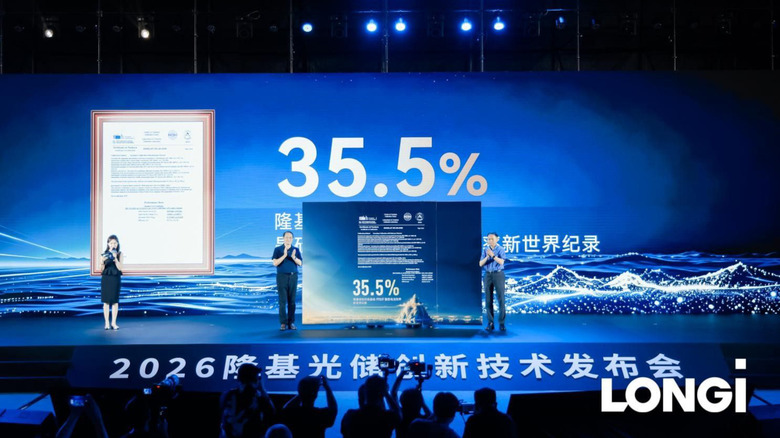
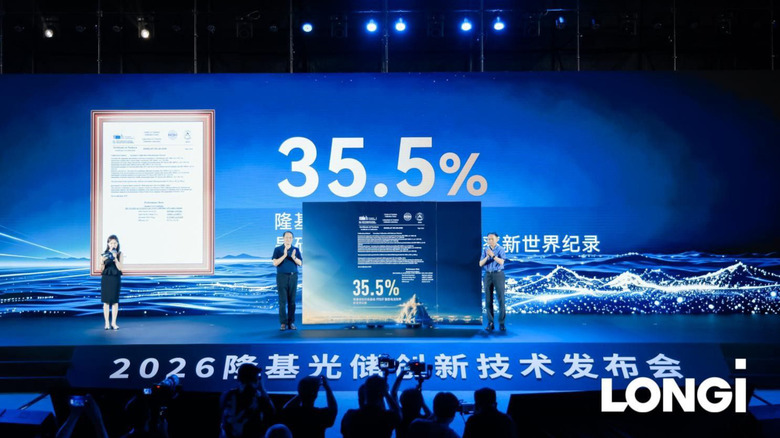
Chinese company LONGi has developed a solar cell that it claims has achieved a conversion efficiency of 35.5 percent, as verified by the European Solar Test Installation, a reference laboratory for the calibration of photovoltaic (PV) devices. That’s an impressive conversion efficiency compared to what most solar cells are capable of. According to the US Energy Information Administration, the solar cells in commercially available panels are just now approaching a 25 percent efficiency. There are cells with a conversion efficiency of 50 percent, but they’re for niche uses, like solar panels for satellites.
The company specifically developed crystalline silicon-perovskite tandem solar cells. They’re an emergent PV technology that LONGi believes is the future of solar energy. Theoretically, these cells could achieve an efficiency of 43 percent. LONGi first achieved an efficiency of 33.9 percent in November 2023 and then 34.6 in June 2024. After several more incremental increases, the company is now claiming an efficiency of 35.5 percent.
LONGi says it holds the world record for efficiency when it comes to this particular PV technology. That said, the US Department of Energy’s National Renewable Energy Laboratory developed a solar cell with an efficiency of 39.5 percent back in 2022. In the grand scheme of things, who holds the record matters very little for most people. What matters is finding a way to mass produce and commercialize cells with these efficiencies so that they can help address humanity’s energy problems.
We may receive a commission on purchases made from links.
If you’re shopping for the right HDMI cable for your TV or monitor, you may have come across the Ultra96 cable. Unless you’re a technophile, you may not know that the Ultra96 supports up to 96 Gbps of bandwidth under the HDMI 2.2 specification. This means that this cable can handle extremely demanding video formats and superior resolutions. But is it just too much cable for what you need?
If you’re buying HDMI 2.2 hardware capable of using its full 96 Gbps bandwidth, the answer is no. In that case, an Ultra96 HDMI cable is the right choice as it delivers everything you need for some modern PCs, TVs, and other advanced devices. This is especially true if you’re using a device capable of 4K at 240Hz, uncompressed 8K at 60Hz, and resolutions up to 16K at 60Hz. The Ultra96 is designed to support these specifications, making it the fastest and highest-bandwidth HDMI cable you can buy.
Advertisement
But if your devices are designed around HDMI 2.1 with 48 Gbps, a cable rated for those specifications is really all you need. The Ultra96 will not give your older devices the best resolution and the fastest speeds because the capability of your equipment is limited to the HDMI standard it was designed to support. However, if you’re planning on upgrading your devices in the future, you could swap your current cables for the Ultra96, because they are backward-compatible. That way, you’ll be ready when you decide to update your equipment.
Advertisement
What makes the Ultra96 cable different
Ultra96 is the latest advancement in the evolution of HDMI technology. Its 96 Gbps bandwidth is a major improvement over the once-standard HDMI 2.0 specification. HDMI 2.0 supported up to 18 Gbps of bandwidth before HDMI 2.1 increased that capability to 48 Gbps. But Ultra96 is designed to support the continued push toward higher resolutions, faster refresh rates, and more demanding video applications.
However, the Ultra96 certification goes beyond just bandwidth. Ultra96 cables are classified as Category 4 HDMI and must go through a testing phase to verify they can meet the full 96 Gbps specification. They are also tested for low electromagnetic interference, which helps reduce the possibility of interference with wireless networks and other electronic devices. But while the Ultra96 cable itself is designed to support the full 96 Gbps bandwidth, HDMI 2.2 devices can often be a bit more complicated.
That’s because unlike HDMI 2.1, HDMI 2.2 includes a few different bandwidth tiers, including 64 Gbps, 80 Gbps, and 96 Gbps. This means that a device bearing an HDMI 2.2 designation may not necessarily support the full performance available from an Ultra96 cable. As a result, consumers will need to pay attention to the specific bandwidth, as well as features, supported by their devices. Otherwise, they could end up with an HDMI cable that goes beyond the capabilities of their equipment.
The 2026 World Cup finalis here as Spain take on Argentina to be crowned champions. It is being billed as Lamine Yamal versus Lionel Messi, but the story runs far deeper than that as two of football’s biggest nations meet on the grandest stage.
Even better is that you can stream the World Cup final 2026 for free.
Here’s the trick: BBC and ITV are streaming the Spain vs Argentina game for free in the U.K..
Advertisement
These are also available in the US, Canada and anywhere else in the world with this VPN.
How to watch World Cup final 2026 for free
The FIFA World Cup 2026 final is free-to-air on BBC iPlayer and ITVX.
You will need an account for these with a UK postcode (e.g. SE1 7PB) and a valid TV license.
Advertisement
But, it isn’t only BBC iPlayer and ITVX showing it for free with SBS in Australia, RTVE Play in Spain and Telefe in Argentina also showing it.
Can’t access your free stream? Use Norton VPN to stream the final from anywhere in the world.
Use a VPN to watch World Cup final free from anywhere
Advertisement
Quick start: Using a VPN to watch 2026 World Cup free
Using a VPN is incredibly simple, just follow these steps.
1. Install the VPN of your choice. As we’ve said, Norton VPN is our favorite for streaming.
2. Choose the location you wish to connect to in the VPN app. For instance if you’re visiting the US. and want to view a UK service, you’d select the “United Kingdom” location from the server list.
3. Sit back and enjoy the action. Head to BBC iPlayer (or any other service depending on where you’re from) and watch World Cup final just like you would at home, FREE.
Advertisement
Which devices can I watch the 2026 World Cup final for free with?
We test and review VPN services in the context of legal recreational uses. For example: 1. Accessing a service from another country (subject to the terms and conditions of that service). 2. Protecting your online security and strengthening your online privacy when abroad. We do not support or condone the illegal or malicious use of VPN services. Consuming pirated content that is paid-for is neither endorsed nor approved by Future Publishing.
Claude will take a moment to generate your report. By default, the chatbot will summarize the last month of your usage, but you can also see the last three, six or 12 months by clicking the toggle at the top.
Once your first report is ready, you’ll see a short summary of your conversations with Claude. As of the writing of this article, you can’t see the exact amount of time you’ve spent using Claude. If you click the Time spent tab, the page just says “coming soon.” Ryn Linthicum, Anthropic’s head of wellbeing policy, told Engadget the reason for that is the company didn’t have an internal system for measuring time spent on Claude when it began working on the Reflect dashboard.
In any case, the dashboard gives you two different ways to manage your time on Claude. First, you can set break reminders, which the chatbot will deliver in the form of a nudge after you use it for a set amount of time. After just how much time Claude prompts you to take a break, is up to you. You can set reminders for every 15, 30 or 45 minutes, or every few hours. Separately, you can set quiet hours, which are designed to prevent you from using Claude during certain hours of the day. You can set different hours for each day of the week independently of each other. So, for example, on Monday you can put up a roadblock from 5PM to 8PM, while on Saturday you can set it from 12PM to 4PM.
Advertisement
As with any screen time tool, it’s ultimately up to you to honor the usage limits you’ve set for yourself since you can freely dismiss all of Claude’s nudges. If you want to tweak your break reminders, you can do so from the Time and focus section of the settings menu.
Anthropic
One more feature of the dashboard I’ll highlight here involves the AI fluency section, which you’ll find toward the bottom of the interface. Under this section, Claude will generate recommendations designed to streamline your usage of the chatbot. For example, if Claude finds you frequently re-establish the same or similar context when you go to write a question or request, it will recommend you use its Projects feature to group your prompts together, so that you don’t need to repeat yourself so often. In my testing, this tool has helped me use Claude smarter. So I recommend giving some of the tips Claude generates a try.
Anthropic’s Claude extension flaws allow fake clicks to launch sensitive AI workflows
Researchers found vulnerable handlers unchanged across eight extension updates
Synthetic clicks bypassed checks designed to confirm real user actions
Security researchers at Manifold Security have claimed Anthropic’s Claude for Chrome browser extension contains two unpatched vulnerabilities in version 1.0.80, released July 7, 2026.
According to Manifold Security, it first reported both vulnerabilities to Anthropic through the company’s bug bounty program on May 21, 2026, and received acknowledgment the following day.
The first flaw lets any browser extension trigger nine predefined Claude workflows by simulating a synthetic user click on claude.ai.
Latest Videos From
Nine workflows and one missing check
Researcher Ax Sharma found that the extension never verified whether a click event carried the Event.isTrusted property before acting on it.
Advertisement
Under default settings, the vulnerability received a CVSS score of 7.7 High, increasing to 9.6 Critical when users enabled automatic execution because Claude could perform actions without approval.
The nine hardcoded tasks include reading Gmail, opening Google Docs, checking Google Calendar, and modifying Salesforce leads without asking.
Because the browser marks synthetic clicks as untrusted, the extension should have rejected them but instead executed the workflow anyway.
Advertisement
Sign up to the TechRadar Pro newsletter to get all the top news, opinion, features and guidance your business needs to succeed!
Manifold Security confirmed on July 7 2026 that both vulnerabilities still work against version 1.0.80, months after first reporting them to Anthropic.
Anthropic released eight separate versions between 1.0.73 and 1.0.80 without altering the specific handlers’ researchers had already flagged as vulnerable.
The company closed the synthetic-click report, saying an existing internal report already tracked the broader trust-boundary issue researchers had described in detail.
Advertisement
However, Sharma believes the fix required only one additional line of code to verify the click event’s isTrusted property before allowing the workflow to continue.
A second, structural weakness
A second flaw involves a side-panel URL parameter called skipPermissions, which can activate a privileged mode without any consent prompt.
Advertisement
When the parameter is set to true, the panel begins skipping permission checks entirely, allowing Claude to act without asking the user first.
Manifold notes that only Anthropic’s own scheduled-task feature is supposed to construct this kind of privileged URL internally right now.
The panel, however, honours that parameter regardless of which script or page actually constructed the originating URL string in practice.
One example task lets Claude read a user’s Gmail inbox, identify promotional messages, and automatically click the unsubscribe links inside them.
Advertisement
Manifold warns that “the bypass is still six lines of JavaScript,” months after researchers first flagged the underlying issue to Anthropic.
Anthropic classified this second finding as informational, arguing that the parameter is only ever constructed by its own internal systems.
Manifold said the content-script and side-panel code linked to both vulnerabilities remained byte-identical across the eight subsequent extension releases examined after the original report.
The flaws were also reproduced across Claude’s Opus, Sonnet, and Fable side-panel model selections, indicating that the issue affected the extension’s security design rather than the underlying artificial intelligence models.
Advertisement
The report also connected the findings with OWASP concerns involving LLM01: Prompt Injection and LLM06: Excessive Agency risks in AI applications.
The researchers noted that abuse involving AI tools may remain difficult to detect because normal browser activity and network connections can appear unchanged while unauthorized AI actions occur.
Christopher Nolan, the Oscar-winning director whose new version of “The Odyssey” is currently conquering the box office, said it’s been “pretty encouraging” to see deep skepticism of AI, especially from young people.
Nolan was responding to a question from interviewer Hugo Travers, who publishes on YouTube under the name HugoDécrypte. Travers brought up the legendary Trojan horse, which plays a key role in Nolan’s film — just as the horse was a gift concealing murderous Greek invaders, he wondered if AI might be something “that you welcome in your daily life” only to see it become “something else and something darker.”
Laughing, Nolan responded, “I think AI is a Trojan horse that everybody knows the Greeks are inside.” He later described the technology as “a transparent horse, it’s made of glass.”
“I’ve never seen a technology advancing so rapidly [that’s been] so completely rejected by the public,” he said. “Everybody’s suspicion of it is so extreme, particularly young people. The reaction to AI videos online and people my children’s age immediately calling it ‘AI slop’ and coining that term and just putting it in a box.”
Advertisement
In Nolan’s view, this is “a very healthy skepticism, because technology is always going to give us great gifts, as you say, but it has to be viewed with skepticism.” Similarly, he said, “The motives of the people giving it to us also have to be viewed with skepticism. That’s when we’ll get the best out of a new technology, rather than just blind faith that everything’s going to be great.” (Meanwhile, SpaceX CEO Elon Musk has been angrily posting about the film’s nonwhite and transgender cast members.)
Nolan didn’t get more specific about what he views as the threat from AI, but the technology has been a growing source of concern in Hollywood and was a major focus during the writers’ and actors’ strikes of 2023. The Directors Guild of America, where Nolan is president, also won some generative AI protections in its most recent contract.
The director has been famously resistant to other technologies, including smartphones; his embrace of film can make him seem simultaneously like a Luddite and a pioneer, with “The Odyssey” becoming the first feature film to be shot entirely on Imax film and cameras.
When The New York Times recently asked Nolan if he thinks of himself as a technophobe, he replied, “I think of myself as a techno-skeptic,” and said his love of film comes from the fact that it’s “better in terms of representing the way the eye sees the world than any digital imaging system I’ve seen.”
Advertisement
“I embrace new technology all the time, but it tends to be sold to people at the expense of systems that might still be valid and viable,” Nolan said. “That’s what I saw in my industry — throwing the baby out with the bath water. We almost lost film!”
When you purchase through links in our articles, we may earn a small commission. This doesn’t affect our editorial independence.
Modern cars are no longer machines that stay the same after they leave the showroom. Increasingly, they’re becoming software-defined vehicles that receive new features, bug fixes, and security patches wirelessly, much like smartphones. But while over-the-air (OTA) updates have made vehicle maintenance easier and cheaper, cybersecurity experts are warning that the same technology could also become one of the automotive industry’s biggest security challenges.
Researchers and policymakers are now calling for stronger oversight as connected vehicles become increasingly dependent on remote software updates. Their concern isn’t just about hackers stealing personal data. It’s about someone potentially interfering with the operation of a moving vehicle.
The convenience of wireless updates comes with new risks
OTA technology allows manufacturers to remotely deliver software updates, firmware upgrades and security patches without requiring owners to visit a dealership. Tesla popularized the concept more than a decade ago when it began rolling out wireless updates for the Model S in 2012. Today, the feature has become commonplace across premium and mainstream vehicles alike.
For consumers, the advantages are obvious. Carmakers can quickly fix software bugs, improve battery management, add new infotainment features or even enhance driving performance without issuing expensive recalls. According to a CNBC report quoting Siraj Ahmed Shaikh, Professor of Systems Security at Swansea University, OTA updates have become an attractive alternative to traditional servicing because they reduce costs and shorten deployment times. Instead of waiting for scheduled maintenance, manufacturers can address issues almost instantly.
Advertisement
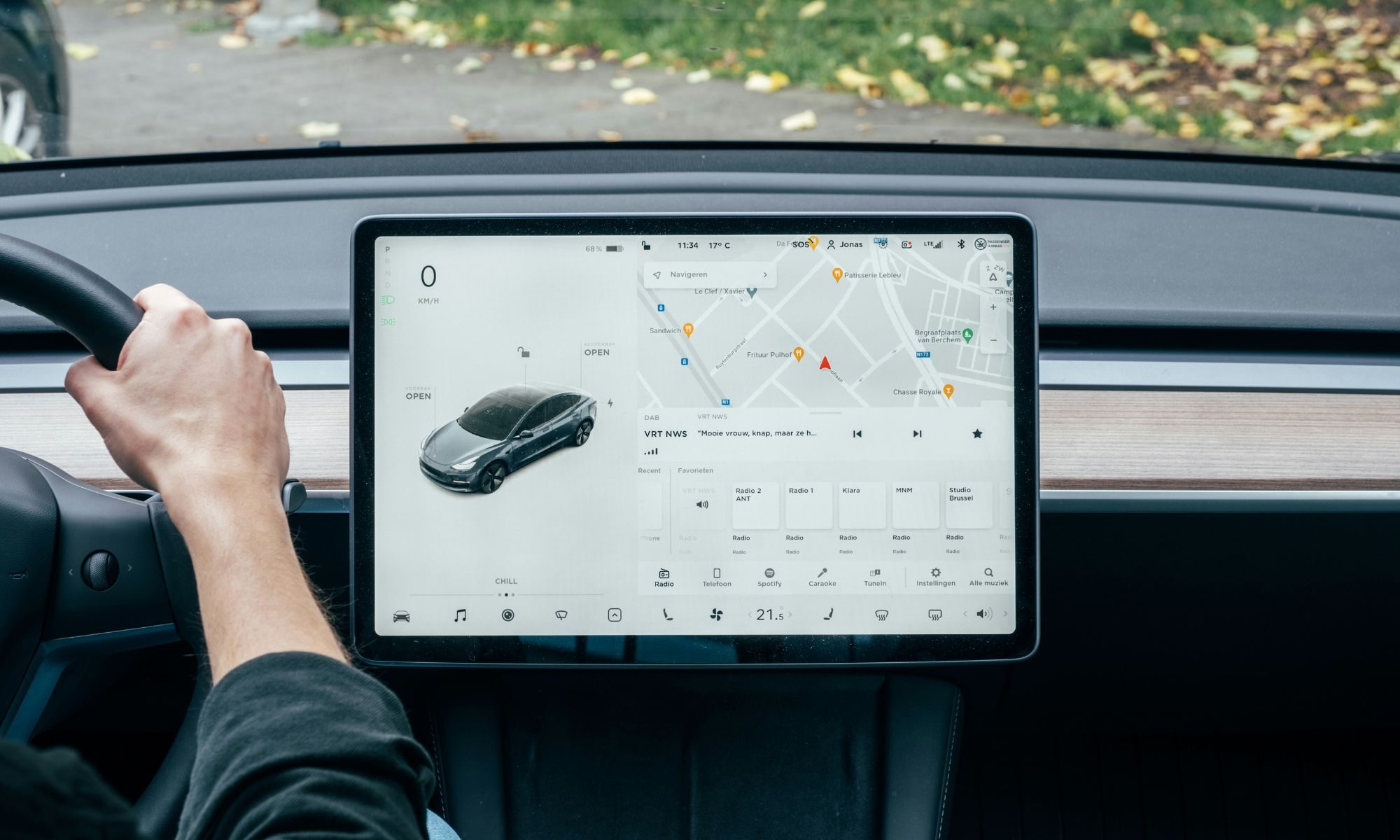
Cybersecurity analysts argue that internet-connected vehicles effectively function as rolling computers.Unsplash
However, the same always-connected architecture that enables these updates also creates a larger attack surface. Cybersecurity analysts argue that internet-connected vehicles effectively function as rolling computers. If attackers were to compromise the update infrastructure or gain privileged access to vehicle software, the consequences could extend well beyond data theft.
Gabriel Lim, Senior Analyst at Singapore’s S. Rajaratnam School of International Studies, told CNBC that the issue represents a potential national security concern. Beyond questions surrounding user privacy, governments are increasingly examining whether foreign manufacturers or hostile actors could theoretically interfere with vehicle systems remotely. Those concerns have prompted several countries to reassess how connected vehicles should be regulated.
Governments are beginning to take the threat seriously
The debate intensified after Norwegian public transport operator Ruter conducted security tests on electric buses last year. The company reported that one vehicle’s battery and power management system could be accessed remotely through a mobile network connection. In theory, it concluded, the manufacturer could disable or immobilize the bus remotely.
Although the investigation focused on buses manufactured by Chinese company Yutong, experts caution that the problem isn’t unique to any single automaker or country. Instead, they see it as an industry-wide challenge tied to the growing adoption of connected vehicle platforms. The findings prompted authorities in both the United Kingdom and Denmark to launch their own investigations, with the UK’s Department for Transport working alongside the National Cyber Security Centre to examine potential vulnerabilities.
As cars become smarter, hackers may get smarter tooUnsplash
Similar concerns are also beginning to shape policy discussions in the United States. Earlier this year, the American Enterprise Institute argued that protecting connected vehicles from foreign espionage should become a strategic priority. The think tank recommended stronger security reviews, greater transparency around vehicle data collection, and tighter restrictions on certain foreign-made automotive software and hardware.
The implications stretch well beyond passenger cars. OTA technology is increasingly finding its way into buses, commercial fleets, rail systems, ships, industrial robots and drones. As more critical infrastructure becomes remotely updateable, experts say cybersecurity can no longer be treated as an afterthought. Wireless updates are undoubtedly making vehicles smarter and more capable. But they’re also changing the definition of automotive safety. In the software-defined era, protecting a car increasingly means protecting the code running inside it, because the next cyberattack may not target your laptop or smartphone. It could target the vehicle you’re driving.
Building a PC used to be a fun adventure — what’s the latest, what’s the greatest, what can I afford? Well, that last question seems to have taken over and sucked all the fun out for a lot of people. [Matt] from [DIY Perks] on YouTube has hit upon a solution that’s brought back the fun, at least for him: recycling! The video is embedded below, and he runs a forum whose thread has more details.
Long story short, though, he’s flagging recycled laptop components as both good value for money and a fun rabbit hole to go down researching parts. The best part, of course, is that you can get a mobo with 32GB of RAM soldered on, and embedded RTX graphics, and a decent processor for about what you’d pay for that RAM on sticks these days. The big hack is getting the dang thing started: he needed to make a single-pin ribbon cable after identifying which pin on the keyboard membrane hit the power button. If you can score a laptop that does not power on from the keyboard, you’ll have an easier time in that regard.
To take recycling further, he shows how to delaminate cracked glass from an old Intel iMac to get a better-than-4K retina screen for nothing but sweat equity. The unit was heading for the bin, and his only cost was the effort it took to extract the LCD panel. Some of us might be able to skip the laptop and just use the iMac; it depends on how much compute is enough for your use case. Maybe a 10-year-old iMac’s guts will do; maybe last year’s gutted laptop isn’t enough.
We have to admit, the oak-and-aluminum all-in-one tripod he makes is very snazzy, though it may have too little brass to be on-brand for [DIY Perks]. The speakers, in case you were wondering, are also e-waste, recovered from an old TV. Perhaps the accent colour should have been green instead of blue!
Welcome back to TechCrunch Mobility, your hub for the future of transportation and now, more than ever, how AI is playing a part. To get this in your inbox, sign up here for free — just click TechCrunch Mobility!
Last week, I wrote aboutUber and Waymo and how their partnership appears to be deteriorating. I predicted the two companies would end up on opposing sides of autonomous vehicle policy. That wasn’t a guess.
For the past several weeks, I’ve been talking to sources and digging through correspondence Uber sent to the D.C. Council, which is evaluating a proposed bill that would allow autonomous vehicles to operate in Washington, D.C.
What I found: Uber and Waymo are already on opposite sides of the proposal, sparring behind the scenes and in public. Uber has made a particularly interesting argument in its effort to shape the rules that govern autonomous vehicles.
Advertisement
Uber, which opposes the D.C. bill, argues it would displace for-hire human drivers and hand Waymo a de facto monopoly. Instead, it has lobbied for a system that would require robotaxis to operate on a ride-hailing network alongside human drivers.
Insiders tell me the “hybrid” approach has little chance of becoming law. But if it did, it would leave AV developers like Waymo with two suboptimal choices: either put their robotaxis on ride-hailing apps like Uber or employ human drivers alongside fleets of robotaxis that took years and hundreds of millions of dollars to develop.
A D.C. Council hearing on Monday drew representatives from Lyft, Tesla, Uber, and Waymo, along with dozens of disability rights and accessibility advocates, local business and industry groups, highway safety organizations, government officials, labor unions, and think tanks.
My takeaway — based on the public testimony and the calls and texts I received afterward — is that Waymo is one of the few companies that generally likes the bill. Much of the rest of the industry does not.
Advertisement
Tesla’s senior policy adviser, India Herdman, echoed concerns I’ve heard from multiple AV developers, including objections to the 180-day, 250,000-mile mandatory testing requirement; the $1 million application fee; the $5 million permit fee; and the $0.15-per-mile tax. Tesla, along with other companies, argued that testing miles accumulated in other jurisdictions should count toward the mileage threshold.
Waymo, which has been testing its AVs with human safety operators in Washington, D.C., has already surpassed the 180-day and 250,000-mile requirements. That means if the bill passed as written today, Waymo would enter the market with at least a six-month head start.
Deals!
Image Credits:Bryce Durbin
Uber is considered a ride-hailing and delivery giant. It is now cementing that status through a $14.8 billion deal to acquire Germany’s Delivery Hero.
If the deal closes — and it will absolutely take time to overcome the regulatory hurdles — Uber will get access to nearly 100 markets across Europe, the Middle East, Latin America, and Asia. The upshot: Uber’s delivery footprint will double.
Delivery Hero also made a separate agreement to sell its business in 14 markets, where Uber Eats is already operating, to New York-based investment firm SSW Partners for $1.6 billion.
Advertisement
Other deals that got my attention …
Self Inspection, a San Diego-based startup trying to disrupt the vehicle inspection process, raised $10 million in a round led by the family office of Sheryl Sandberg. Tire distributor U.S. AutoForce and automotive lender Westlake Financial made strategic investments. Early-stage funds Costanoa Ventures, Rebellion Ventures, and BrightCap Ventures also invested.
Senra, a startup modernizing how wire harnesses are made, raised $65 million in a Series B round co-led by Lowercarbon and Interlagos with participation from General Catalyst, Sequoia Capital, Andreessen Horowitz, and Founders Fund, among others.
Zepto, the Indian fast-delivery company, is seeking a valuation in an initial public offering well below its $7 billion peak, Bloomberg reported, citing anonymous sources.
Advertisement
Notable reads and other tidbits
Image Credits:Bryce Durbin
Chip Motors, a Miami-based startup, revealed a low-speed small EV designed for short errands and families, and with some automated driving capabilities.
The Los Angeles Police Department is reportedly ending its deal with Flock Safety, a surveillance company that helps law enforcement track vehicles using thousands of its license plate cameras placed across the United States.
Lucid Motors is pushing back — and hard — on a report that claimed the EV maker was weighing whether to file for Chapter 11 bankruptcy. The company’s comms team, its CEO, and a filing with the U.S. Securities and Exchange Commission all say the same thing: The rumors are false. The initial report sent the company’s stock down more than 50% on Tuesday, its biggest intra-day drop ever. The stock has since recovered and is now trading about 28% higher than it was prior to the big drop.
Lyft CEO David Risher says it’s the “Good Uber,” per Wired.
Manual, or standard, transmission vehicles are a dying breed, according to preliminary government data that shows just 0.6% of new vehicles made for the U.S. in 2025 had stick shifts, the Washington Post reported. I own two manual vehicles. Does that make me a driving unicorn?
Advertisement
The National Transportation Safety Board said the driver of a Tesla who crashed into a house in June had pressed the accelerator pedal to 100%, overriding the company’s Full Self-Driving (Supervised) software.
San Francisco mayor Daniel Lurie has urged state regulators to toughen rules on autonomous vehicles after Waymo robotaxis became immobile in heavy July 4 traffic, ran out of power, and blocked key streets, further compounding the gridlock. In a letter (parts of which are excerpted here) Lurie outlined four core requirements he would like to see enacted to ensure robotaxi companies can “perform reliably” during extraordinary events.
SpaceXabruptly aborted the second attempted launch of its upgraded Starship rocket system on Thursday, just moments after the booster ignited at the company’s complex in South Texas.
Zoox issued a software recall after one of its robotaxis got confused by smoke emitting from an emergency fire scene in June.
Advertisement
One more thing …
Uber chief product officer Sachin Kansal talks to TechCrunch EIC Connie Loizos about travel, AI agents, and playing both sides of the robotaxi race, in the latest Strictly VC podcast episode. If you’d rather read the interview, check out the Q&A.
When you purchase through links in our articles, we may earn a small commission. This doesn’t affect our editorial independence.
US Federal workers must install an app powered by a Russian-founded software vendor
Security researchers discovered outside code controlling parts of the government application
Elfsight’s Russian operations continued growing despite global geopolitical tensions
The FAA and other federal employees must now install a $1.4 million White House app containing code built by Elfsight, a Russian-founded vendor.
Elfsight was founded in 2016 in the Russian city of Tula by chief executive Andrey Yusupov and chief technology officer Vladimir Fedotov.
The company now markets itself as a European software provider headquartered in Andorra, though its original Russian entity remains active and growing.
Latest Videos From
Business ties that persist
In 2025, the Russian entity reported revenue of about 126.5 million rubles, roughly $1.6 million, marking a 71% increase year on year.
Advertisement
The company’s headcount also grew to 61 employees, and job postings show continued hiring of Russian developers into 2026.
One 2026 job posting sought a Moscow-based support specialist, offering between 60,000 and 100,000 rubles per month for full-time work.
Under Russian law, companies handling user data can be compelled to store that data locally and hand it over to state authorities.
Advertisement
Sign up to the TechRadar Pro newsletter to get all the top news, opinion, features and guidance your business needs to succeed!
However, an Elfsight customer support specialist claims that the company has “never received any request” from Russian authorities for user data or access.
Security review and data practices
A network analysis by the security firm Atomic Computer found that Elfsight’s servers determine which JavaScript files run inside the White House app.
Advertisement
The same session also accepted more than ten cookies from Elfsight, alongside Google DoubleClick advertising domains loaded through the app’s YouTube sections.
Olivia Wales, a White House spokeswoman, said the app “does not request or collect any user locations” and called all its information “safe and secure.”
A White House official later said Elfsight’s only remaining script loads a tax calculator inside a sandboxed webview, disconnected from cookies or files.
Advertisement
The official added that Elfsight passed a full security review and is used widely by brands including UFC, FIFA, the NBA, and Cartier.
That same security clearance sits uneasily alongside records showing Elfsight’s founders retained accounts at sanctioned Russian banks and kept traveling to Russia.
One founder wrote in a private message that Russian tax authorities had summoned him for questioning tied to a separate investment platform.
That legal exposure means a Russian-rooted vendor still effectively controls code running inside a mandatory application on federal government devices.
Advertisement
Since the Russia-Ukraine conflict started in 2022, the United States and its allies have imposed sanctions on numerous Russian companies and individuals.
It remains unclear why an app with such ties to Russia was cleared for use on White House and federal government devices in the first place.
So far, neither Elfsight nor the White House has offered a clear justification for that approval decision.
Avoiding the “lethal trifecta” – access to private data, exposure to untrusted content, and an external communication path – is difficult enough when working with AI agents.
But the use of connectors – integrations with third-party services like Gmail or Slack – expands the scope of concern in a way that makes it exceedingly difficult to reason about defensive due diligence.
Advertisement
PromptArmor, an AI security biz, recently looked at how OpenAI’s ChatGPT and Anthropic’s Claude work with connectors. The results are not reassuring.
Shankar Krishnan, co-founder of PromptArmor, told The Register in an email that enterprise adoption of connectors and the rate of change among connectors helped focus concern on the connector ecosystem.
Connectors share some of the risks of MCP servers, upon which connectors are based. “For connectors, the risks are mostly about the type of tools, what they can do, where the data is going, and what is being done with the data,” said Krishnan.
Introduced about a year ago, connectors (for Claude or ChatGPT) have been going through a lot of changes recently. According to PromptArmor, 931 of 2,517 connectors (37 percent) changed over the six-week period from mid-May to the end of June. So any security assumptions based on declared capabilities may no longer be valid.
Advertisement
PromptArmor found that 1,686 new tools were added to connectors that were already live, creating new ways for AI models to operate on user data and interact with third-party services.
It also found that 1,127 tool descriptions were rewritten, potentially changing how and when an AI model decides to invoke a tool.
And there are a variety of other changes, all of which potentially could raise data security concerns or invalidate governance assumptions.
PromptArmor cited the Dropbox connector as an example, noting that at the start of the study it exposed eight tools and by the end of the study that number had risen to 24. It went from having three write-capable tools to 10, and from zero potentially destructive tools to four. Permission scopes changed and injected instructions for the model were added.
Advertisement
If that weren’t enough to worry about, connectors can behave like intrusive websites that run dozens of tracking scripts: connectors commonly send data to additional AI services.
PromptArmor evaluated all 7,517 tools used by 487 Claude connectors and found that 189 of the connectors, or about 2 in 5, are likely to call additional AI services.
“As an example, if your Claude agent activates Zoom’s connector tool to search meetings with natural language, and passes in a query containing sensitive data, Zoom AI may send that data to any of its ten AI subprocessors in order to generate a response from one of eight different model families it uses,” the security company said.
“The issue is that most teams approving connectors are evaluating and considering the connector – unaware that the vendor is calling more AI services, adding new subprocessors and terms,” explained Krishnan. “So someone concerned about AI risks who has evaluated Claude may not be aware of AI services that the connector is calling externally.”
Advertisement
Anthropic’s connector documentation acknowledges that its security controls don’t necessarily cover third-party data processing.
“Connected services process data on their own infrastructure, under their own terms, which may be located outside the United States,” the AI biz explains. “Settings that control where Claude’s inference runs, like the US-only inference setting on Enterprise plans, don’t change where third-party services operate.”
Krishnan said that connectors vastly expand the risk surface for attacks.
“Bringing agents new sensitive data, new untrusted data, and new sensitive actions to take, the blast radius of an attack explodes,” he said. “We recently highlighted a risk in Codex where even with one connector – email – the combination of sensitive and untrusted data enables exfiltration of legal and financial communications.” ®




























































You must be logged in to post a comment Login