

Crypto World
Michael Saylor Rejects BIP-110 as a “Bad Idea,” Doubles Down on Strategy

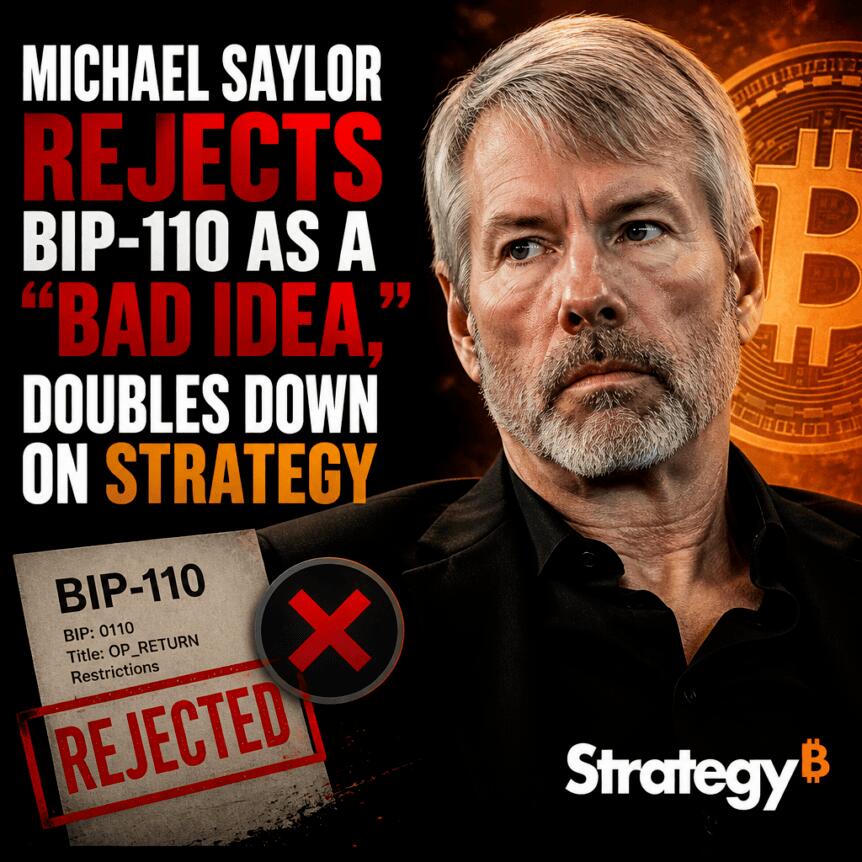
Bitcoin’s internal debate over network “spam” and the place of Ordinals has flared again, with MicroStrategy executive chairman Michael Saylor publicly arguing against a proposed protocol change known as BIP-110. In a long post on X published Sunday, Saylor laid out a broad case against activating the temporary fork, warning that the remedy could undermine the principles he associates with Bitcoin’s neutrality and permissionless innovation.
The proposal, first introduced in December 2025, aims to reduce non-monetary transaction behavior—particularly data associated with Ordinals inscriptions—by changing how certain data is handled by validating nodes. While proponents frame it as protection for Bitcoin’s function as peer-to-peer cash, Saylor said he shares those objectives but disagrees with the approach.
Key takeaways
- Michael Saylor opposes BIP-110 despite acknowledging concerns about Ordinals-style network bloat.
- BIP-110 would require broad node support to activate, with the last measured cycle showing only around 1% of blocks signaling approval.
- Ordinals activity has fallen sharply from its 2023 peak, with recent daily inscriptions reported as under 10,000.
- The dispute echoes earlier Bitcoin governance clashes, including the Blocksize Wars era.
- Major figures remain split: supporters argue it avoids long-term disruption, while critics call it social enforcement rather than neutral protocol design.
Saylor’s critique of BIP-110’s “temporary fork”
Saylor described BIP-110 as a bad idea in an extended post on X, presenting a framework centered on “neutral rules, hard consensus, open markets, and permissionless innovation.” He also emphasized that his critique is directed at the proposal itself, not the people who support it.
According to Saylor, some Bitcoiners he respects back BIP-110 to keep validation affordable for node operators, maintain access to the validation process, preserve low-cost payments, and prevent Bitcoin from drifting into a general-purpose data storage system. He said those are serious concerns—but that the planned remedy is not the right one.
“This article critiques the proposal, not the people behind it. I assume good faith. Bitcoin is strongest when we can disagree vigorously without mistaking allies for enemies.”
As of 12 p.m. ET Sunday, the post had reportedly generated 879,000 views on X, along with 692 replies and 852 retweets.
Why activation is uncertain: node signaling remains low
Even if BIP-110 has passionate supporters, activation would not be automatic. The proposal is designed to proceed only if 55% of Bitcoin nodes validating blocks signal support across a Bitcoin “period.”
In the most recently referenced period, period number 475 (covering blocks 955,584 through 957,599), only about 1% of blocks were reportedly in support. That suggests the proposal currently lacks the consensus threshold needed to move forward.
For investors and traders following protocol governance, the key question is not whether arguments for and against BIP-110 are strong, but whether enough of the ecosystem will converge on a shared view quickly enough to clear the activation hurdle. Low signaling so far implies BIP-110 remains in a “discussion” phase rather than a near-term change likely to land.
Ordinals activity has cooled—so what’s the urgency now?
The conflict over Ordinals and other inscription-style behavior is unfolding at a time when on-chain activity appears to have materially cooled. The reporting cited that in the last month there have been fewer than 10,000 Ordinals inscribed per day, according to Dune Analytics.
That figure stands in stark contrast to the period of peak activity in August 2023, when the same metric reportedly exceeded 400,000 daily inscriptions. The current backdrop complicates the “immediate fix” argument advanced by BIP-110 supporters, because network pressure may not be at the same level as during the earlier surge.
Still, supporters contend that the trend could return—or that even without today’s worst-case bloat, maintaining Bitcoin’s long-term usability requires setting clearer boundaries now. Critics, meanwhile, argue that protocol-level “policing” risks turning Bitcoin’s decentralized norms into a contest of preferences.
The personalities and the governance parallels
BIP-110 is notable not only for its technical objectives, but also for the lineup behind it. The proposal was introduced by pseudonymous Bitcoin developer “Dathon Ohm” and reportedly has support from Ocean protocol founder Luke Dashjr. Opponents include Blockstream CEO Adam Back.
Earlier coverage cited that Dashjr and other supporters view Ordinals-driven bloat as a serious threat and argue BIP-110 would not trigger the chain split many fear. They also point to the fork’s design as temporary—described as a one-year limit—claiming it would not invalidate fee-paying transactions over the long term.
Critics reject those characterizations. Back has previously described BIP-110 as a “quest to police other people,” arguing that Bitcoin’s decentralization should prevent one group from imposing its preferences on others. In his framing, the proposal conflicts with what he portrays as Bitcoin’s cypherpunk ethos of permissionless, censorship-resistant money.
Observers have also drawn historical parallels to the Blocksize Wars of 2015–2017, when Bitcoin’s community debated whether raising the block size limit would be worth the risk of a chain split. Like that earlier period, the BIP-110 conflict is fundamentally about governance: who gets to decide what the network should optimize for, and through what mechanism.
What to watch next
The next decisive signal will be whether BIP-110’s support rises meaningfully toward the 55% threshold across future block periods. With Ordinals activity currently reported as far below earlier peaks, the debate may shift from “stop a present-day emergency” to “define Bitcoin’s long-term scope”—and readers should watch for how node signaling changes alongside that evolving narrative.

Crypto World
Brazil’s securities regulator sets up task force with 60-day deadline for tokenization proposal


Brazil’s securities regulator, the Comissão de Valores Mobiliários (CVM) said it created a working group to draft an experimental framework for tokenized securities.
The regulator said the framework will cover the registration, custody, trading and settlement of securities using distributed ledger technology.
The group must send its first proposal to the CVM’s board within 60 days of being formally installed, while a broader review will run for 120 days, with a possible 30-day extension.
The group brings together 14 CVM departments and may consult government agencies, market associations, self-regulatory bodies and outside specialists. It will also review cybersecurity risks, international regulatory models and results from earlier sandbox programs, the regulator said.
Brazil already applies securities law according to a token’s economic characteristics. The CVM’s 2022 guidance clarified that using blockchain does not change whether an asset qualifies as a security.
The new review will focus on what happens around the asset.
Blockchains can combine functions that are normally split between exchanges, custodians, registrars, depositories and settlement systems. That raises questions over who controls the official ownership record, how private keys are held, when transactions can be reversed and who is liable when systems fail.


Cointelegraph is committed to providing independent, high-quality journalism across the crypto, blockchain, AI, and fintech industries.
All news, reviews, and analyses are produced with full journalistic independence and integrity. For more details on our standards and processes, please read our Editorial Policy.

After years of relying on smart contract audits as a key “trust signal,” institutional investors are increasingly treating operational security as the real gatekeeper for allocating capital to crypto projects. Hacken’s Q2 2026 Security & Compliance Report argues that conventional review artifacts—such as third-party audits and a project’s operating history—have not consistently correlated with which systems end up being exploited.
In the quarter, Hacken tracked 1,427 crypto projects (with market caps above $1 million) and found that only a small fraction had meaningful layers of ongoing monitoring. At the same time, it attributes the majority of losses to compromise scenarios that traditional contract-level audits typically don’t cover, including keys, signers, and surrounding infrastructure. For risk teams, the takeaway is clear: due diligence is moving beyond code review toward evidence that controls are actively maintained and resilient.
Key takeaways
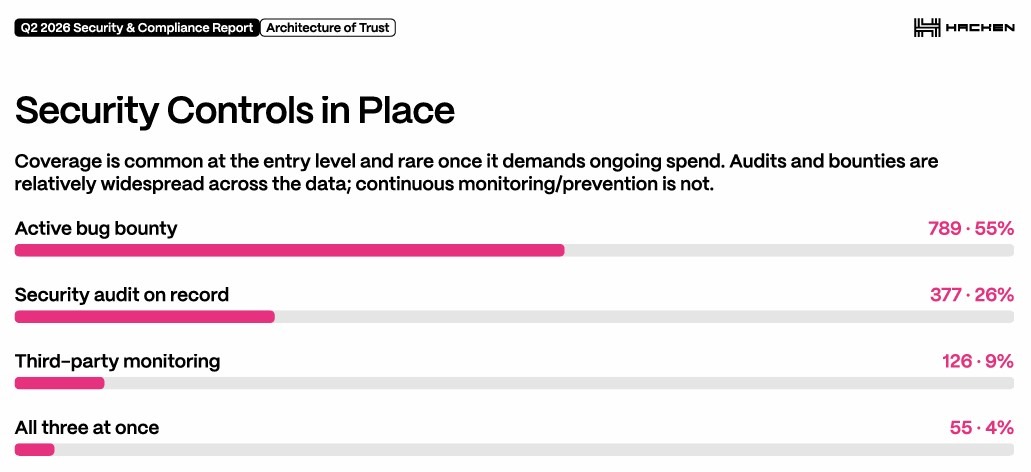
- Hacken reports just 9% of 1,427 tracked projects had third-party monitoring, and only 4% combined monitoring with both a bug bounty and a security audit.
- Across the quarter’s reported thefts of roughly $764 million, Hacken attributes 88.3% of losses to compromised keys, signers, and infrastructure.
- Operational security reviews are expanding to include signer-set changes, collateral backing, third-party dependencies, and incident-response readiness.
- Hacken says projects that cannot show ongoing evidence of operational security may face higher perceived risk, less investment interest, and harder access to insurance or counterparties.
Why audits are no longer enough
Hacken’s central argument is that the audit-centric approach doesn’t reliably predict whether a project will be exploited. According to the report, institutional confidence signals such as prior audits and operational history have not offered consistent protection against real-world compromise.
The report’s data helps explain why. Hacken notes that while 14 of the projects exploited in Q2 had previously undergone audits, the losses mostly came from attack surfaces beyond the typical scope of smart contract review. Those surfaces included signer devices, bridge validator components, backend infrastructure, admin keys, and “older” contracts that remained active even after being deprecated.
That distinction matters for investors because it reframes what “secure” means. An audited contract can still be vulnerable if the surrounding operational controls—key management, signing processes, administrative access, and supporting infrastructure—are weak, stale, or insufficiently monitored.
The monitoring gap highlights a control reality
Hacken’s review of 1,427 projects (based on assets listed across the top 50 centralized exchanges by CoinGecko Trust Score) is designed to capture observable and disclosed control setups. The methodology matters: Hacken’s dataset excludes wrapped assets, stablecoins, and tokenized real-world assets, and it relies on publicly observable arrangements—meaning private measures may not show up in the analysis.
Even with that limitation, the numbers point to a broad monitoring gap. Only 9% of tracked projects had third-party monitoring, and just 4% combined monitoring with an active bug bounty and a security audit. In practice, this suggests that most projects may lack layered external scrutiny that can detect or deter issues before attackers exploit weaknesses.
Hacken also flags a structural consequence for capital access: when projects cannot provide continuing evidence that security controls remain effective over time, they may be priced as higher risk. That can ripple outward into fewer investment opportunities and more difficult negotiations with counterparties and insurers.
Operational resilience reshapes due diligence
Hacken says institutional due diligence is broadening in ways that extend past contract correctness. Its report describes a shift toward checking not just “what was audited,” but how the system operates day to day.
Among the areas now being incorporated are signer-set changes, collateral backing, third-party dependencies, incident-response readiness, and the scope and recency of audits. The emphasis on recency is particularly relevant: even a strong audit from the past may not reflect changes in infrastructure, control policies, governance, or integration dependencies.
One investor risk example comes from Abraxas Capital. In the report, Federico Bagiotti, group head of risk management at Abraxas Capital, is cited saying that “inadequate security relative to the capital at risk” was the factor that most often drove the firm to reject positions. The operational controls Abraxas reportedly screens for include timelocks, withdrawal-address whitelisting, multiparty controls, and avoiding reliance on a single key or single verifier.
Moody’s Ratings’ perspective adds another layer: Rajeev Bamra, head of digital economy strategy at Moody’s Ratings, is quoted in the report stating that operational resilience has become “the practical lens” institutions use to evaluate security, compliance, and governance. Taken together, these views suggest investors are trying to reduce uncertainty by focusing on how failures are prevented—or contained—rather than trusting a static snapshot of code review.
Regulators are also pushing the conversation toward resilience
The report’s narrative aligns with wider scrutiny of operational robustness in the custody and compliance stack. In a July 10 Cointelegraph report, BitGo Chief Operating Officer Jody Mettler said institutional clients had started asking more detailed questions about custody providers’ access controls, incident response, and business continuity, as European regulators examined operational resilience under the Digital Operational Resilience Act (DORA).
That regulatory pressure helps explain why audits alone are losing their predictive value. Key management, signing access, operational continuity, and incident workflows are not merely “best practices”—they are increasingly part of what regulators and risk committees expect to see operationalized.
Hacken’s findings reinforce that point. With 88.3% of the roughly $764 million stolen in Q2 traced to compromised keys, signers, and infrastructure, the industry’s focus on resilience moves closer to the areas where losses actually originate.
What readers should watch next
The next test for projects and investors will be whether security programs evolve from periodic audits into verifiable, continuously maintained controls—especially around signing authority, key custody, administrative access, and incident readiness. Hacken’s Q2 findings suggest that diligence will increasingly reward ongoing evidence, not just historical certifications, so investors should watch how quickly teams improve monitoring coverage and tighten operational guardrails as systems and dependencies change.


Europe’s second-biggest Bitcoin treasury company said the September reverse stock split should attract more institutional investors to the French company.
The FIFA World Cup final, perhaps the biggest sporting event and a spectacle that happens once every four years, took place yesterday (July 19), with Spain facing Argentina.
As usual, it attracted gamblers who wagered substantial sums, such as the Canadian rapper Drake. However, the match’s outcome was far from what the musician (and some other bettors) wanted, and they parted with millions of dollars worth of crypto.
Was Messi Destined to Lose?
Leading up to the big game, tension kept rising, while risk-loving people like Drake placed huge bets, hoping to be on the right side of history and, of course, walk away with huge profits.
The rapper bet $1.5 million in USDT on Argentina to win the final during the 90 minutes (including stoppage time). The South American team was the underdog, and a potential victory would have resulted in a payout of over $5 million worth of crypto for Drake.
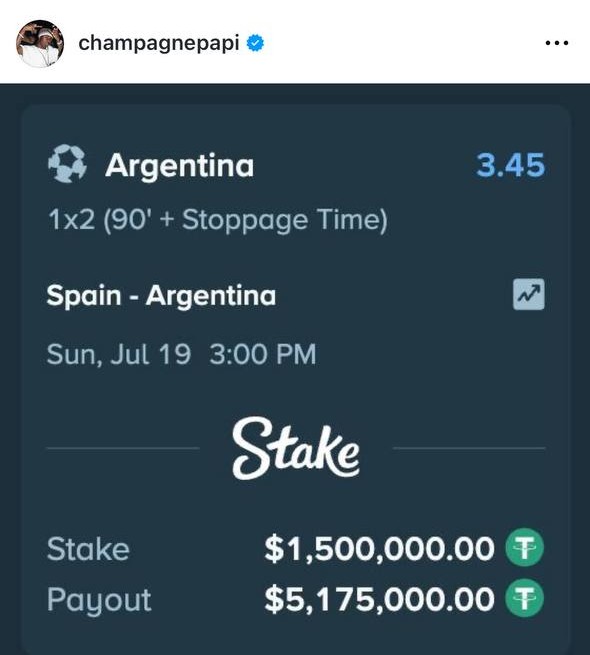
Nonetheless, the Canadian lost his bet. Spain outclassed their opponent in every phase of the game, dominating from start to finish, yet winning only 1-0 after Argentina’s goalkeeper Emiliano Martinez did miracles for 106 minutes.
Did Spain play magical football just because Drake bet against them? It’s doubtful, and the idea would only make sense to those who believe in superstitions. At the same time, it is true that teams and athletes supported by the rapper often end up losing, which has led to the phenomenon known as “the Drake Curse.”
Earlier this month, for instance, he placed $1 million in Bitcoin (BTC) on Conor McGregor, who returned to the octagon at UFC 329 in Las Vegas after a five-year absence and faced Max Holloway. But the comeback was far from desired as “The Notorious” lost in the very first round.
Meanwhile, Drake wasn’t the only one losing a huge sum because of Argentina’s inability to win the World Cup for the second consecutive time. Lookonchain revealed the case of one gambler who bet $1.23 on Lionel Messi and his teammates to lift the trophy at a time when the odds in their favor were around 10%. A potential win would have resulted in a profit of well above $10 million.
The Right Bet
Of course, there are others who picked the right horse and made millions. Such an example is a whale who created a new wallet on Polymarket hours before the final and wagered $1.95 million on Spain to become champion when the odds were 59.1%.
“He won and made $1.35M in just a few hours,” Lookonchain stated.
The post Spain’s World Cup Victory Triggers Massive Crypto Losses for Drake and Others: Details appeared first on CryptoPotato.


In one week, Bitcoin sat still through missile strikes in the Strait of Hormuz and then fell with Asian chip stocks. The war test and the tech test gave opposite answers about what Bitcoin is, and both answers are correct. Working out how is the most useful thing a holder can do right now.
Summary
- Bitcoin held a tight range near $63,000 through a weekend of US strikes on Iran and renewed missile attacks on shipping in the Strait of Hormuz, a marked change for an asset that once sold off on a single Hormuz headline.
- Days later it fell below $63,000 anyway, dragged by an AI-valuation rout that sent Japan’s Nikkei down nearly 5% in its worst session since March and knocked more than 500 points off the Nasdaq.
- Gold went the other way in the same selloff, rising back above $4,000 as the dollar index climbed, which is exactly what a hedge is supposed to do and exactly what Bitcoin did not.
- Analysts increasingly locate Bitcoin’s driver in the liquidity and inflation channel, not the geopolitical hedge narrative, with the soft June CPI and Fed repricing doing more work than the missiles.
- Down roughly 50% from its October 2025 peak near $126,200, Bitcoin has tracked the same rate fears and AI jitters as the Nasdaq. The honest conclusion is not that the hedge thesis died, but that it was always narrower than advertised: Bitcoin hedges money, not missiles.
Two tests were administered to Bitcoin this month, days apart, by events nobody scheduled. The first was a war test: American strikes on Iran, then Iranian missiles fired at commercial ships in the Strait of Hormuz, ending a week-long lull. Oil jumped, gold firmed, Treasuries caught a safety bid, and Bitcoin did something it has almost never done in its history. Nothing. It held a tight range through a weekend of exactly the headlines that once triggered instant three-percent drops.
The second was a tech test: a rout in AI and chip stocks that produced the Nikkei’s worst session since March and a 500-point Nasdaq slide. This time Bitcoin moved immediately, straight down, below $63,000, while gold rose back above $4,000 in the same session. One asset, two shocks, two opposite responses, one week. Either Bitcoin has matured past panic or it has been absorbed into the tech trade, and the strange truth is that both readings are right, because they are answers to different questions.
The week that ran the experiment
The facts first, because the sequencing is the argument.
The war leg came first. Following US strikes on Iranian targets, Iran’s military fired at least two missiles at commercial ships transiting the Strait of Hormuz, ending a pause in attacks under a US-Iran understanding. Brent crude climbed toward $88 a barrel, up roughly 30% over two weeks, the classic supply-shock signature. Gold firmed. And Bitcoin held near $63,800 through the weekend and into the week, trading in a range so tight that market desks remarked on it. This is the asset that fell as much as 3% in hours when Israeli strikes on Iran first landed in 2025, an episode that liquidated over a billion dollars of leveraged longs in a day. The same category of headline now produced approximately no response. Whatever Bitcoin was in that earlier episode, it is not that now.
The tech leg followed. Concerns over stretched AI valuations, brewing for weeks, broke into a rout: heavy selling in Asian semiconductor names took the Nikkei down as much as 5% in its worst session since March, the Nasdaq shed more than 550 points at its lows, and a separate session saw SK Hynix plunge 12% in Seoul, dragging the Kospi down 7%. US index futures pointed lower, and the risk-off rotation ran the textbook route: the dollar index rose to around 100.75, and gold advanced 0.61% to reclaim $4,000. Bitcoin went with the chip stocks, not with the gold, sliding below $63,000, with ether falling harder, as much as 3% toward $1,830, in the usual pattern of a liquidity-driven selloff where the majors bleed and everything beneath them bleeds more. One strategist compressed the week into a phrase, describing a market bruised by “AI fatigue and Hormuz heat.”
Put the two legs side by side, and the discrimination is unmistakable. Bitcoin ignored the war variable and responded to the liquidity variable, in the same week, with the same holders, at the same price level. Markets rarely run experiments this clean.
The maturation reading
The first interpretation is the one Bitcoin’s advocates should be making carefully rather than triumphantly, because it is real but narrower than it sounds.
An asset that no longer panics on kinetic conflict headlines has, by definition, graduated from one class of behavior. The old pattern was mechanical: geopolitical shock, risk-off reflex, leveraged crypto longs liquidated first because crypto trades around the clock and its leverage is the most accessible to margin calls. During the 2025 Israel-Iran escalation, a derivatives executive described the dynamic plainly: in moments of acute military risk, liquidity gets prioritized over narrative, traders raise dollars and cut volatile exposure, and Bitcoin, being the most liquid volatile thing on earth, gets sold. That reflex appears to have weakened substantially. Holding a tight range through strikes, ship attacks, and a hawkish Fed repricing is not what a panic asset does.
Part of the change is structural and measurable. The marginal holder is different now: ETF vehicles, corporate treasuries, and long-horizon allocators sit where leveraged retail once dominated, and Strategy’s stack of 843,775 BTC did not move an inch through the week. Positioning data points the same way, with open interest growing only modestly and funding rates near flat, the signature of a market without a crowded leveraged side to flush. An unlevered holder base with multi-year horizons simply has no mechanism for transmitting a Hormuz headline into a forced sale, and the tape now reflects that.
There is also a subtler point the maturation camp is entitled to: not-reacting is what the digital gold thesis predicts for this specific shock. Gold itself did not spike dramatically on the missiles; it firmed. Hard-asset hedges are not supposed to convulse on war news, they are supposed to sit there being unconfiscatable while everything levered convulses around them. On the war leg alone, Bitcoin behaved more like gold than it ever has.
The tech-proxy reading
Then came the second leg, and the second reading, which the first cannot explain away.
When the AI rout hit, the hedge behaved like a hedge and Bitcoin behaved like a chip stock. Gold up, dollar up, Bitcoin down with the Nasdaq. If Bitcoin’s holders had truly rotated into the it-is-digital-gold consensus, the AI selloff was the moment to prove it, a valuation scare in the exact sector Bitcoin is supposedly a refuge from. Instead the correlation asserted itself immediately, and the explanation is uncomfortable for the maturation camp: the marginal dollar flowing into Bitcoin over the past two years is substantially the same dollar that has been chasing AI. Same risk budget, same momentum style, same sensitivity to the rate path. When that dollar gets scared, it sells both positions, because to its owner they were always the same trade, long technological transformation with leverage on liquidity.
The longer tape supports this reading brutally. Bitcoin sits roughly 50% below its October 2025 record near $126,200, and the path down has tracked the same rate fears, the same liquidity squeeze, and now the same AI-valuation jitters dragging the Nasdaq, with the whole crypto complex down roughly 48% from a $4.2 trillion peak. Nothing in that drawdown looks like an uncorrelated store of value; all of it looks like the high-beta end of a single global risk trade. Analysts working the flows have said so directly: Nansen’s Nicolai Sondergaard argued the tape reflects the inflation and liquidity channel doing the work, not the geopolitical hedge narrative, pointing to the soft June CPI print, 3.5% headline against 3.8% expected, that reset Fed expectations, sank the dollar to multi-month lows, and eased the 10-year toward 4.57% in mid-July. Bitcoin rallied on that print and fell on the AI rout, which is to say it traded monetary conditions twice and missed zero times.
On this reading, the calm during the war was not maturity. It was indifference of a specific kind: the asset’s owners no longer believe Middle East risk changes dollar liquidity much, so they do not trade it, exactly as the Nasdaq does not trade it. Bitcoin did not rise above the war. It joined the asset class that ignores wars until oil makes the Fed’s job harder.
The synthesis the week actually supports
Here is the resolution, and it requires giving up a slogan on each side.
The two tests were testing different claims. The war test asked: is Bitcoin still a panic asset, sold reflexively on any shock? The answer is no, and that answer is genuinely new, structurally grounded in the changed holder base, and worth something. The tech test asked: is Bitcoin an uncorrelated hedge against the financial system? The answer is also no, and the honest advocates conceded that one quarters ago. What remains, once both slogans are surrendered, is a precise and actually useful identity: Bitcoin is a liquidity asset. It prices the supply of money and the appetite for risk, with almost nothing else admitted. Missiles do not move it, because missiles do not move M2. CPI moves it. The Fed moves it. The AI trade moves it, because the AI trade is currently the main pipe through which risk appetite expresses itself.
This is narrower than digital gold and more dignified than Nasdaq beta, and it maps cleanly onto the original thesis if you read the original thesis carefully. Bitcoin was designed as a hedge against monetary debasement, not against geopolitics. Gold hedges both, which is why gold rose on the missiles and on the money. Bitcoin hedges one, with leverage and volatility attached, and it spent this week showing precisely that split: flat on the geopolitics, violently responsive to anything touching rates and liquidity. Holders who wanted a war hedge bought the wrong asset, and this week told them so gently, without even charging them for the lesson. Holders who want a monetary hedge own an instrument that is currently marked 50% below peak because the monetary environment, restrictive rates, a hawkish chair saying the inflation fight is not over, oil threatening the rate-cut path, is exactly what it is priced to hate.
The short-term picture follows from the identity. Polymarket puts the odds of the Fed holding rates at the July meeting at 94%, allocators warn the restrictive regime could stretch into late 2026, and every barrel Brent adds on Hormuz risk tightens the constraint further by feeding the inflation the Fed is fighting. The path for a liquidity asset in that world runs through the liquidity, not the headlines: Bitcoin’s war, the only one it has ever traded, is with the FOMC.
The test the week did not run
Intellectual honesty requires naming the scenario this week’s experiment never reached, because both readings survive it only by assuming it away.
The war leg tested limited escalation: strikes, shipping attacks, a contained supply scare that added a risk premium to oil without breaking the market’s basic assumption that the conflict stays regional. Bitcoin’s indifference to that is now on the record. What remains untested is the discontinuity, the event large enough to jump categories: a sustained closure of the Strait of Hormuz, through which roughly a fifth of global oil transits, a direct exchange that pulls in Gulf producers, anything that converts a risk premium into a supply crisis. In that world the transmission channels stop being separable. Oil gaps rather than climbs, imported inflation stops being a forecast and becomes a print, the rate-cut path does not narrow but closes, and the same liquidity channel that Bitcoin trades every day delivers the geopolitical shock it has been ignoring, at full force, all at once.
How Bitcoin behaves in that scenario is simply unknown, and the week’s evidence supports two incompatible guesses. The maturation evidence, unlevered holders, flat funding, treasuries that do not move, suggests the asset rides through even that, repriced lower with everything else but without the panic mechanics of old. The liquidity-asset evidence suggests something harsher: if Bitcoin is the highest-beta expression of dollar liquidity, then the moment a geopolitical event tightens liquidity violently is the moment Bitcoin underperforms everything, including the chip stocks, because beta is symmetric and the direction is down. Gold, meanwhile, would be doing what it did this week at ten times the scale. The divergence that measured 60 basis points on a Thursday could measure twenty points in a crisis, and every allocator holding both assets as interchangeable hedges would discover the difference in a single session.
There is one more asymmetry worth logging before the test arrives. Bitcoin’s calm this month was partly a positioning artifact, the absence of a crowded leveraged side to liquidate, and positioning is the least stable fact in markets. The structure that produced the indifference, ETF-heavy ownership, flat funding, modest open interest, is a snapshot, not a property of the asset. A two-month rally that rebuilds leverage restores the old transmission mechanism intact, and the next Hormuz headline would find the flush the last one could not. The market has not learned to ignore war. It has, for the moment, arranged itself so that war has nothing to grab. Those are different achievements, and only one of them survives a change in the funding rate.
Which is the honest caveat to the week’s clean result: the experiment ran under laboratory conditions, limited war, clean positioning, a soft CPI at its back. The finding, that Bitcoin trades money and not missiles, is real and holders should build on it. The confidence interval around it should stay wide enough to admit the one scenario where money and missiles become the same variable, because that is the scenario in which the distinction this article has carefully drawn stops mattering, and the only hedge that works is the one that was never correlated to begin with.
What to watch
The oil-to-CPI transmission. The one channel through which the actual war reaches Bitcoin: Brent up 30% in two weeks becomes imported energy inflation, which caps rate-cut optionality, which is the variable Bitcoin genuinely trades. Watch crude and inflation expectations, not the strike maps.
Whether the calm survives a bigger escalation. The maturation reading has been tested against limited strikes and shipping attacks. A full Hormuz closure that gaps oil would test whether the indifference holds when the geopolitical shock is large enough to become a monetary one, which is the boundary where the two readings finally collide.
The funding and open-interest tape. The flat funding and modest open-interest growth that muted this month’s moves is a configuration, not a law. If leverage rebuilds into any rally, the panic-asset behavior the war test declared dead gets its mechanism back, and the next headline will find a crowded side to flush.
Bitcoin spent one week failing the hedge test and passing the panic test, and the market’s confusion about which result matters is understandable, because the asset’s own marketing spent a decade conflating them. The week’s actual finding is smaller and sturdier: Bitcoin has stopped trading the war because the war was never its subject. Money is. It has never traded anything else, and at half its peak, in a restrictive regime, with its chair promising the fight is not over, it is trading its subject with complete fidelity. The missiles were noise. The FOMC is the war.
Disclaimer: This article is for information and educational purposes only and does not constitute financial or investment advice. It describes recent market behavior, which does not predict future behavior, and correlations between assets change without warning. Nothing here is a recommendation to buy, sell, or hold any asset. Always do your own research. Information is accurate as of July 20, 2026.
Frequently Asked Questions
How did Bitcoin react to the US-Iran escalation?
Barely, which is the story. Bitcoin held a tight range near $63,000 to $63,800 through a weekend of US strikes and renewed Iranian missile attacks on commercial ships in the Strait of Hormuz, even as Brent crude climbed toward $88 a barrel. That marks a sharp change from earlier episodes, such as the 2025 Israel-Iran escalation, when similar headlines dropped Bitcoin as much as 3% in hours and liquidated over a billion dollars of leveraged positions.
Then why did Bitcoin fall below $63,000?
Because of the tech selloff, not the war. A rout in AI and chip stocks sent Japan’s Nikkei down nearly 5% in its worst session since March and knocked more than 550 points off the Nasdaq at the lows, with a related session dragging South Korea’s Kospi down 7% on a 12% plunge in SK Hynix. Bitcoin fell alongside the equity move while US futures pointed lower, in a broad liquidity-driven risk-off rotation.
What did gold do during the same selloff?
The opposite. Gold advanced 0.61% to climb back above $4,000 while the dollar index rose to around 100.75, the classic hedge-plus-haven pattern. The divergence is the sharpest evidence in the week’s tape: in a stress event, gold performed the role of an uncorrelated hedge and Bitcoin traded with the technology stocks, not against them.
Does this mean the digital gold thesis is dead?
It means the thesis was always narrower than the slogan. Bitcoin was designed as a hedge against monetary debasement, not geopolitics, and the week showed exactly that split: no reaction to missiles, strong reaction to anything touching rates and liquidity, including the soft June CPI print of 3.5% versus 3.8% expected. Gold hedges both money and war. Bitcoin, on current evidence, hedges money, with volatility attached.
Why has Bitcoin stopped panicking on war headlines?
Structurally, the holder base changed. ETFs, corporate treasuries, and long-horizon allocators replaced much of the leveraged retail positioning that once transmitted headlines into forced selling, and Strategy’s 843,775 BTC did not move through the week. Positioning data showed only modest open-interest growth and near-flat funding rates, meaning there was no crowded leveraged side for a shock to flush.
Is Bitcoin just a Nasdaq proxy now?
The correlation is real but the label overshoots. Bitcoin is down roughly 50% from its October 2025 peak near $126,200, tracking the same rate fears and AI-valuation jitters as the Nasdaq, and analysts such as Nansen’s Nicolai Sondergaard locate the driver in the inflation and liquidity channel. The tighter description is a liquidity asset: it prices monetary conditions and risk appetite, which currently express themselves through the tech trade.
How could the Iran conflict still hit Bitcoin?
Through oil and inflation. Brent is up roughly 30% in two weeks, and sustained energy inflation would constrain the Federal Reserve’s ability to cut rates, extending the restrictive regime that Bitcoin, as a liquidity asset, is priced against. A severe escalation, such as a closure of the Strait of Hormuz, could convert a geopolitical shock into a monetary one, which is the channel Bitcoin actually trades.
What are the key signals to watch next?
Three. The oil-to-inflation transmission, since that is the war’s only route into Bitcoin’s driver. The July FOMC, where markets price a 94% chance of a hold and where guidance on the inflation fight sets the liquidity path. And derivatives positioning: if leverage rebuilds into any rally, the muted-reaction regime of this month loses the structural feature that produced it, and headline sensitivity can return.
Institutional investors are looking beyond smart contract audits after traditional trust signals such as prior audits and operating history failed to predict which crypto projects would be exploited, according to Hacken.
In its Q2 2026 Security & Compliance Report, Hacken said that only 9% of 1,427 tracked projects had third-party monitoring, while 4% combined monitoring with an active bug bounty and a security audit. The report highlighted that compromised keys, signers and infrastructure accounted for 88.3% of the roughly $764 million stolen during the quarter.
Hacken said projects unable to provide ongoing evidence of operational security may face higher perceived risk, reduced investment and more difficult access to insurance or counterparties.
Contributors to the report included Federico Bagiotti, group head of risk management at Abraxas Capital, who said “inadequate security relative to the capital at risk” was the signal that most often led the firm to reject an otherwise attractive position. Rajeev Bamra, Moody’s Ratings’ head of digital economy strategy, said that operational resilience had become “the practical lens” through which institutions evaluated security, compliance and governance.
Security controls among those reviewed. Source: Hacken
Operational security becomes an allocation test
The report said institutional due diligence is beginning to include signer-set changes, collateral backing, third-party dependencies, incident-response readiness and the scope and recency of audits. Abraxas said it now explicitly screens for timelocks, withdrawal-address whitelisting, multiparty controls and single-key or single-verifier dependencies.
The shift has also appeared in regulatory and industry scrutiny. In a July 10 Cointelegraph report, BitGo Chief Operating Officer Jody Mettler said institutional clients had begun asking more detailed questions about custody providers’ access controls, incident response and business continuity as European regulators examined operational resilience under the Digital Operational Resilience Act (DORA).
Related: Crypto hacks fell 47% in H1 but ecosystem is no safer: CertiK
Hacken said 14 projects exploited in the second quarter had previously been audited. However, most losses stemmed from areas outside the scope of conventional smart contract reviews. The affected surfaces included signer devices, bridge validators, backend infrastructure, admin keys and older contracts that remained live despite being deprecated.
The dataset covered 1,427 projects with market caps above $1 million, drawn from assets listed across the top 50 centralized exchanges by CoinGecko Trust Score. Hacken excluded wrapped assets, stablecoins and tokenized real-world assets. Its data relied on publicly observable and disclosed controls, which means that private arrangements may not be captured.
Magazine: Ethereum’s EEZ could pull other blockchains into its orbit
Crypto World
South Korean Authorities Initiate Formal Sanctions Proceedings Against Dunamu Over Upbit Hack
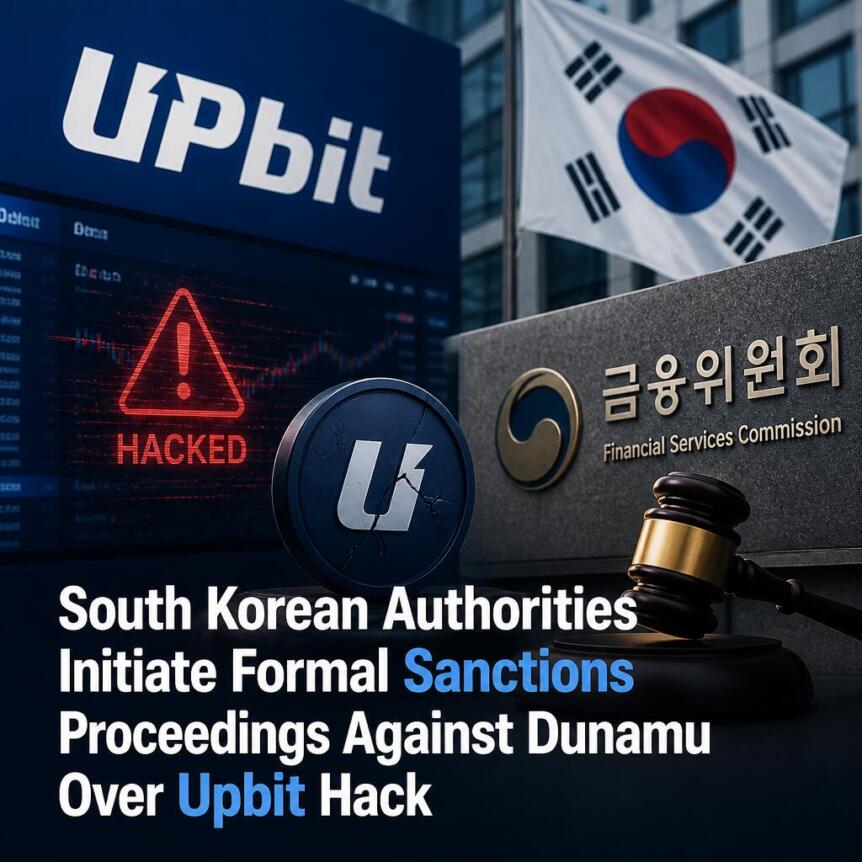
South Korea’s Financial Supervisory Service has initiated formal sanctions proceedings against Dunamu, the parent entity of Upbit, over the $36 million hack reported in November 2025.
Regulatory authorities have since been examining the incident. However, the country’s current laws do not have provisions for hacking penalties. This has left the authorities unsure about the severity of sanctions they can impose on the cryptocurrency exchange.
South Korean Authorities Begin Sanctions Proceedings Against Dunamu
The Financial Supervisory Service’s action against Dunamu comes after an extensive investigation into Upbit and whether it complied with South Korea’s Virtual Asset User Protection Act. According to media reports, the Financial Supervisory Service has sent Dunamu an investigation opinion letter. The opinion letter lets Dunamu respond to the authorities before they decide on the quantum of penalties, if any, to be imposed. The letter is also the beginning of formal sanctions proceedings against the company.
Upbit Response To Hack Under Scrutiny
Upbit, South Korea’s largest cryptocurrency exchange by trading volume, suffered a major exploit in November 2025, with hackers stealing over $36 million in Solana-based assets. The exploit started at 4:42 AM local time and lasted 54 minutes as hackers drained funds into an external wallet. Dunamu, Upbit’s parent entity, responded to the hack by reimbursing affected users from the exchange’s reserve. It also froze around $1.7 million and continued efforts to recover the frozen funds.
However, the exchange was criticized for disclosing the exploit only after a merger event with Naver Financial was completed.
Dunamu has been under scrutiny from South Korea’s Financial Intelligence Unit, and was recently fined 35.2 billion won after failing to comply with customer verification and anti-money laundering rules. However, a local court cancelled a partial suspension against the company, citing an inadequate legal basis for the sanction.
A Regulatory Gap
The Financial Supervisory Service is examining whether the exploit violated the Virtual Asset Protection Act, which focuses on user protections and unfair trading practices. However, it does not contain direct provisions to sanction cryptocurrency exchanges in the event of a hack, leaving authorities uncertain about the scope of sanctions that can be imposed. South Korean regulators will address the regulatory gap in the Digital Asset Basic Act, which will contain provisions for sanctioning and compensation in the event of a hack or similar incidents.
Lee Chan-jin, Financial Supervisory Service Governor, conceded in a December press conference that sanctions under the existing Virtual Asset User Protection Act have limitations, but added that regulators could not ignore the hack and its impact on users. The Financial Supervisory Service will notify Dunamu of the proposed sanctions after completing a clarification process. Final sanctions on Dunamu will be finalized after discussions between the Sanctions Review Committee, the Securities and Futures Commission, and the Financial Services Commission.
The Financial Supervisory Service recently concluded a separate inspection of Bithumb over misallocated BTC and will begin sanctions proceedings once legal reviews are concluded.
Naver Deal Remains Under Scrutiny
Dunamu’s planned share swap deal with Naver Financial remains under review. Both companies delayed the transaction to December 31 because of several pending regulatory approvals. While developments do not block the deal with Naver Financial, Dunamu faces considerable regulatory scrutiny. The company can also challenge any findings before a final decision is taken.
Disclaimer: This article is provided for informational purposes only. It is not offered or intended to be used as legal, tax, investment, financial, or other advice.
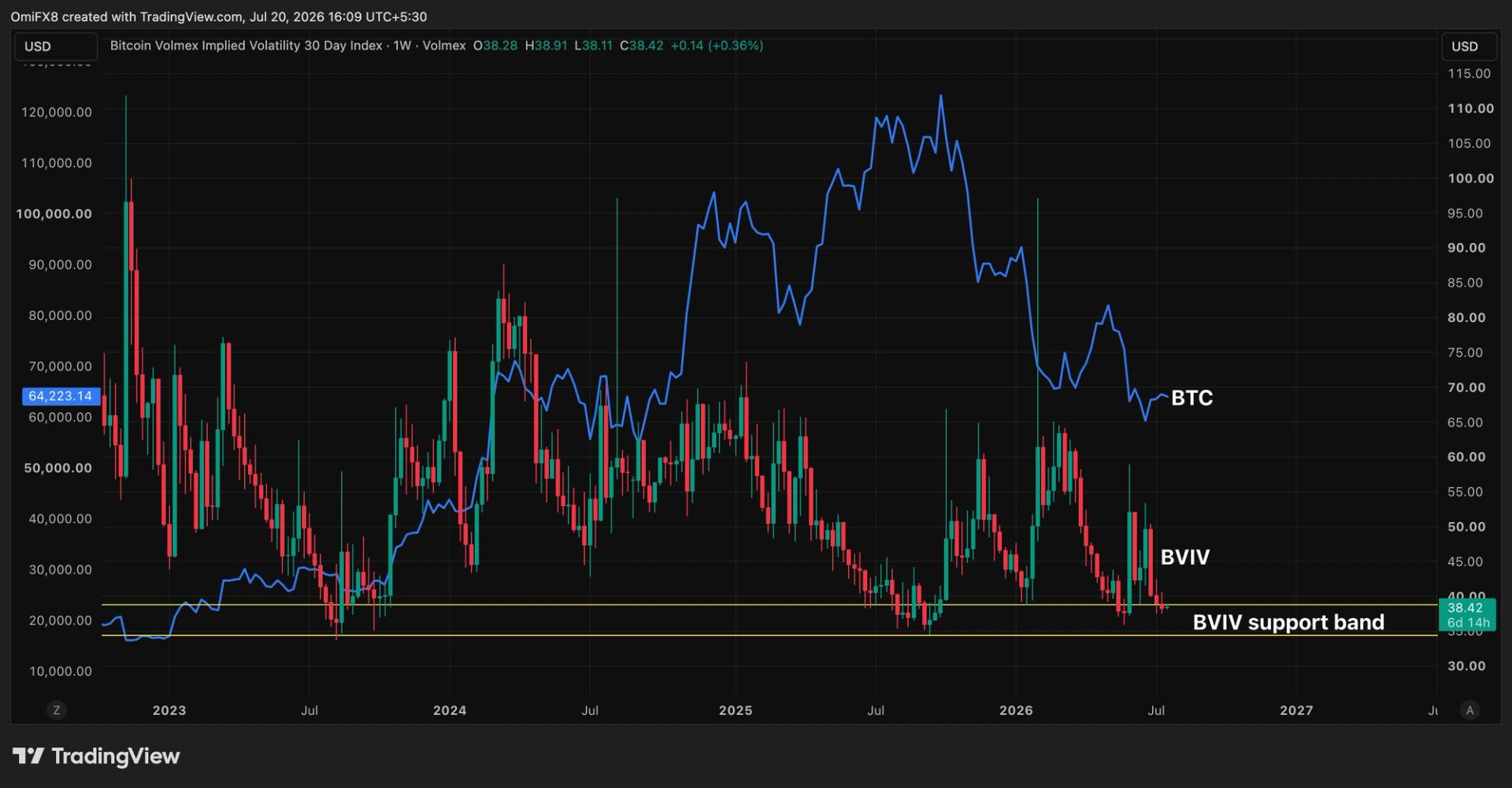
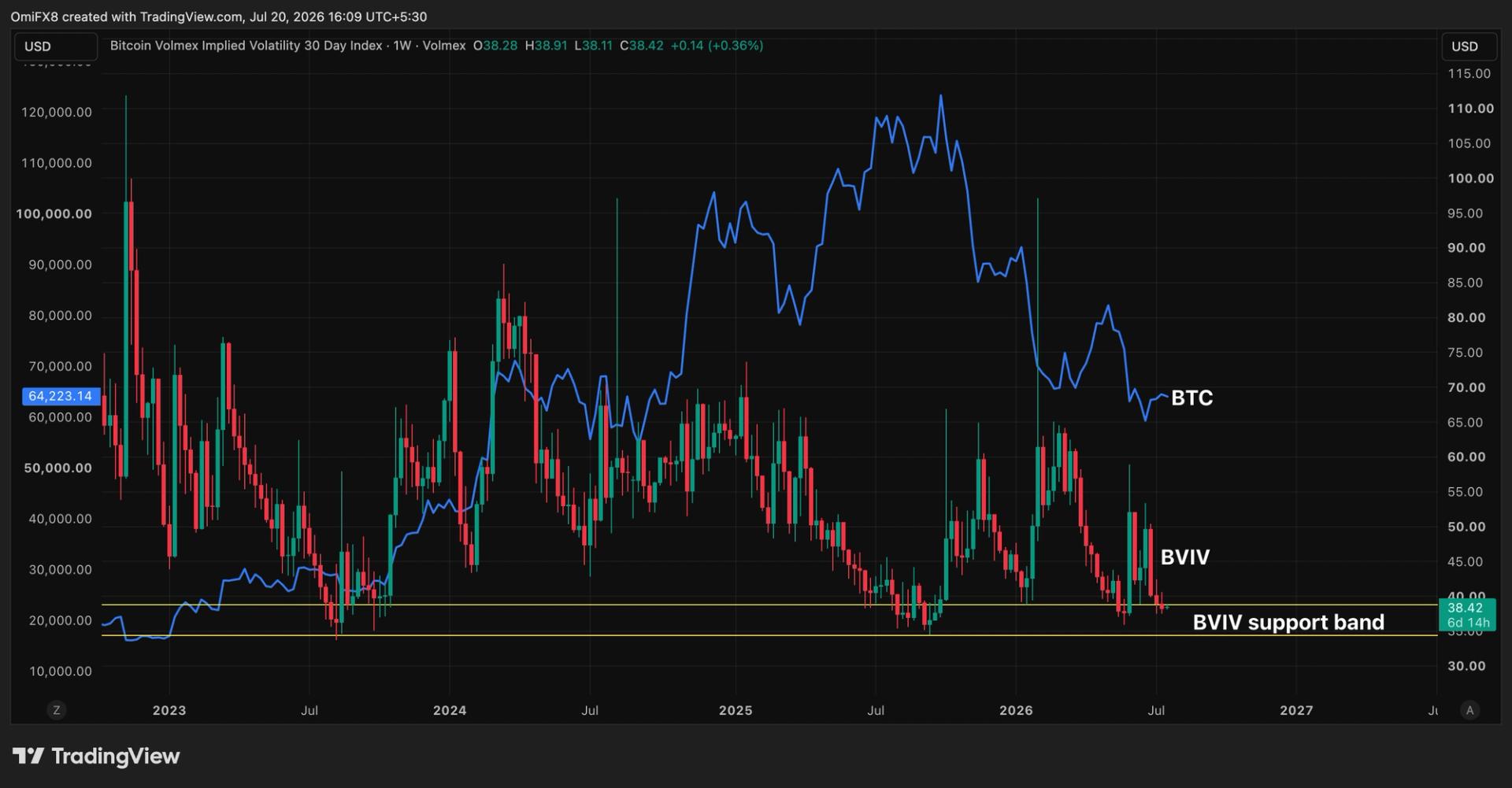
While past patterns are never a guarantee of future performance, volatility metrics are widely known to be mean-reverting. This cyclical nature suggests that periods of below-average volatility are often followed by higher turbulence, while above-average volatility paves the way for market stability.
Currently, the index is trading below both its 30-day and 200-day simple moving averages. In essence, volatility is relatively “cheap” and sitting at a historically reliable support zone, suggesting the measure could be set to rise, which means another round of turbulence.
For now, bitcoin continues to trade just above $64,000, maintaining the range-bound price action that has persisted since last Wednesday. While some analysts have noted two consecutive weeks of spot ETF inflows, the capital movement is tiny compared with the billions yanked from the market during the preceding eight-week outflow streak.
Global volatility gauges in traditional markets are currently offering mixed signals. South Korea’s KOSPI VIX is currently above 70%, its highest level since the 1990s. Meanwhile, Wall Street’s VIX jumped over 12% to reach 18% on Friday, where it continues to hover. However, these levels have been in the play for months, which means that stocks are anything but panicked.
Additionally, the MOVE index, the 30-day volatility gauge for U.S. Treasury notes that underpins global finance, remains steady around 70%, as it has since April, offering a constructive cue for risk assets. Stay alert!
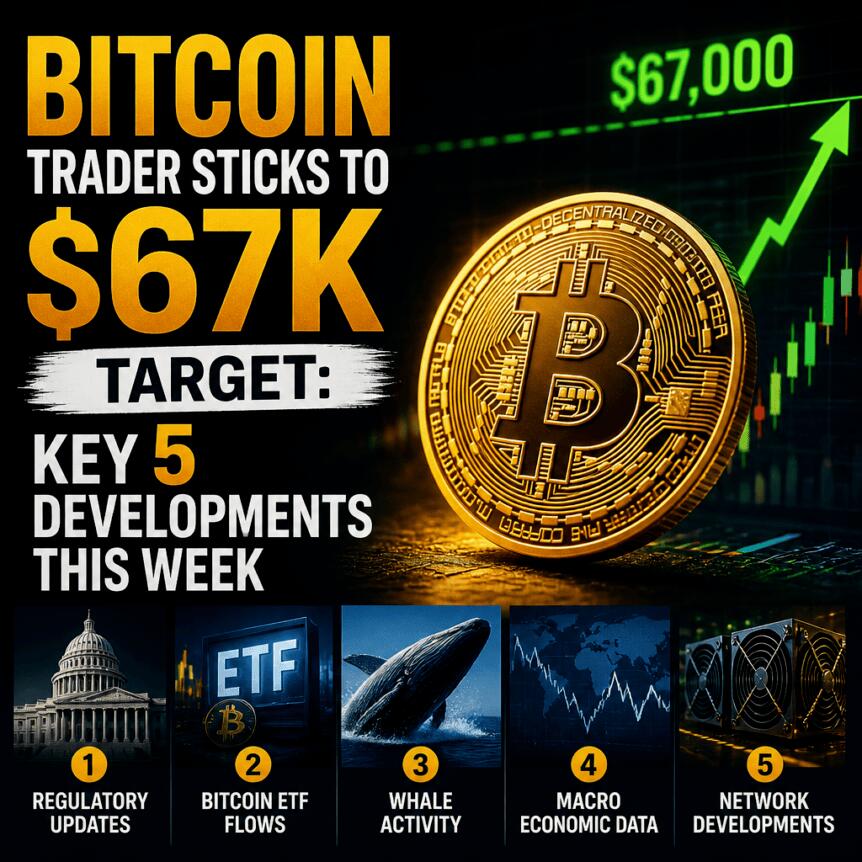
Bitcoin is starting the final full week of July holding onto a key technical level, even as geopolitical and macro pressures continue to loom over risk assets. Traders and analysts say BTC’s near-term floor is being defended, but they are also watching for a clearer break out of a choppy range.
At the same time, on-chain and derivatives-focused research points to a market that is still not fully supported by spot demand—despite some exchange-traded fund (ETF) inflows—while sentiment gauges suggest fear is easing from earlier lows.
Key takeaways
- Bitcoin is maintaining support around the 200-week moving average after a strong weekly close, with some traders targeting a potential move toward the $65,000–$67,000 zone.
- Options and futures activity may not be enough to sustain a rally if spot buying remains weak, according to CryptoQuant research.
- Geopolitical escalation tied to the US-Iran situation is pushing oil prices higher, adding volatility to broader markets ahead of major corporate earnings.
- The Puell Multiple—used to track miner earnings versus its historical baseline—has been improving, but analysts warn against calling a “generational low” too early.
- Crypto Fear & Greed Index readings are near a two-month high, signaling that panic is fading even as caution remains.
BTC traders test the range as weekly support holds
Even with a positive weekly close, the start of the week brought renewed sell-side pressure. TradingView data cited by Cointelegraph indicates BTC saw lower prices after the weekly close, with local lows reaching $63,700 during Monday’s session.
Some traders still see room for additional relief rallies as long as range lows continue to hold. One analyst posting on X, Jelle, said he wouldn’t be surprised to see BTC “towards 65-67k” later this week, framing the current setup as supportive on shorter time frames.
Another market participant, Daan Crypto Trades, pointed to a structural milestone: BTC has reportedly closed above the 200-week simple moving average (SMA) for three consecutive weeks. The 200-week SMA was cited at $63,322. However, Daan also warned that the next meaningful confirmation would be a strong push that helps BTC retrace the latest downside leg and move back above the 200-week exponential moving average (EMA), referenced at $68,521.
“Until then, we’re just caught in this $60K choppy price range.”
That “chop” characterization is consistent with how multiple traders have been framing the market—bullish divergences are being discussed, but the move still needs follow-through to escape the current trading band.
There is also a cautionary overlay from seasonality. Rekt Capital summarized a broader cycle view on X, arguing that Bitcoin is more than halfway through its second year in the current four-year cycle and that 2026 has behaved more like a bear-market year, setting expectations that a more favorable “bottoming out” period may come later.
Geopolitics raises the macro temperature for risk markets
Beyond technicals, this week’s macro backdrop is being driven by renewed tensions in the US-Iran relationship. Iran-related escalation has fed into market concerns, and US officials have discussed sanctions legislation in a way that has heightened attention from investors.
Energy markets responded quickly. Oil futures were reported higher at the weekly open, with WTI crude trading above $80 per barrel at five-week highs, and Brent topping $90. Cointelegraph also noted that the return of conflict coincided with the swift closure of the Strait of Hormuz, a major shipping route, after it had briefly been cleared earlier as part of a now-failed US-Iran peace effort.
For crypto, the implication is less about oil directly and more about how quickly global risk appetite can change when geopolitical tail risks rise. The week’s corporate earnings calendar could amplify that effect, with Tesla, Alphabet, and Intel slated to report in the coming days.
On interest rates, markets appear relatively steady. CME Group’s FedWatch Tool was referenced as showing consensus for a 0.25% rate hike in September.
Spot demand weakens again even as ETF flows look better
One of the clearest frictions in the current Bitcoin recovery narrative is still the spot market. CryptoQuant research highlighted that early-July strength in spot demand has faded.
According to CryptoQuant’s Monday update, a modest increase in supply early in July had already dissipated. Contributor ScenarioX wrote that Bitcoin’s 30-day Spot Demand, which had recovered sharply to around -80K BTC in early July, later deteriorated to nearly -170K BTC.
This shift matters because a persistent gap between derivatives-driven activity and true spot accumulation can leave rallies vulnerable. CryptoQuant pointed to a market that may continue to grind higher temporarily as short-term selling pressure eases—but warned that the underlying demand structure still looks fragile.
“However, derivatives demand remains insufficient to support a sustainable uptrend on its own. This leaves the market in a structurally fragile state, where renewed spot selling could trigger a sharp downside move.”
CryptoQuant also suggested that price could rise “for a while” before derivatives demand gets exhausted. ScenarioX’s caution was that an upside move without meaningful spot support is likely to end in a larger liquidation event.
Still, ETF flows provide a partial counterweight to the spot weakness. Cointelegraph previously reported that spot demand stayed negative while the rolling 30-day measure improved as BTC approached $64,000. At the same time, futures activity appeared stronger. Farside Investors data was cited as showing net inflows into US spot Bitcoin ETFs on four of five days last week.
Puell Multiple rebounds—but “generational low” calls remain premature
Another indicator being watched for signs of miner stress easing is the Puell Multiple. CryptoQuant says the metric continues to head higher after early-June lows, which were tied to depressed miner income relative to its 365-day moving average.
The Puell Multiple is designed to capture whether daily miner revenue, denominated in USD, is unusually low compared to historical norms. CryptoQuant’s TheChessOnChain explained that a low reading suggests miner income is far below normal. June’s reading of 0.87 was cited as the lowest since September 2024.
Importantly, CryptoQuant emphasized that even if Puell lows have helped frame prior market bottoms, the lows may not line up neatly with Bitcoin’s price turning points. Over time, Puell has printed higher lows each cycle, which can support the idea that miner income is not being pushed as deep as it used to be.
However, CryptoQuant argued against assuming the current improvement automatically marks a “generational low.” TheChessOnChain noted that halving-related effects don’t mechanically force the Puell ratio to reach new lows, since the metric scales both sides of the ratio, effectively canceling out the supply cut impact. Instead, the argument is that price declines have historically been less severe in later cycles, reducing how badly miner earnings get squeezed.
The more nuanced warning is that waiting for the classic, deeper Puell territory may be a flawed strategy if those conditions no longer print in the same way. The ChessOnChain said that some of the lows in prior periods were “Puell lows, not price bottoms,” and that the current backdrop reads more like easing miner pressure than the start of a long-term capitulation floor.
“Today reads as easing miner pressure, not a generational low. It turns decisive only if it holds beneath recent lows for weeks.”
Fear fades as sentiment nears a two-month high
While traders weigh demand and macro risks, sentiment indicators suggest the psychological mood is improving. The Crypto Fear & Greed Index from Alternative.me showed a reading of 29/100 on Monday, remaining in the “fear” range but at its highest level since the beginning of June. The article noted that crypto had largely been stuck in “extreme fear” for much of the intervening period.
Research firm Santiment tied the shift to ETF demand returning after a prolonged outflow stretch across May and June, according to its commentary on X. Santiment also pointed to improving risk appetite after favorable US inflation data and suggested “crypto policy optimism” provided another reason for sidelined buyers to re-enter.
Going into the rest of the week, traders are likely to watch whether BTC can reclaim the next key weekly trend levels while spot demand continues to lag—or stabilizes again. The durability of any upside move may ultimately depend on whether ETF-related inflows translate into sustained spot accumulation, as CryptoQuant’s warnings about a structurally fragile market remain central to the current setup.

MONEY – RICHARD AHUMADA / VIDEO OFICIAL

Emmerdale’s Lisa Riley three-word message to Andy Burnham as he becomes Prime Minister

Fenix secures approval to build next Mid West iron ore mine


-
 NewsBeat4 days ago
London Mayor Sadiq Khan handed a peerage by Keir Starmer alongside 15 other Labour figures… just days before the PM leaves No10
-

 Fashion3 days ago
Weekend Open Thread – Corporette.com
-

 Politics2 days ago
The House | The City of London can help the new chancellor deliver growth in every postcode
-

 Politics5 days ago
Young campaigners urge incoming PM to act on outdoor junk food ads
-

 Crypto World4 days ago
CFTC blocks Kalshi from unwinding Michigan trades after court order
-
 Crypto World3 days ago
Two July Windows Left: The CLARITY Act’s Senate Fight and What Failure Means
-

 Business4 days ago
Nvidia Stock Slips After Big Tuesday Rally as Huang Confirms Vera Rubin Chip Is Now in Production Today
-

 Crypto World2 days ago
Ripple Payments Joins MiCA With 14 Firms, Does It Mean Anything For XRP?
-

 Politics23 hours ago
Democrats look to World Cup watch parties to register thousands of voters
-
 Entertainment5 days ago
Disney’s Most Ambitious Failed Star Wars Attraction Is Coming to SDCC
-

 Crypto World3 days ago
Ripple wins EU-wide access as ESMA adds it to MiCA register
-

 Crypto World4 days ago
Injective Submits SEC Transfer-Agent Registration to Onchain Ownership Records
-

 Business4 days ago
Palantir Shares Rise After Expanded Nvidia Partnership and Fresh Analyst Upgrades Ahead of Earnings Day
-

 Tech6 days ago
Get Your ESP32 Sunny Side Up With This Solar Dev Board
-

 NewsBeat3 days ago
Registration is now open for March for Men with Kev 2026
-

 News Videos6 days ago
XRP BOMBSHELL… XRP OMBOARDED FOR TRANSACTIONS!!!
-

 Tech6 days ago
Dark Secrets Emerge When Jailbreaking LLMs
-
 Sports5 days ago
New Cornerback Enters Vikings Trade Rumor Mill
-

 News Videos3 days ago
Money | Class 12 Economics | CBSE Board Exam 2026-27
-

 Business3 days ago
Banco Bilbao Vizcaya Argentaria, S.A. (BBVA) Discusses Global Macro Environment and Economic Outlook for Core Markets Transcript
You must be logged in to post a comment Login