

Business
Refining Margins Hit a Record. What That Means for Gas Prices.




Shares in uranium developer Deep Yellow rose early on Monday morning following an update regarding its flagship Tumas project in Namibia.
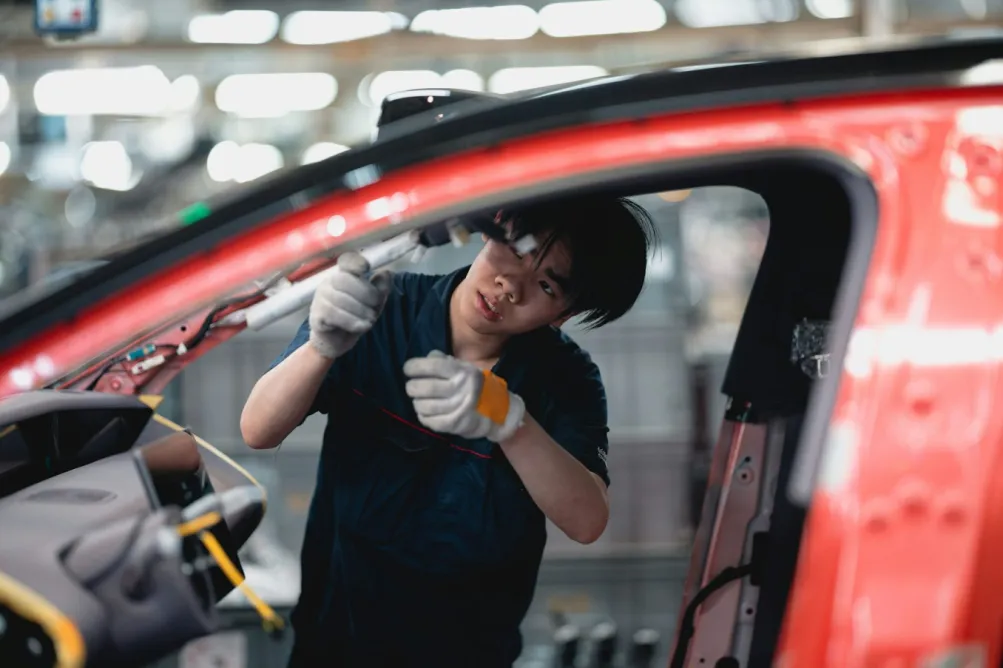
China has been engaged in global economic competition for decades, and it is now approaching first place in terms of GDP while already setting the tone in strategic markets — from carbon-free energy and battery storage to electric vehicles. Its 5% growth in 2025 surpasses global growth (3.2%), US growth (2.2%), and European growth (1.4%), while the country concentrates more than 30% of global manufacturing output.
Abstract
- China leads global manufacturing with over 30% of world output, dominates key sectors including solar panels, batteries, and electric vehicles, and recorded a record trade surplus of one trillion euros in 2025. Its 5% GDP growth outpaces most major economies, while patent filings and advances in AI and humanoid robotics signal continued technological ambition.
- Beneath these headline figures, structural tensions persist. Overcapacity, a deflating real estate sector, and a widening gap between coastal and interior economies create significant domestic pressures. A high household savings rate and weak consumer demand constrain rebalancing efforts, presenting both opportunities and strategic risks for regional business partners in ASEAN and Thailand.
China’s trade surplus reached a record one trillion euros in 2025, and the country now accounts for 20% of global exports. For businesses across Southeast Asia and Thailand, these are not abstract statistics — they define pricing, supply chains, and competitive dynamics across virtually every sector.
Yet behind these headline figures lie deeper structural realities that investors and business leaders in the region would do well to understand.
The Long March to Industrial Domination
China’s industrial ascent since the late 1970s has produced an independent, fully integrated industrial system of remarkable depth and scale. The numbers speak for themselves:
- China produces 70% of the world’s solar panels
- 80% of batteries sold globally are manufactured in China, with 90% of the materials sourced domestically
- Half of all 100% electric vehicles worldwide are made in China
- 90% of civilian drones sold globally come from Chinese factories
- China controls more than 90% of the global vitamin C market, a critical food additive
In 2024, China filed 1.8 million patent applications worldwide — more than three times the US figure of 501,831 and four times Japan’s 419,132.
For ASEAN economies, including Thailand, these figures reinforce China’s position as both an indispensable supplier and an increasingly direct competitor in advanced manufacturing.
Artificial Intelligence and the Robotics Frontier
Chinese leaders have made no secret of their ambitions in artificial intelligence. The launch of DeepSeek V4 — a 1.6 trillion parameter open-source model costing seven to nine times less to run than its American competitors, and built on Huawei’s domestically produced GPU chips — sent a clear signal to global markets.
China is pursuing a dual innovation model: entrepreneurial AI driven by universities and start-ups on one hand, and a Party-State-directed ecosystem where civilian and military capabilities reinforce each other in semiconductors, aeronautics, telecommunications, and AI on the other.
Humanoid robotics is the next frontier. China’s Ministry of Industry and Information Technology has identified humanoid robots as the next disruptive industrial product after computers, smartphones, and electric vehicles. Unitree, the Chinese market leader, delivered approximately 5,500 bipedal humanoid robots in 2025 and expects sales of 10,000 to 20,000 units in 2026. In April 2026, a Chinese humanoid robot completed a half-marathon in Beijing in under 51 minutes — faster than any human on record.
China and the Rest of the World: The New Silk Road Effect
Through its Belt and Road Initiative launched in 2013, China has steadily secured markets and raw material supplies across Asia, Africa, Europe, and Latin America via bilateral partnerships. For Thailand and ASEAN more broadly, this commercial expansion is not a distant geopolitical abstraction — Chinese capital, Chinese platforms, and Chinese supply chains are woven into the regional economy.
This commercial hegemony extends to digital technologies and operates through networks of influence that are as powerful as they are discreet. The strategy, critics argue, creates structural dependencies through unbeatable price competitiveness backed by state subsidies across entire industrial sectors.
The question for the region is whether that dependency deepens or whether the shift in trade policy in Europe and the United States accelerates a rebalancing — and where ASEAN positions itself within that realignment.
The Other Side of the Chinese Economy
China’s growth story has a less visible side that shapes the risks for regional partners and investors.
While GDP growth regularly exceeded 10% before 2010, it has declined steadily since 2011, reaching 5% in 2025. Since the COVID-19 pandemic, the economy has been weakened by disinflation driven by overcapacity across multiple sectors — agri-food processing, textiles, steel, clean energy, and automotive manufacturing, which is operating at only 50% of capacity. Factory closures in building materials and furniture have accelerated since the deflation of the real estate bubble from 2022.
The result is a tale of two economies: a coastal China of 500 million people where salaries and living standards are comparable to Western countries, and an interior economy of more than 800 million people living in developing regions with significantly lower incomes — including factory workers at BYD earning as little as USD 1.49 per hour.
The Employment Paradox
Perhaps the most underappreciated structural challenge is the jobs gap. As digital processes and automation displace workers, China must simultaneously create 12 million new jobs annually for rural migrants and young graduates. Analysis by the Rhodium Group finds that for the same sales value, traditional sectors generated six times more employment than the emerging advanced technology industries now being championed by Beijing.
Young Chinese are pushing back. The “996” work culture — 9am to 9pm, six days a week — is increasingly rejected by a younger generation that prefers shorter hours and lower consumption. The 2026–2030 five-year plan acknowledges this social malaise, but stimulating domestic demand and consumer confidence cannot be decreed, as the failure of the 2024 stimulus package demonstrated.
The household savings rate of 35% reflects not prosperity but anxiety — about retirement, healthcare, and a welfare state far less generous than those in developed economies. This structural caution on consumption remains a brake on the domestic demand that China urgently needs to rebalance its economy.
What This Means for Business in Thailand and ASEAN
China’s technological dominance presents ASEAN businesses and investors with a dual challenge: capitalising on the cost advantages and supply chain depth that Chinese industry offers, while building resilience against the strategic dependencies that come with it. As Washington and Brussels accelerate their own industrial policies, Southeast Asia finds itself at the centre of a global realignment in technology, trade, and investment flows.
The trajectory is clear: China will continue to invest aggressively in AI, robotics, green energy, and digital infrastructure. For Thailand — a regional manufacturing hub navigating its own industrial upgrade — understanding the full picture of Chinese technological power, including its internal contradictions, is not optional. It is essential.
Sources: Rhodium Group (2026), OECD Economic Outlook Vol. 2025 Issue 2, IEA Global EV Outlook 2025
Other People are Reading

David Boshoff
MD & Director
Good morning, everyone, and welcome. I’m David Boshoff, and with me is our CFO, Steve Fewster. We’re pleased to be joining you today for this June 2026 quarterly update. Before we get underway, I’d like to mention that today’s presentation should be read in conjunction with our June quarterly report. This is available on our website. As we move through today’s session, please feel free to add your questions to the live Q&A tab on the right-hand side of your screen, and we’ll respond to these questions at the end of the session.
Our values define us. They guide every decision we make. This quarter, our “how we do what we say” value was in full display. We said we would transition Mardie from filling ponds to operating them, and we have. Salt production has commenced in our crystallizers, and we closed the quarter with salt inventory in the ground. That results belong to our team, our contractors. And as the sun drives the evaporation process, their preparation, coordination, and commitment have made the system perform. Mardie is now firmly established as a working salt operation. And that values-driven approach is exactly what underpins the business we’re building at Mardie
Mardie is already Australia’s largest solar salt operation and the third largest globally. And here’s what makes this moment so significant. After years of construction and now literally months away from completion, the heavy lifting is done. The CapEx is largely spent and the risk to schedule and cost has reduced dramatically. What you’re looking at is no longer a construction story, it’s an emerging production story.
Business
ASX 200 Edges Higher as Oil Spikes on Iran War Escalation and Chinese AI Model Sparks Chip Stock Rout

SYDNEY — Australia’s benchmark S&P/ASX 200 index clawed out modest gains Monday, rising as much as 0.45% in early trade before paring back to a 0.13% advance by mid-morning, as investors weighed surging oil prices tied to the escalating war between the United States and Iran against a deepening global selloff in semiconductor stocks.
The index sat at 8,797.7 points shortly after noon Sydney time, up slightly on the day after finishing the prior week 0.5% lower at 8,796.7. Futures had pointed to a stronger open, with ASX 200 futures up 54 points, or 0.61%, ahead of the session, but several sectors including materials, industrials, consumer staples, consumer discretionary and healthcare that opened higher had slipped back into negative territory by mid-morning.
Oil surges as Middle East conflict widens
Energy was the standout sector Monday, with Brent crude trading 3.1% higher at $91.07 a barrel, its highest level since June 11 and a 27.8% rally since hitting a low on July 1. The gains came as the war between the United States and Iran entered its sixth month with no sign of resolution. Three U.S. service members have died in the conflict, including two killed in an Iranian missile and drone attack in Jordan and a third during the controlled detonation of a downed Iranian drone in northern Iraq, marking the first American fatalities from Iranian fire since March.
U.S. forces have carried out eight consecutive nights of strikes on Iranian air defenses, coastal installations, and missile and drone storage sites, while Iran has widened its retaliation to strike U.S. allies in the Gulf, hitting a power and desalination plant in Kuwait for a second consecutive day. Shipping traffic through the Strait of Hormuz has collapsed to a fraction of pre-war levels, with just three commodity vessels transiting the waterway on Thursday compared with a daily average of about 125 before the conflict began, as a U.S. naval blockade on Iran-linked shipping remains in force.
The energy-driven rally lifted Australian fuel and gas producers. Viva Energy Group climbed 4.7%, Deep Yellow rose 4.07%, Karoon Energy gained 4%, Woodside Energy Group added 2.71% and Ampol rose 2.64%. Sims, the scrap metals recycler, also featured among the day’s top performers, up 3.04%.
Chip selloff weighs on sentiment
Offsetting the energy gains was a deepening rout in technology and semiconductor shares that has rattled markets across Asia and the United States over the past week. The selloff intensified after Chinese startup Moonshot released an open-weight artificial intelligence model, Kimi K3, that the company says outperforms most rivals on overall capability, trailing only Anthropic’s Claude Fable 5 and OpenAI’s GPT-5.6 by some measures. The 2.8 trillion-parameter model, which Moonshot priced at roughly the level of Anthropic’s Sonnet tier, reignited investor concerns about the sustainability of heavy AI infrastructure spending and the durability of pricing power among leading U.S. and Chinese AI developers.
The Philadelphia Semiconductor Index fell into bear-market territory last week, sliding roughly 10% over five sessions in its worst weekly performance in more than a year and ending Friday down just over 20% from its late-June record, though the index remains up more than 60% for the year to date. The rout spread across Asia, where Taiwan Semiconductor Manufacturing Co. shares fell 7.3% in Taipei even after the company lifted its 2026 capital expenditure guidance to between $60 billion and $64 billion. Taiwan’s benchmark Taiex index dropped 6.5%, extending its decline from a June high to nearly 11%, as foreign investors sold a record $5.8 billion of shares on a net basis. A Bloomberg gauge of Asian chip stocks fell more than 6%, led by memory chipmaker Kioxia, whose shares have roughly halved in recent weeks.
The technology weakness followed a losing week on Wall Street, where the S&P 500 fell 1.01% to 7,457.69 on Friday, the Nasdaq dropped 1.4% and the Dow Jones Industrial Average slid 0.77%, capping weekly declines of 1.6%, 2.9% and 0.9%, respectively. Streaming giant Netflix tumbled 7.2% after issuing soft third-quarter revenue guidance, while International Business Machines Corp. posted its worst week on record following disappointing sales.
On the ASX, technology-exposed and gold names bore the brunt of the pullback. Gold miners fell broadly as the surging U.S. dollar and rising oil prices weighed on the sector, with Regis Resources down 2.84%, Evolution Mining off 2.47% and Genesis Minerals down 1.8%. Alcoa Corp. shares slid 4.61% and Flight Centre, the travel agency, dropped 4.43% as higher oil prices raised concerns about airline fuel costs. Qantas Airways fell 1.37%.
Trade and commodity dynamics in focus
Away from the broader market swings, South Korean steelmaker Posco, one of the largest private buyers of Australian exports, called for an overhaul of how the coking coal market sets benchmark prices, arguing that a narrow set of spot trades distorts the indices used across the industry. Posco’s head of raw materials procurement said reliance on limited transaction data represented a structural vulnerability, echoing similar pressure major miners have faced in the iron ore market from Chinese buyers.
In company news, diversified miner South32 said it exceeded full-year production guidance across its portfolio and lifted fourth-quarter sales volumes 15% as it advances a US$5.6 billion sale of its aluminium business to Alcoa, a deal expected to leave roughly 85% of the company’s pro-forma earnings coming from base and precious metals. Elsewhere, MGX Resources struck a binding deal to sell its Koolan Island iron ore operation to infrastructure investor Crestlink, and gold miner Aurelia Metals reported its strongest quarterly cash flow since 2018 alongside the planned departure of chief executive Bryan Quinn later this month.
Also weighing on investor sentiment was a report that U.S. corporate insiders sold $77.6 billion of stock in the first half of 2026, the second-fastest pace of insider selling in more than two decades and up 20% from a year earlier, a trend some market participants view as a caution signal given elevated valuations. Separately, shares of SpaceX have fallen 18.5% over the past six trading sessions and now sit below their initial public offering price, denting enthusiasm ahead of a wave of anticipated technology listings later this year.
Trading is expected to remain volatile through the session as investors continue to balance the geopolitical risk premium building into oil markets against the unwinding of momentum trades in the technology sector that has defined much of the past week’s global market action.

KTF: The Arbitrage Ship Has Sailed, Time To Sell

Why is Fangzhou stock gaining today?


Individual investor and family office principal with over 20 years of investment experience. I favor fundamental analysis and look for individual issues and asset classes that are out of favor and represent a good risk/reward trade off. I often employ options strategies, covered calls on companies I own that have gotten ahead of themselves, and writing puts on stocks that I’d like to own at lower prices.Educational background Finance MBA (NYU Stern) with Computer Science undergraduate.
Analyst’s Disclosure: I/we have a beneficial long position in the shares of MSFT either through stock ownership, options, or other derivatives. I wrote this article myself, and it expresses my own opinions. I am not receiving compensation for it (other than from Seeking Alpha). I have no business relationship with any company whose stock is mentioned in this article.
Seeking Alpha’s Disclosure: Past performance is no guarantee of future results. No recommendation or advice is being given as to whether any investment is suitable for a particular investor. Any views or opinions expressed above may not reflect those of Seeking Alpha as a whole. Seeking Alpha is not a licensed securities dealer, broker or US investment adviser or investment bank. Our analysts are third party authors that include both professional investors and individual investors who may not be licensed or certified by any institute or regulatory body.


Financial analyst by day and a seasoned investor by passion, I’ve been involved in the world of investing for over 15 years and honed my skills in analyzing lucrative opportunities within the market.I specialize in uncovering high quality dividend stocks and other assets that offer potential for long term-growth that pack a serious punch for bill-paying potential. I use myself as an example that with a solid base of classic dividend growth stocks, sprinkling in some Business Development Companies, REITs, and Closed End Funds can be a highly efficient way to boost your investment income while still capturing a total return that follows traditional index funds. I created a hybrid system between growth and income and manage to still capture a total return that is on par with the S&P.
Analyst’s Disclosure: I/we have no stock, option or similar derivative position in any of the companies mentioned, and no plans to initiate any such positions within the next 72 hours. I wrote this article myself, and it expresses my own opinions. I am not receiving compensation for it (other than from Seeking Alpha). I have no business relationship with any company whose stock is mentioned in this article.
Seeking Alpha’s Disclosure: Past performance is no guarantee of future results. No recommendation or advice is being given as to whether any investment is suitable for a particular investor. Any views or opinions expressed above may not reflect those of Seeking Alpha as a whole. Seeking Alpha is not a licensed securities dealer, broker or US investment adviser or investment bank. Our analysts are third party authors that include both professional investors and individual investors who may not be licensed or certified by any institute or regulatory body.

Nvidia: AI Infrastructure Hitting Physical And Financial Limits

NAGARAJ SHETTI
SENIOR TECHNICAL RESEARCH ANALYST, HDFC SECURITIES
Trading Strategies
One may look to buy Bank Nifty July Futures around 58,591-58,500 for an upside target of 59,600 by the July 28 expiry. Place a stop loss at 58,000. One may buy the Nifty 24,500 CE of the July 28 expiry around 137-125 for a target of 250. Place a stop loss at 75. TOP STOCK PICKS
Bajaj Finance: Buy at Rs 1,055 | Target: Rs 1,115 | Stop loss: Rs 1,020 | Timeframe: 1-2 weeks

The stock is poised for a breakout above previous highs, supported by robust volumes and a positive daily RSI. Sona BLW
Precision Forgings: Buy at Rs 705 | Target: Rs 752 | Stop loss: Rs 680 | Timeframe: 1-2 weeks
Bullish chart structure, strong breakout volumes and a positive daily RSI support the uptrend.
 Agencies
Also Read: D-St set for a negative opening as GIFT Nifty signals weak start
MEHUL KOTHARI
DVP – TECHNICAL RESEARCH, ANAND RATHI SHARE AND STOCK BROKERS
Trading Strategy
While the broader trend remains positive, the outlook is cautious until the Nifty decisively clears the immediate resistance zone of 24,350- 24,400. Until then, traders can consider a hedged short strategy: Sell Nifty July Futures around 24,350 Buy 24,300 Call Option (Monthly Expiry) as a hedge. The maximum risk on the strategy is expected to be around Rs 12,000 per lot.
Exit Strategy:
Stop Loss: Exit on a decisive move above 24,500. Target: Book profits if the index revisits the 24,000 support zone.
TOP STOCK PICKS
EPACK Durable: Buy at Rs 240-244 | Target: Rs 275 | Stop loss: Rs 225 | Timeframe: 1-3 months
The stock‘s technical setup has improved after moving above the Ichimoku conversion and base lines, while momentum indicators have also turned positive.
Endurance Technologies: Buy at Rs 2,770-2,800 | Target: Rs 3,100 | Stop loss: Rs 2,620 | Timeframe: 90 days
It has confirmed a bullish breakout from an Ascending Triangle pattern, reinforcing the strength of the prevailing uptrend. The stock continues to trade above the Ichimoku Cloud with improving momentum, indicating the potential for further gains.
Read more: Select mid & smallcaps on a roll, but broader market lags
SACCHITANAND UTTEKAR
VP – RESEARCH (TECHNICAL & DERIVATIVES), TRADEBULLS SECURITIES
Trading Strategy
For the Nifty to unlock meaningful directional momentum, the index must reclaim the 24,350- 24,400 resistance zone. A sustained breakout above this range would reaffirm that the broader market structure remains intact and open the possibility of an upmove towards 24,740-24,950 during the current July series.
On the downside, a decisive close below 23,800 would weaken the technical structure and increase the probability of an extended corrective phase.
Deploy a Bull Call Spread: This strategy is suitable for a moderately bullish view, with the expectation that the Nifty will sustain above 24,300 and potentially move towards 24,600 during the expiry period.
Buy: 1 Lot Nifty 24,350 Call @ Rs 115 Sell: 1 Lot Nifty 24,600 Call @ Rs 26 Net Premium: Rs 89 | SL Below: 62 | TGT: 160 Maximum Profit: Rs 161 points (250-point spread − Rs 89 net premium) Maximum Loss: Rs 89 points (Net premium paid) Breakeven: 24,439 (24,350 + Rs 89)
TOP STOCK PICKS
ABB India: Buy at Rs 7,506 | Target: Rs 8,180 | Stop loss: Rs 7,354
The stock has witnessed a fresh breakout from a Bullish Pennant pattern on the weekly chart, with the RSI displaying a strong positive crossover, another positive sign for directional momentum.
State Bank of India: Buy at Rs 1,044 | Target: Rs 1,080 | Stop loss: Rs 1,036
The Piercing Line bullish reversal pattern confirms Rs 1,000 as a key support. RSI above 50 suggests momentum is building towards the Rs 1,080 target.

Donald Trump ignores FIFA president’s call to leave the stage as he joins Spain’s World Cup final trophy lift in awkward moment

Deep Yellow awards Tumas contracts worth $34m

Former WWE star offers to join Tony Khan’s promotion


-
 NewsBeat4 days ago
London Mayor Sadiq Khan handed a peerage by Keir Starmer alongside 15 other Labour figures… just days before the PM leaves No10
-

 Fashion2 days ago
Weekend Open Thread – Corporette.com
-

 Politics2 days ago
The House | The City of London can help the new chancellor deliver growth in every postcode
-

 Politics5 days ago
Young campaigners urge incoming PM to act on outdoor junk food ads
-

 Crypto World4 days ago
CFTC blocks Kalshi from unwinding Michigan trades after court order
-

 Business4 days ago
Nvidia Stock Slips After Big Tuesday Rally as Huang Confirms Vera Rubin Chip Is Now in Production Today
-
 Crypto World3 days ago
Two July Windows Left: The CLARITY Act’s Senate Fight and What Failure Means
-

 Crypto World2 days ago
Ripple Payments Joins MiCA With 14 Firms, Does It Mean Anything For XRP?
-

 Politics14 hours ago
Democrats look to World Cup watch parties to register thousands of voters
-

 Crypto World2 days ago
Ripple wins EU-wide access as ESMA adds it to MiCA register
-
 Entertainment4 days ago
Disney’s Most Ambitious Failed Star Wars Attraction Is Coming to SDCC
-

 Business4 days ago
Palantir Shares Rise After Expanded Nvidia Partnership and Fresh Analyst Upgrades Ahead of Earnings Day
-

 Crypto World3 days ago
Injective Submits SEC Transfer-Agent Registration to Onchain Ownership Records
-

 Tech6 days ago
Get Your ESP32 Sunny Side Up With This Solar Dev Board
-

 News Videos5 days ago
XRP BOMBSHELL… XRP OMBOARDED FOR TRANSACTIONS!!!
-

 NewsBeat3 days ago
Registration is now open for March for Men with Kev 2026
-

 Tech5 days ago
Dark Secrets Emerge When Jailbreaking LLMs
-
 Sports4 days ago
New Cornerback Enters Vikings Trade Rumor Mill
-

 News Videos3 days ago
Money | Class 12 Economics | CBSE Board Exam 2026-27
-

 Business3 days ago
Banco Bilbao Vizcaya Argentaria, S.A. (BBVA) Discusses Global Macro Environment and Economic Outlook for Core Markets Transcript
You must be logged in to post a comment Login