

Tech
The Best Headphones from CanJam London 2026

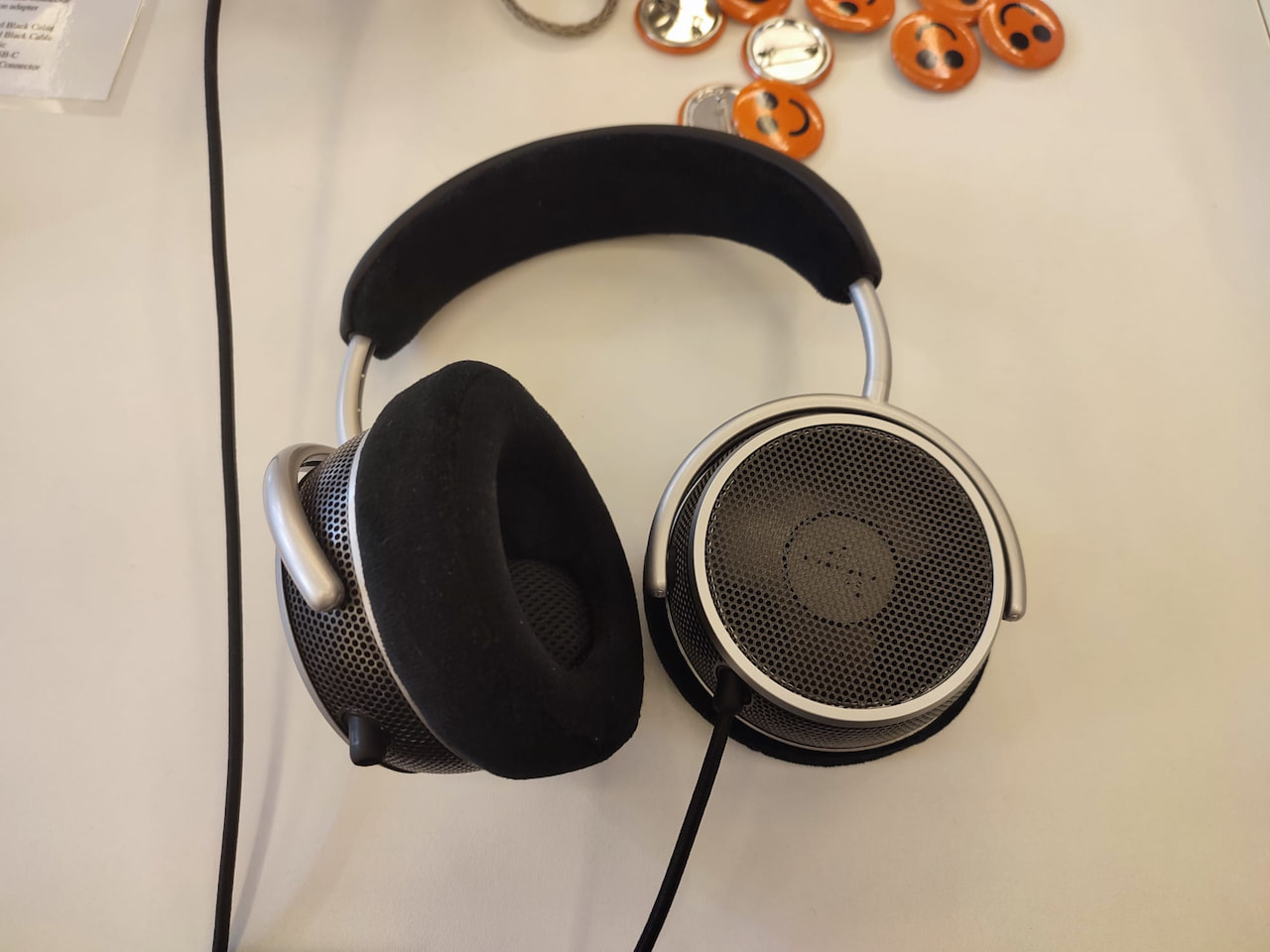
I returned to central London for the second consecutive year for the tenth edition of CanJam London, with a fairly clear idea of which brands and headphones I wanted to hear.
Those expectations lasted about five minutes. The moment I entered the show, I encountered several headphones I had never heard of, along with just as many that sounded completely different from what I expected.
Unlike last year, there were so many new products on display that I simply ran out of time to hear them all. What follows is only a snapshot of the new releases and standout headphones I tested at CanJam London 2026—although nearly 30 pairs of cans still represents a rather substantial snapshot.
This report follows our look at the best DACs, headphone amplifiers, and DAPs from CanJam London 2026, while building on our extensive CanJam NYC 2026 coverage. We will also be heading west for CanJam SoCal 2026 later this summer, where another wave of new headphones and personal audio products will undoubtedly be waiting.
Related Reading: The Best DACs, Headphone Amps and DAPs from CanJam London 2026
The Headphones That Stood Out at CanJam London 2026
Grell OAE2
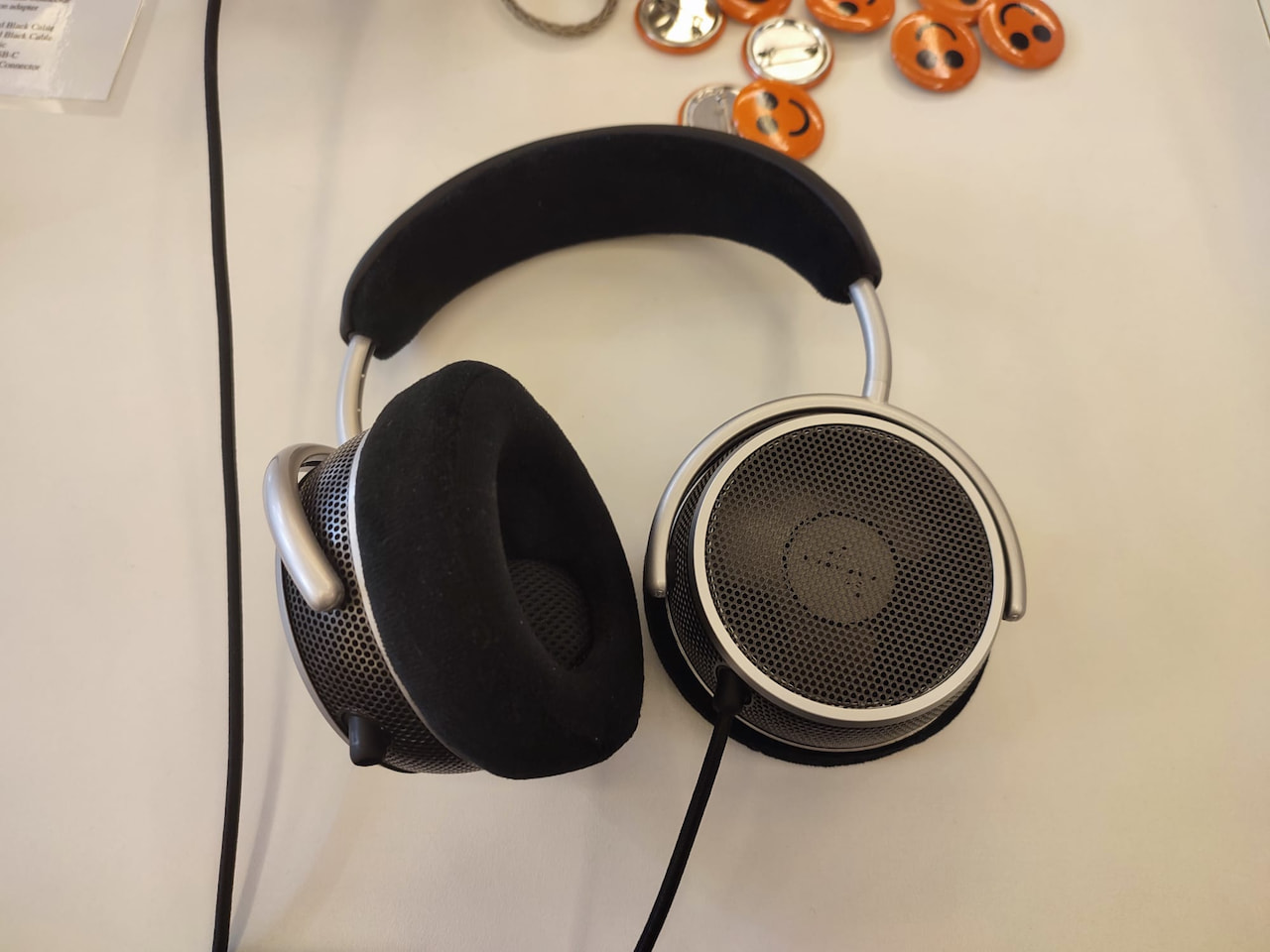
I started at the Electromod booth, conveniently located near the entrance to the show.
The $599 OAE2 is legendary Sennheiser designer Axel Grell’s second attempt at refining his Front-Sided Sound Field Modulation (FSFM) concept. Its 40 mm bio-cellulose dynamic drivers are positioned well forward of the ears, allowing sound to interact more naturally with the outer ear and create a presentation closer to nearfield loudspeakers than conventional headphones. The open-back OAE2 has a 38-ohm impedance, 100 dB sensitivity, a claimed frequency response of 12 Hz to 34 kHz, and weighs 378 grams without its cable.
The original OAE1 received mixed reviews, largely because of its unconventional tonal balance. I did not notice any glaring tonal quirks with the OAE2, although that impression should be taken with a grain of salt because the Electromod booth was hardly a quiet listening environment.
The heavily angled drivers certainly produced the intended forward-facing presentation, which I found pleasant, but the soundstage did not strike my ears as especially wide or expansive. eCoustics Editor-in-Chief Ian White reached a more enthusiastic conclusion during his full review, finding the OAE2 neutral, controlled, and capable of projecting a stable image slightly in front of the listener—although he also noted that the effect varies considerably from one recording to another.
écoute TH2

At the same Electromod booth was one of the more intriguing wireless headphones at CanJam London 2026: the écoute TH2. The closed-back design combines hybrid active noise cancellation and a transparency mode with an eight-band parametric DSP system that allows listeners to make substantial changes to its primary response curve through the accompanying mobile app.
The TH2’s defining feature, however, is its Korg Nutube 6P1 dual-triode vacuum tube in the preamplifier stage, feeding separate Class A/B amplifiers for each channel. It also uses 40 mm titanium-coated Mylar drivers and supports Bluetooth 5.3 with LDAC, AAC, and SBC, along with USB-C digital and 3.5 mm analog connections. Battery life is rated at more than 20 hours.
Sonically, the TH2 delivered prominent midbass with a touch of the harmonic warmth and euphony associated with tube amplification; something rarely experienced from wireless headphones on the move. It was a smooth, relaxed, and thoroughly enjoyable listen. I was told that the TH2 will cost approximately £900 when it goes on sale.
Amoenus Externus
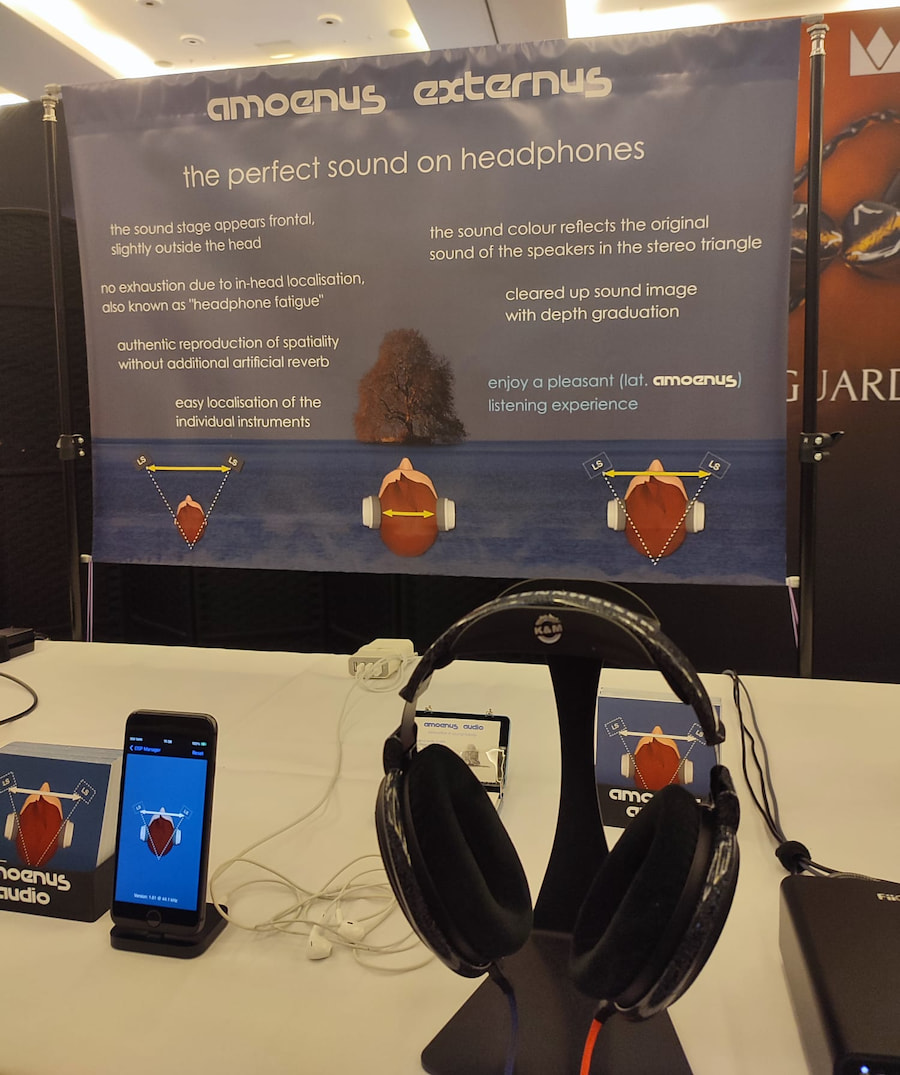
The amoenus externus was the odd one out at CanJam London because it is not a pair of headphones, but rather a software-based spatial-processing system designed specifically for stereo headphone listening.
Instead of adding artificial reverberation or simulating a listening room, the algorithm uses a universal HRTF and an array of nine extremely short delays to reproduce some of the timing cues created by sound interacting with the head, shoulders, and outer ear. The objective is to move the stereo image outside the listener’s head and closer to the presentation of two loudspeakers positioned in front of them. It is available as a stand-alone application or plug-in for 64-bit Windows and Mac systems, along with an AUv3 plug-in for the iPhone.
This was perhaps the most convincing soundstage-enhancement system I have heard thus far. The transformation was not subtle, moving the music away from the sides of my head and placing it significantly farther forward without smothering the recording in artificial ambience. At approximately £20, it is also one of the least expensive products I experienced at CanJam London 2026—and potentially one of the most useful.
FiiO FT15
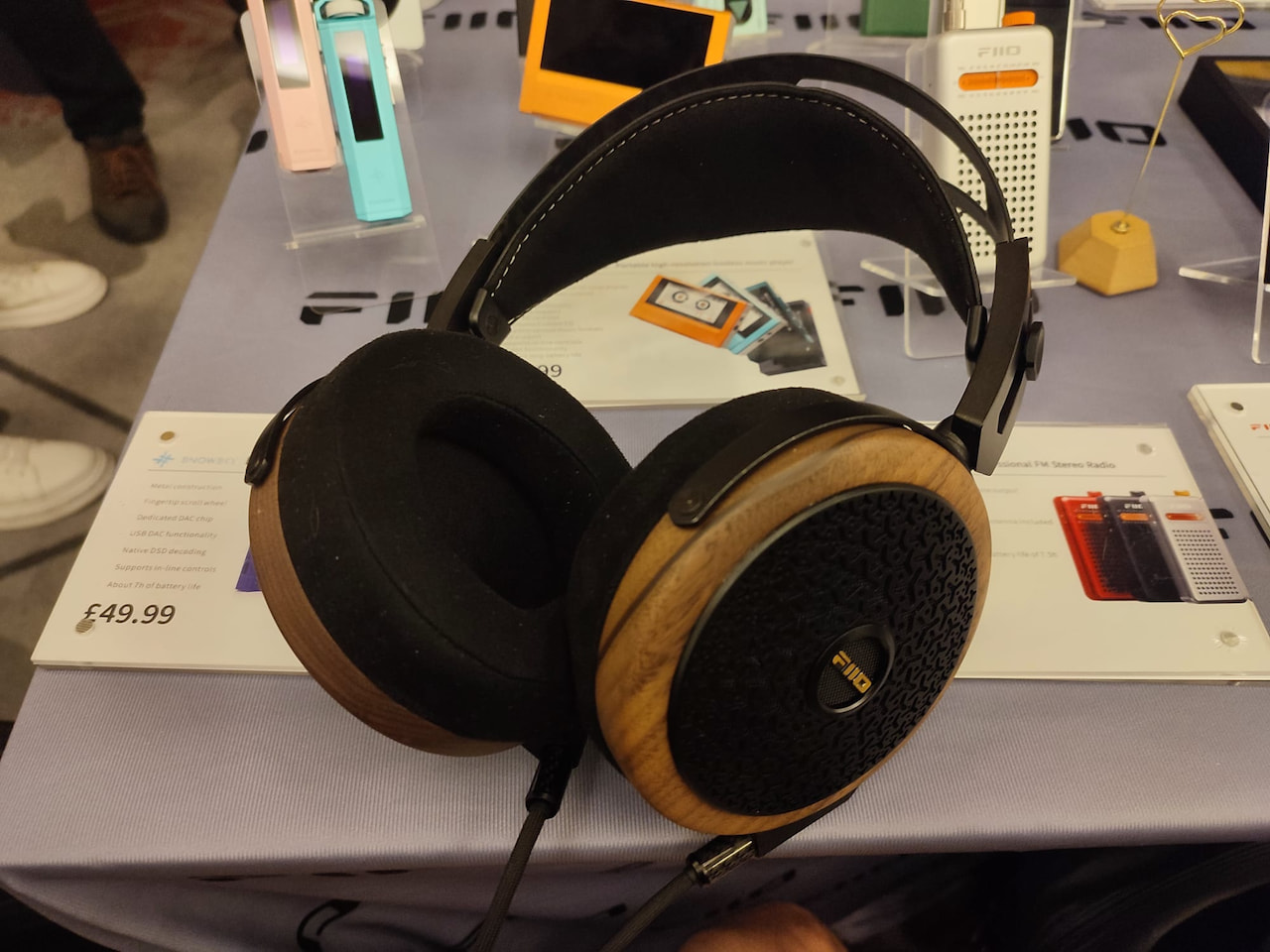
FiiO brought a handful of new and forthcoming products to CanJam London 2026, which should surprise absolutely no one by now.
First up was the FT15, an open-back planar magnetic headphone expected to replace the FT5 while sitting below the flagship FT7 in FiiO’s expanding over-ear lineup. The wood-accented design also continues the visual direction established by several of the company’s recent headphones, with expected pricing of around £499 when it reaches the market. Final specifications and availability have yet to be confirmed.
The FT15 offered a largely balanced tonal presentation, with treble that remained present and airy without becoming immediately aggressive. That openness worked well, but I found its macrodynamic punch and overall sense of contrast somewhat restrained. It was an easy headphone to listen to, although it did not deliver the same dramatic swings or physical energy as some of the stronger planar designs at the show.
FiiO FG3
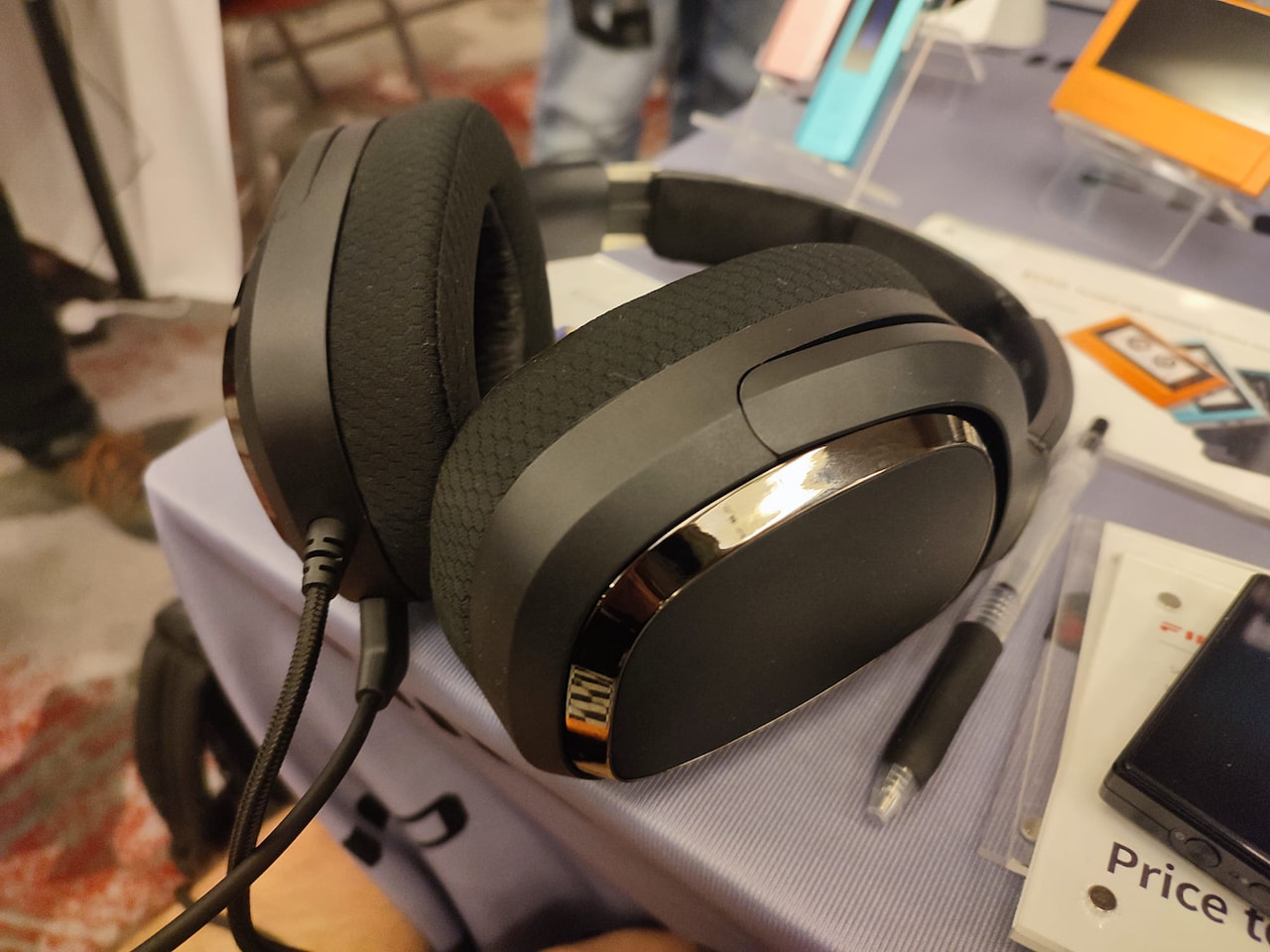
Next was the FG3, FiiO’s first gaming headset and one aimed squarely at the ultra-budget-conscious. Its plastic construction looks and feels every bit of its roughly $70 asking price, but expecting milled aluminum and lambskin at this level would be taking the piss.
The closed-back FG3 uses coaxially mounted 50 mm and 16 mm dynamic drivers with an electronic two-way crossover. It also includes an integrated DAC, headphone amplifier, virtual 7.1 surround processing, five gaming presets, and a 10-band EQ accessible through FiiO Control Web. USB and 3.5 mm connections provide compatibility with computers, consoles, and smartphones, while the detachable microphone uses environmental noise cancellation to reduce background noise.
More importantly, it sounded surprisingly decent for the money. There was some gentle roll-off at both ends of the frequency spectrum, but nothing that undermined the overall presentation during my brief audition. The FG3 is already available internationally for $69.99, and I can imagine it rolling off the shelves rather quickly once UK stock becomes widely available. Pun entirely intended.
Snowsky Nature
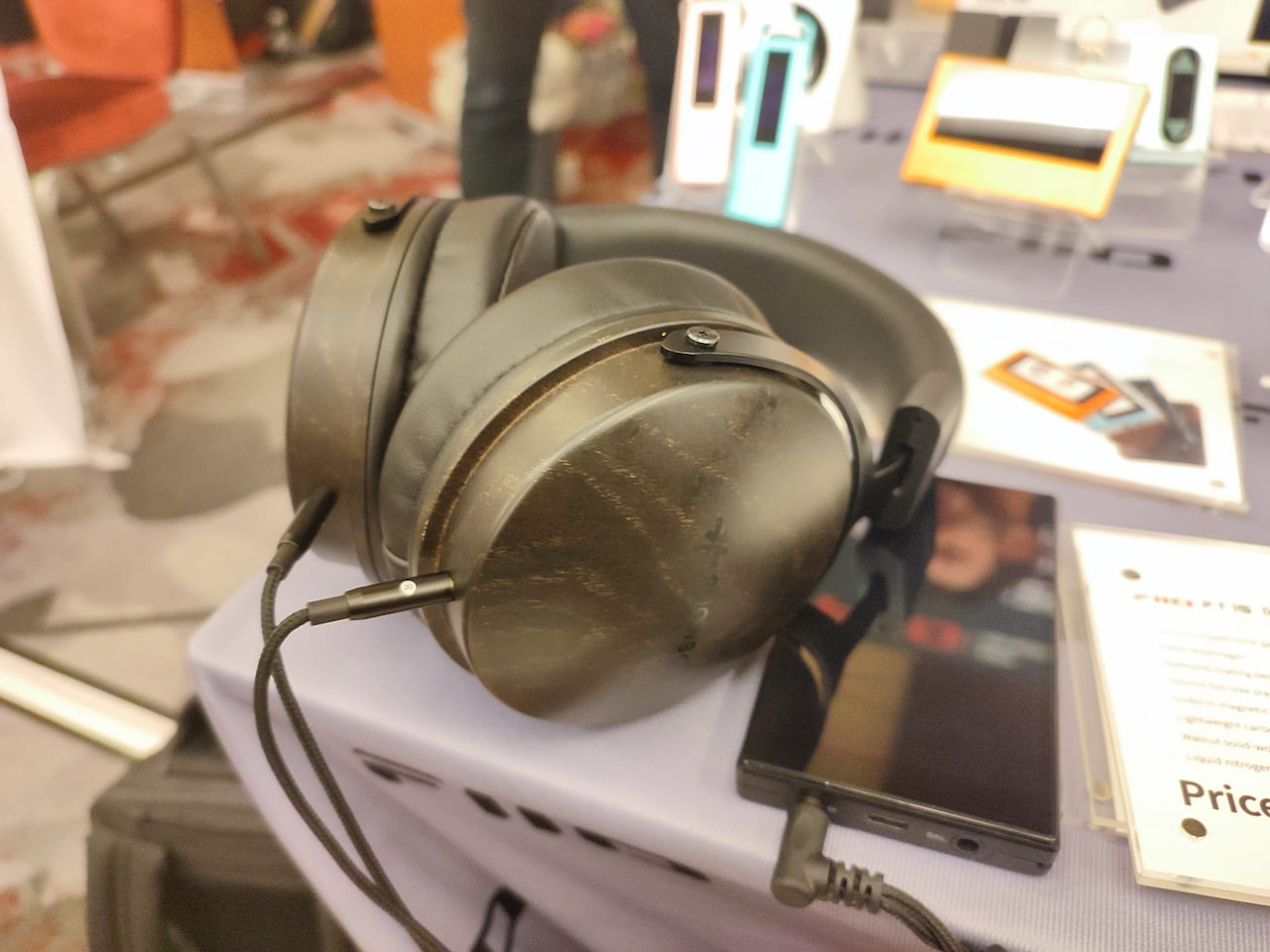
Apparently, FiiO can go even lower in price without the sound falling apart. SNOWSKY is the company’s affordable sub-brand, and the closed-back Nature costs only $40.
The retro-styled over-ear headphone uses 50 mm dynamic drivers with a Japanese carbon-black composite diaphragm, a low 24-ohm impedance, and a sensitivity rating of 101 dB/mW, making it easy to drive from a smartphone, DAP, or inexpensive USB dongle. It also weighs just 280 grams and includes detachable dual 3.5 mm cables, including one with an inline microphone. Despite appearances, the ear cups use a wood-grain water-transfer finish rather than actual wood.
The Nature sounded slightly hollow during my brief audition, but its detail retrieval and generally coherent tonal balance were far better than I expected at this price. For $40, this one is an absolute steal.
Flowztone F-R1
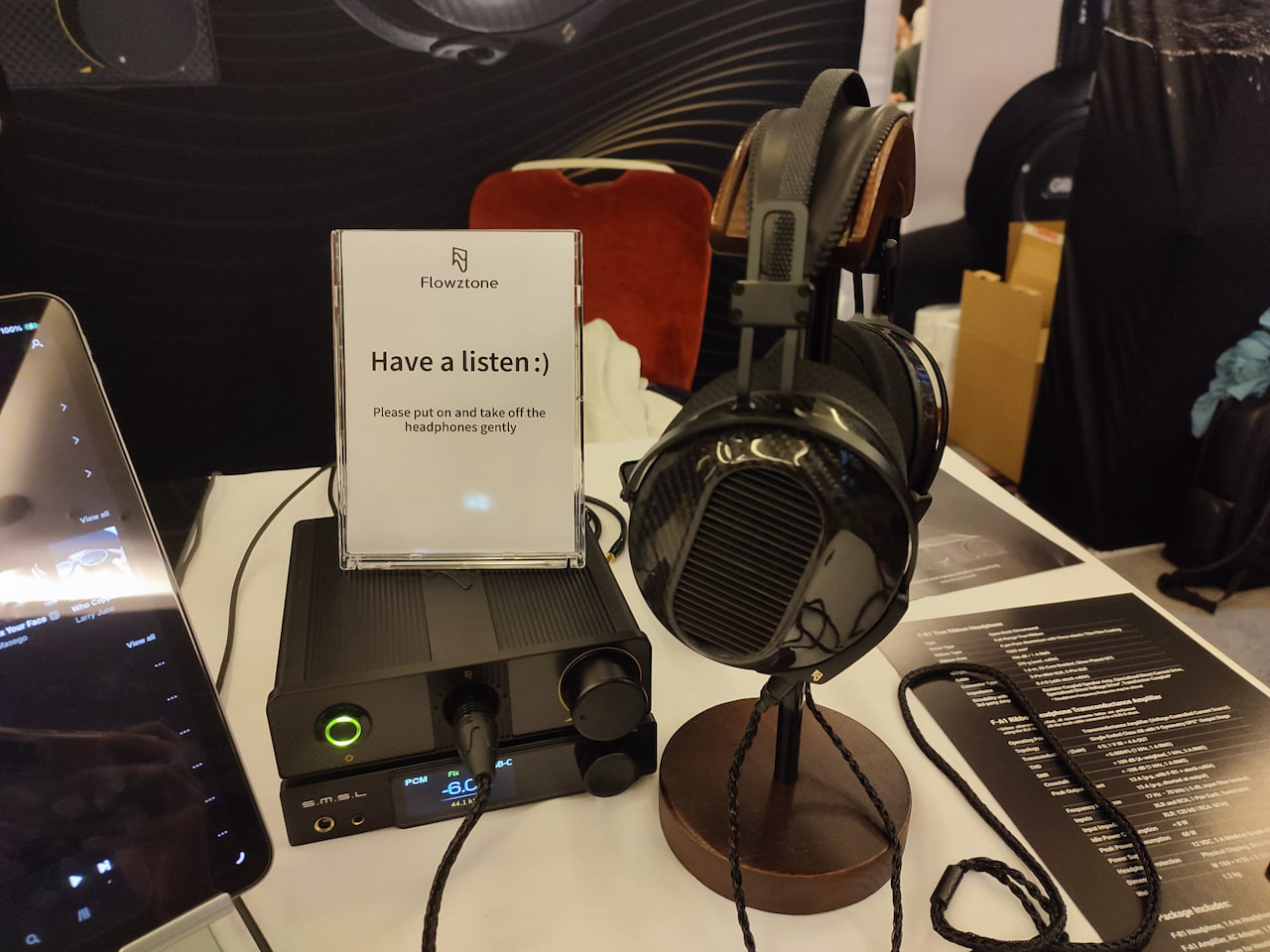
Hong Kong-based Flowztone is preparing to release its first headphone system, and the company has hardly chosen the cautious route. The F-R1 is a true ribbon design expected to cost around $3,000 with its dedicated amplifier.
The open-back F-R1 uses a 4-micron pure-aluminum ribbon diaphragm coated with an ultra-thin viscoelastic polymer layer. Flowztone claims this construction reduces the low-frequency distortion that has traditionally limited true ribbon headphones, with typical bass distortion rated at 0.5% at 94 dB. The 370-gram carbon-fiber headphone also requires Flowztone’s purpose-built transconductance amplifier to drive its exceptionally low 0.4-ohm load.
Right out of the gate, I found the F-R1 slightly sibilant. Inserting the supplied –2 dB tuning filter brought the treble under better control, however, and allowed me to enjoy its Harman-inspired tonal balance. The F-R1 sounded fast, open, and impressively full-bodied for a ribbon design, making this one of the more compelling debuts at CanJam London 2026.
Noble Audio FoKus Artemis
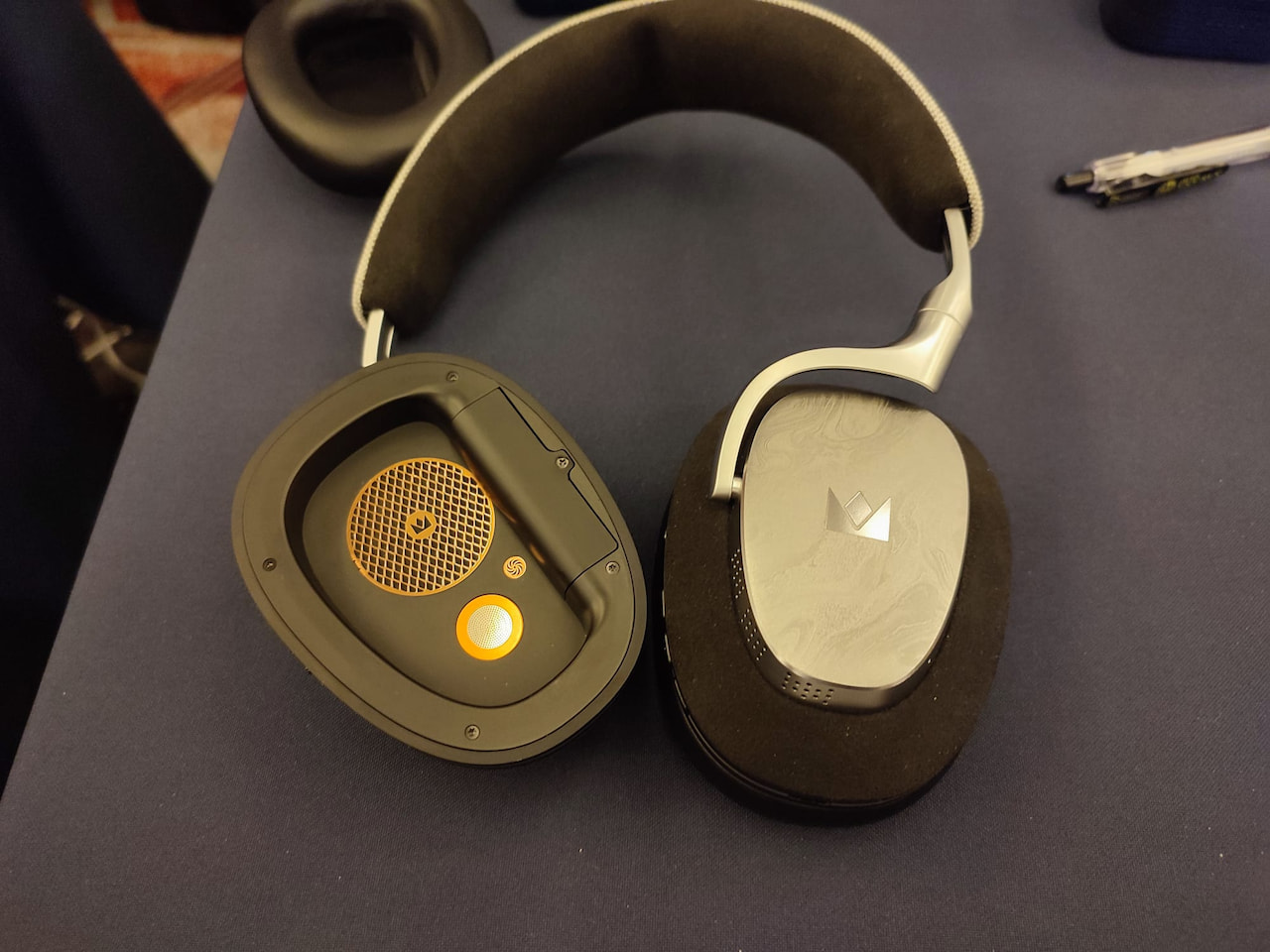
At $899, the Noble Audio FoKus Artemis sits firmly at the upper end of the wireless headphone market, but it certainly looks the part. The sculpted aluminum construction, sleek lines, premium materials, and magnetically attached earpads give it the appearance and feel of a genuine flagship rather than another plastic travel headphone with an inflated price tag.
The Artemis uses an unusual three-driver configuration comprising one dynamic driver, one planar magnetic driver, and one balanced armature driver in each ear cup. It also features adjustable ANC, transparency mode, LDAC, aptX Adaptive and aptX Lossless support, Audiodo hearing personalization, USB-C audio, multipoint connectivity, and a user-replaceable battery rated for more than 40 hours without ANC or 35 hours with it engaged.
Sonically, the Artemis was right up there with the DALI IO-12 that I reviewed previously, delivering excellent detail retrieval, imaging, and overall technical proficiency. Unfortunately, I could not get the earpads to seal properly against the sides of my head. The resulting air gap rendered the ANC almost useless, which was a bit of a disappointment. Fit will clearly vary between listeners, but at this price, prospective buyers should try them before handing over a credit card.
Sendy Audio Apollo Pro

Moving over to the SIVGA and Sendy Audio booth, I listened to the recently released Apollo Pro, a substantially redesigned successor to the original Apollo.
The open-back headphone uses a custom 78 mm planar magnetic driver with a nano-scale composite diaphragm measuring less than 800 nanometers thick. Sendy Audio also employs electron-beam deposition to apply the aluminum conductor layer more uniformly. The 354-gram design combines zebrawood ear cups with CNC-machined aluminum components and includes a detachable 4.4 mm balanced cable with 3.5 mm and 6.35 mm adapters. Impedance is rated at 27 ohms, with a sensitivity of 93 dB.
I have not heard the original Apollo, but I enjoyed the Pro’s particularly intimate and engaging vocal presentation. The trade-off was a soundstage that felt somewhat compact for an open-back planar headphone. Even so, its detail retrieval, separation, and overall technical performance were highly competitive at $494.
ZMF Headphones Tessidera
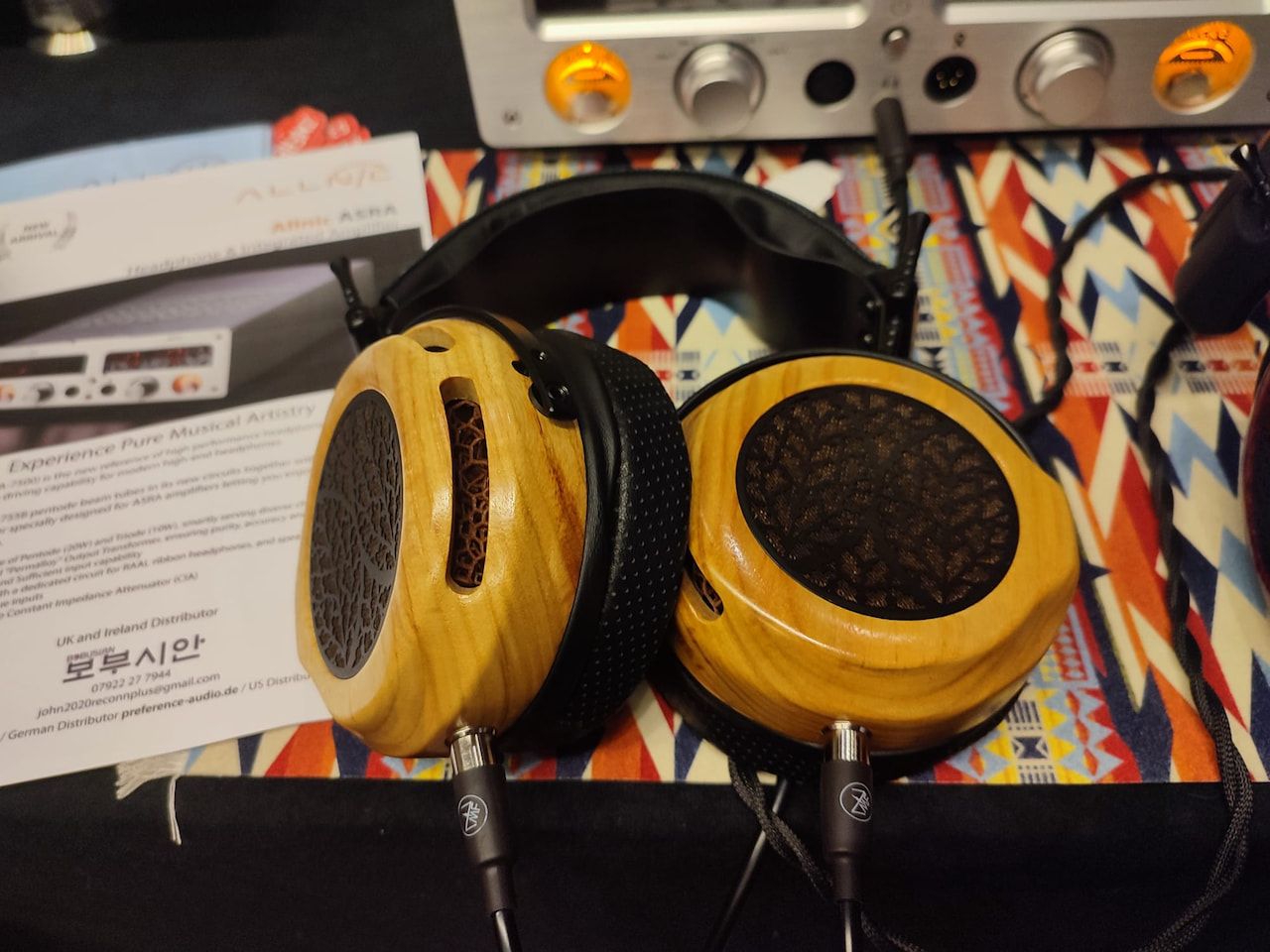
The moment I picked up the $2,499 ZMF Tessidera, I was struck by just how beautiful it looked. ZMF headphones have always resembled works of art, but the angular Canarywood cups and honeycomb-like ZMF Acoustic Matrix visible behind them elevate the design to another level.
The open-back Tessidera uses a newly developed 1-micron planar magnetic driver with a 35-ohm impedance and sensitivity of approximately 92 dB/mW. It combines ZMF’s CAMS magnet structure and Atrium Damping System with the new lattice-style ZMF Acoustic Matrix, designed to reduce standing waves and smooth the treble, and a wooden Soundboard Resonator System intended to improve transient impact and control resonance.
More importantly, how does it sound? To my ears, the Tessidera leaned closer to neutrality than many ZMF headphones, with something of the Auteur’s balance and natural presentation. The treble was smooth and inviting, but dynamics remained strong, while timbre and imaging were as realistic and precise as I have come to expect from ZMF. I have not always connected with the company’s tonal choices, but the Tessidera was right up my alley.
Final Audio Closed-Backs – DX3000CL and DX4000CL
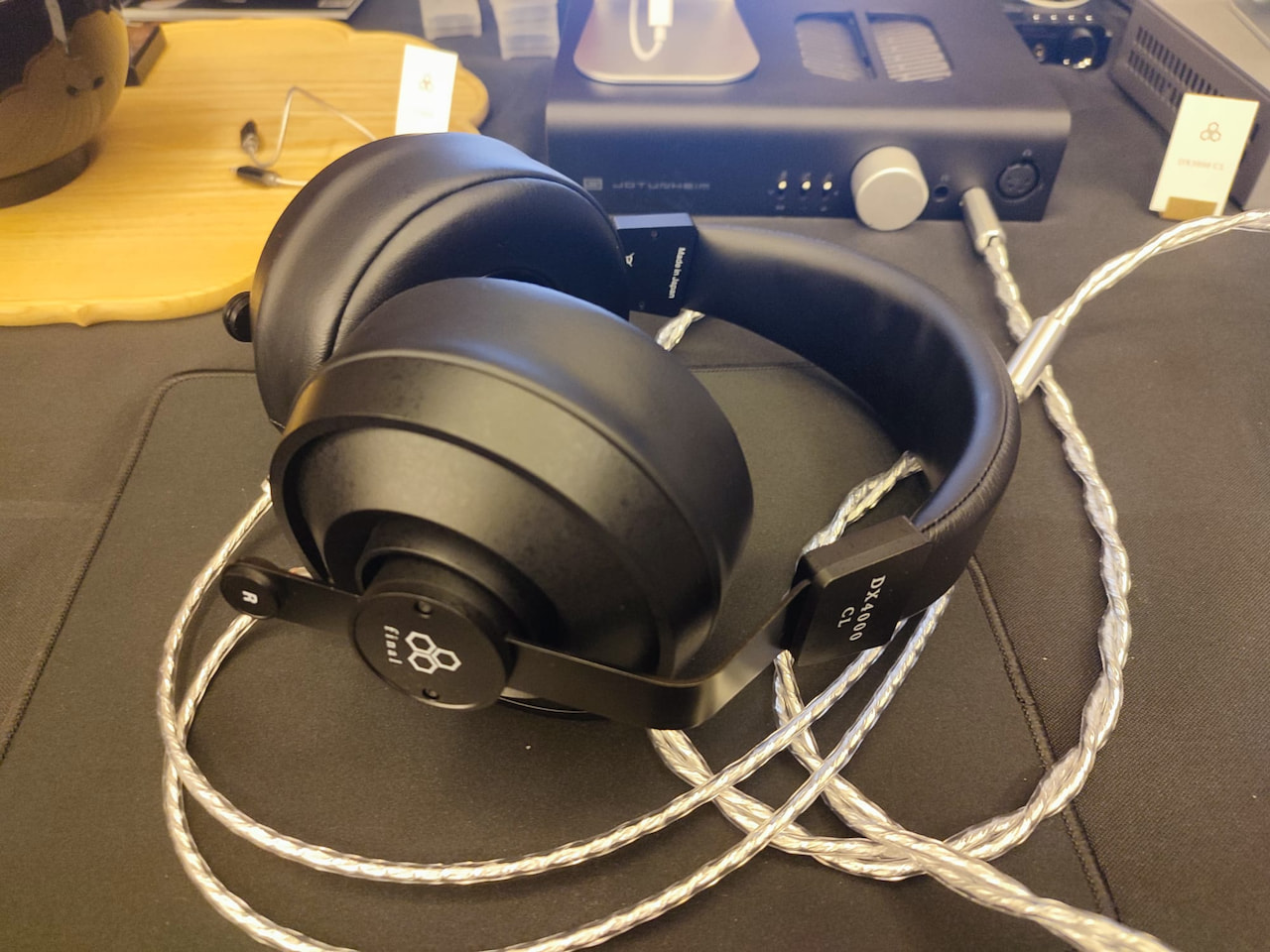
Final recently expanded its premium closed-back headphone range with the DX3000 CL and DX4000 CL. They look almost identical, but the DX3000 CL costs $599, while the DX4000 CL lands just below $1,000.
Both use 40 mm dynamic drivers with lightweight Japanese washi paper and carbon-fiber composite diaphragms, along with thick 30 mm memory-foam earpads and an internal rear-diffuser array designed to suppress unwanted resonances. They also share a 37-ohm impedance and 96 dB/mW sensitivity. The DX4000 CL weighs 375 grams and includes Final’s upgraded silver-coated cable, while the DX3000 CL weighs 410 grams and comes with a standard OFC cable.
In noisy show conditions, I found it difficult to distinguish between their sound signatures. I was told that the more expensive DX4000 CL is slightly more analytical and resolving, while retaining the warmth and generous bass response shared by both models.
Listeners who prefer a warm, full-bodied presentation should find plenty to enjoy here. Unless the DX4000 CL’s lighter construction, added refinement, and upgraded cable are essential, however, I would take the DX3000 CL and pocket the $400 difference.
Final Audio DX10000CL
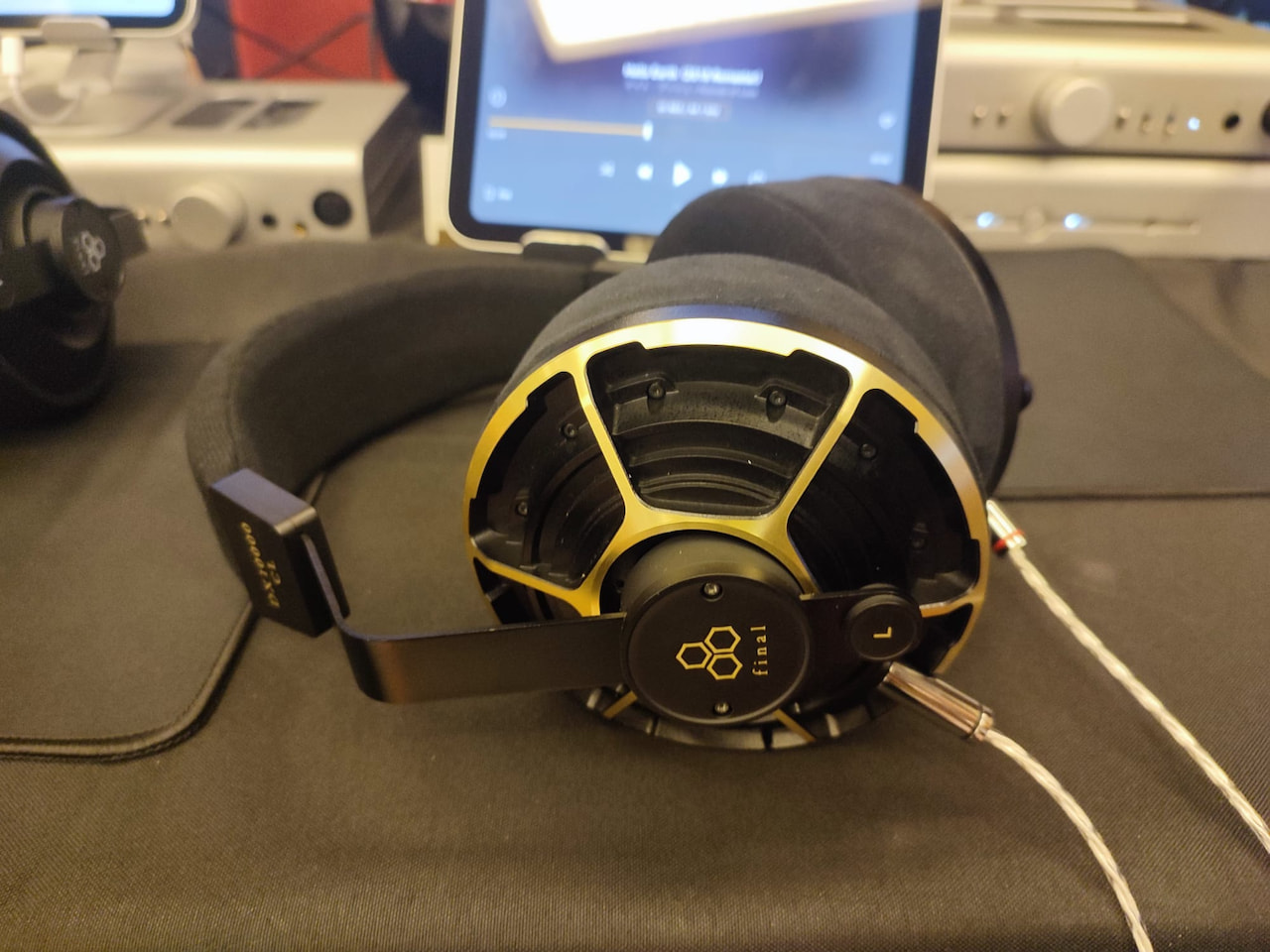
Final had one more new closed-back headphone on display, although the DX10000 CL occupies a very different financial universe from the DX3000 CL and DX4000 CL. The standard model costs a rather unhinged $8,499, while the limited Collector’s Edition adds another $500.
The flagship uses a newly developed 40 mm dynamic driver with a self-supporting True Diamond diaphragm manufactured through chemical vapor deposition. Final claims the material’s extreme rigidity and strong internal damping reduce deformation, resonance, and distortion while improving transient response. The aluminum-magnesium alloy housing has also been engineered to control internal reflections, while the Ultrasuede earpads manage airflow around the ear.
Its subtle steampunk aesthetic looks terrific, but the real surprise came when I listened to it immediately after its two considerably less expensive siblings. The difference was night and day, with substantially greater clarity, perceived detail, and openness owing to its more neutral tonal balance.
I will admit that the DX10000 CL did not tug at my heartstrings quite as strongly as some of the other headphones I heard at the show. Which ones did? I will save those for the Best in Show section.
Audeze Maxwell 2 ANC
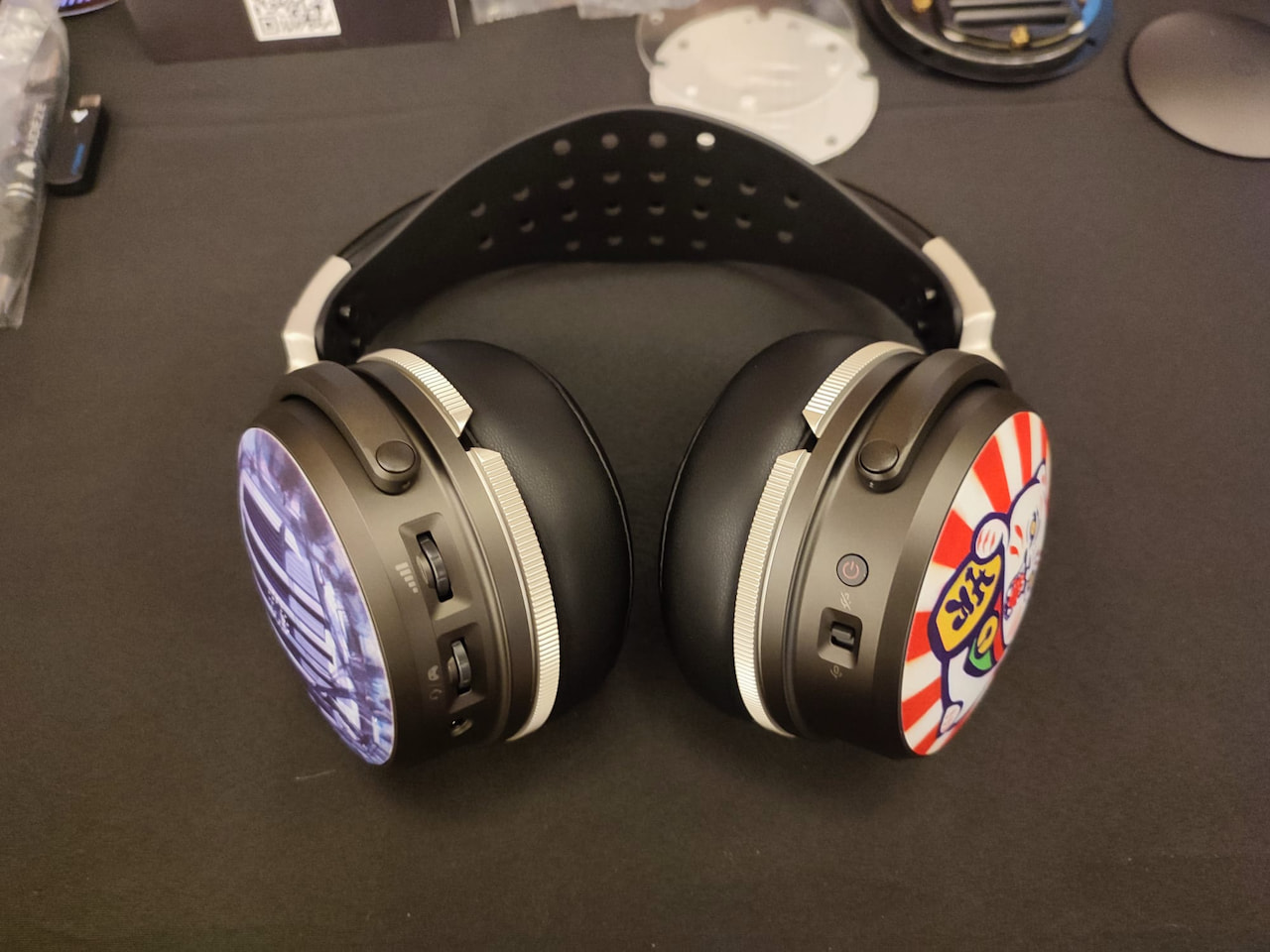
Returning to wireless headphones, I gave the Audeze Maxwell 2 ANC a whirl. As its name suggests, it adds adaptive hybrid noise cancellation and a low-latency transparency mode to the Maxwell 2 platform. It is also the first Audeze headphone of any kind to offer ANC.
The closed-back gaming headset retains Audeze’s 90 mm planar magnetic drivers, Fluxor magnet arrays, Fazor waveguides, and SLAM acoustic technology. Bluetooth 5.3 support includes LDAC, LE Audio, multipoint, and Auracast, which allows a single broadcast source to transmit audio to multiple nearby compatible devices without conventional pairing. Battery life is rated at 40 hours with ANC switched off and 35 hours with it engaged. At 560 grams, however, nobody will mistake it for lightweight travel headphones.
Despite the added weight over the original Maxwell, I preferred the newer model’s sonic balance. Its flatter bass response kept the midrange cleaner without sacrificing impact, while the planar drivers retained the clarity and positional precision that made the Maxwell series stand out in the first place. The PlayStation version costs $429, while Xbox users will pay $449—$100 more than the equivalent Maxwell 2 without ANC.
Audeze MM-520
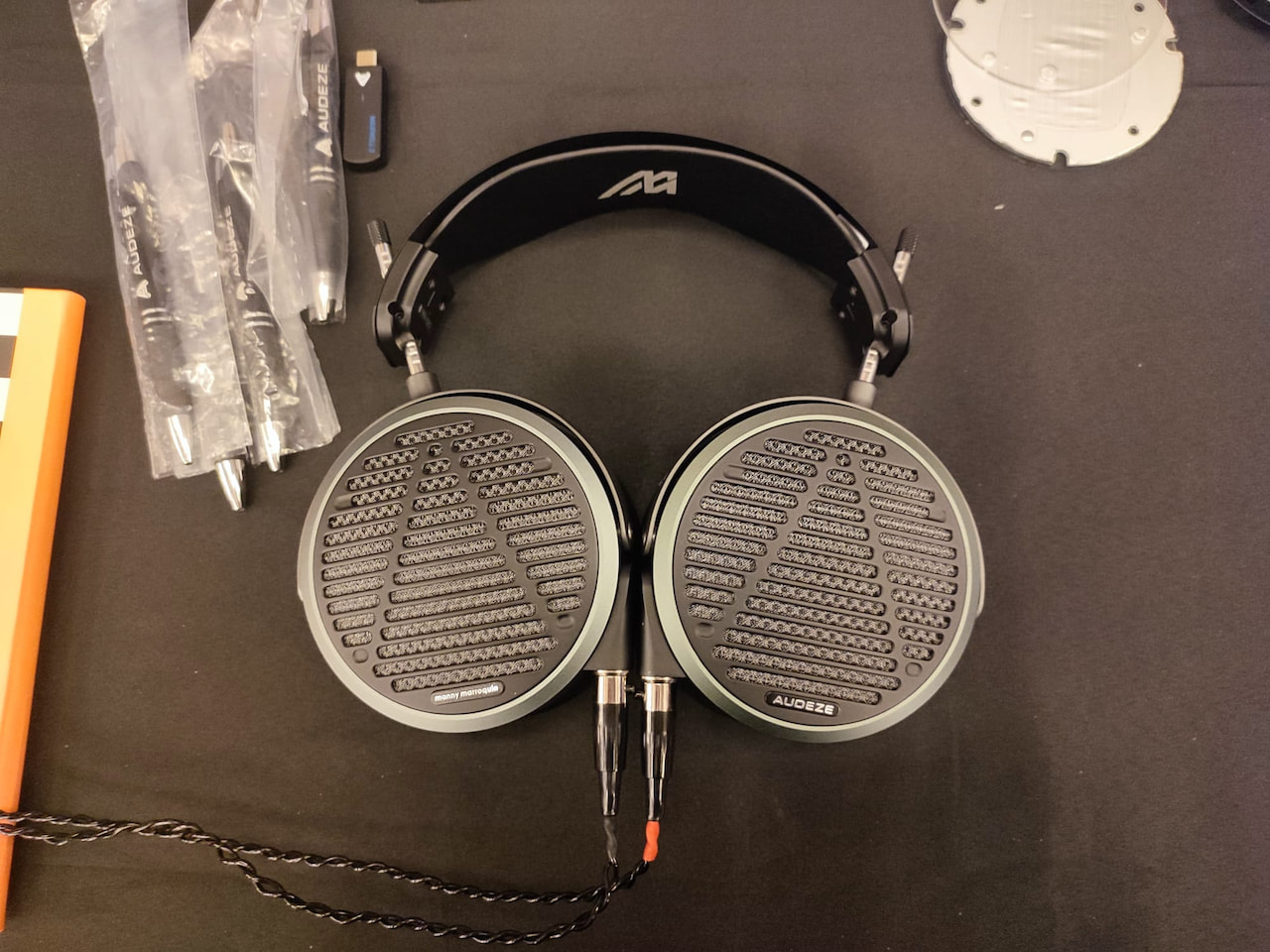
Sticking with Audeze, the $1,699 MM-520 is a studio-focused evolution of the MM-500 developed with 18-time Grammy-winning mixing engineer Manny Marroquin. Its most significant addition is Audeze’s Symmetric Linear Acoustic Modulator, or SLAM, which uses engineered channels to manage airflow and pressure inside the ear cups, improving bass definition and spatial imaging.
The open-back MM-520 uses 90 mm planar magnetic drivers with Ultra-Thin Uniforce diaphragms, Fluxor magnet arrays, and Fazor phase management. It also offers an 18-ohm impedance, 102 dB/mW sensitivity, and a claimed frequency response of 5 Hz to 50 kHz. At 555 grams, however, it remains a substantial piece of studio hardware.
The MM-520 delivered an exceptionally detailed and precise presentation, with the kind of midrange clarity and tonal accuracy expected from Marroquin’s involvement. Even with SLAM, however, I did not find the soundstage especially expansive, and its macrodynamic impact felt somewhat restrained. It is an impressive monitoring tool, but listeners looking for a more physical or emotionally charged presentation may prefer something less analytical.
Moondrop Skyland
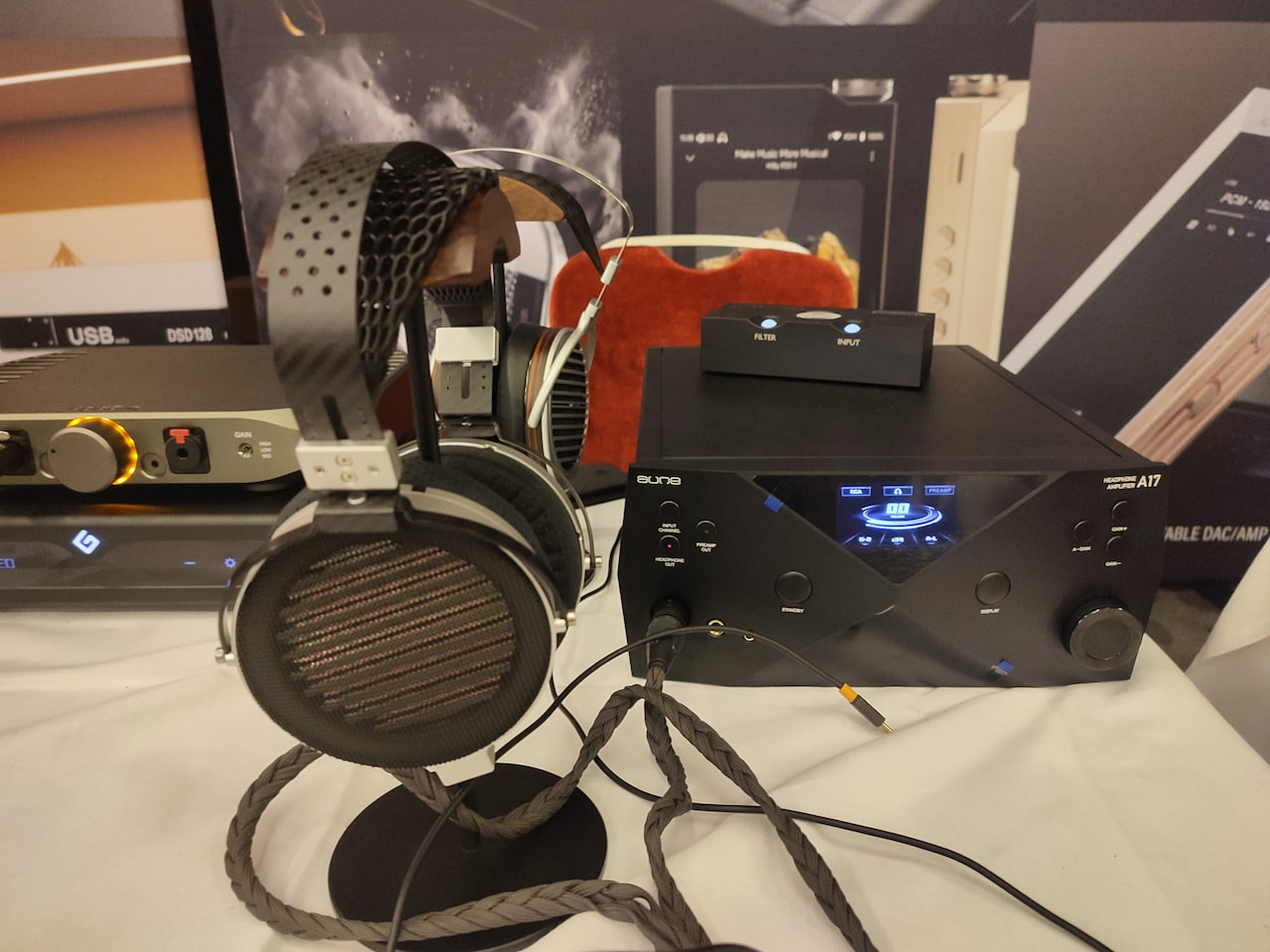
The Elise Audio booth had far too many headphones for me to audition them all, but the Moondrop Skyland immediately caught my eye. It was the first pair I picked up—and wow, this thing is heavy.
The open-back Skyland uses enormous 100 mm planar magnetic drivers with 500-nanometer diaphragms, N55 magnets, and a full-surface drive system. Its all-aluminum CNC construction is paired with a carbon-fiber suspension headband, hybrid lambskin earpads, and a 4.4 mm balanced cable with 6.35 mm and four-pin XLR adapters. Impedance is rated at 60 ohms, with a sensitivity of 96 dB/Vrms and a claimed frequency response of 8 Hz to 34 kHz.
Unfortunately, the substantial weight was compounded by rather low clamping force, resulting in a headphone that did not feel especially secure on my head. I also had to use the smallest headband setting to achieve a workable fit on my average-sized head. Not a promising start.
At least the Skyland sounded good, offering a balanced tonal presentation, seemingly bottomless bass extension, and solid macrodynamic contrast. I was not exactly blown away, however, and the awkward fit would make the $799 asking price difficult to overlook.
Auribus Acoustics Laguna

I was subsequently approached by Auribus Acoustics founder Juan Ovalle, who wanted to hear my impressions of his latest creation: the closed-back Laguna.
The prototype is expected to launch around September for approximately $1,500, although final specifications, pricing, and availability have yet to be announced. Auribus Acoustics is a Southern California headphone manufacturer known for using advanced 3D-printing techniques to refine its acoustic chambers and reduce unwanted resonances.
The moment I placed the Laguna over my ears, I was impressed by its passive noise isolation. It blocked out a substantial amount of the noisy show floor before I had even pressed play.
It also sounded excellent, producing deeply textured sub-bass and a subtle midbass lift that added weight without pushing the presentation into the mud zone. My only minor concern was the treble, which lacked some fine-grained clarity and definition to my ears. Even so, this was a highly promising prototype and one of the more convincing closed-back headphones I heard at CanJam London 2026. Another listener also praised its deep but controlled bass and unusually spacious presentation for a closed-back design.
Viking Audioforge Draupnir
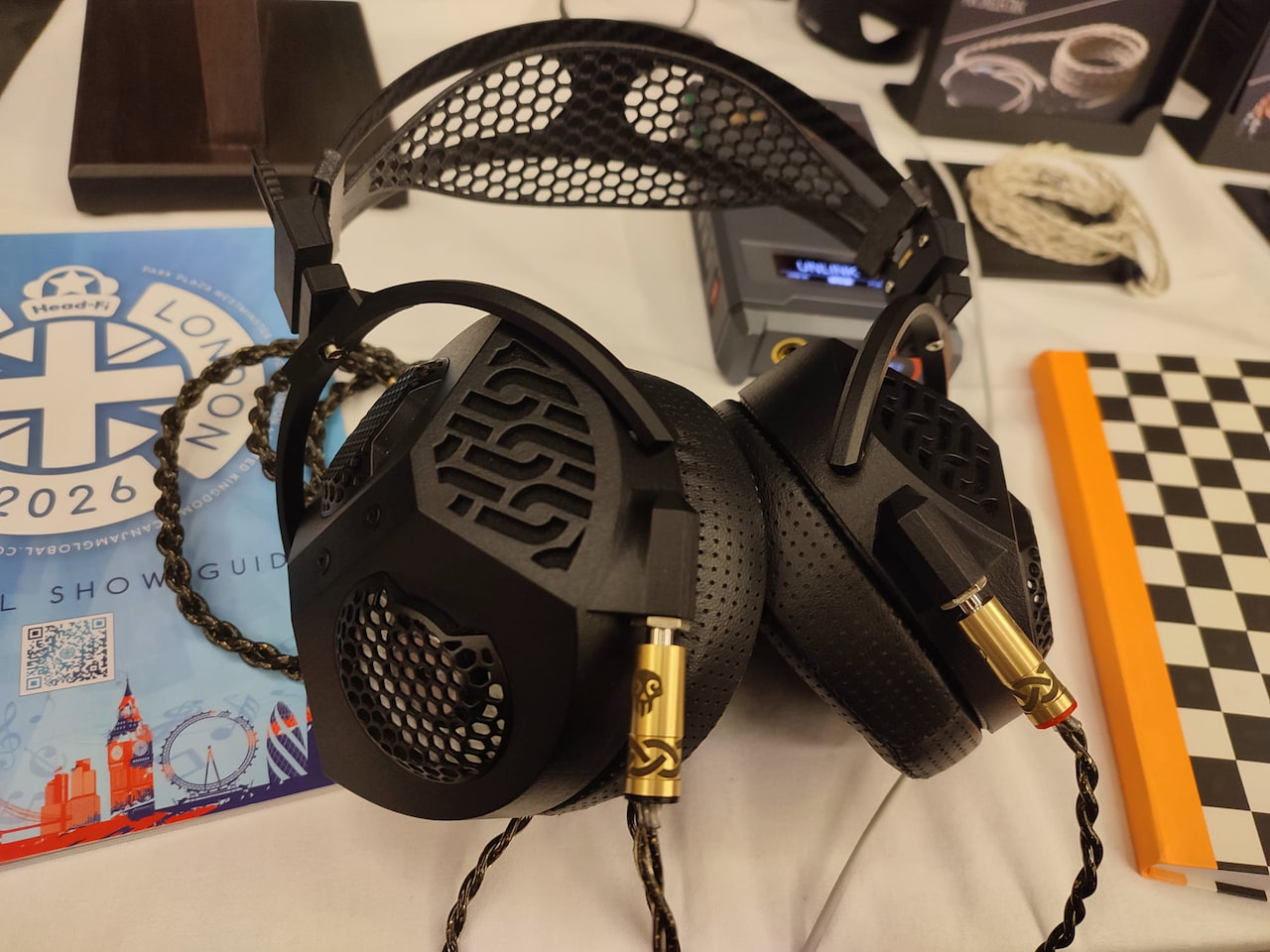
I auditioned a prototype of the Draupnir at CanJam London 2025 and awarded it our Best Innovation honor. One year later, Viking Audioforge has turned that ambitious experiment into a considerably more polished production headphone, now available for preorder at £1,799. Although the fit, finish, and adjustment mechanism have been refined for more consistent manufacturing, Viking Audioforge says the sound, core design, and materials remain unchanged from the Launch Edition.
The open-back Draupnir uses two 50 mm glass-diaphragm dynamic drivers per side, combined through a carefully shaped acoustic lens so that they behave as a coherent source. Its baffle-mounted bass switch adds approximately 6 to 8 dB below 100 Hz, while the lightweight MJF nylon chassis, carbon-fiber headband components, magnetic ZMF earpads, and included Viking Weave cable complete one of the more unconventional headphone designs at the show. It weighs approximately 390 grams.
I cannot say with certainty whether the tuning has changed since last year, but it remains every bit as enjoyable as I remembered. The Draupnir delivered an inviting sense of space and an exciting, quick bass response that became delightfully bombastic once I engaged the boost switch. It would not be an exaggeration to call this one of the most memorable listening experiences I had at CanJam London 2026.
Nur Miah
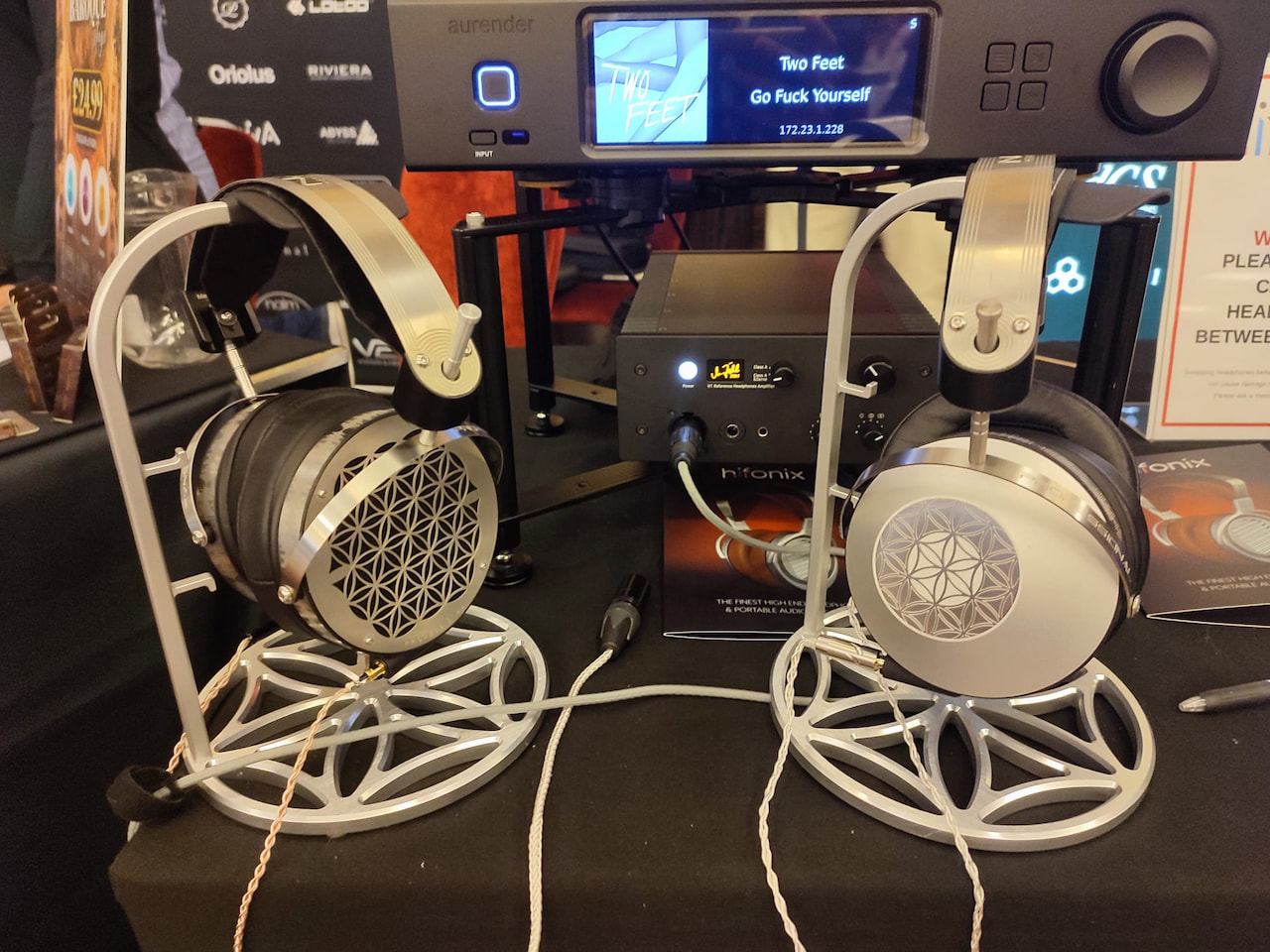
I arrived at the Hifonix booth with no expectations before trying the NUR Miah; admittedly, I had done no research on the Italian headphone manufacturer beforehand.
The forthcoming Miah is a closed-back dynamic headphone with drivers angled forward toward the ears. NUR has not yet published detailed specifications or a firm release date, although I was told at the show that pricing should land somewhere around £2,200.
What surprised me most was the sheer dynamism and realism of its presentation. The Miah sounded exceptionally immediate and lifelike, while maintaining a well-balanced tonal signature that prevented all that energy from becoming tiring or exaggerated. This was an exciting listen—and easily one of the biggest surprises of CanJam London 2026.
Grado Signature S550
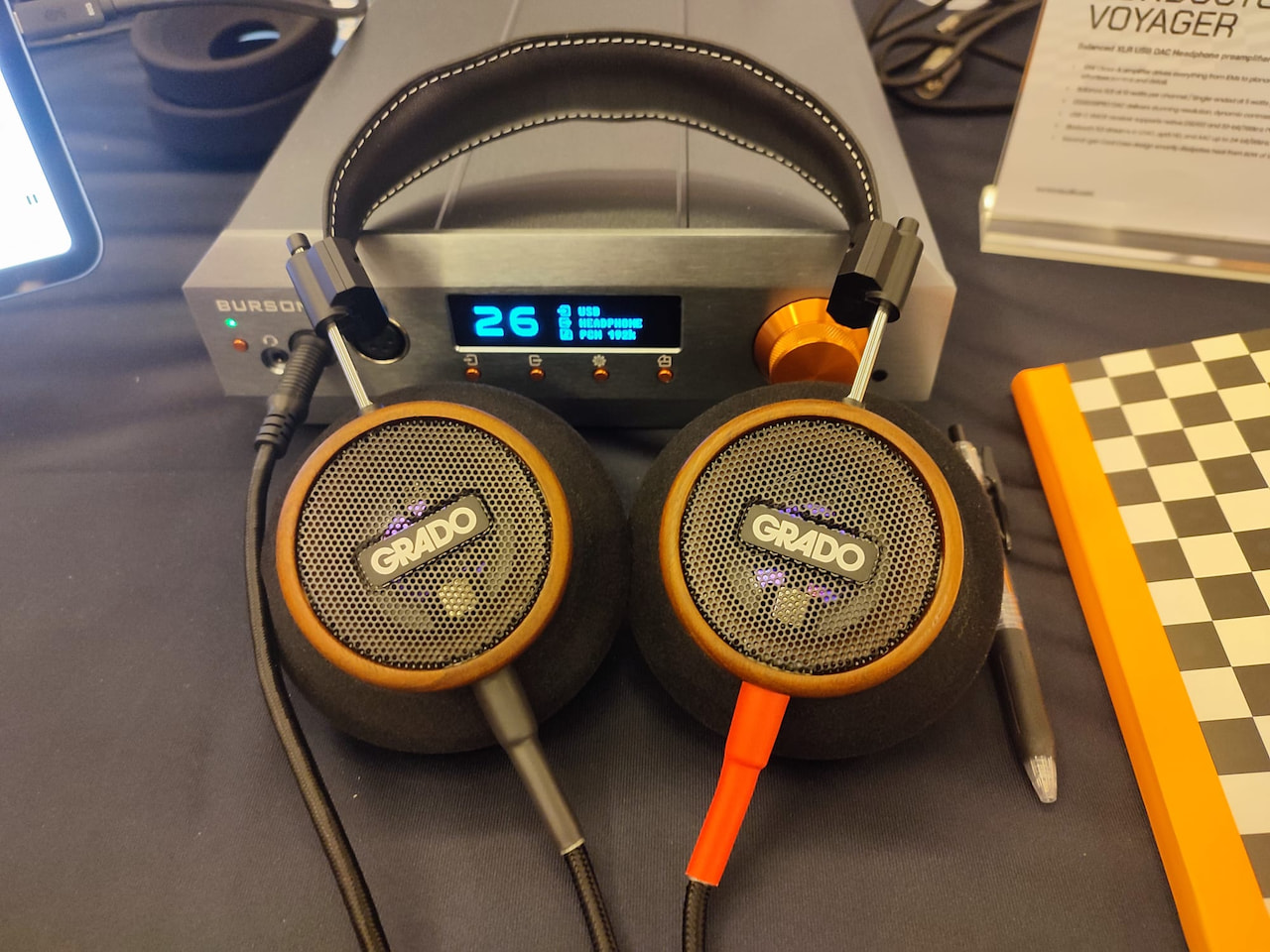
Grado has been rather hit or miss for me in the past. I bought and quickly sold the SR80x because I could not get past its sharp upper midrange, while the HP100 SE proved far more successful, delivering an exciting presentation with beautifully rendered vocals.
The open-back Signature S550 uses Grado’s newly developed 50 mm S2 dynamic driver, with a 38-ohm impedance, 112 dB sensitivity, and a claimed frequency response of 6 Hz to 44 kHz. It weighs 335 grams and includes Grado’s detachable Signature Silver cable, connected through locking four-pin mini-XLR sockets. The S550 ships with the company’s new B cushions but is also compatible with its S, F, L, and G pads, allowing listeners to alter both the fit and sonic presentation.
The $995 S550 firmly lands in the hit column. I have always enjoyed the distinctive appearance of Grado headphones, but what drew me in here was the authoritative bass and excellent dynamic impact. More importantly, it delivered that energy without the overly sharp, grating upper-midrange and treble presentation that has pushed me away from some of the company’s less expensive models.
HiFiMAN HE6 Remastered
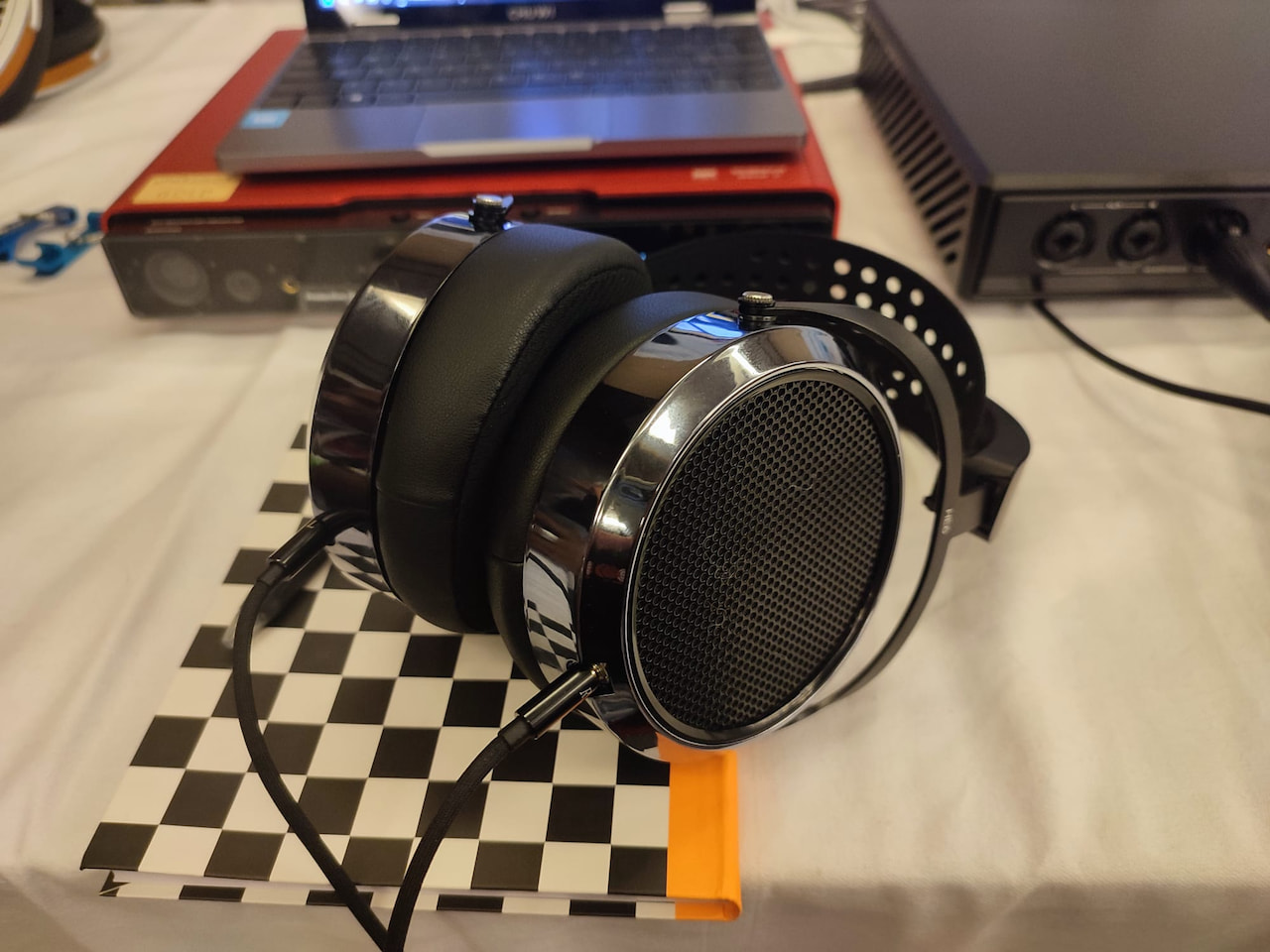
The HiFiMAN HE6 Remastered revives the driver design of the original HE6 while adding the company’s second generation composite headband. This is less a reinvention than an attempt to make one of HiFiMAN’s most celebrated headphones slightly more comfortable and accessible to a new generation of listeners.
The open back planar magnetic headphone retains the original’s brutally inefficient 83.5 dB sensitivity, 50 ohm impedance, and claimed frequency response of 8 Hz to 65 kHz. It weighs 522 grams, which is 28 grams lighter than the original version, but still hardly featherweight.
The original HE6 has achieved near legendary status, so I suspect the $1,899 Remastered will find plenty of willing buyers. For good reason: it remains one of the most impactful and dynamically explosive planar headphones ever produced. Just bear in mind that this is not something you should connect to a phone, laptop, or underpowered dongle DAC. The HE6 Remastered needs a seriously powerful desktop headphone amplifier and will expose anything pretending to be one.
Best in Show
Best Budget Headphones: Hongshu Audio EH-1
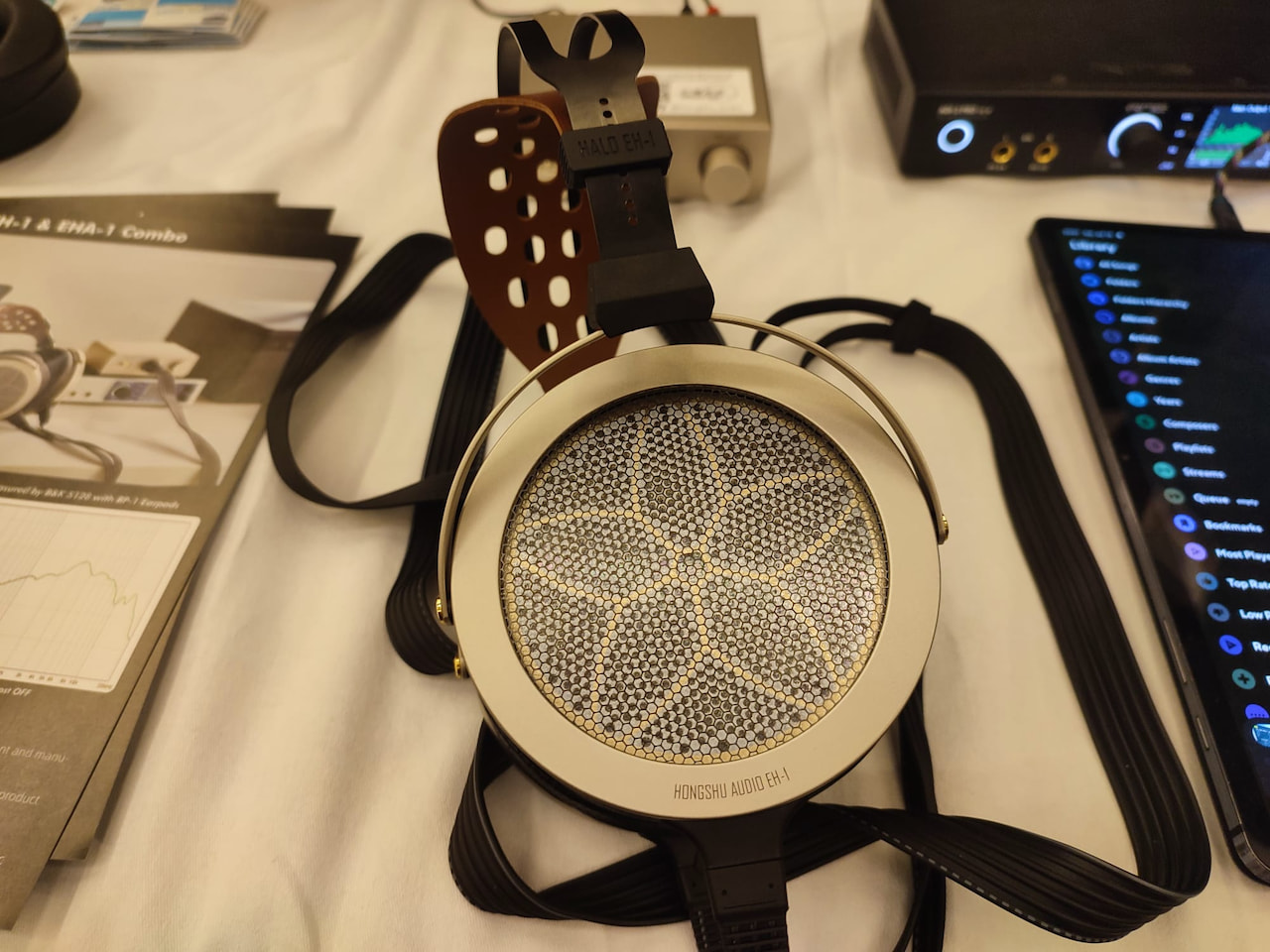
Before anyone reaches for the pitchforks, I know that $649 is hardly cheap. For a complete electrostatic headphone system, however, it qualifies as budget territory, especially because Hongshu Audio includes the dedicated EHA-1 energizer in the price.
The open back EH-1 uses a four inch electrostatic driver, weighs only 295 grams, and is designed around the standard 580 volt bias used by many electrostatic headphones. The compact EHA-1 energizer provides up to 300 Vrms of output, along with a physical channel balance control and a switchable bass boost.
The EH-1 captures the strengths of electrostatic headphones remarkably well, delivering excellent detail, speed, and control across most of the frequency range. Deep subbass rolls off somewhat, which is hardly unusual for the driver type, but Hongshu Audio has also avoided the excessively bright treble that can undermine electrostatic headphones costing several times more.
Listeners looking for greater weight can engage the energizer’s bass boost, which lifts the response from the midbass downward without destroying the headphone’s clarity. At $649 for the complete system, there is very little not to like about the EH-1.
Best Mid-price Headphones: Dan Clark Audio Aeon Core
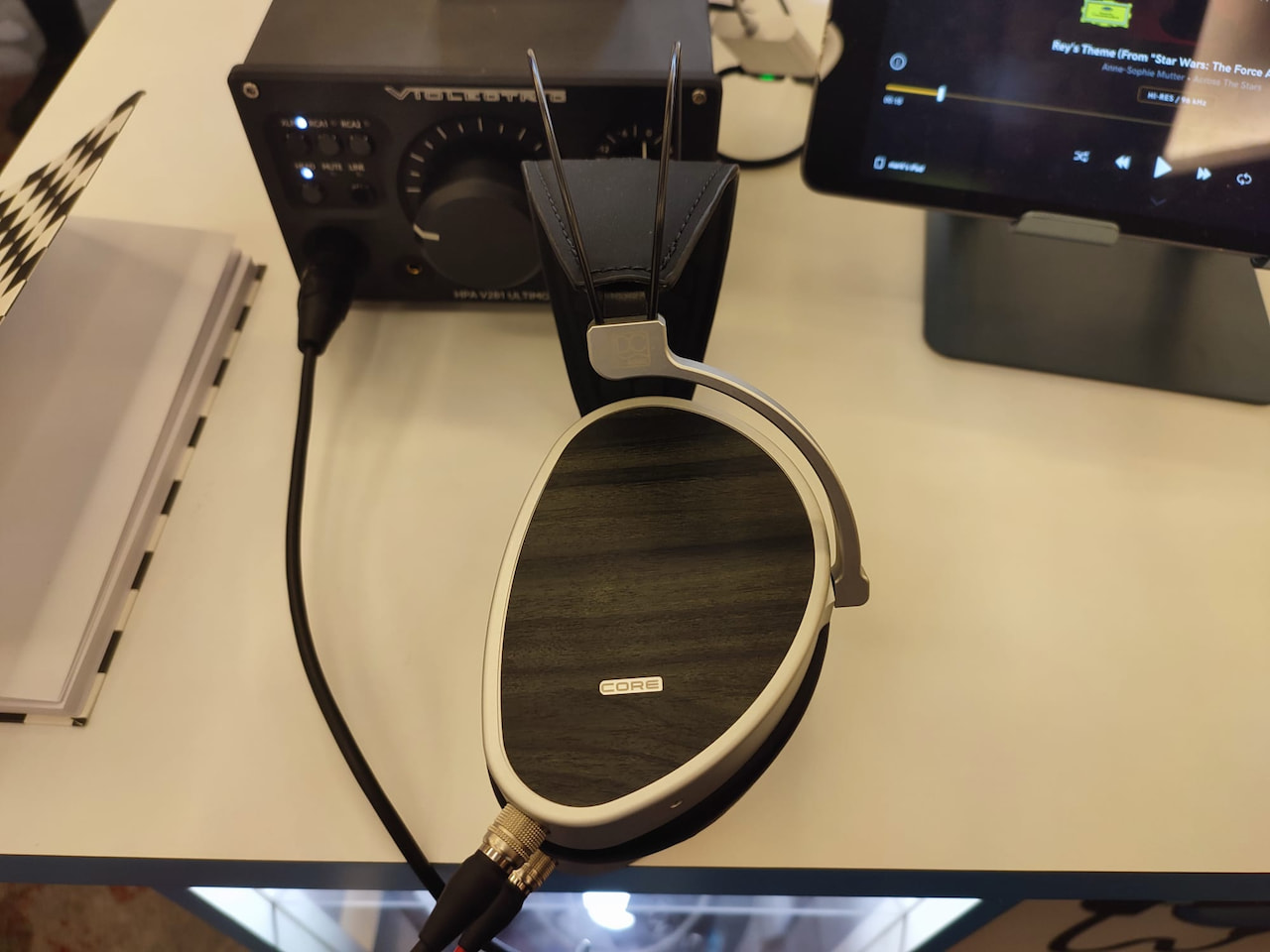
Competition among new wired headphones in the mid-price category, which now seems to hover around $1,000, was surprisingly thin at CanJam London 2026. That should not diminish what Dan Clark Audio achieved with the AEON CORE, however. This was an excellent headphone in its own right.
The closed back AEON CORE is the direct successor to the AEON 2 and uses a new, more efficient planar magnetic driver. It is also the first Dan Clark Audio headphone tuned to a revised Harman over ear target developed through research with Dr. Sean Olive. The design combines aluminum and wood ear cups with the company’s familiar suspension headband and folding frame. It weighs 440 grams, with a 17 ohm impedance and sensitivity of approximately 94 dB/mW.
The AEON CORE was probably the best fitting headphone I tried at the show. Its suspension strap distributed the weight evenly, while the moderately firm clamping pressure and compact ear cups molded comfortably against the sides of my head.
Listening through the Violectric V281 Ultimo certainly did not hurt, but the AEON CORE sounded excellent across the board. Bass was tight and controlled, the midrange remained present and expressive, and the treble added plenty of sparkle without upsetting the overall balance. Everything felt carefully judged without becoming dull, which is a surprisingly difficult trick to pull off.
Best High-End Headphones: Meze Audio ARTA
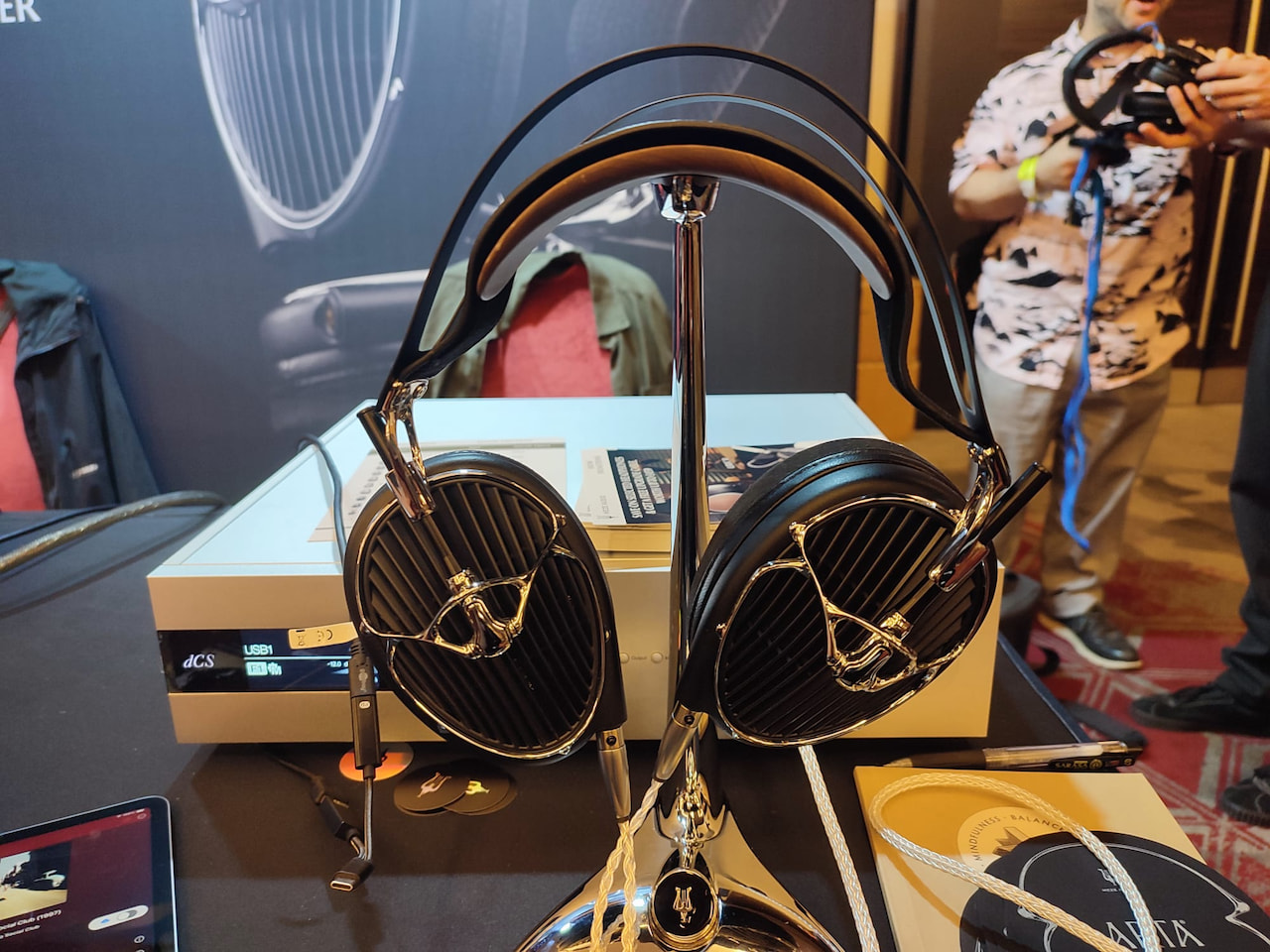
Meze Audio headphones have always looked as though they belong in an art exhibition, and the ARTA continues that tradition. Its meticulously machined components, sculpted metalwork, angled acoustic grille, carbon fiber, and leather come together in an elegant Art Nouveau inspired design that is unmistakably Meze.
The open back ARTA uses Rinaro’s newly developed MZ5 HΩ Isodynamic Hybrid Array planar magnetic driver. Its unusually high 225 ohm impedance is intended to work with higher voltage headphone amplifiers, while the angled acoustic blades behind the driver are designed to reduce internal reflections and improve openness and transient clarity. The ARTA weighs 495 grams and has a claimed frequency response of 3 Hz to 115 kHz. Every major component can also be serviced or replaced, which matters when a headphone costs $6,000.
Some listeners will expect magic at this price, although this hobby has repeatedly demonstrated that a large number on the box guarantees very little. The ARTA, however, delivered deep and beautifully textured bass, along with a remarkably open soundstage that could sound expansive or intimate depending on the recording. Tiny details emerged without requiring me to concentrate or squint into the mix, while its technical precision never came at the expense of emotional engagement.
The Meze Audio ARTA is a display piece that also happens to reproduce music with equal measures of proficiency, scale, and feeling.
Best Wireless Headphones: Noble Audio FoKus Apollo Pro

Noble Audio’s less expensive wireless headphone impressed me more than the flagship FoKus Artemis. The FoKus Apollo Pro, not to be confused with the Sendy Audio headphone bearing the same name, may not look quite as luxurious, but its ANC worked far more effectively on my head and the sound quality was every bit as convincing.
The limited run Apollo Pro combines a 40 mm dynamic driver for the bass with a 14.5 mm planar magnetic driver for the midrange and treble. It also offers hybrid ANC, LDAC, aptX HD, USB C audio, app based EQ, and up to 80 hours of battery life with ANC switched off. Noble has also upgraded the tuning, earpads, headband materials, and overall finish compared with the original Apollo.
It is surprisingly rare to hear a genuinely balanced tonal presentation from wireless headphones, but the FoKus Apollo Pro delivered exactly that. Bass was tight and controlled, the midrange remained clean and present, and the treble offered clarity without becoming sharp. At $699, this was the stronger wireless headphone in Noble Audio’s CanJam London lineup.
The Bottom Line
The fact that I ran out of time before hearing every new headphone at CanJam London 2026 says plenty about the pace of innovation in personal audio.
Some headphones were genuinely exciting, while others were complete disappointments and did not make this report. The real value of CanJam is that specifications, prices, and reputations only tell part of the story. Every pair has the potential to surprise you, for better or worse, the moment you place it over your ears.
That unpredictability is precisely what makes these shows worth attending.
Related Reading:


After selling out the entire stock in 11 minutes in March, the US Mint’s commemorative Steve Jobs coin was briefly back on sale on Thursday.
It still only vaguely looks like Steve Jobs, but it’s intended to be him and to commemorate American innovation. But stop us if you’ve heard this one before, as the coin was released in May 2026.
The US Mint’s listing at the time said that it was a limited pressing, and the release schedule page still says that. It’s conceivable that part of the initial pressing was held back for some reason, but that would be the first time that was done in the American innovation line.

The original US Mint listing from May 2026, showing the coin as a limited edition – image credit: US Mint
Regardless of how it’s happened, it was briefly possible to buy the Steve Jobs commemorative $1 coin. You had to be quick though.
The coins were initially being offered in 25-coin rolls and 100-coin bags. The rolls sold out in around ten minutes, the bags took about 20.
Those rolls were again priced at $61, while the bags are $154.40, both plus shipping. While stocks lasted, the coins were on sale through the US Mint’s online store.
The coins still feature “a young Steve Jobs sitting in front of a quintessentially northern California landscape of oak-covered rolling hills.”
“Captured in a moment of reflection,” continues the US Mint listing, “his posture and expression reflect how this environment inspired his vision to transform complex technology into something as intuitive and organic as nature itself.”
This $1 coin is inscribed with “United States of America,” “California,” and also both “Steve Jobs” and “Make Something Wonderful.” On the opposite side to Jobs, the coin has a stylized Statue of Liberty.
How limited the offer really is
The US Mint did not publicize the number of coins being pressed when they were first released, it only marked the offering as limited. The CoinNews collectors’ site, however, said that a total of 1,233,750 were being produced between the Denver and Philadelphia minting facilities.
If correct, then regardless of whether the new offering represents a second pressing or not, more Steve Jobs coins are being produced than for any previous American Innovation releases. According to Coin Mintages, the program’s previous largest pressing was in 2019 when between Denver and Philadelphia, a total of 952,725 coins were made to commemorate the first US patent.
Clearly, then, the US Mint expected the Steve Jobs coin to sell more than previous ones. It remains correct on that matter, based on how quickly they sold out to the walls the first time and now, how the rolls of them have sold out.
But a greater number of coins, coupled with how the limited release now appears to not have been limited, will reduce the appeal to numismatists.
While any stocks remain, though, it is possible to specify that you want coins from the Denver or Philadelphia pressing plants. According to Coin Week, the Denver press is more precise, while the Philadelphia plant produces coins with more errors than Denver does, which may appeal to a certain type of collector.
We reached out to the US Mint to find out if this is a second pressing, or remnants from the first. A representative from the mint got back to us, and while there was some confusion on if the coins were available or not, they did confirm that there was not nor will there be a second stamping.
However, the coin will be included in the Reverse Proof Set that will go on sale later in 2026, which will be the only remaining unreleased product to feature the coin.
Tech
Microsoft 2.5: New security business chief Hayete Gallot on the company’s push into the agentic era

GeekWire is profiling over the next few weeks some of the people and teams that are shaping the evolution of Microsoft in what we’re calling its “Microsoft 2.5” era.
@media (max-width: 600px) {
.gw-exec-card { padding:18px 18px !important; margin:20px 0 !important; }
.gw-exec-card .gw-exec-media { float:none !important; width:160px !important; margin:0 0 14px 0 !important; }
.gw-exec-card .gw-exec-label { font-size:12px !important; }
.gw-exec-card .gw-exec-name { font-size:22px !important; }
.gw-exec-card .gw-exec-title { font-size:16px !important; margin-bottom:14px !important; }
.gw-exec-card .gw-exec-facts li { margin-bottom:12px !important; }
.gw-exec-card .gw-exec-facts li:last-child { margin-bottom:0 !important; }
.gw-exec-card .gw-exec-value { font-size:15px !important; line-height:1.45 !important; }
}
AI has had an impact on just about every tech-product category, but especially security. Attackers are using AI; customers are looking to defend with AI. The goalposts keep shifting. “Agentic security” is now the holy grail, and Hayete Gallot, the newly minted executive vice president of Microsoft Security, is leading the charge toward it.
Gallot, a 16-plus-year Microsoft veteran who rejoined the company in February after a 1.5-year Google detour, replaced Charlie Bell, who came to Microsoft from AWS in 2021 and continues at the company as an individual contributor focused on engineering quality.
“Customers care about two things: solving for security and being able to afford it,” Gallot said when I asked during our interview this week why she came back to Microsoft.
“I am a problem solver. And an engineer at heart (and by training). Security is the most important problem right now — and Microsoft is the only place with all of the puzzle pieces to help our customers.”
Since her return, Gallot hasn’t been shy about shaking things up. As noted recently by The Information, at least nine corporate vice presidents who previously reported to Bell have left the company this year.
“We’re making changes to ensure we’re in the best formation to go after this opportunity,” she acknowledged.
“I’m motivated by doing the right thing for our customers, my teams, and tech outcomes. I like to move quickly; days and weeks, not months and years, learning through execution, iterating rapidly, and adjusting based on real customer signals.”
The company isn’t starting from scratch. As of 2021, Microsoft claimed security was a $10 billion business for the company. By 2023, security had reached a $20 billion annual revenue rate, officials said.
Those claims haven’t been without controversy. Microsoft has built a huge business in finding and fixing security problems which some customers felt were of the company’s own making.
Microsoft has a wide-ranging and rather unwieldy security portfolio, encompassing identity management (Entra), endpoint protection (Defender), endpoint management (Intune), security information and event management (Sentinel), and compliance (Purview), among others.
In 2023, Microsoft introduced its Security Copilot set of AI analysis services that integrated with some of its existing security offerings. But a portal-based solution like Security Copilot doesn’t offer the kind of end-to-end coverage that an agentic security platform can, Gallot said.
The problem is that attackers are using agents, too. Customers need real-time insight into what’s happening in their environment, and the ability to act just as quickly, Gallot said.
Agentic security is about “taking the signals and turning them into a graph that is useful,” Gallot said. “If you’re trying to reason about 100 trillion signals, it’s not really effective.” The graph, she said, lets agents pick the right model for each threat and close the loop.
In practice, that means the system can quarantine a device or revoke access on its own, for example, rather than waiting for a human.
Microsoft’s core existing security products will continue to play a role as the landscape evolves, both spotting the problems and acting on them. Security Copilot isn’t going away in the process: “You’ll have Copilot and you’ll have agentic security,” she said.
The company’s new Agent 365 “control plane” — a central console for tracking every AI agent a company runs — fits in by letting customers see the “blast radius” of an agent, meaning everything a hijacked agent could reach, Gallot said. It’s similar in concept to Zero Trust, the “never trust, always verify” security model that limited how far an attacker could get with a stolen employee login, but applied now to agents rather than people.
So what exactly is this ‘agentic security’ thing? Microsoft has a whole website dedicated to the very topic.
Traditional AI security and agentic AI security are fundamentally different, Microsoft says. Agentic security doesn’t just protect models and training data; it also can protect tools, workflows, memory, connected systems and more. Because agents can take action, the potential positive and negative stakes are higher.
While AI has helped businesses make strides in finding and fixing vulnerabilities, it hasn’t gone much beyond that. Microsoft introduced its multi-model agentic scanning harness (MDASH) as its first step into the agentic security space, Gallot said.
The company used MDASH internally to boost finding and fixing Windows security issues, and it is now making it available to select customers in an expanded preview. MDASH will allow customers to use the best model for the right task to secure all different types of code bases, she said.
Microsoft is rumored to be readying a more comprehensive agentic security offering, of which MDASH is likely just one piece.
Microsoft is far from the only one doing this. AWS, Anthropic, and OpenAI are offering security tools on their platforms, and dedicated security vendors are building their own agentic platforms.
Microsoft has the advantage of scale in the enterprise. The question is whether Gallot and her new leadership team can turn that scale and emerging AI tools into both a bigger business for the company and better protection for its customers.
With temperatures rising across the planet, air conditioners are less of an option and more of a necessity in many cities. Add to that the increasing frequency and intensity of heat waves, and ACs now have to run for hours continuously during extreme weather.
Effective cooling systems won’t set you back too much, but just because it blows cold air doesn’t automatically make it safe. Despite stringent manufacturing protocols, even buying from the most reliable air conditioner brands doesn’t guarantee a lifetime of safe operation. Technical malfunctions in air conditioners can lead to a variety of concerning problems beyond simple cooling issues, like mold growth, fire, and burn hazards.
Units with more serious, widespread issues undergo recalls and are pulled from circulation. However, people, whether intentionally or unintentionally, might sell these products second-hand at flea markets and online resale platforms. In this article, we discuss five air conditioner models that have been recalled so you can steer clear of them. These models span window ACs, PTACs, and portables. All of these are confirmed Consumer Product Safety Commission (CPSC) recalls, so look out for these models, especially when buying used.
Midea U and U+ Window Air Conditioners
Midea’s U and U+ Window AC line spanned over 40 models and was sold under many brand names, including Frigidaire, Danby, Comfort Aire, and Keystone. The unique U-shaped design of the air conditioner allowed it to sit on the windowsill without eating up the entire frame.
For anyone comparing a window AC and mini split, Midea’s U-shaped lineup has become a popular alternative, running quietly and obstructing less of the window view than standard window units. The models were sold between 2020 and 2025 at major retailers like Home Depot, Costco, and Amazon. They were even rated Wirecutter’s top pick, bolstering their credibility.
This AC model didn’t experience a mechanical failure, but its design didn’t facilitate quick drainage of water, creating conditions ripe for mold growth. There were at least 152 complaints to the company, with a few customers experiencing allergies, sore throats, and full-blown respiratory infections. Midea issued the full recall on June 5, 2025, pulling back around 1.7 million units.
The organization gave customers the option for a free repair or a full or partial refund, depending on the date of purchase. For buyers opting for a repair, Midea would send a technician to install a new drain plug or mail a DIY repair kit. If you’re a current owner or are planning to purchase this air conditioner second-hand, make sure to cross-check its model number on the official Midea U and U+ window AC recall site.
Amana Packaged Terminal Air Conditioners/Heat Pumps with DigiAir
You might not recognize the term PTAC, but you’ve seen air-conditioning units built into or under windows in hotels. Packaged terminal air conditioners are common in hotels and apartments, working independently of a central system to keep your room cool.
Since property owners or managers maintain these units, most guests wouldn’t consider that they’re unsafe. In this case, a huge line of PTACs from Amana had a major engineering flaw that made them an active fire hazard. This line of ACs eventually cost the manufacturer, Daikin Comfort Technologies (DCT), millions. These ACs were sold from May 2015 to January 2023, and they were equipped with DigiAir Modules — systems that bring in outdoor air to dehumidify. However, the compressors in these modules were prone to overheating and posed a fire or burn risk.
Starting in 2017, customers began filing warranty claims, and there were over a dozen fire reports and one injury due to smoke inhalation. Since DCT didn’t report this promptly to the Consumer Product Safety Commission, it was slapped with an $8.5 million civil penalty and required to strengthen its compliance and submit annual compliance reports. Over 62,000 units were recalled in August 2023, and their model numbers start with PMC or PMH. If you’re an owner, visit the Amana PTAC DigiAir recall page to get help disabling the DigiAir compressor and getting a free technician visit.
Royal Sovereign/Royal Centurian Portable Air Conditioners
Easy on the wallet and easier to set up, portable air conditioners are great for targeted cooling. And when temperatures are at their peak, an inexpensive second-hand unit can feel like an oasis in the desert. However, some options shouldn’t be touched even with a 10-foot pole, like the Royal Sovereign (or Royal Centurian) portable air conditioners. Manufactured in China and imported by Royal Sovereign International in New Jersey, the affected lineup had seven models priced around $290. Over 33,000 units were sold from March 2008 to August 2014 at Costco, Amazon.com, Best Buy, and Home Depot.
The issue with these ACs was a defective drain motor that could ignite the unit’s plastic enclosure, posing a major fire and burn hazard. Worse than Daikin’s PTAC case, Royal Sovereign didn’t promptly notify the CPSC and misled it in 2010 by concealing active fire reports and falsely claiming it had discontinued the products. In 2016, a woman died from smoke inhalation and her two children were injured because their portable AC caught fire. The Department of Justice alleges that there were at least 42 fire reports by 2016.
Following a December 2021 recall, Royal Sovereign was fined $8 million in criminal fines and a $16.025 million civil penalty, the maximum authorized by the CPSA. The company, however, shuttered its consumer division and paid only $100,000 of the civil penalty. Current owners must stop using the unit and follow the instructions on the Royal Sovereign portable AC recall page.
Goodman Packaged Terminal Air Conditioners/Heat Pumps (PTACs)
The Goodman PTAC/heat pump recall in March 2018 affected more than 530,000 units in the US and roughly 3,400 in Canada. These units were sold from January 2010 until February 2018 under four brand names — Goodman, Amana, York International, and Energy Knight. Distributed through Goodman Manufacturing’s dealers, these PTACs were commonly installed in hotels, schools, apartments, and commercial spaces, priced from $700 to $1,400.
The firm received nine reports of the units igniting, including one case of smoke inhalation requiring medical attention. The fault stemmed from the unit’s outdoor fan motor overheating, turning into a fire and burn hazard. Although this crisis was triggered by a design flaw, high temperatures can damage systems, making it important to identify warning signs that extreme heat is killing your AC.
To correct the issue, Goodman sent consumers free repair kits, authorized technician support, and reached out directly to commercial owners to arrange free repairs. However, the safety hazard continued despite the 2018 recall because PTAC Crew and PTAC USA refurbished and resold some of these units, which were then recalled in 2021.
This failure wasn’t an isolated incident for the brand. Back in 2016, Goodman had already paid a $5.55 million penalty for failing to properly inform the CPSC about a different PTAC model’s power-cord fire hazard and for understating fire incidents. The official Goodman PTAC and heat pump recall page has more information regarding the 2018 recall models.
Amana Window-Room-Air-Conditioners and Through-the-Wall ACs/Heat Pumps
The previous options in this list were spread across the past few years, but the Amana Window-Room-Air-Conditioners (WRAC) and Through-the-Wall (TTW) ACs and heat pumps were recalled just weeks ago on June 25, 2026. It was right at the start of the heatwave that’s impacting hundreds of millions of people, when demand for reliable air conditioning is especially high.
These ACs, ranging from $850 to $1,500, were sold from April to December in 2025 via HVAC dealers and direct sales. The affected units have model numbers starting with AE, AH, and PB, and they’re commonly installed in apartments, hotels, and commercial spaces. The safety concern with these models was that the heating element would remain active even after the device was turned off — nothing like the common problems with air conditioners. If an electrical fault occurred, the device would become a fire and burn hazard.
Over 13,000 units have been recalled, and as of July 2026, the company has reported a single case of plastic melting on the unit, but no injuries. Unfortunately, there’s no scope for repairing these models, and DCT has asked customers to stop using them immediately. Users are eligible for a full refund once they’ve shared an image of the AC with its cord cut and its serial number with DCT. You can find more information regarding these steps on the official Amana TTW & WRAC recall page.
Nearly 20 years ago (!), in 2007, I published my first and only book: Microsoft 2.0. It focused on changes I expected at the company in the “Post-Gates” era. What would remain the same and what likely would be different once co-founder and CEO Bill Gates had left the building?
CEO Satya Nadella has not exited the company (yet). But there’s no question that Microsoft and its mission have morphed considerably in the past year or two. I’m not quite ready to christen this the Microsoft 3.0 era, even though Nadella handed the reins of Microsoft’s dominant commercial business to Judson Althoff nearly a year ago.
That decision resulted in Nadella moving into more of a “founder mode” role, allowing him to focus less on the day-to-day work of running the business. (Microsoft historians may recall that Gates made a somewhat similar move back in 2000 when he became Microsoft’s chief software architect.)
While it might not yet be time for Microsoft 3.0, we arguably could be in the “Microsoft 2.5” era. Windows and Office are still around and still play a big role. Microsoft still builds and sells developer tools and databases. But there’s no question that the cloud and all things AI are at the top of the pecking order now.
I’m embarking on a series here at GeekWire that will focus on what matters to Microsoft and, by extension, to its customers, partners, investors, and employees these days. Who are some of the people shaping and leading the company? What are their opportunities and challenges right now?
Over the next few weeks, I will be profiling various Microsoft execs working on plans for Microsoft’s ongoing evolution. Some are company veterans; some are newcomers. I’ll be talking with top execs from Microsoft’s Security, Copilot, Windows + Devices, Xbox, GitHub, and more.
I’m interested in their strategies for Microsoft’s key products and technologies and how they plan to try to turn Microsoft’s ambitious vision into reality. What are their teams building? What do they see as their biggest challenges and opportunities? And where do they see the technologies in their respective areas heading?
I feel like many of us who’ve been keeping track of the biggest tech companies (myself included) have fallen into the trap of blaming or attributing everything a company does to AI. Layoffs? AI is the culprit. Price increases? It’s all thanks to AI. Changing sales strategies? Chalk it up to AI …
But upon further reflection, I believe Microsoft’s strategy is more nuanced than “AI or bust.” There’s no question that Microsoft’s AI ambitions are shaping its goals and tactics. But Microsoft, as a heavily enterprise-focused entity, can’t simply stop supporting products that aren’t built from the ground up with AI (as much as it might like to do so). Nor can it just leave behind customers who aren’t 100% onboard with its AI moves.
Couple those enterprise hurdles with some not-so-popular consumer decisions, like axing 3,200 people in the gaming unit, and Microsoft’s approach to turning the ship looks a lot trickier.
Our Microsoft 2.5 series kicks off Thursday. Stay tuned.

Before you ship your college kid back to campus, you might consider the quality of water coming out of their dorm or apartment taps. In partnership with ZeroWater, Culligan has released the first-ever ranking of US college towns based on tap water quality, grading the largest college towns in each state on a scale of A to F for lead and PFAS (“forever chemicals”). The timing is notable with back-to-school season approaching and water quality a growing concern for college-aged adults.

The Best Water Filter Pitchers, Tested by CNET
This year’s incoming class is shaping up to be the most health-conscious yet — nearly 30% of Gen Z and Millennials surveyed say wellness matters more to them now than it did a year ago.
Results suggest most college towns have work to do
PFAS concerns: Roughly one-third of towns scored a “C” or worse on PFAS contamination.
Widespread water contamination: Nearly all college towns evaluated by Culligan — 92% — showed at least one harmful contaminant in their water supply. New York City was the sole town to receive an “F” for lead levels.
Alarming lead levels: Just 8 of the 50 college towns had water quality meeting EPA lead standards.

College towns with the best water (Overall)
- Albuquerque, NM — University of New Mexico
- Blacksburg, VA — Virginia Tech
- Boise, ID — Boise State
- Durham, NH — University of New Hampshire
- Morgantown, WV — West Virginia University
College towns with the worst water (Overall)
- Columbia, SC — University of South Carolina
- Tempe, AZ — Arizona State
- Newark, DE — University of Delaware
- New York City, NY — NYU
- New Brunswick, NJ — Rutgers
See the full list here.
Why it matters
Nearly 30% of Gen Z and millennials noted that wellness matters more to them this year than last, including water quality. The ranking gives incoming students a simple way to check what’s really coming out of the tap in their new college town and decide if some form of filtration is necessary.
Why testing is important

CNET spoke to a water-quality expert while testing countertop filters earlier this year. Dr. Eric Roy explained that the most harmful contaminants, including lead and PFAS, rarely affect the taste or smell of water, underscoring the importance of having your local water tested, especially if it comes from a well. TapScore is one of the leading at-home water quality services with lab testing for around $299.
Testing methodology
Culligan ZeroWater analyzed public water quality data for the largest university’s water system in each state (per 2024 IPEDS enrollment data), grading lead levels against the EPA’s 10 ppb action threshold and five PFAS chemicals (PFOS, PFOA, PFHxS, PFNA, GenX) against UCMR5 monitoring data collected from 2023 to 2025.



Jensen Huang travelled to Monterey this week to give the US Navy a machine that most defence contractors would have had to sell it.
Nvidia’s founder helped commission a DGX GB300 AI supercomputer at the Naval Postgraduate School, the first system of its kind installed anywhere in the American military, and the company donated it rather than route it through a procurement contract.
The hardware is a single liquid-cooled rack that packs 72 Blackwell Ultra GPUs alongside 36 Grace CPUs, wired together as one memory domain and running Nvidia’s Mission Control orchestration software.
It is the rack-scale configuration Nvidia sells for inference and reasoning workloads, and by the standards of the DGX line it is the top of the range. NPS now runs what is, for the moment, the most powerful supercomputer the Pentagon has.
One estimate put the value of the system at roughly $15m, though neither Nvidia nor the school confirmed a figure publicly.
The donation went to the Naval Postgraduate School Foundation rather than through a defence procurement contract, a route that sidesteps the usual competitive-bid machinery.
DDN, VAST Data, and Vertiv supplied the storage, data infrastructure, and cooling wrapped around the rack.
NPS is the Navy’s graduate research university, and the machine is meant for teaching and research rather than live operations.
Faculty and students plan to point it at weather prediction, ocean modelling, cybersecurity, and disaster-response planning, and to build maritime digital twins through Nvidia’s Omniverse platform.
The school also wants to train its own foundation models, including an internal system it is reportedly calling NPS GPT for handling sensitive data.
The rack lands on a campus that stood up a dedicated AI research centre the previous year, so the compute arrives with somewhere to go.
The pull is partly in the resolution. Owen has described being able to forecast conditions for very localised operations rather than working from the coarse grids, roughly 50km across, that most models settle for.
For a Navy that plans amphibious landings and small-boat movements around weather it cannot control, tighter prediction is not an abstraction.
“The question is not whether these technologies will exist,” said Captain Michael Owen, the school’s vice provost for warfare studies.
“The question is whether future military leaders understand them well enough to evaluate their limitations, apply them ethically and employ them responsibly.”
That framing matters, because unlike the Department of Defense’s existing supercomputing centres, which run operational workloads, the NPS system is pitched at research and innovation.
The idea is to let the school refine the models that the wider joint force might one day depend on, rather than to fold the rack into day-to-day command.
Huang, who attended the commissioning alongside Admiral Samuel Paparo, the head of US Pacific Command, described AI as a coming “backbone of America’s defense.”
It is not an entirely neutral observation from the man whose company now supplies much of that backbone.
The event caps an arrangement that started quietly in December 2024, when NPS and Nvidia signed a cooperative research and development agreement.
The Pentagon’s appetite for Nvidia silicon has grown conspicuously over the past year, and the company has spent much of that time selling similar systems to national governments.
The Monterey donation lands the hardware inside a military institution for the first time, which is a different kind of foothold.
A school full of serving officers is also, in effect, a training ground for the customers who will one day write the requirements.
Paparo told the audience that officers would increasingly command in settings where response times compress and advantage goes to whoever can act faster than an adversary.
Vice Admiral Ann Rondeau, the school’s president, put the pitch more plainly. “Education remains our greatest strategic advantage,” she said.
Whether a rack of GPUs counts as education or as infrastructure is, for now, a question the Navy seems content to leave open.


The arrival of Samsung’s latest crop of foldable flagship and ultra-flagship devices came with a $100 price increase across the board. My reaction, perversely, was relief that the figure wasn’t higher, given how badly the AI bubble has severed the link between component pricing and value. My relief isn’t just for the wallets of my fellow consumers, but the health of the industry overall.
If you’ve been keeping an eye on the rumor mill, you’re expecting to see every major handset maker follow Samsung’s lead. Google is thought to be adding at least $100 onto the price of the new Pixel handsets. That wouldn’t be ideal, but if you care enough about getting a brand new phone and can afford it, it won’t be the end of the world. Especially if it’s split across the length of your contract, burying the bad news across the next 12 or 24 months.
Meanwhile, Apple’s outgoing CEO Tim Cook has already laid the groundwork for iPhones to get more expensive, too. Not long after uncharacteristically saying the company couldn’t hold prices at their current level, it bumped up the prices on almost all of its product lines. It doesn’t take a genius to know that similar rises will be applied to the new iPhones when they launch this fall.
There’s a wild theory that Apple is going to split the launch of the iPhones 18 in two as part of this price strategy. It proposes that the (rumored) ultra-flagship iPhone Fold will debut alongside the more lucrative Pro models, with their higher price and higher markup, in the fall. Only after the holiday buying season would the regular iPhone 18 make its debut, perhaps alongside an even more “affordable” iPhone 18e.
The industry-wide price rises have certainly been tough to swallow, and it’s clear it’s made a lot of people reconsider purchases. It’s not as if this is limited to the technology industry, either, as the US Department of Labor says the price of energy has risen by 15.7 percent in the last 12 months.
As budgets get stretched, it’s clear people are hoping to make do with what they’ve got.
There’s already hints that the rises are having a chilling effect. In May 2026, Valve withdrew the entry-level Steam Deck, which was priced at $399. The mid-range and premium tier models, meanwhile, saw their prices rise from $549 and $649 to $789 and $949, respectively. A BoilingSteam report believes the price increases caused sales of the popular gaming handheld to drop by a whopping 82 percent.
Similarly, 9to5Mac polled its readers on how the price rises would affect their behavior, with 38 percent saying they would hold onto their hardware for longer. Industry analysts IDC believe the rises will cause a hefty drop in sales across the rest of the year and across 2027. Similarly, it says the smartphone industry should expect to see a “record low” as the memory crunch bites.
So while a $100 price increase certainly isn’t the gift we’d all like to see, it could have been a hell of a lot worse. It may just shake out that the monthly cost of all these phones, which was already more than some people would be willing to pay, is even more out of reach.
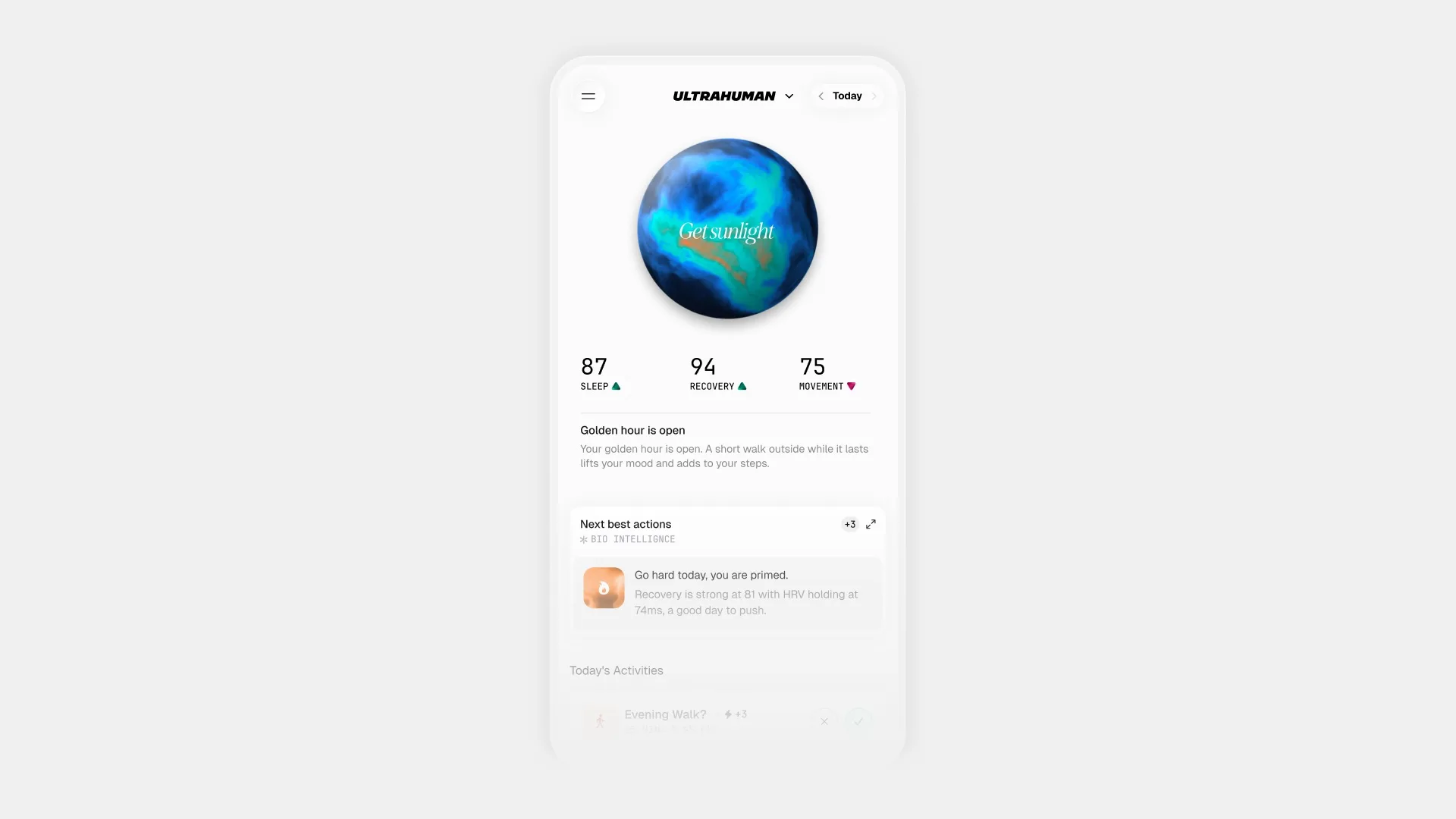
Ultrahuman is rolling out Emerald today, its biggest platform update in four years. If you own an Ultrahuman Ring Air, Ring Pro, or any of its other health devices, your app is about to look and feel very different.
What is UltraSphere, and why does it matter?
The big update is the UltraSphere, a decision engine Ultrahuman claims is a first for a smart ring. Instead of throwing another chart at you, it sits front and center on the home screen and hands out more than 60 Next Best Actions based on your sleep, recovery, HRV, stress, movement, and even glucose data if you use the M1 or M2 CGM.
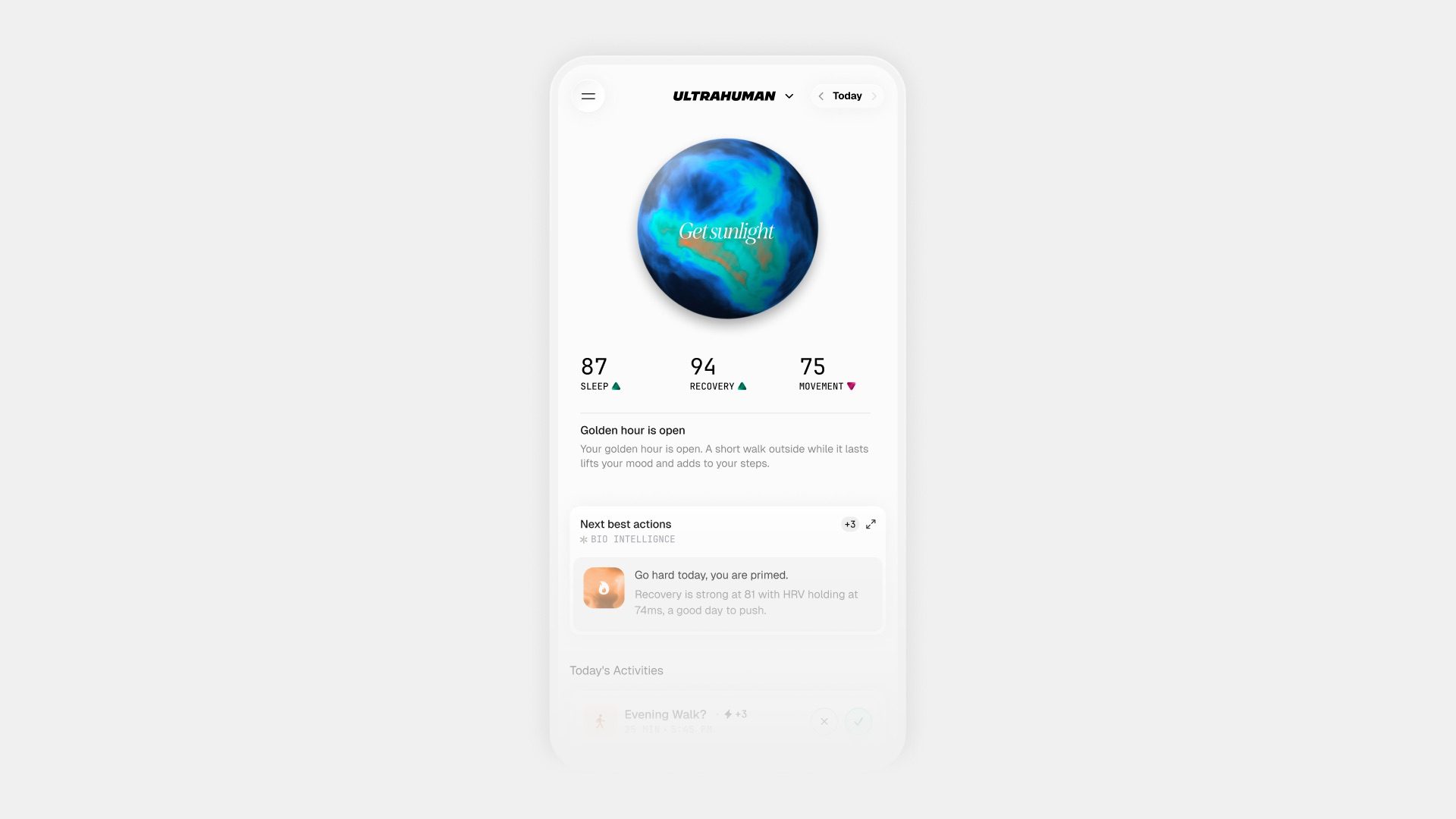
These suggestions change depending on where you are, the weather, and your circadian rhythm, so a jet-lagged traveler and a new parent will not get the same advice. Examples Ultrahuman shared include a nudge to step outside soon after waking to reset your body clock, or a heads-up that caffeine past a certain point will mess with your sleep later.

Mohit Kumar, CEO of Ultrahuman, explained the thinking behind the shift. “All wearable trackers generate data. Data is empowering, but people need something more than a number, they want to know what to do. The Emerald Update is focused on making data actionable, adding layers of biointelligence that finally answer the question of so what with context and insight at every layer.”
What else changes with this update?
Ultrahuman is also adding an essential feature for frequent flyers and anyone stuck without signal. It can now process everything on the device, so your recovery score, stress rhythm, and Next Best Actions keep working with zero connectivity.
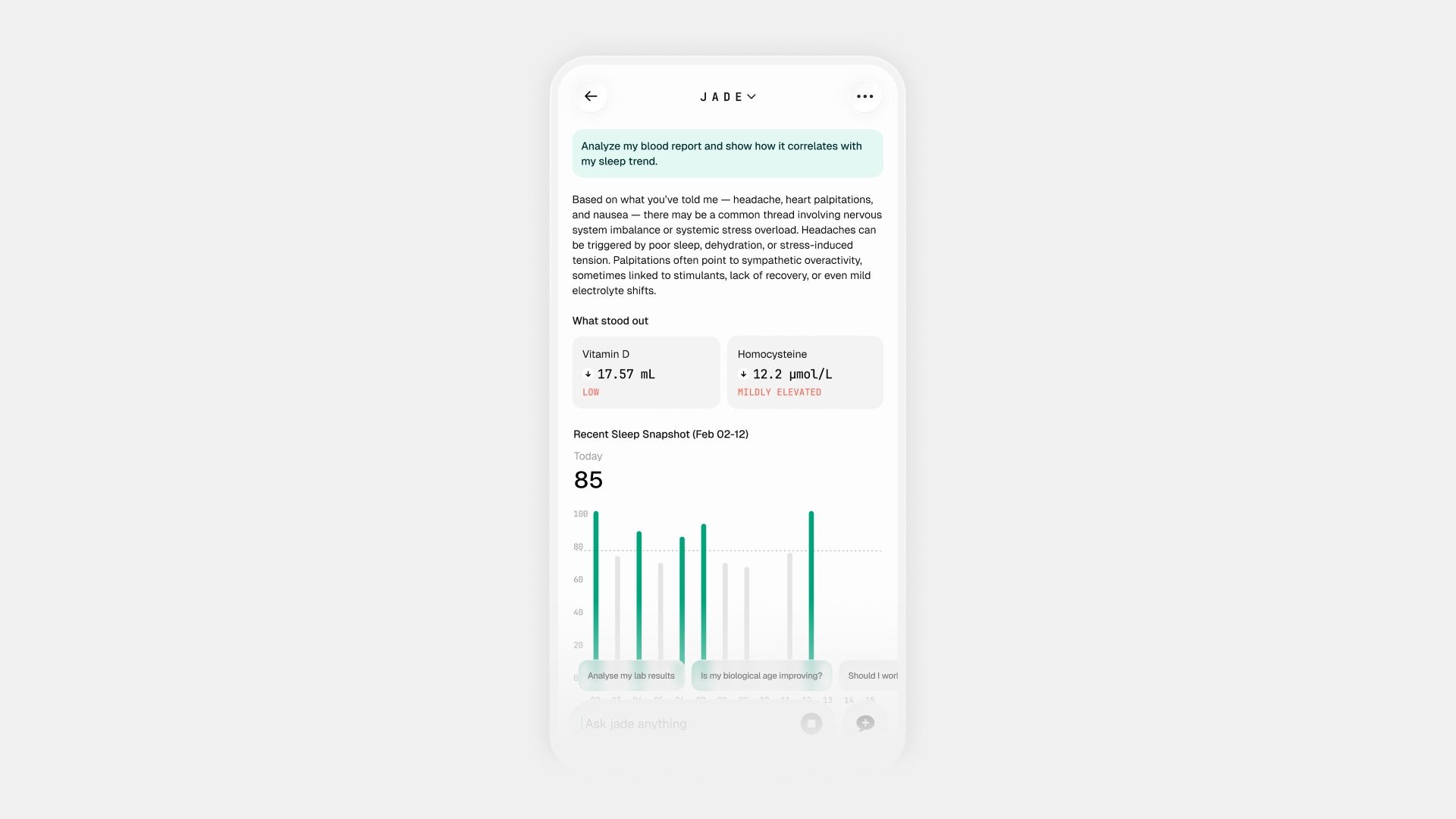
Workout tracking also gets an upgrade, with better automatic detection and heart rate accuracy validated against gold standard devices. If you prefer an Apple Watch, Garmin, WHOOP, or even AirPods Pro Gen 3 for workouts, you can now pair that data directly into the app instead of relying on the ring alone.
VO2 Max, one of the best predictors of long-term health, also got smarter. Ultrahuman says its updated algorithm lands within 5 mL per kg per min of real lab results, tested across more than 100 athletes.

There is plenty more packed in too, including a new Longevity tab for markers like UltraAge and Brain Age, a Sleep Screener that bundles your nightly signals into one report, and the option to finally share cycle and ovulation data with a partner.
Should you update?
The Emerald update is rolling out globally starting today, so there is really no reason to skip it. What I like most is that none of this costs extra. It’s a free update, and it genuinely makes the whole experience feel better.

Alphabet went into its second-quarter results on Wednesday carrying one question louder than the rest: whether the tens of billions it is funnelling into AI infrastructure has started to earn its keep. Judged by the after-hours share price, the answer was not yet.
The company reported revenue of $119.8bn for the three months to June, up 24% from $96.4bn a year earlier and comfortably ahead of forecasts.
Google Cloud did the heavy lifting, with revenue climbing 82% to $24.8bn, operating income more than tripling to $8.8bn, and its margin widening to about 36%. Group operating margin edged up to 34% from 32%.
That extends a streak that had Alphabet closing in on Nvidia as the world’s most valuable company, and it slots into a Big Tech capex cycle now running past $650bn a year. Cloud backlog, the contracted work Google has yet to book, rose to $514bn from $490bn.
Going in, the pressure was explicit. Bloomberg framed the quarter as a test of whether the spending pays off, and Alphabet was hardly alone in facing it, with investors weighing the same question at Tesla and across the rest of the Magnificent Seven the same week.

The 💜 of EU tech
The latest rumblings from the EU tech scene, a story from our wise ol’ founder Boris, and some questionable AI art. It’s free, every week, in your inbox. Sign up now!
The spending, not the growth, is what rattled them. Alphabet lifted its full-year capital-expenditure guidance to as much as $205bn, up from a prior range of $180bn to $190bn, and said quarterly capex had roughly doubled from a year earlier to $44.9bn.
Even $205bn does not cover it. Alphabet said it would keep expanding rented, third-party capacity as a bridge while its own data centres come online, a measure of how quickly demand is outrunning what it can build.
The bill pushed free cash flow to negative $5.9bn, the first quarterly outflow in nearly two decades.
Shares fell about 5% in extended trading despite the revenue beat, part of a now-familiar rhythm this earnings season of clean beats undone by capex lines that land heavier than expected.
The scale is the story. Alphabet is on course to spend more on capital investment in a single year than it books in net income over a comparable stretch, funding the build largely from a search and advertising business growing far more slowly. Analysts have started asking when, exactly, that gap closes.
The backlog is the counterargument the bulls reach for. A book of $514bn in contracted, not-yet-recognised revenue suggests the capacity being built already has buyers waiting; the bearish read is that it is a promise Alphabet still has to fund and deliver while the meter runs.
What both sides agree on is that the answer hinges on cloud becoming self-sustaining before the capex wave crests.
The headline profit figure did not settle the argument. Net income came in at $112.1bn, close to quadruple a year earlier, but roughly $98bn of that was an unrealised paper gain on Alphabet’s stake in SpaceX. Strip it out and the underlying number looks a good deal more ordinary.
The core ad engine held. Search revenue rose 17% to $63.3bn and YouTube advertising 13% to $11.1bn, while the Gemini app reached 950 million monthly active users and Alphabet’s first-party model APIs processed some 22 billion tokens a minute.
Sundar Pichai said AI features in Search were driving incremental queries while still sending billions of clicks to websites each week, and that AI Mode had passed 1 billion monthly users.
To pay for the build, Alphabet has already leaned on a record $85bn equity raise and a debut yen bond. CFO Anat Ashkenazi told investors no further equity offerings were planned beyond a $40bn at-the-market programme starting this quarter.
For all the noise, the results left open the one question they were meant to answer. The AI spending is clearly producing growth.
When it begins paying for itself, and how much more Alphabet is willing to spend while it waits to find out, is still unresolved.
Tech
Samsung’s $2,100 Galaxy Z Fold8 Ultra Phone Asks for More Money, But the Bigger Screens and Cameras Make a Strong Case
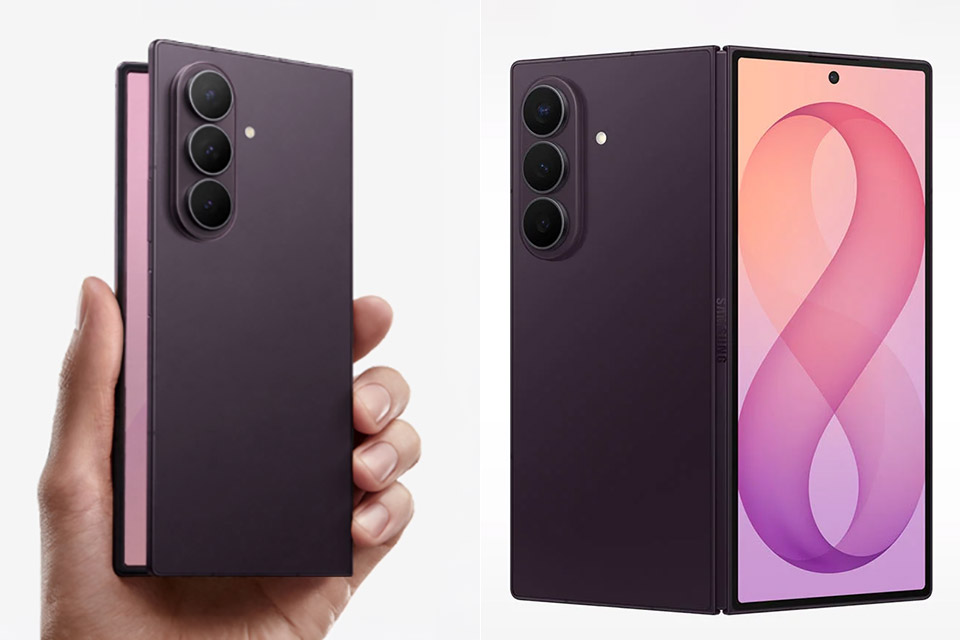
Samsung now sells two book-style foldables side by side. The regular Galaxy Z Fold8 starts at $1,899.99. The Z Fold8 Ultra opens at $2,099.99 for the 256GB model and climbs to $2,699.99 for 1TB. That $200 jump lands the Ultra in rare air for a phone that still has to fold in half. The question is simple: does the extra money buy enough to matter?
Unfolded, the Ultra is only 4.1 millimetres thick and weighs roughly 215 grams, making it one of the thinnest and lightest foldables Samsung has ever created for a pocket. Underneath the large display is a dual-layer titanium structure, and the hinge is also made of titanium alloy, as it’s surprisingly difficult to spot the crease nowadays. The whole thing has an IP48 rating, which should be good for being submerged in 1.5 meters of fresh water for half an hour. When folded, it’s somewhat taller and thinner than the standard Fold8, so it’s not as pocket-friendly, but it’s still a good fit.

Samsung Galaxy Z Fold8 Ultra Phone + $350 Gift Card, 512GB, Violet Shadow
- PRE-ORDER NOW: Get an Amazon gift card when you pre-order Samsung Galaxy Z Fold8 Ultra. You will receive an email once your gift card is available…
- SPLIT THE VIEW. MULTITASK¹ TO THE MAX: Productivity never felt this powerful. Use up to three apps¹ at once on the expansive inner screen of Galaxy…
- MULTITASKING MADE SMARTER WITH AI: Stay one step ahead with AI² that suggests which apps you might need next. Then view those multiple windows side…
The outside and inner screens have both expanded in size, with the cover display now measuring 6.5 inches of FHD+ Dynamic AMOLED 2X goodness, and the main panel expanding to a full 8 inches of QXGA+ when the phone is opened. Peak brightness is increased to 3,000 nits, and there’s an anti-reflection coating to keep things from becoming too shiny on the larger surface. There’s also an Adaptive 120Hz refresh rate, which helps keep things smooth whether you’re using the phone one-handed or treating it like a tiny tablet. The difference between viewing a video and running things side by side is rather noticeable.
The Ultra has also received a significant camera upgrade. The main sensor is a 200-megapixel beast with an f/1.7 lens, and there’s Quad Pixel autofocus for extra sharpness. You can also achieve a nice 2x optical-quality cut that retains sharpness. But that’s not all; in addition to the primary sensor, there’s a 50-megapixel ultrawide with an enhanced f/1.9 aperture for capturing more light, as well as a separate 10-megapixel telephoto picture that finally provides genuine 3x optical zoom. To make things even more intriguing, the main and ultrawide cameras can also shoot 8K video. When you add Nightography and the ProVisual Engine to help with low-light shots, as well as Super Steady to keep your handheld videos from being too shaky, it’s evident that the Ultra is in a class by itself when it comes to camera performance. You can’t help but make comparisons to the S26 Ultra, and to be honest, the difference is now less than it has ever been on a foldable. The normal Fold8, on the other hand, only has two 50-megapixel cameras and no optical telephoto. Zoom and detail are obviously going to be more of an issue with that one.
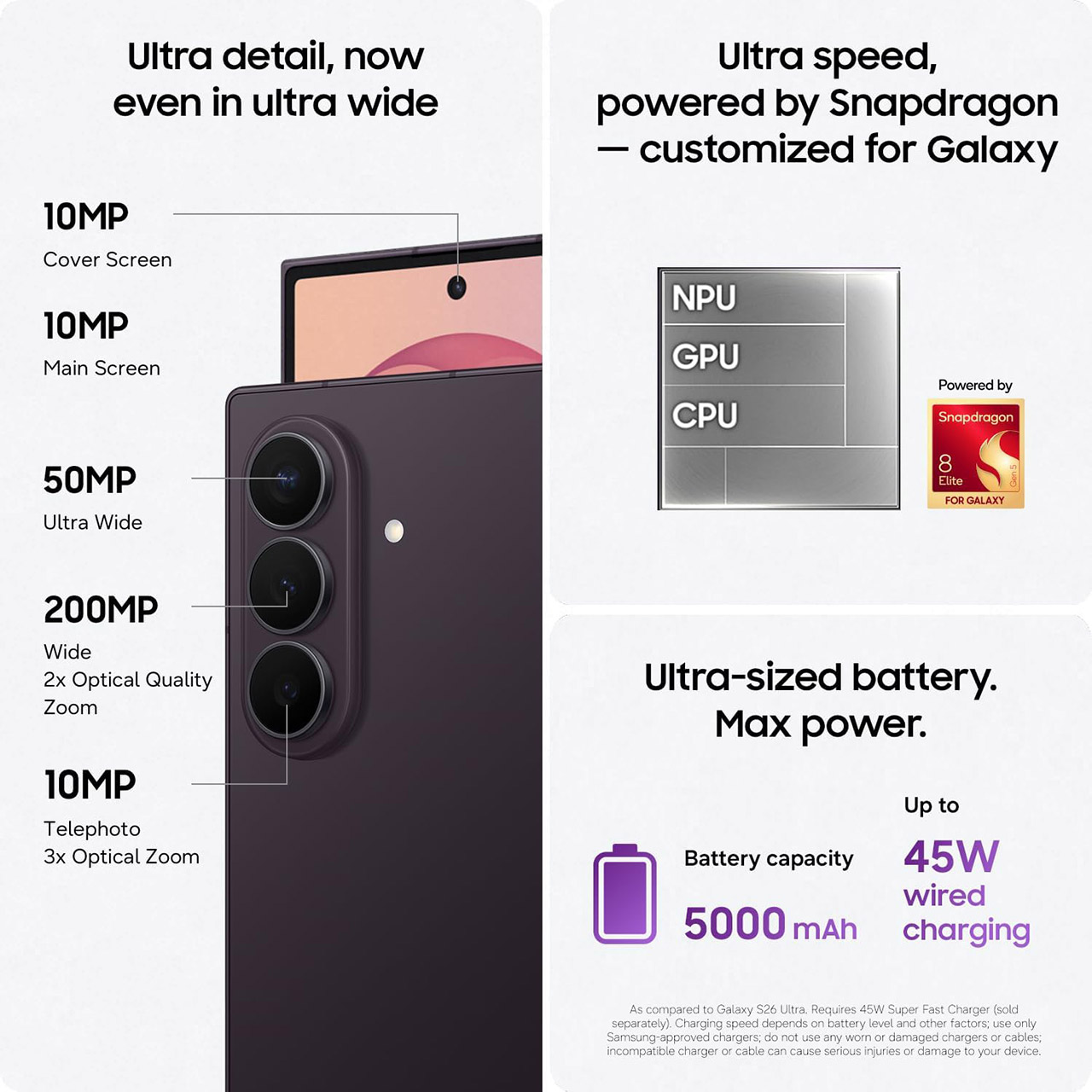
Inside the Ultra, you’ll find the same dependable Snapdragon 8 Elite Gen 5 chip, which has been optimized to maximize Galaxy phone performance. You can get it with 256GB or 512GB of storage and 12GB of RAM, or if you want to go all out, 1TB of storage and 16GB of RAM. The battery has finally expanded to 5,000 mAh, making it the largest Samsung has ever put in a Fold, and it claims up to 27 hours of video playback. There’s also charging, 45W wired charging should charge your battery to two-thirds capacity in under an hour.
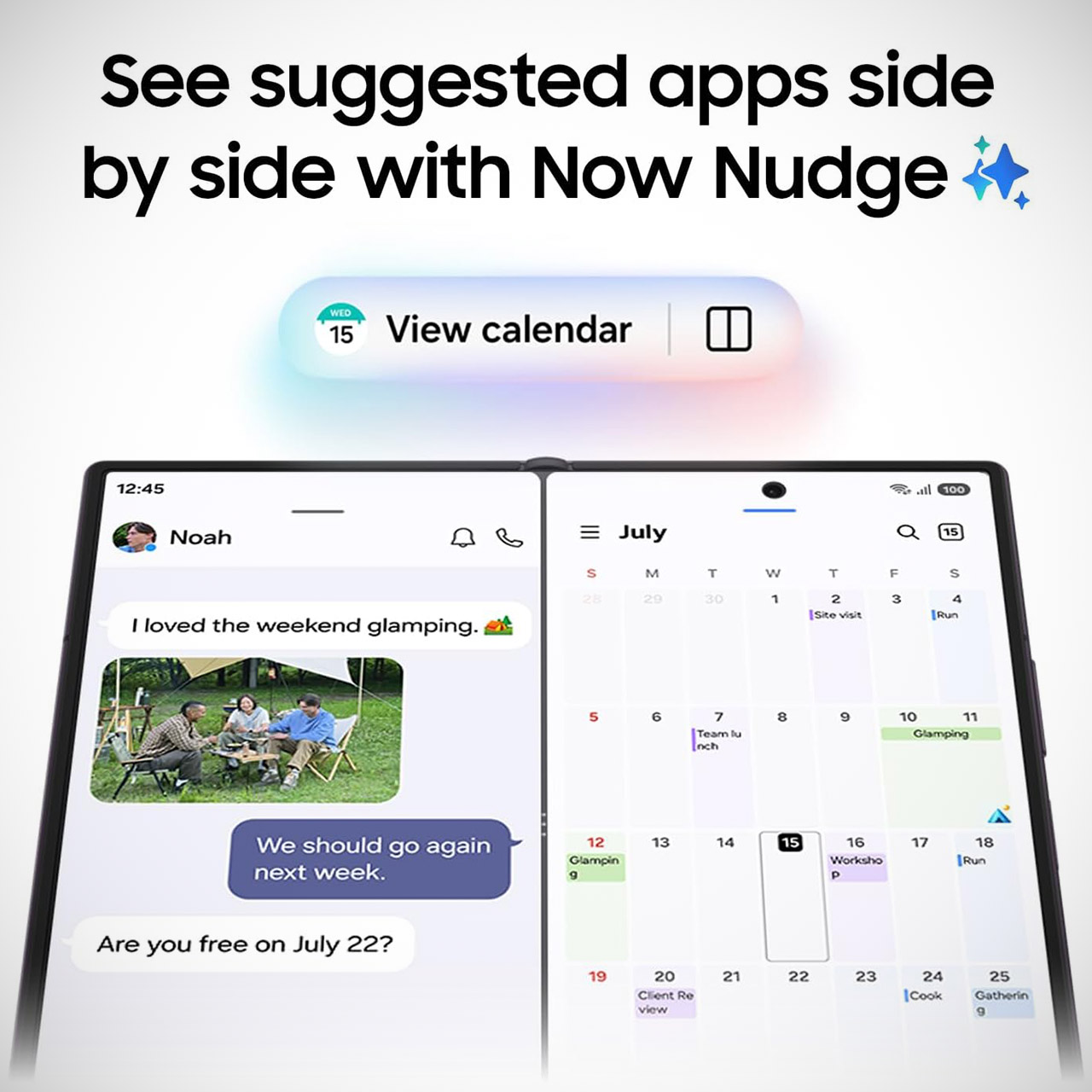
Software includes the whole new One UI 9, which puts a comprehensive set of Galaxy AI tools at your fingertips. The Nudge tool just observes what you’re doing and makes excellent ideas for using split screen in a way that suits you. My FanCam can lock onto a subject and reframe the video on the fly, all without you having to move a finger. With Photo Assist, you can simply type a text prompt and move, remove, or expand items; it’s that simple. Many of these capabilities are also available on the standard Fold8, but having more screen real estate on the larger version helps them feel more natural, especially when you have numerous windows open.
[Source]

Ryanair passengers say ‘I love it’ as method shared to avoid the ‘awful’ seats

The Odyssey boosts IMAX ticket sales and revenue

Goldman Sachs splits from banking lobby over the CLARITY Act


-

 Fashion6 days ago
Weekend Open Thread – Corporette.com
-
 NewsBeat7 days ago
London Mayor Sadiq Khan handed a peerage by Keir Starmer alongside 15 other Labour figures… just days before the PM leaves No10
-

 Politics5 days ago
The House | The City of London can help the new chancellor deliver growth in every postcode
-

 Crypto World5 days ago
Ripple Payments Joins MiCA With 14 Firms, Does It Mean Anything For XRP?
-
 Crypto World6 days ago
Two July Windows Left: The CLARITY Act’s Senate Fight and What Failure Means
-

 Politics4 days ago
Democrats look to World Cup watch parties to register thousands of voters
-

 Crypto World6 days ago
Ripple wins EU-wide access as ESMA adds it to MiCA register
-

 Crypto World2 days ago
Grayscale Files For Worldcoin ETF, WLD Registers Sharp Rise
-

 NewsBeat3 days ago
Unregistered fitter used Gas Safe logo on business flyers
-

 Tech3 days ago
Sail Virtually Aboard The “Itanic” With IA-64 Emulator
-

 Crypto World7 days ago
Injective Submits SEC Transfer-Agent Registration to Onchain Ownership Records
-
 Tech3 days ago
Turtle Beach Command Series KB7 review: a nifty screen-equipped gaming keyboard
-

 NewsBeat6 days ago
Registration is now open for March for Men with Kev 2026
-
 Business1 day ago
New Jersey voter registration controversy explained: How 6,600 noncitizens got on the rolls, and what happens next
-

 Crypto World7 days ago
Claude Fable 5 Slips to Second in AI Coding Leaderboard
-

 News Videos6 days ago
Money | Class 12 Economics | CBSE Board Exam 2026-27
-

 Business7 days ago
Banco Bilbao Vizcaya Argentaria, S.A. (BBVA) Discusses Global Macro Environment and Economic Outlook for Core Markets Transcript
-

 Crypto World5 days ago
Kaspersky exposes OkoBot’s 20-module crypto wallet attack
-

 News Videos4 days ago
Big Money Is Entering XRP
-

 Business6 days ago
Airlines warn Sunshine Protection Act could disrupt flight scheduling
You must be logged in to post a comment Login