

Crypto World
BitGo and OTC Markets to Enable Tokenized Securities for Brokers


BitGo and OTC Markets Group have announced a proposed partnership aimed at bringing digital asset trading and custody capabilities into the broker-dealer workflow used in US over-the-counter markets. The plan is designed to let broker-dealers leverage the same electronic infrastructure for quoting, trading, and settling “digital asset securities” that they already use for conventional OTC and US equity activity.
According to the companies, the alliance would initially serve more than 150 broker-dealers connected to OTC Link ATS, an SEC-regulated alternative trading system. If the framework is implemented, participating firms would be able to route tokenized securities through familiar market channels—while BitGo would handle custody and settlement functions within the proposed operating model.
Key takeaways
- BitGo and OTC Markets Group plan to integrate digital asset securities into OTC Link ATS, allowing broker-dealers to use established trading and settlement infrastructure.
- BitGo Bank & Trust is intended to act as the qualified custodian, with settlement facilitated through BitGo’s Go Network.
- The initial scope is digital asset securities, with room for expansion toward tokenized assets and commodities as relevant regulatory guidance evolves.
- The announcement arrives amid accelerating industry focus on tokenized real-world assets and growing regulatory efforts to clarify rules for digital assets in the US.
- OTC Markets Group shares rose about 2.7% to roughly $53.50 by midday Wednesday, reflecting market attention on the proposal.
A bridge between crypto infrastructure and broker-dealer rails
The core idea behind the BitGo–OTC Markets Group proposal is operational fit. Broker-dealers already operate under mature securities market rules and processes; according to the companies, the partnership would connect digital asset securities to the electronic trading ecosystem broker-dealers use today.
OTC Markets Group operates OTC Link ATS, an alternative trading system regulated by the US Securities and Exchange Commission. Under the plan, broker-dealers using that venue would be able to quote and execute trades in digital asset securities using the same general infrastructure environment already in place for OTC and US equity trading and settlement.
For investors and market participants, that approach matters because it targets one of the most common friction points in institutional crypto adoption: integration complexity. Instead of requiring broker-dealers to move entirely to “crypto-native” systems, the framework aims to plug tokenized securities functionality into established brokerage workflows—potentially lowering onboarding costs and reducing the scope of operational change.
How the custody and settlement model would work
The companies outlined a two-part operational structure. Under the proposal, BitGo Bank & Trust would serve as the qualified custodian. Settlement, meanwhile, would be handled through BitGo’s Go Network.
The partnership’s initial intent is focused on digital asset securities, but the companies also indicated the framework could be expanded to support tokenized assets and commodities as regulatory frameworks develop. That conditional language is important: while tokenization is a rapidly progressing theme, the specific asset classes and the precise regulatory pathway can vary materially depending on how regulators treat different instruments.
BitGo’s role as a qualified custodian is reinforced by its recent US banking milestone. In December, BitGo received final approval from the US Office of the Comptroller of the Currency to operate as a federally chartered national trust bank. That approval positions the firm to provide qualified custody services under federal banking oversight—an element that may be attractive to broker-dealers and other institutional participants seeking clearer custody governance.
Why broker-dealers are central to tokenization’s next phase
Broker-dealers could become a major conduit for tokenized securities because they sit at the intersection of regulation, market access, and capital formation. The BitGo–OTC Markets Group plan effectively tries to transform tokenization from a largely experimental pipeline into something more compatible with existing market plumbing.
The rationale aligns with broader market forecasts. Bernstein analysts have projected that the value of tokenized real-world assets could reach up to $4 trillion by 2030, citing expansion across equities, commodities, and other financial assets. Earlier coverage from Cointelegraph also highlighted how tokenization efforts are increasingly tied to exchange and broker distribution networks.
That context matters because tokenization is not just about issuing tokens—it’s also about where they can be traded and settled. The BitGo–OTC Markets Group proposal suggests a pathway to move tokenized instruments into venues where broker-dealers already operate, rather than relying solely on separate systems.
It also follows similar initiatives aimed at bringing tokenization closer to mainstream capital markets. Cointelegraph previously reported on efforts by companies such as Securitize and Cantor Fitzgerald to pursue tokenized IPOs and follow-on equity offerings, pointing to an industry push to adapt tokenization to established issuance and trading channels.
What to watch: implementation details and regulatory compatibility
While the announcement outlines an operating framework, the most significant uncertainties for market participants are whether and how quickly the partnership can move from proposal to execution, and what the operational scope will be at each stage. The companies’ statement that the approach is “initially intended” to support digital asset securities implies a phased rollout tied to asset-class readiness and regulatory clarity.
Investors and broker-dealers watching this story should focus on three practical questions: how OTC Link ATS would be configured for tokenized securities, what operational requirements are placed on participating broker-dealers, and how BitGo’s custody and settlement services are integrated for actual trade flows. The answers will determine whether tokenized securities become meaningfully accessible through existing institutional pathways—or remain a limited pilot concept.
For now, the proposal reinforces a broader shift in the industry: tokenization is moving from isolated experimentation toward integration with regulated market infrastructure, where broker-dealer connectivity could be a decisive factor in scaling adoption.

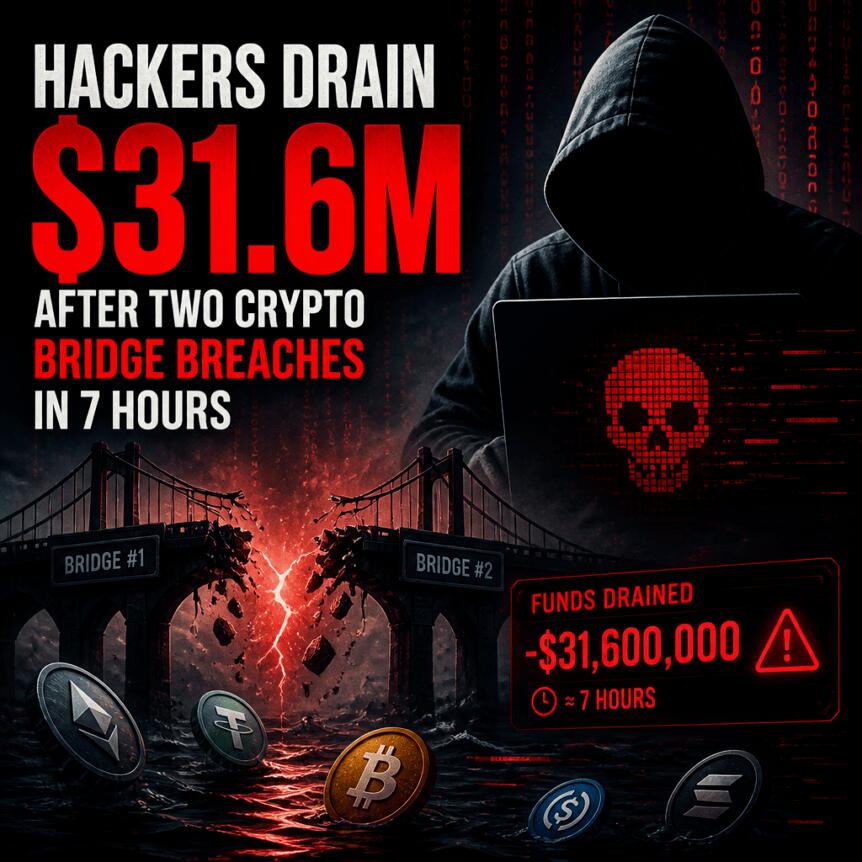
Cross-chain security issues remain a major pain point for crypto markets, after investigators reported two separate bridge-related exploits occurring only hours apart. According to on-chain analytics firm Blockaid, the combined theft totaled more than $31.6 million, with funds taken from bridge infrastructure used by decentralized perpetual exchange AFX and the Verus Ethereum Bridge.
Blockaid said AFX’s bridge lost $24.15 million on Wednesday, before another attack targeting the Verus Ethereum Bridge resulted in roughly $7.5 million drained from bridge reserves. The back-to-back incidents underscore how bridge operators—and the protocols that integrate them—can be exposed even when exploits are not tied to a single chain-level weakness.
Key takeaways
- Blockaid reported losses of $24.15 million from an AFX-operated bridge on Arbitrum and about $7.5 million drained from the Verus Ethereum Bridge within hours.
- Offchain Labs co-founder Stephen Goldfeder said Arbitrum’s native bridge was not hacked, pointing to activity originating from a third-party protocol.
- Security researchers suggested the AFX incident may have involved compromised keys rather than a smart contract logic flaw.
- Blockaid said the Verus exploit appears to mirror a prior May incident, using a similar method while involving a different attacker wallet.
- Both cases highlight that bridges remain high-value targets because they custody large asset pools and move value across ecosystems.
AFX bridge exploit on Arbitrum: what was targeted
Blockaid said it detected an exploit at 9:30 pm UTC aimed at a bridge operated by AFX, a decentralized perpetual exchange running on Arbitrum. The investigation framed the event as a bridge compromise affecting a third-party integration rather than a breach of Arbitrum’s core bridging infrastructure.
According to Offchain Labs co-founder Stephen Goldfeder, a bridge hack report circulating online had impacted a transaction originating from a third-party protocol, and that the Arbitrum native bridge itself had not been exploited. Goldfeder stated that the transaction in question originated from another protocol and emphasized that Arbitrum’s native bridge “has not been hacked or exploited in any way.”
Additional analysis from SunSec, the founder of the DeFi security community DeFiHackLabs and a contributor to SEAL, suggested that the evidence pointed more toward compromised keys than toward a vulnerability in smart contract logic. While that distinction matters for incident response—key compromise typically demands urgent credential rotation and broader access review—it also signals that the weakest point may not always be the bridge contracts themselves.
Cointelegraph sought comment from AFX regarding the reported exploit, but the additional reporting available here centers on what Blockaid and affiliated investigators observed during the incident.
Verus Ethereum Bridge attack: a similar method to May
In a separate incident, Blockaid reported an exploit targeting the Verus Ethereum Bridge that drained approximately $7.5 million across multiple assets held in bridge reserves. The listed tokens included Ether (ETH), tBTC, USDC, USDt, EURC, MKR, and scrvUSD.
Blockaid said the attack method appears similar to a previous Verus Ethereum Bridge incident reported in May, which resulted in the theft of $11.58 million. In that earlier case, Blockaid said the same overall approach was used, but by a different attacker wallet.
According to Blockaid, the attacker used the bridge “import path” to trigger “unbacked Ethereum-side payouts.” In practical terms, this points to a workflow-level weakness: attackers may be able to induce the bridge to release assets on one side of the system without corresponding backing on the other side, creating a direct path to reserve depletion.
For users and integrators, the repeated nature of the tactic raises a persistent risk: even when teams patch one vulnerability, the operational mechanics of how imports and payouts are handled can remain exploitable if the underlying assumptions aren’t fully addressed.
Why bridge failures keep recurring
Bridge exploits are difficult to eliminate entirely because cross-chain infrastructure often combines multiple components: custody of assets, message passing or import/export mechanisms, and permissioning for triggering settlement flows. When attackers find a seam between those elements—whether through compromised credentials, incorrect authorization, or weaknesses in how cross-chain states are validated—the result is frequently rapid draining of funds.
On-chain investigator TheCrypticWolf summarized the broader issue in a post on X, arguing that bridges remain a weak link until “security is upgraded.” While that statement reflects a general view rather than new incident-specific evidence, the two reported attacks within the same day give it concrete support: high-value bridge reserves make the system attractive, and high complexity makes comprehensive hardening challenging.
There is also an important asymmetry across the two incidents. Blockaid’s reporting on the AFX case was paired with Goldfeder’s clarification that Arbitrum’s native bridge was not compromised, suggesting the problem lay in third-party integration or bridge controls tied to a particular protocol. In contrast, Blockaid’s description of the Verus incident emphasizes how the bridge import mechanism can lead to Ethereum-side payouts that are not properly backed—an issue that may relate more directly to settlement logic and state assumptions.
What to watch next for affected ecosystems
Bridge-related incidents typically lead to emergency measures such as pause controls, increased monitoring, and changes to custody or authorization workflows. Readers should watch for follow-up disclosures from AFX and the Verus ecosystem, especially around what Blockaid and other investigators determine about root cause—whether it’s key compromise, an authorization failure, or a repeatable weakness in import/export settlement.
More broadly, these events reinforce that cross-chain exposure isn’t limited to the bridge operators alone: decentralized applications and traders relying on bridges for liquidity and settlement should treat bridge security as a continuously evolving risk, not a one-time checkbox.
Crypto World
SEC Agrees to Overhaul Recordkeeping After Settling Coinbase Lawsuit Over Gensler’s Lost Texts

The US Securities and Exchange Commission went on a blatant war against the cryptocurrency industry in the past couple of years of Gary Gensler’s tenure, especially following the loud collapse of FTX.
However, the new administration settled most cases, and now it was time for one that was actually initiated by Coinbase. It came with some groundbreaking changes as well.
From Defendant to Plaintiff
The legal disputes between the two parties began in 2023 when the regulator went after the largest US-based crypto exchange. However, the roles reversed a year later when Coinbase, through its research firm History Associates, sued the watchdog after the latter denied requests for internal communications related to its approach to crypto regulation.
The Brian Armstrong-led firm argued that the requested records could shed some light on how the SEC developed its enforcement strategy against crypto companies during the Biden administration, including legal theories underpinning several high-profile lawsuits. Recall that the SEC had sued industry giants like Binance, Ripple, and many others.
The agency has now settled with Coinbase in the Freedom of Information Act (FOIA) lawsuit and has agreed to pay $150,000 in attorney fees, release two previously withheld documents, and review its policies governing the presentation of text messages and other electronic communications.
The settlement was announced in an opinion piece by Coinbase Chief Legal Officer Paul Grewal, who said it marked an important victory for government transparency. However, there’s no official confirmation from the SEC as of press time.
Why It Matters
Under Gensler’s leadership, the agency imposed billions of dollars in penalties on banks and financial institutions for failing to preserve employee communications conducted through texts and other unofficial channels. Coinbase, on the other hand, argued that the regulator should be held to the same standards it had enforced against the private sector.
The legal dispute intensified after the SEC disclosed that certain texts involving Gensler and other senior officials had been automatically deleted, making them unavailable for production under the FOIA requests.
Although the settlement does not confirm any wrongdoing by the SEC, it requires the watchdog to review its record-retention procedures, which is believed to be particularly groundbreaking for a regulator whose own rules emphasize preserving official communications.
The post SEC Agrees to Overhaul Recordkeeping After Settling Coinbase Lawsuit Over Gensler’s Lost Texts appeared first on CryptoPotato.


Circle has signed separate memorandums of understanding with Kakao Group and South Korean fintech operator Toss to explore stablecoin payments, blockchain settlement and digital asset infrastructure in South Korea.
Summary
- Circle signed agreements with Kakao Group and Toss to explore stablecoin payment infrastructure in Korea.
- Kakao plans to assess KRW stablecoins, remittances and merchant settlement using Circle’s blockchain payment technology.
- Toss will explore USDC-based services, digital wallets and programmable payments while regulations continue developing nationwide.
The agreements bring Circle’s USDC and payment technology into discussions with some of Korea’s largest consumer finance platforms. Kakao, Kakao Pay and Kakao Bank will study opportunities around KRW-based digital assets, cross-border payments and tokenized financial services. Toss and Toss Bank will examine similar uses, including digital wallets, overseas payments and programmable onchain transactions.
Kakao Group said its agreement with Circle will combine the KakaoTalk-centered platform ecosystem with Kakao Pay’s payment services, Kakao Bank’s banking capabilities and Circle’s blockchain infrastructure. The companies plan to review payment, settlement and digital asset connectivity as South Korea develops rules for stablecoins and other tokenized financial products.
The initial work will focus on faster payment and settlement systems, according to local reporting. The companies will also assess cross-border remittances, merchant settlement and links between blockchain networks and existing financial systems. Kakao Group said the infrastructure could eventually support services from other Korean companies, although the MOU does not set a launch date or confirm a specific stablecoin issuance model.
Kakao Pay CEO Shin Won-keun, who leads the group’s stablecoin task force, said the companies would “preemptively prepare a Korean digital asset ecosystem with Circle.” Circle executives met Kakao representatives in Pangyo on July 22 before the partnership was announced.
Toss explores USDC and programmable payments
Circle also signed a separate MOU with Viva Republica, the operator of Toss, and Toss Bank. The companies will study blockchain-based payments and stablecoin infrastructure, with potential uses covering digital wallets, cross-border settlement and financial services that use USDC.
Toss will review biometric payment tools, USDC-linked financial products and programmable onchain payments. Toss Bank will focus on connecting stablecoin infrastructure with traditional bank accounts and fiat payment networks. The parties also plan to examine compliance, risk management, security and anti-money laundering requirements as Korean rules develop.
The agreement builds on Toss’s broader interest in digital assets. As crypto.news previously reported, the fintech has explored a proprietary blockchain and a possible token while preparing for a Korean stablecoin market. Toss Bank has also been studying blockchain-based payment and settlement models.
Circle expands its South Korea strategy
The new agreements follow months of outreach by Circle in South Korea. As crypto.news reported on July 13, the company planned its Current Seoul event to bring banks, exchanges, payment firms and super-app operators together for talks on digital asset regulation and payments. Kakao Pay CEO Shin Won-keun was among the scheduled speakers.
Circle CEO Jeremy Allaire also visited Seoul in April and met executives from Korean banks, exchanges and payment companies. He said Circle did not plan to issue its own won stablecoin. Instead, the company has positioned USDC and its infrastructure as possible links between future KRW-denominated tokens and global payment networks.
That approach is visible in the latest agreements. Circle is not announcing a KRW stablecoin with Kakao or Toss. The companies are studying how local won-based digital assets could work alongside USDC, blockchain settlement systems and existing financial infrastructure.
Any commercial launch will depend on the final product design and regulatory approvals. Circle Chief Commercial Officer Kash Rajaghi said Korea has “a solid foundation for financial innovation.”
Korean firms prepare for stablecoin rules
South Korean technology and financial groups have increased work on won-based stablecoins as policymakers prepare a broader legal framework. Kakao Bank has already explored stablecoin development, while Kakao Pay has been building a wider group strategy around KRW-linked digital assets.
Kakao Group said its Circle partnership could support a shared foundation for stablecoin services beyond its own platforms. The group is also reviewing tokenized financial services, which could use stablecoins as a settlement layer when assets move between blockchain networks and traditional financial systems.
Circle has taken a similar infrastructure-led approach elsewhere in Asia.The company recently partnered with Japan’s JCB to test USDC for corporate treasury transfers and merchant payments. The Korean agreements extend that regional strategy into platforms with large domestic payment and banking networks.
For now, both partnerships remain exploratory. Kakao Group, Toss and Circle have not announced a launch date for a KRW stablecoin or a live consumer payment product. Their agreements instead create a framework to test business models, technical connections and regulatory requirements as South Korea’s digital asset rules take shape.
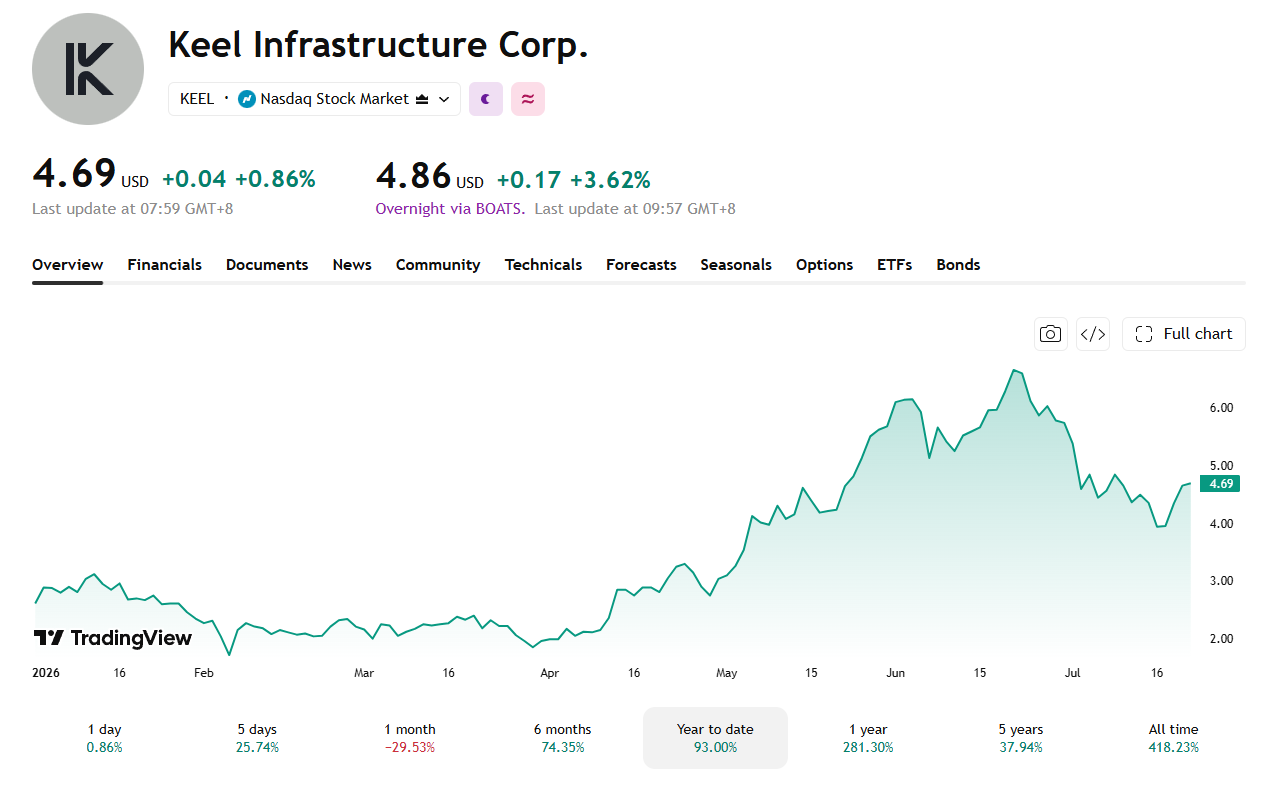
Jim Cramer used his July 22 Mad Money episode to point investors toward Keel Infrastructure (KEEL), a former Bitcoin miner turned AI data center developer. He cited a hedge fund’s expanding stake as the reason to pay attention.
What Cramer Flagged
Cramer highlighted Situational Awareness LP, the fund run by AI researcher Leopold Aschenbrenner, as a notable KEEL holder. Regulatory filings show the fund grew its position by 188% in the first quarter of 2026. It now holds nearly 20 million shares, up from roughly 6.9 million.
Fresh analyst coverage backs up the timing. BTIG initiated KEEL at Buy on July 22 with an $8 price target. That implies roughly 72% upside from the stock’s $4.65 close. The firm pointed to Keel’s power portfolio as the key asset. It also noted that hyperscalers and AI enterprise customers have signed around 10 colocation contracts totaling roughly 2 gigawatts across the sector this year.
The Company Behind the Ticker
Keel Infrastructure is the rebranded successor to Bitfarms. The company completed its shift from Canadian Bitcoin miner to Delaware-based AI infrastructure developer in April. It now controls a 2.2 gigawatt power pipeline across Pennsylvania, Washington, and Quebec. But it still hasn’t landed its first hyperscale colocation contract, the catalyst BTIG and other analysts are watching for.
Keel also carries a debt-to-equity ratio above 140% and negative free cash flow. Execution risk stays real even as the power pipeline draws bullish coverage. The stock’s 52-week range, from $0.98 to $7.37, shows just how sharply sentiment swings on AI infrastructure names that are still waiting on a signed customer.

Should Investors Trust Cramer’s Read
Cramer’s Keel comments follow a rougher stretch for his other tech calls. BeInCrypto has tracked the Inverse Cramer pattern through this earnings season, including Intel’s slide hours after Cramer named it his favorite stock. That history gives KEEL bulls a reason for caution alongside the bullish signal.
Still, the Situational Awareness stake predates Cramer’s endorsement by more than a quarter. And BTIG’s target reflects a specific catalyst analysts are tracking, not blanket enthusiasm for the crypto-to-AI pivot trade.
That trade has also produced disappointments, including American Bitcoin’s post-IPO stagnation.
Whether Keel signs a hyperscaler deal will decide which read on this one ages better, not Cramer’s airtime.
The post Jim Cramer Eyes Ex-Bitcoin Miner’s AI Power Pivot as Hedge Fund Bets Big appeared first on BeInCrypto.


Anthony Scaramucci says the Clarity Act’s new ban on federal officials sponsoring crypto doesn’t go far enough. The SkyBridge Capital founder argues the same ethics logic should extend to insider trading across the board, not just digital assets.
Speaking on CNBC, Scaramucci pointed to Congress’s own pay structure as the root problem.
The Pelosi Problem
Members of Congress earn $180,000 a year, a salary Scaramucci says pushes some toward trading on information they gather in office. His proposed fix borrows from Singapore, where officials draw multimillion-dollar salaries in exchange for stricter ethics enforcement.
Scaramucci’s argument leans on a data point that’s hard to ignore. Public trading records show former House Speaker Nancy Pelosi’s portfolio, managed by her husband Paul Pelosi, has consistently beaten both the S&P 500 and Warren Buffett’s Berkshire Hathaway.
Her 2024 disclosures showed a 70.9% gain against the index’s 24.9% return, and cumulative figures since 2014 put her total returns thousands of percentage points ahead of the benchmark. Rep. Anna Paulina Luna has previously accused Pelosi of trading on nonpublic information, though Pelosi has not been charged with any wrongdoing.
A Familiar Playbook
Scaramucci also referenced a past attempt to weaken congressional trading oversight, saying lawmakers once rolled back a transparency measure through a procedural vote designed to avoid public scrutiny.
The comparison tracks a real precedent: Congress passed the STOCK Act in April 2012 to bar members from trading on nonpublic information, then quietly amended it a year later to scrap the requirement for a searchable online database of staff trades, passing the rollback by unanimous consent with no recorded vote.
Treasury Secretary Scott Bessent has since pushed to revive stricter limits on congressional stock trading.
“They can’t afford two houses… they have all these different loopholes, and they have all these junkets, and they have these ways to get them money.”
— Anthony Scaramucci, CNBC
The updated Clarity Act already bars the president and other federal officials from issuing or sponsoring digital assets, a provision Scaramucci previously called this same bill’s ethics compromise dead on arrival. Whether Congress extends that same logic to its own stock trades remains an open question heading into the bill’s tight window before August recess.
If the crypto ban sets a precedent, Scaramucci’s broader ask may be the harder sell in an institution that has resisted it for over a decade.
The post Scaramucci Says CLARITY Act’s Crypto Ethics Isn’t Enough, Wants Insider Trading Gone appeared first on BeInCrypto.
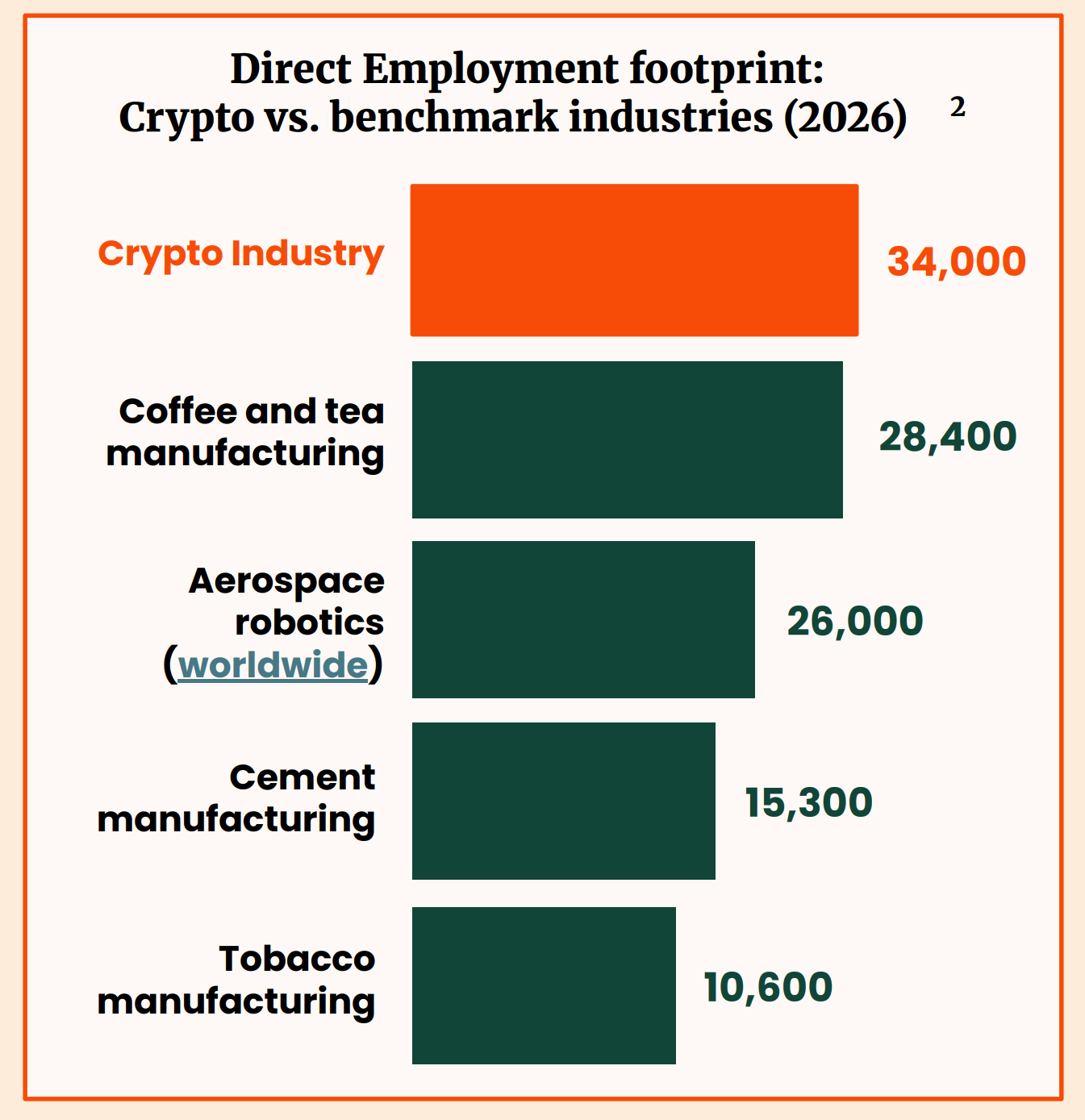
The crypto industry directly supports 34,000 jobs and contributes $55 billion to the US economy in 2026.
The findings come from a new report by the National Cryptocurrency Association (NCA), which commissioned the study from the Pragmatic Policy Group (PPG).
How Crypto Jobs Stack Up
To put that headcount in context, the report measured it against familiar industries. Crypto’s 34,000 direct workers now outnumber coffee and tea manufacturing, which supports 28,400.
Follow us on X to get the latest news as it happens

The gap widens against other benchmarks. Crypto tops both cement manufacturing at 15,300 and tobacco manufacturing at 10,600.
The report also puts the average crypto-related job at $133,000 a year, more than double the national median of $64,000.
It ranks that average above other high-paying fields, listing information and technology at $104,000 and manufacturing at $76,000. In addition, of the $55 billion total economic contribution, roughly $31 billion is worker income.
The Wider Economic Footprint
The report also estimates indirect effects. It finds that each direct crypto job supports 6 more across the economy. That brings total supported employment to 232,000 jobs in 2026.
The total figure accounts for direct, indirect, and induced jobs, not just crypto company payrolls. Supplier industries account for 75,000 roles, while worker spending adds another 123,000.
The distribution is uneven. California, New York, and Texas hold 60% of US crypto jobs, followed by Washington and North Carolina. Heartland states account for more than 17,000 positions.

Overall, crypto’s economic weight now extends well beyond trading, reaching into wages, supplier industries, and household spending across the country.
Subscribe to our YouTube channel to watch leaders and journalists provide expert insights
The post Crypto Now Employs More Americans Than Coffee or Tobacco Manufacturing Industries appeared first on BeInCrypto.


Another week, another multi-million-dollar hack in DeFi, and once again, it’s an off-chain compromise rather than a smart contract exploit.
AFX Trade, a decentralized perpetuals exchange that settles in dollar-pegged stablecoin USDC, was drained of about $24.15 million on Wednesday after an attacker compromised the validator signing keys behind a bridge the protocol operates on Arbitrum, blockchain data shows.
In other words, the smart contract did what it’s supposed to do – verify the signature and execute the transaction. The problem was with the private keys that generated those signatures, as attackers compromised the private validator signing keys (hot keys held offchain by the bridge operators or validators).
Steven Goldfeder, co-founder of Offchain Labs, which develops and maintains the network, said the Arbitrum native bridge “has not been hacked or exploited in any way” and that the transaction originated from a third-party protocol.
A hack of Arbitrum’s own bridge would signal risk across the entire layer-2 network, but a compromised protocol running on top of it is a contained failure.
Nothing in the bridge’s own code logic was broken. Bridges are blockchain-based tools for transferring tokens between various networks, including those they were not initially supported on.


The Securities and Exchange Commission listed three crypto-focused rulemakings in its 2026 Unified Regulatory Agenda, targeting proposed rules as soon as July, according to the agency's own Agency Rule List published on reginfo.gov. The agenda entries cover crypto asset offerings, broker-dealer… Read the full story at The Defiant


Uber cut 10% of its customer service jobs on Wednesday, marking the first time the company has tied layoffs directly to an artificial intelligence (AI) efficiency push.
The reductions hit Uber’s community operations team. Remote workers on the team were also told to relocate to a hub office under the company’s return-to-office mandate.
Why Uber Is Cutting Support Roles
Megha Yethatika, Uber’s vice president of global community operations, told her division that the organization had become “too complex and siloed.” She said the team had made progress with AI but needed a cleaner foundation to build on, according to a memo reported by Bloomberg.
“We cannot scale frontier technology on top of fragmented processes,” Yethatika said.
According to an Uber spokesperson, the company seeks “to simplify operations, strengthen in-person collaboration, and continue to embrace AI”.
The cut is Uber’s second round of reductions in under two months. In June, the company trimmed 23% of its people division, under 1% of its 34,000 global workers, after a new president took charge.
Uber said in May it would slow hiring because of internal AI use. However, it still lists more than 500 open roles, including engineers for its robotaxi partnerships.
Follow us on X to get the latest news as it happens
Uber Joins a Widening 2026 Layoff Wave
Uber’s move mirrors a broader shift across the job market. AI was cited in 101,743 US job cut announcements through June, roughly 23% of the total, according to outplacement firm Challenger, Gray and Christmas.
AI has led all stated reasons for layoffs for four straight months. Yet the impact of AI on jobs remains contested.
Jeff Bezos recently dismissed concerns that AI would displace jobs, arguing that the technology will reshape household economics and create labor scarcity.
Subscribe to our YouTube channel to watch leaders and journalists provide expert insights
The post Uber Cuts 10% of Customer Service Staff in AI Efficiency Push appeared first on BeInCrypto.
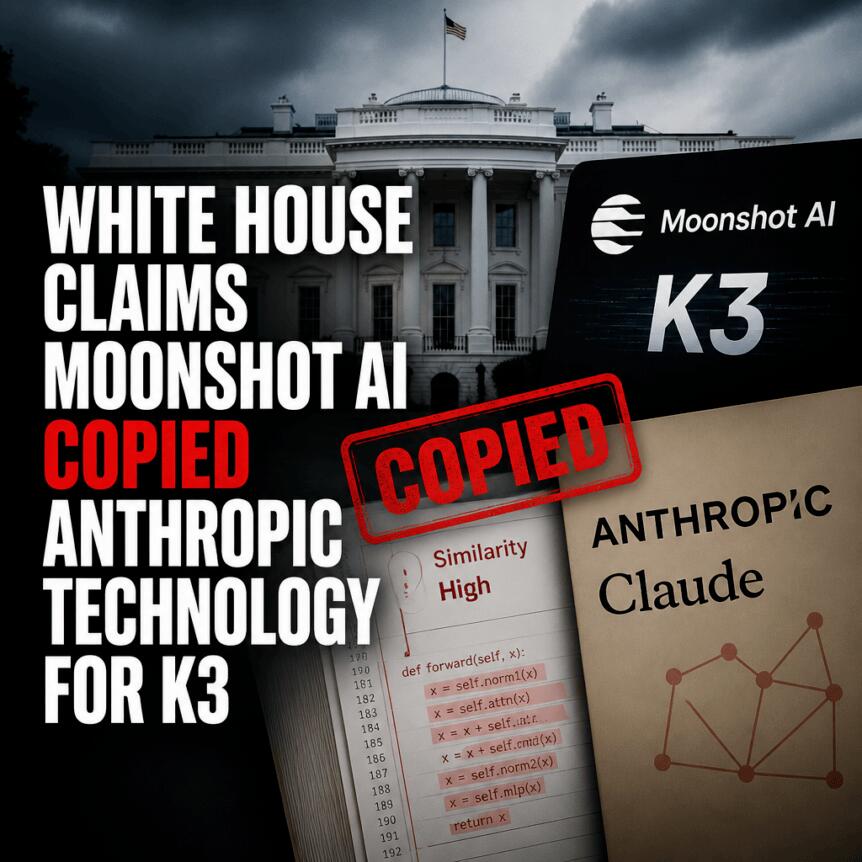
A senior official from the White House’s Office of Science and Technology Policy has accused the Chinese AI firm behind Kimi K3 of using “covert industrial distillation” techniques to replicate capabilities from U.S. models. The allegation, posted to X on Wednesday by Michael Kratsios, underscores how U.S. concerns about AI competitiveness are increasingly blending with fears of large-scale intellectual property (IP) theft.
Kratsios said the company built an internal platform to distill U.S. models “at scale,” specifically using methods intended to evade detection. While he argued that distillation—compressing a model into a smaller one—can be legitimate and part of open innovation, he framed the alleged approach as unacceptable because it targets proprietary American technology rather than improving models through transparent research.
Key takeaways
- White House OSTP Director Michael Kratsios alleged Chinese firm Moonshot AI used large-scale covert distillation tied to the Kimi K3 release.
- Kratsios contrasted legitimate model distillation with alleged industrial-scale techniques aimed at stealing U.S. IP and avoiding detection.
- Some AI researchers dispute claims that Anthropic’s Fable was used to produce Kimi K3’s performance, citing technical plausibility and timing constraints.
- U.S. officials warned that sanctions and Entity List designations could follow IP-theft-style distillation attacks.
Why the allegation matters beyond headlines
AI distillation is not inherently controversial. In general terms, distillation helps create smaller, more efficient models by training them on outputs generated by a larger “teacher” model. The White House’s argument, as stated by Kratsios, is that scale and secrecy change the nature of the activity—turning a common engineering practice into something closer to a targeted extraction of proprietary capability.
That distinction is critical for investors, developers, and researchers because it signals a potential shift in how regulators and governments may view certain AI training pipelines. If authorities treat “covert industrial distillation” as IP theft, it could influence enforcement priorities, compliance expectations, and the willingness of model providers to share weights, outputs, or licensing terms—especially across geopolitical lines.
Timing and the dispute over Anthropic’s role
Kratsios’s claim places particular focus on the question of whether U.S. model technology was used in the preparation of Kimi K3. Cointelegraph previously reported that Anthropic’s Fable 5 was taken offline quickly due to U.S. export controls, then re-released on July 1. Kimi K3, meanwhile, launched on July 16—creating what critics describe as a narrow window for any distillation-derived transfer.
Elie Bakouch, a researcher at Prime Intellect, publicly questioned whether the technical story matches the observed outcomes. In an X post referenced in the original reporting, Bakouch argued that there are only “15 days between fable 5 ban removal and kimi K3 release,” and he added that the performance “could” not be explained in a straightforward way by distillation from Fable.
Dean Ball, head of strategic futures at OpenAI, also pushed back. On Friday, Ball said he did not believe K3’s performance could be “explained away by distillation or anything like that.” Both responses reflect a broader point: even if distillation happened, it may not be the sole—or even the primary—reason for a model’s capabilities, and establishing a clean causal link can be technically difficult.
In the absence of publicly available technical evidence, these disputes matter because they highlight uncertainty. Government accusations may have intelligence backing, but for the wider AI community, the plausibility and traceability of model-to-model influence is a separate question from whether the activity would violate policy or law.
Washington escalates from concerns to potential enforcement
The posture from U.S. officials appears aimed at deterrence. In addition to Kratsios’s claim that “covert industrial distillation” intended to steal U.S. technology is unacceptable, U.S. Treasury Secretary Scott Bessent warned that sanctions and restrictions could be pursued.
Bessent said the U.S. supports open-source AI and the innovation it enables, but he argued open source does not mean “open season” on American IP. He also warned that if firms conduct covert, industrial-scale distillation attacks that cross into IP theft, consequences could include sanctions and Entity List designations.
That statement suggests the U.S. may attempt to treat certain distillation behaviors under the same enforcement logic used for other technology-transfer and IP-protection efforts. For AI companies, the practical takeaway is that even widely used ML techniques could be reinterpreted depending on intent, transparency, and scale.
It also raises a policy tension: distillation can improve accessibility and efficiency, but enforcement actions could push industry toward more restrictive handling of model outputs and training procedures. Developers may respond by tightening documentation, auditing data provenance, or changing how they handle third-party model access.
What to watch next
Whether the dispute becomes a broader enforcement campaign will likely depend on what additional evidence, if any, is made public and how regulators define “industrial-scale” and “covert” distillation in measurable terms. For now, observers should watch for any formal government actions tied to Kimi K3 and for further clarification from researchers on what technical signals can reliably connect teacher models to student performance.

Hackers Drain $31.6M After Two Crypto Bridge Breaches in 7 Hours
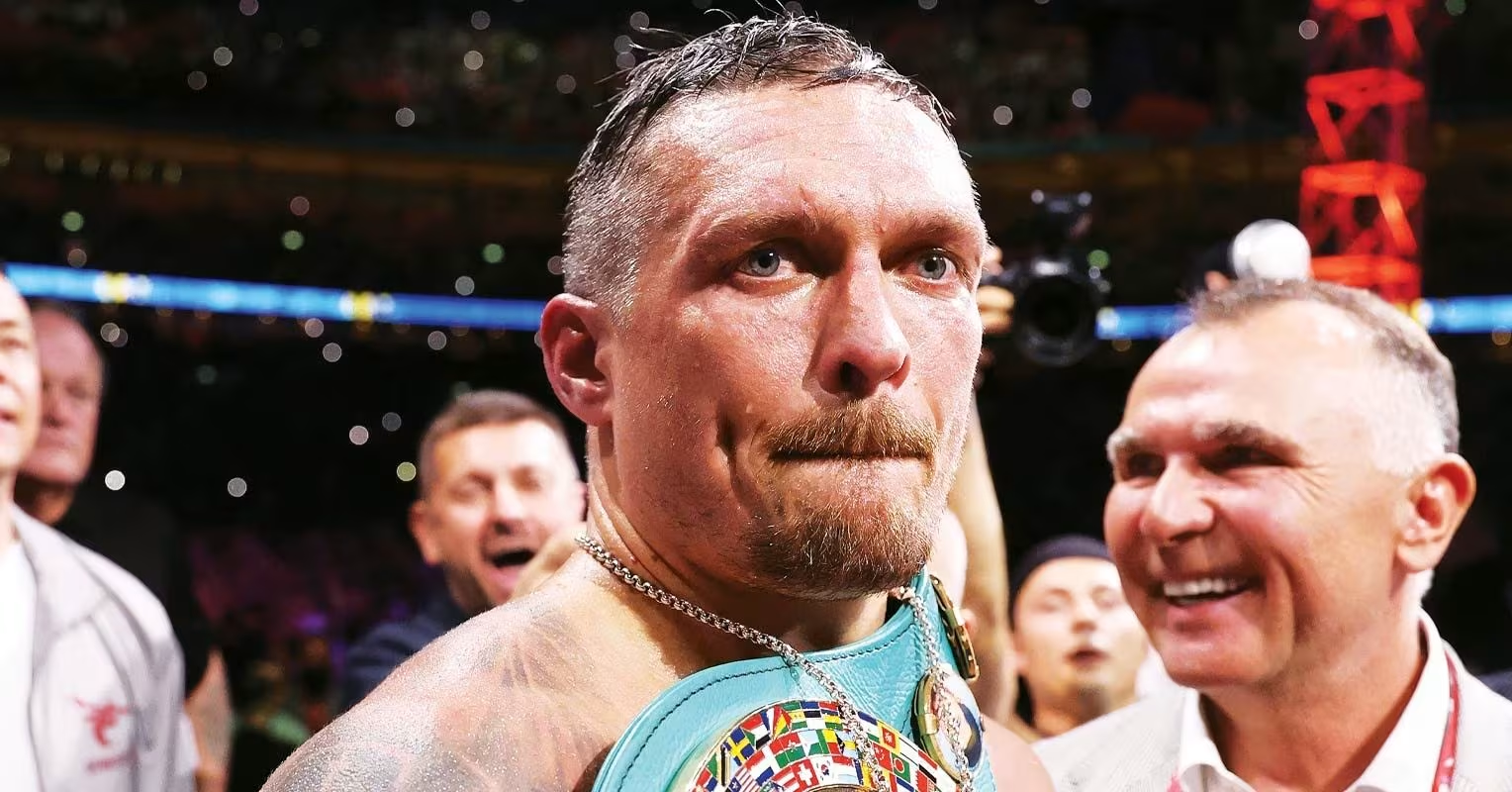
Shakur Stevenson names the heavyweight who would have beaten Oleksandr Usyk

I Test-Drove Substack’s New AI Detection Tool, and It Mostly Worked


-
 NewsBeat7 days ago
London Mayor Sadiq Khan handed a peerage by Keir Starmer alongside 15 other Labour figures… just days before the PM leaves No10
-

 Fashion6 days ago
Weekend Open Thread – Corporette.com
-

 Politics5 days ago
The House | The City of London can help the new chancellor deliver growth in every postcode
-

 Crypto World5 days ago
Ripple Payments Joins MiCA With 14 Firms, Does It Mean Anything For XRP?
-
 Crypto World6 days ago
Two July Windows Left: The CLARITY Act’s Senate Fight and What Failure Means
-

 Politics4 days ago
Democrats look to World Cup watch parties to register thousands of voters
-

 Crypto World5 days ago
Ripple wins EU-wide access as ESMA adds it to MiCA register
-

 Crypto World2 days ago
Grayscale Files For Worldcoin ETF, WLD Registers Sharp Rise
-

 NewsBeat3 days ago
Unregistered fitter used Gas Safe logo on business flyers
-

 Tech2 days ago
Sail Virtually Aboard The “Itanic” With IA-64 Emulator
-

 Crypto World6 days ago
Injective Submits SEC Transfer-Agent Registration to Onchain Ownership Records
-
 Tech2 days ago
Turtle Beach Command Series KB7 review: a nifty screen-equipped gaming keyboard
-

 NewsBeat6 days ago
Registration is now open for March for Men with Kev 2026
-
 Business1 day ago
New Jersey voter registration controversy explained: How 6,600 noncitizens got on the rolls, and what happens next
-

 Crypto World6 days ago
Claude Fable 5 Slips to Second in AI Coding Leaderboard
-

 News Videos6 days ago
Money | Class 12 Economics | CBSE Board Exam 2026-27
-

 Business6 days ago
Banco Bilbao Vizcaya Argentaria, S.A. (BBVA) Discusses Global Macro Environment and Economic Outlook for Core Markets Transcript
-

 Crypto World5 days ago
Kaspersky exposes OkoBot’s 20-module crypto wallet attack
-

 News Videos4 days ago
Big Money Is Entering XRP
-

 NewsBeat5 days ago
Durham County Council to send out electoral registration emails
You must be logged in to post a comment Login