
Connect with us

Business

GM to launch its own in-vehicle AI system later this year

Published

on

GM to launch its own in-vehicle AI system later this year

GM began rolling out Google’s Gemini in eligible model year 2022 and newer Cadillac, Chevrolet, Buick, and GMC vehicles in the U.S. earlier this year with Google Built‑in.

Courtesy GM

DETROIT – General Motors plans to launch its own in-vehicle artificial intelligence system that’s better tailored for its customers later this year.

Advertisement

The new GM AI assistant is expected to be more integrated with the vehicle as well as its capabilities and telematics information than the company’s recently launched Gemini AI assistant from Google, according to Anna Santos, GM director of product management of voice and AI/machine learning.

“Later this year, we’ll be launching a more deeply integrated native AI assistant that combines conversational AI with GM vehicle knowledge and OnStar intelligence to create those capabilities that go beyond what a general purpose assistant can do,” she told CNBC.

GM last year announced the Gemini AI bot would launch this year in millions of 2022 model-year vehicles and newer, followed by a GM AI assist, but did not provide additional details on the technology.

Santos said the new GM assistant, which she declined to disclose a name for, will be able to better “understand the vehicle, the drive and our customers’ needs, and make everyday ownership simpler.”

Advertisement

With Gemini, customers can speak naturally without memorizing commands or repeating context. It also is beginning to offer “live sessions” in which the bot will speak with a like a normal conversation or play games like trivia or 20 questions. It also can control some aspects of GM vehicles, such as temperature and radio controls, but in general operates like it would through a phone.

“This is the beginning of a broader AI journey for us,” Santos said. “There’s a limit to what an AI that’s just sort of sitting at the top level of the vehicle can do.”

The Detroit automaker is working with an unnamed large language model provider on its technology to assist GM and its owners with predictive maintenance, vehicle telemetry and other more auto-focused features.

That also could include commands such as “kids setting” that would tailor music, seats, heating/cooling and door lock controls for children.   

Advertisement

“It’s data that’s going to be proprietary to GM, and our goal is to make sure that we’re bringing the right technology forward to enable us to build the deep vehicle expertise that we want to be able to bring to the AI assistant,” Santos said.

Choose CNBC as your preferred source on Google and never miss a moment from the most trusted name in business news.
Continue Reading
Click to comment

You must be logged in to post a comment Login

Leave a Reply

Business

Lancashire’s ‘significant loss’ as new devolution powers require elected mayor

Published

on

Business Live

Prime Minister Andy Burnham has announced the largest change in local authority funding in over a decade — but the county will miss out on income tax retention powers due to its lack of an elected mayor

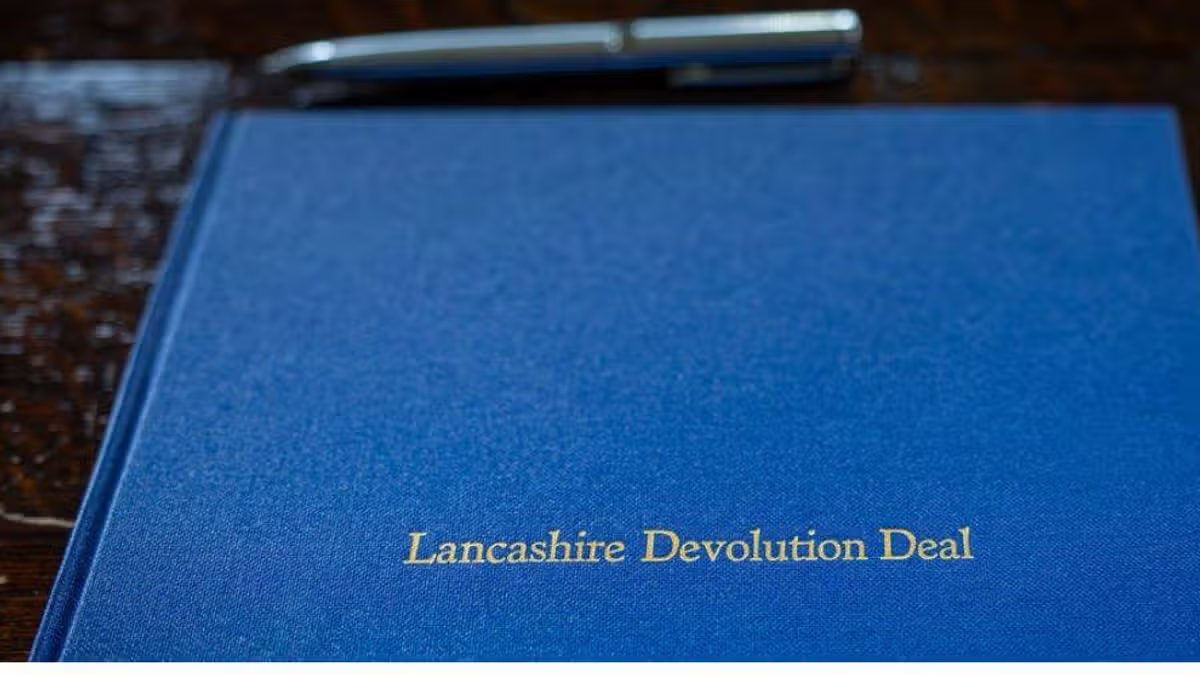
The Lancashire Devolution Deal

(Image: Local Democracy Reporting Service)

Large parts of England are poised to benefit from a sweeping devolution of financial power under Prime Minister Andy Burnham, yet Lancashire will miss out for one straightforward reason.

Advertisement

Burnham is set to unveil the most significant overhaul of local authority funding in more than a decade, with certain regions permitted to retain a share of income tax – the single largest revenue-raising tool at the government’s disposal.

However, the former Manchester Mayor’s proposals will do nothing for Lancashire, owing to a number of district councils having rejected the notion of the county having its own elected mayor, despite repeated efforts over the past ten years to establish the role.

Instead, in 2023, councils agreed to form the Lancashire Combined County Authority, but without an elected mayor, as seen in comparable areas across the country. This compromise, however, means that today’s announcement could represent a ‘significant loss’ for Lancashire.

That is because only regions with an elected mayor will be eligible to take advantage of this landmark devolution settlement, enabling them to direct their share of income tax towards essential public services such as transport and housing.

Advertisement

While the new administration stopped short of specifying the precise sum involved, it could prove a considerable fundraising mechanism for Lancashire, which contributes roughly £4bn to the Exchequer through income tax each year. The leader of Blackburn with Darwen Council, Cllr Phil Riley, responded to the announcement by stating: “It’s just another significant loss for Lancashire in the absence of a Mayor.”

Highlighting the shift towards a mayoral model in neighbouring regions such as the Liverpool City Region and West Yorkshire since 2015, he continued: “This is the national direction of travel and we will continue to lose out till we fix it.”

The power for mayoral authorities to retain a share of income tax represents just one element of the broader push to transfer powers from the UK Government to local councils throughout England, with additional authority to keep some business rates revenue also being devolved.

Prime Minister Andy Burnham said: “I said we’d take power out of Westminster and carry it into every postcode in the country. Today, we make good on that promise.

Advertisement

“Under our plans, more of the taxes raised in a community will stay in that community. Soon, every local leader will have the power and resources to improve public transport, build homes and create jobs.

“I know what it’s like to be ignored by politicians in Westminster. I’m not going to make that same mistake now I’m PM.

“The whole of government will now pull together behind the people and places that desperately need our support. This is how we’ll bring back hope and bring power home to you.”

The new Labour government has indicated it intends to devolve power and decision-making closer to communities, fostering more resilient local economies capable of enhancing public services.

Advertisement

Chancellor of the Exchequer John Healey MP said: “The people who best understand what skills employers want, what transport an area needs and where investment can make the biggest difference are those who live there.

“For the first time we’re giving Mayors a share of income tax so communities directly benefit when their economy grows – passing power out of Westminster and driving growth in every postcode.

“This is the way we start to build new hope and advance the working people of this country.”

These measures are anticipated to take effect from spring next year, with a framework for the devolution set to be outlined in this autumn’s Budget.
Advertisement
Continue Reading

Business

SK Hynix Shares Surge Nearly 30% as Record KOSPI Rally Follows Microsoft’s Blockbuster Earnings Beat

Published

on

SK Hynix ADR Plunges Nearly 8% to $162 as Wild

Shares of SK Hynix surged 29.95% on Friday, climbing 396,000 won to close at 1,718,000 won on the Korea Exchange, effectively hitting the exchange’s daily limit for individual stock price movements as South Korea’s benchmark KOSPI index posted the largest single-day rally in its history.

The KOSPI closed up 17.91% at 6,595.45, marking a record in both point and percentage terms, according to the Korea Herald. Samsung Electronics, SK Hynix’s chief domestic rival in the global memory chip market, surged as much as 26.81% during the same session, according to TradingKey, as both of South Korea’s dominant chipmakers effectively erased much of the ground they had lost during three brutal preceding trading sessions.

Friday’s rally traced its origins directly to a powerful overnight session on Wall Street. Microsoft’s shares soared 15.5% Thursday for the company’s best single-day performance in nearly 18 years, according to the Associated Press, after the technology giant reported that its Azure cloud computing division grew 43% during the quarter, easing broader investor concerns about the sustainability of massive capital spending on artificial intelligence infrastructure. Amazon and Meta Platforms also posted results that exceeded market expectations, reinforcing confidence that AI-related computing demand remains robust, according to CNBC, sending a wave of optimism through Asian technology markets overnight.

SK Hynix’s own recent earnings had already demonstrated the underlying strength driving Friday’s rebound, even though the company’s stock had initially sold off sharply following the results. SK Hynix reported record revenue of 79.3 trillion won for the second quarter, up 51% from the prior quarter and 257% from the same period a year earlier, alongside operating income of 60.5 trillion won. The company said DRAM prices rose approximately 30% during the quarter while NAND flash memory prices surged into the mid-50% range, pushing its operating margin to a record 76%. Despite those record results, SK Hynix shares had initially fallen because the figures came in below the elevated expectations investors had built up around AI-related chip demand, contributing to the broader selloff that gripped the KOSPI over the following days.

Advertisement

Friday’s rebound followed a brutal stretch for Korean equities more broadly. The KOSPI had plummeted more than 17% over the three trading sessions preceding Friday, driven by investor concerns about a potential bubble in artificial intelligence valuations and intensifying competition from Chinese chipmaking rivals, according to the Associated Press. At one point during that selloff, the index had fallen roughly 40% from its June peak, wiping out nearly $2 trillion in market value, according to reporting from the Private Banker.

Foreign investors were the driving force behind Friday’s historic rebound, posting net purchases of 7.25 trillion won, or roughly $5.06 billion, on the KOSPI, according to the Korea Herald. That marked a second consecutive day of net foreign buying, following four straight sessions of net selling that had preceded Thursday.

A separate development specific to SK Hynix appeared to reinforce Friday’s rally. SK Group Chairman Chey Tae-won disclosed personal purchases of SK Hynix shares during the recent selloff, a move that bolstered investor confidence in the world’s second-largest memory chipmaker, according to CNBC, offering a visible signal of leadership confidence at a moment when the stock had come under significant pressure. New cash-deposit requirements for investors using leveraged exchange-traded funds also took effect July 31, a regulatory change some analysts said may have contributed to a broader repositioning among traders active in that segment of the market, while short-covering and mechanical rebalancing tied to leveraged ETFs were also cited as factors amplifying the scale of Friday’s move.

SK Hynix has continued advancing its next-generation memory technology even amid the recent share price volatility. The company said it had begun mass production of its HBM4 high-bandwidth memory chips, with a broader production ramp planned for the second half of 2026, and that it had secured long-term supply agreements with approximately 10 customers as it works toward volume production of its subsequent HBM4E chips in 2027.

Advertisement

Despite the historic single-day gain, market analysts urged caution about reading too much into the rebound. Speaking to CNBC, one analyst identified only as Jung said foreign investors appeared to be the primary force behind Friday’s rally, but cautioned against assuming the gains signal a durable trend reversal. “I would not expect gains of this magnitude to continue,” Jung said, adding that asset prices had become “completely disconnected” from underlying fundamentals during the recent volatility.

Even after Friday’s rally, the KOSPI remained well below its levels from earlier in the year. The index recorded its worst monthly performance since 1997, dropping 22.19% over the course of July, according to TradingKey, underscoring that Friday’s rebound, while historic in scale, only partially offset the scale of losses the index had absorbed over the preceding weeks.

South Korean authorities also announced new measures Friday aimed at supporting the country’s technology and artificial intelligence sector more broadly. The government said it would inject a minimum of 20 trillion won, or approximately $13.9 billion, into the Korea Investment Corporation for strategic investments in artificial intelligence, data centers and broader infrastructure, according to the Private Banker, marking the first time the sovereign wealth fund’s mandate has been expanded to include domestic assets.

With SK Hynix shares having now hit the exchange’s daily trading limit and the broader KOSPI having posted its largest single-day gain on record, investors are likely to watch closely in the sessions ahead for signs of whether Friday’s rebound marks a genuine stabilization in sentiment toward AI-linked technology stocks or another dramatic swing within a period of extraordinary volatility that has gripped South Korea’s chip-heavy equity market throughout the second half of July.

Advertisement
Continue Reading

Business

‘Most extreme’ allegations, Rita Saffioti tells court in Poland, Hedley trial

Published

on

‘Most extreme’ allegations, Rita Saffioti tells court in Poland, Hedley trial

Rita Saffioti claims the allegations made in a secret audio recording were the “most extreme” she’d seen, as the deputy premier takes the witness stand in an ongoing trial.

Continue Reading

Business

LinkedIn AI slop button lets users flag AI-generated posts

Published

on

LinkedIn AI slop button lets users flag AI-generated posts

LinkedIn has introduced a button allowing users to flag posts they believe were generated by artificial intelligence, with the platform’s chief product officer, Hari Srinivasan, saying on Thursday that tackling so-called AI slop is a “top priority”.

The “Seems like AI slop” option sits in the menu on each post. Flags are private reports to LinkedIn and are not shared publicly.

Srinivasan announced the feature in a post on LinkedIn. “AI slop is a top priority for all of us,” he wrote. “We really care about this. People come to LinkedIn to connect with real people and share their real perspectives, ideas and expertise. Here are a few more changes to keep it that way.”

The launch follows research published in July by AI detection firm Pangram, which found that more than 40 per cent of LinkedIn posts longer than 250 words were fully AI-generated. Pangram said it analysed around one million posts over two months across LinkedIn, X, Reddit, Substack and Medium, and that LinkedIn was the most AI-saturated of the platforms studied.

Srinivasan said LinkedIn’s automated tools were already catching “hundreds of thousands of automated comments” and “have blocked billions of other automation attempts (posting at scale, slop) in the last couple months alone”.

Advertisement

The platform, which is owned by Microsoft, is also rolling out new classifiers designed to identify whether a post is AI slop or otherwise low-quality content, Srinivasan said. User flags will feed into those models. Members whose posts are reported will be notified privately through their analytics dashboards that readers found their content inauthentic.

Alongside the new button, LinkedIn is withdrawing its own AI writing feature. “We asked ourselves why do people post with AI anyway? The answer is LinkedIn isn’t a one-word kind of place and they feel more confident running their posts through AI,” Srinivasan wrote.

“We’re taking this learning, removing the ‘enhance your post’ feature you see when you write a post or message & replacing with a feature that proofreads your words, but does not change your voice.”

LinkedIn has not said what happens to a post once it is flagged, beyond the feedback being used to improve its feed, and it is unclear whether reports could limit the reach of posts or accounts.

Advertisement

Early reaction on the platform has been mixed. Jonny Rose, founder of The Story Club, wrote on LinkedIn that he hoped the feature was “the first step in making the platform more enjoyable for everyone”. Tech ghostwriter Colin Steele wrote that the button could be “ripe for abuse”, suggesting companies and their employees could report competitors without merit.

The change comes amid rapid growth in the use of generative AI tools, which now count more than one billion monthly users worldwide, according to the Digital 2026 report from Meltwater and We Are Social.

Other platforms are grappling with the same question from different directions. Newsletter platform Substack launched its own AI detection tool last week in partnership with Pangram, while TikTok last year cut hundreds of UK content moderation jobs as it shifted moderation work towards AI systems.

Srinivasan said LinkedIn is also expanding access to profile and page verification tools and adding an option to block comments from company pages users no longer wish to see.

Advertisement

Amy Ingham

Amy Ingham

Amy Ingham is a reporter at Business Matters, covering UK business news with a focus on breaking news, business policy, late payments and insolvency. She joined the magazine in 2026 after completing the NCTJ Diploma in Journalism at Harlow College’s journalism school. Her recent reporting includes British Steel’s nationalisation and its impact on SME suppliers, the decline in late payments by large firms, and Insolvency Service director disqualifications. Reach her at aingham@cbmeg.co.uk.

Advertisement
Continue Reading

Business

Stellantis to recall 1.5 million Ram 1500 pickup trucks over seat belt issue

Published

on


Stellantis to recall 1.5 million Ram 1500 pickup trucks over seat belt issue

Continue Reading

Business

UK petrol prices hit 160p, highest since Iran war began

Published

on

UK petrol prices hit 160p, highest since Iran war began

The average price of petrol in the UK has reached 160p a litre, its highest level since the Iran war began on 28 February, according to figures from the RAC.

The motoring group puts petrol at 159.97p a litre and diesel at 178.97p. Diesel remains below its 15 April peak of 191.54p a litre, set as pump prices climbed to their highest level in more than two years.

Pump prices fell after the US and Iran agreed a framework deal in June to end the conflict. In early July, the RAC said, average petrol sank to a low of 150.59p a litre and diesel to 164.52p. Both have risen since the collapse of the peace talks.

Simon Williams, head of policy at the RAC, said the price of diesel was likely to reach 185p a litre “in the next few weeks, barring any major oil price reduction”.

The price of fuel tends to track the wholesale price of oil, and analysts say every $10 (£7.44) per barrel increase in the oil price pushes up pump prices by roughly 7p a litre. Because transporting oil is a slow process, wholesale price movements take about a fortnight to show at the pump.

Advertisement

Brent crude, the global benchmark, was about $70 a barrel before the conflict and peaked above $120 as the fighting disrupted oil supplies across the Middle East. It fell back to near $70 in early July after the framework deal was signed, climbed above $100 when the talks collapsed, and now trades at around $90.

Generally speaking, news of further conflict has driven the price up, while hopes of an end to the war have pushed it down.

Despite the rises, petrol and diesel remain below the levels reached in the summer of 2022 following Russia’s invasion of Ukraine, when petrol hit 191.5p a litre and diesel 199p.

The conflict has effectively closed the Strait of Hormuz, through which about 20 per cent of the world’s oil and liquefied natural gas normally passes. Experts warn that even if a deal is agreed to reopen the strait, it will take time before normal levels of shipping resume, and the impact of the war could continue to affect the global economy for months.

Advertisement

The UK is heavily reliant on oil and gas imports, with the majority coming from the US and Norway, and pays the price set on the global market. Although the UK produces some oil in the North Sea, most of it is exported for refining elsewhere.

Fuel retailers have denied accusations of price gouging during the conflict. The official markets regulator said it had “not seen evidence of retailers actively changing their pricing strategies to take advantage of the crisis”.

A government scheme called Fuel Finder lets drivers compare the cost of fuel at petrol stations across the UK. Luke Bosdet, head of policy at the AA, said the group had been surprised at the speed at which prices had fallen and put it down to the scheme.

On 20 May, the then prime minister Sir Keir Starmer said a planned 5p increase in fuel duty due in September would be postponed until 31 December because of the conflict.

Advertisement

Amy Ingham

Amy Ingham

Amy Ingham is a reporter at Business Matters, covering UK business news with a focus on breaking news, business policy, late payments and insolvency. She joined the magazine in 2026 after completing the NCTJ Diploma in Journalism at Harlow College’s journalism school. Her recent reporting includes British Steel’s nationalisation and its impact on SME suppliers, the decline in late payments by large firms, and Insolvency Service director disqualifications. Reach her at aingham@cbmeg.co.uk.

Advertisement
Continue Reading

Business

RBC Capital raises Amazon stock price target to $330 on AWS growth

Published

on


RBC Capital raises Amazon stock price target to $330 on AWS growth

Continue Reading

Business

Mooted demand for commercial property in Wales in Q2

Published

on

Business Live

According to the RICS chartered surveyors are anticipating rising rents

How the next phase of Indurent Park Newport will look.

Computer generated image of the next phase of development at Indurent Park Newport.(Image: Indurent )

Occupier demand for commercial property in Wales was muted in the second quarter of the year according to the latest Royal Institution of Chartered Surveyors (RICS) which also shows optimism for rents in the months ahead.

A net balance of minus 7% of Welsh respondents reported a fall in overall occupier demand through the first quarter of the year. Looking at the subsectors, a net balance of minus 8% of respondents reported a fall in occupier demand for industrial space.

Advertisement

A net balance of -14% of Welsh surveyors reported a fall in occupier demand for retail space, which although remains in negative territory, is up from the survey previous, and for the second consecutive quarter, occupier demand for office space fell flat.

Looking ahead, though, there appears to be some improvement in sentiment. Surveyors in Wales expect rents to rise over the next three months, with a net balance of 13% of respondents anticipating that rents will increase. Both office and industrial space are expected to see rises in rents, however rents in retail space are expected to fall over the next three months.

On the investor side of the market, demand fell flat at the all sector level in Q2. There was a fall in demand from investors for office space, however investor demand for both industrial and retail space rose through the second quarter of this year.

When it comes to capital values, respondents in Wales are more optimistic for the industrial sector which is expected to see its capital values rise over the next three month period. However capital values in both retail and office space are expected to decline. This points to an overall flat picture.

Advertisement

Chris Sutton of Sutton Consulting in Cardiff said: “There is a lack of available grade A floorspace across both office and industrial markets. Developers face challenges including funding, planning delays and increased construction costs.

“There are, however, high quality occupier enquiries in the Cardiff office market, and a recognition that rents will need to rise to improve viability. In the industrial sector, developer Indurent has announced the final two phases of its landmark scheme in Newport, with quoting rents of £10-£12 per sq ft.”

On theUK picture head of market research and analytics for the RICS, Tarrant Parsons, said: “The UK commercial property market appears to have weathered the initial shock from the escalation in geopolitical tensions earlier in the year reasonably well, with the tone from respondents this quarter noticeably more settled than in Q1.

“Occupier fundamentals continue to hold up, and there is tentative evidence that the sharp tightening in credit conditions seen earlier in the year is starting to unwind. That said, the pace of the recovery in investor sentiment remains modest, and respondents continue to flag caution given the wider macroeconomic backdrop.“As we move through the second half of the year, the trajectory of interest rates, alongside developments on the international stage, will remain critical to whether or not positive momentum is allowed to build.”

Advertisement
Continue Reading

Business

York and North Yorkshire gains established mayoral status

Published

on

York and North Yorkshire gains established mayoral status

The York and North Yorkshire Combined Authority has been designated an Established Mayoral Strategic Authority, with confirmation received on Friday 31 July 2026, making it the first rural mayoral area in England to hold the status.

The designation gives the Combined Authority, led by Mayor David Skaith, access to further devolved powers, increased flexibility over funding and the ability to request additional powers from government, the authority said.

Eleven areas now hold Established Mayoral Strategic Authority status, including Greater Manchester, the West Midlands, South Yorkshire, the North East, West Yorkshire, the East Midlands and the West of England.

Under criteria published by the Ministry of Housing, Communities and Local Government, authorities seeking the designation must have had a directly elected mayor in place for at least 18 months, hold a published Local Assurance Framework and submit evidence of a track record of managing major programmes. The status is provided for by the English Devolution and Community Empowerment Act, which received Royal Assent in April 2026.

York and North Yorkshire Combined Authority formed in February 2024. The authority said the designation reflects growing confidence from government in its ability to deliver change for the region.

Advertisement

David Skaith, Mayor of York and North Yorkshire, said: “This is a major milestone and clear evidence of the progress we’ve made as a county and a Combined Authority in a short space of time.

“Now, with Established Status, we will have access to greater powers and funding, allowing us to go even further and faster to address some of the structural challenges holding our county back.

“This will help us fully realise the benefits of devolution and ensure decisions about our county are made by our county, for our county, and in our county by those who know it best.”

Councillor Claire Douglas, leader of City of York Council, said the Combined Authority had attracted funding since 2024 for schemes including affordable homes, jobs, highways and active travel. Investment in the region has included allocations from a £7 million net zero fund agreed as part of the area’s devolution deal.

Advertisement

“Working collectively, we will be able to unlock significantly more funding to drive economic growth, develop more affordable homes, and better connect the city and neighbouring places with sustainable and accessible transport,” she said.

North Yorkshire Council’s leader, Councillor Carl Les, said: “Established Status is a recognition of all the hard work that has been done and will be vital in driving economic growth to improve lives and opportunities for our residents and businesses across the county.”

The designation comes as devolution moves up the political agenda. More than a quarter of England’s population still lives outside a Mayoral Strategic Authority, according to think tank IPPR North, which has urged the government to complete the devolution map by the end of this parliament.

In June, Rachel Reeves told the British Chambers of Commerce annual conference that fiscal devolution was her “unfinished business”, with consultations under way on devolving revenues from income, business and land taxes to local leaders.

Advertisement

Jamie Young

Jamie Young

Jamie Young is Senior Reporter at Business Matters, covering SME finance, employment law and Westminster policy since 2016. He has reported on every Budget and Autumn Statement since 2018, helped make sense of the ‘covid era’ and the bounce-back loan scheme from launch through the fraud investigations, and broke the magazine’s coverage of the 2024 late-payment reforms. He joined Business Matters straight from completing his BA in Administration from Exeter University and is NCTJ-qualified. Reach him at jyoung@cbmeg.co.uk

Advertisement
Continue Reading

Business

Cigna's Valuation Gap Still Stands Out

Published

on

What I Believe Investors Are Missing With Cigna (NYSE:CI)

Cigna's Valuation Gap Still Stands Out

Continue Reading

Trending

Copyright © 2025