
Crypto World
Aave to Shut 6 V3 Markets, Offboards 50 Low-Use Reserves


A proposed Aave governance initiative would wind down multiple Aave V3 lending deployments on six blockchains and retire a large set of low-usage token listings. The plan, advanced through the protocol’s ARFC process, targets a cleanup covering $98.1 million in supplied assets and $15.6 million in outstanding debt, based on balances recorded on July 28.
According to LlamaRisk, which worked with Aave service providers on the assessment, the proposal recommends offboarding 50 low-use reserves and retiring 21 matured Pendle principal token listings across 11 deployments. It also calls for retiring all 25 reserves on Sonic, Scroll, zkSync, Metis, Soneium, and Aptos.
Key takeaways
- The ARFC would deprecate Aave V3 markets on Sonic, Scroll, zkSync, Metis, Soneium, and Aptos, alongside removing 50 low-use reserves and 21 matured Pendle principal token listings.
- The scope is tied to on-chain balances measured July 28, with $98.1 million supplied and $15.6 million in debt included in the cleanup.
- Risk service provider LlamaRisk characterizes the action as part of Aave’s broader risk-governance frameworks rather than a reversal of its multichain growth thesis.
- Prior multichain “temp check” voting already shut down underperforming instances on zkSync, Metis, and Soneium and set a $2 million annual revenue floor for new deployments.
- Aave founder Stani Kulechov framed the move as reducing both economic and technical risk surface under updated listing and risk frameworks.
What the ARFC would change in Aave V3
An ARFC—an “Aave Request for Comment”—is presented as a detailed governance proposal and precursor to an Aave Improvement Proposal. It is not itself confirmation that final on-chain voting has been completed or that execution is already underway.
In this case, the recommendation focuses on reducing exposure to markets with limited usage or maturing positions. LlamaRisk’s work with other Aave service providers outlines multiple categories of deprecation: low-use reserves and certain Pendle principal token listings that have matured, alongside full reserve retirements on the six named chains.
Aptos exit arrives after a rapid liquidity decline
The inclusion of Aptos stands out because it follows relatively recent deployment activity. LlamaRisk’s materials indicate Aave launched its V3 market on Aptos about 11 months earlier. In that period, liquidity fell by 94% over six months, and quarterly revenue reportedly dropped below $1,000, according to LlamaRisk.
Under the proposal, not all chains are treated the same way. LlamaRisk states that every reserve on Scroll, zkSync, Metis, and Soneium was already frozen. By contrast, Sonic and Aptos remained active at the time of the snapshot, with the ARFC recommending that they be frozen as well.
This structure matters for how quickly deprecations could translate into actual risk reduction. Freezing already stops new activity, but full retirement would further narrow Aave’s operational footprint on those deployments.
How earlier “temp check” decisions set the stage
The ARFC is not the first governance signal that Aave would be willing to scale back underperforming V3 instances on certain chains. A prior “temp check” on Aave’s multichain strategy concluded on Dec. 5, 2025, according to the governance record referenced in the source materials. That vote reportedly returned 923,400 votes in favor and under 1% against changing reserve behavior for underperforming instances.
That earlier governance outcome included actions affecting zkSync, Metis, and Soneium—specifically shutting down instances—and introduced a $2 million annual revenue floor for new instance deployment. In other words, the latest ARFC reads less like a sudden pivot and more like an operational follow-through on criteria that were already accepted by the community.
Risk framework updates and protocol-wide cleanup logic
The proposal aligns with Aave’s evolving risk and listing governance. The source notes that Aave added Scroll to the affected set through an accelerated process in April, referencing a direct-to-AIP proposal. In that description, the measure was framed as completing Scroll’s deprecation after a rapid deterioration in network liquidity and Aave market activity.
Separately, Aave published an updated risk framework on June 9 covering asset, bridge, monitoring, and chain risk, along with criteria for winding down reserves or deployments. The current ARFC announcement, as described in the source materials, suggests “de facto” adoption of these rules for the present cleanup.
Aave founder Stani Kulechov also addressed the initiative in a Thursday social media post. He said the move would “reduce Aave’s economic and technical risk surface as part of the new Aave Risk Framework and Technical Asset Listing Framework.” He further emphasized that the action “is not a reversal” of the protocol’s multichain expansion strategy, and that Aave would continue continuous risk assessment across deployments.
That distinction is likely important for market participants. Aave’s multichain approach appears to remain intact conceptually, but the governance direction points toward tighter enforcement of performance and risk thresholds—essentially focusing capital and attention on deployments that meet criteria and exiting those that do not.
Why this matters for users and market participants
For users and liquidity providers, deprecations can change the path of capital: liquidity may diminish further as reserves are frozen or retired, and markets tied to low-use reserves can become less accessible over time. For borrowers and lenders, winding down V3 markets can also affect how easily positions can be adjusted, particularly if token listings tied to specific assets or principal tokens are retired after maturity.
For investors and governance observers, the bigger signal is how Aave is operationalizing its frameworks. By connecting deprecations to measurable liquidity and revenue outcomes—and by referencing an earlier temp check that set a revenue floor—the ARFC underscores a governance style that is increasingly rules-driven rather than ad hoc.
Readers should watch for the next procedural steps: whether the ARFC proceeds into an Aave Improvement Proposal for formal voting, and how execution is sequenced across the chains involved—especially where Sonic and Aptos were still active at the time of the July 28 snapshot.

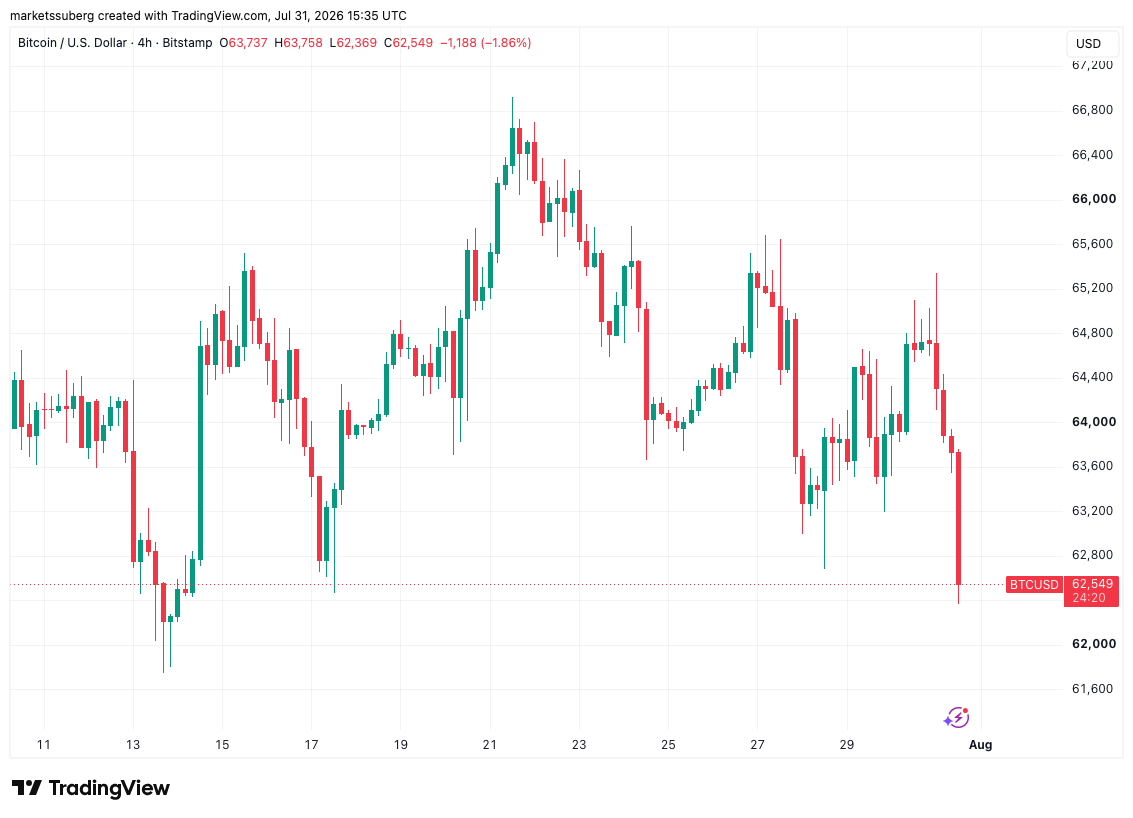
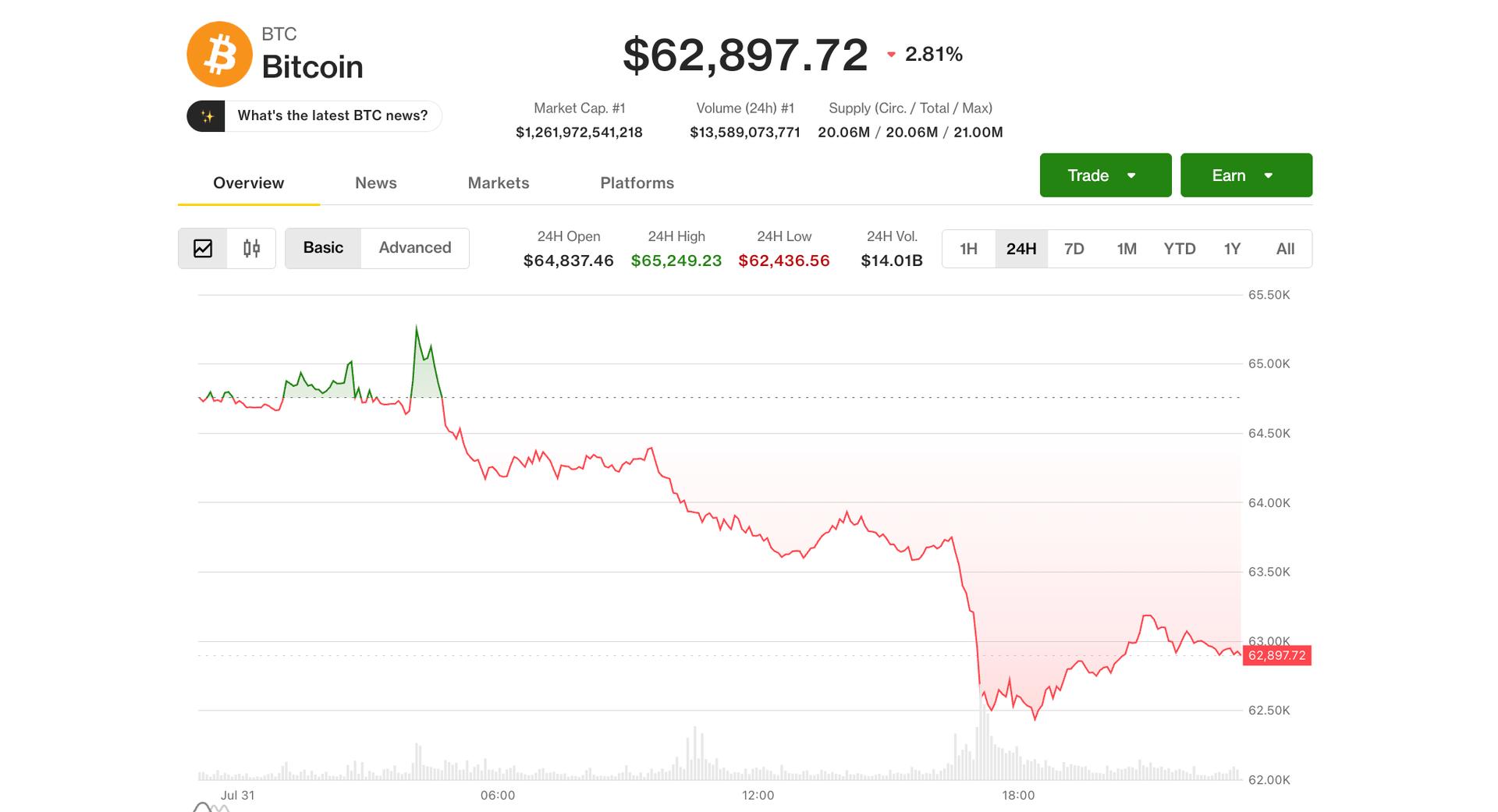
Bitcoin (BTC) fell to its lowest levels in over two weeks on Friday as US stocks saw pressure into the monthly close.
Key points:
- Bitcoin approaches $62,000 as daily losses hit 3.5%.
- US stocks saw no positive reactions to relief in Asia, where stocks rebounded after the semiconductor sell-off.
- Analysis warns that Bitcoin bear-market history should continue to repeat in August.
Bitcoin price targets $62,000 in month-end volatility
Data from TradingView showed BTC/USD falling 3.5% to reach $62,369 on Bitstamp, a level last seen on July 14.
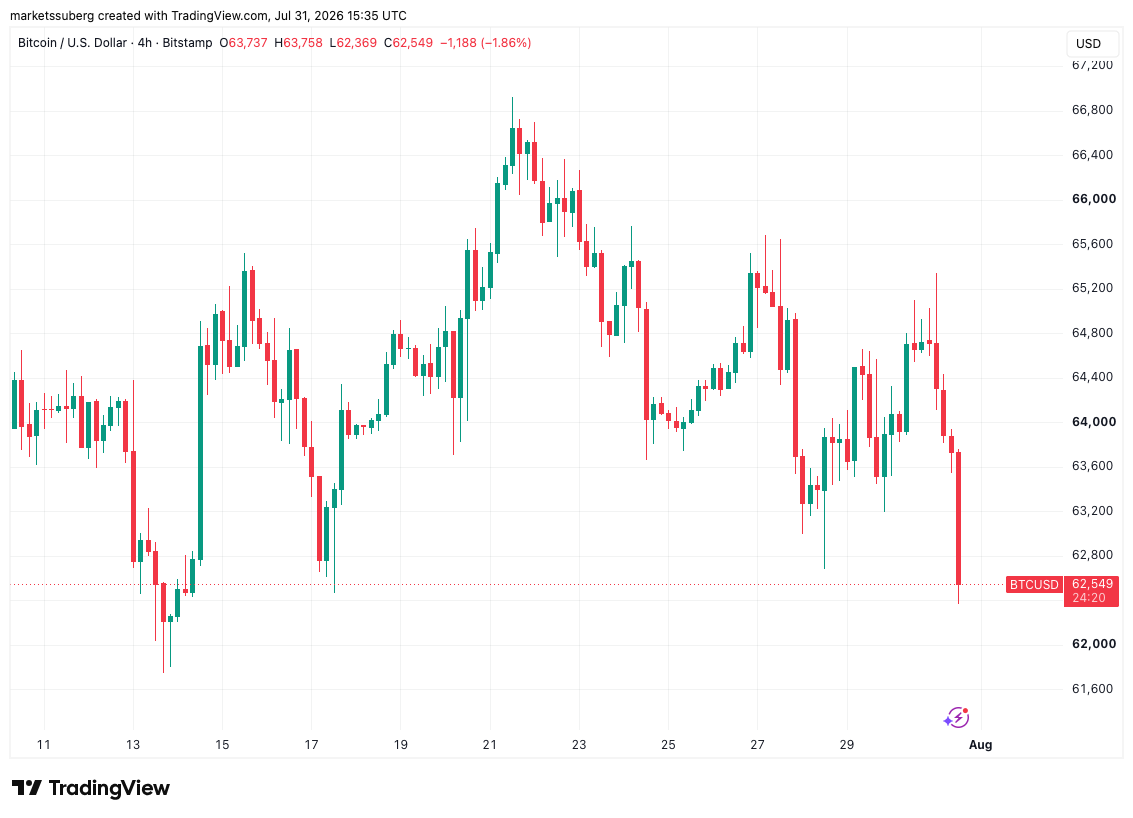
BTC/USD one-hour chart. Source: Cointelegraph/TradingView
US stocks turned red at the open before treading water, diverging from a major relief bounce seen in Asia. There, South Korea’s KOSPI index ended the day up 17.9%, its largest single-day gain on record.
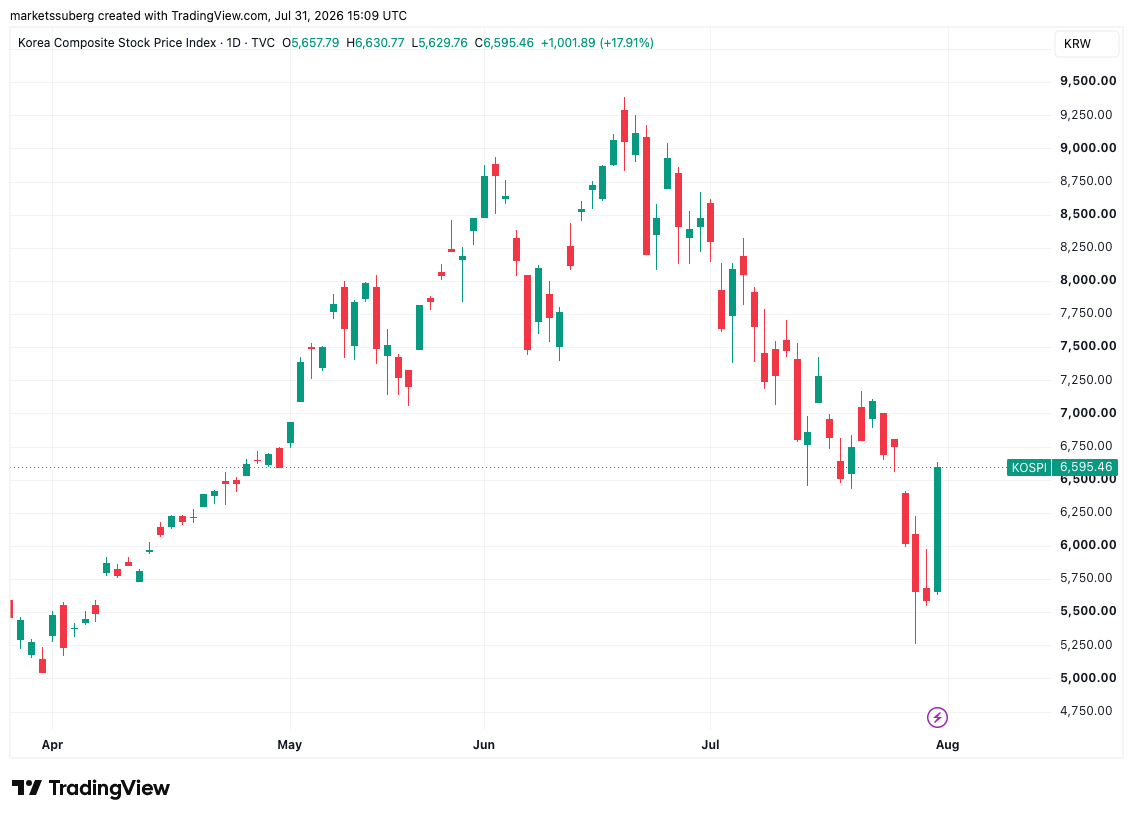
KOSPI index one-day chart. Source: Cointelegraph/TradingView
“Semiconductor shares led both the sell-off and the subsequent recovery, reflecting the index’s high exposure to the global AI and memory-chip cycle,” trading company QCP Capital wrote in commentary on the latest macro market moves.
QCP noted that crypto market trading activity increased around the KOSPI gyrations, something it said “highlighted the growing relationship between crypto liquidity, regional equity positioning and broader technology-sector sentiment.”
Both Japan and Korea reportedly engaged in currency interventions on Thursday, while Japan’s central bank kept benchmark interest rates at 1.0%, following the US Federal Reserve’s decision to stand pat on Wednesday.
Bitcoin traders see bear-market history repeating in August
BTC/USD approached the end of the monthly candle up 8.5%, marking its strongest July performance since 2022, per data from CoinGlass.
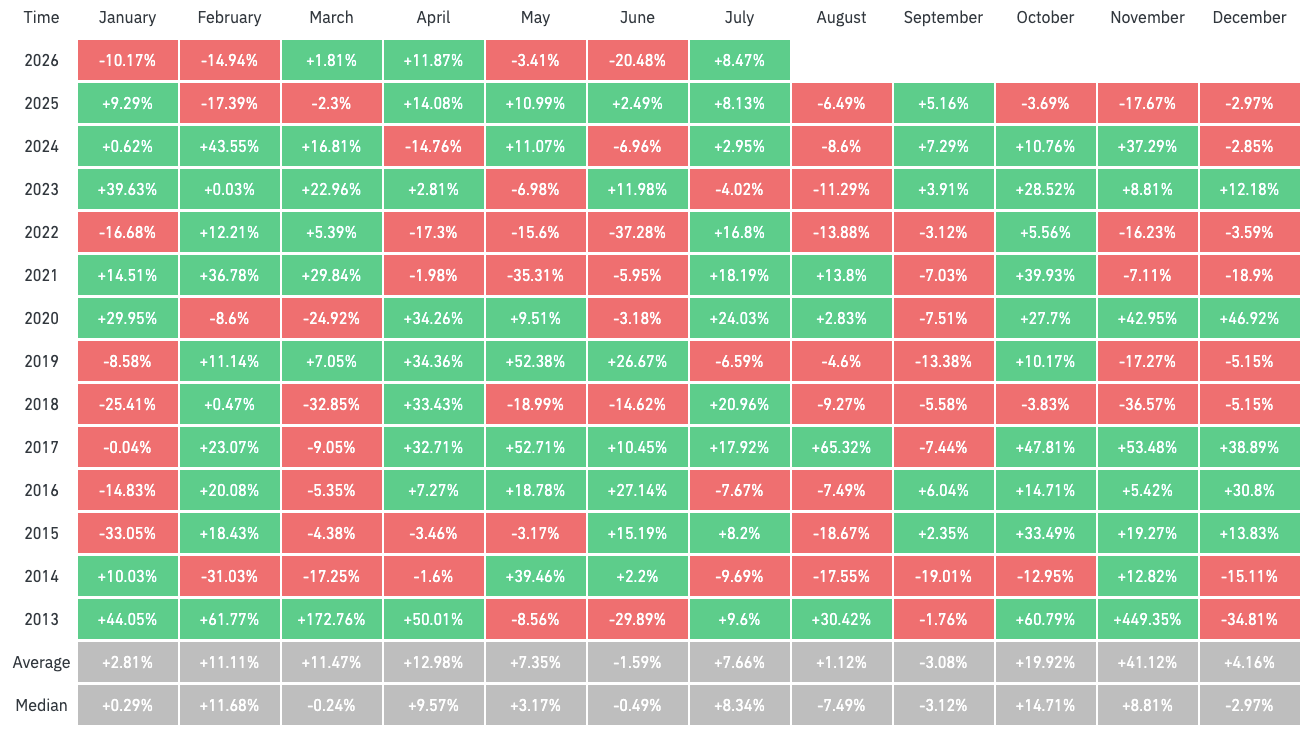
BTC/USD monthly returns (screenshot). Source: CoinGlass
Related: Here’s what happened in crypto today
Previously, traders had anticipated a relief bounce for the pair lasting until August, mirroring the 2022 bear market and ultimately reaching its next long-term bottom.
Trader and analyst Rekt Capital, among those seeing BTC price action copying bear-market moves from four years ago, forecast that the tide might not turn immediately.
“It’s likely price will try to maintain these highs in the early stages of August but history suggests price could rollover just like it did in 2022,” he wrote in a post on X on Friday.
Rekt Capital reiterated that Bitcoin’s 50-month exponential moving average (EMA), currently at $65,820, continued to act as resistance after two failed breakouts since mid-June.
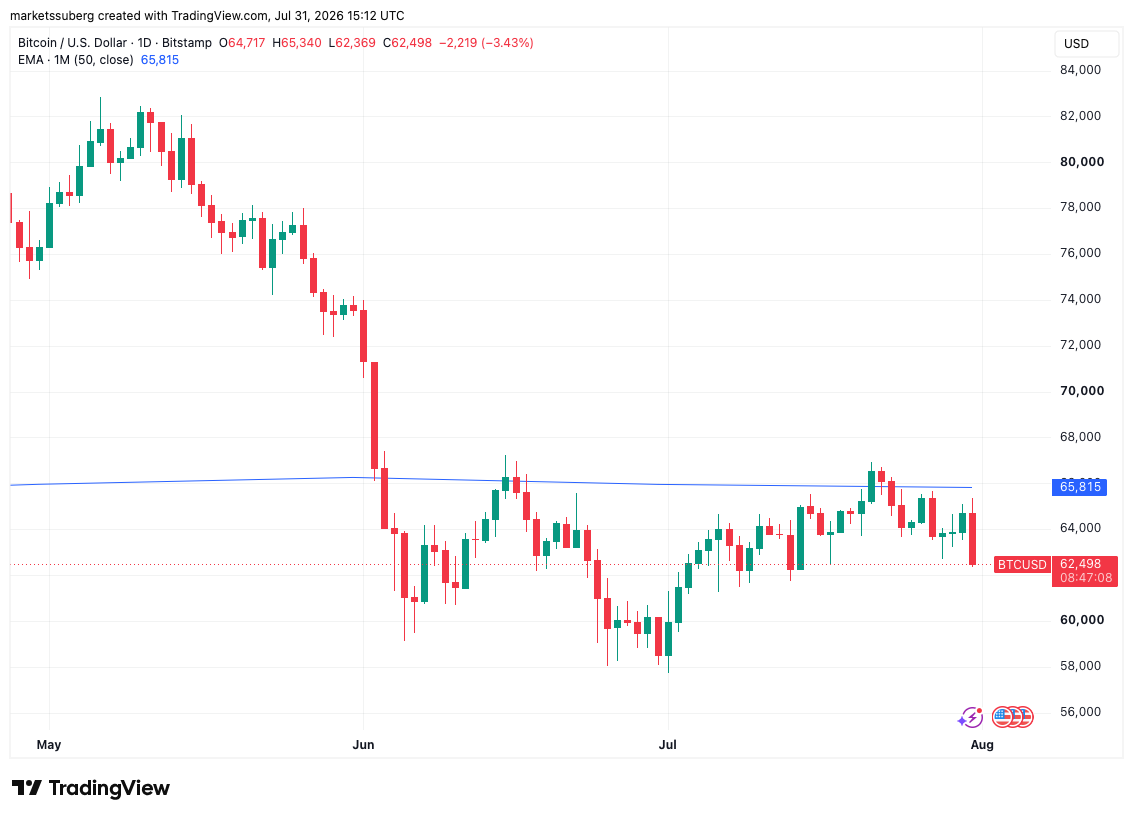
BTC/USD one-day chart with 50-month EMA. Source: Cointelegraph/TradingView


Bitcoin price fell below $63,000 on Friday as a short-lived rebound in Asian semiconductor stocks faded, adding pressure as the cryptocurrency entered its historically weak August trading period.
Summary
- Bitcoin price dropped 3% in 24 hours, extending its weekly loss to about 2%.
- Samsung and SK Hynix surrendered momentum after surging roughly 25% on Thursday.
- Bitcoin’s median August return stands near negative 8%, placing $58,000 in focus.
- The Crypto Fear & Greed Index fell to 25, signaling “Extreme Fear.”
Bitcoin price falls below $63K as risk assets weaken
Bitcoin traded below $63,000 after losing approximately 3% over the previous 24 hours. The decline followed renewed weakness in Asian technology shares, particularly companies tied to the artificial intelligence and semiconductor sectors.
Ethereum fell 2.8% to around $1,860, while Solana declined 2% to approximately $73. XRP traded near $1.06 as selling spread across large-cap cryptocurrencies.
The pullback came one day after Samsung Electronics and SK Hynix rallied roughly 25%, helping South Korea’s KOSPI recover from a steep multiweek decline. That rebound initially suggested investors were returning to semiconductor stocks following heavy selling.
Momentum failed to carry into Friday, however, raising concerns that Thursday’s advance was a temporary relief rally rather than the start of a sustained recovery.
Why faltering AI stocks are weighing on crypto
Crypto assets and AI-related equities have increasingly traded as part of the same risk-sensitive market. Both sectors rely heavily on speculative capital and tend to weaken when investors reduce exposure to high-valuation assets.
Recent pressure on semiconductor stocks has centered on questions about whether AI infrastructure spending can continue at its current pace. Investors are also examining whether future demand for memory chips and computing hardware can support valuations reached during the AI investment boom.
Those concerns are not directly related to Bitcoin’s network or adoption. However, broad risk reduction can still affect crypto as institutional traders rebalance portfolios, reduce leverage and move funds into cash or defensive assets.
For US investors, the next moves in Nvidia and other AI-linked shares could provide an important signal for crypto sentiment. Continued losses across the Nasdaq and semiconductor sector may limit Bitcoin’s ability to recover even without a crypto-specific negative catalyst.
Extreme fear compounds Bitcoin’s August risk
Market sentiment has deteriorated alongside prices. Alternative’s Crypto Fear & Greed Index stood at 25, placing the market in the “Extreme Fear” category. The index was at 28 one week earlier.
CoinGecko category data also showed limited strength across the crypto market. Decentralized finance showed limited relative resilience, but the sector remained under pressure alongside the broader crypto market.
That flat performance suggests investors may be favoring yield-generating or market-neutral DeFi strategies over directional exposure. It does not necessarily indicate that traders expect an immediate market recovery.
Bitcoin’s entry into August adds another risk. Historical data over the past 4 years places its average return for the month near negative 10%, making August one of the cryptocurrency’s weakest calendar periods.
Thin summer liquidity can magnify price swings as participation falls. Traders may also reduce exposure ahead of a month associated with repeated losses, creating additional selling pressure through a self-reinforcing seasonal pattern.
Bitcoin price could test $58K if weakness persists
An 8% decline from Bitcoin’s current level near $63,000 would place the asset around $58,000. That area is likely to attract attention as a possible support zone if selling continues.
A break below $58,000 could expose Bitcoin to a deeper correction, particularly if weak liquidity combines with leveraged long liquidations. Conversely, a recovery above $63,000 would be an early sign that buyers are absorbing supply.
The more important test may come from outside the crypto market. A sustainable floor in AI and semiconductor shares could help restore broader risk appetite, while another sharp decline would increase the likelihood of further pressure on Bitcoin.
Extreme fear has historically appeared near favorable medium-term entry points, but it does not identify an exact market bottom. Bitcoin’s August seasonality, weak technology shares and cautious investor positioning leave the near-term setup tilted toward volatility.

But, with higher fuel prices eating into airline profits, companies are now poorly positioned to take advantage of the moment. To facilitate SAF production, airlines typically agree to long-term agreements to purchase the fuel. With high levels of geopolitical uncertainty, this is not the moment for executives to commit to a price premium without a regulatory mandate. SAF may sound nice, but it remains unaffordable.
The refiners who make SAF, on the other hand, are enjoying record profit margins. But they, too, see too much uncertainty as prices fluctuate wildly. On earnings calls this summer they say they are more focused on improving operations and executing existing plans than investing in new projects.
At a national level, the thinking should be different. SAF is more expensive, but a government can now clearly see the differential as an energy security premium as well as a sustainability advantage. It’s well worth paying to protect the country’s economy in the event of a Hormuz-like situation.
Tether generated approximately $1.5 billion in net operating profit during the second quarter of 2026 as returns from US Treasury holdings and repo operations supported its earnings.
Summary
- Tether recorded about $1.5 billion in quarterly operating profit, according to its BDO attestation.
- USDT supply reached approximately $184.6 billion, representing over 60% of the stablecoin market.
- The company reported $187.7 billion in assets and about $4.1 billion in excess reserves.
- Tether reduced secured loans by $2.4 billion while adding 14 tons to its gold holdings.
Tether reports $4.1B in excess reserves
Tether’s total assets stood at approximately $187.7 billion at the end of June, while its reported liabilities totaled $183.6 billion. The difference left the stablecoin issuer with roughly $4.1 billion in excess reserves.
The figures appeared in Tether’s latest reserve attestation, prepared by accounting firm BDO and released Friday. US government-backed securities continued to account for the largest portion of the company’s reserve portfolio.
Interest earned from that portfolio, along with returns from repo operations, provided the main source of Tether’s second-quarter profit. The company’s exposure to short-term US debt has made its earnings sensitive to Federal Reserve policy and changes in Treasury yields.
Tether also reported that the circulating supply of USDT reached approximately $184.6 billion by the end of June. Based on the company’s figures, the token controlled more than 60% of the global stablecoin market.
Gold holdings rise as secured lending declines
Tether adjusted the composition of its reserves during the quarter by reducing secured lending and increasing its holdings of physical gold.
Outstanding secured loans fell by about $2.4 billion. Tether did not provide a full breakdown of the borrowers or collateral involved in the lending reduction in the information accompanying the results.
Meanwhile, the company purchased another 14 tons of physical gold, bringing its total holdings to more than 146 tons. The increase continued Tether’s move beyond cash-equivalent reserves and into assets such as gold and Bitcoin.
Tether said its portfolio remained resilient despite sharp price swings affecting both assets during the quarter. Its Bitcoin holdings were valued at approximately $5.8 billion at the end of June.
Those positions may provide additional returns when prices rise, but they also expose part of Tether’s balance sheet to greater market volatility than short-dated US government debt.
US Treasury holdings keep Tether tied to US markets
Tether’s reserve structure gives the company a substantial connection to US financial markets even though USDT operates globally.
The company’s earnings remain heavily influenced by income from US Treasury securities and related repo transactions. Any change in US interest rates could therefore affect future profitability, even if the number of USDT tokens in circulation continues to grow.
Tether is also expanding a separate US-focused stablecoin, USAT. The token recently launched on Celo, its second supported mainnet following Ethereum.
USAT users can mint and redeem the token natively on Celo without relying on third-party bridges. Celo’s CIP-64 upgrade also allows approved ERC-20 tokens to pay network transaction fees, meaning users can use USAT for gas instead of holding a separate token.
The deployment extends Tether’s US-oriented product to a blockchain commonly used for digital-dollar payments. It also separates USAT’s expansion from the company’s larger offshore USDT business.
Tether expands infrastructure beyond stablecoins
Tether said it added more than 30 million users globally during the second quarter while continuing preparations for a full audit by a Big Four accounting firm. It did not provide a completion date for that process.
The company is also exploring tokenized capital-market infrastructure in Africa. Tether and the Nairobi Securities Exchange signed a memorandum of understanding on July 28 covering tokenized securities, blockchain-based market systems and digital asset education in Kenya.
The parties will assess whether USDT could support settlement infrastructure where Kenyan regulations allow. However, the memorandum does not authorize a tokenized security, launch a trading venue or commit the exchange to using USDT.
No pilot date, budget, or binding implementation schedule was disclosed. Future developments will depend on regulatory approval, technical assessments, and whether the exploratory agreement advances into a formal project.
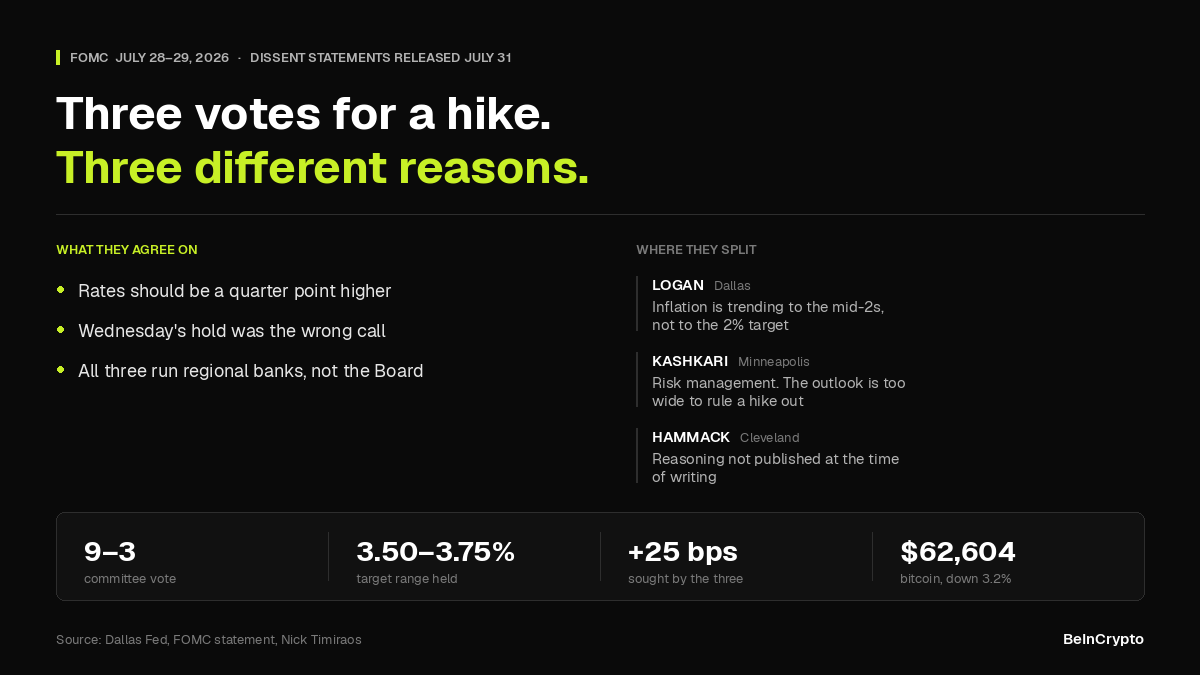
Three Fed officials voted for a rate hike on Wednesday. On Friday, they finally said why.
Their answers do not match. Each one wants higher rates for a different reason. That gap is the real story.
Why the Fed Rate Hike Vote Split 9 to 3
The Fed left rates alone on Wednesday. The target range stayed at 3.50% to 3.75%.
Three people on the committee said no. Lorie Logan of Dallas, Neel Kashkari of Minneapolis and Beth Hammack of Cleveland all wanted a quarter point rise. That made it a 9 to 3 split vote.
The vote was public straight away. The thinking behind it was not.
Chair Kevin Warsh told reporters to play the ball, not the referee. He listed what the committee had argued about. He never explained why the majority chose to hold.
The three who lost the vote have now said more than the nine who won it.
Follow us on X to get the latest news as it happens
Bond traders had already picked a side. The 30-year Treasury yield closed at its highest level since 2007 on Thursday.
Logan Says Inflation Is Stuck Near 2.5%
Logan’s case is simple. Prices have risen too fast for more than five years. Inflation is not on track to reach 2%.
Strip out one-off supply shocks and better productivity, she says, and inflation still lands in the mid-2s. The risk is that it drifts higher, not lower.
She also thinks today’s rates are not slowing anything down. Jobs look solid. So does spending.
“Without any policy restraint, inflation will likely continue to trend above target until there’s an unanticipated shock. The FOMC cannot count on unanticipated shocks to achieve its goals and can always adjust policy if unanticipated shocks occur,” Logan, statement.
Her fix is small and early. A quarter point now beats a bigger move later.
Same Vote, 3 Different Reasons
Kashkari is not making Logan’s argument. Instead, BeInCrypto reads him as a risk manager. He wants tighter policy because the outlook is so uncertain, not because inflation is proven to be stuck.
Hammack is the third vote. Her own reasoning had not been published at the time of writing.

Here is why that matters. One shared argument is easy to answer. Three separate arguments are much harder. It looks like the Fed family feud Warsh once said he wanted.
Crypto has already turned. Bitcoin (BTC) rose after Wednesday’s hold. It has since dropped back, trading near $62,600 on Friday, down 3.2% in a day.

September brings the next meeting. If oil climbs again, the three may not need to win the argument. They may just need one more vote.
The post 3 Fed Officials Just Explained Their Rate Hike Vote: Is Inflation Winning? appeared first on BeInCrypto.
Quantum computers could one day break Bitcoin (BTC), yet the same physics could also build money that is impossible to forge. Two experts argue that quantum money, not the blockchain, may be the final form of digital cash.
Stefano Gogioso and Daniela Herrmann made the argument during the latest BeInCrypto Experts Council. Their case rests on an idea older than crypto itself, and on a single law of physics.
Money Has Always Been a Story About Trust
A companion analysis asked when quantum computers might break Bitcoin. This piece asks the opposite question. What if the same technology builds something better than the money we use today?
The answer begins with a line from Gogioso that reframes the debate. Consensus, he says, is “the last middleman.”
To see why, it helps to trace how money lost its trust in the first place.
Physical cash needs no middleman. A gold coin proves itself, and a buyer does not have to trust a bank, a ledger, or a network to accept it. Cash, however, cannot travel down a wire.
Digital money solved distance, but it brought the middlemen back. Every online payment now trusts an intermediary to confirm that the same unit is not spent twice.
Bitcoin answered that problem by replacing institutions with math and consensus. Thousands of computers agree on one shared history, so no central party is needed.
The idea of using physics instead of trust, however, is older than Bitcoin. It is older than the modern internet.

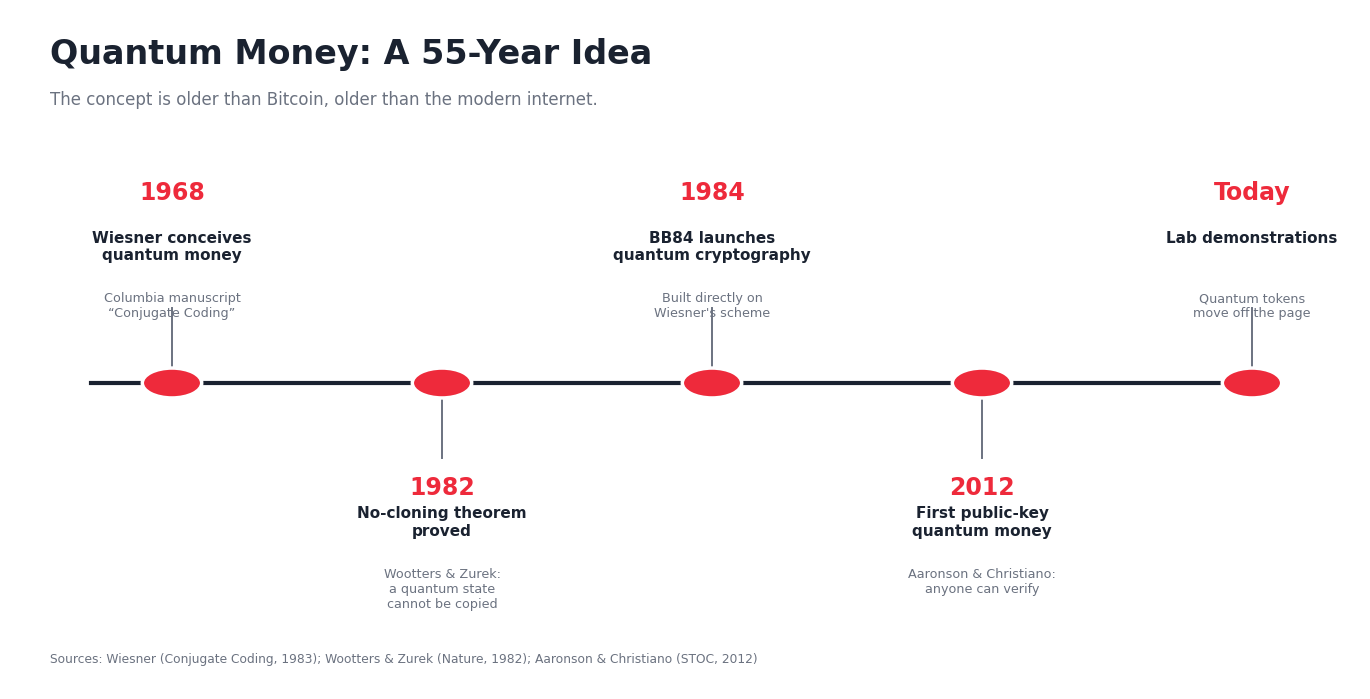
In the late 1960s, a Columbia University graduate student named Stephen Wiesner wrote a manuscript called “Conjugate Coding.” Journals rejected it, and it stayed unpublished until 1983.
Wiesner proposed money that could not be counterfeited, protected by physics rather than by a bank. It was the first real use anyone had imagined for quantum information.
That work later inspired the 1984 protocol known as BB84, which launched quantum cryptography. In effect, the whole field grew out of an attempt to make unforgeable money.
Security From Physics, Not Secrecy
Classical cryptography rests on hard math problems. A code stays safe because solving it would take too long. Quantum cryptography works on a different footing.
Its guarantee comes from a physical law called the no-cloning theorem. Physicists William Wootters and Wojciech Zurek proved it in 1982. An unknown quantum state cannot be perfectly copied.
The mechanism is elegant. Any attempt to copy the state disturbs it. The forgery fails, and the tampering shows.
Gogioso has spent years turning that law into working tools. At an earlier BeInCrypto interview in Naples, he described keys that defend themselves. If someone intercepts a quantum key, it is destroyed in transit, and the receiver sees the protocol break.
On the Council panel, he pushed the idea to its limit.
“You can build applications that do not need to trust the very hardware they run on. You can literally commission the hardware from your attacker, and as long as the application passes its self-testing, you are guaranteed security. Worst case, it simply refuses to run. And this is provably impossible classically.”
Specialists call this device-independent cryptography. The security holds even if the manufacturer is hostile. That property matters because complex hardware is exactly where backdoors tend to hide.
Why Unforgeable Keys Become Money
The step from security to money is short. Cheating and forgery are the same problem in different words.
If you cannot copy a quantum state, you cannot counterfeit it. And a thing that cannot be counterfeited can serve as money.
Gogioso drew the line directly.
“A different way of saying you cannot cheat is saying you cannot copy or forge. From the very same family of techniques, you get quantum money, or quantum financial instruments. New ways of doing digital finance with far fewer trust assumptions on intermediaries, networks, and counterparties.”
His team has already built the smallest version of the concept. In Naples, he demonstrated keys that work only once. To spend one, you have to destroy it, which stops an attacker from replaying an old payment.
A single-use key is a tiny piece of unforgeable value. Scale that principle up, and you reach what researchers call quantum money.
The theory is not new. In 2012, Scott Aaronson and Paul Christiano proposed the first public-key quantum money scheme. It lets anyone verify a note, not only the bank that issued it. Their framing echoed Wiesner almost exactly, describing money that cannot be counterfeited according to the laws of physics.
Quantum Money and the Last Middleman
Now the pieces meet. Bitcoin removed the banks, but it did not remove trust. It shifted that trust onto a network and a shared ledger. Something still has to agree on which payments are real.
Gogioso views that agreement as the final intermediary. Web3 and zero-knowledge tools clawed back some of the trust that digital money gave away, he says, yet consensus still does the last job of preventing forgery.
That job carries a cost. Consensus demands coordination, energy, and a crowd of participants who must broadly agree. A physical guarantee needs none of those things.
Quantum money, in his telling, removes the middleman completely.
“Quantum money is the next and final evolution of that story. You recover something digital that you can transact at a distance, but without trusting intermediaries, global ledgers, or someone deciding which transactions go into an Ethereum (ETH) block. The physics gives you the unforgeability directly. In that sense, consensus is truly the last middleman.”
The claim is large, so it is worth stating plainly. If it holds, quantum money would be to Bitcoin what Bitcoin was to the bank.

There is a symmetry worth noting. The physics that threatens Bitcoin’s signatures is the same physics that could retire the need for consensus altogether.
The One Defense That Survives Smarter Attackers
There is a further reason the timing matters. Artificial intelligence is getting better at breaking things.
Most security today assumes the attacker is not clever enough, or that a problem is simply too hard to solve in time. Gogioso argues that this assumption looks fragile in an age of capable AI.
Physics offers a different kind of promise.
“What quantum really buys you is security based on the laws of the universe. It doesn’t matter how smart the AI is. You can’t break it. Worst case, you can stop it from happening, but you cannot forge it.”
That is the deeper appeal of the approach. A quantum guarantee does not depend on the attacker’s limits. It depends on the structure of reality, which no amount of intelligence can rewrite.
Quantum Money: Not Here Yet, but Within Reach
Both guests were careful not to oversell the idea. Herrmann, whose firm builds commercial quantum tools, marked the boundary clearly.
“Quantum money is the vision, once this all plays out. Right now, quantum money as such isn’t available yet. But as soon as the chips advance, these things have to be handled with real responsibility.”
The main obstacle is quantum memory. Holding a fragile quantum state is difficult, and today the best systems keep one for only seconds. Gogioso has said that the limit still puts full quantum money out of reach, though the same hardware already suits short-lived tasks.
Even so, the direction is set. Laboratory experiments have begun to demonstrate quantum tokens and related schemes, moving the idea off the page.
Gogioso closed the panel on that note.
“Within five, six, seven years we could live in a world where we use quantum resources to do things that are provably impossible today. Not just hard, not just slow, actually impossible. And this is software we can start building today, not in five years. The future is absolutely within reach.”
More than half a century after Wiesner sketched money that physics itself would guard, the idea is finally leaving the whiteboard. If Gogioso and Herrmann are right, the last middleman may not survive the decade.
The post Consensus Is the Last Middleman: The Case for Quantum Money appeared first on BeInCrypto.

Now, younger generations entering the workforce are less drawn to big companies than the generations prior. They factor in wellness outside of work in addition to salary. “They really care about their family, life issues; whether their work will be valuable to their own life. In that sense private companies might be a better place because they can design their own purpose,” Lee says. In this trend, they may also be interested in alternative organization structures like employee-owned companies or worker cooperatives, which have been growing in popularity, with the federal government even encouraging more employers to adopt such models. Southern staple Publix (no. 9) and warehouse chain WinCo (no. 10) are both employee-owned through an Employee Stock Ownership Plan (ESOP).
“Usually, employee-owned companies have higher productivity, their revenue growth is usually 3-4% higher than other companies, and then their quit rate is about a third of other companies,” Lee says. “These numbers always show that employees are very actively engaged in their own company, because their perspective is more long term. … These are motivational incentives for employee owners to make their companies better, and perform better, and that could impact their retirement.” On the other hand, worker cooperatives benefit from “a lot of diverse opinions and comments and insight that really makes their corporate strategy different than other competitors,” Lee says.
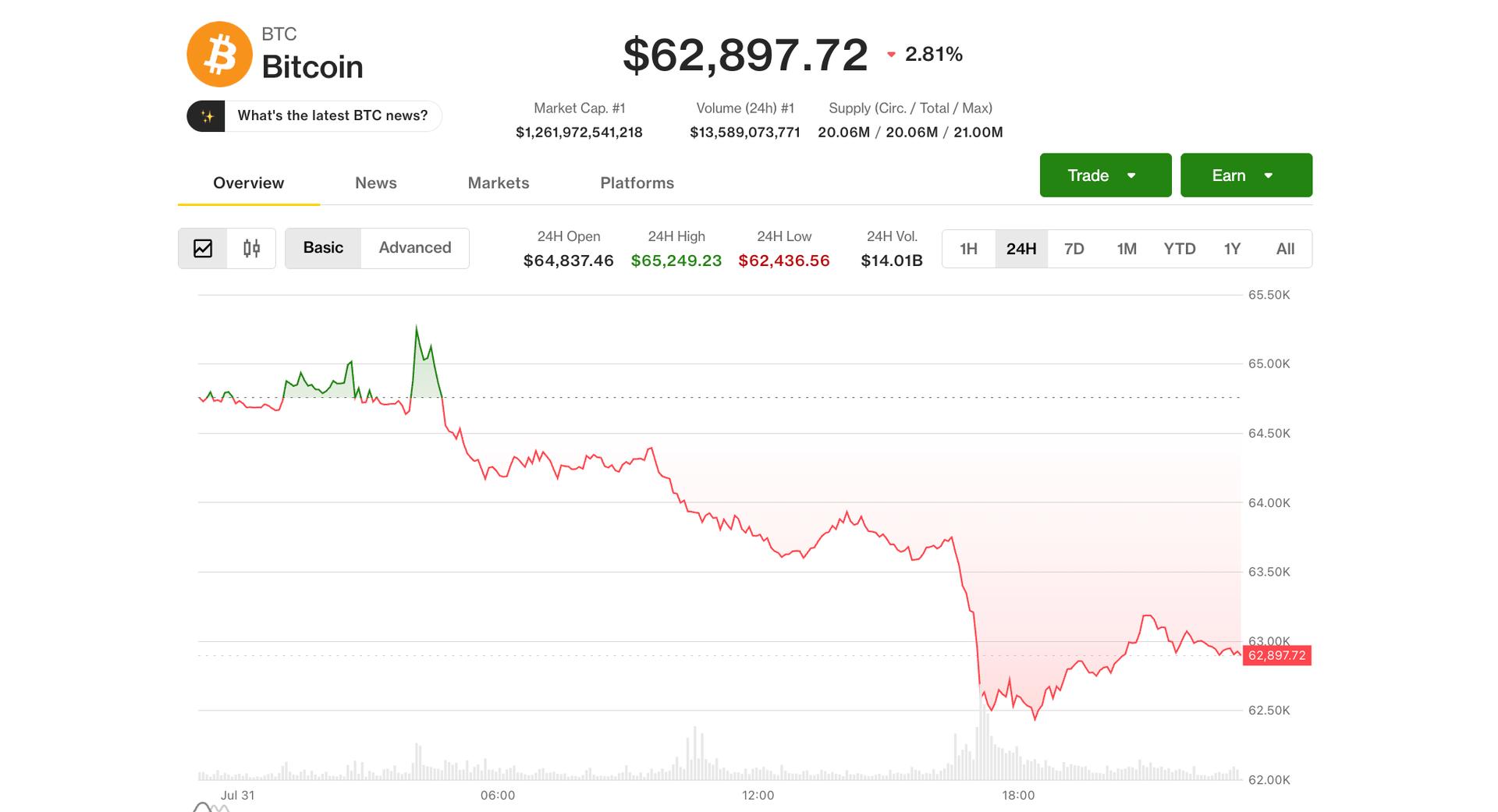
Since then, average daily liquidations have remained well below this year’s typical $400 million-$500 million range, suggesting there has been little forced selling despite the macro shock, according to Bitfinex.
“Crypto fell less than levered equity themes because the forced-selling fuel was already spent,” the analysts wrote.
Security concerns linger
Separately, the market is also digesting the fallout from a major exploit involving Coldcard, which resulted in at least $38 million worth of bitcoin being stolen.
The incident hasn’t materially affected price action, but it marked another blowback as digital asset-related exploits have surged and reignited debate around risks of self-custody, one of crypto’s fundamental promises.
“The proceeds haven’t yet been liquidated, but the knock-on effect of this and the likelihood of liquidation will weigh on bitcoin pricing in the near term,” said Paul Howard, director at trading firm Wincent. More broadly, he said, the exploit highlights the operational risks that continue to accompany self-custody.
Read more: Coldcard’s $38 million (so far) exploit shakes faith in self-custody, may push investors to ETFs
Eyes on jobs data and ETF flows
Looking ahead, macro uncertainty remains the dominant theme.
Jeff Anderson, managing partner at STS Digital, said markets may be entering “a new volatility regime” as investors swing between expectations for rate cuts, pauses and hikes. That uncertainty, he said, is likely to keep pressure on high-beta assets such as bitcoin until the economic outlook becomes clearer.
Grayscale Investments has urged the Senate to vote on the CLARITY Act before the August recess as lawmakers face mounting pressure to resolve disputes holding up the crypto market structure bill.
Summary
- Grayscale requested a Senate floor vote on the CLARITY Act before lawmakers leave Washington.
- The bill would divide digital asset oversight between the SEC and CFTC.
- Ethics restrictions involving federal officials remain a sticking point in bipartisan negotiations.
- Treasury Secretary Scott Bessent has also called for an immediate vote.
Grayscale urges action on the CLARITY Act
Grayscale sent a letter to senators calling for action on the Digital Asset Market Clarity Act, or H.R. 3633. The asset manager said hundreds of thousands of Americans hold its digital asset investment products, giving the company and its clients a direct interest in clearer federal rules.
The bill seeks to establish a regulatory framework for digital asset markets and clarify the respective responsibilities of the Securities and Exchange Commission and Commodity Futures Trading Commission.
“Senators and staff across the aisle have spent months addressing hard questions about jurisdiction, investor protections, and developer safeguards,” Grayscale said.
According to the company, the proposed framework would strengthen investor protections while preventing legitimate blockchain developers from facing rules intended for financial intermediaries.
Grayscale argued that crypto businesses, developers and investors need stable rules instead of relying on enforcement actions and agency guidance that can change between administrations.
The company also linked the legislation to regulated crypto investment products. Clearer asset classifications and trading rules could affect the development of exchange-traded funds, exchange-traded products and other vehicles available to U.S. investors.
Senate negotiations face a shrinking deadline
Senators have limited floor time remaining before the August recess, with nominations, government funding discussions and foreign policy measures competing for attention.
Sen. Cynthia Lummis said Senate leaders were still trying to bring the legislation forward before the break. She noted that lawmakers had “one more week here in Washington,” although she acknowledged the crowded schedule.
The House passed its version of the CLARITY Act by a 294–134 vote in July 2025, with 78 Democrats supporting the legislation. Any changes adopted by the Senate would need approval from both chambers before the bill could reach President Donald Trump’s desk.
Senate negotiations have continued over ethics provisions covering digital asset activities involving federal officials. That dispute has complicated efforts to secure enough Democratic support to overcome the chamber’s 60-vote threshold for advancing most legislation.
Republicans hold 53 Senate seats, meaning the bill would likely need support from at least seven Democrats if every Republican voted in favor. Lawmakers have also considered a procedural vote that could establish the timing and rules for further debate.
Bessent adds pressure for an immediate vote
Treasury Secretary Scott Bessent has joined the campaign for Senate action, calling on lawmakers to vote “NOW” on the CLARITY Act.
Bessent accused Senate Democrats of delaying the measure under pressure from Sen. Elizabeth Warren and other crypto critics. His intervention added support from the Trump administration as negotiators worked to resolve the remaining disagreements.
Ethics enforcement has emerged as one of the main obstacles. A reported proposal from Republican Sen. Thom Tillis and Democratic Sen. Ruben Gallego would allow state authorities to enforce restrictions on federal officials issuing or sponsoring digital tokens.
The proposal would replace an earlier approach that gave the U.S. attorney general sole enforcement authority. Whether that compromise can attract enough bipartisan backing remains uncertain.
US competitiveness becomes part of the debate
Grayscale warned that prolonged uncertainty could push digital asset investment and technical talent toward jurisdictions with more predictable regulations. It cited Singapore and Abu Dhabi as markets that have established clearer frameworks for crypto businesses.
The argument reflects a broader industry effort to frame market structure legislation as an issue of U.S. competitiveness. Supporters say federal rules would give companies more certainty when deciding where to develop products, raise capital and serve customers.
No clear cryptocurrency price movement has been directly linked to Grayscale’s letter. Traders remain focused on whether Senate leaders formally schedule a vote and whether negotiators reach an agreement on ethics restrictions.
Failure to act before the recess would push the debate further into the legislative calendar, where other spending and policy deadlines could make floor time harder to secure. A scheduled vote would signal that Senate leaders believe the bill has enough support to move forward.

UNI rose 13% over the past 24 hours and reached $4.54 – a level not seen since January this year. The latest rally has lifted the asset’s gains over the past month to 60%.
The move came as Uniswap announced Launches in beta, a new tab on its Web App for discovering top token offerings. For now, Robinhood Chain is the first network featured in the new tab, but more networks are expected to be included.
New Tab Debuts
Uniswap said launchpad builders such as Bankr, Pons, Long, and others are using the platform as their trading infrastructure. The company added that Launches will give these projects more distribution. The feature currently includes token releases on Robinhood Chain, with more to come.
According to the platform’s stats, more than 340,000 new tokens launched into Uniswap across Robinhood launchpads in July alone. These collectively generated $3.6 billion in trading volume.
The new Launches tab pulls tokens from top launchpads into a single feed. Users can filter these or sort by 24-hour volume, liquidity, recently debuted, or trending.
The burn was another notable development for UNI this week, as 106,000 units were destroyed on July 29. That comes as the protocol faces renewed debate over its v4 fee structure. Some community members raised concerns that protocol fees could reduce returns for liquidity providers and push liquidity toward competing exchanges.
Uniswap founder Hayden Adams pushed back against what he called the “FUD and misunderstanding: around the changes. He said the new protocol fees are additive, meaning liquidity providers would continue earning the same 30 basis points on a 30bp pool. He also rejected claims that the protocol would take 25% of LP profits, and explained that a 5bp protocol fee on a 30bp pool amounts to about 14% of total swap fees, not LP earnings that already existed.
Adams also argued that the 5bp fee is significantly lower than the 100-200bp fees charged by centralized exchanges.
Zooming Out
The protocol has also been caught up in a wider wave of crypto scams targeting users through fake websites. Earlier this year, a fake Uniswap website was draining funds from crypto wallets. Experts warned that scammers had stolen at least $400,000. Users were advised to use only official links and verify protocols through DeFiLlama.
The warning followed a broader report from security group SEAL, which found a sharp rise in malicious Google Ads targeting crypto users. SEAL blocked more than 356 malicious ad URLs tied to scams impersonating Uniswap and other major platforms.
Interestingly, Uniswap was the most impersonated, as it accounted for 41% of tracked malicious sites. Losses linked to the campaigns exceeded $1.27 million between March 13 and March 30.
The post UNI Just Hit a 6-Month High as Uniswap Rolls Out New Token Discovery Tab appeared first on CryptoPotato.

Bitcoin Slumps into July Close as Analysts Warn of Bear-Market Repeat

Claressa Shields Sends Heated Message After Interview

Boxer didn’t win any fights at the Commonwealth Games. He still left with a


-
 Sports5 days ago
Commonwealth Games boxing: Jadumani Singh seals dominant 5-0 win over Pakistan’s Sumama Rehman to enter quarter-finals | Commonwealth Games News
-

 Business2 days ago
Why Trees Belong on the Risk Register
-

 Tech5 days ago
Intel is reversing course and bringing hyper-threading back to its server chips
-

 Fashion4 hours ago
Weekend Open Thread: Wit & Wisdom
-

 Crypto World6 days ago
Ripple bought a bank in pieces. The $4 billion audit
-

 Politics4 days ago
Luke Littler dismantles Gerwyn Price to retain title in Blackpool
-

 Politics4 days ago
The Part of the Electric Transition Nobody Wants to Discuss
-

 News Videos5 days ago
BITCOIN JUST ENTERED THIS CRITICAL ZONE…
-
 Entertainment3 days ago
‘Stargate’ Creator’s New Sci-Fi Series Returns for Season 3 Tomorrow
-

 Crypto World6 days ago
XRP Ledger adds $2.6B as RWA inflows rank second
-

 Business3 days ago
Major shareholder moves on Canyon
-

 News Videos1 day ago
Bitcoin Enters the 3rd Stage of the Bear Market
-

 Politics5 days ago
Spain sweeps the board at 2026 World Cup with individual awards
-
 Entertainment6 days ago
Sara Gilson Killed By Husband After Viral “Pedophile” TikTok Video
-

 Crypto World3 days ago
Kraken Enables Retail Access to Jersey Mike’s IPO via Tokenized Shares
-

 Tech7 days ago
Anthropic launches Claude Opus 5, a cheaper AI model for coding, agents and enterprise workflows
-

 Tech4 days ago
New macOS Sequoia & Sonoma security updates for older Macs
-

 News Videos3 days ago
Claude: Build Financial Dashboards in Minutes (2026)
-

 Politics1 day ago
Luke Littler’s dominance sparks GOAT debate
-

 Crypto World6 days ago
Upbit expands KRW market with two major DeFi token listings
You must be logged in to post a comment Login