Connect with us

Tech

Here’s Where You Want To Be To See The 2026 Solar Eclipse

Published

on

If you want the best view, you’ll need to travel to Spain or Iceland.

The 2026 solar eclipse on August 12 is a big day for astronomy fans: not only does it mark the first total solar eclipse since 2024, it also coincides with the annual Perseid meteor shower. This eclipse also stands out by being longer than usual due to it coinciding with lunar perigee, which is when the moon appears larger because it’s at the closest point in its orbit to Earth. Though not everywhere in the world will be able to experience the eclipse, many locales will get at least partial sun coverage.

While the 2024 solar eclipse centered on North America, this time around viewers in Spain and Iceland will have the best view. However, that doesn’t mean other places won’t get any glimpse of the event. Those in some parts of Canada, the United States and Europe can still see it, they just won’t be in the path of totality, which is when the moon is directly positioned over the sun, fully blocking it.

Advertisement

Where is the best place to view the 2026 solar eclipse?

The best place to be for the 2026 solar eclipse is western Iceland or northern Spain. The full eclipse will last longest in Látrabjargi, Iceland, and is also visible from Reykjavík, Isafjordur and all other cities on the western coast. However, Spain is arguably the best location if you’re looking for prime eclipse viewing. The eclipse’s path crosses much more land in Spain than it does in Iceland, meaning more likelihood of a good viewing spot, and Spain’s weather tends to be 20 to 30 degrees warmer than Iceland in August.

In Spain, Bilbao, Burgos, Palma, Santander, Valencia, Valladolid and Zaragoza will have a full view of the eclipse A small sliver of Portugal at the northeast border, specifically Montesinho Natural Park in Bragança, will also be in the line of totality. There are a few other spots across Russia and Greenland that will experience a total eclipse, but they’re quite remote and difficult to get to without a specialized expedition.

For those in North America, the partial eclipse will mostly be visible in northern parts of the United States and the eastern part of Canada, and the amount of coverage over the moon vastly varies. Some locales like New York City will only see 9 percent coverage, while others like St. John’s in Newfoundland will have 53%. Below you can find a list of locations, their peak eclipse viewing time, and the amount of coverage. If you’d like to know a time even more specialized to your location, Time and Date has a complete collection of cities.

Advertisement

Location

   Peak Eclipse Time

   Obscuration

León, Spain

Advertisement

   8:33 PM CEST

   100%

Valencia, Spain

   8:32 PM CEST

Advertisement

   100%

Reykjavík, Iceland

   5:48 PM GMT

   100%

Advertisement

Anchorage, AK

   8:21 AM AKDT

   28%

Boston, MA

Advertisement

   1:55 PM EDT

   16%

Chicago, IL

   12:28 PM CDT

Advertisement

   0.1%

New York City, NY

   1:54 PM EDT

   9%

Advertisement

Philadelphia, PA

   1:53 PM EDT

   7%

Portland, ME

Advertisement

   1:53 PM EDT

   19%

Washington, D.C.

   1:53 PM EDT

Advertisement

   4%

Edmonton, Canada

   10:38 AM MDT

   6.5%

Advertisement

Montreal, Canada

   1:45 PM EDT

   18%

St. John’s, Canada

Advertisement

   3:35 PM NDT

   53%

Toronto, Canada

   1:40 PM EST

Advertisement

   8%

Winnipeg, Canada

   12:02 PM CDT

   5%

Advertisement

Dublin, Ireland

   7:10 PM IST

   94%

London, England

Advertisement

   7:13 PM BST

   91%

Madrid, Spain

   8:32 PM CEST

Advertisement

   99%

Paris, France

   8:17 PM CEST

   92%

Advertisement

How to be safe during an eclipse

It’s only ever safe to look directly at a solar eclipse during the brief period of totality; doing so at any other time can cause severe, irreversible eye damage. Since there won’t be a full eclipse anywhere in the US, everyone in the country who wants to watch will need to wear eye protection the entire time. Utilizing things like sunglasses or binoculars will not work for eye protection — even the smartest of sunglasses won’t save your eyes.. Instead, those aiming to look directly at the eclipse will need to utilize specialized eclipse glasses or solar viewers. If you want to take pictures of the eclipse, you’ll also need to protect your lens with a special cover. The American Astronomical Society offers a handy list of all approved products, so you can be sure you’re getting adequate eye protection.

Alternatively, it’s very easy to create indirect viewers. The most common is a pinhole projector, a simple device with crafting directions offered on the official NASA website. Alternatively, you can use any household objects with small holes — a colander is a popular choice — or even your own hands in a criss cross pattern to view the eclipse. With your back to the sun, let the light pass though the holes and onto another surface like a wall or the ground, and you’ll see an outline of the eclipse.

Advertisement

Source link

Continue Reading
Click to comment

You must be logged in to post a comment Login

Leave a Reply

Tech

A Marc Benioff-backed startup thinks AI can solve the AI deployment problem

Published

on

It’s so hard for big businesses to get AI tools working reliably that whole new organizations of forward-deployed engineers or FDEs— specialists who drop into a company to get its AI systems up and running — are springing up to help them.

“AI, paradoxically, increases the demand for professional services,” says Efrat Rapoport, a former Salesforce executive whose new company, June, emerged from stealth Monday morning. “The industry’s answer to AI implementation is, ‘let’s hire more and more and more people.”

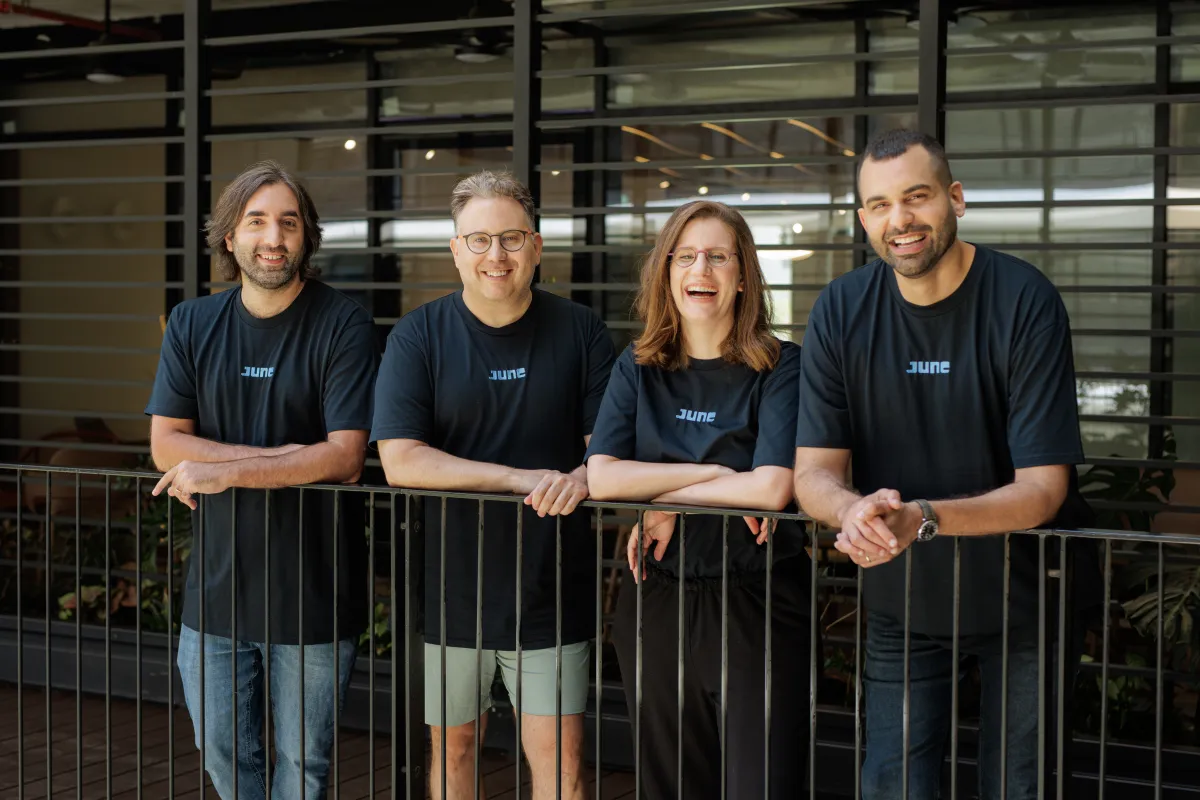
Rapoport and her three cofounders — Ohad Hen, Barak Goldstein, and Idan Tsitiat — have a different idea about how to bring AI into broader use. To pursue it, the company raised $20 million in pre-seed funding led by Marc Benioff’s Time Ventures, with additional backing from tech luminaries like Michael Dell, Aaron Levie and George Kurtz. The company declined to share its valuation.

The four founders previously started Bonobo AI, a pre-transformer language model company that launched a voice-to-text service in 2017. Bonobo AI was snapped up two years later by Salesforce, and the team worked for several years on the tech giant’s AI initiatives before setting out on their own again after watching customers struggle to bring AI into their existing platforms.

Advertisement

Their potential was clear enough to their investors, Rapoport says, that “we didn’t even have a deck for this raise.”

While the so-called SaaSpocalypse has software firms fearing that AI might replace them, thus far no one is vibe-coding a CRM for a Fortune 500 company. Any AI model brought into a corporate setting still has to work with Salesforce, ServiceNow, DataBricks, Workday, or any of a dozen other data-management platforms.

“Before AI can create value, someone has to deal with legacy systems,” Rapoport says. “You have fragmented data across these platforms. You have complex workflows. You have years of technical debt.”

Building an agent template is the easy part, she says. The hard part is getting it to work with the mess underneath. “How does an agent know how to operate when you have 10 duplicate [database] fields that say the same thing, and different teams are using them?”

Advertisement

June’s platform scans a company’s existing systems to understand its business processes, find bottlenecks, and then build more optimized, agent-powered processes to replace them, automatically notifying teams through the company’s comms channels.

“We give you the full roadmap automatically of what needs to happen step by step for you to actually implement this agent successfully in an enterprise environment, which is often very complex,” Rapoport said. “We give you a step by step guide. ‘Remove these duplicates. Connect to this data source.’ And then you click on ‘build’ on each task, and June starts building it for you in the organization.”

Paul Akinmade, chief strategy officer at CMG, a major U.S. mortgage lender, moved his company’s software engineering over to Claude Code quickly, but hit roadblocks trying to integrate it with Salesforce. That was a problem since he’d promised at Salesforce’s annual conference the year before that he’d return with 100 agents running, and it wasn’t looking like he’d hit that target.

Akinmade says his team spent weeks hitting a wall — meeting with architects, talking to forward-deployed engineers, consulting everybody they could — without making progress. June changed that, he says, giving his team a clear view of where to deploy agents and letting them do so safely, even before the official kickoff call between the two companies

Advertisement

Rapoport sees June as a tool that complements FDEs and consultants, but her customers may be drawn to it for the opposite reason: it lets them avoid FDEs altogether.

When Akinmade was first considering piloting the tool at CMG, he says he told her: “If your product requires FDEs, I don’t want your product. I’ve already I’ve already done that and I’m getting annoyed by it. I don’t want a black box. I don’t want something only certain people can figure out. I want an easy-to-use tool.”

Evidently, June cleared the bar.

When you purchase through links in our articles, we may earn a small commission. This doesn’t affect our editorial independence.

Advertisement

Source link

Continue Reading

Tech

MacBook Air Laptops Are Reportedly In Short Supply Due To Ramaggedon

Published

on

Apple is also prioritizing the 14-inch MacBook Pro over the MacBook Air.

Not only did MacBook Air prices recently go up from $1,099 to $1,299, but you couldn’t get one today even if you wanted to. Apple’s popular, lightweight model is currently in such short supply that if you order one today, you won’t receive it until the end of August, retail sources told Bloomberg‘s Mark Gurman. Unusually, Apple is even pushing buyers toward another model. 

“Across its website and retail stores, Apple is prominently steering customers toward the base MacBook Pro instead of the Air — something it has rarely, if ever, done,” Gurman wrote. “In some marketing materials, it even includes a warning: ‘MacBook Air subject to availability.’”

Normally, Apple has no problems making enough MacBooks to feed demand, but these aren’t normal times. The MacBook Air shortage is linked in part to the ongoing “Ramageddon” memory crunch caused by the insatiable demand from new AI data centers. Apparently, Apple is also prioritizing the 14-inch MacBook Pro over the MacBook Air in order to clear stock ahead of an M6 refresh for the former lineup, according to Gurman. 

Advertisement

Though Apple beat Wall Street expectations for its last earnings report, the company warned investors and buyers that supply constraints could impact earnings next quarter and force it to further raise prices.  At the same time, the new Apple Upgrade program introduced last week may drive higher demand for Apple products including its MacBook lineup. 

Source link

Advertisement
Continue Reading

Tech

30 top-paying jobs for under-30 year-olds in S’pore

Published

on

Disclaimer: Unless otherwise stated, any opinions expressed below belong solely to the author. Data sourced from Singapore’s Ministry of Manpower.

As we know, the median salary for fresh graduates in Singapore is currently S$4,500, while the figure for the entire workforce is S$5,775. However, there are some jobs that pay their young workers much better—if not straight out of school, then at least before they hit 30.

According to the data from the Ministry of Manpower, there are 30 occupations where median salaries for workers between 25 and 29 years of age are already above the national average.

S$100,000 by age 30

The list is, unsurprisingly, dominated by jobs in the tech sector (10 occupations) and finance (nine occupations), with the rest divided among medicine, management, law, and design.

Advertisement
Rank Occupation Median Monthly Gross Wage (Jun 2025)
1 Artificial intelligence/ Machine learning engineer S$8,970
2 Advocate/ Solicitor (practising) S$8,800
3 ICT sales and services professional S$7,331
4 Internal medicine physician S$7,069
5 Operations research analyst S$7,041
6 Data scientist S$7,000
7 ICT service manager S$6,960
8 Cyber risk specialist S$6,929
9 Financial services manager S$6,801
10 Budgeting/ Financial accounting manager S$6,778
11 Audit manager S$6,765
12 General practitioner/ Physician S$6,707
13 Marketing manager S$6,699
14 Training/ Staff development professional S$6,614
15 Company director S$6,494
16 Management consultant S$6,400
17 Software developer S$6,400
18 Cloud specialist S$6,380
19 Fund/Portfolio manager S$6,200
20 Tax accountant S$6,100
21 Actuary S$6,085
22 DevOps engineer S$6,052
23 Product/ Industrial designer S$6,050
24 Financial analyst S$6,000
25 Customer service manager S$5,900
26 In-house legal counsel (excluding judiciary, ministries and statutory boards) S$5,834
27 Statistical officer/ Data analyst S$5,833
28 Compliance officer/ Risk analyst (financial) S$5,830
29 Interaction designer S$5,829
30 Data centre engineer S$5,798
Gross wages include the basic wage as well as any additional allowances and overtime payments./ Source: Ministry of Manpower

The boom in AI catapulted young engineers to the top, with IT companies already paying them over S$100,000 per year, outranking the usual high-earners with legal degrees.

But these earnings may see an even bigger rise in 2026, as international tech giants from the US and China are competing for local AI-graduates, with the Straits Times reporting packages worth as much as S$350,000, targeting the most qualified PhD holders.

This follows OpenAI’s S$300 million investment to establish a local AI lab, Google DeepMind’s announcement of its AI research lab last year, and Anthropic’s growing presence—both GIC and Temasek are investors in the latter.

This boom may be a boon for young talent, provided that it doesn’t lose steam and the generous offers do not turn into mass layoffs that the tech industry experienced over the past few years.

Advertisement

If that happens, though, there is hope in finding a job in one of the other occupations, which offer very good earnings to 20-somethings, putting them on track to six figure annual salaries in their 30s.

  • Read other articles we’ve written on Singapore’s job landscape here.

Featured Image Credit: Rawpixel/ depositphotos

Source link

Advertisement
Continue Reading

Tech

Tons of money, but way more grief

Published

on

In this week’s Sunday Reboot, despite Apple making more money than in any previous Q3, it’s never enough to escape a beating from investors or analysts.

Sunday Reboot is a weekly column covering some of the lighter stories within the Apple reality distortion field from the past seven days. All to get the next week underway with a good first step.

The Maddest Money

I have been covering Apple and the tech industry in general for over ten years. I have a decent understanding of how things work in many areas, but I do have some blind spots.

I have trouble understanding the logic of analysts and investors around the time of Apple’s quarterly results.

Advertisement

Every three months, the AppleInsider editorial team has to spend a few hours analyzing a PDF spreadsheet and a press release from Apple, detailing just how much money the company made this time. In painstaking detail.

Of course, that’s followed by listening to a conference call with people asking questions of Tim Cook and Kevan Parekh. Most of the time, the responses are predictably an inability to comment on future plans or reiterating something the pair mentioned 15 minutes prior.

This quarter’s periodic money talk was a bit different, as Cook gave a farewell speech ahead of the CEO transition to John Ternus.

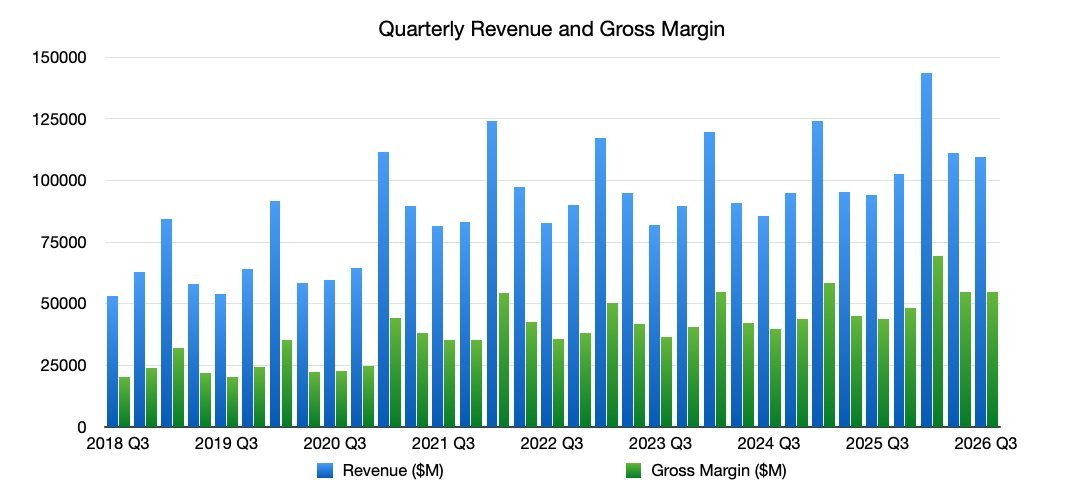
For nine quarters in a row, Apple has declared total revenue that’s a year-over-year improvement over the previous one. Q1 to Q3 2026 inclusive have year-over-year increases of around 16%.

Advertisement
Bar chart showing quarterly revenue and gross margin from 2018 Q3 to 2026 Q3, with blue bars for revenue consistently higher than green gross margin bars, both generally trending upward over time

Apple makes billions, but it’s never enough for analysts.

Despite repeatedly making more money than almost anyone would see in multiple lifetimes in a mere three-month period, the same pattern emerges.

Right after the results release and everyone sees Apple make deity-level bank, the share price goes down. Over the space of an hour, the price went down on July 30 from 338.45 at 4:30 P.M. Eastern to $308.03 at 5:30 P.M.

That could be explained as investors thinking they have done enough to earn that sweet $0.27 dividend and decided to shift their money right afterward. That, at least, I can get my head around.

Advertisement

Gordon Gekko meets Mean Girls

The real brain burner is the swathe of analysts who then decide that Apple didn’t do enough. Despite each of its units earning billions, as if they are major companies in their own right.

Goldman Sachs, after raising the price target to $370 just days before the results, cut the target by $10 after the call. Chiefly because of Apple’s guidance that it won’t meet demand for the next quarter.

You know, during a time period when people have to get a mortgage to afford more RAM.

To Cook’s credit, he said it was not a partner or supplier issue, and was simply one of “incredibly strong demand.” Apple has the nice problem to have of being too wanted by consumers.

Advertisement

Rosenblatt raised its price target by $24, which sounds good except it’s still underwater at $300. Cue complaints about the “volatile financial environment” and supply constraints.

Also for some reason, the iPhone 18 will be having a hard time because the iPhone 17 was such a huge success. Apparently, the high sales for the current generation mean there’s no one around to buy the next one.

More realistically, the problem here is that the iPhone 17 did really well compared to the iPhone 16, which means it’ll be harder for the iPhone 18 to show further improvement over the iPhone 17.

Growth is all-important to investors, even if they are blinkered to Apple having other products or revenue sources available.

Advertisement

Morgan Stanley did a similar trim of its price target as Goldman Sachs, from $364 to $360, citing higher memory costs and slowing Services growth.

Because Services only climbed a mere 12.7% instead of MorgStan’s expectation of 14.6% growth, that apparently means growth will slow to 9.5% next year.

Line chart titled Services Revenue Year-on-Year Growth, showing high growth near 45% in 2018 Q3, declining with fluctuations, then stabilizing around 10— 15% from 2023 to 2025.

The annual growth percentage of Apple’s Services arm. Still aggressively positive.

By that, Morgan Stanley believes Services will earn only $2.9 billion more revenue this time next year, when it really wants to see more than $4 billion.

Advertisement

In effect, people are somehow complaining that a company that made billions more dollars than the same time last year didn’t quite do enough. Also that it is so popular that it cannot keep up with demand, and that’s apparently equally horrific.

Then there’s JP Morgan, which also cut its price target from $345 to $340, again hammering on about the supply constraints. However, at least the analysts are realistic, pointing out that limited product availability will push revenue into later quarters, and that Services will continue to be a benefit.

It’s not as bleak as other analysts’ denouncements of Apple’s success. But it’s still a downer.

The investors and analysts probably have justifiable reasons for pointing out Apple’s deficiencies. But from here, it seems a little bit picky and weird.

Advertisement

It’s almost like they’re trying to pick any perceived fault or shortcoming to justify their salaries to investors, eager to understand Apple’s workings and to know if their investment is safe.

You may have a romanticized image of high-power investors similar to shows like “Billions” and “Succession.” Each quarter, the image that gets reinforced to me is more like “The Office” or an Aldi version of Statler and Waldorf.

I just hope that I don’t get jaded enough to downgrade that view further to “Sanford and Son.”

Last week’s Sunday Reboot talked about Apple TV moving into dating, the existence of “Matchbox The Movie,” and the hope for even more “Ted Lasso”.

Advertisement

Source link

Continue Reading

Tech

Hollywood Fights AI In Public While Quietly Building It Into Movies

Published

on

Even as Hollywood performers protest and Hollywood studios sue “in their war on AI,” reports the Los Angeles Times, “the entertainment industry is deepening its dependence on it.”

Among hundreds of job postings in late June, more than one in 10 was likely connected to AI. The top studios’ public postings suggest they have been recruiting people to build AI tools. They are also recruiting teams to defend their intellectual property against unauthorized AI use. “There are plenty of studios that are hiring [for AI] but never talk about it in public,” said Yoland Yan, a co-founder of ComfyUI, a company that helps studios juggle different AI tools. Companies have been hesitant to detail how they use generative AI in film production — partly because they are concerned about consumer and union backlash. Some in Hollywood described AI use as the new cosmetic surgery, where everyone knows it is happening, but few will admit to it…

Although some companies may be shy about sharing their AI plans, big stars who don’t have to answer to others have been more open about their embrace of the new technology for storytelling. Rejecting AI is like picking a horse and buggy over a car, said “Star Wars” creator George Lucas. “Artificial intelligence means it’s much easier for us to make movies,” he told a trade magazine earlier this year. “There’s nothing you can do about it. That’s progress. It’s the future.” Some in Hollywood have a softer stance on artificial intelligence, with studios cutting deals with AI companies, and filmmakers like Martin Scorsese backing AI companies. Ben Affleck launched an AI film tech company then sold it to Netflix for half a billion dollars. When launching InterPositive, Affleck said he wanted to keep “storytelling human” by building AI tools that could fix lighting, generate missing shots and other things while “keeping creative decisions in the hands of artists….”

Disney, Netflix and Amazon had job postings that were about using AI on the creative side of the business. Universal, Paramount, Warner Bros. and Sony had job ads suggesting they were also using AI but for marketing, distribution and audience analytics. The postings suggest the Disney, Netflix and Amazon studios are building repeatable AI workflows for visual effects, animation, sound and dubbing. The companies also seem to be building in-house teams to develop custom generative-AI models, while also using third-party software.

Advertisement

None of the jobs advertised were to create AI that wrote scripts or created AI actors.

Ironically, the Times used Claude Code to build a scraper to identify the job postings, their article acknowledges.

  • Three Disney jobs were for “content security,” assessing AI tools and guarding against piracy, watermarking and rights-protection work. But Disney is also hiring PhD-level talent “to study ‘computer graphics and AI’ for Pixar and Disney films,” according to the article, and “people to ‘bridge the gap between research and practical studio application.’”
  • Disney-owned visual effects shops Industrial Light & Magic “was searching for supervisors to ‘explore emerging technologies (including AI/Machine Learning)’ to develop new production workflows.”
  • Audio post-production unit Skywalker Sound “seemed to be recruiting to build proprietary AI models for soundtracks, voice separation, and voice transfer, the process of taking a speaker’s tone and pitch, and applying it to new content.”
  • Amazon “was hiring a principal AI executive to drive AI-tool adoption across production, plus roles in operations automation and LLM content classification.”

Source link

Advertisement
Continue Reading

Tech

Making A Retro(ish) Game Console From Scratch

Published

on

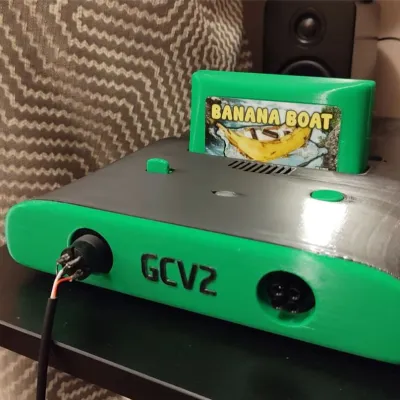
As easy as it is to make a late 1980s-style game console using a modern microcontroller, there’s arguably more fun in doing things the traditional way. This is the challenge that [Throaty Mumbo] took upon himself when he embarked on his retro game console project, called simply the Game Console V2.

In the accompanying video the development process and other details are covered and demonstrated. Most notable perhaps are the proper cartridges with ROMs on a parallel bus rather than something like SD cards, and the absence of any modern ports including even VGA. This means only composite AV output like in the good old days of RF splitters and other assorted fun.

The NTSC output signal is generated by an RP2350 MCU in the form of the PGA-shaped PGA2350 breakout board that’s wired into a 6-bit R-2R network for RGB332 output via the RCA jack, while audio is fed into a PCM5102A I2S DAC. For controllers you get 4-pin Bulgin SA2367 connectors and an N64-compatible protocol.

Advertisement

It’s noted that the use of an RP2350B MCU is temporary, as the goal with the V3 version of the project is to take it into a proper 8- or 16-bit CPU direction. We’re certainly looking forward to seeing this next revision of what looks to be a pretty interesting game console.

Advertisement

Source link

Continue Reading

Tech

Spotting Emacs In The Wild

Published

on

Emacs is one of the big classic text editors, right up there next to vi. It’s famous for its interface and its ubiquity across the *nix world. It’s such a core piece of software in the coding world that it has showed up a fair few times in popular culture—and [Ian Y.E. Pan] has collated some of those appearances. 

Emacs played a role in The Social Network, the retelling of the origin story of Facebook (the social network everybody used to use). Notably, Mark Zuckerberg used the tool to slap together a script for scraping a website. It also appears in Tron: Legacy, Arctic Blast, and the tech TV comedy Silicon Valley—more than once, in fact.

Other appearances include comics, Japanese anime series Key The Metal Idol, and a few miniseries and documentaries to boot.

[Ian]’s list is unlikely to be exhaustive. Both because he hasn’t seen every movie or TV show ever made, and because you can make new content featuring Emacs references tomorrow if you so desire. Still, it’s fun to see some of the famous properties that have featured good ol’ Emacs.

Advertisement

Don’t hesitate to let us know if you happen to put together a similar list about vi. The tipsline is waiting.

Source link

Advertisement
Continue Reading

Tech

Massive Debian 13 Linux Kernel Security Update Patches 68 Vulnerabilities

Published

on

Slashdot reader prisoninmate shares this report from 9to5Linux:

Coming ten days after the previous Linux kernel security update, which only fixed 12 vulnerabilities that may lead to a privilege escalation, denial of service, or information leaks, the new Debian 13 Linux kernel security update is a massive one, and it patches no less than 68 security vulnerabilities in the Linux 6.12 LTS kernel.

ebian 13 “Trixie” kernel security update are CVE-2026-64530, a use-after-free in the traffic-control subsystem leading to remote denial-of-service with potential for remote code execution, and CVE-2026-64531 (a.k.a. OVSwrap), a local-root vulnerability in the Open vSwitch datapath leading to local privilege escalation to root…

All Debian 13 “Trixie” users are urged to update their installations to Linux kernel 6.12.100-1 as soon as possible.

Advertisement

Source link

Continue Reading

Tech

The Best Kids’ Backpacks for the 2026 School Year

Published

on

When my son found out that my daughter was going to get her own tester State backpack to match her State carry-on suitcase, he immediately demanded his own. State is known for its fantastical matching patterns that extend from luggage and backpacks to lunch bags ($48). Its products are pricey, but the kid bags are not worse in quality or fewer in features than the adult bags, which I appreciate. It makes sense, considering kids are often harder on their bags than adults are on theirs.

The Kane kids backpacks come in several sizes. Now that my kids are 8 and 10 years old, they each have the largest double-pocket backpack, which has two separate compartments so that they can separate their dirty clothes or muddy shoes from delicate electronics. Its 23.6-liter capacity can fit up to a 15-inch laptop and is more than capacious enough for a Chromebook, sweatshirt, Omie lunch box, and mini Nalgene water bottle. In fact, these items don’t even use all of the space; my kids probably could’ve stuck with the medium-sized backpack for a little while longer.

On a weekend trip, my son stuffed several big books, a Nintendo Switch, and a full fleece blanket into his. There are also two water bottle pockets, a luggage pass-through so you can attach it to the adjustable handle of a matching carry-on, and a hidden AirTag pocket, so you can keep an eye on them in the airport.

Specs
Age range 2 and up
Capacity 8 L and up
Material Recycled polyester
Water resistant? Yes, but not waterproof

Source link

Advertisement
Continue Reading

Tech

There Are 2 Eclipses This August. Here’s How to See Them

Published

on

The 2026 astronomical calendar features only four eclipses. But August is a bounty of riches, with two set to occur.

They include a full solar eclipse on August 12 and a partial lunar eclipse on August 27 and 28. Catch one—or both—of these eclipses if you can: They’ll be the last ones of 2026, as the other two have already taken place.

We’ve got all the details on what to expect, the path of each August eclipse, and how to watch the celestial happenings.

Solar Eclipse on August 12

The first eclipse of the month will be a total solar eclipse. This occurs when the moon passes between Earth and the sun. The August solar eclipse will be visible in the northern hemisphere.

Advertisement

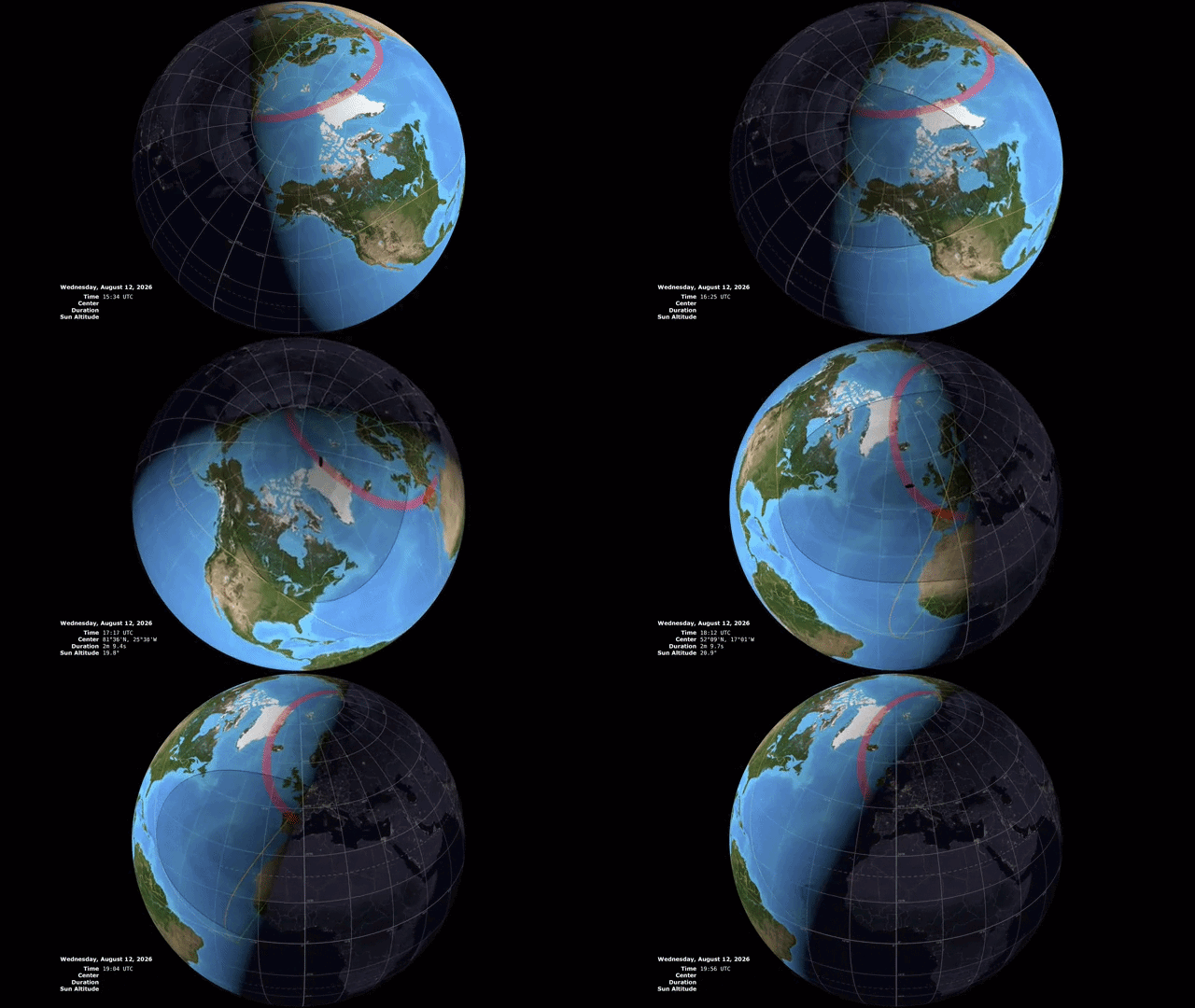
Path: The moon’s shadow will travel from west to east, beginning in the Arctic. Parts of Alaska will be treated to a partial view of the eclipse, as well as other northerly locations including Canada, Iceland, and parts of the North Atlantic. Some locations in Europe and the eastern US will also get a glimpse of the eclipse.

Only a few areas on land will get to see totality, though. Sparsely populated stretches of eastern Greenland will see the sun completely obscured, as will the far western edge of Iceland. Spain is the most populated region in the path of totality. It’s the first time the Iberian Peninsula will be treated to a full solar eclipse in more than a century.

How to view it: For one, not with your naked eye! For areas in the path of totality, the eclipse will reach its peak in the late afternoon. That’s an idea and dramatic time for viewing, when the sun is low on the horizon. Again, just not with your naked eye!

Animation: courtesy of NASA’s Scientific Visualization Studio

Times vary slightly by city, but in almost all of Spain the eclipse will occur at sunset, with totality around 8:30 pm Central European Time. From start to finish, the eclipse will last about an hour; totality is expected to last about two minutes.

Advertisement

Lunar Eclipse on August 27–28

The second eclipse of the month will be a partial lunar eclipse, which occurs when the Earth comes between the sun and the moon. A portion of the lunar surface will remain lit while the rest of the disk darkens or takes on a reddish hue.

Path: Unlike a solar eclipse, a lunar eclipse does not follow a narrow path across the Earth. The partial lunar eclipse will be visible simultaneously across a vast region of the planet. However, the eclipse will be best viewed across the Americas, primarily in eastern and central Canada, the US, and Mexico, as well as throughout Central America, the Caribbean, and South America.

While the eclipse is partial, up to 96 percent of the lunar disk will be in the Earth’s shadow, making for a dramatic view.

Source link

Advertisement
Continue Reading

Trending

Copyright © 2025