
Crypto World
Jump Capital bets on enterprise AI with new $350M Fund VIII



Jump Capital has closed its eighth institutional fund with $350 million in capital commitments, with the new vehicle dedicated to backing founders building AI applications, enterprise infrastructure, and cybersecurity technologies.
Summary
- Jump Capital has closed its eighth institutional fund with $350 million to invest in AI applications, infrastructure, and cybersecurity.
- The firm said enterprise AI adoption is creating demand for new software, infrastructure, and security technologies.
- Fund VIII will back technical founders building AI native enterprise platforms and production ready infrastructure.
- The announcement builds on Jump Capital’s infrastructure focused investing, while Jump Crypto continues backing blockchain and Web3 projects separately.
In an official announcement, the venture firm said its latest investment strategy is built around three developments shaping enterprise AI adoption: software applications being rebuilt around AI, new infrastructure needed to support production-scale deployment, and cybersecurity adapting to increasingly autonomous systems.
The firm said the new fund will continue its long-standing approach of investing in technical founders solving complex infrastructure and enterprise challenges.
Jump Capital sees three areas driving enterprise AI
According to the announcement, enterprise interest in artificial intelligence has moved beyond experimentation, with organizations now facing challenges around deploying AI reliably in production. Jump Capital said enterprises are struggling to realize meaningful returns because infrastructure and security have not advanced as quickly as AI adoption.
The firm said it expects one of the biggest opportunities over the coming years to come from rebuilding the enterprise technology stack to support AI-native software.
On the application side, Jump Capital believes AI is allowing software to execute work that previously depended on consultants, analysts, and other specialists. It said the next generation of enterprise software will become embedded into critical workflows while accumulating proprietary context that improves decision-making over time.
Beneath those applications, the firm said enterprise infrastructure remains in the early stages of development despite significant investment in data centers and graphics processors. It is evaluating startups building autonomous data engineering platforms, semantic and context layers, agent observability and governance, AI-native software quality, distributed inference systems, and orchestration platforms capable of managing increasingly complex AI environments.
Security forms the third pillar of the firm’s investment thesis. Jump Capital said AI adoption is expanding enterprise attack surfaces while introducing new challenges around agent identity, runtime protection, inference infrastructure, autonomous workflows, and third-party risk. The firm expects cybersecurity to become an increasingly important enabler of enterprise AI deployment rather than simply serving as a compliance function.
Fund continues firm’s infrastructure-first investment approach
Jump Capital said the new vehicle represents a “picks-and-shovels” approach to AI adoption, with planned investments across vertical AI applications, cybersecurity, and the infrastructure supporting enterprise deployment.
The firm said it will continue writing initial checks ranging from $1 million to $4 million and larger investments between $8 million and $15 million. It has also expanded its presence in New York over the past two years while continuing to invest across North America and Israel, where it has developed relationships with technical founders.
The Information, citing Jump Capital co-founder and partner Sach Chitnis, reported that the firm’s recent AI investments include compensation software company Compa, GPU software automation startup Standard Kernel, and AI infrastructure platform TrueFoundry.
Previous investments show a focus on foundational technologies
Although the new fund centers on artificial intelligence, Jump Capital’s broader investment history includes backing foundational technologies across multiple sectors.
In May 2025, Jump Crypto, the digital asset investment division that operates separately from Jump Capital, acquired a significant equity stake in real-world asset tokenization platform Securitize. The company said the partnership would help expand institutional access to tokenized Treasurys, private credit, and private equity while improving collateral management.
A month later, Jump Crypto partnered with Aptos Labs to introduce Shelby, a decentralized storage network designed for data-intensive Web3 applications. The project was built to provide cloud-grade decentralized storage with sub-second reads while addressing blockchain limitations around storing and serving large datasets.
The firm’s blockchain investment activity continued in September 2025, when Jump Crypto participated in KGeN’s $13.5 million strategic funding round alongside Accel and Prosus Ventures. KGeN said the capital would expand its on-chain identity and reputation framework supporting user acquisition, commerce, and loyalty programs, while Jump Crypto Chief Investment Officer Saurabh Sharma said the platform introduced greater accountability to digital distribution.
Technical founders remain at the center of Fund VIII
Jump Capital said the pace of AI development has made it increasingly difficult to distinguish durable businesses from short-term opportunities, with stronger competition for talent and higher expectations for new products.
The firm said it continues to favor technical, product-oriented founders who rethink business workflows around AI rather than simply using the technology to improve existing processes. It added that many emerging companies are designing organizations around software-first execution while carefully identifying where human expertise continues to add value.
Looking ahead, Jump Capital said Fund VIII will continue supporting founders modernizing legacy industries, building enterprise AI infrastructure, and securing autonomous software systems as AI adoption accelerates across businesses.



Apple restored Telegram after the messaging platform removed content that violated its child safety policies and banned the user who posted it.
Crypto World
Bhutan’s Gelephu Mindfulness City puts part of its BTC treasury to work after 10,000 bitcoin pledge


Gelephu Mindfulness City (GMC), a special administrative region in southern Bhutan, awarded 3iQ Corp. a mandate to manage part of its bitcoin treasury, the firms said in an email.
GMC declined to disclose the size of the mandate to CoinDesk.
How the money will be run is the new information. GMC told CoinDesk it selected the Toronto-based company to generate long-term returns through a low-risk, market-neutral investment approach, meaning the reserve is to be deployed for yield rather than simply held.
A market-neutral strategy covers a range of possibilities, including basis trades and lending. Such strategies usually yield at least 5% annually in the general market. GMC did not say whether any specific approach has been selected.
In December, when Bhutan’s king, Jigme Khesar Namgyel Wangchuck, pledged up to 10,000 BTC, then worth about $1 billion, the allocation was called a long-term national asset for the city’s development, with collateralization, treasury strategies or holding all listed as options still under consideration.
The mandate’s size matters because the pledge behind it has been in question for months.


Bitcoin was little-changed the past 24 hours after Washington and Tokyo intervened together to support the yen, a rare move that revived concerns about the cheap Japanese funding behind leveraged bets across global markets.
Japan and the United States confirmed they bought yen on Friday after the currency weakened to 163.73 per dollar. Bank of Japan data suggest Tokyo may have spent as much as $36.6 billion, while the size of the U.S. contribution has not yet been disclosed.
The yen rebounded to 157.57 on Friday and held near 157 on Monday.
Crypto traders watch the yen because of the carry trade. Investors borrow in Japan, where the policy rate is 1%, and move the money into assets offering higher returns.
A sudden rise in the yen can force those traders to close positions and sell other assets to repay the loans.
That risk did not reach bitcoin immediately. BTC traded near $63,600 on Monday, up about 1.8% over 24 hours and little changed over seven days.
Alvin Kan, chief operating officer at Bitget Wallet, said the intervention is better viewed as a check on disorderly trading than the start of a lasting yen recovery.
The interest-rate gap still favours the dollar, with the Federal Reserve’s benchmark range at 3.50% to 3.75% against the Bank of Japan’s 1%. Without a smaller gap or investors unwinding yen-funded trades on their own, repeated intervention may only slow the currency’s decline.

Coinbase’s Base has surpassed Solana in terms of capital stored in curated vaults, with over $1.6 billion in such assets or 22.5% of the entire market share.
Ethereum remains the undisputed leader with almost $3.5 billion (or 48.2% of the entire market share), while Base has become the largest layer-2 venue for such capital, according to Sentora.
Ethereum holds $3.46B of curated vault TVL and Base holds $1.62B. Together they represent 70.7% of the category.
Base now carries more than three times the risk curator TVL of Solana, making it the largest L2 venue for curated capital.
Learn more: https://t.co/pUrFvG8nrp pic.twitter.com/HAFgdFBczJ
— Sentora (@SentoraHQ) August 4, 2026
The data shows that Solana remains far behind with less than $550 million. Binance Smart Chain is close by, while the other networks that make up the rest of the top 10 include Plasma ($144 million), Monad ($119 million), and so on.
Curated Capital refers to deposits in DeFi vaults that are actively managed by specialized risk curators according to predefined rules and risk frameworks. It offers more structured, transparent, and accountable risk management than plain pooled lending, especially for stablecoin yield strategies.
The post Base Passes Solana in Curated Capital Milestone (Flash News) appeared first on CryptoPotato.

Nigeria’s tax authority has issued detailed guidance for how crypto platforms and peer-to-peer (P2P) marketplaces must collect, report, and remit taxes on virtual-asset activity—introducing rules that include paying some tax withholdings using digital tokens themselves.
In its Guidelines on Taxation of Virtual Assets, the Nigeria Revenue Service (NRS) outlines how income tax withholding, stamp duty, and value-added tax (VAT) should be handled under existing law. The document is likely to reshape compliance workflows for exchanges and P2P operators operating in Nigeria, while also clarifying what taxpayers can expect when trading, transferring, or earning yield on crypto assets.
Key takeaways
- The NRS says income tax withheld at source and stamp duty must be remitted in the originating token used for the transaction, while VAT must be remitted in the payment currency.
- Platforms and P2P marketplaces must withhold 1% of proceeds from taxable disposals of crypto assets, security tokens, and specified NFTs.
- A 10% withholding rate applies to staking, mining, airdrops, and decentralized finance (DeFi) activity under the guidelines.
- For token-to-fiat and fiat-to-token movements, the rules reference a 1.5% stamp duty.
- Stablecoin sales are exempt from the 1% withholding tax, and withheld amounts are treated as advance payments credited against final income tax liability.
How the NRS expects crypto taxes to be remitted
The practical centerpiece of Nigeria’s new guidance is its instruction on settlement currency for taxes. According to the NRS, income tax deducted at source and stamp duty “shall be remitted to the Service in the originating token of the transaction.” In other words, if a withholding-triggering event results in the taxpayer receiving or paying a specific token, that same token is expected to be used when remitting certain taxes to the NRS.
The NRS draws a sharper line for VAT, stating that value-added tax must be remitted in the currency used for the payment. This separation matters operationally: companies processing Nigerian users’ activity will need systems that can identify the “originating token” for token-based remittance while also ensuring VAT settlement follows the actual payment currency.
The guidelines also position exchanges and P2P marketplaces as key intermediaries in the withholding, reporting, and remittance process, meaning compliance duties do not fall solely on end users.
Withholding rates for trading, yield, and DeFi-linked activity
The NRS sets different rates depending on the type of virtual-asset event. Under the guidelines, platforms must withhold:
- 1% of proceeds from taxable disposals of crypto assets, security tokens, and applicable NFTs.
- 10% withholding on staking, mining, airdrops, and decentralized finance arrangements.
- 1.5% stamp duty on token-to-fiat and fiat-to-token transfers.
The withheld amounts are described as advance payments that will be credited against each taxpayer’s eventual income tax bill. That structure is important for users because it implies the withholding is not intended to be the final tax amount in every case—rather, it should reconcile to the taxpayer’s final liability under Nigeria’s income tax rules.
The NRS also specifies that individuals are taxed using progressive rates, while companies other than small companies face a 30% rate. Additionally, the guidelines note that stablecoin sales are exempt from the 1% withholding tax, reducing one potentially broad category of taxable disposals for which exchanges would otherwise deduct at source.
Nigeria’s wider virtual asset tax architecture
This guidance did not appear in isolation. The NRS framework follows an executive step under which Nigeria established a Virtual Asset Council, chaired by the central bank, with the NRS and the Securities and Exchange Commission (SEC) serving as vice chairs. Earlier in the process, the presidency said the NRS would release policy to implement Nigeria’s tax laws for virtual assets.
The legal baseline for the framework is anchored in Nigeria’s 2025 tax legislation. The NRS points to the Nigeria Tax Act and the Nigeria Tax Administration Act of 2025, which took effect on Jan. 1. These laws treat digital assets as chargeable assets and require virtual asset service providers to report transaction details, including customers’ names, contact information, and Tax Identification Numbers.
That reporting requirement is likely to become a central compliance burden for operators, especially for businesses that previously offered onboarding that did not prioritize Nigeria-specific tax identifiers.
From a flat capital gains tax to detailed withholding mechanics
Nigeria’s approach to crypto taxation has evolved in stages. The Finance Act 2023 previously introduced an explicit tax treatment for gains from crypto disposals, imposing a flat 10% capital gains tax, according to earlier coverage. The current 2025 framework replaces that earlier treatment and—critically for market operators—lays out how valuation, withholding, remittance, and reconciliation should work under the updated rules.
While the guidelines do not merely restate a headline tax rate, their emphasis on specific withholding categories suggests a shift toward a more standardized collection model. For exchanges and P2P platforms, the compliance implication is straightforward: the company’s role in withholding and remitting taxes is now codified, and systems will need to track taxable events across trading, transfers, and certain types of on-chain or programmatic earnings.
For users, the change is less about whether crypto is taxable and more about how taxes get collected during routine activity—potentially meaning taxes are deducted before a final tax calculation is completed.
Nigeria’s guidelines raise immediate questions that operators will need to address as they implement them, including how “originating token” remittance will be handled in complex routing scenarios and how platforms will operationalize stablecoin exemptions while applying token-to-fiat and fiat-to-token duties. The next watchpoint is how exchanges and P2P providers translate the NRS instructions into real-world tax reporting and settlement processes for users.


The ruling leaves New York’s case against Kalshi in place while allowing the CFTC to renew its request before Judge Victor Marrero.
The beginning of August brought renewed optimism to the US technology sector. President Donald Trump announced the cancellation of a planned strike on Iran and expressed his intention to resume negotiations, prompting a sharp decline in oil prices. Investors interpreted the easing of geopolitical tensions as a signal that inflationary risks may also begin to moderate. Additional support for the market came from the Federal Reserve’s earlier decision on 29 July to keep the benchmark interest rate unchanged within the 3.5–3.75% range, although the decision was not unanimous. Together, these developments helped restore investors’ appetite for risk, particularly in large-cap technology stocks.
Technical Analysis of Nasdaq 100
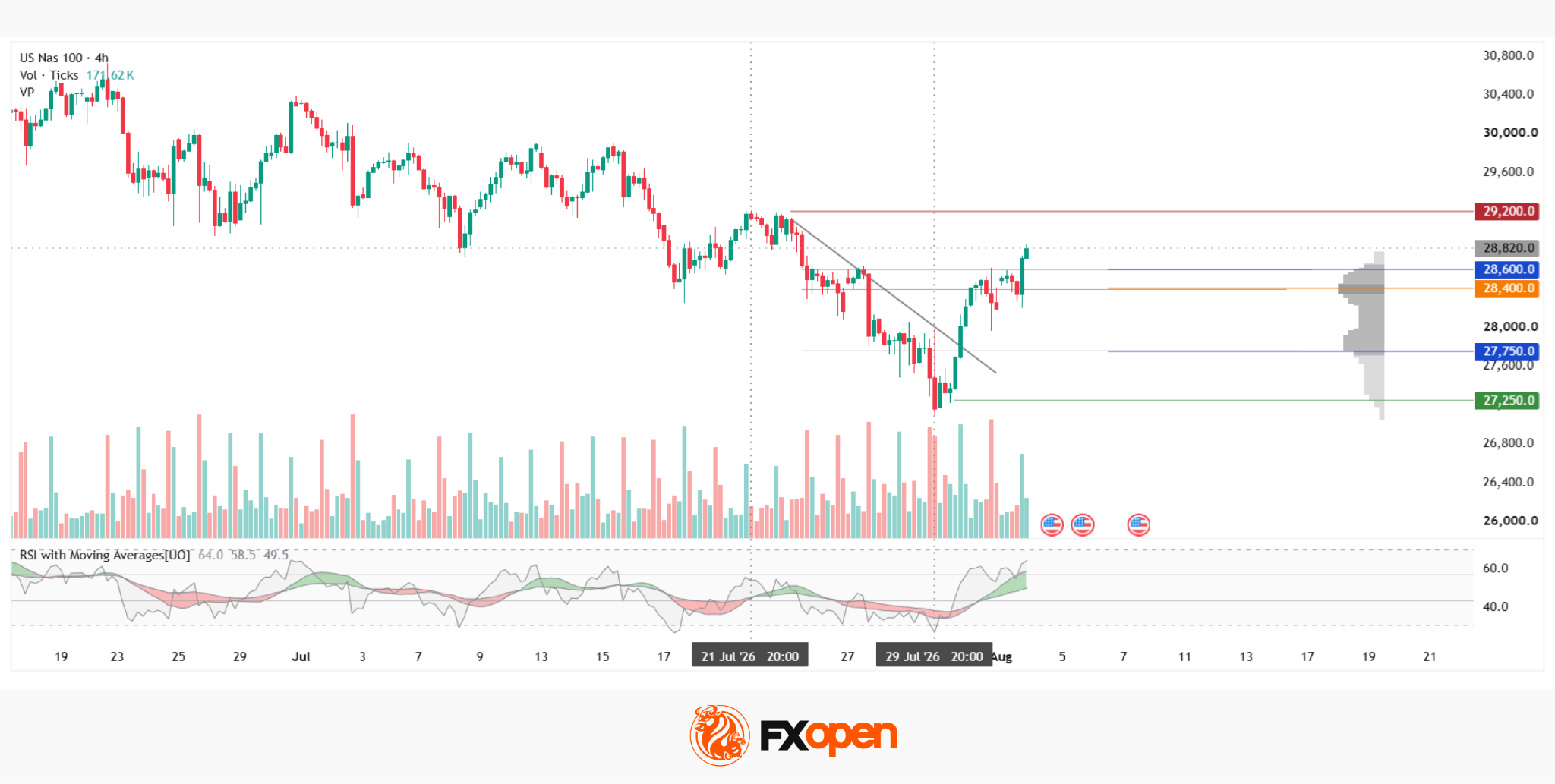
Since mid-July, the Nasdaq 100 index (NDXm on FXOpen) had been moving within a short-term downtrend defined by a descending trendline, before falling towards the 27,100 area, marked by the green support zone. From there, the price reversed, broke above the descending trendline, and recovered roughly half of the previous decline. Following a brief period of consolidation, the current market profile was formed, with the index now trading above its upper boundary at 28,600. Above current levels lies the base of the previous trend at 29,200, marked on the chart as the red resistance level.
Should the current direction reverse, the index may encounter several important technical levels. The POC (Point of Control) at 28,400 represents the nearest area of highest trading activity over the analysed period. Below it are the lower boundary of the market profile at 27,750 and the green support level at 27,250, located near the trend low. The RSI + MAs indicator currently shows readings of 64, 58 and 49. Although the oscillator suggests that the current move may continue, the slower moving average remains within the neutral zone, leaving the bullish signal unconfirmed.
Summary
The Nasdaq 100’s near-term direction is likely to depend heavily on developments surrounding negotiations with Iran. Any deterioration in the geopolitical situation could renew selling pressure on the index, while further diplomatic progress may create room for a move towards higher price levels.
Trade global index CFDs with zero commission and tight spreads (additional fees may apply). Open your FXOpen account now or learn more about trading index CFDs with FXOpen.
This article represents the opinion of the Companies operating under the FXOpen brand only. It is not to be construed as an offer, solicitation, or recommendation with respect to products and services provided by the Companies operating under the FXOpen brand, nor is it to be considered financial advice.
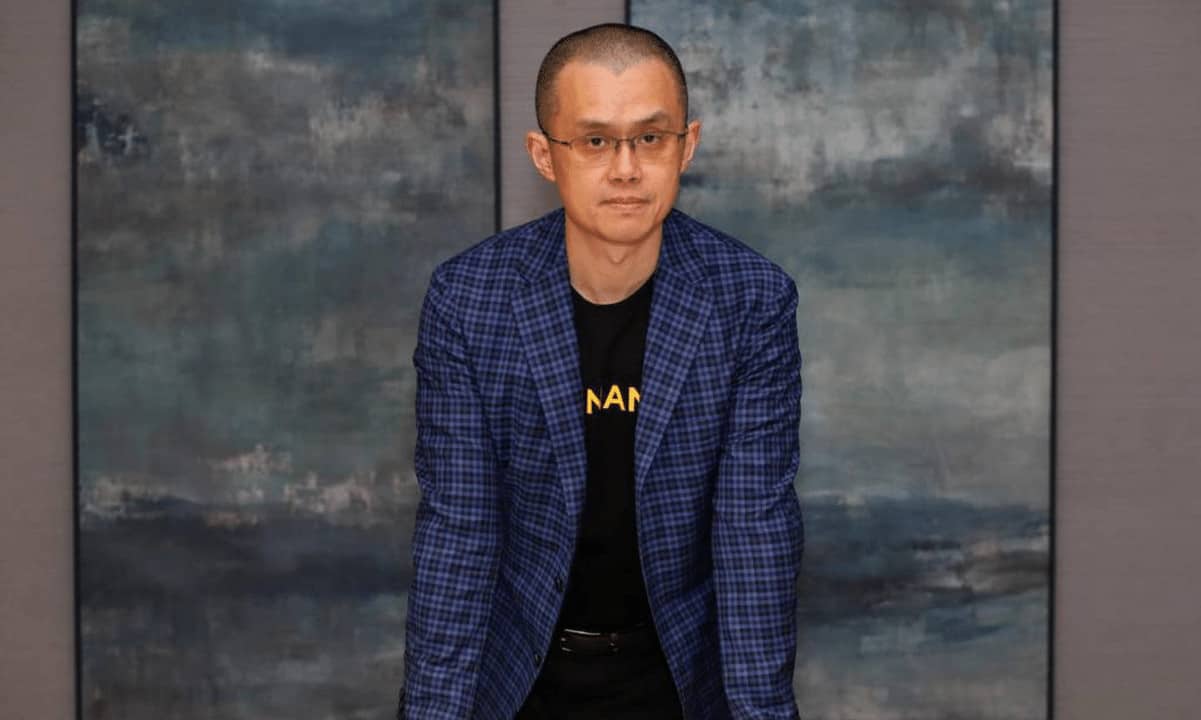
Citing data from popular analyst Willy Woo, Binance’s founder, Changpeng Zhao, published a rather controversial opinion on X, stating that it is statistically safer to store crypto assets on exchanges than in self-custody.
Willy Woo’s data shows that 1.57 million BTC has been lost from investors storing their holdings in self-custody compared to 1.51 million from those keeping their assets on exchanges. However, the data Woo shared comes from a December 2025 report and hasn’t taken into consideration the latest hacks and incidents, including the Coldcard fiasco, in which the value of stolen BTC increases daily.
CZ explained that hack data is easier to collect on the centralized exchange’s side, as most become major news. In contrast, it’s more difficult on the self-custody side, where hacks and lost coins are often not reported.
“On the exchange side, some deceased exchanges drag down the data. Binance (and a few other exchanges) have always covered users for any CEX side hacks.”
He concluded that a balanced approach, in which investors split their holdings into multiple custodians, is “probably best.”
The post CZ and Willy Woo Spark Debate: Exchanges Are Safer Than Self-Custody (Flash News) appeared first on CryptoPotato.
Emerson College Polling surveys of likely midterm election voters paint a similar picture. In March, 49% of respondents said they planned to support the Democratic candidate, while 42% said they would vote Republican. By May, Democrats widened that lead by 2 percentage points, and by July, the gap widened by another 2 points to 53% for Democrats and 42% for the GOP.
George Santos has settled CFTC case over Kalshi prediction market trades by accepting penalties and a three-year trading ban after regulators found he made misleading public statements while betting on his attendance at President Donald Trump’s State of the Union address.
Summary
- George Santos has settled CFTC charges over Kalshi prediction market trades by paying more than $35,000 and accepting a three year trading ban.
- The CFTC found Santos made misleading public statements while placing bets on whether he would attend President Trump’s State of the Union address.
- Trading records show Santos first profited from Yes contracts before switching to No contracts after his travel plans changed.
- Kalshi froze Santos’ account, referred the case to regulators, and said it detected the suspicious trading activity through its surveillance systems.
According to a July 31 order from the U.S. Commodity Futures Trading Commission (CFTC), former U.S. Representative George Santos must return $17,569.98 in trading gains, pay a $17,500 civil monetary penalty, comply with a cease-and-desist order, and stay away from trading on any CFTC-registered entity for three years after settling allegations tied to trades on prediction market platform Kalshi.
The settlement closes an investigation that began earlier this year after Kalshi referred Santos’ trading activity to regulators. While Santos accepted the settlement, the order states that he neither admitted nor denied the agency’s findings or legal conclusions.
CFTC says Santos traded both sides of Kalshi market
Regulators said Santos opened a Kalshi account on Feb. 11, roughly four months after President Donald Trump commuted his prison sentence. The former congressman funded the account with about $7,000 and traded only one event contract, which asked whether he would attend Trump’s State of the Union address.
Trading records included in the order show Santos initially accumulated 30,874 “Yes” contracts between Feb. 12 and Feb. 22 for $6,695.94.
Around the same period, Santos posted on X asking followers whether he should wear a serious or bedazzled suit to the address. The CFTC said the market price for the “Yes” outcome climbed from about $0.15 to $0.70 after the post. Santos later sold his entire position, making a profit of $3,448.43, before withdrawing $10,146.07 through a newly created Venmo account.
Later that day, his airline informed him that his flight to Washington had been canceled. Although he purchased a train ticket and continued posting publicly that he expected to attend, regulators said his trading activity soon moved in the opposite direction.
According to the order, Santos posted another video on Feb. 23 stating that he would attend the speech from the House gallery. About 40 minutes later, he started buying contracts that would pay out if he did not attend.
The CFTC said Santos eventually accumulated 23,855 “No” contracts worth $8,650.66. His train was canceled about an hour after he began building that position. Even after another X user asked whether he would still attend, Santos replied that he would, despite already knowing that both his flight and train had been canceled, information the agency said was not disclosed to the public.
Kalshi activity led to the CFTC investigation
On the day of the State of the Union address, internet records cited by the commission showed Santos accessing Kalshi from his residence rather than traveling to Washington. He later posted that watching the speech on an airport television had not been his original plan.
As the event unfolded, the “Yes” contract price dropped from $0.73 to $0.02, increasing the value of Santos’ “No” position. The order states that he exited those trades early on Feb. 25 with a reported profit of $14,390.57.
Based on that trading sequence, the CFTC concluded that Santos made misleading public statements and omitted material information that influenced the market price for his own financial benefit.
Instead of treating the conduct as a conventional insider trading case based on confidential information, the commission pursued the matter under the Commodity Exchange Act’s anti-manipulation provisions and CFTC Regulation 180.1. The order also classified the State of the Union attendance contract as a swap subject to the agency’s enforcement authority.
Earlier reporting by NPR in June said both the Department of Justice and the CFTC had opened investigations after Kalshi froze Santos’ account and referred the matter to regulators. However, the Washington Examiner later reported that a DOJ official denied the department had an active case, leaving the CFTC settlement as the only confirmed federal enforcement action tied to the trades.
Santos disputes allegations while accepting settlement
Responding through his attorney, Joseph W. Murray, Santos said he originally intended to attend the State of the Union address before severe winter weather disrupted his travel plans.
Murray denied that Santos intended to mislead traders or manipulate the prediction market. He also said his client chose to resolve the matter through settlement rather than continue with expensive litigation.
The CFTC order, however, concluded that Santos’ public statements and omissions occurred while he actively traded positions tied to the same event, allowing him to benefit from price movements in both directions.
Separately, Kalshi said it detected the unusual trading activity through its surveillance systems, froze Santos’ account, and supplied evidence to federal regulators.
Speaking to Axios last month, Kalshi Chief Executive Officer Tarek Mansour said the platform flagged the activity within seconds and received roughly 100 whistleblower complaints within minutes. He added that the exchange plans to pursue its own enforcement action for violations of exchange rules.
Kalshi also said it may reimburse affected traders if it successfully recovers funds from Santos. The company linked its monitoring process to integrity systems developed through its partnership with Sportradar.
Prediction markets continue facing regulatory scrutiny
The Santos case arrives as prediction markets continue drawing attention from regulators over insider trading and market manipulation concerns.
Earlier this year, Kalshi suspended three federal political candidates after determining they had traded on markets involving their own election contests. According to the company, candidates who can directly influence an event’s outcome violate exchange rules regardless of trade size.
Unlike those disciplinary actions, the Santos matter resulted in a referral to federal regulators and ultimately concluded with a formal CFTC enforcement order.
The agency’s approach also follows other recent prediction market cases. Federal prosecutors have charged U.S. Army Master Sgt. Gannon Ken Van Dyke with allegedly using advance knowledge of a military operation to generate more than $404,000 from Polymarket trades tied to Venezuelan President Nicolás Maduro.
In another case, prosecutors accused former Google software engineer Michele Spagnuolo of using confidential Google search ranking data to place multimillion-dollar bets on Polymarket before the information became public.
As regulatory attention has increased, Kalshi has introduced screening tools designed to identify participants directly connected to events listed on its platform, while Polymarket has expanded surveillance programs and hired blockchain analytics firm Chainalysis to assist investigations into insider trading and market manipulation.

Kevin Durant Says LeBron James’ New-Look 76ers Are Better Than His Legendary 2017 Warriors Superteam

Apple briefly removes Telegram from App Store, Gram rebounds

AIPAC front and center in Bell-Bush rematch

Renter of Home in Anne Heche Crash Denies Settlement With Son

No Jackpot Winner as $257 Million Prize Rolls Over to $269 Million Monday Draw

Weekend Open Thread: Staud – Corporette.com

Oil prices fall sharply, Yen strengthens on US intervention | Finance Report | ABC NEWS

WARNING: BITCOIN TRAPPING THE BEARS !!!!

7 Money Lessons I Wish Knew in My 20s! (The Step-by-Step Guide to Build Financial Freedom Faster)
-

 Business6 days ago
Why Trees Belong on the Risk Register
-

 Fashion4 days ago
Weekend Open Thread: Wit & Wisdom
-

 Politics3 days ago
Meta enters AI-training agreement with far-right ‘propaganda rag’ Newsmax
-
 Entertainment7 days ago
‘Stargate’ Creator’s New Sci-Fi Series Returns for Season 3 Tomorrow
-

 Crypto World3 days ago
MicroStrategy Post-Earnings CLARITY Act Push Could Add New Catalyst for Its Stock
-

 Politics7 days ago
The Part of the Electric Transition Nobody Wants to Discuss
-

 Business6 days ago
Major shareholder moves on Canyon
-

 Crypto World3 days ago
XRP Ledger v3.3.0 brings five institutional features
-

 News Videos5 days ago
Bitcoin Enters the 3rd Stage of the Bear Market
-

 Politics6 days ago
Reform UK betrays West Mids residents by running from party pledges
-

 Crypto World6 days ago
Kraken Enables Retail Access to Jersey Mike’s IPO via Tokenized Shares
-

 Politics5 days ago
Luke Littler’s dominance sparks GOAT debate
-

 Sports4 days ago
Seema Kaliramna Wins Discus Throw Bronze, Takes India’s CWG Medals Tally To 17
-

 News Videos7 days ago
Claude: Build Financial Dashboards in Minutes (2026)
-

 Crypto World2 days ago
Crypto PAC spending tops $2M in Michigan House race
-

 Crypto World3 days ago
New York sues Kalshi over prediction market gambling
-

 Business6 days ago
Johnson & Johnson agrees to $5.5B settlement over talc cancer claims
-

 Business4 days ago
Trump Announces Hamas Disarmament Agreement as Iran Strikes Kuwait Air Base and US Attacks Pause Overnight
-

 Tech6 days ago
Gemini can now summarize the messiest comment threads in Google Docs
-

 Tech2 days ago
ESET tracks rise in malicious AI skills and adaptable malware
You must be logged in to post a comment Login