The Commonwealth Games 2026 concluded on Sunday, August 2, with India enjoying a successful campaign despite the Games being restricted to just 10 sporting disciplines.
India finished fourth on the medal table with 39 medals — 13 gold, 17 silver and nine bronze.
While athletics (16 medals) and boxing (10 medals) spearheaded India’s medal surge in the latter half of the Games, weightlifting laid the foundation for the campaign in the opening days. The sport also delivered India’s first gold medal through seasoned campaigner Mirabai Chanu.
An eight-medal haul would ordinarily be considered an excellent return. However, a closer look reveals a far less encouraging picture. India not only registered their lowest weightlifting medal tally since the 2010 Delhi Commonwealth Games but also recorded their fewest gold medals in the discipline across the past five editions.
The number of gold medals keeps dropping
India’s weightlifting programme had steadily progressed after the 2010 Commonwealth Games, winning two gold medals in Delhi before improving to three at Glasgow 2014 and peaking with five gold medals at Gold Coast 2018.
The tally dipped to three gold medals at Birmingham 2022, but the overall campaign still reflected India’s dominance in the sport.
That trend has now worsened. At the Commonwealth Games 2026, only Mirabai Chanu managed to stand atop the podium, reducing India’s gold-medal tally to just one.
More significantly, this is the first time since 2010 that India’s gold-medal count in weightlifting has declined at two successive Commonwealth Games, suggesting that the Birmingham drop was not an isolated setback but part of a broader trend.
India’s medals in weightlifting at the Commonwealth Games since 2010
Edition |
Gold |
Silver |
Bronze |
Total |
2010 (Delhi) |
2 |
2 |
3 |
7 |
2014 (Glasgow) |
3 |
4 |
5 |
12 |
2018 (Gold Coast) |
5 |
2 |
2 |
9 |
2022 (Birmingham) |
3 |
3 |
4 |
10 |
2026 (Glasgow) |
1 |
6 |
1 |
8 |
Overall |
14 |
17 |
15 |
46 |
Why is the drop in gold medals at the Commonwealth Games worrisome for India?
Looking only at the overall medal count, India’s campaign may not appear disappointing. Eight medals are still among the better returns by any nation in Glasgow.
The concern emerges when the performance is viewed in the context of India’s global ambitions. The Commonwealth Games have traditionally been India’s strongest international event in weightlifting. Since 2010, the country has won 46 medals in the competition.
The contrast with bigger competitions is stark. India have won just 14 weightlifting medals in the history of the Asian Games and only two Olympic medals.
In other words, even when the level of competition is comparatively lower at the Commonwealth Games, India have historically found it easier to dominate. If that dominance is beginning to fade, expectations of significantly improved performances at the Asian Games and the Olympics become increasingly difficult to justify.
The declining gold tally, therefore, represents more than a statistical trend — it raises questions about India’s ability to remain competitive against the world’s best.
Why India’s gold-medal numbers are dropping
The decline in India’s gold-medal tally is not merely a statistical anomaly but a reflection of a shrinking pool of athletes capable of dominating international competition.
India still produced eight medals in Glasgow, but six of them were silver. That indicates that the country continues to produce finalists, yet struggles to convert podium finishes into titles. At elite competitions, that final step often separates a good programme from a great one.
The challenge has also become tougher. Commonwealth weightlifting is no longer as India-centric as it once was. Canada have collected 21 medals across the last three editions, England 18, while Malaysia have emerged as a major force by increasing their gold tally from two in 2018 to five in Glasgow 2026.
Nigeria and Australia have also remained consistent contenders. Winning medals is still well within India’s reach, but standing atop the podium has become significantly harder.
The bigger concern, however, lies beyond the Commonwealth Games. India have traditionally used the event as a benchmark because the level of competition is generally lower than at the Asian Games or the Olympics.
If Indian lifters are now finding it difficult to dominate even at the Commonwealth level, expectations of significantly better performances against powerhouses such as China, North Korea, South Korea, Uzbekistan and Kazakhstan become increasingly difficult to justify.
The silver-heavy campaign in Glasgow should, therefore, be viewed as a warning rather than a consolation.
Commonwealth Games: Weightlifting performance of leading nations (2018–2026)
Country |
2018 Gold Coast |
2022 Birmingham |
2026 Glasgow |
Total |
India |
9 |
10 |
8 |
27 |
Canada |
5 |
8 |
8 |
21 |
England |
6 |
5 |
7 |
18 |
Malaysia |
3 |
3 |
7 |
13 |
Nigeria |
0 |
6 |
4 |
10 |
Australia |
3 |
4 |
3 |
10 |
India’s fading pipeline of Commonwealth champions
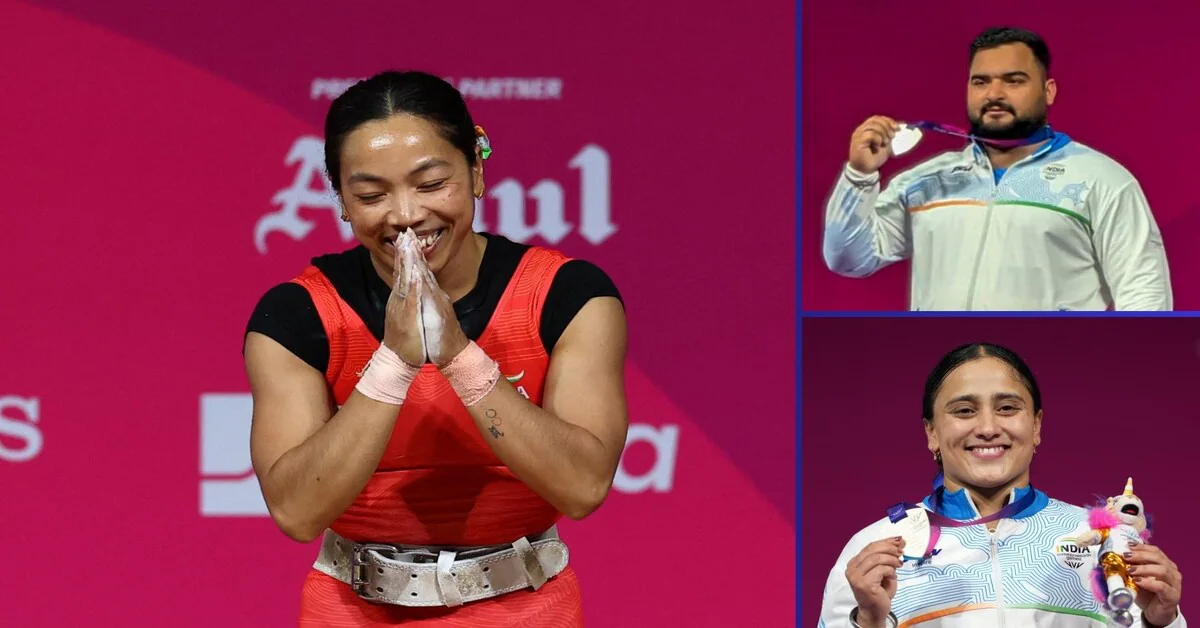
If there was one athlete who once again lived up to expectations in Glasgow, it was Mirabai Chanu.
The Manipur weightlifter claimed India’s only weightlifting gold medal, becoming the first Indian to win three consecutive Commonwealth Games titles. She also rewrote the Games record books with 85 kg in the snatch, 105 kg in the clean and jerk, and a total of 190 kg. More importantly, it was her fourth Commonwealth Games medal, having progressed from silver on her debut in 2014 to a remarkable hat-trick of gold medals in 2018, 2022 and 2026.
Mirabai Chanu at Commonwealth Games 2026 (PIC: PTI)
Yet Mirabai’s brilliance also exposes India’s biggest weakness.
One of the clearest indicators of India’s changing fortunes in Commonwealth weightlifting is the absence of a new generation of serial champions. India’s previous generation consistently returned to the Commonwealth Games and upgraded their performances. Sukhen Dey and Ravi Kumar followed their medals in Delhi 2010 with another podium finish in Glasgow 2014. Sanjita Chanu and Sathish Sivalingam defended their Commonwealth titles in 2018, while Punam Yadav progressed from bronze in 2014 to gold four years later. Mirabai herself set the benchmark by transforming a silver medal into three successive Commonwealth titles.
The current generation has also produced repeat medallists, but the progression has stalled. Harjinder Kaur, Bindyarani Devi and Lovepreet Singh have all returned to the podium, yet none has converted those performances into a Commonwealth title. In Glasgow, despite India winning eight weightlifting medals, not a single lifter apart from Mirabai managed to stand atop the podium. Six settled for silver, suggesting India continue to produce international-standard medallists but far fewer athletes capable of consistently becoming champions.
As Mirabai enters the twilight of an extraordinary career at 31, India face an uncomfortable question: who replaces her? For nearly a decade, every Commonwealth Games campaign has begun and ended with Mirabai delivering exactly what was expected. Expecting her to remain India’s only guaranteed champion through Los Angeles 2028 and beyond could be a little far fetched wish for the nation.
Indian weightlifters to win multiple Commonwealth Games medals (since 2010)
Athlete |
Total medals |
Commonwealth Games medals |
Mirabai Chanu |
4 |
Silver (2014), Gold (2018), Gold (2022), Gold (2026) |
Vikas Thakur |
3 |
Silver (2014), Bronze (2018), Silver (2022) |
Gururaja Poojary |
2 |
Silver (2018), Bronze (2022) |
Harjinder Kaur |
2 |
Bronze (2022), Silver (2026) |
Lovepreet Singh |
2 |
Bronze (2022), Silver (2026) |
Bindyarani Devi |
2 |
Silver (2022), Bronze (2026) |
Khumukcham Sanjita Chanu |
2 |
Gold (2014), Gold (2018) |
Sathish Sivalingam |
2 |
Gold (2014), Gold (2018) |
Punam Yadav |
2 |
Bronze (2014), Gold (2018) |
Sukhen Dey |
2 |
Silver (2010), Gold (2014) |
Ravi Kumar Katulu |
2 |
Gold (2010), Silver (2014) |
India’s high-risk approach needs refinement
Another striking feature of India’s campaign was the willingness of several lifters to chase ambitious weights from the outset.
Mirabai Chanu, Bindyarani Devi, Gyaneshwari Yadav and Rishikanta Singh all opened with, or attempted, some of the heaviest lifts in their respective competitions. The strategy paid off for many of them, but often only after they finished with one or two successful attempts.
The flip side of that approach was evident in the performances of Nirupama Devi and Sajana. Nirupama failed to register a successful snatch after three unsuccessful attempts, while Sajana could not complete a valid clean and jerk, ending both campaigns without a total despite entering as genuine medal contenders.
The contrast highlights the increasingly fine margins in international weightlifting. As the standard rises, especially at the Asian Games and Olympics, an aggressive strategy can be the difference between winning a medal and leaving empty-handed. Glasgow showed that India possess the ability to challenge for the podium, but it also showcased how little room for error exists when every attempt carries greater significance.
Gyaneshwari Yadav at Commonwealth Games 2026 (PIC:PTI)
Every cloud has a silver lining
While the drop in the number of medals, especially gold medals, can be a cause for concern for the future, one cannot deny that weightlifting still stood out as one of India’s strongest pillars at the Commonwealth Games in the absence of sports they have largely dominated, such as wrestling, badminton and hockey.
Improving the conversion of medals into gold will be a major task at hand, but the success of eight early medals definitely boosted India’s morale as they went on to better their overall tally as the tournament drew to a close.
India’s full list of medal winners in weightlifting at the Commonwealth Games 2026:
Medal |
Event |
Athlete |
Gold |
Women’s 48kg |
Saikhom Mirabai Chanu |
Silver |
Men’s 60kg |
Rishikanta Singh |
Silver |
Men’s 65kg |
Muthupandi Raja |
Silver |
Women’s 53kg |
Gyaneshwari Yadav |
Silver |
Men’s 79kg |
Valluri Ajaya Babu |
Silver |
Women’s 69kg |
Harjinder Kaur |
Silver |
Men’s +110kg |
Lovepreet Singh |
Bronze |
Women’s 58kg |
Bindyarani Devi |













![Dim4ou x Shunaka - Need Da Money [OFFICIAL 4K VIDEO] 2024](https://wordupnews.com/wp-content/uploads/2026/05/1777808654_maxresdefault-80x80.jpg)









































You must be logged in to post a comment Login