
Crypto World
Texas power grid moratorium may not materially affect BTC miners


Bitcoin mining companies with existing operations in Texas are likely to face limited direct disruption from a new state-level pause on certain data center approvals, according to Bernstein analysts. The move centers on heightened scrutiny of how quickly new data center projects are being lined up to connect to Texas’ power grid.
Governor Greg Abbott ordered the Public Utility Commission of Texas (PUCT) and the Electric Reliability Council of Texas (ERCOT) to conduct an audit of data centers seeking to connect to the grid, The Texas Tribune reported. Bernstein said many Texas miners are already covered by electric capacity agreements that have been approved, which could reduce near-term operational risk.
Key takeaways
- Bernstein expects most Texas-based Bitcoin miners to be minimally affected because many are contracted for approved power capacity.
- The audit and moratorium are expected to slow or throttle speculative data center “pipeline” projects, potentially increasing the value of sites with development history.
- Miners most exposed may include those whose future growth depends on converting existing pipeline assets into grid-connected capacity during ERCOT’s approvals.
- Bernstein highlighted Texas operations of Cipher Digital, Core Scientific, CleanSpark, IREN and Riot Platforms as relevant to how the approval process evolves.
Texas audit targets data center grid connections
On Monday, Governor Abbott directed regulators to audit all data centers attempting to connect to the state’s electric grid system. The directive is linked to mounting public backlash over the pace of data center development in Texas, as The Texas Tribune noted in reporting on the order.
While the article describing the order did not specify how long the audit would run, the practical effect is already clear: new or pending grid-connection approvals are likely to slow while regulators review the pipeline. For electricity-intensive industries—data centers and Bitcoin mining in particular—grid access timing can be as important as total contracted capacity.
Why Bernstein says active miners may be spared
In a client note released Tuesday, Bernstein analysts argued that the direct impact on Bitcoin miners with Texas operations should be limited. Their central point: most miners operating in the state are under contracts for electric capacity that has already been approved.
That distinction matters for investors and operators. An audit that primarily affects approvals for new connections is less likely to interrupt existing operations tied to already-cleared power supply, especially where miners have scheduled energy use and infrastructure already in place.
Bernstein also suggested that throttling new approvals could create a different kind of market effect. The analysts wrote that the audit “throttles speculative data center pipeline” and, in turn, “makes genuine sites with development history more valuable.” They linked that value proposition to mining sites typically having “longest gestation” characteristics, self-funding infrastructure, and management at the local level.
Which miners Bernstein flags as more vulnerable
Even if day-to-day production is less likely to be disrupted for capacity that is already approved, growth plans can still run into delays. Bernstein pointed to miners it believes could be more exposed—particularly if their path to expansion depends on ERCOT approval processes to convert pipeline assets into grid-connected power capacity.
The analysts specifically named Cipher Digital, Core Scientific and CleanSpark as candidates that could face greater sensitivity to future public opposition and the timeline pressures created by moratoriums or directives affecting new capacity approvals.
They also highlighted IREN and Riot Platforms, noting that both have Texas mining operations that are described as fully ERCOT grid approved. In Bernstein’s framing, that approved status may matter more as new capacity becomes harder or slower to obtain.
From data center controversy to mining capacity economics
At the heart of the story is an electricity allocation question. Texas’ grid-connection process is a bottleneck for any load expansion, and public opposition can influence political and regulatory outcomes—especially when state leadership orders audits or pauses.
Bernstein’s view effectively reframes the risk from “immediate operational shutdown” to “capital planning and future capacity accessibility.” If ERCOT’s approvals become slower, and if speculative data center projects are paused or delayed, then existing—especially already-approved—capacity may retain or increase its relative value versus projects still in the queue.
For miners, this can change how the market evaluates expansion-stage assets. If new MWs (megawatts) are throttled by policy actions, then entities able to monetize power access sooner—either because they are already grid approved or because they have stronger development histories—may face fewer timing disadvantages.
Stock reaction and company updates
In Tuesday’s premarket trading, Cipher Digital shares were down more than 7%, according to Yahoo Finance data. Separately, Cipher Digital reported second-quarter results earlier Tuesday, showing a loss of $0.65 per diluted share that widened from last year’s loss of $0.12 per diluted share, according to the company’s posted update.
While the stock move is not automatically attributable to the Texas audit by the information provided, it underscores how quickly market participants can price in regulatory uncertainty, especially for firms tied to the broader data center and power-capacity conversation.
Going forward, readers should watch how long the audit lasts and how ERCOT and the PUCT handle conversion of pipeline assets into approved grid-connected capacity—because that timeline will likely determine whether the near-term “freeze” stays contained or begins to affect future miner expansion plans.


The United States and the United Kingdom used a recent bilateral meeting to signal continued alignment on digital-asset oversight, focusing in particular on stablecoin regulation, cross-border payments, and the structure of tokenized markets. The discussion took place during the 13th session of the UK–US Financial Regulatory Working Group (FRWG) in London on July 8.
In an Aug. 4 joint statement summarizing the meeting, US officials told their UK counterparts they are updating implementation details for the GENIUS Act, alongside ongoing work on how digital asset markets should be regulated. The statement also highlighted broader efforts on payment modernization and participation in the G20 Cross-border Payments Roadmap.
Key takeaways
- The July 8 FRWG meeting reinforced US–UK policy coordination around stablecoins, digital asset market structure, and tokenization.
- US officials provided an update on implementing the UK-referenced GENIUS Act and related stablecoin work, but no new policy measures were announced.
- Cross-border payments modernization remains a shared priority, with both governments pointing to international work under the G20 roadmap.
- UK stablecoin regulation is evolving as the Bank of England and other authorities reassess earlier approaches amid competitive momentum from the US.
FRWG meeting places GENIUS Act implementation and market structure front and center
The FRWG meeting covered several areas that regulators typically treat as interconnected: stablecoin rules, the way digital-asset markets operate in the US, tokenization, and the UK’s “Wholesale Financial Markets Digital Strategy.” Those topics matter because stablecoins are often the settlement layer for payments and tokenized instruments, while regulatory frameworks for market structure influence how exchanges, brokers, custodians, and trading venues adapt to digital assets.
According to the Aug. 4 joint statement released by the US Treasury, the US side shared updates with the UK about implementing the GENIUS Act—framed as the country’s landmark stablecoin legislation—along with work on digital asset market structure. The statement also indicates that participants discussed payment modernization initiatives and international coordination on cross-border payments through the G20 Cross-border Payments Roadmap.
While the meeting did not yield new regulatory actions, it did reinforce a familiar theme in transatlantic policy: the desire to keep pace with fast-moving market developments without undermining financial stability. Notably, the statement described a “responsible” approach to digital-asset innovation, while still emphasizing oversight and the need for international regulatory cooperation.
US–UK coordination extends beyond stablecoins to tokenization and payments
The FRWG meeting appears to fit into a broader effort by the two governments to coordinate on financial innovation. Earlier, on July 14, the Transatlantic Taskforce for Markets of the Future—an initiative aimed at strengthening cooperation on financial innovation and capital markets—published initial recommendations together with a joint statement on stablecoins.
That earlier announcement said the measures would help set the foundation for continued US–UK leadership in digital assets and capital markets. Taken alongside the July 8 FRWG discussion, it suggests regulators are treating stablecoin policy not as an isolated topic, but as part of a larger strategy that includes tokenized finance and how payments infrastructure evolves.
For investors and operators, the implication is straightforward: regulatory decisions in one country may influence how compliant products and services are designed for the other. Even when there are no immediate new rules, ongoing coordination can reduce uncertainty for cross-border issuers, market intermediaries, and firms building payment and tokenization applications intended to serve both jurisdictions.
UK stablecoin review accelerates as US regulation gains momentum
UK policymakers’ renewed attention to stablecoins arrives at a time when some observers believe the US is pulling ahead. The rationale is that the GENIUS Act has created clearer traction for regulated, dollar-backed stablecoin activity, providing a benchmark for other jurisdictions to respond to.
Within the UK, the Bank of England has reportedly softened its stance after earlier controversy over potential limits. Cointelegraph previously reported that the BoE was considering alternatives to temporary limits on stablecoin holdings and reviewing whether a proposal requiring at least 40% of reserve assets to be held as non-interest-bearing deposits at the central bank was too restrictive. Separate coverage also noted the BoE’s ongoing work to calibrate regulation in a way that supports stability without overly constraining legitimate market participation.
At the same time, the UK’s Financial Conduct Authority has signaled where it sees near-term real-world value. Earlier in the year, the FCA pointed to cross-border payments as one of the “clearest near-term use cases” for stablecoins, emphasizing that regulators increasingly recognize the technology’s potential—not just as a trading asset, but as a component of payments systems.
For market participants, these signals together indicate that the UK is attempting to thread a needle: maintain strong financial stability requirements while ensuring its framework does not lag in usability and competitiveness relative to the US approach.
What to watch next: implementation details and remaining UK constraints
With the FRWG meeting described as a coordination exercise rather than a source of new rules, the practical question for the market is what happens next in implementation—especially in the US under the GENIUS Act—and whether the UK continues adjusting aspects of its earlier stablecoin proposals. Readers should watch for further clarity from UK authorities on reserve requirements and for concrete milestones tied to stablecoin market-structure work, since those details will likely determine how quickly compliant dollar-backed stablecoin services can expand across borders.
SpaceX has expanded its partnership with NVIDIA to power Starmind, a proposed network of orbital data centers designed to process artificial intelligence workloads in space.
Summary
- SpaceX will use NVIDIA’s Vera Rubin platform for its planned Starmind satellite network.
- The company has requested FCC approval for up to one million orbital data-center satellites.
- NVIDIA says its Space-1 module provides up to 25 times the AI compute of an H100 GPU.
- SPCX gained 9.8%, while NVIDIA shares rose 2.5% following the announcement.
SpaceX adds NVIDIA chips to Starmind network
SpaceX plans to equip its Starmind satellites with NVIDIA’s Rubin graphics processing units and Vera central processing units. The hardware forms part of NVIDIA’s Space-1 platform, which was developed for AI processing and other computing workloads in orbit.
The partnership expands NVIDIA’s list of space-computing customers after the chipmaker introduced the platform in March. Its initial launch partners included Aetherflux, Axiom Space, Kepler Communications, Planet Labs, Sophia Space and Starcloud.
SpaceX was not included in the original announcement but has now joined the companies working with NVIDIA on orbital computing. Musk later said SpaceX would build its AI infrastructure exclusively on NVIDIA platforms and described Vera Rubin as the strongest available option.
The companies also plan to jointly design computing payloads for future satellites, according to reports following SpaceX’s investor call.
NVIDIA says its Space-1 Vera Rubin module combines GPUs, CPUs and high-bandwidth connections in a system designed for the power and weight limits of satellites. It can run large language models and process data in orbit instead of transmitting all raw information back to Earth.
One million satellites still need FCC approval
SpaceX’s broader plan remains subject to regulatory approval in the United States. The company filed an application in January seeking permission to launch and operate as many as one million non-geostationary satellites.
The proposed system would operate between 500 and 2,000 kilometers above Earth. SpaceX said optical links would connect the satellites through a high-capacity network capable of moving data between orbital computing nodes.
The Federal Communications Commission accepted the application for filing in February and opened it for public comment. That procedural decision did not constitute final approval, correcting reports that the FCC had already authorized the full constellation.
The requested scale is far larger than the existing satellite population around Earth. It could also face questions involving orbital congestion, collision risks, radio interference and effects on astronomical observations.
SPCX and NVIDIA shares rally
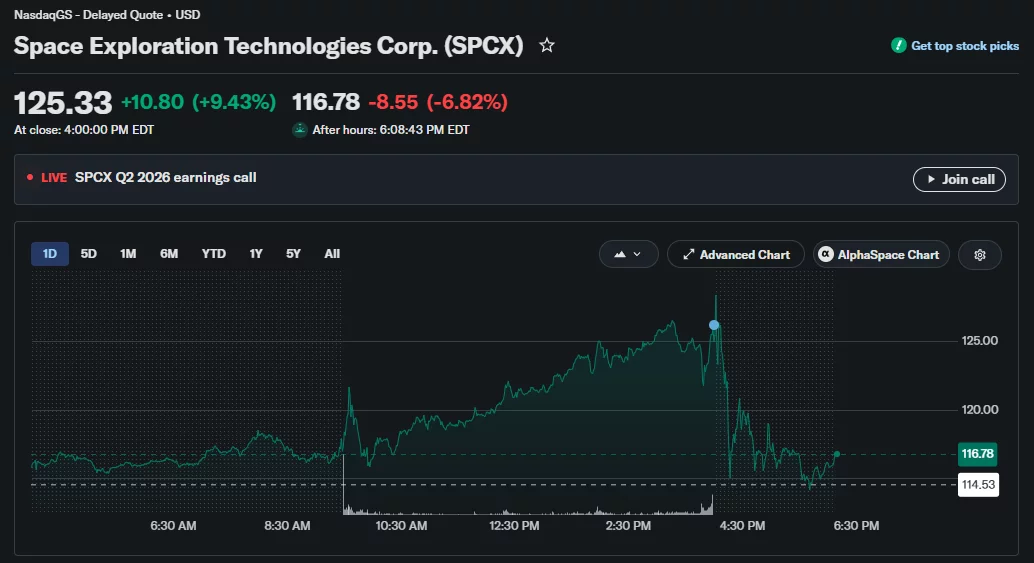
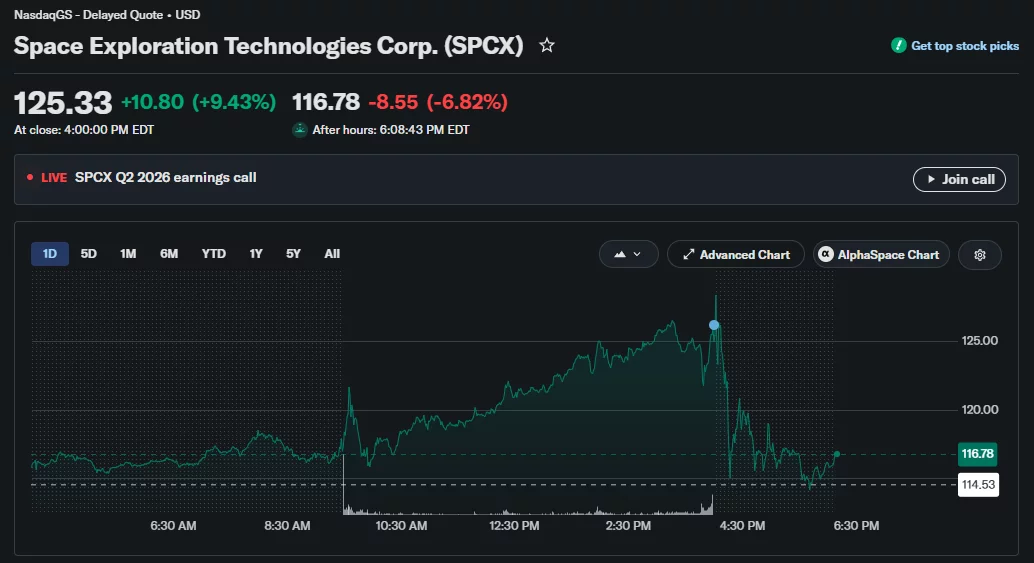
SPCX closed Tuesday at $125.33, up $10.80, or 9.43%, after investors responded to the NVIDIA partnership ahead of SpaceX’s earnings report.
However, the stock reversed course after the closing bell. SPCX fell 6.82% to $116.78 in after-hours trading as investors assessed the company’s quarterly results and AI spending plans.
NVIDIA shares gained 3.03% to $212.91 during Tuesday afternoon trading. The move reflected investor expectations that orbital data centers could create another market for the chipmaker’s AI computing hardware.
NVIDIA says its Space-1 Vera Rubin module can provide up to 25 times the AI computing power of an H100 GPU. The platform is designed for space-based inference, autonomous operations and real-time satellite-data processing.
SpaceX faces cost and execution questions
Starmind could allow SpaceX to combine its launch capabilities, Starlink communications network and AI operations within one infrastructure project. However, deploying orbital data centers would require large investments in satellites, launches, power generation and thermal management.
SpaceX must also demonstrate that the system can operate safely alongside existing spacecraft before receiving final FCC authorization. Even if approved, the company would likely deploy the network in stages rather than launching the full requested number.
For U.S. investors, the NVIDIA agreement provides a clearer hardware path for SpaceX’s AI strategy. The next tests will be regulatory progress, the cost of building the constellation, and whether orbital computing can produce enough revenue to justify the required spending.
SpaceX reports its first quarterly results as a public company after Tuesday’s close, with a webcast following around 4:30 p.m. ET.
The debut print will test whether Starlink profits can fund the company’s aggressive AI and Starship ambitions.

What Wall Street Expects From the Report
The broader consensus centers on $6.8 to $6.9 billion in revenue, a sharp jump from $4.69 billion in the first quarter. Wall Street also models a non-GAAP loss of near $0.23 to $0.26 per share.
Segment expectations vary considerably. Starlink remains the cash engine, projected at around $3.8 billion with operating margins near 36%.
The AI unit should show the fastest growth. Analysts forecast $2 to $2.3 billion from xAI, Grok, and data-center capacity combined. Space keeps consuming capital instead. Falcon, Dragon, and Starship continue to attract heavy investment without delivering near-term returns.
Timing adds pressure to the report. A major lockup tranche opens August 6, potentially releasing hundreds of millions of shares.
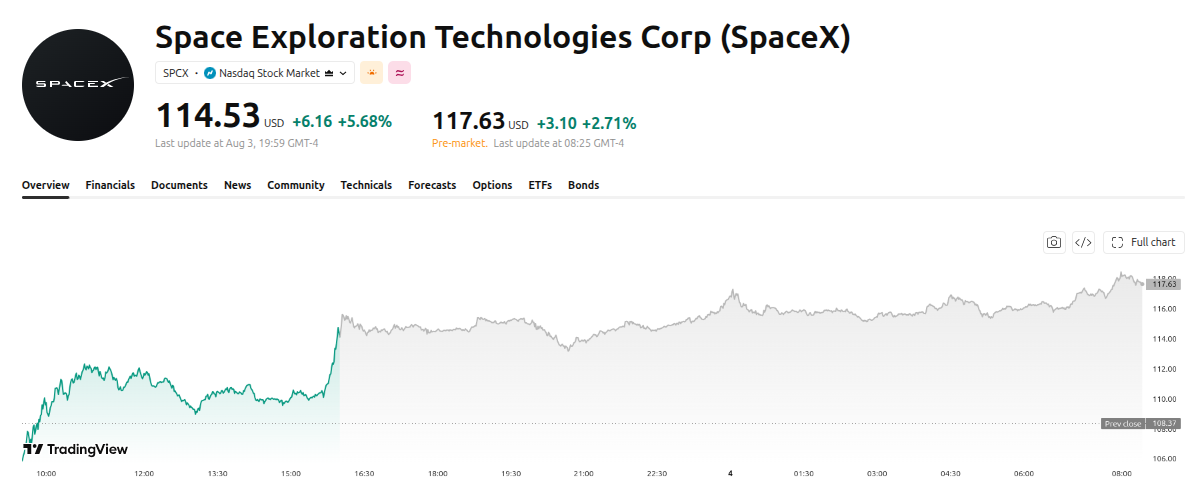
Shares closed Monday at $114.53, up 5.68%, after trading in the mid-100s amid post-IPO volatility, according to TradingView data. The company completed history’s largest public offering in June at roughly $1.5 trillion.
Follow us on X to get the latest news as it happens.
Traders on X are focused on the wide estimate range and the lockup overhang, with options pricing implying significant movement.
Top 3 Scenarios on the Table
Investors have narrowed Tuesday’s possibilities into three broad outcomes. Each depends less on headline revenue than on what management reveals about spending discipline, segment quality, and the path toward self-funding.
Scenario 1: A Clean Beat With Strong Disclosure
Revenue and EBITDA clear consensus while Starlink subscribers and margins hold or improve. AI revenue tracks contracted ramps without slippage.
Management adds concrete detail on capital expenditure phasing, remaining liquidity, and Starship commercialization. Any path toward self-funding would strengthen the case.
That combination could trigger short-covering and a strong rally. It would validate the elevated valuation multiple and offset near-term lockup pressure.
Scenario 2: In-Line Results With Vague Guidance
Numbers land near consensus, with solid sequential growth led by AI and steady Starlink profitability. Details stay high-level instead.
Average Revenue Per User (ARPU) trends, exact AI margins, and peak spending timelines remain unclear, with emphasis shifting toward long-term Mars and orbital-compute vision.
Many analysts consider this the most probable outcome for a first-time public reporter. Markets would likely trade mixed to soft as uncertainty persists.
Scenario 3: Soft Print or Capex Concerns
Total revenue meets or modestly misses, while AI revenue falls short of the expected ramp. Starlink shows ARPU pressure or weaker quality growth.
Space losses widen further from Starship development, while elevated Capex commentary raises fresh funding worries without offsetting positives.
Subscribe to our YouTube channel to watch leaders and journalists provide expert insights.
That outcome would intensify scrutiny of Starlink subsidizing other segments. Sharper selling could follow, especially with increased float arriving days later.
What Really Matters Beyond the Numbers
The earnings call will set the tone for how public investors assess a company blending profitable satellite broadband, leadership in reusable launch, and ambitious AI infrastructure bets. Few listed firms carry that combination, and none at this valuation.
Beyond the headline figures, segment details and management tone will matter most. Signals on cash discipline could prove decisive as the company navigates its early public-market chapter.
The lockup expiration two days later adds another layer entirely. Even a strong report may struggle against fresh supply, leaving Tuesday’s reaction an incomplete verdict on where SpaceX stock heads next.
The post SpaceX Earnings Call Today: Top 3 Scenarios Investors Are Watching appeared first on BeInCrypto.

Michael Burry attends “The Big Short” New York premiere at the Ziegfeld Theater in New York, Nov. 23, 2015.
Andrew Toth | Filmmagic | Getty Images
Michael Burry of “The Big Short” fame is sticking with his bearish wagers even as the S&P 500 surges to a record high, warning that the rally could still end in a sharp sell-off reminiscent of the 1987 stock-market crash.
“I continue to believe it is possible we are near a major top, and possible a 1987-type fall, but the S&P 500 making new highs likely will bring new money into the market,” Burry said in a Tuesday Substack post.
The S&P 500 jumped 1.9% Tuesday to its first record close since June, buoyed by stronger-than-expected corporate earnings and another drop in oil prices as hopes grew that the Strait of Hormuz would reopen to maritime traffic. The tech-heavy Nasdaq Composite soared 2.7%, extending its gain in just the first two days of the week to nearly 5%.
Burry has been among Wall Street’s most outspoken skeptics of the artificial intelligence boom, arguing that demand for AI infrastructure is being fueled by financing arrangements that may prove unsustainable. He said the market’s advance is creating a self-reinforcing cycle, with declining volatility encouraging systematic investors to increase exposure.
“Remember, the market going up on falling volatility forces vol-targeting funds to leverage up, and brings leverage from other momentum strategies into play,” he wrote.
In the face of the rally, Burry said he continues to hold short positions in the iShares Semiconductor ETF (SOXX), Micron, Nvidia, Caterpillar, Palantir, Tesla and Applied Materials.
The investor said he remains confident in his long-term outlook for those positions, though he added that he would cut his losses if the trades moved decisively against him. All of the positions remain profitable except for his bet against Nvidia, he said.
“Again, shorting is not for everyone,” Burry wrote. “I must short. Most should not.”

Bitcoin finished July on a strong note before losing momentum at the start of August with two straight daily closes below $63,000. The decline has raised fresh caution even as blockchain data points to steady buying around current price levels.
That buying activity became clearer in recent on-chain data, which shows roughly 155,000 BTC moved into the $62,000 to $65,000 cost-basis range during the latest pullback. The zone now holds the largest concentration of supply across the market and represents about 0.7% of Bitcoin’s circulating supply.
Accumulation Continues Despite Price Weakness
According to the recent Bitfinex report, the supply cluster expanded while prices declined instead of shrinking through broad selling activity. The report said the pattern suggests buyers absorbed selling pressure rather than existing holders leaving the market in large numbers.
The data also highlights different behavior between long-term and short-term holders during the recent decline. Long-term holders continued accumulating Bitcoin, while many short-term holders reduced positions near their purchase prices.
Despite those signs of accumulation, broader market activity has become more subdued. Bitcoin entered August after recording a 7.3% gain during July, which matched historical seasonal trends for the month. However, spot trading volumes have fallen to levels last seen in late 2023.
Market Sentiment Turns More Cautious
Institutional demand also weakened as U.S. spot Bitcoin exchange-traded funds recorded a combined net weekly outflow of $61.5 million. That result ended three consecutive weeks of positive inflows and reflected softer demand from large market participants.
The options market has also turned more defensive as participants paid higher premiums for downside protection. Even so, implied volatility remains close to multi-year lows, suggesting expectations for relatively limited price swings.
Beyond market positioning, broader economic conditions continue influencing sentiment. Second-quarter GDP expanded 1.5%, while private domestic demand rose 3.9%, driven by consumer spending and AI-related investment.
Inflation also remains a focus after personal consumption expenditures prices increased at a 5.1% annualized pace. Meanwhile, the 10-year real yield reached 2.41%, placing it only nine basis points below a level some analysts consider important for non-yielding assets.
The post Bitcoin Holds Key Support as On-Chain Data Shows Fresh Accumulation appeared first on CryptoPotato.
July was quite successful for the second-largest cryptocurrency, with its price rebounding by 18.5%.
Many market observers expect much stronger upside ahead, with that progress potentially spilling over into the broader altcoin sector.
ETH’s Next Targets
The cryptocurrency made several attempts last month to reach the $2,000 psychological level but couldn’t succeed and currently trades at around $1,850. X user Ted paid special attention to that level, predicting a pump to $2K if that zone holds.
“Spot buying is happening, which is a good sign,” he added.
Michael van de Poppe shared a similar thesis. He assumed that holding $1,800 could lead to breaking the $2,000 barrier, and after that “it’s a fast run to $2,300 and higher.”
For their part, Celal Kucuker argued that ETH has “one of the strongest charts” the analyst has ever seen, envisioning an explosion to as high as $13,000 in 2026-2027. Rising to such a peak seems rather implausible considering the persistent bear market and the current prices, but crypto has surprised the community many times throughout its history.
According to the X user, the CLARITY Act could accelerate that move. The long-awaited US crypto bill is meant to give clear rules for digital assets, but its progress has stalled again after the White House failed to respond to a key counterproposal sent by Senators Thom Tillis and Ruben Gallego.
Meanwhile, the amount of ETH stored on centralized exchanges continues to hover around a 10-year low of 15.1 million coins, which supports the bullish perspective since it leads to reduced selling pressure.

Altcoins to Explode?
The analyst who goes by Dami-Defi on X presented another angle of the situation. They think ETH is about to break a one-year downtrend, which could be a precursor to a substantial rally and might be bullish for the broader altcoin sector.
X users Cup and Gordon also laid out their thoughts on the matter. The former believes that altcoins are poised for a serious pump, forecasting that the biggest breakout of this cycle is coming in the next few weeks.
The latter reminded that gold and silver already had their moments of glory, adding that “bonds are cooked,” while “stocks are looking weak.” That said, they moved their focus to the altcoins, claiming “this is where the biggest gains will be made next.”
The post Ethereum (ETH) Is About to Break a Key Barrier: Good News for All Altcoins? appeared first on CryptoPotato.
Crypto World
Elon Musk’s SpaceX (SPCX) tops earnings as bitcoin (BTC) holding value drops by $540 million


SpaceX (SPCX), Elon Musk’s space technology company, reported its first quarterly results as a public company on Tuesday, announcing second-quarter revenue of $7.8 billion.
That figure topped Wall Street expectations of $6.9 billion, while narrowing its quarterly loss to $541 million as growth accelerated across its launch, Starlink and AI businesses.
The company reported a net loss of $541 million, an improvement from a $1.0 billion loss a year earlier, while adjusted EBITDA nearly tripled to $3.5 billion.
The firm held onto its stash of 18,712 bitcoin , according to the SEC filing. However, the value of holdings declined to $1.10 billion at June 30 from $1.64 billion at the end of 2025, coinciding with bitcoin’s 33% price slump through that period.
SPCX was down 6% after-hours on the report to $118 after closing the regular session nearly 10% higher on the day’s trading, while the Nasdaq 100 gained 3.3%.
The firm’s report arrived less than two months after SpaceX’s record-breaking $86 billion IPO and ahead of the stock’s first major test. On Aug. 6, roughly 912 million shares held by employees and early backers will become eligible for sale, potentially increasing the stock’s public float.


Dr. Daniel Griffin doesn’t like to get sick. The first reason why is obvious—the congestion, the aching, the cough that overstays its welcome, the unpleasant stomach symptoms.
The second is a matter of professional dignity. “It’s almost like a gardener with dead plants,” says Griffin, chief of the division of infectious disease at Island Infectious Disease Medical in Long Island, N.Y. and president of Parasites Without Borders. “I really don’t want to be sick—because then the infectious disease doctor got sick.”
So what do infectious disease doctors and experts like him do differently than the rest of us when it comes to preventing illness? Not as much as you’d think. Infectious disease specialists aren’t disinfecting every surface or hiding from the outside world. Instead, they’ve built a collection of practical habits into their daily lives—simple routines that reduce risk without making life less enjoyable.
We asked six infectious disease experts which habits they never skip.
Set up your kitchen so cross-contamination can’t happen
Jill Roberts tries to take the guesswork out of food safety. “One of the major causes of foodborne illness is cross-contamination,” says Roberts, a molecular epidemiologist and professor at the University of South Florida College of Public Health. “It’s when you have something that’s raw and you get microbes from the raw thing into the ready-to-eat thing.”
Her favorite solution: color-coded cutting boards. Meat always goes on the red one; vegetables never do. “If your meat is always on the red cutting board, you’re never gonna have your salad stuff on your red cutting board,” she says.
Order matters just as much. She makes the salad first, puts it in the refrigerator, and only then brings out the red boards and raw meat. Once she starts handling meat, she’s vigilant about sanitizing any surfaces she may have contaminated—from the counters and sink to the faucet handles and refrigerator door.
Wash your produce under running water—not in a bowl
Some people think rinsing produce means filling a bowl with water and letting everything soak. But that’s not the best approach. “What you actually need is that little bit of friction to break the surface,” says Dr. Heidi Torres, an infectious disease physician and assistant professor of clinical medicine at Weill Cornell Medicine. About 30 seconds under running water, while gently rubbing the produce with your hands, does far more than a passive soak.
The problem with a bowl is that you’re washing everything in the same water. “If you have one piece that’s contaminated, that water could contaminate the other vegetables,” Torres says. Running water washes germs away instead of moving them from one piece of produce to another. It won’t remove everything—Cyclospora, for example, doesn’t simply rinse off—but it does reduce bacteria, viruses, and even some pesticide residue.
Microwave your kitchen sponge
A sponge is a nearly perfect habitat for germs: damp, warm, and studded with food particles, sitting next to the counter where you just set down raw chicken. “Sponges and wet dishcloths are really good at growing bacteria,” says Kelley Steury, a clinical associate professor in the school of public health at the University of Nevada, Reno, who specializes in veterinary preventive medicine. Her routine: Rinse her sponge until no food particles come out, then microwave it for 20 seconds. Just make sure it’s wet. “If you did it when it was pretty dry, you could start a fire,” she says.
Brush your teeth like it’s infection control
Most people brush their teeth to prevent cavities. Torres brushes hers to prevent infections.
“At least 25% of infections that I see are related to dental disease,” she says. Here’s why: Every day, small amounts of bacteria slip into your bloodstream, and a healthy immune system clears them without you ever noticing. Cavities and gum disease change the equation. They allow more bacteria—and more aggressive bacteria—to leak into the blood, which Torres describes as “a highway to all your organs.” In some cases, she says, doctors can trace an infection back to the mouth because the bacteria involved simply don’t live anywhere else.
That makes brushing about much more than fresh breath. “Rinsing alone wouldn’t replace it, because you really need that mechanical brushing to break down that film of bacteria,” Torres says. Hospitals have even started treating basic oral care as a form of infection prevention, she says—which is a pretty compelling reason to take it seriously at home, too.
Rethink the rug in your bathroom
Your bath mat outside the tub should be washable, hung to dry between uses, and tossed in the laundry about once a week. “We don’t leave the wet stuff on the floor, because that’s gross,” Roberts says. A damp bath mat can also spread athlete’s foot from one person to another.
As for the old-fashioned rug wrapped around the base of the toilet? Roberts would get rid of it altogether. Rubber backings don’t often hold up well in the wash, which means it probably doesn’t get cleaned as thoroughly as it should. “Especially if you have kids, they don’t aim well,” she says. “You have splash-overs.” In other words: Nothing around the toilet should be soaking anything up.
Leave your shoes at the door
Shoes pick up a lot more than dirt. Every sidewalk has been shared with other people, their pets, and whatever else has passed through. Dr. Cesar J. Figueroa Ortiz, an infectious diseases specialist at Memorial Sloan Kettering Cancer Center in New York, would rather not track any of that across the floors where his family walks and spends time—so shoes come off at the door.
His job reinforces the habit. Hospitals are meticulously cleaned, but there’s always “the risk of bringing pathogens with you on your shoes,” he says.
Open a window before company comes over
Before guests arrive, most people wipe down the counters. Dr. Peter Chin-Hong, an infectious-disease specialist at the University of California, San Francisco, thinks they should be paying more attention to the air. “I respect air more than surfaces,” he says. “You’re probably going to have a bigger bang for your buck when you think about ventilation.”
His solution is simple: crack a window. If the air conditioning is running, make sure it’s bringing in fresh outdoor air rather than recirculating the same indoor air all evening, he adds.
Wash your hands like you’re not in a hurry
Even infectious disease doctors don’t always practice perfect hand hygiene. Griffin has watched colleagues race out of a public restroom because they were about to miss a lecture at a conference. “They’re so anxious to get back out because they’re missing whatever the lecture is, and they’re not really doing proper hand hygiene,” he says. “Even the people that should know better are rushing back out.”
And when people do wash their hands, they’re often rushing through that, too. “Nobody’s singing ‘Twinkle, Twinkle, Little Star’ to time themselves,” Griffin says (besides him).
His other rule is knowing when soap and water beat sanitizer. (Basically always.) Alcohol-based hand sanitizer doesn’t kill everything: Norovirus—the highly contagious stomach bug behind many cruise ship outbreaks—is particularly resistant. Soap and water keep you safe, though, so if someone around you is vomiting or has diarrhea, Griffin says, head for the sink.
Use your shirt tail
Steury will happily look a little strange to save herself a bout with a germ. “Someone might look at me and think I’m crazy, but I’ll use the bottom of a shirt, like my shirt tails,” she says—or the hem of a cardigan, whatever’s handy—around her hand when she has to touch certain surfaces.
She’s selective about when she does it. What worries her are high-touch surfaces that are indoors and out of the sun: elevator buttons, soda fountain dispensers, and the door handle to a medical clinic, for instance. And if she does touch one of those surfaces directly, she waits until she can wash her hands before touching her eyes, nose, or mouth.
Decline the grocery-store sample
Before you accept that free cube of cheese, think about the cart you’re pushing.
“I always think about what happened to the grocery cart before you got there,” Roberts says. “Somebody picked up raw chicken. Somebody picked up raw seafood. And all of that is on the cart. It’s on the handle.”
Then someone offers you a toothpick with a sample. “I’m supposed to take my hand off this dirty cart and then take that food and put it in my mouth?” she says. “There’s no way.”
Wear sandals in every locker-room shower
At the gym, Torres worries less about the person coughing on the treadmill than the surfaces her bare skin touches. Benches, mats, and other shared equipment can harbor MRSA and fungi like ringworm—even at the nicest gyms. She wipes equipment down before using it, not just afterward, and if there aren’t disinfecting wipes available, she puts a towel between herself and the bench.
The locker-room shower gets its own rule. “It’s this wet, damp floor, walking around the locker room, walking around the joint showers,” she says. “I always recommend bringing a pair of sandals.” Foot fungus is the biggest concern, and some infections can be surprisingly difficult to get rid of.
Wash any cuts before reaching for the antiseptic
Most of us instinctively reach for the antiseptic after nicking a finger. Chin-Hong heads for the sink instead. “The more important thing is to rinse it well with running water and soap, which is more important than the aggressive disinfectant,” he says. Disinfectants don’t kill everything, but running water can physically flush away germs before they have a chance to cause trouble.
His reasoning comes down to one simple idea. “Running things are better than stagnant things,” Chin-Hong says. “We get infections when things are in stasis rather than in movement.” It’s the same reason standing water becomes a mosquito breeding ground.
Pack a pair of tweezers
Torres never leaves for a weekend in tick country without packing a pair of tweezers. It might sound excessive, she admits, but after years of treating tickborne illnesses, it’s become second nature. “This is a little unusual—maybe my colleagues don’t do this,” she says, “but whenever I go away for a weekend, I always pack a pair of tweezers.”
These days, that means much of the country: the Northeast, the Midwest, the South, and parts of the West Coast. After spending time in tall grass or wooded areas, do a full-body tick check, paying special attention to places they like to hide, like under the arms and behind the knees.
It matters more than you might think. “Most people that develop Lyme disease or tickborne illness have no recollection of ever being bitten by a tick or ever seeing a tick,” Torres says. She’s also vigilant against ticks to try to prevent alpha-gal syndrome—the tick-triggered allergy to red meat that has become increasingly common.
Reapply bug spray like it’s sunscreen
Bug spray is a permanent fixture in Chin-Hong’s travel bag. “I respect mosquitoes,” he says. “They actually kill more people than any other animal.” It’s West Nile season, and dengue keeps extending its reach into new parts of the U.S., so he travels with insect repellent as a matter of course.
The biggest mistake people make, he says, is treating bug spray like a one-and-done product. “It’s like sunscreen. You don’t get away with just applying it once.” If you’re outdoors all day, reapply at least every six hours. He also recommends choosing a repellent with about 20% to 50% DEET—or 20% picaridin if you prefer to avoid DEET—and remembering that the mosquitoes most likely to spread disease are busiest from dusk to dawn.
Rinse your toothbrush with bottled water when traveling abroad
Most travelers remember to avoid the tap water in destinations with questionable water supplies. Griffin worries about the toothbrush. “We tell people to be careful of ice cubes and tap water and all the rest,” he says. “But then people brush their teeth with the tap water.”
He calls what often follows “third-day sickness.” By then, your toothbrush has been rinsed repeatedly in tap water and left to sit in a warm, humid bathroom—giving any lingering microbes plenty of time to multiply before the brush goes right back into your mouth. His solution takes just a few seconds: rinse your mouth and toothbrush with bottled water, too.
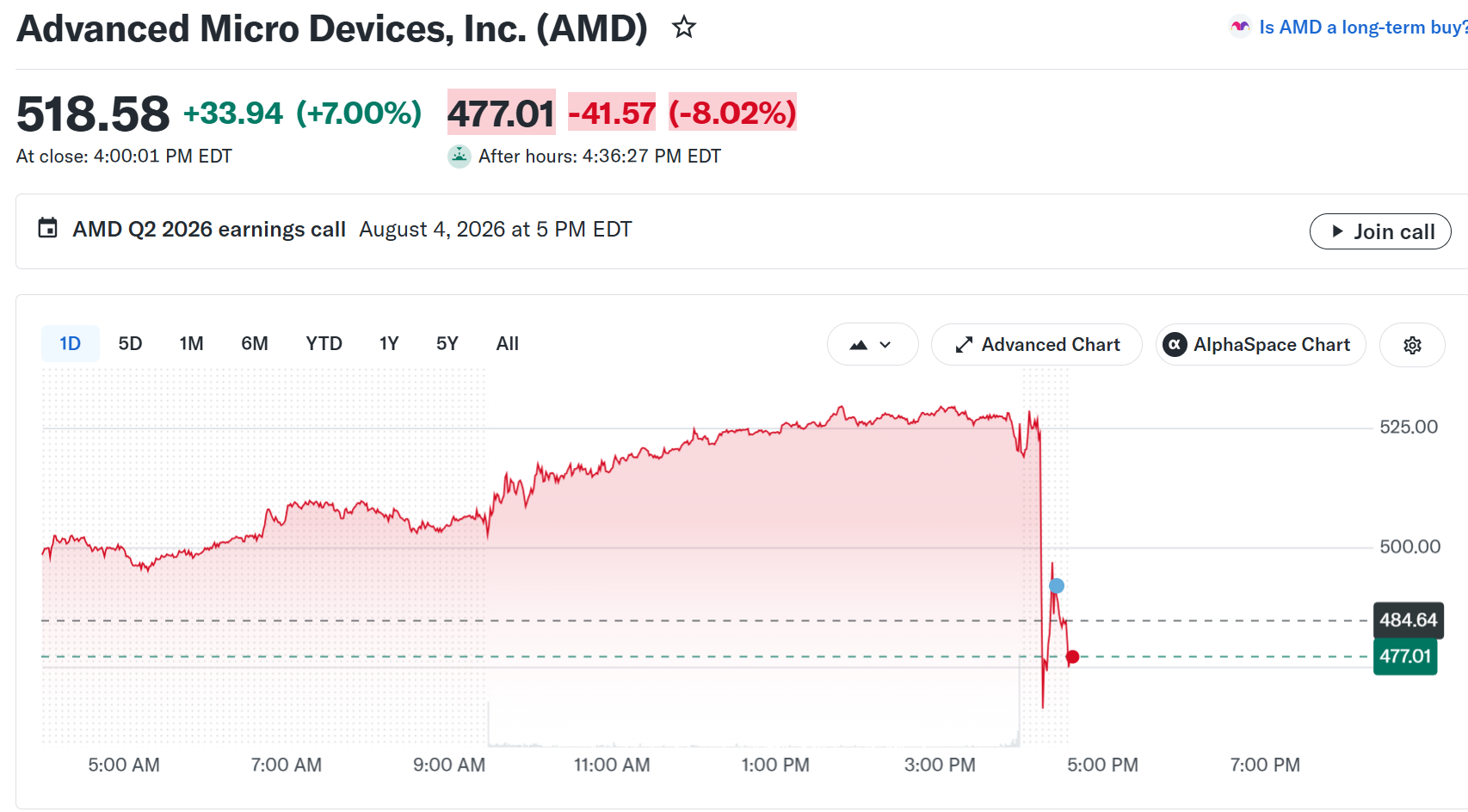
Advanced Micro Devices (AMD) reported earnings that beat Wall Street on revenue, profit, and operating margin. The stock then lost 8% in after-hours trading on Tuesday.
The chipmaker posted record revenue of $11.54 billion and guided third-quarter sales to roughly $13 billion. Investors sold anyway, with the stock already up 140% in 2026 before the release.

AMD Earnings Beat Every Consensus Estimate
Revenue reached $11.54 billion against a $11.31 billion consensus. That marked a 50% increase from a year earlier.
Adjusted earnings came in at $1.66 per share, ahead of the $1.62 estimate. Adjusted operating margin of 27% edged past the 26.9% forecast and more than doubled the 12% booked a year ago.
Data Center revenue carried the quarter at $6.7 billion, up 107% year over year. That single segment now supplies 58% of company sales, driven by EPYC server processors and Instinct artificial intelligence (AI) accelerators.
Elsewhere the picture was mixed. Client revenue rose 23% to $3.06 billion on Ryzen demand. Gaming fell 31% to $779 million as orders for semi-custom console chips shrank.
Follow us on X to get the latest news as it happens
Why a Clean Beat Triggered a Selloff
Capital expenditures told a different story. AMD spent $808 million on property and equipment, nearly triple the roughly $299 million analysts had modeled.
Free cash flow fell to $1.56 billion from $2.57 billion in the first quarter as a result. The company is buying capacity ahead of its Helios rack ramp, which compresses near-term cash generation.
Positioning mattered more than any single line item. Shares closed 7% higher at $518.58 on Tuesday before the release. Large investors had rotated into AMD for most of the year.
That left little room for anything short of a raise. The pattern is familiar this earnings season, since Intel beat forecasts by $1.7 billion in July and still dropped 11% on results.
What Analysts Wanted From the Helios Outlook
Benchmark Capital rates AMD a buy with a $685 target. The firm argued before the print that guidance, margin direction, and Helios timing outweighed the beat itself.
AMD cleared the first two tests. Third-quarter guidance of $13 billion plus or minus $300 million implies 41% annual growth. Non-GAAP gross margin should hold near 56%.
Chief Executive Lisa Su addressed the ramp directly in the release.
“We enter the second half with strong momentum as EPYC demand accelerates, Instinct deployments scale and Helios begins to ramp,” Lisa Su, AMD chair and chief executive, in the company’s statement.
Much of that story was already priced in. AMD’s 2 gigawatt Anthropic deal lifted the stock 10% in July. Helios customers now include Meta, Microsoft, OpenAI, and Oracle.
Skeptics remain. Morgan Stanley has flagged AMD’s valuation against Nvidia and Broadcom. HSBC cut the stock to hold in May, citing capacity limits at contract chipmaker Taiwan Semiconductor Manufacturing Company (TSMC).
AI infrastructure spending now works as a lead indicator for risk assets. Semiconductor selloffs have dragged Bitcoin lower more than once this year.
Nvidia’s August 26 earnings give the market three weeks to judge whether Tuesday’s after-hours reaction was a repricing or a pause.
The post AMD Earnings Beat Estimates and Stock Falls 8%: Was the Bar Too High? appeared first on BeInCrypto.

Ripple’s cross-border token has plunged by 5% over the past month to the current $1.07.
This is just above the crucial $1.06 zone, which, according to some analysts, can trigger the next decisive breakout.
Bulls vs. Bears
Ali Martinez believes that “everything comes down to $1.06 for XRP.” In his view, holding the line could open the door to a rally to $1.35 and even $1.64, whereas losing it might result in a potential slump to as low as $0.62.
X user ChartNerd has also stressed the importance of that level. The analyst noted that XRP found support at $1.06, but claimed there is heavy resistance remaining above the $1.08-$1.23 range and “prior ascending support was lost.”
“$1.16 remains the main roadblock ahead of the EMAs. Downward pressure remains until otherwise,” they added.
Shortly after, ChartNerd touched upon XRP’s bearish outlook amid the challenging times. They suggested that the asset may sweep even below $1 in the near future and that “would not be utterly surprising” given the market structure. At the same time, the analyst described such a potential downtrend as “another golden ticket entry in disguise.”
“The next few months are setting the stage for the next market repricing. Maybe the biggest yet,” they added.
Additional Forecasts
EGRAG CRYPTO and JAVON MARKS also gave their two cents. The former opined that XRP has lost the 50 MA and is approaching the 100 EMA, a zone that has historically provided strong long-term support.
The analyst labeled a possible retrace to the $1-$0.95 range as a “healthy macro retest while holding the 100 EMA.” They set $0.80 as “maximum downside” if XRP tumbles to the lower boundary of the long-term channel, but said the targets of $15, $27, and $50+ don’t shrink and rise in time.
As of now, it’s hard to imagine an explosion to even $15 since it will require the token’s market capitalization to skyrocket to nearly $1 trillion. But then again, no one really knows what the future holds.
JAVON MARKS was also bullish, albeit presenting a far more modest prediction than EGRAG CRYPTO. They claimed that XRP has shown a clear breakout of a key resistance trend and the price can respond by jumping beyond $3.50.
The post XRP’s Most Important Level: The Battle for $1.06 Begins appeared first on CryptoPotato.

US and UK Reaffirm Stablecoin and Tokenization Rules in Joint Talks

Falcons DE Jalon Walker carted off with leg injury

How might Galway be an ideal location for modern-day engineers?


-

 Business6 days ago
Why Trees Belong on the Risk Register
-

 Fashion4 days ago
Weekend Open Thread: Wit & Wisdom
-

 Politics4 days ago
Meta enters AI-training agreement with far-right ‘propaganda rag’ Newsmax
-

 Politics6 days ago
Reform UK betrays West Mids residents by running from party pledges
-

 Crypto World3 days ago
MicroStrategy Post-Earnings CLARITY Act Push Could Add New Catalyst for Its Stock
-

 Business7 days ago
Major shareholder moves on Canyon
-

 Crypto World4 days ago
XRP Ledger v3.3.0 brings five institutional features
-

 Politics2 days ago
Zack Polanski: an incitement to murder Nigel Farage?
-

 News Videos5 days ago
Bitcoin Enters the 3rd Stage of the Bear Market
-

 Crypto World7 days ago
Kraken Enables Retail Access to Jersey Mike’s IPO via Tokenized Shares
-

 Politics5 days ago
Luke Littler’s dominance sparks GOAT debate
-

 Sports5 days ago
Seema Kaliramna Wins Discus Throw Bronze, Takes India’s CWG Medals Tally To 17
-

 Crypto World4 days ago
New York sues Kalshi over prediction market gambling
-

 Crypto World3 days ago
Crypto PAC spending tops $2M in Michigan House race
-

 Business4 days ago
Trump Announces Hamas Disarmament Agreement as Iran Strikes Kuwait Air Base and US Attacks Pause Overnight
-

 Tech6 days ago
Gemini can now summarize the messiest comment threads in Google Docs
-

 Tech3 days ago
ESET tracks rise in malicious AI skills and adaptable malware
-

 NewsBeat5 days ago
Four people die trying to cross Channel in small boats
-

 Tech5 days ago
Gemini Spark can now use Chrome logins and saved passwords to run errands on your behalf
-

 Business2 days ago
DTCR: Deleveraging And A Hedge Fund Collapse Point To A Possible AI Bottom
You must be logged in to post a comment Login