
Crypto World
Ethereum (ETH) Is About to Break a Key Barrier: Good News for All Altcoins?

July was quite successful for the second-largest cryptocurrency, with its price rebounding by 18.5%.
Many market observers expect much stronger upside ahead, with that progress potentially spilling over into the broader altcoin sector.
ETH’s Next Targets
The cryptocurrency made several attempts last month to reach the $2,000 psychological level but couldn’t succeed and currently trades at around $1,850. X user Ted paid special attention to that level, predicting a pump to $2K if that zone holds.
“Spot buying is happening, which is a good sign,” he added.
Michael van de Poppe shared a similar thesis. He assumed that holding $1,800 could lead to breaking the $2,000 barrier, and after that “it’s a fast run to $2,300 and higher.”
For their part, Celal Kucuker argued that ETH has “one of the strongest charts” the analyst has ever seen, envisioning an explosion to as high as $13,000 in 2026-2027. Rising to such a peak seems rather implausible considering the persistent bear market and the current prices, but crypto has surprised the community many times throughout its history.
According to the X user, the CLARITY Act could accelerate that move. The long-awaited US crypto bill is meant to give clear rules for digital assets, but its progress has stalled again after the White House failed to respond to a key counterproposal sent by Senators Thom Tillis and Ruben Gallego.
Meanwhile, the amount of ETH stored on centralized exchanges continues to hover around a 10-year low of 15.1 million coins, which supports the bullish perspective since it leads to reduced selling pressure.

Altcoins to Explode?
The analyst who goes by Dami-Defi on X presented another angle of the situation. They think ETH is about to break a one-year downtrend, which could be a precursor to a substantial rally and might be bullish for the broader altcoin sector.
X users Cup and Gordon also laid out their thoughts on the matter. The former believes that altcoins are poised for a serious pump, forecasting that the biggest breakout of this cycle is coming in the next few weeks.
The latter reminded that gold and silver already had their moments of glory, adding that “bonds are cooked,” while “stocks are looking weak.” That said, they moved their focus to the altcoins, claiming “this is where the biggest gains will be made next.”
The post Ethereum (ETH) Is About to Break a Key Barrier: Good News for All Altcoins? appeared first on CryptoPotato.



US and UK financial regulators have expanded talks on stablecoins, tokenization and digital asset oversight as Washington begins implementing the GENIUS Act.
Summary
- The 13th UK-US regulatory meeting took place in London on July 8.
- US officials briefed UK regulators on GENIUS Act implementation and crypto market structure.
- Both governments support one-to-one stablecoin backing and greater cross-border regulatory coordination.
- The Bank of England has replaced proposed holding limits with a £40 billion issuance cap.
US, UK regulators discuss stablecoin policy
Senior officials from HM Treasury and the US Treasury met in London for the 13th UK-US Financial Regulatory Working Group meeting, according to an Aug. 4 joint statement.
Representatives from the Bank of England, Financial Conduct Authority, Federal Reserve, Securities and Exchange Commission, Commodity Futures Trading Commission, Federal Deposit Insurance Corporation and Office of the Comptroller of the Currency also attended.
Digital finance formed a central part of the July 8 meeting. US officials updated their UK counterparts on the implementation of the GENIUS Act, which establishes a federal framework for payment stablecoins, and on continuing work to define the country’s broader digital asset market structure.
Officials also discussed tokenization, payment modernization and the G20 Cross-border Payments Roadmap. UK representatives provided an update on the country’s Wholesale Financial Markets Digital Strategy and the appointment of Christopher Woolard as Wholesale Digital Markets Champion.
The meeting did not produce new regulations or binding agreements. However, both sides reaffirmed support for the “responsible use and growth of digital assets” alongside consumer protection and financial stability, according to the official working group statement.
GENIUS Act raises pressure on UK stablecoin rules
The talks come as the United States moves from stablecoin legislation toward implementation, giving issuers and financial institutions a clearer route to operate under federal rules.
The UK is still completing its own framework. The FCA is expected to oversee the issuance, custody and trading of qualifying UK stablecoins, while the Bank of England will jointly regulate stablecoins considered systemically important.
Coordination could become important for US stablecoin issuers seeking access to UK payment and capital markets. Differences in reserve requirements, custody rules and insolvency protections could otherwise force issuers to maintain separate structures in each country.
The two governments addressed that risk in a separate July 14 statement from the Transatlantic Taskforce for Markets of the Future. They said their goal was to promote convergence where appropriate without replacing either country’s domestic regulatory process.
“Stablecoins held out as money should be fully backed,” the governments said.
The joint stablecoin statement called for at least one-to-one backing with high-quality liquid assets, segregated reserves and timely redemption. It also proposed exploring a pathway for stablecoins issued in one jurisdiction to enter the other market.
Bank of England softens earlier restrictions
The Bank of England has already revised some of its more restrictive stablecoin proposals following industry feedback.
In June, the central bank abandoned proposed per-coin holding limits of £20,000 for individuals and £10 million for businesses. It replaced them with a temporary £40 billion issuance guardrail for each systemic stablecoin, allowing users to transact without individual limits.
The Bank also reduced the share of reserves that systemic issuers must hold as non-interest-bearing central bank deposits from 40% to 30%. The remaining 70% may be held in short-term UK government debt under the steady-state framework.
These changes bring the UK closer to the shared US-UK position that reserve rules should protect holders without creating barriers that make stablecoin businesses commercially unworkable. The Bank of England plans to finalize its systemic stablecoin code by the end of 2026.
What comes next for transatlantic stablecoins
The next phase will depend on how US agencies implement the GENIUS Act and whether the two countries convert their shared principles into formal market-access arrangements.
Key unresolved issues include the treatment of foreign-issued stablecoins, regulatory recognition between jurisdictions, reserve custody and procedures for cross-border issuer failures.
The Financial Regulatory Working Group plans to meet again in early 2027. Until then, the July recommendations provide a policy direction rather than a unified transatlantic regime, leaving issuers subject to separate US and UK requirements.


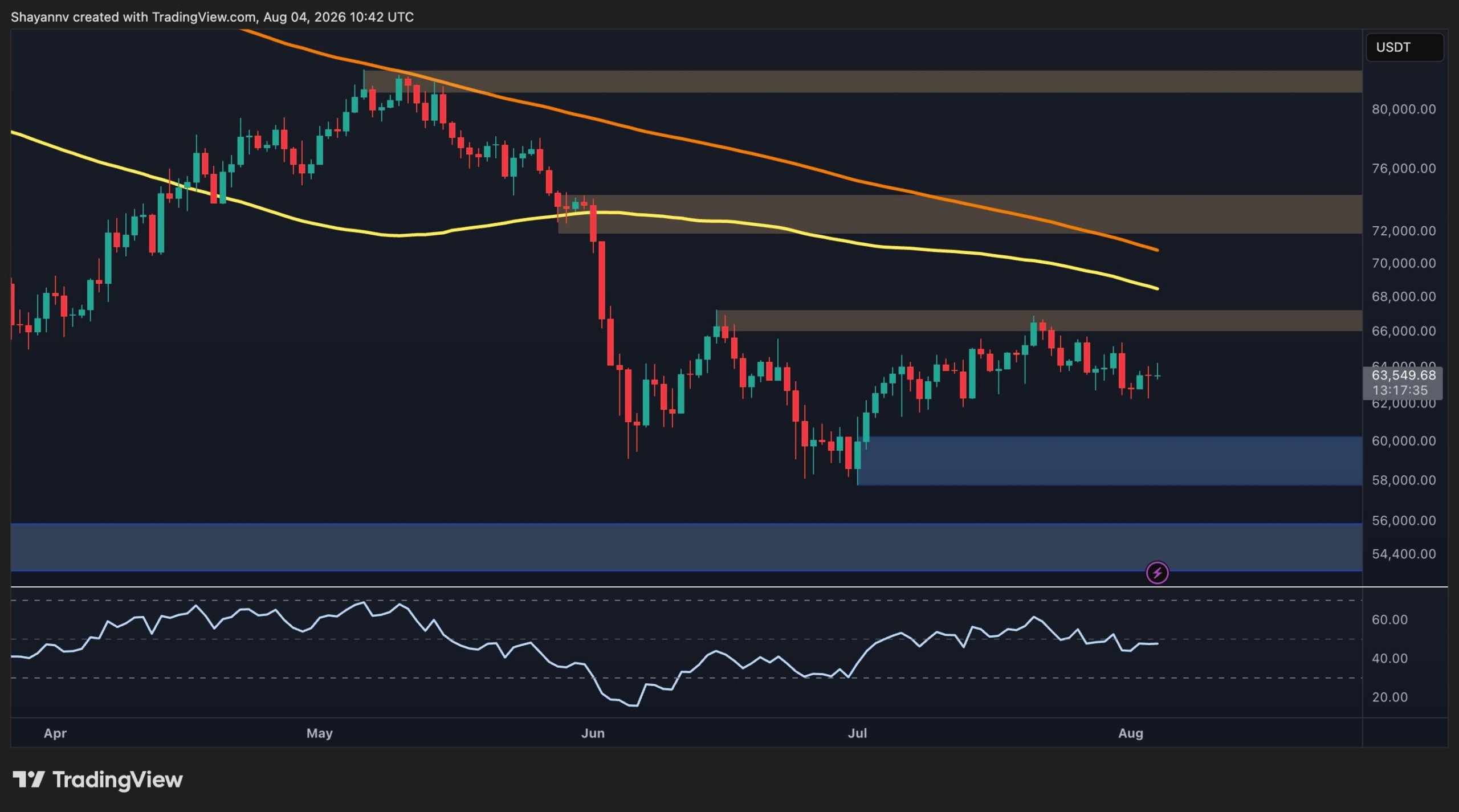
Bitcoin continues to trade within a well-defined consolidation range after failing to establish a meaningful recovery from its late June lows. While short-term price action has stabilized above key support, the broader structure remains neutral to bearish, with overhead resistance still capping every rally. At the same time, the Coinbase Premium Index remains in negative territory, suggesting that US spot demand has yet to return in a convincing manner.
Bitcoin Price Analysis: The Daily Chart
On the daily timeframe, BTC continues to trade around $63.5K after spending several weeks ranging beneath the $67K resistance zone. This area has repeatedly rejected bullish advances and now represents the first major hurdle for buyers.
The broader trend remains bearish as the price continues to trade below both the 100-day and 200-day moving averages, which are sloping downward around the $68K and $70K regions, respectively. These moving averages reinforce the bearish higher-timeframe structure and create a strong confluence resistance zone above the market.
On the downside, the first important demand area remains at $60K, where buyers previously stepped in to defend the market following the sharp June decline. Below that, the final major support sits around $54K, which would likely become the next downside target if the current range eventually breaks lower.
Meanwhile, momentum remains relatively muted. The RSI is hovering around the midpoint near 50, reflecting a balanced market with neither buyers nor sellers maintaining clear control. Unless BTC reclaims the $67K resistance area, the broader structure continues to favor range-bound trading rather than the beginning of a sustained recovery.
BTC/USDT 4-Hour Chart
The lower timeframe highlights a market that is consolidating above the $62K short-term support after several failed attempts to break lower.
The asset has recently bounced from this demand zone and is now trading inside a small fair value gap formed around $63K. This imbalance is acting as the immediate short-term support, and buyers will need to rebound from this area before attempting another move toward the range highs.
As long as BTC holds above the $62K support, another push toward $66K remains possible. However, repeated failures around the upper boundary would continue to strengthen the existing range and increase the probability of another rotation back toward support.
To the downside, a decisive breakdown below $62K would invalidate the current short-term recovery and expose the broader $60K demand zone once again.

Sentiment Analysis
The Coinbase Premium Index continues to paint a cautious picture despite Bitcoin’s recent stabilization. The metric remains below the zero line, currently around -0.08, indicating that BTC is still trading at a discount on Coinbase relative to offshore exchanges.
Historically, sustained positive Coinbase Premium readings have coincided with stronger buying activity from US institutional and spot investors. In contrast, persistent negative values often reflect weaker spot demand or relatively stronger selling pressure from US participants.
Although the index has recovered from the deeply negative readings recorded during previous selloffs, it has yet to establish a sustained move back into positive territory. This suggests that the recent price stabilization has not been accompanied by meaningful accumulation from Coinbase participants.
As a result, Bitcoin’s recovery appears to be driven more by short-term positioning than by strong spot demand from US investors. A sustained move of the Coinbase Premium Index above zero would strengthen the bullish case as it would show large US investors and institutional traders returning, while continued negative readings would leave the market vulnerable to renewed downside pressure if key support levels begin to fail.

The post Bitcoin Price Analysis: Will BTC Break Above $66K or Fall Below $62K Next? appeared first on CryptoPotato.
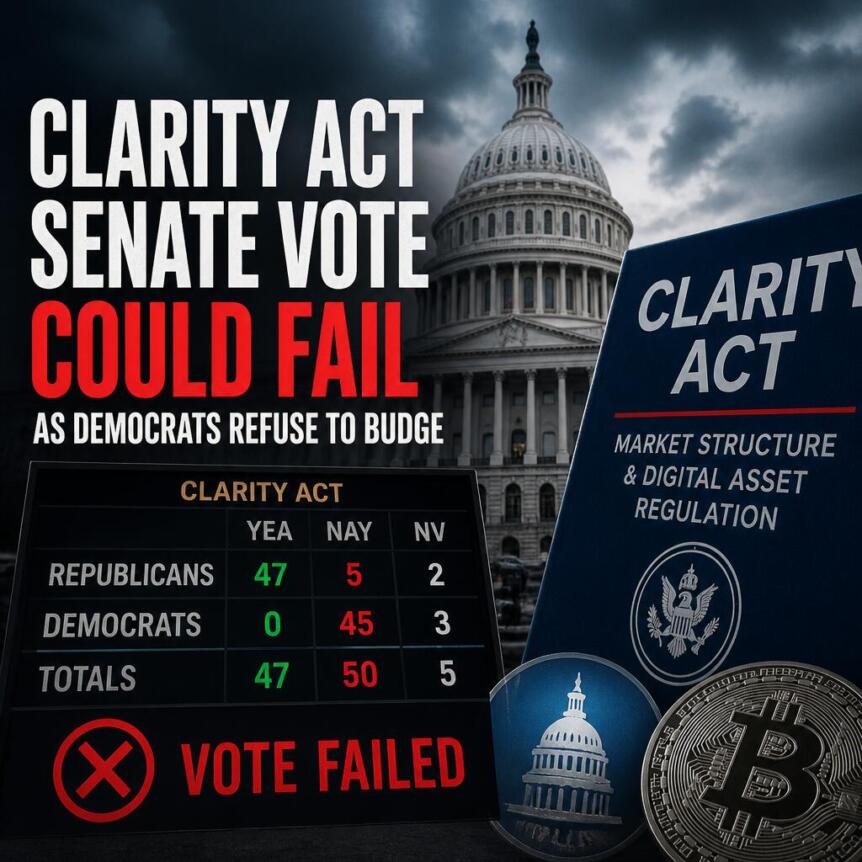
Senate negotiations over digital asset legislation remain unresolved as lawmakers prepare for a key procedural vote. The CLARITY Act faces growing uncertainty after Democratic senators signaled they would not support ending debate without further concessions. Republican leaders continue seeking enough backing before lawmakers leave Washington for the summer recess.
Democrats Signal Resistance Before Procedural Vote
Democratic senators continue coordinating their position before the expected procedural vote on the CLARITY Act. Several lawmakers insist unresolved issues require additional bipartisan negotiations before supporting cloture. Senate leaders have not announced any agreement addressing those concerns.
Punchbowl News reporter Brendan Pedersen described the current Democratic position in a post on X. He wrote, “There is a clear consensus among Senate Democrats right now that—without movement on ethics, illicit finance and stablecoin yield—a cloture vote this week on the Clarity Act will fail.” His comments reflected the latest state of negotiations before the expected vote.
Pedersen also wrote, “Democrats won’t be moved by crypto cash at this point.” That statement highlights continuing resistance despite Republican efforts to secure procedural support. The CLARITY Act therefore remains short of the bipartisan momentum needed for a successful cloture vote.
Outstanding Issues Continue to Divide Both Parties
Senate Majority Leader John Thune continues working toward a procedural vote before lawmakers begin the August recess. However, several Democratic senators argue the CLARITY Act still requires further revisions before advancing. Negotiators continue discussing ethics provisions, illicit finance safeguards, and stablecoin yield rules.
Republican lawmakers have sought Senate consideration of the legislation for several months. Current vote estimates indicate supporters still lack sufficient backing to advance debate. Negotiators continue working to resolve disagreements before the CLARITY Act reaches another procedural milestone.
One Democratic aide questioned whether negotiations could survive another political escalation before Congress returns. The aide said, “If they spend in August, it’s done.” That remark underscores concerns that campaign activity could further complicate CLARITY Act negotiations.
Senate Talks Remain Focused on Reaching Consensus
Senator Ruben Gallego questioned whether Republican negotiators were maintaining productive bipartisan discussions around the CLARITY Act. He said, “We are clearly here, trying to engage constructively.” Gallego also added, “At this point, if they’re not engaging, it’s telling me that they don’t want this to happen.”
Some Democratic lawmakers also expressed concern about political spending by crypto-backed organizations before Congress reconvenes in September. They believe additional campaign activity could further strain ongoing bipartisan discussions. Those concerns continue influencing negotiations surrounding the CLARITY Act.
Supporters of the legislation maintain that additional negotiations could still produce a workable compromise before future procedural votes. They believe remaining differences between House and Senate proposals can still be addressed through bipartisan discussions. For now, the CLARITY Act remains dependent on negotiations before any successful cloture vote can proceed.
Senate negotiations continue without a confirmed breakthrough before the expected procedural vote. The immediate future of the CLARITY Act now depends on whether bipartisan negotiators resolve outstanding disputes. Until then, Democratic resistance continues creating uncertainty over this week’s planned Senate action.

The United States and the United Kingdom used a recent bilateral meeting to signal continued alignment on digital-asset oversight, focusing in particular on stablecoin regulation, cross-border payments, and the structure of tokenized markets. The discussion took place during the 13th session of the UK–US Financial Regulatory Working Group (FRWG) in London on July 8.
In an Aug. 4 joint statement summarizing the meeting, US officials told their UK counterparts they are updating implementation details for the GENIUS Act, alongside ongoing work on how digital asset markets should be regulated. The statement also highlighted broader efforts on payment modernization and participation in the G20 Cross-border Payments Roadmap.
Key takeaways
- The July 8 FRWG meeting reinforced US–UK policy coordination around stablecoins, digital asset market structure, and tokenization.
- US officials provided an update on implementing the UK-referenced GENIUS Act and related stablecoin work, but no new policy measures were announced.
- Cross-border payments modernization remains a shared priority, with both governments pointing to international work under the G20 roadmap.
- UK stablecoin regulation is evolving as the Bank of England and other authorities reassess earlier approaches amid competitive momentum from the US.
FRWG meeting places GENIUS Act implementation and market structure front and center
The FRWG meeting covered several areas that regulators typically treat as interconnected: stablecoin rules, the way digital-asset markets operate in the US, tokenization, and the UK’s “Wholesale Financial Markets Digital Strategy.” Those topics matter because stablecoins are often the settlement layer for payments and tokenized instruments, while regulatory frameworks for market structure influence how exchanges, brokers, custodians, and trading venues adapt to digital assets.
According to the Aug. 4 joint statement released by the US Treasury, the US side shared updates with the UK about implementing the GENIUS Act—framed as the country’s landmark stablecoin legislation—along with work on digital asset market structure. The statement also indicates that participants discussed payment modernization initiatives and international coordination on cross-border payments through the G20 Cross-border Payments Roadmap.
While the meeting did not yield new regulatory actions, it did reinforce a familiar theme in transatlantic policy: the desire to keep pace with fast-moving market developments without undermining financial stability. Notably, the statement described a “responsible” approach to digital-asset innovation, while still emphasizing oversight and the need for international regulatory cooperation.
US–UK coordination extends beyond stablecoins to tokenization and payments
The FRWG meeting appears to fit into a broader effort by the two governments to coordinate on financial innovation. Earlier, on July 14, the Transatlantic Taskforce for Markets of the Future—an initiative aimed at strengthening cooperation on financial innovation and capital markets—published initial recommendations together with a joint statement on stablecoins.
That earlier announcement said the measures would help set the foundation for continued US–UK leadership in digital assets and capital markets. Taken alongside the July 8 FRWG discussion, it suggests regulators are treating stablecoin policy not as an isolated topic, but as part of a larger strategy that includes tokenized finance and how payments infrastructure evolves.
For investors and operators, the implication is straightforward: regulatory decisions in one country may influence how compliant products and services are designed for the other. Even when there are no immediate new rules, ongoing coordination can reduce uncertainty for cross-border issuers, market intermediaries, and firms building payment and tokenization applications intended to serve both jurisdictions.
UK stablecoin review accelerates as US regulation gains momentum
UK policymakers’ renewed attention to stablecoins arrives at a time when some observers believe the US is pulling ahead. The rationale is that the GENIUS Act has created clearer traction for regulated, dollar-backed stablecoin activity, providing a benchmark for other jurisdictions to respond to.
Within the UK, the Bank of England has reportedly softened its stance after earlier controversy over potential limits. Cointelegraph previously reported that the BoE was considering alternatives to temporary limits on stablecoin holdings and reviewing whether a proposal requiring at least 40% of reserve assets to be held as non-interest-bearing deposits at the central bank was too restrictive. Separate coverage also noted the BoE’s ongoing work to calibrate regulation in a way that supports stability without overly constraining legitimate market participation.
At the same time, the UK’s Financial Conduct Authority has signaled where it sees near-term real-world value. Earlier in the year, the FCA pointed to cross-border payments as one of the “clearest near-term use cases” for stablecoins, emphasizing that regulators increasingly recognize the technology’s potential—not just as a trading asset, but as a component of payments systems.
For market participants, these signals together indicate that the UK is attempting to thread a needle: maintain strong financial stability requirements while ensuring its framework does not lag in usability and competitiveness relative to the US approach.
What to watch next: implementation details and remaining UK constraints
With the FRWG meeting described as a coordination exercise rather than a source of new rules, the practical question for the market is what happens next in implementation—especially in the US under the GENIUS Act—and whether the UK continues adjusting aspects of its earlier stablecoin proposals. Readers should watch for further clarity from UK authorities on reserve requirements and for concrete milestones tied to stablecoin market-structure work, since those details will likely determine how quickly compliant dollar-backed stablecoin services can expand across borders.
SpaceX has expanded its partnership with NVIDIA to power Starmind, a proposed network of orbital data centers designed to process artificial intelligence workloads in space.
Summary
- SpaceX will use NVIDIA’s Vera Rubin platform for its planned Starmind satellite network.
- The company has requested FCC approval for up to one million orbital data-center satellites.
- NVIDIA says its Space-1 module provides up to 25 times the AI compute of an H100 GPU.
- SPCX gained 9.8%, while NVIDIA shares rose 2.5% following the announcement.
SpaceX adds NVIDIA chips to Starmind network
SpaceX plans to equip its Starmind satellites with NVIDIA’s Rubin graphics processing units and Vera central processing units. The hardware forms part of NVIDIA’s Space-1 platform, which was developed for AI processing and other computing workloads in orbit.
The partnership expands NVIDIA’s list of space-computing customers after the chipmaker introduced the platform in March. Its initial launch partners included Aetherflux, Axiom Space, Kepler Communications, Planet Labs, Sophia Space and Starcloud.
SpaceX was not included in the original announcement but has now joined the companies working with NVIDIA on orbital computing. Musk later said SpaceX would build its AI infrastructure exclusively on NVIDIA platforms and described Vera Rubin as the strongest available option.
The companies also plan to jointly design computing payloads for future satellites, according to reports following SpaceX’s investor call.
NVIDIA says its Space-1 Vera Rubin module combines GPUs, CPUs and high-bandwidth connections in a system designed for the power and weight limits of satellites. It can run large language models and process data in orbit instead of transmitting all raw information back to Earth.
One million satellites still need FCC approval
SpaceX’s broader plan remains subject to regulatory approval in the United States. The company filed an application in January seeking permission to launch and operate as many as one million non-geostationary satellites.
The proposed system would operate between 500 and 2,000 kilometers above Earth. SpaceX said optical links would connect the satellites through a high-capacity network capable of moving data between orbital computing nodes.
The Federal Communications Commission accepted the application for filing in February and opened it for public comment. That procedural decision did not constitute final approval, correcting reports that the FCC had already authorized the full constellation.
The requested scale is far larger than the existing satellite population around Earth. It could also face questions involving orbital congestion, collision risks, radio interference and effects on astronomical observations.
SPCX and NVIDIA shares rally
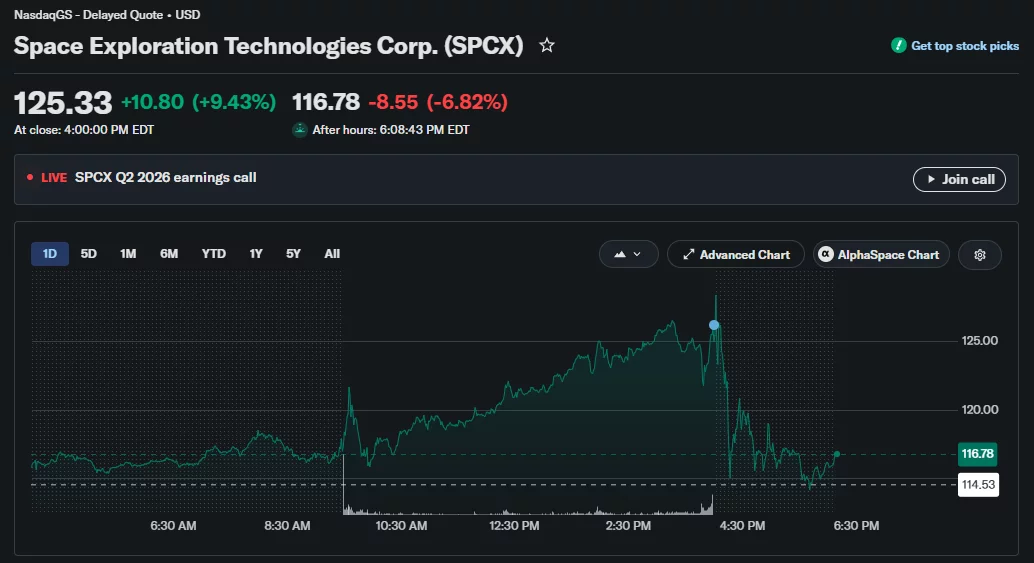
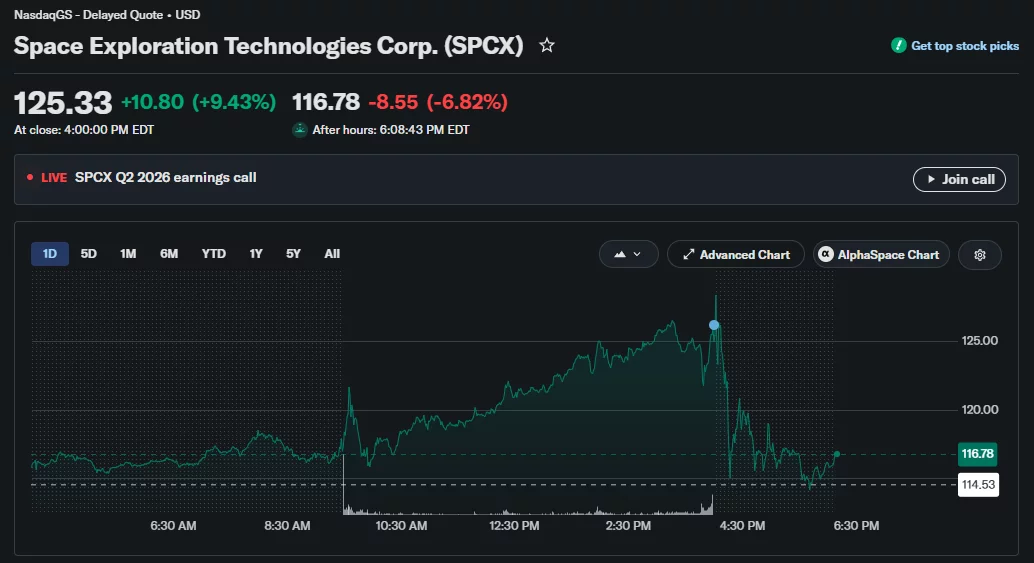
SPCX closed Tuesday at $125.33, up $10.80, or 9.43%, after investors responded to the NVIDIA partnership ahead of SpaceX’s earnings report.
However, the stock reversed course after the closing bell. SPCX fell 6.82% to $116.78 in after-hours trading as investors assessed the company’s quarterly results and AI spending plans.
NVIDIA shares gained 3.03% to $212.91 during Tuesday afternoon trading. The move reflected investor expectations that orbital data centers could create another market for the chipmaker’s AI computing hardware.
NVIDIA says its Space-1 Vera Rubin module can provide up to 25 times the AI computing power of an H100 GPU. The platform is designed for space-based inference, autonomous operations and real-time satellite-data processing.
SpaceX faces cost and execution questions
Starmind could allow SpaceX to combine its launch capabilities, Starlink communications network and AI operations within one infrastructure project. However, deploying orbital data centers would require large investments in satellites, launches, power generation and thermal management.
SpaceX must also demonstrate that the system can operate safely alongside existing spacecraft before receiving final FCC authorization. Even if approved, the company would likely deploy the network in stages rather than launching the full requested number.
For U.S. investors, the NVIDIA agreement provides a clearer hardware path for SpaceX’s AI strategy. The next tests will be regulatory progress, the cost of building the constellation, and whether orbital computing can produce enough revenue to justify the required spending.
SpaceX reports its first quarterly results as a public company after Tuesday’s close, with a webcast following around 4:30 p.m. ET.
The debut print will test whether Starlink profits can fund the company’s aggressive AI and Starship ambitions.

What Wall Street Expects From the Report
The broader consensus centers on $6.8 to $6.9 billion in revenue, a sharp jump from $4.69 billion in the first quarter. Wall Street also models a non-GAAP loss of near $0.23 to $0.26 per share.
Segment expectations vary considerably. Starlink remains the cash engine, projected at around $3.8 billion with operating margins near 36%.
The AI unit should show the fastest growth. Analysts forecast $2 to $2.3 billion from xAI, Grok, and data-center capacity combined. Space keeps consuming capital instead. Falcon, Dragon, and Starship continue to attract heavy investment without delivering near-term returns.
Timing adds pressure to the report. A major lockup tranche opens August 6, potentially releasing hundreds of millions of shares.
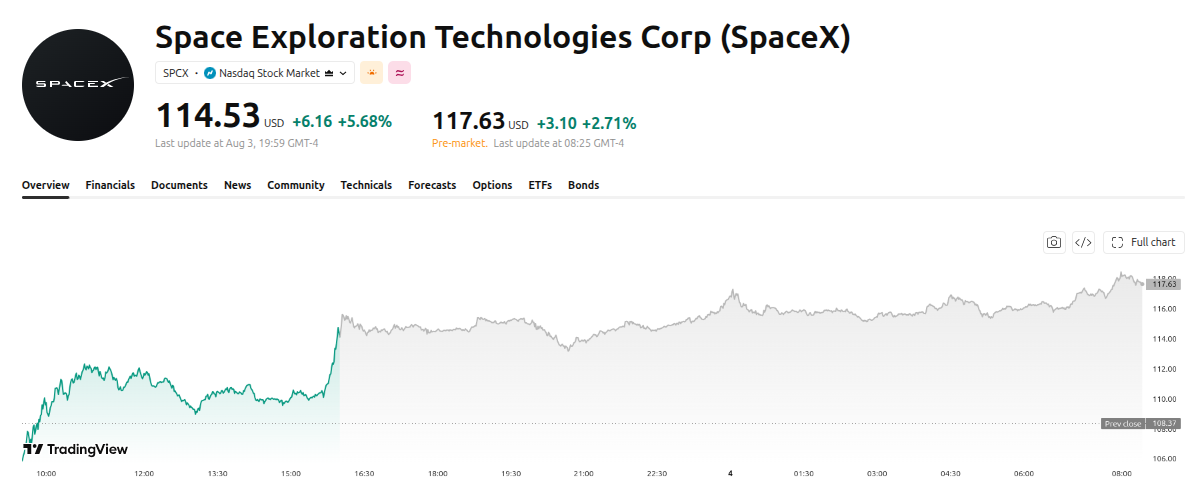
Shares closed Monday at $114.53, up 5.68%, after trading in the mid-100s amid post-IPO volatility, according to TradingView data. The company completed history’s largest public offering in June at roughly $1.5 trillion.
Follow us on X to get the latest news as it happens.
Traders on X are focused on the wide estimate range and the lockup overhang, with options pricing implying significant movement.
Top 3 Scenarios on the Table
Investors have narrowed Tuesday’s possibilities into three broad outcomes. Each depends less on headline revenue than on what management reveals about spending discipline, segment quality, and the path toward self-funding.
Scenario 1: A Clean Beat With Strong Disclosure
Revenue and EBITDA clear consensus while Starlink subscribers and margins hold or improve. AI revenue tracks contracted ramps without slippage.
Management adds concrete detail on capital expenditure phasing, remaining liquidity, and Starship commercialization. Any path toward self-funding would strengthen the case.
That combination could trigger short-covering and a strong rally. It would validate the elevated valuation multiple and offset near-term lockup pressure.
Scenario 2: In-Line Results With Vague Guidance
Numbers land near consensus, with solid sequential growth led by AI and steady Starlink profitability. Details stay high-level instead.
Average Revenue Per User (ARPU) trends, exact AI margins, and peak spending timelines remain unclear, with emphasis shifting toward long-term Mars and orbital-compute vision.
Many analysts consider this the most probable outcome for a first-time public reporter. Markets would likely trade mixed to soft as uncertainty persists.
Scenario 3: Soft Print or Capex Concerns
Total revenue meets or modestly misses, while AI revenue falls short of the expected ramp. Starlink shows ARPU pressure or weaker quality growth.
Space losses widen further from Starship development, while elevated Capex commentary raises fresh funding worries without offsetting positives.
Subscribe to our YouTube channel to watch leaders and journalists provide expert insights.
That outcome would intensify scrutiny of Starlink subsidizing other segments. Sharper selling could follow, especially with increased float arriving days later.
What Really Matters Beyond the Numbers
The earnings call will set the tone for how public investors assess a company blending profitable satellite broadband, leadership in reusable launch, and ambitious AI infrastructure bets. Few listed firms carry that combination, and none at this valuation.
Beyond the headline figures, segment details and management tone will matter most. Signals on cash discipline could prove decisive as the company navigates its early public-market chapter.
The lockup expiration two days later adds another layer entirely. Even a strong report may struggle against fresh supply, leaving Tuesday’s reaction an incomplete verdict on where SpaceX stock heads next.
The post SpaceX Earnings Call Today: Top 3 Scenarios Investors Are Watching appeared first on BeInCrypto.

Michael Burry attends “The Big Short” New York premiere at the Ziegfeld Theater in New York, Nov. 23, 2015.
Andrew Toth | Filmmagic | Getty Images
Michael Burry of “The Big Short” fame is sticking with his bearish wagers even as the S&P 500 surges to a record high, warning that the rally could still end in a sharp sell-off reminiscent of the 1987 stock-market crash.
“I continue to believe it is possible we are near a major top, and possible a 1987-type fall, but the S&P 500 making new highs likely will bring new money into the market,” Burry said in a Tuesday Substack post.
The S&P 500 jumped 1.9% Tuesday to its first record close since June, buoyed by stronger-than-expected corporate earnings and another drop in oil prices as hopes grew that the Strait of Hormuz would reopen to maritime traffic. The tech-heavy Nasdaq Composite soared 2.7%, extending its gain in just the first two days of the week to nearly 5%.
Burry has been among Wall Street’s most outspoken skeptics of the artificial intelligence boom, arguing that demand for AI infrastructure is being fueled by financing arrangements that may prove unsustainable. He said the market’s advance is creating a self-reinforcing cycle, with declining volatility encouraging systematic investors to increase exposure.
“Remember, the market going up on falling volatility forces vol-targeting funds to leverage up, and brings leverage from other momentum strategies into play,” he wrote.
In the face of the rally, Burry said he continues to hold short positions in the iShares Semiconductor ETF (SOXX), Micron, Nvidia, Caterpillar, Palantir, Tesla and Applied Materials.
The investor said he remains confident in his long-term outlook for those positions, though he added that he would cut his losses if the trades moved decisively against him. All of the positions remain profitable except for his bet against Nvidia, he said.
“Again, shorting is not for everyone,” Burry wrote. “I must short. Most should not.”

Bitcoin finished July on a strong note before losing momentum at the start of August with two straight daily closes below $63,000. The decline has raised fresh caution even as blockchain data points to steady buying around current price levels.
That buying activity became clearer in recent on-chain data, which shows roughly 155,000 BTC moved into the $62,000 to $65,000 cost-basis range during the latest pullback. The zone now holds the largest concentration of supply across the market and represents about 0.7% of Bitcoin’s circulating supply.
Accumulation Continues Despite Price Weakness
According to the recent Bitfinex report, the supply cluster expanded while prices declined instead of shrinking through broad selling activity. The report said the pattern suggests buyers absorbed selling pressure rather than existing holders leaving the market in large numbers.
The data also highlights different behavior between long-term and short-term holders during the recent decline. Long-term holders continued accumulating Bitcoin, while many short-term holders reduced positions near their purchase prices.
Despite those signs of accumulation, broader market activity has become more subdued. Bitcoin entered August after recording a 7.3% gain during July, which matched historical seasonal trends for the month. However, spot trading volumes have fallen to levels last seen in late 2023.
Market Sentiment Turns More Cautious
Institutional demand also weakened as U.S. spot Bitcoin exchange-traded funds recorded a combined net weekly outflow of $61.5 million. That result ended three consecutive weeks of positive inflows and reflected softer demand from large market participants.
The options market has also turned more defensive as participants paid higher premiums for downside protection. Even so, implied volatility remains close to multi-year lows, suggesting expectations for relatively limited price swings.
Beyond market positioning, broader economic conditions continue influencing sentiment. Second-quarter GDP expanded 1.5%, while private domestic demand rose 3.9%, driven by consumer spending and AI-related investment.
Inflation also remains a focus after personal consumption expenditures prices increased at a 5.1% annualized pace. Meanwhile, the 10-year real yield reached 2.41%, placing it only nine basis points below a level some analysts consider important for non-yielding assets.
The post Bitcoin Holds Key Support as On-Chain Data Shows Fresh Accumulation appeared first on CryptoPotato.
Crypto World
Elon Musk’s SpaceX (SPCX) tops earnings as bitcoin (BTC) holding value drops by $540 million


SpaceX (SPCX), Elon Musk’s space technology company, reported its first quarterly results as a public company on Tuesday, announcing second-quarter revenue of $7.8 billion.
That figure topped Wall Street expectations of $6.9 billion, while narrowing its quarterly loss to $541 million as growth accelerated across its launch, Starlink and AI businesses.
The company reported a net loss of $541 million, an improvement from a $1.0 billion loss a year earlier, while adjusted EBITDA nearly tripled to $3.5 billion.
The firm held onto its stash of 18,712 bitcoin , according to the SEC filing. However, the value of holdings declined to $1.10 billion at June 30 from $1.64 billion at the end of 2025, coinciding with bitcoin’s 33% price slump through that period.
SPCX was down 6% after-hours on the report to $118 after closing the regular session nearly 10% higher on the day’s trading, while the Nasdaq 100 gained 3.3%.
The firm’s report arrived less than two months after SpaceX’s record-breaking $86 billion IPO and ahead of the stock’s first major test. On Aug. 6, roughly 912 million shares held by employees and early backers will become eligible for sale, potentially increasing the stock’s public float.

US, UK deepen stablecoin talks after GENIUS Act

Funshow secures hat-trick at Rosehill in 2026

Strengthening 3D Prints With A Carbon-Fiber Epidermis


-

 Business6 days ago
Why Trees Belong on the Risk Register
-

 Fashion4 days ago
Weekend Open Thread: Wit & Wisdom
-

 Politics4 days ago
Meta enters AI-training agreement with far-right ‘propaganda rag’ Newsmax
-

 Politics6 days ago
Reform UK betrays West Mids residents by running from party pledges
-

 Crypto World3 days ago
MicroStrategy Post-Earnings CLARITY Act Push Could Add New Catalyst for Its Stock
-

 Business7 days ago
Major shareholder moves on Canyon
-

 Crypto World4 days ago
XRP Ledger v3.3.0 brings five institutional features
-

 Politics2 days ago
Zack Polanski: an incitement to murder Nigel Farage?
-

 News Videos5 days ago
Bitcoin Enters the 3rd Stage of the Bear Market
-

 Crypto World7 days ago
Kraken Enables Retail Access to Jersey Mike’s IPO via Tokenized Shares
-

 Politics5 days ago
Luke Littler’s dominance sparks GOAT debate
-

 Sports5 days ago
Seema Kaliramna Wins Discus Throw Bronze, Takes India’s CWG Medals Tally To 17
-

 Crypto World4 days ago
New York sues Kalshi over prediction market gambling
-

 Crypto World3 days ago
Crypto PAC spending tops $2M in Michigan House race
-

 Business4 days ago
Trump Announces Hamas Disarmament Agreement as Iran Strikes Kuwait Air Base and US Attacks Pause Overnight
-

 Tech6 days ago
Gemini can now summarize the messiest comment threads in Google Docs
-

 Tech3 days ago
ESET tracks rise in malicious AI skills and adaptable malware
-

 NewsBeat5 days ago
Four people die trying to cross Channel in small boats
-

 Tech5 days ago
Gemini Spark can now use Chrome logins and saved passwords to run errands on your behalf
-

 Business2 days ago
DTCR: Deleveraging And A Hedge Fund Collapse Point To A Possible AI Bottom
You must be logged in to post a comment Login