
Crypto World
EIP-8363 Draft Targets Lower Ethereum Staking Rewards Amid 50% Ratio

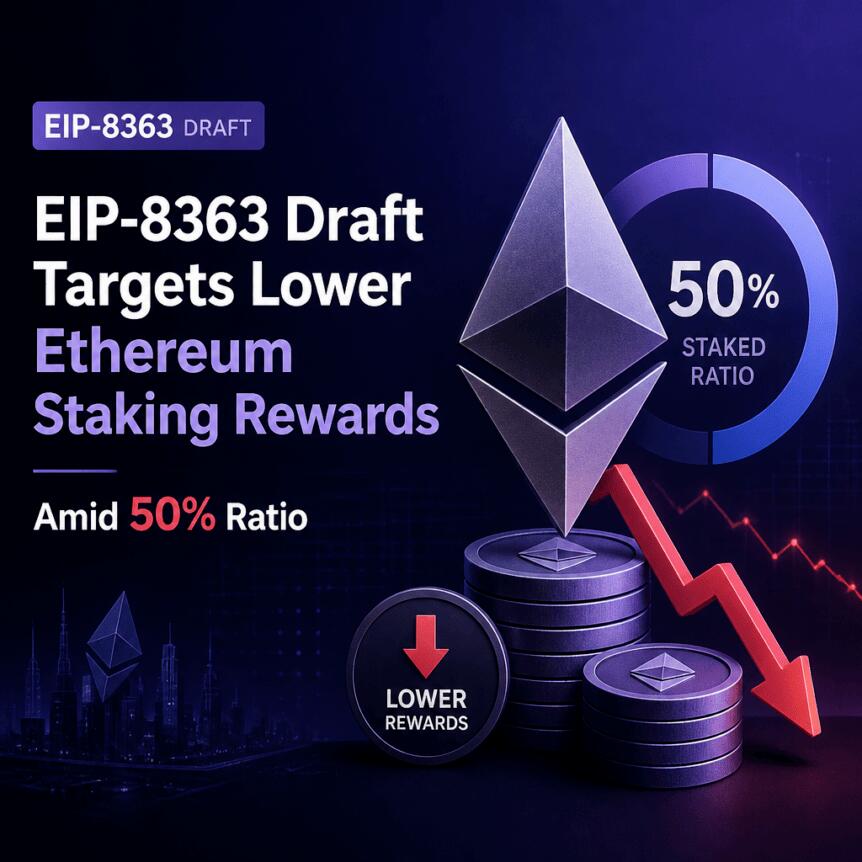
A draft Ethereum Improvement Proposal from a group of six researchers and developers—including Ethereum Foundation’s Justin Drake—would change how new ETH is issued to validators. The “Tapered Issuance Burn” proposal, provisionally numbered EIP-8363, aims to reduce validator rewards more aggressively as more ETH is staked, with an increasing portion of consensus rewards burned to curb long-term inflation.
The proposal targets a fixed staked-ETH threshold of 60.25 million ETH (about 50% of the current ETH supply). As the staking ratio approaches that level, the burn mechanism would intensify, reaching 100% deduction once the threshold is met. The changes are designed to phase in over roughly 18 months. The draft is published on GitHub as an EIP draft.
Key takeaways
- EIP-8363 would “taper” validator issuance by burning an increasing fraction of consensus rewards as staking grows.
- The mechanism is tied to a threshold of 60.25 million staked ETH, at which point the deduction would reach 100%.
- Critics argue the proposal could disadvantage solo validators and reduce DeFi borrowing and yield tied to staking rewards.
- Some developers and community members also question whether there is enough time for careful review, given its proximity to proposal deadlines around Ethereum’s Hegotá upgrade.
- The draft has not been approved or scheduled and is not currently included in Hegotá.
A proposed monetary lever tied to staking saturation
The authors’ central concern is the trajectory of staking. According to the draft’s advocates, under the current issuance and incentive curve, staking rewards would not meaningfully “turn off,” even if nearly all ETH were staked. One of the proposal’s authors, Jérôme de Tychey, argued that this creates a persistent incentive to stake, raising the question of what ultimately stops the process.
In the proposal discussion, de Tychey also highlighted the potential for growing concentration of ETH held through large custodians and staking derivatives. The thesis is not only about dilution from issuance, but about the role of ETH as “a neutral, trustless store of value.” He warned that unchecked issuance could increasingly shift the ecosystem’s “working money” from raw ETH to intermediated staking claims.
As described in the draft’s framing, EIP-8363 would bound and make issuance more predictable. The proposal sketches a scenario in which issuance would peak at roughly 0.5% of ETH supply per year at its highest point (with about 20% of ETH staked), then decline toward zero as the staking ratio reaches the 60.25 million ETH threshold.
Supporters also position the change as complementary to existing Ethereum supply-reduction mechanics, including EIP-1559 and the protocol’s Blob burn structure. De Tychey argued that, with these in place, Ethereum’s net supply trend could more often decrease, while the network maintains a “sustainable security budget.”
Why the timing is drawing fire
Even though EIP-8363 is still an early draft, its publication came shortly before a deadline being discussed in relation to Ethereum’s Hegotá upgrade. Some community members see the schedule pressure as a process risk, especially for a change that would affect monetary policy.
Community developer Greg Koumoutsos said the proposal “clearly doesn’t leave adequate time for community review” of a monetary-policy change of this magnitude. In response to some confusion around the timetable, the article’s reporting indicates that the relevant Aug. 6 deadline is for pull requests proposing additional EIPs for Hegotá, rather than a deadline for deciding which proposals will ultimately be included.
Ethereum community organizer Trent Van Epps indicated that the selection process could continue until Nov. 8. According to the reporting, Hegotá is likely to reach mainnet in the second quarter of 2027, based on the project schedule referenced in the coverage.
Developer and DeFi concerns: solo validators, institutions, and yield markets
While the proposal’s goals are framed as reducing dilution and strengthening neutrality, it has met backlash from parts of the Ethereum development ecosystem, including stakers and DeFi builders.
One line of criticism is that lowering staking rewards could reduce institutional demand for ETH. The article notes concerns about whether reward cuts could affect how institutions interpret yield and exposure, and it points to linked coverage about institutional staking interest.
Another major critique centers on validator structure. The argument from some quarters is that solo validators would be hit harder because they generally face higher relative costs than larger operators. According to the reporting, Mike Silagadze, CEO of Ether.Fi, said the mechanism would push out solo stakers not subsidized by entities such as the Ethereum Foundation. His view is that the staking landscape would become dominated by large centralized organizations, leaving users to hold ETH indirectly while those operators capture the remaining incentive structure.
De Tychey disputed the “guaranteed solo exit” framing. In a response on the Ethereum Magicians forum, he argued that users of large staking providers must pay fees, which could make such services less attractive as rewards fall. However, the reporting also emphasizes that related research is “contested,” leaving the economic second-order effects uncertain.
Beyond validator economics, critics warn that staking reward changes could ripple into DeFi markets that depend on staking yield. Stani Kulechov, founder of Aave, characterized the proposal as harmful—arguing it could weaken institutional demand for ETH and reduce borrowing activity across DeFi. His critique is that the proposal does not achieve its intended outcome and could negatively affect Ethereum’s broader ecosystem incentives.
Backers see bounded inflation and potentially long-run upside
Support for EIP-8363’s direction is not confined to the proposal’s authors. The coverage also points to Grayscale research leadership. In May, Grayscale head of research Zach Pandl said limiting staking incentives would be “positive for the price of Ether over time,” framing the idea as part of improving Ethereum’s long-run economic profile.
In the proposal’s own narrative, the change is designed to address a specific economic tension: a world where staking keeps expanding, issuance continues unabated, and more of the ecosystem’s exposure becomes mediated through staking derivatives. Supporters argue that burning an increasing share of rewards as staking rises can cap issuance growth and reduce dilution, while still maintaining security incentives early in the process.
Yet, with the draft at an early stage and schedule constraints under debate, the most immediate takeaway is that the proposal is not yet a policy. It is one part of a larger, contested set of considerations about Ethereum’s monetary future as staking participation rises and as staking derivatives evolve.
As Ethereum approaches the Hegotá selection window, readers should watch for how the community evaluates EIP-8363’s economic modeling—especially the projected impact on solo validators, liquid staking incentives, and DeFi borrowing flows—and whether the proposal is revised, delayed, or replaced by alternatives before any formal inclusion.

Arthur Hayes says Bitcoin’s climb to $1 million depends on the AI industry’s credit problems, not its earnings. In a new essay titled “Situationship,” the BitMEX co-founder makes his case.
He argues that AI data center spending resembles 2008-style debt speculation rather than 2000-style dot-com overvaluation. He expects central banks to print enough money to eventually rescue over-leveraged AI lenders. That flood of liquidity, he says, is what carries Bitcoin toward seven figures.
Why Hayes Separates AI From the Dot-Com Bubble
Hayes argues investors mistake data centers for pure technology. In his view, they are really real estate developments packed with fast-depreciating chips.
He made a related case in May. Back then, he called AI spending history’s largest fiat credit bubble and set an initial Bitcoin price target near $126,000.
“AI CAPEX is just another boring real estate play”
— Arthur Hayes,
In his view, hyperscalers increasingly fund data centers with borrowed money, not free cash flow. That shifts default risk onto banks and bondholders.
He compares this to the 2006-2008 mortgage cycle. Lending kept flowing even after home price growth stalled. It only broke once construction spending actually contracted.
The Bailout Mechanism Behind the $1 Million Call
Hayes expects AI capital spending growth to decelerate in 2027. That slowdown, he says, will expose the weakest data center loans. He argues the Fed and Treasury will respond the way they did in 2008 and 2020. That means emergency lending facilities, and possibly direct equity purchases, to prevent a systemic default.
His forecast follows a familiar pattern from the Fed. Chair Kevin Warsh held interest rates steady at his second meeting in late July. Three FOMC members dissented, favoring a hike. Markets now price high odds of a rate hike later this year.
Hayes reads that hold as evidence authorities will keep credit flowing. He sees continued bank lending to AI projects as further confirmation officials won’t let weak borrowers fail.
This isn’t Hayes’s first seven-figure Bitcoin call. He made a similar $1 million prediction last year based on an expected Fed shift toward yield curve control.
This time, he ties the call to AI credit stress instead. He also reiterated a $5,000 Ethereum target for the end of 2026. Hayes points to Ethereum’s emerging role as a settlement layer for tokenized real-world assets.
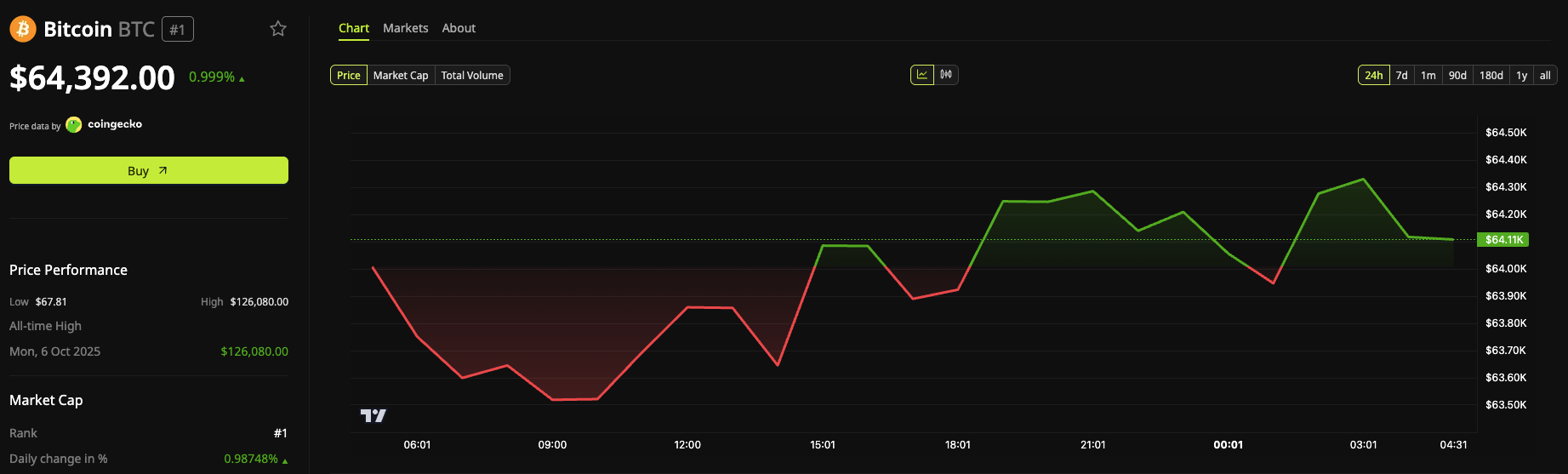
Bitcoin traded near $64,300 at the time of writing, up roughly 1% over 24 hours, per BeInCrypto data.

Hayes has also called for a Bitcoin bottom near $40,000 before any run toward his higher targets. That framework leaves room for further downside first. Whether the AI credit cycle actually unwinds on his 2027 timeline remains the open question. Investors will likely watch hyperscaler earnings and bank loan books for early signs over the coming quarters.
The post Arthur Hayes Says Bitcoin’s Going to $1 Million After an AI Credit Bust appeared first on BeInCrypto.
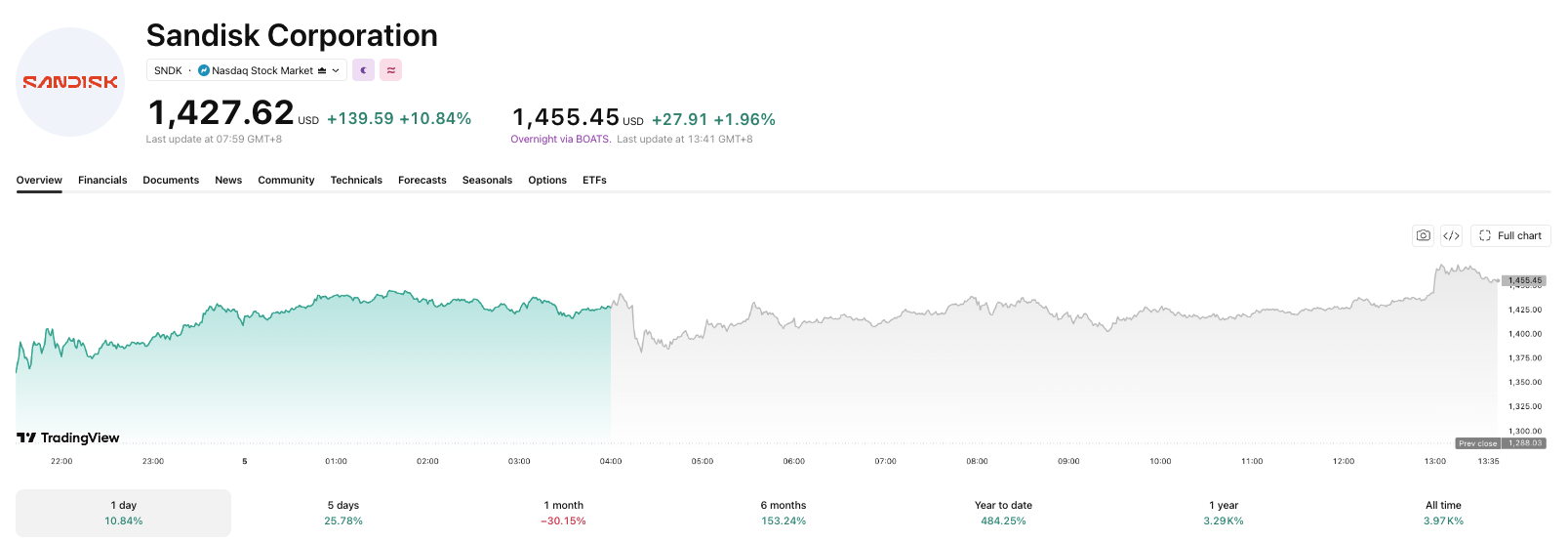
SanDisk stock jumped 10.84% on Tuesday following a new AI memory milestone with SK Hynix. The companies advanced their ongoing collaboration by releasing the first industry specification for High Bandwidth Flash (HBF) technology.
SanDisk also presents a keynote on AI memory today at the Future of Memory and Storage (FMS) Conference, just hours before its earnings call. Google and Tenstorrent joined the HBF consortium during the standardization process, adding credibility to the new standard.
A New Memory Tier for AI Chips
The Open Compute Project (OCP), an industry group that builds open hardware standards, published the HBF specification this week. The standard gives chip designers a shared framework for using HBF in AI accelerators.
It fills a gap left by High Bandwidth Memory (HBM), which is fast but capacity-constrained. In contrast, solid-state drives hold more data at slower speeds.
The specification supports NAND stacking up to 512GB per die stack. It also defines three performance tiers, with read speeds reaching 3.0 terabytes per second.
SanDisk and SK Hynix started the HBF consortium in February. Google and Tenstorrent joined as members during the specification’s development. SanDisk Chief Technology Officer Alper Ilkbahar called the release a major step for the technology.
“an important milestone for the HBF ecosystem”
Alper Ilkbahar, SanDisk’s chief technology officer, said in a statement.
Earnings Loom as Memory Stocks Rebound
SanDisk reports fiscal fourth-quarter results after markets close today. Wall Street expects earnings near $33 per share on revenue around $8.3 billion, up sharply from $0.29 a year earlier. However, SanDisk shares pulled back in premarket trading Wednesday, as some investors turned cautious ahead of tonight’s results.

SanDisk shares fell roughly 47% last month during a broader memory sector selloff. Meanwhile, SK Hynix shares have swung just as sharply since their Nasdaq debut in July.
The rebound reflects a tighter link between Korean and US markets, as AI infrastructure spending increasingly moves both in tandem.
Today’s earnings will show whether the AI memory story behind Tuesday’s rally holds up under closer scrutiny.
The post SanDisk Stock Jumps 10% on New AI Memory Milestone With SK Hynix Ahead of Earnings appeared first on BeInCrypto.
A wallet identified by onchain analytics platform Lookonchain as being associated with Strategy transferred 1,030 Bitcoin worth about $66.14 million on Aug. 5.
Summary
- A suspected Strategy wallet moved 1,030 Bitcoin, but no official sale has been confirmed yet.
- Strategy officially sold 1,638 Bitcoin last week, raising $104.73 million for preferred dividends and repurchases.
- Strategy reported 842,138 Bitcoin holdings, acquired for $63.51 billion at an average $75,419 per coin.
- MARA transferred 6,000 Bitcoin to Two Prime, where it already maintains managed institutional investment arrangements.
- MARA previously allocated 2,000 Bitcoin to Two Prime’s institutional yield strategies under a managed account.
The movement came two days after Strategy officially disclosed another Bitcoin sale, increasing scrutiny of the company’s changing treasury policy. Lookonchain’s post described the addresses as wallets linked to Strategy.
However, Strategy has not confirmed that the latest transfer represented a sale. Its most recent Securities and Exchange Commission filing reported holdings of 842,138 BTC as of Aug. 2. No later filing had reduced that figure when this report was prepared.
Strategy transfer is not yet a confirmed Bitcoin sale
Lookonchain asked, “Is Michael Saylor’s Strategy dumping BTC again?” The wording reflects uncertainty. Wallet attribution can indicate that an address is likely connected to an organization, but an onchain transfer alone does not establish its purpose or legal ownership.
Bitcoin can move between custodians, internal wallets, trading accounts and settlement addresses without being sold. Confirmation would require a company disclosure, an identified exchange deposit followed by trading activity, or other evidence showing that ownership changed.
Strategy’s public Bitcoin ledger still lists 842,138 BTC following the company’s Aug. 3 update. The ledger records transactions reported by Strategy rather than every transfer attributed to the company by external analytics firms.
The latest movement occurred after the Aug. 2 reporting cutoff in Strategy’s filing. It could therefore appear in a later update if it represents a sale under the company’s Bitcoin monetization program.
Strategy officially sold 1,638 BTC for $104.73 million
Strategy confirmed that it sold 1,638 BTC between July 27 and Aug. 2. The company received $104.73 million after fees, equal to an average sale price of $63,957 per Bitcoin. The official figure is higher than the roughly $102.4 million cited in some early reports.
Strategy used $52.4 million of the proceeds to fund preferred stock dividends. It directed the remaining $52.3 million toward repurchases of its STRC preferred shares. The company separately bought back 912,143 STRC shares for $81.2 million during the period.
Its remaining 842,138 BTC had an aggregate purchase price of $63.51 billion and an average cost of $75,419 per coin. The company also reported a $4 billion U.S. dollar reserve, including unsettled proceeds from common stock sales.
The transaction was permitted under Strategy’s Bitcoin monetization framework, which its board approved in June. The framework allows Bitcoin sales to support the cash reserve, pay dividends or interest, and finance approved security repurchases. It does not require Strategy to sell any specific amount.
As crypto.news reported, the Aug. 3 disposal followed earlier sales that marked a departure from Strategy’s previous focus on continuous accumulation. Its ledger shows four reported 2026 sales totaling 5,258 BTC.
MARA’s Two Prime transfer may involve asset management
Separately, Lookonchain reported that MARA transferred 6,000 BTC, worth approximately $384.6 million at the time, to addresses identified as belonging to Two Prime. The analytics firm cautioned that the movement “doesn’t necessarily mean a sale” and could relate to asset management.
MARA has an established financial relationship with Two Prime. In July 2025, the miner led a $20 million investment in the firm and expanded its managed Bitcoin allocation from 500 BTC to 2,000 BTC. Two Prime manages institutional trading, lending and Bitcoin yield strategies.
An SEC filing showed that MARA transferred 2,000 BTC into a separately managed account during 2025. The account held 1,903 BTC by Sept. 30 after recording a net trading loss of roughly 97 BTC.
The new 6,000 BTC transfer could expand the arrangement, move assets between custody accounts or support another financial transaction. Those possibilities remain unconfirmed. MARA’s 2025 annual report says it may buy or sell Bitcoin depending on market conditions and capital allocation priorities.
In related coverage, crypto.news reported that MARA increased its holdings to 36,303 BTC in June after selling 15,133 BTC during March to support a $1 billion convertible debt repurchase.
Official filings will determine whether more Bitcoin was sold
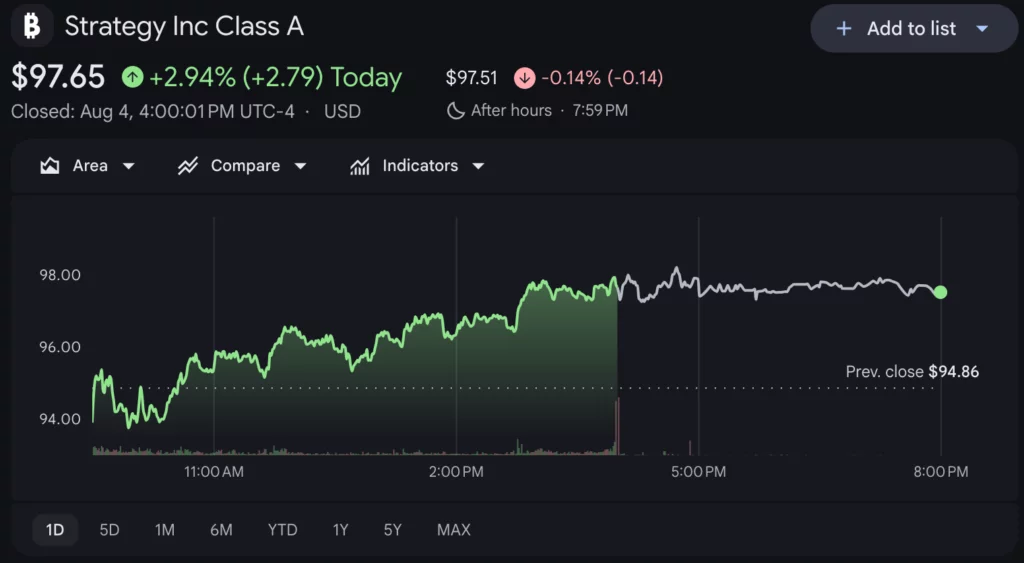
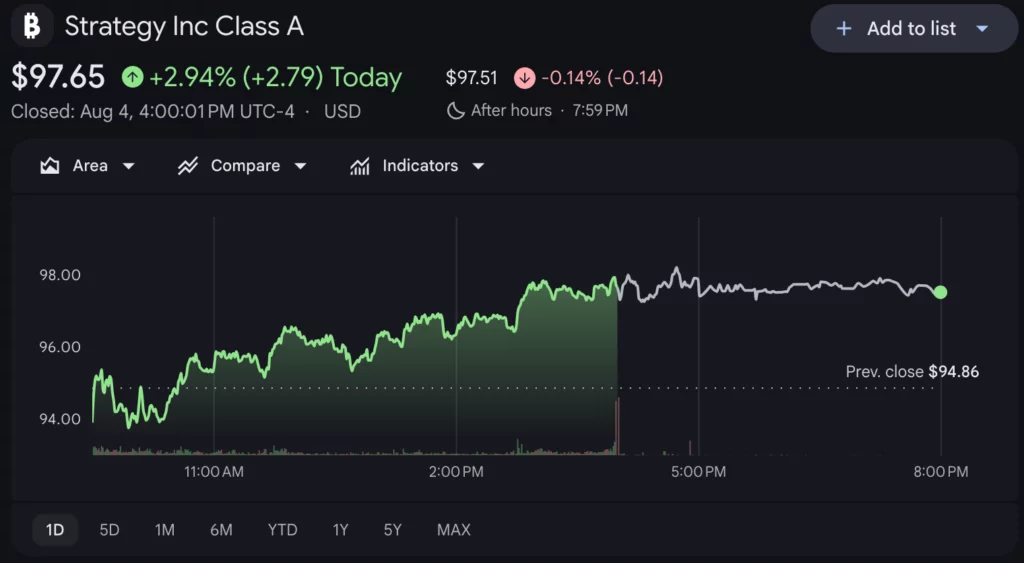
Bitcoin traded near $64,387 at the time of reporting, up about 0.95%. Strategy shares rose approximately 2.9% to $97.65 during the latest U.S. session, while MARA shares were nearly unchanged at $11.75. The market data showed no immediate broad selloff tied to the reported transfers.
Strategy says it will disclose material Bitcoin monetization through its customary Form 8-K filings and its public dashboard. Its next update should show whether the 1,030 BTC movement changed the company’s reported holdings.
MARA investors will similarly need an SEC filing or company statement to determine whether its 6,000 BTC remains under company ownership. Until those disclosures arrive, both movements should be treated as transfers rather than confirmed sales.


Cloudflare began the first stage of its programmable wallet rollout on Aug. 4, allowing customers to claim unique wallet handles for future stablecoin payments by artificial intelligence agents.
Summary
- Cloudflare users can claim wallet handles now, while stablecoin funding and payment functions remain forthcoming.
- Account Wallets will hold funds, while Virtual Wallets let authorized agents make controlled purchases online.
- Owners can cap allowances, approve merchants, limit transaction sizes, and require human overrides when needed.
- x402 processed 75.41 million transactions and $24.24 million in volume during the last thirty days.
- Cloudflare has not disclosed supported stablecoins, networks, custody partners, fees, or full launch timing yet.
The official Cloudflare announcement said users can reserve a handle tied to their Cloudflare account through cloudflare.pay. However, the company said the ability to fund wallets and use them to purchase APIs, data and online content will arrive “soon.” It did not provide a launch date.
The distinction means Cloudflare has opened the identity layer of the product rather than a fully functioning payment service. Customers cannot yet assume that the stablecoin storage, withdrawal or automated spending features described by the company are broadly available.
Cloudflare Wallets begin with handles, not payments
Cloudflare plans to offer two wallet types. Account Wallets will be controlled by individual or organizational customers. Users will be able to add funds, withdraw balances and delegate spending authority to wallets operated by their AI agents.
Virtual Wallets will operate through API keys. An agent will use the wallet to purchase services within permissions established by the Account Wallet owner. Cloudflare listed APIs, Model Context Protocol tools, data, AI inference and online content as potential purchases.
The company is also building a human readable identity system around the wallets. A business could assign an agent an address such as research.example.cloudflare.pay, allowing merchants to associate the software with a particular organization. Declaring that identity will remain optional. Merchants will decide whether to serve unidentified agents or give priority to known ones.
Cloudflare compared the system with the way the Domain Name System links readable website names to less readable internet addresses. The wallet handle will be connected to an agent’s cryptographic key rather than replace the underlying verification process.
Spending controls aim to limit autonomous agent risks
Cloudflare said Account Wallet owners will be able to set allowances, approved merchant lists and maximum transaction sizes. These controls are intended to let agents test low cost services without requesting human approval for every purchase.
A company could, for example, give each employee’s agent a weekly budget for AI inference. When a wallet reaches its limit, the agent could request a manual override from an authorized administrator. Unexpectedly fast spending could also trigger a review before the owner increases the budget or adds more funds.
Cloudflare presented these limits as protection against overspending. However, it has not published technical documentation explaining how lost API keys, compromised agents, disputed payments or unauthorized purchases will be handled.
The company has previously worked with Visa and Mastercard on systems that help merchants distinguish approved shopping agents from malicious bots. Visa’s Trusted Agent Protocol and Mastercard’s Agent Pay use Cloudflare’s Web Bot Auth system to verify cryptographic signatures and confirm whether an agent intends to browse or complete a payment.
x402 connects agent wallets with paid online resources
The wallets form the buyer side of Cloudflare’s planned agent commerce system. Its Monetization Gateway will provide the seller side by allowing website owners and developers to charge for pages, datasets, APIs and MCP tools.
As crypto.news previously reported, Cloudflare opened the Monetization Gateway waitlist in July. Customers will be able to set fixed or variable prices and require payment before Cloudflare passes a request to their server.
Payments will use x402, an open protocol that attaches payment instructions to standard HTTP requests. When an agent requests a paid resource, the server returns an HTTP 402 “Payment Required” response containing the price and settlement instructions. The agent pays and resubmits the request with payment proof.
Coinbase introduced x402 in 2025 and later formed the x402 Foundation with Cloudflare. The foundation aims to maintain the system as a neutral standard rather than a protocol controlled by one company or blockchain.
The x402 website reported 75.41 million transactions, $24.24 million in volume, 94,060 buyers and 22,000 sellers over the latest 30 day period at the time of reporting. Those figures are live protocol metrics and may change as new activity is recorded.
In related coverage, crypto.news reported that Amazon Bedrock AgentCore integrated x402 payments, allowing agents to purchase services using USDC. That rollout shows Cloudflare is entering a growing market that already includes cloud providers, payment companies and blockchain developers.
Full wallet access depends on compliance and funding support
Cloudflare said it will initially offer conventional funding and withdrawal methods in supported locations. Eligible customers will also be able to fund their wallets directly with stablecoins. The company has not identified the first countries or regions included in that rollout.
It also has not disclosed which stablecoins or blockchains the wallets will support. The announcement did not name a custodian, banking partner, onramp provider or entity responsible for identity and compliance checks. Pricing, transaction fees and withdrawal limits also remain unknown.
These details will determine how widely companies can deploy the product. Wallet services involving stablecoin custody and fiat conversion can face different regulatory requirements across U.S. states and international markets.
The next verified update should clarify when Cloudflare customers can fund Account Wallets, create Virtual Wallets and complete live x402 purchases. Until then, users can claim wallet handles, but the core stablecoin payment features remain a planned service rather than a completed general release.

A wallet reportedly belonging to Strategy (formerly MicroStrategy) transferred another 1,030 Bitcoin (BTC), worth roughly $66.14 million, on Wednesday. On-chain tracker, Lookonchain, flagged the move.
Strategy has not confirmed any sale, and the transfer alone does not prove one. Still, the timing has revived questions about the company’s shrinking Bitcoin reserve.
Follow us on X to get the latest news as it happens
MicroStrategy Sale Speculation Builds After Last Week’s Disclosure
The suspicion is not unfounded. Strategy disclosed on Monday that it sold 1,638 BTC last week at an average price of $63,957.
That sale raised roughly $104.7 million and reduced holdings to 842,138 BTC, valued at nearly $54 billion at press time. Lookonchain had reported a similar wallet movement earlier, when 299.84 BTC left a Strategy-linked address.
Executive Chairman Michael Saylor has defended the sales as corporate capital management rather than a change in conviction.
“When I say ‘Never Sell Your Bitcoin,’ I speak as one saver to another. I have never sold mine. Not one satoshi. Strategy is a public company, not my wallet…” he said.
The company sold coins at prices below its $75,419 average cost basis to fund preferred dividends and STRC stock repurchases. Those obligations reached $400.7 million in the second quarter alone.
MARA Moves 6,000 Bitcoin to Two Prime
Meanwhile, Bitcoin miner MARA transferred 6,000 BTC, worth around $384.6 million, to Two Prime within five hours.
“The transfer doesn’t necessarily mean a sale—it could be for asset management,” Lookonchain noted.
That reading has some basis. MARA holds an equity stake in Two Prime and allocates Bitcoin to the firm’s strategies.
However, MARA has also sold before, offloading 15,133 BTC in March to retire $1 billion in convertible debt. The miner still holds 36,303 BTC, worth approximately $2.34 billion.
Strategy’s next weekly disclosure will show whether Wednesday’s transfer became a sale or a custody reshuffle.
Subscribe to our YouTube channel to watch leaders and journalists provide expert insights
The post Saylor’s MicroStrategy Linked to Fresh $66 Million Bitcoin Transfer appeared first on BeInCrypto.
A failure to pass the CLARITY Act this week will put the bill in a “walking dead” state, but won’t stop the crypto industry’s march forward, according to Bitwise chief investment officer Matt Hougan.
In a blog post on Wednesday, Hougan said while many, including himself, have called it the “make or break” week for the CLARITY Act, the reality is that the crypto industry has made too much progress to “go back in the bottle.”
“The reality is that Washington is always late to major technology shifts, and it has rarely mattered as much as people feared,” said Hougan.
His comments come as the Senate faces an Aug. 5 deadline to advance the landmark crypto market structure bill before its summer recess, with many concerned that failure to pass this week could see the bill pushed into the next year as lawmakers focus on the midterm elections in November.
Prospects for CLARITY this year fade
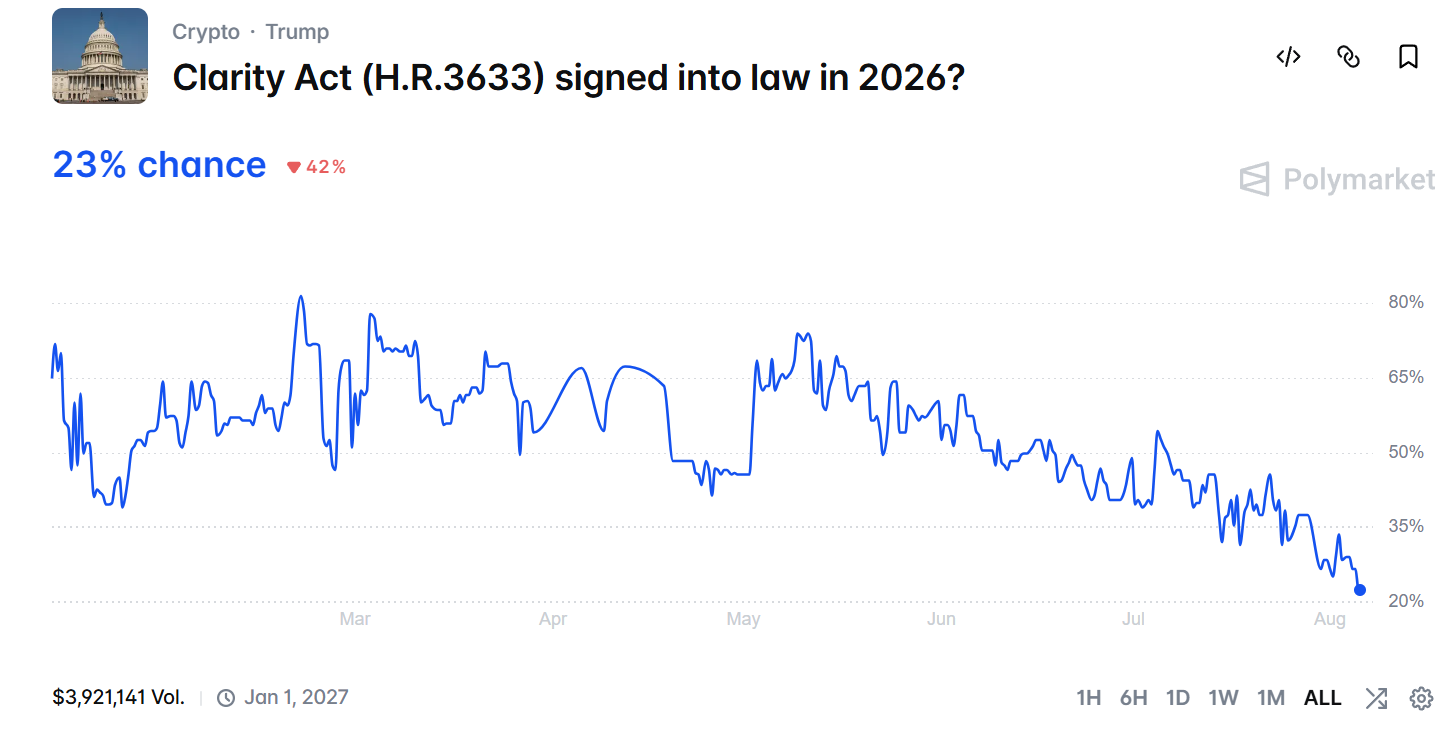
Market observers are increasingly pessimistic about the CLARITY Act’s passage this year. In July, Galaxy Research lowered its probability of the CLARITY Act passing in 2026 to 30%, while Polymarket currently shows a 23% chance of it being signed into law this year, down from 82% in February.
On July 24, NYDIG global head of research Greg Cipolaro said the latest draft was more complete but still lacked sufficient bipartisan support.
“The central investor takeaway is that Republicans have produced a substantially more complete bill, but not yet one with a credible path to 60 votes,” Cipolaro said.
According to sources speaking to Punchbowl News, without signs of progress from the White House on a bipartisan ethics deal, and movement on illicit finance and stablecoin yield, Senate Democrats will deny cloture for the crypto bill.
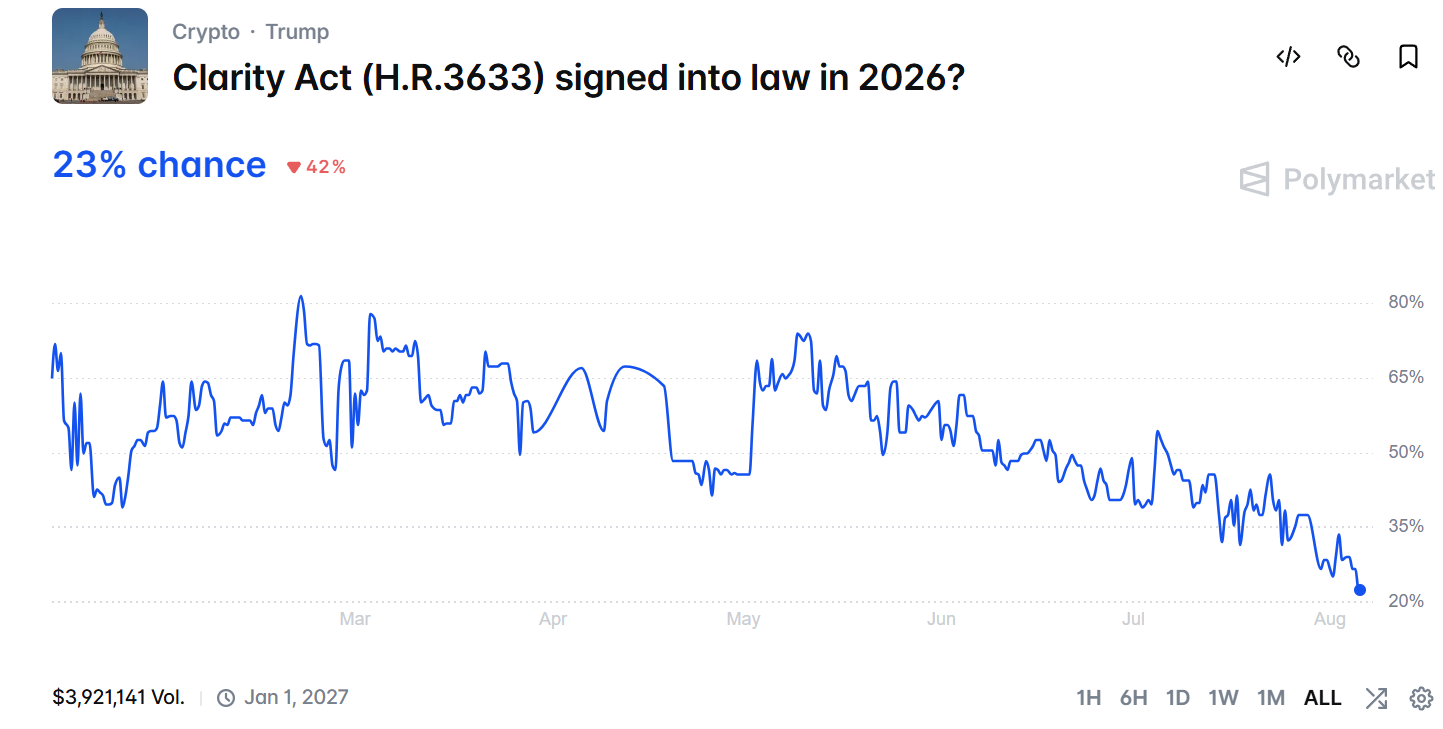
Polymarket odds for the CLARITY Act passing in 2026 are at 23%. Source: Polymarket
Hougan said failure to pass the bill will put it in a “walking dead” state, stalled, but not permanently defeated. He said there is some hope that the bill could pass in September, or even in December, when Congress returns for a lame duck session.
“Congress often bundles multiple bills into a year-end “omnibus” package, forcing legislators to vote on a single bill that includes things they like and things they hate. Maybe the Clarity Act can pass that way.”
“Crypto will be fine,” Bitwise’s Hougan says
If the CLARITY Act fails to pass this year, Hougan said that the industry will fall back to the SEC-CFTC’s joint interpretation issued in March, which classifies Bitcoin and other assets as digital commodities and replaces the SEC’s 2019 staff guidance.
SEC Chair Paul Atkins reinforced this last week, saying his agency is “ready, willing, and able to come out with rules that address the same issues as CLARITY and other aspects of the crypto market.”
Related: CLARITY Act failure could send crypto valuations lower: Bernstein
However, the rules issued by the two regulators aren’t as durable as legislation, and could be challenged in court or reversed by a future administration. Atkins even acknowledged this in March when the two agencies released the interpretation.
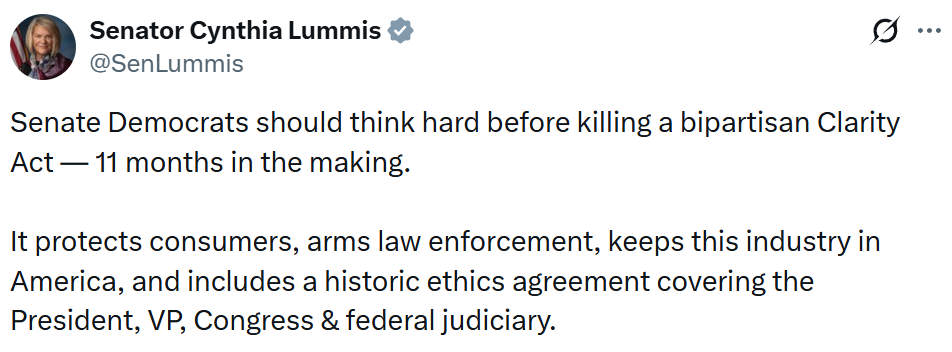
Source: Cynthia Lummis
“Only Congress can ensure that regulation in this area is future-proofed through comprehensive market structure legislation,” Atkins said.
WisdomTree chief legal officer Ryan Louvar has argued that the absence of legislation would continue to impede the market, despite the regulators’ efforts.
“A market cannot function well when its participants cannot tell in advance which agency’s rules apply to them,” Louvar said at a July congressional hearing.
Hougan said “crypto will be fine” despite this, as it would still give the industry two and a half years to accelerate before a new administration could potentially install a new SEC.
“Washington is dysfunctional. It seems crazy to me that we can’t get our act together to pass legislation that would improve investor protections and spark new innovation,” said Hougan.
“But it’s not a referendum on crypto’s validity as a pillar of the global financial infrastructure. That ship has long since sailed. At this point, crypto has enough momentum that it will reshape finance for decades, regardless of what happens in the next few days.”
Magazine: CLARITY hopes fade, BitMEX shuts as lawsuit looms: Hodler’s Digest, July 26
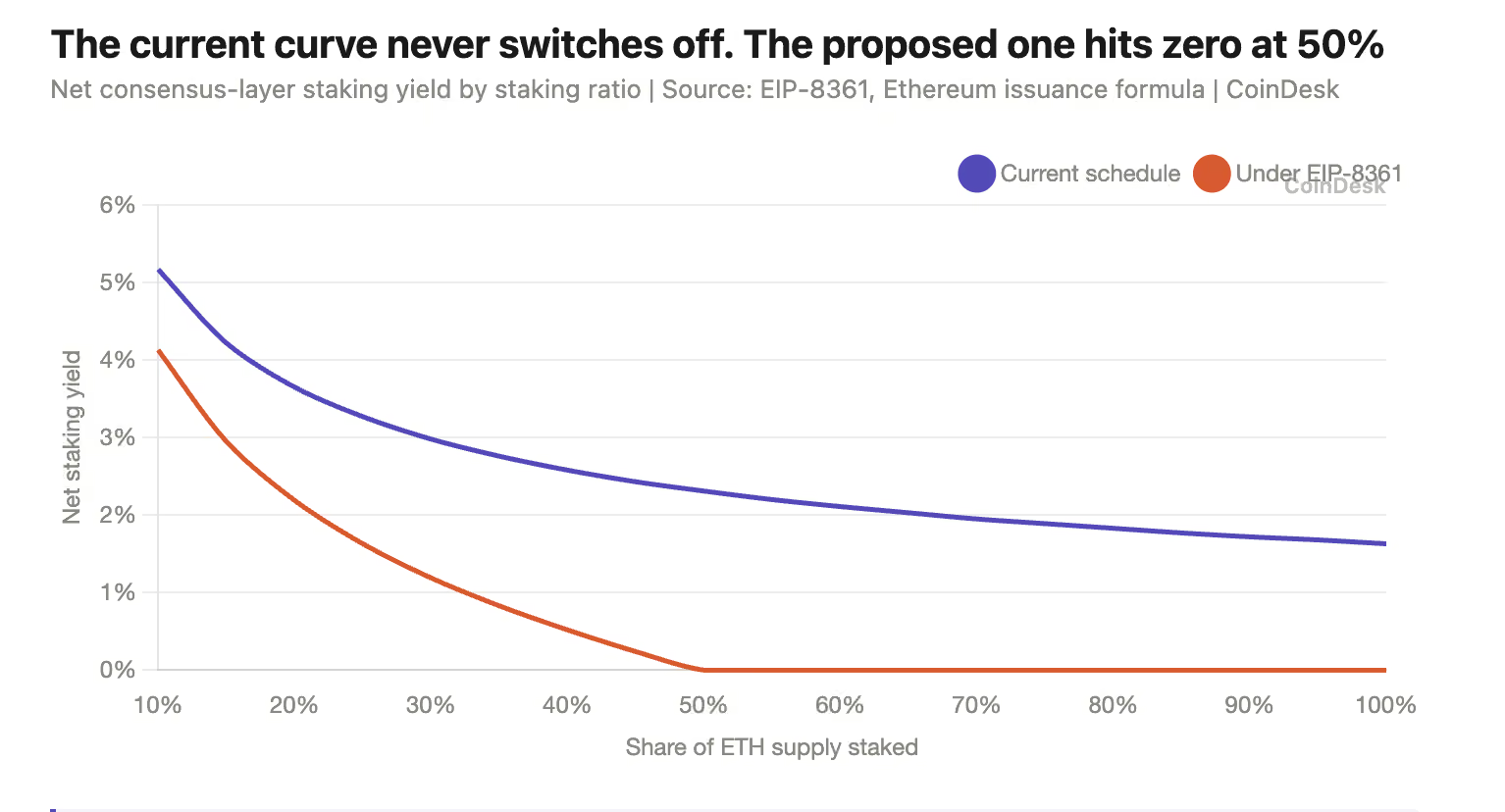
Validators would still be paid the same way for doing the same work, and they keep all the transaction fees and tips they earn from building blocks. Only the newly created ETH gets burned. The deduction from validator rewards arrives slowly, phasing in over 18 months, with about six months before that while the upgrade ships, so roughly two years to adjust.

Six researchers signed the proposal, including Justin Drake of the Ethereum Foundation. It landed days before the deadline for smaller changes to be considered for Hegotá, Ethereum’s next network upgrade.
The problem, as the authors see it, is that staking never stops paying. Even if every ETH were staked, the yield would still sit near 1.5%, so there is always a reason to add more.
Jérôme de Tychey, one of the proposal’s authors, projects more than 70 million ETH staked by January 2028 if nothing changes. Past a certain level, the proposal states, extra stake makes Ethereum less secure rather than more, because the ETH ends up held by exchanges and staking providers instead of its owners, while small individual stakers get squeezed out.
About 41 million ETH is staked today, or close to 34% of supply. Another 2.5 million sits in the queue waiting to be activated, trackers show, a wait of six weeks or more, and nobody is queuing to leave.

Ethereum limits how fast validators can join or leave, so both directions form a line. The cap exists so a large bloc can’t enter or exit fast enough to destabilize the network. Entry queue is ETH waiting to start staking, exit queue is ETH waiting to stop. Currently about 57,600 ETH a day can activate.
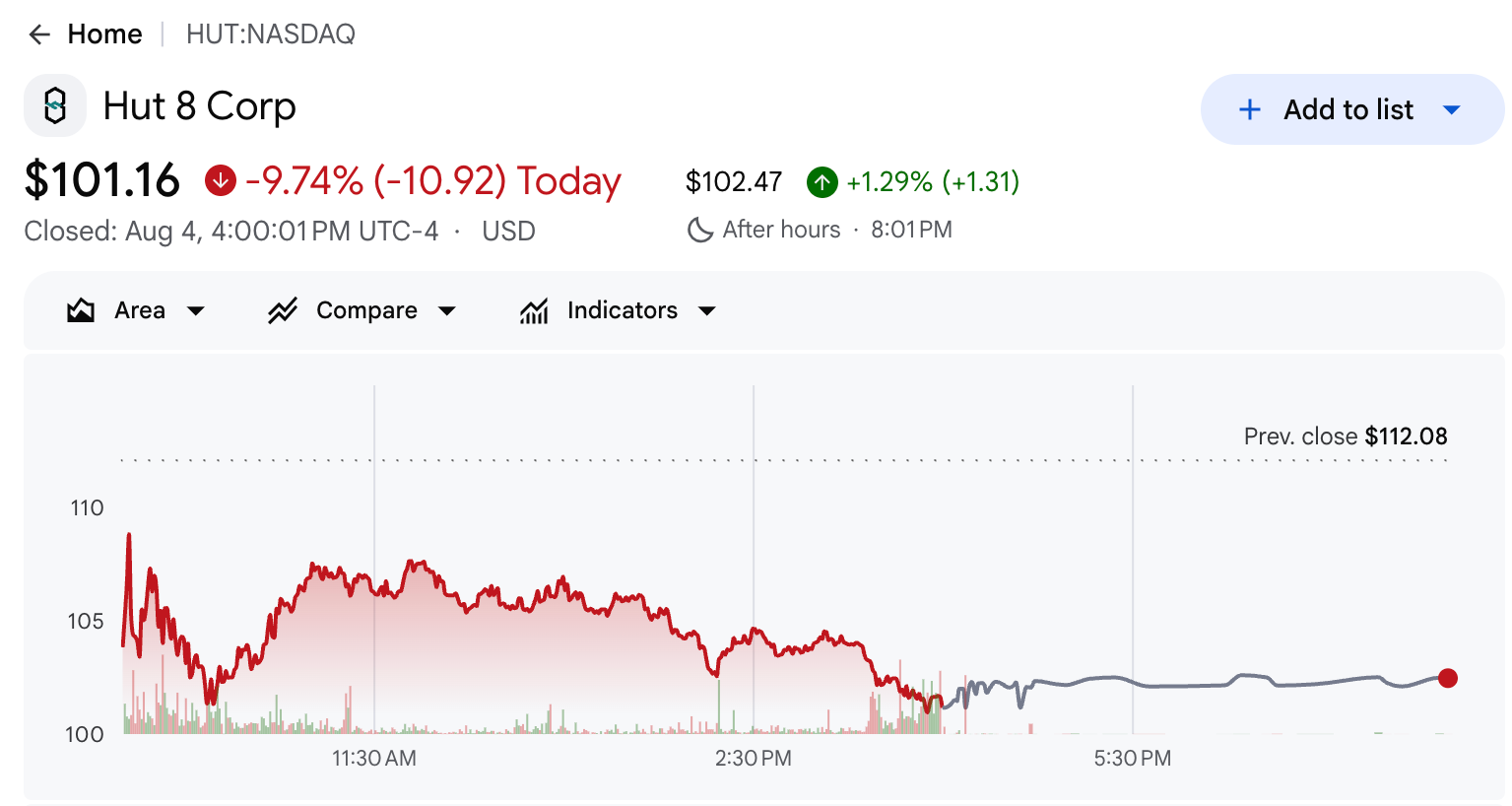
Hut 8 stock dropped 9.74% to $101.16 on Tuesday after the company reported second-quarter earnings. Revenue climbed 81% year over year to $74.9 million, while net losses reached $177.1 million.
The Bitcoin (BTC) miner turned AI data center developer recovered 1.29% to $102.47 in after-hours trading. Investors appear focused on the loss rather than the company’s growing lease book.
Follow us on X to get the latest news as it happens

Why Hut 8 Stock Fell Despite Revenue Growth
Most of the quarterly loss existed only on paper. The company booked $138.6 million in primarily unrealized losses on digital assets, according to its earnings release.
The comparison with last year sharpened the reaction. Hut 8 posted $137.5 million in net income in Q2 2025, when digital asset gains lifted results.
Core operations moved the other way. Adjusted EBITDA excluding digital assets reached $10.4 million, up from $4.2 million a year earlier.
“Adjusted EBITDA inclusive of digital assets mark-to-market for the three months ended June 30, 2026 was $(94.6) million, compared to $221.2 million in the prior-year period,” the firm revealed.
AI Leases Reach 949 MW and $26.6 Billion
The loss overshadowed a growing commercial pipeline. Contracted IT capacity across Hut 8’s AI campuses reached 949 MW, with a base-term contract value of roughly $26.6 billion.
Those leases are expected to generate more than $1.75 billion in average annual net operating income. A 352 MW Beacon Point Phase 2 deal, signed after quarter-end, lifted that campus alone to roughly $19.6 billion.
The build-out extends the AI data center pivot Hut 8 began in December with AI cloud firm Fluidstack. Financing kept pace, as the company closed $7.5 billion in investment-grade project notes split between its River Bend and Beacon Point campuses, with no recourse to the parent.
CEO Asher Genoot said execution now takes precedence over deal-making.
“Delivery is now our central priority. We continue to apply the full weight of our organization to deliver River Bend and Beacon Point: operating rigor built through years of developing energy-intensive infrastructure at scale and a team we continue to expand ahead of the growth to come,” the exeutive stated.
Delivery timelines now define the story. River Bend targets its first data hall in Q2 2027. Beacon Point Phase 1 expects initial energization in Q1 2027. The coming quarters will show whether the construction pace matches the contracted numbers.
Subscribe to our YouTube channel to watch leaders and journalists provide expert insights
The post Hut 8 Stock Slides 9.7% Despite 81% Revenue Surge in Q2 appeared first on BeInCrypto.

The Core Team behind the project rarely stays quiet, trying to improve the broader network with new updates, features, redesigns, and anything in between.
Although these attempts generally fall short when it comes to boosting investor sentiment toward the underlying asset, there has been an evident shift in the past week or so.
Pi Joins RoboPay
The latest announcement coming from the Pi Network team outlined a partnership with RoboPay, making it a payment partner. This would allow “tens of millions of Pi users” to have access to robot services directly through the use of the asset they already hold, meaning they can spend Pi for grocery deliveries, property patrols, industrial inspections, and humanoid assistance.
RoboPay is an on-chain system built by the non-profit Fabric Foundation to let AI agents discover, hire, and pay robots autonomously.
“This partnership marks a fundamental shift in how humans are able to interact with robotics. Instead of purchasing robots themselves, users will be able to simply purchase outcomes. Physical intelligence becomes an on-demand service that is discoverable, programmable, and instantly payable through a shared economic network,” reads the announcement.
Launchpad Model
The Core Team has long claimed that it tends to approach token launches differently than other blockchain projects, which typically keep the raised funds. In contrast, Pi Network sends the committed Pi coins directly into a liquidity pool paired with the newly issued ecosystem asset.
In a recent post, they outlined the details of how this process will enhance user engagement and real application functions. More than 240,000 Pioneers participated in the distribution of the Testnet token called SLICE. According to the team, users have committed roughly 16 million Test-Pi for 10 million SLICE tokens.
The newly issued asset, which remains only in test mode and will never go to mainnet, as the team explained, is linked to the game Slice of Pi. It aims to test engagement-based bonuses and promote product utility over capital raising.
Next Protocol Version
Pi Network confirmed the completion of protocol version 25 at the end of July, and outlined August 11 as the deadline for the deployment of the next one, version 26. The team described it as a major milestone that leads to the final planned upgrade, version 27, after eight successful migrations.
Later on, they published a reminder to node operators that they have to ensure their systems are upgraded by the set deadline, otherwise risk being disconnected from the network.
PI Price Update
It was less than a month ago when the underlying asset plummeted to a new all-time low of just over $0.07. This was the culmination of consecutive breakdowns and the loss of key support levels.
The bulls finally stepped up and helped it surge to $0.10 within days. However, another rejection followed, and PI slipped below $0.09 and $0.08. This time, though, the support at $0.074 managed to contain the losses, and the asset has remained above $0.08 for the past several days.
Moreover, it jumped from under $0.083 to over $0.086 earlier today, where it was stopped and now sits inches below it. Nevertheless, it’s still 22% higher than the ATL marked in mid-July. A large portion of these gains came after the team announced the upcoming version 26.
The post Important Pi Network News and PI Token Update: August 5 appeared first on CryptoPotato.

Bitcoin’s price recovery from the dip to $62,200 continues, as the asset has added two grand and now sits confidently above $64,000. It appears that the market is pricing in the latest positive development on the Middle East uncertainty.
A report from Axios from earlier this morning indicated that the US, Iran, and Oman are “closing in on an interim agreement to reopen the Strait of Hormuz.” Moreover, it added that President Trump wants the confirmation to be announced today.
The report follows the weekend developments in which the POTUS canceled the planned strikes against Iran and claimed that there’s a deal in the making, something which the Middle Eastern country initially refuted.
Citing two regional sources familiar with the matter, Axios outlined details of the worked-out deal: all inbound traffic of ships would go through the Iran-controlled northern lane, while outbound traffic would pass through the southern lane through Omani waters.
In addition, neither side will charge fees or tolls for a 60-day period. Previously, Iran wanted up to $2 million per ship, possibly paid in BTC.
The parties will work on clearing naval mines from the median lane, which would later be used for inbound and outbound traffic under the terms of a permanent arrangement between Oman and Iran.
BTC has gained over $2,000 since the local low at $62,200, as it continues to be impacted by the developments on the war front. However, the breakout attempt would probably not be validated until a permanent deal is reached.
The post BTC Reclaims $64K Ahead of Expected Iran-US-Oman Hormuz Deal Today: Report appeared first on CryptoPotato.

TP-Link patches Omada ZTP flaws allowing hackers to breach networks

Dad died trying to save his daughter in devastating double drowning, inquest hears

Merck (MRK) earnings Q2 2026


-

 Business6 days ago
Why Trees Belong on the Risk Register
-

 Fashion5 days ago
Weekend Open Thread: Wit & Wisdom
-

 Politics4 days ago
Meta enters AI-training agreement with far-right ‘propaganda rag’ Newsmax
-

 Politics7 days ago
Reform UK betrays West Mids residents by running from party pledges
-

 Crypto World4 days ago
MicroStrategy Post-Earnings CLARITY Act Push Could Add New Catalyst for Its Stock
-

 Politics3 days ago
Zack Polanski: an incitement to murder Nigel Farage?
-

 Crypto World4 days ago
XRP Ledger v3.3.0 brings five institutional features
-

 News Videos6 days ago
Bitcoin Enters the 3rd Stage of the Bear Market
-

 Politics6 days ago
Luke Littler’s dominance sparks GOAT debate
-

 Sports5 days ago
Seema Kaliramna Wins Discus Throw Bronze, Takes India’s CWG Medals Tally To 17
-

 Crypto World4 days ago
New York sues Kalshi over prediction market gambling
-

 Crypto World3 days ago
Crypto PAC spending tops $2M in Michigan House race
-

 Tech7 days ago
Gemini can now summarize the messiest comment threads in Google Docs
-

 Business5 days ago
Trump Announces Hamas Disarmament Agreement as Iran Strikes Kuwait Air Base and US Attacks Pause Overnight
-

 Business2 days ago
DTCR: Deleveraging And A Hedge Fund Collapse Point To A Possible AI Bottom
-

 Tech3 days ago
ESET tracks rise in malicious AI skills and adaptable malware
-

 Tech5 days ago
Building A Reproduction PlayStation Motherboard
-

 Tech5 days ago
Gemini Spark can now use Chrome logins and saved passwords to run errands on your behalf
-

 Sports7 days ago
Sakshi, Arundhati Enter Boxing Semi-Finals. India Assured Of 18 Medals At CWG 2026
-

 NewsBeat6 days ago
Four people die trying to cross Channel in small boats
You must be logged in to post a comment Login