
Crypto World
Bitcoin is 49% below its record while the S&P 500 hits all-time highs

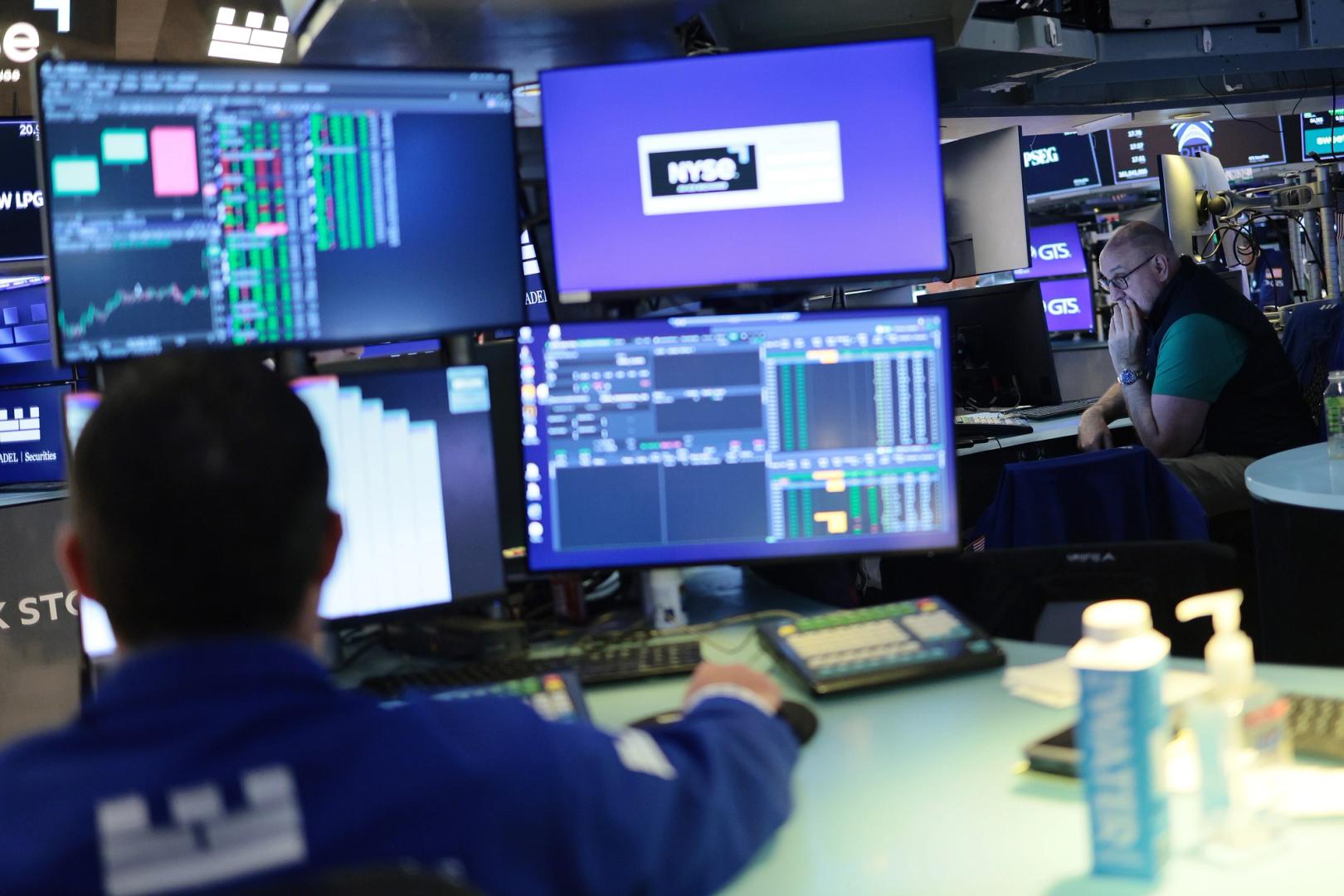
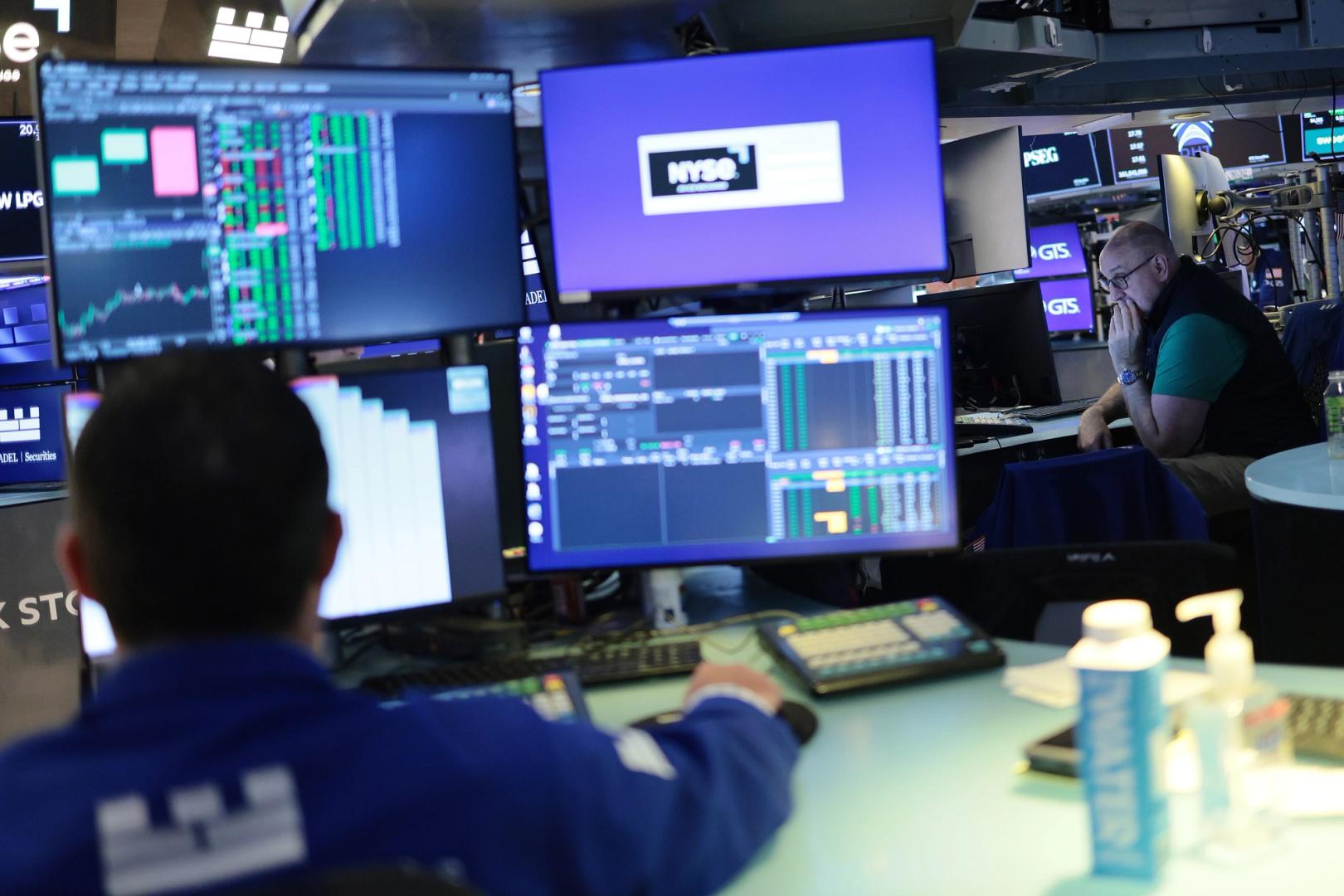
SK Hynix rose 6.4% after the Seoul open and Nvidia added over 2% after hours, though AMD dropped 9% on a soft sales outlook and SpaceX fell 7.5% on higher projected AI spending.
Brent crude fell 1.1% to about $78.50 a barrel after Axios reported Washington, Tehran and Oman were close to an agreement to reopen the Strait of Hormuz, with an announcement targeted for Wednesday. Treasuries and gold both advanced as traders trimmed bets on further rate hikes.
Equities are printing records while bitcoin sits roughly 49% below the $126,000 it reached last October, and the second-largest asset is falling on the week.
Cheaper oil, easing rate expectations and a risk-on equity bid have now failed to move crypto for three straight sessions, which points the drag inward rather than at the macro.
Watch what happens if the Hormuz announcement lands Wednesday as reported. That is the cleanest macro catalyst crypto will get this week, and a market that cannot rally on a confirmed deal after failing to rally on the prospect of one is telling you the buyers are elsewhere.


Bybit has taken another step toward expanding its regulated business in Europe after its Austria-based payments unit, Bybit Payments GmbH, received an electronic money institution (EMI) license from the country’s Financial Market Authority. The approval gives the exchange a clearer regulatory foundation to introduce payment-related products alongside its existing Europe-focused platform.
In an announcement shared on Tuesday, Bybit said the EMI authorization enables its future payment capabilities, which may eventually include person-to-person transfers, merchant payment services, open banking functionality, and card products. For users and partners, the practical impact is that Bybit is positioning to offer payment rails and e-money services under a supervisory framework rather than relying solely on third-party arrangements.
Key takeaways
- Bybit Payments GmbH has received an electronic money institution license from Austria’s Financial Market Authority.
- The authorization is intended to support future payment and e-money products, potentially including P2P, merchant solutions, open banking, and cards.
- Payments will be offered through Bybit.eu alongside existing services from a separate Austrian crypto-licensed entity.
- Bybit EU GmbH continues to operate under EU MiCA authorization (granted in May 2025), with responsibilities kept distinct from the EMI permissions.
- Bybit stated Malta is excluded, citing MiCA passporting requirements that must be met for each jurisdiction.
Austria approval lays groundwork for regulated e-money and payments
The EMI license centers on Bybit Payments GmbH’s ability to provide regulated electronic money and payment services. Bybit did not describe a specific go-live date for any particular product, but it tied the authorization to a broader plan to expand payments features as they are introduced.
For institutional and business users, this matters because payment services typically require ongoing regulatory oversight that extends beyond exchange operations. By obtaining an EMI license, Bybit can create a more direct, jurisdictionally supervised pathway to integrate with banks, payment providers, and enterprises—potentially improving operational control and reducing dependence on external payment infrastructure.
How Bybit plans to split roles across two Austrian entities
Bybit’s European structure now hinges on two different Austrian entities, each carrying different regulatory permissions. The exchange said Bybit Payments GmbH will manage the EMI and payment-related activity as e-money and payment products are launched. Meanwhile, Bybit EU GmbH—another Austrian entity—remains responsible for crypto services under EU Markets in Crypto-Assets Regulation (MiCA).
According to Bybit, Bybit EU GmbH is authorized to provide crypto custody, exchange, placement, and transfer services. This separation is designed to keep permissions and obligations distinct: one entity under the crypto regime for crypto-asset activities, and the other under the payments regime for electronic money and regulated payment products.
Bybit also said both services will be made available through Bybit.eu, suggesting the user-facing platform will continue to act as a single destination while the underlying compliance responsibilities are managed by the appropriate licensed entity.
Which regions will have access—and why Malta is missing
Bybit Payments GmbH’s services are expected to run through Bybit.eu for users across the European Economic Area (EEA), with an exception: Malta.
Bybit did not give a specific operational reason for the exclusion. Instead, it referenced its own website guidance, stating that services are offered only in jurisdictions where applicable MiCA passporting requirements have been met. The statement suggests that regulatory coverage for the overall Bybit offering—including how crypto and payments are packaged for particular regions—depends on whether passporting conditions have been satisfied.
For readers, the key takeaway is that licensing alone may not automatically translate into immediate availability across every EEA jurisdiction. Even when an entity is licensed in one country, market access can hinge on broader cross-border permissions tied to the regulatory framework involved.
Why the milestone could change how Bybit partners with banks
Beyond product expansion, Bybit framed the EMI license as a relationship-strengthening development with banks, payment providers, and enterprises. Bybit suggested the new approval could also reduce reliance on third-party payment infrastructure.
That shift is particularly relevant in Europe, where fintech and crypto firms often face a trade-off: speed to market versus the cost and complexity of building and maintaining compliant payment operations. Establishing an EMI license can support more direct routing of payment flows and potentially help standardize integrations with counterparties. It may also make it easier for partners to understand which part of Bybit’s business is responsible for regulated payment activities.
At the same time, it remains to be seen how quickly Bybit will convert the license into concrete consumer-facing offerings. An EMI authorization provides a regulatory capability, but product rollouts—especially those involving card services or open banking—typically require additional implementation work and coordination with payment networks and partners.
Related: Crypto exchange Bybit launches in Indonesia after NOBI acquisition
Investors and users should watch how Bybit translates the EMI license into specific payment features on Bybit.eu, and whether the exchange later broadens availability to additional jurisdictions currently excluded—particularly Malta. The other open question is the pace of integration between the MiCA-authorized entity and the newly licensed EMI unit, since the two permissions are meant to stay distinct even if the experience is unified.
Bitwise Chief Investment Officer Matt Hougan said on Aug. 4 that the crypto industry would continue expanding even if the U.S. Senate fails to advance the CLARITY Act before its August recess.
Summary
- No CLARITY Act cloture motion appeared on Tuesday’s Senate schedule, narrowing this week’s remaining window.
- Bitwise’s Matt Hougan says SEC rulemaking could sustain crypto growth if Congress delays market structure.
- The bill cleared Senate Banking 15 to 9 but still needs sixty votes for cloture.
- Democratic senators seek ethics, consumer protection, illicit finance, conflict, and market integrity provisions before passage.
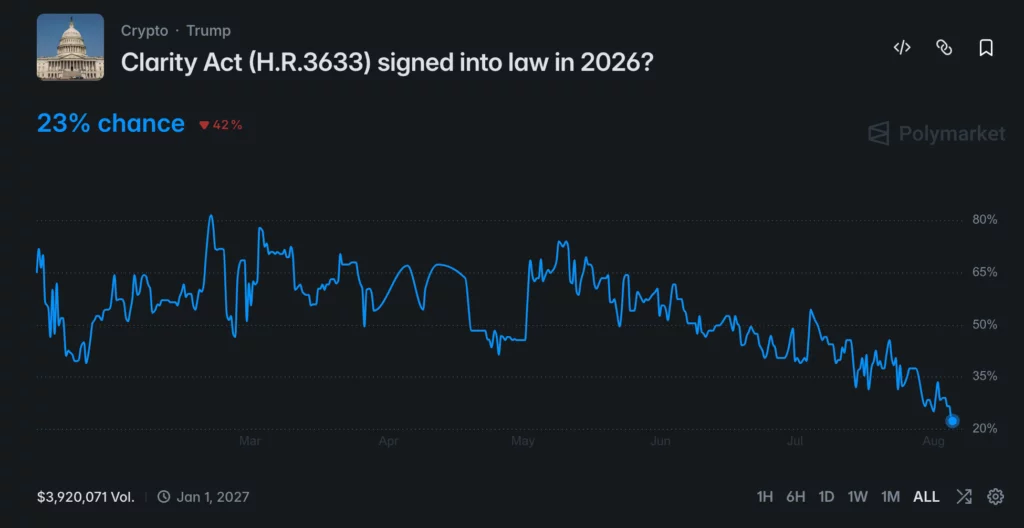
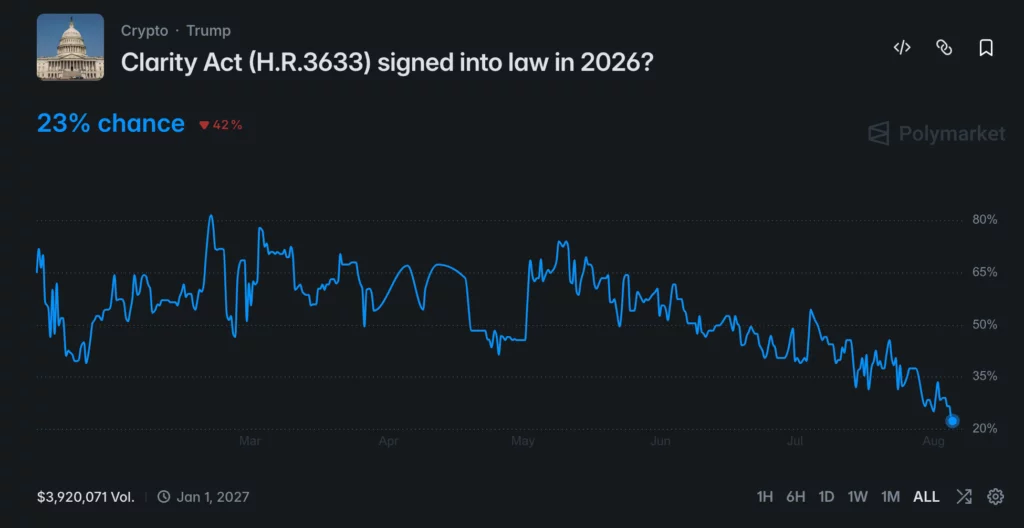
- Polymarket traders place 2026 enactment odds at 23%, reflecting doubts before the Senate recess begins.
In a new investor memo, Hougan said crypto “will be fine” without immediate congressional action. He argued that Securities and Exchange Commission rulemaking could provide an alternative path while traditional financial companies continue adopting digital assets. His assessment is a forward looking industry view, not a confirmed regulatory outcome.
The bill’s immediate prospects remain uncertain. The Senate’s Aug. 4 floor schedule did not include H.R. 3633, and the chamber’s official list of pending cloture motions named two unrelated matters. No cloture filing for the CLARITY Act had been announced by the end of Tuesday’s session.
CLARITY Act faces an Aug. 5 procedural test
Hougan identified Wednesday, Aug. 5, as the practical deadline for Senate leaders to file cloture and preserve a possible Friday procedural vote. Senate Rule XXII ordinarily requires a cloture vote one hour after the chamber meets on the following calendar day but one after filing. Sixteen senators must sign the motion.
Ending debate on legislation normally requires three fifths of senators duly chosen and sworn, or 60 votes when every seat is filled. The measure could move faster under a unanimous consent agreement, but such an arrangement would require cooperation that Senate leaders have not announced.
The Senate Banking Committee approved the bill 15 to 9 on May 14. Senator Cynthia Lummis later released a merged 616 page proposal combining work by the Banking and Agriculture committees. The revised measure remains on the Senate legislative calendar but has not received a full chamber vote.
As crypto.news reported on Aug. 4, government funding legislation and nominations occupied the available floor schedule. The omission does not legally kill the CLARITY Act, but it leaves little time for debate, amendments and a final vote before lawmakers depart.
SEC rules could help but cannot replace the bill
Hougan based his fallback scenario on comments from SEC Chair Paul Atkins, who said the agency was “ready, willing, and able” to address several matters covered by the legislation. Hougan believes rules adopted under Atkins could initially prove more favorable to innovation than compromises required for a bipartisan law. He said they “may even be an accelerant,” although no such effect is assured.
Atkins has supported agency action through Project Crypto, including work on token classifications, capital formation and securities market rules. However, he has also backed congressional legislation. In an official speech, Atkins said statutory language provides the strongest protection against future regulators reversing the current approach.
The distinction matters because the CLARITY Act would divide digital asset jurisdiction between the SEC and Commodity Futures Trading Commission. The updated congressional summary covers token disclosures, digital commodity exchanges, customer property, decentralized finance, stablecoin rewards and anti money laundering requirements.
The SEC can change rules governing securities, registered intermediaries and token offerings within its existing authority. It cannot independently grant the CFTC nationwide authority over digital commodity spot markets. SEC rules could therefore provide part of the framework, but not the complete structure Congress is considering.
As previously reported by crypto.news, agency rules would also be less durable than legislation. A future commission could revise or withdraw them through another regulatory process. A federal statute could only be changed through new congressional action.
Political disputes still threaten Senate support
Seven Democratic senators said on July 22 that the updated Republican text “falls short.” Catherine Cortez Masto, Angela Alsobrooks, Cory Booker, Ruben Gallego, John Hickenlooper, Mark Warner and Raphael Warnock requested stronger rules for elected officials, consumer protection, illicit finance, conflicts of interest and market integrity. They also said negotiations would continue.
The merged bill already contains an ethics division that would restrict covered officials and spouses from issuing or sponsoring digital assets for compensation while in office. It would also require additional financial disclosures. Democrats have not accepted those provisions as sufficient.
Banks are separately seeking tighter restrictions on rewards linked to payment stablecoin balances. The current proposal prohibits interest paid solely for holding stablecoins but allows certain activity and loyalty rewards. Banking groups argue that some exceptions could still resemble deposit interest and draw funds away from community lending.
Prediction markets have created another dispute. Twelve senators asked committee leaders to prevent CFTC registered platforms from listing contracts that resemble sports wagers or casino games. They also requested protections for state authority, tribal sovereignty and tribal gaming compacts.
These disagreements make the 60 vote threshold harder to reach. They also show why SEC action cannot resolve every issue. Questions involving CFTC powers, banking law, political ethics and tribal gaming require broader federal authority or additional legislation.
A delay would move the fight into a harder calendar
The Senate’s published calendar places lawmakers in a state work period from Aug. 10 through Sept. 11. Failure to act this week would not remove H.R. 3633 from the calendar, but it would push consideration into a period crowded by government funding, the November election and other unfinished legislation.
Hougan described that outcome as a “walking dead” period in which the bill remains alive without a clear route to passage. He suggested lawmakers could revisit it in September or attach provisions to a year end package. Those possibilities remain speculative because Senate leaders have announced neither a fall vote nor an omnibus strategy.
Polymarket traders currently give the CLARITY Act a 23% chance of becoming law by Dec. 31, down from 27% when Hougan published his memo. The market has attracted approximately $3.9 million in volume. Its price measures trader sentiment and is not an official congressional forecast.
A cloture filing on Aug. 5 would be the next concrete development. Without one, ordinary Senate procedure would leave almost no route to a pre recess vote. The industry could still receive narrower SEC rules, but the long term allocation of U.S. digital asset oversight would remain unsettled.
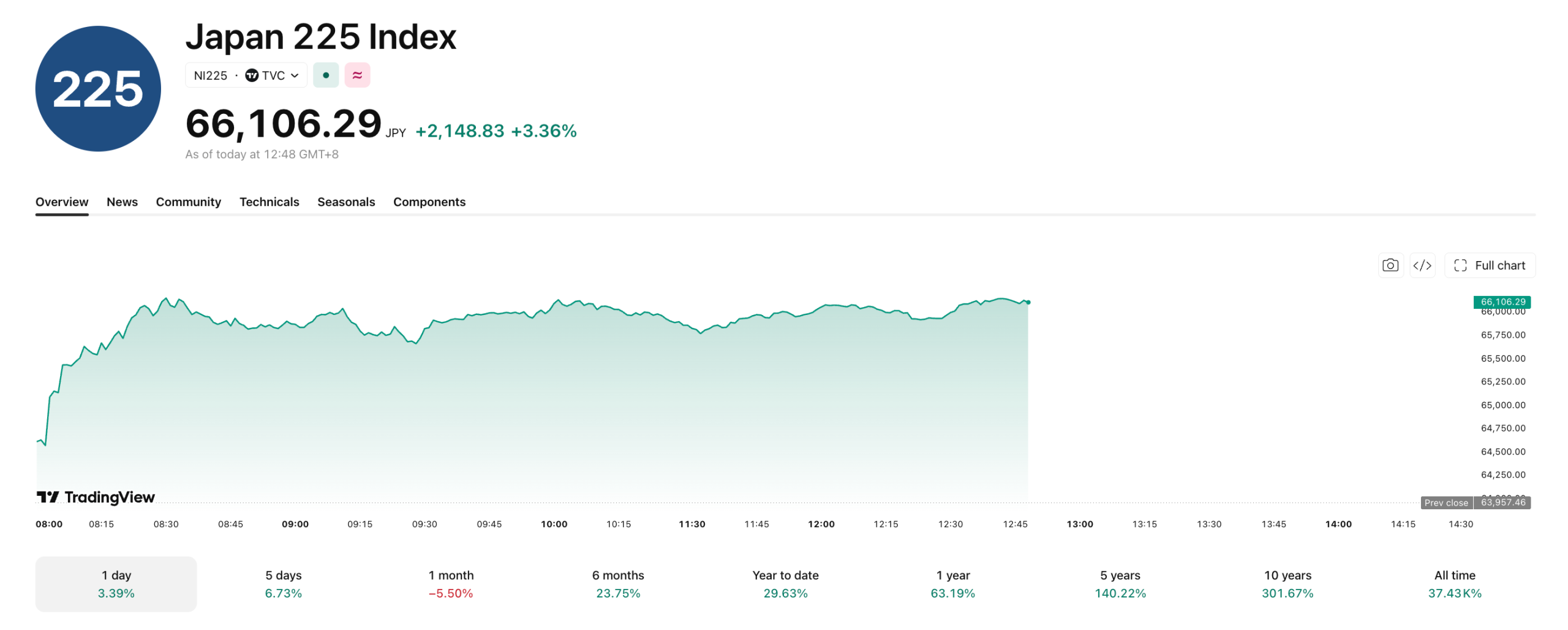
Japan’s Nikkei 225 climbed 3.34% Wednesday to 66,090 points, marking its sharpest one-day gain in weeks. Chip stocks led the advance across Asian markets.
The rally followed an overnight surge on Wall Street. Traders also welcomed fresh hope that the United States and Iran will soon reopen the Strait of Hormuz.
Chip Stocks Lead The Rally
The Nikkei 225 opened nearly 1% higher and climbed steadily through the session. The gain reversed recent pressure tied to Bank of Japan currency intervention.
SoftBank Group surged more than 10%, according to CNBC. Tokyo Electron added 3.64%, Advantest gained 7%, and Kioxia rose 6.34%.

South Korea’s SK Hynix jumped around 6%. Samsung Electronics gained more than 4% at the open, extending South Korea’s chip rebound into the new session.
Ortus Advisors strategist Andrew Jackson linked the move to renewed U.S. semiconductor strength. He said it reinforced the bullish outlook for Asian AI stocks.
SK Hynix also partnered with SanDisk (SNDK) to launch High Bandwidth Flash (HBF), a new memory standard for AI servers. Investors read the move as a sign of continued momentum in AI memory supply chains.
Bessent’s Iran Remarks Support The Rally
Treasury Secretary Scott Bessent told CNBC Tuesday he expects a deal “today or tomorrow” to reopen the strait. He called it a critical corridor for global oil shipments.
Iran has periodically threatened the waterway during its conflict with the United States. Bessent’s comments followed Trump’s Monday Hormuz talks announcement.
The remarks helped push oil prices lower. Cheaper oil eases cost pressure on energy-dependent economies like Japan and South Korea.
Overnight, the S&P 500 and Dow Jones Industrial Average both closed at record highs. The Nasdaq Composite led gains, climbing 2.59%.
Wednesday’s gains follow a volatile stretch for Japanese and South Korean equities. Morgan Stanley’s Korea upgrade points to further room for chip stocks to recover. Traders will watch whether the rally holds once Washington and Tehran confirm a Hormuz deal.
The post Nikkei 225 Jumps 3% as Chip Stocks Rally on Iran Deal Hopes appeared first on BeInCrypto.
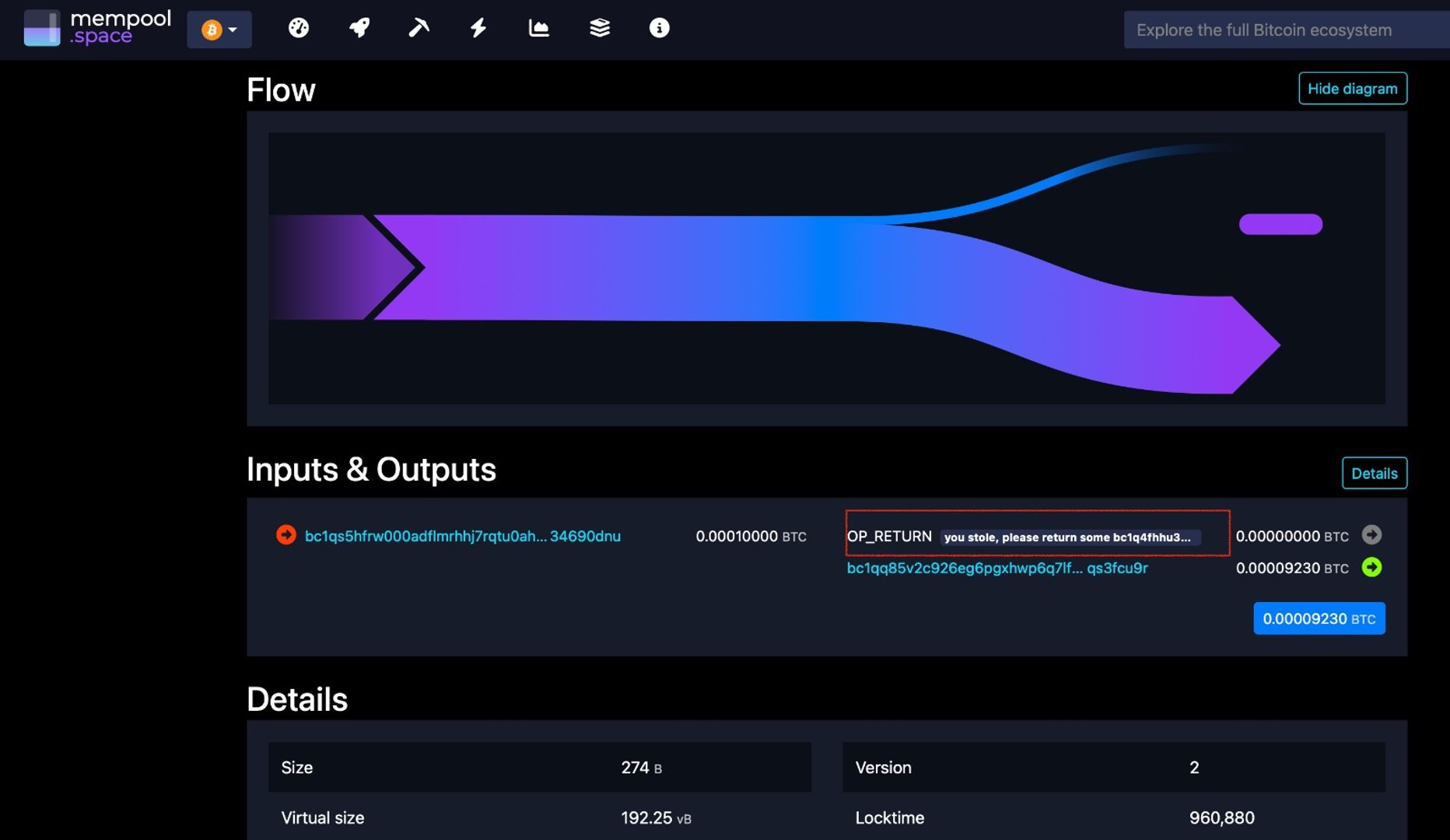
That’s because the ability to write messages is tied to a quirky Bitcoin feature called OP_RETURN, which lets anyone attach a small text string to a transaction. The text gets permanently timestamped into the blockchain alongside the transfer of money. The function exists for technical purposes; mainly, developers use it to timestamp documents or embed small proofs. That said, users can use the function to leave personal notes.
The Coldcard hardware wallet exploit, first detected on July 30, has snowballed into a major self-custody breach, with confirmed losses now topping $100 million.
What people are actually writing
The plea that opened this article isn’t the only one. Several similar messages have surfaced, according to on-chain tracker Arkham Intelligence.
One reads “Please Please Please” alongside an address; another bluntly asks for “80% of my 5 BTC” back. Whether these come from genuine hack victims or opportunists capitalizing on the sympathy wave is difficult to verify.
Other messages are opportunistic rather than sympathetic.
One reads, “I clean btc, do kyc and cashout. I take 10%,” complete with a Telegram handle — a laundering pitch hoping to land the hacker as a client. Another begs, “1 BTC for my Bitcoin journey,” which is entirely unrelated to the hack. The sender seems to be using the hacker wallet’s spotlight to solicit money from strangers.


Three Missouri men have pleaded not guilty to a federal charge tied to an alleged plan to steal Bitcoin through a home invasion in Connecticut.
Summary
- Three Missouri men face a federal conspiracy charge over an alleged Connecticut Bitcoin robbery plan.
- Prosecutors say the group surveilled the intended target and his parents for two consecutive days.
- The Hobbs Act robbery conspiracy charge carries a maximum federal prison sentence of twenty years.
- Louis and Davis remain detained, while Williams pleaded not guilty and remains free on bond.
- Two admitted coordinators face August sentencing dates as the Connecticut prosecution continues in federal court.
The U.S. Attorney’s Office for the District of Connecticut announced the charges on Aug. 4 against Sedric Louis, 32, John Davis, 34, and Martel Williams, 27, all of St. Louis.
A New Haven grand jury returned a second superseding indictment on May 22. It charged the three defendants with conspiracy to interfere with commerce by robbery, commonly known as Hobbs Act robbery. Federal law allows a sentence of up to 20 years, although any punishment would depend on a conviction and the court’s findings.
According to the Justice Department, the defendants traveled to Connecticut between Aug. 21 and Aug. 24, 2024. Prosecutors allege that they obtained rental vehicles, air rifles and walkie talkies before watching the intended target and his parents for two days.
The alleged plan involved entering the family’s home, threatening the target and forcing a transfer of Bitcoin to accounts controlled by the organizers. Prosecutors say the Missouri group left after fearing that home security cameras had recorded them and after losing confidence in the plan.
The charges connect to a later Connecticut kidnapping
The Justice Department says another group from Florida arrived after the Missouri men departed. Danbury police arrested six Florida men on Aug. 25, 2024, after a violent carjacking and the beating and kidnapping of two people.
Investigators identified the victims as the parents of a person who participated in the theft of hundreds of millions of dollars in Bitcoin. The latest release does not identify that person or state how much cryptocurrency the alleged home invasion crew expected to recover.
The three new defendants have denied the charge. Louis and Davis have remained detained since their June 25 arrests and pleaded not guilty on July 30. Williams pleaded not guilty on July 17 and was released on bond. The Justice Department stressed that “an indictment is not evidence of guilt” and that all three remain presumed innocent.
Guilty pleas already shape the broader federal case
The prosecution reaches beyond the three newly announced defendants. Adam Iza pleaded guilty on June 1 to the same Hobbs Act conspiracy offense. Prosecutors say he communicated with participants, directed logistics and supplied funding. His sentencing is scheduled for Aug. 12.
Saif Faiq pleaded guilty on June 8. The Justice Department says he recruited participants, traveled to Connecticut and helped conduct surveillance. His sentencing is scheduled for Aug. 28. Six people charged over the later carjacking and kidnapping have also pleaded guilty, according to prosecutors.
The case reflects the use of physical coercion to target digital asset holders. As crypto.news previously reported, three men faced federal charges in a separate alleged $6.5 million cryptocurrency robbery involving kidnapping and forced transfers.
In related coverage, a French crypto worker fought off an armed intruder who allegedly sought access to cryptocurrency wallets.
What happens next in the Bitcoin robbery case
The Justice Department’s Aug. 4 announcement did not provide a trial date for Louis, Davis or Williams. The federal court will next address pretrial motions, evidence and scheduling unless the parties reach plea agreements.
The FBI New Haven Violent Crimes Task Force, FBI offices in Los Angeles and St. Louis, and Danbury police are investigating. Assistant U.S. Attorneys Karen L. Peck and Daniel George are prosecuting the case. The scheduled August sentencings of Iza and Faiq may provide the next public updates in the broader prosecution.


Bitcoin rose about 1.6% to trade near $63,700 on Aug. 4 after CNBC host Jim Cramer said he planned to sell his holdings because of concerns about quantum computing.
Summary
- Cramer said he plans to sell Bitcoin after IBM chief Arvind Krishna raised quantum concerns.
- Bitcoin traded near $63,700, gaining 1.6% despite Cramer’s warning and weak spot market liquidity conditions.
- Google estimates fewer than 500,000 physical qubits could eventually break widely used elliptic curve cryptography.
- Glassnode classifies 1.92 million Bitcoin, or 9.6% of supply, as structurally exposed to quantum attacks.
- A 16,400 Bitcoin whale transfer moved funds between wallets, not onto any identified cryptocurrency exchange.
Cramer tied the decision to a CNBC interview with IBM Chairman and CEO Arvind Krishna. Krishna said investors should become “paranoid” about cryptocurrency security within three to four years. Cramer later said, “I’m going to sell mine.” Neither the size of his holdings nor evidence of an executed sale has been disclosed.
Bitcoin rises despite Cramer’s sell plan
Bitcoin climbed from an intraday low near $62,387 to as high as $64,117 before easing. The recovery left the asset about 1.6% higher over 24 hours, although the price remained inside the range that has controlled trading since the June decline.
The market reaction does not prove traders dismissed Cramer’s warning. Bitcoin was also absorbing Strategy’s recent sale, miner distribution estimates and the Coldcard security incident. As crypto.news reported, buyers continued defending the area above $60,000 despite those pressures.
The TradingView daily chart supplied with the story shows Bitcoin consolidating after its sharp June decline. Support remains near $60,000, while $65,000 to $67,000 is the main resistance zone. Volume near 5,950 BTC appeared modest compared with earlier selloff periods, suggesting the rebound still lacked strong participation.
A sustained move above $67,000 would strengthen the recovery case. Until that happens, the price remains range bound rather than in a confirmed new uptrend.
Quantum warning describes a future risk
Krishna’s three to four year estimate is a forecast, not proof that a quantum machine can currently break Bitcoin. IBM’s official roadmap targets a large scale, fault tolerant system called Starling for 2029. The company says the planned machine would use 200 logical qubits and perform 100 million quantum operations. IBM has not claimed that Starling could recover Bitcoin private keys.
Google Quantum AI tightened the theoretical risk estimate in March. Its researchers said a future cryptographically relevant quantum computer could solve the elliptic curve problem used by many digital assets with fewer than 500,000 physical qubits under stated hardware assumptions. The estimate was about 20 times lower than previous calculations.
However, Google described this as a future capability. It urged blockchains to begin moving toward post quantum cryptography before such machines become available. Current systems do not have the scale and error correction needed to conduct the proposed attack.
Glassnode has measured which Bitcoin outputs could face exposure if that capability emerges. Its May analysis classified 1.92 million BTC, or 9.6% of issued supply, as structurally exposed because the associated public keys are already visible.
It placed another 4.12 million BTC in an operationally exposed category linked largely to address reuse and custody practices. Glassnode explicitly said its study did not predict whether or when a practical quantum attack would become possible. As crypto.news reported, the figures measure exposure rather than an active theft risk.
Whale transfer and thin trading add caution
Blockchain tracker Lookonchain reported that a wallet holding 16,400 BTC, worth about $1.04 billion, transferred its full balance to a new address after seven months of inactivity.
The transaction was a wallet to wallet movement. The funds did not go directly to an identified exchange, meaning the transfer does not establish that the holder was preparing to sell. It may have reflected custody changes, security measures or internal wallet management.
Market depth remains a separate concern. The Kobeissi Letter, citing Kaiko data, said daily spot activity across 44 exchanges fell to about $15 billion, around 70% below its January peak.
The underlying Kaiko dataset was not available in a public report reviewed for this article. The $15 billion figure should therefore remain attributed to the post rather than treated as an independently confirmed market total.
Social media users also revived the “inverse Cramer” meme, which treats his bearish calls as contrarian buy signals. The meme reflects several widely discussed calls that later moved against him, but it is not a tested indicator and does not explain Bitcoin’s price movement by itself.
Bitcoin must reclaim $67,000
Bitcoin’s immediate test remains the $65,000 to $67,000 resistance band. A sustained close above that area, supported by stronger volume, would improve the short term structure. Failure to maintain the current recovery could return attention to $62,000 and then the key $60,000 support level.
The longer term question is whether developers, exchanges and custodians accelerate preparations before quantum computers become cryptographically relevant. Bitcoin companies have begun funding post quantum research, while BitGo recently introduced four wallet controls designed to measure and reduce public key exposure.
Cramer’s statement does not change Bitcoin’s current security, and no practical quantum computer is known to have broken its cryptography. The next verified developments would include evidence that Cramer completed a sale, movement of the 16,400 BTC toward an exchange, stronger spot volume or measurable progress on Bitcoin’s post quantum migration plans.
XRP extended its decline on Aug. 5, 2026, trading near $1.07 as buyers struggled to move the token away from its lower range.
Summary
- XRP trades near $1.07 as weak momentum keeps the token pinned above crucial technical support.
- CoinGlass data shows open interest near $2.25 billion after leveraged positions continued unwinding across exchanges.
- CryptoQuant sees balanced liquidations and neutral funding, suggesting positioning reset rather than forced capitulation currently.
- U.S. spot XRP ETFs reportedly logged four consecutive inflow days despite the token’s weak price.
- A sustained break below $1.05 could expose $1.00, while $1.10 remains the first recovery hurdle.
crypto.news data showed XRP down about 0.9% over 24 hours, with trading volume near $911.7 million and market capitalization around $66.7 billion. XRP remained the sixth largest cryptocurrency.
The decline left XRP close to the $1.05 to $1.06 area that has repeatedly attracted buyers since late June. However, momentum indicators, spot flows and derivatives positioning offer little evidence of a confirmed recovery.
The current setup is not a typical liquidation collapse. Leverage has declined, funding remains close to neutral and liquidations have been relatively balanced. These conditions may reduce the risk of an immediate forced selloff, but they also show that traders have limited conviction in a rebound.
XRP price remains trapped near its lower range
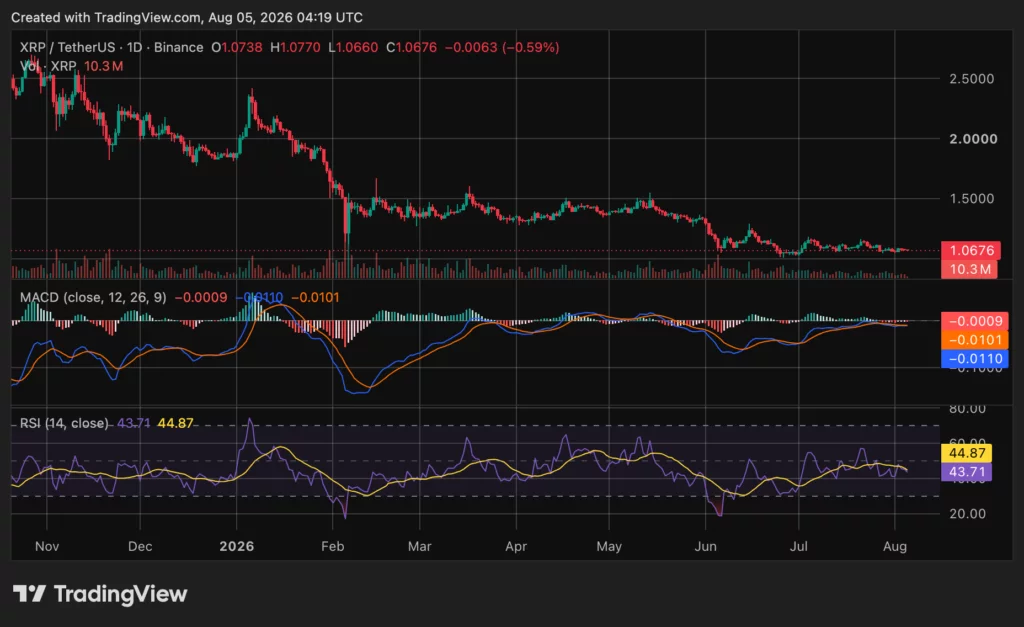
The supplied XRP/USDT daily chart shows a broad decline from above $2.50 to around $1.0676. Recent candles have formed a narrow consolidation close to the bottom of that move. XRP has not established a sustained recovery above $1.10, leaving the short term structure weak.
The relative strength index stood at 43.71, below both the neutral 50 level and its moving average of 44.87. The reading shows that buying momentum remains limited, although XRP has not entered deeply oversold territory on the daily chart.
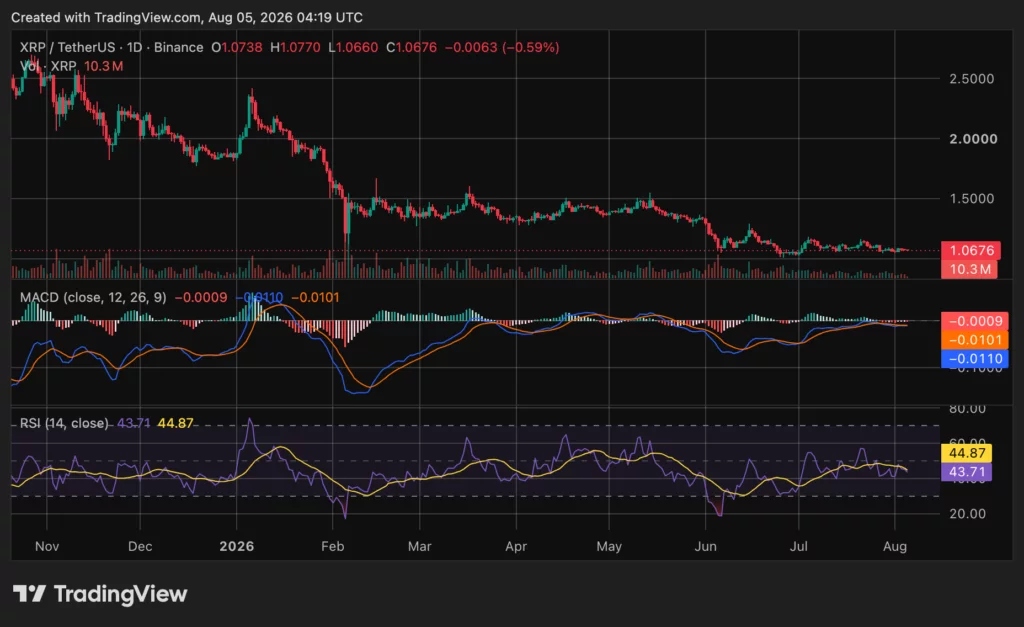
MACD also remains mildly bearish. The MACD line was near negative 0.0110, below the signal line around negative 0.0101. The histogram remained slightly negative at about negative 0.0009. The small difference between the lines points to weak downside momentum rather than a sharp acceleration.
The immediate technical test sits between $1.05 and $1.06. A daily close below that range could expose the psychological $1 level and the late June lows around $1.01. XRP briefly broke the $1.05 area on July 28 before buyers returned. The earlier decline also pushed the four hour RSI into oversold territory, but that reading did not create a lasting reversal.
A recovery above $1.10 would provide the first evidence that buyers are regaining control. XRP would then need to clear the $1.13 to $1.15 region, which has repeatedly limited advances since June.
Analyst Ali Charts described $1.06 as the deciding level. His upside estimates of “$1.35 and $1.64” depend on XRP holding support and confirming a recovery. His downside levels of “$0.80 and potentially $0.62” require a clear breakdown. Neither path has been confirmed.
Other social media forecasts calling for “$23” or “$50+” are highly speculative. Those targets sit far above the current price and are not supported by present momentum, verified institutional forecasts or an established breakout structure.
Lower leverage points to a quiet positioning reset
CoinGlass data showed XRP futures volume near $1.35 billion and total derivatives open interest around $2.25 billion at the time of reporting. The price on the platform stood near $1.067. The supplied data snapshot showed volume falling 10.27% and open interest declining 5.59% over 24 hours.
Falling price and falling open interest usually mean traders are closing positions rather than adding aggressive new shorts. This can reduce the fuel available for large liquidation driven moves. It does not, however, establish that spot buyers are ready to take control.
A separate CryptoQuant analysis found that its XRP open interest measure had fallen into a six month range low between 362 million and 369 million. The estimated leverage ratio also declined toward 0.139 to 0.142, close to the lowest reading during the same period.
CryptoQuant contributor CryptoOnchain also noted that funding remained between roughly negative 0.009 and positive 0.010 during the latest decline. Long and short liquidations alternated rather than producing a one sided cascade. The analyst interpreted the structure as a positioning reset rather than forced capitulation.
Network valuation also compressed faster than reported transaction activity. CryptoOnchain said the network value to transactions ratio fell 42.7% compared with its three month average, while transaction count declined 23.3%. This may indicate that market valuation weakened faster than ledger usage, but it does not provide a reliable timing signal for a price reversal.
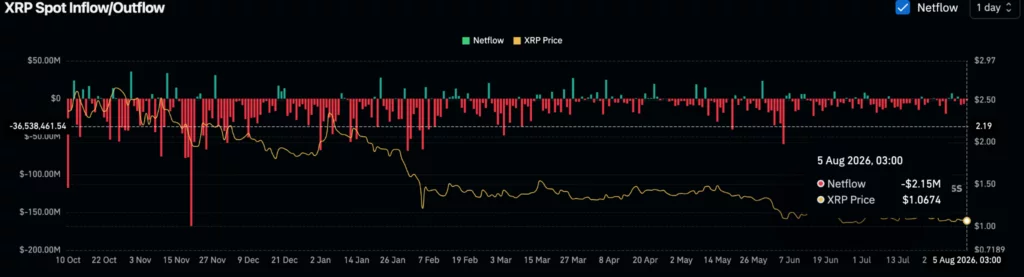
The supplied CoinGlass spot flow chart recorded a net outflow of about $2.15 million on Aug. 5. Recent negative readings have been smaller than the large outflow spikes recorded in late 2025. Selling pressure appears less intense, but sustained positive flow would offer stronger evidence that demand is improving.
U.S. XRP demand has not produced a breakout
U.S. spot XRP exchange traded funds have continued attracting capital despite weak price performance. Recent flow data reportedly showed four consecutive inflow sessions totaling about $15.4 million.
XRP nevertheless remained near $1.08 during that period, showing that the purchases were not large enough to overcome selling elsewhere in the market.
As crypto.news reported in an earlier analysis, five U.S. spot XRP funds launched between November and December 2025 and had attracted roughly $1.5 billion by mid 2026. The funds created a new regulated source of demand, but XRP remained confined to a range around $1.00 to $1.13.
This divergence suggests that ETF inflows alone have not been enough to change the wider trend. Fund purchases must compete with token sales, exchange activity, derivatives hedging and weaker demand across offshore spot markets.
Regulated derivatives activity provides another U.S. market signal. CME Group data showed activity across its standard XRP futures contracts, while the settlement page listed prior day open interest of 6,894 contracts. CME contract data cannot be compared directly with CoinGlass totals because the products use different contract sizes and reporting methods.
The legal risk surrounding Ripple has also changed. The SEC and Ripple dismissed their appeals in August 2025. The district court’s final judgment remained in force, including a $125.04 million penalty and an injunction concerning future registration violations. The dismissal removed the active appeal, but it did not erase the court’s findings involving Ripple’s institutional sales. The SEC litigation release confirms that status.
Wider U.S. legislation remains unresolved. The CLARITY Act has reached the Senate calendar, but it still requires sufficient floor support, reconciliation with other legislative text and presidential approval. Seven Democratic senators said in July that the Republican proposal still fell short on several matters, and no final Senate vote had been confirmed by Aug. 5.
A confirmed vote or renewed delay could influence sentiment toward XRP and other U.S. traded digital assets. It would not, by itself, guarantee a sustained price move.
Ripple developments have not changed near term momentum
Ripple announced strategic investments in ZILO and Licuido on Aug. 3. The companies plan to add transfer agency, token issuance, trading and collateral tools to Ripple’s institutional infrastructure on the XRP Ledger. Ripple did not disclose the investment amounts or financial targets. The official company announcement described RLUSD as a settlement asset for tokenized fund transactions.
As crypto.news reported in related coverage, the investments support Ripple’s broader move into tokenized capital markets. They have not yet produced disclosed revenue, transaction volume or XRP demand that can be tied directly to the token’s price.
The XRP Ledger also faced a validator manifest flood in late July. Developers released xrpld version 3.2.1 to restrict the processing and storage of untrusted manifests. The ledger continued closing normally, and no confirmed loss of funds or altered transactions was reported. Node operators were urged to install the update.
The next price signal will likely come from the market itself. Traders will watch whether XRP can hold $1.05, reclaim $1.10 and build stronger volume above $1.15. Open interest should also stabilize without price making new lows. Continued ETF inflows would be more constructive if they coincide with positive spot flows and stronger momentum.
A break below $1.05 would keep $1.00 exposed. A confirmed daily recovery above $1.15 would weaken the immediate bearish structure. Until either event occurs, XRP remains in a low conviction range with reduced leverage and limited bullish confirmation.
FAQs
Is XRP oversold?
Not on the supplied daily chart. Its RSI near 43.71 remains below neutral but above the conventional oversold level of 30. Shorter time frames have reached oversold readings during recent declines, although those readings did not confirm a lasting bottom.
Does falling open interest support an XRP recovery?
It can reduce liquidation risk because fewer leveraged positions remain open. A recovery still requires stronger spot demand, improving momentum and price confirmation above resistance.
Why have XRP ETF inflows not lifted the price?
ETF demand represents only one part of the market. It can be offset by direct token selling, hedging, weak offshore demand and distributions from existing holders.
What are the main XRP levels to watch?
The immediate support range is $1.05 to $1.06, followed by $1.00. Initial resistance sits near $1.10, with stronger confirmation required above $1.13 to $1.15.
Disclosure: This article does not represent investment advice. The content and materials featured on this page are for educational purposes only.
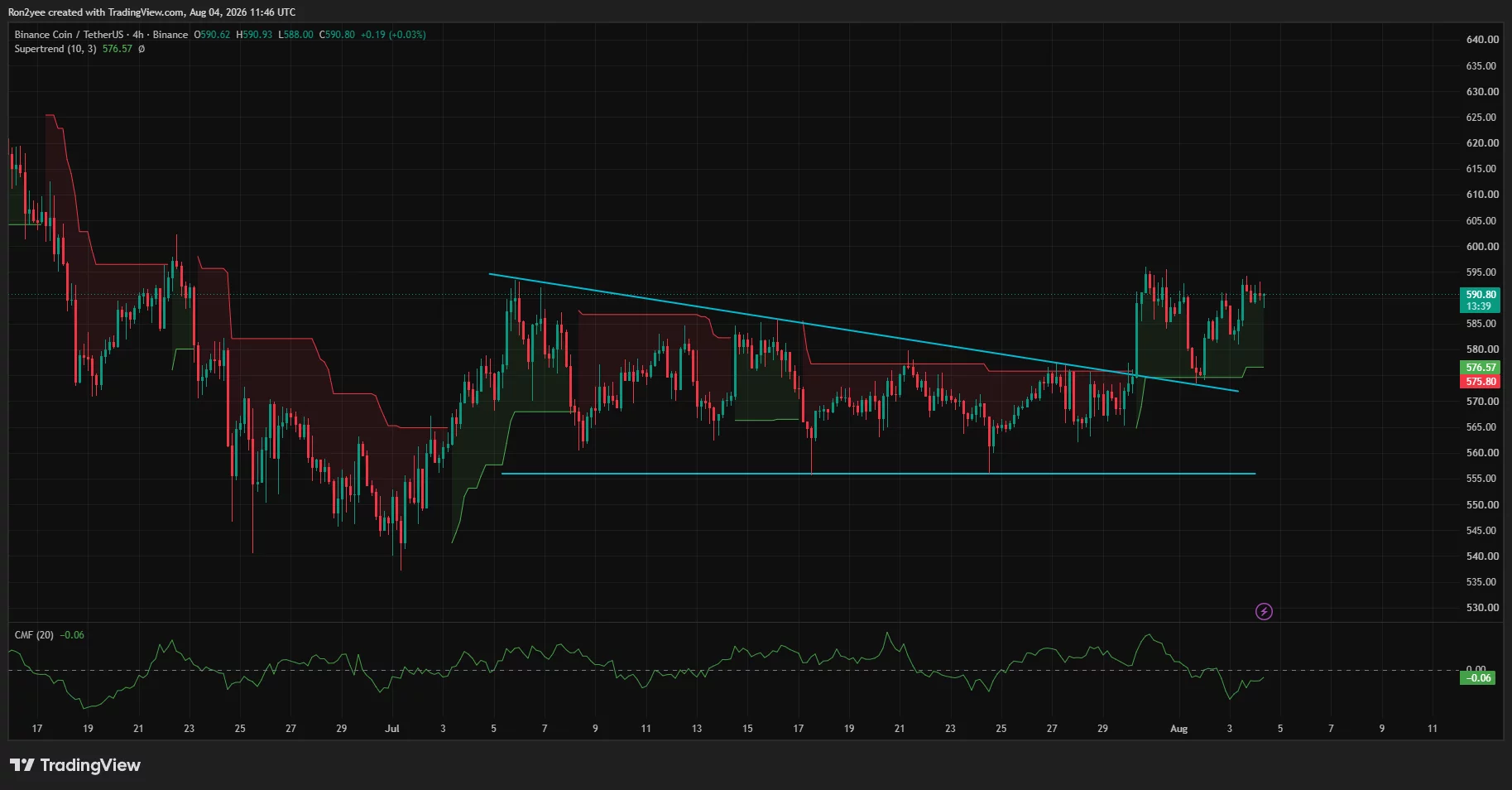
BNB price traded near $590 on Tuesday after holding a trendline breakout, but resistance at $592 and a large liquidation cluster above $605 could decide its next move.
Summary
- BNB price broke above a descending trendline and successfully retested the former resistance as support.
- The daily RSI has risen to 57.45, while the MACD remains in bullish territory.
- $592 to $600 is the immediate resistance zone separating BNB from a larger recovery.
- The liquidation heatmap shows concentrated short liquidity around $605 to $610.
BNB price holds breakout above $581
According to data from crypto.news, BNB (BNB) price was trading at $590.10 at press time after moving between $588 and $593.09 during the daily session. The token has gained roughly 4% over the past week, recovering from a recent low near $566.
The 4-hour chart shows that BNB broke above a descending trendline that had capped its recovery since early July. Buyers then defended a retest near $576 before pushing the price back toward $590.
This sequence converted the former trendline resistance into short-term support. BNB also remains above the 4-hour Supertrend, currently positioned near $576.57, keeping the short-term structure bullish.
The daily chart provides another important level at $581.62. This marks the 78.6% Fibonacci retracement of BNB’s decline from $745.33 to $537.05. Holding above it strengthens the breakout, while a daily close below the level would weaken the current setup.
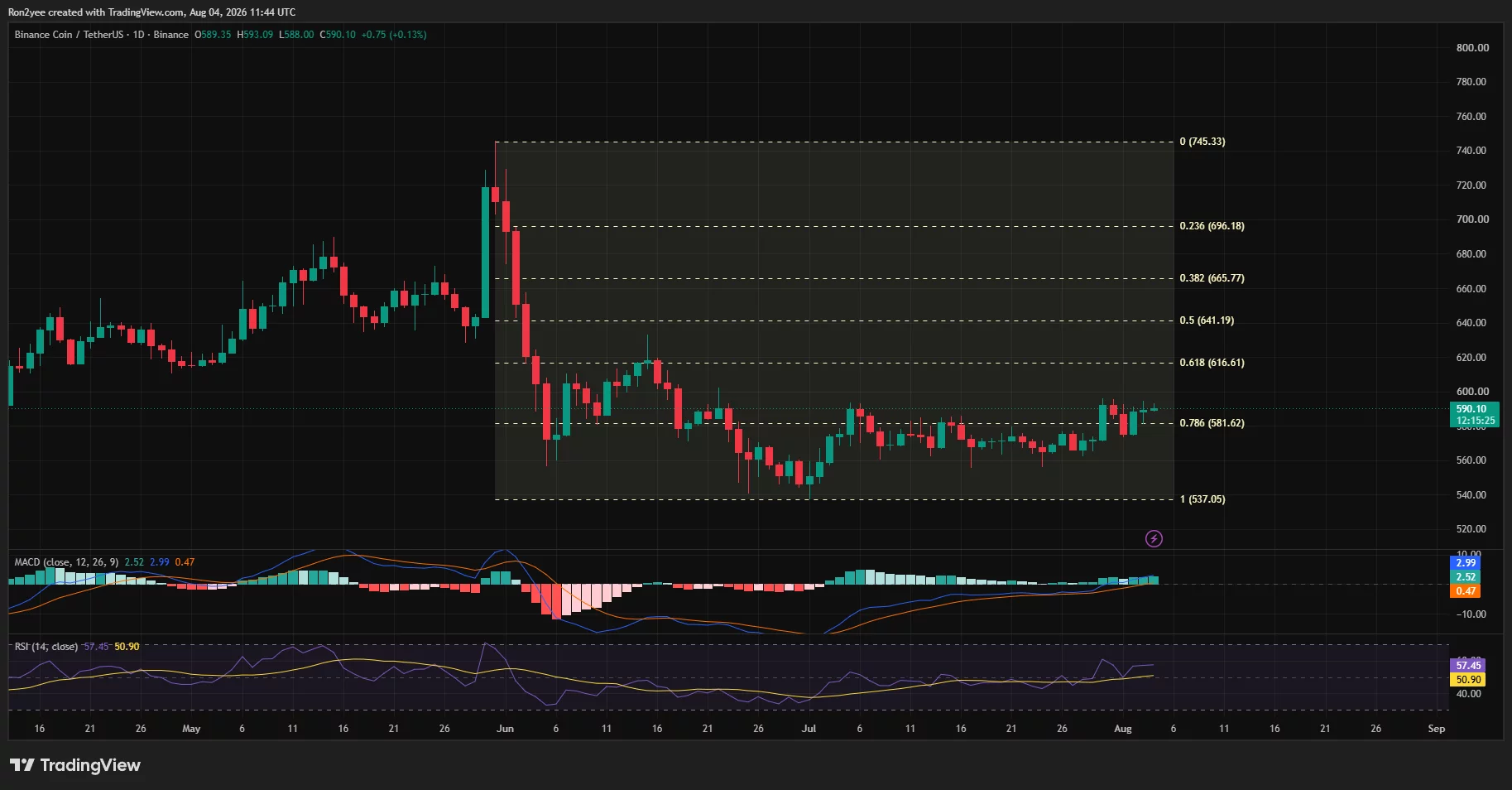
However, the Chaikin Money Flow reading on the 4-hour chart remains at -0.06. This shows that capital inflows have not fully confirmed the price recovery, leaving the move vulnerable if buying volume fades.
What is driving the BNB move?
Rising network activity has supported BNB’s recovery. BNB Chain recorded approximately $19 billion in weekly decentralized exchange volume, placing it ahead of Ethereum and Solana during the measured period.
Network utilization also increased from roughly 17% to almost 30%. Higher activity can support demand for BNB because the token is used to pay transaction fees and deploy contracts across the network.
The chain’s latest quarterly burn provides a longer-term supply tailwind. BNB Chain removed approximately 1.62 million BNB, worth about $932 million at the time, during its 36th quarterly burn in July. The reduction left the total supply near 133.17 million BNB.
These fundamentals have helped BNB outperform a largely range-bound altcoin market. Still, the immediate move appears primarily technical, following the confirmed breakout and retest visible on the 4-hour chart.
$592 could decide whether BNB reaches $616
BNB is now testing $592, a level that has repeatedly acted as resistance during 2026. The token briefly traded above this area but has yet to establish a decisive daily close beyond it.
A confirmed break above $592 would bring the $600 psychological barrier into focus. The one-week liquidation heatmap shows the largest nearby concentration of leveraged positions between $605 and $610.
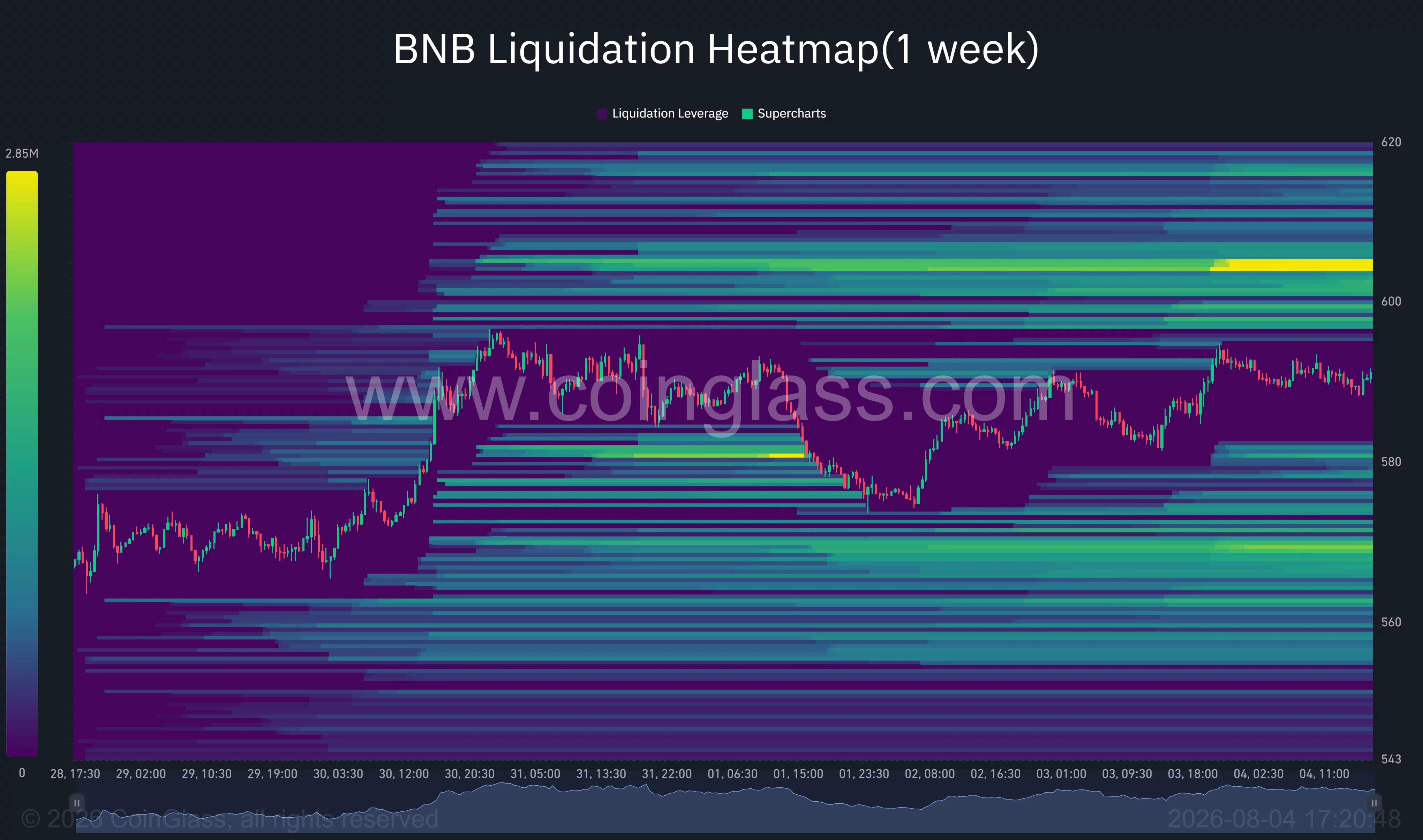
If BNB moves into that range, forced short liquidations could add buying pressure and accelerate the advance. The next chart-based target would then sit at $616.61, corresponding to the 61.8% Fibonacci retracement.
Beyond $616, the daily chart identifies additional resistance at $641.19 and $665.77. Those targets would require stronger spot demand because BNB would be moving into a broader supply zone created during its June decline.
The daily MACD supports the bullish case. The MACD line remains above its signal line, while the positive histogram stands near 0.47. RSI has climbed to 57.45, above its moving average of 50.90 but still below overbought territory.
Analysts see the retest as bullish confirmation
Crypto analyst Batman said BNB had reclaimed its 50-day moving average and successfully retested the breakout zone.
“This opens up a big move ahead,” the analyst wrote.
Satoshi Stacker also identified $592 as the key level separating a broader uptrend from a temporary recovery. The analyst said flipping that resistance into support would strengthen the case that BNB has moved beyond a relief bounce.
The bearish scenario begins if BNB fails at $592 and loses $581.62. In that case, the 4-hour Supertrend area between $575.80 and $576.57 would provide the next support.
Below that zone, the liquidation heatmap shows liquidity around $567, while the 4-hour chart places major horizontal support near $556. A break beneath $556 would invalidate the current higher-low structure and expose the daily range floor around $537.
US liquidity remains the main external risk
For US investors, BNB’s breakout remains sensitive to broader dollar liquidity and Federal Reserve expectations. Higher Treasury yields or a renewed risk-off move could limit demand for altcoins even if BNB Chain activity remains strong.
Geopolitical pressure and elevated oil prices add to that risk by keeping inflation concerns active. If those conditions push US rate expectations higher, BNB may struggle to attract enough capital for a sustained move through $600.
For now, the technical structure favors buyers while BNB remains above $581.62. A daily close above $592 would improve the probability of a move toward the $605–$616 region, while a loss of $576 would return the token to its previous consolidation range.
Disclosure: This article does not represent investment advice. The content and materials featured on this page are for educational purposes only.


Western Union and stablecoin payments company Rain launched Stablecard on Aug. 4, giving customers in 37 markets a way to receive, hold and spend Western Union’s USDPT stablecoin.
Summary
- 37 markets now offer Western Union Stablecard access, with expansion targeting more than 60 markets.
- USDPT remittances can fund a Visa card for spending online, in stores, or at ATMs.
- Anchorage Digital Bank issues USDPT on Solana and publishes monthly independent reserve attestation reports online.
- Western Union’s second quarter digital transactions rose 25%, supporting its wider shift toward digital services.
- Solana Explorer showed 5.92 million USDPT outstanding, above the amount covered by June’s attestation report.
The product combines a digital wallet with a Visa card and is available through dedicated applications on Apple’s App Store and Google Play.
USDPT is issued by Anchorage Digital Bank on Solana and is redeemable at a one to one rate for U.S. dollars. Customers can receive eligible Western Union transfers into the Stablecard wallet, transfer USDPT from compatible wallets or exchanges, and spend through Visa merchants or ATMs.
The companies did not identify every launch market in their announcements. Western Union said it is “targeting 60+ markets by the end of the year,” making that figure a planned expansion rather than current availability. Access, fees and individual features will depend on local rules and geographic requirements.
Western Union Stablecard connects USDPT to Visa spending
The official Western Union announcement describes Stablecard as a way to receive funds, retain their value in USDPT and spend through Visa without first moving the balance into a conventional bank account. Customers can also add the virtual card to Apple Pay or Google Pay.
The application gives users several funding routes. They can transfer USDPT from a supported crypto wallet or exchange, or use a “Cash Redirect” feature to move an eligible Western Union remittance into Stablecard. The store listings say users must complete identity verification, although they do not need a credit check or minimum balance.
Users can still access cash through ATMs or participating Western Union locations. However, the applications warn that ATM charges, foreign exchange costs and other fees may apply. The card is issued through a third party, Nimbus LLC, doing business as Third National, according to the store disclosures.
The consumer launch follows USDPT’s May introduction. As crypto.news reported, Western Union initially positioned the token as an always available settlement asset for agents, partners and future customer products. Stablecard now adds a direct spending function to that infrastructure.
Rain provides the wallet, card and compliance layer
Rain built the mobile application, embedded wallet and card infrastructure supporting the product. Its Stablecard case study says its Visa programs can operate at more than 175 million merchant locations across over 200 countries and territories.
Rain also argues that stablecoin settlement could reduce Western Union’s reliance on prefunded bank accounts. Remittance companies traditionally place money in local accounts before customers request payouts. Rain says USDPT could allow capital to move when demand arises rather than remaining idle for days. This is Rain’s assessment of the expected operating benefits. Western Union has not disclosed realized savings from Stablecard.
Rain’s social media statement that “$100B a year for 100M customers is moving onchain” needs context. Its longer case study uses those figures to describe Western Union’s existing annual network scale. It does not say that all $100 billion has already migrated to Solana or Stablecard. Neither company released transaction volume, active user numbers or revenue for the new product.
The launch arrives as Western Union’s digital channel grows faster than its retail operation. The company’s second quarter results showed branded digital revenue rising 7% and digital transactions increasing 25% from a year earlier. Digital activity represented 32% of consumer money transfer revenue and 43% of transactions.
Western Union’s total quarterly revenue nevertheless declined 1% to about $1 billion. Management cited weakness in the Americas retail business, lower margins and higher expenses. Stablecard therefore forms part of a broader effort to grow digital services while the legacy retail operation faces pressure.
U.S. oversight gives USDPT a regulated structure
Anchorage Digital Bank, a national trust bank overseen by the Office of the Comptroller of the Currency, issues and redeems USDPT. Western Union says reserves can include bank deposits, U.S. Treasury bills and similar cash equivalents. The official Solana contract address is published on the company’s USDPT information page.
Anchorage also publishes monthly reserve reports reviewed by an independent accounting firm. Its June 30 attestation recorded 21,581 redeemable USDPT and $122,245 of reserve assets. Those reserves consisted of $3,116 in cash and $119,129 in a money market fund.
Onchain supply has since grown. The official Solana Explorer displayed approximately 5.92 million USDPT at the time of reporting. That figure is not covered by the June 30 snapshot because the tokens were apparently minted after its reporting date. Anchorage’s reserve page listed only May and June reports as of Aug. 5, so the next attestation will provide a newer comparison between circulating tokens and reserve assets.
The federal banking structure does not make USDPT a government guaranteed asset. Western Union states that the token is not issued, approved or guaranteed by the U.S. government and is not protected by FDIC insurance. This distinction matters for consumers who may associate a federally supervised issuer with deposit insurance.
The next test is adoption across 60 markets
Western Union’s immediate target is to expand Stablecard from 37 markets to more than 60 before year end. The company has not provided a market by market timetable, expected card count or revenue forecast. Publishing the complete availability list would also clarify where remittance receipt, digital wallet transfers and cash withdrawal features are active.
Future reserve reports will show whether USDPT supply continues growing after the consumer launch. Usage data will be equally important because minted supply does not reveal how frequently customers receive remittances, use cards or retain balances in the application.
Exchange access could support that growth. As previously reported, Bybit added USDPT trading, transfers and custody in June, initially connecting the asset with fiat channels in Latin America. Western Union has also said wider exchange support and additional cash access services are planned.
Stablecard moves Western Union’s stablecoin strategy from settlement infrastructure into a consumer product. The next evidence will come from active users, payment volume, market expansion, fees and updated reserve disclosures rather than the size of Western Union’s existing remittance network.
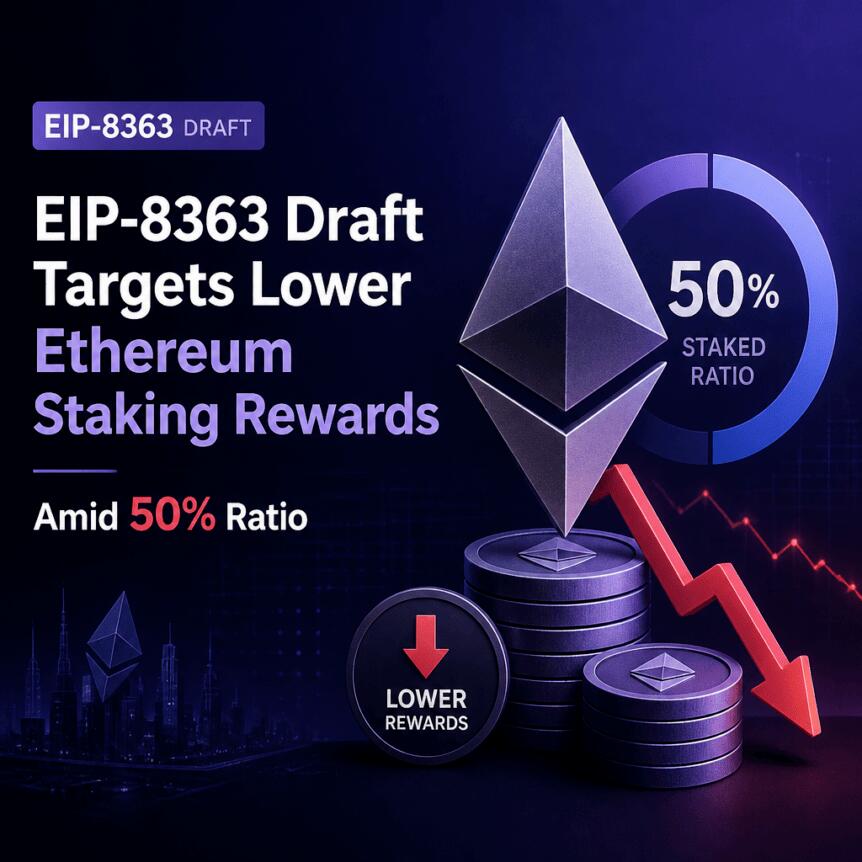
A draft Ethereum Improvement Proposal from a group of six researchers and developers—including Ethereum Foundation’s Justin Drake—would change how new ETH is issued to validators. The “Tapered Issuance Burn” proposal, provisionally numbered EIP-8363, aims to reduce validator rewards more aggressively as more ETH is staked, with an increasing portion of consensus rewards burned to curb long-term inflation.
The proposal targets a fixed staked-ETH threshold of 60.25 million ETH (about 50% of the current ETH supply). As the staking ratio approaches that level, the burn mechanism would intensify, reaching 100% deduction once the threshold is met. The changes are designed to phase in over roughly 18 months. The draft is published on GitHub as an EIP draft.
Key takeaways
- EIP-8363 would “taper” validator issuance by burning an increasing fraction of consensus rewards as staking grows.
- The mechanism is tied to a threshold of 60.25 million staked ETH, at which point the deduction would reach 100%.
- Critics argue the proposal could disadvantage solo validators and reduce DeFi borrowing and yield tied to staking rewards.
- Some developers and community members also question whether there is enough time for careful review, given its proximity to proposal deadlines around Ethereum’s Hegotá upgrade.
- The draft has not been approved or scheduled and is not currently included in Hegotá.
A proposed monetary lever tied to staking saturation
The authors’ central concern is the trajectory of staking. According to the draft’s advocates, under the current issuance and incentive curve, staking rewards would not meaningfully “turn off,” even if nearly all ETH were staked. One of the proposal’s authors, Jérôme de Tychey, argued that this creates a persistent incentive to stake, raising the question of what ultimately stops the process.
In the proposal discussion, de Tychey also highlighted the potential for growing concentration of ETH held through large custodians and staking derivatives. The thesis is not only about dilution from issuance, but about the role of ETH as “a neutral, trustless store of value.” He warned that unchecked issuance could increasingly shift the ecosystem’s “working money” from raw ETH to intermediated staking claims.
As described in the draft’s framing, EIP-8363 would bound and make issuance more predictable. The proposal sketches a scenario in which issuance would peak at roughly 0.5% of ETH supply per year at its highest point (with about 20% of ETH staked), then decline toward zero as the staking ratio reaches the 60.25 million ETH threshold.
Supporters also position the change as complementary to existing Ethereum supply-reduction mechanics, including EIP-1559 and the protocol’s Blob burn structure. De Tychey argued that, with these in place, Ethereum’s net supply trend could more often decrease, while the network maintains a “sustainable security budget.”
Why the timing is drawing fire
Even though EIP-8363 is still an early draft, its publication came shortly before a deadline being discussed in relation to Ethereum’s Hegotá upgrade. Some community members see the schedule pressure as a process risk, especially for a change that would affect monetary policy.
Community developer Greg Koumoutsos said the proposal “clearly doesn’t leave adequate time for community review” of a monetary-policy change of this magnitude. In response to some confusion around the timetable, the article’s reporting indicates that the relevant Aug. 6 deadline is for pull requests proposing additional EIPs for Hegotá, rather than a deadline for deciding which proposals will ultimately be included.
Ethereum community organizer Trent Van Epps indicated that the selection process could continue until Nov. 8. According to the reporting, Hegotá is likely to reach mainnet in the second quarter of 2027, based on the project schedule referenced in the coverage.
Developer and DeFi concerns: solo validators, institutions, and yield markets
While the proposal’s goals are framed as reducing dilution and strengthening neutrality, it has met backlash from parts of the Ethereum development ecosystem, including stakers and DeFi builders.
One line of criticism is that lowering staking rewards could reduce institutional demand for ETH. The article notes concerns about whether reward cuts could affect how institutions interpret yield and exposure, and it points to linked coverage about institutional staking interest.
Another major critique centers on validator structure. The argument from some quarters is that solo validators would be hit harder because they generally face higher relative costs than larger operators. According to the reporting, Mike Silagadze, CEO of Ether.Fi, said the mechanism would push out solo stakers not subsidized by entities such as the Ethereum Foundation. His view is that the staking landscape would become dominated by large centralized organizations, leaving users to hold ETH indirectly while those operators capture the remaining incentive structure.
De Tychey disputed the “guaranteed solo exit” framing. In a response on the Ethereum Magicians forum, he argued that users of large staking providers must pay fees, which could make such services less attractive as rewards fall. However, the reporting also emphasizes that related research is “contested,” leaving the economic second-order effects uncertain.
Beyond validator economics, critics warn that staking reward changes could ripple into DeFi markets that depend on staking yield. Stani Kulechov, founder of Aave, characterized the proposal as harmful—arguing it could weaken institutional demand for ETH and reduce borrowing activity across DeFi. His critique is that the proposal does not achieve its intended outcome and could negatively affect Ethereum’s broader ecosystem incentives.
Backers see bounded inflation and potentially long-run upside
Support for EIP-8363’s direction is not confined to the proposal’s authors. The coverage also points to Grayscale research leadership. In May, Grayscale head of research Zach Pandl said limiting staking incentives would be “positive for the price of Ether over time,” framing the idea as part of improving Ethereum’s long-run economic profile.
In the proposal’s own narrative, the change is designed to address a specific economic tension: a world where staking keeps expanding, issuance continues unabated, and more of the ecosystem’s exposure becomes mediated through staking derivatives. Supporters argue that burning an increasing share of rewards as staking rises can cap issuance growth and reduce dilution, while still maintaining security incentives early in the process.
Yet, with the draft at an early stage and schedule constraints under debate, the most immediate takeaway is that the proposal is not yet a policy. It is one part of a larger, contested set of considerations about Ethereum’s monetary future as staking participation rises and as staking derivatives evolve.
As Ethereum approaches the Hegotá selection window, readers should watch for how the community evaluates EIP-8363’s economic modeling—especially the projected impact on solo validators, liquid staking incentives, and DeFi borrowing flows—and whether the proposal is revised, delayed, or replaced by alternatives before any formal inclusion.

Brad Pitt asks court to ORDER Angelina Jolie to turn over financial records after she claimed she put ‘career on hold’

Chipotle stock falls on link to salmonella outbreak in Minnesota

Bybit’s EU Payments Unit Obtains Austrian E-Money License


-

 Business6 days ago
Why Trees Belong on the Risk Register
-

 Fashion4 days ago
Weekend Open Thread: Wit & Wisdom
-

 Politics4 days ago
Meta enters AI-training agreement with far-right ‘propaganda rag’ Newsmax
-

 Politics7 days ago
Reform UK betrays West Mids residents by running from party pledges
-

 Crypto World4 days ago
MicroStrategy Post-Earnings CLARITY Act Push Could Add New Catalyst for Its Stock
-

 Politics3 days ago
Zack Polanski: an incitement to murder Nigel Farage?
-

 Crypto World4 days ago
XRP Ledger v3.3.0 brings five institutional features
-

 News Videos6 days ago
Bitcoin Enters the 3rd Stage of the Bear Market
-

 Politics6 days ago
Luke Littler’s dominance sparks GOAT debate
-

 Sports5 days ago
Seema Kaliramna Wins Discus Throw Bronze, Takes India’s CWG Medals Tally To 17
-

 Crypto World4 days ago
New York sues Kalshi over prediction market gambling
-

 Crypto World3 days ago
Crypto PAC spending tops $2M in Michigan House race
-

 Tech7 days ago
Gemini can now summarize the messiest comment threads in Google Docs
-

 Business5 days ago
Trump Announces Hamas Disarmament Agreement as Iran Strikes Kuwait Air Base and US Attacks Pause Overnight
-

 Tech3 days ago
ESET tracks rise in malicious AI skills and adaptable malware
-

 Business2 days ago
DTCR: Deleveraging And A Hedge Fund Collapse Point To A Possible AI Bottom
-
 Tech5 days ago
Building A Reproduction PlayStation Motherboard
-

 Tech5 days ago
Gemini Spark can now use Chrome logins and saved passwords to run errands on your behalf
-

 NewsBeat6 days ago
Four people die trying to cross Channel in small boats
-

 Sports7 days ago
Sakshi, Arundhati Enter Boxing Semi-Finals. India Assured Of 18 Medals At CWG 2026
You must be logged in to post a comment Login