
Crypto World
China Makes Largest Gold Purchase Since 2023 as Bullion’s Price Surges 8%


China made its largest monthly gold purchase in nearly three years and continues a massive accumulation streak, while other central banks have refocused on the precious metal.
This is among the reasons behind the asset’s price resurgence over the past week, in which it gained 8% from bottom to top.
China Buys Big
Data provided by The Kobeissi Letter shows that the People’s Bank of China (PBOC) added approximately 640,000 troy ounces, or roughly 20 tons, of gold in July alone, making it the biggest single-month purchase since October 2023.
Its streak has extended to a highly impressive 21 consecutive months of buying gold. The reserves climbed to just over 76 million ounces at the end of July from under 75.5 million in June. Current prices show that the country’s gold stash is worth over $306 billion.
Perhaps the bigger story here is the pace at which China is accelerating its purchases. It added only 160,000 ounces in March, followed by progressively larger acquisitions over the subsequent months. June’s 480,000-ounce accumulation was already the biggest in almost three years, only to be beaten by July’s acquisition.
Beijing has also focused on moving a large portion of its gold reserves from London to Hong Kong as it continues to support the city’s ambition to become a major precious metal hub.
“The relocation is set to continue as Hong Kong launches a new gold-clearing system aimed at making the city a bigger center for global gold trading and pricing,” said the analysts at The Kobeissi Letter.
Meanwhile, the World Gold Council data shows that central banks purchased a record 289 tonnes of gold during Q2, which is a 74% increase compared with the same period last year.
In contrast to its gold behavior, China actually tightened its cryptocurrency restrictions again earlier this year, confirming that any digital asset-related business activities remain illegal. It also expanded the scrutiny to stablecoins and real-world asset tokenization.
BTC vs Gold
The record accumulation from the PBOC and other central banks helped gold’s price stop its freefall and recover significantly over the past week. The precious metal fell from its ATH of $5,600/oz to just under $4,000 within months, but rebounded by 8% in the past week to close at $4,342. Interestingly, this recovery helped gold return to a breakeven YTD price.
As such, the bullion, even though it’s not really in the green in 2026, has performed a lot better than the so-called digital gold. BTC continues to struggle at $65,000, down over 25% since the start of the year.
The post China Makes Largest Gold Purchase Since 2023 as Bullion’s Price Surges 8% appeared first on CryptoPotato.



Texas Governor Greg Abbott has outlined five key disclosures data centers must reveal to connect to the state grid.
The move comes amid growing public backlash over the rapid expansion of data centers, with state officials seeking greater transparency into how much electricity and water these facilities will require.
What Abbott Wants Data Centers to Disclose
This month, Abbott ordered a pause on data center approvals. The governor directed the Public Utility Commission of Texas (PUCT) and the Electric Reliability Council of Texas (ERCOT) to audit all data centers advancing through ERCOT’s interconnection process. Any center that fails state requirements will be denied a grid connection.
The requirements focus on five areas: public funding, power use, water consumption, community impact, and ownership. Companies must reveal any taxpayer-funded incentives they receive.
They must detail projected power demand and on-site generation plans. They must also identify water sources, reuse methods, and community measures such as noise and traffic controls.
Follow us on X to get the latest news as it happens
The scale is large. ERCOT is weighing more than 474 gigawatts of connection requests, over five times the state’s record peak demand. Data centers make up roughly 90% of those requests.
“Any project that fails to comply with the requirements set forth by the PUCT and ERCOT, and by state law, must be denied connection to the Texas grid. Simply put, Texans must come first,” Abbott said.
New York’s Freeze Signals a Wider Backlash
Texas is not alone. New York enacted the first statewide moratorium on new hyperscale data centers in July.
The pushback is spreading across the country. About a dozen states have proposed data center bans, according to CNN.
Public opposition is also rising. A recent Gallup poll found that 71% of Americans oppose having a data center built in their local area. Separately, a Reuters/Ipsos survey found that 57% would oppose a data center being built in their community.
Subscribe to our YouTube channel to watch leaders and journalists provide expert insights
The post Texas Has 5 New Rules for Data Centers as AI Backlash Grows appeared first on BeInCrypto.

Brazil’s central bank has approved new rules that require virtual asset service providers (VASPs) to temporarily freeze certain crypto transfers before sending funds to foreign platforms or self-custody wallets. The precautionary hold is designed to give firms time to review suspected fraud and suspected illicit behavior.
According to a note published by the Banco Central do Brasil (BCB) on Friday, the requirement takes effect on Jan. 1, 2027 and will apply to transfers where the amount received by a customer exceeds $10,000, either as a single transaction or based on the customer’s total activity in a day. In addition to that threshold, VASPs must also place holds on other transfers flagged for enhanced scrutiny under their risk-management systems.
Key takeaways
- Brazil’s BCB will require VASPs to implement precautionary holds of up to 24 hours on certain outbound virtual asset transfers.
- The initial trigger is $10,000 in value received, measured per transaction or aggregated across daily customer activity.
- Holds also cover transfers marked for review under a provider’s existing risk-management policies.
- VASPs must inform customers about holds and maintain records of fraud incidents and remediation steps.
- Japan’s earlier anti-scam measures exist, but they are non-binding—a key difference from Brazil’s approach.
How the 24-hour hold will work
Under the BCB’s framework, VASPs must apply precautionary holds to certain transfers once the underlying conditions are met. The central bank’s statement specifies that the rules cover funds received above $10,000, either in a single transaction or through the accumulation of transactions over the course of a day.
The BCB also requires providers to place holds on additional transfers that need further evaluation under their own risk policies. In other words, the $10,000 threshold is not the only gate: the central bank expects VASPs to treat certain flagged activity more cautiously, even if the threshold is not the only factor.
Providers will be allowed to complete their assessment and release a transfer before the 24-hour window ends, as long as they follow parameters set out by the BCB. That gives firms flexibility in cases where they can quickly clear the transfer after review.
Operational duties for VASPs
The BCB’s note makes clear that the hold mechanism comes with compliance obligations. VASPs must:
- Notify customers when a transfer is subject to a hold.
- Keep records of fraud incidents, attempted fraud, and the corrective actions taken in response.
These requirements matter for users and firms alike because they effectively formalize what providers must do when suspicious cross-border activity is detected. For traders and businesses relying on fast settlement, the policy introduces a potential delay on outbound transfers routed to foreign venues or self-custody addresses when the relevant conditions apply.
Why this is being tightened now
The central bank’s move reflects a broader shift among regulators as they confront scams that leverage the speed and global reach of digital assets. Crypto transfers can settle quickly across borders, which can help legitimate users—but it also creates opportunities for criminals to move funds before counterparties can intervene.
Brazil’s rules are part of a larger international pattern where regulators seek to slow down or add friction at key stages of the transfer process, particularly when money is leaving regulated custody environments for higher-risk destinations such as self-custody wallets.
That context is especially important for investors and service providers: while blockchain activity is transparent, reversing losses is often difficult. Measures like precautionary holds aim to reduce the chance that funds are sent to the wrong addresses in the first place.
Comparisons: Japan’s withdrawal delays and Europe’s scam warnings
Brazil’s action follows similar anti-scam developments elsewhere. In Japan, the Financial Services Agency and the National Police Agency asked crypto exchanges to restrict withdrawals after customers deposit fiat or buy digital assets. As reported earlier by Cointelegraph, Japanese authorities urged exchanges to implement controls such as requiring customers to preregister withdrawal addresses and applying a waiting period before newly added addresses can be used.
Other safeguards discussed in Japan include customer-specific withdrawal limits, stronger monitoring, phishing-resistant multifactor authentication, and checks intended to confirm that a bank remitter’s name matches the crypto account holder.
However, the Japanese measures are not binding. Exchanges can decide how to implement protections based on their own operations and exposure to misuse, which stands in contrast to Brazil’s regulatory timing and threshold-based structure.
In Europe, regulators have also highlighted risks tied to impersonation and fraud. Earlier coverage from Cointelegraph noted warnings about criminals impersonating watchdogs and crypto firms, including instances involving fake websites and the misuse of identity and logos in falsified documents. While those reports focus more on deception surrounding licensed providers, they point to the same underlying issue: scammers adapt quickly to user demand, especially when people are looking for regulated access points.
What to watch next
With Brazil’s hold rules scheduled to begin on Jan. 1, 2027, VASPs will likely adjust transfer flows, customer communications, and fraud-review processes well before the effective date. Users sending large transfers to foreign services or self-custody wallets should watch how providers interpret the $10,000 trigger and what criteria they use to classify additional transfers as “requiring further scrutiny.”


Grayscale Head of Research says the crypto industry can keep moving forward even if the CLARITY Act, the bill that would set US rules for digital asset markets, fails to pass this year.
Zach Pandl said full passage looks unlikely in 2026, given the crowded Senate calendar and election-year politics.
Crypto Ran 17 Years Before the CLARITY Act
Pandl noted that digital assets operated for roughly 17 years without comprehensive US market structure rules. Progress, he said, can continue through regulators rather than Congress.
“CLARITY not passing won’t have an immediate impact on the functioning of major blockchains, the demand for Bitcoin as a store of value, or on the growth of stablecoin payments,” he said.
He expects the Securities and Exchange Commission (SEC) and other regulators to fill gaps through rulemaking, particularly around tokenized securities. He pointed to the regulators interpretative guidance on the application of Federal securities laws to crypto assets, calling it a “big step forward for the industry.”
Pandl also credited the Trump-era policy for aiding the sector. He cited new institutional custody rules, improved access to banking, clearer staking policies, and growth in crypto exchange-traded products (ETPs).
“Crypto will move forward without CLARITY, supported by expected rulemaking by the SEC and other regulators,” Pandl added.
Follow us on X to get the latest news as it happens
Grayscale Warns Activity Could Move Abroad
Nonetheless, without clear rules at home, the executive cautioned that a growing share of new investment and developer activity could drift to overseas markets. He framed the delay as a missed opportunity rather than a crisis for domestic crypto markets.
“The lack of comprehensive market structure legislation could hold back new investment activity in the United States,” he wrote.
Meanwhile, Senate Majority Leader John Thune filed cloture on the motion to proceed, setting up a floor vote after lawmakers return on September 15.
Even so, the bill still lacks the support to advance, and analysts have flagged several Senate roadblocks that could sink a possible September vote.
Subscribe to our YouTube channel to watch leaders and journalists provide expert insights
The post Can Crypto Advance Without the CLARITY Act? Grayscale Says Yes appeared first on BeInCrypto.
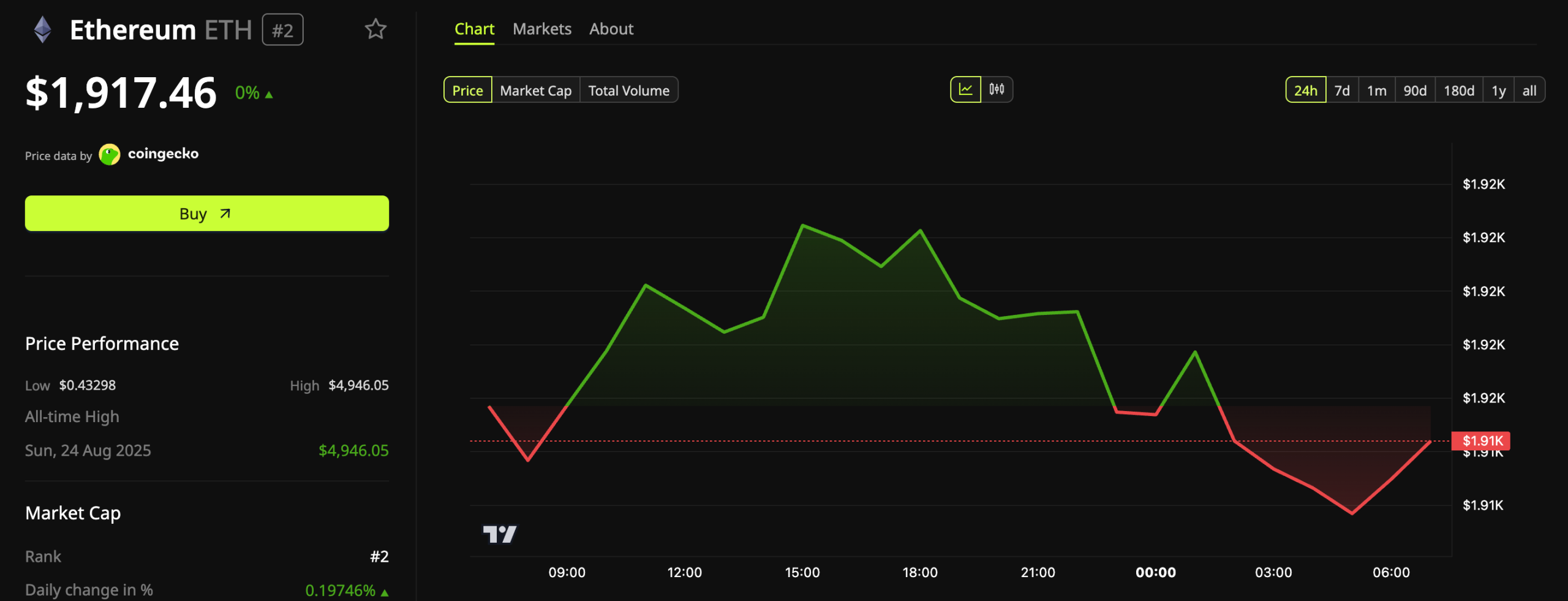
Ethereum (ETH) is tightening from several directions at once, with coins leaving exchanges, staking absorbing supply, and stablecoin liquidity rotating onto its rails. Yet, the price sits still near $1,900.
The setup has drawn attention from onchain analysts. The read points to a market quietly repositioning, while the chart shows little.

Supply Squeeze Building Beneath a Flat Ethereum Price Chart
Ethereum balances held on exchanges have fallen through 2026. CryptoQuant data shows aggregate exchange reserves down to 15.12 million ETH, from 16.86 million in January.
That marks a decline of roughly 1.74 million ETH, close to 10% of the balances available to sell.

At the same time, large-holder movement, measured through top-10 inflow and outflow volumes, is running below recent averages.
Staking has climbed above 34% of the circulating supply. In addition, validator exit queue sits near zero. Thus, holders are choosing to keep it staked rather than sell.
Exchange-traded funds are removing supply as well. Spot ETH funds drew about $482 million over the four weeks to August 7, with the final week alone adding roughly $245 million. Cumulative net inflows now sit near $11.46 billion, according to SoSo Value data.
New smart contract deployments have also risen sharply. The result is a widening gap between shrinking available supply and expanding onchain usage.
Independent data reinforces the picture. Analyst Tanaka noted weekly transaction activity above 20 million, near historical highs.
An analyst noted that similar conditions, where exchange liquidity thins as network activity builds, have led to sharper price moves in the past once demand picks a direction. He cautioned that the pattern provides no timing signal on its own.
Where the Dollars Are Moving
The liquidity side tells a parallel story. CryptoOnchain highlighted that over the past 14 days, total stablecoin netflows to Binance averaged around $87 million per day, but the composition shifted sharply.
Tether (USDT) on Tron (TRX) has drained fast. Binance’s Tron-based USDT reserves fell from about $1.4 billion to $709 million in roughly two weeks.
Ethereum-based stablecoins moved the other way. USDT on Ethereum saw weekly netflows rise 210%, while USD Coin (USDC) inflows climbed 114% over the same period.
The signal is not capital leaving the market. It is capital choosing which network to sit on, with market makers favoring deeper liquidity on Ethereum.
“Large holders and market makers may be shifting collateral away from Tron and toward Ethereum, potentially reflecting a preference for deeper DeFi liquidity, broader Ethereum-based market infrastructure, or positioning ahead of Ethereum-centric volatility,” the post read.
The Trigger Has Not Fired
ETF inflows have been steady in the past few weeks, yet they have not moved the price. That points to offsetting supply reaching the market, or to conviction too thin to force a breakout.
At the same time, spot buying on US venues remains weak. The Coinbase Premium Index, which tracks US spot strength relative to offshore venues, has held negative since early May and sits near -0.069.

Meanwhile, analyst Michaël van de Poppe described the price picture as unchanged, with ETH stuck between $1,800 and $2,000 and volatility near multi-year lows. A clean break above $2,000, he suggested, could open a stronger move.
Whether that break comes depends on demand firming, which the data does not yet show. The setup can also persist, as a tighter supply alone does not force a move.
Subscribe to our YouTube channel to watch leaders and journalists provide expert insights
The post Ethereum Price Risk: Fewer Coins to Sell and More Dollars in Position appeared first on BeInCrypto.


Brazil’s central bank has ordered virtual asset service providers to hold certain crypto transfers for up to 24 hours from Jan. 1, 2027, adding a new anti-fraud layer to the country’s expanding digital asset rulebook.
Summary
- Brazil will require 24-hour holds on qualifying crypto transfers above $10,000 beginning January 1, 2027.
- Transfers to overseas crypto providers and self-custody wallets fall within the central bank’s new safeguards.
- Providers may release transfers early after completing risk reviews under parameters established by Brazil’s regulator.
- Virtual asset providers must notify customers and maintain records covering fraud attempts and corrective actions.
- Brazil’s latest rule follows broader 2026 measures covering licensing capital audits and cross-border crypto activity.
Banco Central do Brasil published Resolution BCB No. 584 on Aug. 7, covering transfers above $10,000 destined for foreign crypto providers or self-custody wallets.
The threshold applies either to one transaction or a customer’s combined transactions during the same day. Smaller transfers can also face additional review when a provider’s risk policies identify reasons for closer scrutiny. The central bank said the measure responds to growing use of virtual assets, including stablecoins, to move proceeds from financial fraud quickly, sometimes beyond Brazil or into wallets controlled directly by users.
Brazil crypto transfers will face new checks
Under the central bank’s new anti fraud rules, a covered provider must retain the assets for 24 hours before proceeding with qualifying transfers. However, the measure is precautionary rather than a permanent freeze. A provider can complete its risk review and release the transfer before the full period ends when the conditions established by the regulator are met.
Providers must also tell customers when a transfer is being held. In addition, institutions must maintain records of fraud incidents, attempted fraud and the corrective measures taken. These requirements extend Brazil’s existing payment fraud controls to virtual asset services and give providers more time to review transactions that could otherwise settle rapidly.
The 24-hour hold joins a wider 2027 crypto rulebook
The transfer rule is one part of a broader regulatory expansion. In July, the BCB classified virtual asset service providers under its prudential framework and said they would begin following capital, risk management and disclosure requirements from Jan. 1, 2027. They must also enter the more demanding Segment 4 supervisory category by June 30, 2028, regardless of size.
In related coverage of Brazil’s capital rules, the framework builds on earlier licensing, customer asset segregation and compliance requirements. Separately, as previously reported, the central bank has restricted the use of virtual assets to settle payments inside regulated cross-border electronic foreign exchange channels.
The tighter oversight also follows fresh scrutiny of Brazil’s stablecoin market. The International Monetary Fund’s July Financial System Stability Assessment found that Brazilian crypto activity, particularly involving U.S. dollar pegged stablecoins, has grown rapidly since 2017. It said cross-border crypto flows have been rising faster than traditional capital flows and nominal GDP.
What happens before the January 2027 deadline
Crypto providers now have less than five months to adapt transaction monitoring, customer notification and record keeping systems before Resolution 584 takes effect. Firms will also need processes capable of calculating the $10,000 threshold across multiple transactions made by the same customer during a single day.
Meanwhile, the Jan. 1 deadline will bring several regulatory changes into force at once. Besides the new transfer controls, providers will begin operating under additional prudential requirements covering capital and risk management. The overlap means Brazil is moving beyond basic crypto licensing toward ongoing supervision of how regulated providers manage assets, transfers and financial risks.
For customers, the new rule does not create a general 24-hour delay on every crypto withdrawal. It targets qualifying transfers to overseas providers and self-custody wallets, along with other transactions selected for additional risk assessment. Providers may also release reviewed transactions early, making the eventual waiting time dependent on the circumstances of each transfer.


MARA Holdings secured $600 million of new borrowing on Aug. 4 after pledging 18,750 BTC worth about $1.2 billion as initial collateral, according to its Aug. 6 quarterly filing with the U.S. Securities and Exchange Commission.
Summary
- 18,750 BTC worth about $1.2 billion initially secured MARA’s two new Bitcoin backed lending facilities.
- Coinbase provided $300 million of new funding while refinancing MARA’s existing $150 million credit line.
- Two Prime supplied $300 million at a fixed 7.65% rate, with maturity in August 2028.
- MARA said loan proceeds may help finance cash consideration for its planned Long Ridge acquisition.
- The pledged Bitcoin equals roughly 53% of MARA’s 35,577 BTC holdings reported at June end.
The financing came from Coinbase Credit and Two Prime Lending as MARA directs more capital toward energy assets, Bitcoin mining, artificial intelligence and high performance computing.
The loans were completed after the June quarter, when MARA reported holding 35,577 BTC with a fair value of about $2.1 billion. The pledged 18,750 BTC therefore equals roughly 53% of its reported quarter end Bitcoin holdings. MARA said it “expects to use the proceeds” for general corporate purposes, including financing part of the cash consideration for its planned Long Ridge Energy & Power acquisition.
MARA gets $600M while refinancing another $150M
Although the two facilities carry $750 million of combined principal, only $600 million represents new borrowing. Coinbase provided a $450 million facility consisting of $300 million in fresh funding and the refinancing of MARA’s existing $150 million Coinbase credit line. Two Prime separately provided a fully drawn $300 million term loan.
Coinbase’s debt carries a floating rate equal to the midpoint of the federal funds target range plus 3.875%. The Federal Reserve maintained its target range at 3.50% to 3.75% on July 29, which puts the current rate on the Coinbase facility at about 7.5%. The loan matures on Aug. 4, 2028 and automatically extends for another year unless either party cancels the extension.
Meanwhile, Two Prime’s $300 million facility carries a fixed annual interest rate of 7.65% and matures on Aug. 3, 2028. At the currently applicable rates, the two loans would generate about $56.7 million in annual interest expense if the full principal remained outstanding for a year. That figure is calculated from the disclosed rates rather than provided as MARA guidance.
Bitcoin collateral adds liquidity and margin risk
The financing shows MARA using its Bitcoin reserves as a source of liquidity alongside outright BTC sales. At June 30, the company already had 4,528 BTC pledged as collateral and another 4,742 BTC loaned to third parties. During the first six months of 2026, MARA also sold about 23,093 BTC for $1.6 billion to fund operations, pursue growth opportunities and manage liquidity.
MARA ended the second quarter with 35,577 BTC, down 29% from 49,951 BTC a year earlier. The company reported quarterly revenue of $174.9 million and a $611.3 million net loss, while declining Bitcoin prices contributed to a $342.7 million fair value loss on its holdings.
However, borrowing against Bitcoin also exposes the company to collateral requirements if BTC prices decline. MARA must maintain agreed collateral ratios under both lending arrangements. If the value of pledged assets falls below specified margin call limits, it must add collateral or take other permitted action to restore those ratios.
Failure to provide enough collateral would constitute an event of default and could allow Coinbase or Two Prime to liquidate pledged Bitcoin. The filing does not disclose the exact margin call thresholds, so public information does not show the Bitcoin price that would trigger additional collateral requirements.
Long Ridge connects the loans to MARA’s AI expansion
MARA has linked part of the new financing to its proposed acquisition of Long Ridge Energy & Power in Hannibal, Ohio. The company announced the transaction in April at an enterprise value of about $1.5 billion, including assumed debt. Long Ridge includes a power generation business and more than 1,600 acres that MARA plans to combine with its existing infrastructure at the site.
MARA says the property could support several workloads, including Bitcoin mining, power generation, AI infrastructure and high performance computing. Those plans remain forward looking. The company has not announced completed AI tenant contracts for the campus, although it said it had received interest from prospective customers.
The Ohio deal is part of a wider infrastructure expansion. MARA agreed in July to acquire a powered site covering more than 1,200 acres in Matagorda County, Texas. The purchase price can reach $600 million through milestone based payments, while MARA says the site could eventually support up to 2 GW of capacity.
MARA has also been reshaping its balance sheet to finance that strategy. In related coverage, the company sold 20,880 BTC during the first quarter and used part of the proceeds to repurchase convertible debt. By June 30, MARA said total debt had fallen to about $2.4 billion from $3.6 billion at the end of 2025.
What happens next for MARA
The next major milestone is completion of the Long Ridge transaction. MARA’s SEC filing says the acquisition carries an enterprise value of approximately $1.5 billion, including up to roughly $900 million of assumed debt. The company has also obtained a Barclays commitment for a 364 day senior secured bridge facility of up to $785 million as backstop financing for part of that debt if needed.
Closing is not guaranteed. MARA disclosed that it could owe a $75 million termination fee if the acquisition is not completed by Nov. 30, 2026. That deadline can extend to June 30, 2027 if certain regulatory conditions remain unresolved.
For now, the Coinbase and Two Prime loans give MARA $600 million of additional liquidity without requiring another immediate large Bitcoin sale or equity issuance. In return, a large portion of its Bitcoin treasury is now tied to lender collateral requirements. The balance between those financing benefits and the risk of lower BTC prices will remain a key factor as MARA moves toward the Long Ridge closing and continues building its U.S. energy and AI infrastructure portfolio.
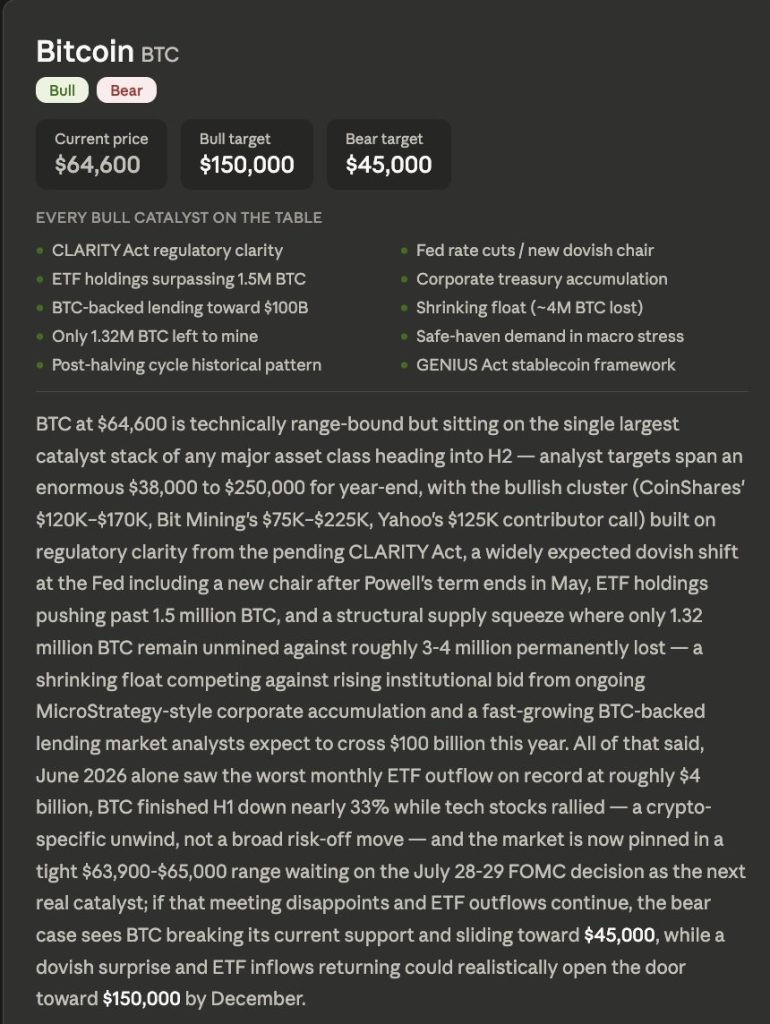
Only 1.32 million coins remain unmined, while another 4 million sit permanently lost. Claude Fable 5 AI predicts that the shrinking float becomes the story of H2, and the price prediction runs to $150,000 by December from $64,600 today.
The catalyst list is unusually long. CLARITY Act regulatory clarity leads it, with the GENIUS Act stablecoin framework close behind.
Fed rate cuts factor heavily, including a widely expected dovish shift once Powell’s term ends in May. ETF holdings pushing past 1.5 million BTC add persistent demand.
Corporate treasury accumulation continues in the background. A BTC-backed lending market analysts expect to cross $100B this year sits alongside it.
The post-halving cycle historical pattern rounds it out. Safe-haven demand in macro stress is the final entry.
The other side is more sobering. June 2026 delivered the worst monthly ETF outflow on record at roughly $4B.
Bitcoin finished H1 down nearly 33% while tech stocks rallied. Claude Fable 5 reads that as a crypto-specific unwind rather than broad risk-off.
The market now sits pinned in a tight $63,900 to $65,000 band. If the FOMC decision disappoints and outflows continue, the bear case sees BTC breaking support and sliding toward $45,000.

Discover: Everyone’s Got a Take. Get Free $25 to Actually Trade Yours
Bitcoin Price Prediction: Fewer Coins, More Buyers, And One Meeting That Decides Everything
The daily chart covers a full round trip. Bitcoin ran from $75,000 last April to a peak near $126,000 in October. November began the unwind. Price fell to roughly $80,000 by December before a brief recovery attempt.
February broke it decisively, carving it down from $90,000 to $60,000. Spring rebuilt toward $82,000 by May. June erased that entirely and returned Bitcoin to $58,000. Since then, the structure has been a tight base with slightly higher lows.
The close reads $64,809, up 0.86% and $553 on the session. The daily range spanned $64,103 to $64,910. Support sits at $63,900 first, then $60,000 and $58,000. Resistance stacks at $68,000, $72,000, and $76,000.
RSI reads 54.15 against a signal line at 49.64. That gap of roughly 4.5 points leans mildly bullish without conviction. Both lines hover near the middle of the range. Momentum has flattened into indecision.
Claude Fable 5 frames the entire range as a coiled spring. The FOMC outcome is what determines which of those two targets the chart starts moving toward.
Discover: Your Market Calls Are Worth Something. Start With Free $25 on Kalshi
Everyone’s Got a Predicts Even Claude AI, Yours Can Carry a Price And Make You Money.
Reading the chart is free. Backing the call costs something, which is exactly why the odds on Kalshi tend to move before the headlines do.
It’s a CFTC-regulated exchange for event contracts: the Fed, inflation, crypto price levels, resolved against a defined source. Being right on a slow timeline still loses if the contract expires first, so mind the dates.
→ Get up to $25 to trade your first market on Kalshi
Don’t Miss Out on Our $1,000 USDT Airdrop on ByBit
The post Dario Amodei Claude AI Predicts the Next Chapter for Bitcoin in 2026 appeared first on Cryptonews.
Bitcoin’s dull price action continues over the weekend, as the asset has barely moved from the $65,000 range, currently trading inches below that line.
Most larger-cap alts have remained sideways as well, but BNB has been able to reclaim the $600 psychological mark, while SOL and ZEC are up by just over 2%.
BTC Slips Below $65K
The business week began on the wrong foot for the primary cryptocurrency. The asset had recovered some ground during the previous weekend after Trump canceled the then-planned attacks against Iran, and sat close to $64,000. However, it was quickly rejected on Monday morning and slipped to $62,200.
Nevertheless, the bulls were quick to intercept the move and helped bitcoin rebound to $64,000 by Tuesday morning. The next few days saw some gradual price increases from BTC, which was able to tap $65,000. Although it was stopped there, after the CLARITY Act faced another setback in the US Senate, the weak jobs report that came on Friday resulted in a minor rally that drove the asset to $65,400.
Bitcoin couldn’t continue climbing and retreated to $65,000, where it spent the entire Saturday. It has remained sideways on Sunday as well, currently trading a few hundred dollars below that level.
Its market capitalization remains at around $1.3 trillion, while its dominance over the alts is above 57% on CG.

BEAT Rockets Again
Today belongs to the undisputed leader in terms of gains – Audiera’s BEAT. The highly volatile token has skyrocketed by 50% in the past 24 hours and tapped $3.30 minutes ago. PUMP and CC follow suit, with increases of 8-10%, while CRO has erased some of yesterday’s losses and has neared $0.05 again.
Solana has reclaimed the $76 level after a 2% increase, while ZEC is close to $220 after a near-3% jump. BNB is above $600 now, while XRP, HYPE, DOGE, and RAIN have marked minor losses. ETH still stands above $1,900.
The cumulative market cap of all crypto assets has slipped by around $25 billion and is down to $2.275 trillion on CG.

The post Viral Altcoin Skyrockets 50% as BTC Slips Further From $65K: Weekend Watch appeared first on CryptoPotato.

The result was sobering. On the day after the 10 mass shootings with the most fatalities, traffic deaths rose by an average of 14.3%, about 20 additional deaths nationwide. Put another way, the extra deaths on the road equaled roughly 75% of the number of people killed in the shootings themselves.
Any surprising result invites an obvious question: Could it be a coincidence? To find out, we repeated the analysis 10,000 times, substituting fake, random dates for the dates of mass shootings. A spike as large as the one we observed arose only once in 10,000 iterations, making it clear that our findings were highly unlikely to have occurred by chance. The increase held across nearly every kind of driver, region, and weather condition, and it persisted even in states far from the shooting, which argues against local explanations like road closures or emergency response. And when we examined active-shooter incidents with no fatalities—events that drew much less public attention—we observed no rise in traffic deaths.


The rules, effective Jan. 1, 2027, cover transactions above $10,000 sent to overseas providers or self-custody wallets, along with other transfers flagged for review.
Brazil’s central bank will require virtual asset service providers (VASPs) to place precautionary holds of up to 24 hours on certain transfers to foreign platforms or self-custody wallets as part of new measures aimed at preventing fraud.
On Friday, the Banco Central do Brasil (BCB) said the requirement will apply to funds received above $10,000, either in a single transaction or based on a customer’s total transactions in a day. Providers must also hold other transfers requiring further scrutiny under their risk-management policies.
The rules take effect on Jan. 1, 2027. Providers must notify customers of holds and keep records of fraud incidents, attempted fraud and corrective actions. A VASP may complete its assessment and release a transfer before the 24 hours expire, provided that it follows parameters set out by the central bank.
The measure adds Brazil to a growing list of jurisdictions tightening crypto safeguards as regulators confront scams that exploit the speed and cross-border reach of digital assets.
Brazil joins global push against crypto scams
Brazil’s move follows anti-scam measures introduced in other jurisdictions. In Japan, the Financial Services Agency and National Police Agency asked crypto exchanges to restrict withdrawals after customers deposit fiat currency or buy digital assets.
The authorities also called for platforms to require customers to preregister withdrawal addresses and impose a waiting period before newly added addresses can be used.
Other proposed safeguards include customer-specific withdrawal limits, stronger monitoring, phishing-resistant multifactor authentication and checks that the name of a bank remitter matches the crypto account holder.
Unlike Brazil’s regulation, the Japanese measures are not binding. In addition, exchanges can determine implementation based on their operations and exposure to misuse.
Related: Brazil bars crypto settlement in regulated cross-border payment rails
European regulators have warned of criminals impersonating watchdogs and crypto companies as users search for licensed service providers after the EU’s Markets in Crypto-Assets licensing deadline.
France’s financial regulator reported cases involving fake websites, while the European Securities and Markets Authority said scammers had misused its identity and logo in falsified documents.
Magazine: 10 weirdest things ever tokenized… including farts

Bitcoin’s Hidden Setup Points To $76,000

Transfer news LIVE: Arsenal FC hijack Barcola bid; Alvarez ‘signs’; Liverpool medical; Man Utd; Chelsea latest
MEXC Lists New Ondo Tokenized Stock Pairs Spanning AI Infrastructure, Semiconductor and Rare Earth Sectors


-

 Politics7 days ago
Zack Polanski: an incitement to murder Nigel Farage?
-

 Fashion2 days ago
Frugal Friday’s Workwear Report: Cap-Sleeve Pointelle Crewneck Sweater
-

 Fashion2 days ago
Weekend Open Thread: Mattifying Sunscreen
-

 Business6 days ago
DTCR: Deleveraging And A Hedge Fund Collapse Point To A Possible AI Bottom
-

 Crypto World7 days ago
XRP Ledger urges node upgrade after manifest flood
-

 Sports3 days ago
Jordan Coyle & Cordiamo take Laya Arena Stakes at RDS
-

 News Videos1 day ago
Can Astrology Help Find Gold and Silver Trends? A Financial Astrology Guide
-

 Crypto World5 days ago
US Tech Stocks See Largest 5-Week Inflow in History: Can Nasdaq Break Its Downtrend?
-
 Business4 days ago
US stocks: Dow closes at record on Mideast optimism; SpaceX, AMD drag Nasdaq
-

 Politics3 days ago
Reform UK And Greens Sink To Lowest Favourability Ratings To Date
-

 Business4 days ago
Nvidia Stock Climbs 2.5% as Chip Sector Rally Builds Ahead of AMD Earnings, Nvidia’s Own Report Looms
-

 Crypto World5 days ago
Polymarket targets $20 billion valuation as competition heats up in prediction market sector
-

 Tech6 days ago
OpenAI teases Astra, its next major AI model, after it solves 10 long-standing math problems
-

 Tech4 days ago
OpenAI, Anthropic AI agents targeted real people and systems in cyber tests
-

 Business4 days ago
Supply chain issues impact Ingredion
-

 News Videos6 days ago
#crypto #cryptocurrency #cryptonews #cuet2026 #ceuta
-

 Business6 days ago
Myspace owners announce plans to relaunch the once-popular platform
-

 News Videos6 days ago
Crypto.com Partners with UFC for UFC 331 Event
-
 Crypto World5 days ago
CLARITY Act Senate Vote Locked In, But 60-Vote Hurdle Looms Large
-

 News Videos6 days ago
Huge SPINS!! (for me) #slots #casino #gambling #money #jackpot
You must be logged in to post a comment Login