






Of all the side-effects of weight-loss jabs, this might just be the strangest one yet: Welcome to the rise of ‘Ozempic feet’.
For some, the weight loss of dropping down a dress size also sees them develop painful foot conditions.
Jatender Chaggar, senior foot health practitioner at the Foot-Map clinic, says he’s seen a 4 per cent increase in ‘patients experiencing rapid “foot fat” loss due to GLP-1 weight-loss medications’.
The fat loss on the sole of the foot is like an inflatable being slowly let down, resulting in more pressure on the ball and toes.
Although there is no strong evidence that GLP-1 medications directly cause foot problems, the physical changes associated with major weight loss, including reduction of naturally cushioning fat pads, changes in muscle mass, gait and pressure distribution, may result in stress and pain on certain areas of the foot.
So if you’ve lost weight on the jabs and are struggling in your mules this summer, that might be why.
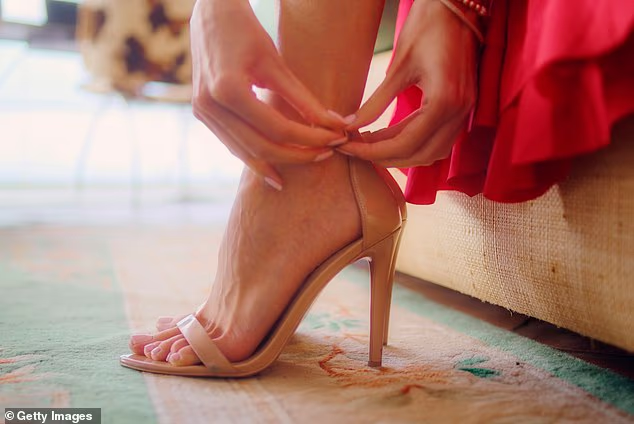
‘Ozempic feet’ are surprisingly common; fat loss on the sole of the foot causes more pressure on the ball and toes, meaning walking in heels can be especially painful for those suffering it
This loss of padding can also be exacerbated by hormonal shifts in menopause and reduced collagen from ageing. Leading podiatrist and brand founder Margaret Dabbs warns: ‘As we age, the fat pads in our feet can migrate and become thinner and GLP-1s may potentially reduce soft tissue support further. This natural cushioning normally helps absorb impact when walking and supports the foot structure.’
Which is why many of us – particularly when wearing high heels – find it more tiring being on our feet as we get older.
So, what is the best way to ease Mounjaro or Meno Foot without resigning yourself to a life of slippers? Here’s what our experts advise…
1. Get support
Dabbs says, ‘There is not just one cause of heel or metatarsal pain [a burning or tingling on the ball of the foot] and your first point of call should be to book a podiatrist appointment for a full diagnostic assessment (available from £85 at margaretdabbs.co.uk).’

Leading podiatrist and brand founder Margaret Dabbs says the natural cushioning in our feet becomes thinner with ageing, but custom shoe inserts or foot creams can help
Moulded orthotics, custom-made shoe inserts to support the foot and provide shock absorption, are also worth investing in (assessments from £90, prescription orthotics from £400).
2. Fill your feet
‘The plantar fat pads act as shock absorbers,’ says Dr Manav Bawa, Medical Director of Time Clinic. ‘So when that cushioning reduces, patients may experience increased pressure in the heel and forefoot, tenderness on hard surfaces, or a sensation that their feet tire more quickly.
‘In some cases, it can even unmask or worsen underlying issues such as metatarsalgia [pain on the ball of the foot] or plantar fasciitis [stabbing pain on the bottom of the heel linked to repetitive strain].’
Dermal filler, such as Juvéderm, can replace cushioning. Often known as a ‘Loub Job’ – a phrase inspired by Christian Louboutin heels – filler is placed into the heel and ball of the foot to improve shock absorption (from £400). The results can last 6-12 months with maintenance treatments once or twice a year.
Filler in the feet must be administered conservatively by an injector with strong anatomical knowledge, says aesthetician Dr Sophie Shotter, ‘Because the tissues are thinner and there are important blood vessels and structures that can be at risk if product is placed incorrectly.’ She adds: ‘It’s also important to understand that addressing volume loss doesn’t change the underlying cause, so maintaining stable weight and wearing supportive footwear is just as important.’
Chaggar, whose clinic is linked to Altimus sportswear in Kensington, recommends trainers such as Asics Metaspeed or Asics Kayano (£180, altimusoutdoor.com).
3. Keep fit
To ease ‘Ozempic feet’, Dabbs recommends foot exercises twice a day. These reduce stiffness, improve circulation, maintain joint flexibility and strength. Try ten reps for each foot, which only takes three to five minutes.

Foot exercises, including using a resistance band, can reduce stiffness and increase strength
- Toe raises/heel raises: Stand with feet hip-width apart. Slowly lift your heels off the ground, balancing on your toes for three seconds, then lower.
- Toe curls: Sit on a chair, place a towel on the floor, and try to scrunch it toward you with your toes. Hold the position for three seconds then relax.
- Ankle circles: Sit or lie down. Lift one foot and slowly rotate the ankle clockwise, then counterclockwise.
- Heel-to-toe walking: Walk in a straight line, placing your heel directly in front of the toes of the other foot each step.
- Resistance band exercises: Loop a resistance band around the ball of your foot. Push your foot away (plantarflexion) or pull it toward you (dorsiflexion).
- Calf stretch/Achilles stretch: Stand facing a wall, one foot behind the other, heel on the ground. Lean forward to stretch the back leg. Hold for five seconds and then alternate.
4. Cream matters
‘Skin on our feet is 15 times thicker than other parts of the body, which is why foot lotion is advised,’ says Dabbs.
‘Applying with a short massage helps circulation, bringing nutrients to the area and relieving muscle tension.’
Pedicurist Bastien Gonzalez (pedicure £145, mandarinoriental.com) says fat pads can be plumped with massage.
Try Margaret Dabbs Miracle Foot Cream (£24, margaretdabbs.co.uk), The Body Shop Peppermint Invigorating Foot Cream (£12, thebodyshop.com) and Reverence de Bastien Le Baum (£95, niche-beauty.com).
5. Audit your socks
‘When fat pads thin out, the nerves on top of the foot become hypersensitive,’ points out Chaggar.
‘Switch to seamless, moisture-wicking socks to reduce friction and prevent the burning sensations (paresthesia) often triggered by fabric rubbing against the skin.’
Try Bamboo Ankle Socks from Panda Food (£18.71, pandafood.co.uk).

















































You must be logged in to post a comment Login