The shares of Power Finance Corporation (PFC) dropped more than 5% on Monday after the company reported a 2% year-on-year increase in consolidated net profit to Rs 7,012 crore for the first quarter of FY27, with Motilal Oswal Financial Services slashing earnings estimates.
PFC shares dropped to Rs 398 apiece on the NSE on Monday morning, the lowest level seen by the stock in more than four months. On Friday, the company reported a slight decline in revenue from operations to Rs 28,527 crore in Q1 FY27, from Rs 28,539 crore in the corresponding quarter of the previous financial year.
Along with the Q1 results, PFC announced an interim dividend of Rs 3.90 per share with a face value of Rs 10 each for the ongoing financial year 2027. The record date to determine the eligibility of shareholders set to receive the dividend has been fixed on August 27 (Thursday).
Motilal Oswal Financial Services noted that the company’s standalone net profit grew nearly 5% YoY to Rs 4,750 crore, beating estimates. Net interest income (NII), however, declined 4%, missing expectations.
Live Events
PFC indicated that the decline in lending yields during the quarter was in line with expectations, reflecting lower lending rates on both the existing and incremental loan portfolio amid the declining interest rate environment, Motilal noted. Going forward, the company will continue to calibrate its lending rates in line with market conditions while balancing growth and spreads, it added. The domestic brokerage cut its FY27 and FY28 EPS estimates for PFC by 2% and 5%, respectively, primarily to reflect lower loan growth and margin contraction, partly offset by lower credit costs. It maintained its ‘Buy’ rating on PFC shares, but reduced its target price to Rs 500 per share. This implies upside potential of more than 19% from the stock’s previous closing price of Rs 420 per share on NSE.
PFC share price
PFC shares have fallen more than 5% in a week and nearly 2% in a month, but have overall gained nearly 10% in 2026 so far. This comes as the company heads for its mega merger with REC.
In the longer term, PFC shares have fallen 1.45% over one year, but delivered positive returns of 87% over three years and more than 288% over five years. The company currently has a market capitalisation of nearly Rs 1.32 lakh crore.
(Disclaimer: Recommendations, suggestions, views and opinions given by the experts are their own. These do not represent the views of The Economic Times)
Aarti Pharmalabs shares hit the 20% upper circuit at Rs 823 on the BSE on Monday following the announcement of its June-quarter results. The sharp rally came after the company reported strong double-digit growth in revenue and net profit, along with key announcements on plant expansion and board-level management changes.
Strong revenue and profit growth drive earnings
The company’s consolidated revenue from operations in Q1 surged 38.7% year-on-year to Rs 535.79 crore compared to Rs 386.19 crore in the corresponding quarter of the previous year. Total consolidated income reached Rs 536.25 crore, up from Rs 386.96 crore a year ago. On the bottom-line front, consolidated net profit after tax (PAT) jumped 65.4% year-on-year to Rs 76.14 crore against Rs 46.03 crore reported in Q1 FY26. Consequently, basic earnings per share (EPS) expanded to Rs 8.40 from Rs 5.08 in the base quarter. Profitability was further boosted by a turnaround performance from its joint venture, Ganesh Polychem Limited, which contributed Rs 7.41 crore to the net profit share compared to a loss of Rs 1.80 crore in the same period last year.
Rs 149-Crore Capex Plan for CDMO Expansion
Alongside its financial results, the Board of Directors approved a major capital investment of Rs 149 crore to construct a new Intermediate Block. The proposed facility will add 405 KL of manufacturing capacity and is designed to meet growing demand from contract development and manufacturing organisation (CDMO) partners and intermediate clients. The expansion project is targeted for completion within one year and will be funded through a mix of internal accruals and borrowings.
Live Events
Board Restructuring and Leadership Transition
The board also approved changes to senior leadership roles, which will take effect from October 1, 2026, subject to shareholder approval. Shri Rashesh C. Gogri will transition from Non-Executive Director to Managing Director. Concurrently, Smt. Hetal Gogri Gala will transition from Managing Director to Executive Director. In line with these changes, the board reconstituted its key governance bodies, including the Audit Committee, the CSR Committee, and the Stakeholders Relationship Committee.
Advertisement
Standalone Performance and Stock Reaction
On a standalone basis, Aarti Pharmalabs reported revenue from operations of Rs 534.59 crore, marking a 42.4% increase from Rs 375.31 crore in the year-ago quarter. Standalone net profit grew 49.3% year-on-year to Rs 71.31 crore.
Following the earnings release, the stock opened with a sharp gap-up at Rs 763.00 before touching the maximum permissible limit of Rs 823.00 on the stock exchanges. Today’s rally brings the stock closer to its 52-week high of Rs 946.10.
(Disclaimer: Recommendations, suggestions, views and opinions given by the experts are their own. These do not represent the views of Economic Times)
Millions of people across the Northern Hemisphere will have the chance to witness a solar eclipse on August 12, with a narrow path of totality crossing remote Arctic regions, Iceland and northern Spain while a much broader partial eclipse stretches across Europe, parts of North Africa and northeastern North America.
The total solar eclipse occurs when the Moon completely covers the Sun’s disk, briefly darkening the sky and revealing the solar corona. Greatest eclipse takes place over the North Atlantic near Iceland, where totality is expected to last up to 2 minutes and 18 seconds. The path of totality is relatively narrow, roughly 180 to 190 miles wide at points, and will sweep from the Arctic across eastern Greenland, western and northern Iceland, then southeast across the Atlantic to make landfall in northern Spain before ending near the Balearic Islands around sunset.
Approximately 15 million people live within or near the path of totality. Nearly one billion people could potentially see at least a partial eclipse, according to visibility estimates.
In Iceland, Reykjavik sits near or within the path. Partial phases are expected to begin in the late afternoon, with totality around 5:48 p.m. to 5:49 p.m. local time lasting roughly one minute, followed by the end of partial phases near 6:47 p.m. Western coastal areas of Iceland may experience slightly longer periods of totality. Viewers there will see the event in the late afternoon under typically cool summer conditions.
Advertisement
In northern Spain, the eclipse arrives later in the day. In León, partial phases begin around 7:32 p.m. local time, with totality from approximately 8:28 p.m. to 8:30 p.m. Similar timing applies to Zaragoza and other cities along the path. In Valencia and areas toward the Mediterranean coast, totality occurs shortly after 8:30 p.m., with the Sun low in the sky and, in some locations, setting while still partially eclipsed. A small northwestern corner of Portugal also falls inside the path for a brief period of totality near sunset.
Outside the path of totality, a deep partial eclipse will be visible across much of Europe. In many western and central European cities the Moon will cover 85 to 95 percent or more of the Sun’s disk in the evening. London, Paris and other major cities will experience significant coverage before or around sunset. Further east, the Sun may set while still partially eclipsed, limiting the deepest phase for some observers.
In North America, no locations will see totality. A partial eclipse will be visible across parts of Alaska, much of Canada and the northeastern United States. Coverage is greater in Atlantic Canada, where more than half the Sun may be obscured in places such as Newfoundland. In New England and nearby areas, the percentage is lower, typically in the teens or less in major cities such as Boston and New York, occurring in the early to mid-afternoon local time. Western and southern portions of the continent will see little or none of the event.
Safety remains the top priority for any viewing. Looking directly at the Sun without proper protection can cause serious and permanent eye damage. Certified solar eclipse glasses that meet the ISO 12312-2 international safety standard are required for the partial phases. Only during the brief period of totality, when the Sun is completely covered, is it safe to look with the naked eye—and only then. As soon as the bright photosphere begins to reappear, protective filters must be used again. Ordinary sunglasses, homemade filters or unfiltered cameras and binoculars are not safe.
Advertisement
Many observers plan to use indirect viewing methods as well, such as pinhole projectors or projecting the Sun’s image through binoculars onto a white surface. Weather will play a major role. Coastal and northern locations along the path can experience variable cloud cover in August. Spain’s interior and Mediterranean regions often offer clearer skies in late summer, though evening haze or local conditions can affect the view of a low Sun.
The eclipse belongs to Saros series 126. Because it occurs near perigee, the Moon appears relatively large in the sky, supporting a longer maximum duration of totality than some other eclipses in the cycle. The entire event, from first partial contact to last, spans roughly four hours globally, though any single location experiences a shorter sequence of phases.
Astronomers and space agencies have prepared detailed maps and local timing calculators so people can determine exact contact times for their coordinates. Greatest eclipse occurs at approximately 17:46 UTC. The shadow’s journey across Earth lasts a little more than 90 minutes from the first appearance of the umbra to its final departure.
For those outside the path, live broadcasts from locations in Iceland and Spain are expected to provide real-time views of totality. Local astronomy clubs, science centers and tourism organizations in the path countries have organized viewing events, with safety briefings and equipment checks emphasized.
Advertisement
The August 12 eclipse offers a relatively accessible total solar eclipse for residents of Iceland and northern Spain compared with more remote polar paths. It also provides a widespread partial experience for large populations across Europe. Clear skies, proper eye protection and accurate local timing will determine how much of the celestial alignment any individual observer is able to witness.
Shares of One97 Communications, the parent company of payments aggregator Paytm, rallied 4.5% to their day’s high of Rs 1,506 on the BSE on Monday after Bernstein raised its target price on the stock to Rs 2,200 (52%upside) from Rs 1,500, while retaining its Outperform rating.
The revised target is the highest on the Street and marks the first time Paytm has received a target price above its IPO price.
Paytm made its stock market debut in July 2021 at an issue price of Rs 2,150, a level the stock has not returned to since its listing. Bernstein said it has incorporated the introduction of the merchant discount rate (MDR) on UPI transactions into its base case from FY28 onwards.
The target price hike comes as Bernstein incorporates the introduction of MDR on UPI transactions into its base case from FY28E onwards. The brokerage expects MDR to improve Paytm’s net payments margin by around 3-4 basis points, resulting in an estimated 30% increase in FY30E EPS compared with its previous forecasts.
Advertisement
Bernstein said recent comments from the Ministry of Finance, along with legislative changes removing the statutory prohibition on charging MDR on UPI transactions, suggest the discussion has shifted from whether MDR will return to when and in what form. It has therefore moved UPI monetisation from its optionality assumptions into its base-case forecasts, with the benefits phased in from FY28E onwards.
Live Events
The brokerage assumes a headline MDR of around 35 basis points, applicable only to a subset of UPI P2M transactions. Given the skew in UPI transaction values, Bernstein estimates that even a limited charging perimeter could cover a meaningful portion of payment value. It expects MDR to apply to around 50% of transaction value, with Paytm realising around 3-4 basis points of incremental net payments margin. This is estimated to translate into around Rs 22 billion of additional EBITDA by FY30E. Also read:Paytm attracts more Gen Z users as its UPI payments growth outpaces industry“Competitive intensity in merchant acquiring could increase further, as a result, realised economics could prove to be lower than published rates,” Bernstein said in its note.
The government’s position on UPI charges also remains in focus. Over the weekend, it said consumers will not be charged for UPI transactions. If MDR is introduced, it will apply only to select merchant transactions above a certain threshold. The government also said a revenue model is needed to make UPI self-sustaining, given the continued investment required in cybersecurity, fraud provision and infrastructure.
Paytm Q1 results
The company reported strong quarterly earnings. For the quarter ended June 2026, the fintech company posted a consolidated net profit of Rs 220 crore, up 79% from Rs 123 crore in the corresponding quarter last year.
The company’s board also decided against proceeding with a bonus issue, saying it would instead continue focusing on compounding growth and profitability to create long term shareholder value.
Advertisement
“After evaluating the proposal from the perspective of long term shareholder value and due deliberation, the Board was of the view that the company should continue to focus on further compounding growth and profitability for shareholder value creation. Accordingly, the Board decided not to proceed with the said proposal at this time,” the company said.
Instead, the board approved an additional investment of Rs 100 crore through subscription to equity shares of its wholly owned subsidiary, Paytm Money.
Revenue from operations rose 28% year on year to Rs 2,448 crore from Rs 1,918 crore. On a sequential basis, revenue increased 8% from Rs 2,264 crore in the March quarter. Total income for the quarter stood at Rs 2,630 crore, up 22% from Rs 2,159 crore a year ago and higher than Rs 2,442 crore reported in the previous quarter.
Advertisement
(Disclaimer: Recommendations, suggestions, views and opinions given by the experts are their own. These do not represent the views of Economic Times)
Yes. Corporate subscriptions are available for teams and organisations, with discounted rates as user numbers increase. Pricing starts from $1,625 + GST per user. Get in touch
to discuss the right option for your organisation.
Business News subscriptions are used by executives, investors, consultants and professionals who need to stay informed and make better decisions about the WA market. When you subscribe you’ll get
Unlimited access to WA’s most trusted business journalism
Data & Insights — detailed profiles of WA companies, people, projects and deals
MyBN — a personalised feed based on the companies, people and sectors you follow
Special publications and industry reports
Daily and weekly email newsletters
Data & Insights is a research tool built specifically for the WA market. It draws on more than 30 years of Business News reporting, updated regularly to reflect what’s happening now. Use it to:
Look up detailed profiles of WA companies, including financials, directors and ownership
Find decision-makers and track their career movements
Research live and completed projects across WA industries
Monitor deals, appointments and market activity
Access industry rankings and league tables
Data & Insights is updated daily by our dedicated research team, which uses the latest announcements, ASX filings and editorial coverage to keep our person, company, list and project records up to date.
Business News welcome all opportunities to make our dataset accurate, complete and current, so if you have an update request, please email the team at general@businessnews.com.au, and we’d be happy to assist.
Advertisement
MyBN
is part of every subscription. It’s your personalised view of Business News. You can follow the companies, people, sectors and projects that matter to you, and get a news feed and alerts tailored to your interests. You can save articles to read later and retain only what you need.
Only subscribers have full access to all content on the Business News website.
Advertisement
If staying informed about the WA economy is part of your job, and/or you’re looking for networking opportunities in WA, Business News is built for you.
Business News subscribers are:
Executives and directors tracking competitors, clients and market movements
Investors and advisers researching companies, deals and industry trends
Consultants and professionals staying across sectors relevant to their clients
Business owners looking for leads, context and market intelligence
Most Business News publications cover national or global markets. Business News is focused entirely on Western Australia, which means the journalism, the data and the intelligence are all built around WA companies, people and projects — not adapted from a national feed. Data & Insights, included with every subscription, combines more than 30 years of WA-specific editorial research with live business data. There’s no comparable product for the WA market.
Advertisement
The Morning Digest Email provides a comprehensive wrap of the major headlines, relevant to WA business, and includes with a snapshot of the overnight news covering oil, gold and ASX-listed companies.
The Afternoon Wrap Email focuses on the news covered by our team of journalists during the course of the working day, including exclusive stories and analysis, all of which relates to WA business and the local economy.
The BN Weekender Email contains a wrap of the Business News from the week that was, highlighting the top stories in each area of WA business. Sign up for free.
Advertisement
We’re happy to help. Get in touch
and our team will come back to you.
In the first half of the year, our main funds have once again delivered double-digit gains, ahead of global indices. While this might suggest that there is now ‘less room left to rise’, we at Azvalor sell companies that consistently rise, and reinvest in others that we consider deeply undervalued by the market. This ‘rotation’ allows us to keep a high upside across all our portfolios, as detailed fund-by-fund below.
In this letter, we wish to convey two key ideas for our investments.
Advertisement
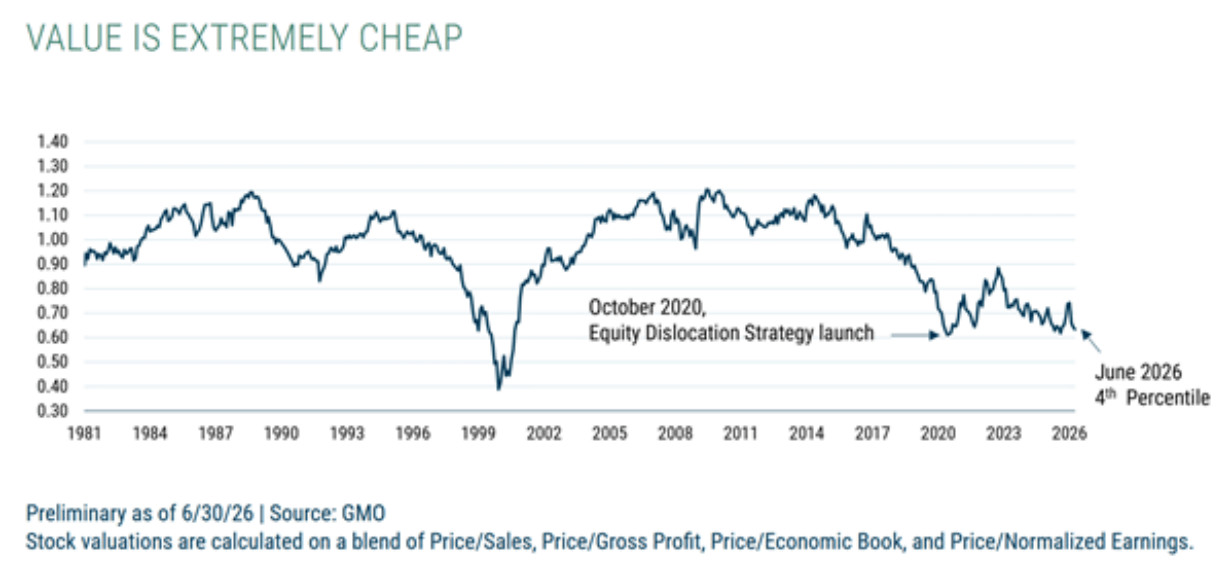
First, we believe this remains a new ‘golden age’ for our investment style. The chart below needs no further explanation.
These opportunities are arising because of how speculation is encouraged in the markets. Wall Street is a selling machine, but it receives no revenue when our investors buy one of our funds, forget about it, and find ten years later that they have almost quadrupled their money. They profit, for example, by bouncing investors from defence stocks, to AI stocks, to buying some bitcoin, to hedging against a fall by selling futures, with the odd meme stock thrown in that is ‘already up 900%’. The problem is that, while this strategy is undoubtedly profitable for Wall Street, we are far less certain it is profitable for you. The sums now invested in 3- and 4-times-leveraged indices are frankly alarming, and our recommendation is to stay clear of this type of investment. Many investors, unfortunately, pay no heed – which is precisely why we who invest by weighing probabilities, rather than speculating ‘to the song of Wall Street’s sirens’, are living in a ‘golden age’.
The second idea is that the market is NOT cheap. For the first time in twenty years, the S&P 500 dividend yield is lower than that on short-term government bills. Despite the S&P 500 doubling since October 2020, earnings have risen only 30%, underscoring how Investors should be wary of investing in the indices.
In terms of business activity, we currently manage assets of approximately EUR 4.8 billion and, in the first half, recorded net inflows of EUR 460 million. More than 8,900 new co-investors joined Azvalor during the period, bringing the total to 39,000.
Advertisement
These figures are a source of great satisfaction but, rather than a goal in themselves, they are the result of having done our job well for more than a decade. Our aim is to continue striving to beat the market with less risk than equities in general.
Underpinning these outcomes is a research and investment team that continues growing and maturing, both in the number of professionals and in the depth of its sector and geographical knowledge. This increased capacity now allows us to analyse larger numbers of companies with greater rigour across a more diverse range of sectors and geographies – which we regard as the best news for future returns, even more so than the specific results of any given period.
Let us examine the portfolios in detail.
Azvalor Iberia
Following its strong performance in 2025 (+31%), the net asset value of Azvalor Iberia FI has continued rising in the first half of 2026, with a gain of +6% to EUR 207.5. Since launch, it has accumulated a return of +107.5%, more than doubling the initial capital.
Advertisement
Among the main holdings contributing positively in 2026 were Meliá and Repsol. During the year, we added four relatively new ideas to the portfolio, in keeping with our Azvalor Method of gradually selling or trimming investments as they bear fruit, replacing them with new investments offering an attractive upside. As a result, the value of the fund increased this half-year at an even greater pace, raising its upside potential, which we estimate at +60% . 1
Azvalor Internacional
Following its strong performance in 2025 (+19.5%), the net asset value of Azvalor Internacional FI has continued rising during the first half of 2026, with a gain of +15%. Since inception, the fund has multiplied money invested by 3.5 times.
In the first half of 2026, we added more than ten investment ideas with a meaningful weighting. These are well-managed companies, profitable businesses and, most importantly, are trading at very attractive prices. There is no common sector theme; they are separate cases across different sectors with substantial upside ahead. As a result, the value of the fund has surpassed the EUR 600 per unit mark for the first time, and, therefore, the current upside of +82% remains attractive despite the strong cumulative gains.
The best news is that, over the past couple of years, we have worked hard to build a deep ‘bench’ of ideas and now have the strongest squad of ‘substitutes’ in our history. We are better prepared than ever to continue renewing the fund’s upside as it reaches ever greater highs.
Advertisement
Azvalor Blue Chips
The net asset value of Azvalor Blue Chips FI rose by +17.8% to EUR 255.2 in the first half of 2026, and, as of today, has multiplied initial investments 2.7 times.
Azvalor Blue Chips FI invests in large companies but, as the fund holds EUR 120 million, it still enjoys the virtues of a reasonably small portfolio: greater concentration than Azvalor Internacional and greater ‘agility’ to buy and sell during periods of high volatility. The upside is currently close to +84% .
Azvalor Managers
Azvalor Managers FI delivered a return of +9.3% in the first half of 2026 and, since its launch just over seven years ago, has accumulated an appreciation of +127.2%.
Advertisement
The fund has assets under management of more than EUR 250 million and over 2,700 co-investors, and holds a 5-star Morningstar rating and a Citywire ‘Rating +’ .
In valuation terms, the fund trades at around a 45% discount to the global equity market, with a portfolio comprised of companies from every continent, selected by those we consider the best managers in the world. Close to 70% is invested in small- and mid-cap companies with 35% in geographically emerging markets (including China).
Azvalor International SICAV Luxembourg
Azvalor International SICAV Lux, available to international investors, follows a strategy similar to that of Azvalor’s other investment vehicles. More specifically, the portfolio invests in companies held in our Azvalor Internacional fund – our international equities fund domiciled in Spain – and selects the best ideas from Azvalor Iberia, our Iberian equities fund domiciled in Spain.
The fund trades at an average FCF yield of 12% and a weighted average ROCE of 20% . The upside of this investment vehicle at the end of the first half of the year is +82% .
Advertisement
The main positions added during the period were Yellow Cake and Borr Drilling . On the other hand, we sold Tenaris , among others. In terms of performance contribution, Noble was the top performer during the first half of the year.
News at Azvalor
Last May we received news that gives us great satisfaction: for the fourth consecutive year, Azvalor has been named best independent domestic asset manager at the 2025 Expansión-Allfunds Fund Awards ( see news ) . We celebrated it with the same enthusiasm as the first time, yet without losing sight of the humility and expectations with which we approach each new year.
Four consecutive years receiving this recognition speak less of a one-off good result than of consistency in a way of working. We read it as an award for our track record, and the team and management model we have built since the firm’s inception, rather than for the returns in any particular period. It is precisely that reading which spurs us to carry on with the same high level of expectations that have defined us for more than twenty-five years.
Behind this award lies what has always been there, the same pairing we regard as our true competitive advantage: a distinctive investment method (the ‘ Azvalor Method ‘) underpinned by a strong corporate culture resting on continuous training of our teams, hard work, meritocracy, and the pursuit of excellence in everything we do. It is the path that has brought us here, and it is also the only one we know how to follow.
Advertisement
We wish to remind you that, since last June, Azvalor Annual Report for the 2025 financial year has been available for your perusal ( see the Report in Spanish, soon available in English). It was prepared with a twofold aim: first, to present our annual account of stewardship and, second, to present, from a broader corporate perspective, the full range of actions carried out by the firm over the past year.
In the area of social action and patronage, we have renewed our sponsorship agreements with the Fundación Amigos del Museo del Prado and the Teatro Real. Likewise, we have renewed our partnership agreement with España Rumbo al Sur, a pioneering programme for the development of young people, which embarked a few days ago on its annual expedition, this time travelling across Peru.
Final considerations
Throughout this letter, we have stressed the principles we have followed for years, and will continue to follow precisely because they remain true. These principles include the importance of looking where others do not, exercising patience so that the market recognises the value of companies in the portfolio, and the wisdom to not be swept up by transitory prevailing narratives.
The current environment – marked by euphoria around certain growth stories, and by a high concentration of returns in a small number of companies – feels familiar to us. We have seen it before with different protagonists, and, on every previous occasion, the market corrected valuation excess wherever it existed, recognising the value of sound businesses trading at unjustifiably low prices.
Advertisement
At Azvalor we continue to face the future with prudence, enthusiasm, and humility . Prudence , because we are aware that no investment process, however rigorous, is free from mistakes or difficult periods. Enthusiasm , because we now have a team that is larger, more experienced, and better trained than ever in the Azvalor Method, allowing us to analyse a broader universe of opportunities in greater depth. And humility , because we know that the good results achieved so far have been possible only with the trust and patience of you, our co-investors, who have stood firm in times of greatest uncertainty.
We will continue striving, as we have from day one, to be the best possible safe haven for your savings and ours.
We close by thanking you once again for your trust, inviting you to contact our Investor Relations team should you seek further information on any of the topics discussed, or on any other matter of interest.
Sincerely,
Advertisement
Azvalor Asset Management SGIIC Team
1 The upside figures referred to throughout this document are derived from the difference between the estimated value of each of the portfolios’ underlying assets, based on our internal valuation models, and the prices at which each of them currently trades on the stock markets.
Sumitomo Corporation has acquired a third stake in the Gwynt Glas project
09:50, 10 Aug 2026Updated 09:52, 10 Aug 2026
Gwynt Glas.
A Japanese corporate has taken a third stake in a planned huge floating offshore windfarm off the coast of Pembrokeshire.
Having secured an option to develop a 1.5 gigawatt windfarm in the Celtic Sea from the Crown Estate last year, joint venture partners in the Gwynt Glas project, EDF power solutions and Irish Government-owned ESB, have sold a third stake to Sumitomo Corporation
Advertisement
The value of the deal, which gives the three parties an equal third ownership interest, has not been disclosed.
The floating offshore windfarm is one of three in the Celtic Sea being taken forward via the Crown Estate’s offshore wind leasing licensing round five. The other straddles Welsh and English waters, with a third solely in English waters.
Once all three are operational in the mid 2030s they will have combined capacity for 4.5 gigawatt of clean energy that would generate the electricity needs for more than four million homes and create more than 5,000 direct and supply chain jobs – creating a £1.5bn economic boost.
Gwynt Glas said its project continues to make “strong progress “having submitted its scoping report for the project to the Planning Inspectorate this summer
Advertisement
Matthieu Hue, chief executive of EDF power solutions UK and Ireland said “We are delighted to welcome Sumitomo Corporation to the Gwynt Glas team. Their extensive global experience in offshore wind development and investment complements our own and ESB’s, creating a powerful partnership dedicated to delivering this vital project for Wales and the UK. We look forward to working closely with our new and existing partners.”
Jim Dollard, executive director, generation trading at ESB said:“We are delighted to welcome Sumitomo Corporation to the Gwynt Glas project, and are looking forward to working with them together alongside our longstanding partners, EDF power solutions UK and Ireland.
“This marks another significant step at this stage of the project – one which is so important to us at ESB as offshore wind will be a cornerstone of the delivery of our net zero carbon emissions strategy.
Jun Minase, general manager, Overseas Energy Solutions SBU at Sumitomo Corporation, said: “We are delighted to join the Gwynt Glas project. As a large-scale floating offshore wind development being advanced by EDF power solutions UK and Ireland and ESB, the project represents an important opportunity to contribute to the energy transition.
Advertisement
“Leveraging our experience and expertise in both the UK market and the offshore wind sector, Sumitomo Corporation will work closely with its partners to support the successful development of the Project and enhance its long-term value.
“The United Kingdom remains an important strategic market for market for Sumitomo Corporation. Through this investment, we aim to contribute to the UK Government’s Net Zero 2050 ambitions while supporting the energy transition and the realisation of a more sustainable society.”
All three floating offshore windfarm projects in the Celtic Sea will seek contract for difference support, which will ensure energy produced will be commercially viable, from the UK Government. Turbines could be as high as the Shard building in London at 300 metres on floating platforms similar in size to a football pitch. They will be anchored to the seabed via huge chains.
SEOUL — South Korea’s benchmark Kospi index closed higher Monday, snapping a two-session losing streak, as bargain hunters moved into semiconductor-related shares following a record-setting rally on Wall Street, even as foreign investors continued heavy selling and the won weakened against the dollar.
The Kospi rose 40.89 points, or 0.65%, to close at 6,299.66 after a volatile session that saw the index swing between strong early gains and a more subdued afternoon. The index opened 0.76% higher at 6,306.33 and briefly surged as much as 2.16% in early trading before paring most of those gains as the day wore on, ultimately settling just shy of the psychologically significant 6,300 level.
The secondary Kosdaq market fared considerably better, jumping 6.97% to close at 854.47, a gain of 55.66 points, as smaller technology and growth-oriented stocks attracted heavy buying interest.
Trading volume on the main board was moderate, with 629.9 million shares changing hands worth a combined 29.09 trillion won, or roughly $20.5 billion. Advancing stocks outnumbered decliners by a wide margin of 695 to 183, suggesting broad-based buying even as the index’s overall gain remained modest relative to the number of stocks that moved higher.
Advertisement
Foreign investors extended their selling streak, offloading a net 1.48 trillion won worth of shares during the session. Institutional investors and retail traders both stepped in on the other side of those trades, purchasing a net 567.4 billion won and 899.8 billion won, respectively, helping cushion the market against the scale of foreign outflows.
Large-cap technology names were mixed. Samsung Electronics slipped 0.43% to 230,000 won after opening in positive territory, while SK Hynix edged down 0.14% to 1.42 million won, also having started the session higher before losing ground. The pullback in the two chip giants came after reports that Apple is considering sourcing memory chips from Chinese manufacturer CXMT, a development that weighed on sentiment toward Korea’s dominant semiconductor exporters even as the broader market advanced.
Lee Kyung-min, an analyst at Daishin Securities, said the reports around Apple’s potential shift toward Chinese memory suppliers pressured large-cap chip stocks during the session, even as “bargain hunters moved into semiconductor equipment and materials stocks” elsewhere in the sector, helping offset losses in the biggest names.
Other major stocks fared better. LG Energy Solution gained 2.08% to 367,500 won, while automaker Hyundai Motor rose 3.16% to 408,000 won, both benefiting from renewed investor appetite following the strong close on U.S. markets at the end of last week.
Advertisement
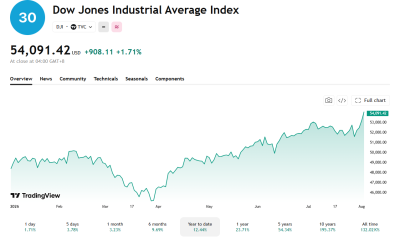
Monday’s rebound in Seoul followed a rally on Wall Street on Friday, when U.S. job data eased concerns over further interest rate hikes from the Federal Reserve. The Dow Jones Industrial Average rose 0.28% and the S&P 500 added 0.62% to close at a fresh record, while the tech-heavy Nasdaq Composite jumped 1.3%. The improved sentiment on U.S. markets carried into Asian trading Monday, with Japan’s Nikkei 225 also posting solid early gains alongside the Kospi as investors across the region responded to easing rate-hike fears and renewed optimism around artificial intelligence-related spending.
The Korean won weakened by 2.3 won from the previous session to trade at 1,418.4 won against the dollar as of 3:30 p.m. local time, reflecting continued pressure on the currency even as local equities advanced. The won’s slide came against a backdrop of persistent foreign selling in Korean equities, a dynamic that has kept currency traders watchful in recent weeks even as the stock market itself has shown resilience.
Monday’s gains came after the Kospi closed lower for two consecutive sessions last week, weighed down by a bout of foreign selling that had interrupted what had otherwise been a strong year for Korean equities. The index remains sharply higher than year-ago levels, having been lifted over the past year by sustained investor enthusiasm for semiconductor stocks and optimism around artificial intelligence-related capital spending across the technology sector, even as the market has periodically seen sharp pullbacks tied to swings in global risk appetite and volatility linked to leveraged retail trading products.
The session also unfolded against a broader domestic political backdrop, with South Korean President Lee Jae Myung facing declining approval ratings amid concerns over policy execution and debate around the administration’s approach to prosecutorial investigative powers. While the political developments have drawn attention domestically, Monday’s market action appeared to be driven primarily by the shift in global sentiment following Friday’s Wall Street rally rather than by local political news.
Advertisement
Looking ahead, investors in Seoul are likely to continue watching developments in the global semiconductor supply chain closely, particularly any further signals on whether major U.S. technology companies might diversify their chip sourcing away from established Korean suppliers. Market participants are also expected to keep a close eye on upcoming U.S. inflation data and any further signals from the Federal Reserve on the path of interest rates, both of which are likely to continue shaping sentiment in Seoul in the sessions ahead.
For now, Monday’s advance offered some relief to investors after a choppy stretch for Korean equities, even as the modest size of the Kospi’s gain — relative to both its early intraday surge and the much larger rally in the Kosdaq — suggested that sentiment toward the market’s largest constituents remained cautious.























































You must be logged in to post a comment Login