

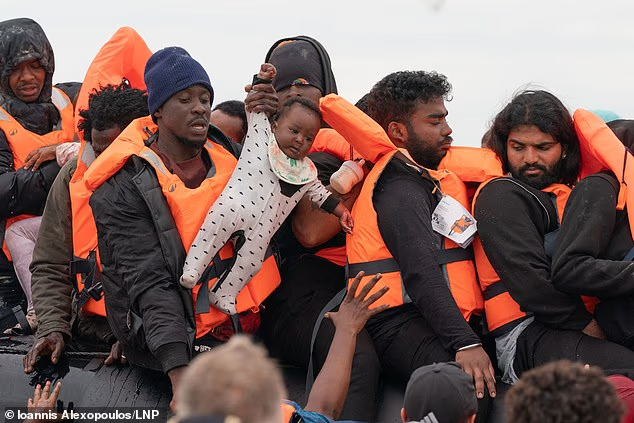
French police did nothing more than watch as a baby and toddlers were carried aboard a dinghy to England.
Dozens of migrants clambered aboard the boat in the waves as tourists enjoyed lunch on the beach yesterday.
The youngest hauled aboard was a baby who appeared to be just months old. There were a number of other young children and women, too, alongside mostly young men.
Police apparently threatened to arrest the photographer who captured the images of French officers standing by as babies and toddlers were dragged on to the dinghy from the sea by their arms.
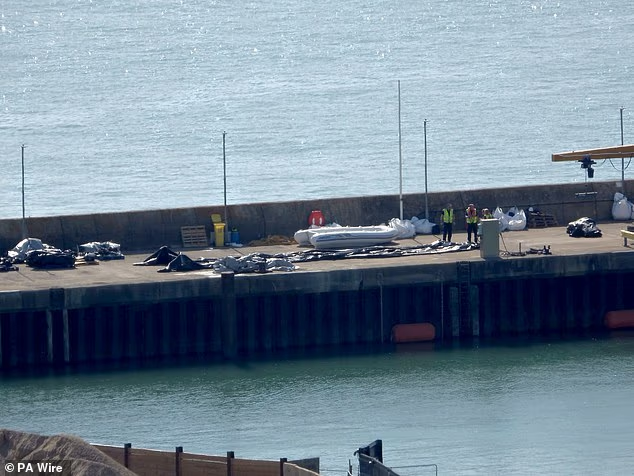
The migrants motored off and were picked up in the middle of the Channel by a British Border Security Command vessel and taken into Dover.
The group of migrants were just a small portion of the 2,092 who have already crossed the channel since Andy Burnham became Prime Minister just three weeks ago.
Remarkably, they were boarding a small boat the French authorities had closely tracked for nine-and-a-half hours – and simply let it be – as it picked up multiple groups of passengers along the French coast.
The dinghy appears to have been launched near Dieppe at around 4am.
This is far further south than from where boats usually leave, but people-smugglers are using new launch spots away from regular police searches.
Soon after setting off it was followed by a French coastguard vessel – but only in case of a sinking.
After 40 miles it pulled in alongside Berck beach, then 12 miles further north it approached Camiers beach at around noon, where photographer Ioannis Alexopoulos saw the youngsters taken on board after groups of migrants had emerged from the dunes.
Mr Alexopoulos said: ‘Three police turned up, gendarmes in military clothes – but all they did was film, and threaten to arrest me if I kept taking pictures.’
A man holds a baby in a babygrow as migrants board a dinghy at the beach at Ecault in France

French police watched on from the beach

A toddler is dragged aboard as French police watch on

Migrants wait in the sea to board a taxi boat to their dinghy

Life jackets for sale at the French sports superstore Decathlon in Dunkirk
This comes as the Daily Mail revealed that sporting goods stores in the northern French towns of Calais and Dunkirk have become key to the operations of gangs smuggling people into Britain.
Migrants appear to be buying up lifejackets en masse from the retailers, with the flimsy, €17.99 (£15.40) garments offering little protection against the perilous crossings they are set to undertake.
This, however, is only the last step in a vast international supply chain spanning all the way to China, which is profiting off migrants’ desperation, misery and suffering.
Last week it was revealed that the average number of migrants crammed onto small boats has more than doubled over five years to a record high under Labour.
Analysis found 66 migrants on average were packed onto each of the 219 vessels which have successfully crossed the Channel so far this year. They were carrying 14,561 migrants in total.
This was up from an average 28 per boat for the whole of 2021, when 1,064 vessels carrying 28,526 migrants made it to the Kent coast.
It was also an increase from the average 62 arrivals per boat last year and 53 in 2024.
The findings come amid a surge in the use of so-called ‘mega-dinghies’ capable of carrying more than 100 people as people smugglers shift their tactics.
Experts said it was likely because smugglers are starting to launch more boats away from Calais and Dunkirk, where distances between the French and UK coastlines are much greater. This means larger and more powerful boats capable of travelling further are needed.
Former head of UK Border Force, Tony Smith, said: ‘These mega-dinghies are clearly built to carry many more migrants than the original business model.
‘That suggests the crime gangs in Europe have moved towards manufacturing larger boats because the French authorities have at least done something in Calais and Dunkirk.
‘It’s much harder now to launch from some of those beaches that we’ve seen in the past.
‘They’re now moving further down the French coast, and the crime gangs have said we don’t need loads of small dinghies anymore because that’s going to be quite difficult to get people across.

Migrants board their dinghy at Ecault, France, before attempting to cross the English Channel

The migrants were rescued in the middle of the Channel trying to reach the UK and taken to Dover by a Border Security Command vessel
‘They’ve probably needed to start manufacturing larger vessels capable of travelling longer distances and carrying more migrants.’
In recent weeks, a new record was set for the number of migrants reaching Britain in one day.
Official Home Office figures showed there were 752 arrivals on July 30, smashing the previous high of 710 set in June.
And last month, two boats carrying 128 and 165 migrants respectively made it across the Channel, both smashing the previous record for the most-packed vessels to successfully make it to Britain.
At least 14 UK-bound migrants have died in the Channel this year, either by drowning or through suffocation aboard overcrowded small boats.
After previous Prime Minister Sir Keir Starmer won the 2024 election, he ditched the Tories’ Rwanda deportation plan and instead focused on ‘smashing the gangs’.
In April, as part of the strategy, Home Secretary Shabana Mahmood signed a £662million deal over three years with France to crack down on crossings.
But while crossings are down 40 per cent compared to last year, Labour has failed to stop the boats completely.
And more enforcement in concentrated areas appears to have caused smugglers to try and launch boats from further away on the French coastline from Calais and Dunkirk.
New premier Andy Burnham faced criticism after gaining the keys to Downing Street last month and failing to mention the issue in his maiden speech.
It took him two weeks to visit Dover after he prioritised announcements on capping bus fares, slashing VAT on energy bills and unveiling his No10 North, which critics have branded a ‘gimmick’.
Calais was previously known for one such settlement, nicknamed the ‘Jungle’, which at its largest housed around 8,000 migrants – but was cleared by French authorities in 2016.
Around 700 migrants are still sleeping rough in the city, according to charity Care4Calais, whose possessions are often seized by police determined to stop another long-term camp forming.
And the port city of Dunkirk has become a similar hotspot, with thousands of asylum seekers living in tents in the Grande-Synthe and Loon-Plage areas of the city.
Facing an indeterminate wait for a crossing they have likely paid extortionate sums to traffickers for, the migrants often need to be prepared at a moment’s notice.
To do this, they seem to have been turning – of all places – to the sporting goods chain store Decathlon.
One branch in Dunkirk is in a retail park in the heart of the city’s Grande-Synthe suburb, an inland industrial area just off the motorway, to the west of the harbour and port.
Migrants living in the area, on arable and wooded land next to the busy D601 road, are understood to often catch the bus to the store.
When the Daily Mail visited this week, men, women and children could be seen walking from a complex of tents along the highway to reach a bus station outside a nearby shopping complex.
There, they appeared to buy essentials like food – many were seen walking back with large bags of baguettes – or travel onwards on the bus roughly 5km (three miles) to the Decathlon store.
Indeed, it was at a bus stop across the road from the chain sports shop where two people who appeared to be migrants could be seen waiting with lifejackets.
Rather than arriving by car – like most visitors to the retail park the Decathlon store is in – the men were on foot, buying only the buoyancy aids and no other gear before heading off.
Outside the front entrance to the shop, the Daily Mail spoke to another two men who had each purchased around a dozen lifejackets inside, which they had stowed in grey bin bags.
The pair, from Iraq, who wished to remain anonymous fearing for repercussions from the British government, confirmed they were set to use the vests to take a small boat to the UK.
When asked, ‘Did you buy lifejackets in there?’ and, ‘Is it for a boat crossing? Are you going to be on a boat to the UK?’ they simply responded, each time, ‘Yes’.

Migrants pictured leaving a local sports shop in Dunkirk rammed with lifejackets

Another man was spotted leaving the store with at least ten lifejackets. Like the Iraqi men, he had come prepared, bringing bin bags to carry them in

He was seen packing the vests just inside the exit from the store in Dunkirk, France
One man, who said the pair had waited with their relatives in France for two months to be able to cross, added: ‘We are with our family. These are not all for me!
‘We’ve had a long journey to get here. We’ve travelled a long way.’
The man wished our reporter a nice day before saying goodbye. It was sobering – while her day would carry on, his, with a perilous boat crossing imminent, might end quite differently.
It also suggested migrants appear to have to buy their own buoyancy aids – and that they are not covered by their extortionate crossing fares.
Another man was spotted leaving the store with at least ten lifejackets. Like the Iraqi men, he had come prepared, bringing bin bags to carry them in.
He was seen packing the vests just inside the exit from the store, before tying the bags together and slinging them over his shoulder. When approached by the Daily Mail, he did not respond.
A group of three other men were also spotted carrying similarly sized bin bags across the car park away from the store.
Purchases appeared to happen in waves – perhaps in line with and reactive to when a particular crossing was planned.
Indeed, over the three days the Daily Mail visited the Decathlon store in Dunkirk, all lifejacket transactions witnessed happened on a single day and in quick succession.
Inside the shop, there is plenty of choice – the shelves in the water sports section are full of orange lifejackets, immediately recognisable after years of migrant-related headlines.
Racks on racks – along with a large bin, sitting under a print of an ominously enormous wave – offered a range of sizes, with a high proportion designed for babies, of only 10 to 15kg.
Starting at just €17.99 for the most basic design – little more than polyester-bound foam – the aids ranged in price up to €89.99 (£77.20), for the most sophisticated gas cylinder-powered model.
Various combinations of whistles, additional straps and reflective patches saw other designs offered for €19.99, €29.99 and €34.99.
It was these mid-range versions which most often appeared in purchases witnessed by the Daily Mail. Buying ten, for example, might therefore set you back several hundred euros.
The gas-powered vests, meanwhile, were priced higher, at €54.99, €55 and €79.99 as complexity increased – with some even labelled as ‘tested and validated by French Lifeguards’.

























































You must be logged in to post a comment Login