Connect with us

NewsBeat

Ukraine hits Putin with one of its deadliest attacks of the war, killing 12 Russians and wounding dozens more in new oil facility attack

Published

on

Smoke is seen rising after a Ukrainian strike on a Nizhnekamsk oil refinery in the Russian republic of Tatarstan

A Ukrainian drone strike has hit one of Russia’s largest oil refineries, killing 12 Russians in one of Kyiv‘s most deadly single attacks of the more than four-year war.

A further 39 were wounded in the strike on Nizhnekamsk in Russia‘s Tatarstan region, Radmir Belyayev, the city’s mayor, announced today.

The region’s oil refinery, understood to be one of Russia’s most technologically advanced, was hit in the long-range attack, according to state media.

Long-distance drones travelled almost 800 miles to strike the giant facility. 

Advertisement

Ukraine has targeted Russian oil facilities with long-range drones almost daily in recent months. The barrage has caused fuel shortages in Russia, eaten into the country’s refining capacity, and unsettled the Russian public.

Ukrainian President Volodymyr Zelensky says it is a campaign to force Vladimir Putin to the negotiating table and stop his more than four-year-old invasion.

Nizhnekamsk is roughly 1,200 kilometers (750 miles) east of the Ukrainian border and has a population of about 240,000. 

The city is an important oil refining hub, home to two refineries and a petrochemical plant.

Advertisement

Tatneft’s TANECO refinery, which was previously hit by Ukraine in early June, processed 17 million tons of crude oil in 2024, producing 2.7 million tons of gasoline and 8.5 million tons of diesel fuel. 

Smoke is seen rising after a Ukrainian strike on a Nizhnekamsk oil refinery in the Russian republic of Tatarstan

Nizhnekamsk is home to two oil refineries and a petrochemical plant, responsible for producing millions of tons of gasoline and diesel fuel

Nizhnekamsk is home to two oil refineries and a petrochemical plant, responsible for producing millions of tons of gasoline and diesel fuel

Advertisement
A warehouse in occupied Makiivka, the outskirts of Donetsk, is on fire after a Ukrainian strike

A warehouse in occupied Makiivka, the outskirts of Donetsk, is on fire after a Ukrainian strike

Ukraine’s domestically developed long-range drones have flown increasing distances deep inside Russia, with some now reaching Siberia, around 2,000 kilometers (1,200 miles) from the countries’ border.

‘We do deliver entirely justified responses, and every Russian strike will be met with our response. Russia’s war will be felt more and more at their own home – in Russia,’ Zelensky said late Sunday on social media.

‘The only reason this is still continuing is Russia’s unwillingness to end this war.’

Advertisement

Tatarstan head Rustam Minnikhanov has declared a period of mourning after the Ukrainian attack, Mr Belyayev said.

He added: ‘This morning, the republic was subjected to another brutal attack by enemy drones,’ said Radmir Belyayev, Nizhnekamsk city’s mayor.

‘A massive attack is ongoing in the city of Nizhnekamsk.’

Ukraine has stepped up its strikes on Russian oil refineries in recent months in a campaign which has caused fuel shortages in many parts of Russia, though authorities say that most of those initial problems have since been resolved.

Advertisement

Meanwhile, parts of the city of Simferopol in Crimea were temporarily left without power amid a reported drone attack. 

It came as Ukraine has stepped up its attacks on land access routes to occupied Crimea.

Extraordinary images showed the bombardment on the ‘highways of hell’ linking the Black Sea peninsula to Russia as oil tanker trucks were bombed.

In another Ukrainian strike, there were claims that Russian forces stationed around a former Epicentr store in the occupied city of Makiivka, Donetsk region, were ‘reduced to ashes’.

Advertisement
Oil tanker trucks were bombed on Putin's key land route to occupied Crimea

Oil tanker trucks were bombed on Putin’s key land route to occupied Crimea

Vehicles burn on Putin's 'highways of hell' linking the Black Sea peninsula to Russia

Vehicles burn on Putin’s ‘highways of hell’ linking the Black Sea peninsula to Russia

Burnt-out cars stay in the courtyard of a multi-storey apartment block after a Russian attack on Odesa, Ukraine

Burnt-out cars stay in the courtyard of a multi-storey apartment block after a Russian attack on Odesa, Ukraine

A Russian missile hit a four-storey residential building in central Odessa, Ukraine on Saturday night

A Russian missile hit a four-storey residential building in central Odessa, Ukraine on Saturday night

Advertisement

Smoke was seen rising from the scene, but there was no immediate confirmation of casualties.

It comes after Russian attacks on Ukraine were accelerated over the weekend.

More than 200 missiles and drones rained down on Ukraine, in a blitz on Saturday night.

The coastal town of Odesa bore the brunt, with a dozen injured and the city’s largest sports arena, the Chornomorets Stadium, damaged. 

Advertisement

Missiles also struck a high-rise apartment block in Kharkiv, Ukraine’s second-largest city, according to reports.

Footage showed smoke rising from the 10-storey building as officials said three people had died and 37 were wounded in the eastern city.

The World Health Organization’s European office said on Monday that one of its warehouses in the central Dnipro region of Ukraine had been struck twice in less than 24 hours.

The attacks destroyed emergency supplies worth an estimated $500,000 that were intended for front-line health facilities, it said in a statement.

Advertisement

No casualties were reported.


Source link

Advertisement
Continue Reading
Click to comment

You must be logged in to post a comment Login

Leave a Reply

NewsBeat

Expert says this household item can be used to kill weeds

Published

on

Expert says this household item can be used to kill weeds

In the summer months, they can grow between cracks in your paving slabs or through your lawn.

Many people suggest using vinegar, baking soda, or chemical sprays to get rid of weeds.

A gardening expert has shared a hack using a common household item that might surprise you.

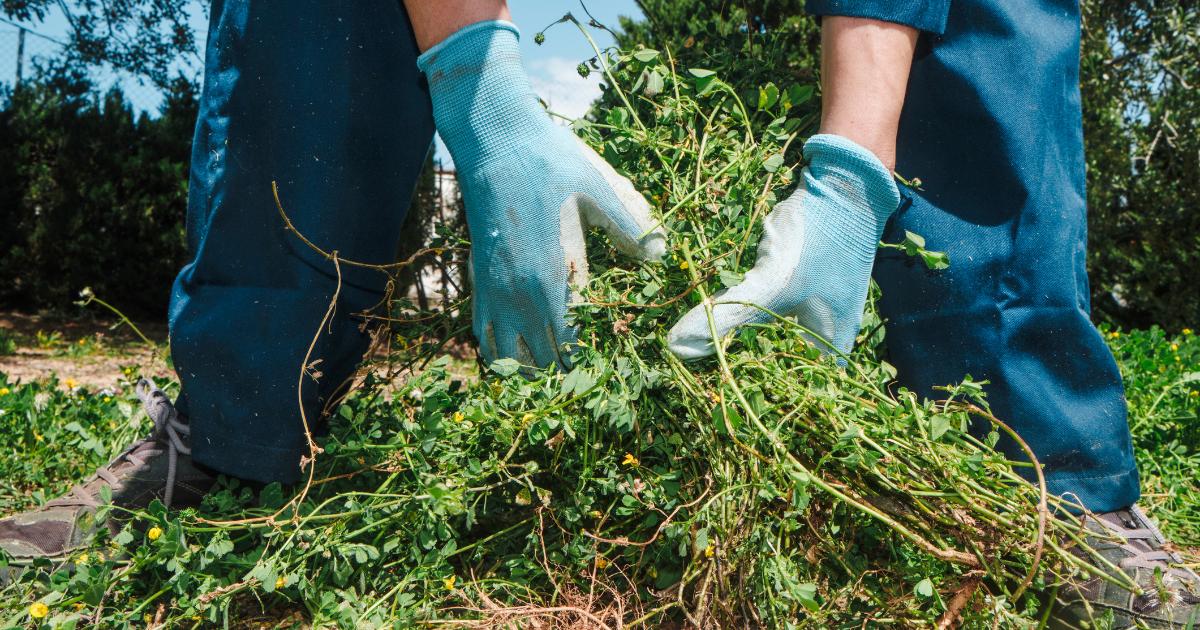
The cardboard helps block the sunlight from the weeds. (Image: Getty)

How to get rid of weeds in your garden

For the hack, you only need one thing, which is cardboard.

Advertisement

Chris Bonnett, horticulturalist and founder of GardeningExpress, said: “Using leftover cardboard is an eco-friendly method that allows you to recycle old boxes while helping the soil as the cardboard naturally decomposes.

“Laying cardboard over problematic areas helps suppress weeds by blocking out sunlight, which is crucial for them to grow.”

All you have to do is cut a piece of cardboard to fit any area that has a problem with weeds and place it over the top.

You need to make sure you remove any tape or stickers from the cardboard, as these are not biodegradable.

Advertisement

You should press it down to stop there from being any gaps between the pieces of cardboard.

Chris added: “If smaller pieces of cardboard are all that are at hand, overlap them by around 15cm to stop weeds creeping through the edges to reach the sunlight.”

The hack is also great, as it helps to nourish the soil underneath.

After placing the cardboard down, cover it with some mulch or compost to hold it in place and help the soil to retain some moisture.

Advertisement

The weeds will decompose, and the cardboard will slowly break down naturally.

Chris said: “After a few months, the cardboard will begin to decompose, benefiting the soil as brown matter, helping to create a healthier growing environment for the rest of your plants.”

This method is better than using harsh chemicals in your garden, as they can disrupt the balance and heath of your garden and create problems for other plants that you might want to grow.

Did you know about this chemical-free hack to get rid of weeds from your garden? Let us know in the comments.

Advertisement

Source link

Continue Reading

NewsBeat

Record 230 people cross English Channel in one small boat

Published

on

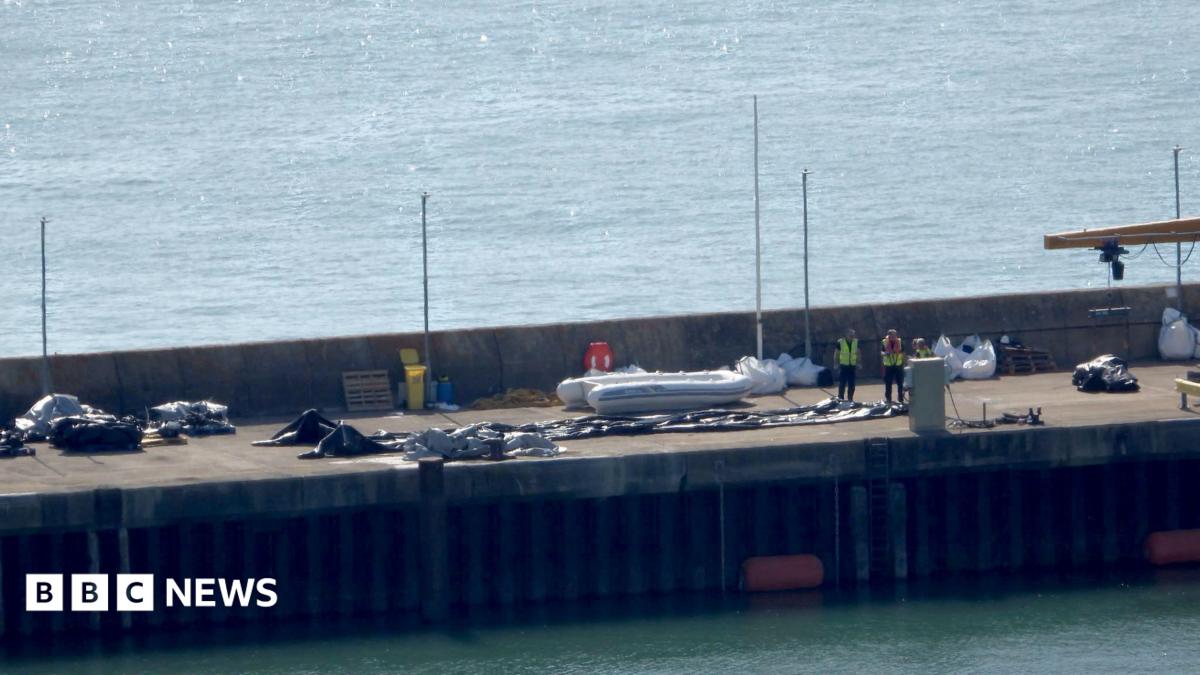
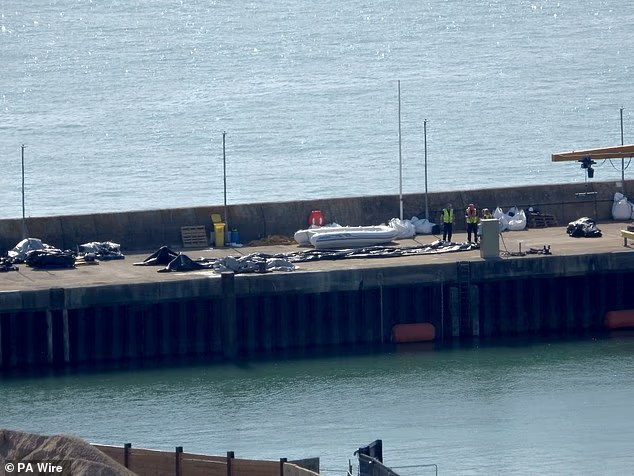
A Border Force boat with a dinghy.

Provisional Home Office figures for the number of people who have crossed the Channel to the UK this year so far is 14,819 – 43% lower than the number recorded by this time last year, and down 16% on the same period in 2024.

Earlier this month, more than 170 people were rescued after the boat they were using to make the crossing caught fire.

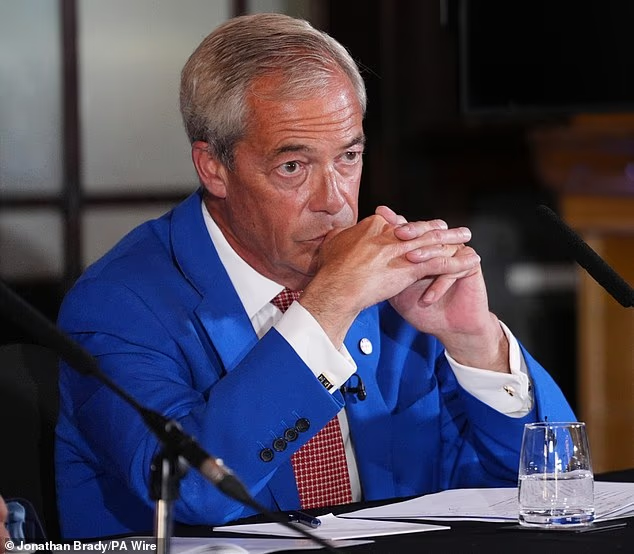
On X, Reform UK leader Nigel Farage said: “At 2.30am this morning a boat carrying 230 people was taken into Dover.

“This is a record number in a single vessel.

Advertisement

“It’s yet more proof that this illegal invasion is a national security emergency.”

A Home Office spokesperson said: “We are making progress, with the number of small boat crossings down this year and the lowest number recorded for the month of July since 2020.

“But we must go further, which is why we have signed a payment-by-results deal with the French to put 40% more boots on the ground on French beaches.”

Follow BBC Kent on Facebook, external, on X, external, on Instagram, external and listen to BBC Radio Kent on Sounds. Send your story ideas to southeasttoday@bbc.co.uk, external or WhatsApp us on 08081 002250.

Advertisement

Source link

Continue Reading

NewsBeat

5 Science-Backed Signs Your Dog Loves You

Published

on

5 Science-Backed Signs Your Dog Loves You

Every dog owner I know feels sure they can tell how their pet’s feeling – which is pretty remarkable, given that our body language and facial expressions are completely different.

Still, research suggests that sometimes, we get it wrong. For instance, a 2009 paper found that the “guilty” look ascribed to dogs after they’ve misbehaved probably has more to do with being told off than it does actual remorse.

We may never know whether they feel the bond as we do. But experts feel pretty sure dogs feel empathy with their owners and react to their emotions, and they can miss and trust us, too.

Here are some science-backed signs your dog feels “excessively affectionate” towards you:

Advertisement

1) Your dog wants to be near you, especially when they’re stressed

A 2019 paper found that when a stranger was introduced to a room with a dog and their owner, the dog tended to huddle closer to the familiar face. And when they were left alone with the new person, dogs were likely to stand near the door, as if waiting for their friend to return.

2) They raise their eyebrows at you

Among humans, that might be seen as a bit passive-aggressive or as a sign of surprise. But some evidence suggests that dogs are more expressive when humans are around, suggesting they might want to communicate with us – and raised eyebrows may have even evolved to help us feel closer to them.

Advertisement

3) Your dog is a petty thief

Some experts think that stealing everything from your shoes to your clothes (socks very much included) could mean your dog is trying to surround themselves with your reassuring scent.

We sweat more from the bottoms of our feet than other parts of our body (not least because they have a whopping 250,000 sweat glands), meaning our socks and shoes are infused with even more of our soothing smell.

4) They hate to see you stressed

Advertisement

One study found that dogs whose owners were trapped in a simulated box trap seemed visibly distressed, pawing at the container to help them escape and pining for their favourite human.

We also know that dogs can “catch” their owners’ emotions (meaning they can perceive and feel them too), especially when they feel close to them.

5) They keep soft, relaxed eye contact with you

Scientists have previously found that owners and their dogs are more in sync with one another’s brainwaves when they made eye contact. And gazing into one another’s eyes seemed to increase bonding chemicals for both humans and their dogs.

Advertisement

Source link

Advertisement
Continue Reading

NewsBeat

Reform announces plans to deport all foreign criminals to El Salvador if Nigel Farage becomes Prime Minister

Published

on

Nigel Farage has already held discussions with Salvadoran officials about the possibility of renting places at the country's jails, which are known for being tough

Reform UK plans to deport foreign criminals to hellhole jails in El Salvador if Nigel Farage becomes Prime Minister. 

Lee Anderson, the party’s chairman, is expected to travel to the Central American country within months for talks with President Nayib Bukele’s government. 

Mr Farage has reportedly held initial discussions with Salvadoran officials about the possibility of renting places at the country’s prisons, which are known worldwide for their tough, spartan regimes. 

Unveiling Reform’s prisons policy last night, the party’s home affairs spokesman Zia Yusuf vowed to ‘change the law so that those who commit serious crimes such as murder, manslaughter, rape and serious violence serve their full sentences’.

Advertisement

He said: ‘Unbelievably, there are over 10,000 foreign nationals in British jails.

‘We will deport all foreign nationals from our jails. If their home countries won’t take them back we will send them to serve their sentences in countries like El Salvador and Kosovo.

‘We will use the space created to ensure that serious criminals stay where they belong. Behind bars.’

Advertisement

Nigel Farage has already held discussions with Salvadoran officials about the possibility of renting places at the country’s jails, which are known for being tough

Inmates at El Salvador's Counter-Terrorism Confinement Centre (Cecot) are crammed behind floor-to-ceiling bars with nothing to do

Inmates at El Salvador’s Counter-Terrorism Confinement Centre (Cecot) are crammed behind floor-to-ceiling bars with nothing to do

The plans echo a US policy in which Donald Trump struck an agreement with El Salvador to deport migrants from the United States.

The Sun reported Mr Farage will today pledge to create 12,000 new prison spaces through the construction of pop-up nightingale prisons.

Advertisement

Temporary nightingale hospitals and courts were introduced during the pandemic to provide additional space for treatment and hearings.

Mr Farage is also expected to promise an end to early release for dangerous offenders and reintroduce short sentences for shoplifters.

It comes as the Government has faced pressure over its early release scheme, which starts in October in a bid to tackle prison overcrowding.

Some 5,000 people are expected to be released early under sentencing changes, down from 6,000 after the exemptions announced as part of an urgent review of the scheme.

Advertisement

Under current plans, PC Andrew Harper’s killers remain eligible to be freed halfway through their 13-year sentences after they were convicted of manslaughter in 2020 following Mr Harper’s death in 2019.

More than 850,000 people have signed a petition calling for Jessie Cole and Albert Bowers to remain in jail, with a Government source saying the Prime Minister is prepared to ‘explore every option’ to block their early release.

El Salvador’s most famous prison is the Terrorism Confinement Centre (Cecot). 

A cornerstone of Mr Bukele’s war on drug cartels, it houses thousands of shaven-headed inmates who sit in silence in windowless concrete cells where they are kept locked up for 23-and-a-half hours a day.

Advertisement
There are no family visits, no recreational spaces and no rehabilitation programmes at the jail

There are no family visits, no recreational spaces and no rehabilitation programmes at the jail

Good Morning Britain host Richard Madeley visited the prison earlier this year and described its regime. 

‘They just sit on their bunks, day in day out, and the prison lights stay on 24/7, never dimmed. All will die in this prison. It’s a living death,’ he said. 

The 57-acre facility was built to hold up to 40,000 prisoners and currently houses an estimated 15,000 inmates. 

Advertisement

Many are suspected members of rival gangs that terrorised the country for decades, alongside convicted murderers and rapists.

Mr Madeley said: ‘Nothing, absolutely nothing, can prepare you for the sight of 3,000 shaven-headed men crammed behind floor-to-ceiling bars. No doors. No screening.

‘They sit there in permanently open view through the bars, on tiers of metal bunks four-high – no mattresses, just thin cotton sheets – staring out. It’s one hell of a sight’

President Bukele ordered the mega-prison to be built in March 2022 as part of his campaign against El Salvador’s gangs, and it opened a year later.

Advertisement

There are no workshops, libraries, opportunities to learn kitchen skills and no visitors.

Mr Madeley added: ‘All meals must be taken in their cells, inside which they spend 23-and-a-half hours every day, with just 30 minutes outside for brief, heavily guarded exercise.’

A Labour Party spokesman said: ‘Keeping the public safe is and always will be Labour’s first priority. The Government has already made clear we are working at pace to deport foreign criminals and we’re building more prison places to deliver justice for victims and keep criminals behind bars.

‘Reform have no serious answers to the Tory prisons crisis and would lead the system to collapse. This would result in a free-for-all for dangerous and violent offenders, including murderers and rapists.

Advertisement

‘Nigel Farage and Reform simply can’t be trusted to keep Britain safe.’

Source link

Continue Reading

NewsBeat

Why science businesses are choosing to grow in Durham

Published

on

Why science businesses are choosing to grow in Durham

In the North East, companies are proving that they can develop, manufacture and commercialise world-leading technologies while remaining firmly rooted in the region.

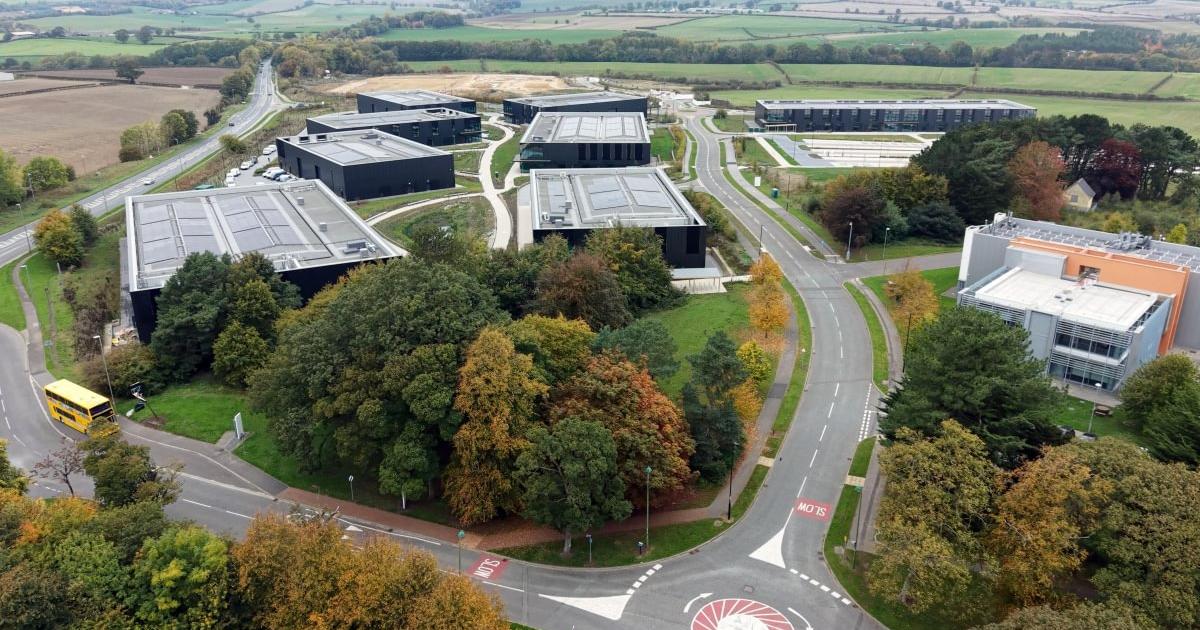
At the North East Technology Park (NETPark) in County Durham, businesses are demonstrating that it is possible to start, scale and commercialise cutting-edge technologies from a single location.

The latest example is advanced materials company SEEDS, which has announced a major expansion as it prepares to move from research and development into commercial-scale production.

The company, which develops engineered graphene technologies for applications in sectors including microelectronics, aerospace, energy storage and advanced manufacturing, is taking on a new dedicated facility as part of NETPark’s £100 million expansion programme.

Advertisement

For founder and chief executive Jason Chehal, the move represents far more than simply acquiring additional space.

“This expansion marks a defining moment for SEEDS, as we move from research excellence into full commercial deployment,” he says.

“Over the past decade, we’ve developed a way to engineer graphene not just as a material, but as a platform technology that can be tuned to solve real-world industrial challenges at scale.”

Jason Chehal, SEEDS (Image: NETPark)

The expansion will increase production capacity and support new industrial partnerships, marking another milestone in the company’s growth journey in Durham.

Advertisement

SEEDS is not alone.

Over the past two decades, NETPark has developed into one of the UK’s leading science and technology campuses. Today, the site is home to more than 40 science and technology companies employing over 1,000 people and working across sectors including advanced materials, semiconductors, photonics, life sciences, defence and space technologies.

Crucially, many of those companies have been able to remain on site as they have grown, retaining valuable expertise, highly skilled jobs and specialist knowledge within the region.

One of the most prominent examples is Filtronic. The telecommunications and aerospace technology company has grown from its NETPark base to become a globally recognised specialist in high-performance radio frequency systems, securing contracts with major international organisations including SpaceX and Airbus.

Advertisement

Similarly, radiation detection specialist Kromek have grown from its origins as a Durham University spin-out into an international technology business, supplying advanced detection systems used in healthcare, security and nuclear industries worldwide, while continuing to expand from its Durham base.

More recently, companies such as aXenic have demonstrated how emerging businesses can also benefit from the ecosystem that has developed around the park. The optical communications specialist is developing advanced modulator technologies for space, aerospace and defence sectors, positioning itself within rapidly growing international markets while remaining firmly rooted in the North East.

Together, these businesses highlight an important trend — companies are increasingly choosing locations that can support both innovation and commercial growth.

NETPark’s recent expansion has increased the site’s capacity by around 285,000 sq ft of specialist laboratory and advanced manufacturing space, creating opportunities for businesses that have outgrown their existing facilities but do not want to leave the region.

Advertisement

Space is only part of the attraction. Long-standing partnerships with Durham University and the Centre for Process Innovation (CPI) give companies access to research expertise, specialist facilities and commercialisation support.

SEEDS has benefited directly from that approach, working with CPI to refine manufacturing processes and develop pathways to commercial production. Its partnership with Japanese industrial giant Mitsui is now helping accelerate access to international markets.

The result is an environment where businesses can access the support they need to move from research and development to commercial success.

Chris Pape, Property Director at Business Durham, believes that is one of the park’s greatest strengths.

Advertisement

“There is something incredibly satisfying about seeing a company grow from an ambitious idea into a business with global potential, and then knowing that journey has happened here in County Durham.

“SEEDS joins a growing list of companies that have chosen to scale at NETPark. That tells us we’re creating the right environment for innovation, but it also means the jobs, expertise and opportunities created by that success stay in the region.” Says Chris Pape.

When companies scale locally, they retain skilled jobs, specialist expertise and supply chain opportunities in the North East, strengthening the region’s reputation and helping attract future investment.

As more businesses follow the path established by these companies Durham is demonstrating that innovation does not need to migrate elsewhere once a company is ready to grow.

Advertisement

Instead, businesses are proving that world-leading technologies can be developed, manufactured and commercialised from the North East, creating jobs, attracting investment and building internationally competitive industries along the way.

For SEEDS, the next chapter will focus on taking its engineered graphene technology to global markets. For Durham, it is another sign that the region is becoming an increasingly important location for companies looking not only to innovate, but to scale.

Find out more:

northeasttechnologypark.com

Advertisement

Source link

Continue Reading

NewsBeat

Small boat record smashed again as 230 migrants smuggled into Britain on ‘mega dinghy’ – despite Labour claims its ‘smash the gangs’ policy is working

Published

on

The migrant mega-dinghy - pictured in Dover today - with 230 people aboard reached Britain overnight

Advertisement

A migrant mega-dinghy with 230 people aboard reached Britain overnight, according to reports.

It smashed the previous record for the largest number of migrants in a single dinghy – set just 17 days earlier with 165.

The 230 arrivals are yet to be officially confirmed by the Home Office.

But if the unofficial count – obtained by GB News – is accurate it would be more than the typical capacity of a Boeing 737 jet.

Advertisement

People traffickers are currently thought to charge around £2,000 per head for illegal passage to Britain – meaning this single dinghy could have made them a staggeirng £450,000 profit.

Their new mega dinghies are floating deathtraps and, at 42ft, are longer than a double-decker bus.

It comes after a Home Office source unwisely insisted on Friday that Labour’s plan to tackle the Channel crisis was ‘beginning to bear fruit’.

The overnight arrivals mean more than 900 migrants reached Britain over the weekend.

Advertisement

The migrant mega-dinghy – pictured in Dover today – with 230 people aboard reached Britain overnight

Yesterday, French police did nothing more than watch as a baby and toddlers were carried aboard a dinghy to England

Yesterday, French police did nothing more than watch as a baby and toddlers were carried aboard a dinghy to England

Last week officials confirmed that traffickers are adapting their methods in a bid to circumvent Labour’s ‘smash the gangs’ strategy.

Advertisement

On Sunday French police looked on as a baby and toddlers were carried aboard a dinghy to England.

Dozens of migrants clambered aboard the boat in the waves off Camiers beach, south of Boulogne.

The youngest hauled aboard was a baby who appeared to be just months old. There were a number of other young children and women, too, alongside mostly young men.

Enhanced policing designed to block the traffickers – such as by seizing boats and outboard motors – has seen gangs ‘experiment’ with using mega dinghies on the Channel, they said.

Advertisement

They are also deploying co-ordinated dinghy launches from a wider area of the French and Belgian coast in a bid to evade detection.

Advertisement

But despite a 43 per cent reduction in the number of migrants reaching Britain year-on-year there is still the same level of demand for illegal crossings in migrant camps in northern France, it is understood.

Advertisement

Officials believe smugglers’ use of the extra-large vessels – which are longer than a double-decker bus – increases the risk of a mass tragedy.

An incident on Tuesday last week involving a mega-dinghy with 173 people aboard saw them rescued in a major operation after its motor caught fire.

The terrifying scenes off the French coast were the closest to a ‘mass casualty incident’ that has been seen on the Channel in years, officials admitted.

The Government scrapped the Conservatives’ Rwanda asylum deal shortly after the 2024 General Election and instead attempted to tackle the small boats crisis through improved work by police and other law enforcement agencies.

Advertisement

Home Secretary Shabana Mahmood secured a new security deal with the French in April that will see £662million handed over by the British taxpayer over three years.

Officials have insisted it is having an effect, despite Shadow Home Secretary Chris Philp last month observing at first hand how gendarmes refused to intervene as migrants scrambled aboard a dinghy. Similar scenes were repeated on Sunday.

A Home Office source said: ‘Numbers are down, but we are not complacent.

‘This Government is focused on what works – and our work is beginning to bear fruit.’

Advertisement

Advertisement

Source link

Continue Reading

NewsBeat

‘Dangerous man’ raped teenage girl in Cambridge after getting into bed with her

Published

on

Cambridgeshire Live

The man denied raping the victim

A “dangerous man” who raped a teenage girl in Cambridge has been sent to prison. Steven Coulson, 32, got into bed with the girl in the early hours of January 8, 2024.

Advertisement

He began touching her and she asked him to stop but he continued to touch her. When she tried to get out of the bed Coulson pulled her back and raped her, according to Cambridgeshire Police.

Police were informed and the 32-year-old handed himself in at Parkside Police Station on January 10. In interview, he denied raping the victim.

However, on Thursday, August 6, Coulson, of Newton Close, Cottenham, South Cambridgeshire, was jailed for nine years and nine months, having been found guilty of rape and assault a female 13 and over by penetration with part of the body at Cambridge Crown Court.

Coulson was also handed an indefinite sexual harm prevention order and restraining order as well as being placed on the Sex Offenders Register for life.

Advertisement

Detective Sergeant Molly Halksworth, who investigated, said: “Coulson is a dangerous man who took advantage of the victim so I’m glad he’s been brought to justice. I would also like to pay tribute to the victim’s bravery in coming forward and supporting us with a prosecution.”

Source link

Continue Reading

NewsBeat

Kim Kardashian cosies up to boyfriend Lewis Hamilton before posing in a bikini in loved-up snaps after the F1 star shared how she ‘makes him happier’

Published

on

Kim Kardashian and her boyfriend Lewis Hamilton showed their romance is stronger than ever as they posed for a string of loved-up snaps

Kim Kardashian and her boyfriend Lewis Hamilton showed their romance is stronger than ever as they posed for a string of loved-up snaps.

The Formula One star, 41, and the SKIMS mogul, 45, have been dating since February, and she even supported him at the Monaco Grand Prix in June.

Kim shared a post on Instagram offering a glimpse at her recent week, which included several selfies with Lewis, who has been enjoying the F1 summer break.

One snap showed the pair cosied up together in matching loungewear, while another showed Kim dressed in a low-cut white crop top.

Advertisement

Kim also offered a glimpse at her famous curves in a snap dressed in a skimpy pink and white bikini. 

In July, the British star made a rare comment about his ladylove at Silverstone Circuit racing venue during the British Grand Prix.

Kim Kardashian and her boyfriend Lewis Hamilton showed their romance is stronger than ever as they posed for a string of loved-up snaps

Advertisement
The SKIMS mogul also offered a glimpse at her famous curves in a snap dressed in a skimpy pink and white bikini

The SKIMS mogul also offered a glimpse at her famous curves in a snap dressed in a skimpy pink and white bikini

After a fan observed, ‘You’ve been a happier man recently, why’s that? Could that be a girlfriend?’ Hamilton responded: ‘Yeah, that’s a good one!’ 

He later added: ‘Of course, of course, it’s Kim.’

Earlier this summer, the sports star joined his girlfriend and her huge family on a lake trip.

Advertisement

He appeared in various photos she shared on social media, revealing he has met and spent time with the four kids she shares with ex-husband Kanye West, 49: North, 13, Saint, 10, Chicago, eight, and Psalm, seven.

Kardashian and West tied the knot in Italy in 2014, less than one year after North was born.

She filed to divorce the Chicago-born rapper in February 2021 and the split was finalised in November 2022.

Prior to West, she was married twice before – first to music producer Damon Thomas, whom she divorced in 2004 after nearly four years of marriage.

Advertisement

She later wed NBA player Kris Humphries in 2011, with the marriage famously lasting just 72 days. The divorce was finalised in 2013.

Kim shared a post on Instagram offering a glimpse at her recent week, which included several selfies with Lewis, who has been enjoying the F1 summer break

Kim shared a post on Instagram offering a glimpse at her recent week, which included several selfies with Lewis, who has been enjoying the F1 summer break

One snap showed the pair cosied up together in matching loungewear, while another showed Kim dressed in a low-cut white crop top (pictured)

One snap showed the pair cosied up together in matching loungewear, while another showed Kim dressed in a low-cut white crop top (pictured)

The couple looked cosy as Kim held Lewis's arm as they posed in sunglasses

The couple looked cosy as Kim held Lewis’s arm as they posed in sunglasses 

Advertisement
The F1 star and the reality star looked more loved-up than ever in selfies

The F1 star and the reality star looked more loved-up than ever in selfies 

Hamilton was first romantically linked to SKIMS founder Kardashian earlier this year, yet the Grand Prix marked their first PDA-filled outing. 

The pair enjoyed a trip to Japan together and they are said to have spent a weekend at Estelle Manor in the Cotswolds, England, as well as visiting Paris, France in early February. 

They also appeared publicly together during the 2026 Super Bowl in February, when they were shown on the stadium’s big screen during the game between the New England Patriots and the Seattle Seahawks.

Advertisement

Hamilton – who has previously been linked romantically with singer Nicole Scherzinger and actress Sofía Vergara – and Kardashian had known each other for several years before getting together.

A source told Us Weekly: ‘Because their relationship started with a friendship first, those closest to them believe this could be endgame for them both.

‘They are both very committed to making things work no matter how long the distance is or how busy they are.’

Meanwhile, Kardashian – who is mother to North, 13, Saint, ten, Chicago, eight, and Psalm, seven, with her ex-husband Kanye West – is said to be taking her new relationship seriously.

Advertisement

A source recently told PEOPLE: ‘[Lewis is] just an easy-going guy with great energy. Her family likes him and Kim’s very into him. They are both busy with their careers, but see each other as much as possible.’

They are said to have ‘more than just a casual connection’ with the insider adding: ‘It takes a lot to capture Kim’s interest and she’s definitely intrigued.’

Source link

Advertisement
Continue Reading

NewsBeat

French police stand and watch as months-old baby is carried aboard a packed dinghy headed for Britain

Published

on

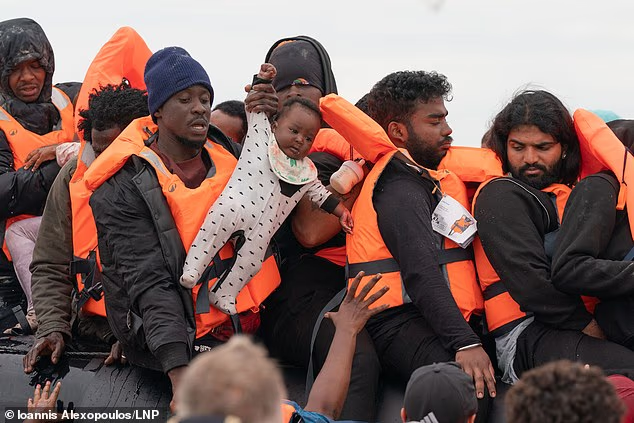
A man holds a baby in a babygrow as migrants board a dinghy at the beach at Ecault in France

French police did nothing more than watch as a baby and toddlers were carried aboard a dinghy to England.

Dozens of migrants clambered aboard the boat in the waves as tourists enjoyed lunch on the beach yesterday.

The youngest hauled aboard was a baby who appeared to be just months old. There were a number of other young children and women, too, alongside mostly young men.

Police apparently threatened to arrest the photographer who captured the images of French officers standing by as babies and toddlers were dragged on to the dinghy from the sea by their arms. 

Advertisement

The migrants motored off and were picked up in the middle of the Channel by a British Border Security Command vessel and taken into Dover.

The group of migrants were just a small portion of the 2,092 who have already crossed the channel since Andy Burnham became Prime Minister just three weeks ago.

Remarkably, they were boarding a small boat the French authorities had closely tracked for nine-and-a-half hours – and simply let it be – as it picked up multiple groups of passengers along the French coast.

The dinghy appears to have been launched near Dieppe at around 4am. 

Advertisement

This is far further south than from where boats usually leave, but people-smugglers are using new launch spots away from regular police searches. 

Soon after setting off it was followed by a French coastguard vessel – but only in case of a sinking.

After 40 miles it pulled in alongside Berck beach, then 12 miles further north it approached Camiers beach at around noon, where photographer Ioannis Alexopoulos saw the youngsters taken on board after groups of migrants had emerged from the dunes.

Mr Alexopoulos said: ‘Three police turned up, gendarmes in military clothes – but all they did was film, and threaten to arrest me if I kept taking pictures.’ 

Advertisement

A man holds a baby in a babygrow as migrants board a dinghy at the beach at Ecault in France

French police watched on from the beach

French police watched on from the beach 

A toddler is dragged aboard as French police watch on

A toddler is dragged aboard as French police watch on

Advertisement
Migrants wait in the sea to board a taxi boat to their dinghy

Migrants wait in the sea to board a taxi boat to their dinghy

Life jackets for sale at the French sports superstore Decathlon in Dunkirk

Life jackets for sale at the French sports superstore Decathlon in Dunkirk

Advertisement

This comes as the Daily Mail revealed that sporting goods stores in the northern French towns of Calais and Dunkirk have become key to the operations of gangs smuggling people into Britain.

Migrants appear to be buying up lifejackets en masse from the retailers, with the flimsy, €17.99 (£15.40) garments offering little protection against the perilous crossings they are set to undertake. 

This, however, is only the last step in a vast international supply chain spanning all the way to China, which is profiting off migrants’ desperation, misery and suffering. 

Last week it was revealed that the average number of migrants crammed onto small boats has more than doubled over five years to a record high under Labour.

Advertisement

Analysis found 66 migrants on average were packed onto each of the 219 vessels which have successfully crossed the Channel so far this year. They were carrying 14,561 migrants in total.

This was up from an average 28 per boat for the whole of 2021, when 1,064 vessels carrying 28,526 migrants made it to the Kent coast.

It was also an increase from the average 62 arrivals per boat last year and 53 in 2024.

The findings come amid a surge in the use of so-called ‘mega-dinghies’ capable of carrying more than 100 people as people smugglers shift their tactics.

Advertisement

Experts said it was likely because smugglers are starting to launch more boats away from Calais and Dunkirk, where distances between the French and UK coastlines are much greater. This means larger and more powerful boats capable of travelling further are needed.

Former head of UK Border Force, Tony Smith, said: ‘These mega-dinghies are clearly built to carry many more migrants than the original business model.

‘That suggests the crime gangs in Europe have moved towards manufacturing larger boats because the French authorities have at least done something in Calais and Dunkirk.

‘It’s much harder now to launch from some of those beaches that we’ve seen in the past.

Advertisement

‘They’re now moving further down the French coast, and the crime gangs have said we don’t need loads of small dinghies anymore because that’s going to be quite difficult to get people across.

Migrants board their dinghy at Ecault, France, before attempting to cross the English Channel

Migrants board their dinghy at Ecault, France, before attempting to cross the English Channel

The migrants were rescued in the middle of the Channel trying to reach the UK and taken to Dover by a Border Security Command vessel

The migrants were rescued in the middle of the Channel trying to reach the UK and taken to Dover by a Border Security Command vessel

‘They’ve probably needed to start manufacturing larger vessels capable of travelling longer distances and carrying more migrants.’ 

Advertisement

In recent weeks, a new record was set for the number of migrants reaching Britain in one day. 

Official Home Office figures showed there were 752 arrivals on July 30, smashing the previous high of 710 set in June. 

And last month, two boats carrying 128 and 165 migrants respectively made it across the Channel, both smashing the previous record for the most-packed vessels to successfully make it to Britain.

At least 14 UK-bound migrants have died in the Channel this year, either by drowning or through suffocation aboard overcrowded small boats.

Advertisement

After previous Prime Minister Sir Keir Starmer won the 2024 election, he ditched the Tories’ Rwanda deportation plan and instead focused on ‘smashing the gangs’.

In April, as part of the strategy, Home Secretary Shabana Mahmood signed a £662million deal over three years with France to crack down on crossings.

But while crossings are down 40 per cent compared to last year, Labour has failed to stop the boats completely.

And more enforcement in concentrated areas appears to have caused smugglers to try and launch boats from further away on the French coastline from Calais and Dunkirk.

Advertisement

New premier Andy Burnham faced criticism after gaining the keys to Downing Street last month and failing to mention the issue in his maiden speech.

It took him two weeks to visit Dover after he prioritised announcements on capping bus fares, slashing VAT on energy bills and unveiling his No10 North, which critics have branded a ‘gimmick’.

Calais was previously known for one such settlement, nicknamed the ‘Jungle’, which at its largest housed around 8,000 migrants – but was cleared by French authorities in 2016.

Around 700 migrants are still sleeping rough in the city, according to charity Care4Calais, whose possessions are often seized by police determined to stop another long-term camp forming.

Advertisement

And the port city of Dunkirk has become a similar hotspot, with thousands of asylum seekers living in tents in the Grande-Synthe and Loon-Plage areas of the city.

Facing an indeterminate wait for a crossing they have likely paid extortionate sums to traffickers for, the migrants often need to be prepared at a moment’s notice.

To do this, they seem to have been turning – of all places – to the sporting goods chain store Decathlon.

One branch in Dunkirk is in a retail park in the heart of the city’s Grande-Synthe suburb, an inland industrial area just off the motorway, to the west of the harbour and port.

Advertisement

Migrants living in the area, on arable and wooded land next to the busy D601 road, are understood to often catch the bus to the store.

When the Daily Mail visited this week, men, women and children could be seen walking from a complex of tents along the highway to reach a bus station outside a nearby shopping complex.

There, they appeared to buy essentials like food – many were seen walking back with large bags of baguettes – or travel onwards on the bus roughly 5km (three miles) to the Decathlon store.

Indeed, it was at a bus stop across the road from the chain sports shop where two people who appeared to be migrants could be seen waiting with lifejackets.

Advertisement

Rather than arriving by car – like most visitors to the retail park the Decathlon store is in – the men were on foot, buying only the buoyancy aids and no other gear before heading off.

Outside the front entrance to the shop, the Daily Mail spoke to another two men who had each purchased around a dozen lifejackets inside, which they had stowed in grey bin bags.

The pair, from Iraq, who wished to remain anonymous fearing for repercussions from the British government, confirmed they were set to use the vests to take a small boat to the UK.

When asked, ‘Did you buy lifejackets in there?’ and, ‘Is it for a boat crossing? Are you going to be on a boat to the UK?’ they simply responded, each time, ‘Yes’.

Advertisement
Migrants pictured leaving a local sports shop in Dunkirk rammed with lifejackets

Migrants pictured leaving a local sports shop in Dunkirk rammed with lifejackets

Another man was spotted leaving the store with at least ten lifejackets. Like the Iraqi men, he had come prepared, bringing bin bags to carry them in

Another man was spotted leaving the store with at least ten lifejackets. Like the Iraqi men, he had come prepared, bringing bin bags to carry them in

He was seen packing the vests just inside the exit from the store in Dunkirk, France

He was seen packing the vests just inside the exit from the store in Dunkirk, France

One man, who said the pair had waited with their relatives in France for two months to be able to cross, added: ‘We are with our family. These are not all for me!

Advertisement

‘We’ve had a long journey to get here. We’ve travelled a long way.’

The man wished our reporter a nice day before saying goodbye. It was sobering – while her day would carry on, his, with a perilous boat crossing imminent, might end quite differently.

It also suggested migrants appear to have to buy their own buoyancy aids – and that they are not covered by their extortionate crossing fares.

Another man was spotted leaving the store with at least ten lifejackets. Like the Iraqi men, he had come prepared, bringing bin bags to carry them in.

Advertisement

He was seen packing the vests just inside the exit from the store, before tying the bags together and slinging them over his shoulder. When approached by the Daily Mail, he did not respond.

A group of three other men were also spotted carrying similarly sized bin bags across the car park away from the store.

Purchases appeared to happen in waves – perhaps in line with and reactive to when a particular crossing was planned.

Indeed, over the three days the Daily Mail visited the Decathlon store in Dunkirk, all lifejacket transactions witnessed happened on a single day and in quick succession.

Advertisement

Inside the shop, there is plenty of choice – the shelves in the water sports section are full of orange lifejackets, immediately recognisable after years of migrant-related headlines.

Racks on racks – along with a large bin, sitting under a print of an ominously enormous wave – offered a range of sizes, with a high proportion designed for babies, of only 10 to 15kg.

Starting at just €17.99 for the most basic design – little more than polyester-bound foam – the aids ranged in price up to €89.99 (£77.20), for the most sophisticated gas cylinder-powered model.

Various combinations of whistles, additional straps and reflective patches saw other designs offered for €19.99, €29.99 and €34.99.

Advertisement

It was these mid-range versions which most often appeared in purchases witnessed by the Daily Mail. Buying ten, for example, might therefore set you back several hundred euros.

The gas-powered vests, meanwhile, were priced higher, at €54.99, €55 and €79.99 as complexity increased – with some even labelled as ‘tested and validated by French Lifeguards’.

Source link

Advertisement
Continue Reading

NewsBeat

Car washes and swimming pools could be banned from using water as record-breaking drought worsens with temperatures set to rise to 36C again

Published

on

A drone view shows parched grassland around Stonehenge in Wiltshire on July 31

Car washes and swimming pools could face a water ban as the record-breaking drought worsens with no rain in sight and a sixth heatwave of the year this week.

Some 27million people across England and Wales are already under a hosepipe ban as reservoir levels plunge amid an extraordinarily hot and dry spring and summer.

Nine water companies have brought in restrictions which mean customers are legally banned from using hosepipes to water gardens or wash cars, patios or boats.

Southern Water is among them, having imposed a ban in Hampshire and the Isle of Wight on July 10 – but it could now go further by applying to the Government for a Drought Order and Non-Essential Use Ban (NEUB), which would affect businesses.

Advertisement

A NEUB would prevent companies from washing cars and windows with hosepipes or other mechanical devices, or filling non-domestic swimming or paddling pools.

The pool ban would cover facilities restricted to members of a private club, gym or association rather than general walk-in users. It would include pools at hotels, holiday parks or private health clubs if they do not meet open public access criteria.

An NEUB would also force businesses to stop watering outdoor plants on commercial premises; fill or maintain a pond; clean any vehicle, boat, aircraft or train; clean industrial plants; suppress dust; or operate cisterns on unoccupied buildings.

If Southern Water’s application is granted, it would be the first NEUB since one was given to Sutton and East Surrey Water in 2006 – which was itself the first since 1995.

Advertisement

Advertisement

A drone view shows parched grassland around Stonehenge in Wiltshire on July 31

A green square surrounded by dry grass at Maidenhead and Bray Cricket Club on July 25

A green square surrounded by dry grass at Maidenhead and Bray Cricket Club on July 25 


A sunbather reads while relaxing on the scorched grass of Hyde Park in London yesterday

A sunbather reads while relaxing on the scorched grass of Hyde Park in London yesterday

Advertisement

If the separate Drought Order application is successful, it would allow Southern Water to take the same amount of water from the River Test even if river flows are lower.

Advertisement

A Southern Water spokesman said: ‘Due to the ongoing dry weather, and following the declaration of drought in Hampshire and the Isle of Wight, we have reached the trigger level requiring us to apply to Defra for a Drought Order and Non-Essential Use Ban in these areas.

‘These are precautionary measures and making an application does not mean they will be introduced. However, we must follow the regulatory process to protect water supplies and the environment if dry conditions persist.

Difference between a hosepipe ban and non-essential use ban

Hosepipe ban

A Temporary Use Ban (TUB) – also known as a ‘hosepipe ban’ – means people cannot use their hosepipes for watering their garden, filling a paddling pool or washing their car.

Advertisement

They can still water their plants and clean their car, but must use a watering can or bucket instead of a hosepipe. Anyone who breaks the rules can face a fine of up to £1,000.

Non-Essential Use Ban (NEUB)

A non-essential use ban (NEUB) is the next stage after a hosepipe ban, and targets businesses who must stop using water for these activities:

  • Watering outdoor plants on commercial premises
  • Filling or maintaining a non-domestic swimming pool or paddling pool
  • Filling or maintaining a pond
  • Operating a mechanical vehicle washer
  • Cleaning any vehicle, boat, aircraft or railway rolling stock
  • Cleaning non-domestic premises
  • Cleaning windows on non-domestic
  • Cleaning industrial plant
  • Suppressing dust
  • Operating cisterns on unoccupied buildings

<!- – ad: https://mads.dailymail.co.uk/v8/de/news/none/article/other/mpu_factbox.html?id=mpu_factbox_1 – ->

Advertisement

‘Protecting the River Test remains a priority, and any future drought measures would be subject to strict environmental monitoring and controls.’

Eight other companies have brought in hosepipe bans so far – Affinity Water, Anglian Water, Cambridge Water, Dŵr Cymru Welsh Water, Essex and Suffolk Water, South East Water, South West Water and Thames Water.

The latest of these was South West Water which announced restrictions last Friday for all 1.8million customers across Devon, Cornwall, parts of Dorset and Somerset and the Isles of Scilly.

This week, parts of the UK are set to see their sixth heatwave of the summer with temperatures expected to reach 36C (97F) or higher.

Advertisement

The Met Office has warned of possible impacts to railway lines and power networks as forecasters consider issuing rare amber or red extreme heat warnings.

Today will be slightly cooler before temperatures rise again tomorrow.

Met Office meteorologist Tom Morgan said: ‘We’ll probably see highs reaching the mid-30s quite widely on Wednesday, and indeed on Thursday too for England and Wales.

‘On Wednesday, probably the Midlands, maybe a little bit further south, the M4 corridor, west of London, up towards the Midlands, is where we might have a small chance of reaching 36C in one or two spots.

Advertisement

‘But Thursday at this stage looks the most likely hottest day of the week. So 36C is a fairly reasonable probability locally on Thursday and there’s a small chance it could get even higher than that.’

Drought was declared last month for all of Wales and more than half of England – covering parts of the South East including London, West Midlands and all of the South West.

The Environment Agency has said several further unspecified areas could be moved from ‘dry weather’ to drought status when officials meet at the National Drought Group today.

People walk on parched earth and sun-damaged grass near Tower Bridge in London yesterday

People walk on parched earth and sun-damaged grass near Tower Bridge in London yesterday

Advertisement
Parched land around Bratton Camp Iron Age hillfort and the White Horse of Westbury yesterday

Parched land around Bratton Camp Iron Age hillfort and the White Horse of Westbury yesterday

Parched grass at St James's Park in London yesterday as the extremely dry weather continues

Parched grass at St James’s Park in London yesterday as the extremely dry weather continues

People look at the Thames Estuary in Allhallows, Kent, yesterday ahead of the new heatwave

People look at the Thames Estuary in Allhallows, Kent, yesterday ahead of the new heatwave

Beachgoers at St Anthony Head in Cornwall yesterday as fresh heat health alerts began

Beachgoers at St Anthony Head in Cornwall yesterday as fresh heat health alerts began

Advertisement
The Wisley Golf Club in Woking, Surrey, has the odd area of green among otherwise dry ground

The Wisley Golf Club in Woking, Surrey, has the odd area of green among otherwise dry ground

Beaverbrook Golf Club in Leatherhead, Surrey, is very dry apart from a few patches of green

Beaverbrook Golf Club in Leatherhead, Surrey, is very dry apart from a few patches of green

Around 16million people could move into drought status as public water supplies ‘remain under increasing pressure with continued dry weather and high demand’.

Mr Morgan said: ‘If it wasn’t for this incredible summer that we’re currently seeing, then we’d be talking about these temperatures as being really, very unusual. But of course, we’ve had such an exceptional summer, people have become a bit used to it.


Advertisement

‘There is a potential for impacts, so impacts to infrastructure, things like railway lines and power networks, impacts to vulnerable people as well.’

Water firms imposing hosepipe bans in 2026

  • Affinity Water
  • Anglian Water
  • Cambridge Water
  • Dŵr Cymru Welsh Water
  • Essex and Suffolk Water
  • Southern Water
  • South East Water
  • South West Water
  • Thames Water

<!- – ad: https://mads.dailymail.co.uk/v8/de/news/none/article/other/mpu_factbox.html?id=mpu_factbox_2 – ->

Health officials have warned of the effect on vulnerable people in the upcoming hot weather, with significant impacts possible in health and social care settings and a potential rise in deaths because of the heat.

Yellow heat health alerts issued by the UK Health Security Agency are in place for the East Midlands, West Midlands, South East, South West, East of England, Yorkshire and the Humber, and London.

Advertisement

The alerts continue until 9pm tomorrow, but could be extended as the hot weather continues.

Meanwhile, the Met Office is considering issuing rare extreme heat warnings ahead of the scorching temperatures forecast later in the week.

‘We sometimes issue extreme heat warnings, amber and red warnings, which we did back in June, so that’s under consideration at the moment,’ Mr Morgan said.

Another record is set to tumble this week after yesterday was the 34th day so far this year when temperatures exceeded 30C (86F) somewhere in the UK, equalling the record from 1995.

Advertisement

So far, the extreme weather of summer 2026 has included two record-breaking heatwaves in May and June that led to more than 2,800 excess deaths.

Advertisement
The UK Health Security Agency (UKHSA) has issued yellow heat health alerts across England

The UK Health Security Agency (UKHSA) has issued yellow heat health alerts across England

A UK heatwave is official when a location records at least three consecutive days of daily maximum temperatures which meet or exceed a specified threshold - which varies by region

A UK heatwave is official when a location records at least three consecutive days of daily maximum temperatures which meet or exceed a specified threshold – which varies by region

Two more heatwaves in July, the driest July in England and Wales since records began in 1836, have fuelled drought and wildfires. 

Advertisement

The fifth heatwave of the year was confirmed on Monday last week.

Much of southern England is now close to two months without any meaningful rainfall – with Wisley in Surrey having had more than 50 consecutive dry days.

The exceptional weather resulted in a record number of wildfires for England and Wales last month – with firefighters attending 395 blazes in the three weeks to July 31 amid fears the ‘whole country is like one giant tinderbox’, reported The Times.

On the A31 near the New Forest in Hampshire yesterday, police told drivers to leave their cars ‘if you want to stay alive’ as a van fire sparked a wildfire.

Advertisement

Fears are also growing over more water-related deaths, after a 19-year-old died on Saturday after getting into difficulty in the water at Grasmere in the Lake District.

The European Union’s earth observation programme Copernicus said average temperatures across western Europe reached 21.61C (70.92F) for June to July, breaking the record set in 2022.

Globally, this year is just behind 2024 and 2025 as the third hottest year on record.

Source link

Advertisement
Continue Reading

Trending

Copyright © 2025