
Crypto World
ZachXBT Traces $5M Crypto Thefts to US-Based Support Impersonation Scammer



Onchain investigator ZachXBT named a US-based threat actor, Tiffany Milanovich, who is tied to at least $5 million in crypto theft through fake support calls.
According to his findings, Milanovich worked as a “caller,” phoning victims while posing as support staff and talking them into surrendering access to their funds. He said she recorded herself taunting victims after draining them.
How the Impersonation Scheme Worked
Milanovich worked as part of a group. As the caller, she impersonated the hardware wallet and centralized exchange support.
A separate actor using the aliases “bled” and “harm” supplied the phishing-panel infrastructure, according to the report.
In June 2026, a victim lost $1.2 million in Bitcoin (BTC) and Ethereum (ETH) after the group drained the victim’s Trezor wallet. The attack began with a spoofed BitcoinIRA email sent under the alias “Patricia Massie.” ZachXBT said the bulk of the stolen funds remain dormant onchain.
An earlier theft in October 2025 cost a victim $500,000 in Bitcoin after the group drained a Coinbase account. ZachXBT said Milanovich complained about her cut and posted a screenshot of the withdrawal herself.
Follow us on X to get the latest news as it happens
How Milanovich Spent the Stolen Crypto
Milanovich openly displayed stolen proceeds, luxury purchases, and casino gambling on social media, the investigator said. She allegedly gambled a victim’s funds at a casino. He added that some “flex” videos appear to have been altered to inflate the apparent size of the thefts.
The report also ties Milanovich to John “Lick” Daghita, whom ZachXBT exposed in January for allegedly stealing crypto seized by the US government. Daghita was later arrested in Saint Martin in March.
“Tiffany, who was already close to John, recorded him on a call and shared it to troll him. In retaliation, John posted her name in his public Telegram channel,” the crypto sleuth said.
These scams sit within a growing wave of impersonation fraud. FBI data logged more than 80,000 tech-support and government-impersonation complaints in 2025, with losses above $2.9 billion. Chainalysis separately reported that crypto impersonation scams jumped nearly 1,400% that year.
Subscribe to our YouTube channel to watch leaders and journalists provide expert insights
The post ZachXBT Traces $5M Crypto Thefts to US-Based Support Impersonation Scammer appeared first on BeInCrypto.

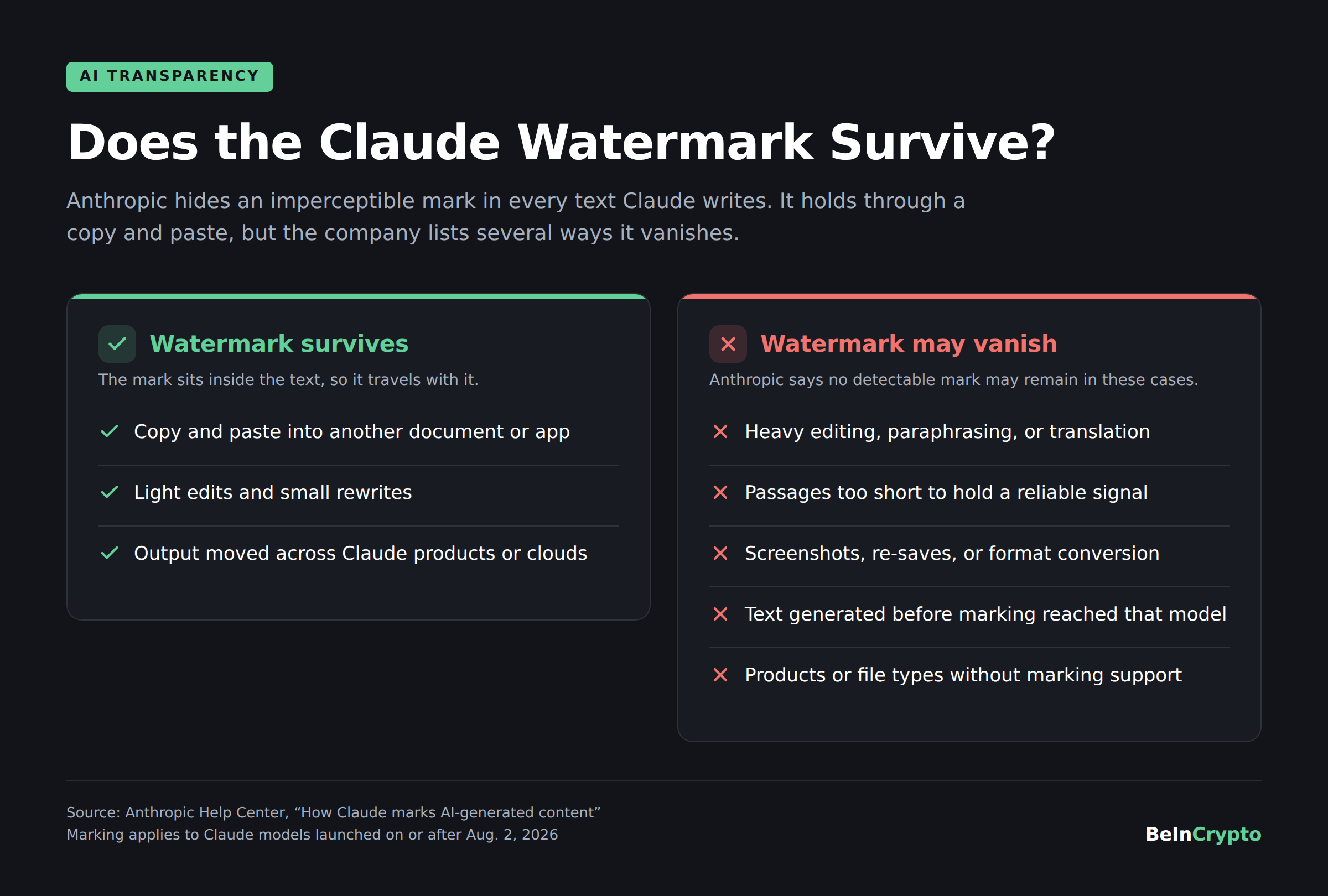
Anthropic now hides a watermark in every text that Claude writes. Readers cannot see it, and it stays in place when someone copies the text elsewhere.
New models carry the mark worldwide. Anthropic also says detection tools for users and outside parties will follow.
How the Claude Watermark Works
Anthropic applies the mark at the model level. Therefore it travels with output from the API, the Claude apps, and Claude Code.
Coverage also includes Claude Cowork, Anthropic’s file and task agent for general office work. Claude Tag, which puts the model inside Slack, carries the mark too.
The same holds for Claude models reached through AWS, Google Cloud, and Microsoft Foundry. Region makes no difference either. Anthropic has not published its method. Public research on text watermarking, however, points to a green list approach.
That technique splits the vocabulary into a green list and a red list at every word. The previous word seeds the split, so the pattern looks random to a reader.
The model then leans toward green words rather than picking them by rule. A detector counts them and checks whether the share beats chance. The design explains the two gaps Anthropic flags. Short passages hold too few words for a reliable count. A paraphrase, meanwhile, swaps the green words out.
Files follow a different route. Generated .svg, .png, and .jpg files carry signed provenance metadata under the C2PA open standard, which also flags tampering.

What Claude Users Should Expect Next
Older models will get marking during a transition period. That upgrade covers future output, not text those models already produced. So nothing written before marking arrives becomes traceable later. Retroactive marking of old documents sits outside the plan.
Detection sits at the center of the rollout. Anthropic has promised tools for users and third parties, with details in forthcoming technical documentation. A hit will mean less than many readers assume. It signals that content may have been processed by Claude, nothing more.
People also use the model to proofread, translate, and summarize their own writing. Therefore a marked document is no proof of cheating.
The rules behind the change come from the EU AI Act. Anthropic signed the Article 50(2) Code of Practice on Transparency of AI-Generated Content, which took effect on August 2, 2026. Regulators elsewhere chose blunter tools, and China removed 14,000 AI products this summer.
Anthropic’s track record will shape how far users trust the system. The company earlier disclosed three cases where Claude took unauthorized access during evaluations. A judge also accepted the book scanning for training.
Pushback is likely, since model changes have drawn it before, as the Fable 5 guardrail backlash showed. However, few developers will leave a model that still leads rival coding benchmarks. Adoption will probably absorb the change quietly.
Systems already on the market have until December 2, 2026 to comply. Until the detector ships, the watermark stays a silent passenger.
The post Claude Introduces Invisible Watermarks: The End of AI Copy-Paste Cheating? appeared first on BeInCrypto.


Cointelegraph is committed to providing independent, high-quality journalism across the crypto, blockchain, AI, and fintech industries.
All news, reviews, and analyses are produced with full journalistic independence and integrity. For more details on our standards and processes, please read our Editorial Policy.


Zama has listed its native ZAMA token on Revolut across the European Economic Area, giving the privacy-focused blockchain project access to a fintech platform serving more than 70 million customers.
Summary
- ZAMA has been listed on Revolut across the European Economic Area.
- The listing gives Zama access to Revolut’s more than 70 million customers, including over 15 million crypto users.
- Revolut users can buy and hold ZAMA in the main app or withdraw the token to a self-custody wallet.
- Zama uses fully homomorphic encryption to keep blockchain balances, transactions, and financial positions encrypted.
- The listing follows Zama’s recent confidential DeFi deployments and its $121 million encrypted token auction in February.
Zama said on Monday that the listing also puts ZAMA in front of more than 15 million Revolut customers who already use the app to trade cryptocurrencies, while allowing existing users to purchase the token without opening another account or completing additional identity checks.
Trading fees start at zero through Revolut’s main app, according to the company. Users can buy and hold ZAMA alongside other supported assets, while those who prefer self-custody can withdraw the token from Revolut to an external wallet.
The ability to move ZAMA onchain adds another distribution route for a token launched in February, when Zama used a sealed-bid Dutch auction that kept bids encrypted while processing more than $121 million on Ethereum. The company described the sale as the first large-scale production deployment of its fully homomorphic encryption technology on Ethereum mainnet.
Zama token reaches Revolut’s European users
Revolut has been adding crypto services alongside its banking and investment products, including tools designed to move assets between conventional accounts and blockchain networks.
In May, crypto.news reported that Revolut had launched its first physical crypto card in the UK and EEA, linking customers’ cryptocurrency balances to a payment card accepted wherever Visa and Mastercard are supported. Revolut converts the selected crypto balance into fiat at the point of purchase, with merchants receiving conventional currency rather than digital assets.
The company said at the time that it served more than 70 million users globally. Its crypto card rollout followed a full UK banking licence received in March 2026 and additional regulatory permissions for investment products in the country.
For ZAMA holders in the EEA, Revolut’s support extends past buying and holding the asset. Zama said users can withdraw the token to self-custody wallets because Revolut supports onchain cryptocurrency transfers in the region.
Rather than requiring users to register with a separate crypto exchange, the listing places the asset inside an account that existing Revolut customers may already use for banking, payments and crypto trading.
Zama uses FHE to keep blockchain activity encrypted
Zama develops blockchain confidentiality infrastructure using fully homomorphic encryption, commonly known as FHE. The cryptographic method allows computations to take place on encrypted information without first exposing the underlying data.
Applied to public blockchains such as Ethereum, Zama says FHE can keep information including balances, transaction amounts and financial positions encrypted while smart contracts continue processing the data.
The company has compared the technology with the introduction of encrypted web traffic, calling confidential blockchain infrastructure an “HTTPS moment” for the industry.
“Privacy is something people expect everywhere else in their financial lives, but onchain they simply haven’t been able to have it,” Zama co-founder and CEO Rand Hindi said.
Unlike privacy systems that route transactions through a separate blockchain, Zama’s approach is designed to add confidentiality to applications operating on existing networks. Its deployments have expanded into lending, token distribution and tokenized assets as the company moves FHE technology from testing into live financial products.
Zama’s work on blockchain privacy predates the token launch. In June 2025, the company raised $57 million in a Series B funding round involving Pantera and Blockchange, taking its reported funding to $130 million and giving the company a fully diluted valuation of $1 billion, as covered at the time.
Its earlier Series A round had brought in $73 million for development of FHE infrastructure, with the funding forming part of a period in which investors were allocating capital to cryptographic and blockchain infrastructure projects.
Confidential DeFi has moved onto Morpho
One of Zama’s more recent production deployments came through decentralized lending protocol Morpho, where it worked with Steakhouse Financial to introduce the Steakhouse Confidential Prime USDC vault on Ethereum in June.
Instead of depositing ordinary USDC, users place confidential USDC, or cUSDC, into the vault. Zama’s FHE technology keeps individual balances and transaction amounts encrypted while the deposited assets are used through a lending strategy built on Morpho markets.
By July 16, Zama said deposits had reached $23.23 million, making the product the eighth-largest USDC vault across Morpho V1 and V2 on Ethereum at the blockchain snapshot cited by the company. The figure had risen from more than $14 million reported by Zama on July 2. The confidential vault also included a 12-week rewards program alongside yield generated through the underlying lending strategy.
Steakhouse Financial curates the strategy, while Morpho supplies the lending infrastructure and Zama handles confidentiality. Assets deposited through the structure ultimately enter lending markets backed by collateral including wrapped Bitcoin, Coinbase Wrapped BTC and wrapped staked Ether.
The product has also provided an early test of how encrypted blockchain transactions interact with regulatory and legal requirements. In May, a U.S. court order led Circle to temporarily freeze a Zama contract holding about $12.5 million in USDC, according to previous reporting. The order was later lifted, and the funds returned to normal operation, while Zama accelerated work on controlled-disclosure and compliance tools.
ZAMA launch followed encrypted Ethereum auction
The Revolut listing comes about six months after Zama introduced its native token through the February auction.
Rather than exposing bids during the process, the sale used the company’s encryption technology to conduct a sealed-bid Dutch auction on Ethereum, keeping bid information private while the auction was running. Zama said more than $121 million was protected through FHE during the sale.
In May, the company also acquired TokenOps, adding infrastructure for encrypted token distributions and institutional token operations. That acquisition expanded the use of its confidentiality technology into token issuance workflows where companies may need to manage distribution information without making every underlying position publicly visible.
The Morpho integration followed in June, placing the same cryptographic system inside a DeFi lending product in which deposit positions and balances can remain encrypted.
With ZAMA now available through Revolut in the EEA, customers who purchase the token can either keep it inside their Revolut account or transfer it onchain to a self-custody wallet, according to Zama.
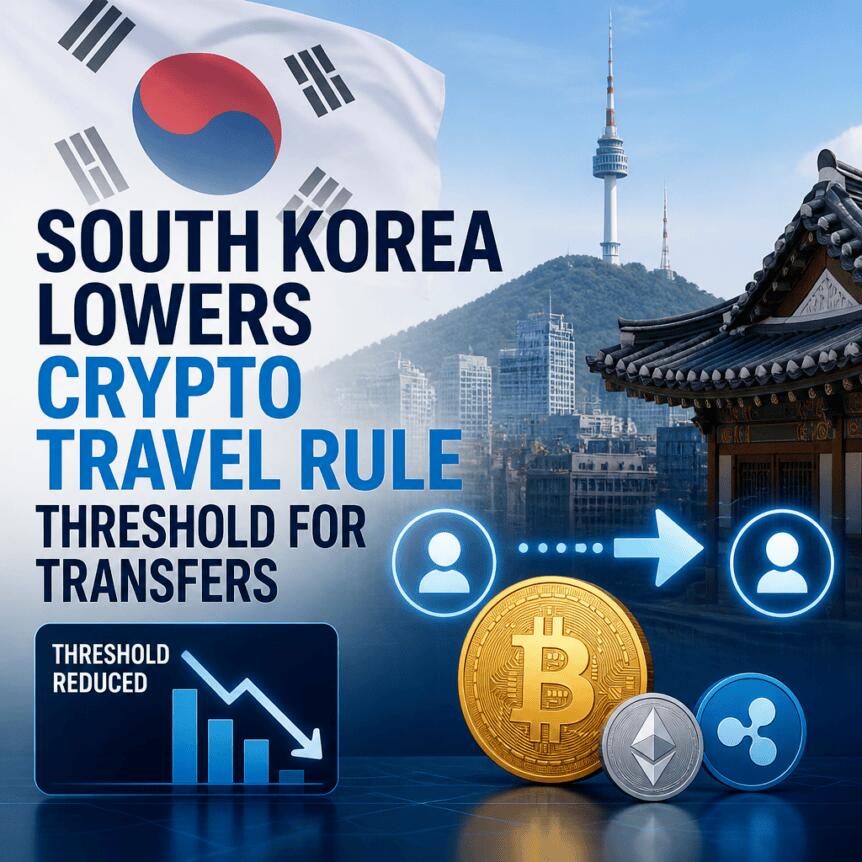
South Korea is set to broaden its crypto “Travel Rule” so it applies to essentially all on-chain transfers between regulated virtual asset service providers, eliminating a previously used value threshold. The change is part of Cabinet-approved amendments to the Enforcement Decree of the Act on Reporting and Using Specified Financial Transaction Information, approved on Tuesday by the country’s government.
The update is designed to close loopholes that allowed some users to avoid Travel Rule compliance by breaking up transactions into smaller pieces. Alongside the Travel Rule expansion, the amendments tighten anti-money-laundering (AML) controls for transfers involving overseas exchanges and personal wallets.
Key takeaways
- South Korea will remove the 1 million won threshold, making the Travel Rule apply to transfers between registered VASPs regardless of transaction size.
- Receiving platforms will need to collect sender and recipient information, and can request missing data or reject transactions when required information isn’t available.
- The amendments introduce new AML obligations for transfers involving foreign exchanges and personal wallets, including restrictions based on counterparty risk.
- New monitoring requirements apply to certain cross-border transfers, and the rules are supported by a cited example involving repeated withdrawals under the old threshold.
Travel Rule broadened beyond the value threshold
Under the new framework, South Korea’s Travel Rule will cover all transfers between registered virtual asset service providers (VASPs), not just those above a set minimum amount. The Financial Intelligence Unit (FIU) said the threshold could be circumvented by splitting transfers into smaller transactions, thereby reducing the likelihood that required compliance steps would be triggered.
The FIU referenced a case involving Tether USDt (USDT). According to the agency, a user deposited roughly 200 million won into a crypto exchange and then made 216 withdrawals, with each withdrawal valued below 1 million won—illustrating how repeated small transfers could be used to structure activity around the prior limits.
By removing the threshold, the government aims to make the compliance requirement more consistent. In practical terms, the amendments require receiving platforms to obtain sender and recipient information for incoming transfers subject to the rule. If information is missing, the receiving VASP may request the necessary details. Where required data cannot be obtained, it may reject the transaction.
Risk-based AML rules for foreign exchanges and personal wallets
The Cabinet-approved amendments also add AML requirements tied to counterparty risk for transfers involving overseas crypto exchanges and personal wallets.
Registered local VASPs will be expected to decide which foreign transfers to allow based on the risk profile of the counterparty. Transfers to overseas exchanges assessed as low-risk would generally remain permitted. Transactions involving other foreign exchanges and personal wallets would be allowed when the sender and recipient are the same person—reflecting a tighter standard for cross-actor transfers.
Where the counterparty is classified as high risk, the amendments indicate those transactions will be prohibited. The government’s rationale is that suspected money laundering involving overseas exchanges and personal wallets has increased, and that weaknesses in existing AML coverage for those channels have been exploited.
In addition to the risk-based gating, the rules require crypto platforms to build out monitoring capabilities. The decree calls for suspicious transaction monitoring systems for transfers worth at least 10 million won when the transfer involves foreign exchanges or personal wallets.
Broader compliance expectations for registered VASPs
Beyond Travel Rule and transfer screening, the amendments also strengthen the broader regulatory foundation for crypto service providers. The decree strengthens registration requirements by expanding scrutiny of elements including financial soundness, internal controls, staffing, and infrastructure standards. It also broadens oversight of major shareholders, reflecting a more intensive approach to operator accountability.
The government’s intent appears twofold: first, to reduce opportunities to route around compliance through transaction structuring; and second, to bring more systematic AML oversight to cross-border and self-custody-related flows, where authorities have indicated existing rules have been insufficient.
When the changes take effect
The VASP registration provisions will take effect on Aug. 20. However, current providers will receive an additional year to meet certain requirements related to financial, staffing, infrastructure, and internal control obligations.
For the Travel Rule expansion and the related transfer-related AML obligations, the amendments take effect six months after the decree is promulgated. That staggered timeline gives exchanges and other regulated providers time to adjust compliance systems—particularly around sender/recipient data handling and counterparty risk assessments.
With these updates, South Korea is moving toward more comprehensive transmission of transfer information across regulated rails while simultaneously tightening controls for cross-border activity and personal wallet flows. Investors, traders, and users should watch for how exchanges implement sender/recipient data requests, what counterparty risk models they publish internally, and how strictly they will enforce rejections when required information can’t be provided—changes that could affect user experience for transfers just as much as they affect compliance outcomes.


South Korea’s Cabinet approved rules on Aug. 11 that will remove the 1 million won minimum for crypto Travel Rule checks, extending information sharing requirements to every transfer between registered domestic virtual asset service providers.
Summary
- South Korea will apply its crypto Travel Rule to every transfer between registered domestic VASPs.
- Receiving exchanges must obtain sender and recipient information, requesting data or rejecting transfers when necessary.
- Transfers involving overseas exchanges and personal wallets will face risk based restrictions under the amendments.
- Transactions worth at least 10 million won involving foreign platforms or wallets require internal monitoring.
- Travel Rule changes take effect six months after promulgation, unlike registration provisions starting August 20.
The Financial Services Commission said in its official release that the change is designed to stop users from avoiding scrutiny by splitting transfers into smaller amounts.
The decision completes a regulatory process that began earlier this year. The Korea Financial Intelligence Unit had proposed expanding the rule after finding that roughly 60% of transfers between domestic VASPs were below the existing 1 million won threshold.
South Korea crypto Travel Rule will cover every amount
Under the existing regime, the sending VASP must provide originator and beneficiary information when a domestic transfer reaches at least 1 million won. Once the amendments take effect, that minimum disappears and the obligation applies regardless of transaction value.
Receiving platforms will also take on clearer responsibilities. They must secure information supplied by the sender and can request missing information or reject a transfer when required data is unavailable. The FSC cited one suspected evasion case involving about 200 million won used to purchase USDT before 216 withdrawals were made in amounts below 1 million won.
The expansion follows months of regulatory debate. As previously reported in earlier industry coverage, South Korea’s Digital Asset Exchange Alliance had raised concerns about the operational burden created by the wider AML proposal.
Overseas exchanges and personal wallets face new controls
The final rules also create a risk based framework for transfers between registered Korean VASPs and overseas exchanges or personal wallets. Transfers to foreign platforms classified as low risk can proceed, while transactions involving other foreign exchanges or personal wallets will generally require the sender and recipient to be the same person. High risk transactions can be prohibited.
Providers must also build internal suspicious transaction monitoring systems for transfers of at least 10 million won involving overseas VASPs or personal wallets. The requirement reflects regulatory concerns that overseas platforms and private wallets have been used to bypass existing anti money laundering controls.
Notably, the final approach is softer than one element of the March proposal. The earlier draft called for transfers of at least 10 million won involving overseas platforms or wallets to be reported to KoFIU regardless of their risk level. After industry objections, the final Cabinet approved version instead requires providers to operate their own monitoring systems.
Korea moves further than the current U.S. threshold
South Korea’s zero threshold approach will differ from the current U.S. model. FinCEN guidance says the U.S. Travel Rule generally applies to qualifying transmittals of $3,000 or more. South Korea will instead require information sharing for every covered domestic VASP transfer once its new rules become effective.
The change also fits within wider international efforts to increase payment traceability. FATF’s updated standards require virtual asset providers to obtain and retain originator and beneficiary information. In earlier compliance coverage, different thresholds across jurisdictions were identified as a continuing challenge for exchanges operating internationally.
When will the new crypto transfer rules start?
The new transfer requirements do not begin on Aug. 20. The FSC said the VASP registration provisions and rules concerning sanctions on former employees take effect on that date. The Travel Rule expansion and other transfer related AML requirements will instead take effect six months after the decree is formally promulgated.
Existing VASPs also receive a one year grace period for certain new requirements covering debt ratios, staffing, computer infrastructure and internal controls. The broader registration framework will allow regulators to examine financial soundness, senior management qualifications and major shareholders more closely.
The changes add another layer to South Korea’s expanding oversight of cross border crypto activity. In previous cross border coverage, lawmakers had already moved to create registration requirements for businesses handling international virtual asset transfers.
For exchanges and users, the next date to watch is the decree’s formal promulgation because that will start the six month countdown for the new transfer rules. KoFIU also plans continued supervision of VASPs as firms update their systems to handle identity information on transfers that previously fell below the threshold.


Flight tracking company FlightAware has sued Kalshi over flight-cancellation prediction markets that rely on its data, seeking court orders to stop the platform from using its information and brand in connection with the contracts.
Summary
- FlightAware has sued Kalshi over its flight cancellation prediction markets and alleged unauthorized use of its data.
- The company is seeking injunctions to stop Kalshi from using its tracking data and brand for the contracts.
- FlightAware said the markets could create incentives for unsafe attempts to influence flight cancellations.
- The lawsuit adds to Kalshi’s ongoing legal disputes with state regulators over prediction markets.
FlightAware, in a complaint filed Monday, accused Kalshi of using its flight-tracking data without permission to settle prediction markets while giving users the impression that the two companies had a close commercial relationship.
The dispute centers on markets Kalshi introduced last month that allow users to trade on whether individual flights will be canceled. Kalshi tells users that the outcomes of the contracts are “verified from FlightAware,” according to the filing.
FlightAware said it had not agreed to have its data used for that purpose and was not told beforehand that its information would determine whether traders received payouts.
“Kalshi never informed FlightAware that it would rely on FlightAware’s data to determine the outcome of these betting markets,” the company said in its complaint.
The lawsuit accuses Kalshi of breach of contract, trademark infringement and unfair competition. FlightAware is seeking a temporary restraining order as well as preliminary and permanent injunctions that would stop Kalshi from using the flight-tracking company’s services and brand for the disputed markets.
FlightAware says Kalshi created an impression of partnership
FlightAware’s objection extends beyond Kalshi’s use of flight data to determine contract outcomes.
By naming FlightAware in the verification process, Kalshi allegedly gave customers the impression that the tracking company had approved or participated in the markets, according to the complaint.
FlightAware said customers began assuming it had become involved with Kalshi after the cancellation markets went live, creating reputational concerns for a company whose services are used to track commercial and private aviation.
The filing also argues that the markets could expose FlightAware to criticism over the types of events traders are being allowed to speculate on, even though FlightAware itself does not operate or administer the contracts.
For the flight contracts, traders effectively take positions on whether a specified flight will be canceled. Kalshi then relies on the stated verification source to determine the final result and settle the corresponding positions.
FlightAware alleges that Kalshi obtained the benefit of its data and reputation while making that information part of a commercial betting product without securing permission for such use.
Flight cancellation markets raised safety concerns
Beyond the contractual and trademark claims, FlightAware raised concerns about incentives created by allowing traders to profit from flight cancellations.
Kalshi excludes payouts for cancellations caused by malicious acts or security-related disruptions, according to the lawsuit, but FlightAware argued that the contracts still created safety risks connected with attempts to influence aviation operations.
The company said there was “widespread outrage and concern” that the contracts could encourage unsafe efforts to affect whether flights operate as scheduled.
Such conduct could “strand travelers, disrupt airline operations, and threaten safety,” FlightAware said.
The complaint does not allege that a trader has successfully interfered with a flight to win one of the contracts. Instead, FlightAware’s argument focuses on the incentive it says is created when financial payouts depend on whether a real-world flight is canceled.
The concern adds another type of challenge for Kalshi as its event contracts expand beyond traditional financial or political outcomes into sports and other real-world events.
Kalshi operates as a Commodity Futures Trading Commission-regulated prediction market and has argued in several state disputes that its event contracts fall under federal derivatives oversight rather than state gambling laws.
Kalshi faces separate fights over prediction markets
The FlightAware lawsuit comes as Kalshi is already fighting several cases over whether some of its contracts amount to gambling under state law.
On July 31, New York Attorney General Letitia James and Governor Kathy Hochul sued Kalshi, accusing the company of operating an unlicensed gambling business in the state. As crypto.news previously reported, New York is seeking at least $36 billion in damages, penalties and related relief while also asking a court to halt the disputed contracts.
The New York complaint alleges that Kalshi offered event contracts without a state gaming license and allowed users between 18 and 20 to participate even though New York requires customers to be at least 21 for mobile sports betting. State investigators also said they opened accounts and completed transactions on Kalshi as part of their investigation.
Court rulings have not produced a uniform answer on how prediction markets should be treated.
In Washington, a judge on July 21 granted a preliminary injunction restricting Kalshi’s sports event contracts after finding that state gambling laws could apply despite the company’s federal registration. The Washington court ruling rejected Kalshi’s argument at that stage of the case that the Commodity Exchange Act prevented the state from enforcing its gambling rules.
Michigan has produced another setback for prediction-market operators. On Aug. 6, U.S. District Judge Shalina Kumar denied Coinbase Financial Markets’ request for preliminary relief that would have stopped Michigan officials from applying state sports-betting laws to the company’s event contracts, according to a recent Michigan ruling.
Kalshi itself had already become caught between Michigan authorities and the CFTC in July. A Michigan court ordered restrictions on its sports contracts, while the federal regulator later directed the company not to unwind trades in response to the state order. Kalshi said at the time that the conflicting instructions left it trying to comply with competing state and federal requirements.
Minnesota court has favored Kalshi and Polymarket
Minnesota has produced a different result.
A federal judge on July 27 blocked enforcement of Minnesota’s prediction-market ban against CFTC-registered designated contract markets while litigation continues. As previously covered by crypto.news, the Minnesota injunction protected Kalshi, Polymarket US and other federally registered markets from enforcement of the new law at the preliminary stage.
Judge Katherine Menendez found that the plaintiffs were likely to succeed on at least part of their federal preemption argument, although she did not rule that every event contract offered by the platforms qualified for federal protection.
The court specifically questioned whether registration as a designated contract market automatically determines the legal status of every individual contract. The judge noted that different types of event contracts could require separate analysis as the cases move toward final decisions.
At the federal level, the CFTC has taken the position that derivatives traded on registered prediction-market exchanges fall within its jurisdiction under the Commodity Exchange Act. That position has put the regulator in direct conflict with states seeking to apply gambling rules to sports-related contracts.
According to the FlightAware report, the CFTC has pursued complaints involving Wisconsin, Illinois, Arizona, Connecticut, New York, New Mexico, Minnesota and Rhode Island as part of the jurisdiction fight.
FlightAware’s case follows a different legal route because it concerns the use of the company’s data and trademarks rather than whether Kalshi’s contracts violate state gambling laws. The company is asking the court to stop Kalshi from using FlightAware information and branding in connection with its flight-cancellation markets while its breach-of-contract, trademark and unfair-competition claims proceed.


ADI Chain’s job is to turn those deals into blockchain tokens and handle payments using stablecoins (digital tokens pegged 1-to-1 to real currencies like the UAE dirham or the U.S. dollar), so money moves instantly without a traditional bank wire. For now, this is aimed at “qualified institutional participants,” or large, vetted investors, not everyday retail buyers.
Shipfinex CEO Capt. Vikas Pandey said the partnership would let the company “create a regulated digital route into this market, with every instrument tied to a real vessel, its economics and its legal structure.”
No maritime asset tokens have been issued yet and Shipfinex doesn’t yet have a green light to do so. Its regulatory clearance from Dubai’s Virtual Asseets Regulatory Authority is an “In-Principle Approval” — a preliminary thumbs-up confirming it has passed an initial background check, not a finished license to operate.
Nevertheless, Shipfinex has earmarked around 35 vessels worth about $500 million combined as candidates for tokenization, once the regulatory approval and deal structure are finalized. Each ship will eventually sit in its own separate legal entity, so if one ship runs into financial trouble, it doesn’t drag down investors in the others.
Buying a token, once one becomes available, could mean one of a few different things for the institutional investors, depending on how each deal ends up being structured. It could mean a loan backed by the ship (similar to earning interest on a loan), a share of the money the ship earns from shipping contracts, or a broader economic stake in the vessel’s value.
Payments platform Decta has integrated USDC into its internal treasury operations to settle company funds internationally through OpenPayd, without adding stablecoins to its customer-facing payment services.
Summary
- Decta will use USDC to settle its own funds internationally through OpenPayd’s infrastructure.
- OpenPayd will convert Decta’s company funds into USDC through its OTC services for operational settlements.
- The integration is limited to Decta’s treasury operations and will not introduce stablecoins into customer-facing payment flows.
- Decta previously explored issuing a euro-pegged stablecoin under MiCA with France-based Next Generation.
Decta said Tuesday that company funds will be transferred into OpenPayd’s regulated infrastructure, where they can be converted into Circle’s USDC through the financial infrastructure provider’s over-the-counter services before being used for international operational settlements.
The arrangement is limited to Decta’s own money rather than funds handled for merchants or other clients, keeping the stablecoin component behind the company’s existing payments business.
Lux Thiagarajah, chief commercial officer at OpenPayd, told crypto media that the integration represents a proprietary treasury use case and does not introduce USDC into Decta’s customer payment flows.
Using this setup, Decta can move its own funds between international entities, convert fiat into USDC when required and use the stablecoin for settlement through OpenPayd’s infrastructure. The company said the arrangement will support liquidity management while simplifying transfers across its operations.
Decta uses USDC for internal treasury settlements
Decta CEO Scott Dawson said the company is using technology to make its financial operations faster, simpler and more resilient while retaining its existing controls and regulatory requirements.
Rather than allowing customers to pay merchants in stablecoins, Decta is using USDC as an operational settlement asset between parts of its business. Thiagarajah said OpenPayd handles the conversion through its OTC capabilities after Decta transfers its funds into the provider’s regulated infrastructure.
The distinction separates the arrangement from consumer-facing stablecoin payment products because Decta’s clients do not directly interact with USDC as part of the transaction process.
Decta, founded in London in 2015, provides payment processing, acquiring, card issuance, banking infrastructure and related services to businesses. According to the company’s announcement, it operates across 32 countries and serves hundreds of companies.
Its website describes the group as an end-to-end payments infrastructure provider covering acquiring, issuing and processing, with services including payment acquiring, BIN sponsorship, white-label card issuing, issuer and acquirer processing and digital banking infrastructure.
The USDC arrangement adds a blockchain-based settlement rail to Decta’s internal financial operations without requiring the company to change the payment products offered to its customers.
OpenPayd brings regulated USDC conversion into the process
OpenPayd’s role in the arrangement follows the company’s expansion of its regulated digital asset services in Europe.
In June 2026, OpenPayd received MiCA authorization, which allows the London-founded financial infrastructure provider to offer regulated crypto services across the European Economic Area under a single authorization.
The approval covers fiat-to-stablecoin conversions, custody, wallet infrastructure and stablecoin transfers across supported blockchain networks, according to OpenPayd. The company secured the authorization shortly before the European Union’s MiCA transition period ended on July 1.
OpenPayd was founded in London in 2018 and connects traditional fiat payment infrastructure with digital assets. Its client base includes Kraken, eToro, OKX and institutional crypto liquidity provider B2C2, according to the Decta announcement.
Its USDC infrastructure was developed before the MiCA approval. Back in 2025, OpenPayd partnered with Circle to allow clients to convert between fiat currencies and USDC while managing both forms of money through the company’s financial infrastructure.
At the time, the companies said the integration was designed for uses including payments, treasury management and digital asset services. OpenPayd said it processed more than €130 billion annually when the partnership was announced.
The company has since built stablecoin functions that allow businesses to receive, hold, convert and send digital dollars alongside fiat balances. OpenPayd said in February that its infrastructure could also be embedded into existing treasury and payment workflows while supporting cross-border settlement.
Stablecoins are entering corporate treasury workflows
Decta is not the only company testing stablecoins primarily as a treasury tool rather than as a consumer payment method.
In July, Hyundai Motor’s U.S. and Mexican operations completed a $20,000 cross-border treasury transfer using USDT on Avalanche, with the transaction settling in about seven minutes, as previously covered by crypto.news.
Tether said Hyundai Motor America converted dollars into USDT and transferred the tokens to Hyundai Motor Mexico, where the stablecoin was converted back into dollars. Hyundai Card designed the remittance structure while Axiym supplied settlement infrastructure, and the companies kept their existing compliance, accounting and treasury controls in place during the test.
The Hyundai pilot also followed a separate integration between Circle and treasury software provider Kyriba. According to the companies, Kyriba’s corporate clients can manage USDC balances alongside cash positions and use the stablecoin for eligible cross-border and intercompany transactions while retaining existing treasury approval procedures.
Business use of stablecoins has also extended into liquidity management. Bitso Business said in July that stablecoin transaction volume on its platform had increased 81% year over year during the first half of 2026, attributing the increase to demand for real-time settlement, treasury management and cross-border liquidity services. More than 60% of its newly onboarded business clients during the period were financial institutions, including banks and licensed payment providers, the company said.
Decta’s implementation differs from some of those pilots because the company is integrating USDC into an active internal treasury process through an external regulated infrastructure provider rather than announcing a customer stablecoin product.
Decta has previously explored a MiCA stablecoin
The treasury integration follows Decta’s earlier work involving regulated stablecoins in Europe.
In August 2024, Decta Limited and France-based Next Generation said they were exploring the issuance of a euro-pegged stablecoin under the European Union’s Markets in Crypto-Assets Regulation, subject to receiving the necessary regulatory approval.
MiCA introduced specific requirements for stablecoin issuers and crypto service providers across the European Union, while authorization in one member state can allow eligible firms to passport their services across the bloc. The regulatory transition for crypto-asset service providers ended on July 1, 2026.
USDC has remained available within the regulated European market because Circle obtained the required authorization for the stablecoin, while several platforms restricted non-compliant assets as the MiCA transition ended.
For its latest implementation, however, Decta is not issuing a stablecoin or offering one to customers. Its funds are instead sent to OpenPayd, converted into USDC through OpenPayd’s OTC infrastructure and used for Decta’s own international operational settlements before the company continues managing its customer payment services separately.
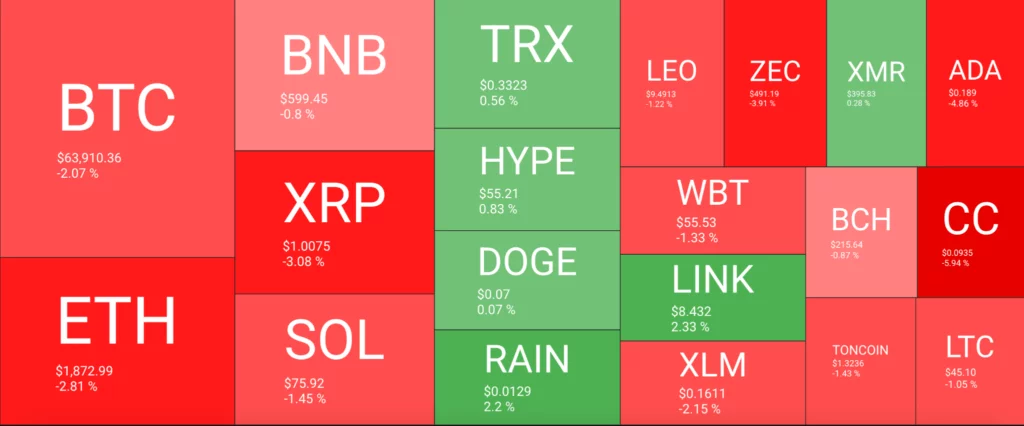
Bitcoin slipped below $64,000 on Aug. 11 as traders cut risk ahead of fresh U.S. inflation data and rising oil prices revived concerns about the Federal Reserve’s rate path.
Summary
- Bitcoin traded near $63,855, down 1.6%, after failing to establish support above $65,000 this week.
- Ether fell 2.2% and XRP lost 2.1%, while Hyperliquid and Chainlink advanced against broader weakness.
- U.S. spot Bitcoin ETFs recorded $144.6 million in net outflows Monday after five inflow sessions.
- Brent crude held near $88 as stalled U.S. Iran talks renewed inflation concerns before CPI.
- July CPI is scheduled Wednesday at 8:30 a.m. ET, leaving crypto exposed to macro volatility.
BTC traded near $63,855 at the time of writing, down about 1.6% over 24 hours after making several unsuccessful attempts to establish support above $65,000.
The pullback follows a short recovery that took Bitcoin above $65,300 on Monday. As covered in Monday’s CPI preview, weaker U.S. employment data had previously helped BTC recover as traders reduced expectations for tighter monetary policy. The focus has now shifted to inflation and energy prices.
Bitcoin has tested the $65,000 area for four consecutive days without sustaining a move above it. Downside levels remain relevant. Recent short term holder analysis placed the average acquisition price for newer holders at $67,523, meaning BTC remains below a level where some investors could seek to exit near breakeven. Support has recently formed around $63,000 to $64,000.
Ether and XRP lead losses as altcoins split
Large cap altcoins were mostly weaker alongside Bitcoin. Ether traded at about $1,871 at press time, down 2.8% over 24 hours. XRP traded near $1.00 after falling 3.1% and was down more than 6% over seven days. Solana declined about 1% to $75.78, while BNB slipped 1% to roughly $599.
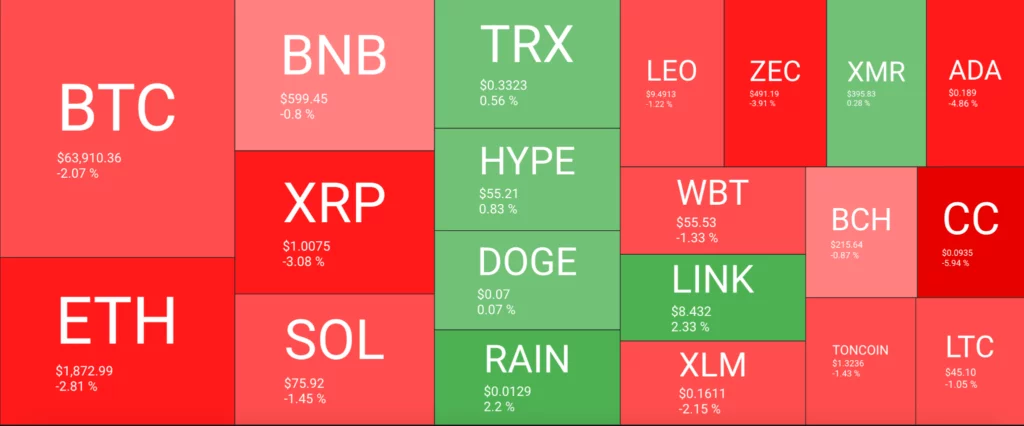
Performance was not uniformly negative. Hyperliquid rose about 2.4% to $55.25, Chainlink gained 2% to $8.43, TRX advanced 0.5% to $0.33 and Dogecoin added roughly 0.5% around $0.07. Among the top 100 assets shown, Internet Computer gained 8.3%, Lighter rose 7% and Mantle added 5.8%. Bitway fell 8.1%, Canton declined 6.5% and Cardano lost 4.8%.
The split suggests traders are still willing to take selective altcoin exposure despite weakness in Bitcoin, Ether and XRP. However, the broad market has yet to show the synchronized strength typically associated with a sustained risk rally.
U.S. CPI and oil become the next macro test
Oil has returned as a major U.S. macro risk. Brent crude held around $87.81 on Tuesday after gaining more than 5% in the previous session as hopes for an agreement between Washington and Tehran weakened. Negotiations over the Strait of Hormuz remain unsettled, keeping energy supply risks elevated. Reuters provided the latest report.
Higher energy prices can feed into inflation expectations and affect the outlook for U.S. interest rates. The Bureau of Labor Statistics schedule confirms that July CPI will be released Wednesday, Aug. 12, at 8:30 a.m. ET. The release gives traders a fresh reading on inflation after softer June data had eased some pressure on risk assets.
U.S. Treasury markets are already reflecting some of that caution. The benchmark 10 year yield rose toward 4.7% alongside oil on Monday. Higher yields generally raise the return available on lower risk assets, creating another hurdle for Bitcoin and other cryptocurrencies ahead of the CPI release.
What happens next for Bitcoin and ETF flows
Institutional flows offer a mixed signal. U.S. spot Bitcoin ETFs recorded five consecutive positive sessions from Aug. 3 through Aug. 7, attracting $865.3 million according to Farside Investors. That streak ended Monday with $144.6 million in net withdrawals, including $53.6 million from BlackRock’s IBIT and $52 million from Grayscale’s GBTC. Farside’s latest data replaces earlier provisional estimates of Monday’s outflow.
The strong preceding week was examined in recent ETF inflow coverage, although that report used SoSoValue figures and therefore produced a slightly different weekly total. Both datasets showed the same broad pattern: five positive sessions followed by renewed withdrawals on Monday.
Washington also remains part of the market backdrop. The Senate pushed its CLARITY Act vote into September after lawmakers failed to resolve disagreements before the August recess, as detailed in earlier CLARITY Act coverage. That removed an anticipated August policy event while leaving market structure legislation unresolved.
Wednesday’s CPI release is now the nearest fixed catalyst. Bitcoin first needs to reclaim $65,000 before the $67,500 to $70,000 region becomes relevant again.
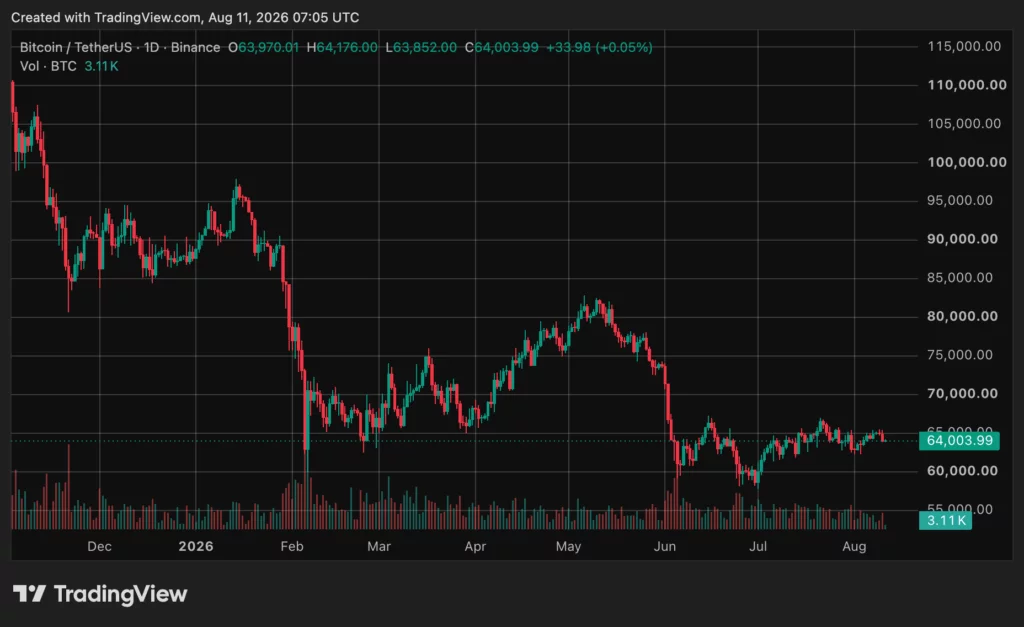
A move below the recent $63,000 area would instead put the market’s latest recovery under greater pressure. Neither direction has been confirmed, leaving inflation, Treasury yields and ETF flows as the clearest near term signals to watch.
Disclosure: This article does not represent investment advice. The content and materials featured on this page are for educational purposes only.


Bitcoin Knots told followers early on August 11 that the Bitcoin network faces an attack and that block production has slowed sharply. Public chain data contradicts that claim.
The warning drew instant pushback. David Schwartz, the former chief technology officer at Ripple, accused the project of misleading readers who lack the technical context to check it.
BTC Keeps Producing Blocks While the Knots Fork Sits Frozen
Bitcoin Knots is an alternative node client maintained by veteran developer Luke Dashjr. It filters out data its users treat as spam, and it runs on a small slice of the network.
Bitcoin blocks keep arriving on schedule. The main chain passed height 961,963 on August 11, with the last six blocks averaging under 10 minutes apart.
The frozen chain belongs to Knots itself. Its controversial BIP-110 soft fork, a rule change meant to squeeze non-monetary data out of Bitcoin blocks, stalled at block 961,633 after producing just two blocks. The main network has since pulled more than 300 blocks ahead.
Miners never backed the split. Support peaked near 2.53% even after organizers cut the activation threshold from 95% to 55%, then dropped to zero during mandatory signaling. The fork died within days.
Meanwhile, Bitcoin (BTC) trades near $63,979, down 1.5% on the day. Traders have shrugged off the dispute entirely.
Experts Tell Bitcoin Node Operators to Ignore the Downgrade Advice
The account never named the alleged attackers. Instead, its supporters have recast the lopsided miner vote as sabotage by large pools.
Knots also urged users to stay on its software, warning that weaker consensus rules invite false confirmations. Developers outside the project reject that framing. Bitcoin Core nodes follow the chain that almost all hashpower secures, and that chain never stopped.
Schwartz put it bluntly:
Trust in the camp had already thinned. Mining pool OCEAN, co-founded by Knots maintainer Luke Dashjr, admitted routing miners onto the minority chain without clear consent. Its hashrate collapsed by 96% soon after.
Backers are not done, however. The group will pick a new proof-of-work algorithm on August 11 at 14:00 UTC through a deterministic draw in its Discord. Such a switch would strip today’s Bitcoin miners of any role on a breakaway chain, which supporters aim to launch by September 1.
Whether anyone follows them remains an open question. Adam Back has already dismissed the campaign as unserious. The next three weeks will show whether the September plan draws more hashpower than the last attempt did.
The post Bitcoin Knots Says the Network Is Under Attack, Ripple’s Ex-CTO Calls it Nonsense appeared first on BeInCrypto.

Is Trial Balance a Financial Statement? | Class 11 Accounts Basics

‘Urgent health warning’ issued about High Street underwear that could be leaving wearers with silent but stubborn foul-smelling bacterial infections

At Close of Business podcast August 11 2026


-

 Fashion4 days ago
Weekend Open Thread: Mattifying Sunscreen
-

 Fashion4 days ago
Frugal Friday’s Workwear Report: Cap-Sleeve Pointelle Crewneck Sweater
-

 Sports5 days ago
Jordan Coyle & Cordiamo take Laya Arena Stakes at RDS
-

 News Videos3 days ago
Can Astrology Help Find Gold and Silver Trends? A Financial Astrology Guide
-
 Business5 days ago
US stocks: Dow closes at record on Mideast optimism; SpaceX, AMD drag Nasdaq
-

 Politics5 days ago
Reform UK And Greens Sink To Lowest Favourability Ratings To Date
-

 Business6 days ago
Nvidia Stock Climbs 2.5% as Chip Sector Rally Builds Ahead of AMD Earnings, Nvidia’s Own Report Looms
-

 Tech6 days ago
OpenAI, Anthropic AI agents targeted real people and systems in cyber tests
-

 Crypto World7 days ago
Polymarket targets $20 billion valuation as competition heats up in prediction market sector
-

 Business5 days ago
Supply chain issues impact Ingredion
-
 Crypto World7 days ago
CLARITY Act Senate Vote Locked In, But 60-Vote Hurdle Looms Large
-

 Tech3 days ago
Rinn Pharma & Biopharma to join NordicPharmaTrain network
-

 Business2 days ago
How to Start a Cleaning Business: A Step-by-Step Guide
-
 Crypto World6 days ago
Dow and S&P 500 Hit Records on AI Earnings: When Will the Bubble Burst?
-

 Business2 days ago
Datadog: Best Of Breed For Multiple Reasons
-

 Business2 days ago
BDC Weekly Review: Private BDC Q2 Numbers Are Strong
-
 Crypto World6 days ago
Dollar Index Trapped at 100 as Hawkish Fed Meets Official Selling
-
Crypto World7 days ago
Trump Administration Plans Ban on New Chinese AI Data Center Components: Report
-

 Business6 days ago
McDonald’s (MCD) Q2 2026 earnings
-

 Fashion6 days ago
The Bright Side of Black and White
You must be logged in to post a comment Login