
Crypto World
Stock Market Today: Dow Rises On CPI Inflation Report; Nvidia Partner CoreWeave Soars


Futures for the Dow Jones Industrial Average and the other major stock indexes traded higher Wednesday, as Wall Street reacted to a key inflation report. Meanwhile, Nvidia (NVDA) partner CoreWeave (CRWV) was a big earnings winner on the stock market today. Ahead of Wednesday’s open, Dow futures rose 0.3%, as S&P 500 futures moved up 0.4%. Nasdaq-100 futures climbed 0.8%…
Copyright ©2026 Investor’s Business Daily, LLC. All rights reserved. 87990cbe856818d5eddac44c7b1cdeb8

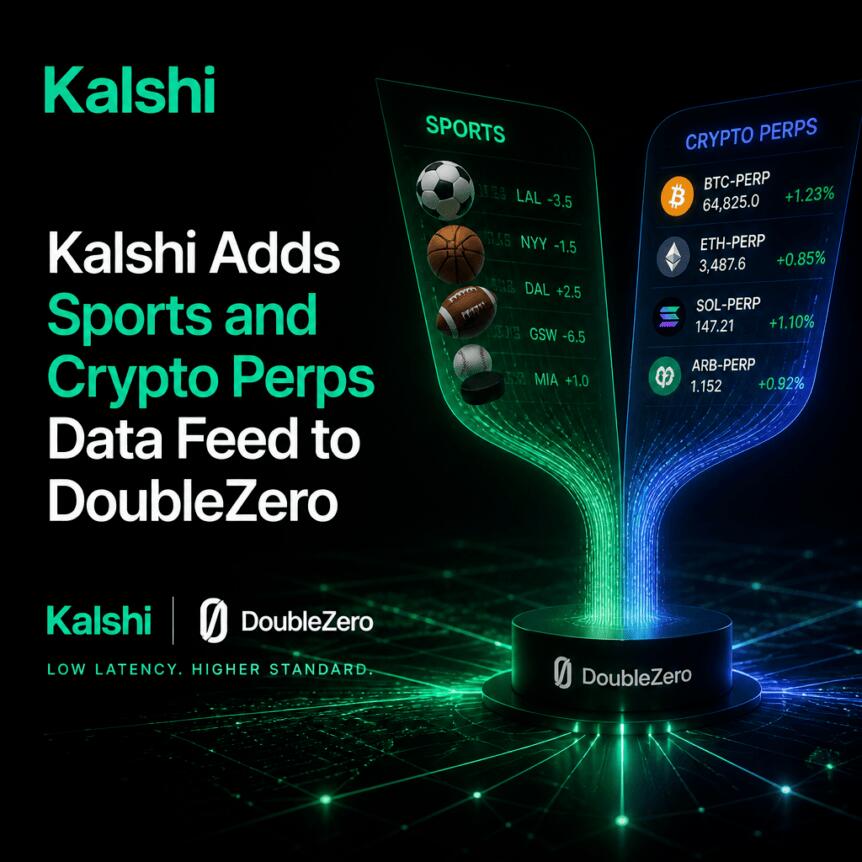
Prediction market infrastructure is getting a more institutional-style upgrade. Kalshi says its live order book for event contracts is now available through data provider DoubleZero Edge’s dedicated fiber network, allowing subscribers to consume real-time market depth in a machine-readable form.
The companies announced on Wednesday that the arrangement will be the first of its kind for a prediction market supplying its real-time order book data on sports and crypto perpetuals event contracts through that dedicated distribution channel. Instead of assembling market data from order books and API responses, users can subscribe to a purpose-built feed designed to reduce the engineering effort required to integrate prediction-market liquidity.
Key takeaways
- Kalshi’s real-time order book for sports and crypto perpetuals event contracts is now distributed via DoubleZero Edge’s dedicated fiber network.
- DoubleZero Edge positions the feed as a turnkey, machine-readable alternative to building infrastructure using raw order books and API responses.
- Sports is Kalshi’s second-largest category by weekly notional volume, with crypto in third place, according to Dune data.
- The move comes as Kalshi remains embroiled in ongoing US jurisdiction disputes over whether its sports event contracts are regulated as derivatives or treated as wagers.
Dedicated fiber distribution for prediction-market order books
At the center of the announcement is how market data is delivered. DoubleZero Edge provides a dedicated fiber network and a corresponding data feed, which the companies say will stream Kalshi’s live order book information for relevant contracts.
From a user perspective, that matters because prediction markets often require low-latency, structured data pipelines to support faster market analysis, algorithmic trading strategies, and more reliable execution. The companies’ messaging emphasizes that data access is a “critical part” of market structure, and they argue that the broader ecosystem has lacked similar distribution-grade infrastructure as crypto, perpetuals, and prediction markets have expanded.
DoubleZero co-founder Austin Federa framed the initiative as bringing “institutional-grade infrastructure” to industry participants. In practical terms, the pitch is less about changing the underlying contracts and more about improving how market participants can ingest and process market depth at scale.
Where Kalshi’s volume sits across sports, crypto, and exotics
The announcement also highlights Kalshi’s product mix. According to Dune data shared in the original coverage, exotics lead Kalshi’s weekly notional trading volume at 39.4%, followed by sports at 37.8%. Crypto ranks third at 20.3% in the same weekly notional-volume breakdown.
Sports being the second-largest category helps explain why the order book distribution focus includes sports event contracts. It also signals that demand for structured, low-latency access isn’t limited to crypto-linked products; it spans the broader set of markets Kalshi operates.
These percentages are based on weekly notional volume and are attributed to Dune via a referenced query on its platform. (See: Dune data.)
Regulatory pressure remains: sports contracts and competing jurisdiction claims
The new data distribution capability lands in the middle of a regulatory fight that has been escalating for months. Kalshi’s sports event contracts have become the subject of a jurisdictional dispute involving state regulators and the US Commodity Futures Trading Commission (CFTC).
State authorities have argued that Kalshi’s sports contracts amount to wagers and should therefore fall under state gambling laws. Kalshi and the CFTC counter that the contracts are derivatives, placing them under the CFTC’s exclusive authority.
Legal actions cited in the reporting illustrate how unsettled the status remains. In late June, a Michigan judge temporarily blocked Kalshi from allowing residents to place bets on sporting events. Around the same time, Kentucky filed suit against multiple prediction market platforms—including Kalshi and Polymarket—alleging they operate unlicensed sports betting services.
Nevada also issued a temporary ban on Kalshi earlier in March, according to the same reporting. Meanwhile, the CFTC has taken the opposite tack by suing several states. The agency’s argument, as described in earlier coverage, is that federally regulated event contracts fall under its exclusive jurisdiction.
For market participants, these disputes are more than legal background—they can affect where contracts are accessible and under what compliance frameworks traders can operate. Even as the infrastructure for order book delivery improves, the ability to participate may still depend on jurisdiction-specific rulings and enforcement outcomes.
Broader visibility for Kalshi markets
The story also connects Kalshi’s markets to broader consumer-facing visibility. Earlier in July, OpenAI began displaying Kalshi’s prediction market odds for FIFA World Cup matches in ChatGPT search results, according to prior coverage.
This kind of display can increase public awareness of event markets and may expand the audience beyond traditional traders and developers. However, it also underlines that prediction markets are increasingly part of mainstream information flows—an environment where legal clarity becomes even more important.
What to watch next
Kalshi and DoubleZero Edge’s dedicated fiber feed could make it easier for institutions and serious builders to integrate prediction-market order books without custom plumbing, but the larger question for users is whether contract access will remain stable as courts and regulators continue to argue over jurisdiction. Watch upcoming rulings and any further adjustments to where and how sports event contracts can be offered.
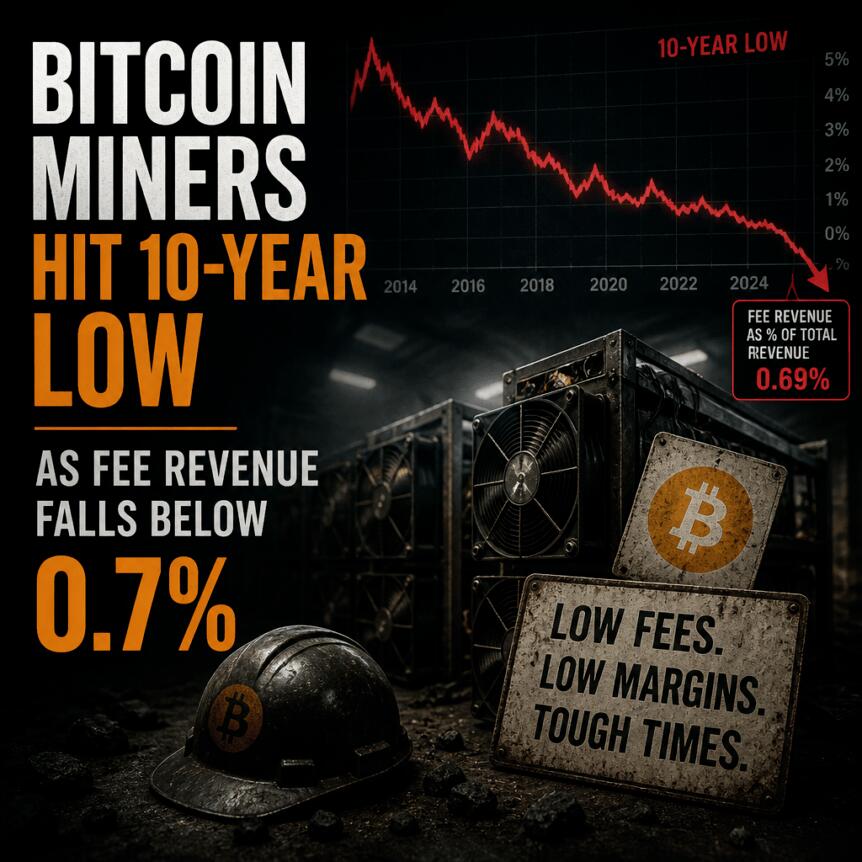
Bitcoin’s mining economics are looking increasingly subsidy-driven as transaction fees sink to levels last seen in the late stages of the decade. At the same time, multiple analysts point to a shift in miner strategy toward AI and high-performance computing (AI/HPC), coinciding with a noticeable decline in network hash rate.
Onchain analytics and mining cost estimates show fees make up just 0.69% of miner revenue, while the broader pressure on margins continues as Bitcoin’s price weakens and electricity costs remain a critical factor for operators. The resulting question for investors is whether miners’ AI pivot will stabilize long-term operations—or introduce new volatility to the network’s security parameters.
Key takeaways
- Glassnode data indicates Bitcoin fees are contributing only 0.69% of miner revenue, returning close to decade-low territory.
- Fees were reported as low as 0.52% in April, leaving miners more dependent on the fixed block subsidy.
- Checkonchain estimates show hash rate fell about 33% from an October 2025 peak of 1.3 ZH/s to 861 EH/s.
- Analysts argue the industry’s shift toward AI/HPC has contributed to reduced mining activity as difficulty adjustments evolve.
- Estimated mining production costs remain above current spot price, intensifying profitability pressure for marginal operators.
Fees fade as miner reliance on subsidies grows
According to Glassnode, transaction fees now represent just 0.69% of miner revenue—near the lowest levels seen in years. Glassnode co-founder Rafael Schultze-Kraft previously highlighted that fees had stayed below 1% of miner revenue for almost a year, with the share falling to 0.52% in April.
In a post on X, Schultze-Kraft said that “Bitcoin was below $400 the last time fee share was this low.” While that comparison is meant to contextualize the current environment, the practical impact is straightforward: when fee revenue collapses, miners lean more heavily on the block subsidy to cover operating expenses.
That matters because the subsidy is fixed in BTC terms—currently 3.125 BTC per block—but its value in US dollars depends on Bitcoin’s price. The article notes Bitcoin has fallen nearly 50% since its October 2025 all-time high, which would reduce the USD value of each subsidy payment and squeeze margins unless operational costs fall or fee rates rebound.
Cost pressure stays high: production estimates outpace spot
The mining picture is also constrained by profitability math. Checkonchain’s mining analytics put the estimated average cost to produce one Bitcoin at $78,254 as of Tuesday—about 23% above the current spot price referenced in the source.
Even if these are “estimated” costs rather than audited figures for every operator, the direction is what counts for the market: when production costs exceed spot value, miners are incentivized to either optimize aggressively, consolidate, or exit. That dynamic tends to hit smaller players first, potentially concentrating hash rate among operators with more capital flexibility and better power procurement.
Investors should also consider that production costs are influenced by variables outside the chain itself, especially electricity prices and hardware efficiency. In periods where fees remain weak, any non-chain cost increase can accelerate the churn in mining capacity.
Hash rate drops 33% since October 2025 peak
Network security metrics reflect the mining sector’s changing behavior. Checkonchain estimates hash rate declined from a peak of about 1.3 ZH/s in October 2025 to roughly 861 EH/s, a drop of 33%.
Hash rate is an important indicator not because it alone determines security, but because sustained decreases can signal reduced competitive participation. If the network’s mining base becomes less active, difficulty and mining economics may adjust over time—but the transition itself can be disruptive for operators and for the incentives that sustain long-run security.
Analysts warn AI/HPC pivot could be a concerning shift
Beyond the numbers, several analysts argue the decline in hash rate is linked to a strategic redeployment of compute resources. Independent analyst William Clemente, in an analysis published at the weekend and shared on X, acknowledged the downturn while arguing that automated difficulty readjustments would have offered a window for miners to increase activity. With difficulty reported as rising again, he suggested that miners’ move toward “more lucrative AI computing” has become more visible.
“There is no other way to slice it, hash rate has been in a decline,” Clemente wrote, pointing to margin compression after 2022 and higher energy prices, but also emphasizing a pivot by “many into AI/HPC.” He characterized these AI-related moves as “prudent business decisions” for publicly traded companies that pursued them.
The broader claim is not simply that miners are diversifying; it’s that the timing and direction of the shift could reduce mining participation during a period when fees are already contributing less than 1% of revenue. In an environment where the subsidy is already under pressure from Bitcoin’s price drawdown, a reduction in mining activity could widen the gap between operational realities and long-term security assumptions.
Cointelegraph previously reported that CleanSpark refocused on AI, shifting toward operating data centers after missing profit targets. Another example cited in the source is Keel Infrastructure, which shut down all US mining operations after revenue fell 50% in the second quarter. These cases support Clemente’s argument that operators facing weaker mining profitability may look to alternative compute markets.
Charles Edwards of Capriole Investments also linked hash rate declines to miners’ AI pivot, describing it as a “concerning Bitcoin development in 2026” and noting acceleration since April.
What to watch next as incentives keep shifting
With fee revenue near decade-low levels and estimated mining costs exceeding spot value, the next signal will be whether hash rate stabilizes as difficulty adjusts—or whether additional miners continue reallocating capital toward AI/HPC. Investors may also want to monitor how quickly fee share recovers, since sustained low fees increase the network’s dependence on the subsidy at exactly the moment when operators appear to be changing how they deploy compute.


Prediction market Kalshi’s live order book is now available through data provider DoubleZero Edge’s dedicated fiber network, the two companies said in a Wednesday announcement shared with Cointelegraph.
Kalshi said this makes it the first prediction market to distribute its real-time order book data on sports and crypto perpetuals event contracts, which will be available to new DoubleZero Edge subscribers.
Users looking for a machine-readable view of prediction market data can access these capabilities via the dedicated feed, instead of building this infrastructure from order books and application programming interface (API) responses themselves.
Data access is a “critical part” of market structure, but related infrastructure has been missing from new financial paradigms such as crypto, perpetuals and prediction markets, said Austin Federa, co-founder of DoubleZero, adding that this initiative will bring institutional-grade infrastructure to industry participants.
Sports ranks as the second-largest category on Kalshi with 37.8% of weekly notional volume, followed by crypto in third place, at 20.3%. Exotics ranked first, accounting for 39.4% of Kalshi’s weekly notional trading volume, according to Dune data.
In early July, OpenAI started displaying Kalshi’s prediction market odds for FIFA World Cup matches in ChatGPT search results.
Kalshi’s sports event contracts are at the center of a jurisdictional dispute between state regulators and the federal Commodity Futures Trading Commission (CFTC). State authorities argue that the contracts are wagers subject to state gambling laws, while the CFTC and Kalshi contend that they are derivatives subject to the CFTC’s exclusive jurisdiction.
On June 29, a Michigan judge temporarily blocked Kalshi from allowing residents to place bets on sporting events. Days earlier, Kentucky sued five prediction market platforms, including Kalshi and Polymarket, accusing them of operating unlicensed sports betting platforms. Nevada also issued a temporary ban on Kalshi earlier in March.
The CFTC also sued several states, arguing that federally regulated event contracts fall under its exclusive authority.
Magazine: Why Argentina is blocking Polymarket despite its global growth
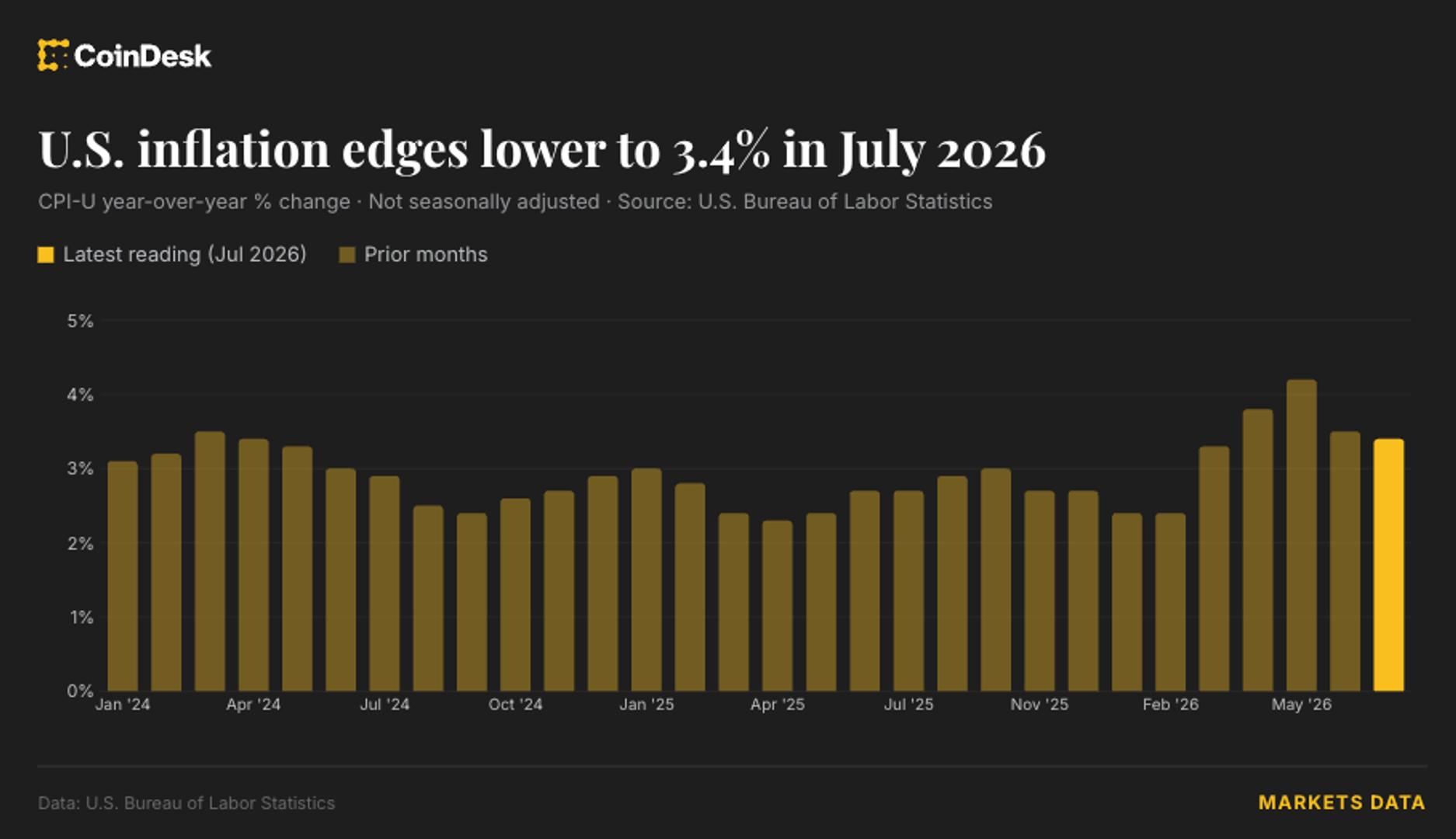
U.S. inflation in July was in line with expectations, leaving expectations for another Federal Reserve rate hike broadly unchanged.
The Consumer Price Index (CPI) rose 0.1% in July from the previous month, compared with economists’ forecast for a 0.1% increase and June’s 0.4% decline.
On a year-over-year basis, CPI rose 3.4%, in line with forecasts and slightly lower than June’s 3.5% reading.
Core CPI, which excludes food and energy, rose 0.2% month over month in July, compared with forecasts for a 0.2% increase and an unchanged reading in June. On a year-over-year basis, core CPI rose 2.5% as expected by analysts and edging lower from June’s 2.6%.
Bitcoin fell from $64,400 to $64,080 in a knee-jerk reaction before stabilizing, still largely flat over 24 hours. Nasdaq 100 futures traded 0.7% higher.
Treasury yields remained under pressure, maintaining pre-CPI weakness. The two-year hovered at 4.19%, down 3.6 basis points on the day, and the 10-year yield stood at 4.66%, also down three basis points.
Already a key data point for markets, July’s CPI report took on added importance after a weaker-than-expected U.S. employment report showed that the economy unexpectedly shed 23,000 jobs in July.


Standard Chartered-led Anchorpoint Financial has started a limited rollout of HKDAP, its Hong Kong dollar-backed stablecoin, four months after securing one of the city’s first two issuer licences.
The initial rollout will focus on institutional payments and settlement before adding more access channels and cross-border applications.
HashKey Exchange and OSL Group joined as authorized distributors, allowing eligible institutions and professional investors to obtain HKDAP through their apps and other supported channels, according to separate announcements.
HashKey said it had completed its first minting and redemption transaction for the token, including conversions between HKDAP and fiat currency.
Anchorpoint, a joint venture between Standard Chartered, Animoca Brands and HKT, plans to use distributors and commercial partners to bring the token into payments, settlement and other financial applications. HKDAP stands for “Hong Kong dollar at par.”
Stablecoins are cryptocurrencies with values pegged to an external reference such as fiat currencies. Stablecoins are widely used to finance crypto trading, serve as a means of payment and facilitate cross‑border capital flows. The combined market cap of all stablecoins was nearly $287 billion as of this writing.
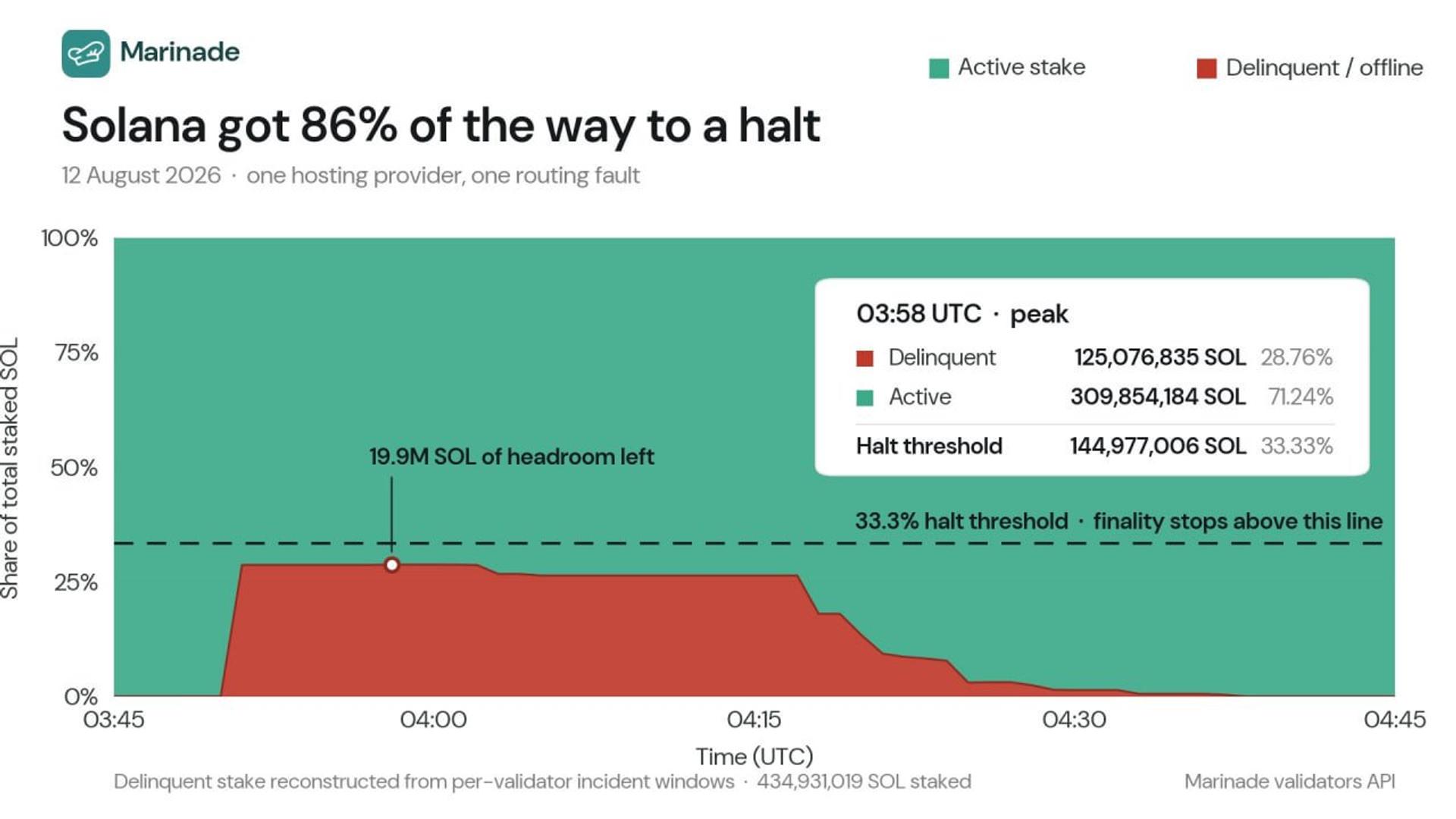
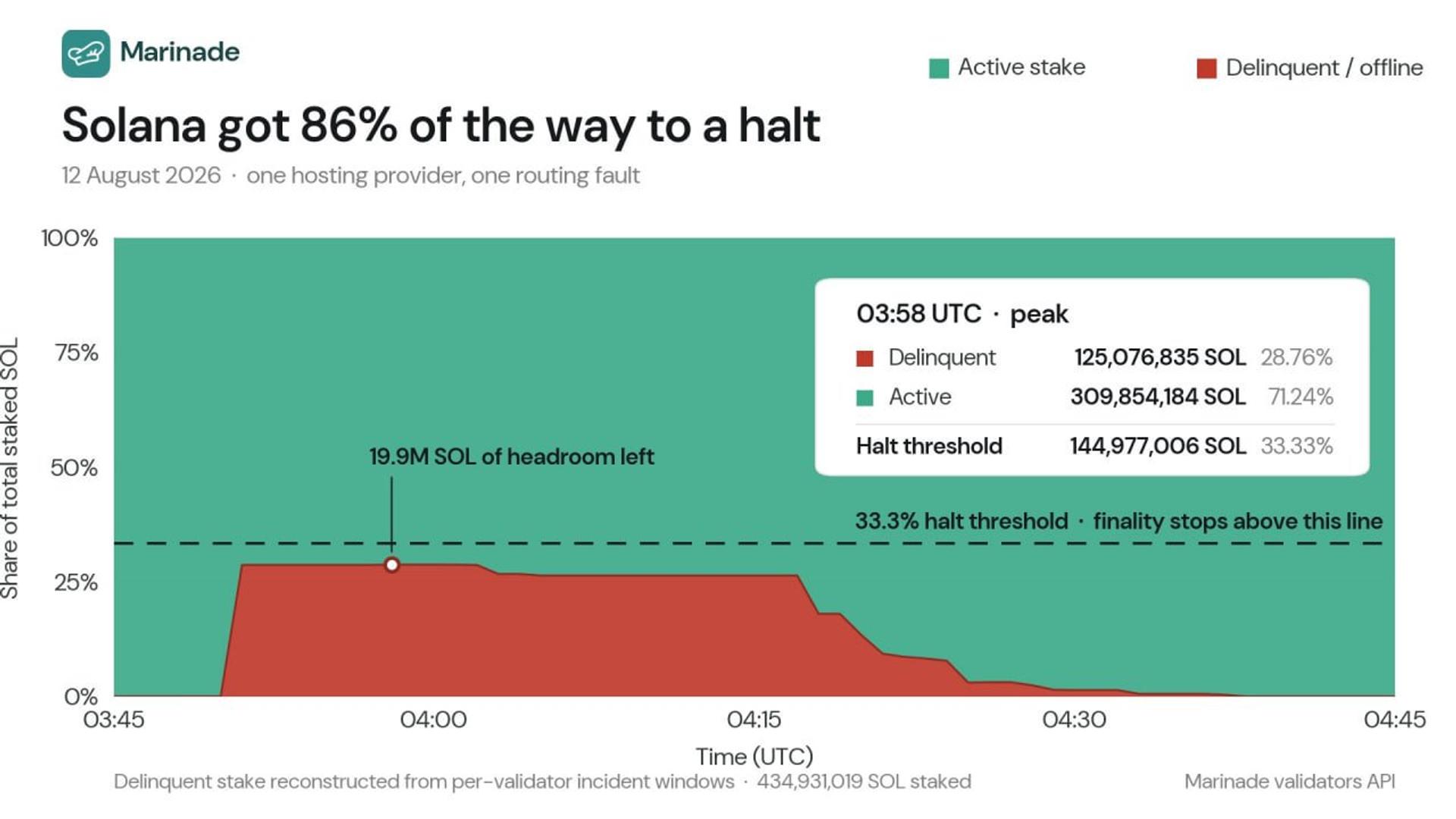
The latest issue started with a bad internet route from Teraswitch’s Miami facility that then spread to data centers across Europe and Asia, cutting off validators in London, Amsterdam, Frankfurt, Singapore and Tokyo. North America stayed online. The company fixed the issue in about 10 minutes, and traffic was flowing again by 4:16 a.m. UTC.
One single network operator, identified as AS2032, controlled more than a quarter of all the tokens people had locked up to secure the network, which was more than the Solana-prescribed safety limit. Almost all of those tokens went offline at the same time. Other companies lost another 14 million tokens in the same short period. Most of the affected validators, including the big one called Helius, stayed offline for the full 33 minutes because their backup systems never switched on.
This whole event is a clear warning: if more than one-third of the network’s tokens ever go offline at once, the entire blockchain freezes for every single person holding SOL, and there is no quick way to fix the bigger damage that would follow.
Pi Network price rose more than 5% toward $0.090 on Aug. 12 as the Protocol 26 deadline passed and softer U.S. inflation data supported speculative assets.
Summary
- Pi Network price rose more than 5% before settling near $0.088 during the session.
- Protocol 26’s Aug. 11 deadline required Mainnet node operators to update or lose connectivity.
- PI remains above its 20-day moving average at $0.0853, but below the 50-day average.
- A breakout above $0.096–$0.10 could open a path toward $0.12 and potentially $0.15.
Pi Network price action today
According to data from crypto.news, Pi Network (PI) price climbed more than 5% to approach $0.090 on Aug. 12, while trading activity reportedly increased by about 35%. PI traded near $0.0883 at the time of writing after giving back part of its intraday advance.
The move followed the Aug. 11 deadline for Mainnet node operators to complete the Protocol 26 upgrade. The Pi Core Team previously said nodes that missed the cutoff would lose Mainnet connectivity until they installed the required update.
No widespread network disruption had been reported by the time of writing. However, the team had not published figures showing how many operators completed the upgrade, making it difficult to confirm the participation rate across Pi Network’s node infrastructure.
Protocol 26 improves smart contract safety, state management, interoperability, and cryptographic functions. The upgrade is also intended to prepare the network for Protocol 27, the final planned step in the current protocol update sequence.
Cooling US inflation supports PI recovery
U.S. macroeconomic conditions provided a second tailwind for PI and the broader crypto market. The Bureau of Labor Statistics reported that the Consumer Price Index rose 0.1% in July and 3.4% from a year earlier.
Annual inflation slowed from 3.5% in June, while core CPI increased 0.2% month over month and 2.5% annually. Both annual readings eased from the previous month.
Slower inflation can reduce pressure on the Federal Reserve to raise interest rates further. Lower rate expectations generally support risk assets by improving liquidity conditions, although PI’s immediate move remained closely tied to the network upgrade and retail trading activity.
PI’s price is still more than 95% below its February 2025 peak, leaving the token exposed to sharp swings as short-term traders respond to technical breakouts and project updates.
Supply also remains an important risk. Data attributed to PiScan indicates that approximately 775.8 million PI could be unlocked by the end of 2026. Unlocks do not guarantee immediate selling, but they may increase the amount of PI available in the market if recipients choose to sell.
PI price holds above short-term support
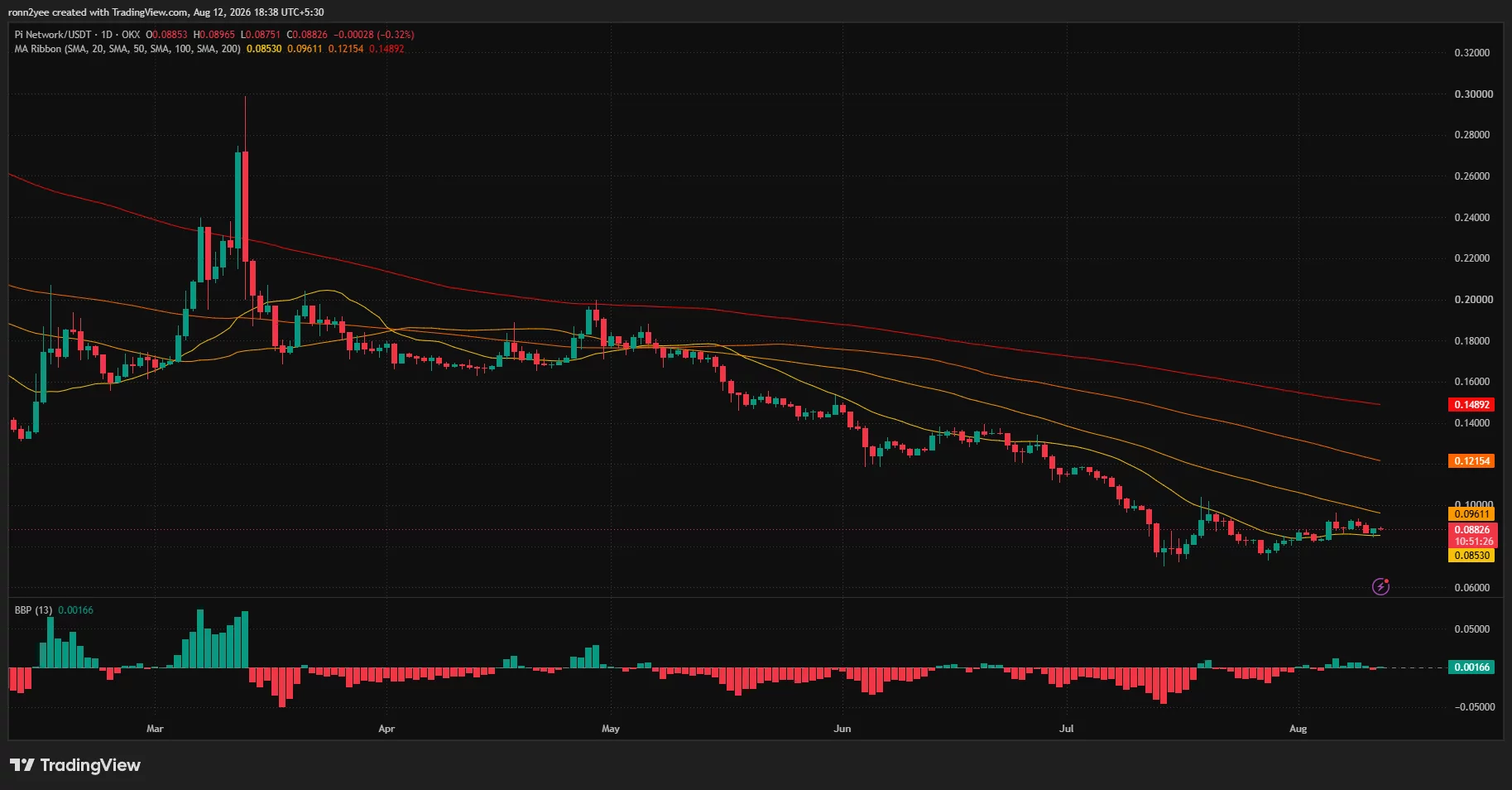
The daily chart shows PI trading above its 20-day simple moving average at $0.0853. Reclaiming the average marks an improvement from the sustained downtrend that pushed the token from above $0.20 in March to a July low near $0.071.
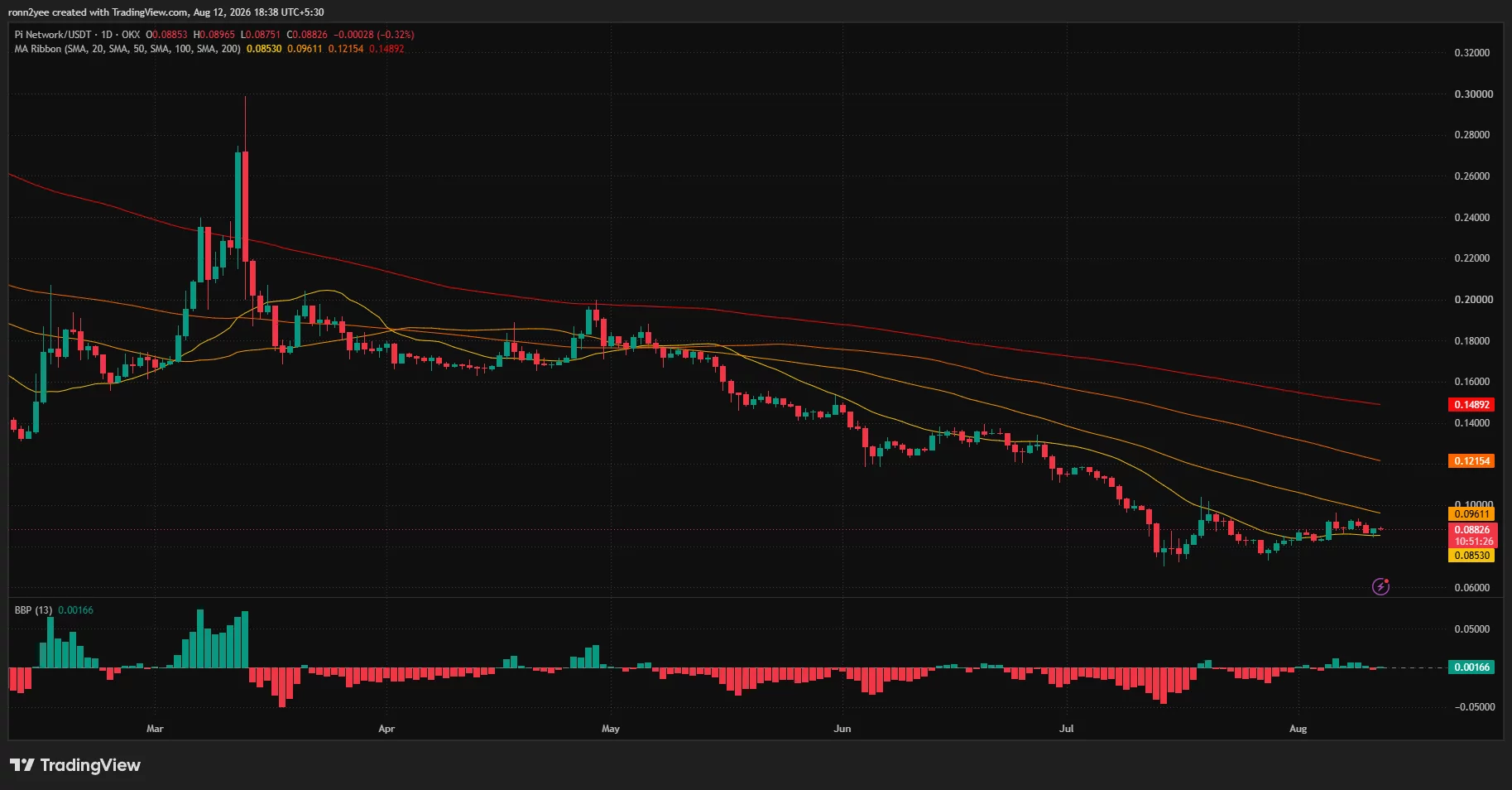
Bull-bear power has also turned slightly positive at 0.00166, indicating that buyers have gained limited control around the current range. Price has nevertheless failed to produce a decisive trend reversal.
PI remains below the 50-day moving average at $0.0961, which forms the first major resistance zone. The 100-day and 200-day averages sit much higher at $0.1215 and $0.1489, respectively, showing that the broader daily trend remains bearish.
A daily close above $0.096 would strengthen the recovery case and place the psychological $0.10 level in focus. Clearing both barriers could allow buyers to target the 100-day average near $0.12.
Failure to hold $0.0853 would weaken the current setup. Sellers could then test $0.080, followed by the July support area between $0.071 and $0.075.
4-hour indicators show weak but improving momentum
PI’s 4-hour chart shows price consolidating between approximately $0.085 and $0.092 after recovering from the late-July low. Buyers have repeatedly defended the lower end of the range, but rallies have lost momentum around $0.090–$0.093.
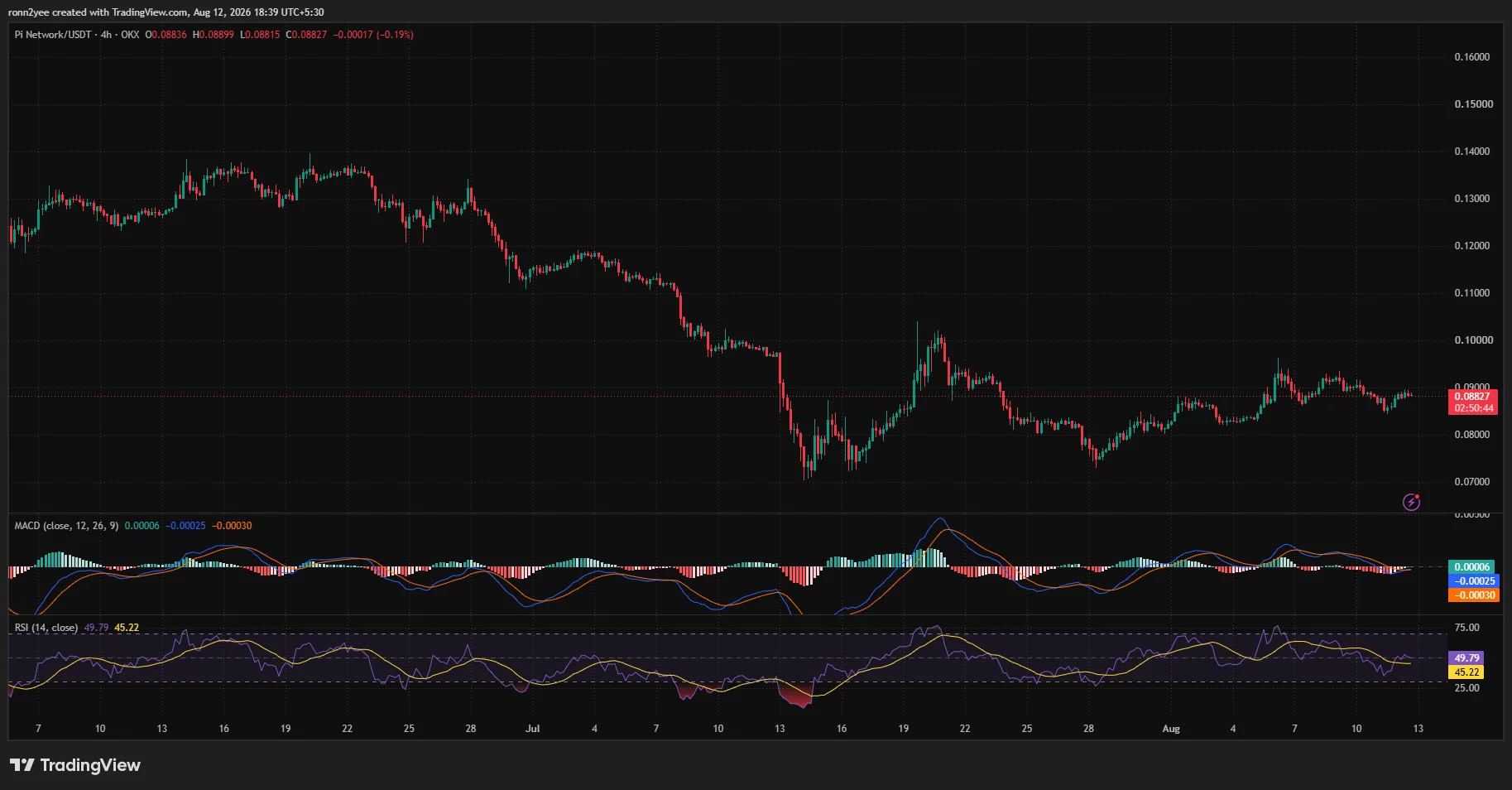
The 4-hour Relative Strength Index stood at 49.79, just below the neutral 50 level. The reading shows that selling pressure has eased without confirming strong bullish momentum.
MACD offered a slightly more constructive signal. Its histogram turned positive at 0.00006 as the MACD line moved above the signal line, although both remained below zero. The setup points to an early recovery attempt rather than a confirmed breakout.
A 4-hour close above $0.093 would improve the short-term structure and expose the $0.096–$0.10 resistance zone. Losing $0.085, however, would invalidate the immediate bullish setup and raise the risk of another move toward $0.080.
Analyst sees $0.15 target after triangle breakout
Crypto analyst Crypto With Gopal said PI was compressing between descending resistance and rising support, creating a large triangle pattern.
According to the analyst’s chart, a clean break above approximately $0.10 could trigger a larger move toward $0.15. Such a move would require PI to reclaim its 50-day and 100-day moving averages before challenging the 200-day average near the analyst’s target.
Until PI closes above $0.10, the pattern remains unconfirmed. The token’s position below its major long-term averages and the pending supply unlocks continue to limit the strength of the bullish case.
Disclosure: This article does not represent investment advice. The content and materials featured on this page are for educational purposes only.
Trump isn’t the only President to execute a decoy mission
Although rare, a decoy maneuver such as this is not unheard of when it comes to presidential travel.
A similar episode occurred in March 2000, when former President Bill Clinton secretly switched to a decoy jet, with all of the markings of Air Force One, as he traveled to Islamabad, Pakistan for a visit marked by extraordinary security.
The switch was revealed when a Secret Service agent resembling Clinton stepped out of Air Force One upon touching down in Pakistan, while Clinton disembarked from the second aircraft.
However, at least one member of the White House pool was aware of the ruse: Susan Page, then-president of the White House Correspondents’ Association, who was covering the trip for USA TODAY.
Page this week broke her 26-year silence on the briefing that preceded the secret switch.
“They told me about the extraordinary security procedures being taken because of the dangers in flying there, including use of the decoy plane,” she told the Post. “Of course, the dangers threatened the journalists covering the trip as well as President Clinton.”

A coalition of crypto companies and industry groups has asked frontier artificial intelligence (AI) labs to provide Bitcoin developers and other open-source “defenders” early access to their most capable models. The request comes in a letter published Monday by the Bitcoin Policy Institute (BPI), arguing that current access arrangements can leave critical infrastructure teams operating behind the pace of rapidly advancing AI-assisted cyber capabilities.
In the letter, signatories say many defenders—including Bitcoin Core developers—can be limited by the absence of dedicated “trusted-access programs” and by guardrails applied to publicly available frontier systems. As a result, they contend that qualified teams may be forced to rely on less capable open-weight models, even as attackers may use more powerful AI tooling to probe for weaknesses.
Key takeaways
- The Bitcoin Policy Institute letter calls for “standing trusted-access programs” so open-source financial infrastructure defenders can use top-tier frontier AI before widespread public release.
- Signatories argue that guardrails and limited access to advanced models can hinder security research and response for Bitcoin and broader crypto systems.
- The letter links the push to the rising scale of AI-enabled vulnerability discovery and threats, citing multiple reports from open-source maintainers.
- Industry data referenced in the letter points to a sharp jump in monthly crypto hacks, with April 2026 losses exceeding $634 million.
- The coalition includes major ecosystem participants such as Anchorage Digital, BitGo, Bitwise, Blockstream, Kraken, Ledger, and Trezor, among others.
Why the letter centers on “trusted access”
The BPI says the economics of security research and cyber operations are shifting as frontier AI models become more capable. According to the letter, advanced systems can search large codebases, surface potential weaknesses, and compress timelines for complex technical work—benefits that apply not only to attackers, but also to defenders responsible for maintaining open-source financial infrastructure.
Without early, dedicated access programs, the letter warns that defenders may struggle to keep pace with evolving threats. It also argues that cyber incidents exploiting open-source vulnerabilities can translate directly into real-world harm, including the risk of losing “life savings,” given how widely open-source software underpins digital finance.
To address this asymmetry, the letter asks frontier AI labs to “establish or expand standing trusted-access programs” for qualified open-source defenders. The focus is less on broad public access and more on structured access channels for teams charged with safeguarding infrastructure.
What data and security commentary are used to support the case
The letter points to recent increases in hack activity across the sector. It cites DefiLlama data showing that total monthly crypto hacks surged in April 2026, with malicious actors stealing more than $634 million from cryptocurrency platforms—described as the highest monthly total since the Bybit hack. That earlier incident, the letter notes, contributed to losses of roughly $1.4 billion in February 2025, again according to DefiLlama.
In addition to incident volume, the letter frames AI as a force multiplier for vulnerability discovery. It references concerns raised across the crypto security industry as newer AI systems make it easier to automate parts of the probing and exploit development cycle.
Earlier coverage cited within the letter highlights comments from Mitchell Amador, CEO of bug bounty platform Immunefi, who characterized the moment as a “vulnerability apocalypse” in relation to developments in AI-assisted research. The letter also mentions the emergence of newer frontier models—described in the article as Claude Opus 4.8 and ChatGPT 5.5—as part of the broader shift raising security stakes.
Who signed the request
The open letter is co-signed by a broad cross-section of the crypto industry, signaling that the concern is not confined to one segment of infrastructure. Alongside the Bitcoin Policy Institute, the signatories include organizations such as the African Bitcoin Institute, Anchorage Digital, BitGo, Bitwise, Blockstream, Bull Bitcoin, MARA, Kraken, Ledger, and Trezor, among others.
By bringing together companies spanning custody, exchanges, analytics, wallet infrastructure, and Bitcoin-focused organizations, the letter underscores the “system-wide” nature of the risk it describes: open-source code and shared software dependencies can affect multiple products, operators, and user bases at once.
Implications for Bitcoin developers and the broader security community
If frontier AI labs establish or expand trusted-access programs as requested, the most immediate practical impact would be on the speed and effectiveness of defensive work around open-source financial infrastructure. In the letter’s framing, having early access to capable models could improve how maintainers audit code, identify potential weaknesses, and respond to new exploit techniques.
The request also highlights a tension that many in security research recognize: attackers may benefit from advanced tools faster than defenders can. By arguing that public guardrails and limited availability of powerful models can block legitimate defense work, the letter effectively calls for a policy-like solution—one that treats certain defenders as authorized users of frontier capabilities.
At the same time, it remains unclear what “standing trusted-access programs” would look like in practice, including how labs would vet applicants, what models would be shared, and how output would be handled. The letter is a policy request rather than a technical specification, so builders and investors should watch for follow-up actions that clarify implementation details.
For now, the key signal is the coalition’s insistence that time-to-defense matters as AI capabilities scale—especially as hack activity remains elevated and AI-assisted vulnerability discovery accelerates. The next phase will likely involve whether frontier AI labs respond, and whether any program structures emerge that could help Bitcoin and other open-source maintainers close the gap between defensive capacity and adversarial capability.

London, United Kigdom, August 12th, 2026, Chainwire
HCB Advisory has published a new analysis examining the role of market sentiment in financial markets and how changes in investor behaviour, demand, and expectations can influence short- and medium-term asset price movements.
Financial markets are shaped not only by economic indicators and fundamental developments, but also by the behaviour and expectations of market participants. Changes in investor confidence, risk appetite, demand for particular assets, and reactions to new information can contribute to significant changes in market dynamics.
According to HCB Advisory, analysing market sentiment can provide an additional perspective when assessing financial markets. By observing how participants respond to economic developments, corporate news, monetary policy decisions, and changes in broader market conditions, analysts can gain a better understanding of the factors influencing price movements.
“Market sentiment can provide important context when analysing short- and medium-term changes in asset prices,” Blake Rees said a representative of HCB Advisory. “Investor behaviour, changes in demand, and reactions to new information can all contribute to market dynamics. Understanding these factors allows analysts to evaluate price movements from a broader perspective.”
Understanding Market Sentiment
Market sentiment describes the general attitude and expectations of participants toward a particular asset, market, or the broader financial environment.
Sentiment can change as investors respond to new information, economic data, company announcements, central bank decisions, geopolitical developments, or changes in financial conditions.
Periods of positive sentiment may be associated with increased risk appetite and stronger demand for certain assets. Conversely, declining confidence can lead investors to become more cautious and reduce exposure to assets perceived as carrying greater uncertainty.
HCB Advisory notes that sentiment is not necessarily uniform across all market participants. Different investors can interpret the same information differently, creating a range of expectations and contributing to changes in market activity.
Investor Behaviour and Market Dynamics
Investor behaviour represents an important component of sentiment analysis.
Market participants continuously evaluate available information and make decisions based on their expectations about future conditions. These decisions can affect buying and selling activity and, consequently, the balance between supply and demand.
According to HCB Advisory, observing changes in investor behaviour can help analysts understand why an asset may experience increased activity even when there has been no major change in its underlying fundamentals.
Behaviour can also change rapidly when new information enters the market. Unexpected economic data, policy announcements, or significant corporate developments can alter expectations within a short period of time.
For this reason, monitoring behavioural changes can complement traditional market analysis.
Changes in Demand
Demand is another important indicator when assessing market sentiment.
An increase in demand can indicate growing interest in a particular asset or market segment, while declining demand may reflect a reduction in investor interest or a shift toward alternative opportunities.
HCB Advisory considers changes in demand alongside other market indicators rather than treating them as an independent signal.
Trading volumes, price movements, liquidity, and broader market conditions can provide additional context when evaluating whether changes in demand represent a temporary development or part of a broader shift in sentiment.
Understanding these relationships can help analysts develop a more complete view of market behaviour.
Identifying Potential Trading Signals
Changes in sentiment and investor behaviour can also be incorporated into the process of identifying potential trading signals.
A trading signal does not necessarily represent a prediction of future market performance. Instead, it can serve as an indicator that a particular market condition or change in participant behaviour may require additional analysis.
For example, a significant increase in trading activity accompanied by a change in investor sentiment may indicate that market participants are responding to new information.
Similarly, a sharp change in demand may prompt analysts to investigate the factors behind the movement and determine whether it is connected to broader market developments.
According to HCB Advisory, such signals should be evaluated together with other analytical factors rather than used in isolation.
Combining Sentiment With Market Analysis
Market sentiment is only one component of a broader analytical framework.
Traditional market analysis can include economic indicators, interest rates, inflation, corporate developments, valuation measures, liquidity conditions, and other factors relevant to a particular asset.
HCB Advisory believes that combining these areas of analysis with information about investor behaviour can provide a broader perspective on market conditions.
For example, a change in asset prices may be driven by fundamental developments, changing expectations, or a combination of both. Understanding the role of sentiment can help analysts examine the behavioural component of the movement.
This approach is particularly relevant when evaluating short- and medium-term market changes, where investor expectations can influence price dynamics over relatively short periods.
Technology and Sentiment Analysis
Modern financial technologies are creating new opportunities for analysing market sentiment.
Analytical platforms can process large volumes of information from financial markets, news sources, economic publications, and other data channels. Advanced data-processing systems can help identify changes in activity and highlight developments that may require further investigation.
Artificial intelligence and machine learning technologies can also assist with processing large datasets and identifying patterns in market behaviour.
According to HCB Advisory, these tools can support analysts by improving the speed at which information is collected and organized.
However, technological systems still require interpretation. Changes in sentiment can have different meanings depending on the broader market environment, making professional analysis an important part of the process.
Short-Term and Medium-Term Market Movements
Sentiment analysis can be particularly relevant when examining short- and medium-term price dynamics.
In the short term, markets can respond quickly to changes in expectations, news events, and investor positioning. Over longer periods, sentiment can interact with economic and fundamental developments to influence broader market trends.
HCB Advisory emphasizes that distinguishing between temporary changes in sentiment and more persistent shifts is an important part of the analytical process.
A short-lived increase in demand may have a different significance from a sustained change in investor behaviour that continues across multiple trading sessions or market cycles.
Avoiding a Single-Indicator Approach
HCB Advisory stresses that no single sentiment indicator can provide a complete explanation of market behaviour.
Investor sentiment can change quickly, and indicators based on historical or current activity may not fully reflect future developments.
For this reason, the company advocates combining sentiment analysis with broader market research.
Analysts can consider price dynamics, trading activity, economic conditions, liquidity, fundamental developments, and other relevant information alongside changes in investor behaviour.
This multi-factor approach can provide greater context when evaluating potential market scenarios.
Looking Ahead
Financial markets are becoming increasingly data-driven, while investors have access to information from a growing number of sources.
As information becomes more readily available, understanding how market participants respond to that information may become increasingly relevant to financial analysis.
According to HCB Advisory, the combination of traditional market research, behavioural analysis, and modern data-processing technologies can provide additional insight into changing market conditions.
The company concludes that understanding investor behaviour and changes in market sentiment can help analysts evaluate the reasons behind short- and medium-term price movements more comprehensively.
About HCB Advisory
HCB Advisory is a financial research and advisory company focused on financial markets, investment analysis, market intelligence, and modern financial technologies. The company publishes research and industry insights covering global economic developments, market trends, investor behaviour, investment processes, and the evolution of financial decision-making.
Website: https://hcbadvisory.com/
Disclaimer
This press release is provided for informational purposes only and does not constitute financial, investment, legal, or tax advice. Market sentiment and behavioural indicators cannot guarantee future price movements or investment outcomes. The information presented is for general informational purposes and should not be interpreted as a recommendation to buy, sell, or hold any financial instrument, security, digital asset, or investment product.
Contact
Caleb Grant
marketing@hcbadvisory.com
Terra Innovatum at Canaccord growth conference: push for fast nuclear scale

Kalshi Adds Sports and Crypto Perps Data Feed to DoubleZero

Strictly Come Dancing 2026 Cast: The 15 Stars On This Year’s Line-Up

Weekend Open Thread: Staud – Corporette.com

Weekend Open Thread – Corporette.com

Weekend Open Thread: Brooks Brothers

Crypto Trading LIVE: BTC Live Trading Bitcoin Analysis | 11 AUG #crypto #bitcoin #btc

Lehman Brothers Collapse Explained | How One Bank Triggered the 2008 Global Financial Crisis

#Money Motivation |#Money mantra |#Law Of Attraction |#Universe @Positive thoughts121
-

 Fashion5 days ago
Weekend Open Thread: Mattifying Sunscreen
-

 Fashion5 days ago
Frugal Friday’s Workwear Report: Cap-Sleeve Pointelle Crewneck Sweater
-

 News Videos4 days ago
Can Astrology Help Find Gold and Silver Trends? A Financial Astrology Guide
-

 Sports7 days ago
Jordan Coyle & Cordiamo take Laya Arena Stakes at RDS
-
 Business7 days ago
US stocks: Dow closes at record on Mideast optimism; SpaceX, AMD drag Nasdaq
-

 Politics6 days ago
Reform UK And Greens Sink To Lowest Favourability Ratings To Date
-

 Business7 days ago
Supply chain issues impact Ingredion
-

 Tech5 days ago
Rinn Pharma & Biopharma to join NordicPharmaTrain network
-

 Business3 days ago
How to Start a Cleaning Business: A Step-by-Step Guide
-

 Business3 days ago
Datadog: Best Of Breed For Multiple Reasons
-

 Business4 days ago
BDC Weekly Review: Private BDC Q2 Numbers Are Strong
-
 NewsBeat15 hours ago
Communication cards help banking customers access services or report scams
-
Sports7 days ago
Spider-Man: Brand New Day ending explained: Is Peter Parker alive?
-

 Fashion7 days ago
Suit of the Week: Me + Em
-

 Tech5 days ago
Price Hikes May Be Coming for PC Motherboards Next
-

 Business5 days ago
Brightwater secures funding for WA-first dementia projects
-
 Crypto World6 days ago
Galaxy Digital Stock Slides 14% as Crypto Prices Hit Earnings
-

 Politics7 days ago
The Not-So Talented Mr Arday
-

 Politics7 days ago
Comedian Jimmy Cricket Has Died, Aged 80
-
 Tech6 days ago
How to Use Your Phone as a Webcam on PC and Mac (2026)
You must be logged in to post a comment Login