experts say this summer’s main threat of lettuce-borne cyclospora may finally be waning, with investigators having identified the likely culprit as iceberg lettuce sold through Taylor Farms de Mexico. But the fact remains that commercially-produced lettuce isn’t always safe.
For almost two years, I have been growing my own organic salad greens and herbs—and even vegetables like beans and zucchini—right in my living room in a Lettuce Grow Farmstand, producing enough food for my family of three to avoid purchasing nearly all our vegetables from the grocery store. Here’s what my garden looks like right now:
Photograph: Kat Merck
Photograph: Kat Merck
A full-size setup like Lettuce Grow’s is an investment, but one that’s likely to pay for itself over time; the water pump and LEDs don’t use a noticeable amount of power, and all Farmstands come with their own first round of seedlings and enough nutrients to last a couple of grows.
The CFTC has ordered Kalshi to keep operating in New York, claiming the state’s lawsuit against the prediction market created a “market emergency.” They said it acted “to ensure market stability” and “ordered the exchange to continue to operate in accordance with the Commodity Exchange Act’s Core Principles.” Ars Technica reports: The market emergency alleged by the CFTC is that New York Attorney General Letitia James sued Kalshi on July 31. James’ lawsuit seeks a court order to permanently enjoin Kalshi “from operating an unlawful gambling business” in the state. The lawsuit also demands that Kalshi “make full restitution to customers who have engaged in betting” and pay financial penalties.
“New York intends to make event contract derivatives waste away under its iron curtain of state gaming laws before the courts get the chance to issue final rulings,” CFTC Chairman Michael Selig said yesterday. “Congress did not intend for derivatives exchanges to be regulated under a patchwork of state gaming laws… New York has no business regulating these interstate financial markets. The commission is required by law to ensure order in these markets, and that is what we have done today.” […]
The CFTC says it alone has the power to regulate platforms such as Kalshi and Polymarket under the Commodity Exchange Act, a US law that gives the CFTC exclusive jurisdiction over designated contract markets (DCMs). “These are financial exchanges that offer financial instruments and operate across state lines,” Selig said yesterday. “They match the bid from a resident of one state with the offer of a resident from another state and submit the trade to a clearinghouse that backstops the transactions of customers throughout the country.”
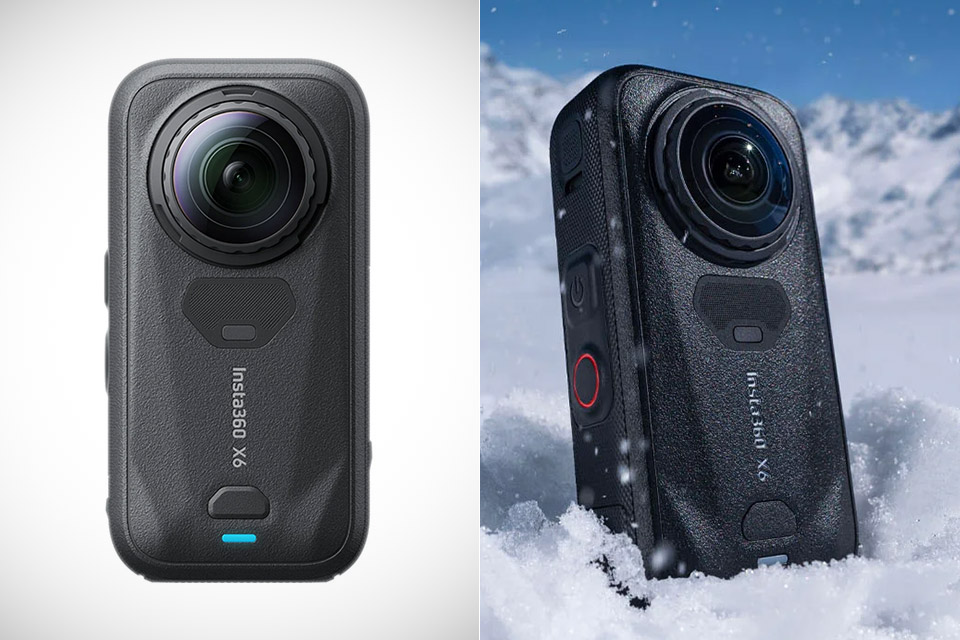
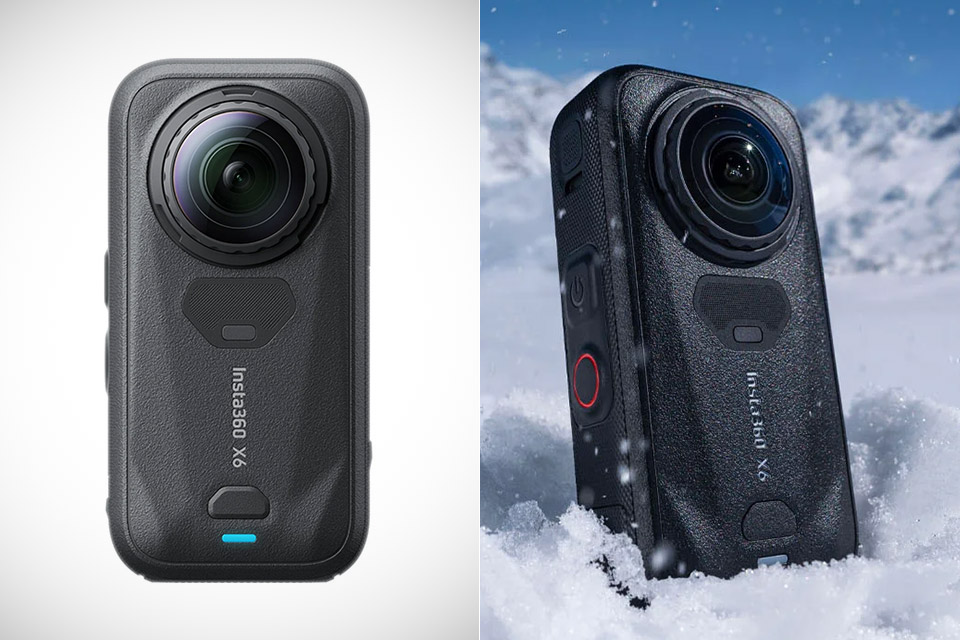
Insta360 just launched the X6, and the company is treating it like a full replacement for the gear most people carry on trips, rides, and everyday outings. One compact body now handles full 360 capture, locked-on subject tracking in flat video, and single-lens action shooting. Switch between the three with a tap. The camera then analyzes the footage on its own and delivers finished clips before you reach for your phone.
Dual custom Sony sensors are at the heart of this upgrade, with each 1.1-inch sensor organized in a square setup, providing a full one-inch equivalent when working in 360 mode. This configuration is significant since it gives you 33 percent more sensor area to work with than the preceding X5. That’s nearly four times the quantity of light you can capture in each shot. Low-light and high-contrast scenes will look much better. AdaptiveTone 2.0 now meters the two lenses separately, allowing it to draw two exposures every frame, which helps to extend the dynamic range without requiring any human adjustments. There are also two ambient light sensors that will help to clean up nite video, minimizing flicker and making things appear smoother.
DUAL 1/1.1″ SENSORS & TRIPLE AI CHIP SYSTEM: Custom-built dual 1/1.1″ square sensors deliver unprecedented 360 image quality. Combined with a triple…
FLAGSHIP 8K50FPS 360 VIDEO: Hit record on our 360 action camera and capture your world in stunning native 8K50fps video. Every view, every highlight…
IN-HOUSE AI MODEL FOR EFFORTLESS 360 EDITING: Insta360’s own AI model, built specifically for 360 editing. New AI Director edits your footage…
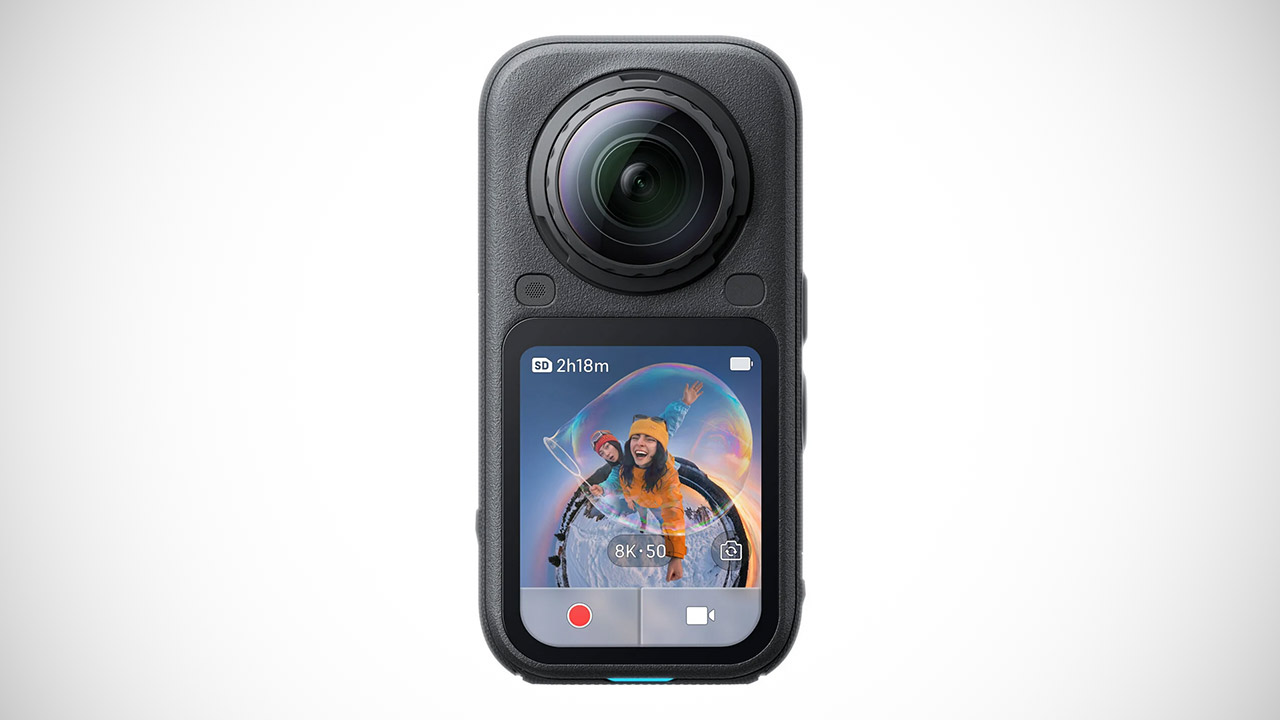
The processing power has been increased to match the larger sensors, with an 8-core 3.3 GHz processor built on a 4-nanometer technology driving the show, along with two dedicated imaging chips for good measure. That provides you a five-fold increase in computational capacity over the X5, and it will run more than twice as fast with 35% reduced power consumption. With this amount of headroom, you can run the camera in native 8K at 50 frames per second in full 360 and then reframe in whichever direction you choose. If you want something simpler, flat mode provides clear 4K with InstaFrame 2.0 subject tracking that locks onto people, dogs, or objects and keeps them centered. The single-lens action mode, on the other hand, offers 5K at 60 frames per second with a choice of 170 degree or 132 degree fields of view, or 4K at 120 frames per second in slow motion if desired.
The larger 2600mAh battery provides 140 minutes of continuous 8K @ 30 360 recording, which is a 51% increase over the X5. It charges to 80 percent in 24 minutes and can operate in temperatures as low as -20 degrees Celsius. The body is slightly shorter and more pocketable than the previous iteration, despite the larger sensors inside. The 2.32-inch OLED panel can reach 1200 nits while remaining legible in direct sunlight, and it also functions as a big record button when gloves are worn. The camera’s waterproofing has also been increased, allowing it to dive 20 meters without a case and 60 meters with the Invisible Dive Case Pro.
Advertisement
The windproof 360 microphones inside the body have been updated, and there’s also a new Hidden Engine Mic mode that separates engine sound while blocking out the wind for motorcycle riders. The Intelligent Audio Mode will also adapt automatically, eliminating the need for you to do anything. You now have the option of pairing two wireless transmitters simultaneously. Connectivity has also been sped up across the board, with Wi-Fi 6 moving files at a zippy 100MB per second wirelessly and USB 3.0 reaching 450MB per second via cable. If you’re afraid about dropping the connection, Bluetooth will reconnect in under a second.
The most significant change will likely be in how you edit your footage. The AI Director process takes place on the camera itself, as it pulls up your video, selects the best sections, and assembles whole clips for you, complete with framing, movement, cuts, music, and everything else, before neatening it up and delivering it to the app for sharing. Auto Edit 2.0 employs a sophisticated PanoMind model that has been trained on over 10,000 hours of real-world 360-degree film from travel, sports, diving, cycling, and everyday life.
Moments Pro on the cloud allows you to create more versions after you’ve established your subject, mood, style, and so on; simply choose your timings and it will do the rest for you. You also get ten-bit color and native Dolby Vision, as well as I-Log for heavy-duty color grading afterward. We’re talking a respectable 47 gigabytes of storage memory, so you can shoot to your heart’s content without having to worry about juggling SD cards.
The lenses themselves are five times more scratch resistant, and you can pop them in and out for sixty percent less. The magnetic mounts are fully compatible with all of your X5 and Ace gear, and you get over a hundred different accessories that can fit onto scooters, bikes, cars, and selfie sticks. A power selfie stick can give you an extra three hours of use out of your camera. Fast charge cases now have two batteries and card slots. You have the option of Midnight Black or Arctic White. The regular bundle now starts at $699.99 and includes the camera, cable, pouch, and lens cloth. Push the button to upgrade to the basics kit for an additional $100, which includes a backup battery, invisible stick, lens caps, charge case, and an extended warranty.
The Trump-class battleship program could cost the Navy $275 billion total
First battleship alone carries a staggering $23.4 billion price tag
Each ship weighs 35,000 tons and packs hypersonic missiles, nuclear missiles, lasers, and more
A new US Congressional Budget Office report has estimated that the Navy’s proposed Trump-class battleship program could ultimately cost taxpayers $275 billion.
The first vessel alone is projected to cost $23.4 billion, roughly $6 billion more than the Navy’s initial estimate initially offered in December 2025.
Officials describe the 35,000-ton nuclear-powered warship as the most heavily armed surface combatant the Navy has ever attempted to build.
Latest Videos FromTechRadar
Advertisement
Ambitious design, timeline, and escalating costs
The Trump administration announced its intention to build this new class of large surface combatants in December 2025, describing it as a guided missile battleship.
It plans to equip this battleship with rail guns, large lasers, hypersonic missiles, nuclear cruise missiles and anti-air, land-attack and anti-ship missiles.
“If built to those specifications, the ship would be the largest surface combatant in the world and larger than any surface combatant built for the Navy since World War II,” according to the report.
“It would be more than three and a half times the size of the Navy’s Arleigh Burke-class guided missile destroyer and more than twice the size of the Zumwalt-class guided missile destroyer.”
Sign up to the TechRadar Pro newsletter to get all the top news, opinion, features and guidance your business needs to succeed!
The Navy will construct 15 Trump-class battleships between 2028 and 2056, with each of the following fourteen ships priced at $18 billion.
Advertisement
By comparison, the USS Gerald R. Ford, the Navy’s newest nuclear-powered aircraft carrier, cost approximately $13.3 billion to build.
According to the CBO report, shipyards would need to produce 12% greater tonnage by 2035 under the 2027 plan than under the 2025 version.
To meet this schedule, the Navy would need to construct roughly one new battleship every other year between 2028 and 2056.
Advertisement
During that same period, the service would also need to continue producing two DDG-51 destroyers every single year without interruption or delay.
By 2058, total tonnage for large surface combatants would need to grow by 60%, a pace the report calls a potential challenge for industry.
Shipbuilding struggles raise doubts
Concerns about the Navy’s shipbuilding capacity are not new, and a Government Accountability Office (GAO) report from last March outlined years of setbacks.
Advertisement
The GAO found that too few ships have been completed, that new vessels often fail to perform as expected, and that deliveries frequently run late.
Some ships have arrived up to three years behind schedule, according to the agency’s assessment of nearly two decades of shipbuilding programs.
“We are effectively made to operate in a perpetual state of triage,” said Shelby S. Oakley, director at the Government Accountability Office.
Oakley told the Senate Armed Services Committee that unrealistic assumptions about cost and schedule have repeatedly diverted resources and delayed shipbuilding programs.
Advertisement
The report further notes that switching to nuclear propulsion could lower the battleship’s long-term operating costs by removing the need for fuel purchases.
However, the CBO did not provide a specific estimate of how much money nuclear power might save over the life of the program.
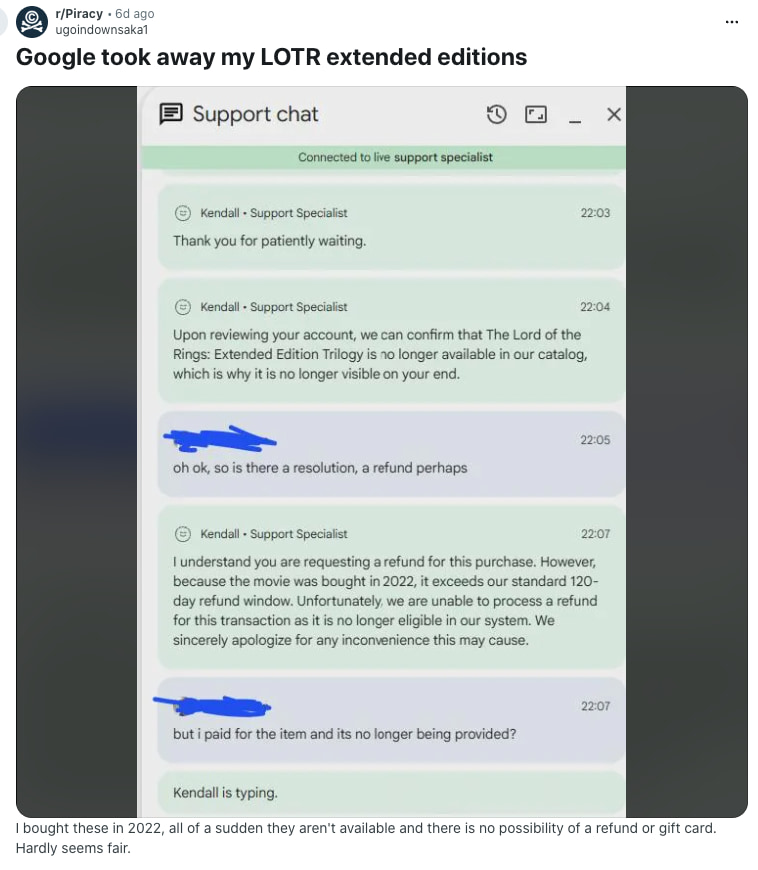
Before anyone starts marching on Google headquarters waving torches and 4K Blu-ray cases, one important fact needs to be established: this happened to one reported customer, not millions. There is no evidence that Google suddenly removed The Lord of the Rings movies from huge numbers of digital libraries or that widespread deletions are occurring.
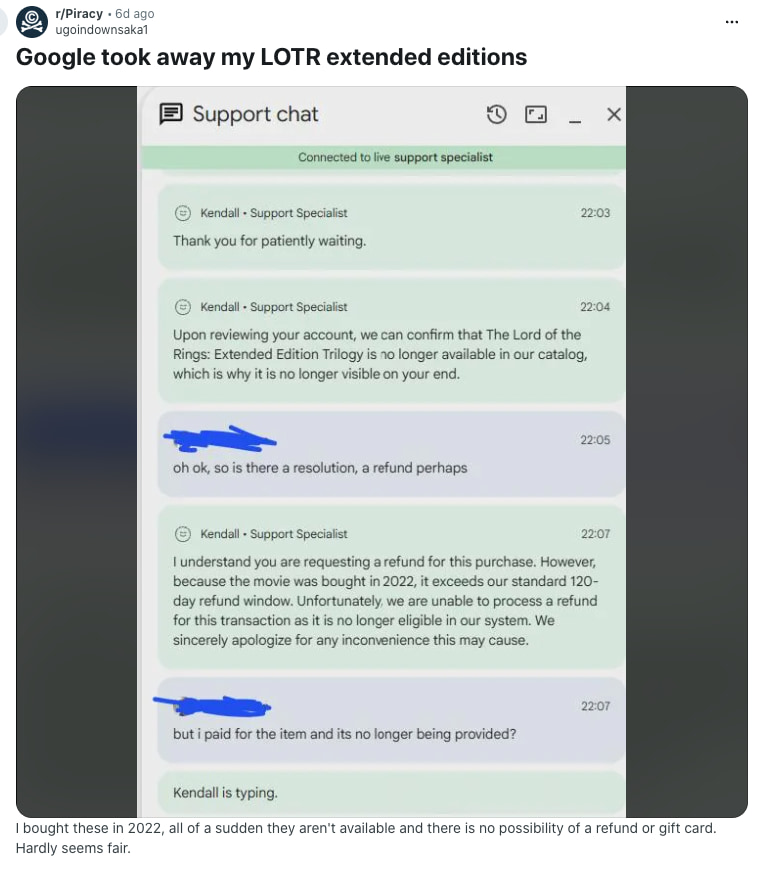
What we do have is a Reddit user who says the Extended Edition Trilogy they purchased through Google Play Store in 2022 disappeared from their library. Screenshots shared by the user appear to show Google Support confirming that the title had been removed from its catalog and that it could neither restore access nor provide a refund.
That distinction matters because this isn’t a mass deletion story. It is, however, a very good example of why the word “Buy” has become increasingly slippery in the digital era.
Related Reading:
You Bought It. Sort Of.
According to the customer, they paid for the films four years ago and reasonably expected them to remain available. Google Support reportedly explained that because the trilogy had been removed from its system and the transaction dated back to 2022, it could not restore the movies or issue a refund.
You can understand why someone might find that response less satisfying than walking barefoot to Mordor.
Advertisement
Google’s own current terms make the larger issue fairly clear. After purchasing content, customers receive a non-exclusive right to access and use it. Google also states that purchased content generally remains available only as long as Google retains the right to provide it. If those rights disappear, content or services are discontinued, or certain other conditions arise, Google can stop providing access to something you paid for.
That little “Buy” button suddenly feels considerably less permanent.
Digital movies are enormously convenient. I buy them and stream them, and most consumers are not going back to walls filled with thousands of discs.
I might not be the best example.
Advertisement
I own more than 3,700 movies on DVD, Blu-ray, 4K UHD Blu-ray and even LaserDisc, and there is a reason I have never viewed that collection as obsolete. If I purchase The Lord of the Rings on disc and put it on my shelf, Warner Bros. cannot remove it because a licensing agreement changes. Google cannot decide my copy is no longer in the catalog, and the internet can disappear for the evening without taking Gandalf with it.
Physical media has limitations. Discs can be damaged or lost, players eventually fail, and 3,700 movies require slightly more storage space than an app icon. But access to them does not depend on someone else’s server continuing to recognize my license.
Advertisement. Scroll to continue reading.
For home theater enthusiasts, there is also the performance argument. 4K UHD Blu-ray can deliver higher video bitrates and lossless audio without the compression and bandwidth compromises inherent to streaming. Physical media offers excellent performance along with something becoming increasingly unusual in modern entertainment: a copy you can actually keep.
Advertisement
Music Has Exactly the Same Problem
The same argument applies to Spotify, Apple Music, TIDAL, Qobuz and every other subscription music service. You don’t own those 100 million songs. You are paying for access to a catalog, and that catalog can change.
Albums disappear. Different masters replace older ones. Labels change distributors. Licensing agreements expire. The album you played yesterday may not necessarily be there tomorrow.
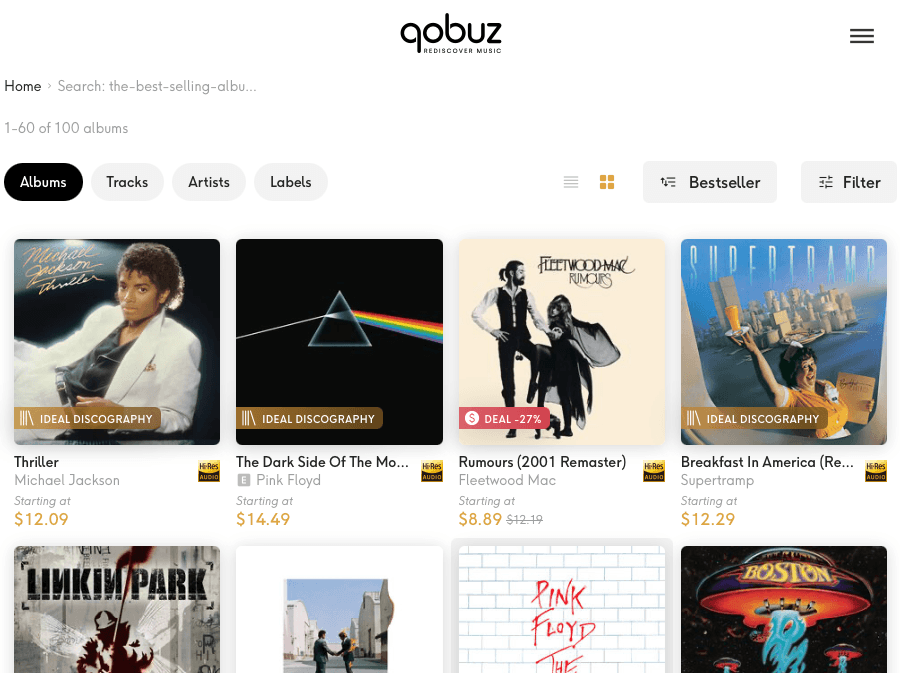
Qobuz Music Download Store – Best Selling Albums
Qobuz offers an important alternative because it operates a download store alongside its streaming service. Customers can purchase albums and download actual music files to local storage. Roon Ready? Permanence sold separately.
But even Qobuz makes the distinction worth understanding. Its support documentation says customers can normally re-download purchases, while explicitly warning that albums may later become unavailable for download and recommending that customers create backups.
Advertisement
That is the key difference. If you bought the download, saved the files and backed them up, a record label removing the album from Qobuz’s streaming catalog doesn’t magically reach into your NAS and delete it. If you only streamed it, you never had anything to begin with.
One Customer Is Enough to Ask the Question
Millions of consumers buy movies digitally without anything disappearing, and this single case is not evidence that everybody’s library is about to evaporate. It would also be naïve to assume this is the only person who has ever lost access to something they purchased digitally. Most of us do not conduct annual inventory checks on libraries containing hundreds of movies, so a missing title could easily go unnoticed for months or even years. What we cannot say is how many customers this has affected because Google does not publish that data.
But the story matters because it demonstrates what can happen when ownership is replaced by licensed access.
The customer clicked “Buy,” paid for the movies and expected them to remain available. Four years later, according to the support exchange they shared, they didn’t.
Advertisement
Perhaps the industry needs a different word than “Buy.”
Until then, I’ll keep my 4K discs, CDs, records and even those LaserDiscs. They take up more room, but none of them vanish because somebody in a licensing department changed a spreadsheet.
The takeaway: AMD has published a new security bulletin about the Trusted Platform Module reference implementation used in its computer platforms. The disclosed flaws could have significant reliability and security implications, but updates for AMD’s numerous CPU families have already been available for months. Users simply need to install them.
Researchers working with the Trusted Computing Group recently identified a potential security issue in AMD’s TPM code, prompting the company to release new motherboard and firmware updates to address the vulnerability. The update process was not exactly swift, however, as the fixed TPM code had already been available for months. Meanwhile, AMD has only just released its AMD-SB-7064 bulletin detailing the issue.
The US chipmaker explained that the TCG Vulnerability Response Team was informed by Intel researchers about a potential out-of-bounds read vulnerability in its TPM 2.0 reference code. The flaw could be exploited by local attackers with elevated user privileges, allowing them to force the TPM code to read sensitive data stored in the firmware or even affect the availability of the TPM.
AMD programmers confirmed the issue, which affects the company’s TPM implementation in two different ways. The first flaw (CVE-2026-6726) could leak information and allow a malicious actor to recover credentials from a TPM-aware Certificate Authority, potentially enabling them to falsify TPM encryption keys or other TPM-based attestation mechanisms.
Advertisement
AMD describes the second flaw (CVE-2026-6727) as a timing side-channel vulnerability affecting decryption workloads using the RSA cryptosystem. The flaw could allow an attacker to decrypt encrypted data or falsify TPM 2.0 attestation keys. Both vulnerabilities require a local attack with “privileged” user access, meaning they should not pose a significant security risk to systems exposed solely to the internet.
Threat level aside, the two flaws have been assigned relatively high CVSS scores of 8.5 and 8.3, respectively, and are noteworthy for the large number of affected processors. AMD’s list includes Epyc 4004 and 4005 Series CPUs, several embedded processors, Ryzen desktop CPUs from the 3000 through 9000 series, Threadripper workstation processors, and more.
AMD recommends that users install the updated Platform Initialization firmware releases designed to address both CVE-2026-6726 and CVE-2026-6727. The fixed firmware versions have been available since at least May for most processors, while Ryzen Embedded CPUs received their updated firmware in July.
The Trusted Platform Module is a security-focused cryptoprocessor specification defined by the TCG in 2003, but the major TPM 2.0 implementation upgrade has been available since 2014. A TPM 2.0 hardware module or firmware implementation became part of Windows 11’s mandatory system requirements, providing a significant security improvement for the Windows ecosystem.
Advertisement
As these two AMD flaws clearly demonstrate, however, total security remains a distant goal even in the modern TPM-enabled PC world.
Researchers at Israeli cybersecurity firm Dream say suspected China-linked hackers used an open-source AI-agent system to conduct what may be the first observed end-to-end autonomous cyberattack against a government. According to the Financial Times (paywalled), the attack compromised at least 85 accounts and resulted in the theft of more than 2,500 personnel records from Taiwanese systems. Tom’s Hardware reports: The campaign reportedly ran for four days at the beginning of July and at times deployed as many as eight autonomous agents in parallel. Dream said the system mapped 21 government systems before compromising user accounts and extracting personnel information. The attackers subsequently expanded their activity to Taiwan’s nuclear safety agency, at least seven energy companies, government suppliers, and other government systems.
Dream says it found the evidence inside a 160-megabyte (160MB) online archive that surfaced during its broader tracking of cyberthreat actors. The archive reportedly held 1,395 files showing that the tool was built on two open-source AI agent systems — Hermes and OpenClaw — both of which can be downloaded freely and are designed to let large language models carry out multi-step tasks on their own.
Researchers could not determine which underlying model powered the agents, but the data reportedly showed the model’s safeguards had been sidestepped by presenting the intrusion as an authorized penetration test rather than a real attack. Of particular concern is that the toolkit for the hack comprised such easily available systems, neither of which was purpose-built for offense. The operators appear to have assembled a capable autonomous tool out of components any developer can pull down and run.
What the researchers describe as the tool’s most striking feature was its ability to continuously devise attacks on its own, rather than follow a preprogrammed route. The platform continuously assessed available evidence, ranked possible attack paths, and reprioritized them as circumstances changed. When one technique failed, the tool tasked another agent with searching the internet for information and developing an alternative approach.
The headset remains one of the most technically impressive consumer products Apple has ever built, with extraordinary displays, convincing passthrough video, Spatial Audio and the ability to turn a hotel room or airplane seat into something resembling a private movie theater. But almost three years after Apple first unveiled Vision Pro, I know exactly one person who bought one.
He returned it.
Advertisement
That anecdote obviously isn’t market research, but the actual market research isn’t particularly comforting for Cupertino either. Apple does not disclose Vision Pro unit sales, but IDC estimated that Apple shipped roughly 400,000 units during 2024. Counterpoint subsequently reported that Vision Pro shipments fell 43% sequentially during the fourth quarter of that year. The Financial Times reported an IDC estimate of only around 45,000 Vision Pro shipments during Q4 2025.
For comparison, Meta shipped roughly 5.6 million headsets during 2024, according to IDC data cited by The Verge. Vision Pro is also no longer a $3,499 proposition: Apple’s U.S. online store currently lists the M5 version starting at $3,699.
So what does Apple do now?
Apparently, it takes you out to the ballgame.
Advertisement
Baseball Is Going Immersive
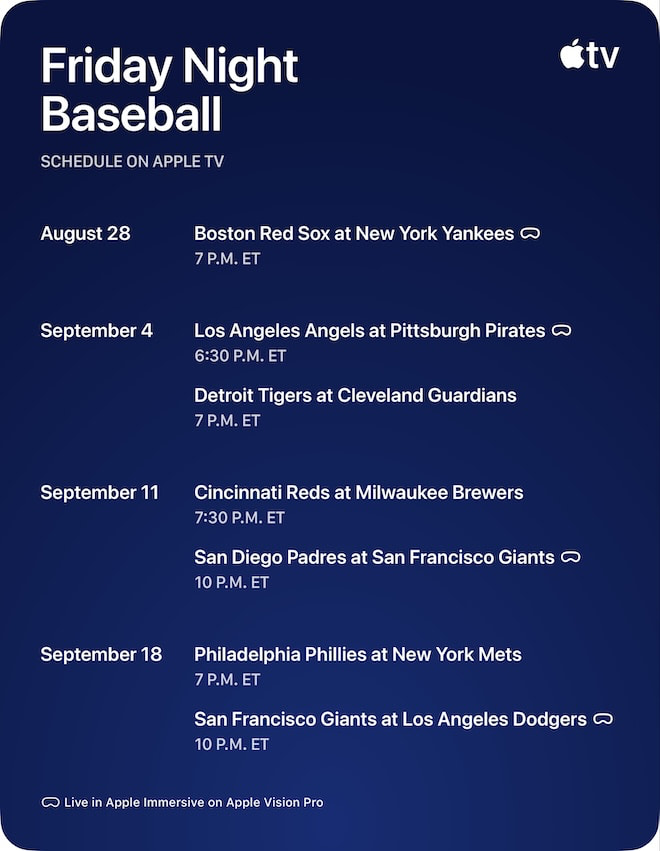
Beginning August 28, Apple will stream Friday Night Baseballlive in Apple Immersive for Vision Pro owners for the first time. The initial game is Red Sox versus Yankees, presented in stereoscopic 3D video recorded in 8K with a 180-degree field of view.
This isn’t simply the normal Apple TV baseball feed floating on an enormous virtual screen.
Apple is producing the immersive version with dedicated camera positions, separate commentary, dedicated replays and graphics that appear within the viewer’s space. Ambisonic microphones will capture the stadium for Spatial Audio, while cameras are intended to place viewers close to the batter, dugouts, outfield wall and other positions around the field.
Advertisement. Scroll to continue reading.
Both the original M2 Vision Pro and current M5 model are supported. An active Apple TV subscription is required, which currently costs $12.99 per month in the U.S. Live immersive baseball will initially be available in Australia, Canada, Germany, Hong Kong, Japan, South Korea, Taiwan, the U.K. and U.S.
Advertisement
Apple says live Friday Night Baseball in Immersive will become a weekly experience after the first game. Its September schedule includes stars such as Bryce Harper, Fernando Tatís Jr. and Shohei Ohtani, although Apple has not specifically identified every individual matchup that will receive the full Immersive treatment.
Watching Ohtani turn on a 98 mph fastball from a position that feels like you’re sitting somewhere behind the plate sounds extremely cool.
But is it $3,699 cool?
That’s the problem Apple still has to solve.
Advertisement
Vision Pro Needs Something Your Television Cannot Do
Apple already says Vision Pro has access to more than one million compatible apps, including more than 3,000 built specifically for visionOS, hundreds of 3D movies and an expanding library of Apple Immersive programming. Yet those numbers have not translated into mass consumer adoption.
Because consumers don’t buy platforms because someone tells them they support a million apps.
They buy them because one or two experiences become indispensable.
The iPod had your music library. The iPhone combined the internet, communications and apps in your pocket. Apple Watch eventually found its footing around fitness and health.
Vision Pro still needs its answer.
Advertisement
Live sports might be the strongest one Apple has found.
Sports are recurring rather than something you experience for 20 minutes during an Apple Store demonstration. Fans have emotional connections to teams and players. More importantly, properly produced immersive sports can potentially deliver something fundamentally different from watching the same Yankees game on an 85-inch Mini-LED television.
Advertisement. Scroll to continue reading.
Baseball is also unusually suited to the experiment. The field is enormous, the action repeatedly concentrates around predictable locations, and the pauses between pitches give viewers time to look around rather than desperately trying to follow a puck moving at highway speeds.
Advertisement
If Apple can make viewers feel as though they are standing beside the Yankees dugout or sitting somewhere they could never afford to sit at Yankee Stadium, Vision Pro suddenly becomes more than an extremely expensive screen strapped to your face.
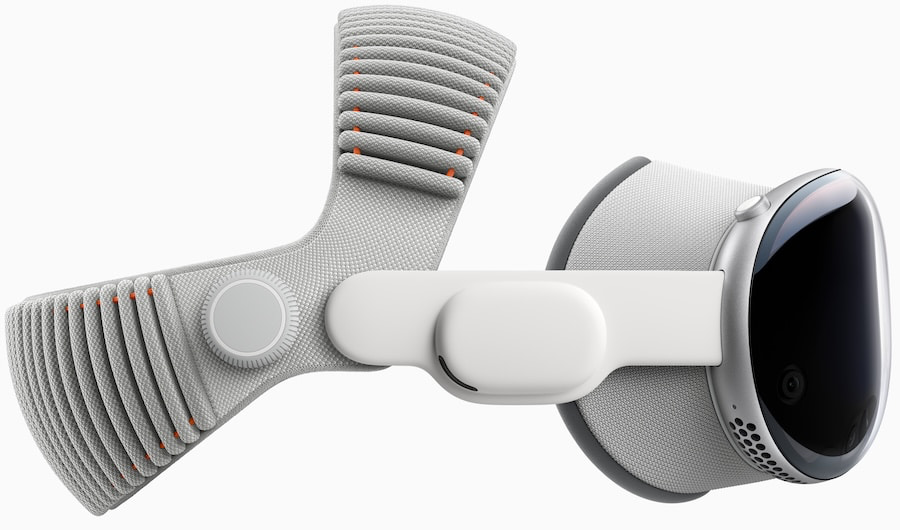
Apple Vision Pro Dual Knit Band
But Sports Alone Won’t Fix Vision Pro
There is still an enormous obstacle hanging over all of this.
Price.
A baseball fan can buy an excellent 77-inch OLED television for considerably less than a Vision Pro. Families can watch that television together. Nobody has to wear a computer on their face for three hours, and when Aaron Judge hits one into the second deck, everyone in the room gets to see it.
Advertisement
Vision Pro remains fundamentally solitary hardware in a medium — sports — that is often communal.
The broader XR market isn’t exactly exploding either. Counterpoint says global VR headset shipments fell 17% year over year in Q1 2026, while lighter AR smart glasses are growing much faster.
That suggests immersive baseball probably isn’t going to turn Vision Pro into the next iPhone.
But perhaps that is no longer the immediate objective.
Advertisement
Apple needs experiences compelling enough to keep developers interested, convince existing owners to keep using the hardware and give curious consumers a reason to walk into an Apple Store and actually try one. Live baseball, followed by more basketball and other immersive sports, can help Apple demonstrate what spatial computing does better than televisions, phones and tablets.
Our initial coverage of Vision Pro asked back in 2023 whether consumers would bite at $3,499.
Three years later, the available sales evidence suggests the answer has largely been no.
Advertisement. Scroll to continue reading.
Advertisement
Live 8K baseball won’t solve the price problem.
But watching a 450-foot home run land somewhere over your virtual shoulder might finally explain what Apple has been trying to sell us.
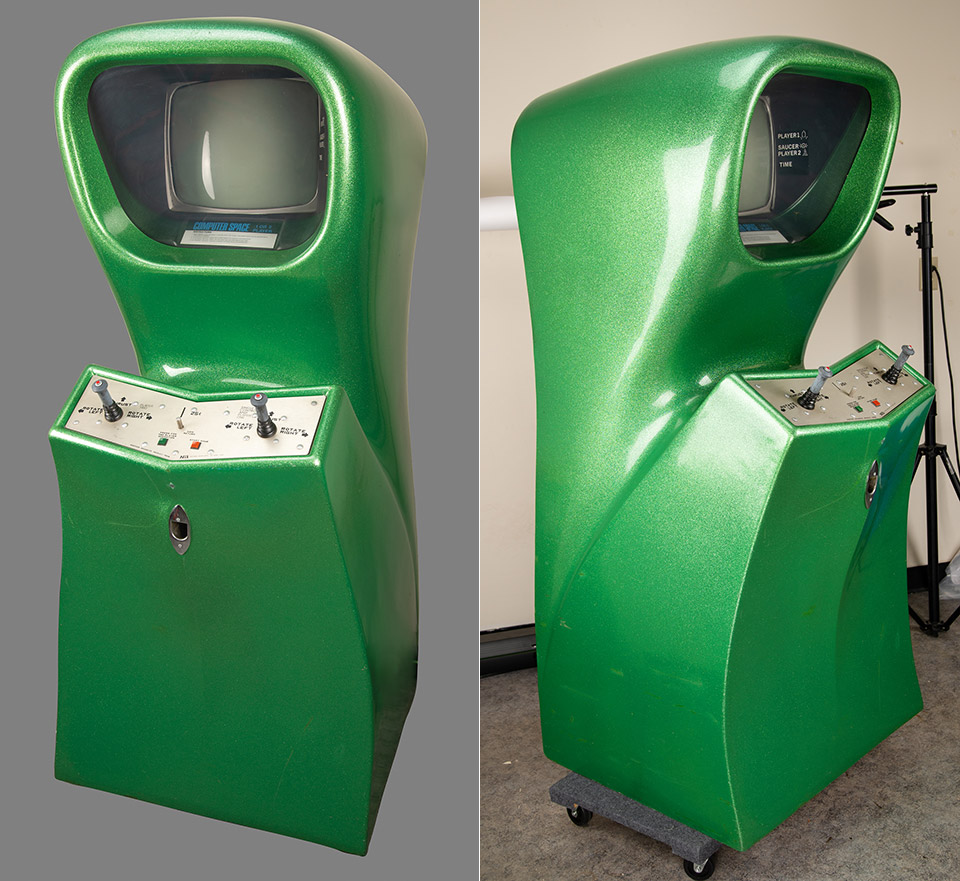
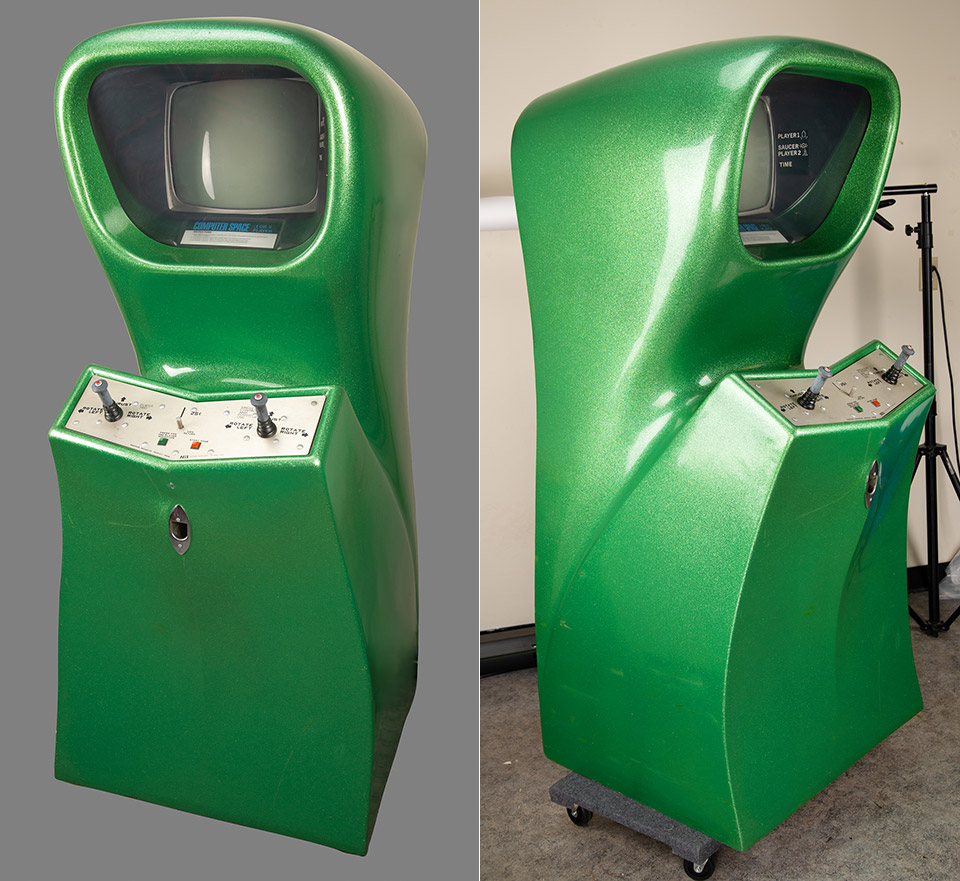
Nolan Bushnell and Ted Dabney spent months turning a mainframe curiosity into something that could sit in a bar and take quarters. Their 1971 creation, Computer Space, became the first coin-operated video game ever sold to the public. A rare two-player version of that same machine, finished in metallic green sparkle fiberglass and still working more than fifty years later, is now on the block at RR Auction with bids climbing toward an estimate north of $20,000.
Spacewar! had been running on pricey university computers since 1962. Players were launching rocket ships around a large star, firing missiles at each other as gravity pulled them in. Bushnell and Dabney, working as Syzygy Engineering, reduced the game to its bare essentials, running it on a few logic boards and a black-and-white television. There’s no need for a minicomputer or gravity; only one player in a rocket, two hardware-driven saucers, and a starfield made up of static dots. They created an extremely futuristic cabinet out of fiberglass, the kind of flowing design you see on hot tubs rather than pinball machines, and brought four solid color prototypes to the Music Operators of America convention in Chicago in October 1971.
14 Classic Games Included: Play PAC-MAN, Galaga, Dig Dug, Pac-Land, Mappy, and more—14 built-in titles deliver hours of iconic retro arcade fun at…
Authentic Arcade Experience: Real-feel joystick and buttons let you dodge ghosts, eat pellets, and chase high scores just like you did in the arcade
Crisp 17-Inch Display: BOE color monitor brings every glowing maze and character to life with sharp visuals that stay true to the original arcade look
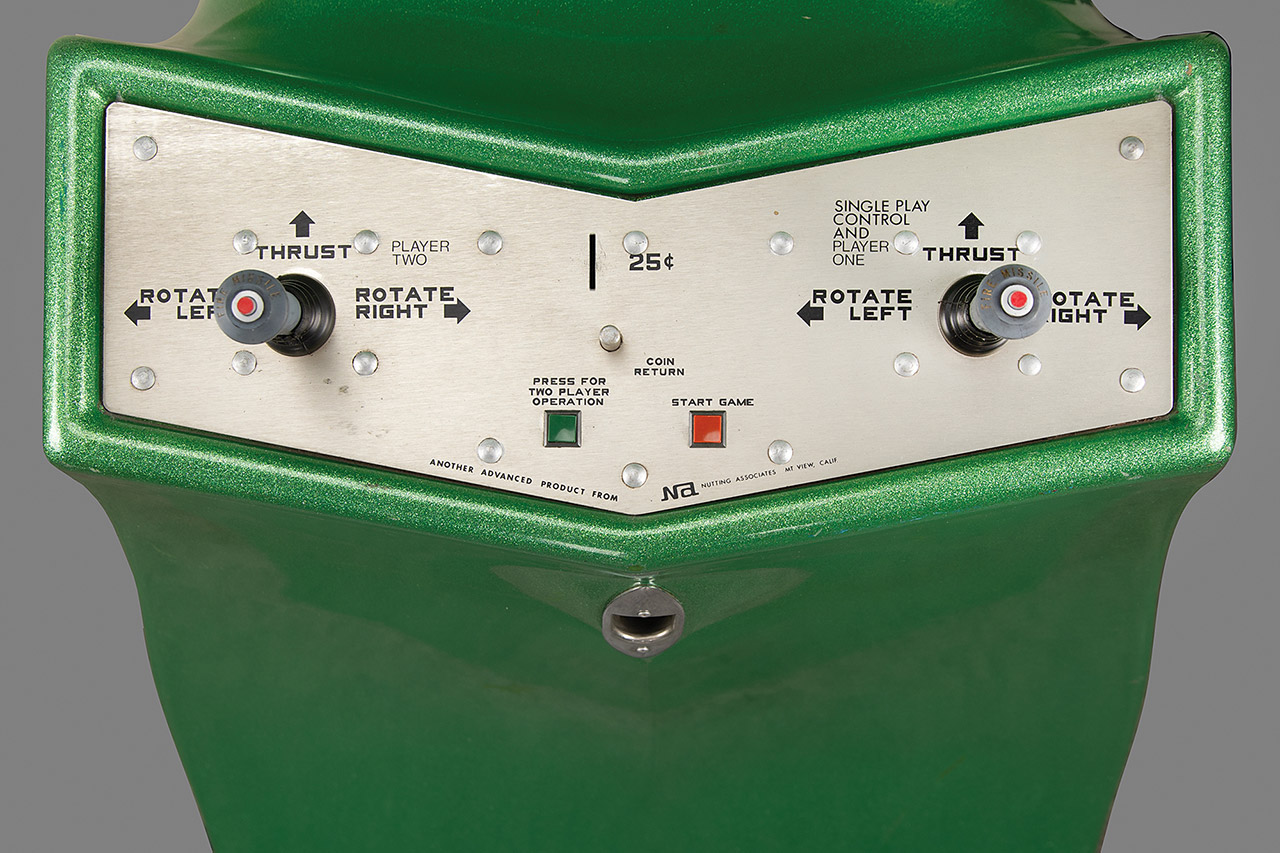
Nutting Associates in Mountain View, California, took the game to the next level and put it into production. In 1972, approximately 1,300 to 1,500 single-player cabinets were produced, each painted in metallic flake red, blue, or the uncommon green. Sales were consistent around college campuses, but everyplace else, operators discovered that the controls were too complex for the usual bar population to handle. Still, it demonstrated that a video game can earn money. Bushnell and Dabney withdrew from Nutting, renamed their firm Atari, and published Pong the following year. Computer Space had finished its duty.
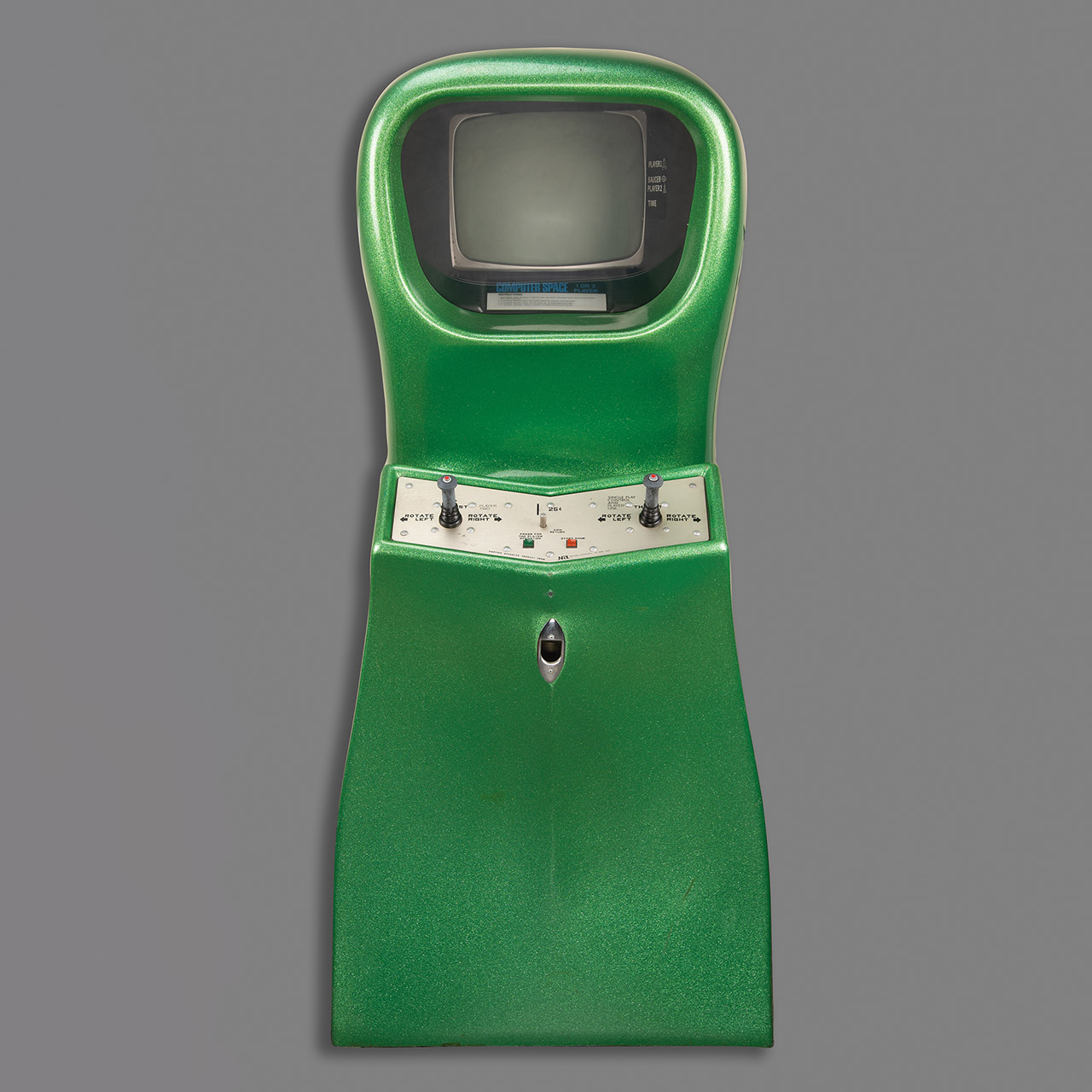
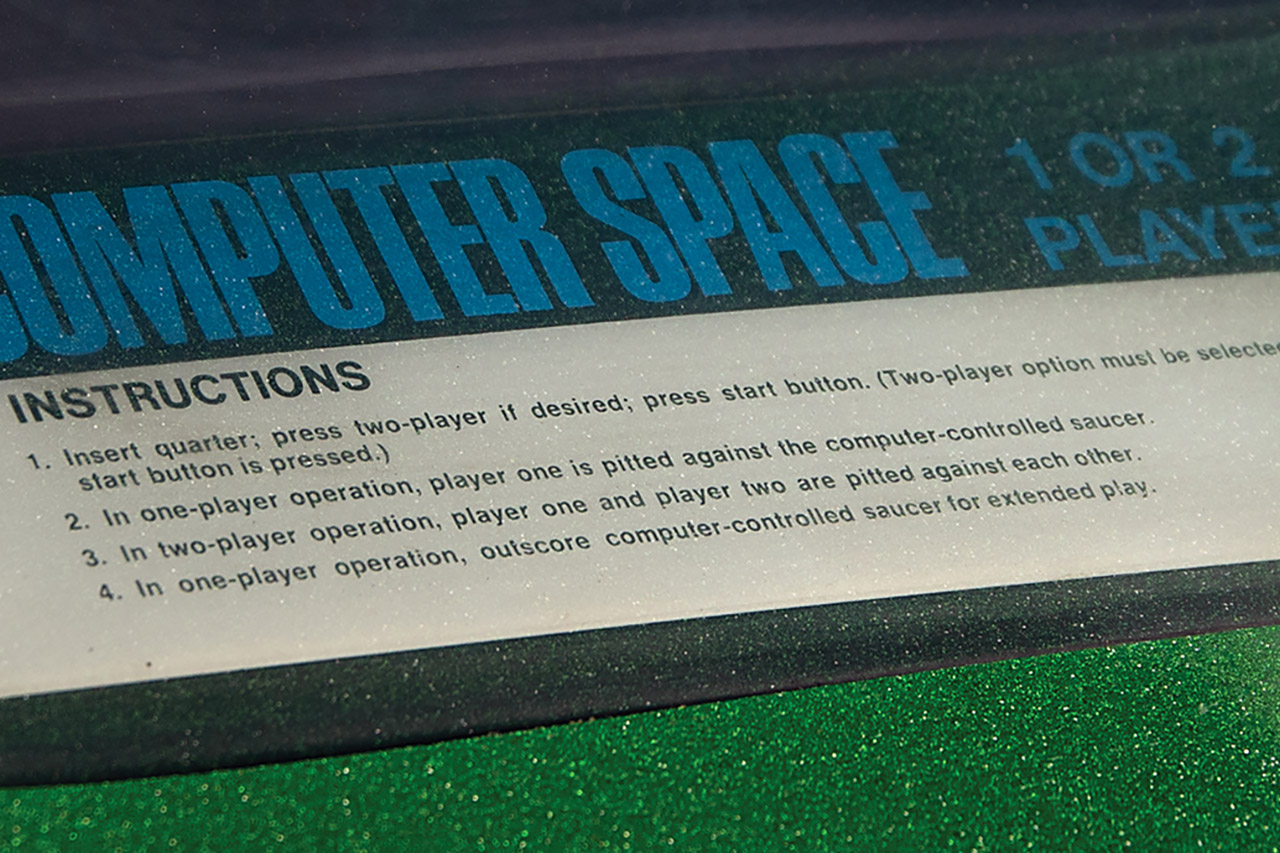
However, Nutting kept the game alive. In July 1973, the business began shipping a two-player successor. Steve Bristow handled the engineering, and the design was altered; the new cabinet was now solely green metallic flake. The original push-button configuration was replaced by two rotational joysticks and a set of red fire buttons. A green button labeled “Two Player Operation” sat between the coin slot and the red start button. Instructions printed under the screen were simple: drop a quarter, choose one or two players before you hit start, then fight. In single-player mode you still faced the computer-controlled saucer. In two-player mode the two human rockets dueled each other across the same starfield.
Unfortunately, we don’t know how many two-player versions were made. Some collectors believe there were just a few hundred, and the Video Game Preservation Society has confirmed that less than ten originals remain. Working versions are practically never for sale. One recent green example was apparently sold to a museum for almost $20,000. Paul Allen, one of Microsoft’s co-founders, once owned a blue single-player device that would have sold for a much higher price. Obtaining parts has become nearly impossible, as vacuum-tube monitors and discrete logic boards are just unavailable.
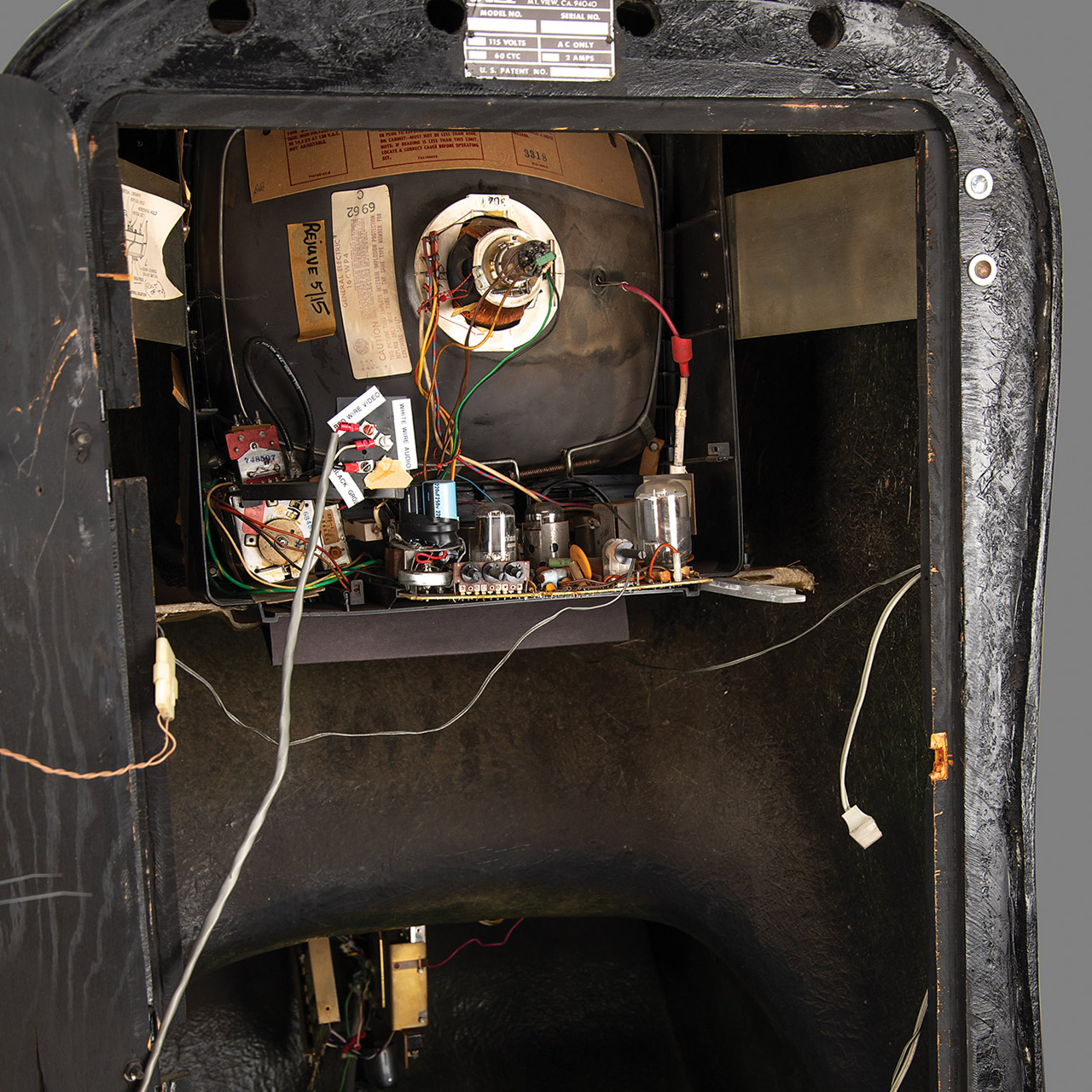
The one being auctioned has serial number 30644 and model number 724C. The cabinet has some scuffing, but the machine still works and displays the game on the screen. The original joysticks and buttons are still attached, indicating that it is in excellent shape. Dave Perry, the game designer of Shiny Entertainment, is the current owner who is selling since he has run out of space at home. The auction is part of RR Auction’s larger “Steve Jobs & the Computer Revolution” sale and is set to end on August 20.
For decades, building a proper home theater required a fairly predictable piece of hardware sitting somewhere beneath the television. The AV receiver accepted all of your sources, decoded the soundtrack, powered the speakers, managed the subwoofer, corrected for the room and generally acted as traffic cop for everything involving sound. The television mostly knew its place.
That relationship is changing rather quickly. TV manufacturers are increasingly turning the display into something far more important than the final stop for the picture. Samsung, LG and TCL are moving speaker coordination, room optimization and immersive audio processing directly into their television ecosystems, while Sony has already turned compatible BRAVIA TVs into active participants in its home theater systems. Apple and Google are approaching the same problem from another direction, shifting much of the responsibility into their streaming platforms.
None of this means the AV receiver is about to disappear. Someone running an Anthem AVR with seven passive speakers and four ceiling channels isn’t unplugging it tomorrow. The family buying a 77-inch OLED who wants Dolby Atmos without speaker wire, an equipment rack and a Saturday afternoon spent deciphering channel assignment menus? That’s the customer the industry is coming for, and there are millions more of them.
2026 LG G6 OLED TV
The TV Is No Longer Just Passing the Sound Along
The important distinction here is control. A television connected to an AVR through HDMI eARC is still largely handing audio responsibility to another component. The receiver determines how the soundtrack is decoded, how speakers are configured, where bass gets redirected and how the system interacts with the room.
Advertisement
The newer wireless ecosystems begin moving some of those decisions upstream. Compatible televisions can identify speakers, coordinate their output with the TV’s internal speakers, compensate for placement and distribute different parts of an immersive soundtrack around the room. Streaming apps are already inside the display, HDMI sources are connected directly to it, and increasingly the audio system is configured through the television’s interface or companion app.
The television isn’t becoming an AV receiver in the traditional hardware sense, but it is starting to perform some of the jobs that made the AV receiver necessary for mainstream users in the first place. That’s an important distinction because the disruption isn’t really about replacing a Denon, Marantz or Anthem feature for feature. It’s about removing enough complexity that millions of people decide they never needed one to begin with.
Samsung Has Been Quietly Building This for Years
Samsung’s Q Symphony originally looked like a clever way to stop customers from wasting the speakers already inside their expensive television whenever they added a soundbar. The 2026 version is considerably more ambitious.
Compatible Samsung TVs can now coordinate with as many as five Samsung audio devices through Q Symphony, including soundbars and Wi-Fi speakers, while automatically adjusting how the system behaves based on speaker placement. SmartThings provides another layer of system management for playback and audio settings. In other words, the television isn’t merely outputting Dolby Atmos to another box; it is becoming an active participant in the system.
Samsung’s Music Studio 7 can operate independently or become part of a larger Q Symphony installation with compatible Samsung televisions, soundbars and wireless speakers. The company’s 2026 Neo QLED and OLED televisions continue pushing Q Symphony deeper into the television lineup as well.
Advertisement
There is, however, a rather large Samsung shaped catch: it is still Samsung. Q Symphony remains a proprietary ecosystem. Buy the television and the appropriate Samsung audio products and the integration can be compelling. Decide two years later that you prefer speakers from somebody else and the doors to the clubhouse become considerably less welcoming. That isn’t necessarily a deal breaker, but consumers need to understand what they’re buying into.
Related Reviews:
Dolby Atmos FlexConnect Could Change the Rules
Dolby Atmos FlexConnect Diagram
Dolby Atmos FlexConnect is potentially much more disruptive because the long term goal isn’t supposed to be another closed ecosystem. The technology allows a compatible television or soundbar to work with wireless speakers placed around a room and then automatically determines their locations, calibrates the system and adjusts how Dolby Atmos content is reproduced.
Advertisement. Scroll to continue reading.
Precise symmetry is no longer mandatory, which matters in actual homes where one surround speaker ends up beside a bookcase, another gets moved because somebody objected to its presence next to the sofa, and the architect apparently designed the room without consulting Dolby Laboratories.
TCL was first out of the gate with commercial FlexConnect support. Its compatible TVs can integrate their own speakers with Z100 wireless speakers, using processing to compensate for imperfect placement and create immersive audio without conventional speaker wiring. We heard the technology at CEDIA Expo and found that it produced convincing positional effects even when the physical speaker arrangement wasn’t ideal.
Advertisement
TCL has continued the technology into its 2026 lineup. The QM8L, for example, supports FlexConnect configurations with the Z100 speakers and Z100 SW subwoofer, while the flagship X11L expands the same idea around its integrated Bang & Olufsen audio system. This is much closer to the television becoming the audio system’s conductor rather than merely feeding a signal to something else.
LG Takes the Idea Even Further
LG Sound Suite at CES 2026
LG’s 2026 Sound Suite makes the same argument from another direction. The H7 soundbar, M5 and M7 wireless speakers and W7 subwoofer use Dolby Atmos FlexConnect to create a modular system that can grow from a relatively simple arrangement into something LG describes as a 13.1.7 channel configuration. More importantly for this discussion, FlexConnect is also being integrated into LG’s premium televisions.
At CES 2026, we heard the system progress from the television’s internal speakers to the TV combined with a pair of M7 wireless speakers, and finally to a much larger configuration incorporating the H7, subwoofer and additional M7 speakers. Automatic calibration compensated for the physical layout and created a genuinely immersive presentation without conventional speaker wiring.
That demonstration gets directly to the point: you don’t necessarily need a soundbar sitting beneath the television just to begin building the system anymore. You can start with the TV and add components around it, which represents a fairly profound change in architecture.
There is also an important caveat surrounding Dolby’s promise of interoperability. FlexConnect is designed to be brand agnostic, which theoretically opens the door to compatible televisions and wireless speakers from different manufacturers. We have not yet seen enough real world cross brand interoperability, however, to declare the walled gardens demolished.
Advertisement
Can an LG FlexConnect television eventually work seamlessly with a TCL speaker? Will another loudspeaker manufacturer be able to enter the ecosystem without requiring its own television platform? Those questions matter enormously, and until that actually happens, brand agnostic remains the destination rather than proof that we’ve arrived.
Sony Is Heading in the Same Direction but Isn’t There Yet
With Sony Bravia Acoustic Center Sync speakers behind the screen on select Sony TVs improve the center channel.
Sony presents another variation on the idea. Acoustic Center Sync allows compatible BRAVIA televisions to become the center channel in systems built around products such as the BRAVIA Theater Bar 9 or Theater Quad. Dialog originates at the screen while the external audio system handles the surrounding information.
We’ve found the implementation quite effective with the BRAVIA 8 II and Theater Bar 9. Dialog became better anchored to the image and the television behaved like another active component in the overall loudspeaker system.
This is not quite the same architecture as TCL or FlexConnect because the external Sony audio product remains essential, and the television isn’t taking over the entire processing and distribution role. Sony nevertheless reinforces the broader point: the television speaker is no longer something manufacturers necessarily expect you to turn off the moment you buy better audio hardware. It is becoming part of the home theater.
Apple and Google Move the Hub Into the Streamer
Apple HomePods setup as a stereo pair with Apple TV 4K.
Apple and Google complicate the argument in a useful way because neither makes the television itself the center of the system. They make the streaming platform the center.
Advertisement. Scroll to continue reading.
Advertisement
One or two Google Home Speakers can pair wirelessly with the Google TV Streamer. Two speakers create genuine physical stereo separation and Google’s Spatial Audio processing can simulate a broader surround presentation. There is an important limitation, however, that we’ve already highlighted in our coverage.
Google has not confirmed that the Home Speaker pair constitutes a Dolby Atmos playback system, even though the Google TV Streamer itself supports Dolby Atmos. Google describes the speaker implementation as Spatial Audio rather than confirmed Atmos reproduction. It also hasn’t documented an equivalent to Apple’s eARC arrangement for routing sound from external devices such as a game console or Blu ray player through the Google speakers.
Apple goes further. A full size HomePod or stereo pair connected to Apple TV 4K can reproduce Dolby Atmos, Dolby Digital 7.1 and Dolby Digital 5.1. Apple TV’s eARC support can also accept audio originating from other devices connected to the television and send it to the HomePods.
In Apple’s world, therefore, the Apple TV increasingly behaves like a miniature wireless home theater processor. It’s a different architecture, but the trajectory is the same: the dedicated box filled with speaker terminals is no longer mandatory for everyone.
Advertisement
Where the AV Receiver Still Wins and It Isn’t Close
Before anybody starts boxing up their Denon, Marantz, Anthem, Yamaha or Onkyo, there are some rather substantial differences between these systems and a traditional AVR.
An AV receiver provides real amplification for passive loudspeakers and considerably greater flexibility for speaker selection, subwoofer integration, source connectivity, surround formats, bass management, channel assignment and system expansion. A conventional 7.1.4 Dolby Atmos installation also uses actual loudspeakers positioned around and above the listener.
No amount of spatial processing changes the physical reality that discrete speakers placed in the correct locations can create localization, scale and dynamics that a handful of wireless speakers attempting to generate phantom channels may struggle to equal.
We saw exactly that kind of compromise during our Sony BRAVIA Theater Bar 9 testing. The soundbar by itself delivered impressive spaciousness but lacked convincing deep bass and benefited substantially from adding the dedicated subwoofer and rear speakers. We also noted that a component based system at roughly the same total price could provide higher overall performance, albeit with greater complexity.
There is another distinction that marketing departments tend to whisper: wireless speakers are usually wireless for the audio signal. They still need electricity. You may have eliminated speaker cable running across the room, but four powered speakers and a subwoofer can still require five convenient AC outlets. David Copperfield has not joined the engineering department. The wires have not vanished entirely.
Advertisement
The Biggest Advantage Is Simplicity
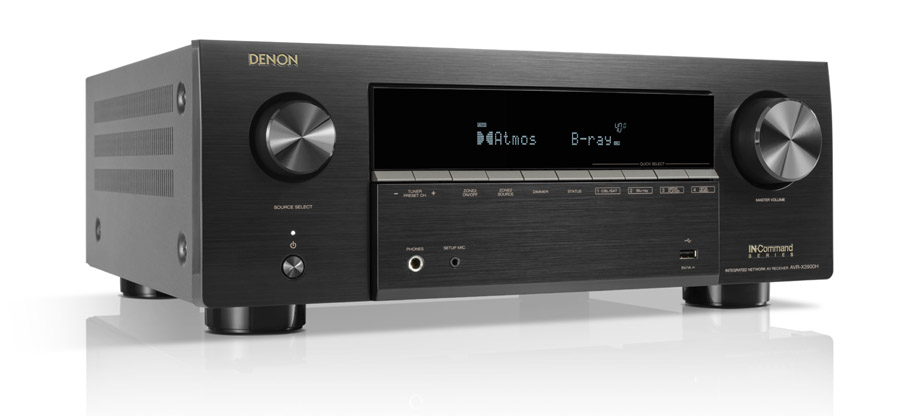
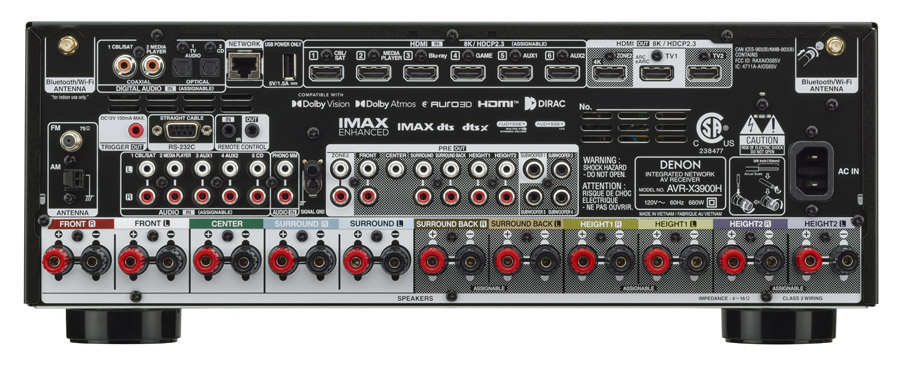
2026 Denon AVR-X3900H A/V Receiver (rear)
This is where the traditional home theater industry needs to pay attention. Most consumers don’t want to learn what an 11.2 channel receiver actually means, determine crossover frequencies, assign height channels, understand HDMI handshake problems or wonder why the streaming box suddenly produces sound but the PlayStation doesn’t. They want to turn on the television and have everything work.
If the TV detects two or four wireless speakers, measures where they are, determines what each one should reproduce and automatically configures an immersive soundtrack, that’s enormously attractive. FlexConnect also allows unconventional placement, which matters outside dedicated theater rooms. Apartments, open concept living spaces, bedrooms and multipurpose family rooms rarely permit the kind of symmetrical loudspeaker layout installers would choose if given a blank sheet of paper.
Software can compensate for some of that. Not perfectly, but possibly well enough, and well enough plus vastly easier has destroyed more than one consumer electronics category.
Advertisement. Scroll to continue reading.
The Pros and Cons
For mainstream consumers, these TV centered and platform centered systems offer some very real advantages: far less speaker wiring, fewer components beneath the television, automatic speaker detection and room calibration, greater freedom with placement, easier expansion and tighter integration between the television and external speakers. They also make considerably more sense in apartments and multipurpose rooms where a traditional component system simply isn’t practical.
Advertisement
The tradeoffs are just as real. Many of today’s ecosystems remain proprietary, wireless speakers still require AC power, and ultimate output, bass extension and dynamics can trail a good component system. Virtual channels are not identical to correctly positioned physical speakers, input and codec support vary wildly between platforms, and network reliability suddenly becomes part of the audio chain.
There is also a longer term issue that deserves far more attention than it receives: software support. A pair of passive loudspeakers bought in 1996 can still work perfectly with an amplifier purchased this afternoon. Nobody has to maintain a cloud service so that your KEFs remember how to reproduce the left channel. Whether today’s networked wireless speaker ecosystems demonstrate that kind of longevity remains to be seen.
Who Is This Really For?
If you own a dedicated theater, care deeply about channel separation, use multiple subwoofers, want Dirac Live or similarly sophisticated room correction, own high quality passive speakers or regularly upgrade individual parts of your system, the AVR isn’t going anywhere. Keep it.
The new model makes far more sense for the much larger audience that wants better home theater audio without turning the living room into a rack of electronics. Buy the television, add two wireless speakers and decide six months later that you want surrounds and a subwoofer. Let the system find them, measure them and figure out what to do.
Advertisement
That’s a far easier proposition to sell at Best Buy than explaining why somebody needs eleven channels of amplification when they’re still trying to determine which HDMI port says eARC.
The Bottom Line
The AV receiver isn’t dying, but it is being pushed toward the enthusiast, performance and custom installation markets where its flexibility, amplification and upgradeability still matter enormously. What’s changing is everything underneath that market.
Samsung’s expanding Q Symphony ecosystem, TCL and LG’s embrace of Dolby Atmos FlexConnect, Sony’s integration of BRAVIA displays into the speaker system and the increasingly sophisticated Apple and Google streaming ecosystems all point toward the same destination: fewer boxes, fewer cables and more of the home theater being controlled by software.
The television doesn’t need to become a literal AV receiver to threaten the receiver’s position in the living room. It only needs to make millions of consumers ask a much more dangerous question: Do I still need one?
Advertisement
For an increasing number of people, the answer may soon be no.
By any metric, the horror film Obsession has been one of the most extraordinary Hollywood success stories of 2026.
Made on a budget of around $750,000 and released in May, it went on to earn $488 million worldwide, catapulting 26-year-old director and screenwriter Curry Barker—originally known for his YouTube sketch comedy—to the top of the industry’s “it” list.
So why, you might ask, are people creating a stink over Universal Studios, the international distributor of Obsession, adding its lead female character, Nikki, to the cast of the Halloween Horror Nights event at its Hollywood theme park? Even though the actor who plays her seems very much on board? To answer that, one has to review three months of fierce and enduring debate.
Since the movie hit theaters, fans and critics have been at odds over a thorny question: Who is the victim in Obsession? The plot concerns an awkward, painfully insecure young man, Bear (Michael Johnston), who yearns to be in a romantic relationship with his friend, the seemingly unattainable Nikki (Inde Navarrette). In a moment of frustration, he snaps something called a “One Wish Willow”—believing it to be a whimsical and harmless novelty gift—and voices his desire that she love him more than anyone else in the world.
Advertisement
From that moment forward, Nikki is an unnatural version of herself, moving as if controlled by another consciousness. Her need to be with Bear around the clock is marked by increasingly alarming performances of total devotion that finally escalate to murder. Bear recognizes almost right away that something is wrong but cannot resist acting out his fantasy with the helpless and brainwashed woman who has taken to his bed.
As a consequence, there’s been a lot of hand-wringing as to whether viewers understood that Nikki was not the true villain or monster of the story, regardless of the acts she was cursed to commit. “Nikki was the victim and only Nikki,” insisted one representative X user in a viral post in June, adding that it would be “delusional” to apply the same label to Bear.
Whether anyone did try to defend Bear (as, for example, a guy who had no idea he was casting a real magic spell) seemed beside the point. Commentators wanted to hammer home that Nikki was robbed of her autonomy and that she was effectively raped due to her inability to consent to sex. Again and again, they invoked some theoretical viewer who saw her as the monster in the situation, decrying this reading of the film.
Then, on Monday, Universal Studios Hollywood officially announced that an actor portraying Nikki would haunt the park during its upcoming Halloween Horror Nights, which will run from late September 3 to November 1 and will also feature attractions like a haunted house based on Sinners. Mentioning the addition of Nikki to the event in a press release, Universal teased that “guests may find themselves face-to-face with the latest victim of the One Wish Willow’s terrifying curse,” apparently agreeing with the consensus that the character is at the mercy of a paranormal force rather than intentionally malicious.
Advertisement
It didn’t matter. X users called it a “catastrophically bad idea,” said it was in poor taste to portray “a victim of sexual assault” as a frightening figure, and worried about the actor’s safety as they interacted with park guests. A few argued that it should be Bear wandering the park, overlooking the problem that the character has no distinguishing visual shorthand, whereas Nikki, as in the climax of the film, will be “all bloody,” with tattoos scribbled on her body, according to John Murdy, the creative director and executive producer of Halloween Horror Nights.






























































You must be logged in to post a comment Login